1. Introduction
Microplastics (MPs) and nanoplastics (NPs) are pervasive pollutants in aquatic environments, raising ecological and public health concerns [
1,
2,
3]. These contaminants originate from both primary and secondary sources, including synthetic textiles, personal care products, tire abrasion, and the breakdown of larger plastic debris [
4,
5,
6,
7]. In this review, MPs are defined as synthetic polymer particles with dimensions ≤ 5 mm, whereas NPs are defined as particles < 1 µm, consistent with recent definitions in the literature [
8,
9]. MPs and NPs have been detected in freshwater systems, marine environments, and even in treated drinking water [
10,
11,
12]. Their persistence, potential for bioaccumulation, and capacity to adsorb co-contaminants, such as heavy metals, organic compounds, and microbial pathogens, make them particularly challenging to manage [
13,
14,
15,
16]. These particles can also enter the human body through multiple exposure routes, including the consumption of contaminated seafood, ingestion of drinking water, and inhalation of airborne MP particles [
17]. For simplicity, the term “microplastics” (MPs) is used throughout this review to refer to both MPs and NPs, unless otherwise specified.
In addition to their environmental persistence, MPs have been shown to exert a range of biological effects, including genotoxic and neurotoxic effects, in both aquatic organisms and mammalian systems. Laboratory studies have demonstrated that exposure to MPs and NPs can induce oxidative stress, DNA strand breaks, and inflammatory responses in cells and tissues, leading to potential genotoxic damage [
18]. Recent toxicological assessments have also identified neurotoxic effects, such as mitochondrial dysfunction, neurotransmitter imbalance, and behavioural alterations in aquatic species, suggesting potential risks for higher organisms and humans [
19]. Evidence of MP accumulation in human tissues, including the lungs, placenta, and brain, further underscores the urgency of mitigating exposure through improved removal technologies [
20,
21].
Recent research has highlighted the absence of unified policies governing MP emissions. Casella et al. [
22] reviewed international legislation and identified major regulatory gaps, stressing the need for harmonised frameworks to control the production and release of MPs across sectors.
Conventional water and wastewater treatment technologies typically exhibit limited efficacy in MP removal, especially in the submicron and nanosize range [
23,
24,
25]. Techniques such as membrane filtration, sedimentation, and coagulation–flocculation provide only partial removal of these contaminants. Their performance depends strongly on the particle size, surface properties, and the presence of dissolved organic matter (DOM) [
26,
27,
28]. These constraints underscore the need for advanced, cost-effective, and scalable treatment solutions.
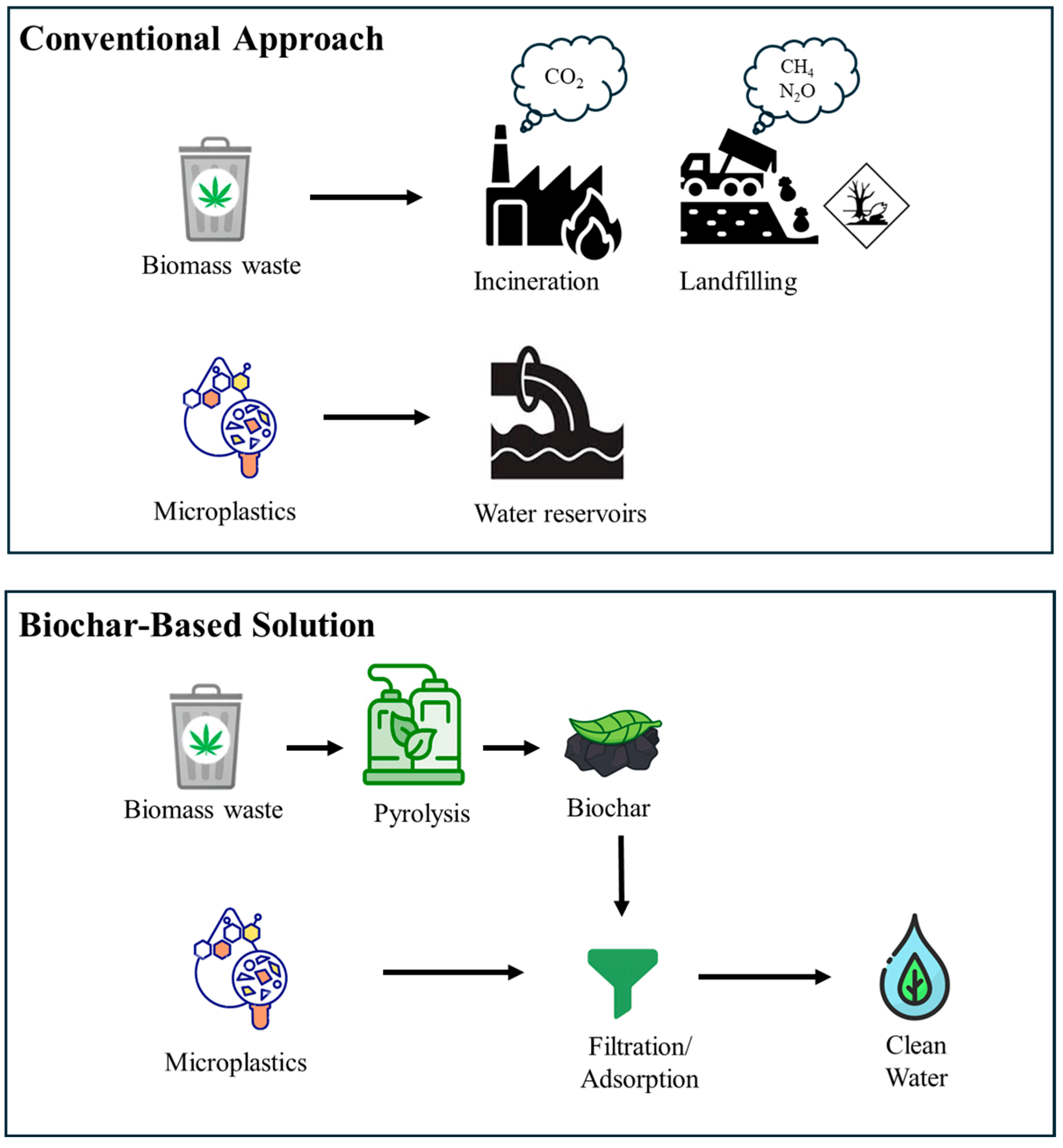
Figure 1 conceptually contrasts the limitations of current plastic and MP pathways (upper panel) with a circular water treatment framework based on the application of biochar (lower panel). In this approach, waste biomass is converted into functionalised biochar for MP removal, integrating pollutant mitigation and resource valorisation.
Biochar, a carbonaceous material derived from the pyrolysis of biomass under oxygen-limited conditions, has emerged as a promising sorbent for water treatment [
29,
30,
31]. Its physicochemical properties, including its high surface area, porosity, and surface functionalisation potential, render it well-suited for MP capture [
32,
33,
34]. Additionally, the low production cost, renewable feedstocks, and potential role of biochar in carbon sequestration contribute to its environmental sustainability [
35,
36].
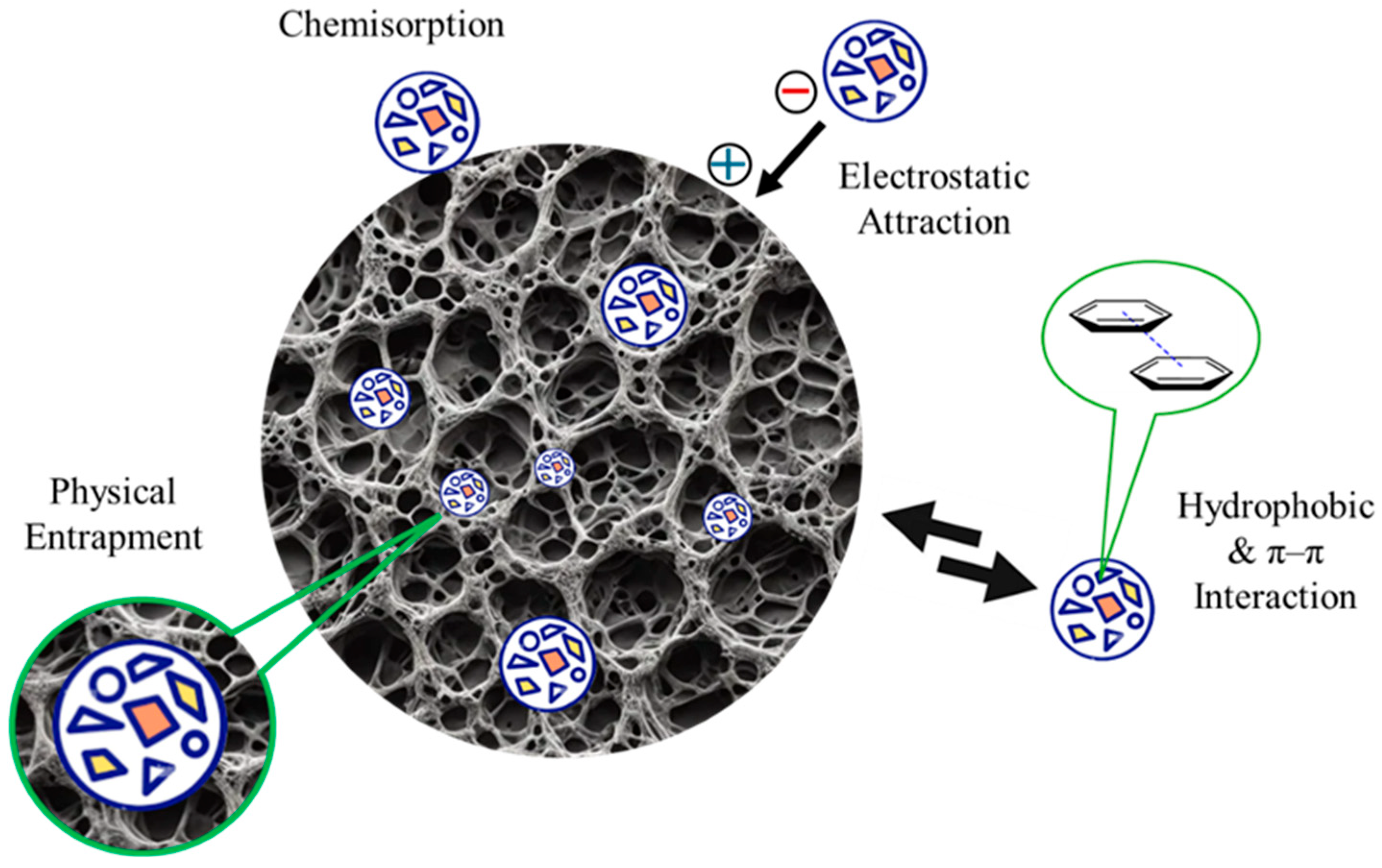
Mechanistic studies suggest that biochar facilitates MP removal through electrostatic attraction, hydrophobic interactions, π–π stacking, pore entrapment and surface complexation [
37,
38]. Laboratory experiments have demonstrated high removal efficiencies, particularly for polystyrene particles, using pristine, chemically modified, and magnetised biochars [
39,
40,
41]. Other emerging approaches have also been proposed. For instance, Ebrahimi et al. [
42] developed a slippery liquid-infused porous surface (SLIPS) material that removes MPs through hydrophobic and capillary interactions, demonstrating the diversity of materials explored alongside biochar. However, limited data are available on the performance of biochar in complex environmental matrices, where DOM, competing ions, and surface aging processes can reduce removal efficiency. For example, Omorogie et al. [
43] reported that the removal decreased from 98.2% in deionised water to 55.8% in municipal wastewater, while similar declines (approximately 15–40%) were observed in river and stormwater matrices compared to pure water systems [
44,
45,
46,
47].
While several narrative reviews have explored the theoretical aspects of this topic [
1,
15,
48], a systematic synthesis of the experimental literature remains absent. Existing reviews often lack detailed comparisons of biochar feedstocks, preparation techniques, modification strategies, plastic typologies, and the operational conditions of the production process. To our knowledge, no comprehensive PRISMA-based scoping review has been conducted to systematically assess experimental studies on biochar-based MP removal from aqueous systems.
This review addresses this gap by systematically mapping the current experimental studies on the use of biochar for MP removal from water and wastewater. Using PRISMA-based protocols, we evaluated variations in biochar production and modification, plastic properties, experimental design, and water matrix effects. The synthesis is guided by the hypothesis that surface-modified biochar materials (e.g., magnetised, surfactant-coated, or chemically activated) demonstrate strong potential for removing MPs via multimodal mechanisms such as electrostatic attraction, hydrophobic interactions, π–π stacking, and pore entrapment. However, this performance may diminish in realistic water matrices (e.g., wastewater and surface water) because of fouling, competing ions, and the diversity of weathered plastic particles. Addressing these environmental and methodological limitations is essential to realise the full potential of biochar-based treatment systems.
3. Results
3.1. Overview of Included Studies
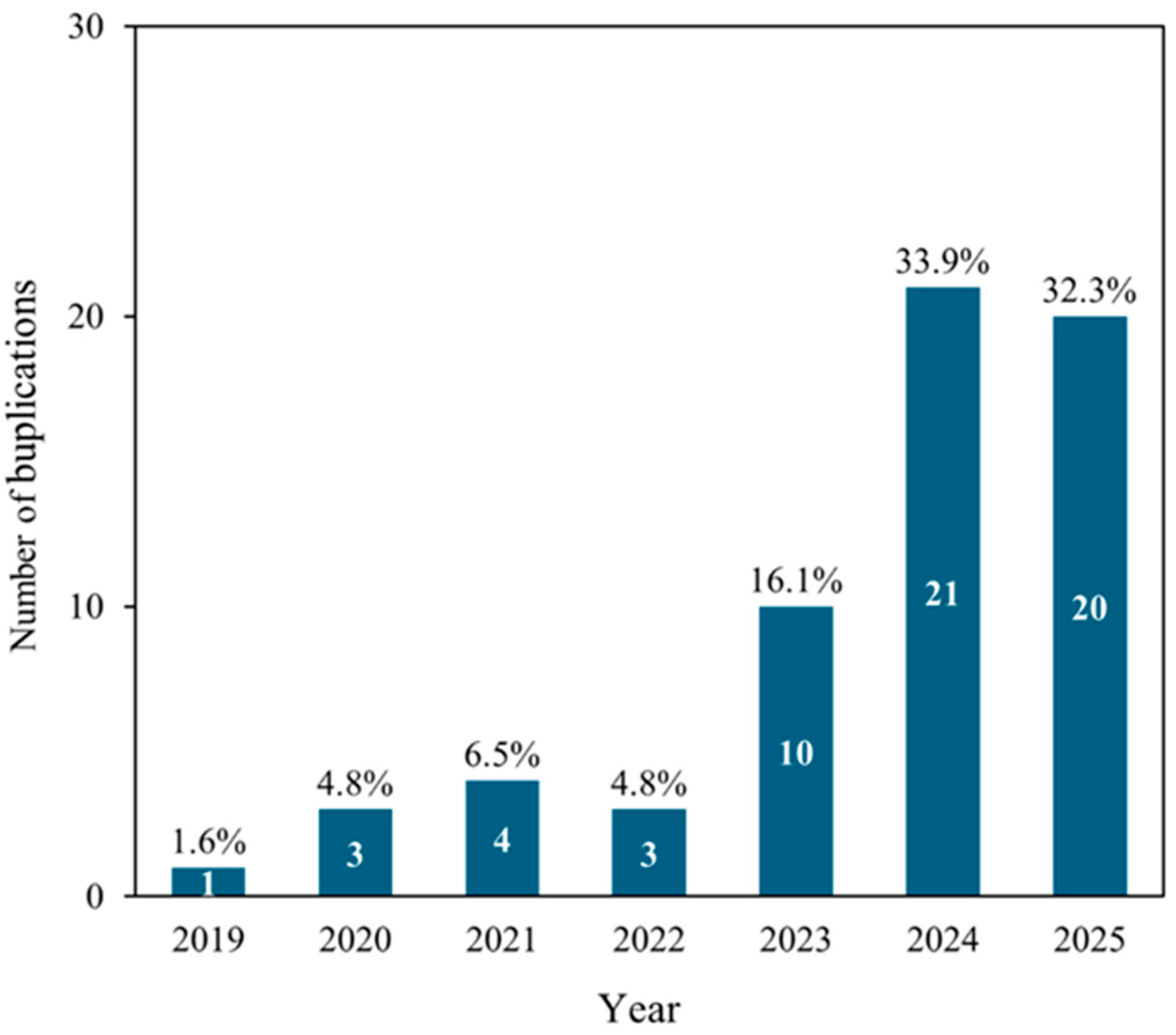
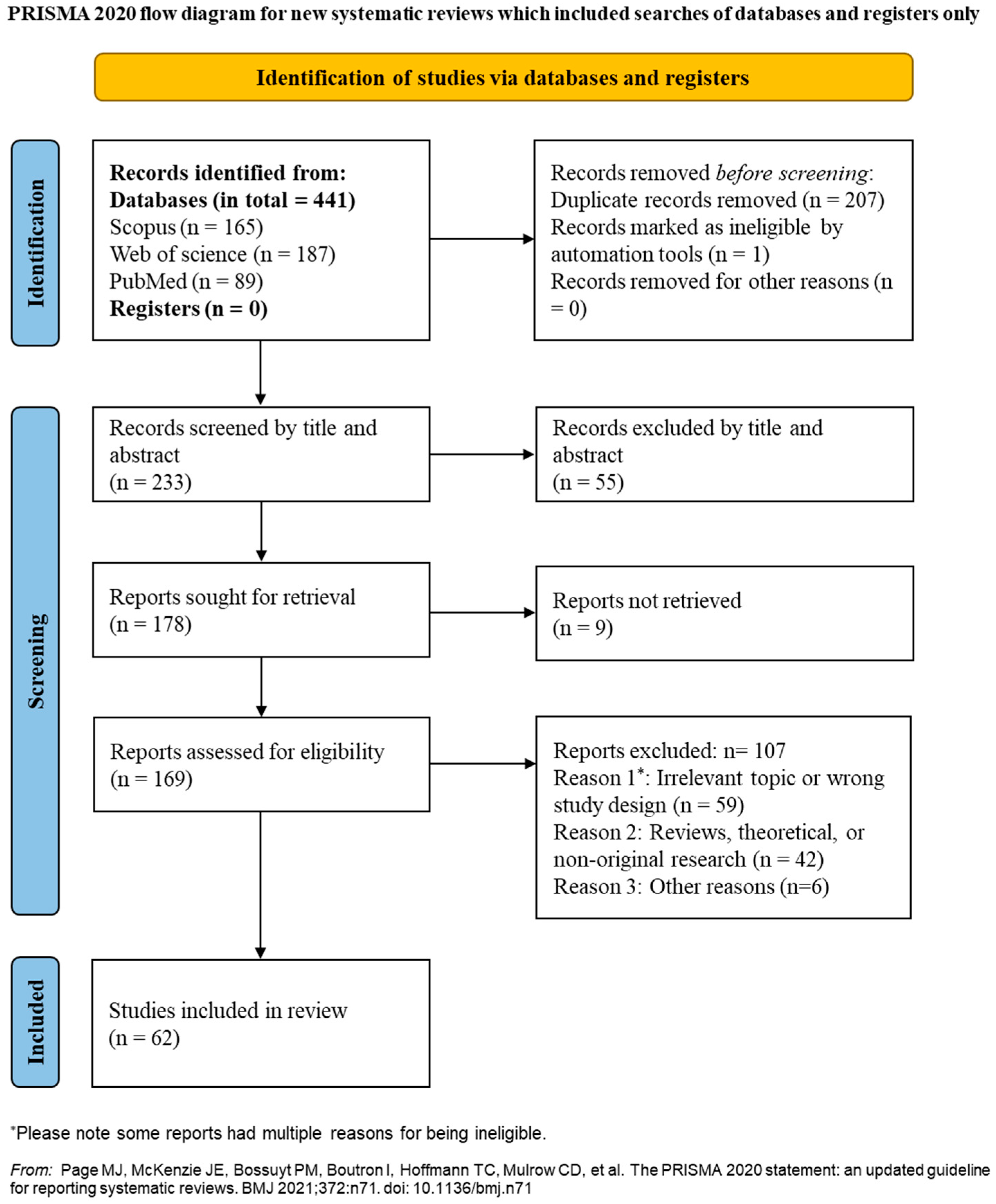
This review includes 62 peer-reviewed studies published between 2019 and 2025, comprising 57 original experimental or theoretical investigations and five review articles. The annual distribution of publications is presented in
Figure 3. From 2019 to 2022, the volume of research remained limited, with only one study in 2019 and modest growth in subsequent years (three in 2020, four in 2021, and three in 2022). A substantial increase was observed from 2023 onwards, with 10 studies published in 2023, followed by 21 in 2024, and 20 in the first half of 2025. This surge reflects the growing recognition of biochar as a promising material for the removal of MPs in water treatment applications. The included studies exhibited considerable diversity in terms of experimental design, biochar feedstocks, pyrolysis conditions, surface modification strategies, and MP characteristics. This methodological heterogeneity underscores both the rapid development of the field and the need for a systematic synthesis. Notably, while five review articles were identified, none conducted structured cross-comparative assessments of the empirical findings.
3.2. Biochar Feedstock Sources
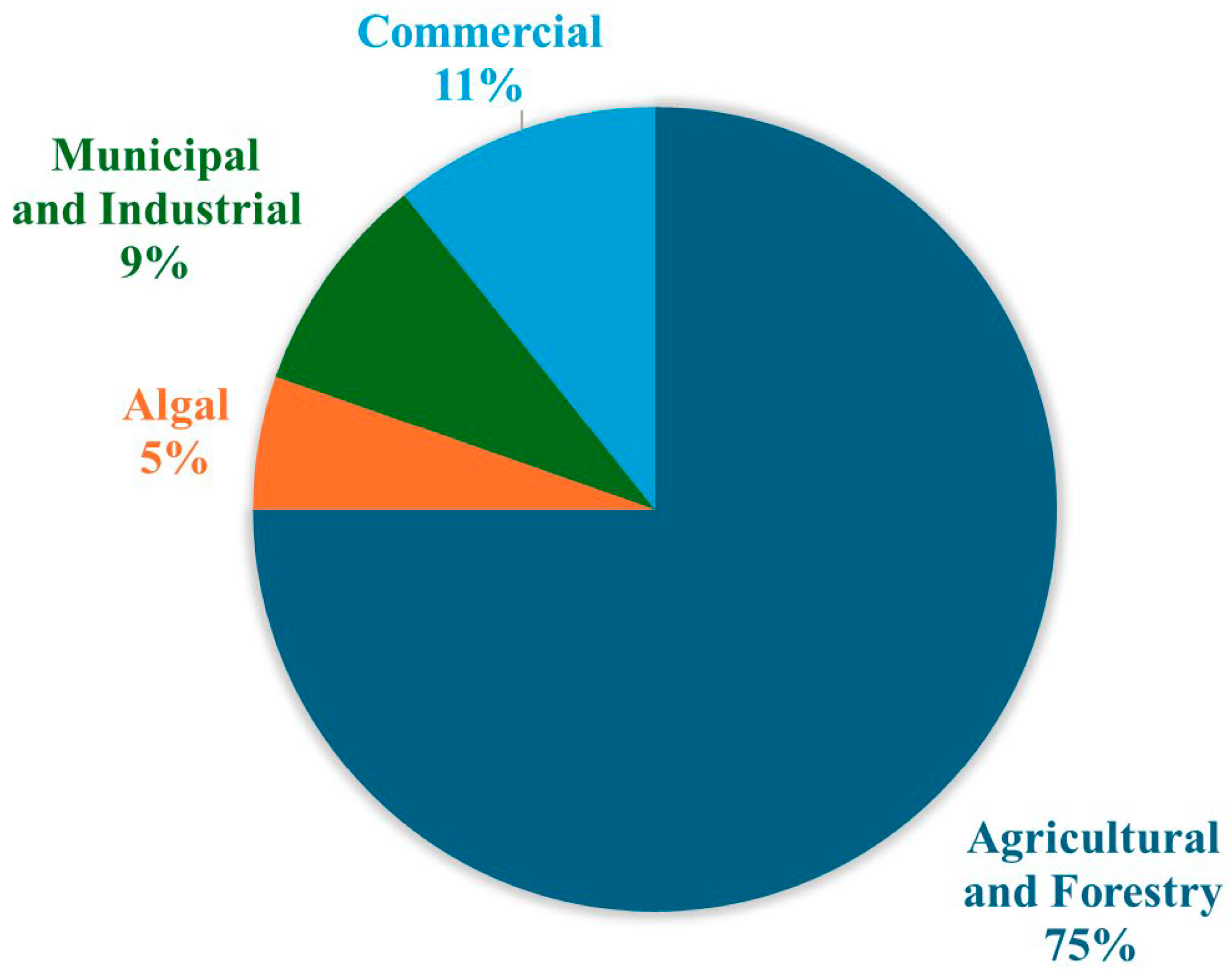
The feedstock used in biochar production is a key determinant of its physicochemical characteristics and subsequent performance in MP removal from aqueous systems. In the reviewed studies, feedstocks were categorised into four primary groups: Agricultural and Forestry, Algal, Municipal and Industrial, and Commercial. This classification was established according to the origin and functional nature of the precursor materials, following the commonly used typologies in the biochar literature. Agricultural and forestry residues represent lignocellulosic biomass sources, algal materials are derived from aquatic biomass, municipal and industrial feedstocks originate from anthropogenic waste streams, and commercial feedstocks include standardised or engineered materials designed for reproducibility in laboratory research. The diversity of the feedstocks is illustrated in
Figure 4, and detailed listings are provided in
Supplementary Table S1, respectively.
Agricultural and forestry residues were the dominant feedstock category, accounting for approximately 75% of the reviewed studies. Commonly used materials include rice husks, sugarcane bagasse, corncobs, palm kernel shells, and pinewood sawdust. These biomasses are widely available, cost-effective, and reflect a growing interest in sustainable waste valorisation for environmental applications. Several studies using these feedstocks demonstrated notably high MP removal efficiencies, for instance, Wang et al. [
50] (up to 99.5%), Ganie et al. [
30,
31] (>90%), and Hanif et al. [
2] (93.1–93.7%). However, large-scale reliance on agricultural residues introduces sustainability trade-offs. Expanded biochar production could compete with alternative uses such as soil amendment, energy recovery, or composting, and in some cases, may encourage dedicated biomass cultivation with associated land-use implications.
Algal feedstocks, although less frequently investigated (5%), represent a promising class of renewable resources. Studies have included both freshwater and marine biomass, such as filamentous algae and Ulva prolifera, suggesting an early interest in aquatic-derived biochars. These biochars exhibited moderate adsorption capacities but had unique surface chemistries enriched with nitrogen- and oxygen-containing functional groups, which may facilitate electrostatic and hydrogen-bonding interactions with MPs (Li et al. [
51]; Huang et al. [
52]).
Municipal and industrial feedstocks (9%) comprise a variety of high-volume residues, including sewage sludge, red mud, and mining waste. Their use highlights the potential of integrated waste management strategies, in which problematic by-products are repurposed for pollutant removal. Because of their higher mineral and metal content, some of these biochars exhibit enhanced magnetic or catalytic functionality, improving MP separation and reusability (e.g., Kim et al. [
26]; Sun et al. [
41]).
Commercial feedstocks (11%) included standardised materials such as purified cellulose, lignin, and engineered biochar composites. These materials are often selected for their consistency, tunable surface chemistry, and experimental reproducibility. One study [
53] did not specify the biochar feedstock. Given its use in vermifiltration at an agricultural research facility, this material likely originated from agricultural or municipal sources. However, owing to the lack of explicit information, it was excluded from both
Figure 4 and
Supplementary Table S1. Overall, this four-group classification provides a logical framework for comparing feedstock origins and relating them to the observed MP removal performance trends.
3.3. Pyrolysis Conditions for Biochar Production
The conditions under which biochar is produced critically influence its physicochemical and structural properties, which, in turn, affect its adsorption capacity for MPs. The key pyrolysis variables identified in the literature include temperature, heating rate, residence time, atmospheric conditions, and reactor configuration. The parameters are summarised in
Table 2.
The most commonly applied pyrolysis temperature was 600 °C, with values ranging from 200 to 1100 °C. Most studies operated within the 500–700 °C range, which is considered suitable for producing biochar with the pore structure and surface chemistry required for MP adsorption. The reported heating rates typically include 5 and 10 °C/min, with an overall observed range between 5 and 30 °C/min. The residence times ranged from 1 to 14 h, with 2 h being the most frequently reported value. Some studies have employed longer durations (typically 3–4 h), often in conjunction with slower heating rates or larger-scale reactors. From these data, it can be concluded that most of the reviewed experiments fall within the regime typically defined as slow pyrolysis, heating rates below approximately 50 °C min−1 and temperatures between approximately 400 °C and 700 °C, which are conditions well suited for producing biochars with developed porosity and stable surface functionality for MP removal.
An inert atmosphere, typically nitrogen (N2), is the most common condition, as it minimises oxidation and promotes the development of carbon-rich porous materials. A small number of studies used oxygen-limited environments, and several did not explicitly report atmospheric conditions, requiring inferences from reactor setup descriptions.
Most studies have employed laboratory-scale tubes and muffle furnaces. A minority used fixed-bed or pilot-scale systems, indicating early-stage efforts to transition to more scalable biochar production systems for environmental applications.
One study [
33] reported pyrolysis in an air atmosphere. This represents a significant deviation from standard biochar synthesis methods, as oxidative conditions can alter the physicochemical structure and surface functionality of the resulting materials. Owing to this methodological inconsistency, this study was excluded from
Table 2. Its findings were nonetheless referenced qualitatively in the discussion, where relevant, to ensure comprehensive coverage of all the available evidence.
3.4. Biochar Modification Strategies
The surface area, porosity, mineral content, and functional groups of biochar critically influence its ability to remove MPs from water. However, unmodified biochar often shows limited interactions with diverse MP types. To enhance their performance, various modification strategies have been developed to optimise surface chemistry, increase porosity, add magnetic properties, and improve selectivity. These strategies fall into two categories: pre-treatment (applied to biomass before pyrolysis) and post-treatment (applied to biochar after pyrolysis). Pre-treatment can modify both the thermal decomposition behaviour and the resulting surface chemistry and elemental composition of the biochar, for example, by incorporating minerals or functional groups into the carbon matrix (e.g., [
33,
36,
60]. Post-treatment typically further refines the surface properties or introduces new functionalities, such as magnetism or enhanced charge compatibility (e.g., [
29]). The following subsections review both approaches and their impacts on MP removal mechanisms.
3.4.1. Pre-Treatment for Enhanced Microplastic Adsorption
The pre-treatment of biomass significantly alters the structural and surface characteristics of the resulting biochar, influencing its efficiency in adsorbing MPs. Chemical pre-treatment methods are the most commonly employed, particularly acid and alkali washing, which helps remove inorganic impurities and reduce the ash content. For example, Garfansa et al. [
24] treated biomass with 1.0 M nitric acid (HNO
3) followed by 1.0 M sodium hydroxide (NaOH) to improve its purity and reduce its silica content.
Another widespread approach involves metal salt impregnation, which introduces catalytic and magnetic elements. Zhang et al. [
61] impregnated pine sawdust with a combination of iron, zinc, and magnesium nitrate salts, whereas Wang et al. [
50], Wu et al. [
45], and Parashar and Hait [
60] used ferric nitrate (Fe(NO
3)
3) or ferric chloride (FeCl
3) to pre-load raw biomass.
Some studies have combined metal impregnation with other techniques. Jiao et al. [
57] ultrasonicated lignin with ferric chloride hexahydrate (FeCl
3·6H
2O) prior to pyrolysis to improve metal dispersion, and Zhou et al. [
46] used ferrous sulfate heptahydrate (FeSO
4·7H
2O) to introduce a magnetic potential. Other approaches include acid-assisted treatments with mine tailings and strong mineral acids [
26], and oxidative impregnation with potassium ferrate (K
2FeO
4) [
34].
The composite formation during the pre-treatment was also investigated. Omorogie et al. [
43] blended coffee waste with phosphoric acid and zeolites (ZSM-5 and zeolite Y) to facilitate in situ composite synthesis. Zhu et al. [
62] used polyethylene glycol as a porosity-modifying dispersion aid. Feng et al. [
63] mixed municipal sludge with red mud, lignin, and chitosan to alter its chemical composition and structural morphology before pyrolysis.
3.4.2. Post-Treatment Strategies for Biochar Enhancement
Post-pyrolysis modifications further enhance the biochar functionality by introducing chemical groups, modifying the surface charge, or forming composites. These can be categorised as chemical, physical, thermal, and biological.
Chemical Post-Treatment Methods
Chemical post-treatment is the most extensively studied strategy for improving the biochar–MP interactions. Alkaline activation with potassium hydroxide (KOH) or NaOH is widely used to increase the surface area and introduce basic functional groups. Babalar et al. [
29] applied KOH impregnation followed by high-temperature pyrolysis to generate microporous carbon, whereas Li et al. [
32] used NaOH after magnetisation to enhance surface basicity. Garfansa et al. [
24] combined alkali activation with sonication to improve pore accessibility.
Acid washing removes residual ash, alters the surface charge, and the exposes reactive sites. Treatments employed a variety of acids, such as hydrochloric acid (HCl) and nitric acid (HNO
3), at concentrations ranging from 0.1 to 2 M, with treatment durations between 1 and 12 h (e.g., [
64,
65], and [
40]). Babalar et al. [
29] applied HNO
3 washing after alkali activation to introduce oxygen-containing functional groups.
Magnetisation methods allow facile recovery and reusability. Approaches include co-precipitation using ferric and ferrous salts [
39,
40] and solvothermal synthesis using agents such as sodium citrate (Na
3C
6H
5O
7) and ethylene glycol (C
2H
6O
2) [
37]. Li et al. [
51] achieved the hydrothermal deposition of iron on post-pyrolysed biochar.
Nanoscale zero-valent iron (nZVI) doping has also been investigated. Ganie et al. [
30] applied a one-pot synthesis using sodium borohydride (NaBH
4) and ferric chloride hexahydrate (FeCl
3·6H
2O), while sodium dithionite (Na
2S
2O
4) was used for sulfidation to enhance the reductive reactivity.
Polymer and surfactant coatings include cetyltrimethylammonium bromide (CTAB) [
2], polyethylenimine/polyethylene glycol (PEI/PEG) blends [
66], and polyaniline (PANI) [
34] to improve the surface charge, hydrophobicity, and MP affinity. Composite materials have been created by integrating biochar with zeolites, clays, or polymeric membranes [
29,
66]. Oxalic acid (C
2H
2O
4) functionalisation [
33] and aqueous extraction of biochar-derived dissolved organic matter [
56] have also been reported as niche but potentially valuable strategies.
Table 3 summarizes the chemical post-treatment techniques, categorizing them by treatment type, mechanism, and literature reference.
Across the reviewed studies, chemical and composite post-treatments consistently produced the highest MP removal efficiencies. Alkali activation, acid washing, and magnetic or polymer functionalisation typically achieved removal rates above 90% (see
Table S3 for detailed performance data). For example, Babalar et al. [
29] reported up to 99.3% polystyrene removal after sequential KOH activation, acid washing, magnetisation, and PEI/PEG coating, whereas Parashar and Hait [
60] obtained up to 99.7% removal using CTAB-assisted magnetic biochar derived from rice husks. Acid activation and oxidation (e.g., [
33,
65]) enhanced adsorption by increasing the number of surface oxygen groups, whereas Fe
3O
4 or metal-oxide doping improved both recovery and adsorption performance [
26,
32]. Collectively, these post-treatments increased the specific surface area, surface charge density, and functional group diversity, which strengthened the electrostatic attraction, hydrogen bonding, and π–π interactions with the MPs. Pre-treatments, such as alkaline impregnation and mineral addition (e.g., [
2,
36,
46]) also improved porosity and chemical activity, although their enhancement was generally less pronounced than that of multi-step post-treated materials.
In several cases, post-treatment increased adsorption capacities by an order of magnitude compared to that of untreated biochars. For instance, Huang et al. [
52] achieved a theoretical capacity of 1626 mg g
−1 with FeCl
3-modified biochar, whereas Sun et al. [
41] reported a capacity of up to 716 mg g
−1 for biochar composites. Similarly, Ganie et al. [
30] observed that nZVI-embedded biochars removed > 99% of MPs compared with <70% for unmodified controls (see
Table S3 for comparative removal efficiencies). Such improvements are primarily attributed to the enhanced active-site density, mesoporosity, and surface polarity resulting from chemical activation, oxidation, or Fe-based doping.
Overall, multifunctional chemical and composite modifications provided the most substantial gains in adsorption capacity and removal efficiency compared with unmodified biochars. Additional discussion on how intrinsic physicochemical properties (e.g., surface area, charge, and hydrophobicity) govern adsorption mechanisms following biochar modification is provided in
Supplementary Note S3.
Physical Post-Treatment Methods
Physical modifications, such as grinding, sieving, and ball milling, are used to adjust the particle size and prepare biochar for chemical treatments. These methods have been applied in multiple studies as preparatory steps [
30,
61,
70,
73]. Among these, ball milling has recently emerged as an effective physical modification technique for enhancing the physicochemical properties of biochar for the removal of MP. This process mechanically reduces the particle size, exposes new surface defects, and increases pore accessibility, thereby accelerating the adsorption kinetics and improving the interfacial interactions with the polymer particles. In addition, ball milling promotes the homogeneous dispersion of magnetic or catalytic nanoparticles and facilitates the subsequent surface functionalisation.
Shi et al. [
69] reported that pinewood biochar ball-milled with Fe
3O
4 nanoparticles for 24 h achieved up to 95.2% removal of aminated polystyrene nanoplastics (PS–NH
2), substantially outperforming unmodified biochar. This improvement was attributed to the enhanced magnetic aggregation, defect-mediated adsorption, and increased surface accessibility. Similarly, Wang et al. [
34] demonstrated that fine-milled magnetic biochar nanoparticles coated with polyaniline maintained nearly 100% removal efficiency for PS and PET across a wide pH range, benefiting from improved coating uniformity and particle dispersion. Parashar and Hait [
60] incorporated particle size reduction before CTAB surface modification to optimise biochar integration in sand-filter columns, improving hydraulic flow and contact efficiency.
Thermal and Biological Post-Treatment Methods
Thermal treatments, including calcination and annealing, enhance the structural stability of biochar and improve its catalytic potential. For example, Babalar et al. [
29] calcined a zeolite–biochar composite, whereas Jiao et al. [
57] demonstrated the thermal degradation of polystyrene on catalytic biochar at 550 °C. Annealing treatments have also been employed to stabilise magnetic hybrids [
35,
39].
Biological post-treatment has been explored in a limited number of studies to date. Changlor et al. [
59] reported the development of Bacillus subtilis biofilms on biochar surfaces for use in column systems, which facilitated biologically mediated MP capture.
3.5. Plastic Types and Size Ranges
The reviewed studies examined a wide variety of polymer types and particle sizes, reflecting both synthetic model systems and environmentally relevant MPs. Nine major polymer categories were identified in this study. Polystyrene (PS) was the most extensively studied polymer, and it was included in 41 of the 57 experimental studies (~72%). PS was tested in both pristine and functionalised forms, including carboxylated, sulfonated, and amine-modified forms.
Figure 5 provides a visual summary of the distribution of the polymer types across the dataset. While PS clearly dominates, polyethylene (PE, 13 studies), polypropylene (PP, 5 studies), and polyamide (PA, 7 studies) are investigated much less frequently, and other high-production polymers such as PVC and PET are each represented in only six studies. The “Other” category comprises mixed MPs, fibrous fragments, and tire wear particles, collectively contributing only a few cases. This strong skew toward PS test systems underscores a mismatch between the experimental focus and the polymers that are most abundant in real-world environments.
Reported particle sizes ranged from 0.02 to over 3000 µm, with most studies focusing on the 0.1–1 and 1–100 µm size ranges. These often include engineered NPs and latex microspheres. A detailed summary of the plastic types and particle size ranges is provided in
Table S2, and the frequency distribution across standardised size bins is presented in
Table 4.
Polyethylene (PE) was the second most frequently studied polymer, being identified in 12 studies. It has sometimes been evaluated in combination with polyamide (PA), polypropylene (PP), or within complex environmental MP mixtures. The sizes of PE particles ranged from less than 10 µm to fibrous structures exceeding 5000 µm, illustrating their morphological diversity and environmental relevance. PP and PA were primarily tested as model microspheres or fragments, with particle sizes between 10 and 1000 µm.
Other polymers, including polyvinyl chloride (PVC), polyethylene terephthalate (PET), polymethyl methacrylate (PMMA), and polylactic acid (PLA), have been studied less frequently. This is notable, given their widespread occurrence in environmental MP samples. PVC and PET studies generally reported particles in the 0.05–150 µm and 0.08–5000 µm ranges, respectively. PMMA, PLA, and additional polymers such as polycarbonate and polyurethane appeared primarily in studies utilising environmental MP mixtures (for example [
5,
8,
33].
A smaller subset of studies focused on tyre wear particles (TWPs) and mixed or uncharacterised fibre and fragment mixtures derived from real wastewater or sludge. These materials spanned a broad size distribution, typically from <10 µm to >5000 µm, and frequently lacked detailed polymer characterisation.
As shown in
Table 4, PS dominated across all size ranges, particularly at the sub-micron scale. There is also a noticeable concentration of studies targeting engineered PS-based NPs, whereas limited data exist for PVC, PET, and other high-production-volume polymers, particularly at the nanoscale. This imbalance may limit the generalisability of the findings and highlights underexplored areas that warrant further investigation to broaden the applicability of biochar-based MP removal technologies.
3.6. Removal Mechanisms
The removal of MPs using biochar-based materials involves multiple mechanisms, including adsorption, electrostatic interactions, hydrophobic attraction, and physical entrapment (
Figure 6). These mechanisms act concurrently and are influenced by the surface chemistry, structure, and properties of the plastic particles.
Electrostatic attraction was the most frequently reported mechanism, being identified in more than two-thirds of the studies reviewed. Babalar et al. [
29], Singh et al. [
37], and Wu et al. [
45] reported strong interactions between negatively charged MPs and positively charged biochar. Enhancements in electrostatic affinity have been achieved through surface functionalisation with CTAB [
36,
60] or the incorporation of metal oxides such as magnetite (Fe
3O
4) [
26,
68]. Environmental parameters, including pH and ionic strength, have also been shown to modulate these interactions [
38,
63].
Hydrophobic interactions and π–π stacking are prominent in the adsorption of nonpolar polymers, such as polystyrene and polyethylene, particularly when biochar is thermally modified or treated with surfactants [
46,
62,
69]. π–π stacking, especially relevant for aromatic MPs, occurred via interactions between delocalised electrons in the MPs and graphitic domains on the biochar surface [
33,
51,
61]. These interactions frequently co-occurred with hydrogen bonds.
Physical entrapment occurs through mechanical retention in pores and on irregular surfaces. Several studies [
11,
24,
74,
75] have reported the immobilisation of MPs via pore confinement. SEM and HRTEM imaging provide visual evidence of these mechanisms [
64]. This form of retention was more effective for larger MPs and less relevant for nanoscale particles.
Surface complexation has been observed in studies utilising biochars enriched with oxygenated functional groups or doped with transition metals. Chemisorptive bonding via Fe–O, C=O, and COO
− groups supported stable site-specific interactions with MPs. This mechanism was demonstrated by Zhang et al. [
65], Duan et al. [
39], and Omorogie et al. [
43]. Several studies have described Langmuir-type isotherms, consistent with monolayer chemisorption [
33,
36].
Filtration and mechanical retention were significant in the column and flow-through systems. Seetasang et al. [
53], Kuoppamäki et al. [
71], and Struzak et al. [
55] reported MP removal through straining, interception, and sedimentation within packed biochar beds. Hanif et al. [
2] identified bed depth, particle size, and flow rate as key parameters affecting the removal performance.
Biodegradation and oxidative pathways have been explored less frequently. Lyu et al. [
56] demonstrated the oxidative degradation of MPs under photoactive conditions that generated reactive oxygen species. Seetasang et al. [
53] documented enhanced degradation in vermifiltration systems, whereas Johansson et al. [
10] observed MP degradation coupled with sedimentation and plant uptake in constructed wetland systems.
Synergistic mechanisms have been commonly observed, with many studies reporting that MP removal results from the combined actions of multiple mechanisms. Tong et al. [
76] described a combination of heteroaggregation, zeta potential shifts, and steric repulsions. Hanif et al. [
77] and Hsieh et al. [
73] reported concurrent electrostatic, hydrophobic, and physical mechanisms that operate within a single system. These findings reflect the multifunctional nature of engineered biochars, particularly in complex environmental conditions.
3.7. Removal Efficiency
Reported removal efficiencies for MPs using biochar-based materials vary substantially, ranging from approximately 25% to nearly complete removal. This variability reflects the differences in the material composition, modification strategies, water chemistry, and particle properties. Based on the studies reviewed, the removal performance can be broadly categorised into three tiers.
Low to moderate efficiency (<70%) was typically observed in systems using unmodified or minimally functionalised biochars. Li et al. [
68] reported only ~25% MP removal with pristine biochar, whereas the surface-aged material achieved up to ~97% removal under similar conditions. Zhang et al. [
65] observed adsorption capacities ranging from 42 to 73 mg/g in acid-washed biochars, indicative of limited surface activation. Reduced efficiency was also associated with low adsorbent dosages and NP treatment, which often exhibit lower capture efficiency due to their small size and high mobility.
Moderate to high efficiency (70–90%) was achieved by biochars that underwent partial modification or were tested under more realistic water conditions. Omorogie et al. [
43] highlighted a sharp contrast between the removal efficiencies in deionised water (98.2%) and municipal wastewater (55.8%), underscoring the influence of the matrix complexity. Subair et al. [
27] achieved 92.2% MP removal in optimised filtration columns, while Struzak et al. [
55] reported efficiencies of ~86% across varying biochar doses. Duan et al. [
39] observed high removal for carboxylated polystyrene (98.3%), but a significantly lower adsorption capacity for unmodified polystyrene (71 mg/g), highlighting the role of polymer-specific interactions.
High to near-complete efficiency (>90%) was reported in more than half of the studies, particularly those using engineered or chemically modified biochars.
High to near-complete efficiency (>90%) has been reported in 38 of 57 experimental studies, particularly for engineered or chemically modified biochars (see
Supplementary Table S3). Babalar et al. [
29] reported a 99.3% removal of 15 µm MPs using PEI/PEG-coated biochar. A similar performance was achieved using magnetised or metal-impregnated biochar in batch systems [
23,
26,
39]. Hanif et al. [
2] and Rullander et al. [
47] demonstrated stable and high-efficiency removal across various MP types and bed configurations in dynamic flow-through systems. In controlled laboratory conditions, complete or near-complete removal has been reported in selected studies [
10,
73].
Notably, these reported efficiencies are strictly descriptive and not derived from pooled or averaged datasets. Considerable heterogeneity exists among studies in terms of polymer type, particle size, and surface functionalisation, factors that often yield distinct removal values even within a single study. Therefore, descriptive plots were not produced; instead,
Table S3 provides a comprehensive tabulation of all reported efficiencies, preserving methodological details without oversimplifying heterogeneous data and ensuring full transparency and reproducibility across the studies.
3.8. Factors Influencing Removal Efficiency
The MP removal performance is influenced by several interacting operational and material-specific factors. In addition to external conditions, the intrinsic physicochemical properties of biochar, such as surface area, pore structure, surface charge, hydrophobicity, aromaticity, and abundance of oxygen-containing functional groups, strongly influence its adsorption performance. A high specific surface area and well-developed porosity provide abundant sites for the physical entrapment of MPs [
11,
24,
68,
74], whereas hydrophobic and aromatic domains promote π–π and van der Waals interactions with polymeric surfaces [
33,
51,
61]. The surface charge and point of zero charge govern the electrostatic compatibility between biochar and MPs, with positively charged biochars generally favouring the adsorption of negatively charged particles [
29,
37,
45].
Among these, pH has emerged as the most frequently reported determinant. Acidic to near-neutral conditions (pH 4–7) generally enhance adsorption via favourable electrostatic interactions [
29,
33], whereas alkaline conditions often reduce performance due to surface deprotonation and hydroxide competition.
The particle size and shape also significantly influenced the removal. Larger and more spherical MPs were captured more effectively via entrapment and adsorption. For instance, Torboli et al. [
74] observed an increase in removal from 49% for 1 µm particles to 99.7% for 5 µm particles. Smaller or irregularly shaped MPs are more likely to escape retention, particularly in systems that rely on mechanical mechanisms [
70].
Biochar dosage was positively correlated with removal efficiency up to a saturation point, beyond which aggregation or pore-blocking could occur [
35,
51]. Surface modification, such as CTAB treatment [
60], magnetic doping with Fe
3O
4 [
26], and acid activation [
65], consistently enhanced the performance by improving the charge compatibility, porosity, and surface affinity.
Ionic strength and the presence of competing anions (e.g., HCO
3−, SO
42−) or dissolved organic matter reduces the removal efficiency by shielding electrostatic sites or displacing adsorbed particles [
34,
38]. Nonetheless, several studies have reported that chemically and magnetically modified biochars retain high removal performance even under challenging conditions, such as elevated ionic strength, low or high pH, and the presence of dissolved organic matter, highlighting the role of tailored surface chemistry in mitigating matrix interferences [
23,
31,
32,
33,
38].
Finally, the temperature and contact time influenced the removal dynamics. Higher temperatures favour MP binding in thermodynamically endothermic systems [
33], and sufficient residence time is crucial in flow-through configurations to ensure complete adsorption.
Further discussion on how intrinsic physicochemical properties, such as surface area, charge distribution, hydrophobicity, and functional groups, influence biochar performance for MP removal is provided in
Supplementary Note S2, which summarises representative evidence from the reviewed studies.
3.9. Experimental Matrices and System Configurations
The type of water matrix used in MP removal studies plays a crucial role in determining the removal efficiency and reproducibility. Most studies employed deionised or ultrapure water, especially in batch configurations, owing to its controlled nature. These simplified matrices have been widely used (for example [
26,
57,
58,
69]). While offering reproducibility, they lack the ionic strength, dissolved organics, and colloidal complexity characteristic of real water systems. This limitation is particularly relevant for the behaviour of nanoplastics (NPs), where surface interactions are more sensitive to the matrix composition.
In contrast, several studies have sought to replicate realistic conditions by using simulated or actual environmental waters, including municipal wastewater [
73,
74], stormwater runoff [
6,
55], wastewater treatment plant effluents [
36,
39,
41], surface waters [
16,
50], and landfill leachate [
66]. These matrices introduced DOM, competing ions, and turbidity, all of which contributed to the reduced MP removal efficiency. For instance, Omorogie et al. [
43] reported 98.2% MP removal in deionised water, which declined to 55.8% in municipal wastewater. A smaller number of studies (e.g., [
37,
38,
61]) directly compared the removal performance across matrices, confirming consistently lower efficacy in complex aqueous environments due to fouling, adsorption competition, and altered aggregation and mobility of NPs.
The experimental system design also strongly influenced the observed outcomes. Batch setups are the most common, valued for their simplicity and capacity to assess equilibrium and kinetic behaviours (for example [
32,
60,
63]). These experiments typically control parameters such as contact time, pH, MP concentration, and biochar dosage. Approximately one-third of the studies adopted continuous-flow configurations, such as column filtration systems (e.g., [
2,
27,
73,
74]), which enabled evaluation under more realistic hydraulic conditions. Key design elements, such as the flow rate, bed height, and particle size, are often adjusted to mimic practical treatment scenarios.
The design parameters varied substantially across the studies. In batch systems, fixed volumes of MPs and biochar are typically agitated in glass or polypropylene vessels at 160–250 rpm, with contact times ranging from 30 min to 48 h, depending on particle characteristics (e.g., [
33,
69]). Temperature (commonly 25 ± 2 °C) and pH were routinely controlled during the experiment. Column-based systems utilise upflow or downflow configurations with heights ranging from 10 to 50 cm. The media included pure biochar or layered composites, such as sand, bark, and vermicompost (for example [
70,
73,
74]). Flow rates ranged from 2 mL/min in controlled lab setups [
23] to over 180 mL/h in more field-relevant systems [
75], although hydraulic retention time (HRT) has seldom been reported.
Advanced and hybrid configurations have also been explored. Some studies have combined batch and column phases for optimisation and semi-operational testing (for example [
30,
36,
60,
72]). Others have incorporated mesocosms [
10,
55], biologically active filters (e.g., vermifilters) [
53], and coagulation–filtration hybrids [
78]. Magnetic separation techniques [
67,
68] have been used to enhance recovery, especially for NPs.
A study-level tally of the test matrices showed a marked skew toward the idealised conditions. Of the 57 experimental studies, 27 included at least one real matrix (e.g., river, lake, seawater, wastewater, effluent, stormwater, runoff, tap water, melted snow, and agricultural runoff), 28 used pure lab water (ultrapure, deionised, distilled, or Milli-Q), and 22 employed synthetic matrices (e.g., synthetic wastewater, groundwater, stormwater, NaCl solutions, ethanol–water, synthetic seawater, synthetic leachate, and lab hardness waters). Many studies tested more than one matrix; therefore, the counts do not add up to 57. These distributions (see
Supplementary Table S3) corroborate the overreliance of the field on simplified conditions and help explain why removal efficiencies often decline in complex waters.
The considerable heterogeneity in experimental setups and water matrices limits the comparability of the results across studies. To enhance the reproducibility and relevance of the findings, future research should adopt more standardised reporting protocols detailing MP/NP characteristics (e.g., polymer type, size range, and degree of weathering), system hydraulics (e.g., HRT), and quantification methodologies.
3.10. Reusability and Regeneration of Biochar-Based Adsorbents
The regeneration performances varied considerably among the reviewed studies. Several studies have reported minimal loss of adsorption efficiency over multiple reuse cycles. For example, Hsieh et al. [
73] achieved complete retention of MP removal capacity following simple density separation and reuse. Similarly, Babalar et al. [
66] maintained consistent removal across five cycles using a combination of forward and backwashing, whereas Wang et al. [
34,
66] reported over 92% efficiency even after seven regeneration cycles. In contrast, other studies have observed a notable decline. Jiao et al. [
57] documented a drop from 99% to 28% removal following three pyrolysis-based regeneration cycles. Mahmoud et al. [
33] also reported sharp reductions after only two cycles, with performance depending heavily on the biochar feedstock used. These differences underscore the need to match the regeneration strategy with the material type and operational context.
A diverse range of regeneration techniques has been explored, each offering distinct advantages and limitations of the technique. These include thermal, chemical, solvent-based, ultrasonic, and passive methods. A summary of the regeneration methods, performance metrics, and experimental details is provided in
Supplementary Table S4. Further discussion of the influencing factors and regeneration outcomes is provided in
Supplementary Note S3.
Although these studies demonstrate that biochar can often be regenerated with reasonable efficiency, the practical implications of different methods extend beyond the laboratory performance. Thermal regeneration is effective for desorbing plastics; however, it can be highly energy-intensive and may progressively degrade the porous structure of biochar, thereby limiting its reuse potential. Chemical or solvent-based methods can restore adsorption capacity; however, they incur costs associated with reagents and may generate hazardous secondary waste. In contrast, milder strategies, such as ultrasonic cleaning or magnetic-assisted recovery, are less resource-intensive but remain at an early experimental stage, with uncertain scalability. Therefore, a more systematic evaluation of the cost–benefit and environmental implications of regeneration strategies is needed, ideally integrated with life-cycle assessment and techno-economic analysis.
3.11. Overview of Existing Review Articles
Five of the 62 studies included in this scoping review were review articles that specifically addressed the use of biochar for the remediation of MPs in aquatic systems. Although diverse in scope, these studies collectively underscore the potential of biochar as a sustainable, adaptable, and cost-effective solution for controlling plastic pollution.
Ihenetu et al. [
48] offered a broad environmental assessment, highlighting the dual role of biochar in MP adsorption and co-contaminant removal, particularly heavy metals, in complex treatment systems. They emphasised feedstock adaptability and advocated the integration of biochar into both decentralised and large-scale water treatment frameworks. Cairns et al. [
1] provided a mechanistic synthesis focusing on physicochemical interactions, such as electrostatic attraction and π–π stacking. Their review highlighted the promise of hybrid systems, especially those combining biochar with membranes or other advanced materials, in engineered water treatment scenarios. Two complementary reviews by Siipola et al. [
14,
15] examined biochar and other carbonaceous materials. The first, published in 2020, focused on low-cost biochars derived from agricultural and industrial residues, emphasising sustainable sourcing and eco-design principles [
14]. Building on this foundation, the 2022 article broadened the scope to compare biochar with activated carbon, carbon nanotubes, and graphene derivatives, while underscoring the need for standardised testing protocols and long-term field validation [
15]. Fan et al. [
44] adopted a broader scope and examined the multifunctionality of biochar in removing MPs along with pharmaceuticals, endocrine-disrupting compounds (EDCs), and per- and polyfluoroalkyl substances (PFAS). Their review stressed the importance of regeneration, life cycle assessment, and performance testing under environmentally relevant conditions, which are still underexplored in the current empirical literature.
Unlike these prior studies, which predominantly offered conceptual overviews or material comparisons, the present scoping review provides a data-driven synthesis of 57 experimental studies. By systematically examining feedstock variability, modification strategies, removal efficiencies, regeneration performance, and the influence of water matrices, this review complements earlier analyses with empirically grounded insights and directly addresses the operational challenges of biochar-based MP remediation.
4. Discussion
4.1. Synthesis of Key Findings
This scoping review reveals consistent patterns and emerging trends in the use of biochar for removing MPs from aqueous environments. Across the experimental studies examined, agricultural and forestry residues, such as rice husks, sugarcane bagasse, pinewood sawdust, and corncob (e.g., [
30,
36,
67,
68]), were the predominant feedstocks. These materials offer a sustainable and cost-effective route for biochar production, resulting in sorbents with desirable physicochemical properties, including a high surface area, adjustable porosity, and amenability to functional modifications.
PS was the most frequently investigated polymer, appearing in over 40 studies (e.g., [
38,
50,
54,
76]). This preference reflects its commercial availability, morphological uniformity, and compatibility with optical and spectroscopic quantification methods. However, this methodological bias reduces ecological relevance by overlooking the diversity of plastic pollutants that are typically found in natural systems. Other polymers, such as PE, PP, PA, and PVC, which are commonly present in environmental waters, were comparatively underrepresented (e.g., [
4,
47,
70,
78]). Furthermore, the dominant use of pristine, unaged plastics limits insights into biochar interactions with weathered, oxidised, or biofilm-coated particles, which are more representative of real-world conditions. According to the compiled data in
Supplementary Table S3, fewer than one-third of the studies investigated non-PS polymers (notably PE, PVC, and PET), and only a limited number examined polymer mixtures under realistic conditions. Therefore, highlighting these underexplored materials is essential for improving ecological relevance and guiding future research priorities.
To enhance the sorptive performance, most studies have incorporated surface modification strategies. Pre-pyrolysis treatments, such as acid washing (e.g., HNO
3 or HCl), alkali treatment (e.g., NaOH), and metal salt impregnation (e.g., FeCl
3 and ZnCl
2), were employed to alter the feedstock composition prior to pyrolysis (for example [
24,
50,
52,
57]). Post-pyrolysis modifications involve surfactant functionalisation (e.g., CTAB, PEI), magnetisation via iron salt co-precipitation, and composite formation with polymers or metal–organic frameworks (e.g., [
29,
60,
66,
70]). These strategies support various removal mechanisms, including electrostatic attraction, hydrophobic interactions, π–π stacking, and physical entrapment. However, few studies have quantified the relative contributions of these mechanisms, thereby limiting mechanistic clarity.
Reported removal efficiencies are typically high under controlled laboratory conditions, with more than half of the studies exceeding 90% removal in batch systems using synthetic or deionised water (for example [
26,
29,
39]). However, these efficiencies decline significantly in more complex water matrices, such as wastewater, surface water, and stormwater runoff. In such environments, dissolved organic matter and competing ions impede sorption and contribute to fouling (e.g., [
6,
43]), reinforcing the need for testing under environmentally realistic conditions. These findings align with the framing hypothesis that modified biochars exhibit a strong removal capacity under controlled conditions but face diminished performance in realistic water matrices due to fouling, competition, and particle heterogeneity.
Overall, the evidence supports the viability of biochar as a tunable, multifunctional adsorbent for MP removal. It can be produced from renewable feedstocks, engineered for diverse removal mechanisms, and shows promising performance in simplified systems. Nevertheless, this field is still in its early stages of development. Many studies are still confined to laboratory-scale investigations with limited consideration of real-world constraints and operational scalability issues. The lack of standardised protocols, particularly concerning plastic weathering, matrix complexity, and removal quantification, hampers the comparability of cross-studies. Recent international initiatives, including emerging ISO and ASTM standards for MP identification and quantification (e.g., ISO/TR 21960:2020 and ASTM D8332–20 [
79,
80]), are expected to improve methodological consistency in sampling, particle characterisation, and data reporting. Progress in this area will require both continued material innovation and the establishment of harmonised experimental frameworks to facilitate translational research.
4.2. Influence of Experimental Variables
The performance of biochar-based systems for MP removal is influenced by complex interactions between experimental variables, including pyrolysis conditions, surface modification strategies, plastic characteristics, and the water matrix composition. These factors affect not only the structural and chemical attributes of biochar but also the nature and strength of its interactions with the target pollutants.
The pyrolysis temperature is one of the most consistently reported variables that influence the sorptive performance. Most studies employed temperatures between 500 and 700 °C, with 600 °C being the most prevalent setting (e.g., [
2,
30,
35]). Elevated temperatures generally enhance the aromaticity, porosity, and graphitic structure, promoting hydrophobic interactions and π–π stacking. However, temperatures exceeding 800 °C were sometimes associated with a decline in oxygenated surface groups, which are essential for electrostatic attraction and hydrogen bonding. This reflects a trade-off between enhancing the structural complexity and retaining the surface functionalities that are critical for pollutant binding.
Surface modification had a more pronounced impact on the removal efficiency than pyrolysis conditions alone. Pre-pyrolysis treatments, such as acid or alkali washing and metal salt impregnation (e.g., [
24,
43,
50,
52]), were applied to feedstock materials to modify the elemental composition, enhance porosity, and facilitate the in situ formation of metal oxide species. Post-pyrolysis modifications include functionalisation with surfactants (e.g., cetyltrimethylammonium bromide (CTAB)), polymer coatings, and integration with metal–organic frameworks (MOFs) (e.g., [
2,
60,
66]). These approaches improved the surface charge distribution, hydrophobicity, and magnetic properties. Multi-stage or hybrid modifications, which combine several strategies, often achieve the highest removal efficiencies (e.g., [
66]), indicating the benefit of synergistic surface features. These modifications align with the hypothesis that multimodal mechanisms, including electrostatic attraction, hydrophobic interactions, and physical entrapment, can be optimised to enhance performance in controlled systems.
The properties of the target plastic particles, including their size, shape, and polymer composition, also significantly influence the removal performance. Larger MPs (>100 µm) are more effectively captured through mechanical filtration or entrapment within pores, whereas smaller particles, especially NPs (<1 µm), require finely tuned surface chemistry for effective adsorption (for example [
70,
74]). Irregular or fibrous morphologies were associated with lower removal efficiencies, likely due to the diminished contact surface and poor alignment with the pore structures.
The composition of the water matrix is another important determinant. While most studies used deionised or ultrapure water as a baseline, those that incorporated real or simulated wastewater frequently reported diminished performance, even for high-performing biochars. For example, Omorogie et al. [
43] showed a drop in removal efficiency from 98.2% in deionised water to 55.8% in wastewater.
Dissolved organic matter, surfactants, and competing anions such as chloride (Cl
−), sulfate (SO
42−), and bicarbonate (HCO
3−) interfere with surface interactions and obscure active binding sites, thereby reducing adsorption efficiency. Only a limited number of studies (e.g., [
37,
61]) have systematically compared the performance across different water matrices, despite the fact that such comparisons are essential to assess biochar viability in real-world contexts. These findings reinforce the hypothesis that, although modified biochars show promise under ideal conditions, their performance can be substantially compromised by environmental complexity.
Finally, experimental parameters such as pH, temperature, contact time, and biochar dosage further modulated the removal efficiency. Acidic to near-neutral pH conditions enhance the electrostatic attraction between negatively charged MPs and positively functionalised biochars (e.g., [
29]), whereas alkaline pH often reduces adsorption due to surface deprotonation of the biochar. Chemisorption-driven systems show improved efficiency with increasing temperature (e.g., [
33]), although this trend is dependent on the dominant removal mechanism.
In conclusion, the removal efficiency is determined by both the intrinsic properties of the biochar and the external conditions under which it is applied. Effective optimisation of biochar systems for MP removal requires an integrated understanding of these interacting factors, particularly under the complex and variable conditions encountered in real-world water systems. Addressing this complexity through environmentally relevant testing is essential to bridge the gap between laboratory promises and field-scale applications.
4.3. Mechanistic Insights and Multifunctionality
The removal of MPs by biochar-based materials is governed by a suite of physicochemical mechanisms that frequently operate simultaneously. The principal pathways identified in the reviewed studies include electrostatic interactions, hydrophobic attraction, π–π stacking, surface complexation, and physical entrapment [
2,
29,
30,
35]. These mechanisms are modulated by the surface chemistry, porosity, and morphology of the biochar. They are also affected by the size, charge, and surface characteristics of plastic particles, as well as the chemical complexity of the surrounding matrix. Understanding the interplay between these mechanisms is crucial for explaining the strong removal performance observed under controlled conditions. It also clarifies the reduced efficacy in complex matrices, as noted in the framing hypothesis.
Electrostatic attraction has emerged as one of the most effective removal mechanisms, particularly in systems incorporating positively charged or metal-doped biochars [
36,
37,
38,
60]. This mechanism is particularly critical for the adsorption of negatively charged or surface-functionalised MPs, such as carboxylated polystyrene and sulfate-modified latex [
31,
63]. The effectiveness of electrostatic attraction is strongly pH-dependent, favoured under acidic to near-neutral conditions, and diminished in high ionic strength environments owing to charge shielding effects [
2,
38].
Hydrophobic interactions are another major pathway, particularly for nonpolar polymers, such as PS and PE. These interactions were enhanced in biochars produced at higher pyrolysis temperatures, which tend to generate aromatic and low-polarity surfaces [
32,
33]. The presence of nonpolar carbon domains facilitates van der Waals adhesion, particularly under conditions of low ionic strength, where the electrostatic contributions are minimal. π–π stacking, a specific type of hydrophobic interaction, was notably effective for aromatic polymers such as PS and PET, enabling electron delocalisation interactions between the plastic and biochar surfaces [
33,
40,
46,
69].
In systems using pristine or unmodified biochar, physical entrapment and general hydrophobic attraction are dominant [
6,
24]. Biochars with well-developed or hierarchical pore structures can immobilise larger MPs via mechanical straining or lodging [
47,
59]. However, these mechanisms are generally ineffective for NPs and irregularly shaped particles, which escape size-based capture and require more specific surface interactions for effective removal [
54].
Surface complexation and chemisorption have been commonly reported in systems employing biochars enriched with oxygen-containing groups or doped with transition metals [
39,
65,
72]. These biochars exhibited strong and often irreversible bonds, such as through Fe–O or C=O interactions, with MP surfaces. Although these mechanisms offer enhanced adsorption strength, they can hinder reusability because of persistent binding. Although such irreversible interactions are beneficial for initial removal, they may limit regeneration potential, which is another constraint aligned with observations from performance testing in complex matrices [
2,
26].
Multimodal mechanisms were frequently observed, particularly in systems using layered surface modifications and composite biochar structures. For instance, Tong et al. [
76] reported simultaneous heteroaggregation, zeta potential shifts, and steric hindrance, whereas Hanif et al. [
77] documented the co-occurrence of pore entrapment, electrostatic attraction, and hydrophobic binding. These synergistic effects underscore why modified biochars tend to outperform unmodified materials and support the hypothesis that their versatility is key to their high removal under ideal conditions.
In addition to plastic removal, many engineered biochars exhibit multifunctionality, such as the concurrent adsorption of heavy metals, nutrients, and pharmaceuticals (for example [
10,
35,
66]). This versatility broadens their utility in complex wastewater streams; however, it also introduces potential competition for the adsorption sites. Therefore, precise tuning of the surface properties is necessary to maintain performance under co-contaminant scenarios.
These insights emphasise the importance of designing biochar materials tailored not only to specific plastic characteristics but also to environmental parameters such as pH, ionic strength, and pollutant mixtures. A deeper mechanistic understanding will facilitate the development of more effective and adaptable biochar systems for real-world applications.
4.4. Limitations and Methodological Gaps
Despite the encouraging performance of biochar-based systems for MP removal, several methodological and research limitations constrain the generalisability, reproducibility, and scalability of the current findings.
- i.
Predominance of pristine PS and limited polymer diversity
A prominent limitation of this study is the predominant use of pristine PS as the test polymer. Although PS is readily available and well-suited for optical detection, its widespread use does not reflect the diversity of polymers commonly found in aquatic environments. Environmental samples often contain a mixture of plastics, such as PE, PP, PA, PVC, and PET, in addition to heterogeneous forms, including fibres, films, and weathered fragments. These materials exhibit varying surface chemistries, densities, and degradation behaviours, all of which influence their interactions with biochar. Furthermore, the frequent reliance on unaged plastics overlooks the effects of environmental weathering, oxidation, and biofilm colonisation. This lack of representativeness limits ecological realism and may lead to a systematic overestimation of removal efficiencies in field settings, as suggested by the diminished performance observed in complex matrices.
- ii.
Lack of standardised testing protocols
Another major gap is the lack of a standardised testing protocol. Considerable variability exists across studies in terms of plastic dosing, contact time, quantification techniques (e.g., fluorescence spectroscopy, FTIR, microscopy), and removal metrics. This methodological heterogeneity hinders cross-study comparisons and precludes meaningful meta-analyses of the results. Moreover, few studies have reported essential characterisation parameters such as zeta potential, point of zero charge (pH
pzc), or pore size distribution, metrics that are critical for understanding adsorption mechanisms (for example [
24,
27,
54]). Similarly, the matrix effects were inconsistently addressed in the literature. Although some studies have compared the performance in different water types, many rely solely on deionised water, which does not replicate the ionic strength, dissolved organic matter, or co-contaminants present in real aquatic systems (for example [
38,
57,
65]). Such oversimplified test conditions undermine the applicability of the results to real-world scenarios, which is precisely the concern highlighted in the review’s guiding hypothesis.
- iii.
Limited continuous-flow and field-scale validation
The limited use of continuous-flow or field-scale configurations is another limitation. Although batch adsorption experiments offer valuable mechanistic insights, they do not replicate the hydraulic dynamics or loading conditions of the operational treatment systems. Only a minority of studies utilised column filtration, pilot reactors, or hybrid configurations, such as vermifiltration or constructed wetlands. This data gap limits our ability to evaluate the scalability and system-level robustness of biochar-based technologies.
- iv.
Insufficient assessment of long-term performance and regeneration
However, the long-term performance and reusability of these catalysts are often insufficiently investigated. Most studies have focused on single-use experiments, with few evaluating the effects of repeated regeneration, aging, and structural degradation of biochar materials. Even among those that explore reusability, the approaches to regeneration vary significantly, and few are optimised for practical applications. Without understanding how the removal efficiency evolves across multiple cycles, it is challenging to assess the long-term viability and cost-effectiveness of these systems. This further limits confidence in the transition of biochar from laboratory innovation to field-ready applications.
- v.
Potential publication and selection bias
Another limitation was the potential for publication and selection bias. Studies reporting low or non-significant removal efficiencies are less likely to be published, which may lead to an overestimation of the average biochar performance. In addition, focusing on peer-reviewed English-language articles may have excluded relevant grey literature and non-English studies. Recognising these sources of bias is important for interpreting current evidence and guiding future systematic reviews toward more comprehensive coverage of available research.
- vi.
Scope and methodological intent of this review
Finally, we emphasise that this work is a scoping review intended to characterise and organise the evidence base rather than to produce pooled effect estimates. Therefore, we did not conduct a formal study quality appraisal or risk of bias assessment, and we did not perform a meta-analysis. This decision reflects the pronounced heterogeneity of polymers, particle sizes, matrices, experimental designs, and outcome definitions. Consequently, all quantitative tallies reported here are strictly descriptive and supported by the curated extraction table in the
Supplementary Materials.
4.5. Implications for Real-World Application
The reviewed studies collectively underscore the considerable potential of biochar as a viable material for mitigating MP contamination in water systems. However, translating this promise into real-world applications necessitates addressing several operational, infrastructural, and regulatory challenges.
The foremost issue is the scalability of the biochar production process. While most studies have utilised laboratory-scale pyrolysis units, transitioning to industrial-scale output will require feedstock standardisation, the development of energy-efficient pyrolysis technologies, and robust life-cycle assessments (LCAs) that account for emissions, by-products, and carbon balance. The prevalent use of agricultural and forestry residues, such as rice husks, sawdust, and corncobs, indicates a strong potential for decentralised or regional production models, particularly in areas with abundant biomass waste and acute plastic pollution. This aligns with the hypothesis that residue-derived biochars offer a sustainable pathway for scaled-up deployment, provided that their performance remains robust under real-world conditions.
The integration of these technologies into existing water treatment infrastructure is another critical consideration. Biochar shows promise as a filtration medium in fixed-bed columns, packed filters, and biofilters, offering modular adaptability to both municipal and industrial systems. Its application in passive or semi-passive systems, including bioretention cells, constructed wetlands, and vermifiltration units, has also been explored. However, variability in the flow rate, hydraulic retention time, and fouling susceptibility remains a key barrier to consistent performance. These operational factors, which are closely linked to matrix complexity, may contribute to the diminished efficiencies observed outside the laboratory, reinforcing the need for field-based optimisation.
The economic viability of biochar systems is closely linked to their reusability and regenerative capacities. Several studies have demonstrated that functionalised or magnetised biochars can sustain high removal efficiencies over multiple cycles using solvent washing, thermal treatment, or backflushing (for example [
29,
34,
66]). Conversely, some materials exhibit rapid performance degradation after only a few cycles (e.g., [
57]), raising concerns about long-term cost-effectiveness and operational continuity. Therefore, it is essential to tailor regeneration protocols to the specific biochar types, modification methods, and target applications to maximise material longevity and minimise waste. Ensuring durability across regeneration cycles is critical for both performance reliability and economic sustainability.
Regulatory and environmental safety considerations are also crucial. As MP regulations evolve, particularly within the European Union and North America, water treatment technologies will need to demonstrate not only high removal efficiencies but also environmental benignity. The inherent stability, low ecotoxicity, and carbon sequestration potential of biochar position it favourably; however, comprehensive risk assessments are needed to address the fate of adsorbed plastics and potential leachates or degradation products under operational conditions. Such evaluations will help ensure that biochar systems meet both treatment and sustainability goals.
Furthermore, the multifunctionality of biochar systems presents opportunities for integrated pollution management. Many of the reviewed studies reported the concurrent removal of MPs alongside co-contaminants such as heavy metals, nutrients, pharmaceuticals, and endocrine-disrupting compounds (for example, [
10,
31,
66]). While this versatility is advantageous for complex or mixed waste streams, it may also introduce competition for adsorption sites, necessitating prioritisation and optimisation strategies based on local water quality profiles and treatment goals.
Beyond technical and operational considerations, the broader policy and regulatory contexts will also determine the practical relevance of biochar for MP removal. The regulatory landscape is evolving rapidly; for example, the European Union recently adopted Commission Regulation (EU) 2023/2055, which restricts the intentional addition of MPs under REACH. Such measures underscore the growing attention to the standardised control of MPs in water and product systems. However, no universally accepted protocols exist for the detection, quantification, or removal of MPs from engineered water systems. Developing harmonised testing guidelines would improve comparability across studies and facilitate the integration of biochar into existing treatment frameworks. More broadly, embedding biochar within circular economy strategies could help align scientific advances with emerging regulatory priorities for sustainable water and waste management.
4.6. Operational Feasibility and Regulatory Outlook
Although biochar-based technologies show strong laboratory performance, their large-scale implementation must also consider operational feasibility and compliance with the emerging regulatory frameworks. Recent sustainability assessments have highlighted that the large-scale deployment of biochar filters depends heavily on cost factors, such as feedstock sourcing, modification treatments, regeneration requirements, and reactor maintenance, all of which can substantially affect economic viability [
81]. Moreover, most tested biochars are single-use materials, and their long-term stability under continuous operation remains uncertain, particularly in terms of clogging, fouling, and mechanical degradation issues. Studies on biochar regeneration for wastewater treatment further emphasise the challenges of maintaining adsorption capacity and preventing secondary contamination during its reuse [
82]. The re-release of trapped MPs during repeated cycles or after disposal is another concern that warrants investigation under realistic hydraulic conditions [
82,
83]. Additionally, recent reviews of biochar–MP interactions underline the need to evaluate these systems beyond idealised batch tests to capture their performance and risks under environmentally relevant conditions [
83]. In parallel, regulatory developments, such as EU Regulation 2023/2055, which restricts the intentional addition of MPs to products, signal a broader policy shift toward stricter control of MP emissions. In this context, the integration of biochar filters into existing wastewater or stormwater infrastructures must align with waste classification and reuse standards to avoid secondary pollution and ensure regulatory compliance [
81]. Addressing these operational, economic, and policy dimensions is essential to bridge the gap between experimental success and scalable environmental applications.
This review did not include a comparative assessment of regeneration costs, energy requirements, or life cycle impacts, as such information was not consistently reported across the reviewed studies. However, these parameters are critical for evaluating the real-world feasibility. Dedicated techno-economic and environmental analyses, supported by the standardised reporting of operational energy and regeneration efficiency, will be essential in future studies to ensure that biochar systems can be deployed sustainably at scale.
4.7. Environmental Risk and End-of-Life Management
Although biochar is generally regarded as a benign sorbent, poorly engineered or inadequately conditioned materials can introduce secondary risks through the release of fine particle or co-contaminants. Practical measures to minimise these risks include (i) pre-rinsing/conditioning of granular media to remove loose particles and initial leachates, an approach implicit in field-oriented biofilter studies where initial material flushing was noted [
10]; (ii) selecting appropriate feedstocks and pyrolysis conditions within the slow-pyrolysis domain typically used for water-treatment biochars (≈400–700 °C, modest heating rates), which favour devolatilisation and structural stability (see
Section 3.3; e.g., [
35,
56]); and (iii) verifying material performance under relevant matrices, as higher ionic strength and dissolved organic matter can influence particle transport and interaction behaviour in porous media [
54,
76]. For mineral-rich or sludge-derived materials, routine characterisation (e.g., ash/mineral content and leachability) is advisable, given the deliberate incorporation of metal oxides or layered double oxides [
41,
72]. More broadly, sustainability assessments emphasise the need to align material selection and operational practices with emerging regulatory expectations to avoid secondary pollution [
81,
83].
The management of spent (MP-loaded) biochar requires end-of-life strategies that prevent the re-release of captured particles into the environment. The regeneration studies in this review demonstrate several viable approaches, thermal treatment (typically 450–600 °C, N
2), solvent rinsing, chemical washing, ultrasound, and magnetic recovery, with varying degrees of performance retention. A consolidated summary is presented in
Supplementary Table S4. Thermal regeneration and re-pyrolysis can desorb or thermally degrade trapped plastics; however, they may incur energy costs and gradual pore structure changes [
50,
57]. Solvent or chemical rinses can restore capacity but generate secondary liquid waste and require careful handling (for example [
29,
31]). Milder options, such as ultrasonic cleaning or magnetic separation, reduce reagent use but remain in the early stages of scale-up (for example [
34,
40]). Where regeneration is no longer practical, controlled thermal treatment within regulated facilities offers a route to irreversible plastic destruction and the safe disposal of the carbon matrix. However, life cycle and techno-economic assessments are still needed to compare end-of-life options under realistic operating scenarios. Collectively, these measures indicate that risk-aware material selection, preconditioning, and appropriately chosen regeneration or disposal routes are essential to ensure that biochar-based MP removal provides a net environmental benefit.
4.8. Future Research Directions
To facilitate the transition of biochar-based systems from laboratory demonstrations to practical deployment for MP remediation, this review identifies several critical avenues for future research.
- i.
Broader polymer scope and ageing effects
The predominance of pristine PS in current studies constrains the understanding of the interaction of biochar with a broader diversity of plastic pollutants. Real-world water bodies contain a complex mixture of polymer types, including PE, PP, PVC, PET, and PA, often in aged, oxidised, or biofilm-associated forms. Future research should incorporate these environmentally relevant polymers and simulate natural weathering processes to generate more representative performance data and improve their ecological applicability. Accounting for particle diversity is essential to validate the hypothesis that biochar performance declines under more realistic plastic conditions.
- ii.
Standardised testing protocols
There is an urgent need for methodological harmonisation to enable robust cross-study comparisons and data synthesis. Key priorities include standardising MP dosing concentrations, reporting key material properties (e.g., zeta potential, pHpzc, and specific surface area), adopting consistent removal efficiency metrics, and utilising realistic water matrices. The development of standardised protocols will improve reproducibility, facilitate regulatory alignment, and support technology benchmarking. This step is foundational for translating experimental insights into practical engineering applications.
- iii.
Mechanistic quantification and modelling
Although numerous mechanisms underpin MP removal, few studies have quantified these mechanisms’ relative contributions. Future work should integrate advanced surface and spectroscopic characterisation techniques with adsorption modelling (e.g., isotherms and kinetic models) to elucidate interaction pathways. Mechanistic clarity is vital for targeted material design and performance prediction in various environmental scenarios. Quantifying multimodal interactions will also support the rational optimisation of surface modifications for enhanced field performance.
- iv.
Field-scale validation and long-term performance
Despite encouraging results from batch experiments, the performance of biochar under real-world conditions remains insufficiently explored in the literature. There is a pressing need for pilot- and full-scale trials that examine biochar behaviour under continuous flow, fluctuating hydraulic loads, and seasonal variations. These trials should assess the operational stability, maintenance requirements, and long-term retention of the adsorbed plastics. Monitoring structural degradation and pollutant release over time is essential for life cycle risk assessment and regulatory compliance. Field-based testing is critical for assessing whether the strong laboratory performance of modified biochars can be maintained in complex environmental systems.
- v.
Regeneration and life-cycle optimisation
Effective and sustainable regeneration is central to the long-term viability of biochar-based systems. Future studies should systematically evaluate regeneration methods, thermal, solvent-based, chemical, or hybrid, across different biochar formulations, targeting a high recovery efficiency with minimal material degradation. Integrating LCA and techno-economic analysis (TEA) into regeneration research will inform decisions regarding scalability, environmental impact, and cost effectiveness. Durability across regeneration cycles is a decisive factor in determining the real-world feasibility.
- vi.
Multifunctional systems and co-pollutant interactions
Given the complexity of wastewater matrices, there is significant scope for developing multifunctional biochars capable of removing MPs alongside co-contaminants, such as heavy metals, nutrients, and pharmaceutical residues. However, such integrated systems must be carefully optimised to manage potential competition for active sites and maintain selectivity. Studies should investigate the performance of these systems under multi-pollutant conditions to inform tailored designs for specific treatment contexts. Understanding these synergistic or antagonistic effects will support the development of holistic treatment strategies using biochar.
- vii.
Techno-economic and policy integration
The long-term adoption of biochar-based treatment systems will depend on their economic and regulatory integration into existing water management frameworks. Future studies should incorporate techno-economic assessments, energy-use modelling, and life-cycle evaluations to quantify the sustainability of large-scale operations. Cost–benefit analyses should be complemented by policy studies that align biochar deployment with emerging regulatory measures, such as EU Regulation 2023/2055, which restricts intentionally added MPs. This dual focus on economic feasibility and regulatory alignment will provide the evidence base required for policy uptake and industrial implementation.
- viii.
Sustainable feedstock management
The future development of biochar-based systems should also address the sustainability of feedstock sources. While agricultural and forestry residues currently dominate production, large-scale expansion may create competition with other uses, such as soil amendment, composting, or bioenergy generation. Research integrating life-cycle assessment and circular economy principles is needed to ensure that biochar deployment contributes to net environmental benefits without unintended land use or resource trade-offs.
- ix.
Environmental safety and end-of-life management
The environmental stability and ultimate fate of MP-loaded biochar remain unexplored. Poorly engineered biochars may release fine particles and residual contaminants (e.g., PAHs and metals) or capture MPs under fluctuating environmental conditions. Therefore, future studies should evaluate the structural integrity, leaching potential, and long-term stability of biochar under operational stress. Research is also needed to develop safe end-of-life strategies, including controlled thermal regeneration, re-pyrolysis, and co-processing with other residues, to ensure the irreversible degradation of retained plastics and prevent secondary pollution. Integrating life cycle assessment with environmental risk evaluation is crucial to ensure that biochar-based technologies deliver net ecological benefits.
5. Conclusions
This scoping review synthesised data from 57 experimental and review studies on the application of biochar for the removal of microplastics (MPs) and nanoplastics (NPs) from aqueous environments. These findings affirm that biochar subjected to chemical, thermal, or composite modifications holds substantial promise for MP/NP remediation. Its efficacy arises from a suite of removal mechanisms, including electrostatic attraction, hydrophobic interactions, π–π stacking, and physical entrapment, which often operate in synergy.
Although high removal efficiencies have been frequently reported under idealised laboratory conditions, performance declines markedly in complex water matrices, such as wastewater and surface water. This reduction was largely attributable to the dissolved organic matter, ionic competition, and fouling. These findings support the framing hypothesis that modified biochars show strong removal under controlled conditions but experience diminished performance in more environmentally realistic systems. The overrepresentation of pristine polystyrene as a model contaminant, coupled with methodological heterogeneity and the limited use of continuous-flow or field-scale systems, constrains the ecological validity and generalisability of many findings.
Notably, most research to date has been conducted by academic and public institutions. This non-commercial research landscape has facilitated open-access dissemination, encouraged innovation with low-cost and regionally available feedstocks, and supported broader applicability, particularly in settings where advanced water treatment infrastructure is limited or unavailable.
To realise the practical potential of biochar-based systems for MP/NP remediation, future research must address several priority areas: expanding the polymer diversity under study, standardising experimental methodologies, rigorously evaluating regeneration strategies, and conducting pilot- to full-scale trials under environmentally realistic conditions. However, alignment with the evolving policy landscape is equally important. Recent measures, such as Commission Regulation (EU) 2023/2055, which restricts the addition of microplastics, highlight the growing momentum toward harmonised monitoring and control frameworks. Embedding biochar research within these regulatory developments and validating its performance in real-world contexts, is essential for advancing biochar beyond the experimental phase into a robust, scalable, and sustainable solution for mitigating plastic pollution in global water systems.