Article

Enhancement of Cationic Dye Adsorption by Alkaline-Activated Sewage Sludge

by
Patcharaporn Phuinthiang
1,
Punyanuch Thammaacheep
2,
Wikorn Punyain
2,
Wilawan Khanitchaidecha
3,
Auppatham Nakaruk
4 and
Duangdao Channei
2,*
1
Rattanakosin College for Sustainable Energy and Environment, Rajamangala University of Technology Rattanakosin, Nakhonpathom 73170, Thailand
2
Department of Chemistry, Faculty of Science, Naresuan University, Phitsanulok 65000, Thailand
3
Centre of Excellence for Innovation and Technology for Water Treatment, Faculty of Engineering, Naresuan University, Phitsanulok 65000, Thailand
4
School of Sustainable Engineering and the Built Environment, Arizona State University, Tempe, AZ 85281, USA
*
Author to whom correspondence should be addressed.
Biomass 2026, 6(3), 45; https://doi.org/10.3390/biomass6030045

Submission received: 13 May 2026 / Revised: 9 June 2026 / Accepted: 15 June 2026 / Published: 17 June 2026

Abstract

Wastewater from street food activities is a major pollution source. In this study, sewage sludge (SS) from a treatment plant in Thailand was converted into a porous adsorbent via NaOH activation and calcination (SS-B-C600), while SS-C600 was used as a control. Characterization revealed that both samples were composed of SiO2 with minor kaolinite. FTIR confirmed Si–O–Si vibrations in both samples, while SS-B-C600 showed enhanced –OH (Si–OH) groups, indicating improved surface hydroxylation. Activation significantly enhanced the adsorption performance for methylene blue (MB) in laboratory-scale experiments. The equilibrium data were best fitted by the Langmuir isotherm model, indicating monolayer adsorption, with maximum capacities of 3.11 mg/g (SS-C600) and 7.56 mg/g (SS-B-C600). The kinetic results were well described by the pseudo-second-order model, suggesting that the adsorption mechanism is governed by a combination of porosity and surface interactions through physisorption. DFT calculations revealed that intermolecular hydrogen bonds between MB and aluminosilicate play a key role in the formation of the complex, while the calculated interaction energy (ΔE = −304.27 kJ/mol) further confirmed the presence of strong intermolecular interactions. Moreover, SS-B-C600 showed stable performance over three reuse cycles, highlighting its potential as a cost-effective and sustainable adsorbent.

1. Introduction

Sewage sludge (SS) is a byproduct generated from wastewater treatment processes associated with municipal and industrial effluents, biological treatment systems, and grease trap operations. In tourist areas, street food activities play a significant role in Thailand’s economy, supporting employment, generating income, and promoting tourism. However, these activities also produce substantial amounts of wastewater containing high levels of organic matter and grease, primarily originating from intensive cooking and routine cleaning processes. Consequently, the resulting sludge consists of accumulated suspended solids; inorganic and organic substances; and fats, oils, and grease.
In many cases, SS is often discharged without adequate pretreatment, causing sewer blockage, flooding, environmental degradation, and public health risks due to microbial contamination. Instead of discharging, converting SS into functional materials presents an alternative approach for sustainable waste management. The utilization of sludge waste as an adsorbent enables the efficient removal of organic pollutants while promoting circular economy-based waste-to-resource utilization. In most studies, sludge-derived adsorbents are evaluated for their effectiveness in removing heavy metals and organic contaminants from aqueous systems [1,2,3,4]. Synthetic dyes are commonly employed as model pollutants due to their widespread use in industries such as textiles, paper, cosmetics, and pharmaceuticals, as well as their strong color intensity and chemical stability. Dye-contaminated wastewater poses significant environmental and health risks, as many dyes are toxic, persistent, and resistant to biodegradation [5,6,7,8]. As reported by Sahnoun et al., dried sewage sludge biomass obtained from a municipal wastewater treatment plant in Mascara exhibited a high adsorption performance for MB. The presence of abundant surface functional groups (–COOH) enhanced MB uptake through electrostatic attraction, achieving a maximum monolayer adsorption capacity of approximately 325 mg/g within 20 min of contact time [9]. In addition, Ferrentino et al. synthesized KOH-activated sewage sludge hydrochar and reported that the KOH-modified hydrochar prepared at 250 °C exhibited an enhanced MB adsorption capacity of up to 203.16 mg/g (Langmuir, qm). The improved performance was attributed to the increased surface area and the presence of oxygen-containing functional groups [10]. Similarly, Jellali et al. investigated KOH-activated industrial sludge-derived biochar pyrolyzed at 750 °C and reported an improved MB monolayer adsorption capacity of approximately 65.9 mg/g, highlighting the importance of pore development and surface functional groups in enhancing dye uptake [11]. Furthermore, Ben Nasr et al. demonstrated that activated carbon prepared from paper sludge using K2CO3 activation effectively removed MB from aqueous solutions, achieving an adsorption capacity of approximately 280 mg/g, with the adsorption behavior consistent with multilayer uptake [12]. More recently, Singh et al. converted biomass into hydrochar via hydrothermal pretreatment followed by KOH chemical activation prior to adsorption experiments. All hydrochar samples exhibited comparable MB adsorption capacities of approximately 190 mg/g after 24 h of contact time [13].
Based on the literature, porosity and surface functionalization are key factors influencing adsorption performance; therefore, chemical activation and thermal treatment are commonly employed to convert sludge waste into an effective adsorbent. Given that sludge waste contains complex organic and inorganic constituents, including fats, oils, and grease, chemical impregnation using strong acids or bases is often required to enhance the pore structure and surface functionality. Previous studies have predominantly employed acidic activators such as H3PO4, H2SO4, and HCl to improve adsorption performance [14,15,16].
This study utilizes NaOH as a strong alkaline activating agent because it is widely available in local markets in the form of caustic soda flakes, making it a practical and cost-effective option for community-based small-scale applications and large-scale industrial or wastewater treatment plants. The NaOH treatment was applied to increase the number of surface hydroxyl (–OH) groups and improve the surface properties of the sewage sludge. The hydroxyl groups may facilitate methylene blue adsorption through hydrogen-bonding interactions, while the negatively charged surface may also contribute through electrostatic attraction. In addition, NaOH activation promotes pore development and increases the surface area, thereby enhancing the adsorption performance of the adsorbent.
In this study, raw sewage sludge (SS) was collected from a large centralized municipal wastewater treatment plant located in Chonburi Province, Thailand. The collected SS was chemically activated using NaOH, followed by thermal treatment at 600 °C to enhance its porosity and surface properties. The physicochemical properties of the sludge-derived materials were comprehensively characterized, including their crystal structure, morphology, and surface porosity, with a comparative analysis performed between NaOH-activated and non-activated samples (SS-B-C600 and SS-C600). Batch experiments were conducted to investigate the removal of MB from aqueous solutions at varying initial concentrations under isothermal conditions until equilibrium was attained. The equilibrium data were analyzed using isotherm and kinetic models to determine the maximum adsorption capacity and explain the adsorption mechanism. In addition, the adsorption energy and interaction behavior were further investigated using density functional theory (DFT) modeling to elucidate the dominant intermolecular forces between the adsorbate and adsorbent in this study.

2. Materials and Methods

2.1. Synthesis of Adsorbents from Sewage Sludge Waste (SS) via Direct Calcination

Sewage sludge (SS) was collected from a large centralized municipal wastewater treatment plant located in Chonburi Province, Thailand. The SS was initially dried under sunlight for 48 h, followed by oven drying at 105 °C for 24 h. The dried material was subsequently ground and sieved to obtain a homogeneous powder. Then, the inorganic composition of the dried sewage sludge (dried-SS) was determined via WD-XRF analysis, which revealed that the raw SS was primarily composed of SiO2 (36.9 wt.%), Fe2O3 (18.7 wt.%), Al2O3 (14.4 wt.%), P2O5 (8.48 wt.%), and CaO (5.85 wt.%). The organic composition of the dried SS was evaluated by determining its protein and fat contents. The protein content was measured at 24.13 g/100 g using the combustion method with a CHNS analyzer, while the total fat content was 2.49 g/100 g, determined according to the AOAC Official Methods of Analysis (21st ed., 2019).
Next, 50.0 g of the prepared dried-SS powder was calcined in a muffle furnace at 600 °C for 3 h. After calcination, the sample was allowed to cool naturally to room temperature, ground into a fine powder, and stored in desiccator for subsequent adsorption experiments. The final product in this step was denoted as SS-C600.

2.2. Preparation of Sludge-Derived Adsorbents Using Alkaline Activation and Calcination

After pretreatment of the sludge waste, 50.0 g of dried SS powder was immersed in 500 mL of a 25% (w/v) sodium hydroxide (NaOH) solution to enhance the pore development and surface functionalization of the adsorbent. The resulting suspension was magnetically stirred at room temperature for 24 h, separated by centrifugation, and repeatedly washed with DI water until the filtrate reached a neutral pH of 6.5–7.0. The washed sample was then oven-dried at 105 °C for 12 h. Thereafter, the dried base-activated SS was calcined at 600 °C for 3 h in a muffle furnace. The resulting material was denoted as SS-B-C600.

2.3. Material Characterizations

To compare the effects of different activation strategies, the morphology and microstructural features of the samples, as well as their elemental composition, were examined using a field-emission scanning electron microscope equipped with an energy-dispersive spectroscopy detector (FESEM/EDS, Apreo S, Thermo Scientific, Waltham, MA, USA) operated at an accelerating voltage of 20.00 kV. The surface properties, including the specific surface area, pore volume, and pore size distribution, were determined via N2 adsorption–desorption measurements using a BET surface area analyzer (Micromeritics, Norcross, GA, USA). Prior to analysis, the samples were degassed at 130 °C for 12 h. The functional groups of SS-C600 and SS-B-C600 were analyzed using Fourier transform infrared spectroscopy (FTIR, PerkinElmer, Waltham, MA, USA) in the wavenumber range of 4000–400 cm−1. The crystalline structure and phase composition were characterized via X-ray diffraction (XRD, D2 Phaser, Bruker, Karlsruhe, Germany) using Cu Kα radiation (λ = 1.5406 Å) over a 2θ range of 10–90° with a scanning rate of 2°/min. The surface charge characteristics at different pH values were determined according to the zeta potential measurements using a Zetasizer Nano-ZS (ZEN3600, Malvern Instruments, Malvern, UK). For each measurement, 0.01 g of the sample was dispersed in 50 mL of deionized water and ultrasonicated for 15 min. The pH of the suspension was adjusted using 0.1 M HCl or 0.1 M NaOH prior to analysis. All measurements were performed at room temperature. The inorganic composition of the samples was analyzed using a wavelength-dispersive X-ray fluorescence spectrometer (WD-XRF, Rigaku, Tokyo, Japan), and the results were reported as oxide weight percentages. The elemental composition of carbon, hydrogen, nitrogen, and sulfur was determined using a CHNS elemental analyzer (CHNS628, LECO, St. Joseph, MI, USA). Approximately 0.10 g of dried sample was used for each analysis, and the measurements were carried out according to the manufacturer’s standard combustion procedure.

2.4. Batch Adsorption Experiments

For each adsorption experiment, SS-C600 or SS-B-C600 was dispersed in MB solutions with initial concentrations ( C o ) of 5, 10, 15, and 20 mg/L, maintaining a constant solid-to-liquid ratio of 1 g/L. The suspension was continuously mixed using a magnetic stirrer, and approximately 3 mL aliquots were withdrawn at determined time intervals over a total duration of 240 min at room temperature (26 °C, 299.15 K). The solid phase was separated via centrifugation, and the residual MB concentration ( C t , mg/L) in the supernatant was determined using UV–Vis spectroscopy at a wavelength of 664 nm (model: Genesys10S UV–Vis, Thermo Scientific, Madison, WI, USA). The time-dependent adsorption capacity ( q t , mg/g) of the adsorbent was determined from the C t of the adsorbate, as shown in Equation (1), where the symbol V represents the volume of the adsorbate solution (L), while W denotes the mass of the adsorbent used (g). The adsorption efficiency (%AE) was determined according to Equation (2).
q t   = C o C t W × V  
%   A E = C o C t C o × 100        
Equilibrium data ( C e and q e ) were applied to Langmuir and Freundlich isotherm models to evaluate whether adsorption occurs as monolayer adsorption on a homogeneous surface or multilayer adsorption on a heterogeneous surface [17,18]. The linearized forms of these models are presented in Equations (3) and (4), respectively. From the linear Langmuir plot, the slope (1/ q m ) was used to determine the maximum monolayer adsorption capacity ( q m , mg/g). The parameters K L (L/mg) and K F (mg/g) represent the Langmuir and Freundlich constants, respectively. The Freundlich parameter 1 n , obtained from the slope of the Freundlich plot, reflects the adsorption intensity and surface heterogeneity of the adsorbent. A value of 1 n < 0.5 suggests favorable multilayer adsorption behavior [19].
C e q e = C e q m + 1 K L q m    
log q e = 1 n log C e + l o g K F  
In addition, the kinetic data were analyzed using pseudo-first-order and pseudo-second-order models (Equations (5) and (6), respectively) to provide insight into the adsorption mechanism, including the contributions of pore-filling processes and surface-controlled interactions [20,21]. The parameters k 1 (min−1) and k 2 (g mg−1 min−1) are the rate constants for the pseudo-first-order and pseudo-second-order models, respectively.
l n q e q t = k 1 × t + l n q e    
t q t = 1 k 2 × q e 2 + 1 q e   t      
The Dubinin–Radushkevich (D–R) isotherm model was employed to differentiate between physisorption and chemisorption through the evaluation of the mean adsorption energy at the specified temperature [22,23]. First, the Polanyi potential (ε, J mol−1), which represents the energy required to move an adsorbate from solution to the adsorbent surface, was calculated using Equation (7), where R is the gas constant (8.314 J mol−1·K−1), and T is the temperature (299.15 K).
ε = R T × l n 1 + 1 C e    
l n   q e = β ε 2 + l n   q m
E = 1 2 β
Subsequently, the mean adsorption energy (E, kJ/mol) was calculated from the negative slope of the linear l n   q e   versus ε 2 (J2 mol−2) plot (Equation (8)) using the activity coefficient ( β , mol2 J−2) (Equation (9)). An adsorption energy ≤ 16 kJ/mol is characteristic of physisorption, while values > 16 kJ/mol are indicative of chemisorption [24].

3. Results and Discussion

3.1. XRD Analysis

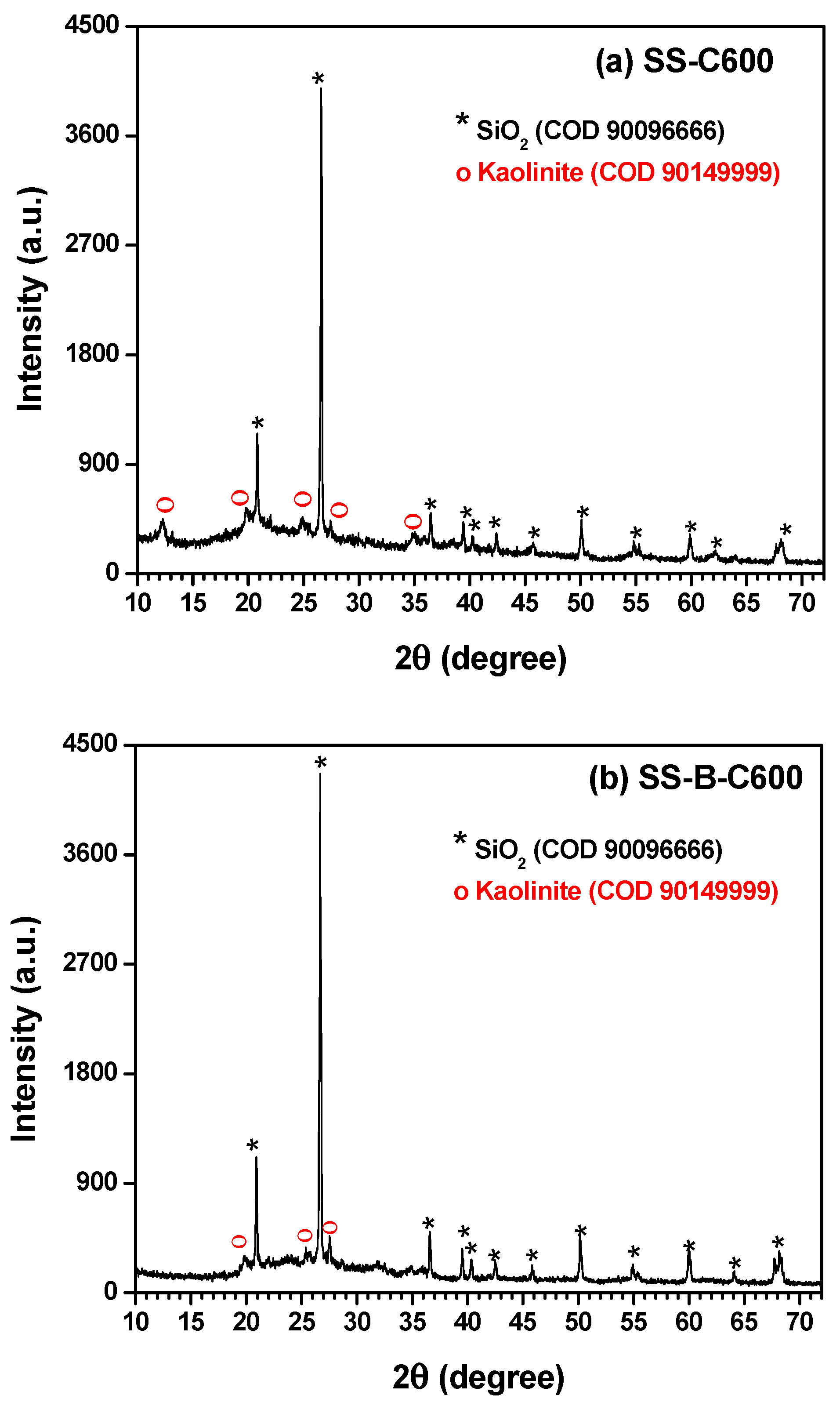
Figure 1 shows that the XRD patterns of SS-C600 and SS-B-C600 exhibit well-defined diffraction peaks at approximately 2θ = 20.8°, 26.6°, 36.5°, 39.5°, 42.4°, 50.1°, 54.8°, 59.9°, 63.9°, and 68.0°, in good agreement with the characteristic crystalline planes of α-quartz (SiO2), as indexed according to COD No. 90096666 (JCPDS No. 46-1045) [25,26]. The presence of SiO2 is attributed to the inorganic constituents of the collected sludge waste, including sand and other siliceous materials. Due to its high thermal and chemical stability, the quartz phase remains largely unaffected by calcination and subsequent NaOH activation, persisting as the primary crystalline component after treatment. The minor diffraction features observed at approximately 2θ ≈ 12.3°, 20.1°, 24.8°, 27.3°, and 34.9° in SS-C600 (Figure 1a) are attributed to residual kaolinite (COD No. 9014999, Al2Si2O5(OH)4) [27,28].
In the SS-B-C600 sample, NaOH activation and subsequent calcination at 600 °C promote the structural transformation of the aluminosilicate framework through the cleavage of Si–O–Al bonds under combined alkaline and thermal conditions. This process induces the amorphization of the original kaolinite structure, as evidenced by the disappearance of the characteristic kaolinite reflection at 2θ ≈ 12.3° in the SS-B-C600 pattern (Figure 1b).

3.2. BET Surface Analysis

The surface properties of the samples were evaluated using nitrogen adsorption–desorption analysis (Table 1). The raw dried SS and calcined sample (SS-C600) exhibited low specific surface areas of 1.16 and 1.20 m2/g, respectively, even after calcination at 600 °C, indicating that calcination alone has a negligible effect on pore development. Moreover, both samples exhibited comparable pore volumes and pore sizes, indicating that the dense structure of the sludge remained largely unchanged following thermal treatment.
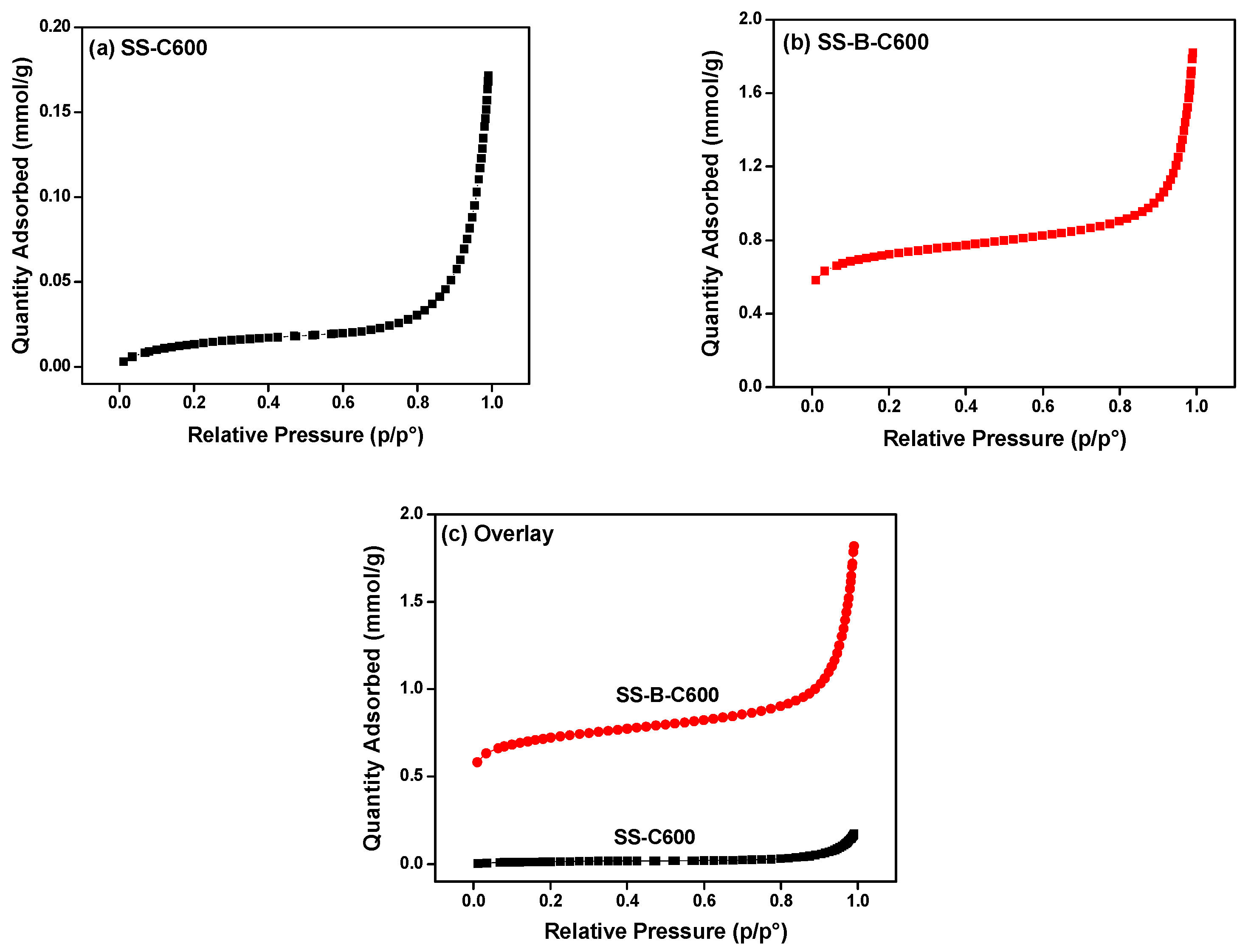
In contrast, the NaOH-activated sample (SS-B-C600) exhibits a dramatic increase in BET surface area to 51.9074 m2/g, along with a significant enhancement in pore volume (0.042278 cm3/g). NaOH activation enhances the surface area through alkaline etching of the aluminosilicate framework and the removal of organic impurities. Subsequent calcination at an elevated temperature further promotes pore formation and structural reorganization, resulting in increased pore volume and a higher density of accessible surface sites relative to thermal treatment alone. This improvement is further supported by the N2 adsorption–desorption isotherm profile (Figure 2), which shows a pronounced increase in the adsorbed volume at higher relative pressures, indicating enhanced pore development.

3.3. SEM/EDS Analysis

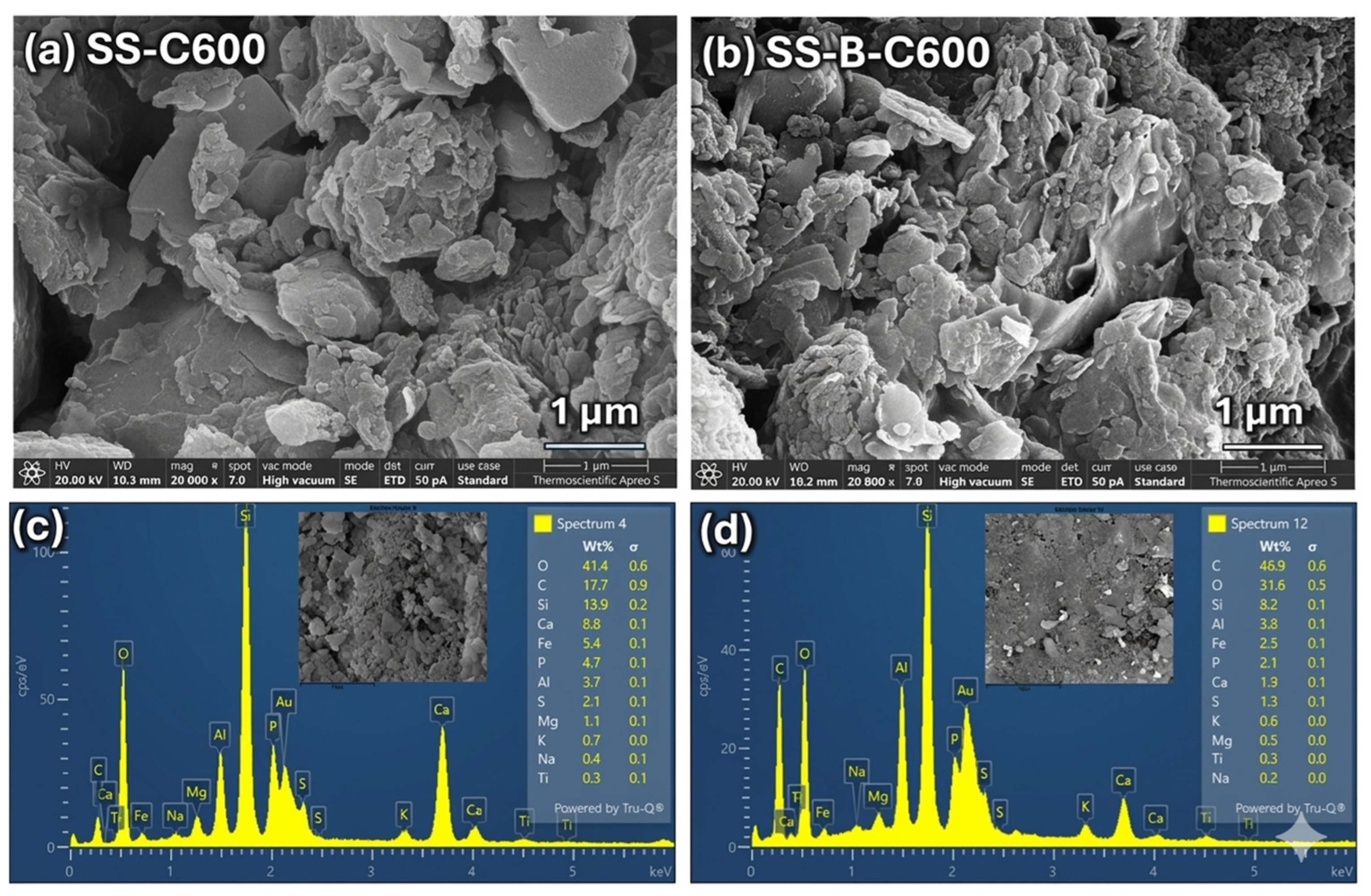
This observation is consistent with the SEM morphology of SS-B-C600 presented in Figure 3, where SS-C600 exhibits a relatively dense and aggregated morphology, indicating limited pore development after calcination alone (Figure 3a); in contrast, NaOH impregnation followed by recalcination promotes the partial dissolution of inorganic phases and induces structural etching, resulting in the formation of a more open and porous framework (Figure 3b). This morphological transformation is in good agreement with the BET results, where SS-B-C600 exhibits a significantly higher specific surface area. The increased surface roughness and pore development provide a larger number of accessible active sites, which are beneficial for adsorption processes. Furthermore, SS-C600 and SS-B-C600 exhibit similar elemental compositions, primarily consisting of C, O, and Si, which are characteristic of sludge-derived materials. These elements are mainly associated with SiO2 and aluminosilicate phases (e.g., kaolinite), as confirmed by XRD analysis.

3.4. FTIR Analysis

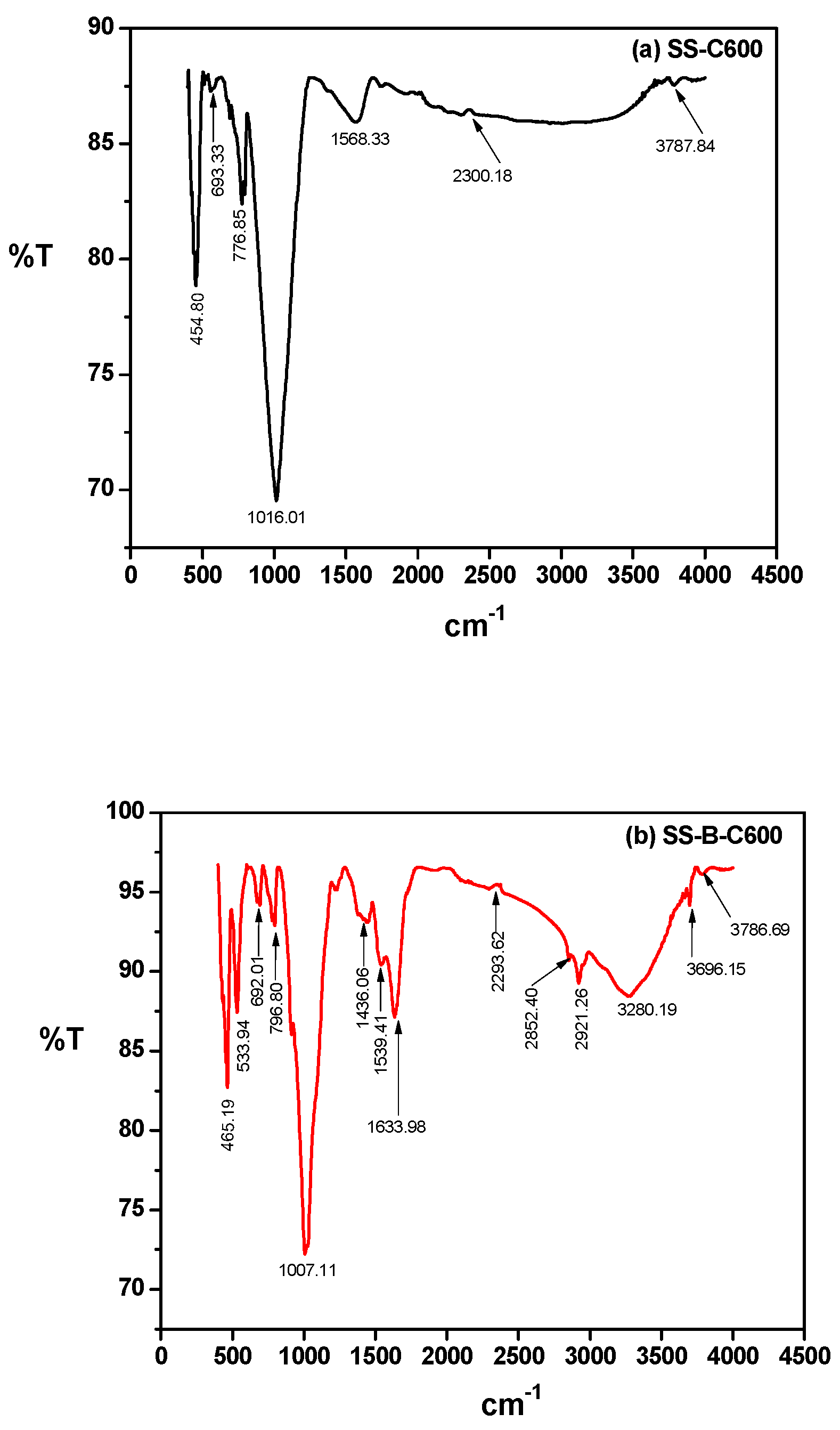
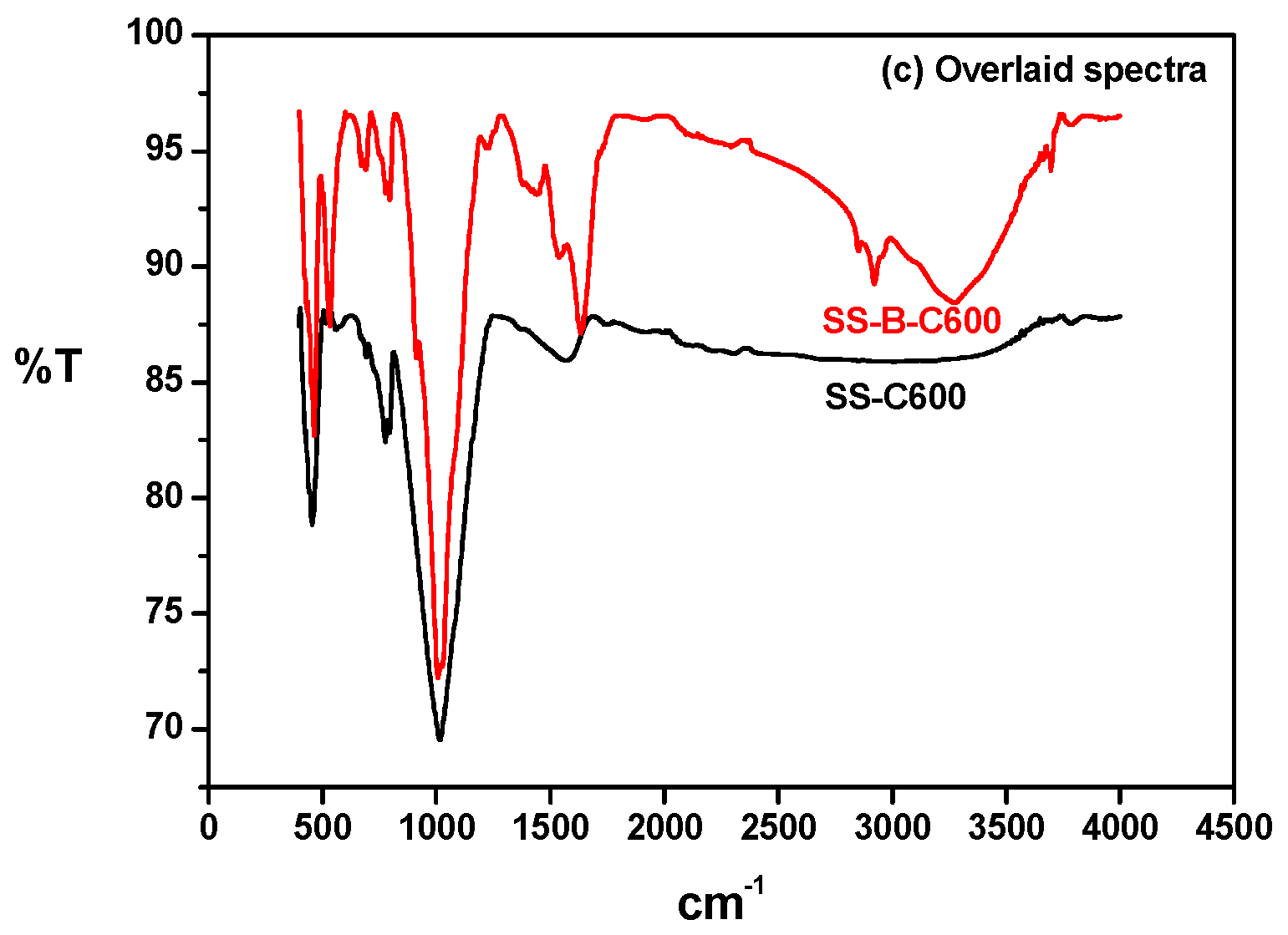
NaOH activation not only enhances the porosity of the material but also significantly modifies its surface chemistry through the introduction of hydroxyl (–OH) functional groups. This modification is clearly supported by the FTIR spectra shown in Figure 4.
Both samples exhibit strong absorption bands at 1016.01 and 1007.11 cm−1, respectively, which are assigned to the asymmetric stretching vibration of Si–O–Si (siloxane), confirming the presence of a silicate framework consistent with the dominant SiO2 phase identified in the XRD patterns. Notably, the main Si–O–Si band shifts from 1016.01 cm−1 in SS-C600 to 1007.11 cm−1 in SS-B-C600 (Figure 4a), indicating the formation of a more disordered aluminosilicate structure after NaOH activation. Additional bands observed in SS-C600 at 776.85 and 454.80 cm−1 are attributed to the symmetric stretching and bending vibrations of Si–O–Si, respectively. Similar bands are also observed in SS-B-C600 at 796.80 and 465.19 cm−1, confirming the preservation of the siloxane network after treatment (Figure 4b).
In the hydroxyl region, SS-C600 exhibits only a weak peak at 3787.84 cm−1, whereas SS-B-C600 shows more pronounced peaks at 3786.69 and 3696.15 cm−1, along with a broad band centered at 3280.19 cm−1, indicating a significant increase in surface hydroxyl (Si–OH) groups. Moreover, a distinct band at 1633.98 cm−1 was observed only in SS-B-C600, corresponding to the H–O–H bending vibration of adsorbed water. These findings indicate that NaOH activation promotes surface hydroxylation and hydrophilicity, leading to abundant –OH groups and stronger hydrogen-bonding interactions [29,30,31,32].

3.5. DFT Investigations on the Adsorption of MB by Aluminosilicate

We used density functional theory (DFT) at the B3LYP-D/cc-pVDZ level including short range dispersion interaction for the calculations in this research. The starting geometries of methylene blue, the protonated form of small unit aluminosilicate, and the complexes of methylene blue–aluminosilicate were constructed using the Gabedit program package [33]. The geometry optimizations and the frequency calculations were performed at the B3LYP-D/cc-pVDZ level of theory to confirm that the optimized structure is located on the potential energy surface (PES) at the local minimum point (File S1: XYZ optimized geometry at B3LYP-D/cc-pVDZ level).
The interaction energies were calculated by using the energy of the methylene blue–aluminosilicate complex minus the energy summation of the methylene blue and the aluminosilicate, as shown in Equation (10).
E = E m e t h y l e n e   b l u e a l u m i n o s i l i c a t e   c o m p l e x ( E m e t h y l e n e   b l u e + E a l u m i n o s i l i c a t e )
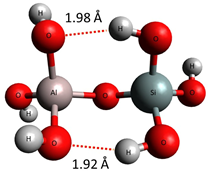
All of the DFT calculations were conducted using the ORCA program package [34], and the molecular graphical pictures were drawn using the Avogadro program package [35]. The optimized molecular structure of the methylene blue, small unit aluminosilicate, and the complexes of methylene blue–aluminosilicate at the B3LYP-D/cc-pVDZ level are shown in Table 2.
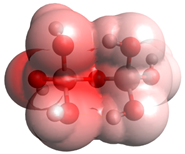
The results presented in Table 2 show that the intramolecular hydrogen bonds occurred in the protonated form of small unit aluminosilicate with the hydrogen bond distances 1.98 and 1.92 Å. When methylene blue forms a complex with small unit aluminosilicate, the intermolecular hydrogen bonds play an important role in the complex formation via the σ-type [36]. Three intermolecular hydrogen bonds occurred in the complex with distances of 2.34, 2.28 and 2.19 Å. The molecular electrostatic potential (MEP) maps in Table 3 show the partial charge distribution in the methylene blue, the small unit aluminosilicate, and the complexes, revealing the negative charge (blue color) located on the O, S, N atoms and the positive charge (white color) located on hydrogen atoms. The hydrogen bond and strong dipole–dipole interaction are the main factors that hold methylene blue and aluminosilicate together in the complex. The calculated interaction energy E (binding energy) at the B3LYP-D/cc-pVDZ level of the complex is −304.27 kJ/mol, showing that these complexes occurred from the strong intermolecular interactions.

3.6. Adsorption Studies and Equilibrium

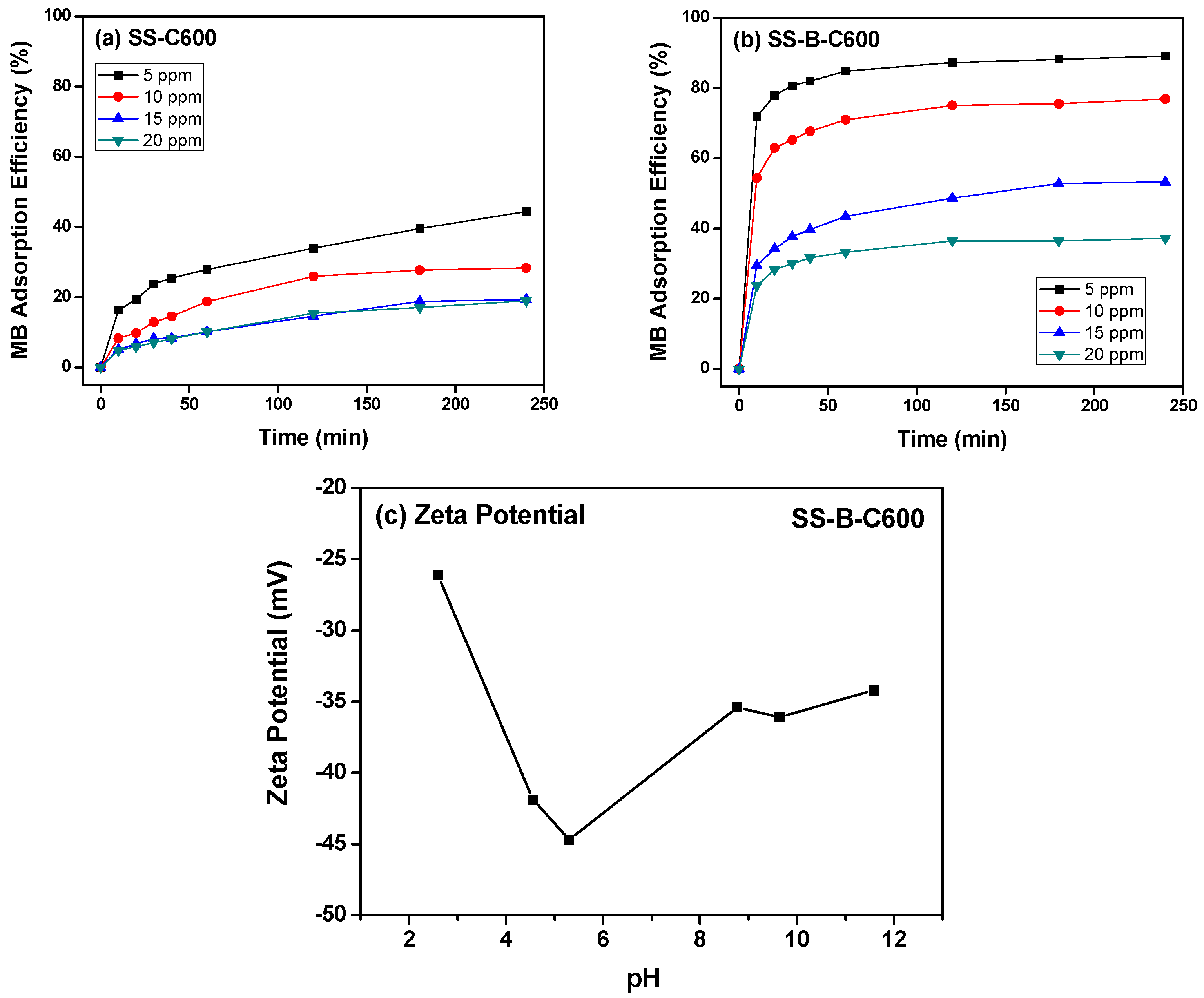
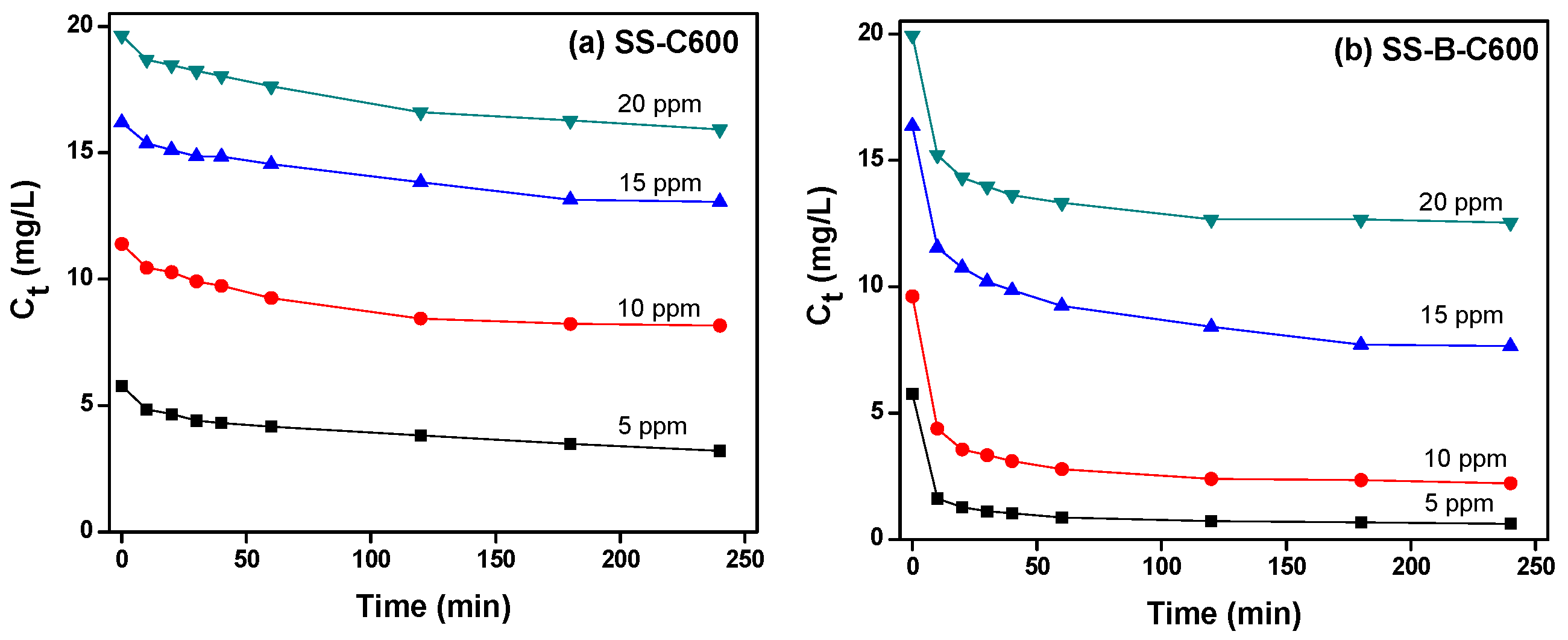
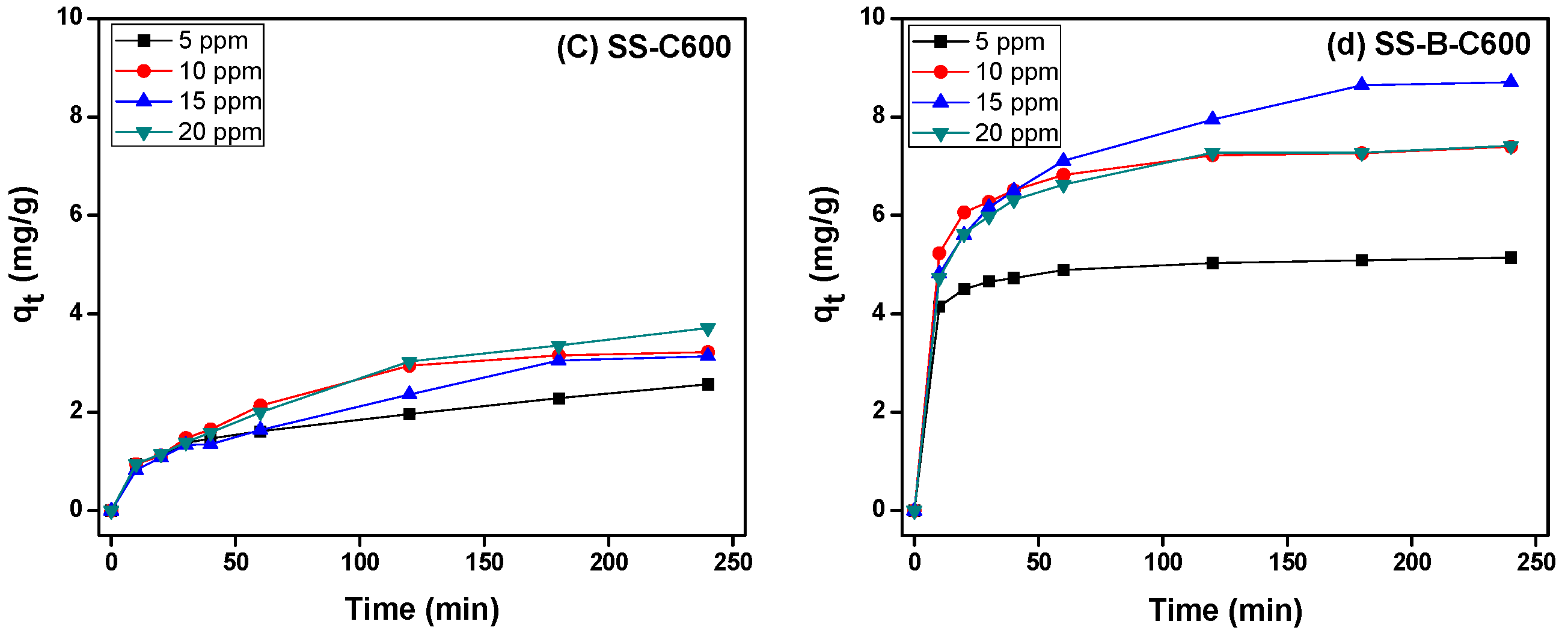
The effect of the initial MB concentration on the adsorption performance of SS-C600 and SS-B-C600 was investigated by varying the MB concentration from 5 to 20 ppm. The adsorption experiments were conducted under identical conditions with an adsorbent dosage of 1 g/L at room temperature (26 °C, 299.15 K). At the initial stage, the adsorption rate was rapid, due to the large concentration gradient between the bulk solution and the adsorbent surface, which enhanced the mass transfer driving force. However, the overall adsorption efficiency decreased, as the initial concentration increased. This behavior can be attributed to the limited number of available active adsorption sites on the adsorbent surface, which become progressively saturated at higher dye concentrations, as illustrated in Figure 5. Notably, SS-B-C600, shown in Figure 5b, exhibited significantly higher MB removal efficiency compared to SS-C600, shown in Figure 5a. This enhancement is attributed to the surface modification induced by NaOH activation, which introduced additional hydroxyl (–OH) functional groups and increased the number of active surface sites. Furthermore, DFT calculations confirmed that the formation of intermolecular hydrogen bonding between the adsorbate and adsorbent strengthened the adsorption interaction.
Another possible adsorption mechanism involves electrostatic attraction between the negatively charged surface of SS-B-C600 and cationic MB molecules. Figure 5c shows that the zeta potential analysis revealed that SS-B-C600 possessed a negative surface charge throughout the investigated pH range. Therefore, at the natural pH of the MB solution (approximately 6.0), electrostatic interactions may facilitate the adsorption of MB onto the adsorbent surface, thereby contributing to the overall adsorption performance.
The parameter C t represents the remaining concentration at different sampling times. The raw data were initially obtained as absorbance intensity values measured at 664 nm for MB. The Beer–Lambert law was applied to convert the absorbance intensity into concentration using the calibration curve (y = 6.2464x, R2 = 0.9992). The corresponding axes are presented in Figure 6a,b for SS-C600 and SS-B-C600, respectively. Subsequently, the C t values were converted into the adsorption capacity ( q t ) of MB on the solid adsorbent using Equation (1) presented in the Materials and Methods section. The calculated adsorption amounts are shown in Figure 6c,d for the two samples.
The C t profiles show that the adsorption equilibrium was reached at approximately 120 min. Therefore, this time was designated as the equilibrium time for both samples. The remaining concentration at equilibrium and the corresponding adsorption capacity were denoted as C e and q e , respectively.
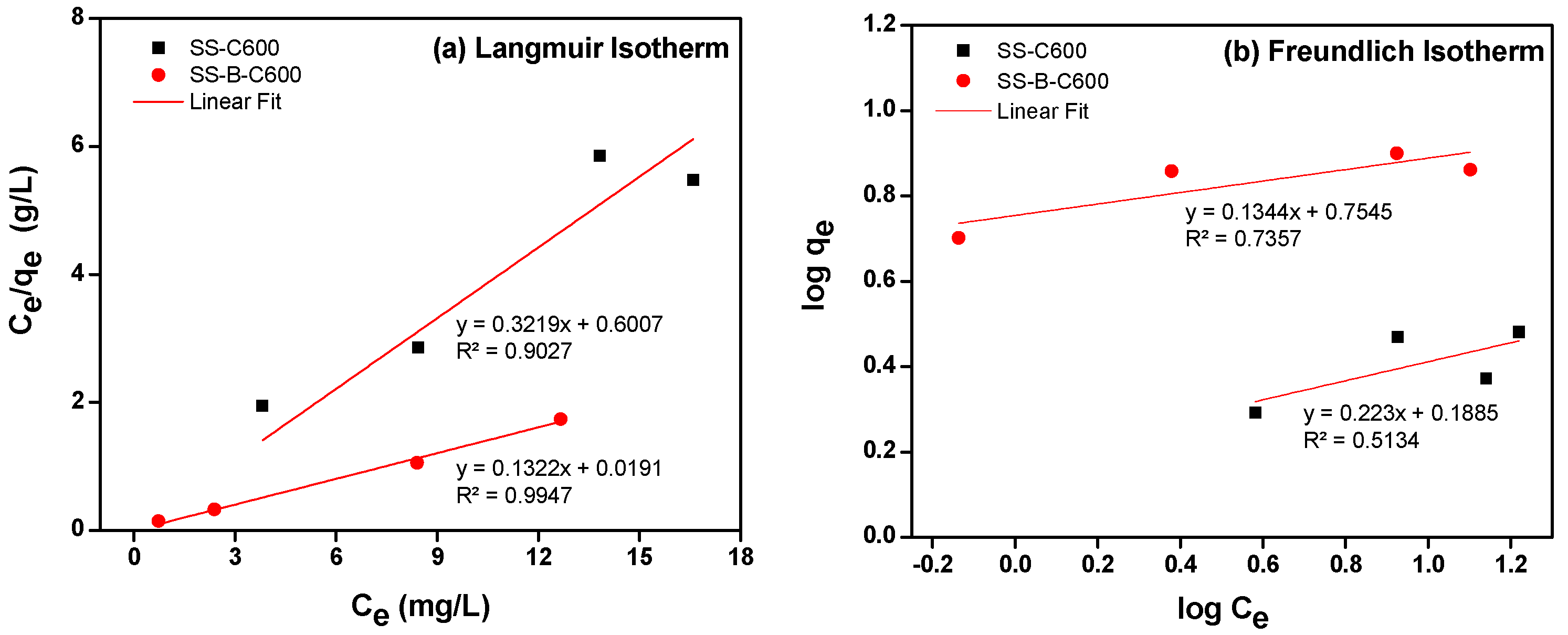
The C e and q e data were further analyzed using adsorption isotherm models to determine whether the adsorption process follows monolayer or multilayer behavior. As mentioned earlier, two widely used isotherm models were applied in this study, as represented by Equations (5) and (6), respectively. Based on the regression coefficient ( R 2 ) values (Figure 7), the Langmuir model exhibited a better fit than the Freundlich model for both samples. This result indicates that the adsorption process predominantly follows monolayer adsorption, where MB adsorbate molecules are assumed to occupy homogeneous active sites without transmigration across the adsorbent surface. Furthermore, the 1   n values derived from the Freundlich model were 0.134 and 0.223 for SS-C600 and SS-B-C600, respectively. Since 1 n < 0.5 , this suggests that the adsorption process is favorable for MB removal using both adsorbents [37]. In addition, the maximum adsorption capacities ( q m ) estimated from the slope of the Langmuir linear plot ( q m = 1 / slope ) were determined to be 3.11 and 7.56 mg/g for SS-C600 and SS-B-C600, respectively. These results confirm that the modified adsorbent (SS-B-C600), enriched with –OH functional groups, exhibits approximately twofold higher adsorption capacity than the unmodified SS-C600.
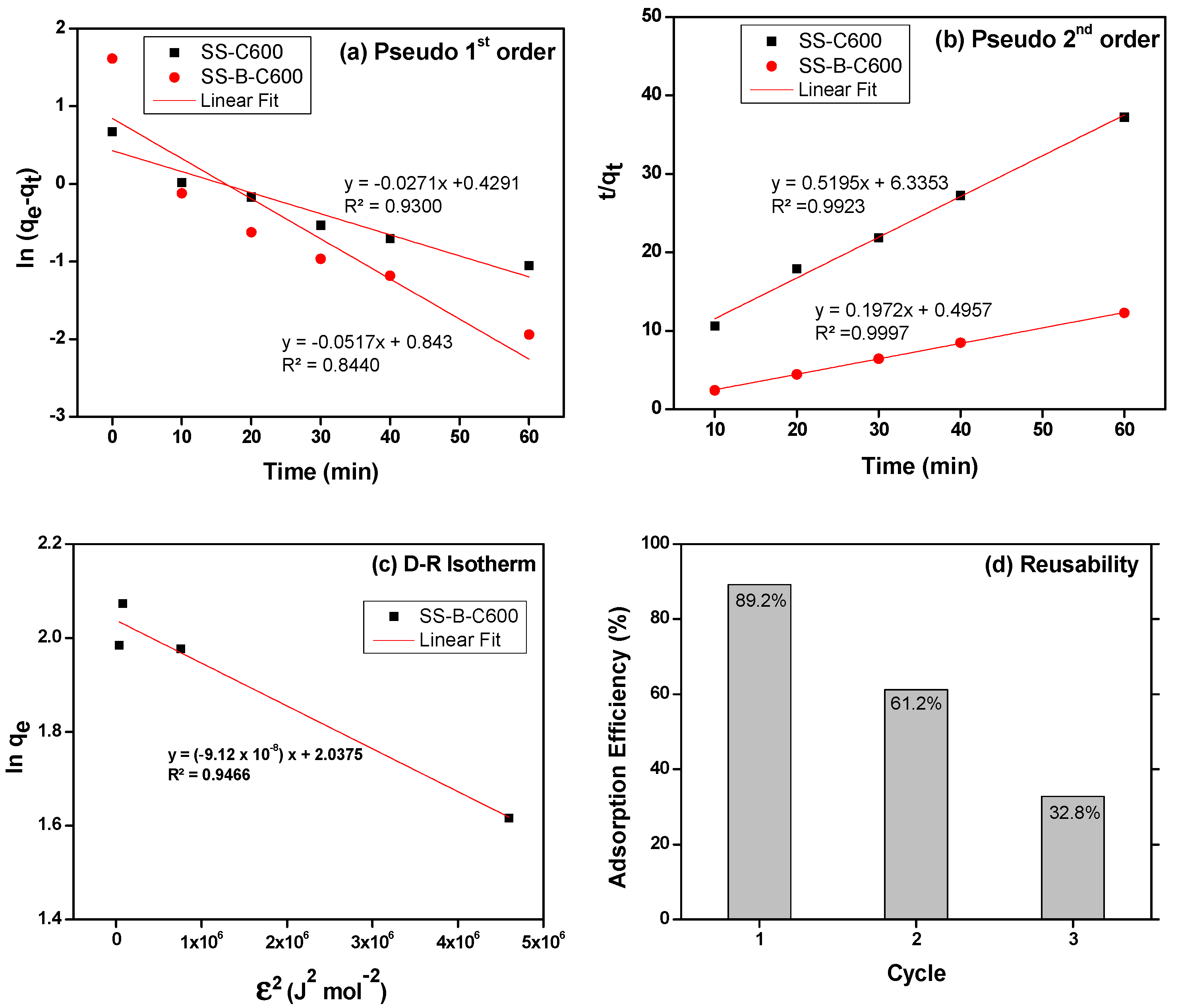
To compare the adsorption mechanism and adsorption rates of the two adsorbents at the same temperature, kinetic models were applied using an initial MB concentration of 5 ppm. Figure 8 shows that the correlation coefficient (R2) values for both samples were better fitted by the pseudo-second-order kinetic model, indicating that the adsorption process was not only influenced by porosity through pore-filling at the initial stage but also governed by surface-controlled interactions between MB molecules and surface –OH groups via hydrogen bonding [38,39].
This interpretation is further corroborated by the D–R isotherm results shown in Figure 8c, where the mean adsorption energy (E) at 299.15 K was calculated from the slope to be approximately 2.34 kJ/mol, using Equations (7)–(9). Since this value is lower than 16 kJ/mol, the adsorption process was confirmed to be governed by physisorption through hydrogen-bonding interactions. Further analysis of the rate constants, estimated from the slope and intercept of the pseudo-second-order model, reveals that the rate constant of SS-C600 (0.0426 g·min·mg−1) is approximately 46% lower than that of SS-B-C600 (0.0785 g·min·mg−1) (Table 4), which indicates that SS-C600 exhibits a slower adsorption rate.
As the system is heterogeneous, it offers the advantage of easy separation and reuse. The regeneration of the adsorbent was performed using a simple washing and drying procedure. After each adsorption cycle, the spent adsorbent was separated from the solution, washed several times with deionized water to remove the residual MB, dried in a hot-air oven, and reweighed to maintain a constant adsorbent mass for the subsequent adsorption cycle. The results in Figure 8d show that the removal efficiency decreased progressively with increasing reuse cycles, with values of 89.2% in the first cycle, 61.2% in the second cycle, and 32.8% in the third cycle, indicating a significant decline in adsorption performance upon reuse. As the number of reuse cycles increased, some adsorption sites may have remained occupied by MB molecules due to incomplete desorption during the washing process, leading to a gradual reduction in adsorption performance. Therefore, the regeneration results reported in this study reflect the reusability of the adsorbent under a simple and low-cost regeneration strategy rather than complete adsorbent regeneration.
To evaluate the performance of the prepared adsorbent, the adsorption capacity of SS-B-C600 was compared with those of other sewage sludge-derived adsorbents reported in the literature for MB removal (Table 5). The maximum adsorption capacity of SS-B-C600 (7.56 mg/g) was lower than those reported for most sludge-derived activated carbons and activated carbon materials but higher than that of sewage sludge biochar prepared by chemical activation followed by thermal treatment (2.0235 mg/g). The relatively low adsorption capacity of SS-B-C600 may be attributed to its limited surface area (51.91 m2/g), which is considerably lower than those of the highly porous activated carbons reported in the literature. Furthermore, residual inorganic ash and trace organic residues originating from wastewater treatment processes may partially block pore openings and reduce the accessibility of adsorption sites, thereby limiting the diffusion and adsorption of MB molecules.

4. Conclusions

In summary, alkali activation combined with calcination effectively transformed sewage sludge into a functional porous adsorbent with enhanced physicochemical properties. The NaOH-treated sample (SS-B-C600) exhibited improved surface characteristics, including higher porosity and enriched surface hydroxyl groups, which played a key role in enhancing the adsorption performance. SS-B-C600 exhibited a significantly higher adsorption capacity toward MB than the calcined-only sample (SS-C600), while also maintaining reasonable performance over multiple reuse cycles, highlighting its potential for practical applications. The adsorption behavior followed the Langmuir isotherm and pseudo-second-order kinetics, indicating a monolayer adsorption process governed by combined pore-filling and surface-controlled interactions, particularly through hydrogen bonding as a form of physisorption. This conclusion was further supported by DFT calculations, which confirmed that intermolecular hydrogen bonding played a key role in stabilizing the MB–aluminosilicate complex and governing the adsorption mechanism.

Supplementary Materials

The following supporting information can be downloaded at: https://www.mdpi.com/article/10.3390/biomass6030045/s1, File S1: XYZ optimized geometry at B3LYP-D/cc-pVDZ level.

Author Contributions

Conceptualization, W.K., A.N. and D.C.; Methodology, P.P. and D.C.; Software, W.P.; Validation, P.P.; Formal Analysis, P.P. and P.T.; Investigation, D.C.; Resources, W.K. and A.N.; Data Curation, W.P.; Writing—Original Draft Preparation, W.P. and D.C.; Writing—Review and Editing, D.C.; Visualization, D.C.; Supervision, D.C.; Project Administration, D.C.; Funding Acquisition, W.K. and A.N. All authors have read and agreed to the published version of the manuscript.

Funding

This work was supported by Naresuan University (NU), and National Science, Research and Innovation Fund (NSRF), Grant No R2568B031.

Data Availability Statement

The original contributions presented in this study are included in the article and its appendices. Further inquiries can be directed to the corresponding author.

Acknowledgments

The authors acknowledge the Chemistry department, Faculty of Science, Naresuan University, for providing computing resources and facilities that have contributed to the research results reported within this paper. The authors also gratefully acknowledge the Rattanakosin College for Sustainable Energy and Environment, Rajamangala University of Technology Rattanakosin, for providing laboratory facilities to support the adsorption experiments.

Conflicts of Interest

The authors declare no conflicts of interest.

References

  1. Rajakaruna, R.M.A.S.D.; Sewwandi, B.G.N.; Najim, M.M.M.; Baig, M.B.; Alotaibi, B.A.; Traore, A. Sustainable approaches for wastewater treatment: An analysis of sludge-based materials for heavy metal removal from wastewater by adsorption. Sustainability 2023, 15, 14937. [Google Scholar] [CrossRef]
  2. Chen, Y.; Jiang, X.; Wang, Y.; Zhuang, D. Spatial characteristics of heavy metal pollution and the potential ecological risk of a typical mining area: A case study in China. Process Saf. Environ. Prot. 2018, 113, 204–219. [Google Scholar] [CrossRef]
  3. Mao, L.; Wu, M.; Zhu, S.; Wang, X.; Zhang, J.; Qin, Y. Adsorption potential and mechanism of sludge-based activated carbon modified with fly ash for removal of heavy metals. Sustainability 2024, 16, 2972. [Google Scholar] [CrossRef]
  4. Aljubiri, S.M.; Younes, A.A.O.; Alosaimi, E.H.; Abdel Daiem, M.M.; Abdel-Salam, E.T.; El-Shwiniy, W.H. Recycling of sewage sludge: Synthesis and application of sludge-based activated carbon in the efficient removal of cadmium (II) and lead (II) from wastewater. Int. J. Mol. Sci. 2024, 25, 9866. [Google Scholar] [CrossRef] [PubMed]
  5. Ganesan, S.; Kokulnathan, T.; Sumathi, S.; Palaniappan, A. Efficient photocatalytic degradation of textile dye pollutants using thermally exfoliated graphitic carbon nitride (TE–g–C3N4). Sci. Rep. 2024, 14, 2284. [Google Scholar] [CrossRef] [PubMed]
  6. Berradi, M.; Hsissou, R.; Khudhair, M.; Assouag, M.; Cherkaoui, O.; El Bachiri, A.; El Harfi, A. Textile finishing dyes and their impact on aquatic environs. Heliyon 2019, 5, e02711. [Google Scholar] [CrossRef] [PubMed]
  7. Pandey, S.; Do, J.Y.; Kim, J.; Kang, M. Fast and highly efficient removal of dye from aqueous solution using natural locust bean gum-based hydrogels as adsorbent. Int. J. Biol. Macromol. 2020, 143, 60–75. [Google Scholar] [CrossRef] [PubMed]
  8. Khan, I.; Saeed, K.; Zekker, I.; Zhang, B.; Hendi, A.H.; Ahmad, A.; Ahmad, S.; Zada, N.; Ahmad, H.; Shah, L.A.; et al. Review on methylene blue: Its properties, uses, toxicity and photodegradation. Water 2022, 14, 242. [Google Scholar] [CrossRef]
  9. Sahnoun, A.Y.; Selatnia, A.; Alouache, A.; Tidjani, A.E.B.; Bellil, A.; Ayeche, R. Valorization of sewage sludge for methylene blue removal from aqueous solution. Biomass Conv. Bioref. 2024, 14, 8775–8791. [Google Scholar] [CrossRef]
  10. Ferrentino, R.; Ceccato, R.; Marchetti, V.; Andreottola, G.; Fiori, L. Sewage sludge hydrochar: An option for removal of methylene blue from wastewater. Appl. Sci. 2020, 10, 3445. [Google Scholar] [CrossRef]
  11. Jellali, S.; Azzaz, A.A.; Al-Harrasi, M.; Charabi, Y.; Al-Sabahi, J.N.; Al-Raeesi, A.; Usman, M.; Al Nasiri, N.; Al-Abri, M.; Jeguirim, M. Conversion of industrial sludge into activated biochar for effective cationic dye removal: Characterization and adsorption properties assessment. Water 2022, 14, 2206. [Google Scholar] [CrossRef]
  12. Ben Nasr, J.; Hamdi, N.; Elhalouani, F. Characterization of activated carbon prepared from paper sludge for methylene blue adsorption. J. Mater. Environ. Sci. 2017, 8, 1960–1967. [Google Scholar]
  13. Singh, D.K.; Garg, A. Application of sewage sludge-derived hydrochar as an adsorbent for removal of methylene blue. Sustain. Chem. Environ. 2024, 8, 100158. [Google Scholar] [CrossRef]
  14. Kiełbasa, K.; Bayar, Ş.; Varol, E.A.; Sreńscek-Nazzal, J.; Bosacka, M.; Miądlicki, P.; Serafin, J.; Wróbel, R.J.; Michalkiewicz, B. Carbon dioxide adsorption over activated carbons produced from molasses using H2SO4, H3PO4, HCl, NaOH, and KOH as activating agents. Molecules 2022, 27, 7467. [Google Scholar] [CrossRef] [PubMed]
  15. González-García, P. Activated carbon from lignocellulosic precursors: A review of synthesis methods, characterization techniques and applications. Renew. Sustain. Energy Rev. 2018, 82, 1393–1414. [Google Scholar] [CrossRef]
  16. Martin, M.J.; Balaguer, M.D.; Rigola, M. Feasibility of activated carbon production from biological sludge by chemical activation with ZnCl2 and H2SO4. Environ. Technol. 1996, 17, 667–671. [Google Scholar] [CrossRef]
  17. Murphy, O.P.; Vashishtha, M.; Palanisamy, P.; Kumar, K.V. A review on adsorption isotherms and design calculations for the optimization of adsorbent mass and contact time. ACS Omega 2023, 8, 17407–17430. [Google Scholar] [CrossRef] [PubMed]
  18. Kanwal, S.; Devi, P.; Ahmed, Z.; Qambrani, N.A. Adsorption isotherm, kinetic and thermodynamic studies for adsorption of fluoride on waste marble powder. Desalin. Water Treat. 2024, 319, 100441. [Google Scholar] [CrossRef]
  19. Channei, D.; Jannoey, P. Adsorption of indigo carmine dye onto porous adsorbent derived from banaba peels waste. Trends Sci. 2021, 18, 9. [Google Scholar] [CrossRef]
  20. Ezzati, R.; Ezzati, S.; Azizi, M. Exact solution of the Langmuir rate equation: New insights into pseudo-first-order and pseudo-second-order kinetic models for adsorption. Vacuum 2024, 220, 112790. [Google Scholar] [CrossRef]
  21. Revellame, E.D.; Fortela, D.L.; Sharp, W.; Hernandez, R.; Zappi, M.E. Adsorption kinetic modeling using pseudo-first-order and pseudo-second-order rate laws: A review. Clean. Eng. Technol. 2020, 1, 100032. [Google Scholar] [CrossRef]
  22. Elshafei, M.F.; Mostafa, M.R.; Khalf-Alla, P.A.; Mohamed, G.G.; Fouad, O.A. Kinetic and isotherm study of Ni-MOF/magnetite nanoparticles adsorption capacity as green synthesized adsorbent toward rhodochrome (Kammererite). Sci. Rep. 2025, 15, 44669. [Google Scholar] [CrossRef] [PubMed]
  23. Channei, D.; Jannoey, P.; Thammaacheep, P.; Khanitchaidecha, W.; Nakaruk, A. From waste to value: Banana-peel-derived adsorbents for efficient removal of polar compounds from used palm oil. Appl. Sci. 2025, 15, 2205. [Google Scholar] [CrossRef]
  24. Mahanty, B.; Behera, S.K.; Sahoo, N.K. Misinterpretation of the Dubinin–Radushkevich isotherm and its implications on adsorption parameter estimates. Sep. Sci. Technol. 2023, 58, 1275–1282. [Google Scholar] [CrossRef]
  25. Liang, C.; Lin, S.; Liu, G. Study on the preparation of biochar ceramsite based on sewage sludge and the characterization of its properties. Appl. Sci. 2021, 11, 5522. [Google Scholar] [CrossRef]
  26. Shi, R.; Zhao, J.; Li, X.; Zou, C.; Cui, Y.; Qiu, G. Experimental study on the preparation of cementing materials by direct reduction coupling of a hematite–carbon base. Metals 2020, 10, 1086. [Google Scholar] [CrossRef]
  27. Zanelli, C.; Marrocchino, E.; Guarini, G.; Toffano, A.; Vaccaro, C.; Dondi, M. Recycling Construction and Demolition Residues in Clay Bricks. Appl. Sci. 2021, 11, 8918. [Google Scholar] [CrossRef]
  28. Mahrous, M.A.; Šegvić, B.; Zanoni, G.; Khadka, S.D.; Senadheera, S.; Jayawickrama, P.W. The role of clay swelling and mineral neoformation in the stabilization of high plasticity soils treated with fly ash- and metakaolin-based geopolymers. Minerals 2018, 8, 146. [Google Scholar] [CrossRef]
  29. Widjonarko, D.M.; Jumina, J.; Kartini, I.; Nuryono, N. Phosphonate-modified silica for adsorption of Co(II), Ni(II), Cu(II), and Zn(II). Indo. J. Chem. 2014, 14, 143–151. [Google Scholar] [CrossRef]
  30. Mabu, D.; Waleng, N.J.; Munonde, T.S.; Nqombolo, A.; Nomngongo, P.N. Fe3O4/SiO2 nanocomposite derived from coal fly ash and acid mine drainage for the adsorptive removal of diclofenac in wastewater. Recycling 2025, 10, 99. [Google Scholar] [CrossRef]
  31. Hosseinzadeh, H.; Jahanbakhsh, Z.; Masoumi, B.; Hooshangi, V. Preparation of amino-functionalized β-cyclodextrin/Fe3O4@SiO2 magnetic nanocarrier for controlled release of doxorubicin, an anticancer drug. Arab. J. Sci. Eng. 2024, 49, 459–473. [Google Scholar] [CrossRef]
  32. Gaweł, B.A.; Ulvensøen, A.; Łukaszuk, K.; Arstad, B.; Muggerud, A.M.F.; Erbe, A. Structural evolution of water and hydroxyl groups during thermal, mechanical and chemical treatment of high-purity natural quartz. RSC Adv. 2020, 10, 29018–29030. [Google Scholar] [CrossRef] [PubMed]
  33. Allouche, A.-R. Gabedit—A graphical user interface for computational chemistry softwares. J. Comput. Chem. 2011, 32, 174–182. [Google Scholar] [CrossRef]
  34. Neese, F.; Wennmohs, F.; Becker, U.; Riplinger, C. The ORCA quantum chemistry program package. J. Chem. Phys. 2020, 152, 224108. [Google Scholar] [CrossRef] [PubMed]
  35. Hanwell, M.D.; Curtis, D.E.; Lonie, D.C.; Vandermeersch, T.; Zurek, E.; Hutchison, G.R. Avogadro: An advanced semantic chemical editor, visualization, and analysis platform. J. Cheminform. 2012, 4, 17. [Google Scholar] [CrossRef] [PubMed]
  36. Sladek, V.; Punyain, K.; Ilčin, M.; Lukeš, V. Substitution effect on the intermolecular halogen and hydrogen bonds of the σ-bonded fluorinated pyridine···XY/HX complexes (XY = F2, Cl2, ClF.; HX = HF, HCl). Int. J. Quantum Chem. 2014, 114, 869–878. [Google Scholar] [CrossRef]
  37. Utomo, H.D.; Ong, X.C.; Lim, S.M.S.; Ong, G.C.B.; Li, P. Thermally processed sewage sludge for methylene blue uptake. Int. Biodeterior. Biodegrad. 2013, 85, 460–465. [Google Scholar] [CrossRef]
  38. Wang, J.; Guo, X. Rethinking of the intraparticle diffusion adsorption kinetics model: Interpretation, solving methods and applications. Chemosphere 2022, 309, 136732. [Google Scholar] [CrossRef] [PubMed]
  39. Atif, M.; Haider, H.Z.; Bongiovanni, R.; Fayyaz, M.; Razzaq, T.; Gul, S. Physisorption and chemisorption trends in surface modification of carbon black. Surf. Interfaces 2022, 31, 102080. [Google Scholar] [CrossRef]
  40. Roslan, F.A.S.; Yub Harun, N.; Saeed, A.A.H.; Ramli, R.M.; Mannikam, S.D.; Hussein Al-Qadami, E.H. Methylene Blue Removal Using Palm Oil Mill Effluent Sludge-Derived Adsorbent. Chem. Eng. Trans. 2022, 91, 589–594. [Google Scholar] [CrossRef]
  41. Wolski, R.; Bazan-Wozniak, A.; Pietrzak, R. Adsorption of Methyl Red and Methylene Blue on Carbon Bioadsorbents Obtained from Biogas Plant Waste Materials. Molecules 2023, 28, 6712. [Google Scholar] [CrossRef] [PubMed]
  42. Agoe, A.K.; Poulopoulos, S.G.; Sarbassov, Y.; Shah, D. Investigation of Sewage Sludge–Derived Biochar for Enhanced Pollutant Adsorption: Effect of Particle Size and Alkali Treatment. Energies 2024, 17, 4554. [Google Scholar] [CrossRef]
  43. Sanz-Santos, E.; Álvarez-Torrellas, S.; Ceballos, L.; Larriba, M.; Águeda, V.I.; García, J. Application of Sludge-Based Activated Carbons for the Effective Adsorption of Neonicotinoid Pesticides. Appl. Sci. 2021, 11, 3087. [Google Scholar] [CrossRef]
  44. Hong, J.; Bao, J.; Liu, Y. Removal of Methylene Blue from Simulated Wastewater Based upon Hydrothermal Carbon Activated by Phosphoric Acid. Water 2025, 17, 733. [Google Scholar] [CrossRef]
  45. Zeng, H.; Qi, W.; Zhai, L.; Wang, F.; Zhang, J.; Li, D. Preparation and Characterization of Sludge-Based Magnetic Biochar by Pyrolysis for Methylene Blue Removal. Nanomaterials 2021, 11, 2473. [Google Scholar] [CrossRef] [PubMed]
  46. Lawtae, P.; Tangsathitkulchai, C. The Use of High Surface Area Mesoporous-Activated Carbon from Longan Seed Biomass for Increasing Capacity and Kinetics of Methylene Blue Adsorption from Aqueous Solution. Molecules 2021, 26, 6521. [Google Scholar] [CrossRef] [PubMed]
  47. Zhou, Y.; Geng, L.; Zhang, L.; Su, Y.; Liu, R.; Guo, F.; Zhang, L. High-Efficiency Adsorption of Methylene Blue by Balsa Wood Waste-Based Microporous Carbon. Molecules 2026, 31, 1251. [Google Scholar] [CrossRef] [PubMed]
Figure 1. XRD patterns of (a) SS-C600 and (b) SS-B-C600.
Biomass 06 00045 g001
Figure 2. BET N2 adsorption–desorption isotherms of (a) SS-C600 and (b) SS-B-C600 and (c) the overlay of the two samples.
Biomass 06 00045 g002
Figure 3. SEM images (a,b) and EDS spectra (c,d) of SS-C600 and SS-B-C600.
Biomass 06 00045 g003
Figure 4. FTIR spectra of (a) SS-C600, (b) SS-B-C600, and (c) both overlaid.
Biomass 06 00045 g004aBiomass 06 00045 g004b
Figure 5. Effect of the initial concentration on the adsorption capacity of two adsorbents. (a) SS-C600 and (b) SS-B-C600 and (c) the zeta potential of SS-B-C600.
Biomass 06 00045 g005
Figure 6. Effect of contact time on MB removal and adsorption equilibrium data: (a,b) the remaining concentration; (c,d) the adsorption capacity.
Biomass 06 00045 g006aBiomass 06 00045 g006b
Figure 7. Adsorption isotherms of SS-C600 and SS-B-C600: (a) Langmuir and (b) Freundlich linear isotherms.
Biomass 06 00045 g007
Figure 8. (a) Pseudo-first-order and (b) pseudo-second-order kinetic models for MB adsorption onto SS-C600 and SS-B-C600, (c) D–R isotherm, and (d) reusability of SS-B-C600 for 5 ppm MB over 240 min.
Biomass 06 00045 g008
Table 1. BET surface area and pore structure parameters of the dried SS, SS-C600, and SS-B-C600 samples.
SampleSurface Area (m2/g)Pore Volume (cm3/g)Average Pore Width (nm)
BETBJH (Desorption)BJH (Desorption)
Dried SS1.160.00600619.7
SS-C6001.200.00592418.6
SS-B-C60051.910.04227810.0
Table 2. The optimized molecular structure of the methylene blue, aluminosilicate, and the methylene blue–aluminosilicate complex at the B3LYP-D/cc-pVDZ level.
CompoundStructure
Methylene blueBiomass 06 00045 i001
AluminosilicateBiomass 06 00045 i002
Methylene blue–aluminosilicateBiomass 06 00045 i003
Table 3. The molecular electrostatic potential (MEP) maps of the methylene blue, aluminosilicate, and the methylene blue–aluminosilicate complex, where red is negative, and blue is positive at the B3LYP-D/cc-pVDZ level.
ComplexMolecular Electrostatic Potential (MEP) Maps
Methylene blueBiomass 06 00045 i004
AluminosilicateBiomass 06 00045 i005
Methylene blue–aluminosilicateBiomass 06 00045 i006
Table 4. Comparison of kinetic parameters for the adsorption of 5 mg/L MB by SS-C600 and SS-B-C600.
Pseudo 1st OrderEquationR2Rate Constant
(min−1)
SS-C600y = −0.0271x +0.42910.93000.0271
SS-B-C600y = −0.0517x + 0.8430.84400.0517
Pseudo 2nd OrderEquationR2Rate Constant
(g.min mg−1)
SS-C600y = 0.5195x + 6.33530.99230.0426
SS-B-C600y = 0.1972x + 0.49570.99970.0785
Table 5. Comparison of MB adsorption capacities of sludge-derived adsorbents and activated carbon materials reported in the literature.
AdsorbentModification MethodBET Surface Area (m2/g)Maximum
Adsorption
Capacity (mg/g)
Ref.
Sewage Sludge Biochar (SB)Chemical activation followed by thermal treatment25.282.0235Roslan
et al. [40]
Biogas Plant WastePyrolysis320 to 61631 to 113Wolski
et al. [41]
Sewage SludgePyrolysis144.2735 Agoe
et al. [42]
Sewage SludgeHydrothermal
carbonization (HTC)
31.070.51Ferrentino
et al. [10]
Sewage Sludge Carbons (SBAC)ZnCl2 chemical activation558166Sanz-Santos
et al. [43]
Sewage Sludge Biochar (SB)HTC17.56268.4Hong
et al. [44]
Sludge-Based Magnetic
Biochar
Pyrolysis20.19 to
278.23
296.52Zeng
et al. [45]
Mesoporous-
Activated
Carbon
Chemical activation followed by thermal treatment17731000Lawtae
et al. [46]
Porous Super
Activated
Carbon (SAC)
Chemical activation and carbonization38331037.76Zhou
et al. [47]
SS-B-C600
(This study)
NaOH activation followed by
calcination 600 °C
51.917.56This study
Disclaimer/Publisher’s Note: The statements, opinions and data contained in all publications are solely those of the individual author(s) and contributor(s) and not of MDPI and/or the editor(s). MDPI and/or the editor(s) disclaim responsibility for any injury to people or property resulting from any ideas, methods, instructions or products referred to in the content.