
Impact of Heavy Metal Sequestration During Phytoremediation of Textile Wastewater on Biogas Yield of Aquatic Plants: A Review

 , , , , , , and
Abstract
1. Introduction
1.1. Importance of Textile Wastewater Management
1.2. Objectives and Scope of This Study
2. Textile Wastewater: Composition and Contamination
3. Phytoremediation of Textile Wastewater
3.1. Concept and Mechanisms of Phytoremediation
3.2. Types of Phytoremediation Techniques
3.3. Selection Criteria for Aquatic Plants
4. Aquatic Plants in Phytoremediation
4.1. Common Aquatic Plants Used

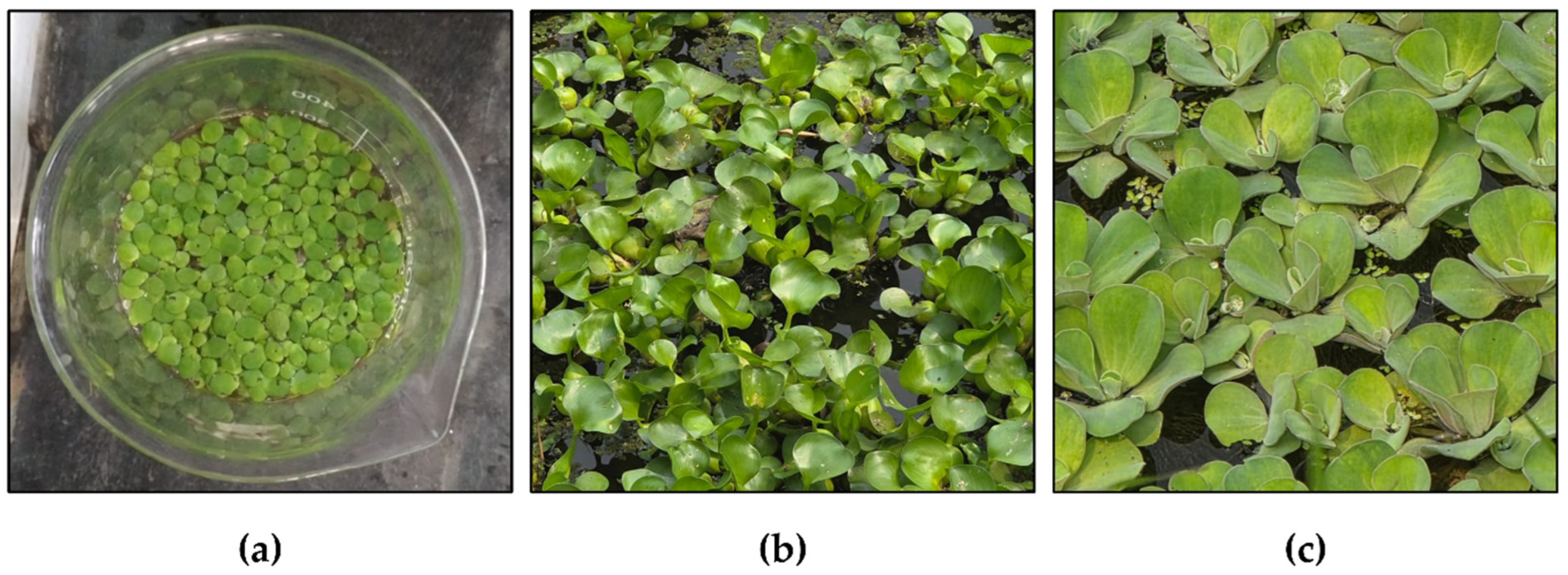
| Feature/Parameter | Duckweed (Lemna minor) | Water Hyacinth (Eichhornia crassipes) | Water Lettuce (Pistia stratiotes) | References |
|---|---|---|---|---|
| Growth Form | Free-floating; tiny roots on or below the water surface. | Free-floating with aerial rosettes and long submerged roots. | Free-floating with rosette leaves and hanging roots. | [48,49] |
| Growth Rate | Rapid, tolerant to various conditions. | Extremely fast-growing; biomass doubles in days. | Fast-growing but slower than hyacinth. | [50] |
| Metal Tolerance | High tolerance; some species grow better at low metal concentrations. | High tolerance, but excessive metal concentrations may reduce growth. | Moderate to high; effectiveness varies by metal and conditions. | [51,52] |
| Heavy Metals Removed | Pb, Ni, Cr, Cu, Zn, Cd, U, B, As. | Fe, Cu, Zn, Cr, Mn, Cd, Hg, Pb, As. | Cd, Cu, Fe, Pb, Zn, Mn, Cr, Hg, Al. | [53,54,55,56,57] |
| Notable Removal Efficiency | 99.3% Ni in 28 days (L. minor); 95% Pb and 84% Cr in 12 days (L. gibba); 62.8% Pb in 3 days. | 96% Pb in 12 days (2 ppm); BCF: Fe > Cd > Cu (up to 3622.86). | >85% removal of Pb, Cr, Mn, Zn (in 24 h); Higher Pb and Fe uptake than E. crassipes. | [57,58,59,60,61,62] |
| Bioconcentration Factor (BCF) | Pb > Mn > Cu > Zn. | Fe (3622.86) > Cd (439.74) > Cu (233.33). | Zn > Cd (2.3) > Ni (2.2); BCF > 1 for many metals. | [54,61,63,64,65,66,67] |
| Organic Pollutant Removal | Dimethomorph, Flazasulfuron, Copper sulphate. | Endocrine disruptors, neonicotinoids, insecticides (e.g., mevinphos), and herbicides (e.g., ethion). | Chlorpyrifos (82%), Cu2+, Hg2+, Fe3+. | [55,68,69,70,71,72] |
| Influence of Nutrients | Nutrient enrichment improves metal tolerance and growth but may reduce metal accumulation at high levels. | Excessive metals can reduce growth and phytoremediation efficiency. | Efficiency influenced by pH, metal concentration, and exposure duration. | [51,52,73,74] |
| Cold Tolerance | High (better than water hyacinth); suitable for colder climates. | Low; less suited for colder environments. | Moderate; more tolerant than hyacinth but less than duckweed. | [75] |
| Other Features | High starch and protein content in biomass; Ideal for biorefinery applications. | Can also treat organic pollutants; Invasive species; Can choke wetlands if not managed. | Effective against both metals and pesticides; May be more effective in combination with other aquatic plants. | [74,76,77,78] |
| Best Use Case | Industrial effluents, textile wastewater, cold climates, and integrated phytoremediation-biorefinery. | Polluted wetlands, large-scale contaminated water bodies, and heavy organic pollutant load. | Shallow ponds, pesticide-affected water, combined with other aquatic plants, for broader remediation spectrum. | [53,61,74,78,79,80,81] |
4.2. Mechanisms of Metal Uptake and Accumulation in Aquatic Plants
4.3. Efficiency of Different Aquatic Plants in Metal Sequestration
5. Biogas Production from Aquatic Plants
5.1. Overview of Biogas Production
5.2. Role of Organic Matter in Biogas Production
5.3. Biogas Yield from Aquatic Plants
Plant Type and Biomass
5.4. Factors Influencing Biogas Production
Process Conditions
6. Impact of Heavy Metal Sequestration on Biogas Yield
6.1. Speciation of Heavy Metals in Plant Biomass and Its Influence on Bioavailability
6.2. Metal Contamination Impact
6.3. Levels for Metal-Specific Toxicity and Inhibition
6.4. Link Between Metal-Sequestered Biomass and Anaerobic Digestion
6.5. Disruption in Microbial Activity
6.6. Interpretation and Permanent Environmental Effects
7. Challenges and Research Gaps
7.1. Technical and Operational Challenges
7.2. Limitations of Current Phytoremediation Practices
7.3. Gaps in Understanding the Interaction Between Metal Sequestration and Biogas Production
7.4. Crisis Management Strategy
8. Conclusions
- The phytoremediation approach using aquatic plants is an effective and economical way of removing heavy metals from textile effluents.
- Some of the promising plants include Pistia stratiotes, Eichhornia crassipes, and Lemna minor.
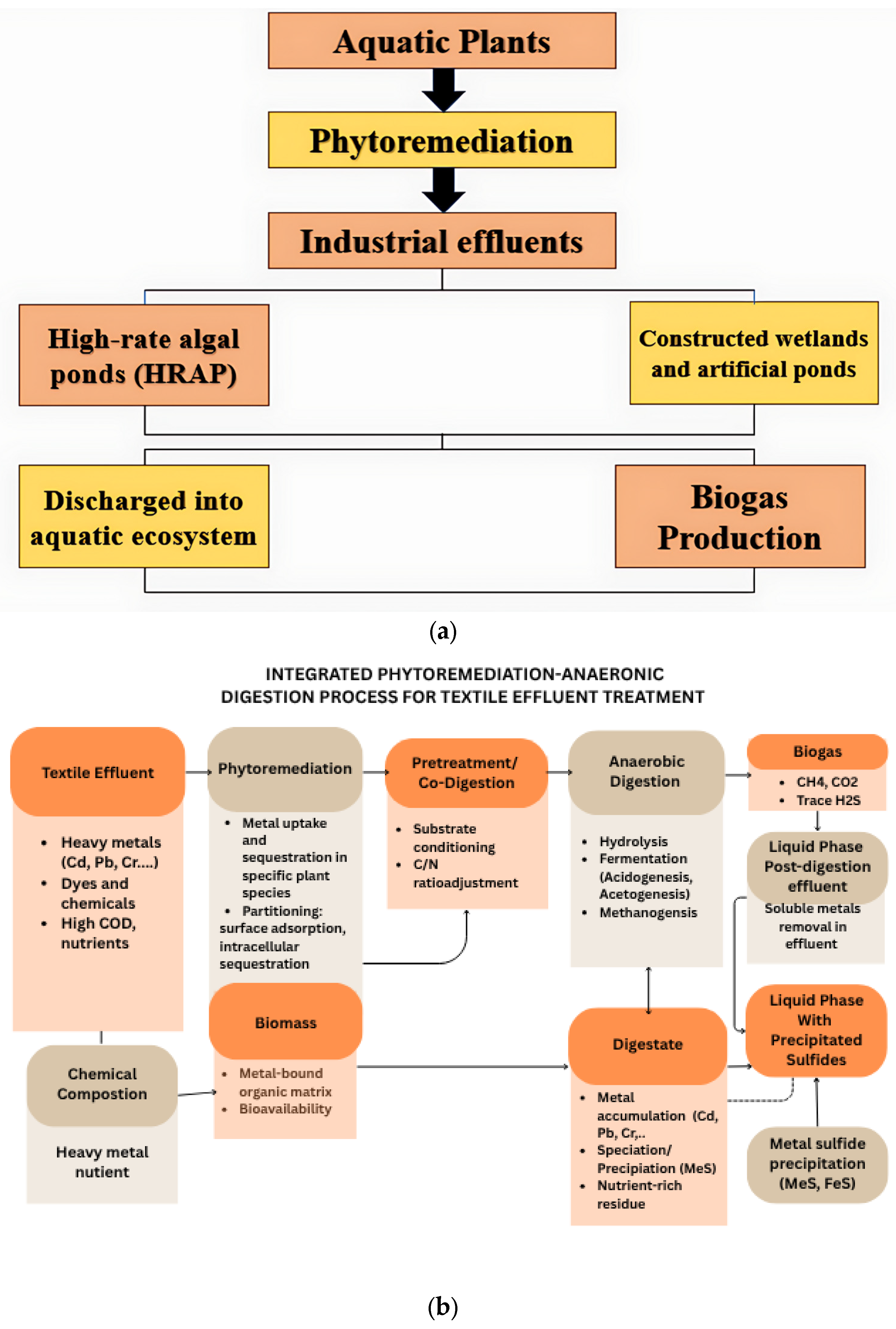
- By integrating phytoremediation with anaerobic digestion, we can achieve wastewater management and energy production through biogas production.
- However, the presence of heavy metals in plant biomass may hinder microbial metabolism, hence reducing biogas production.
Author Contributions
Funding
Data Availability Statement
Acknowledgments
Conflicts of Interest
References
- Islam, M.S.; Ahmed, M.K.; Raknuzzaman, M.; Habibullah -Al- Mamun, M.; Islam, M.K. Heavy Metal Pollution in Surface Water and Sediment: A Preliminary Assessment of an Urban River in a Developing Country. Ecol. Indic. 2015, 48, 282–291. [Google Scholar] [CrossRef]
- Mitchell, E.; Frisbie, S.; Sarkar, B. Exposure to Multiple Metals from Groundwater—A Global Crisis: Geology, Climate Change, Health Effects, Testing, and Mitigation. Metallomics 2011, 3, 874–908. [Google Scholar] [CrossRef]
- Gupta, B.G.; Mukhopadhyay, R. Heavy Metal Contamination from Textile Wastewater and Its Health Impacts: A Case Study from West Bengal with Sustainable Remediation Approaches. Sci. Rep. 2025, 15, 29578. [Google Scholar] [CrossRef]
- Sharma, J.K.; Kumar, N.; Singh, N.P.; Santal, A.R. Phytoremediation Technologies and Their Mechanism for Removal of Heavy Metal from Contaminated Soil: An Approach for a Sustainable Environment. Front. Plant Sci. 2023, 14, 1076876. [Google Scholar] [CrossRef]
- Kant, R. Textile Dyeing Industry an Environmental Hazard. Nat. Sci. 2012, 4, 22–26. [Google Scholar] [CrossRef]
- Ellen MacArthur Foundation. A New Textiles Economy: Redesigning Fashion’s Future; Ellen MacArthur Foundation: Cowes, UK, 2017. [Google Scholar]
- Younus, M. The Economics of A Zero-Waste Fashion Industry: Strategies To Reduce Wastage, Minimize Clothing Costs, And Maximize & Sustainability. Strateg. Data Manag. Innov. 2025, 2, 116–137. [Google Scholar] [CrossRef]
- Jayakumar, N.; Rajagopal, A. Noyyal River Basin: Water, Water Everywhere, Not a Drop to Drink. In Water Conflicts in India; Routledge: New Delhi, India, 2021; pp. 156–159. [Google Scholar] [CrossRef]
- Nelliyat, P. Valuation of Ecosystem Damages: A Case Study of Textile Pollution in Noyyal River Basin, South India. In Ecosystems and Integrated Water Resources Management in South Asia; Routledge: New Delhi, India, 2020; pp. 229–253. [Google Scholar] [CrossRef]
- Briffa, J.; Sinagra, E.; Blundell, R. Heavy Metal Pollution in the Environment and Their Toxicological Effects on Humans. Heliyon 2020, 6, e04691. [Google Scholar] [CrossRef]
- Benli, H. Bio-Mordants: A Review. Environ. Sci. Pollut. Res. 2024, 31, 20714–20771. [Google Scholar] [CrossRef] [PubMed]
- Mazumder, D. Process Evaluation and Treatability Study of Wastewater in a Textile Dyeing Industry. J. Energy Environ. 2011, 2, 2076–2909. [Google Scholar]
- Holkar, C.R.; Jadhav, A.J.; Pinjari, D.V.; Mahamuni, N.M.; Pandit, A.B. A Critical Review on Textile Wastewater Treatments: Possible Approaches. J. Environ. Manag. 2016, 182, 351–366. [Google Scholar] [CrossRef]
- Bailey, K.; Basu, A.; Sharma, S. The Environmental Impacts of Fast Fashion on Water Quality: A Systematic Review. Water 2022, 14, 1073. [Google Scholar] [CrossRef]
- Rahimzadeh, M.R.; Rahimzadeh, M.R.; Kazemi, S.; Moghadamnia, A.A. Cadmium Toxicity and Treatment: An Update. Casp. J. Intern. Med. 2017, 8, 135–145. [Google Scholar] [CrossRef]
- Genchi, G.; Sinicropi, M.S.; Lauria, G.; Carocci, A.; Catalano, A. The Effects of Cadmium Toxicity. Int. J. Environ. Res. Public Health 2020, 17, 3782. [Google Scholar] [CrossRef]
- Jaishankar, M.; Tseten, T.; Anbalagan, N.; Mathew, B.B.; Beeregowda, K.N. Toxicity, Mechanism and Health Effects of Some Heavy Metals. Interdiscip. Toxicol. 2014, 7, 60–72. [Google Scholar] [CrossRef]
- Dogan, I.; Ozyigit, I.I.; Tombuloglu, G.; Sakcali, M.S.; Tombuloglu, H. Assessment of Cd-Induced Genotoxic Damage in Urtica pilulifera L. Using RAPD-PCR Analysis. Biotechnol. Biotechnol. Equip. 2016, 30, 284–291. [Google Scholar] [CrossRef]
- Ozyigit, I.I.; Dogan, I.; Igdelioglu, S.; Filiz, E.; Karadeniz, S.; Uzunova, Z. Screening of Damage Induced by Lead (Pb) in Rye (Secale cereale L.)—A Genetic and Physiological Approach. Biotechnol. Biotechnol. Equip. 2016, 30, 489–496. [Google Scholar] [CrossRef]
- Yasar, U.; Ozyigit, I.I. Use of Human Hair as a Potential Biomonitor for Zinc in the Pendik District Istanbul Turkey. Roum. Biotechnol. Lett. 2009, 14, 4477–4484. [Google Scholar]
- Shahidi, S.; Moazzenchi, B. The Influence of Dyeing on the Adsorption of Silver and Copper Particles as Antibacterial Agents on to Cotton Fabrics. J. Nat. Fibers 2019, 16, 677–687. [Google Scholar] [CrossRef]
- Das, B.K.; Das, P.K.; Prava Das, B.; Dash, P. Green Technology to Limit the Effects of Hexavalent Chromium Contaminated Water Bodies on Public Health and Vegetation at Industrial Sites. J. Appl. Biol. Biotechnol. 2021, 9, 28–35. [Google Scholar] [CrossRef]
- Ratnaike, R.N. Acute and Chronic Arsenic Toxicity. Postgrad. Med. J. 2003, 79, 391–396. [Google Scholar] [CrossRef]
- Chowdhury, N.R.; Das, R.; Joardar, M.; Ghosh, S.; Bhowmick, S.; Roychowdhury, T. Arsenic Accumulation in Paddy Plants at Different Phases of Pre-Monsoon Cultivation. Chemosphere 2018, 210, 987–997. [Google Scholar] [CrossRef]
- Uddin, M.M.; Zakeel, M.C.M.; Zavahir, J.S.; Marikar, F.M.M.T.; Jahan, I. Heavy Metal Accumulation in Rice and Aquatic Plants Used as Human Food: A General Review. Toxics 2021, 9, 360. [Google Scholar] [CrossRef] [PubMed]
- Dhameliya, K.B.; Ambasana, C. Assessment of Wastewater Contaminants Caused by Textile Industries. J. Pure Appl. Microbiol. 2023, 17, 1477–1485. [Google Scholar] [CrossRef]
- Polat, G.; Türkeş, E.; Açıkel, Y.S. Simultaneous Removal of Methylene Blue and Direct Blue 71 with Pb(II) Ions from Multi-Component Systems: Application of the Multi-Component Langmuir Model. Desalination Water Treat. 2023, 289, 206–220. [Google Scholar] [CrossRef]
- RoyChowdhury, A.; Datta, R.; Sarkar, D.; RoyChowdhury, A.; Datta, R.; Sarkar, D. Heavy Metal Pollution and Remediation. In Green Chemistry: An Inclusive Approach; Elsevier: Amsterdam, The Netherlands, 2018; p. 359. [Google Scholar] [CrossRef]
- Kar, S.; Paul, S.; Singh, R.K.; Parveen, S.; Hossain, K.; RoyChowdhury, A. Application of Water hyacinth for Phytoremediation of Ammoniacal Nitrogen. Nitrogen 2026, 7, 27. [Google Scholar] [CrossRef]
- Yaseen, D.A.; Scholz, M. Textile Dye Wastewater Characteristics and Constituents of Synthetic Effluents: A Critical Review. Int. J. Environ. Sci. Technol. 2018, 16, 1193–1226. [Google Scholar] [CrossRef]
- Mishra, A. Phytoremediation of Heavy Metal-Contaminated Soils: Recent Advances, Challenges, and Future Prospects. In Bioremediation for Environmental Sustainability: Toxicity, Mechanisms of Contaminants Degradation, Detoxification and Challenges; Elsevier: Amsterdam, The Netherlands, 2021; pp. 29–51. [Google Scholar] [CrossRef]
- Mahar, A.; Wang, P.; Ali, A.; Awasthi, M.K.; Lahori, A.H.; Wang, Q.; Li, R.; Zhang, Z. Challenges and Opportunities in the Phytoremediation of Heavy Metals Contaminated Soils: A Review. Ecotoxicol. Environ. Saf. 2016, 126, 111–121. [Google Scholar] [CrossRef]
- Yaseen, D.A.; Scholz, M. Textile Dye Removal Using Experimental Wetland Ponds Planted with Common Duckweed under Semi-Natural Conditions. Environ. Prot. Eng. 2017, 43, 39–60. [Google Scholar] [CrossRef]
- Moreira, H.; Pereira, S.I.A.; Mench, M.; Garbisu, C.; Kidd, P.; Castro, P.M.L. Phytomanagement of Metal(Loid)-Contaminated Soils: Options, Efficiency and Value. Front. Environ. Sci. 2021, 9, 661423. [Google Scholar] [CrossRef]
- Pandey, C.V.; Gajić, G.; Sharma, P.; Roy, M. Adaptive Phytoremediation Practices: Resilience to Climate Change; Elsevier: Amsterdam, The Netherlands, 2022; ISBN 9780128238325. [Google Scholar]
- Davies, L.C.; Carias, C.C.; Novais, J.M.; Martins-Dias, S. Phytoremediation of Textile Effluents Containing Azo Dye by Using Phragmites Australis in a Vertical Flow Intermittent Feeding Constructed Wetland. Ecol. Eng. 2005, 25, 594–605. [Google Scholar] [CrossRef]
- Saxena, G.; Kishor, R.; Bharagava, R.N. Application of Microbial Enzymes in Degradation and Detoxification of Organic and Inorganic Pollutants. In Bioremediation of Industrial Waste for Environmental Safety; Springer: Berlin/Heidelberg, Germany, 2020; pp. 41–51. [Google Scholar] [CrossRef]
- Kishor, R.; Bharagava, R.N.; Saxena, G. Industrial Wastewaters. In Recent Advances in Environmental Management; CRC Press: Boca Raton, FL, USA, 2018; pp. 1–25. [Google Scholar] [CrossRef]
- RoyChowdhury, A.; Mukherjee, P.; Panja, S.; Datta, R.; Christodoulatos, C.; Sarkar, D. Evidence for Phytoremediation and Phytoexcretion of NTO from Industrial Wastewater by Vetiver Grass. Molecules 2020, 26, 74. [Google Scholar] [CrossRef]
- Khan, M.S.; Zaidi, A.; Wani, P.A.; Oves, M. Role of Plant Growth Promoting Rhizobacteria in the Remediation of Metal Contaminated Soils. Environ. Chem. Lett. 2008, 7, 1–19. [Google Scholar] [CrossRef]
- Yasar, A.; Khan, M.; Tabinda, A.B.; Hayyat, M.U.; Zaheer, A. Percentage Uptake of Heavy Metals of Different Macrophytes in Stagnant and Flowing Textile Effluent. J. Anim. Plant Sci. 2013, 23, 2013. [Google Scholar]
- Akter, S.; Afrin, R.; Mia, M.Y.; Hossen, M.Z. Phytoremediation of Chromium (Cr) from Tannery Effluent by Using Water lettuce (Pistia stratiotes). ASA Univ. Rev. 2014, 8. [Google Scholar]
- Sasmaz, M.; Arslan Topal, E.I.; Obek, E.; Sasmaz, A. The Potential of Lemna Gibba L. and Lemna minor L. to Remove Cu, Pb, Zn, and As in Gallery Water in a Mining Area in Keban, Turkey. J. Environ. Manag. 2015, 163, 246–253. [Google Scholar] [CrossRef]
- RoyChowdhury, A.; Sarkar, D.; Datta, R. Remediation of Acid Mine Drainage-Impacted Water. Curr. Pollut. Rep. 2015, 1, 131–141. [Google Scholar] [CrossRef]
- RoyChowdhury, A.; Sarkar, D.; Datta, R. A Combined Chemical and Phytoremediation Method for Reclamation of Acid Mine Drainage–Impacted Soils. Environ. Sci. Pollut. Res. 2019, 26, 14414–14425. [Google Scholar] [CrossRef]
- Singh, D.; Tiwari, A.; Gupta, R.; Nagar, G.; Pradesh, M.; Divya Singh, I. Phytoremediation of Lead from Wastewater Using Aquatic Plants Gandhi Proudyogiki Vishwavidyalaya Airport Bypass Road. J. Agric. Technol. 2012, 8, 1–11. [Google Scholar]
- Banik, B.K.; Islam, M.; Kabir, I.; Hoque, M.A. Phytoremediation of Cr(VI)-Rich Wastewater Using Water hyacinth, Water lettuce and Duckweed. Environ. Res. Technol. 2025, 8, 88–96. [Google Scholar] [CrossRef]
- Arber, A. Water Plants: A Study of Aquatic Angiosperms: Arber, Agnes Robertson, 1879–1960; University Press: Dhaka, Bangladesh, 1920. [Google Scholar]
- Sculthorpe, C.D. The Biology of Aquatic Vascular Plants; Edward Arnold: London, UK, 1967. [Google Scholar]
- Rai, P.K. Heavy Metal Pollution in Aquatic Ecosystems and Its Phytoremediation Using Wetland Plants: An Ecosustainable Approach. Int. J. Phytoremediat. 2008, 10, 133–160. [Google Scholar] [CrossRef] [PubMed]
- Fahruddin, F.; Samawi, M.F.; Tuwo, M.; Tanjung, R.E. The Effect of Heavy Metal Lead (Pb) on the Growth of Ammonia-Degrading Bacteria and Physical Changes of Eichhornia crassipes in Groundwater Phytoremediation. Int. J. Adv. Sci. Eng. Inf. Technol. 2021, 11, 994–1000. [Google Scholar] [CrossRef]
- Odjegba, V.J.; Fasidi, I.O. Phytoremediation of Heavy Metals by Eichhornia crassipes. Environmentalist 2007, 27, 349–355. [Google Scholar] [CrossRef]
- Abeywardhana, M.L.D.D.; Bandara, N.J.G.J.; Rupasinghe, S.K.L.S. Removal of Heavy Metals and Nutrients from Wastewater Using Salvinia molesta and Lemna gibba. In Proceedings of the International Forestry and Environment Symposium, Kalutara, Sri Lanka, 10–11 November 2017; Volume 22. [Google Scholar] [CrossRef][Green Version]
- Das, S.; Goswami, S.; Talukdar, A. Das A Study on Cadmium Phytoremediation Potential of Water lettuce, Pistia stratiotes L. Bull. Environ. Contam. Toxicol. 2013, 92, 169–174. [Google Scholar] [CrossRef] [PubMed]
- Kumar, V.; Singh, J.; Saini, A.; Kumar, P. Phytoremediation of Copper, Iron and Mercury from Aqueous Solution by Water lettuce (Pistia stratiotes L.). Environ. Sustain. 2019, 2, 55–65. [Google Scholar] [CrossRef]
- Kumar, V.; Singh, J.; Kumar, P. Heavy Metal Uptake by Water lettuce (Pistia stratiotes L.) from Paper Mill Effluent (PME): Experimental and Prediction Modeling Studies. Environ. Sci. Pollut. Res. 2019, 26, 14400–14413. [Google Scholar] [CrossRef]
- Tabinda, A.B.; Arif, R.A.; Yasar, A.; Baqir, M.; Rasheed, R.; Mahmood, A.; Iqbal, A. Treatment of Textile Effluents with Pistia stratiotes, Eichhornia crassipes and Oedogonium sp. Int. J. Phytoremediat. 2019, 21, 939–943. [Google Scholar] [CrossRef] [PubMed]
- Ubuza, L.J.A.; Arazo, R.O.; Mabayo, V.I.F.; Ido, A.L.; Nacalaban, C.M.N.; Tolentino, J.T.; Tolentino, J.C.; Alcoran, D.C.; Padero, P.C.S. Assessment of the Potential of Duckweed (Lemna minor L.) in Treating Lead-Contaminated Water through Phytoremediation in Stationary and Recirculated Set-Ups. Environ. Eng. Res. 2019, 25, 977–982. [Google Scholar] [CrossRef]
- Abdallah, M.A.M. Phytoremediation of Heavy Metals from Aqueous Solutions by Two Aquatic macrophytes, Ceratophyllum demersum and Lemna Gibba L. Environ. Technol. 2012, 33, 1609–1614. [Google Scholar] [CrossRef]
- Fahruddin, F. Absorption of Heavy Metal Lead (Pb) by Water hyacinth (Eichhornia crassipes) and Its Influence to Total Dissolved Solids of Groundwater in Phytoremediation. J. Akta Kim. Indones. (Indones. Chim. Acta) 2020, 13, 10–15. [Google Scholar] [CrossRef]
- Ajayi, T.O.; Ogunbayio, A.O. Achieving Environmental Sustainability in Wastewater Treatment by Phytoremediation with Water hyacinth (Eichhornia crassipes). J. Sustain. Dev. 2012, 5, 80. [Google Scholar] [CrossRef]
- Miretzky, P.; Saralegui, A.; Cirelli, A.F. Aquatic macrophytes Potential for the Simultaneous Removal of Heavy Metals (Buenos Aires, Argentina). Chemosphere 2004, 57, 997–1005. [Google Scholar] [CrossRef]
- Azeez, N.M. Bioaccumulation and Phytoremediation of Some Heavy Metals (Mn, Cu, Zn and Pb) by Bladderwort and Duckweed. Biodiversitas 2021, 22, 2993–2998. [Google Scholar] [CrossRef]
- Wickramasinghe, S.; Jayawardana, C.K. Potential of Aquatic macrophytes Eichhornia crassipes, Pistia stratiotes and Salvinia molesta in Phytoremediation of Textile Wastewater. J. Water Secur. 2018, 4, 1–8. [Google Scholar] [CrossRef]
- Kumar, V.; Singh, J.; Chopra, A.K. Assessment of Plant Growth Attributes, Bioaccumulation, Enrichment, and Translocation of Heavy Metals in Water lettuce (Pistia stratiotes L.) Grown in Sugar Mill Effluent. Int. J. Phytoremediat. 2018, 20, 507–521. [Google Scholar] [CrossRef] [PubMed]
- Li, Y.; Xin, J.; Ge, W.; Tian, R. Tolerance Mechanism and Phytoremediation Potential of Pistia stratiotes to Zinc and Cadmium Co-Contamination. Int. J. Phytoremediat. 2022, 24, 1259–1266. [Google Scholar] [CrossRef] [PubMed]
- Lu, Q.; He, Z.L.; Graetz, D.A.; Stoffella, P.J.; Yang, X. Uptake and Distribution of Metals by Water lettuce (Pistia stratiotes L.). Environ. Sci. Pollut. Res. 2011, 18, 978–986. [Google Scholar] [CrossRef]
- Dosnon-Olette, R.; Couderchet, M.; Eullaffroy, P. Phytoremediation of Fungicides by Aquatic macrophytes: Toxicity and Removal Rate. Ecotoxicol. Environ. Saf. 2009, 72, 2096–2101. [Google Scholar] [CrossRef]
- De Laet, C.; Matringe, T.; Petit, E.; Grison, C. Eichhornia crassipes: A Powerful Bio-Indicator for Water Pollution by Emerging Pollutants. Sci. Rep. 2019, 9, 7326. [Google Scholar] [CrossRef]
- Xia, H.; Ma, X. Phytoremediation of Ethion by Water hyacinth (Eichhornia crassipes) from Water. Bioresour. Technol. 2006, 97, 1050–1054. [Google Scholar] [CrossRef]
- Wolverton, B.C. Water hyacinths for Removal of Phenols from Polluted Waters 1975. Available online: https://ntrs.nasa.gov/citations/19750008056 (accessed on 10 February 2026).
- Prasertsup, P.; Ariyakanon, N. Removal of Chlorpyrifos by Water lettuce (Pistia stratiotes L.) and Duckweed (Lemna minor L.). Int. J. Phytoremediat. 2011, 13, 383–395. [Google Scholar] [CrossRef]
- Aksoy, A.; Leblebici, Z. Effect of Nutrient Enrichment on Metal Accumulation and Biological Responses of Duckweed (Lemnaceae) Spread in Turkey. In Plants, Pollutants and Remediation; Springer: Berlin/Heidelberg, Germany, 2015; pp. 319–340. [Google Scholar] [CrossRef]
- Gusti Wibowo, Y.; Tyaz Nugraha, A.; Rohman, A. Phytoremediation of Several Wastewater Sources Using Pistia stratiotes and Eichhornia crassipes in Indonesia. Environ. Nanotechnol. Monit. Manag. 2023, 20, 100781. [Google Scholar] [CrossRef]
- Sharma, S.S.; Gaur, J.P. Potential of Lemna Polyrrhiza for Removal of Heavy Metals. Ecol. Eng. 1995, 4, 37–43. [Google Scholar] [CrossRef]
- Rai, P.K.; Nongtri, E.S. Heavy Metals/-Metalloids (As) Phytoremediation with Landoltia Punctata and Lemna Sp. (Duckweeds): Coupling with Biorefinery Prospects for Sustainable Phytotechnologies. Environ. Sci. Pollut. Res. 2024, 31, 16216–16240. [Google Scholar] [CrossRef] [PubMed]
- Khan, A.G.; Kuek, C.; Chaudhry, T.M.; Khoo, C.S.; Hayes, W.J. Role of Plants, Mycorrhizae and Phytochelators in Heavy Metal Contaminated Land Remediation. Chemosphere 2000, 41, 197–207. [Google Scholar] [CrossRef]
- Bhat, A.P.; Bhat, P.P. Sustainable Use of Plants for Heavy Metal Removal from Water: Phytoremediation. Int. J. Appl. Sci. Biotechnol. 2016, 4, 150–154. [Google Scholar] [CrossRef]
- Bokhari, S.H.; Mahmood-Ul-hassan, M.; Ahmad, M. Phytoextraction of Ni, Pb and, Cd by Duckweeds. Int. J. Phytoremediat. 2019, 21, 799–806. [Google Scholar] [CrossRef] [PubMed]
- Pandey, V.C. Phytoremediation Efficiency of Eichhornia crassipes in Fly Ash Pond. Int. J. Phytoremediat. 2016, 18, 450–452. [Google Scholar] [CrossRef]
- Panneerselvam, B.; Shunmuga Priya, K. Phytoremediation Potential of Water hyacinth in Heavy Metal Removal in Chromium and Lead Contaminated Water. Int. J. Environ. Anal. Chem. 2023, 103, 3081–3096. [Google Scholar] [CrossRef]
- Baker, A.J.M.; Brooks, R.R. Terrestrial Higher Plants Which Hyperaccumulate Metallic Elements, A Review of Their Distribution, E. Biorecovery 1989, 1, 88–126. [Google Scholar]
- Ernst, W.H.O.; Verkleij, J.A.C.; Schat, H. Metal Tolerance in Plants. Acta Bot. Neerl. 1992, 41, 229–248. [Google Scholar] [CrossRef]
- Ali, H.; Khan, E.; Sajad, M.A. Phytoremediation of Heavy Metals—Concepts and Applications. Chemosphere 2013, 91, 869–881. [Google Scholar] [CrossRef]
- Rai, P.K. Heavy Metal Phytoremediation from Aquatic Ecosystems with Special Reference to Macrophytes. Crit. Rev. Environ. Sci. Technol. 2009, 39, 697–753. [Google Scholar] [CrossRef]
- Ryu, S.K.; Park, J.S.; Lee, I.S. Purification and Characterization of a Copper-Binding Protein from Asian Periwinkle Littorina Brevicula. Comp. Biochem. Physiol. Part C. Toxicol. Pharmacol. 2003, 134, 101–107. [Google Scholar] [CrossRef]
- Ross, S.M. Retention, Transformation and Mobility of Toxic Metals in Soils. In Toxic Metals in Soil Plant Systems; John Wiley & Sons Ltd.: Hoboken, NJ, USA, 1994; pp. 63–152. [Google Scholar]
- Krämer, U.; Cotter-Howells, J.D.; Charnock, J.M.; Baker, A.J.M.; Smith, J.A.C. Free Histidine as a Metal Chelator in Plants That Accumulate Nickel. Nature 1996, 379, 635–638. [Google Scholar] [CrossRef]
- Dhir, B. Salvinia: An Aquatic Fern with Potential Use in Phytoremediation|Request. Environ. We Int. J. Sci. Tech. 2009, 4, 23–27. [Google Scholar]
- Ahmad, P.; Sarwat, M.; Sharma, S. Reactive Oxygen Species, Antioxidants and Signaling in Plants. J. Plant Biol. 2008, 51, 167–173. [Google Scholar] [CrossRef]
- Azqueta, A.; Shaposhnikov, S.; Collins, A.R. DNA Oxidation: Investigating Its Key Role in Environmental Mutagenesis with the Comet Assay. Mutat. Res. Genet. Toxicol. Environ. Mutagen. 2009, 674, 101–108. [Google Scholar] [CrossRef]
- Dräger, D.B.; Desbrosses-Fonrouge, A.G.; Krach, C.; Chardonnens, A.N.; Meyer, R.C.; Saumitou-Laprade, P.; Krämer, U. Two Genes Encoding Arabidopsis Halleri MTP1 Metal Transport Proteins Co-Segregate with Zinc Tolerance and Account for High MTP1 Transcript Levels. Plant J. 2004, 39, 425–439. [Google Scholar] [CrossRef]
- Kim, D.; Gustin, J.L.; Lahner, B.; Persans, M.W.; Baek, D.; Yun, D.J.; Salt, D.E. The Plant CDF Family Member TgMTP1 from the Ni/Zn Hyperaccumulator Thlaspi Goesingense Acts to Enhance Efflux of Zn at the Plasma Membrane When Expressed in Saccharomyces Cerevisiae. Plant J. 2004, 39, 237–251. [Google Scholar] [CrossRef]
- Dushenkov, V.; Nanda Kumar, P.B.A.; Motto, H.; Raskin, I. Rhizofiltration: The Use of Plants to Remove Heavy Metals from Aqueous Streams. Environ. Sci. Technol. 1995, 29, 1239–1245. [Google Scholar] [CrossRef]
- Salt, D.E.; Blaylock, M.; Kumar, N.P.B.A.; Dushenkov, V.; Ensley, B.D.; Chet, I.; Raskin, I. Phytoremediation: A Novel Strategy for the Removal of Toxic Metals from the Environment Using Plants. Bio/Technology 1995, 13, 468–474. [Google Scholar] [CrossRef]
- Greger, M.; Kautsky, L. Use of Macrophytes for Mapping Bioavailable Heavy Metals in Shallow Coastal Areas, Stockholm, Sweden. Appl. Geochem. 1993, 8, 37–43. [Google Scholar] [CrossRef]
- Fritioff, A.; Greger, M. Aquatic and Terrestrial Plant Species with Potential to Remove Heavy Metals from Stormwater. Int. J. Phytoremediat. 2003, 5, 211–224. [Google Scholar] [CrossRef]
- Krupnova, T.G.; Mashkova, I.V.; Kostryukova, A.M.; Egorov, N.O.; Gavrilkina, S. V Bioconcentration of Heavy Metals in Aquatic macrophytes of South Urals Region Lakes. Biodiversitas 2018, 19, 296–302. [Google Scholar] [CrossRef]
- Zaidi, J.; Khan, A.H.; Pal, A. Some Aquatic macrophytes and Their Metal Accumulation Potentiality. J. Ecophysiol. Occup. Health 2017, 17, 972–4397. [Google Scholar] [CrossRef]
- Buta, E.; Török, A.; Zongo, B.; Cantor, M.; Buta, M.; Majdik, C. Comparative Studies of the Phytoextraction Capacity of Five Aquatic Plants in Heavy Metal Contaminated Water. Not. Bot. Horti Agrobot. Cluj. Napoca 2014, 42, 173–179. [Google Scholar] [CrossRef]
- Agami, M.; Reddy, K.R. Competition for Space between Eichhornia crassipes (Mart.) Solms and Pistia stratiotes L. Cultured in Nutrient-Enriched Water. Aquat. Bot. 1990, 38, 195–208. [Google Scholar] [CrossRef]
- Pang, Y.L.; Quek, Y.Y.; Lim, S.; Shuit, S.H. Review on Phytoremediation Potential of Floating Aquatic Plants for Heavy Metals: A Promising Approach. Sustainability 2023, 15, 1290. [Google Scholar] [CrossRef]
- Maurya, N.K.; Shivakumar, M.; Lakshmipathi, M.T.; Kumar, V.; Annappaswamya, T.S. Phytoremediation of Metal Contamination: Evaluating Pistia stratiotes and Eichhornia crassipes for Lead and Cadmium Removal. Int. J. Environ. Clim. Change 2025, 15, 205–221. [Google Scholar] [CrossRef]
- Ajiboye, A.V.; Adelodun, A.A.; Babatola, J.O. Simultaneous Removal of Nutrients and Heavy Metals from Wastewater Using Sole and Combined Water Macrophytes: Eichhornia crassipes, Lemna minor, Nymphaea, and Pistia stratiotes. Int. J. Res. Sci. Innov. 2024, 11, 602–618. [Google Scholar] [CrossRef]
- Yilwa, V.M.; Tochukwu, N.C.; Chika, E.M.; Ojodale, A.P.; Barde, D.T. Phytoremediation Indices of Water hyacinth (Eichhornia crassipes) Growing in Panteka Stream, Kaduna, Nigeria. Asian J. Biol. 2023, 19, 21–31. [Google Scholar] [CrossRef]
- Abdullahi, F.A.; Namadi, M.M.; Akpai, A.S. Evaluation of Eichhornia crassipes, Pistia stratiotes and Vetiver Zizanoides in Phytoremediation of a Hospital Wastewater Effluent. Sahel J. Life Sci. FUDMA 2024, 2, 185–194. [Google Scholar] [CrossRef]
- Ali, S.; Abbas, Z.; Rizwan, M.; Zaheer, I.E.; Yavas, I.; Ünay, A.; Abdel-Daim, M.M.; Bin-Jumah, M.; Hasanuzzaman, M.; Kalderis, D. Application of Floating Aquatic Plants in Phytoremediation of Heavy Metals Polluted Water: A Review. Sustainability 2020, 12, 1927. [Google Scholar] [CrossRef]
- Mishra, V.K.; Tripathi, B.D. Concurrent Removal and Accumulation of Heavy Metals by the Three Aquatic macrophytes. Bioresour. Technol. 2008, 99, 7091–7097. [Google Scholar] [CrossRef]
- Mokhtar, H.; Morad, N.; Fizri, F.F.A. Phytoaccumulation of Copper from Aqueous Solutions Using Eichhornia crassipes and Centella Asiatica. Int. J. Environ. Sci. Dev. 2011, 2, 205–210. [Google Scholar] [CrossRef]
- Singh, M.M.; Rai, P.K. A Microcosm Investigation of Fe (Iron) Removal Using Macrophytes of Ramsar Lake: A Phytoremediation Approach. Int. J. Phytoremediat. 2016, 18, 1231–1236. [Google Scholar] [CrossRef]
- El-Gendy, A.S.; Biswas, N.; Bewtra, J.K. A Floating Aquatic System Employing Water hyacinth for Municipal Landfill Leachate Treatment: Effect of Leachate Characteristics on the Plant Growth. J. Environ. Eng. Sci. 2005, 4, 227–240. [Google Scholar] [CrossRef]
- Aurangzeb, N.; Nisa, S.; Bibi, Y.; Javed, F.; Hussain, F. Phytoremediation Potential of Aquatic Herbs from Steel Foundry Effluent. J. Chem. Eng. 2014, 31, 881–886. [Google Scholar] [CrossRef]
- Kaur, L.; Gadgil, K.; Sharma, S. Role of ph in the Accumulation of Lead and Nickel by Common Duckweed (Lemna minor). Int. J. Bioassays 2012, 1, 191–195. [Google Scholar]
- Rasool, S.; Ahmad, I.; Jamal, A.; Saeed, M.F.; Zakir, A.; Abbas, G.; Seleiman, M.F.; Caballero-Calvo, A. Evaluation of Phytoremediation Potential of an Aquatic Macrophyte (Eichhornia crassipes) in Wastewater Treatment. Sustainability 2023, 15, 11533. [Google Scholar] [CrossRef]
- Weiland, P. Biogas Production: Current State and Perspectives. Appl. Microbiol. Biotechnol. 2009, 85, 849–860. [Google Scholar] [CrossRef]
- Yadvika; Santosh; Sreekrishnan, T.R.; Kohli, S.; Rana, V. Enhancement of Biogas Production from Solid Substrates Using Different Techniques––A Review. Bioresour. Technol. 2004, 95, 1–10. [Google Scholar] [CrossRef] [PubMed]
- Koutinas, A.A.; Chatzifragkou, A.; Kopsahelis, N.; Papanikolaou, S.; Kookos, I.K. Design and Techno-Economic Evaluation of Microbial Oil Production as a Renewable Resource for Biodiesel and Oleochemical Production. Fuel 2014, 116, 566–577. [Google Scholar] [CrossRef]
- Sutherland, D.L.; Howard-Williams, C.; Turnbull, M.H.; Broady, P.A.; Craggs, R.J. Enhancing Microalgal Photosynthesis and Productivity in Wastewater Treatment High Rate Algal Ponds for Biofuel Production. Bioresour. Technol. 2015, 184, 222–229. [Google Scholar] [CrossRef] [PubMed]
- da Silva Paulo, R.N.; Vieira, A.V.G.; Rodrigues, P. Evaluation of Biogas Production through Anaerobic Digestion of Aquatic macrophytes in a Brazilian Reservoir. J. Energy Res. Rev. 2021, 7, 1–14. [Google Scholar] [CrossRef]
- Kathi, S. Bioenergy from Phytoremediated Phytomass of Aquatic Plants via Gasification. In Bioremediation and Bioeconomy; Elsevier: Amsterdam, The Netherlands, 2016; pp. 111–128. [Google Scholar] [CrossRef]
- Anand, S.; Bharti, S.K.; Kumar, S.; Barman, S.C.; Kumar, N. Phytoremediation of Heavy Metals and Pesticides Present in Water Using Aquatic macrophytes. Microorg. Sustain. 2019, 9, 89–119. [Google Scholar] [CrossRef]
- Dębowski, M.; Zieliński, M.; Kazimierowicz, J.; Walery, M. Aquatic Macrophyte Biomass Periodically Harvested Form Shipping Routes and Drainage Systems in a Selected Region of Poland as a Substrate for Biogas Production. Appl. Sci. 2023, 13, 4184. [Google Scholar] [CrossRef]
- Buss, M.V.; Mignoni, D.S.B.; Michelon, W.; Schutz, E.D.; Luchessi, A.D.; Bley, C.; Menezes, J.C.; Nunes, E. Bioenergy Potential and Biomass Yield of Floating Macrophytes Grown in Impacted Environments. Int. J. Phytoremediat. 2025, 27, 1661–1670. [Google Scholar] [CrossRef] [PubMed]
- Ghosh, R.; Özaslan, C.; Ray, P. Invasive Alien Freshwater Hydrophytes: Co-Facilitating Factors with Emphasis on Indian Scenario. Indian J. Weed Sci. 2021, 53, 216–229. [Google Scholar] [CrossRef]
- Elhaak, M.A.; Mohsen, A.A.; Hamada, E.-S.A.M.; El-Gebaly, F.E. Biofuel Production from Phragmites australis (cav.) and Typha domingensis (pers.) Plants of burullus lake. Egypt. J. Exp. Biol. (Bot.) 2016, 11, 237. [Google Scholar]
- Kabeyi, M.J.B.; Olanrewaju, O.A. Biogas Production and Applications in the Sustainable Energy Transition. J. Energy 2022, 2022, 8750221. [Google Scholar] [CrossRef]
- Vasiliadou, I.A.; Gioulounta, K.; Stamatelatou, K. Production of Biogas via Anaerobic Digestion. In Handbook of Biofuels Production; Elsevier: Amsterdam, The Netherlands, 2023; pp. 253–311. [Google Scholar] [CrossRef]
- Chauhan, K.; Kumar, A.; Goswami, K.; Negi, L.; Chauhan, A.; Madan, K.; Jain, S. Lignin Extraction from Lignocellulosic Biomass (Sugarcane bagasse) and Its Potential Application as a Feedstock for Fuel Production. Mater. Today Proc. 2023, 78, 688–694. [Google Scholar] [CrossRef]
- Salihu, A.; Alam, M.Z. Pretreatment Methods of Organic Wastes for Biogas Production. J. Appl. Sci. 2016, 16, 124–137. [Google Scholar] [CrossRef]
- Magdalena, J.A.; Ballesteros, M.; González-Fernandez, C. Efficient Anaerobic Digestion of Microalgae Biomass: Proteins as a Key Macromolecule. Molecules 2018, 23, 1098. [Google Scholar] [CrossRef]
- Pilli, S.; Bhunia, P.; Yan, S.; LeBlanc, R.J.; Tyagi, R.D.; Surampalli, R.Y. Ultrasonic Pretreatment of Sludge: A Review. Ultrason. Sonochem. 2011, 18, 1–18. [Google Scholar] [CrossRef]
- Koley, A.; Mukhopadhyay, P.; Gupta, N.; Singh, A.; Ghosh, A.; Show, B.K.; GhoshThakur, R.; Chaudhury, S.; Hazra, A.K.; Balachandran, S. Biogas Production Potential of Aquatic Weeds as the Next-Generation Feedstock for Bioenergy Production: A Review. Environ. Sci. Pollut. Res. 2023, 30, 111802–111832. [Google Scholar] [CrossRef]
- Soltan, M.E.; Rashed, M.N. Laboratory Study on the Survival of Water hyacinth under Several Conditions of Heavy Metal Concentrations. Adv. Environ. Res. 2003, 7, 321–334. [Google Scholar] [CrossRef]
- Klumpp, A.; Bauer, K.; Franz-Gerstein, C.; De Menezes, M. Variation of Nutrient and Metal Concentrations in Aquatic macrophytes along the Rio Cachoeira in Bahia (Brazil). Environ. Int. 2002, 28, 165–171. [Google Scholar] [CrossRef]
- Cheng, J.; Xie, B.; Zhou, J.; Song, W.; Cen, K. Cogeneration of H2 and CH4 from Water hyacinth by Two-Step Anaerobic Fermentation. Int. J. Hydrogen Energy 2010, 35, 3029–3035. [Google Scholar] [CrossRef]
- Singhal, V.; Rai, J.P.N. Biogas Production from Water hyacinth and Channel Grass Used for Phytoremediation of Industrial Effluents. Bioresour. Technol. 2003, 86, 221–225. [Google Scholar] [CrossRef]
- Mishima, D.; Kuniki, M.; Sei, K.; Soda, S.; Ike, M.; Fujita, M. Ethanol Production from Candidate Energy Crops: Water hyacinth (Eichhornia crassipes) and Water lettuce (Pistia stratiotes L.). Bioresour. Technol. 2008, 99, 2495–2500. [Google Scholar] [CrossRef] [PubMed]
- Pantawong, R.; Chuanchai, A.; Thipbunrat, P.; Unpaprom, Y.; Program, B.; Pantawong, R.; Chuanchai, A.; Thipbunrat, P.; Unpaprom, Y.; Ramaraj, R. Experimental Investigation of Biogas Production from Water lettuce, Pistia stratiotes L. Emergent Life Sci. Res. 2015, 1, 41–46. [Google Scholar]
- Kaur, M.; Kumar, M.; Sachdeva, S.; Puri, S.K. Aquatic Weeds as the next Generation Feedstock for Sustainable Bioenergy Production. Bioresour. Technol. 2018, 251, 390–402. [Google Scholar] [CrossRef]
- Khan, M.A.; Marwat, K.B.; Gul, B.; Wahid, F.; Khan, H.; Hashim, S. Pistia stratiotes L. (araceae): Phytochemistry, Use in Medicines, Phytoremediation, Biogas and Management Options. Pak. J. Bot. 2014, 46, 851–860. [Google Scholar]
- Koley, A.; Mukhopadhyay, P.; Show, B.K.; Ghosh, A.; Balachandran, S. Biogas Production Potentiality of Water hyacinth, Pistia and Duckweed: A Comparative Analysis. In Proceedings of the National Symposium: Recent Trends in Sustainable Technology-Techno-Commercial Developments, Kolkata, Indien, 10 September 2022; pp. 9–10. [Google Scholar]
- Bonomo, L.; Pastorelli, G.; Zambon, N. Advantages and Limitations of Duckweed-Based Wastewater Treatment Systems. Water Sci. Technol. 1997, 35, 239–246. [Google Scholar] [CrossRef]
- Verma, R.; Suthar, S. Utility of Duckweeds as Source of Biomass Energy: A Review. BioEnergy Res. 2015, 8, 1589–1597. [Google Scholar] [CrossRef]
- Jain, A.; Bora, B.J.; Kumar, R.; Buradi, A. Comparative Study of Performance and Emission of Biodiesel Produced from Water hyacinth and Salvinia molesta: A Critical Review. In Lecture Notes in Mechanical Engineering; Springer: Berlin/Heidelberg, Germany, 2022; pp. 377–388. [Google Scholar] [CrossRef]
- Kulichkova, G.I.; Ivanova, T.S.; Köttner, M.; Volodko, O.I.; Spivak, S.I.; Tsygankov, S.P.; Blume, Y.B. Plant Feedstocks and Their Biogas Production Potentials. Open. Agric. J. 2020, 14, 219–234. [Google Scholar] [CrossRef]
- Zehnsdorf, A.; Moeller, L.; Stabenau, N.; Bauer, A.; Wedwitschka, H.; Gallegos, D.; Stinner, W.; Herbes, C. Biomass Potential Analysis of Aquatic Biomass and Challenges for Its Use as a Nonconventional Substrate in Anaerobic Digestion Plants. Eng. Life Sci. 2018, 18, 492–497. [Google Scholar] [CrossRef]
- Yadav, D.; Barbora, L.; Bora, D.; Mitra, S.; Rangan, L.; Mahanta, P. An Assessment of Duckweed as a Potential Lignocellulosic Feedstock for Biogas Production. Int. Biodeterior. Biodegrad. 2017, 119, 253–259. [Google Scholar] [CrossRef]
- Cui, W.; Cheng, J.J. Growing Duckweed for Biofuel Production: A Review. Plant Biol. 2015, 17, 16–23. [Google Scholar] [CrossRef]
- Clark, P.B.; Hillman, P.F. Enhancement of Anaerobic Digestion Using Duckweed (Lemna minor) Enriched with Iron. Water Environ. J. 1996, 10, 92–95. [Google Scholar] [CrossRef]
- Henderson, S.L.; Triscari, P.A.; Reinhold, D.M. Enhancement of Methane Production by Codigestion of Dairy Manure with Aquatic Plant Biomass. Biol. Eng. Trans. 2012, 5, 147–157. [Google Scholar] [CrossRef]
- Ramaraj, R.; Unpaprom, Y. Effect of Temperature on the Performance of Biogas Production from Duckweed. Chem. Sci. 2016, 1, 58–66. [Google Scholar]
- Ogunwande, G.A.; Adanikin, B.A.; Adesanwo, O.O. Comparative Evaluation and Kinetics of Biogas Yield from Duckweed (Lemna minor) Co-Digested with Water hyacinth (Eichhornia crassipes). Ife J. Sci. 2018, 20, 649–661. [Google Scholar] [CrossRef]
- Calicioglu, O.; Brennan, R.A. Sequential Ethanol Fermentation and Anaerobic Digestion Increases Bioenergy Yields from Duckweed. Bioresour. Technol. 2018, 257, 344–348. [Google Scholar] [CrossRef]
- Ren, H.; Jiang, N.; Wang, T.; Omar, M.M.; Ruan, W.; Ghafoor, A. Enhanced Biogas Production in the Duckweed Anaerobic Digestion Process. J. Energy Resour. Technol. Trans. ASME 2018, 140, 041805. [Google Scholar] [CrossRef]
- Barua, V.B.; Rathore, V.; Kalamdhad, A.S. Anaerobic Co-Digestion of Water hyacinth and Banana Peels with and without Thermal Pretreatment. Renew. Energy 2019, 134, 103–112. [Google Scholar] [CrossRef]
- Show, B.K.; Shivakumaran, G.; Koley, A.; Ghosh, A.; Chaudhury, S.; Hazra, A.K.; Balachandran, S. Effect of Thermal and NaOH Pretreatment on Water hyacinth to Enhance the Biogas Production. Environ. Sci. Pollut. Res. 2023, 30, 120984–120993. [Google Scholar] [CrossRef]
- Unpaprom, Y.; Pimpimol, T.; Whangchai, K.; Ramaraj, R. Sustainability Assessment of Water hyacinth with Swine Dung for Biogas Production, Methane Enhancement, and Biofertilizer. Biomass Convers. Biorefinery 2020, 11, 849–860. [Google Scholar] [CrossRef]
- Njogu, P.; Kinyua, R.; Muthoni, P.; Nemoto, Y. Biogas Production Using Water hyacinth (Eicchornia crassipes) for Electricity Generation in Kenya. Energy Power Eng. 2015, 7, 209–216. [Google Scholar] [CrossRef]
- Patil, J.H.; AntonyRaj, M.A.L.; Shankar, B.B.; Shetty, M.K.; Pradeep Kumar, B.P. Anaerobic Co-Digestion of Water hyacinth and Sheep Waste. Energy Procedia 2014, 52, 572–578. [Google Scholar] [CrossRef]
- Obi, L.U.; Roopnarain, A.; Tekere, M.; Adeleke, R.A. Bioaugmentation Potential of Inoculum Derived from Anaerobic Digestion Feedstock for Enhanced Methane Production Using Water hyacinth. World J. Microbiol. Biotechnol. 2023, 39, 153. [Google Scholar] [CrossRef]
- Tasnim, F.; Iqbal, S.A.; Chowdhury, A.R. Biogas Production from Anaerobic Co-Digestion of Cow Manure with Kitchen Waste and Water hyacinth. Renew. Energy 2017, 109, 434–439. [Google Scholar] [CrossRef]
- Güngören Madenoğlu, T.; Jalilnejad Falizi, N.; Kabay, N.; Güneş, A.; Kumar, R.; Pek, T.; Yüksel, M. Kinetic Analysis of Methane Production from Anaerobic Digestion of Water lettuce (Pistia stratiotes L.) with Waste Sludge. J. Chem. Technol. Biotechnol. 2019, 94, 1893–1903. [Google Scholar] [CrossRef]
- Abbasi, S.A.; Nipaney, P.C.; Panholzer, M.B. Biogas Production from the Aquatic Weed Pistia (Pistia stratiotes). Bioresour. Technol. 1991, 37, 211–214. [Google Scholar] [CrossRef]
- Varun, P.; Chandran, S.S. Sustainable Utilization of Some Noxious Aquatic Weeds by Energy Recovery Using High Solid Anaerobic Digesters. In Proceedings of 2017 IEEE International Conference on Technological Advancements in Power and Energy: Exploring Energy Solutions for an Intelligent Power Grid, TAP Energy, Kollam, India, 21–23 December 2017; IEEE: Piscataway, NJ, USA, 2018; pp. 1–5. [Google Scholar] [CrossRef]
- Kumar, V.; Singh, J.; Pathak, V.V.; Ahmad, S.; Kothari, R. Experimental and Kinetics Study for Phytoremediation of Sugar Mill Effluent Using Water lettuce (Pistia stratiotes L.) and Its End Use for Biogas Production. 3 Biotech 2017, 7, 330. [Google Scholar] [CrossRef]
- Nipaney, P.C.; Panholzer, M.B. Influence of Temperature on Biogas Production from Pistia stratiotes. Biol. Wastes 1987, 19, 267–274. [Google Scholar] [CrossRef]
- Forchhammer, N.C. Production Potential of Aquatic Plants in Systems Mixing Floating and Submerged Macrophytes. Freshw. Biol. 1999, 41, 183–191. [Google Scholar] [CrossRef]
- Wang, L.; Shao, H.; Guo, Y.; Bi, H.; Lei, X.; Dai, S.; Mao, X.; Xiao, K.; Liao, X.; Xue, H. Ecological Restoration for Eutrophication Mitigation in Urban Interconnected Water Bodies: Evaluation, Variability and Strategy. J. Environ. Manag. 2024, 365, 121475. [Google Scholar] [CrossRef]
- Jia, J.; Xiao, H.; Peng, S.; Zhang, K. Study on Purification Efficiency of Novel Aquatic Plant Combinations and Characteristics of Microbial Community Disturbance in Eutrophic Water Bodies. Water 2023, 15, 2586. [Google Scholar] [CrossRef]
- Al-Iraqi, A.R.; Gandhi, B.P.; Folkard, A.M.; Barker, P.A.; Semple, K.T. Influence of Inoculum to Substrate Ratio and Substrates Mixing Ratio on Biogas Production from the Anaerobic Co-Digestion of Phragmites Australis and Food Waste. Bioenergy Res. 2023, 17, 1277–1287. [Google Scholar] [CrossRef]
- Gotore, O.; Mushayi, V.; Tipnee, S. Evaluation of Cattail Characteristics as an Invasive Wetland Plant and Biomass Usage Management for Biogas Generation. Maejo Int. J. Energy Environ. Commun. 2021, 3, 1–6. [Google Scholar] [CrossRef]
- Yu, L.; Zhang, Y.; Liu, C.; Xue, Y.; Shimizu, H.; Wang, C.; Zou, C. Ecological Responses of Three Emergent Aquatic Plants to Eutrophic Water in Shanghai, P.R. China. Ecol. Eng. 2019, 136, 134–140. [Google Scholar] [CrossRef]
- Karuppiah, T.; Azariah, V.E. Biomass Pretreatment for Enhancement of Biogas Ptoduction. In Anaerobic Digestion; Banu, J.R., Ed.; IntechOpen: London, UK, 2019; pp. 91–112. ISBN 9781838818494. [Google Scholar]
- Sharma, S.; Kumar, T.; Das, D.K.; Mittal, A.; Verma, N. Vinod Phytoremediation of Heavy Metals in Soil—Concepts, Advancements, and Future Directions. J. Soil Sci. Plant Nutr. 2025, 25, 1253–1280. [Google Scholar] [CrossRef]
- Chau, N.N.V.; Van, T.H.; Cong, T.N.; Kim, L.; Van Pham, D. Water lettuce (Pistia stratiotes L.) Increases Biogas Effluent Pollutant Removal Efficacy and Proves a Positive Substrate for Renewable Energy Production. PeerJ 2023, 11, e15879. [Google Scholar] [CrossRef] [PubMed]
- Brendonck, L.; Maes, J.; Rommens, W.; Dekeza, N.; Nhiwatiwa, T.; Barson, M.; Callebaut, V.; Phiri, C.; Moreau, K.; Gratwicke, B.; et al. The Impact of Water hyacinth (Eichhornia crassipes) in a Eutrophic Subtropical Impoundment (Lake Chivero, Zimbabwe). II. Species Diversity. Arch. Hydrobiol. 2003, 158, 389–405. [Google Scholar] [CrossRef]
- Gaur, R.Z.; Khan, A.A.; Suthar, S. Effect of Thermal Pre-Treatment on Co-Digestion of Duckweed (Lemna gibba) and Waste Activated Sludge on Biogas Production. Chemosphere 2017, 174, 754–763. [Google Scholar] [CrossRef] [PubMed]
- Peng, K.; Luo, C.; Lou, L.; Li, X.; Shen, Z. Bioaccumulation of Heavy Metals by the Aquatic Plants Potamogeton pectinatus L. and Potamogeton Malaianus Miq. and Their Potential Use for Contamination Indicators and in Wastewater Treatment. Sci. Total Environ. 2008, 392, 22–29. [Google Scholar] [CrossRef]
- Romero-Oliva, C.S.; Contardo-Jara, V.; Pflugmacher, S. Time Dependent Uptake, Bioaccumulation and Biotransformation of Cell Free Crude Extract Microcystins from Lake Amatitlán, Guatemala by Ceratophyllum demersum, Egeria Densa and Hydrilla verticillata. Toxicon 2015, 105, 62–73. [Google Scholar] [CrossRef]
- Xue, P.Y.; Li, G.X.; Liu, W.J.; Yan, C.Z. Copper Uptake and Translocation in a Submerged Aquatic Plant Hydrilla verticillata (L.f.) Royle. Chemosphere 2010, 81, 1098–1103. [Google Scholar] [CrossRef] [PubMed]
- Newete, S.W.; Byrne, M.J. The Capacity of Aquatic macrophytes for Phytoremediation and Their Disposal with Specific Reference to Water hyacinth. Environ. Sci. Pollut. Res. 2016, 23, 10630–10643. [Google Scholar] [CrossRef]
- Duman, F.; Urey, E.; Koca, F.D. Temporal Variation of Heavy Metal Accumulation and Translocation Characteristics of Narrow-Leaved Cattail (Typha angustifolia L.). Environ. Sci. Pollut. Res. 2015, 22, 17886–17896. [Google Scholar] [CrossRef]
- Harguinteguy, C.A.; Cirelli, A.F.; Pignata, M.L. Heavy Metal Accumulation in Leaves of Aquatic Plant Stuckenia Filiformis and Its Relationship with Sediment and Water in the Suquía River (Argentina). Microchem. J. 2014, 114, 111–118. [Google Scholar] [CrossRef]
- Rahman, M.A.; Hasegawa, H. Aquatic Arsenic: Phytoremediation Using Floating Macrophytes. Chemosphere 2011, 83, 633–646. [Google Scholar] [CrossRef] [PubMed]
- Sarwar, N.; Imran, M.; Shaheen, M.R.; Ishaque, W.; Kamran, M.A.; Matloob, A.; Rehim, A.; Hussain, S. Phytoremediation Strategies for Soils Contaminated with Heavy Metals: Modifications and Future Perspectives. Chemosphere 2017, 171, 710–721. [Google Scholar] [CrossRef] [PubMed]
- Kushwaha, A.; Hans, N.; Kumar, S.; Rani, R. A Critical Review on Speciation, Mobilization and Toxicity of Lead in Soil-Microbe-Plant System and Bioremediation Strategies. Ecotoxicol. Environ. Saf. 2018, 147, 1035–1045. [Google Scholar] [CrossRef]
- Blaylock, M.J. Field Demonstrations of Phytoremediation of Lead-Contaminated Soils. In Phytoremediation of Contaminated Soil and Water; CRC Press: Boca Raton, FL, USA, 2020; pp. 1–12. [Google Scholar] [CrossRef]
- Grzegórska, A.; Rybarczyk, P.; Rogala, A.; Zabrocki, D. Phytoremediation—From Environment Cleaning to Energy Generation—Current Status and Future Perspectives. Energies 2020, 13, 2905. [Google Scholar] [CrossRef]
- Ajiboye, A.V.; Babatola, J.O.; Adelodun, A.A. Biogas Production from Heavy Metal-Sequestering Macrophytes Used in Textile Wastewater Phytoremediation. Int. J. Environ. Sci. Technol. 2025, 22, 10253–10272. [Google Scholar] [CrossRef]
- Al Mamun, M.R.; Torii, S. Enhancement of Production and Upgradation of Biogas Using Different Techniques—A Review. Int. J. Eart Sci. Eng. 2015, 8, 877–892. [Google Scholar]
- Wang, P.; Peng, H.; Adhikari, S.; Higgins, B.; Roy, P.; Dai, W.; Shi, X. Enhancement of Biogas Production from Wastewater Sludge via Anaerobic Digestion Assisted with Biochar Amendment. Bioresour. Technol. 2020, 309, 123368. [Google Scholar] [CrossRef]
- Sharma, A.K.; Panwar, J.S. Effect of Temperature on Biogas Production in a Water hyacinth Digester. Urja 1985, 17, 13–18. [Google Scholar]
- Lackner, N.; Wagner, A.O.; Markt, R.; Illmer, P. PH and Phosphate Induced Shifts in Carbon Flow and Microbial Community during Thermophilic Anaerobic Digestion. Microorganisms 2020, 8, 286. [Google Scholar] [CrossRef]
- Astuti, N.; Soeprobowati, T.R.; Budiyono, B. Observation of Temperature and PH during Biogas Production from Water hyacinth and Cow Manure. Waste Technol. 2013, 1, 22–25. [Google Scholar] [CrossRef]
- Akizuki, S.; Suzuki, H.; Fujiwara, M.; Toda, T. Impacts of Steam Explosion Pretreatment on Semi-Continuous Anaerobic Digestion of Lignin-Rich Submerged Macrophyte. J. Clean. Prod. 2023, 385, 135377. [Google Scholar] [CrossRef]
- Kwietniewska, E.; Tys, J. Process Characteristics, Inhibition Factors and Methane Yields of Anaerobic Digestion Process, with Particular Focus on Microalgal Biomass Fermentation. Renew. Sustain. Energy Rev. 2014, 34, 491–500. [Google Scholar] [CrossRef]
- Singh, R.; Malik, R.K.; Tauro, P. Anaerobic Digestion of Cattle Waste at Various Retention Times: A Pilot Plant Study. Agric. Wastes 1985, 12, 313–316. [Google Scholar] [CrossRef]
- Patel, S. Experimental Investigation of Phytodesalination and Growth Rate of Duckweed (Lemna minor) in Saltwater Hydroponics. Int. J. High. Sch. Res. 2025, 7, 92–97. [Google Scholar] [CrossRef]
- Qi, X.; Zhang, S.; Wang, Y.; Wang, R. Advantages of the Integrated Pig-Biogas-Vegetable Greenhouse System in North China. Ecol. Eng. 2005, 24, 175–183. [Google Scholar] [CrossRef]
- Jameel, M.K.; Mustafa, M.A.; Ahmed, H.S.; Jassim Mohammed, A.; Ghazy, H.; Shakir, M.N.; Lawas, A.M.; khudhur Mohammed, S.; Idan, A.H.; Mahmoud, Z.H.; et al. Biogas: Production, Properties, Applications, Economic and Challenges: A Review. Results Chem. 2024, 7, 101549. [Google Scholar] [CrossRef]
- Das, A.; Das, S.; Das, N.; Pandey, P.; Ingti, B.; Panchenko, V.; Bolshev, V.; Kovalev, A.; Pandey, P. Advancements and Innovations in Harnessing Microbial Processes for Enhanced Biogas Production from Waste Materials. Agriculture 2023, 13, 1689. [Google Scholar] [CrossRef]
- Desai, M.; Patel, V.; Madamwar, D. Effect of Temperature and Retention Time on Biomethanation of Cheese Whey-Poultry Waste-Cattle Dung. Environ. Pollut. 1994, 83, 311–315. [Google Scholar] [CrossRef]
- Alrawashdeh, K.A.B.; Gul, E.; Yang, Q.; Yang, H.; Bartocci, P.; Fantozzi, F. Effect of Heavy Metals in the Performance of Anaerobic Digestion of Olive Mill Waste. Processes 2020, 8, 1146. [Google Scholar] [CrossRef]
- Herout, M.; Malaťák, J.; Kučera, L.; Dlabaja, T. Biogas Composition Depending on the Type of Plant Biomass Used. Res. Agric. Eng. 2011, 57, 137–143. [Google Scholar] [CrossRef]
- Chandra, R.; Takeuchi, H.; Hasegawa, T.; Kumar, R. Improving Biodegradability and Biogas Production of Wheat Straw Substrates Using Sodium Hydroxide and Hydrothermal Pretreatments. Energy 2012, 43, 273–282. [Google Scholar] [CrossRef]
- Kamusoko, R.; Jingura, R.M. Utility of Jatropha for Phytoremediation of Heavy Metals and Emerging Contaminants of Water Resources: A Review. Clean 2017, 45, 1700444. [Google Scholar] [CrossRef]
- Zhang, H.; Cao, Y.; Tian, Y.; Zheng, L.; Huang, H. Metal Speciation Distribution of Anaerobic Fermentation with Alfalfa Grass Harvested from Abandoned Iron Mine and the Influence of Metals Addition. Process Saf. Environ. Prot. 2021, 152, 527–535. [Google Scholar] [CrossRef]
- Zheng, X.; Wu, K.; Sun, P.; Zhouyang, S.; Wang, Y.; Wang, H.; Zheng, Y.; Li, Q. Effects of Substrate Types on the Transformation of Heavy Metal Speciation and Bioavailability in an Anaerobic Digestion System. J. Environ. Sci. 2021, 101, 361–372. [Google Scholar] [CrossRef] [PubMed]
- Salazar-Batres, K.J.; Moreno-Andrade, I. Review of the Effects of Trace Metal Concentrations on the Anaerobic Digestion of Organic Solid Waste. BioEnergy Res. 2025, 18, 24. [Google Scholar] [CrossRef]
- Yu, L.; Kim, D.G.; Ai, P.; Yuan, H.; Ma, J.; Zhao, Q.; Chen, S. Effects of Metal and Metal Ion on Biomethane Productivity during Anaerobic Digestion of Dairy Manure. Fermentation 2023, 9, 262. [Google Scholar] [CrossRef]
- Abd Elnabi, M.K.; Elkaliny, N.E.; Elyazied, M.M.; Azab, S.H.; Elkhalifa, S.A.; Elmasry, S.; Mouhamed, M.S.; Shalamesh, E.M.; Alhorieny, N.A.; Abd Elaty, A.E.; et al. Toxicity of Heavy Metals and Recent Advances in Their Removal: A Review. Toxics 2023, 11, 580. [Google Scholar] [CrossRef]
- Wu, S.L.; Wei, W.; Ni, B.J. Enhanced Methane Production from Anaerobic Digestion of Waste Activated Sludge through Preliminary Pretreatment Using Calcium Hypochlorite. J. Environ. Manag. 2021, 295, 113346. [Google Scholar] [CrossRef] [PubMed]
- Yun, S.; Fang, W.; Du, T.; Hu, X.; Huang, X.; Li, X.; Zhang, C.; Lund, P.D. Use of Bio-Based Carbon Materials for Improving Biogas Yield and Digestate Stability. Energy 2018, 164, 898–909. [Google Scholar] [CrossRef]
- Pobeheim, H.; Munk, B.; Johansson, J.; Guebitz, G.M. Influence of Trace Elements on Methane Formation from a Synthetic Model Substrate for Maize Silage. Bioresour. Technol. 2010, 101, 836–839. [Google Scholar] [CrossRef] [PubMed]
- Mary, C.T.; Swarnalatha, K.; Harishma, S.J. Experimental Analysis on the Effects of Trace Metals as Micronutrients in Enhancing Biomethane Production. Sustain. Energy Res. 2024, 11, 3. [Google Scholar] [CrossRef]
- Montusiewicz, A.; Szaja, A.; Musielewicz, I.; Cydzik-Kwiatkowska, A.; Lebiocka, M. Effect of Bioaugmentation on Digestate Metal Concentrations in Anaerobic Digestion of Sewage Sludge. PLoS ONE 2020, 15, e0235508. [Google Scholar] [CrossRef]
- Abdel-Shafy, H.I.; Mansour, M.S.M. Biogas Production as Affected by Heavy Metals in the Anaerobic Digestion of Sludge. Egypt. J. Pet. 2014, 23, 409–417. [Google Scholar] [CrossRef]
- Al bkoor Alrawashdeh, K. Anaerobic Co-Digestion Efficiency under the Stress Exerted by Different Heavy Metals Concentration: An Energy Nexus Analysis. Energy Nexus 2022, 7, 100099. [Google Scholar] [CrossRef]
- Zheng, X.; Zou, D.; Wu, Q.; Wang, H.; Li, S.; Liu, F.; Xiao, Z. Review on Fate and Bioavailability of Heavy Metals during Anaerobic Digestion and Composting of Animal Manure. Waste Manag. 2022, 150, 75–89. [Google Scholar] [CrossRef]
- Zheng, X.; Liu, Y.; Huang, J.; Du, Z.; Zhouyang, S.; Wang, Y.; Zheng, Y.; Li, Q.; Shen, X. The Influence of Variables on the Bioavailability of Heavy Metals during the Anaerobic Digestion of Swine Manure. Ecotoxicol. Environ. Saf. 2020, 195, 110457. [Google Scholar] [CrossRef]
- George, S.; Mattei, M.R.; Frunzo, L.; Esposito, G.; van Hullebusch, E.D.; Fermoso, F.G. Dynamic Modelling the Effects of Ionic Strength and Ion Complexation on Trace Metal Speciation during Anaerobic Digestion. J. Environ. Manag. 2023, 343, 118144. [Google Scholar] [CrossRef]
- Kadam, R.; Khanthong, K.; Jang, H.; Lee, J.; Park, J. Occurrence, Fate, and Implications of Heavy Metals during Anaerobic Digestion: A Review. Energies 2022, 15, 8618. [Google Scholar] [CrossRef]
- Kouzi, A.I.; Puranen, M.; Kontro, M.H. Evaluation of the Factors Limiting Biogas Production in Full-Scale Processes and Increasing the Biogas Production Efficiency. Environ. Sci. Pollut. Res. 2020, 27, 28155–28168. [Google Scholar] [CrossRef]
- Głowacka, A.; Szostak, B.; Klebaniuk, R. Effect of Biogas Digestate and Mineral Fertilisation on the Soil Properties and Yield and Nutritional Value of Switchgrass Forage. Agronomy 2020, 10, 490. [Google Scholar] [CrossRef]
- Selling, R.; Håkansson, T.; Björnsson, L. Two-Stage Anaerobic Digestion Enables Heavy Metal Removal. Water Sci. Technol. 2008, 57, 553–558. [Google Scholar] [CrossRef]
- Zhang, X.; Yang, H.; Wei, D.; Chen, Z.; Wang, Q.; Song, Y.; Ma, Y.; Zhang, H. Tolerance of Anaerobic Digestion Sludge to Heavy Metals: COD Removal, Biogas Production, and Microbial Variation. J. Water Process Eng. 2023, 55, 104157. [Google Scholar] [CrossRef]
- Guo, Q.; Majeed, S.; Xu, R.; Zhang, K.; Kakade, A.; Khan, A.; Hafeez, F.Y.; Mao, C.; Liu, P.; Li, X. Heavy Metals Interact with the Microbial Community and Affect Biogas Production in Anaerobic Digestion: A Review. J. Environ. Manag. 2019, 240, 266–272. [Google Scholar] [CrossRef] [PubMed]
- Shin, D.C. Effect of Trace Elements on Mesophilic Anaerobic Digestion of Food Wastewater and Optimization of Biogas Production. Environ. Sci. Pollut. Res. 2025, 32, 18014–18024. [Google Scholar] [CrossRef] [PubMed]
- Rajkumar, H.; Naik, P.K.; Rishi, M.S. A New Indexing Approach for Evaluating Heavy Metal Contamination in Groundwater. Chemosphere 2020, 245, 125598. [Google Scholar] [CrossRef] [PubMed]
- Qian, M.; Li, Y.; Zhang, Y.; Sun, Z.; Wang, Y.; Feng, J.; Yao, Z.; Zhao, L. Efficient Acetogenesis of Anaerobic Co-Digestion of Food Waste and Maize Straw in a HSAD Reactor. Bioresour. Technol. 2019, 283, 221–228. [Google Scholar] [CrossRef]
- Czatzkowska, M.; Rolbiecki, D.; Korzeniewska, E.; Harnisz, M. Heavy Metal and Antimicrobial Residue Levels in Various Types of Digestate from Biogas Plants—A Review. Sustainability 2025, 17, 416. [Google Scholar] [CrossRef]
- Balali-Mood, M.; Naseri, K.; Tahergorabi, Z.; Khazdair, M.R.; Sadeghi, M. Toxic Mechanisms of Five Heavy Metals: Mercury, Lead, Chromium, Cadmium, and Arsenic. Front. Pharmacol. 2021, 12, 643972. [Google Scholar] [CrossRef]
- Wang, S.; Wang, J.; Li, J.; Hou, Y.; Shi, L.; Lian, C.; Shen, Z.; Chen, Y. Evaluation of Biogas Production Potential of Trace Element-Contaminated Plants via Anaerobic Digestion. Ecotoxicol. Environ. Saf. 2021, 208, 111598. [Google Scholar] [CrossRef]
- Bonet-Garcia, N.; Baldasso, V.; Robin, V.; Gomes, C.R.; Guibaud, G.; Alves, M.J.; Castro, R.; Mucha, A.P.; Almeida, C.M.R. Metal Mobility in an Anaerobic-Digestate-Amended Soil: The Role of Two Bioenergy Crop Plants and Their Metal Phytoremediation Potential. Front. Environ. Sci. 2023, 11, 1267463. [Google Scholar] [CrossRef]
- Sankey, M.; Gadima, B.S.; Dangarba, S.K. Effect of Heavy Metals (Cd and Cu) on Bmp from Poultry Waste. NIPES Proc. Sci. Technol. 2024, 3, 160–165. [Google Scholar] [CrossRef]
- Wang, Y.; Fu, Q.; Yang, F.; Li, X.; Ma, X.; Xu, Y.; Liu, X.; Wang, D. Mechanistic Insights into Fe3O4-Mediated Inhibition of H2S Gas Production in Sludge Anaerobic Digestion. Water Res. 2024, 267, 122464. [Google Scholar] [CrossRef] [PubMed]
- Yokel, R.A.; Lasley, S.M.; Dorman, D.C. The Speciation of Metals in Mammals Influences Their Toxicokinetics and Toxicodynamics and Therefore Human Health Risk Assessment. J. Toxicol. Environ. Health B Crit. Rev. 2006, 9, 63–85. [Google Scholar] [CrossRef]
- Mudhoo, A.; Kumar, S. Effects of Heavy Metals as Stress Factors on Anaerobic Digestion Processes and Biogas Production from Biomass. Int. J. Environ. Sci. Technol. 2013, 10, 1383–1398. [Google Scholar] [CrossRef]
- Blagodatskaya, E.V.; Pampura, T.V.; Myakshina, T.N.; Dem’yanova, E.G. The Influence of Lead on the Respiration and Biomass of Microorganisms in Gray Forest Soil in a Long-Term Field Experiment. Eurasian Soil Sci. 2006, 39, 498–506. [Google Scholar] [CrossRef]
- Jin, Y.; Luan, Y.; Ning, Y.; Wang, L. Effects and Mechanisms of Microbial Remediation of Heavy Metals in Soil: A Critical Review. Appl. Sci. 2018, 8, 1336. [Google Scholar] [CrossRef]
- Inyang, V.; Laseinde, O.T.; Kanakana, G.M. Techniques and Applications of Lignocellulose Biomass Sources as Transport Fuels and Other Bioproducts. Int. J. Low.-Carbon Technol. 2022, 17, 900–909. [Google Scholar] [CrossRef]
- Surendra, K.C.; Ogoshi, R.; Reinhardt-Hanisch, A.; Oechsner, H.; Zaleski, H.M.; Hashimoto, A.G.; Khanal, S.K. Anaerobic Digestion of High-Yielding Tropical Energy Crops for Biomethane Production: Effects of Crop Types, Locations and Plant Parts. Bioresour. Technol. 2018, 262, 194–202. [Google Scholar] [CrossRef] [PubMed]
- Olatunji, K.O.; Ahmed, N.A.; Ogunkunle, O. Optimization of Biogas Yield from Lignocellulosic Materials with Different Pretreatment Methods: A Review. Biotechnol. Biofuels 2021, 14, 159. [Google Scholar] [CrossRef] [PubMed]
- Adedeji, J.A.; Chetty, M. Kinetics Analysis for Anaerobic Co-Digestion of Sewage Sludge and Industrial Wastewater. Chem. Eng. Trans. 2021, 86, 283–288. [Google Scholar] [CrossRef]
- Diéguez-Santana, K.; Chicaiza-Ortiz, C.; Zhang, J.; Logroño, W. Anaerobic Digestate: Pollutants, Ecotoxicology, and Legislation. In Anaerobic Digestate Management; IWA Publishing: London, UK, 2022; pp. 359–384. [Google Scholar] [CrossRef]
- Hooda, V. Phytoremediation of Toxic Metals from Soil and Waste Water. J. Environ. Biol. 2007, 28, 367–376. [Google Scholar]
- Chatterjee, S.; Datta, S.; Mallick, P.H.; Mitra, A.; Veer, V.; Mukhopadhyay, S.K. Use of Wetland Plants in Bioaccumulation of Heavy Metals; Springer: Berlin/Heidelberg, Germany, 2013; pp. 117–139. [Google Scholar] [CrossRef]
- Mandal, R.R.; Bashir, Z.; Mandal, J.R.; Raj, D. Potential Strategies for Phytoremediation of Heavy Metals from Wastewater with Circular Bioeconomy Approach. Environ. Monit. Assess. 2024, 196, 502. [Google Scholar] [CrossRef]
- Islam, M.M.; Saxena, N.; Sharma, D. Phytoremediation as a Green and Sustainable Prospective Method for Heavy Metal Contamination: A Review. RSC Sustain. 2024, 2, 1269–1288. [Google Scholar] [CrossRef]
- Salifu, M.; John, M.A.; Abubakar, M.; Bankole, I.A.; Ajayi, N.D.; Amusan, O.; Salifu, M.; John, M.A.; Abubakar, M.; Bankole, I.A.; et al. Phytoremediation Strategies for Heavy Metal Contamination: A Review on Sustainable Approach for Environmental Restoration. J. Environ. Prot. 2024, 15, 450–474. [Google Scholar] [CrossRef]
- Wani, Z.A.; Ahmad, Z.; Asgher, M.; Bhat, J.A.; Sharma, M.; Kumar, A.; Sharma, V.; Kumar, A.; Pant, S.; Lukatkin, A.S.; et al. Phytoremediation of Potentially Toxic Elements: Role, Status and Concerns. Plants 2023, 12, 429. [Google Scholar] [CrossRef]
- Mohanty, P.; Pant, K.K.; Mittal, R. Hydrogen Generation from Biomass Materials: Challenges and Opportunities. Adv. Bioenergy Sustain. Chall. 2015, 93–108. [Google Scholar] [CrossRef]


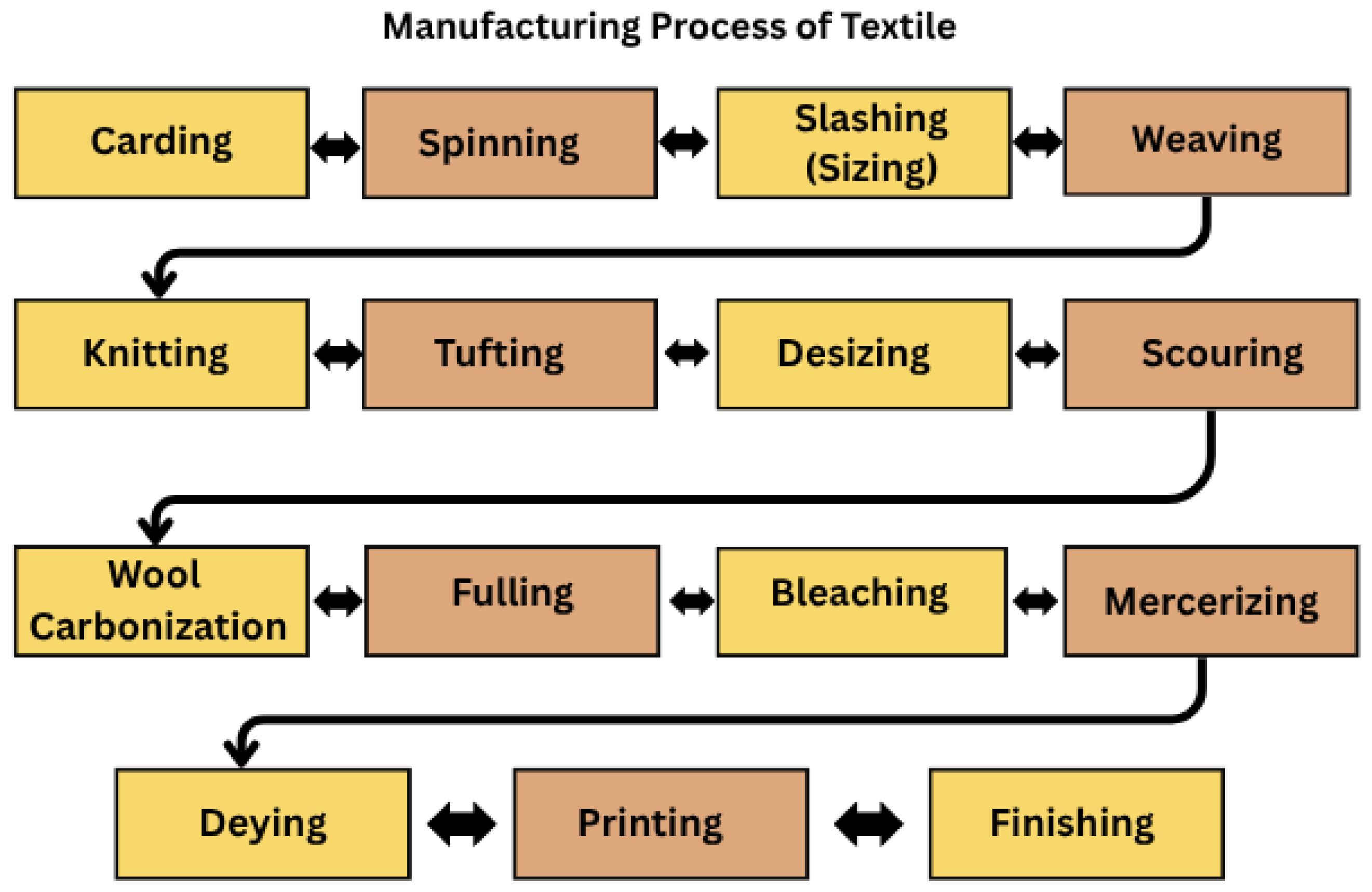
| Process | Nature of Effluent | Typical COD and BOD Levels | Treatment Strategies |
|---|---|---|---|
| Sizing | Starch, waxes, binders, polyvinyl alcohol (PVA) | COD: 1500–3000 mg/L; BOD: 600–1200 mg/L | Enzymatic hydrolysis for starch removal - Screening and sedimentation for suspended solids - Biodegradation for organic binders |
| Desizing | High BOD, COD, turbidity, color | COD: 5000–12,000 mg/L; BOD: 2000–6000 mg/L | Biological treatment (activated sludge, trickling filters) - Coagulation–flocculation - Aerated lagoons |
| Scouring | Suspended solids, high pH, COD, oil, and grease | COD: 3000–8000 mg/L; BOD: 1000–3500 mg/L | Neutralization (acid dosing) - Oil–water separators - Sedimentation and filtration |
| Bleaching | Alkalinity, residual chlorine, medium COD, high TDS | COD: 1000–3000 mg/L; BOD: 100–500 mg/L | Dechlorination (using sodium bisulfite) - Reverse osmosis or nanofiltration - pH adjustment |
| Mercerizing | Alkali content, high pH, low COD and conductivity | COD: 300–800 mg/L; BOD: 50–200 mg/L | Caustic recovery systems - Ion exchange or membrane filtration - Equalization tanks |
| Dyeing | Strongly colored, medium COD, low TDS, heavy metals | COD: 1500–6000 mg/L; BOD: 300–1500 mg/L | Adsorption (activated carbon, biosorbents) - Advanced oxidation processes (AOPs) - Membrane filtration |
| Printing | Pigments, metals, waxes, binders, softeners, urea, thickeners, medium COD | COD: 2000–5000 mg/L; BOD: 500–1500 mg/L | Electrochemical treatment - Photo-catalytic degradation - Foam fractionation and coagulation |
| Metal | Use in the Textile Industry | Health and Environmental Impact | References |
|---|---|---|---|
| Cadmium (Cd) | Used in dyes and coatings | Highly toxic, accumulates in organs, carcinogenic, bioaccumulates in the food chain | [15,16,17,18] |
| Lead (Pb) | Present in compounds like lead nitrate, molybdate, and acetate, used during dyeing | Affects nervous, circulatory, and immune systems; impairs development in children; inhibits plant growth | [17,19] |
| Zinc (Zn) | Used as ZnO in pigments and antimicrobial finishes | Essential in trace amounts; excess causes immune disruption, fertility reduction, which accumulates in crops | [20] |
| Nickel (Ni) | Used in dyeing processes with cobalt and chromium | Causes allergies, fibrosis, organ damage, cancer, and genetic changes | [16] |
| Copper (Cu) | Used in bright-colored pigments | Excess causes nausea, liver/kidney damage, and water pollution; linked to Wilson’s Disease | [21,22] |
| Chromium (Cr) | Catalyst, a mordant for dyeing wool, is used in leather processing | Skin and respiratory carcinogens contribute to major water pollution | [22] |
| Arsenic (As) | Historically used in green dyes; now in residual wastewater | Bioaccumulates in organs, causing cancer, crop toxicity, and needs stricter waste management | [23,24] |
| Country | Textile Process Type | pH | COD (mg/L) | TDS (mg/L) | Pb (mg/L) | Cd (mg/L) | Cr (mg/L) | Cu (mg/L) | Zn (mg/L) | Ni (mg/L) | As (mg/L) | Key Notes | References |
|---|---|---|---|---|---|---|---|---|---|---|---|---|---|
| Bangladesh | Mixed discharge (dyeing + tanning) | 7.6–9.4 | NR | NR | 0.08–4.77 | 0.01–0.16 | 0.04–12.03 | 0.01–0.13 | 0.08–1.02 | 0.01–0.05 | NR | Elevated Pb, Cd, Cr pose health risks | [25] |
| India (Gujarat) | Bleaching, mercerizing, Printing, Washing | 12.3–13.1 | 3926–4449 | 18,720–21,989 | NR | NR | NR | NR | NR | NR | NR | Alkaline effluent with high dissolved solids | [26] |
| Turkey | Dyeing/finishing | 3–5 | NR | NR | 50–500 | NR | NR | NR | NR | NR | NR | Pb concentration increased on dyes addition. | [27] |
| India (South 24 Parganas, West Bengal) | Small-scale textile unit effluents | NR | NR | NR | 0.07–1.84 | NR | NR | NR | 0.07–0.94 | 0.05–0.09 | NR | Severe contamination in real effluent context | [3] |
| Species | Typical Metal Share in Roots | Typical Metal Share in Shoots | References |
|---|---|---|---|
| Lemna minor | ~75–90% of metal mass | ~10–25% | [100,102] |
| Eichhornia crassipes | ~70–90% | ~10–30% | [102,103,104,105] |
| Pistia stratiotes | ~60–80% (often higher) | ~20–40%; in some cases, ~50% | [102,103,106] |
| Aquatic Plant | Key Characteristics | Biogas Yield | Methane Content (%) | Process Optimization and Key Findings | References |
|---|---|---|---|---|---|
| Lemna minor (Duckweed) | High starch, cellulose; rapid growth; low lignin | 1250–10,377 mL total biogas; 390 ± 0.1 mL CH4/g VS | Up to 85.48% (with co-digestion) | 44% higher gas yield; reduced digestion time (~15 days); co-digestion with cow dung enhances methane; integrated bioethanol–biomethane process increases energy output by 70.4% | [147,148,149,150,151,152,153,154] |
| Eichhornia crassipes (Water Hyacinth) | High cellulose and hemicellulose; low lignin; balanced C/N ratio | Up to 812 L/kg VS; 0.36 L/kg VS | 49–68.89% | 5% NaOH pretreatment improves yield (142.61 L/kg VS, 64.59% CH4); co-digestion (swine dung, banana peel, cow dung) enhances methane (~65%); digestate is useful as fertilizer | [136,155,156,157,158,159,160,161] |
| Pistia stratiotes (Water Lettuce) | Moderate lignin concentration, Moderate cellulose; produces VFAs; suitable for phytoremediation | 234–321 mL/g VS; up to 17,570 mL total | 48–79.7% | Acid/enzymatic pretreatment improves biomethane (234 mL/g VS); stable methane production with inoculum; adaptable across 35–65 °C; HSAD systems show high yield | [138,162,163,164,165,166] |
| Parameters | Impact on Biogas Production | References |
|---|---|---|
| Organic Matter Content | Higher organic matter enhances microbial decomposition, increasing biogas yield. | [115] |
| C: N Ratio | Ideal ratio (~20:1–30:1) depending on substrate type supports microbial activity; imbalance leads to ammonia inhibition or nitrogen limitation. | [195] |
| Temperature | Higher temperature boosts gas production but may lower methane content. | [190,202] |
| pH | Optimal pH is crucial; extremes hinder microbial activity and reduce biogas yield. | [193] |
| Retention Time | Adequate time ensures complete decomposition and maximum gas output. | [199] |
| Inhibition | Presence of toxic substances like heavy metals inhibit microbial processes. | [203] |
| Microbial Diversity | A diverse microbial population improves substrate breakdown and gas generation. | [201] |
| Plant Species | Different plants vary in digestibility and biogas potential. | [204] |
| Pretreatment | Methods like chopping or chemical treatment enhance substrate digestibility and gas yield. | [205,206] |
| Heavy Metal | Beneficial Range | Inhibitory Range | Chemical Species (If Known) | Affected Microbial Group | Substrate Type/Context | References |
|---|---|---|---|---|---|---|
| Iron (Fe) | 0.56–1.67 mg/g VS | >5 mg/g VS (excess leads to imbalance) | Fe2+, Fe3+, FeS | Methanogens (enzyme activation) | Organic waste, sludge | [209,212] |
| Nickel (Ni) | 0.005–0.5 mg/L | >10 mg/L | Ni2+ | Methanogens (cofactor in enzymes) | Agricultural waste, manure | [209,230] |
| Cobalt (Co) | 0.01–0.1 mg/g VS | >5 mg/L | Co2+ | Methanogens (vitamin B12 synthesis) | Food waste, sludge | [209] |
| Copper (Cu) | Trace (<1 mg/L) | ~281 mg/L (up to 77% inhibition) | Cu2+ | Methanogens, acidogens | Textile wastewater biomass | [203] |
| Zinc (Zn) | <5 mg/L | >150 mg/L | Zn2+ | Enzymatic systems (general microbes) | Mixed substrates | [217] |
| Chromium (Cr) | Trace amounts | >100 mg/L (35–50% reduction) | Cr3+, Cr6+ (Cr6+ highly toxic) | Methanogens | Industrial effluents | [217] |
| Cadmium (Cd) | None (non-essential) | >1–10 mg/L | Cd2+ | Methanogens (highly toxic) | Contaminated biomass | [216,230] |
| Lead (Pb) | None (non-essential) | >50 mg/L (process instability) | Pb2+ | Methanogens | Phytoremediated plants | [229] |
| Mercury (Hg) | None (non-essential) | >1 mg/L (severe inhibition) | Hg2+, methyl-Hg | Methanogens (enzyme inhibition) | Industrial sludge | [217,231] |
Disclaimer/Publisher’s Note: The statements, opinions and data contained in all publications are solely those of the individual author(s) and contributor(s) and not of MDPI and/or the editor(s). MDPI and/or the editor(s) disclaim responsibility for any injury to people or property resulting from any ideas, methods, instructions or products referred to in the content. |
© 2026 by the authors. Licensee MDPI, Basel, Switzerland. This article is an open access article distributed under the terms and conditions of the Creative Commons Attribution (CC BY) license.
Share and Cite
Hossain, K.; Kar, S.; Hati, D.; Ghosh, A.; Sengupta, S.; Paul, S.; De, A.; RoyChowdhury, A. Impact of Heavy Metal Sequestration During Phytoremediation of Textile Wastewater on Biogas Yield of Aquatic Plants: A Review. Biomass 2026, 6, 34. https://doi.org/10.3390/biomass6030034
Hossain K, Kar S, Hati D, Ghosh A, Sengupta S, Paul S, De A, RoyChowdhury A. Impact of Heavy Metal Sequestration During Phytoremediation of Textile Wastewater on Biogas Yield of Aquatic Plants: A Review. Biomass. 2026; 6(3):34. https://doi.org/10.3390/biomass6030034
Chicago/Turabian StyleHossain, Kaizar, Sayanti Kar, Dipsita Hati, Arpita Ghosh, Sinjini Sengupta, Souvik Paul, Avik De, and Abhishek RoyChowdhury. 2026. "Impact of Heavy Metal Sequestration During Phytoremediation of Textile Wastewater on Biogas Yield of Aquatic Plants: A Review" Biomass 6, no. 3: 34. https://doi.org/10.3390/biomass6030034
APA StyleHossain, K., Kar, S., Hati, D., Ghosh, A., Sengupta, S., Paul, S., De, A., & RoyChowdhury, A. (2026). Impact of Heavy Metal Sequestration During Phytoremediation of Textile Wastewater on Biogas Yield of Aquatic Plants: A Review. Biomass, 6(3), 34. https://doi.org/10.3390/biomass6030034