Review

Phosphorus Recovery from Wastewater in the Circular Economy: Focus on Struvite Crystallization

1
Department of Chemical Technologies, Burgas State University “Prof. Dr. Assen Zlatarov”, 8010 Burgas, Bulgaria
2
Competence Center “Clean Technologies for Sustainable Environment—Water, Waste, Energy for Circular Economy” (Clean&Circle), Burgas State University “Prof. Dr. Assen Zlatarov”, 8010 Burgas, Bulgaria
Biomass 2026, 6(2), 32; https://doi.org/10.3390/biomass6020032
Submission received: 9 March 2026 / Revised: 8 April 2026 / Accepted: 10 April 2026 / Published: 17 April 2026

Abstract

Phosphorus is an essential and finite resource critical for global food production, yet its inefficient use and discharge from wastewater systems contribute to eutrophication and resource depletion. The transition from conventional wastewater treatment plants to water resource recovery facilities has intensified interest in technologies that enable phosphorus recovery within a circular economy framework. This review provides a critical and up-to-date synthesis of phosphorus recovery strategies from wastewater, with primary emphasis on struvite (MgNH4PO4·6H2O) crystallization as one of the most mature and practically implemented recovery routes. The occurrence and chemical forms of phosphorus in wastewater streams are discussed alongside conventional approaches, such as enhanced biological phosphorus removal and chemical precipitation, in order to position struvite recovery within the broader phosphorus management landscape. In addition to struvite crystallization, selected competing and complementary recovery pathways, including electrochemical systems, biochar-assisted processes, and sludge ash recovery, are discussed to compare technological maturity, recovery potential, and practical applicability. Particular attention is given to reactor configurations, full-scale applications, and commercial technologies to assess operational reliability, recovery performance, and fertilizer product quality. Life-cycle assessment results and regulatory developments are also discussed to contextualize sustainability claims, technology selection, and market integration. The review identifies key technical and economic challenges, particularly regarding magnesium supply, competing ions, wastewater matrix effects, and the feasibility of mainstream application. Overall, controlled sidestream struvite crystallization appears to offer the most favorable balance between recovery efficiency, operational reliability, and fertilizer product quality under suitable plant conditions.

1. Introduction

Phosphorus (P) is indispensable for food production and ecosystem functioning, yet its management remains predominantly linear: phosphate rock is mined, processed into fertilizers, applied to land, and ultimately dispersed through losses to waters or immobilized in residual streams. This linearity is increasingly problematic because it couples a finite, geographically concentrated resource with persistent environmental impacts, most notably eutrophication driven by excessive nutrient discharge [1,2,3,4,5]. In parallel, the growing recognition of critical raw material vulnerabilities has strengthened the case for P recycling as a strategic element of long-term food security and resource governance [6,7,8].
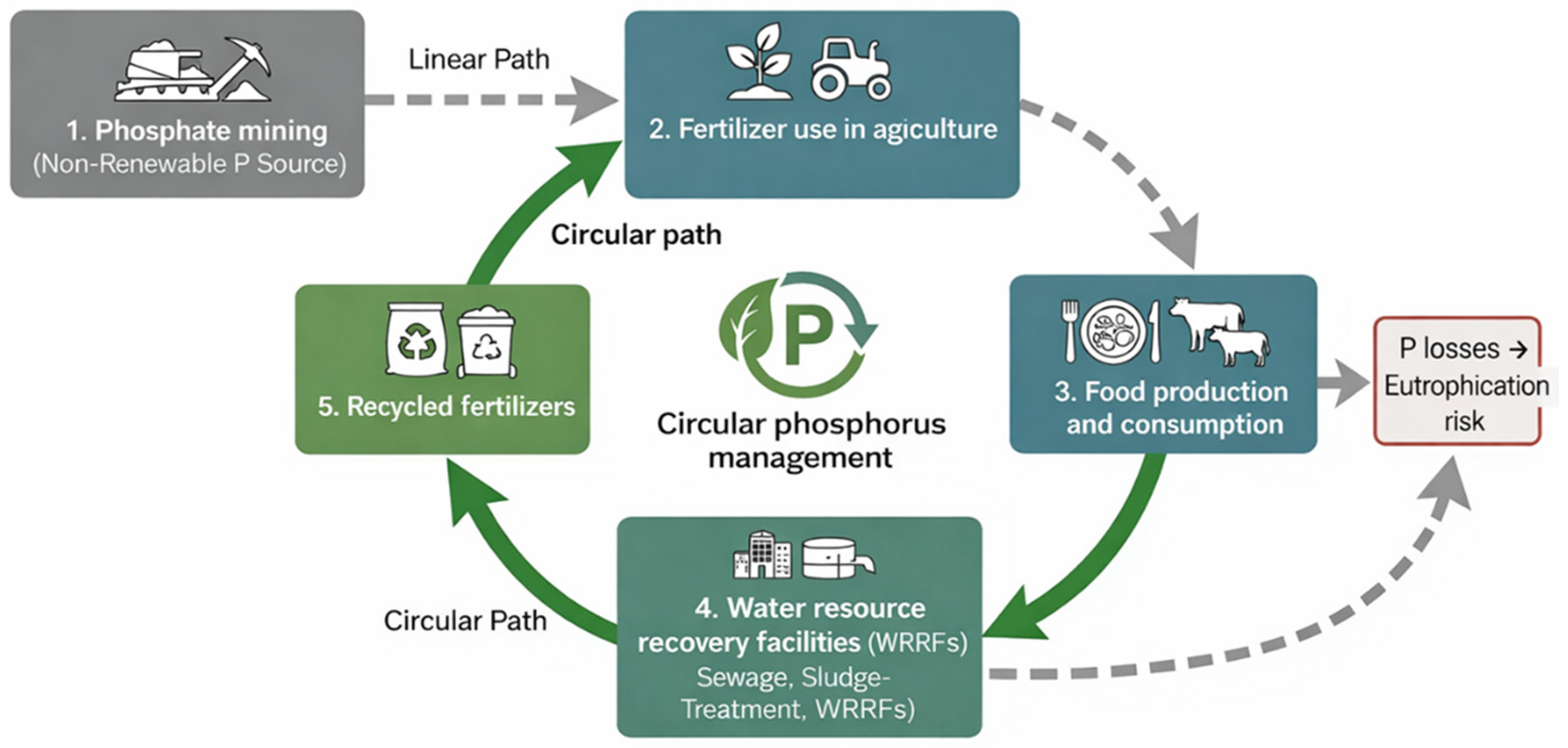
Municipal and industrial wastewaters represent a continuous, locally available secondary phosphorus stream. However, conventional phosphorus removal in wastewater treatment plants (WWTPs) has historically been optimized for compliance rather than recovery. Enhanced biological phosphorus removal (EBPR) and chemical precipitation can achieve low effluent phosphorus concentrations; however, in many systems, phosphorus is largely transferred into sludge-bound forms, where downstream reuse is constrained by variable composition, contaminants, and the costs of further processing [9,10,11,12]. These limitations have supported a broader shift in the field—from treatment-centric WWTPs toward water resource recovery facilities (WRRFs)—where nutrients, energy, and water are recovered as products and services rather than managed as waste [13,14,15,16]. Framed within circular economy thinking, nutrient recovery is increasingly regarded as a core mechanism for closing material loops and reducing primary resource demand [17,18]. In this context, the transition from linear to circular phosphorus management is closely linked to the transformation of WWTPs into WRRFs and to the development of nutrient recovery pathways (Figure 1).
Among phosphorus recovery routes, struvite crystallization (MgNH4PO4·6H2O) is widely regarded as one of the most mature and implementable technologies. Struvite recovery converts dissolved phosphorus into a concentrated, transportable solid; it can mitigate uncontrolled scaling in pipelines and dewatering equipment; and it yields a slow-release fertilizer containing both phosphorus and nitrogen [19,20,21]. Full-scale experience and commercial deployment have demonstrated that struvite recovery performs most robustly in high-strength sidestreams, such as digester supernatant and dewatering centrate/filtrate, where supersaturation potential and process controllability are more favorable than in the mainstream [22,23,24,25,26,27].
Despite its technological maturity, the broader adoption of struvite recovery is still shaped by wastewater matrix effects and system-level constraints. Key practical issues include competition with calcium phosphate formation, sensitivity to organic matter and ionic strength, magnesium sourcing and cost, and the need to ensure consistent product purity and safety for agricultural use [20,28,29,30]. These considerations have become more prominent as research has moved toward intensified and hybrid concepts, including electrochemical magnesium dosing and innovative process integration for nutrient recovery from complex industrial streams [31,32,33]. In parallel, attention has expanded to alternative phosphorus products and routes—particularly recovery from sewage sludge ash (SSA)—which can contribute to phosphorus circularity but differ substantially from struvite in reaction pathway, product characteristics, infrastructure requirements, and deployment context [34,35].
Regulatory frameworks increasingly influence technology selection and the marketability of recovered products. In the European Union, Regulation (EU) 2019/1009 has provided a pathway for placing recovered fertilizers on the market under defined quality and safety criteria, including categories relevant to precipitated phosphate salts and related recovered materials [36,37,38]. This regulatory evolution—together with life-cycle and techno-economic evidence—has shifted the discussion from the technical feasibility of phosphorus recovery toward the identification of routes that can deliver robust environmental and economic value under real plant conditions [23,39,40,41]. Comparative LCA studies further indicate that such conclusions remain sensitive to system boundaries and fertilizer substitution assumptions [35,42].
This review synthesizes recent advances in phosphorus recovery from wastewater, with a primary focus on struvite crystallization, while positioning it against conventional, competing, and complementary recovery pathways. Specifically, it (i) summarizes the physicochemical basis of struvite formation and the operational parameters governing nucleation, crystal growth, and recovery performance; (ii) compares reactor configurations, process control strategies, and commercial implementations, with emphasis on full-scale applicability; (iii) discusses product quality, environmental safety, and agronomic evidence relevant to fertilizer use; and (iv) integrates economic, life-cycle, and regulatory considerations that influence technology selection and deployment [20,24,27,36,40]. By linking process engineering with product acceptance, practical implementation, and policy context, this review aims to support the informed selection and further development of phosphorus recovery strategies aligned with circular economy objectives.
In contrast to broader reviews that address phosphorus recovery in general or focus primarily on individual treatment routes, the present review places struvite crystallization at the center of the analysis within a single WRRF-oriented framework. Its novelty lies in integrating process fundamentals, reactor technologies, implementation evidence, product quality, environmental and economic performance, and regulatory context in order to clarify the practical conditions under which struvite recovery can be considered a robust and scalable strategy for circular phosphorus management.

1.1. Review Scope and Approach

This review is a critical narrative review centered on struvite crystallization as the principal phosphorus recovery route examined in the context of circular wastewater management. Other recovery pathways, including enhanced biological phosphorus removal, chemical precipitation, electrochemical systems, and sewage sludge ash recovery, are included to position struvite against conventional, competing, or complementary approaches and to clarify its practical advantages and limitations. Particular attention is given to reaction principles, process control, reactor configurations, operational constraints, product quality, and full-scale applicability. Recent literature and practically relevant studies are also emphasized to support researchers, engineers, and decision-makers involved in phosphorus recovery and WRRF design.
In this review, the term removal is used for processes that reduce phosphorus concentrations in wastewater without necessarily generating a reusable product, whereas recovery refers to processes that convert phosphorus into a form with potential for reuse, including fertilizer-grade materials such as struvite.

1.2. Literature Search and Review Approach

This manuscript was prepared as a critical narrative review focused on phosphorus recovery from wastewater, with primary emphasis on struvite crystallization and its position relative to competing and complementary recovery pathways. The literature survey was conducted using major scientific databases, including Scopus, Web of Science, and Google Scholar. Particular emphasis was placed on peer-reviewed publications addressing phosphorus occurrence in wastewater, conventional phosphorus removal, struvite chemistry and crystallization, reactor technologies, full-scale and commercial applications, product quality, environmental and economic assessment, and regulatory aspects.
Priority was given to recent literature, especially studies published from 2020 onward, while earlier landmark publications were retained where necessary to provide the conceptual, mechanistic, or technological foundations of the field. Studies were selected and grouped according to their relevance to the main review themes, including phosphorus forms in wastewater, conventional removal versus recovery pathways, struvite formation mechanisms, operational parameters, reactor configurations, product quality, environmental and economic performance, and implementation challenges. Conference abstracts, non-substantiated claims, and sources lacking clear methodological or technical relevance were not prioritized in the comparative discussion.

2. Phosphorus in Wastewater: Sources, Forms, and Environmental Impact

Phosphorus enters wastewater systems from a wide range of anthropogenic and natural sources, primarily through human activities, agricultural practices, and industrial processes. These sources include municipal wastewater, industrial effluents, agro-industrial wastewater, and sludge liquor generated during wastewater treatment. Municipal wastewater is one of the most significant contributors to phosphorus pollution, as phosphorus originates from human excreta, food residues, detergents, and household cleaning products [43,44]. Agricultural runoff also represents a major pathway, particularly in regions with intensive fertilizer use and livestock production, where phosphorus is transported from soils to surface waters and eventually enters wastewater treatment systems [2,45]. In addition, industrial wastewater from food processing, dairy production, fertilizer manufacturing, and chemical industries can contain elevated phosphorus concentrations, depending on the process conditions and raw material composition [10].
The concentration of phosphorus in wastewater varies depending on its origin and treatment stage. Typical total phosphorus concentrations in municipal wastewater range from 4 mg/L to 15 mg/L, whereas agricultural and industrial wastewater streams may contain significantly higher concentrations [44]. The highest phosphorus concentrations are typically observed in sidestream flows, such as sludge dewatering liquors and anaerobic digestion effluents, which are the most suitable targets for phosphorus recovery technologies because they combine elevated phosphate concentrations with comparatively low flow rates and more favorable conditions for process control. Wastewater treatment processes often concentrate phosphorus in sludge streams, digestate, and centrate following anaerobic digestion, where phosphorus concentrations may exceed 100 mg/L, making these streams particularly suitable for recovery [20].
In wastewater systems, phosphorus exists in several chemical forms, including dissolved inorganic phosphorus, organic phosphorus, and particulate-bound phosphorus. Orthophosphate (o-PO43−) is the most abundant, reactive, and readily recoverable form of phosphorus, because it directly participates in biological uptake, chemical precipitation, and crystallization reactions, including struvite formation. Organic phosphorus compounds originate from biological materials, such as cellular components and metabolic byproducts, and require enzymatic or microbial degradation before they become available for recovery or removal [43,46]. Particulate phosphorus is typically associated with suspended solids and biomass and may be released in soluble forms during sludge treatment and digestion [14].
The presence of phosphorus in wastewater has significant environmental implications. When discharged into natural water bodies without adequate treatment, phosphorus acts as a limiting nutrient for algal growth and can accelerate eutrophication, leading to excessive algal blooms, oxygen depletion, and degradation of aquatic ecosystems [4]. Eutrophication negatively affects biodiversity, drinking water quality, and recreational water use and can result in increased water treatment costs and ecosystem instability [3]. Consequently, strict regulations have been implemented in many countries to limit phosphorus discharge from wastewater treatment plants.
Wastewater is a valuable secondary source of phosphorus that can be recovered and reused, thereby reducing reliance on finite phosphate rock resources. The recovery of phosphorus from wastewater contributes to resource conservation, environmental protection, and circular economy implementation by converting waste streams into valuable products [6,13,47]. Consequently, wastewater treatment plants are increasingly being transformed into water resource recovery facilities (WRRFs), where phosphorus recovery is integrated into the treatment processes to promote resource efficiency and environmental sustainability. From a recovery perspective, the most important distinction is between phosphorus that remains dispersed in mainstream flows and phosphorus that becomes concentrated in sludge-line sidestreams, where direct recovery is more feasible [27,48].
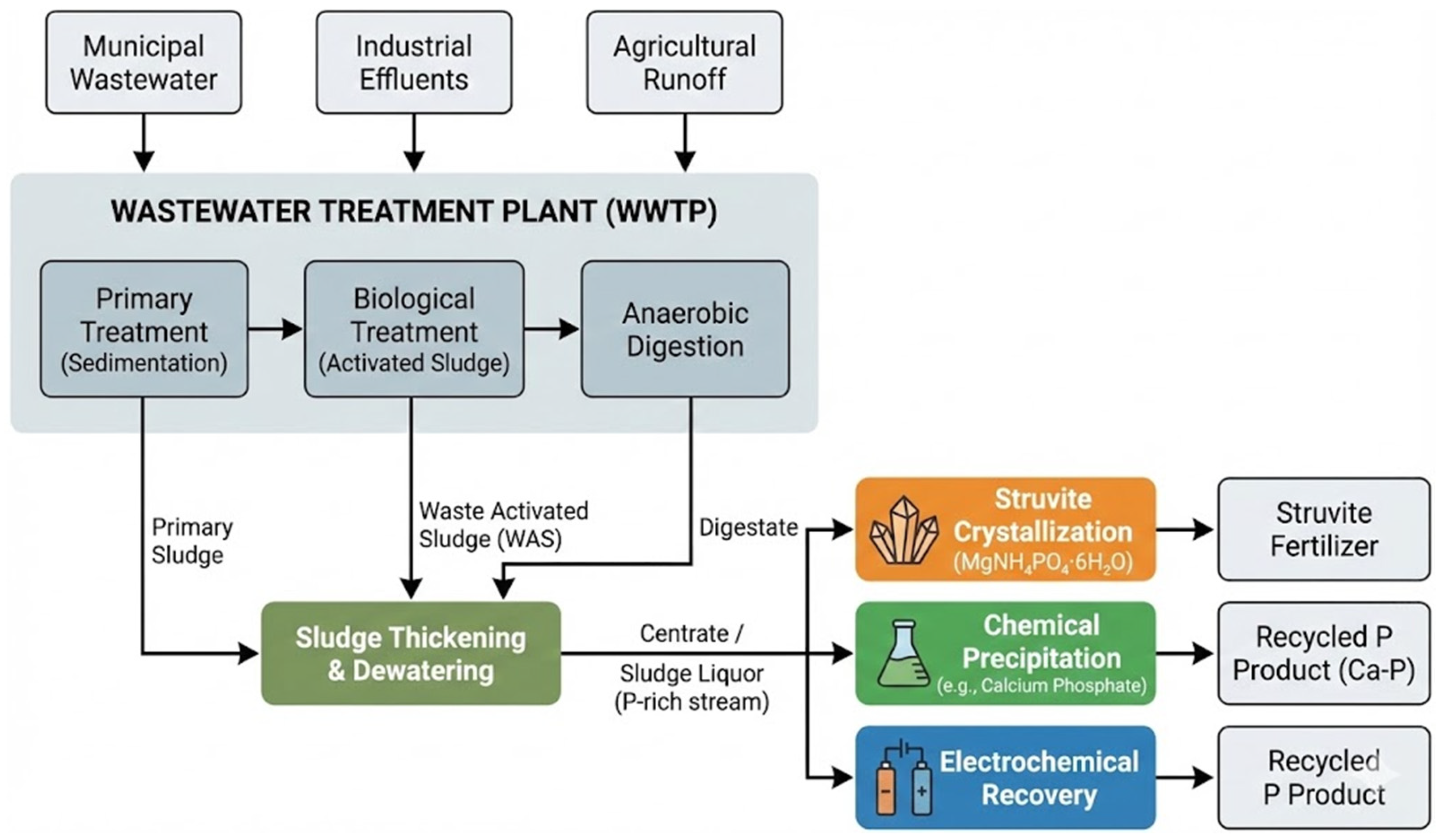
The main phosphorus pathways and recovery opportunities within wastewater treatment plants are illustrated in Figure 2, which highlights the key streams suitable for phosphorus recovery, particularly sludge liquors, digestate, and centrate. Significant phosphorus concentrations are typically found in digested sludge and waste streams, which are key for recovery technologies such as struvite crystallization.
To provide a concise overview of where phosphorus is concentrated within wastewater treatment systems, Table 1 summarizes major WWTP/WRRF process streams, reporting indicative phosphorus concentration ranges, dominant phosphorus forms, and associated recovery potential. The table distinguishes between indirect recovery (phosphorus primarily retained in solids and requiring downstream processing) and direct recovery from P-rich sidestream liquors (e.g., centrate/filtrate or digester supernatant), which typically offer the most favorable conditions for crystallization-based routes such as struvite formation.
As shown in Table 1, phosphorus concentrations vary markedly across WWTP/WRRF streams. The highest direct recovery potential is associated with P-rich sidestream liquors generated during digestion and dewatering, where phosphorus is predominantly present as dissolved orthophosphate. These streams offer favorable conditions for crystallization-based recovery, particularly struvite precipitation, due to elevated phosphate (and often ammonium) concentrations, comparatively smaller flow rates than the mainstream, and the greater feasibility of controlling supersaturation and product formation.

3. Conventional Phosphorus Removal and Recovery Technologies

Phosphorus removal from wastewater is conventionally implemented to mitigate eutrophication and protect aquatic ecosystems. Conventional wastewater treatment systems are primarily designed to reduce phosphorus concentrations in treated effluents rather than enable phosphorus recovery and reuse. In conventional wastewater treatment plants, a large fraction (often reported as ~80–95%) of the influent phosphorus is typically transferred to sewage sludge rather than recovered as a reusable product, limiting its contribution to resource circularity [23,44,49]. The two principal approaches for phosphorus removal are enhanced biological phosphorus removal (EBPR) and chemical precipitation, both of which are widely applied in municipal wastewater treatment plants worldwide [22,50,51].
Although these conventional technologies are highly effective in reducing phosphorus discharge, P transferred to sludge is rarely converted into reusable products. Increasing concerns regarding phosphorus resource depletion and environmental sustainability have driven interest in technologies that enable both phosphorus removal and recovery [2,25].

3.1. Enhanced Biological Phosphorus Removal

Enhanced biological phosphorus removal is a widely implemented process that utilizes specialized microbial populations, known as polyphosphate-accumulating organisms (PAOs), to remove phosphorus from wastewater. These microorganisms accumulate phosphorus intracellularly as polyphosphates, allowing phosphorus removal through the separation and disposal of excess sludge [11,44].
The EBPR process relies on alternating anaerobic and aerobic conditions. Under anaerobic conditions, PAOs release phosphorus into the liquid phase while assimilating readily biodegradable organic substrates. During the subsequent aerobic phase, PAOs uptake phosphorus in excess of their metabolic requirements and store it intracellularly, resulting in net phosphorus removal from wastewater [11,52]. This mechanism enables phosphorus removal without routine chemical dosing, thereby reducing reagent consumption and, in some cases, operational costs.
Despite these advantages, EBPR performance is strongly influenced by operational parameters, such as temperature, pH, sludge retention time, and the availability of biodegradable carbon sources [12]. Lower temperatures and insufficient readily biodegradable carbon can reduce PAO activity and favor competing populations, including glycogen-accumulating organisms (GAOs), thereby lowering phosphorus uptake efficiency. Sludge retention time and pH also influence microbial selection, phosphorus release and uptake kinetics, and the stability of biological phosphorus removal, which explains why EBPR performance can vary substantially between plants and operating regimes [11]. Furthermore, phosphorus removed through EBPR is primarily stored in sludge, and subsequent sludge treatment processes, particularly anaerobic digestion, may release phosphorus back into the liquid phase. Although this release presents challenges for process stability, it also creates opportunities for phosphorus recovery from sludge liquor [20,22,25]. In practice, this relationship is especially important because EBPR-enriched sludge can become a favorable precursor for sidestream struvite recovery after anaerobic digestion and dewatering. Under these conditions, phosphorus released from polyphosphate-rich biomass enters centrate or filtrate streams together with elevated ammonium concentrations, creating the high-strength sidestream environment in which struvite crystallization is most commonly implemented at full scale [22,23,24]. Thus, EBPR is not itself a struvite recovery technology, but it can indirectly support struvite formation by shifting phosphorus into sludge phases that later generate recoverable sidestream liquors.
Although EBPR is effective for phosphorus removal, phosphorus remains bound within the biomass and is not directly recovered. Recovery typically requires additional downstream processing steps, such as sludge digestion followed by struvite precipitation or chemical extraction, highlighting that EBPR alone is primarily a phosphorus removal rather than a phosphorus recovery technology [22,23].

3.2. Chemical Precipitation

Chemical precipitation is one of the most widely used and reliable methods for removing phosphorus from wastewater. This process involves the addition of metal salts, typically iron, aluminum, or calcium compounds, which react with dissolved phosphate ions to form insoluble precipitates that can be removed through sedimentation [44].
Typical precipitation reactions are as follows:
Fe3+ + PO43− → FePO4
Al3+ + PO43− → AlPO4
Ca2+ + 2PO43− → Ca3(PO4)2
Chemical precipitation can achieve phosphorus removal efficiencies exceeding 95% under optimized conditions and is widely applied because of its operational simplicity and reliability [23,25,50,51]. Its continued widespread use is largely explained by its robustness, ease of retrofit into existing treatment trains, and predictable compliance performance under variable wastewater conditions. This process is effective under a wide range of operational conditions and is commonly used in combination with biological treatment processes.
However, in contrast to crystallization-based recovery processes, chemical precipitation produces amorphous or poorly crystalline metal phosphates with low agronomic value and limited reuse potential. Consequently, this approach is considered effective for pollution control but inefficient for phosphorus resource recovery within the circular economy framework [49,53]. This distinction is central to the comparison with struvite crystallization. Whereas conventional Fe- or Al-based precipitation mainly immobilizes phosphorus for discharge compliance, struvite recovery aims to convert dissolved phosphorus into a concentrated and reusable fertilizer product. For this reason, chemical precipitation remains widely applied where reliable effluent control is the primary objective, while struvite crystallization is more attractive in sidestreams where recovery as a marketable product is technically and economically more feasible.

3.3. Phosphorus Recovery from Sewage Sludge and Sludge Ash

A substantial fraction of the phosphorus captured during wastewater treatment is transferred to sewage sludge. Consequently, sludge-derived streams constitute a key leverage point for shifting from phosphorus removal to recovery and product generation. In practice, two main recovery routes are applied: (i) recovery from sludge liquors generated during anaerobic digestion and dewatering, and (ii) recovery from sewage sludge ash (SSA) following sludge incineration [22,23].

3.3.1. Recovery from Sludge Liquors

Phosphorus release during anaerobic digestion and subsequent sludge dewatering produces centrate/filtrate streams with elevated orthophosphate and ammonium concentrations, creating favorable conditions for controlled crystallization processes. These sidestream liquors are widely recognized as the most practical entry point for nutrient recovery in WRRFs because they combine high supersaturation potential with comparatively low reactor volumes and predictable hydraulic loading [23,54]. Struvite crystallization is particularly suited to these streams, as it enables the recovery of dissolved phosphorus in a concentrated, transportable form, while simultaneously mitigating scaling and operational fouling associated with uncontrolled precipitation [22,24,27]. This is one of the clearest practical examples of how a conventional treatment pathway and a recovery technology become linked: phosphorus initially captured in sludge during biological or chemical treatment may later reappear in digestion and dewatering liquors, where it becomes directly recoverable as struvite. In this sense, sidestream crystallization does not replace upstream phosphorus removal processes, but rather valorizes the phosphorus they transfer into sludge-derived liquid streams. Nevertheless, recovery performance remains sensitive to matrix effects such as calcium competition, organic matter, and ionic strength, which can shift precipitation toward calcium phosphates or reduce crystal quality [30]. Compared with ash-based routes, recovery from sludge liquors is more directly compatible with struvite crystallization because phosphorus is already present in a dissolved and more immediately recoverable form, avoiding the additional extraction steps required for SSA processing.

3.3.2. Phosphorus Recovery from Sewage Sludge Ash

For systems where sludge incineration is practiced, SSA represents an additional strategic resource recovery route [35,55]. Incineration substantially reduces the sludge mass and volume (often by 70–90%) while concentrating phosphorus in the ash. The phosphorus content of SSA is commonly reported to be in the range of approximately 10–25% P2O5, although the exact value depends on the sludge origin and incineration conditions [34,35]. However, phosphorus in SSA frequently occurs in mineral phases with limited solubility (e.g., various calcium phosphates and iron-associated forms), which necessitates further processing to produce plant-available or fertilizer-grade products.
Current SSA processing technologies can be grouped into wet-chemical and thermochemical routes.
  • Wet-chemical leaching.
Wet-chemical recovery relies on acid extraction (commonly H2SO4, HCl, or H3PO4) to solubilize phosphorus, often achieving high extraction efficiencies that may exceed 90%. A critical limitation is the simultaneous dissolution of heavy metals (e.g., Cd, Pb, and Cu), which requires downstream purification steps to meet fertilizer safety criteria. Industrial concepts, such as EcoPhos, address this challenge through multistage treatment (e.g., selective precipitation and/or ion-exchange polishing) to generate higher-quality phosphate products [34,54].
  • Thermochemical recovery.
Thermochemical approaches treat SSA at elevated temperatures (typically 800–1000 °C), often in the presence of chloride-based additives (e.g., MgCl2 or CaCl2). These processes can volatilize or separate heavy metals while transforming phosphorus into more bioavailable mineral phases (e.g., renanite-type phases), thereby improving the agronomic usability of the product. Demonstrated examples include AshDec and Mephrec. The principal trade-off is the higher energy demand and associated operating cost compared with wet leaching, although the process can reduce liquid waste generation and simplify product handling [34,35].
Thus, SSA recovery represents an important but technologically distinct route to phosphorus circularity: unlike struvite crystallization, it typically relies on post-incineration extraction and purification and is therefore more dependent on incineration infrastructure, chemical input, and downstream product upgrading.
Compared with sidestream struvite recovery, SSA-based routes therefore represent a less direct pathway from wastewater to reusable phosphorus products. Their practical relevance is highest in systems where mono-incineration is already established, whereas struvite crystallization is generally better aligned with WRRF configurations that seek direct sidestream recovery before phosphorus is locked into ash-derived mineral phases.

3.3.3. Integrated Environmental and Economic Considerations

From a system perspective, SSA-based recovery is a classic example of technology trade-offs. Wet-chemical routes may provide high phosphorus yields but can generate chemical consumption burdens and secondary liquid residues that require management. Thermochemical routes often deliver cleaner, fertilizer-compatible solids and improved heavy-metal control, but at the expense of higher energy intensity. Recent integrated assessments emphasize that the preferred route is context-dependent and should be evaluated against local energy prices, ash quality, contaminant constraints, and the value chain for fertilizer products [23,35]. Accordingly, SSA recovery should be framed not as a universal replacement for sidestream crystallization, but as a complementary option in WRRF portfolios—particularly relevant where mono-incineration is established and policy incentives support ash-derived nutrient products.

3.4. Limitations of Conventional Phosphorus Removal Approaches

Although phosphorus recovery technologies have advanced markedly in the last decade, their real-world applicability is still shaped by interacting constraints that extend beyond reactor performance. Limitations arise from wastewater and sludge matrix effects, chemical demand and sourcing, process integration into existing WWTP layouts, and requirements for product quality, marketability, and regulatory compliance [22,23]. Importantly, the same plant may experience different bottlenecks depending on whether recovery is implemented in the mainstream, high-strength sidestreams (e.g., centrate/filtrate), or via sludge/ash processing routes.
In biological and chemical removal pathways, the central limitation is that phosphorus is typically transferred into sludge rather than recovered as a marketable product. EBPR performance depends on stable operational conditions and influent characteristics (e.g., availability of readily biodegradable carbon), whereas chemical precipitation is robust for compliance but increases sludge production and can reduce downstream recovery potential because phosphorus becomes bound in metal-phosphate forms [9,10,11,52]. Consequently, additional processing steps are required to convert sludge-bound phosphorus into reusable fertilizers or industrial feedstocks [22,54]. This is precisely why struvite crystallization occupies a distinct position among phosphorus management options: rather than merely transferring phosphorus into residual solids, it can recover dissolved phosphorus directly from suitable sidestream liquors as a reusable product, provided that matrix effects and process conditions remain favorable.
The limitations for struvite crystallization are more closely linked to physicochemical controls and matrix effects. Competing precipitation, particularly with calcium phosphates, can reduce the fraction of phosphate available for struvite formation and may compromise product purity and settling behavior [20,29]. Chemical demand—especially magnesium dosing—and the choice of magnesium source can strongly influence operating costs and the overall environmental footprint of recovery [23,39]. In addition, successful long-term operation depends on reactor hydrodynamics, solids handling, and robust separation of the crystallized product; insufficient control can lead to fine formation, fouling, or unstable recovery performance [19,22]. While sidestream applications have demonstrated reliable full-scale implementation, mainstream recovery remains more challenging because of lower phosphate concentrations and limited supersaturation [23].
Sludge- and ash-based recovery routes face different constraints. Wet-chemical extraction can achieve high phosphorus dissolution; however, it often requires substantial chemical consumption and generates secondary liquid residues; additionally, the co-extraction of heavy metals necessitates purification steps to meet fertilizer safety requirements [34,54]. Thermochemical ash treatment may improve heavy-metal control and yield more standardized products; nevertheless, it typically involves higher energy demands and dedicated infrastructure, rendering its feasibility strongly site-dependent [34,35]. Consequently, ash-based recovery is best evaluated as part of a broader WRRF strategy that reflects local sludge management, energy context, and policy incentives rather than as a stand-alone solution.
Table 2 summarizes the main phosphorus removal and recovery pathways, including their mechanisms, indicative performances, recovery potentials, and key constraints. It should be noted that while conventional compliance-oriented chemical precipitation is generally associated with low direct recovery potential, calcium-based precipitation routes may, under selected conditions, support the formation of recoverable phosphate products such as hydroxyapatite.
Overall, these limitations indicate that phosphorus recovery cannot be treated as a universal “add-on” technology. Instead, the selection and design should be guided by stream characteristics (mainstream vs. sidestream), sludge management infrastructure (digestion, dewatering, incineration), product requirements (purity and handling), and the local regulatory and market context that determines whether recovered materials can be used as fertilizers [36,37,40]. This framing provides the basis for the subsequent sections, which examine the underlying chemistry and process designs—particularly for struvite crystallization—and the conditions under which recovery strategies can be translated from laboratory studies to robust full-scale practice.

3.5. Summary of Conventional Phosphorus Removal and Recovery Approaches

Conventional phosphorus removal strategies, most notably, EBPR and chemical precipitation, are effective for meeting discharge limits, but they remain primarily compliance-oriented because they transfer phosphorus into sludge rather than directly recover it as a reusable product [56]. By contrast, sidestream struvite crystallization becomes feasible when phosphorus is present in dissolved, concentrated form in digestion and dewatering liquors, and SSA-based recovery becomes relevant mainly where incineration infrastructure already exists. Sludge- and ash-based recovery routes can achieve higher overall recovery yields; however, they typically rely on additional processing steps, chemical inputs, and/or energy-intensive infrastructure, and their feasibility is strongly site-dependent. These constraints have increased interest in crystallization-based nutrient recovery, particularly struvite crystallization, which enables the direct conversion of dissolved phosphorus into a concentrated, transportable solid with established full-scale experience. Under real plant conditions, sidestream struvite crystallization currently provides the clearest route to a concentrated and potentially marketable phosphorus product. This provides the rationale for the following section, which focuses on the fundamental principles, operating parameters, and reactor configurations governing struvite formation and recovery.

4. Struvite Crystallization for Phosphorus Recovery

4.1. Chemistry and Fundamental Principles of Struvite Formation

Struvite crystallization has emerged as one of the most effective and widely implemented technologies for phosphorus recovery from wastewater, enabling the direct conversion of dissolved phosphate into a reusable fertilizer product. Struvite, chemically known as magnesium ammonium phosphate hexahydrate (MgNH4PO4·6H2O), forms under supersaturated conditions in aqueous environments containing magnesium, ammonium, and phosphate ions and represents a thermodynamically stable mineral phase under alkaline conditions [19,20,25,57].
Struvite formation is governed by thermodynamic and kinetic principles, particularly supersaturation, which is the driving force for nucleation and crystal growth. Struvite precipitation occurs when the ionic activity product (IAP) of magnesium, ammonium, and phosphate exceeds the solubility product constant (Ksp), resulting in thermodynamically favorable crystallization [58,59]. The reported Ksp values for struvite range from 10−13 to 10−14; however, the apparent solubility behavior depends on factors such as temperature, ionic strength, pH, and overall solution composition, which can influence precipitation under real wastewater conditions [60,61].
Struvite crystallization involves two main stages: nucleation and crystal growth. Nucleation refers to the formation of stable crystal nuclei from dissolved ions, which occurs when supersaturation exceeds a critical threshold. Crystal growth subsequently occurs via the incorporation of ions into the crystal lattice, resulting in the formation of larger and well-defined crystals [58,62]. The relative dominance of nucleation versus crystal growth determines the size distribution and morphology of struvite crystals, which directly affects the recovery efficiency and downstream handling.
Struvite has significant agronomic value because it contains three essential plant nutrients: phosphorus, nitrogen, and magnesium. Its low solubility enables slow and controlled nutrient release, reduces nutrient losses through leaching, and improves fertilizer efficiency compared with highly soluble phosphate fertilizers [49,63,64]. These characteristics make struvite an attractive product for sustainable fertilizer production and circular nutrient management systems.

4.2. Factors Influencing Struvite Crystallization

Struvite crystallization is influenced by several physicochemical and operational parameters, including pH, ion concentration, supersaturation, temperature, hydrodynamic conditions, and the presence of competing ions [27,65]. These factors determine the thermodynamic feasibility and kinetic rate of crystallization, ultimately affecting phosphorus recovery efficiency. In practice, these parameters govern not only whether struvite precipitates, but also the extent of phosphorus recovery, crystal size distribution, separation efficiency, and the agronomic quality of the recovered product.
Among these parameters, pH is one of the most critical because it influences both phosphate speciation and struvite solubility. Optimal struvite precipitation typically occurs within a pH range of 7.5–9.5, where phosphate species favorable for precipitation, particularly PO43− and HPO42−, are present in sufficient concentrations [20,27,60,66]. At lower pH values, increased struvite solubility limits crystallization, whereas excessively high pH values may promote competing precipitation reactions. For example, sidestream liquors from anaerobic digestion are commonly adjusted into this pH window because recovery performance is otherwise limited by higher apparent solubility at lower pH or by increased competition with other mineral phases at excessively alkaline conditions [20,27,60,66].
The molar ratios of magnesium, ammonium, and phosphate are other key factors that influence crystallization efficiency. Although a stoichiometric ratio of 1:1:1 is theoretically sufficient, excess Mg is commonly applied to ensure complete precipitation and overcome kinetic limitations [19,58,67,68]. Magnesium is often supplied as MgCl2, MgSO4, or MgO, depending on the process conditions and economic considerations. Supersaturation is the primary driving force for crystallization and controls both nucleation and crystal growth kinetics. High supersaturation levels favor rapid nucleation, resulting in the formation of numerous small crystals, whereas moderate supersaturation promotes controlled crystal growth and the formation of larger crystals, which are suitable for efficient separation and fertilizer production [60,62,65]. Accordingly, optimal recovery is not defined solely by the amount of phosphorus precipitated, but also by the formation of crystals that can be efficiently harvested and reused as a fertilizer product. This distinction is important in practice: operating conditions that produce very fine crystals may still remove phosphorus from solution, but they do not necessarily deliver efficient phosphorus recovery if the product cannot be separated, handled, and reused [60,62,65,67].
Temperature also affects the crystallization kinetics and solubility. Although struvite solubility decreases slightly with increasing temperature, temperature primarily influences reaction kinetics and crystal growth rates rather than equilibrium solubility [27,58]. The presence of competing ions, particularly calcium, may inhibit struvite crystallization by promoting the formation of calcium phosphate minerals and reducing phosphorus recovery efficiency. These interactions highlight the importance of wastewater composition in determining crystallization performance. Hydrodynamic conditions, including mixing intensity and reactor flow patterns, also influence crystallization. Controlled mixing enhances mass transfer and promotes crystal growth, while excessive mixing may increase secondary nucleation and result in smaller crystals [26,67,69]. A representative example is calcium-rich wastewater, where competing calcium phosphate precipitation may reduce the phosphorus fraction available for struvite formation and thereby lower selective recovery. Likewise, under poorly controlled supersaturation and mixing conditions, phosphorus may still precipitate, but predominantly as fines that are difficult to harvest, illustrating that crystallization conditions control recovery quality as well as recovery extent [26,27,30,67].

4.3. Electrochemical Phosphorus Recovery and Bio-Electrochemical Systems

Electrochemical phosphorus recovery is an emerging route that is particularly relevant to struvite recovery because it enables controlled magnesium release and localized pH adjustment without external chemical dosing, thereby facilitating in situ struvite precipitation [70,71,72]. In electrochemical systems, Mg ions are generated directly from sacrificial Mg anodes through anodic oxidation, whereas cathodic reactions produce hydroxyl ions, thereby increasing the local pH and promoting struvite precipitation [73,74,75,76]. This makes electrochemical systems particularly attractive for streams in which reagent dosing is undesirable or where tighter control of local precipitation conditions is needed. In this review, electrochemical systems are discussed specifically because they can function as an enabling route for struvite-based phosphorus recovery rather than merely as an unrelated phosphorus removal technology. Their relevance lies in the fact that they may convert dissolved phosphate into recoverable struvite by simultaneously supplying Mg2+ and creating localized alkaline conditions favorable for crystallization [70,71,72,73,74,75,76].
Despite these advantages, electrochemical phosphorus recovery remains subject to several practical limitations. Its performance depends on electrical energy demand, sacrificial anode consumption, electrode passivation or fouling, and sensitivity to wastewater matrix composition, including competing ions and variable conductivity. In addition, although electrochemical systems are promising for process intensification and selective nutrient recovery, their long-term scale-up potential under full-scale wastewater treatment conditions is still less established than that of sidestream struvite crystallization in conventional reactor systems. For this reason, electrochemical systems should presently be interpreted as promising struvite-enabling or struvite-intensifying approaches rather than as broadly established standalone recovery solutions.
One of the key advantages of the electrochemical method is its effectiveness in treating specific industrial wastewater streams. For example, recent studies have demonstrated the successful extraction of struvite from wastewater in the dairy industry (cheese whey wastewater) through an electrolysis process, achieving high product purity [31]. Optimizing the current density and electrode configuration reduces operating costs and minimizes side effects, such as anode passivation [76]. This example illustrates the practical connection between electrochemical process control and phosphorus recovery as struvite: the objective is not only to remove phosphorus from the liquid phase, but to recover it in a crystalline and reusable form. Accordingly, electrochemical systems are relevant to the present review insofar as they intensify or support struvite formation under conditions where conventional reagent-based dosing may be less attractive [31,70,76].
In the context of biorefineries, bioelectrochemical systems (BESs), such as microbial fuel cells (MFCs) and microbial electrolysis cells (MECs), represent the next step in sustainable development. These systems use the metabolism of electroactive bacteria to convert chemical energy from organic waste directly into electricity or hydrogen, while facilitating the extraction of nutrients [77,78]. The integration of these processes allows for the simultaneous treatment of carbon pollution and the recovery of phosphorus and nitrogen in the form of struvite, which significantly improves the energy balance of treatment plants [75,79].
Although electrochemical struvite-oriented phosphorus recovery has high potential, its large-scale application is limited by challenges such as high energy consumption and the cost of magnesium anodes. However, comparative analyses have shown that these costs may in some cases be partially offset by reduced chemical logistics and the potential production of higher-quality recovered products [41].
The main factors affecting struvite crystallization and phosphorus recovery efficiency are summarized in Table 3.

4.4. Sources of Struvite Formation in Wastewater Treatment Plants

Struvite formation commonly occurs in phosphorus-rich sidestreams of wastewater treatment plants, particularly in anaerobic digestion effluents, sludge dewatering liquors, and centrate/filtrate streams. These streams contain elevated concentrations of ammonium and phosphate released during sludge digestion, creating favorable conditions for spontaneous or controlled struvite crystallization [23,25].
Uncontrolled struvite precipitation may cause operational problems, including scaling, clogging, and equipment fouling, resulting in increased maintenance costs and reduced operational efficiency [19]. Controlled crystallization allows wastewater treatment plants to convert this operational challenge into an opportunity for phosphorus recovery and fertilizer production.
Reported full-scale applications in phosphorus-rich sidestreams have shown recovery efficiencies that may reach 80–95% under favorable and controlled conditions, although the reported values depend on stream composition, process design, and the definition of recovery used [23,24,54].

4.5. Advanced Nutrient Recovery Using Modified Biochars

Biochar-assisted crystallization represents an advanced strategy for enhancing phosphorus recovery efficiency while simultaneously valorizing biomass waste. In this context, biochar does not replace struvite recovery, but acts as a support material that can improve nucleation, crystal growth, and nutrient capture within struvite-centered recovery systems [80,81,82]. Biochar provides a highly porous structure and functional surface groups that serve as nucleation sites, promoting controlled crystal growth and improving recovery efficiency [32,83].
Recent studies have highlighted the potential of modified biochars to overcome the economic barriers of traditional struvite precipitation. In particular, the use of Mg-impregnated biochars allows for the simultaneous recovery of phosphorus and nitrogen from complex waste streams, such as food wastewater and sewage sludge ash [84]. In addition to magnesium salts, the use of MgO-modified biochars derived from animal manure or agricultural residues has shown exceptional efficiency in treating high-strength wastewater (e.g., swine wastewater), achieving phosphorus recovery rates exceeding 95% [85,86]. Modification of biochar surfaces through steam or KOH activation significantly increases porosity and surface area, enhancing the ion-exchange capacity and providing more nucleation sites for struvite growth [32,87].
A key advantage of this approach is the creation of a biochar–struvite composite, which functions as a superior slow-release fertilizer. Unlike pure struvite, these composites benefit from the porous structure of biochar, which improves soil water retention and promotes long-term carbon sequestration [88,89]. The porous matrix acts as a habitat for beneficial soil microorganisms, enhancing microbial activity in the rhizosphere and further improving nutrient bioavailability [21]. Furthermore, the synergy between biochar and struvite reduces nutrient leaching and stabilizes heavy metals potentially present in waste streams, making it a safer and more environmentally friendly alternative to conventional mineral fertilizers [90,91].
From an industrial perspective, using sawdust, straw, or even sewage sludge to produce biochar for nutrient recovery closes the loop in a wastewater biorefinery model [32]. This integrated approach not only reduces the costs associated with magnesium salts but also valorizes multiple waste streams simultaneously, aligning with the “waste-to-resource” paradigm [15,31].
Despite these promising results, biochar-assisted phosphorus recovery remains subject to several limitations. Product performance may vary substantially with feedstock type, pyrolysis conditions, surface modification, and wastewater composition, which affects reproducibility and product consistency. In addition, impurity transfer, uncertainty regarding regeneration or reuse, and the still limited evidence beyond laboratory and pilot-scale studies mean that these systems should currently be regarded as promising but not yet broadly established recovery approaches. These considerations are particularly important when biochar-based systems are discussed in relation to fertilizer production, where standardization, contaminant control, and market acceptance are critical.

4.6. Reactor Technologies for Struvite Crystallization

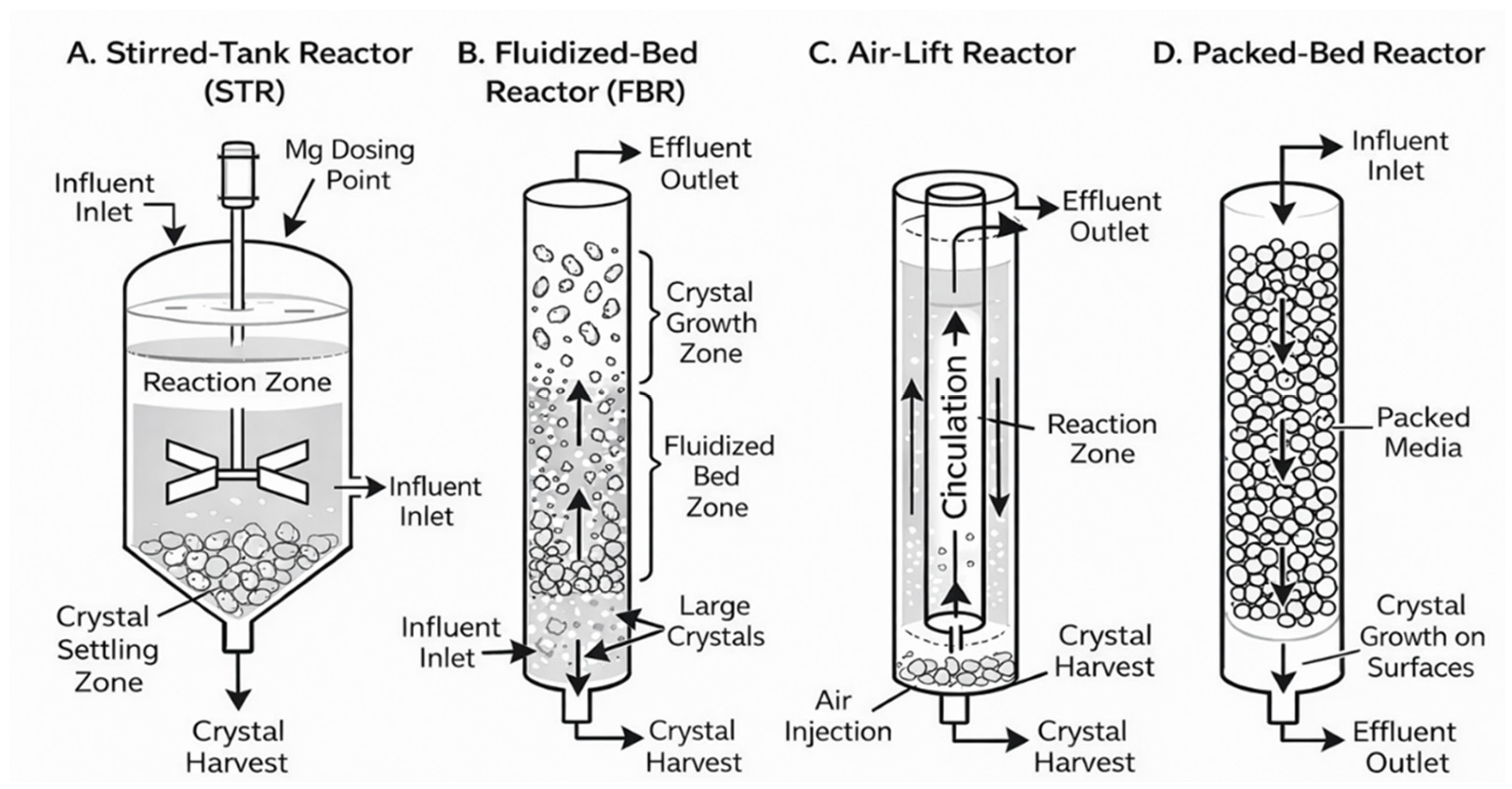
The reactor configuration plays a critical role in determining the crystallization efficiency, crystal size distribution, and process stability. Various reactor designs have been developed to promote controlled crystallization, including stirred tank reactors, fluidized bed reactors, air-lift reactors, and packed-bed systems [20,23,67]. A schematic comparison of the main reactor configurations used for struvite crystallization is presented in Figure 3.
Among these configurations, fluidized bed reactors (FBRs) have become the preferred technology because of their ability to promote controlled crystal growth and produce large, uniform crystals suitable for fertilizer applications [92,93,94]. This practical preference is consistent with full-scale implementation, where reactor stability, continuous harvesting, and production of marketable crystals are critical design criteria. These configurations provide optimal hydrodynamic conditions that balance nucleation and crystal growth while enabling continuous crystal harvesting [25,54].
Several full-scale commercial technologies have been developed, including the Ostara Pearl, AirPrex, and NuReSys systems, which utilize fluidized bed crystallization to recover phosphorus in the form of high-quality struvite fertilizer [23,54].
Although fluidized-bed reactors are generally preferred for full-scale struvite recovery because they promote controlled crystal growth and continuous harvesting of relatively large particles, other reactor configurations may be advantageous under specific operating conditions. Stirred-tank systems may offer greater simplicity and flexibility in pilot-scale or batch-oriented applications, but they more often generate fine crystals and impose higher demands on downstream solids separation. Air-lift reactors can provide lower shear and energy-efficient circulation, whereas packed-bed systems may support heterogeneous nucleation but are more sensitive to clogging, channeling, and solids accumulation. Reactor selection therefore depends not only on phosphorus recovery efficiency, but also on supersaturation control, crystal size distribution, harvestability, hydraulic loading, solids separation requirements, and operational simplicity.

4.7. Advantages and Limitations of Struvite Crystallization

Struvite crystallization offers several advantages over conventional P removal technologies. These include high P recovery efficiency, production of a valuable fertilizer product, reduction of operational problems associated with uncontrolled scaling, and alignment with circular economy principles. Struvite has demonstrated agronomic effectiveness comparable to conventional P fertilizers, with the added benefit of slow nutrient release and reduced environmental impact [49,64].
However, several limitations constrain the broader implementation of struvite crystallization. These include the need for magnesium addition in magnesium-deficient wastewater, sensitivity to wastewater composition and operational conditions, and reduced selectivity in calcium-rich matrices, where competing calcium phosphate precipitation may decrease struvite yield and product purity [22]. Poorly controlled supersaturation may also generate fine crystals that are difficult to separate and reduce the consistency and marketability of the recovered product. Additional practical constraints include solids handling requirements, product washing, and the lower feasibility of mainstream application at dilute phosphorus concentrations [27,65].
Taken together, these limitations show that the success of struvite crystallization depends not only on chemical feasibility, but also on selective crystal formation, efficient solids separation, and stable process control under real wastewater conditions. For this reason, struvite recovery is currently most robust in phosphorus-rich sidestreams, where these constraints can be managed more effectively.

4.8. Thermodynamic and Kinetic Modeling of Struvite Crystallization

Thermodynamic and kinetic modeling play a critical role in understanding, predicting, and optimizing struvite crystallization processes in wastewater treatment systems. Thermodynamic models are primarily used to determine whether precipitation is feasible under given environmental conditions, whereas kinetic models describe the rates of nucleation and crystal growth. These modeling approaches are important because they support reactor design, operating setpoint selection, scale-up, and the prediction of phosphorus recovery efficiency and crystal quality under variable wastewater compositions [27,92].
The thermodynamic feasibility of struvite formation is governed by its solubility product constant (Ksp), which defines the equilibrium between dissolved ions and the solid phase. The equilibrium reaction can be expressed as follows (1):
Mg2+ + NH4+ + PO43− + 6H2O ⇌ MgNH4PO4·6H2O(s)
The solubility product constant is defined as (2):
Ksp = [Mg2+][NH4+][PO43−]
where the square brackets represent ionic activity rather than concentration. Struvite precipitation occurs when the ionic activity product (IAP) exceeds the solubility product constant (IAP > Ksp), resulting in a supersaturated solution [19,27].
The degree of supersaturation was quantified using the supersaturation ratio (S) (3):
S = IAP/Ksp
Supersaturation is the primary driving force for crystallization. When S exceeds unity, nucleation becomes thermodynamically favorable, and crystal formation can occur. Higher supersaturation levels increase nucleation rates, resulting in the formation of numerous small crystals, whereas moderate supersaturation promotes crystal growth and larger crystal formation [62].
Kinetic models describe the rate of crystal growth as a function of supersaturation. The crystal growth rate can be expressed using empirical relationships, such as (4):
G = k·(S − 1)n
where G, k, and n represent the crystal growth rate, kinetic rate constant, and empirical exponent, respectively, dependent on the system conditions. These models are essential for optimizing reactor design and operating conditions to maximize crystal size and recovery efficiency.
Geochemical modeling tools, such as PHREEQC and Visual MINTEQ, are widely used to predict struvite precipitation potential under various wastewater compositions. These tools allow the simulation of ion speciation, saturation indices, and equilibrium conditions, providing valuable insights into process optimization and reactor performance [27,60]. For this reason, modeling is not only a theoretical exercise, but also a practical tool for identifying operating windows in which struvite recovery can be maximized while minimizing unwanted co-precipitation.

5. Environmental and Economic Aspects of Struvite Recovery

5.1. Environmental Benefits and Circular-Economy Relevance

Struvite crystallization represents a technically mature approach for converting dissolved phosphorus into a marketable nutrient product while simultaneously addressing eutrophication control and resource scarcity. By diverting phosphorus from effluent discharge and capturing it as a stable solid, struvite recovery can reduce nutrient loading into receiving waters and mitigate the risk of harmful algal blooms, oxygen depletion, and loss of aquatic biodiversity [3,4]. Beyond local environmental protection, struvite recovery contributes to global phosphorus security by decreasing reliance on finite phosphate rock reserves and lowering exposure to geopolitical and market volatility in the fertilizer supply chain. Economic and policy analyses have highlighted that phosphorus recycling from wastewater is essential for reducing dependency on imported phosphate rock and enhancing long-term fertilizer security in Europe [2,6,95].
From a circular-economy perspective, struvite recovery aligns with the shift from conventional wastewater treatment plants toward water resource recovery facilities (WRRFs), where nutrients are recovered as products rather than removed as waste [14,27]. Full-scale struvite recovery systems typically achieve phosphorus recovery efficiencies between 80 and 95%, depending on wastewater characteristics and operational conditions. However, these environmental benefits are most pronounced when recovery is implemented in high-strength sidestreams, where phosphorus concentrations, supersaturation potential, and process controllability are more favorable than in the mainstream. Struvite recovery from sludge liquors can substantially reduce phosphorus recirculation to the mainstream, with the extent of reduction depending on plant configuration and the proportion of flow treated [22,23,24,54].
Controlled crystallization reduces uncontrolled scaling and blockages associated with spontaneous struvite formation in pipes, centrifuges, and pumps, thereby lowering maintenance frequency, chemical cleaning demand, and operational downtime [19,20].

5.2. Economic Feasibility and Cost Drivers

The economic viability of struvite recovery is determined by the balance between added costs (chemicals, infrastructure, and operation) and the avoided costs and revenues associated with reduced chemical dosing for phosphorus removal, lower scaling-related maintenance, and fertilizer product value. Several techno-economic assessments have demonstrated that plant size and sidestream P concentration strongly influence cost effectiveness, with larger facilities achieving shorter payback periods [39,41]. Accordingly, struvite recovery should not be regarded as universally cost-effective; rather, its viability depends on whether recovery efficiency, avoided maintenance costs, and product value are sufficient to offset chemical and infrastructure expenditures at a given site. The primary variable cost component is typically the magnesium source, particularly when wastewater is magnesium-limited and supplementation is required to reach an effective Mg:P molar ratio. Additional costs may include alkali dosing for pH control, reactor operation (mixing/recirculation), dewatering/handling of crystals, and monitoring and control systems.
From a benefit perspective, struvite recovery can reduce expenditures associated with conventional P removal and sludge management. In plants where chemical precipitation is used to meet low P effluent limits, partial diversion of P to struvite may allow lower metal salt consumption or improved biological performance, translating into operational savings [22,23]. Importantly, economic benefits often arise from avoided scaling, which can be a significant hidden cost in digestion and dewatering facilities. Reduced scaling lowers maintenance labor, unplanned shutdowns, and the replacement of damaged components. In many cases, these avoided operational burdens contribute more strongly to the business case than fertilizer sales alone, especially where uncontrolled struvite scaling has previously caused recurrent maintenance problems.
The market value of recovered struvite depends on product purity, granule size, regulatory status, certification, and end-user acceptance. Struvite’s agronomic performance as a slow-release fertilizer is generally comparable to that of conventional phosphate fertilizers, particularly for crops with sustained nutrient demand; however, its economic competitiveness varies by region and depends on local fertilizer prices and regulatory frameworks governing recovered products [40,49,64]. In practice, the strongest business cases are typically observed in plants with high-strength sidestreams (centrate/digestate liquors) and high scaling-related maintenance costs, where both recovery efficiency and avoided costs are maximized [54]. By contrast, recovery from dilute mainstream flows is generally less attractive economically because larger hydraulic loads, lower supersaturation, and lower product yields reduce process efficiency and increase specific costs.
The regulatory status of recovered struvite products plays a critical role in determining market acceptance. In the European Union, recovered phosphorus products may fall under the EU Fertilizing Products Regulation (EU 2019/1009), which defines the quality and safety criteria for recycled fertilizers. Compliance with such frameworks enhances product credibility and supports large-scale market integration. In economic terms, avoided scaling-related maintenance costs in medium-sized wastewater treatment plants may alone reach tens to hundreds of thousands of EUR per year [54]. Additionally, the recovered struvite product has a commercial value ranging from 200 to 600 EUR per ton, depending on its purity and market conditions [49]. Economic performance is highly sensitive to wastewater composition, magnesium availability, plant size, and fertilizer market conditions. Therefore, site-specific techno-economic assessments are essential prior to implementation.

5.3. Life-Cycle Assessment and Sustainability Evaluation

Life-cycle assessment (LCA) is increasingly used to quantify the broader environmental performance of phosphorus recovery technologies, including greenhouse gas emissions, energy demand, chemical footprint, and eutrophication potential. In many comparative assessments, struvite recovery performs favorably when it offsets mineral fertilizer production, reduces chemical dosing, and decreases operational burdens caused by scaling; however, the overall outcome is sensitive to the magnesium source, energy intensity, transport distances, and the assumed substitution ratio for conventional fertilizers [25,40,41,42,76]. Consequently, sustainability claims should be framed in a context-specific manner and supported by plant-scale data wherever possible. In particular, LCA outcomes can shift substantially depending on whether the analysis credits avoided mineral fertilizer production, avoided scaling-related maintenance, or reductions in chemical phosphorus removal, as well as on the assumed magnesium source and transport distance.
Several life-cycle assessments have indicated that struvite recovery may reduce greenhouse gas emissions and eutrophication potential when mineral fertilizer substitution and avoided chemical dosing are considered [22,23].
Recent assessments consistently indicate that the strongest environmental and economic performance is observed in high-strength sidestream applications. Under these conditions, higher supersaturation potential, smaller reactor volume requirements, and more favorable chemical dosing and solids-separation economics can also reduce nutrient recycling to the mainstream. In this context, struvite crystallization can be viewed as a process-intensification strategy that supports WRRF transformation and circular economy implementation.
Compared with conventional phosphorus removal, struvite crystallization enables more direct recovery of phosphorus in a reusable form [14,22].
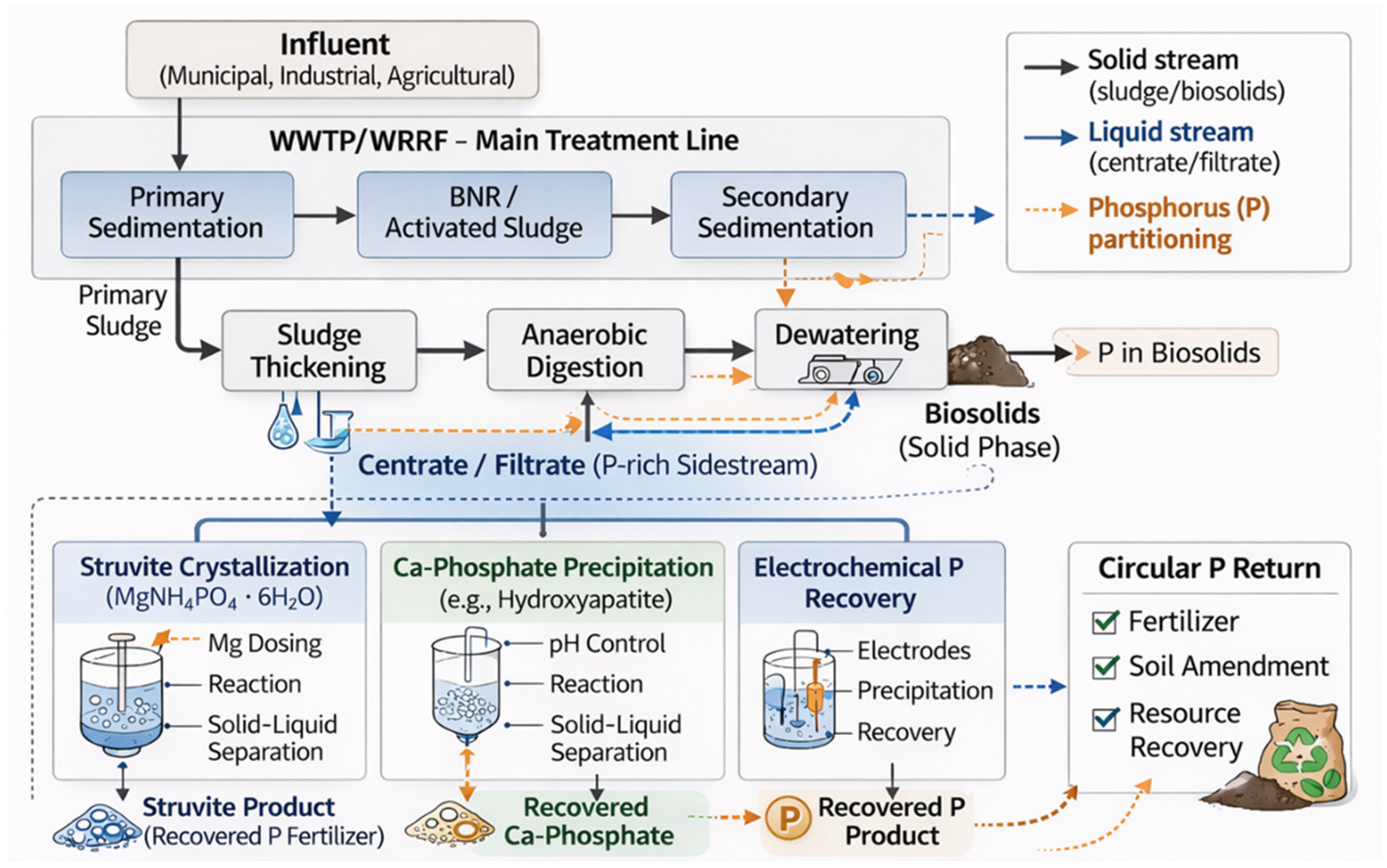
To clarify how phosphorus recovery can be integrated into conventional wastewater treatment infrastructure, Figure 4 presents a simplified process-flow overview of a WWTP/WRRF, highlighting phosphorus partitioning between solid (biosolids) and liquid (centrate/filtrate) streams along the sludge line. The diagram emphasizes that P-rich sidestream liquors generated during thickening, anaerobic digestion, and dewatering can be routed to recovery units such as struvite crystallization, calcium phosphate precipitation, or electrochemical P recovery, yielding recycled phosphorus products suitable for circular nutrient management.
Overall, struvite crystallization can represent a technologically mature and environmentally favorable option when implemented in high-strength sidestreams and when magnesium sourcing and fertilizer-substitution assumptions support net benefits. These environmental and economic considerations are therefore central to determining under which practical conditions struvite recovery can move beyond technical feasibility and become a robust full-scale strategy within circular wastewater management.

5.4. Regulatory Framework and End-of-Waste Criteria

The successful implementation of phosphorus recovery technologies depends not only on technical performance but also on the regulatory status of recovered materials and their eligibility to enter fertilizer markets. In the European Union, Regulation (EU) 2019/1009 (Fertilizing Products Regulation, FPR) established harmonized rules for placing fertilizing products on the EU market under CE marking, thereby creating a pathway for certain recovered and bio-based fertilizing materials, provided they comply with defined quality, safety, and labelling requirements [36].
A key element supporting recovered nutrient products is the STRUBIAS initiative (struvite, biochar, and ash-based products), which informed technical proposals and criteria for specific categories of recovered materials. In this context, precipitated phosphate salts, such as struvite, are associated with dedicated component material categories (e.g., CMC 12), whereas ash-derived products from thermal oxidation and materials derived from pyrolysis/gasification are addressed through categories such as CMC 13 and CMC 14, respectively [37]. Importantly, eligibility under these categories is conditional: materials must meet strict limits for contaminants (e.g., heavy metals) and hygiene/safety parameters and they must demonstrate compliance with the relevant product-function requirements before being placed on the market.
Although the FPR framework facilitates market access for eligible recovered products, regulatory compliance alone does not guarantee adoption. Uptake is also influenced by end-user acceptance, perceived supply reliability, product price competitiveness, and transparent quality assurance, including consistent product characterization and communication of agronomic performance [96]. In practice, differences in national implementation, stakeholder familiarity, and procurement practices can further affect the speed and extent of market penetration, highlighting the need for continuous alignment between regulatory standards, analytical protocols, and market-facing certification schemes [37,97].
Overall, EU regulatory evolution strengthens the enabling environment for WRRF implementation by reducing administrative uncertainty for compliant recovered products (e.g., struvite and ash-derived phosphates) and supporting investments in recovery technologies. However, sustained scaling will require robust quality management, harmonised testing and certification practices, and evidence-based communication to agricultural stakeholders regarding product safety and performance. These factors directly influence whether recovered struvite and ash-derived phosphates are not only compliant on paper, but also accepted, trusted, and traded in practice.

6. Full-Scale Applications and Commercial Technologies

6.1. Full-Scale Implementation in Wastewater Treatment Plants

Full-scale implementation of struvite recovery has attracted increasing attention as wastewater treatment plants transition toward WRRF-oriented operation. Struvite crystallization has emerged as a mature and widely implemented solution for phosphorus recovery, particularly in sidestream treatment processes associated with anaerobic sludge digestion [22,23].
Struvite recovery is most commonly implemented in sidestreams such as digester effluents, centrate, or sludge dewatering liquors, where phosphorus and ammonium concentrations are significantly elevated due to the release of intracellular polyphosphate and organic nitrogen during anaerobic digestion. These streams typically contain phosphorus concentrations ranging from 50 to 800 mg/L and ammonium concentrations exceeding 500 mg/L, providing favorable conditions for struvite crystallization [25,54]. The elevated supersaturation potential in these streams enables efficient phosphorus recovery with relatively small reactor volumes compared to mainstream treatment processes.
At full scale, struvite systems can achieve high recovery from phosphorus-rich sidestream liquors, with reported values often in the range of ~80–95% under favorable operating conditions; however, these values mainly refer to phosphorus recovery from dissolved sidestream streams under controlled crystallization conditions and should not be interpreted as a universal total-system recovery metric. Reported performance therefore depends strongly on stream type, reactor configuration, process control, and the way recovery is defined in the original study [22,23,24]. In addition to P recovery, these systems significantly reduce P recycling to the mainstream treatment process, which can otherwise increase the load on biological or chemical P removal processes. By removing P from sidestreams before recirculation, struvite recovery improves overall plant performance and facilitates compliance with stringent effluent discharge regulations.
In addition to nutrient recovery, full-scale struvite crystallization systems provide substantial operational benefits by preventing uncontrolled struvite scaling. Uncontrolled struvite formation is a common problem in anaerobic digestion and sludge dewatering systems, in which high concentrations of magnesium, ammonium, and phosphate promote spontaneous precipitation. This can result in pipe clogging, pump failures, and reduced efficiency of centrifuges and heat exchangers, leading to increased maintenance costs and operational disruptions. Controlled struvite crystallization mitigates these operational problems while simultaneously recovering phosphorus as a valuable product.
The integration of struvite recovery into wastewater treatment plants typically occurs downstream of anaerobic digestion, as illustrated in Figure 4. In this configuration, digested sludge is dewatered, and the resulting liquid stream containing dissolved phosphorus and ammonium is directed to a crystallization reactor. Magnesium is added if necessary to achieve optimal stoichiometric conditions, and the pH is adjusted to promote struvite precipitation. The recovered crystals are then separated, washed, and processed into fertilizer products suitable for agricultural use [23,54].
Full-scale struvite recovery has been successfully implemented in municipal wastewater treatment plants, particularly through sidestream treatment of digested sludge liquors. Reported installations span a wide range of plant sizes, and long-term operation has demonstrated stable recovery performance and consistent product quality under real plant conditions. Continuous recovery from digested sludge liquor has been shown to yield high-purity struvite and support both operational benefits (e.g., reduced scaling and maintenance) and nutrient resource recovery [24]. A representative full-scale example is sidestream recovery from digested sludge liquors, where phosphorus released during anaerobic digestion is captured as struvite before recirculation to the mainstream, thereby combining nutrient recovery with the reduction of scaling-related operational burdens [22,23,24].
In addition to municipal wastewater treatment, struvite recovery has been successfully applied in industrial wastewater treatment systems, particularly in food processing, livestock operations, and fertilizer production facilities, where wastewater often contains elevated concentrations of phosphorus and ammonium. These applications highlight the versatility of struvite crystallization as a nutrient recovery technology across diverse sectors. Overall, full-scale experience indicates that the most robust applications are those targeting phosphorus-rich sidestreams, where high supersaturation potential, lower hydraulic loads, and clearer operational benefits support both recovery performance and economic justification.
Overall, full-scale experience confirms that struvite crystallization is one of the most practically established nutrient recovery routes in WRRF-oriented wastewater treatment, particularly in phosphorus-rich sidestream applications.

6.2. Commercial Struvite Recovery Technologies

Commercial struvite recovery technologies have emerged as practical full-scale solutions for phosphorus-rich sidestreams in both municipal and selected industrial wastewater treatment applications. These systems promote controlled crystallization under managed pH, magnesium availability, and hydrodynamic conditions, enabling efficient phosphorus recovery from P-rich process streams and the production of fertilizer-grade struvite. Full-scale implementations, applied to both municipal and selected industrial sidestreams, have reported stable operation and reliable recovery performance, while also providing operational benefits such as improved process stability and reduced scaling-related maintenance. Most commercial configurations are based on fluidized-bed or air-lift reactor principles, which offer favorable conditions for crystal growth and solid–liquid separation [20,23,54]. These commercial systems differ not only in reactor configuration, but also in the way they are integrated into existing treatment trains, which affects phosphorus recovery efficiency, retrofitting potential, product quality, and operational complexity.

6.2.1. Ostara Pearl Process

The Ostara Pearl process is a widely cited commercial approach for struvite recovery. It employs a fluidized-bed reactor to recover phosphorus from WWTP sidestream liquors, particularly digester centrate and dewatering streams, by promoting controlled crystallization under appropriate pH, magnesium availability, and hydraulic conditions that support crystal growth to harvestable sizes [25]. Its relevance as a benchmark technology lies in its ability to combine controlled crystal growth, continuous harvesting, and production of a fertilizer-grade product under stable sidestream conditions. Full-scale sidestream struvite recovery has been implemented at multiple municipal facilities, demonstrating stable long-term operation and high recovery performance from P-rich liquors under real plant conditions [22,23,24]. In practical terms, the Ostara Pearl concept is often cited as a benchmark example of commercial sidestream struvite recovery because it combines continuous crystal harvesting, fertilizer-oriented product generation, and integration into municipal sludge-handling sidestreams [22,23,24,25].

6.2.2. AirPrex Process

The AirPrex process is another widely implemented struvite recovery technology, particularly in European wastewater treatment plants. Unlike conventional fluidized bed systems, the AirPrex process integrates struvite crystallization directly into the sludge treatment line, typically between anaerobic digestion and sludge dewatering.
In this system, magnesium is added to digested sludge, and carbon dioxide stripping is used to increase pH, thereby promoting struvite crystallization within a dedicated reactor. This process enhances phosphorus recovery while simultaneously improving sludge dewaterability and reducing scaling in downstream equipment. Full-scale applications of the AirPrex process have demonstrated phosphorus recovery efficiencies of up to 85%, along with improved operational stability and reduced maintenance requirements [22,54]. Compared with dedicated fluidized-bed recovery systems, the AirPrex concept is particularly attractive where direct integration into sludge handling is preferred and where improved dewaterability and scaling control are central operational priorities. This makes AirPrex a useful example of a technology whose value lies not only in phosphorus recovery itself, but also in the operational improvements it can deliver within the sludge line [22,54].

6.2.3. NuReSys Technology

The NuReSys system is another commercial struvite recovery technology based on controlled crystallization principles. This technology uses a stirred crystallization reactor combined with optimized Mg dosing and pH control to promote struvite precipitation. The recovered crystals are separated and processed into reusable fertilizer products [25].
NuReSys installations have demonstrated reliable phosphorus recovery performance and flexibility for integration into existing wastewater treatment infrastructure. The modular design allows adaptation to various plant sizes and operational conditions, making it suitable for both municipal and industrial applications [23]. This flexibility makes the technology particularly relevant for plants seeking modular implementation without the need for major process restructuring. Accordingly, NuReSys can be viewed as an illustrative example of a more modular and retrofit-oriented commercial recovery strategy compared with systems designed around more standardized sidestream configurations [23,25].

6.2.4. PHOSPAQ Process

The PHOSPAQ process, developed by Paques, represents an integrated nutrient recovery system that may include struvite precipitation depending on the operational configuration. For this reason, PHOSPAQ is better interpreted as a broader integrated recovery platform rather than a purely struvite-specific technology. This system integrates biological and chemical processes, allowing simultaneous nitrogen and phosphorus removal and recovery. The process promotes struvite formation within a controlled reactor environment, followed by crystal separation and reuse [49].
PHOSPAQ has been successfully applied in both municipal and industrial wastewater treatment systems, particularly for high-strength wastewaters, such as those from food processing and agricultural industries. The system can support efficient nutrient recovery while improving overall treatment performance, particularly in high-strength wastewaters where integrated treatment and recovery are advantageous.

6.2.5. Comparison and Selection of Commercial Technologies

The selection of an appropriate struvite recovery technology depends on several factors, including wastewater composition, phosphorus concentration, plant size, operational requirements, and economic considerations. Fluidized bed reactor systems, such as the Ostara Pearl process, are generally considered the most effective for producing high-quality fertilizer products because of their ability to promote controlled crystal growth and efficient separation. This advantage is particularly important because product quality is determined not only by phosphorus recovery efficiency, but also by crystal size uniformity, purity, and ease of downstream handling.
AirPrex and NuReSys are particularly attractive where retrofitting potential and integration with existing sludge treatment processes are important [54].
Overall, commercial struvite recovery technologies have demonstrated reliable full-scale performance, confirming the technical feasibility of phosphorus recovery from wastewater. However, their economic attractiveness remains site-dependent and is strongly influenced by sidestream composition, plant scale, avoided scaling costs, and the marketability of the recovered product.
A direct comparison of the principal commercial systems is presented in Table 4. Together, Ostara Pearl, AirPrex, NuReSys, and PHOSPAQ illustrate how commercial phosphorus recovery can differ in reactor logic, target stream, integration strategy, and operational objective, even when struvite formation remains central in several of these systems [22,23,24,25,54].

6.3. Product Quality and Fertilizer Applications

One of the key advantages of struvite crystallization is the production of a high-value fertilizer product that can be directly reused in agriculture. Struvite (MgNH4PO4·6H2O) contains three essential macronutrients required for plant growth—phosphorus, nitrogen, and magnesium—making it a multifunctional fertilizer with agronomic and environmental benefits [19,49,64].
A defining characteristic of struvite is its low solubility compared to conventional phosphate fertilizers, such as monoammonium phosphate (MAP) and diammonium phosphate (DAP). This property allows struvite to function as a slow-release fertilizer, gradually supplying nutrients to plants. Slow nutrient release improves nutrient use efficiency and reduces nutrient losses through leaching and runoff, thereby minimizing environmental impacts, such as eutrophication of surface waters.
Numerous agronomic studies have demonstrated that struvite provides phosphorus availability comparable to that of conventional mineral fertilizers under a wide range of soil and crop conditions. Crop yield responses to struvite application have been found to be similar to those achieved using traditional phosphorus fertilizers, particularly in acidic and neutral soils, where struvite dissolution is sufficient to meet plant nutrient demand [64,98]. In addition to phosphorus, struvite provides magnesium, an essential nutrient involved in chlorophyll synthesis and plant metabolic processes, further enhancing its agronomic value. Nevertheless, agronomic performance remains context-dependent and may vary with soil pH, crop type, application strategy, and the dissolution behavior of the recovered crystals. This should be considered when comparing struvite with highly soluble mineral fertilizers under short-term nutrient demand.
The physical properties of struvite crystals, including particle size, morphology, and purity, play an important role in determining fertilizer quality and applicability. Commercial struvite recovery technologies, particularly fluidized bed reactor systems, can produce uniform granules ranging in size from 0.5 to 5 mm, which are suitable for direct application using conventional fertilizer spreading equipment [25,54]. Larger crystal sizes improve handling, storage, and application efficiency, while reducing dust formation and product losses.
The chemical purity of recovered struvite is generally high, particularly when produced from municipal wastewater treatment plants. Most contaminants present in wastewater, including heavy metals and organic micropollutants, remain primarily associated with the sludge phase rather than being incorporated into struvite crystals. Consequently, recovered struvite typically meets the regulatory requirements for fertilizer use in agriculture [49]. Product quality can nevertheless vary with wastewater composition, upstream treatment conditions, and process control, which makes routine characterization important for consistent fertilizer-grade production [27,99]. Therefore, quality monitoring and regulatory compliance remain essential for ensuring the safe agricultural use of recovered struvite [36,100].
Struvite recovery contributes to sustainable fertilizer production by reducing the dependence on phosphate rock mining, which is associated with environmental degradation, energy consumption, and geopolitical supply risks [6]. By recovering phosphorus from wastewater and reintroducing it into agricultural systems, struvite crystallization supports circular nutrient management and enhances long-term resource sustainability. These product-related advantages are central to the practical value of struvite recovery, but their realization depends on stable process performance, product consistency, and feasible integration into full-scale treatment systems.
Struvite fertilizers have been commercialized under various product names and are increasingly used in agriculture, horticulture, turf management, and specialty crop production. These applications demonstrate the feasibility of converting wastewater-derived nutrients into valuable agricultural products, closing the phosphorus cycle, and supporting circular economy implementation.
The agronomic and environmental characteristics of struvite compared with conventional phosphate fertilizers are summarized in Table 5.

6.4. Operational Performance and Implementation Challenges

The long-term performance of struvite recovery systems depends on the ability to maintain stable crystallization conditions under variable full-scale wastewater treatment environments. However, successful implementation depends on the careful optimization of the operational parameters, reactor design, and wastewater characteristics. Several technical and operational factors influence the efficiency, stability, and economic feasibility of struvite crystallization systems. In practice, implementation is most robust where phosphorus-rich sidestreams provide favorable supersaturation conditions, manageable hydraulic loads, and clear operational benefits such as scaling control and sidestream phosphorus reduction [27].
Maintaining appropriate stoichiometric and thermodynamic conditions is critical for crystallization. Efficient struvite formation requires adequate concentrations of magnesium, ammonium, and phosphate, as well as optimal pH conditions, typically in the range of 7.5–9.5. In many wastewater treatment plants, magnesium concentrations are insufficient for complete precipitation, necessitating the addition of magnesium salts, such as magnesium chloride, magnesium oxide, or magnesium hydroxide. Magnesium dosing represents one of the primary operational costs associated with struvite recovery [20,22,23,49]. The challenge is therefore not only to achieve precipitation, but to do so selectively and under conditions that favor the formation of harvestable crystals with consistent fertilizer quality [65].
In addition, process control and reactor hydrodynamics play a crucial role in determining the crystal size distribution and recovery efficiency. Controlled supersaturation and moderate mixing conditions promote crystal growth and the formation of larger, recoverable particles, whereas excessive turbulence may increase nucleation rates and produce fine crystals that are difficult to separate [69]. Fluidized bed reactor systems are particularly effective in maintaining favorable crystallization conditions and producing high-quality fertilizer-grade crystals [54]. This is one of the main reasons why fluidized-bed configurations are widely preferred in commercial sidestream applications. In commercial practice, this preference reflects the need to recover phosphorus not merely as precipitated solids, but as harvestable crystals of sufficiently consistent size and quality for downstream handling and product use.
Wastewater composition can significantly affect process performance. The presence of competing ions, particularly calcium, may inhibit struvite formation by promoting the precipitation of calcium phosphate minerals. High calcium concentrations may reduce phosphorus recovery efficiency and require process optimization or pretreatment strategies [25]. In addition, variations in wastewater composition, flow rates, and nutrient concentrations may require adaptive process control to ensure stable operation. Under such variable conditions, maintaining selective struvite formation becomes essential, as uncontrolled co-precipitation can reduce both recovery efficiency and product quality.
Another important consideration is the integration of struvite recovery systems into existing wastewater treatment infrastructure. Retrofitting existing plants may require modifications to sludge handling processes, installation of crystallization reactors, and implementation of chemical dosing and process control systems. Although these modifications require initial capital investment, they may be offset over time by operational benefits such as reduced scaling, lower maintenance costs, and production of valuable fertilizer products, particularly in plants where uncontrolled struvite formation has previously imposed recurrent operational burdens [23,54,92].
Operational monitoring and maintenance are essential for ensuring long-term system stability. The key parameters that must be monitored include the pH, magnesium concentration, phosphate concentration, and reactor hydraulic conditions. Proper monitoring ensures optimal crystallization conditions and prevents operational issues such as incomplete precipitation or excessive scaling. It also supports consistent product quality, which is important when recovered struvite is intended for fertilizer use or market placement.
Despite these challenges, full-scale studies and commercial applications have shown that struvite recovery systems can operate reliably over extended periods when process control, wastewater composition, and reactor configuration are well matched. Under such conditions, the operational benefits—including reduced scaling, improved plant performance, and recovery of valuable fertilizer products—can outweigh the associated operational costs.
Continued technological development and optimization are expected to further improve the efficiency, reliability, and economic viability of struvite recovery systems; however, broader adoption will still depend on site-specific feasibility, regulatory acceptance, and the ability to maintain consistent product quality under real wastewater conditions.

7. Challenges

This section focuses primarily on the technical, economic, and regulatory barriers that currently constrain the practical implementation of P recovery technologies.
Phosphorus recovery has progressed from the conceptual “nutrient removal” toward product-oriented WRRF strategies; however, broad implementation is still limited by interacting technical, economic, and regulatory barriers. These barriers become particularly evident when technologies are transferred from optimized sidestream operation to more variable plant-wide conditions [22,23]. In practice, the challenge is not only to recover phosphorus, but to do so selectively, consistently, and in a form that can be safely integrated into fertilizer value chains under real wastewater conditions.

7.1. Technical Challenges

A central technical challenge is the variability of wastewater matrices, which affects supersaturation control, nucleation, crystal growth, and solid–liquid separation [27]. In struvite systems, competition with calcium phosphate formation can reduce the fraction of phosphate available for struvite, generate fines, and compromise product purity and harvestability [20,29]. Hydrodynamics and solids handling are also decisive; insufficient mixing or poor separation design can lead to unstable operation, high fine fractions, or fouling and scaling within the recovery unit [19,22]. Such effects are particularly important because operationally successful recovery depends not only on precipitation itself, but also on the production of crystals that can be efficiently separated, handled, and reused as a fertilizer product.
Beyond sidestreams, mainstream recovery remains technically constrained by low phosphate concentrations and limited supersaturation, often requiring intensified configurations, pre-concentration, or hybrid trains to reach competitive recovery yields [23,27]. As a result, mainstream implementation remains substantially less mature than sidestream recovery and is currently more difficult to justify from both process-control and product-recovery perspectives.

7.2. Economic Barriers and Cost Sensitivity

Economic feasibility is highly site-specific and is often driven by magnesium sourcing and dosing, pH control, energy requirements, and solids handling [41]. While benefits can include avoided maintenance from uncontrolled scaling and reduced chemical demand for conventional P removal, these savings vary widely across plants, and smaller facilities may face disproportionately high capital and integration costs [23,39]. Consequently, the strongest business cases are generally observed in plants treating phosphorus-rich sidestreams and experiencing recurrent struvite scaling, where both recovery efficiency and avoided operational burdens are maximized. In addition, revenue expectations depend on local fertilizer markets and the degree to which recovered products can be standardized and traded [40]. This means that technical success does not automatically translate into economic attractiveness, particularly where product certification, transport logistics, or end-user confidence remain uncertain.

7.3. Regulatory Acceptance and Market Integration

Even when recovery performance is technically demonstrated, deployment depends on whether the recovered material can be legally placed on the market as a fertilizer. In the EU, Regulation (EU) 2019/1009 provides a pathway for recovered materials under defined safety and quality requirements; however, compliance remains contingent on product characterization, contaminant thresholds, and certification procedures [36,37]. Consequently, regulatory clarity and harmonized quality assurance are central to market uptake and cross-border implementation [100]. However, broader adoption also depends on farmer acceptance, supply reliability, product consistency, and transparent communication of agronomic performance and safety.
Overall, the future expansion of phosphorus recovery will depend on the ability to align process engineering, product quality, economic feasibility, and regulatory acceptance within site-specific implementation strategies. In this context, struvite recovery remains one of the most promising routes, particularly where high-strength sidestreams, favorable process conditions, and clear end-use pathways can be combined.

8. Research Gaps

In contrast to the implementation-oriented challenges discussed above, this section highlights unresolved research questions that remain important for further scientific and technological development. Despite strong progress in sidestream applications and increasing full-scale experience, several knowledge gaps remain critical if struvite crystallization and related recovery routes are to move from technically successful niche applications toward broadly deployable WRRF strategies.

8.1. Mainstream Phosphorus Recovery Feasibility

Mainstream recovery is underdeveloped because of low phosphate concentrations and limited supersaturation. Under these conditions, the challenge is not only to induce precipitation, but also to generate sufficient and harvestable product to justify reactor operation, reagent demand, and downstream handling. Research is needed to evaluate intensified reactor designs under realistic plant variability and to assess pre-concentration strategies (e.g., membrane concentration, selective adsorption/ion exchange) and hybrid biological–chemical trains in decision-grade techno-economic terms [23,27]. This also requires comparative evaluation against sidestream-focused strategies, which currently remain more mature and operationally favorable.

8.2. Long-Term Product Quality and Soil Impact

Although struvite is commonly reported as a relatively clean recovered phosphate compared with sludge-derived solids, long-term field studies remain limited. Recent field-scale and soil-based assessments have begun to evaluate struvite impacts on soil element dynamics, microbial activity, and phosphate leaching behavior under realistic agronomic conditions; however, the available evidence remains limited in duration and breadth across soils and climates [101,102,103]. Key gaps therefore include multi-season assessment of trace element accumulation, fate of organic micropollutants, soil microbiome responses, and agronomic performance under different soil–climate contexts [21,29,40]. This is particularly relevant for assessing potential nutrient losses, as dissolution behavior and application practices can influence runoff/leaching risks compared with highly water-soluble phosphate fertilizers [101].

8.3. Standardization of Product Specifications and Analytical Protocols

A practical barrier to scaling up is the lack of globally harmonized product specifications and analytical protocols for recovered phosphates. More work is required on standardized approaches to certify product quality, define acceptable contaminant thresholds, and communicate fertilizer performance in ways that are credible to regulators and end-users [36,37]. Without such harmonization, the comparison of recovered products across technologies, plants, and jurisdictions remains difficult, which slows both regulatory approval and market confidence.

8.4. Predictive Modeling and Process Control Under Dynamic Full-Scale Conditions

Although thermodynamic frameworks for struvite precipitation have been established, validation under dynamic full-scale conditions is less developed. Research should link modelling with real-time monitoring to support predictive dosing/control strategies that maintain stable crystal size distributions and reduce overdosing, fines formation, and downtime [19,22]. A key objective is to move from equilibrium-based prediction alone toward operationally useful control systems that support selective crystallization and the consistent production of recoverable, fertilizer-grade crystals.

8.5. Robust TEA/LCA with Uncertainty and Scenario Analysis

Many TEA/LCA studies support phosphorus recovery; however, uncertainty and sensitivity analyses are often insufficient to guide investment decisions. More robust evaluations are needed that include magnesium price volatility, energy scenarios, plant size effects, and product substitution assumptions [39,40]. Such analyses are especially important for distinguishing between technically feasible systems and those that remain economically or environmentally robust under changing operating conditions.

8.6. Comparative Evidence Across Recovery Routes and Infrastructure Contexts

When sludge incineration is practiced, SSA-based recovery may become strategically important; however, comparative evidence across wet-chemical and thermochemical routes remains context-dependent, especially regarding heavy metal management, energy intensity, and product acceptability [34,35]. Future work should therefore compare these routes not only in terms of recovery yield, but also with respect to infrastructure dependence, product marketability, and compatibility with different wastewater and sludge-management strategies.
Overall, future research should move beyond proof-of-concept studies and focus more strongly on long-term performance, product consistency, full-scale process control, and comparative evidence across infrastructure contexts. Such work will be essential for determining where struvite recovery can deliver not only technical success, but also durable environmental, economic, and market value within circular wastewater management.

9. Future Perspectives

Future developments should prioritize integrated, resource-efficient recovery strategies that remain robust under real WWTP variability and deliver standardized products aligned with regulatory and market requirements.

9.1. Intensified Reactors and Hybrid Recovery Trains

A key direction is the development of compact, intensified crystallization systems coupled with pre-concentration or selective separation (e.g., adsorption and membranes) and optimized biological nutrient removal. Such hybrids may enable feasible mainstream recovery while reducing chemical consumption and footprint [23,27]. Adsorption-based phosphorus capture is also relevant as a complementary route for selective separation, pre-concentration, and hybrid recovery design, although it is not the primary focus of this struvite-centered review [83].

9.2. Integration into WRRF Platforms and Multi-Resource Recovery

Struvite crystallization should increasingly be assessed as a WRRF unit embedded in broader resource recovery strategies (nutrients, energy, and carbon). Integration with digestion optimization, nitrogen recovery, and other circular pathways may improve overall plant performance, reduce operational trade-offs, and strengthen the business case for phosphorus recovery [22,40].

9.3. Digitalization, Monitoring, and Predictive Control

Advances in online sensing (e.g., phosphate/speciation proxies, turbidity/particle signals, pH, and conductivity) combined with data-driven modeling can improve the long-term stability of struvite recovery units by enabling tighter dosing control, maintaining target crystal size distributions, and reducing downtime associated with unstable nucleation or fines washout [104,105]. More broadly, AI-assisted and machine-learning-based approaches may further support anomaly detection, adaptive dosing, process forecasting, and decision support under variable wastewater conditions. In addition to empirical optimization, model-based control approaches, such as economic model predictive control (EMPC), have been demonstrated to support real-time optimization of magnesium dosing and operating objectives, offering a pathway toward more robust and cost-effective operations under variable influent conditions [106]. Looking forward, digital twins and predictive controllers that couple mechanistic crystallization models with plant data represent promising tools for translating laboratory optimization into reliable full-scale performance, particularly where supersaturation management and crystal size control are critical [107].

9.4. Product Certification, Policy Alignment, and Market Expansion

Scaling adoption requires clear certification pathways, transparent quality assurance, and stronger engagement with agricultural stakeholders. Policy instruments that align circular economy goals with fertilizer regulation and end-product standards will be central to expanding recovered phosphate markets. In parallel, stronger evidence on field performance, product consistency, and contaminant safety will be important for building end-user confidence and expanding market uptake.
Overall, future progress will depend on the ability to combine process intensification, digital control, product standardization, and WRRF integration into recovery systems that remain technically reliable, economically viable, and acceptable to regulators and end users.

10. Use of Generative AI

Generative AI was used only for language polishing, grammar correction, and improvement of readability during manuscript preparation. No AI tool was used to generate scientific content, analyze data, interpret the literature, or formulate the scientific conclusions of this review. The author takes full responsibility for the content of the manuscript.

11. Conclusions

Phosphorus recovery from wastewater has become an increasingly important component of sustainable resource management. Although conventional phosphorus removal technologies can effectively reduce nutrient discharge, they do not address the broader challenge of long-term phosphorus resource depletion.
Among the available recovery strategies, struvite crystallization has emerged as one of the most technically mature and operationally validated solutions, particularly for phosphorus-rich sidestreams. This process enables the direct conversion of dissolved phosphorus into magnesium ammonium phosphate, a slow-release fertilizer with demonstrated agronomic effectiveness. In addition to nutrient recycling, struvite recovery contributes to improved operational stability by mitigating uncontrolled scaling in digestion and dewatering systems, thereby enhancing plant reliability and reducing maintenance costs.
Full-scale applications across municipal and industrial wastewater treatment facilities have confirmed the technical feasibility of struvite crystallization under real operating conditions. Advances in reactor design, particularly fluidized-bed and integrated sludge-line systems, have enabled recovery efficiencies typically exceeding 80–90% in high-strength sidestreams under controlled operating conditions, although the reported values depend on stream composition, process design, and the definition of recovery used. In practical terms, controlled sidestream crystallization—especially in fluidized-bed and related commercial reactor configurations—currently represents the most mature and widely implemented route for phosphorus recovery as struvite. Commercial technologies such as Ostara Pearl, AirPrex, NuReSys, and PHOSPAQ illustrate the transition of struvite recovery from pilot research toward established full-scale practice, although their suitability remains site-dependent.
However, several challenges remain. Process performance is highly sensitive to wastewater composition, magnesium availability, competing ions, selective crystallization control, and the ability to produce harvestable crystals of consistent quality. Economic feasibility depends on site-specific factors, including phosphorus concentration, plant scale, fertilizer market conditions, and the extent to which scaling-related maintenance costs can be avoided. Mainstream phosphorus recovery, long-term product quality monitoring, and system-level sustainability assessment require further research.
Overall, the strongest current evidence supports controlled struvite crystallization in phosphorus-rich sidestreams, where full-scale and commercial experience is already well established. By contrast, electrochemical systems, biochar-assisted and hybrid recovery approaches, and broader advanced WRRF integration strategies remain promising but less mature, with further validation needed under long-term and full-scale operating conditions.
The future of wastewater treatment lies in its transformation into integrated water resource recovery facilities (WRRFs), where nutrients, energy, and water are recovered simultaneously. In this context, struvite crystallization represents not merely a recovery technology, but one of the most practically relevant routes within circular nutrient management. Continued advancements in process optimization, digital monitoring, alternative magnesium sourcing, and hybrid recovery systems will further strengthen its role in sustainable infrastructure.
Ensuring long-term phosphorus sustainability requires coordinated technological innovation, economic optimization, and supportive regulatory frameworks. Under favorable site-specific conditions, struvite recovery can provide a practical and scalable pathway toward closing the phosphorus cycle and reducing the environmental footprint of wastewater treatment, thereby contributing to broader circular economy objectives and the continued transition toward WRRF-based infrastructure.

Funding

This research was funded/financially supported by the Grant Project № BG16RFPR002-1.014-0015: “Clean Technologies for Sustainable Environment—Water, Waste, Energy for Circular Economy”, financed by the European Regional Development Fund through Bulgarian Programme “Research, Innovation and Digitalisation for Smart Transformation”.

Institutional Review Board Statement

Not applicable.

Informed Consent Statement

Not applicable.

Data Availability Statement

No new data were created or analyzed in this study. Data sharing is not applicable to this article.

Acknowledgments

The author acknowledges the support from the Grant Project № BG16RFPR002-1.014-0015: “Clean Technologies for Sustainable Environment—Water, Waste, Energy for Circular Economy”, financed by the European Regional Development Fund through Bulgarian Programme “Research, Innovation and Digitalisation for Smart Transformation”. During the preparation of this manuscript, ChatGPT (OpenAI, GPT-5.4 Thinking) was used only for language polishing, grammar correction, and improvement of readability.

Conflicts of Interest

The author declares no conflicts of interest. The funders had no role in the design of the study; in the collection, analysis, or interpretation of data; in the writing of the manuscript; or in the decision to publish the results.

Abbreviations

The following abbreviations are used in this manuscript:
BESBioelectrochemical systems
CMCComponent Material Category (EU Fertilising Products Regulation)
DAPDiammonium phosphate
EBPREnhanced biological phosphorus removal
EMPCEconomic model predictive control
ERDFEuropean Regional Development Fund
FBRFluidized bed reactor
FPRFertilising Products Regulation (Regulation (EU) 2019/1009)
GAOsGlycogen-accumulating organisms
IAPIonic activity product
KspSolubility product constant
LCALife-cycle assessment
MAPMonoammonium phosphate
MECMicrobial electrolysis cell
MFCMicrobial fuel cell
PAOsPolyphosphate-accumulating organisms
SSASewage sludge ash
STRUBIASStruvite, Biochar and Ash-based products
TEATechno-economic assessment
WRRFWater resource recovery facility
WWTPWastewater treatment plant
SSupersaturation ratio

References

  1. Cordell, D.; Drangert, J.O.; White, S. The Story of Phosphorus: Global Food Security and Food for Thought. Glob. Environ. Change 2009, 19, 292–305. [Google Scholar] [CrossRef]
  2. Cordell, D.; Rosemarin, A.; Schröder, J.J.; Smit, A.L. Towards Global Phosphorus Security: A Systems Framework for Phosphorus Recovery and Reuse. Chemosphere 2011, 84, 747–758. [Google Scholar] [CrossRef] [PubMed]
  3. Elser, J.J.; Bennett, E.M. Phosphorus cycle: A broken biogeochemical cycle. Nature 2011, 478, 29–31. [Google Scholar] [CrossRef] [PubMed]
  4. Smith, V.H.; Schindler, D.W. Eutrophication Science: Where Do We Go from Here? Trends Ecol. Evol. 2009, 24, 201–207. [Google Scholar] [CrossRef]
  5. Soo, A.; Shon, H.K. A Nutrient Circular Economy Framework for Wastewater Treatment Plants. Desalination 2024, 592, 118090. [Google Scholar] [CrossRef]
  6. European Commission. Critical Raw Materials Resilience: Charting a Path Towards Greater Security and Sustainability; European Commission: Brussels, Belgium, 2020. [Google Scholar]
  7. Kalpakchiev, T.; Fraundorfer, M.; Jacobs, B.; Martin-Ortega, J.; Cordell, D. Transforming the European Union’s phosphorus governance through holistic and intersectoral framings. Front. Sustain. Resour. Manag. 2023, 2, 1273271. [Google Scholar] [CrossRef]
  8. Smol, M.; Adam, C.; Preisner, M. Circular Economy Model Framework in the European Water and Wastewater Sector. J. Clean. Prod. 2020, 248, 119251. [Google Scholar] [CrossRef]
  9. Yeoman, S.; Stephenson, T.; Lester, J.N.; Perry, R. The Removal of Phosphorus during Wastewater Treatment. Environ. Pollut. 1988, 49, 183–233. [Google Scholar] [CrossRef]
  10. Morse, G.K.; Brett, S.W.; Guy, J.A.; Lester, J.N. Review: Phosphorus Removal and Recovery Technologies. Sci. Total Environ. 1998, 212, 69–81. [Google Scholar] [CrossRef]
  11. Oehmen, A.; Lemos, P.C.; Carvalho, G.; Yuan, Z.; Keller, J.; Blackall, L.L.; Reis, M.A.M. Advances in Enhanced Biological Phosphorus Removal: From Micro to Macro Scale. Water Res. 2007, 41, 2271–2300. [Google Scholar] [CrossRef]
  12. Izadi, P.; Izadi, P.; Eldyasti, A. Design, operation and technology configurations for enhanced biological phosphorus removal (EBPR) process: A review. Rev. Environ. Sci. Biotechnol. 2020, 19, 561–593. [Google Scholar] [CrossRef]
  13. Guest, J.S.; Skerlos, S.J.; Barnard, J.L.; Beck, M.B.; Daigger, G.T.; Hilger, H.; Jackson, S.J.; Karvazy, K.; Kelly, L.; Macpherson, L. A New Planning and Design Paradigm to Achieve Sustainable Resource Recovery. Environ. Sci. Technol. 2009, 43, 6126–6130. [Google Scholar] [CrossRef] [PubMed]
  14. Loosdrecht, M.C.M.; Brdjanovic, D. Anticipating the next Century of Wastewater Treatment. Science 2014, 344, 1452–1453. [Google Scholar] [CrossRef]
  15. Kehrein, P.; van Loosdrecht, M.; Osseweijer, P.; Garfí, M.; Dewulf, J.; Posada, J. A critical review of resource recovery from municipal wastewater treatment plants—Market supply potentials, technologies and bottlenecks. Environ. Sci. Water Res. Technol. 2020, 6, 877–910. [Google Scholar] [CrossRef]
  16. Verstraete, W.; Caveye, P.; Diamantis, V. Maximum Use of Resources Present in Domestic “Used Water”. Bioresour. Technol. 2009, 100, 5537–5545. [Google Scholar] [CrossRef] [PubMed]
  17. Ghisellini, P.; Cialani, C.; Ulgiati, S. A Review on Circular Economy: The Expected Transition to a Balanced Interplay of Environmental and Economic Systems. J. Clean. Prod. 2016, 114, 11–32. [Google Scholar] [CrossRef]
  18. Kirchherr, J.; Reike, D.; Hekkert, M. Conceptualizing the Circular Economy: An Analysis of 114 Definitions. Resour. Conserv. Recycl. 2017, 127, 221–232. [Google Scholar] [CrossRef]
  19. Doyle, J.D.; Parsons, S.A. Struvite Formation, Control and Recovery. Water Res. 2002, 36, 3925–3940. [Google Scholar] [CrossRef]
  20. Le Corre, K.S.; Valsami-Jones, E.; Hobbs, P.; Parsons, S.A. Phosphorus Recovery from Wastewater by Struvite Crystallization: A Review. Crit. Rev. Environ. Sci. Technol. 2009, 39, 433–477. [Google Scholar] [CrossRef]
  21. Talboys, P.J.; Heppell, J.; Roose, T.; Healey, J.R.; Jones, D.L.; Withers, P.J.A. Struvite: A Slow-Release Fertiliser for Sustainable Agriculture? Plant Soil 2016, 401, 109–123. [Google Scholar] [CrossRef]
  22. Desmidt, E.; Ghyselbrecht, K.; Zhang, Y.; Pinoy, L.; Bruggen, B.; Verstraete, W.; Rabaey, K.; Meesschaert, B. Global Phosphorus Scarcity and Full-Scale P-Recovery Techniques: A Review. Crit. Rev. Environ. Sci. Technol. 2015, 45, 336–384. [Google Scholar] [CrossRef]
  23. Egle, L.; Rechberger, H.; Zessner, M.; Krampe, J. Phosphorus Recovery from Municipal Wastewater: An Integrated Comparative Technological, Environmental and Economic Assessment. Sci. Total Environ. 2016, 571, 522–542. [Google Scholar] [CrossRef] [PubMed]
  24. Saerens, B.; Geerts, S.; Weemaes, M. Phosphorus Recovery as Struvite from Digested Sludge—Experience from the Full Scale. J. Environ. Manag. 2021, 280, 111743. [Google Scholar] [CrossRef] [PubMed]
  25. Chrispim, M.C.; Scholz, M.; Nolasco, M.A. Phosphorus Recovery from Municipal Wastewater Treatment: Critical Review of Challenges and Opportunities for Developing Countries. J. Environ. Manag. 2019, 248, 109268. [Google Scholar] [CrossRef]
  26. Li, B.; Huang, H.M.; Boiarkina, I.; Yu, W.; Huang, Y.F.; Wang, G.Q.; Young, B.R. Phosphorus recovery through struvite crystallisation: Recent developments in the understanding of operational factors. J. Environ. Manag. 2019, 248, 109254. [Google Scholar] [CrossRef]
  27. Yan, Y.; Kallikazarou, N.I.; Nisiforou, O.; Shang, Q.; Fu, D.; Antoniou, M.G.; Fotidis, I.A. Phosphorus Recovery through Struvite Crystallization from Real Wastewater: Bridging Gaps from Lab to Market. Bioresour. Technol. 2025, 427, 132408. [Google Scholar] [CrossRef]
  28. Peng, L.; Dai, H.; Wu, Y.; Peng, Y.; Lu, X. A Comprehensive Review of Phosphorus Recovery from Wastewater by Crystallization Processes. Chemosphere 2018, 197, 768–781. [Google Scholar] [CrossRef]
  29. Liu, X.; Wang, Y.; Chang, J. A Review on the Incorporation and Potential Mechanism of Heavy Metals on the Recovered Struvite from Wastewater. Water Res. 2021, 207, 117823. [Google Scholar] [CrossRef]
  30. Yan, J.; Ma, M.; Li, F. Phosphorus Recovery via Struvite Crystallization in Batch and Fluidized-Bed Reactors: Roles of Microplastics and Dissolved Organic Matter. J. Hazard. Mater. 2024, 476, 135108. [Google Scholar] [CrossRef]
  31. Fernandes, V.B.; Farinon, D.M.; Fernandes, A.; Silveira, J.E.; Amaro, A.; Zazo, J.A.; Sousa, C.Y. Towards a Circular Phosphorus Economy: Electroless Struvite Precipitation from Cheese Whey Wastewater Using Magnesium Anodes. Appl. Sci. 2025, 16, 298. [Google Scholar] [CrossRef]
  32. Zin, M.M.T.; Hussain, M.; Kim, D.J.; Yang, J.E.; Choi, Y.J.; Park, Y.K. Circular Economy Approach: Nutrient Recovery and Economical Struvite Production from Wastewater Sources by Using Modified Biochars. Chemosphere 2024, 362, 142589. [Google Scholar] [CrossRef]
  33. Xu, Z.; Chen, Z.; Peng, S.; Bai, S.; Li, X.; Wang, G.; Zheng, R.; Ni, B.-J. Electrochemical Phosphorus Recovery from Waste. J. Environ. Chem. Eng. 2025, 13, 117695. [Google Scholar] [CrossRef]
  34. Wilfert, P.; Kumar, P.S.; Korving, L.; Witkamp, G.J.; Loosdrecht, M.C.M. The Concept of Phosphorus Recovery from Sewage Sludge Ash: A Review. Environ. Sci. Technol. 2015, 49, 9400–9414. [Google Scholar] [CrossRef] [PubMed]
  35. Xu, Y.; Zhang, L.; Chen, J.; Liu, T.; Li, N.; Xu, J.; Yin, W.; Li, D.; Zhang, Y.; Zhou, X. Phosphorus Recovery from Sewage Sludge Ash (SSA): An Integrated Technical, Environmental and Economic Assessment of Wet-Chemical and Thermochemical Methods. J. Environ. Manag. 2023, 344, 118691. [Google Scholar] [CrossRef] [PubMed]
  36. European Parliament; Council of the European Union. Regulation (EU) 2019/1009 of the European Parliament and of the Council of 5 June 2019 laying down rules on the making available on the market of EU fertilising products. Off. J. Eur. Union 2019, L 170, 1–114. Available online: http://data.europa.eu/eli/reg/2019/1009/oj (accessed on 1 March 2026).
  37. Huygens, D.; Saveyn, H.G.M. Technical Proposals for Selected New Fertilising Materials Under the Fertilising Products Regulation; Joint Research Centre-European Commission: Brussels, Belgium, 2019. [Google Scholar]
  38. Śniatała, B.; Al-Hazmi, H.E.; Sobotka, D.; Zhai, J.; Mąkinia, J. Advancing Sustainable Wastewater Management: A Comprehensive Review of Nutrient Recovery Products and Their Applications. Sci. Total Environ. 2024, 937, 173446. [Google Scholar] [CrossRef]
  39. Amann, A.; Zoboli, O.; Krampe, J.; Rechberger, H.; Zessner, M.; Egle, L. Environmental Impacts of Phosphorus Recovery from Municipal Wastewater. Resour. Conserv. Recycl. 2018, 130, 127–139. [Google Scholar] [CrossRef]
  40. Lam, K.L.; Solon, K.; Jia, M.; Volcke, J.P.; Hoek, J.P. Life Cycle Environmental Impacts of Wastewater-Derived Phosphorus Products: An Agricultural End-User Perspective. Environ. Sci. Technol. 2022, 56, 10289–10298. [Google Scholar] [CrossRef]
  41. Mayor, A.; Vinardell, S.; Ganesan, K.; Bacardí, C.; Cortina, J.L.; Valderrama, C. Life-Cycle Assessment and Techno-Economic Evaluation of the Value Chain in Nutrient Recovery. Sci. Total Environ. 2023, 892, 164452. [Google Scholar] [CrossRef]
  42. Pausta, C.M.; Kalbar, P.; Saroj, D. Life Cycle Assessment of Nutrient Recovery Strategies from Domestic Wastewaters to Quantify Environmental Performance and Identification of Trade-Offs. Sci. Rep. 2024, 14, 3678. [Google Scholar] [CrossRef]
  43. Witek-Krowiak, A.; Gnus, M.; Turski, K.; Chojnacka, K. Phosphorus recovery from wastewater and bio-based waste: An overview. Bioengineered 2022, 13, 13474–13506. [Google Scholar] [CrossRef]
  44. Metcalf & Eddy, AECOM. Wastewater Engineering: Treatment and Resource Recovery, 5th ed.; McGraw-Hill: New York, NY, USA, 2014. [Google Scholar]
  45. Cordell, D.; White, S. Life’s Bottleneck: Sustaining the World’s Phosphorus for a Food Secure Future. Annu. Rev. Environ. Resour. 2014, 39, 161–188. [Google Scholar] [CrossRef]
  46. Li, X.; Shen, S.; Xu, Y.; Guo, T.; Hongliang, D.; Lu, X. Transformation and Fate of Non-Reactive Phosphorus (NRP) in Enhanced Biological Phosphorus Removal Process with Sidestream Phosphorus Recovery. Sci. Total Environ. 2022, 839, 156275. [Google Scholar] [CrossRef] [PubMed]
  47. Park, N.; Kim, M.; Kwak, D.; Jung, J.; Kim, W. Development of High-Concentration Ammonium Removal Process via NH4+ Ion Exchange and Mg–P Recycling Using Struvite. Environ. Technol. Innov. 2026, 42, 104904. [Google Scholar] [CrossRef]
  48. Santos, A.F.; Mendes, L.S.; Alvarenga, P.; Gando-Ferreira, L.M.; Quina, M.J. Nutrient Recovery via Struvite Precipitation from Wastewater Treatment Plants: Influence of Operating Parameters, Coexisting Ions, and Seeding. Water 2024, 16, 1675. [Google Scholar] [CrossRef]
  49. Melia, P.M.; Cundy, A.B.; Sohi, S.P.; Hooda, P.S.; Busquets, R. Trends in the Recovery of Phosphorus in Bioavailable Forms from Wastewater. Chemosphere 2017, 186, 381–395. [Google Scholar] [CrossRef]
  50. Cornel, P.; Schaum, C. Phosphorus Recovery from Wastewater: Needs, Technologies and Costs. Water Sci. Technol. 2009, 59, 1069–1076. [Google Scholar] [CrossRef]
  51. Abdoli, S.; Asgari Lajayer, B.; Dehghanian, Z.; Bagheri, N.; Vafaei, A.H.; Chamani, M.; Rani, S.; Lin, Z.; Shu, W.; Price, G.W. A Review of the Efficiency of Phosphorus Removal and Recovery from Wastewater by Physicochemical and Biological Processes: Challenges and Opportunities. Water 2024, 16, 2507. [Google Scholar] [CrossRef]
  52. Seviour, R.J.; Mino, T.; Onuki, M. The Microbiology of Biological Phosphorus Removal in Activated Sludge Systems. FEMS Microbiol. Rev. 2003, 27, 99–127. [Google Scholar] [CrossRef]
  53. Driver, J.; Lijmbach, D.; Steen, I. Why Recover Phosphorus for Recycling, and How? Environ. Technol. 1999, 20, 651–662. [Google Scholar] [CrossRef]
  54. Kabbe, C.; Kraus, F.; Remy, C. Review of Promising Methods for Phosphorus Recovery and Recycling from Wastewater. Proc. Int. Fertil. Soc. 2015, 763, 1–32. [Google Scholar]
  55. Luyckx, L.; Caneghem, J.V. Recovery of Phosphorus from Sewage Sludge Ash: Influence of Chemical Addition Prior to Incineration on Ash Mineralogy and Related Phosphorus and Heavy Metal Extraction. J. Environ. Chem. Eng. 2022, 10, 108117. [Google Scholar] [CrossRef]
  56. Lin, H.; Wang, Y.; Dong, Y. A Review of Methods, Influencing Factors and Mechanisms for Phosphorus Recovery from Sewage and Sludge from Municipal Wastewater Treatment Plants. J. Environ. Chem. Eng. 2024, 12, 111657. [Google Scholar] [CrossRef]
  57. Ye, Z.; Shen, Y.; Ye, X.; Zhang, Z.; Chen, S.; Shi, J. Phosphorus recovery from wastewater by struvite crystallization: Property of aggregates. J. Environ. Sci. 2014, 26, 991–1000. [Google Scholar] [CrossRef] [PubMed]
  58. Song, Y.; Yuan, P.; Zheng, B.; Peng, J.; Yuan, F.; Gao, Y. Nutrients removal and recovery by crystallization of magnesium ammonium phosphate from synthetic swine wastewater. Chemosphere 2007, 69, 319–324. [Google Scholar] [CrossRef]
  59. Ohlinger, K.N.; Young, T.M.; Schroeder, E.D. Predicting Struvite Formation in Digestion. Water Res. 1998, 32, 3607–3614. [Google Scholar] [CrossRef]
  60. Pastor, L.; Mangin, D.; Barat, R.; Seco, A. A pilot-scale study of struvite precipitation in a stirred tank reactor: Conditions influencing the process. Bioresour. Technol. 2008, 99, 6285–6291. [Google Scholar] [CrossRef]
  61. Britton, A.; Koch, F.A.; Mavinic, D.S.; Adnan, A.; Oldham, W.K.; Udala, B. Pilot-scale struvite recovery from anaerobic digester supernatant at an enhanced biological phosphorus removal wastewater treatment plant. J. Environ. Eng. Sci. 2005, 4, 265–277. [Google Scholar] [CrossRef]
  62. Ali, M.I.; Schneider, P.A. An Approach of Estimating Struvite Growth Kinetic Incorporating Thermodynamic and Solution Chemistry, Kinetic and Process Description. Chem. Eng. Sci. 2008, 63, 3514–3525. [Google Scholar] [CrossRef]
  63. Zheng, Y.; Wan, Y.; Zhang, Y.; Huang, J.; Yang, Y.; Tsang, D.C.W.; Wang, H.; Chen, H.; Gao, B. Recovery of phosphorus from wastewater: A review based on current phosphorous removal technologies. Crit. Rev. Environ. Sci. Technol. 2022, 53, 1148–1172. [Google Scholar] [CrossRef]
  64. Rahman, M.M.; Salleh, M.A.M.; Rashid, U.; Ahsan, A.; Hossain, M.M.; Ra, C.S. Production of Slow Release Crystal Fertilizer from Wastewaters through Struvite Crystallization. Arab. J. Chem. 2014, 7, 139–155. [Google Scholar] [CrossRef]
  65. Rodríguez-Alegre, R.; Durán-Videra, S.; Cepero-Sánchez, M.; Pérez Megías, L.; Andecochea Saiz, C.; You, X. Feasibility of Struvite Crystals Obtained from Swine Wastewater and Urban Sewage Sludge Liquid Fraction as Fertilising Product. Sustainability 2025, 17, 6080. [Google Scholar] [CrossRef]
  66. Quintana, M.; Sánchez, E.; Colmenarejo, M.F.; Barrera, J.; García, G.; Borja, R. Kinetics of phosphorus removal and struvite formation by the utilization of by-product of magnesium oxide production. Chem. Eng. J. 2005, 111, 45–52. [Google Scholar] [CrossRef]
  67. Ariyanto, E.; Sen, T.K.; Ang, H.M. The influence of various physico-chemical process parameters on kinetics and growth mechanism of struvite crystallisation. Adv. Powder Technol. 2014, 25, 682–694. [Google Scholar] [CrossRef]
  68. Kataki, S.; West, H.; Clarke, M.; Baruah, D.C. Phosphorus Recovery as Struvite: Recent Concerns for Use of Alternative Magnesium Sources. Resour. Conserv. Recycl. 2016, 107, 142–156. [Google Scholar] [CrossRef]
  69. Rahaman, M.S.; Mavinic, D.S.; Meikleham, A.; Ellis, N. Modeling phosphorus removal and recovery from anaerobic digester supernatant through struvite crystallization in a fluidized bed reactor. Water Res. 2014, 51, 1–10. [Google Scholar] [CrossRef]
  70. Mores, R.; Cunha Junior, A.; Antes, F.G.; Di Luccio, M.; Oro, C.E.D.; Tres, M.V.; Steffens, C.; Steffens, J.; Kunz, A.; Dallago, R.M. Electrochemical Precipitation of Struvite from Wastewater: A Sustainable Approach for Nitrogen Recovery. Separations 2025, 12, 108. [Google Scholar] [CrossRef]
  71. Zaffar, A.; Prabhakar, M.R.; Jayaraman, S.; Liu, C.; Balasubramanian, P. Multivariate Optimization of Electrochemical Struvite Precipitation from Wastewater Using Principal Component Analysis. ACS EST Water 2025, 5, 2361–2372. [Google Scholar] [CrossRef]
  72. Niu, Y.-F.; Dong, T.-T.; Zhao, Z.-G.; Liu, M.-Y.; Wang, R.; Yuan, L.-J. Self-driven electrochemical system for struvite and energy recovery from digested wastewater: Device optimization strategy and long-term operation. J. Environ. Manag. 2025, 373, 123904. [Google Scholar] [CrossRef]
  73. Kékedy-Nagy, L.; English, L.; Anari, Z.; Abolhassani, M.; Pollet, B.G.; Popp, J.; Greenlee, L.F. Electrochemical nutrient removal from natural wastewater sources and its impact on water quality. Water Res. 2022, 210, 118001. [Google Scholar] [CrossRef]
  74. Wang, Z.; Liu, F.; He, Z. Electrochemical phosphorus release and recovery from wastewater sludge: A review. Crit. Rev. Environ. Sci. Technol. 2023, 53, 1360–1377. [Google Scholar] [CrossRef]
  75. Liu, Y.; Zhou, J.; Zhang, Z.; Li, X.; Yang, D.; Chang, Y.; Xu, H.; Yan, W. Electrochemical phosphorus recovery from wastewater: A critical analysis of mechanisms, process optimization, and future pathways toward industrial application. Chem. Eng. J. 2025, 512, 162468. [Google Scholar] [CrossRef]
  76. Bhoi, G.P.; Singh, K.S.; Connor, D.A. Optimization of Phosphorus Recovery Using Electrochemical Struvite Precipitation and Comparison with Iron Electrocoagulation System. Water Environ. Res. 2023, 95, 10847. [Google Scholar] [CrossRef] [PubMed]
  77. Deng, S.; Ngo, H.H.; Guo, W.; You, N.; Peng, S. Biological Nutrient Recovery from Wastewater for Circular Economy. In Current Developments in Biotechnology and Bioengineering; Elsevier: Amsterdam, The Netherlands, 2023; pp. 315–345. [Google Scholar]
  78. Kuntke, P.; Smiech, K.M.; Bruning, H.; Zeeman, G.; Hamelers, H.V.M.; Post, J.W.; Buisman, C.J.N. Ammonium Recovery and Energy Production from Urine by a Microbial Fuel Cell. Water Res. 2012, 46, 2627–2636. [Google Scholar] [CrossRef] [PubMed]
  79. Perera, M.K.; Englehardt, J.D.; Dvorak, A.C. Technologies for Recovering Nutrients from Wastewater: A Critical Review. Environ. Eng. Sci. 2019, 36, 511–529. [Google Scholar] [CrossRef]
  80. Zin, M.M.T.; Sarker, M.; Lim, T.-T. Biochar-Seeded Struvite Production from Combination of on-Farm and Industrial Wastewater: A Review. Resour. Conserv. Recycl. Adv. 2025, 27, 200273. [Google Scholar] [CrossRef]
  81. Wang, S.; Sun, K.; Xiang, H.; Zhao, Z.; Shi, Y.; Su, L.; Tan, C.; Zhang, L. Biochar-Seeded Struvite Precipitation for Simultaneous Nutrient Recovery and Chemical Oxygen Demand Removal in Leachate: From Laboratory to Pilot Scale. Front. Chem. 2022, 10, 990321. [Google Scholar] [CrossRef]
  82. Shapiro Ellis, T.; Rahman, M.S.; Ingram, M.; McIntosh, S.; Erler, D. Nutrient Recovery from Dairy Processing Wastewater Using Biochar. Water 2025, 17, 2250. [Google Scholar] [CrossRef]
  83. Wu, H.; Vaneeckhaute, C. Nutrient Recovery from Wastewater: A Review on the Integrated Physicochemical Technologies of Ammonia Stripping, Adsorption and Struvite Precipitation. Chem. Eng. J. 2022, 433, 133664. [Google Scholar] [CrossRef]
  84. Zin, M.M.T.; Kim, D.J. Simultaneous Recovery of Phosphorus and Nitrogen from Sewage Sludge Ash and Food Wastewater as Struvite by Mg-Biochar. J. Hazard. Mater. 2021, 403, 123704. [Google Scholar] [CrossRef]
  85. Fang, C.; Zhang, T.; Li, P.; Jiang, R.-F.; Wang, Y.-C. Application of Magnesium Modified Corn Biochar for Phosphorus Removal and Recovery from Swine Wastewater. Int. J. Environ. Res. Public Health 2014, 11, 9217–9237. [Google Scholar] [CrossRef]
  86. Nardis, B.O.; Carneiro, J.S.S.; de Souza, I.M.G.; de Barros, R.G.; Melo, L.C.A. Phosphorus recovery using magnesium-enriched biochar and its potential use as fertilizer. Arch. Agron. Soil Sci. 2020, 67, 1076–1089. [Google Scholar] [CrossRef]
  87. Xiang, W.; Zhang, X.; Chen, J.; Zou, W.; He, F.; Hu, X.; Tsang, D.C.W.; Ok, Y.S.; Gao, B. Biochar technology in wastewater treatment: A critical review. Chemosphere 2020, 252, 126539. [Google Scholar] [CrossRef] [PubMed]
  88. Yin, J.; Zhao, L.; Xu, X.; Li, D.; Qiu, H.; Cao, X. Evaluation of Long-Term Carbon Sequestration of Biochar in Soil with Biogeochemical Field Model. Sci. Total Environ. 2022, 822, 153576. [Google Scholar] [CrossRef] [PubMed]
  89. Lehmann, J. Bio-energy in the black. Front. Ecol. Environ. 2007, 5, 381–387. [Google Scholar] [CrossRef]
  90. Zan, F.; Iqbal, A.; Lu, X.; Wu, X.; Chen, G. Food Waste Wastewater-Energy/Resource Nexus, Integrating Food Waste Management with Wastewater Treatment towards Urban Sustainability. Water Res. 2022, 211, 118089. [Google Scholar] [CrossRef]
  91. Parat, C.; Chaussod, R.; Lévêque, J.; Dousset, S.; Andreux, F. Predicting Phosphorus Bioavailability from High-Ash Biochars. Plant Soil 2012, 357, 173–187. [Google Scholar] [CrossRef]
  92. Valderama, V.E.; Ballesteros, F.C.; Garcia-Segura, S.; Lu, M.-C. Transforming Wastewater into Resources: A Review of Fluidized-Bed Homogeneous Crystallization for Sustainable Treatment and Recovery. J. Environ. Chem. Eng. 2025, 13, 118702. [Google Scholar] [CrossRef]
  93. Hu, R.; Liu, X.; Lin, Z.; Huang, T.; Wen, G.; Ni, S. Pilot-Scale Tests on Struvite Recovery from Agricultural Wastewater: The Effects of Seeding, Growth Kinetics, and Crystallization Mechanisms. Chem. Eng. J. 2025, 521, 166612. [Google Scholar] [CrossRef]
  94. Anh Luu, T.; Cuong Nguyen, G.; Tuan Truong, M.; Giang Le, V.; Thanh Bui, X. Recovery of High-Quality Struvite Fertilizer Product from Swine Wastewater Using Fluidized Bed Homogeneous Crystallization. RSC Adv. 2025, 15, 24122–24136. [Google Scholar] [CrossRef]
  95. van Dijk, K.C.; Lesschen, J.P.; Oenema, O. Phosphorus flows and balances of the European Union Member States. Sci. Total Environ. 2016, 542, 1078–1093. [Google Scholar] [CrossRef]
  96. Magaya, S.; Reimer, M.; Metson, G.S.; Neset, T.-S.; Torralba, M.; Schulp, C.J.E. Use of Recycled Phosphorus Products in Organic Farming in EU Member States: Theoretically Supported but Practically Restricted. Food Policy 2025, 134, 102881. [Google Scholar] [CrossRef]
  97. Smol, M.; Marcinek, P.; Šimková, Z.; Bakalár, T.; Hemzal, M.; Klemeš, J.J.; Fan, Y.V.; Lorencz, K.; Koda, E.; Podlasek, A. Inventory of Good Practices of Sustainable and Circular Phosphorus Management in the Visegrad Group (V4). Resources 2023, 12, 2. [Google Scholar] [CrossRef]
  98. Degryse, F.; Baird, R.; Silva, R.C.; McLaughlin, M.J. Dissolution Rate and Agronomic Effectiveness of Struvite Fertilizers. Plant Soil 2017, 410, 139–152. [Google Scholar] [CrossRef]
  99. Dymaczewski, Z.; Jeż-Walkowiak, J.; Gielniak, W.; Komorowska-Kaufman, M.; Krzemiński, P.; Ribeiro, A.L.; Stachowiak, M. Wastewater Recovered Struvite: Quality Assessment for Heavy Metals, PFAS, and Microplastic. Desalination Water Treat. 2025, 323, 101301. [Google Scholar] [CrossRef]
  100. Hidalgo, D.; Martín-Marroquín, J.M.; Corona, F.; Verdugo, F. Waste-Derived Fertilizers: Conversion Technologies, Circular Bioeconomy Perspectives and Agronomic Value. Agronomy 2025, 15, 2167. [Google Scholar] [CrossRef]
  101. Mancho, C.; Diez-Pascual, S.; Alonso, J.; Gil-Díaz, M.; Lobo, M.C. Assessment of Recovered Struvite as a Safe and Sustainable Phosphorous Fertilizer. Environments 2023, 10, 22. [Google Scholar] [CrossRef]
  102. Ramut, R.; Jama-Rodzeńska, A.; Woźniak, M.; Siebielec, S.; Kamińska, J.; Szuba-Trznadel, A.; Gałka, B. The Effect of Broadcast Struvite Fertilization on Element Soil Content and Microbial Activity Changes in Winter Wheat Cultivation in Southwest Poland. Sci. Rep. 2025, 15, 6451. [Google Scholar] [CrossRef]
  103. Deinert, L.; Ashekuzzaman, S.M.; Forrestal, P.; Schmalenberger, A. One-Time Application of Struvites, Ashes and Superphosphate Had No Major Impact on the Microbial Phosphorus Mobilization Capabilities over 15-Months in a Grassland Field Trial. Appl. Soil Ecol. 2025, 212, 106198. [Google Scholar] [CrossRef]
  104. Zhang, X.; Sun, S.; Han, X.; Shu, S. Optimizing Struvite Recovery from Wastewater Treatment: Insights from Machine Learning Models. J. Water Process Eng. 2025, 77, 108520. [Google Scholar] [CrossRef]
  105. Kuligowski, K.; Tran, Q.B.; Nguyen, C.C.; Kaczyński, P.; Konkol, I.; Świerczek, L.; Cenian, A.; Nguyen, X.C. Analyzing and Predicting the Agronomic Effectiveness of Fertilizers Derived from Food Waste Using Data-Driven Models. Appl. Sci. 2025, 15, 5999. [Google Scholar] [CrossRef]
  106. Nair, A.M.; Haugen, F.A.; Ratnaweera, H. Economic Model Predictive Control for Optimal Struvite Recovery. J. Environ. Manag. 2021, 280, 111830. [Google Scholar] [CrossRef]
  107. Leeming, R.; Mahmud, T.; Roberts, K.J.; George, N.; Webb, J.; Simone, E.; Brown, C.J. Development of a Digital Twin for the Prediction and Control of Supersaturation during Batch Cooling Crystallization. Ind. Eng. Chem. Res. 2023, 62, 11067–11081. [Google Scholar] [CrossRef]
Figure 1. Transition from a linear to a circular phosphorus economy (original schematic illustration prepared by the author).
Biomass 06 00032 g001
Figure 2. Integration of phosphorus recovery technologies within wastewater treatment plants: From influent sources to high-value recycled products (original schematic illustration prepared by the author).
Biomass 06 00032 g002
Figure 3. Representative reactor configurations for struvite crystallization: (A) stirred tank reactor, (B) fluidized bed reactor, (C) air-lift reactor, and (D) packed-bed reactor (original schematic compilation prepared by the author based on the cited literature [20,54,67]).
Biomass 06 00032 g003
Figure 4. Process integration of anaerobic digestion and sidestream phosphorus recovery in a WWTP/WRRF, highlighting phosphorus partitioning between solid and liquid streams and representative recovery routes (original schematic illustration prepared by the author).
Biomass 06 00032 g004
Table 1. Major phosphorus-containing streams in wastewater treatment: literature-based indicative concentration ranges, dominant phosphorus forms, and recovery potential (compiled by the author from the cited literature [20,22,23,25,26,27,28,49]).
SourceIndicative P Concentration (mg/L)Dominant Phosphorus FormsRecovery PotentialTypical Recovery Pathways
Municipal wastewater (influent)4–15Orthophosphate, organic phosphorus, and particulate/polyphosphate-associated phosphorusModerate (indirect)EBPR and chemical precipitation for compliance; indirect recovery via sludge line (e.g., struvite crystallization from sidestream liquors)
Treated effluent0.1–2Mainly residual dissolved orthophosphateLowNot typically targeted for recovery (low P); discharged after compliance
Waste activated sludge (WAS) a500–3000 (sludge-associated P; concentration depends on TS content and sampling point)Sludge-associated organic P, polyphosphates, and inorganic phosphorusHigh (indirect)Anaerobic digestion followed by recovery from P-rich sidestream liquors (e.g., struvite)
Sludge dewatering liquor (centrate/filtrate, post-dewatering)50–800Predominantly dissolved orthophosphateVery high (direct)Struvite crystallization; calcium phosphate precipitation
Digester supernatant/digestion liquor (pre-dewatering) b80–600Predominantly dissolved orthophosphate, often accompanied by high ammonium concentrationsVery high (direct)Struvite crystallization; electrochemical P recovery; chemical precipitation
Agro-industrial and livestock wastewater20–500Organic P and orthophosphateHighStruvite crystallization (typically after conditioning); biological and chemical recovery routes depending on matrix
Industrial wastewater (e.g., food processing and fertilizer production)10–1000 cOrthophosphate and polyphosphatesModerate to high (case-dependent)Chemical precipitation; crystallization (often as a sidestream unit); adsorption/ion exchange depending on wastewater chemistry
a Reported WAS ranges depend on sludge concentration (TS), plant configuration, and sampling point (e.g., return sludge vs. true WAS). b “Digester supernatant/digestion liquor” refers to the liquid phase associated with anaerobic digestion prior to or during dewatering; plants may report this as digester supernatant, centrate/filtrate, or combined sidestream liquor depending on the configuration. c Reported industrial ranges vary strongly by sector, degree of process water recycling, and sampling location; values are indicative. Note: The reported ranges are literature-based indicative values compiled from different wastewater streams, treatment configurations, and reporting conventions. Depending on the source, the reported phosphorus concentrations may refer to dissolved orthophosphate, total phosphorus in liquid streams, or sludge-associated phosphorus; therefore, the values should be interpreted as comparative guidance rather than as directly harmonized design values.
Table 2. Comparative overview of major phosphorus removal and recovery pathways in wastewater and sludge management (compiled by the author from the cited literature [11,12,20,22,23,25,44,49,54]).
TechnologyCore MechanismTypical Performance (Indicative)Recovery Pathway/PotentialKey AdvantagesKey Limitations/Constraints
Enhanced biological phosphorus removal (EBPR)PAO-mediated P uptake and storage (poly-P)Effluent P removal: typically high under stable operation (site-dependent)Indirect: P is concentrated in sludge; recovery requires downstream processing (e.g., sludge liquor release followed by sidestream crystallization)Lower chemical demand; proven full-scale; reduced mineral sludge productionSensitive to influent variability (volatile fatty acids (VFA), temperature, SRT); risk of performance deterioration; P mostly ends in sludge without additional recovery step
Chemical precipitationMetal salt dosing (Fe/Al/Ca) → insoluble phosphate formationEffluent P removal: high and robust across operating conditionsLow (direct): P immobilized in metal-P sludge; reuse/recovery often limited without further treatmentOperationally simple; reliable compliance; rapid response to load changesIncreased sludge production; reduced P bioavailability; higher OPEX/chemical footprint; recovery as fertilizer is constrained
Struvite crystallization (sidestream)Controlled MgNH4PO4·6H2O precipitation (typically from centrate/filtrate)P recovery from sidestream: typically high when supersaturation is maintained (matrix-dependent)High (direct): crystalline fertilizer product; scalable with established commercial designsProduces reusable fertilizer-grade product; mitigates uncontrolled scaling; supports WRRF/circular economy conceptRequires Mg source/dosing; sensitive to Ca2+ competition and organics; needs good solids separation; mainstream recovery remains challenging at low PO4–P
Chemical extraction from sludge/wet-chemical leachingAcid/chemical solubilization of sludge-bound P; purification/precipitationP extraction: can be high, but strongly dependent on sludge type and process designModerate to high: P can be converted into recovered phosphate salts, but often requires multi-step treatmentEnables recovery from existing sludge streams; can target specific product formsHigh chemical consumption; complex process trains; secondary liquid residues; potential co-extraction of metals/impurities
P recovery from sewage sludge ash (SSA)Incineration concentrates P in ash; recovery via wet-chemical or thermochemical routesPotential P yield: high due to P concentration in ash; product quality depends on metal controlHigh (indirect): recovered phosphates are possible, but usually require dedicated extraction and upgrading infrastructureHigh P concentration; potential production of standardized fertilizer materials; compatible with mono-incineration strategiesHigh energy/infrastructure needs; heavy metal management critical; process complexity varies by route
Note: Indicative performance depends on wastewater matrix, stream type (mainstream vs. sidestream), and how “performance” is defined (effluent removal vs. recovery yield as product). “Recovery potential” reflects the feasibility of obtaining a marketable product, not only achieving low effluent phosphorus. Because the compared pathways differ in function, the performance indicators are expressed in technology-relevant terms (e.g., effluent P removal, extraction efficiency, or recovery yield as product) rather than as a single unified metric.
Table 3. Factors affecting struvite crystallization and phosphorus recovery efficiency in wastewater treatment systems (compiled by the author from the cited literature [19,20,22,25,26,27,28,60,62,67]).
FactorTypical/Optimal Range (Indicative)Impact on Recovery Efficiency
pH8.0–9.2 (typically ~8.2–8.8)Critical
Mg2+ availabilityMg:P (molar) = 1.0–1.2 (often slightly above stoichiometric)Critical
PO43− availabilityStream-dependent; sufficient to achieve target supersaturation (higher in sidestream liquors)High
NH4+ availabilityTypically non-limiting in digestion/dewatering liquors; adequate NH4+ requiredModerate
SupersaturationModerate supersaturation preferred (controlled nucleation/growth)Critical
Mixing intensityModerate mixing (avoid excessive fines)High
Temperature15–35 °CModerate
Competing ions (Ca2+)Low Ca2+/low Ca:P ratio preferredHigh
Seeding materialOften beneficial (improves crystal size and harvestability)High
Note: Impact ratings (Critical/High/Moderate) provide a qualitative indication of relative sensitivity of struvite formation to the listed factors, compiled from the cited literature.
Table 4. Comparative overview of major commercial struvite recovery technologies and their implementation characteristics (compiled by the author from the cited literature [22,23,24,25,54]).
TechnologyReactor PrincipleTypical Target StreamReported PerformanceMain Operational AdvantagesMain Limitations/Implementation Constraints
Ostara PearlFluidized-bed crystallizationDigester centrate, dewatering liquors, municipal sidestreamsHigh phosphorus recovery under controlled sidestream conditions; stable long-term full-scale operation reportedControlled crystal growth; continuous harvesting; strong full-scale validationRequires sidestream integration, Mg dosing, pH control, and careful supersaturation management
AirPrexIntegrated sludge-line crystallization with CO2 stripping and Mg dosingDigested sludge before dewatering/sludge lineHigh recovery in sludge-line applications; up to ~85% reported under favorable conditionsGood integration with sludge treatment; reduced downstream scaling; improved dewaterabilityPerformance depends on sludge-line configuration; less directly comparable to dedicated sidestream FBR systems
NuReSysControlled crystallization reactor with optimized Mg dosing and pH controlMunicipal and industrial sidestreamsReliable phosphorus recovery under plant-specific operating conditionsModular design; adaptable to different plant sizes; retrofit-friendlyProduct consistency and performance remain site-dependent
PHOSPAQIntegrated biological/chemical nutrient recovery platform that may include struvite precipitationHigh-strength industrial wastewaters and selected municipal applicationsConfiguration-dependent nutrient recoverySuitable for integrated treatment and recovery in high-strength wastewatersLess directly comparable to dedicated struvite systems; performance depends strongly on process configuration
Table 5. Comparison of struvite and conventional phosphate fertilizers (compiled by the author from the cited literature [49,64,101]).
PropertyStruvite (MgNH4PO4·6H2O)Conventional Phosphate Fertilizers (MAP, DAP)
SolubilityModerate solubility; sparingly soluble; dissolution is slower than MAP/DAP (depends on soil pH and conditions)High water solubility; rapidly dissolving
Nutrient compositionProvides P and N with Mg co-nutrientPrimarily provides P and N (typically no Mg)
Nutrient release rateControlled, gradual release (notably for P)Rapid nutrient release
Leaching/runoff loss potentialGenerally lower peak concentrations; reduced loss potential under comparable dosingHigher loss potential under rapid dissolution and surplus application
Environmental footprintPotentially lower (context-dependent; influenced by Mg source, energy demand, and avoided impacts)Typically higher due to mining/beneficiation and chemical processing (product- and region-dependent)
Circularity/resource originRecovered from wastewater sidestreams; supports nutrient recyclingProduced from mined phosphate rock and industrial processing
Note: This is a qualitative comparison; outcomes depend on soil type, climate, crop demand, application rate, and product specifications.
Disclaimer/Publisher’s Note: The statements, opinions and data contained in all publications are solely those of the individual author(s) and contributor(s) and not of MDPI and/or the editor(s). MDPI and/or the editor(s) disclaim responsibility for any injury to people or property resulting from any ideas, methods, instructions or products referred to in the content.