Article

Biogas and Hydrogen Production from Waste Biomass via Dark Fermentation Evaluating VFAs, COD, and HRT for Process Optimization


by
Hoe-Gil Lee
* and
Zachary Dulany
Department of Mechanical, Environmental, and Civil Engineering, Tarleton State University, Stephenville, TX 76401, USA
*
Author to whom correspondence should be addressed.
Biomass 2025, 5(3), 57; https://doi.org/10.3390/biomass5030057

Submission received: 3 August 2025 / Revised: 9 September 2025 / Accepted: 16 September 2025 / Published: 18 September 2025
(This article belongs to the Topic Advanced Bioenergy and Biofuel Technologies)

Abstract

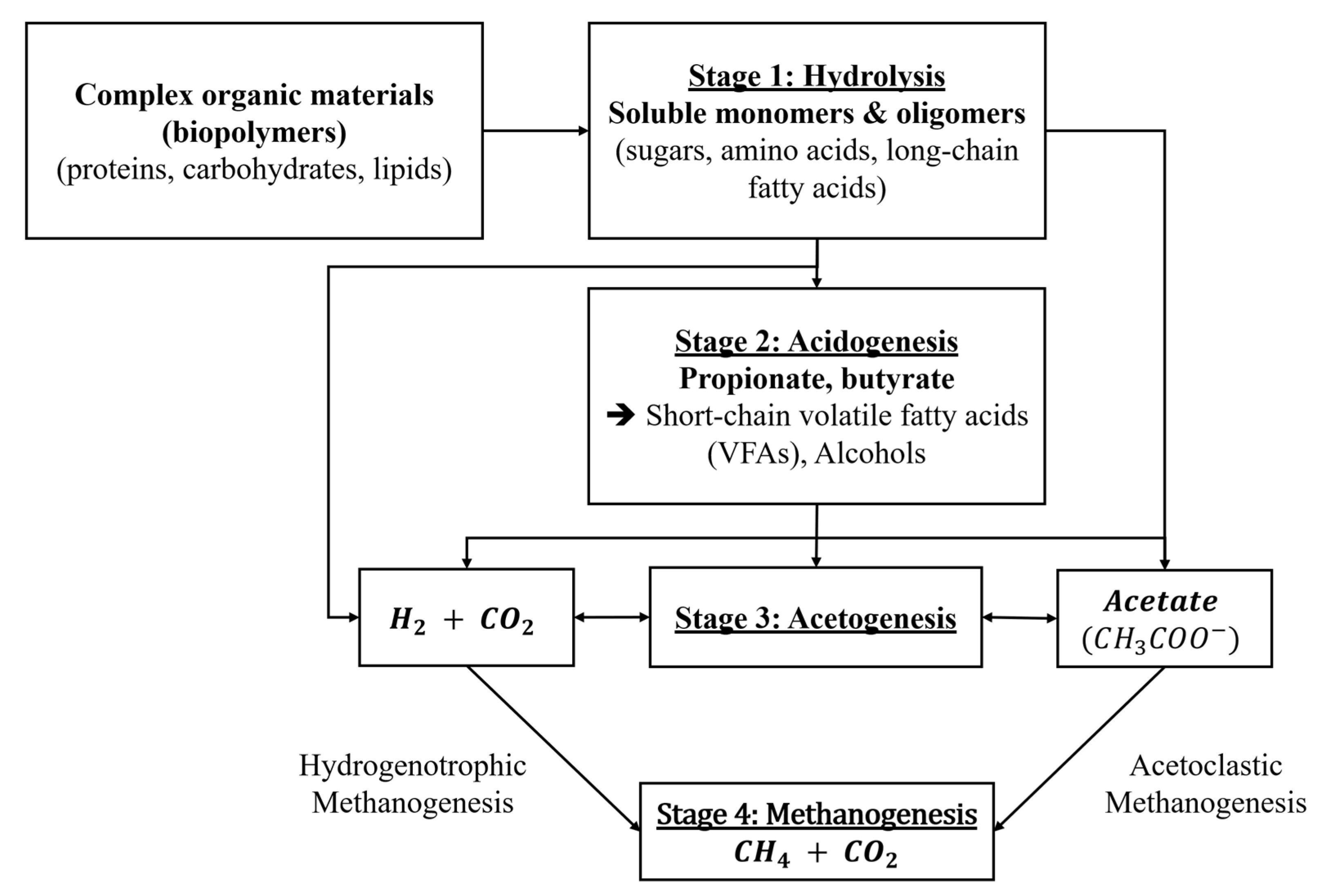
Biomass energy transforms waste into biofuels and supports water purification. This study examines enhanced hydrogen production via dark fermentation, tracking volatile fatty acids (VFAs), chemical oxygen demand (COD), carbohydrates, and hydraulic retention time (HRT) to optimize biogas yield and quality. Investigations into acidogenesis and acetogenesis explore methods for breaking down long-chain VFAs into short-chain VFAs, which are critical for efficient hydrogen generation. Testing and analysis of VFAs, carbonates, COD, and HRT provide insights into bacterial activity that drives hydrogen production. The main VFAs produced were acetic, propionic, and butyric acids. DF1 and DF2 primarily generated acetic acid, consistent with cheese whey (CW)-based fermentations. DF1.1, using 5× diluted CW and a 30:70 inoculum-to-substrate ratio (I2SR), exhibited elevated butyric acid levels, similar to those observed with food waste. The first dark fermentation process (DF1) initially showed effective carbohydrate metabolism but later experienced spikes in succinic and lactic acids, which reduced hydrogen production. In contrast, the second dark fermentation process (DF2) maintained low lactic acid levels and increased acetate concentrations, indicating improved system performance. DF1.1 also demonstrated stable VFA production and lactic acid reduction. Greater CW dilution, higher initial pH, and increased HRT were key factors in minimizing acidification and enhancing hydrogen-producing pathways.
Keywords: hydrogen; anerobic digestion; microbial electrolysis cell; agriculture wastes; anaerobic inoculum; substrates; dilution; inoculum-to-substrate ratio hydrogen; anerobic digestion; microbial electrolysis cell; agriculture wastes; anaerobic inoculum; substrates; dilution; inoculum-to-substrate ratio