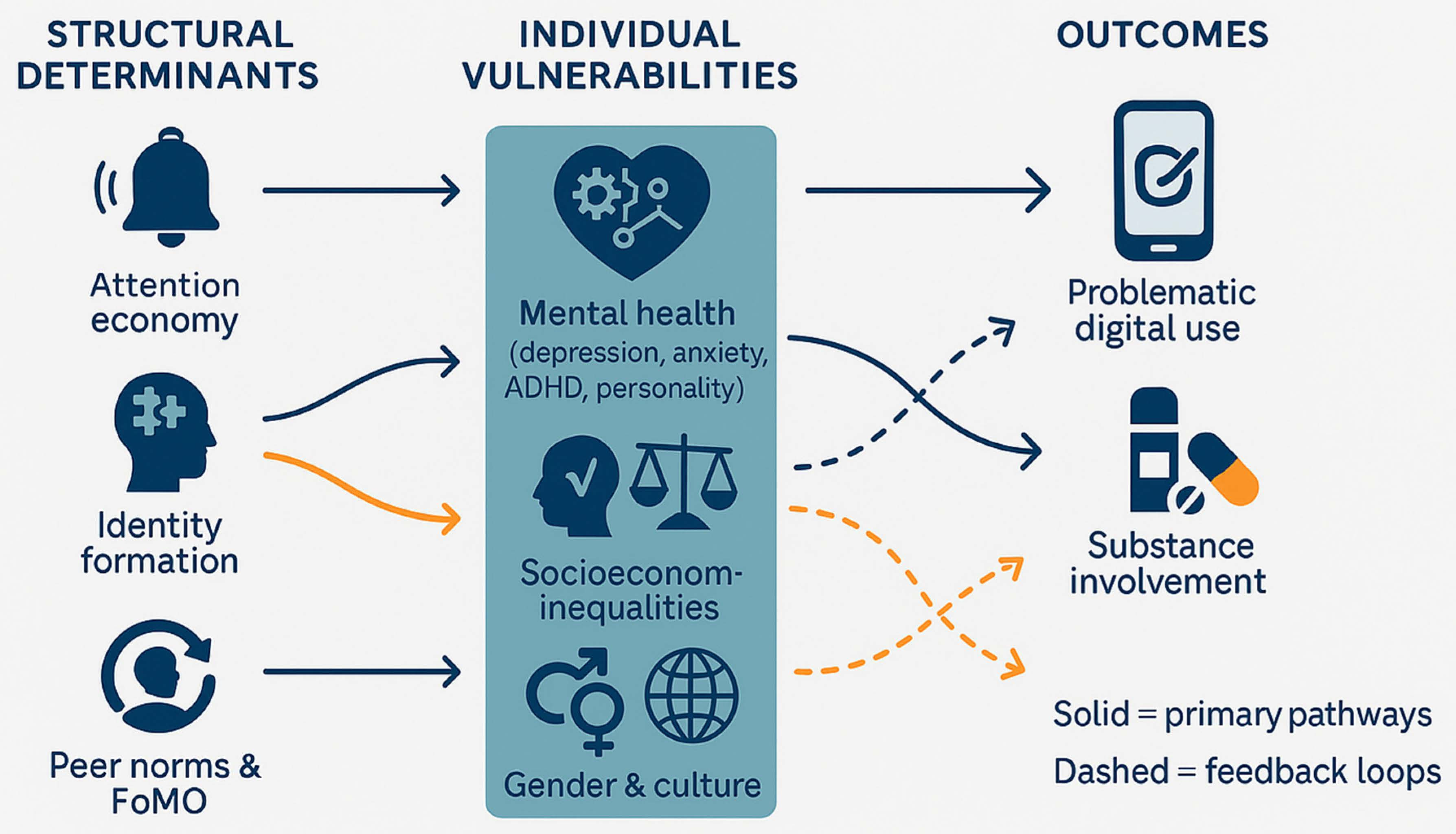


Digital and Substance Dependence in the Post-Digital Era


Definition
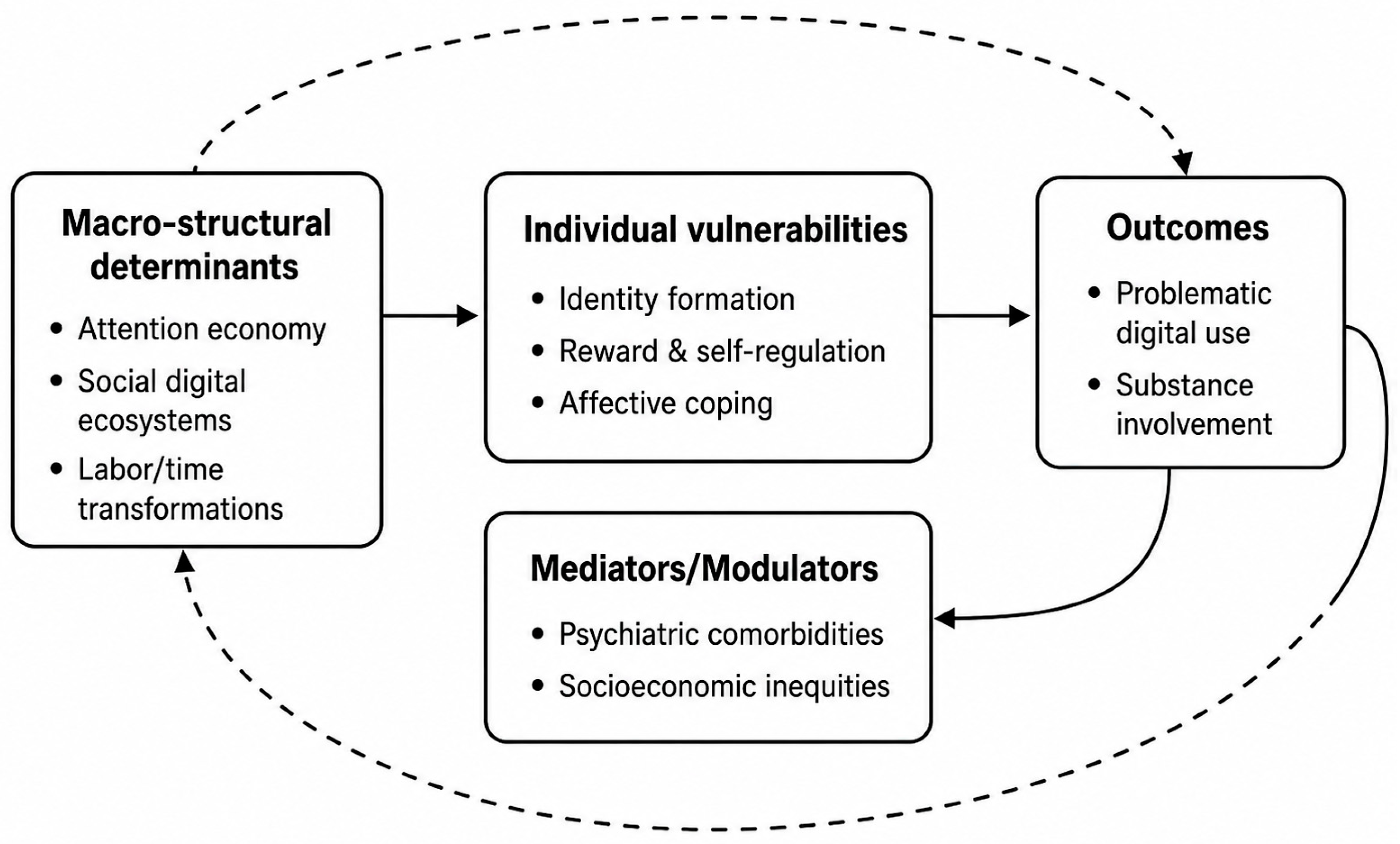
1. Introduction
2. Macro-Structural Determinants
2.1. Attention Economy and Platforms: Attention Capture, Algorithmic Amplification, Notifications, and Variable Rewards
2.2. Digital Social Ecosystems: Online/Offline Peer Norms, Imitation, Viral Challenges, and Fear of Missing Out
2.3. Transformations of Work and Time: Precarity, Gig Modalities, Hyper-Connection, and Technostress
2.4. Access, Costs, and Availability: How Digital Infrastructure and Substance Markets Shape Exposure and Vulnerability
3. Individual Vulnerabilities and Psychological Mechanisms
3.1. Identity Development in Digital-Native Cohorts
3.2. Reward, Self-Regulation, Impulsivity: Shared Neurobehavioral Substrates
3.3. Coping, Affect Regulation, and Stress: Digital Stressors and Self-Medication
3.4. Peer Influence: Belonging, Status, and Normative Beliefs
4. Intersections with Mental Health and Inequalities
4.1. Psychiatric Comorbidities as Mediators (Depression, Anxiety, ADHD, Personality Disorders)
4.2. Socioeconomic Gradient: Poverty, Educational Exclusion, Geographic Inequalities
4.3. Cultural and Gender Aspects: Intersectional Differences and Culture-Bound Practices
5. Evidence from Recent Studies
5.1. Longitudinal and Cross-Cultural Trends
5.2. Digital-Behavior Analytics and Observational Trace Data
5.3. Conceptual and Measurement Limitations
5.4. Synthesis
6. Implications for Policies and Practice
6.1. Regulatory Guardrails
6.2. Choice Architecture and Digital Nudging
6.3. Education and Digital Literacy
6.4. Prevention and Clinical Care
6.5. Cultural Tailoring and Equity
7. Outlook/Research Gaps
8. Conclusions
Funding
Institutional Review Board Statement
Informed Consent Statement
Data Availability Statement
Acknowledgments
Conflicts of Interest
Abbreviations
| ADHD | Attention-Deficit/Hyperactivity Disorder |
| CBT | Cognitive Behavioral Therapy |
| FAIR | Findable, Accessible, Interoperable, Reusable (Guiding Principles for scientific data management) |
| FoMO | Fear of Missing Out |
| GDPR | General Data Protection Regulation (EU Regulation 2016/679) |
| KPI | Key Performance Indicator |
| PIU | Problematic Internet Use |
| PSMU | Problematic Social Media Use |
| RCL | Recreational Cannabis Legalization (legalization of non-medical cannabis) |
| SUD | Substance Use Disorder |
References
- Orben, A.; Blakemore, S.-J. How social media affects teen mental health: A missing link. Nature 2023, 614, 410–412. [Google Scholar] [CrossRef] [Scilit] [PubMed]
- Borges, G.; Orozco, R.; Benjet, C.; Martínez, K.I.; Contreras, E.V.; Pérez, A.L.; Uribe, P.C.H.; Couder, M.A.C.D.; Méndez, E.; Medina-Mora, M.E.; et al. (Internet) Gaming Disorder in DSM-5 and ICD-11: A case of the glass half empty or half full. Can. J. Psychiatry 2021, 66, 477–484. [Google Scholar] [CrossRef] [Scilit] [PubMed]
- Brand, M.; Wegmann, E.; Stark, R.; Müller, A.; Wölfling, K.; Robbins, T.W.; Potenza, M.N. The Interaction of Person–Affect–Cognition–Execution (I-PACE) model for addictive behaviors: Update, generalization to addictive behaviors beyond Internet-use disorders, and specification of the process character of addictive behaviors. Neurosci. Biobehav. Rev. 2019, 104, 1–10. [Google Scholar] [CrossRef] [Scilit] [PubMed]
- Volkow, N.D.; Koob, G.F.; McLellan, A.T. Neurobiologic Advances from the Brain Disease Model of Addiction. N. Engl. J. Med. 2016, 374, 363–371. [Google Scholar] [CrossRef] [Scilit] [PubMed]
- Berridge, K.C.; Robinson, T.E. Liking, wanting, and the incentive-sensitization theory of addiction. Am. Psychol. 2016, 71, 670–679. [Google Scholar] [CrossRef] [Scilit] [PubMed]
- McLoughlin, K.L.; Brady, W.J. Human-algorithm interactions help explain the spread of misinformation. Curr. Opin. Psychol. 2024, 56, 101770. [Google Scholar] [CrossRef] [Scilit] [PubMed]
- Guess, A.M.; Malhotra, N.; Pan, J.; Barberá, P.; Allcott, H.; Brown, T.; Crespo-Tenorio, A.; Dimmery, D.; Freelon, D.; Gentzkow, M.; et al. How do social media feed algorithms affect attitudes and behavior in an election campaign? Science 2023, 381, 398–404. [Google Scholar] [CrossRef] [Scilit] [PubMed]
- Cai, Z.; Mao, P.; Wang, Z.; Wang, D.; He, J.; Fan, X. Associations Between Problematic Internet Use and Mental Health Outcomes of Students: A Meta-analytic Review. Adolesc. Res. Rev. 2023, 8, 45–62. [Google Scholar] [CrossRef] [Scilit] [PubMed]
- Shannon, H.; Bush, K.; Villeneuve, P.J.; Hellemans, K.G.C.; Guimond, S. Problematic Social Media Use in Adolescents and Young Adults: Systematic Review and Meta-analysis. JMIR Ment. Health 2022, 9, e33450. [Google Scholar] [CrossRef] [Scilit] [PubMed]
- Xiao, Y.; Meng, Y.; Brown, T.T.; Keyes, K.M.; Mann, J.J. Addictive Screen Use Trajectories and Suicidal Behaviors, Suicidal Ideation, and Mental Health in US Youths. JAMA 2025, 334, 219–228. [Google Scholar] [CrossRef] [Scilit] [PubMed]
- Wang, J.; Hao, Q.; Tu, Y.; Peng, W.; Wang, Y.; Li, H.; Zhu, T.-M. Assessing the Association Between Internet Addiction Disorder and Health Risk Behaviors Among Adolescents and Young Adults: A Systematic Review and Meta-Analysis. Front. Public Health 2022, 10, 809232. [Google Scholar] [CrossRef] [Scilit] [PubMed]
- Cheng, B.; Lim, C.C.W.; Rutherford, B.N.; Huang, S.; Ashley, D.P.; Johnson, B.; Chung, J.; Chan, G.C.K.; Coates, J.M.; Gullo, M.J.; et al. A systematic review and meta-analysis of the relationship between youth drinking, self-posting of alcohol use and other social media engagement (2012–21). Addiction 2024, 119, 28–46. [Google Scholar] [CrossRef] [Scilit] [PubMed]
- Nagata, J.M.; Smith, N.; Zamora, G.; Sajjad, O.M.; Ganson, K.T.; Testa, A.; Jackson, D.B. Problematic social media use and alcohol expectancies in early adolescents (ABCD Study). BMC Public Health 2023, 23, 1597. [Google Scholar] [CrossRef] [Scilit] [PubMed]
- Metherell, T.E.; Ghai, S.; McCormick, E.M.; Ford, T.J.; Orben, A. Digital access constraints predict worse mental health among adolescents during COVID-19. Sci. Rep. 2022, 12, 19088. [Google Scholar] [CrossRef] [Scilit] [PubMed]
- Nawi, A.M.; Ismail, R.; Ibrahim, F.; Hassan, M.R.; Manaf, M.R.A.; Amit, N.; Ibrahim, N.; Shafurdin, N.S. Risk and protective factors of drug abuse among adolescents: A systematic review. BMC Public Health 2021, 21, 2088. [Google Scholar] [CrossRef] [Scilit] [PubMed]
- Piers, R.; Williams, J.M.; Sharpe, H. Review: Can digital mental health interventions bridge the “digital divide” for socioeconomically and digitally marginalised youth? A systematic review. Child Adolesc. Ment. Health 2023, 28, 90–104. [Google Scholar] [CrossRef] [Scilit] [PubMed]
- Steinberg, L. A dual systems model of adolescent risk-taking. Dev. Psychobiol. 2010, 52, 216–224. [Google Scholar] [CrossRef] [Scilit] [PubMed]
- Shulman, E.P.; Smith, A.R.; Silva, K.; Icenogle, G.; Duell, N.; Chein, J.; Steinberg, L. The dual systems model: Review, reappraisal, and reaffirmation. Dev. Cogn. Neurosci. 2016, 17, 103–117. [Google Scholar] [CrossRef] [Scilit] [PubMed]
- Kardefelt-Winther, D. A conceptual and methodological critique of Internet addiction research: Towards a model of compensatory Internet use. Comput. Hum. Behav. 2014, 31, 351–354. [Google Scholar] [CrossRef] [Scilit]
- Lythreatis, S.; Singh, S.K.; El-Kassar, A.-N. The digital divide: A review and future research agenda. Technol. Forecast. Soc. Change 2022, 175, 121359. [Google Scholar] [CrossRef] [Scilit]
- Patel, V.; Saxena, S.; Lund, C.; Thornicroft, G.; Baingana, F.; Bolton, P.; Chisholm, D.; Collins, P.Y.; Cooper, J.L.; Eaton, J.; et al. The Lancet Commission on Global Mental Health and Sustainable Development. Lancet 2018, 392, 1553–1598. [Google Scholar] [CrossRef] [Scilit] [PubMed]
- Ayalew, Y.E.; Verdoodt, V.; Lievens, E. General Comment No. 25 on Children’s Rights in Relation to the Digital Environment: Implications for Children’s Right to Privacy and Data Protection in Africa. Hum. Rights Law Rev. 2024, 24, ngae018. [Google Scholar] [CrossRef] [Scilit]
- Information Commissioner’s Office. Age Appropriate Design: A Code of Practice for Online Services; Information Commissioner’s Office: Wilmslow, UK, 2020. [Google Scholar]
- Binns, R.; Veale, M. Is that your final decision? Multi-stage profiling, selective effects, and Article 22 of the GDPR. Int. Data Priv. Law 2021, 11, 319–332. [Google Scholar] [CrossRef] [Scilit]
- Bakshy, E.; Messing, S.; Adamic, L.A. Exposure to ideologically diverse news and opinion on Facebook. Science 2015, 348, 1130–1132. [Google Scholar] [CrossRef] [Scilit] [PubMed]
- Corsi, G. Evaluating Twitter’s algorithmic amplification of low-credibility content: An observational study. EPJ Data Sci. 2024, 13, 18. [Google Scholar] [CrossRef] [Scilit]
- Schultz, W.; Dayan, P.; Montague, P.R. A neural substrate of prediction and reward. Science 1997, 275, 1593–1599. [Google Scholar] [CrossRef] [Scilit] [PubMed]
- Stothart, C.; Mitchum, A.; Yehnert, C. The attentional cost of receiving a cell phone notification. J. Exp. Psychol. Hum. Percept. Perform. 2015, 41, 893–897. [Google Scholar] [CrossRef] [Scilit] [PubMed]
- Ward, A.F.; Duke, K.; Gneezy, A.; Bos, M.W. Brain Drain: The Mere Presence of One’s Own Smartphone Reduces Available Cognitive Capacity. J. Assoc. Consum. Res. 2017, 2, 140–154. [Google Scholar] [CrossRef] [Scilit] [PubMed]
- Wilmer, H.H.; Sherman, L.E.; Chein, J.M. Smartphones and cognition: A review of research exploring the links between mobile technology habits and cognitive functioning. Front. Psychol. 2017, 8, 605. [Google Scholar] [CrossRef] [Scilit] [PubMed]
- Chein, J.; Albert, D.; O’Brien, L.; Uckert, K.; Steinberg, L. Peers increase adolescent risk taking by enhancing activity in the brain’s reward circuitry. Dev. Sci. 2010, 14, F1–F10. [Google Scholar] [CrossRef] [Scilit] [PubMed]
- Przybylski, A.K.; Murayama, K.; DeHaan, C.R.; Gladwell, V. Motivational, emotional, and behavioral correlates of fear of missing out. Comput. Hum. Behav. 2013, 29, 1841–1848. [Google Scholar] [CrossRef] [Scilit]
- Tarafdar, M.; Pullins, E.B.; Ragu-Nathan, T.S. Technostress: Negative effect on performance and possible mitigations. Inf. Syst. J. 2015, 25, 103–132. [Google Scholar] [CrossRef] [Scilit]
- Nastjuk, I.; Trang, S.; Grummeck-Braamt, J.-V.; Adam, M.T.P.; Tarafdar, M. Integrating and synthesising technostress research: A meta-analysis on technostress creators, outcomes, and IS usage contexts. Eur. J. Inf. Syst. 2024, 33, 361–382. [Google Scholar] [CrossRef] [Scilit]
- Bahamondes-Rosado, M.E.; Cerdá-Suárez, L.M.; Dodero Ortiz de Zevallos, G.F.; Espinosa-Cristia, J.F. Technostress at work during the COVID-19 lockdown phase (2020–2021): A systematic review of the literature. Front. Psychol. 2023, 14, 1173425. [Google Scholar] [CrossRef] [Scilit] [PubMed]
- Glavin, P.; Schieman, S. Dependency and Hardship in the Gig Economy: The Mental Health Consequences of Platform Work. Socius 2022, 8, 23780231221082414. [Google Scholar] [CrossRef] [Scilit]
- Akter, S.; Rahman, M.M.; Rouyard, T.; Aktar, S.; Nsashiyi, R.S.; Nakamura, R. A systematic review and network meta-analysis of population-level interventions to tackle smoking behaviour. Nat. Hum. Behav. 2024, 8, 2367–2391. [Google Scholar] [CrossRef] [Scilit] [PubMed]
- Nazar, G.P.; Sharma, N.; Chugh, A.; Abdullah, S.M.; Lina, S.; Mdege, N.D.; John, R.M.; Huque, R.; Bauld, L.; Arora, M. Impact of tobacco price and taxation on affordability and consumption of tobacco products in the South-East Asia Region: A systematic review. Tob. Induc. Dis. 2021, 19, 97. [Google Scholar] [CrossRef] [Scilit] [PubMed]
- Farrelly, K.N.; Wardell, J.D.; Marsden, E.; Scarfe, M.L.; Najdzionek, P.; Turna, J.; MacKillop, J. The impact of recreational cannabis legalization on cannabis use and associated outcomes: A systematic review. Subst. Abus. Res. Treat. 2023, 17, 11782218231172054. [Google Scholar] [CrossRef] [Scilit] [PubMed]
- Aldridge, J.; Décary-Hétu, D. Hidden wholesale: The drug diffusing capacity of online drug cryptomarkets. Int. J. Drug Policy 2016, 35, 7–15. [Google Scholar] [CrossRef] [Scilit] [PubMed]
- Aldridge, J.; Stevens, A.; Barratt, M.J. Will growth in cryptomarket drug buying increase the harms of illicit drugs? Addiction 2018, 113, 789–796. [Google Scholar] [CrossRef] [Scilit] [PubMed]
- Kroger, J.; Martinussen, M.; Marcia, J.E. Identity status change during adolescence and young adulthood: A meta-analysis. J. Adolesc. 2010, 33, 683–698. [Google Scholar] [CrossRef] [Scilit] [PubMed]
- Meeus, W. The study of adolescent identity formation 2000–2010: A review of longitudinal research. J. Res. Adolesc. 2011, 21, 75–94. [Google Scholar] [CrossRef] [Scilit]
- Pfeifer, J.H.; Berkman, E.T. The Development of Self and Identity in Adolescence: Neural Evidence and Implications for a Value-Based Choice Perspective on Motivated Behavior. Child Dev. Perspect. 2018, 12, 158–164. [Google Scholar] [CrossRef] [Scilit] [PubMed]
- Avci, H.; Baams, L.; Kretschmer, T. A systematic review of social media use and adolescent identity development. Adolesc. Res. Rev. 2025, 10, 219–236. [Google Scholar] [CrossRef] [Scilit] [PubMed]
- Dalley, J.W.; Everitt, B.J.; Robbins, T.W. Impulsivity, compulsivity, and top-down cognitive control. Neuron 2011, 69, 680–694. [Google Scholar] [CrossRef] [Scilit] [PubMed]
- Dalley, J.W.; Robbins, T.W. Fractionating impulsivity: Neuropsychiatric implications. Nat. Rev. Neurosci. 2017, 18, 158–171. [Google Scholar] [CrossRef] [Scilit] [PubMed]
- Moffitt, T.E.; Arseneault, L.; Belsky, D.; Dickson, N.; Hancox, R.J.; Harrington, H.; Houts, R.; Poulton, R.; Roberts, B.W.; Ross, S.; et al. A gradient of childhood self-control predicts health, wealth, and public safety. Proc. Natl. Acad. Sci. USA 2011, 108, 2693–2698. [Google Scholar] [CrossRef] [Scilit] [PubMed]
- Poulton, A.; Hester, R. Transition to substance use disorders: Impulsivity for reward and learning from reward. Soc. Cogn. Affect. Neurosci. 2020, 15, 1182–1191. [Google Scholar] [CrossRef] [Scilit] [PubMed]
- Feinstein, B.A.; Hershenberg, R.; Bhatia, V.; Latack, J.A.; Meuwly, N.; Davila, J. Negative social comparison on Facebook and depressive symptoms: Rumination as a mechanism. Psychol. Pop. Media Cult. 2013, 2, 161–170. [Google Scholar] [CrossRef] [Scilit]
- Kowalski, R.M.; Giumetti, G.W.; Schroeder, A.N.; Lattanner, M.R. Bullying in the Digital Age: A Critical Review and Meta-Analysis of Cyberbullying Research among Youth. Psychol. Bull. 2014, 140, 1073–1137. [Google Scholar] [CrossRef] [Scilit] [PubMed]
- Khantzian, E.J. The self-medication hypothesis of substance use disorders: A reconsideration and recent applications. Harv. Rev. Psychiatry 1997, 4, 231–244. [Google Scholar] [CrossRef] [Scilit] [PubMed]
- Borsari, B.; Carey, K.B. Peer influences on college drinking: A review of the research. J. Subst. Abus. 2001, 13, 391–424. [Google Scholar] [CrossRef] [Scilit] [PubMed]
- Neighbors, C.; Larimer, M.E.; Lewis, M.A. Targeting misperceptions of descriptive drinking norms: Efficacy of a computer-delivered personalized normative feedback intervention. J. Consult. Clin. Psychol. 2004, 72, 434–447. [Google Scholar] [CrossRef] [Scilit] [PubMed]
- Augner, C.; Vlasak, T.; Aichhorn, W.; Barth, A. The relationship between problematic internet use and attention deficit, hyperactivity and impulsivity: A meta-analysis. J. Psychiatr. Res. 2023, 168, 1–12. [Google Scholar] [CrossRef] [Scilit] [PubMed]
- Halkett, A.; Hinshaw, S.P. Problematic social Internet use and associations with ADHD symptoms in girls: A longitudinal observational study. BMC Public Health 2024, 24, 2850. [Google Scholar] [CrossRef] [Scilit] [PubMed]
- Wilens, T.E. Attention-deficit/hyperactivity disorder and the substance use disorders: The nature of the relationship, subtypes at risk, and treatment issues. Psychiatr. Clin. N. Am. 2004, 27, 283–301. [Google Scholar] [CrossRef] [Scilit] [PubMed]
- Trull, T.J.; Freeman, L.K.; Vebares, T.J.; Choate, A.M.; Helle, A.C.; Wycoff, A.M. Borderline personality disorder and substance use disorders: An updated review. Borderline Personal. Disord. Emot. Dysregulation 2018, 5, 15. [Google Scholar] [CrossRef] [Scilit] [PubMed]
- Ding, H.; Cao, B.; Sun, Q. The association between problematic internet use and social anxiety within adolescents and young adults: A systematic review and meta-analysis. Front. Public Health 2023, 11, 1275723. [Google Scholar] [CrossRef] [Scilit] [PubMed]
- Cheshmehzangi, A.; Zou, T.; Su, Z. The digital divide impacts on mental health during the COVID-19 pandemic. Brain Behav. Immun. 2022, 101, 211–213. [Google Scholar] [CrossRef] [Scilit] [PubMed]
- Okamoto, S. Parental socioeconomic status and adolescent health in Japan: A cross-sectional study. Sci. Rep. 2021, 11, 12089. [Google Scholar] [CrossRef] [Scilit] [PubMed]
- Steare, T.; Evans-Lacko, S.; Araya, M.; Cueto, S.; Dang, H.-A.H.; Ellanki, R.; Garman, E.; Lewis, G.; Rose-Clarke, K.; Patalay, P. Economic inequalities in adolescents’ internalising symptoms: Longitudinal evidence from eight countries. Lancet Psychiatry 2024, 11, 890–898. [Google Scholar] [CrossRef] [Scilit] [PubMed]
- Su, W.; Han, X.; Jin, C.; Yan, Y.; Potenza, M.N. Are males more likely to be addicted to the Internet than females? A meta-analysis involving 34 global jurisdictions. Comput. Hum. Behav. 2019, 99, 86–100. [Google Scholar] [CrossRef] [Scilit]
- Su, W.; Han, X.; Yu, H.; Wu, Y.; Potenza, M.N. Do men become addicted to internet gaming and women to social media? A meta-analysis examining gender-related differences in specific internet addiction. Comput. Hum. Behav. 2020, 113, 106480. [Google Scholar] [CrossRef] [Scilit]
- Kelly, Y.; Zilanawala, A.; Booker, C.; Sacker, A. Social Media Use and Adolescent Mental Health: Findings from the UK Millennium Cohort Study. eClinicalMedicine 2018, 6, 59–68. [Google Scholar] [CrossRef] [Scilit] [PubMed]
- Bowleg, L. The Problem With the Phrase “Women and Minorities”: Intersectionality—An Important Theoretical Framework for Public Health. Am. J. Public Health 2012, 102, 1267–1273. [Google Scholar] [CrossRef] [Scilit] [PubMed]
- Kato, T.A.; Kanba, S.; Teo, A.R. Defining pathological social withdrawal: Proposed diagnostic criteria for hikikomori. World Psychiatry 2020, 19, 116–117. [Google Scholar] [CrossRef] [Scilit] [PubMed]
- Nagata, J.M.; Al-Shoaibi, A.A.A.; Leong, A.W.; Zamora, G.; Testa, A.; Ganson, K.T.; Baker, F.C. Screen time and mental health: A prospective analysis of the Adolescent Brain Cognitive Development (ABCD) Study. BMC Public Health 2024, 24, 2686. [Google Scholar] [CrossRef] [Scilit] [PubMed]
- Orben, A.; Dienlin, T.; Przybylski, A.K. Social media’s enduring effect on adolescent life satisfaction. Proc. Natl. Acad. Sci. USA 2019, 116, 10226–10228. [Google Scholar] [CrossRef] [Scilit] [PubMed]
- Orben, A.; Przybylski, A.K. The association between adolescent well-being and digital technology use. Nat. Hum. Behav. 2019, 3, 173–182. [Google Scholar] [CrossRef] [Scilit] [PubMed]
- Mojtabai, R. Problematic social media use and psychological symptoms in adolescents. Soc. Psychiatry Psychiatr. Epidemiol. 2024, 59, 2271–2278. [Google Scholar] [CrossRef] [Scilit] [PubMed]
- Jamal, A.; Park-Lee, E.; Birdsey, J.; West, A.; Cooper, M.R.; Cowan, H.; Wang, J.; Sawdey, M.D.; Cornelius, M.E.; Cullen, K.A.; et al. Tobacco Product Use Among Middle and High School Students—National Youth Tobacco Survey, United States, 2024. MMWR Morb. Mortal. Wkly. Rep. 2024, 73, 917–924. [Google Scholar] [CrossRef] [Scilit] [PubMed]
- Raitasalo, K.; Rossow, I.; Moan, I.S.; Bye, E.K.; Svensson, J.; Thor, S.; Ekholm, O.; Pisinger, V.; Arnarsson, Á.; Bloomfield, K. Changes in co-use of alcohol and cannabis among Nordic adolescents in the 21st century: Results from the European School Survey Project on Alcohol and Other Drugs study. Drug Alcohol Rev. 2024, 43, 616–624. [Google Scholar] [CrossRef] [Scilit] [PubMed]
- Parry, D.A.; Davidson, B.I.; Sewall, C.J.R.; Fisher, J.T.; Mieczkowski, H.; Quintana, D.S. A systematic review and meta-analysis of discrepancies between logged and self-reported digital media use. Nat. Hum. Behav. 2021, 5, 1535–1547. [Google Scholar] [CrossRef] [Scilit] [PubMed]
- Ellis, D.A.; Davidson, B.I.; Shaw, H.; Geyer, K. Do smartphone usage scales predict behavior? Int. J. Hum.-Comput. Stud. 2019, 130, 86–92. [Google Scholar] [CrossRef] [Scilit]
- Tkaczyk, M.; Tancoš, M.; Šmahel, D.; Elavsky, S.; Plhák, J. (In)accuracy and convergent validity of daily end-of-day and single-time self-reported estimations of smartphone use among adolescents. Comput. Hum. Behav. 2024, 158, 108281. [Google Scholar] [CrossRef] [Scilit]
- Boniel-Nissim, M.; van den Eijnden, R.J.J.M.; Furstova, J.; Marino, C.; Lahti, H.; Inchley, J.; Šmigelskas, K.; Vieno, A.; Badura, P. International perspectives on social media use among adolescents: Implications for mental and social well-being and substance use. Comput. Hum. Behav. 2022, 129, 107144. [Google Scholar] [CrossRef] [Scilit]
- Zhong, W.; Tian, N. Problematic Social Media Use Profiles and Adolescent Substance Use Across Countries: A Latent Class Analysis with Multilevel Models. J. Adolesc. 2026. online ahead of print. [Google Scholar] [CrossRef] [Scilit] [PubMed]
- Zewde, E.A.; Tolossa, T.; Tiruneh, S.A.; Azanaw, M.M.; Yitbarek, G.Y.; Admasu, F.T.; Ayehu, G.W.; Amare, T.J.; Abebe, E.C.; Muche, Z.T.; et al. Internet addiction and its associated factors among African high school and university students: Systematic review and meta-analysis. Front. Psychol. 2022, 13, 847274. [Google Scholar] [CrossRef] [Scilit] [PubMed]
- Santos, P.C.; da Costa, B.G.G.; Lopes, M.V.V.; Malheiros, L.E.A.; Arundell, L.; Silva, K.S. Cross-sectional associations of screen time activities with alcohol and tobacco consumption among Brazilian adolescents. Int. J. Public Health 2023, 68, 1605816. [Google Scholar] [CrossRef] [Scilit] [PubMed]
- Rodman, A.M.; Burns, J.A.; Cotter, G.K.; Ohashi, Y.-G.B.; Rich, R.K.; McLaughlin, K.A. Within-person fluctuations in objective smartphone use and emotional processes during adolescence: An intensive longitudinal study. Affect. Sci. 2024, 5, 332–345. [Google Scholar] [CrossRef] [Scilit] [PubMed]
- Minich, M.; Moreno, M.A. Real-world adolescent smartphone use is associated with improvements in mood: An ecological momentary assessment study. PLoS ONE 2024, 19, e0298422. [Google Scholar] [CrossRef] [Scilit] [PubMed]
- Allcott, H.; Gentzkow, M.; Mason, W.; Wilkins, A.; Barberá, P.; Brown, T.; Cisneros, J.C.; Crespo-Tenorio, A.; Dimmery, D.; Freelon, D.; et al. The effects of Facebook and Instagram on the 2020 election: A deactivation experiment. Proc. Natl. Acad. Sci. USA 2024, 121, e2321584121. [Google Scholar] [CrossRef] [Scilit] [PubMed]
- Guess, A.M.; Malhotra, N.; Pan, J.; Barberá, P.; Allcott, H.; Brown, T.; Crespo-Tenorio, A.; Dimmery, D.; Freelon, D.; Gentzkow, M.; et al. Reshares on social media amplify political news but do not detectably affect beliefs or opinions. Science 2023, 381, 404–408. [Google Scholar] [CrossRef] [Scilit] [PubMed]
- Yu, X.; Haroon, M.; Menchen-Trevino, E.; Wojcieszak, M. Nudging recommendation algorithms increases news consumption and diversity on YouTube. PNAS Nexus 2024, 3, pgae518. [Google Scholar] [CrossRef] [Scilit] [PubMed]
- Bekalu, M.A.; Sato, T.; Viswanath, K. Conceptualizing and Measuring Social Media Use in Health and Well-being Studies: Systematic Review. J. Med. Internet Res. 2023, 25, e43191. [Google Scholar] [CrossRef] [Scilit] [PubMed]
- Rumpf, H.-J.; Achab, S.; Billieux, J.; Bowden-Jones, H.; Carragher, N.; Demetrovics, Z.; Higuchi, S.; King, D.L.; Mann, K.; Potenza, M.N.; et al. Including gaming disorder in the ICD-11: The need to do so from a clinical and public health perspective. J. Behav. Addict. 2018, 7, 556–561. [Google Scholar] [CrossRef] [Scilit] [PubMed]
- Brand, M.; Rumpf, H.-J.; Demetrovics, Z.; Müller, A.; Stark, R.; King, D.L.; Goudriaan, A.E.; Mann, K.; Trotzke, P.; Fineberg, N.A.; et al. Which conditions should be considered as disorders in the ICD-11 designation of “other specified disorders due to addictive behaviors”? J. Behav. Addict. 2020, 11, 150–159. [Google Scholar] [CrossRef] [Scilit] [PubMed]
- Billieux, J. Problematic Use of the Mobile Phone: A Literature Review and a Pathways Model. Curr. Psychiatry Rev. 2012, 8, 299–307. [Google Scholar] [CrossRef] [Scilit]
- Weinmann, M.; Schneider, C.; Vom Brocke, J. Digital Nudging. Bus. Inf. Syst. Eng. 2016, 58, 433–436. [Google Scholar] [CrossRef] [Scilit]
- Mertens, S.; Herberz, M.; Hahnel, U.J.J.; Brosch, T. The effectiveness of nudging: A meta-analysis of choice architecture interventions across behavioral domains. Proc. Natl. Acad. Sci. USA 2022, 119, e2107346118. [Google Scholar] [CrossRef] [Scilit] [PubMed]
- Jachimowicz, J.M.; Duncan, S.; Weber, E.U.; Johnson, E.J. When and why defaults influence decisions: A meta-analysis of default effects. Behav. Public Policy 2019, 3, 159–186. [Google Scholar] [CrossRef] [Scilit]
- Council on Communications and Media; American Academy of Pediatrics. Media use in school-aged children and adolescents. Pediatrics 2016, 138, e20162592. [Google Scholar] [CrossRef] [Scilit] [PubMed]
- Jones, L.M.; Mitchell, K.J.; Beseler, C.L. The Impact of Youth Digital Citizenship Education: Insights from a Cluster Randomized Controlled Trial Outcome Evaluation of the Be Internet Awesome (BIA) Curriculum. Contemp. Sch. Psychol. 2024, 28, 509–523. [Google Scholar] [CrossRef] [Scilit]
- Jeong, S.-H.; Cho, H.; Hwang, Y. Media literacy interventions: A meta-analytic review. J. Commun. 2012, 62, 454–472. [Google Scholar] [CrossRef] [Scilit] [PubMed]
- Vahedi, Z.; Sibalis, A.; Sutherland, J.E. Are media literacy interventions effective at changing attitudes and intentions towards risky health behaviors in adolescents? A meta-analytic review. J. Adolesc. 2018, 67, 140–152. [Google Scholar] [CrossRef] [Scilit] [PubMed]
- Xie, X.; Gai, X.; Zhou, Y. A meta-analysis of media literacy interventions for deviant behaviors. Comput. Educ. 2019, 139, 146–156. [Google Scholar] [CrossRef] [Scilit]
- Conrod, P.J.; O’Leary-Barrett, M.; Newton, N.; Topper, L.; Castellanos-Ryan, N.; Mackie, C.; Girard, A. Effectiveness of a selective, personality-targeted prevention program for adolescent alcohol use and misuse: A cluster randomized controlled trial. JAMA Psychiatry 2013, 70, 334–342. [Google Scholar] [CrossRef] [Scilit] [PubMed]
- Harrer, M.; Adam, S.H.; Baumeister, H.; Cuijpers, P.; Karyotaki, E.; Auerbach, R.P.; Kessler, R.C.; Bruffaerts, R.; Berking, M.; Ebert, D.D. Internet interventions for mental health in university students: A systematic review and meta-analysis. Int. J. Methods Psychiatr. Res. 2019, 28, e1759. [Google Scholar] [CrossRef] [Scilit] [PubMed]
- Rickwood, D.; McEachran, J.; Saw, A.; Telford, N.; Trethowan, J.; McGorry, P. Sixteen years of innovation in youth mental healthcare: Outcomes for young people attending Australia’s headspace centre services. PLoS ONE 2023, 18, e0282040. [Google Scholar] [CrossRef] [Scilit] [PubMed]
- Skinner, A.; Perez-Bennetts, E.; Iorfino, F.; Varidel, M.; Richards, M.; Occhipinti, J.-A.; Song, Y.J.C.; Rosenberg, S.; Scott, E.M.; Hickie, I.B. Reshaping youth mental health care for optimal system-level outcomes: A dynamic modelling analysis. PLoS Ment. Health 2025, 2, e0000232. [Google Scholar] [CrossRef] [Scilit] [PubMed]
- Resnicow, K.; Baranowski, T.; Ahluwalia, J.S.; Braithwaite, R.L. Cultural sensitivity in public health: Defined and demystified. Ethn. Dis. 1999, 9, 10–21. [Google Scholar] [PubMed]
- Kagawa-Singer, M.; Valdez Dadia, A.; Yu, M.C.; Surbone, A. Cancer, culture, and health disparities: Time to chart a new course? CA Cancer J. Clin. 2010, 60, 12–39. [Google Scholar] [CrossRef] [Scilit] [PubMed]
- Bernal, G.; Domenech Rodríguez, M.M. (Eds.) Cultural Adaptations: Tools for Evidence-Based Practice with Diverse Populations; APA: Washington, DC, USA, 2012. [Google Scholar] [CrossRef] [Scilit]
- Kreuter, M.W.; Wray, R.J. Tailored and targeted health communication: Strategies for enhancing information relevance. Am. J. Health Behav. 2003, 27, S227–S232. [Google Scholar] [CrossRef] [Scilit] [PubMed]
- Fetters, M.D.; Curry, L.A.; Creswell, J.W. Achieving integration in mixed methods designs—Principles and practices. Ann. Fam. Med. 2013, 11, 557–564. [Google Scholar] [CrossRef] [Scilit] [PubMed]
- Johnson, R.B.; Onwuegbuzie, A.J. Mixed methods research: A research paradigm whose time has come. Educ. Res. 2004, 33, 14–26. [Google Scholar] [CrossRef] [Scilit]
- Wilkinson, M.D.; Dumontier, M.; Aalbersberg, I.J.J.; Appleton, G.; Axton, M.; Baak, A.; Blomberg, N.; Boiten, J.-W.; da Silva Santos, L.B.; Bourne, P.E.; et al. The FAIR Guiding Principles for scientific data management and stewardship. Sci. Data 2016, 3, 160018. [Google Scholar] [CrossRef] [Scilit] [PubMed]
- Salathé, M.; Bengtsson, L.; Bodnar, T.J.; Brewer, D.D.; Brownstein, J.S.; Buckee, C.; Campbell, E.M.; Cattuto, C.; Khandelwal, S.; Mabry, P.L.; et al. Digital epidemiology. PLoS Comput. Biol. 2012, 8, e1002616. [Google Scholar] [CrossRef] [Scilit] [PubMed]
- Vayena, E.; Blasimme, A.; Cohen, I.G. Machine learning in medicine: Addressing ethical challenges. PLoS Med. 2018, 15, e1002689. [Google Scholar] [CrossRef] [Scilit] [PubMed]
- Floridi, L.; Cowls, J.; Beltrametti, M.; Chatila, R.; Chazerand, P.; Dignum, V.; Luetge, C.; Madelin, R.; Pagallo, U.; Rossi, F.; et al. AI4People—An ethical framework for a good AI society. Minds Mach. 2018, 28, 689–707. [Google Scholar] [CrossRef] [Scilit] [PubMed]
- Mitchell, M.; Wu, S.; Zaldivar, A.; Barnes, P.; Vasserman, L.; Hutchinson, B.; Spitzer, E.; Raji, I.D.; Gebru, T. Model cards for model reporting. In Proceedings of the Conference on Fairness, Accountability, and Transparency (FAccT), Atlanta, GA, USA, 29–31 January 2019. [Google Scholar] [CrossRef] [Scilit]
- Gebru, T.; Morgenstern, J.; Vecchione, B.; Vaughan, J.W.; Wallach, H.; Iii, H.D.; Crawford, K. Datasheets for datasets. Commun. ACM 2021, 64, 86–92. [Google Scholar] [CrossRef] [Scilit]
- Liu, X.; Rivera, S.C.; Moher, D.; Calvert, M.J.; Denniston, A.K.; SPIRIT-AI and CONSORT-AI Working Group. Reporting guidelines for clinical trial reports for interventions involving artificial intelligence: The CONSORT-AI Extension. BMJ 2020, 370, m3164. [Google Scholar] [CrossRef] [Scilit] [PubMed]
- Cruz Rivera, S.; Liu, X.; Chan, A.-W.; Denniston, A.K.; Calvert, M.J.; SPIRIT-AI and CONSORT-AI Working Group. Guidelines for clinical trial protocols for interventions involving artificial intelligence: The SPIRIT-AI Extension. BMJ 2020, 370, m3210. [Google Scholar] [CrossRef] [Scilit] [PubMed]

| Model/Framework | Concise Definition | Relevance to This Entry |
|---|---|---|
| I-PACE model [3] | Problematic online behaviors emerge from interactions among person-level vulnerabilities, affective responses, cognitive biases, cue reactivity, and reduced executive control. | This model explains how individual vulnerability, emotional states, cognitive appraisal, and control processes may transform high digital engagement into dysregulated or addiction-like use. |
| Dual-systems model [17,18] | Adolescent risk-taking is partly explained by heightened reward sensitivity combined with still-maturing cognitive-control capacities. | This model helps clarify why adolescents and emerging adults may be especially sensitive to immediate digital rewards, peer feedback, and substance-related cues. |
| Incentive-sensitization theory [5] | Repeated exposure to rewarding cues can increase cue-triggered “wanting” even when pleasure or “liking” decreases. | This theory supports the comparison between substance-related craving and some digital reward loops, such as notifications, likes, feed refreshes, and variable reinforcement. |
| Compensatory Internet Use model [19] | Digital engagement may become problematic when it is used primarily to regulate distress, loneliness, rejection, boredom, or dysphoria. | This model explains how digital overuse and substance use may both function as short-term coping strategies maintained by negative reinforcement. |
| Structural determinants framework [14,15,16,20,21,22,23,24] | Individual risk is shaped by broader social, economic, technological, and policy conditions, including platform design, inequality, access, labor conditions, education, and regulation. | This framework prevents an exclusively individualistic interpretation of risk and supports population-level prevention, safer defaults, equitable access to care, and culturally adapted interventions. |
| Study/Source (Ref.) | Region/Setting | Design/Sample | Digital Exposure | Outcome(s) | Main Finding and Key Limitation |
|---|---|---|---|---|---|
| ABCD Prospective Cohort [68] | USA | Prospective cohort; approx. 9500 children/adolescents, 9–13 years | Self-reported screen time by modality | Depressive, ADHD, and conduct symptoms | Small prospective associations after adjustment; stronger for some modalities. Limitation: self-reported exposure and small absolute effects. |
| National adolescent cohort [10] | USA | Multi-year prospective adolescent cohort | Addictive use of digital devices | Suicidal ideation | Addictive digital use predicted later suicidal ideation after adjustment. Limitation: residual confounding and measurement non-equivalence across subgroups. |
| UK Millennium Cohort Study [65] | UK | Large cohort; age-14 sweep | Hours/day of social-media use | Depressive symptoms, cyber-victimization, sleep | Associations were stronger in girls and partly mediated by cyber-victimization and sleep. Limitation: cross-sectional sweep and self-reported exposure. |
| Multi-dataset re-analyses [69,70] | UK/USA | Re-analysis of large adolescent datasets | Digital technology/social-media use | Life satisfaction and well-being | Average associations were close to zero, with substantial between-person heterogeneity. Limitation: operational heterogeneity and analytic sensitivity. |
| NYTS Surveillance [72] | USA | Repeated national cross-sectional surveillance | Tobacco/nicotine product use | E-cigarette, cigarette, and nicotine pouch use | E-cigarette use declined, while nicotine pouches emerged as an important product. Limitation: self-report and rapidly changing product landscape. |
| Nordic adolescents/ESPAD-related trends [73] | Nordic countries | Repeated cross-sectional and trend analyses | Alcohol and cannabis use indicators | Co-use and secular substance-use trends | Mixed trends, with some alcohol declines and persistence of high-risk subgroups. Limitation: policy and cultural heterogeneity across countries. |
| ABCD Early Adolescents [13] | USA | Cross-sectional cohort analysis | Problematic social-media use vs. time online | Alcohol expectancies | PSMU was associated with alcohol expectancies, whereas time alone was less informative. Limitation: expectancies are cognitive antecedents, not substance-use behavior. |
| Social media alcohol-content meta-analysis [12] | Multi-country | Systematic review and meta-analysis | Self-posting/viewing alcohol-related social-media content | Drinking behaviors | Small-to-moderate associations with drinking behaviors. Limitation: mostly observational evidence and residual confounding. |
| Boniel-Nissim et al. [77] | 42 countries, HBSC | Cross-national study; 190,089 adolescents aged 11, 13, and 15 | Intense and problematic social-media use | Mental/social well-being and substance use | Problematic users showed the least favorable well-being profile and highest substance use. Limitation: cross-sectional design and regional heterogeneity. |
| Zhong et al. [78] | 39 countries, HBSC | Latent class analysis; 157,717 adolescents | PSMU profiles | Smoking, drunkenness, cannabis use | Different PSMU profiles were associated with adolescent substance use across countries. Limitation: cross-sectional data and possible measurement differences across cultures. |
| Zewde et al. [79] | Africa | Systematic review and meta-analysis; 28 studies, 10 countries, 14,946 students | Internet addiction | Prevalence and associated factors | High pooled prevalence of internet addiction; associated with male sex, urban residence, and >4 h/day use. Limitation: high heterogeneity and limited direct substance-use outcomes. |
| dos Santos et al. [80] | Brazil | Cross-sectional adolescent study | Screen time by activity type | Alcohol and tobacco use | Social media use was associated with higher odds of smoking and alcohol use, whereas screen time for studying showed inverse associations. Limitation: cross-sectional design and no causal inference. |
| Policy Lever | Concrete Measure | Mechanism | Expected Outcome | Equity Consideration |
|---|---|---|---|---|
| Profiling limits | Ban personalized advertising to minors; allow contextual advertising only. | Reduces commercial targeting based on inferred vulnerability, impulsivity, or affective state. | Lower exposure to persuasive or age-inappropriate content; reduced compulsive purchasing, loot-box spending, and substance-normalizing advertising. | Audits should include minority-language segments, low-literacy users, and transparent enforcement procedures. |
| Age assurance and safer defaults | Use risk-tiered, privacy-preserving age assurance; set non-personalized feeds as default for under-16 accounts. | Constrains recommender personalization and reduces amplification of high-arousal or mature content. | Reduced exposure to mature content, binge-scrolling, and risky viral challenges. | Age assurance should avoid exclusion of undocumented youth, low-income families, or users without formal identity documents. |
| Privacy by default | Set profiles to private by default; turn off direct messages from non-contacts for under-16 accounts. | Reduces unsolicited contact, grooming risk, cybervictimization, and social-evaluative pressure. | Fewer unsolicited messages and harassment reports; lower anxiety and distress linked to online victimization. | Reporting and appeal systems should be accessible, multilingual, and non-punitive. |
| Location and geotagging protection | Turn location sharing off by default; require opt-in geotagging with clear friction for minors. | Reduces doxxing, stalking risk, and place-based social comparison. | Fewer location-based safety incidents; stronger privacy-protective behaviors. | Interfaces should use simple language and icons for low-literacy users and younger adolescents. |
| Independent auditability | Require external audits of ad delivery, feed composition, age-gating performance, and high-risk engagement design. | Creates accountability for platform-level exposure and prevents hidden amplification of risky content. | Improved transparency; earlier detection of harmful design patterns or unequal exposure across groups. | Audits should assess differential effects by gender, socioeconomic status, language, disability, and geographic location. |
| Illegal marketing and harmful content controls | Throttle or remove illegal substance marketing; apply friction before mature-rated or substance-normalizing content. | Increases friction and reduces repeated exposure to substance-related cues. | Reduced visibility of risky challenges, high-potency product promotion, and peer-normalizing substance content. | Controls should be transparent and include appeal mechanisms to avoid over-removal of legitimate harm-reduction information. |
| Policy Lever | Concrete Measure | Mechanism | Expected Outcome | Equity Consideration |
|---|---|---|---|---|
| Safe defaults | Set autoplay off and activate night-time quiet hours, for example, 22:00–07:00, for under-16 accounts. | Reduces variable reward density, automatic continuation, and nocturnal cueing; preserves sleep opportunity. | Less after-bed scrolling, fewer late-night notifications, improved sleep duration and regularity, and lower daytime sleepiness. | Defaults should apply across low-cost devices and major platforms to avoid unequal protection by device or vendor. |
| Notification bundling | Bundle notifications and deliver them in scheduled windows, for example, three times per day, with emergency bypass. | Reduces cue frequency and attentional fragmentation while preserving access to important communication. | Fewer daily interruptions, better on-task behavior, lower perceived technostress, and improved academic engagement. | Must work in low-data/offline contexts and allow emergency exceptions for family, health, or safeguarding needs. |
| Session-length prompts | Introduce prompts after 20–30 min of continuous use with an easy “take a break” option. | Interrupts habit loops, increases self-monitoring, and introduces light friction before prolonged sessions. | Shorter continuous sessions, increased perceived control, and lower problematic digital use severity. | Prompts should be non-stigmatizing, localizable, accessible, and easy to dismiss when use is purposeful. |
| Chronological or less-personalized feed option | Use chronological or less-personalized feeds as default for minors; make algorithmic feeds opt-in. | Reduces algorithm-driven amplification and lowers exposure to high-arousal or polarizing content. | More diverse content exposure, lower binge-scrolling risk, and reduced susceptibility to viral harms or challenges. | Feed options should be understandable to young users and available regardless of subscription status. |
| Quality labels and content friction | Apply quality labels to low-credibility links and add friction before resharing or engaging with substance-normalizing content. | Slows impulsive sharing and encourages reflection before exposure or dissemination of risky material. | Lower reshares of low-credibility content; increased critical evaluation; reduced normalization of risky behaviors. | Labels must be culturally sensitive, independently governed, and avoid bias against non-mainstream but legitimate sources. |
| Rate-limiting social reward metrics | Limit rapid refresh cycles and delay or batch display of likes, views, streaks, or similar social metrics. | Reduces immediate social reinforcement and lowers status-driven checking loops. | Lower compulsive checking, reduced comparison pressure, and improved capacity to disengage from platforms. | Design should avoid penalizing youth creators, minoritized voices, or educational uses of social platforms. |
| Policy Lever | Concrete Measure | Mechanism | Expected Outcome | Equity Consideration |
|---|---|---|---|---|
| Media and privacy literacy | Deliver age-graded modules on privacy, data trails, advertising, recommender systems, and the attention economy. | Builds critical understanding of persuasive design and strengthens privacy-protective behavior. | Improved media knowledge, critical processing, privacy skills, and resistance to risky online norms. | Materials should be low-bandwidth, multilingual, disability-accessible, and adapted to the platforms used locally. |
| School digital citizenship curriculum | Implement spiraled school curricula integrating social–emotional learning, norm correction, sleep hygiene, and peer-influence literacy. | Addresses risk before problems emerge and reframes digital behavior as part of psychosocial development. | Greater self-regulation, healthier peer norms, reduced cybervictimization, and lower risk of problematic use. | Curricula should be co-designed with students, caregivers, and communities facing socioeconomic or territorial disadvantage. |
| Routine dual-risk screening | Screen for problematic digital use, sleep problems, mood/anxiety symptoms, ADHD traits, substance use, and online victimization. | Identifies comorbidity early and prevents separation of digital and substance-related problems into disconnected care pathways. | Earlier detection, better referral accuracy, and improved monitoring of adolescents with combined risks. | Screening must be confidential, non-punitive, trauma-informed, and connected to accessible services. |
| Stepped-care pathway | Use a stepped model: psychoeducation and self-help; brief digital CBT or motivational modules; clinician-guided intervention; specialist referral when impairment is significant. | Matches intervention intensity to severity and reduces treatment barriers. | Reduced symptom scores, improved functioning, higher care retention, and lower escalation to severe SUD or behavioral addiction. | Care should be no-cost or low-cost, available after hours, and supported by interpreters where needed. |
| Nudge to care | Offer opt-in prompts to chatlines, school counselors, or youth clinics after repeated harm signals, such as harassment, sleep disruption, or self-reported distress. | Reduces help-seeking friction at the moment of need while preserving consent. | Increased linkage to brief interventions; reduced PSMU severity, binge drinking, vaping episodes, or crisis escalation. | Must use explicit consent, privacy-preserving analytics, and clear safeguards against punitive consequences. |
| Culturally adapted prevention | Adapt prevention content to local language, values, family norms, dominant platforms, substance-use patterns, and community resources. | Improves engagement by aligning intervention content with deep cultural structures and local explanatory models. | Higher acceptability, better adherence, improved family involvement, and more equitable prevention uptake. | Adaptation should include youth from minority, rural, low-income, migrant, and marginalized communities. |
Disclaimer/Publisher’s Note: The statements, opinions and data contained in all publications are solely those of the individual author(s) and contributor(s) and not of MDPI and/or the editor(s). MDPI and/or the editor(s) disclaim responsibility for any injury to people or property resulting from any ideas, methods, instructions or products referred to in the content. |
© 2026 by the author. Licensee MDPI, Basel, Switzerland. This article is an open access article distributed under the terms and conditions of the Creative Commons Attribution (CC BY) license.
Share and Cite
Romeo, V.M. Digital and Substance Dependence in the Post-Digital Era. Encyclopedia 2026, 6, 160. https://doi.org/10.3390/encyclopedia6070160
Romeo VM. Digital and Substance Dependence in the Post-Digital Era. Encyclopedia. 2026; 6(7):160. https://doi.org/10.3390/encyclopedia6070160
Chicago/Turabian StyleRomeo, Vincenzo Maria. 2026. "Digital and Substance Dependence in the Post-Digital Era" Encyclopedia 6, no. 7: 160. https://doi.org/10.3390/encyclopedia6070160
APA StyleRomeo, V. M. (2026). Digital and Substance Dependence in the Post-Digital Era. Encyclopedia, 6(7), 160. https://doi.org/10.3390/encyclopedia6070160