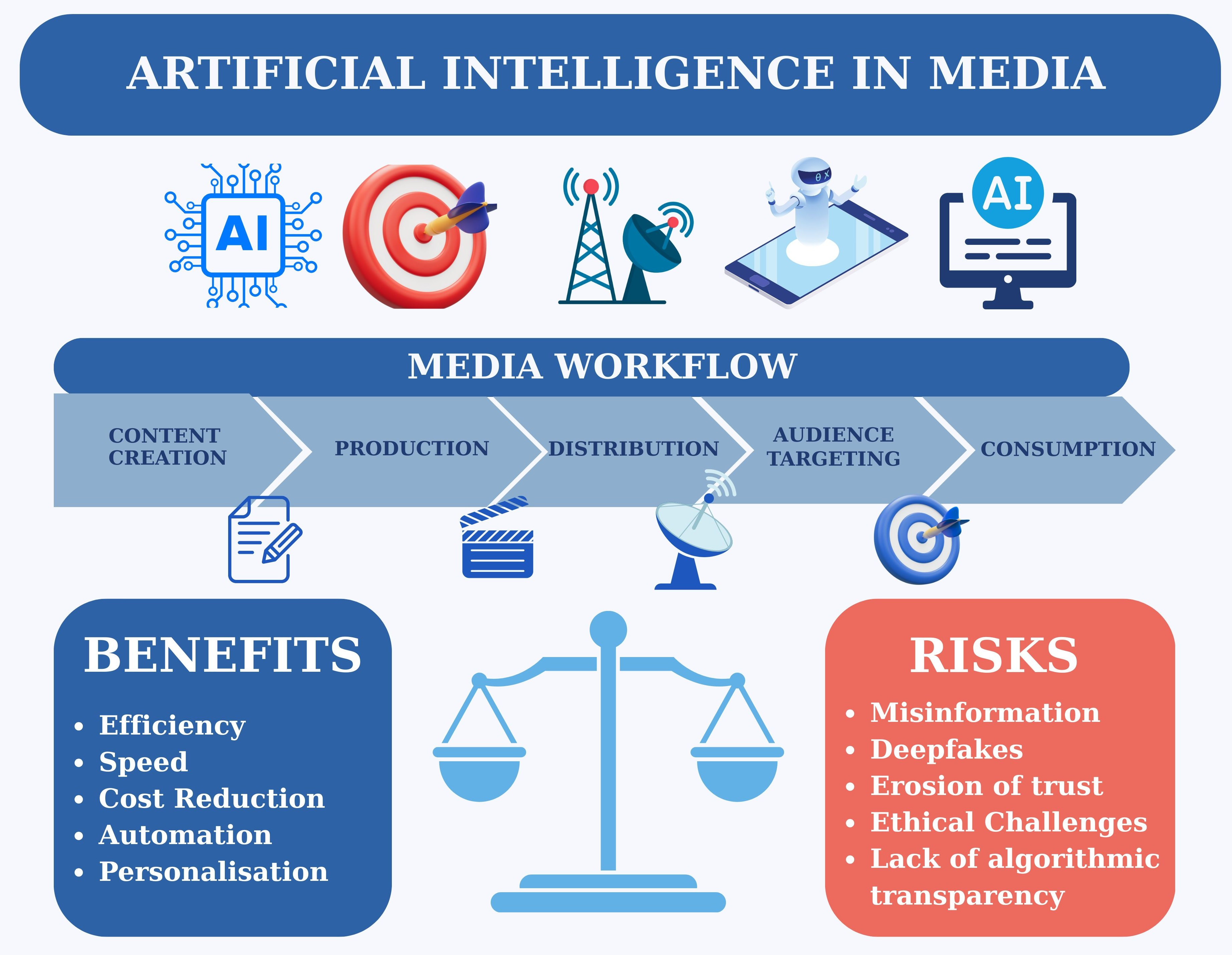


Artificial Intelligence and the Transformation of the Media System

Definition
1. Introduction
2. History
3. Artificial Intelligence Applications in the Media Sector
3.1. Newsgathering
3.2. Generative Intelligence and Text Writing
3.3. Generating Images and Video with Artificial Intelligence
3.4. Integrating Voice Cloning into Media
3.5. Virtual Presenters, Avatars, and Influencers in Media Production
3.6. AI-Powered Innovations in Video Post-Production
3.7. The Role of Speech Recognition in Improving Media Workflows
3.8. Artificial Intelligence-Assisted Content Moderation
3.9. Verifying Information and Combating Disinformation
3.10. Examples of AI-Driven Practices in Media Sector
4. Challenges and Ethical Issues in the Use of Artificial Intelligence in the Media
5. Discussion
6. Conclusions
- Editorial responsibility and decision-making
- Media literacy and artificial intelligence literacy
- Responsible technological integration
- Institutional governance and regulatory adaptation
Funding
Institutional Review Board Statement
Informed Consent Statement
Data Availability Statement
Conflicts of Interest
References
- Cools, H.; Diakopoulos, N. Uses of Generative AI in the Newsroom: Mapping Journalists’ Perceptions of Perils and Possibilities. J. Pract. 2024, 1–19. [Google Scholar] [CrossRef]
- Van Dalen, A. Revisiting the Algorithms behind the Headlines. How Journalists Respond to Professional Competition of Generative AI. J. Pract. 2024, 1–18. [Google Scholar] [CrossRef]
- Xu, J.; Qu, R.; Zhou, S.; Ren, J. Generative Artificial Intelligence and the Media Digital Divide: Comparison of Four Tiers of Chinese Media. J. Pract. 2025, 1–19. [Google Scholar] [CrossRef]
- Leaver, T.; Srdarov, S. ChatGPT Isn’t Magic. M/C J. 2023, 26. [Google Scholar] [CrossRef]
- Mühlhoff, R. Human-Aided Artificial Intelligence: Or, How to Run Large Computations in Human Brains? Toward a Media Sociology of Machine Learning. New Media Soc. 2019, 22, 1868–1884. [Google Scholar] [CrossRef]
- Silvia, T. Artificial Intelligence in Journalism: Changing the News; McFarland: McFarland, CA, USA, 2025. [Google Scholar]
- Wang, R.; Ophir, Y. Behind the Black Box: The Moderating Role of the Machine Heuristic on the Effect of Transparency Information about Automated Journalism on Hostile Media Bias Perception. Journalism 2024, 27, 103–121. [Google Scholar] [CrossRef]
- Caswell, D.; Dörr, K. Automated Journalism 2.0: Event-Driven Narratives. J. Pract. 2017, 12, 477–496. [Google Scholar] [CrossRef]
- Thäsler-Kordonouri, S.; Barling, K. Automated Journalism in UK Local Newsrooms: Attitudes, Integration, Impact. J. Pract. 2023, 19, 58–75. [Google Scholar] [CrossRef]
- Gillespie, T. Content Moderation, AI, and the Question of Scale. Big Data Soc. 2020, 7, 205395172094323. [Google Scholar] [CrossRef]
- Huang, T. Content Moderation by LLM: From Accuracy to Legitimacy. Artif. Intell. Rev. 2025, 58, 320. [Google Scholar] [CrossRef]
- Steensen, S.; Ferrer-Conill, R.; Peters, C. (Against a) Theory of Audience Engagement with News. J. Stud. 2020, 21, 1662–1680. [Google Scholar] [CrossRef]
- Lim, J.S.; Shin, D.; Zhang, J.; Masiclat, S.; Luttrell, R.; Kinsey, D. News Audiences in the Age of Artificial Intelligence: Perceptions and Behaviors of Optimizers, Mainstreamers, and Skeptics. J. Broadcast. Electron. Media 2022, 67, 353–375. [Google Scholar] [CrossRef]
- Broussard, M.; Diakopoulos, N.; Guzman, A.L.; Abebe, R.; Dupagne, M.; Chuan, C.-H. Artificial Intelligence and Journalism. J. Mass Commun. Q. 2019, 96, 673–695. [Google Scholar] [CrossRef]
- Hassan, A.; Albayari, A. The Usage of Artificial Intelligence in Journalism. In Studies in Computational Intelligence; Springer: Cham, Switzerland, 2022; pp. 175–197. [Google Scholar]
- Bontridder, N.; Poullet, Y. The Role of Artificial Intelligence in Disinformation. Data Policy 2021, 3, e32. [Google Scholar] [CrossRef]
- García-Faroldi, L.; Teruel, L.; Blanco, S. Unmasking AI’s Role in the Age of Disinformation: Friend or Foe? J. Media 2025, 6, 19. [Google Scholar] [CrossRef]
- Tiernan, P.; Costello, E.; Donlon, E.; Parysz, M.; Scriney, M. Information and Media Literacy in the Age of AI: Options for the Future. Educ. Sci. 2023, 13, 906. [Google Scholar] [CrossRef]
- Sánchez-García, P.; Diez-Gracia, A.; Mayorga, I.R.; Jerónimo, P. Media Self-Regulation in the Use of AI: Limitation of Multimodal Generative Content and Ethical Commitments to Transparency and Verification. J. Media 2025, 6, 29. [Google Scholar] [CrossRef]
- Lamprou, S.; Dekoulou, P.; Kalliris, G. The Critical Impact and Socio-Ethical Implications of AI on Content Generation Practices in Media Organizations. Societies 2025, 15, 214. [Google Scholar] [CrossRef]
- Reiter, E. Natural Language Generation. In The Handbook of Computational Linguistics and Natural Language Processing; Clark, A., Fox, C., Lappin, S., Eds.; Wiley-Blackwell: Oxford, UK, 2010; pp. 574–598. [Google Scholar]
- Myers, A. Stanford’s John McCarthy, Seminal Figure of Artificial Intelligence, Dies at 84. Available online: https://news.stanford.edu/stories/2011/10/stanfords-john-mccarthy-seminal-figure-artificial-intelligence-dies-84 (accessed on 20 December 2025).
- Manning, C. Artificial Intelligence Definitions. 2020. Available online: https://hai-production.s3.amazonaws.com/files/2020-09/AI-Definitions-HAI.pdf (accessed on 20 December 2025).
- Stonier, T. The Evolution of Machine Intelligence. In Beyond Information; Springer: London, UK, 1992. [Google Scholar] [CrossRef]
- McLuhan, M. Understanding Media: The Extensions of Man; McGraw Hill: New York, NY, USA, 1964. [Google Scholar]
- Russell, S.; Norvig, P. Artificial Intelligence: A Modern Approach, 4th ed.; Pearson: Harlow, UK, 2021. [Google Scholar]
- Westerman, D.; Edwards, A.P.; Edwards, C.; Luo, Z.; Spence, P.R. I-It, I-Thou, I-Robot: The perceived humanness of AI in human-machine. Commun. Stud. 2020, 71, 393–408. [Google Scholar] [CrossRef]
- Shi, Y.; Sun, L. How Generative AI Is Transforming Journalism: Development, Application and Ethics. J. Media 2024, 5, 582–594. [Google Scholar] [CrossRef]
- Dörr, K.N. Mapping the Field of Algorithmic Journalism. Digit. J. 2016, 4, 700–722. [Google Scholar] [CrossRef]
- Brown, P.F.; Della Pietra, S.A.; Della Pietra, V.J.; Mercer, R.L. The Mathematics of Statistical Machine Translation: Parameter Estimation. Comput. Linguist. 1993, 19, 263–311. [Google Scholar]
- Colavizza, G.; Blanke, T.; Jeurgens, C.; Noordegraaf, J. Archives and AI: An Overview of Current Debates and Future Perspectives. J. Comput. Cult. Herit. 2021, 15, 1–15. [Google Scholar] [CrossRef]
- Anderson, C.W. Towards a Sociology of Computational and Algorithmic Journalism. New Media Soc. 2012, 15, 1005–1021. [Google Scholar] [CrossRef]
- Broussard, M. Artificial Intelligence for Investigative Reporting. Digit. J. 2014, 3, 814–831. [Google Scholar] [CrossRef]
- Pavlik, J.V. Innovation and the Future of Journalism. Digit. J. 2013, 1, 181–193. [Google Scholar] [CrossRef]
- Kim, H. AI in Journalism: Creating an Ethical Framework. Bachelor’s Thesis, Syracuse University, Syracuse, NY, USA, 2019. [Google Scholar]
- Phillips, A. Transparency and the New Ethics of Journalism. J. Pract. 2010, 4, 373–382. [Google Scholar] [CrossRef]
- Thurman, N.; Lewis, S.C.; Kunert, J. Algorithms, Automation, and News. Digit. J. 2019, 7, 980–992. [Google Scholar] [CrossRef]
- Diakopoulos, N. Algorithmic Accountability. Digit. J. 2014, 3, 398–415. [Google Scholar] [CrossRef]
- Bender, S. Generative-AI, the Media Industries, and the Disappearance of Human Creative Labour. Media Pract. Educ. 2024, 26, 200–217. [Google Scholar] [CrossRef]
- Porlezza, C. Promoting Responsible AI: A European Perspective on the Governance of Artificial Intelligence in Media and Journalism. Communications 2023, 48, 370–394. [Google Scholar] [CrossRef]
- Diakopoulos, N.; Trielli, D.; Lee, G. Towards Understanding and Supporting Journalistic Practices Using Semi-Automated News Discovery Tools. Proc. ACM Hum.-Comput. Interact. 2021, 5, 1–30. [Google Scholar] [CrossRef]
- Shoemaker, P.J.; Reese, S.D. Mediating the Message in the 21st Century: A Media Sociology Perspective; Routledge: Oxfordshire, UK, 2013. [Google Scholar] [CrossRef]
- Hermida, A.; Simon, F.M. AI in the Newsroom: Lessons from the Adoption of the Globe and Mail’s Sophi. J. Pract. 2025, 19, 2323–2340. [Google Scholar] [CrossRef]
- Cools, H.; Van Gorp, B.; Opgenhaffen, M. New Organizations, Different Journalistic Roles, and Innovative Projects: How Second-Generation Newsroom Innovation Labs Are Changing the News Ecosystem. J. Pract. 2022, 18, 1605–1620. [Google Scholar] [CrossRef]
- Deuze, M.; Beckett, C. Imagination, Algorithms and News: Developing AI Literacy for Journalism. Digit. J. 2022, 10, 1913–1918. [Google Scholar] [CrossRef]
- Lorenz, P.; Perset, K.; Berryhill, J. Initial Policy Considerations for Generative Artificial Intelligence; OECD Artificial Intelligence Papers; OECD Publishing: Paris, France, 2023. [Google Scholar]
- Gutiérrez-Caneda, B.; Vázquez-Herrero, J.; López-García, X. AI Application in Journalism: ChatGPT and the Uses and Risks of an Emergent Technology. Prof. Inf. 2023, 32, e320514. [Google Scholar] [CrossRef]
- Nishal, S.; Diakopoulos, N. Envisioning the Applications and Implications of Generative AI for News Media. arXiv 2024, arXiv:2402.18835. [Google Scholar] [CrossRef]
- Du, W.; Kim, Z.M.; Raheja, V.; Kumar, D.; Kang, D. Read, Revise, Repeat: A System Demonstration for Human-in-the-loop Iterative Text Revision. In Proceedings of the First Workshop on Intelligent and Interactive Writing Assistants (In2Writing 2022); ACL: Stroudsburg, PA, USA, 2022; pp. 96–108. [Google Scholar] [CrossRef]
- Ho, J.; Chan, W.; Saharia, C.; Whang, J.; Gao, R.; Gritsenko, A.; Kingma, D.P.; Poole, B.; Norouzi, M.; Fleet, D.J.; et al. Imagen Video: High Definition Video Generation with Diffusion Models. arXiv 2022, arXiv:2210.02303. [Google Scholar] [CrossRef]
- Zhang, C.; Zhang, C.; Zhang, M.; Kweon, I.S.; Kim, J. Text-to-Image Diffusion Models in Generative AI: A Survey. arXiv 2023, arXiv:2303.07909. [Google Scholar] [CrossRef]
- Kondratyuk, D.; Yu, L.; Gu, X.; Lezama, J.; Huang, J.; Schindler, G.; Hornung, R.; Birodkar, V.; Yan, J.; Chiu, M.-C.; et al. VideoPoet: A Large Language Model for Zero-Shot Video Generation. arXiv 2024, arXiv:2312.14125. [Google Scholar] [CrossRef]
- Storey, V.C.; Yue, W.T.; Zhao, J.L.; Lukyanenko, R. Generative Artificial Intelligence: Evolving Technology, Growing Societal Impact, and Opportunities for Information Systems Research. Inf. Syst. Front. 2025, 27, 2081–2102. [Google Scholar] [CrossRef]
- Regulation (EU) 2024/1689 of the European Parliament and of the Council of 13 June 2024 Laying Down Harmonised Rules on Artificial Intelligence and Amending Regulations (EC) No 300/2008, (EU) No 167/2013, (EU) No 168/2013, (EU) 2018/858, (EU) 2018/1139 and (EU) 2019/2144 and Directives 2014/90/EU, (EU) 2016/797 and (EU) 2020/1828 (Artificial Intelligence Act) (Text with EEA Relevance). Available online: https://eur-lex.europa.eu/legal-content/EN/TXT/?uri=CELEX%3A32024R1689 (accessed on 20 December 2025).
- Thomson, T.J.; Thomas, R.J.; Matich, P. Generative Visual AI in News Organizations: Challenges, Opportunities, Perceptions, and Policies. Digit. J. 2024, 13, 1693–1714. [Google Scholar] [CrossRef]
- Boerescu, G. Moment unic la Protevelion 2024: Regretata Draga Olteanu Matei va avea un Moment Spectaculos ca Hologramă. ProTV.ro, 28 December 2023. Available online: https://www.protv.ro/articol/95460-moment-unic-la-protevelion-2024-regretata-draga-olteanu-matei-va-avea-un-moment-spectaculos-ca-holograma (accessed on 10 January 2026).
- Bendel, O. The synthetization of human voices. AI Soc. 2019, 34, 83–89. [Google Scholar] [CrossRef]
- Franganillo, J. La inteligencia artificial generativa y su impacto en la creación de contenidos mediáticos. Methaodos Rev. Cienc. Soc. 2023, 11, m231102a10. [Google Scholar] [CrossRef]
- Genelza, G.G. A Systematic Literature Review on AI Voice Cloning Generator: A Game-Changer or a Threat? J. Emerg. Technol. 2024, 4, 54–61. [Google Scholar]
- Dale, R. The voice synthesis business: 2022 update. Nat. Lang. Eng. 2022, 28, 401–408. [Google Scholar] [CrossRef]
- González-Docasal, A.; Álvarez, A. Enhancing Voice Cloning Quality through Data Selection and Alignment-Based Metrics. Appl. Sci. 2023, 13, 8049. [Google Scholar] [CrossRef]
- Berkowitz, A.E.; Sweeney, M.E. Look Who’s Talking: Voice Cloning as Tension Point Between Identity and Data. Philos. Technol. 2025, 38, 131. [Google Scholar] [CrossRef]
- Verma, P.; Oremus, W. AI Voice Clones Mimic Politicians and Celebrities, Reshaping Reality. The Washington Post. Retrieved 7 January 2026. 2023. Available online: https://www.washingtonpost.com/technology/2023/10/13/ai-voice-cloning-deepfakes/ (accessed on 20 December 2025).
- Milewski, K.; Zaporowski, S.; Czyżewski, A. Comparison of the ability of neural network model and humans to detect a cloned voice. Electronics 2023, 12, 4458. [Google Scholar] [CrossRef]
- Choi, M.; Jang, J.-W. AI in the Newsroom: How Presentation of AI Anchor and Viewers’ Familiarity with AI Shape Perceptions of AI Anchor. Mass Commun. Soc. 2026, 1–16. [Google Scholar] [CrossRef]
- Wang, X. AI Anchors’ Development Status and the Prospect of Traditional Hosts in the Era of Artificial Intelligence. Front. Soc. Sci. Technol. 2023, 5, 30–34. [Google Scholar] [CrossRef]
- Ndlovu, M. Audience Perceptions of AI-Driven News Presenters: A Case of ‘Alice’ in Zimbabwe. Media Cult. Soc. 2024, 46, 1692–1706. [Google Scholar] [CrossRef]
- Tait, A. ‘Here Is the News. You Can’t Stop Us’: AI Anchor Zae-In Grants Us an Interview. The Guardian, 20 October 2023. Available online: https://www.theguardian.com/tv-and-radio/2023/oct/20/here-is-the-news-you-cant-stop-us-ai-anchor-zae-in-grants-us-an-interview (accessed on 10 January 2026).
- Li, L. Impact of AI Virtual Anchors on Traditional News Anchors. Int. J. Knowl. Manag. 2024, 21, 1–17. [Google Scholar] [CrossRef]
- Choudhry, A.; Han, J.; Xu, X.; Huang, Y. I Felt a Little Crazy Following a ‘Doll’. Proc. ACM Hum.-Comput. Interact. 2022, 6, 1–28. [Google Scholar] [CrossRef]
- Kim, D.; Wang, Z. The Ethics of Virtuality: Navigating the Complexities of Human-like Virtual Influencers in the Social Media Marketing Realm. Front. Commun. 2023, 8, 1205610. [Google Scholar] [CrossRef]
- Gavran, I.; Honcharuk, S.; Mykhalov, V.; Stepanenko, K.; Tsimokh, N. The Impact of Artificial Intelligence on the Production and Editing of Audiovisual Content. Preserv. Digit. Technol. Cult. 2025, 54, 223–235. [Google Scholar] [CrossRef]
- Sun, P. A Study of Artificial Intelligence in the Production of Film. SHS Web Conf. 2024, 183, 03004. [Google Scholar] [CrossRef]
- Wang, X.; Xie, L.; Dong, C.; Shan, Y. Real-ESRGAN: Training Real-World Blind Super-Resolution with Pure Synthetic Data. In Proceedings of the IEEE/CVF International Conference on Computer Vision (ICCV); IEEE: New York, NY, USA, 2021. [Google Scholar]
- Laine, S.; Karras, T.; Lehtinen, J.; Aila, T. High-quality self-supervised deep image denoising. arXiv 2019, arXiv:1901.10277. [Google Scholar] [CrossRef]
- Salmona, A.; Bouza, L.; Delon, J. DeOldify: A Review and Implementation of an Automatic Colorization Method. Image Process. Line 2022, 12, 347–368. [Google Scholar] [CrossRef]
- Zhou, S.; Yang, P.; Wang, J.; Luo, Y.; Loy, C.C. Upscale-A-Video: Temporal-Consistent Diffusion Model for Real-World Video Super-Resolution. arXiv 2024, arXiv:2312.06640. [Google Scholar] [CrossRef]
- Amiriparian, S.; Hübner, T.; Karas, V.; Gerczuk, M.; Ottl, S.; Schuller, B.W. DeepSpectrumLite: A Power-Efficient Transfer Learning Framework for Embedded Speech and Audio Processing from Decentralized Data. Front. Artif. Intell. 2022, 5, 856232. [Google Scholar] [CrossRef]
- Lehtinen, J.; Munkberg, J.; Hasselgren, J.; Laine, S.; Karras, T.; Aittala, M.; Aila, T. Noise2Noise: Learning Image Restoration without Clean Data. arXiv 2018, arXiv:1803.04189. [Google Scholar] [CrossRef]
- Zhang, H.; Goodfellow, I.; Metaxas, D.; Odena, A. Self-Attention Generative Adversarial Networks. arXiv 2018, arXiv:1805.08318. [Google Scholar] [CrossRef]
- Gillain, E. Demystifying Artificial Intelligence: Symbolic, Data-Driven, Statistical and Ethical AI; De Gruyter: Berlin, Germany, 2024. [Google Scholar]
- Fieiras-Ceide, C.; Vaz-Álvarez, M.; Túñez-López, M. Artificial Intelligence Strategies in European Public Broadcasters: Uses, Forecasts and Future Challenges. Prof. Inf. 2022, 31, 20. [Google Scholar] [CrossRef]
- De-Lima-Santos, M.F.; Ceron, W. Artificial intelligence in news media: Current perceptions and future outlook. J. Media 2021, 3, 13–26. [Google Scholar] [CrossRef]
- Hannun, A.; Case, C.; Casper, J.; Catanzaro, B.; Diamos, G.; Elsen, E.; Prenger, R.; Satheesh, S.; Sengupta, S.; Coates, A.; et al. Deep Speech: Scaling up end-to-end speech recognition. arXiv 2014, arXiv:1412.5567. [Google Scholar]
- Lucca, A.; Pierri, F. From Speech to Subtitles: Evaluating ASR Models in Subtitling Italian Television Programs. arXiv 2025, arXiv:2512.19161. [Google Scholar] [CrossRef]
- TK, B.; Annavarapu, C.S.R.; Bablani, A. Machine Learning Algorithms for Social Media Analysis: A Survey. Comput. Sci. Rev. 2021, 40, 100395. [Google Scholar] [CrossRef]
- Pradel, F.; Zilinsky, J.; Kosmidis, S.; Theocharis, Y. Toxic Speech and Limited Demand for Content Moderation on Social Media. Am. Political Sci. Rev. 2024, 118, 1895–1912. [Google Scholar] [CrossRef]
- Wang, S.; Kim, K.J. Content Moderation on Social Media: Does It Matter Who and Why Moderates Hate Speech? Cyberpsychol. Behav. Social. Netw. 2023, 26, 527–534. [Google Scholar] [CrossRef]
- Gillespie, T. Custodians of the Internet: Platforms, Content Moderation, and the Hidden Decisions That Shape Social Media; Yale University Press: New Haven, CT, USA, 2018. [Google Scholar]
- Roberts, S.T. Behind the Screen: Content Moderation in the Shadows of Social Media; Yale University Press: New Haven, CT, USA, 2019. [Google Scholar]
- Jhaver, S.; Birman, I.; Gilbert, E.; Bruckman, A. Human–Machine Collaboration for Content Regulation: The Case of Reddit. ACM TOCHI 2019, 26, 1–35. [Google Scholar] [CrossRef]
- Klonick, K. The New Governors: The People, Rules, and Processes Governing Online Speech. Harv. Law. Rev. 2018, 131, 1598–1670. [Google Scholar]
- Gorwa, R.; Binns, R.; Katzenbach, C. Algorithmic content moderation: Technical and political challenges in the automation of platform governance. Big Data Soc. 2020, 7, 1–15. [Google Scholar] [CrossRef]
- Binns, R. Fairness in machine learning: Lessons from political philosophy. In Proceedings of the 1st Conference on Fairness, Accountability and Transparency; Association for Computing Machinery: New York, NY, USA, 2018; pp. 149–159. [Google Scholar]
- Koenecke, A.; Nam, A.; Lake, E.; Nudell, J.; Quartey, M.; Mengesha, Z.; Toups, C.; Rickford, J.R.; Jurafsky, D.; Goel, S. Racial disparities in automated speech recognition. Proc. Natl. Acad. Sci. USA 2020, 117, 7684–7689. [Google Scholar] [CrossRef]
- Floridi, L.; Cowls, J.; Beltrametti, M.; Chatila, R.; Chazerand, P.; Dignum, V.; Luetge, C.; Madelin, R.; Pagallo, U.; Rossi, F.; et al. AI4People—An ethical framework for a good AI society. Minds Mach. 2018, 28, 689–707. [Google Scholar] [CrossRef]
- Park, S.; Nan, X. Generative AI and Misinformation: A Scoping Review of the Role of Generative AI in the Generation, Detection, Mitigation, and Impact of Misinformation. AI Soc. 2025, 1–15. [Google Scholar] [CrossRef]
- Alshuwaier, F.A.; Alsulaiman, F.A. Fake News Detection Using Machine Learning and Deep Learning Algorithms: A Comprehensive Review and Future Perspectives. Computers 2025, 14, 394. [Google Scholar] [CrossRef]
- Ayyasamy, R.K.; Ponnusamy, C.; Bhargavi, K.N.; Cherukuvada, S.; Babu, G.C.; Amutha, S.; Gamu, D.T. A Hybrid Deep Learning Framework for Fake News Detection Using LSTM-CGPNN and Metaheuristic Optimization. Sci. Rep. 2025, 15, 41522. [Google Scholar] [CrossRef]
- Jadhav, R.; Meshram, V.; Bhosle, A.; Patil, K.; Dash, S.; Jadhav, S. Explainable Multilingual and Multimodal Fake-News Detection: Toward Robust and Trustworthy AI for Combating Misinformation. Front. Artif. Intell. 2025, 8, 1690616. [Google Scholar] [CrossRef]
- Nasser, M.; Arshad, N.I.; Ali, A.; Alhussian, H.; Saeed, F.; Da’u, A.; Nafea, I. A Systematic Review of Multimodal Fake News Detection on Social Media Using Deep Learning Models. Results Eng. 2025, 26, 104752. [Google Scholar] [CrossRef]
- Yi, J.; Xu, Z.; Huang, T.; Yu, P. Challenges and Innovations in LLM-Powered Fake News Detection: A Synthesis of Approaches and Future Directions. arXiv 2025, arXiv:2502.00339. [Google Scholar] [CrossRef]
- Dierickx, L.; Opdahl, A.L.; Khan, S.A.; Lindén, C.-G.; Rojas, D.C.G. A Data-Centric Approach for Ethical and Trustworthy AI in Journalism. Ethics Inf. Technol. 2024, 26, 64. [Google Scholar] [CrossRef]
- Quinonez, C.; Meij, E. A New Era of AI-assisted Journalism at Bloomberg. AI Mag. 2024, 45, 187–199. [Google Scholar] [CrossRef]
- Pavlik, J.V. Automation, algorithms, artificial intelligence and cross-border journalism. In The Palgrave Handbook of Cross-Border Journalism; Springer: Cham, Switzerland, 2024. [Google Scholar]
- De-Lima-Santos, M.-F.; Salaverría, R. From Data Journalism to Artificial Intelligence: Challenges Faced by La Nación in Implementing Computer Vision in News Reporting. Palabra Clave 2021, 24, e2437. [Google Scholar] [CrossRef]
- Molla, M.A.M.; Ahsan, M.M. Artificial Intelligence and Journalism: A Systematic Bibliometric and Thematic Analysis of Global Research. arXiv 2025, arXiv:2507.10891. [Google Scholar] [CrossRef]
- Noain-Sánchez, A. Addressing the impact of artificial intelligence on journalism: The perception of experts, journalists and academics. Commun. Soc. 2022, 35, 105–121. [Google Scholar] [CrossRef]
- Calvo, D.; Cano-Orón, L.; Morales-I-Gras, J. Unstoppable Implementation. Technological Imaginaries on Artificial Intelligence in Southern European Journalism. J. Pract. 2025, 19, 2209–2229. [Google Scholar] [CrossRef]
- Mayopu, R.G.; Nalluri, V.; Chen, L.-S. Detecting ChatGPT Virtual News in the Era of Artificial Intelligence. Enterp. Inf. Syst. 2025, 19, 2508169. [Google Scholar] [CrossRef]
- Deuze, M. What is Journalism? Professional Identity and Ideology of Journalists Reconsidered. Journalism 2005, 6, 442–464. [Google Scholar] [CrossRef]
- Triantafyllou, S.; Panagopoulos, A.M.; Kapos, P. AI Pioneers and Stragglers in Greece: Challenges, Gaps, and Opportunities for Journalists and Media. Societies 2025, 15, 209. [Google Scholar] [CrossRef]
- de-Lima-Santos, M.F.; Yeung, W.N.; Dodds, T. Guiding the way: A comprehensive examination of AI guidelines in global media. AI Soc. 2024, 40, 2585–2603. [Google Scholar] [CrossRef]
- Molitorisz, S. A legal cure for news choice overload. Policy Internet 2024, 16, 643–660. [Google Scholar] [CrossRef]
- Dodds, T.; De Vreese, C.; Helberger, N.; Resendez, V.; Seipp, T. Popularity-Driven Metrics: Audience Analytics and Shifting Opinion Power to Digital Platforms. J. Stud. 2023, 24, 403–421. [Google Scholar] [CrossRef]
- Carlson, M.; Robinson, S.; Lewis, S.C. News After Trump: Journalism’s Crisis of Relevance in a Changed Media Culture; Oxford University Press: Oxford, UK, 2021. [Google Scholar]
- Simon, F.M. Uneasy Bedfellows: AI in the News, Platform Companies and the Issue of Journalistic Autonomy. Digit. J. 2022, 10, 1832–1854. [Google Scholar] [CrossRef]
- Hagey, K.; Kruppa, M.; Bruell, A. News Publishers See Google’s AI Search Tool as a Traffic-Destroying Nightmare. Available online: https://www.wsj.com/tech/ai/news-publishers-see-googles-ai-search-tool-as-a-traffic-destroying-nightmare-52154074 (accessed on 29 January 2026).
- Guzman, A.L.; Lewis, S.C. What Generative AI Means for the Media Industries, and Why It Matters to Study the Collective Consequences for Advertising, Journalism, and Public Relations. Emerg. Media 2024, 2, 347–355. [Google Scholar] [CrossRef]
- Cazzamatta, R.; Sarısakaloğlu, A. AI-Generated Misinformation: A Case Study on Emerging Trends in Fact-Checking Practices across Brazil, Germany, and the United Kingdom. Emerg. Media 2025, 3, 214–251. [Google Scholar] [CrossRef]
- Adjin-Tettey, T.D.; Muringa, T.; Danso, S.; Zondi, S. The role of AI in journalism practice in two African countries. J. Media 2024, 5, 846–860. [Google Scholar] [CrossRef]
- Umejei, E.; Ayisi, A.; Phiri, M.; Tallam, E. Artificial Intelligence and Journalism in Four African Countries: Optimists, Pessimists, and Pragmatists. J. Pract. 2025, 19, 2249–2265. [Google Scholar] [CrossRef]
- Ibañez, D.B.; Jamil, S.; De La Garza Montemayor, D.J. Disinformation and Artificial Intelligence: The Case of Online Journalism in China. Estud. Sobre Mensaje Periodístico 2023, 29, 761–770. [Google Scholar] [CrossRef]
- Cools, H.; De Vreese, C.H. From Automation to Transformation with AI-Tools: Exploring the Professional Norms and the Perceptions of Responsible AI in a News Organization. Digit. J. 2025, 1–20. [Google Scholar] [CrossRef]
Disclaimer/Publisher’s Note: The statements, opinions and data contained in all publications are solely those of the individual author(s) and contributor(s) and not of MDPI and/or the editor(s). MDPI and/or the editor(s) disclaim responsibility for any injury to people or property resulting from any ideas, methods, instructions or products referred to in the content. |
© 2026 by the author. Licensee MDPI, Basel, Switzerland. This article is an open access article distributed under the terms and conditions of the Creative Commons Attribution (CC BY) license.
Share and Cite
Stănescu, G.C. Artificial Intelligence and the Transformation of the Media System. Encyclopedia 2026, 6, 45. https://doi.org/10.3390/encyclopedia6020045
Stănescu GC. Artificial Intelligence and the Transformation of the Media System. Encyclopedia. 2026; 6(2):45. https://doi.org/10.3390/encyclopedia6020045
Chicago/Turabian StyleStănescu, Georgiana Camelia. 2026. "Artificial Intelligence and the Transformation of the Media System" Encyclopedia 6, no. 2: 45. https://doi.org/10.3390/encyclopedia6020045
APA StyleStănescu, G. C. (2026). Artificial Intelligence and the Transformation of the Media System. Encyclopedia, 6(2), 45. https://doi.org/10.3390/encyclopedia6020045