

Skip to Content
EncyclopediaEncyclopedia
  • Entry
  • Open Access

9 February 2026

Career Anchors

and
Department of Psychology, University of Bologna, 40127 Bologna, Italy
*
Author to whom correspondence should be addressed.

Definition

The career anchor (CA) is a metaphor created by Edgar Schein to illustrate the role of patterns of self-perceived talents, motives, and values in guiding, stabilizing (i.e., anchoring), and integrating a person’s work career. With the early years of work experience, this pattern tends to stabilize into one of the possible CAs and plays two main roles: guiding the selection of specific occupations and work environments; shaping individual reactions to the actual occupation and work environment. Since Schein’s initial conceptualization, theoretical refinements have been proposed, suggesting that CAs can change over time and that multiple CAs can coexist. Although substantial evidence supports the theory’s key predictions, the available literature appears fragmented, with a primary focus on descriptive concerns. Actual measurement issues also limit the development of theoretical knowledge. This entry provides an updated overview of the central predictions related to CAs, aiming at promoting greater integration and coherence in research and practice.

1. Introduction

Around 50 years ago, Edgar Schein [1] studied 44 MBA students and their career progressions longitudinally, discovering that their work histories showed significant similarities in the motivations underlying their career decisions. Schein organized the qualitative content collected through interviews and analyzed how personal values and motives influenced career-related experiences. Despite the pressure exerted by organizations, the author recognized the power individuals have in shaping their work histories and identified five distinct patterns of talents, needs, and values, self-defined by the person, that he suggested serve to guide, integrate, and stabilize the individual’s career [1,2]. Focusing on the career-stabilizing role of the emerging pattern, the author used the metaphor of the Career Anchor (CA hereinafter) to describe and name the personal emerging pattern. The most innovative aspect of Schein’s conceptualization lies in the simplification of the reality and complexity of individual work histories, obtained through the development of the taxonomy of anchors. This classification clarifies what anchors individual career decisions and suggests predictions about expected outcomes.
In the more recent decades, career research has placed increasing emphasis on internal or subjective career characteristics, and the term career orientations is widely used to refer to a variety of personal (e.g., career capitals, career competencies, career resources) and environmental factors that support people’s proactivity and self-direction in constructing their work history [3,4]. In this scenario, the concept of CA remains widely prevalent in the scientific literature, particularly in studies examining how an individual’s values, beliefs, attitudes, and motivations shape their career [5]. However, the available literature appears fragmented and driven by somewhat different objectives. Furthermore, to our knowledge, there are no recent reviews on the topic, with the sole exceptions of Cabot and Gagnon [6] as well as Woldeamanuel [5]. However, the former is limited to studies focused on information technology professionals, and the latter is a “scientometric” analysis primarily oriented towards mapping the characteristics of published research (e.g., main topics, keywords, geographic areas, trends in the number of publications).
With this entry, we do not aim to provide an exhaustive review of the existing literature but rather to highlight and systematize the main knowledge available on the key predictions of the CA concept and methodological issues, promoting greater integration and coherence in research and practice. The entry is divided into three parts: the conceptual development of CAs, the methodological issue, and the knowledge available regarding the model’s key predictions.

2. Conceptualization of the CAs and Developments

The conceptualization of CA can be broadly divided into three temporal phases: (1) the early theorization provided by Schein [1,2,7,8], (2) the reformulation and conceptual development provided by the seminal paper by Feldman and Bolino [9], and (3) the following recent new or broader conceptualizations related to the concept and taxonomy of CA (e.g., refs. [4,10,11]).
1. The early theorization. Schein’s conceptualization [1,2,7,8] contrasts with the prevailing idea of his time, which held that the first career choice is the most important one, as it directs a person toward a largely predetermined path and a stable career. Instead, Schein focuses on the first few years of employment after entry into the workforce. People may have desires, hopes, and ambitions (for example, becoming a successful manager or an established professional in their area of specialization), but they have very little information about what they are capable of doing or what they enjoy doing. Through exposure to the real demands posed by work tasks in specific organizational contexts, individuals challenge previous beliefs and expectations that may prove illusory, and gradually discover what they are good at and what they are not (talents and abilities), what their preferred structure of work roles is, for example, in terms of levels of autonomy allowed (motives and needs), and what type of organizational culture or occupational values they feel to share (values). Thus, over time, individuals develop a more realistic and detailed understanding of their own talents, needs, and values, which tend to become more stable and consistent.
Analyzing the patterns of talents, motives, and needs that emerged from interviews conducted during his early studies, Schein identified dominant themes and established a taxonomy of CAs. In his early works, Schein [1,2,7] identified five CAs: technical/functional competence (TEC), general managerial competence (MAN), entrepreneurial/creativity (ENTR), autonomy/independence (AUT), and security/stability (SEC). Subsequent research conducted in the 1980s by Schein and his PhD students (e.g., refs. [12,13]) on broader occupational groups identified three additional CAs: lifestyle integration (LIF), services/dedication to a cause (SER), and pure challenge (PUR). More recent research [14,15] has shown that the ENTR and SEC CAs can each be divided into two more specific anchors: entrepreneurship (ENT) and creativity (CRE) for the former, and stability (STA) and geographic security (GEO) for the latter. Thus, a total of 10 CAs follow Schein’s initial conceptualization and are briefly outlined in Table 1.
Table 1. Career Anchors’ core theme description for the 10 CAs following Schein’s initial conceptualization.
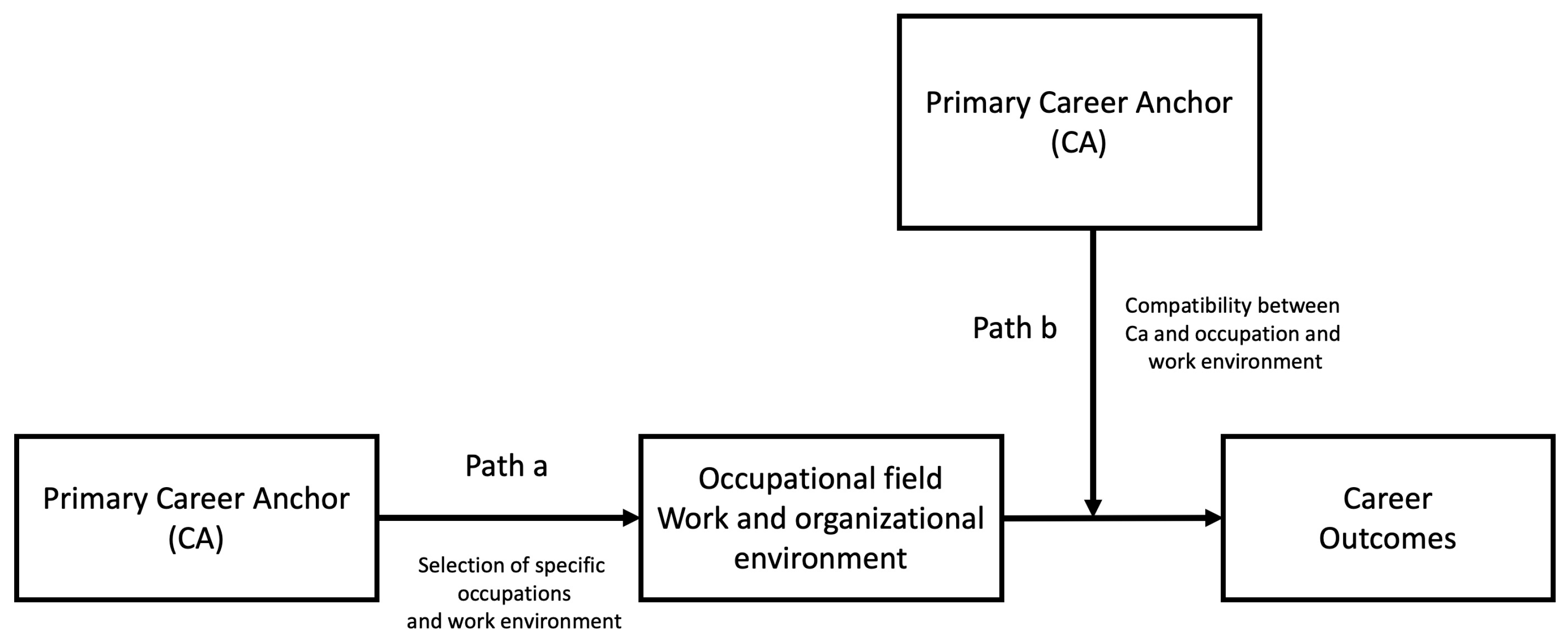
According to Schein [2,8], once formed (after five to ten years of work experience, depending on the quantity and variety of tasks performed and the organizational contexts encountered), the emerging pattern (i.e., the so-called “primary CA”) guides, integrates, and stabilizes the individual’s work career, driving the career choices to the selection of occupations and work environment that are congruent with the personal characteristics. In doing so, if job alternatives are available to the person, a progressive fit between the individual’s and the work environment’s characteristics is achieved, with consequent positive outcomes in terms of job stability, job/career satisfaction, and work effectiveness. Thus, even if not explicitly stated by Schein, the CAs play two main roles: (a) the primary CA shapes the person’s career path with the selection of specific occupations and work environments, and (b) when compatibility (i.e., fit) between the primary CA and the individual’s work situation is achieved, the likelihood of positive outcomes increases [9]. These predictions can be depicted as shown in Figure 1, where paths a and b represent the two roles described.
Figure 1. Graphical representation of the two main roles of the primary CA as conceptualized by Schein.
Schein’s primary interest was the practical application of CAs, based on the idea that discovering one’s primary CA (i.e., becoming aware of it) enables individuals to actively manage their careers, achieve a congruent work environment, and experience positive outcomes. Consistently, the author has developed several practical materials, among which one can recall an in-depth interview that can be used to identify the individuals’ primary anchor [16] and the famous book “Career anchors: Discovering your real values” [8,17], which proposes a self-assessment process aimed at the recognition of the person’s own anchor. Furthermore, given the focus on the individual primary CA and the strong interest in practice, Schein [16] suggested, from a methodological perspective, using the in-depth interview as the primary technique. Subsequently, he reinforced the procedure through a quantitative assessment obtained using the Career Orientation Inventory (COI) [8,17]. After completing the questionnaire, individuals are asked to add 4 points to each of the three items that seemed most true, thereby favoring the identification of the most important CA but potentially impairing the reliability and validity of the collected data.
In the years following Schein’s conceptualization, the use of CAs in practice has increased rapidly and was proposed in various application modalities and areas of intervention intended for both individual and institutional career planning [9,18], such as the use of the interview as a self-assessment and development exercise [9,19], applications in development centers, career workshops, and mentoring activities [20], job/role analysis and planning [19], organizational career planning [9], and talent management [19].
On the contrary, the empirical evaluation of Schein’s conceptualization was initially rather scarce, with only 22 studies published in scientific journals between 1975 and 1995, as Woldeamanuel’s review [5] shows. This may be due to Schein’s prevailing interest in practice, leaving the CAs underspecified theoretically, as noted by Feldman and Bolino [9]. These authors made a fundamental contribution in this regard, systematizing Schein’s work and fostering scientific research, which tripled in the following 20 years, according to data reported by Woldeamanuel [5].
2. The reconceptualization provided by Feldman and Bolino. In their seminal 1996 paper, Feldman and Bolino [9] noted the under-specification of Schein’s theory and proposed several refinements for future research. On the one hand, the authors more explicitly outlined the roles of CAs (as described above), with a primary focus on path b regarding compatibility. On the other hand, they proposed a revision to Schein’s conceptualization, focusing on dimensions, the number of CAs a person can hold, their compatibility and stability, and their outcomes.
While Schein considered each CA as a particular integration of individuals’ talents, needs, and values, Feldman and Bolino proposed that CAs can be differentiated by the centrality of these three components. TEC, MAN, and ENTR CAs are primarily based on feedback on employees’ talents and abilities, derived from interactions with the requirements of daily activities and tasks. These CAs were called talent-based. AUT, SEC, and LIF focus on the structure preferred by the person in the job role and are based on motives and needs discovered when performing specific, real roles (need-based CAs). SER and PUR are grounded in a person’s values and developed through interacting with specific occupations and/or organizational cultures (value-based CAs). Because these categories and dimensions are not mutually exclusive, the authors proposed that individuals may have more of one primary (or dominant) CA, i.e., multiple career anchors. However, they suggested that, in these cases, the outcomes of congruence with the work environment are less positive and depend on the compatibility among the multiple anchors owned. In this regard, referring to Holland’s classic model of career choices [21], they have formulated a compatibility model based on an octagonal shape, with CAs placed at the vertices, aimed at understanding if a constellation of CAs can be described as complementary (i.e., the CAs are close to each other in the octagon), or mutually inconsistent (i.e., they are located at opposite vertices).
Regarding the expected outcomes of congruence, the authors expanded on Schein’s three (i.e., job/career satisfaction, job stability, and work effectiveness) by including work role adjustment, outside role conflict, and psychological well-being. They also proposed that, due to their specificity, the expected outcomes will depend on the dimension of the CAs considered, with talent-based CAs’ congruence primarily impacting work effectiveness and stability, need-based CAs influencing work role adjustment and outside role conflict the most, and value-based CAs impacting career satisfaction and psychological well-being. Several moderators that could better explain the relationship between congruence and outcomes were also suggested, including personal life constraints and the consistency of the CAs with the dominant occupational profile and organizational culture. Finally, Feldman and Bolino [9] challenged the stability of CAs, suggesting that it may depend on personal characteristics such as age and job history.
From a methodological point of view, the authors questioned the procedure adopted by Schein to measure the CAs (i.e., interview and its combination with the COI), mainly aimed at identifying only the dominant one and called for “Factor analyses of Schein’s Career Orientation Inventory to determine the factor structure underlying the career anchor typology,” as “there is not definitive evidence on how many independent career anchor types exist and how independent these eight types are.” [9] (p. 105).
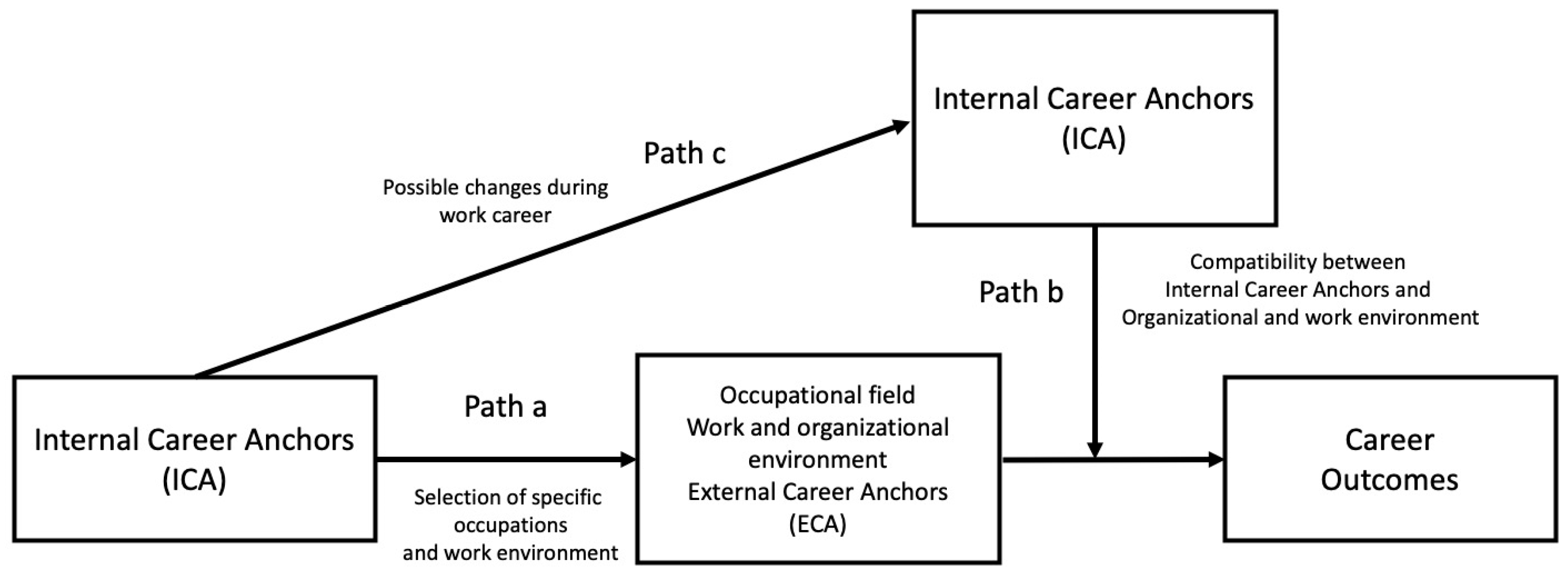
Overall, the merit of Feldman and Bolino’s contribution is evident in the refinement of the concept of CA itself and in the more precise specification and formalization of several theoretical and methodological propositions that can be empirically evaluated. As a consequence of their refinement, the basic predictions of Schein’s original model provided above can be reframed as depicted in Figure 2—where (a) path c is added to account for possible CAs change over the individual work career history, and (b) the term primary career anchor is replaced with career anchors—to recognize that more than the primary one can influence career choices and the outcomes of compatibility with the work environment [22].
Figure 2. Updated graphical representation of the main roles related to the CA concept.
Furthermore, to make explicit the distinction between the internal, subjective career domain and the external, objective one, the term “Internal Career Anchors” (ICAs) is used to refer to the individual’s self-concept and the psychological attractions that guide the individual’s career [23]. The consequent specific occupations and work environment features can also be referred to as “External Career Anchors” (ECAs) [23,24], which can be described with the same set of anchors, but to the extent that individuals perceive that the organization currently satisfies the internal anchors through benefits and incentives.
The model illustrated is clearly an oversimplification and does not account for other variables that have been theoretically identified as possible moderators (e.g., work experience, available job alternatives, compatibility among multiple anchors). However, these variables have received little to no empirical attention and have yielded conflicting results; therefore, their inclusion is still not considered feasible.
3. More recent conceptualizations. Following the work of Feldman and Bolino, many researchers have focused on validating their claims [25] or proposing revised conceptualizations of CAs, suggesting new CAs, proposing structures of multiple CAs, or integrating CAs into modified or broader models of career choice.
Regarding the existence of CAs beyond the ten described above, two have already been proposed by Delong [26] (identity and variety) and are still used (e.g., ref. [27]), albeit rarely. Two other CAs have been proposed in recent years: being marketable [28] and internationalism [29,30,31]. Despite the authors’ reported prevalence in some individuals, these anchors appear to be understudied, a situation that may be due to the most common questionnaire for measuring CAs, the COI, which is limited to the 10 described.
The existence of multiple CAs, as proposed by Feldman and Bolino, has been confirmed in several studies. For example, Chapman and Brown [22] found that only 12.9% of their sample had a single primary CA, and Ramakrishna and Potosky [32] reported that 46% of individuals had two, three, or four dominant CAs. The existence of multiple CAs is now widely accepted [33], and after the proposed octagonal model of Feldman and Bolino, other conceptual models of compatibility have been proposed to explain the factor structure of the CAs (e.g., refs. [34,35,36]). However, both Barclay et al. [25] and Cai et al. [33] compared the relative fit of four theoretical models of CAs compatibility with the results of studies that gathered CA data using the COI (e.g., refs. [23,37,38,39,40,41]). Barclay et al. [25] found weak support for Schein’s proposed model of mutual inconsistency (i.e., most of the CAs are dichotomous, such as security versus autonomy). Cai et al. [33] concluded that previous studies do not converge on a solid CA structure and suggest that this is due to cultural and population-specific characteristics that prevent the construction of a universal model. However, as the authors also stated, the data were collected using three different versions of the COI. As we will see below, despite having the same name, they have very different psychometric characteristics, which may have prevented the identification of a single compatibility model that fits the data from previous studies. In any case, there is currently no commonly accepted model for the compatibility structure of multiple CAs.
Due to these negative results on compatibility models and the shortcomings identified in the psychometric characteristics and factor structure of the COI [42,43] (see below), some authors have also proposed alternative models of CAs by reviewing its fundamental characteristics or incorporating it into broader models. An example of the first type is constituted by Rodrigues et al. [4]. Starting from the theory of CAs and its limits highlighted by Feldman and Bolino, the authors proposed a contemporary theory of career preferences, focusing on career orientations, defined as “relatively stable career preferences emerging inter alia from the interaction between self-identify, family relationships, social and cultural background, education, work experiences and labor market conditions.” [4] (p. 143). Studying a sample of 37 professional pharmacists in the UK, they refined the theory of CAs by proposing a slightly different classification of career orientations and showing that orientations are partially shaped by the broader social and family context already present before the first years of work experience. Furthermore, they stated and confirmed that most people can have both primary and secondary orientations, and that these orientations may change as individuals’ work and life circumstances change. Additionally, based on the collected data, the authors stated that career orientations are context-specific, which limits the construction of a universal model. More recently, Schein himself [11] updated his view of CAs and suggested the spiderweb as a metaphor that allows the eight factors to be traded off against one another in their dynamic context.
An example of broader models incorporating the CA concept is provided by Abessolo and colleagues [10,44]. The authors noted that work values, career orientations, and career anchors are conceptually overlapping and should be considered simultaneously in studying career choices and paths. They proposed the term “career values” to conceptualize these constructs as value-based orientations for career choice across the lifespan. Using a heterogeneous sample of employees, they confirmed their hypotheses and integrated these constructs into a common framework, using Schwartz’s broad values [45] to situate, organize, and structure career orientations (i.e., protean and boundaryless careers) and CAs. In 2021, they developed and validated the “Multidimensional Career Values Questionnaire” [44], designed for an integrative assessment of career values in research and practice related to individual career choices.
Despite these refinements and new conceptualizations (which could be sustained and reinforced by future studies), the CA term, taxonomy, and theory are still widely used in the literature, as reported by Woldeamanuel [5].
However, the literature (as evident in the two reviews cited above) has only partially analyzed its fundamental theoretical predictions (i.e., paths a, b, and c) and methodological issues, focusing instead on more descriptive aspects of the CAs, outcomes, or practical issues [46,47]. Cabot and Gagnon [6] classified the existing literature into three areas: (1) studies that demonstrate heterogeneity in CAs owned, showing that the model challenges the traditionally opposing management or technical career paths that guide HRM practices; (2) studies that relate the ownership of specific CAs to various demographic backgrounds; (3) the role of CAs in career choices, in terms of intentions to stay, turnover, and changing one’s current field. Woldeamanuel [5] concluded that “the analysis of the major focus of career anchor/orientation research indicates that the majority of the articles assessed the distribution of the various dimensions of career anchor/orientation. The rest related career anchor/orientation with a diverse group of organizational outcomes” (p. 10).
Despite the importance of this knowledge, the empirical evaluation of the CA’s conceptual model appears rather limited, focusing primarily on multiple anchors and leaving the model’s fundamental predictions largely unexplored and fragmented.
In the following sections, we will examine the three key predictions and outline the current knowledge available for each. Before doing so, however, it is necessary to discuss the methodological aspects of CA measurement, particularly those related to the COI questionnaire, which is by far the most widely used instrument in studies.

3. The Measurement of the Internal Career Anchors and the Use of the COIs

The COI [8,17] is the most well-known questionnaire to measure the eight ICA, and nearly all career anchor studies have used the COI exclusively [22]. Several studies followed the call of Feldman and Bolino [9] for factor analyses of Schein’s Career Orientation Inventory. Costigan et al. [42], reviewing the available literature, noted that “the findings of previous studies that have examined the factor structure of Schein’s COI are inconclusive” [42] (p. 201), which was also suggested by Bravo et al. [43]. These limitations are often invoked in many studies to justify the development of new conceptualizations of (or with) career anchors or to create new questionnaires. However, as we discuss below, different versions of the COI are available and used in the literature, which can explain the lack of coherence found in the questionnaire’s factor structure, psychometric properties, and other theoretical issues related to career anchors.
A preliminary version of the questionnaire, called the “career orientation survey,” was formulated by DeLong [26] and included 41 items to measure the five CAs first identified by Schein (TEC, MAN, ENT, SEC, AUT) and three new anchors (identity, service, and variety). Each CA is measured using five items, except for SEC, which comprises six items: three related to geographical security and three related to job tenure security. This aligns with Schein [16], who defined the SEC as a combination of these features. This questionnaire version is still in use (e.g., refs. [27,32,48]), although it is rarely used.
In 1985, Schein [8] developed a new 41-item version of the questionnaire, called the Career Orientation Inventory (COI), for the first time. The five typical CAs were measured using the same items as Delong, and three additional CAs (LIF, SER, PUR) were introduced and measured. Igbaria and Baroudi [38] and Leong et al. [15] evaluated the psychometric properties of the COI 1985, finding a similar eleven-factor solution in which six CAs were confirmed, and the SEC and PUR anchors were each divided into two factors. Furthermore, both studies found poor internal consistency in two scales, PUR and LIF, indicating that their items do not optimally measure these CAs. Igbaria and Baroudi [38] further selected 25 items to create a short version with a hypothesized nine-factor structure, in which the SEC is divided into geographical security (GEO) and job tenure security/stability (STA). In doing so, the authors formalized the two features of the SEC described by Schein [16] as independent constructs. The authors evaluated the short version with a second sample, confirming the nine-factor solution, but also the poor internal consistency of LIF and PUR, which was also found in several other studies that used the questionnaire (see Table 2 for examples and for a resume of the characteristics of the three versions of the COI). The COI 1985 or its short version has been widely used (e.g., refs. [37,49,50]).
Table 2. Summary of the main features of the three versions of the COI.
In 1990, Schein published a new version of the COI [17], measuring the eight CAs using several new items (five per dimension). The psychometric properties of the COI 1990 were first evaluated by Danziger et al. [14]. Based on previous results by Marshal and Bonner [54], the authors proposed dividing the ENTR into two CAs: entrepreneurship (ENT) and creativity (CRE). This is because creating new ideas, processes, or products does not always result in a new business, which is the core element of ENTR. Of the five items that comprise the ENTR scale in the COI 1990, three relate to setting up a new business, and the other two concern creativity alone. Consequently, Danziger et al. [14] proposed a nine-factor solution to the COI 1990 and showed empirically that it better fits the data than the eight-factor solution proposed by Schein [17]. However, a poor internal consistency was found for TEC. Costigan et al. [42] adopted the same procedure to evaluate the Turkish version of the COI 1990, confirming not just the 9-factor structure (compared to the 8-factor) but also the low internal consistency of the TEC, as consistently found in studies adopting the COI 1990 (see Table 2 for examples).
Overall, as we showed, excluding the original instrument of DeLong, that at least three main versions of the COI coexist in the literature (1985, 1985 short, and 1990), with different items, factorial structures, and internal consistency issues (see Table 2 for a resume of the characteristics of the three versions). The COI 1985 is expected to show an 11-factor or 9-factor structure in its short version, with SEC divided into GEO and STA. Both versions are also expected to show low internal consistency of LIF and PUR. The COI 1990 is expected to show a 9-factor structure, with ENTR divided into ENT and CRE, and low internal consistency in TEC. Furthermore, the core theme itself of some CA seems different between versions. For example, the TEC measure focuses mainly on being in a specialized area in the 1985 short version (which achieves good internal consistency), whereas in the 1990 version, it is a mix of the latter and the development and use of special skills (showing consistently low internal consistency). However, the literature does not explicitly acknowledge the use of different COI versions, which can make it difficult to compare results and study the structure of the CAs, as shown by Costigan et al. [42]. The authors noted that previous studies on the factor structure of Schein’s COI are inconclusive, but the studies reviewed used the three different versions of the COI (1985, 1990, and the 1985 short version). Similarly, Bravo et al. [43] noted the different factorial solutions reported in the literature (i.e., 9 and 11 factors) and concluded that the results are inconsistent regarding the number of factors the scale represents. However, the results of the cited studies are consistent if the version of the COI used is considered.
It is worth noting that using different COIs may also prevent the development of theoretical knowledge on the CAs. For example, the studies by Barclay et al. [25] and Cai et al. [33], which we described above, aimed to determine whether each CA is complementary or mutually exclusive with respect to the others, but the results did not converge on a solid CA structure. However, both studies compared the relative fit of compatibility models with results from studies that gathered CAs data using the COI (e.g., refs. [23,37,38,39,40,41]), but collected with three different versions (i.e., 1985, 1990, and 1985 short version). Therefore, the correlational matrix used may not have been comparable due to differences in the psychometric properties of the questionnaires and varying theme content in some CA, leaving the issue not fully explored.
In summary, the current use of different COIs may hinder the development of theoretical knowledge about the CAs, and a new version that considers all 10 CAs, along with their psychometric results, is desirable.

4. Empirical Evidence on Key Predictions of the Model

4.1. Empirical Evidence and Path C: Change in CAs over Time

In his 12-year longitudinal study of 44 former Sloan School of Management students, Schein [1] found substantial evidence of stability in the primary anchor once formed and suggested that this occurs because it is the conservative, stable part of the personality that generates the CA, which is an expression of key parts of a person’s self-concept. Deer [55] challenged the hypothesized stability, suggesting that transitioning into different work and non-work roles throughout one’s life can influence people’s career motives, and different CAs can emerge. Feldman and Bolino [9] further developed this point of view, arguing that, according to Schein, CAs are discovered through interactions across multiple job assignments and work organizations; however, people vary significantly in their experiences. Thus, age and job histories (i.e., length of work experience, number of job assignments, and number of work organizations) should predict the durability of the career anchor. It is noteworthy that this explanation overlaps with Schein’s explanation for the formation of the primary CA and seems to indicate that stability is less when the CA is not yet fully developed (which is not in contrast with Schein’s claim). However, to the best of our knowledge, no empirical result is available in this regard.
More recently, Rodrigues et al. [4] noted that the seminal study by Schein was conducted on young male managers for 12 years, that is, at an early career stage, and does not cover later career stages when other roles and priorities may become salient. Indeed, empirical results suggest that CAs can vary across career stages. In a UK survey of 374 employees, Yarnall [56] found that senior employees were more likely to have a MAN, while lower-grade employees had higher STA. Yarnall discussed the results as a suggestion that CAs may change with career stage, as proposed by Deer, while recognizing that reverse causality could be true, i.e., CAs may be the cause of participants’ grade level. More recent studies have specifically focused on evaluating stability through interviews. Chang et al. [57] adopted a multiple-case study approach with 10 information systems employees who had experienced at least one job change and had made career advancements. Through semi-structured interviews investigating retrospectively changes in job history, in CAs, and the associated reasons, the authors found that TEC and STA were important at all career stages, while MAN, GEO, and AUT became more important in the later stages. Similarly, Quesenberry et al. [58] detected both stability and change in CAs. They adopted an interpretive epistemology and conducted open-ended interviews with 92 US women employed in Information Technology in 2002 and 2006. They found substantial stability for TEC and MAN, with the former developing in the early part of the career and the latter once participants have experienced managerial roles. On the contrary, LIF and GEO were discussed by some participants as prevalent during a particular period of their lives (i.e., young children or children in secondary school), but losing their importance once the children reached an older age (with the participants returning to the previous CAs). Empirical support for both stability and change was also detected by Rodrigues et al. [4]. They conducted semi-structured interviews with 37 UK professional pharmacists to explore the reasons behind their career decisions. The results of a thematic analysis indicate that the CAs are stable for most participants, as Schein suggested. However, some participants showed changes in their CAs. Even if the authors did not discuss the type of CAs that showed stability or change, they provided two explanations for change derived from their qualitative data. First, they found that some women reported a change in career orientations after marrying and/or having children, and recalled the explanation provided by Deer [55], i.e., that career motivations can change when transitioning between different work and non-work roles, which is also coherent with the results of Quesenberry et al. [58]. Second, they observed that some older participants challenged their career orientations when they achieved successful careers (i.e., CAs’ fulfillment) and sought new goals for the future. Therefore, according to the motivation literature, the authors suggest that once career needs are satisfied, they cease to be motivating [59], which is more likely to occur in later career stages.
Overall, the available empirical results support the hypothesis of CAs’ stability for most people but also suggest a possible change in the more advanced stages of their careers, both in transitioning to different roles (both work and non-work) and in developing new motivations once existing ones have been fully satisfied. Furthermore, the results suggest that not all career anchors are equally stable and durable, as Feldman and Bolino [9] have also suggested. From a methodological point of view, even if focusing on career histories through qualitative studies can be appropriate, because interviews favor post hoc rationalization, longitudinal studies are also recommended to evaluate stability over time and, ultimately, the determinants of change [4].

4.2. Empirical Evidence and Path A: Selection of a Specific Occupation/Work Environment

The primary prediction of the CA model is that, once formed, the pattern of self-perceived talents, needs, and values influences an individual’s career-related decisions and shapes the selection of specific occupations and work environments [2]. However, as noted also by Arnold et al., “there has been very little research on the relationships between career anchors and how people enact their careers” [47] (p. 3194), which means that “a core tenet of the concept has remained untested to date” [46] (p. 413).
Indeed, earlier research has only indirectly evaluated career choices, assuming that individuals with a determinate primary career anchor(s) will actually cover positions that match them. Nordvick [60] found that CAs were reasonably related to participants’ occupations. For example, aviation pilots showed the highest TEC score (and lowest GEO), while social service and health workers scored higher in SER, and marketing leaders scored higher in CRE. Igbaria et al. [61] found that management information systems workers were primarily anchored in TEC and MAN (approximately 50% of the sample, N = 464), and were employed in job roles consistent with their career orientation (i.e., technical or managerial positions). Hardin et al. [53] demonstrated that, among their sample of 407 U.S. Certified Public Accountants, 47% held a primary LIF; however, the relative frequency differed significantly and coherently across industry sectors and job types. For example, STA was found to be four times more likely in governmental settings than in public accountants and three times more likely than in private industry accountants. Ellison and Schreuder [62] adapted the COI to reflect individuals’ perceptions of their actual occupation and work environment characteristics, measured on the same dimensions as CAs. A study conducted with 295 mid-career employees (both managerial and non-managerial) revealed a significant overall relationship between CAs and the occupational type individuals described.
Other studies were more interested in linking individual career-related preferences (i.e., potential future choices) to individuals’ actual CAs. Petroni [63], in an Italian sample of 151 researchers and engineers employed at a large public research institution, found several correlations between four career route preferences (managerial, technical/functional, project-to-project, technical vertical) and CAs. Tremblay et al. [64] studied a sample of 900 Canadian engineers’ preferences for five career paths (i.e., managerial, technical, project-based, entrepreneurial, hybrid) and the individual and contextual determinants, including CAs as control variables. The results revealed the influence of several factors, primarily individual-related, but the CAs also appeared to distinguish preferences for specific paths. For example, AUT and SER were CAs clearly linked to the entrepreneurial path, and STA was linked to the technical path. Similarly, but focusing on intra-organizational mobility decisions, Mignonac and Herrbach [65] studied 113 software engineers working in a large French electronics firm and the impact of several variables (i.e., organizational commitment, job satisfaction, subjective career plateaus, socio-demographic variables, CAs, and awareness of intra-organizational opportunities) on the willingness to accept various (i.e., seven) types of internal mobility opportunities. Running multiple regression analyses, the results showed that CAs were among the most influential variables (impacting five of seven internal mobility types), and that MAN (the most impactful), TEC, and SER were significant predictors.
More recently, Pepermans and Peiffer [49] investigated whether participants’ perceptions and reputations of three sectors (i.e., public, non-profit, and for-profit) predict sector-specific job-pursuit intentions, and they used personal CAs as a behavioral concept that might moderate this relationship. They focused on STA, SER, and PUR and developed sector-specific hypotheses for them, which were mainly confirmed among 421 management graduate students (mean age = 26 years). The image and reputation of the public sector were predictors of sector-specific job-pursuit intentions, and the relationship was stronger for individuals high in STA and, unexpectedly, for those low in PUR. The relationship was stronger in the non-profit sector for individuals higher in SER and in the for-profit sector for individuals higher in PUR.
Finally, few studies have evaluated a path-focused approach to career choices, considering previous motives and reasons, or career trajectories.
Feldman and Bolino [66] employed the CA framework (limited to AUT, ENT, and STA) to identify the underlying reasons that led individuals to self-employment (i.e., attract them and keep them attached). Their mixed-method study of the career patterns of 153 self-employed participants showed that they were mainly anchored in AUT (46%), ENTR (33%), and SEC (21%), and that they had different motives for becoming self-employed depending on the CA they owned. For example, ENTR mostly refers to themes such as gaining respect and recognition or capitalizing on a good business idea. AUT reports living as they would like, and SEC undervalues challenges, emphasizing the possibility of controlling their lives.
Gubler et al. [46] used sequence analysis (i.e., optimal matching analysis) to examine the career trajectories of 377 Swiss managers over the previous 15 years, investigating if and how CAs differentiate career trajectories into different patterns. They found MAN and LIF to be the stronger differentiators, clearly separating different patterns of career trajectories.
Finally, it is worth noting the contribution of Arnold et al. [47], who proposed that if CAs are significant in enacting career development, it should be possible to recognize relationships between them and what people seek to do to manage their careers, which include the use of Organizational Career Management (OCM) practices. Accordingly, they demonstrated this through a quantitative study of 1629 information technology professionals from 10 organizations, showing that, although accounting for only a small portion of the explained variance after controlling for several variables, CAs accounted for highly statistically significant amounts of variance in preferences for OCM practices. For example, TEC (positively) and MAN (negatively) predicted for the “technical employability training and skill development”, and “sense of community” OCM practices. MAN positively predicted “selection of longer-term business” and “leadership skill development”, which was negatively associated with TEC. Unexpectedly, STA was positively associated, and MAN was negatively associated with “opportunities for advancement” practices.
Overall, several studies showed a fit between CAs and actual occupation, work environment, and ECA, while others supported preferences for career paths or job pursuit intentions that were coherent with the CAs held. However, studies focused on the link between CAs and motives for career choices, previous career trajectories, and organizational practices that can enact their own career are still scarce, even if they can more directly sustain the core prediction of path a. These few studies provided mostly positive results, but they also suggest that there could be a more informative understanding of the role of specific CAs instead of the role of a primary CA or a constellation of multiple CAs.

4.3. Empirical Evidence and Path B: Interaction Between Internal and External CAs and Outcomes

A key prediction of the career anchor theory (path b) is that positive outcomes are expected when individuals achieve congruence between their internal career anchors and their external organizational and work environment [9]. As noted by several CAs researchers (e.g., refs. [61,67]), this prediction is founded on the Person-Environment fit (P-E fit) concept, i.e., “the compatibility between an individual and a work environment that occurs when their characteristics are well matched” [68] (p. 281). CAs are considered compatible with the organizational and work environment when the job requires abilities that are valued and possessed, job assignments and duties are found stimulating, and desirable rewards are provided to the employees [53,61]. Thus, the domain of compatibility can be better identified in the Person-Job fit (P-J fit), and job performance, job stability, and job/career satisfaction were predicted by Schein [1,2] as the expected outcomes of the congruence, with Feldman and Bolino [9] adding work role adjustment, psychological well-being, and less outside role conflict. Furthermore, Feldman and Bolino [9] suggested that specific outcomes are more likely to occur when the type of CA is congruent.
Research on the effects of congruence between ICA (i.e., the P term of the fit) and ECA (i.e., the J term of the fit) is limited, and it has adopted different perspectives and measures of ECAs. All the studies, however, measured ICAs through the COI, even though they used different versions.
This literature primarily evaluated compatibility by computing fit indices as measures of match/mismatch between the primary ICA (which, in many cases, consisted of the highest raw score obtained with one of the COIs) and the primary ECA. The latter was identified using different strategies. Some authors adopted an “objective” fit perspective (i.e., fit is calculated through the comparison of P and J variables as reported by different sources [68]) and assumed the ECA, considering the job position and level [61,69], or inferred from the occupational profile of the participants [39,53]. The results mainly supported the positive impact of the congruence on the selected outcomes (job and career satisfaction, organizational commitment, and turnover intention). However, in identifying the ECAs, job position and level are limited to the TEC and MAN, and using the occupational profile is a laborious and demanding procedure (and not always possible, e.g., due to the type of job or in large and/or heterogeneous samples of workers). Thus, other studies have adopted a “subjective” fit measure, which assesses fit by comparing P and J variables reported by the same person [68], for example, by adding a specific scale to the questionnaire. Both Ellison et al. [62] and Danziger and Valency [70] developed a measure of the ECAs (40 and 8 items, respectively) and identified the primary ECA from the answer of the participants using the highest raw score [62] or asking the participants to select the most important aspect that the job satisfies [70]. Both studies showed through a comparison of the mean scores (i.e., t-test) that matched participants (i.e., the ICA and the ECA are the same) perceive more satisfaction (related to the job [70], or general and intrinsic [62]) than mismatched participants (i.e., the ICA and the ECA are different). At least three other studies [23,48,67] have developed surveys to measure ECAs, but none have evaluated together their congruence with ICA and the predictive role of the interaction in explaining selected outcomes.
Overall, despite these studies mainly supporting congruence prediction, methodological and theoretical shortcomings limit their contribution to the theory of CAs. In the measurement, except for Guan et al. [69], the primary ICA is identified using the highest raw score of the COI’s results, which is a non-validated strategy and forces the selection of one CA that may differ in just a few decimals from the others, or even those that are identical. Similarly, the ECA was identified as having the highest raw score on long questionnaires (which share the same issues as before) or adopting complex procedures that examine the occupational profile, which are not always applicable and are subject to biases. From a theoretical perspective, the studies primarily evaluated the match/mismatch between the dominant ICA and the dominant ECA, independent of the type of CA considered. Thus, two presumptions mainly guided these studies (in line with the original conceptualization of Schein): only the congruence of the primary CA must be considered; the type of CA that interacts is irrelevant. However, as we have shown, neither is supported by the recent literature, and limiting the study of congruence to a single dominant CA (without knowing its content) appears to be an oversimplification that hinders theoretical understanding of CAs.
By contrast, the study of the congruence of specific CAs in explaining outcomes was rarely examined. An exception is provided by Guan et al. [69], although it is limited to MAN. The authors used the actual job position and level as an indicator of the external MAN and proposed that it predicts career satisfaction depending on the internal MAN (i.e., the moderator), with the relation being stronger among those with higher values of the moderator. The results supported the moderator effect and suggested that CAs can influence outcomes regardless of their position in the personal hierarchy of importance, acting as an individual variable that moderates the impact of the work environment (conceptualized with the CAs’ dimensions) on the outcomes.

5. Discussion and Conclusions

In this entry, we described and focused on Schein’s concept of CA, highlighting its conceptual evolution over time, and noting how the basic predictions have remained essentially the same, albeit with slight modifications. Despite this, research was primarily focused on the descriptive features of the CAs or theoretical issues related to universal models of multiple CAs [5,6], which were limited by the use of different versions of the COI. On the contrary, the basic evaluation of the model’s key predictions remained limited and fragmented in the literature [46,47]. Taking these considerations together, past and, to some extent, current research appears to be more focused on issues that have currently proven difficult to investigate, such as the prevalence of CAs and the existence of a universal model. This has often led to contradictory results, partly due to methodological limitations and, at times, to the suggestion that the theory is outdated.
After highlighting the methodological limitations arising from the use of COIs, which are almost exclusively used in this field of study, we integrated and summarized the main available findings for each of the model’s key predictions, which best support rather than refute the CA theory.
Several studies have shown that CAs play a key role in understanding and predicting career choices and outcomes. Focusing more on the model’s understudied key predictions and investigating the distinctive role of each CA could yield more useful insights than the role of a primary anchor or constellations of multiple anchors. Indeed, several studies have already switched their focus from the role of a primary or constellations of multiple anchors in evaluating the key predictions to the understanding of the role of all the CAs (i.e., using mean scores to assess an individual’s orientation to each anchor [46]), or to the specific (and differential) characteristics of each one, independently from its position of importance for the individual [69].
The knowledge that can consequently be developed can be further enriched in the future by considering other contextual (e.g., consistency of CAs with the dominant occupational profile, or dominant organizational culture [9]) or personal (e.g., life constraints, complementarity of multiple CAs) variables suggested in the literature that may mediate or moderate the theory’s fundamental relationships.
In doing so, research should also broaden its focus from “traditional” careers to emerging career contexts and conceptualizations that will be increasingly important in the future. First, we refer to the boundaryless careers [71], even if the concept of career anchors has already been discussed in a congruent perspective from the beginning. In fact, Schein [2] described CAs as the element in the self-concept that, in times of transition and strong “winds of change,” serves as an “anchor,” providing stability and fostering individual growth. However, highlighting their usefulness as a personal factor that supports people’s proactivity and self-direction in constructing their work histories, CAs could be considered in addressing the issue of sustainable careers that emerged within the boundaryless context. Indeed, it has been noted [72] that studying sustainable careers requires considering three key dimensions (person, context, and time) and their roles in achieving health, happiness, and productivity together through person-career fit over time. To the best of our knowledge, CAs were never explicitly linked to career sustainability, even though they encompass a conceptualization of individual agency and proactivity and key dimensions that align with this perspective, i.e., person (ICAs), context (occupational field, work and organizational environment, ECAs), person career fit, and outcomes on the three dimensions. While the first conceptualization of the CAs provides a somewhat static perspective, a more dynamic one that better fits with sustainable careers has been added, recognizing possible individual changes (i.e., path c) because of personal and life constraints. Future research could also add a more dynamic view of the contextual variables. Indeed, because of the ICAs, individuals choose specific occupations, work and organizational environments, and ECAs (i.e., path a), but they could also act directly on the work and organizational context aimed at increasing a dynamic person-career fit. For example, job crafting, and career crafting are known activities that can enhance sustainable careers (see, for example, ref. [73]) and research could evaluate if the ICAs can explain these efforts, adding a “path d” to the model (i.e., persons actively craft their work environment congruently with their ICAs) that substitutes the static, central box (work environment and ECA) depicted in Figure 2.
Second, as more workers engage in the “gig” economy, it becomes increasingly important to understand their interests and desires, which may be nontraditional and pose critical challenges for organizations in motivating and engaging them [74]. The CAs framework has been adopted in this context, particularly in relation to crowdwork, a form of platform-mediated work characterized by flexible, short-term tasks performed entirely online [50,74].
Taylor and Joshi [74] showed that the CA framework remains relevant in this context, although career anchors may more strongly evolve as workers progress through various life stages. Haq et al. [50] tested the CA model and found poor construct validity among these workers. The authors also argued that the concept of career scripts (which focuses on the interplay between individual agency and institutional constraints) better describes their non-linear but emergent careers and suggested the need to situate digital labor within broader cultural and policy frameworks. Future research should further explore the issue across other types of workers in the gig economy, evaluating whether the CA framework requires refinements to account for the workers’ peculiar characteristics or whether this and similar frameworks are not transferable to them, requiring the development or adoption of new perspectives.
Finally, we conclude by highlighting the practical implications of our contribution. By confirming the conditions for the validity and practical applicability of the CA construct, this contribution strengthens the rationale for sustainable organizational interventions to support career development. It reinforces the importance for career counselors of deepening their understanding of the career anchors as motivational drivers underlying individuals’ career choices and work behaviors, thereby facilitating more informed decision-making and fostering stronger self-determination. To enhance the effectiveness of their interventions, practitioners should address both individual-level factors (e.g., workers’ awareness of their ICAs) and contextual influences (e.g., recognizing the relevance of the ECAs). Likewise, employers and human resource managers can better appreciate the value of assessing employees’ CA profiles to design career paths aligned with their expectations and to support them in achieving their goals, ultimately enhancing organizational commitment, productivity, and well-being.

Author Contributions

Conceptualization, S.T.; writing—original draft preparation, S.T.; writing—review and editing, G.S. All authors have read and agreed to the published version of the manuscript.

Funding

This research received no external funding.

Institutional Review Board Statement

Not applicable.

Data Availability Statement

No new data were used or created in this study. Data sharing is not applicable to this article.

Conflicts of Interest

The authors declare no conflicts of interest.

Abbreviations

The following abbreviations are used in this manuscript:
CACareer Anchor
ICAInternal Career Anchor
ECAExternal Career Anchor
TECTechnical/functional Career Anchor
MANGeneral managerial Career Anchor
ENTEntrepreneurial Career Anchor
CRECreativity Career Anchor
AUTAutonomy/independence Career Anchor
STASecurity/stability Career Anchor
GEOGeographical Stability Career Anchor
LIFLifestyle Career Anchor
SERService/dedication to a cause Career Anchor
PURPure challenges Career Anchor
COICareer Orientation Inventory

References

  1. Schein, E.H. Career Anchors and Career Paths: A Panel Study of Management School Graduates; MIT Alfred P. Sloan School of Management: Cambridge, MA, USA, 1974. [Google Scholar]
  2. Schein, E.H. Career Dynamics: Matching Individual and Organizational Needs; Addison Wesley: Reading, MA, USA, 1978. [Google Scholar]
  3. Hirschi, A.; Koen, J. Contemporary Career Orientations and Career Self-Management: A Review and Integration. J. Vocat. Behav. 2021, 126, 103505. [Google Scholar] [CrossRef]
  4. Rodrigues, R.; Guest, D.; Budjanovcanin, A. From Anchors to Orientations: Towards a Contemporary Theory of Career Preferences. J. Vocat. Behav. 2013, 83, 142–152. [Google Scholar] [CrossRef]
  5. Woldeamanuel, A.G. A Scientometric Analysis of Career Anchor/Orientation Research from 1975 to 2023. Future Bus. J. 2024, 10, 74. [Google Scholar] [CrossRef]
  6. Cabot, C.; Gagnon, S. Understanding the Career Dynamics of IT Professionals in Digital Transformation Times: A Systematic Review of Career Anchors Studies. Int. J. Inf. Syst. Proj. Manag. 2021, 9, 44–60. [Google Scholar] [CrossRef]
  7. Schein, E.H. How Career Anchors Hold Executives to Their Career Paths. Personnel 1975, 52, 11–24. [Google Scholar]
  8. Schein, E.H. Career Anchors: Discovering Your Real Values; University Associates. Inc.: San Diego, CA, USA, 1985. [Google Scholar]
  9. Feldman, D.C.; Bolino, M.C. Careers within Careers: Reconceptualizing the Nature of Career Anchors and Their Consequences. Hum. Resour. Manag. Rev. 1996, 6, 89–112. [Google Scholar] [CrossRef]
  10. Abessolo, M.; Rossier, J.; Hirschi, A. Basic Values, Career Orientations, and Career Anchors: Empirical Investigation of Relationships. Front. Psychol. 2017, 8, 1556. [Google Scholar] [CrossRef] [PubMed]
  11. Schein, E.H.; Van Maanen, J.; Schein, P.A. Career Anchors Reimagined: Finding Direction and Opportunity in the Changing World of Work; John Wiley & Sons: Hoboken, NJ, USA, 2023. [Google Scholar]
  12. Anderson, M.E. Career Evolution of Sloan Fellows. Ph.D. Thesis, Alfred P. Sloan School of Management, Massachusetts Institute of Technology, Cambridge, MA, USA, 1980. [Google Scholar]
  13. Grzywacz, J.M. Career Anchors of Sloan Alumnae. Ph.D. Thesis, Alfred P. Sloan School of Management, Massachusetts Institute of Technology, Cambridge, MA, USA, 1982. [Google Scholar]
  14. Danziger, N.; Rachman-Moore, D.; Valency, R. The Construct Validity of Schein’s Career Anchors Orientation Inventory. Career Dev. Int. 2008, 13, 7–19. [Google Scholar] [CrossRef]
  15. Leong, F.T.; Rosenberg, S.D.; Chong, S. A Psychometric Evaluation of Schein’s (1985) Career Orientations Inventory. J. Career Assess. 2014, 22, 524–538. [Google Scholar] [CrossRef]
  16. Schein, E.H. Developing Your Career: Know Your Career Anchors and Develop Your Options; Alfred P. Sloan School of Management, Massachusetts Institute of Technology: Cambridge, MA, USA, 1980. [Google Scholar]
  17. Schein, E.H. Career Anchors: Discovering Your Real Values; Jossey-Bass/Pfeiffer: San Francisco, CA, USA, 1990. [Google Scholar]
  18. Toderi, S.; Sarchielli, G. Sviluppare La Carriera Lavorativa: Risorse Personali e Metodi D’intervento; Il mulino: Bologna, Italy, 2013. [Google Scholar]
  19. Schein, E.H.; Van Maanen, J. Career Anchors and Job/Role Planning. Organ. Dyn. 2016, 45, 165–173. [Google Scholar] [CrossRef]
  20. Evans, C. A Review of Career Anchors in Use. Eur. J. Work. Organ. Psychol. 1996, 5, 609–615. [Google Scholar] [CrossRef]
  21. Holland, J.L. Making Vocational Choices: A Theory of Careers; Prentice-Hall: Englewood Cliffs, NJ, USA, 1973. [Google Scholar]
  22. Chapman, J.R.; Brown, B.L. An Empirical Study of the Career Anchors That Govern Career Decisions. Pers. Rev. 2014, 43, 717–740. [Google Scholar] [CrossRef]
  23. Hsu, M.K.; Jiang, J.J.; Klein, G.; Tang, Z. Perceived Career Incentives and Intent to Leave. Inf. Manag. 2003, 40, 361–369. [Google Scholar] [CrossRef][Green Version]
  24. Jiang, J.J.; Klein, G.; Balloun, J.L. The Joint Impact of Internal and External Career Anchors on Entry-Level IS Career Satisfaction. Inf. Manag. 2001, 39, 31–39. [Google Scholar] [CrossRef]
  25. Barclay, W.B.; Chapman, J.R.; Brown, B.L. Underlying Factor Structure of Schein’s Career Anchor Model. J. Career Assess. 2013, 21, 430–451. [Google Scholar] [CrossRef]
  26. DeLong, T.J. Reexamining the Career Anchor Model. Personnel 1982, 59, 50–61. [Google Scholar]
  27. Chang, C.L. The Study of the Turnover of MIS Professionals—The Gap between Taiwanese and US Societies. Int. J. Inf. Manag. 2010, 30, 301–314. [Google Scholar] [CrossRef]
  28. Ituma, A.; Simpson, R. Moving beyond Schein’s Typology: Individual Career Anchors in the Context of Nigeria. Pers. Rev. 2007, 36, 978–995. [Google Scholar] [CrossRef]
  29. Suutari, V.; Taka, M. Career Anchors of Managers with Global Careers. J. Manag. Dev. 2004, 23, 833–847. [Google Scholar] [CrossRef]
  30. Lazarova, M.; Cerdin, J.-L.; Liao, Y. The Internationalism Career Anchor: A Validation Study. Int. Stud. Manag. Organ. 2014, 44, 9–33. [Google Scholar] [CrossRef]
  31. Wechtler, H.; Koveshnikov, A.; Dejoux, C. Career Anchors and Cross-Cultural Adjustment among Expatriates in a Non-Profit Organization. Manag. Int. Rev. 2017, 57, 277–305. [Google Scholar] [CrossRef]
  32. Ramakrishna, H.V.; Potosky, D. Conceptualization and Exploration of Composite Career Anchors: An Analysis of Information Systems Personnel. Hum. Resour. Dev. Q. 2003, 14, 199–214. [Google Scholar] [CrossRef]
  33. Cai, M.; Chapman, J.R.; Brown, B. Career-Anchor Model Fit Evaluated in the Context of a Variety of Populations. Organ. Cult. 2016, 16, 21. [Google Scholar] [CrossRef]
  34. Bristow, N. The Beyond Job Satisfaction Fieldbook: Tools and Templates for Maximizing Yor Engagement and Vitality at Work; IEEE: Washington, DC, USA, 2004. [Google Scholar]
  35. Wils, L.; Wils, T.; Tremblay, M. Toward a Career Anchor Structure: An Empirical Investigation of Engineers. Relat. Ind. 2010, 65, 236–256. [Google Scholar] [CrossRef]
  36. Chapman, J.R. A Partial Response to Feldman and Bolino’s Critique of Schein’s Career Anchor Theory. Ph.D. Thesis, Brigham Young University, Provo, UT, USA, 2009. Available online: https://www.proquest.com/openview/e2d5d019a402db703b65e3faae14079f/1?pq-origsite=gscholar&cbl=18750 (accessed on 24 November 2025).
  37. Boshoff, A.; Bennet, H.F.; Kellerman, A.M. Career Orientations as Predictors of the Level of Job Involvement of Professional People. SA J. Ind. Psychol. 1994, 20, 8–13. [Google Scholar] [CrossRef][Green Version]
  38. Igbaria, M.; Baroudi, J.J. A Short-Form Measure of Career Orientations: A Psychometric Evaluation. J. Manag. Inf. Syst. 1993, 10, 131–154. [Google Scholar] [CrossRef]
  39. Tan, H.-H.; Quek, B.-C. An Exploratory Study on the Career Anchors of Educators in Singapore. J. Psychol. 2001, 135, 527–545. [Google Scholar] [CrossRef]
  40. Igbaria, M.; Meredith, G.; Smith, D.C. Career Orientations of Information Systems Employees in South Africa. J. Strateg. Inf. Syst. 1995, 4, 319–340. [Google Scholar] [CrossRef]
  41. Igbaria, M.; Kassicieh, S.K.; Silver, M. Career Orientations and Career Success among Research, and Development and Engineering Professionals. J. Eng. Technol. Manag. 1999, 16, 29–54. [Google Scholar] [CrossRef]
  42. Costigan, R.; Gurbuz, S.; Sigri, U. Schein’s Career Anchors: Testing Factorial Validity, Invariance across Countries, and Relationship with Core Self-Evaluations. J. Career Dev. 2018, 45, 199–214. [Google Scholar] [CrossRef]
  43. Bravo, J.; Seibert, S.E.; Kraimer, M.L.; Wayne, S.J.; Liden, R.C. Measuring Career Orientations in the Era of the Boundaryless Career. J. Career Assess. 2017, 25, 502–525. [Google Scholar] [CrossRef]
  44. Abessolo, M.; Hirschi, A.; Rossier, J. Development and Validation of a Multidimensional Career Values Questionnaire: A Measure Integrating Work Values, Career Orientations, and Career Anchors. J. Career Dev. 2021, 48, 243–259. [Google Scholar] [CrossRef]
  45. Ros, M.; Schwartz, S.H.; Surkiss, S. Basic Individual Values, Work Values, and the Meaning of Work. Appl. Psychol. Int. Rev. 1999, 48, 49–71. [Google Scholar] [CrossRef]
  46. Gubler, M.; Biemann, T.; Tschopp, C.; Grote, G. How Career Anchors Differentiate Managerial Career Trajectories: A Sequence Analysis Perspective. J. Career Dev. 2015, 42, 412–430. [Google Scholar] [CrossRef]
  47. Arnold, J.; Coombs, C.R.; Gubler, M. Career Anchors and Preferences for Organizational Career Management: A Study of Information Technology Professionals in Three European Countries. Int. J. Hum. Resour. Manag. 2019, 30, 3190–3222. [Google Scholar] [CrossRef]
  48. Jiang, J.J.; Klein, G. Supervisor Support and Career Anchor Impact on the Career Satisfaction of the Entry-Level Information Systems Professional. J. Manag. Inf. Syst. 1999, 16, 219–240. [Google Scholar] [CrossRef]
  49. Pepermans, R.; Peiffer, M. Choosing Jobs in the Public, Non-Profit, and for-Profit Sectors: Personal Career Anchors Moderating the Impact of Sector Image and Reputation. Rev. Public Pers. Adm. 2024, 44, 295–324. [Google Scholar] [CrossRef]
  50. Haq, S.U.; Sulbout, J.; Pichault, F. From Anchors to Scripts: Reframing Career Theory for the Microtasking Era. Career Dev. Int. 2025, 30, 581–596. [Google Scholar] [CrossRef]
  51. Sarchielli, G.; Toderi, S. Career Anchors: Interest Motives, Research Opportunities, and a Contribution to the Italian Validation of the Career Orientation Inventory (COI-It). Boll. Di Psicol. Appl. 2007, 252, 21–32. [Google Scholar]
  52. Cortés Sánchez, J.D.; Grueso Hinestroza, M.P. Factor Analysis Evaluation of Schein’s Career Orientations Inventory in Colombia. Bus. Theory Pract. 2017, 18, 186–196. [Google Scholar] [CrossRef][Green Version]
  53. Hardin, J.R.; Stocks, M.H.; Graves, O.F. The Effect of Match or Mismatch between the Career Anchors and the Job Set Tings of CPAs: An Empirical Analysis. Adv. Account. 2001, 18, 119–148. [Google Scholar] [CrossRef]
  54. Marshall, V.; Bonner, D. Career Anchors and the Effects of Downsizing: Implications for Generations and Cultures at Work. A Preliminary Investigation. J. Eur. Ind. Train. 2003, 27, 281–291. [Google Scholar] [CrossRef]
  55. Deer, C.B. Managing the New Careerist; Jossey-Bass: San Francisco, CA, USA, 1986. [Google Scholar]
  56. Yarnall, J. Career Anchors: Results of an Organisational Study in the UK. Career Dev. Int. 1998, 3, 56–61. [Google Scholar] [CrossRef]
  57. Chang, C.L.-H.; Chen, V.; Klein, G.; Jiang, J.J. Information System Personnel Career Anchor Changes Leading to Career Changes. Eur. J. Inf. Syst. 2011, 20, 103–117. [Google Scholar] [CrossRef]
  58. Quesenberry, J.L.; Trauth, E.M. What Do Women Want? An Investigation of Career Anchors among Women in the IT Workforce. In Proceedings of the 2007 ACM SIGMIS CPR Conference on Computer Personnel Research: The Global Information Technology Workforce, St. Louis, MO, USA, 19–21 April 2007; pp. 122–127. [Google Scholar]
  59. Ryan, R.M.; Deci, E.L. Intrinsic and Extrinsic Motivations: Classic Definitions and New Directions. Contemp. Educ. Psychol. 2000, 25, 54–67. [Google Scholar] [CrossRef]
  60. Nordvik, H. Relationships between Holland’s Vocational Typology, Schein’s Career Anchors and Myers—Briggs’ Types. J. Occup. Organ. Psychol. 1996, 69, 263–275. [Google Scholar] [CrossRef]
  61. Igbaria, M.; Greenhaus, J.H.; Parasuraman, S. Career Orientations of MIS Employees: An Empirical Analysis. MIS Q. 1991, 15, 151–169. [Google Scholar] [CrossRef]
  62. Ellison, J.A.; Schreuder, A. The Relation between Career Anchors, Occupational Types and Job Satisfaction of Midcareer Employees. SA J. Ind. Psychol. 2000, 26, 1–6. [Google Scholar] [CrossRef][Green Version]
  63. Petroni, A. Strategic Career Development for R&D Staff: A Field Research. Team Perform. Manag. Int. J. 2000, 6, 52–62. [Google Scholar] [CrossRef]
  64. Tremblay, M.; Wils, T.; Proulx, C. Determinants of Career Path Preferences among Canadian Engineers. J. Eng. Technol. Manag. 2002, 19, 1–23. [Google Scholar] [CrossRef]
  65. Mignonac, K.; Herrbach, O. Managing Individual Career Aspirations and Corporate Needs: A Study of Software Engineers in France. J. Eng. Technol. Manag. 2003, 20, 205–230. [Google Scholar] [CrossRef]
  66. Feldman, D.C.; Bolino, M.C. Career Patterns of the Self-Employed: Career Motivations and Career Outcomes. J. Small Bus. Manag. 2000, 38, 53. [Google Scholar]
  67. Chen, H.; Wang, Y.; Ding, Y. Do Career Demands and Career Choices Always Coincide? A Matching Perspective Based on Career Anchors and Job Characteristics. Sustainability 2021, 13, 11273. [Google Scholar] [CrossRef]
  68. Kristof-Brown, A.L.; Zimmerman, R.D.; Johnson, E.C. Consequences OF INDIVIDUALS’FIT at Work: A Meta-Analysis OF Person–Job, Person–Organization, Person–Group, and Person–Supervisor Fit. Pers. Psychol. 2005, 58, 281–342. [Google Scholar] [CrossRef]
  69. Guan, Y.; Wen, Y.; Chen, S.X.; Liu, H.; Si, W.; Liu, Y.; Wang, Y.; Fu, R.; Zhang, Y.; Dong, Z. When Do Salary and Job Level Predict Career Satisfaction and Turnover Intention among Chinese Managers? The Role of Perceived Organizational Career Management and Career Anchor. Eur. J. Work. Organ. Psychol. 2014, 23, 596–607. [Google Scholar] [CrossRef]
  70. Danziger, N.; Valency, R. Career Anchors: Distribution and Impact on Job Satisfaction, the Israeli Case. Career Dev. Int. 2006, 11, 293–303. [Google Scholar] [CrossRef]
  71. Arthur, M.B.; Rousseau, D.M. Introduction: The Boundaryless Career as a New Employment Principle. In The Boundaryless Career: A New Employment Principle for a New Organizational Era; Oxford University Press: Oxford, UK, 1996; pp. 3–20. [Google Scholar]
  72. De Vos, A.; Van der Heijden, B.I.; Akkermans, J. Sustainable Careers: Towards a Conceptual Model. J. Vocat. Behav. 2020, 117, 103196. [Google Scholar] [CrossRef]
  73. Kilic, E.; Kitapci, H. Contextual and Individual Determinants of Sustainable Careers: A Serial Indirect Effect Model through Career Crafting and Person-Career Fit. Sustainability 2024, 16, 2865. [Google Scholar] [CrossRef]
  74. Taylor, J.; Joshi, K. Joining the Crowd: The Career Anchors of Information Technology Workers Participating in Crowdsourcing. Inf. Syst. J. 2019, 29, 641–673. [Google Scholar] [CrossRef]
Disclaimer/Publisher’s Note: The statements, opinions and data contained in all publications are solely those of the individual author(s) and contributor(s) and not of MDPI and/or the editor(s). MDPI and/or the editor(s) disclaim responsibility for any injury to people or property resulting from any ideas, methods, instructions or products referred to in the content.

Article Metrics

Citations

Article Access Statistics

Multiple requests from the same IP address are counted as one view.