
Pedagogical Content Knowledge in Science Education



Definition
1. Introduction
2. Models of PCK
2.1. Historical Evolution of PCK Models
2.2. Epistemological Aspects of PCK Models
2.3. Consensus Model and Refined Consensus Model of PCK in Science Education
3. Components of PCK Models
3.1. Knowledge of Students’ Understanding of Science
3.2. Knowledge of Instructional Strategies
3.3. Knowledge of Context
3.4. Content Knowledge
3.5. Knowledge of Science Curriculum
3.6. Pedagogical Knowledge
3.7. Orientations to Teaching Science
3.8. Knowledge of Assessment
3.9. Teacher Self-Efficacy
4. PCK in the Generative Artificial Intelligence Era
5. Conclusions and Prospects
Author Contributions
Funding
Institutional Review Board Statement
Informed Consent Statement
Data Availability Statement
Acknowledgments
Conflicts of Interest
References
- Park, S.; Oliver, J.S. Revisiting the Conceptualisation of Pedagogical Content Knowledge (PCK): PCK as a Conceptual Tool to Understand Teachers as Professionals. Res. Sci. Educ. 2008, 38, 261–284. [Google Scholar] [CrossRef]
- Shulman, L. Those Who Understand: Knowledge Growth in Teaching. Educ. Res. 1986, 15, 4–14. [Google Scholar] [CrossRef]
- Shulman, L. Knowledge and Teaching: Foundations of the New Reform. Harv. Educ. Rev. 1987, 57, 1–23. [Google Scholar] [CrossRef]
- Kind, V. Pedagogical Content Knowledge in Science Education: Perspectives and Potential for Progress. Stud. Sci. Educ. 2009, 45, 169–204. [Google Scholar] [CrossRef]
- Gess-Newsome, J. A Model of Teacher Professional Knowledge and Skill Including PCK: Results of the Thinking from the PCK Summit. In Re-Examining Pedagogical Content Knowledge in Science Education; Berry, A., Friedrichsen, P.J., Loughran, J., Eds.; Routledge: New York, NY, USA, 2015; pp. 38–52. ISBN 9781315735665. [Google Scholar]
- Carlson, J.; Daehler, K.R.; Alonzo, A.C.; Barendsen, E.; Berry, A.; Borowski, A.; Carpendale, J.; Chan, K.K.H.; Cooper, R.; Friedrichsen, P.; et al. The Refined Consensus Model of Pedagogical Content Knowledge in Science Education. In Repositioning Pedagogical Content Knowledge in Teachers’ Knowledge for Teaching Science; Hume, A., Cooper, R., Borowski, A., Eds.; Springer: Singapore, 2019; pp. 77–94. [Google Scholar]
- Mishra, P.; Warr, M.; Islam, R. TPACK in the Age of ChatGPT and Generative AI. J. Digit. Learn. Teach. Educ. 2023, 39, 235–251. [Google Scholar] [CrossRef]
- Veal, W.R.; Sermeus, J. Implications of Inter-and Transdisciplinary Science Education on Teacher’s PCK. In Proceedings of the European Science Education Research Association (ESERA) Conference, Copenhagen, Denmark, 25–29 August 2025. [Google Scholar]
- Chan, K.K.H.; Park, S. Indicators of High-Quality PCK: A Systematic Literature Review. In Proceedings of the European Science Education Research Association (ESERA) Conference, Copenhagen, Denmark, 25–29 August 2025. [Google Scholar]
- Chaitidou, M. Models of Pedagogical Content Knowledge in Science Education: An Epistemological Approach and a Concise Description. Res. Sci. Technol. Educ. 2022, 2, 1–38. (In Greek) [Google Scholar] [CrossRef]
- Tamir, P. Subject Matter and Related Pedagogical Knowledge in Teacher Education. Teach. Teach. Educ. 1988, 4, 99–110. [Google Scholar] [CrossRef]
- Cochran, K.F.; DeRuiter, J.A.; King, R.A. Pedagogical Content Knowing: An Integrative Model for Teacher Preparation. J. Teach. Educ. 1993, 44, 263–272. [Google Scholar] [CrossRef]
- Geddis, A.N. Transforming Subject-matter Knowledge: The Role of Pedagogical Content Knowledge in Learning to Reflect on Teaching. Int. J. Sci. Educ. 1993, 15, 673–683. [Google Scholar] [CrossRef]
- Fernández-Balboa, J.-M.; Stiehl, J. The Generic Nature of Pedagogical Content Knowledge among College Professors. Teach. Teach. Educ. 1995, 11, 293–306. [Google Scholar] [CrossRef]
- Carlsen, W. Domains of Teacher Knowledge. In Examining Pedagogical Content Knowledge; Gess-Newsome, J., Lederman, N.G., Eds.; Springer: Dordrecht, The Netherlands, 1999; pp. 133–144. [Google Scholar]
- Gess-Newsome, J. Pedagogical Content Knowledge: An Introduction and Orientation. In Examining Pedagogical Content Knowledge; Gess-Newsome, J., Lederman, N.G., Eds.; Springer: Dordrecht, The Netherlands, 1999; pp. 3–17. [Google Scholar]
- Magnusson, S.; Krajcik, J.; Borko, H. Nature, Sources, and Development of Pedagogical Content Knowledge for Science Teaching. In Examining Pedagogical Content Knowledge; Gess-Newsome, J., Lederman, N.G., Eds.; Springer: Dordrecht, The Netherlands, 1999; pp. 95–132. [Google Scholar]
- Morine-Dershimer, G.; Kent, T. The Complex Nature and Sources of Teachers’ Pedagogical Knowledge. In Examining Pedagogical Content Knowledge; Gess-Newsome, J., Lederman, N.G., Eds.; Springer: Dordrecht, The Netherlands, 1999. [Google Scholar]
- Veal, W.R.; MaKinster, J.G. Pedagogical Content Knowledge Taxonomies. Electron. J. Sci. Educ. 1999, 3, 4. [Google Scholar]
- Hashweh, M.Z. Teacher Pedagogical Constructions: A Reconfiguration of Pedagogical Content Knowledge. Teach. Teach. 2005, 11, 273–292. [Google Scholar] [CrossRef]
- Lee, E.; Luft, J.A. Experienced Secondary Science Teachers’ Representation of Pedagogical Content Knowledge. Int. J. Sci. Educ. 2008, 30, 1343–1363. [Google Scholar] [CrossRef]
- Rollnick, M.; Bennett, J.; Rhemtula, M.; Dharsey, N.; Ndlovu, T. The Place of Subject Matter Knowledge in Pedagogical Content Knowledge: A Case Study of South African Teachers Teaching the Amount of Substance and Chemical Equilibrium. Int. J. Sci. Educ. 2008, 30, 1365–1387. [Google Scholar] [CrossRef]
- Abell, S.K.; Rogers, M.A.P.; Hanuscin, D.L.; Lee, M.H.; Gagnon, M.J. Preparing the Next Generation of Science Teacher Educators: A Model for Developing PCK for Teaching Science Teachers. J. Sci. Teacher Educ. 2009, 20, 77–93. [Google Scholar] [CrossRef]
- Davidowitz, B.; Rollnick, M. What Lies at the Heart of Good Undergraduate Teaching? A Case Study in Organic Chemistry. Chem. Educ. Res. Pract. 2011, 12, 355–366. [Google Scholar] [CrossRef]
- Schneider, R.M.; Plasman, K. Science Teacher Learning Progressions: A Review of Science Teachers’ Pedagogical Content Knowledge Development. Rev. Educ. Res. 2011, 81, 530–565. [Google Scholar] [CrossRef]
- Park, S.; Chen, Y. Mapping out the Integration of the Components of Pedagogical Content Knowledge (PCK): Examples from High School Biology Classrooms. J. Res. Sci. Teach. 2012, 49, 922–941. [Google Scholar] [CrossRef]
- Mavhunga, E.; Rollnick, M. Improving PCK of Chemical Equilibrium in Pre-Service Teachers. Afr. J. Res. Math. Sci. Technol. Educ. 2013, 17, 113–125. [Google Scholar] [CrossRef]
- Otto, C.A.; Everett, S.A. An Instructional Strategy to Introduce Pedagogical Content Knowledge Using Venn Diagrams. J. Sci. Teacher Educ. 2013, 24, 391–403. [Google Scholar] [CrossRef]
- Sothayapetch, P.; Lavonen, J.; Juuti, K. Primary School Teachers’ Interviews Regarding Pedagogical Content Knowledge (PCK) and General Pedagogical Knowledge (GPK). Eur. J. Sci. Math. Educ. 2013, 1, 84–105. [Google Scholar] [CrossRef] [PubMed]
- Kind, V. On the Beauty of Knowing Then Not Knowing. In Re-Examining Pedagogical Content Knowledge in Science Education; Berry, A., Friedrichsen, P., Loughran, J., Eds.; Routledge: New York, NY, USA, 2015; pp. 178–195. [Google Scholar]
- Abell, S.K. Twenty Years Later: Does Pedagogical Content Knowledge Remain a Useful Idea? Int. J. Sci. Educ. 2008, 30, 1405–1416. [Google Scholar] [CrossRef]
- Loughran, J. Pedagogy: Making Sense of the Complex Relationship Between Teaching and Learning. Curric. Inq. 2013, 43, 118–141. [Google Scholar] [CrossRef]
- Chaitidou, M.; Spyrtou, A.; Kariotoglou, P.; Dimitriadou, C. Professional Development in Inquiry-Oriented Pedagogical Content Knowledge among Primary School Teachers. Int. J. Sci. Math. Technol. Learn. 2018, 25, 17–36. [Google Scholar] [CrossRef]
- Aydin, S.; Demirdogen, B.; Nur Akin, F.; Uzuntiryaki-Kondakci, E.; Tarkin, A. The Nature and Development of Interaction among Components of Pedagogical Content Knowledge in Practicum. Teach. Teach. Educ. 2015, 46, 37–50. [Google Scholar] [CrossRef]
- Carlson, J.; Stokes, L.; Helms, J.; Gess-Newsome, J.; Gardner, A. The PCK Summit: A Process and Structure for Challenging Current Ideas, Provoking Future Work, and Considering New Directions. In Re-Examining Pedagogical Content Knowledge in Science Education; Berry, A., Friedrichsen, P., Loughran, J., Eds.; Routledge: New York, NY, USA, 2015; pp. 14–27. [Google Scholar]
- Alonzo, A.C.; Berry, A.; Nilsson, P. Unpacking the Complexity of Science Teachers’ PCK in Action: Enacted and Personal PCK. In Repositioning Pedagogical Content Knowledge in Teachers’ Knowledge for Teaching Science; Hume, A., Cooper, R., Borowski, A., Eds.; Springer: Singapore, 2019; pp. 273–288. [Google Scholar]
- Turner-Bisset, R. The Knowledge Bases of the Expert Teacher. Br. Educ. Res. J. 1999, 25, 39–55. [Google Scholar] [CrossRef]
- Nilsson, P. Teaching for Understanding: The Complex Nature of Pedagogical Content Knowledge in Pre-service Education. Int. J. Sci. Educ. 2008, 30, 1281–1299. [Google Scholar] [CrossRef]
- Friedrichsen, P.; Driel, J.H.V.; Abell, S.K. Taking a Closer Look at Science Teaching Orientations. Sci. Educ. 2011, 95, 358–376. [Google Scholar] [CrossRef]
- Chan, C.K.Y.; Colloton, T. Generative AI in Higher Education; Routledge: London, UK, 2024; ISBN 9781003459026. [Google Scholar]
- Clark, T.M.; Fhaner, M.; Stoltzfus, M.; Queen, M.S. Using ChatGPT to Support Lesson Planning for the Historical Experiments of Thomson, Millikan, and Rutherford. J. Chem. Educ. 2024, 101, 1992–1999. [Google Scholar] [CrossRef]
- Zhang, P.; Tur, G. A Systematic Review of ChatGPT Use in K-12 Education. Eur. J. Educ. 2024, 59, e12599. [Google Scholar] [CrossRef]
- Großmann, L.; Koberstein-Schwarz, M.; Krüger, D.; Krell, M. Lesson Planning with ChatGPT for Inquiry-Based Biology Instruction–A(I) Roll of the Dice? Int. J. Sci. Educ. 2025, 1–20. [Google Scholar] [CrossRef]
- Peikos, G.; Stavrou, D. ChatGPT for Science Lesson Planning: An Exploratory Study Based on Pedagogical Content Knowledge. Educ. Sci. 2025, 15, 338. [Google Scholar] [CrossRef]
- Mishra, P.; Koehler, J.M. Technological Pedagogical Content Knowledge: A Framework for Teacher Knowledge. Teach. Coll. Rec. 2006, 108, 1017–1054. [Google Scholar] [CrossRef]
- Feldman-Maggor, Y.; Blonder, R.; Alexandron, G. Perspectives of Generative AI in Chemistry Education Within the TPACK Framework. J. Sci. Educ. Technol. 2024, 34, 1–12. [Google Scholar] [CrossRef]
- UNESCO. Guidance for Generative AI in Education and Research; UNESCO: Paris, France, 2023; ISBN 9789231006128. [Google Scholar]
- Wei, J.; Wang, X.; Schuurmans, D.; Bosma, M.; Ichter, B.; Xia, F.; Chi, E.H.; Le, Q.V.; Zhou, D. Chain-of-Thought Prompting Elicits Reasoning in Large Language Models. arXiv 2023, arXiv:2201.11903. [Google Scholar]
- Atlas, S. ChatGPT for Higher Education and Professional Development: A Guide to Conversational AI. 2023. Available online: https://digitalcommons.uri.edu/cgi/viewcontent.cgi?article=1547&context=cba_facpubs (accessed on 10 January 2025).
- Okulu, H.Z.; Muslu, N. Designing a Course for Pre-Service Science Teachers Using ChatGPT: What ChatGPT Brings to the Table. Interact. Learn. Environ. 2024, 32, 7450–7467. [Google Scholar] [CrossRef]
- Kinskey, M.; Zeidler, D. Primary Level Preservice Teachers’ Enacted Pedagogical Content Knowledge for Teaching Socioscientific Issues. In Proceedings of the European Science Education Research Association (ESERA) Conference, Copenhagen, Denmark, August 2025. [Google Scholar]
- Nilsson, P.; Berry, A. Exploring Teacher Adaptive Expertise Through the Framework of Pedagogical Content Knowledge. Presented at the European Science Education Research Association (ESERA) Conference, Copenhagen, Denmark, 25–29 August 2025. [Google Scholar]


| Authors/Year | Short Description |
|---|---|
| Tamir [11] 1988 | Extended Shulman’s work [2,3] by identifying six domains of teacher knowledge presented as a table. Introduced subject matter specific pedagogical knowledge, integrated substantive and syntactic knowledge, and clarified that skills arise through experience rather than transmission. |
| Cochran et al. [12] 1993 | Redefined PCK as Pedagogical Content Knowing (PCKg), emphasizing its dynamic nature and the integration of four interrelated components: content, learners, context, and pedagogy. Represented the model as intersecting circles, with PCKg at the center as an ellipse. |
| Geddis [13] 1993 | Linked PCK to teachability, highlighting its role in teacher education. Focused on knowledge of students, instructional strategies, and representations, emphasizing the value of understanding misconceptions for effective teaching. |
| Fernandez-Balboa & Stiehl [14] 1995 | Conceptualized general PCK among university lecturers as the integration of five key components: content, students, teaching strategies, context, and goals. Focused on teaching across multiple courses rather than subject-specific PCK. |
| Carlsen [15] 1999 | Viewed PCK as one of five knowledge categories (students, aims, curriculum, and instructional strategies) represented as nested rectangles. Positioned PCK as being informed by general pedagogical knowledge and content knowledge, emphasizing the interaction with context. |
| Gess-Newsome [16] 1999 | Proposed that PCK is the intersection of three components: pedagogical, content, and contextual knowledge. Suggested a “mixture” metaphor where components maintain their properties but integrate differently during teaching. |
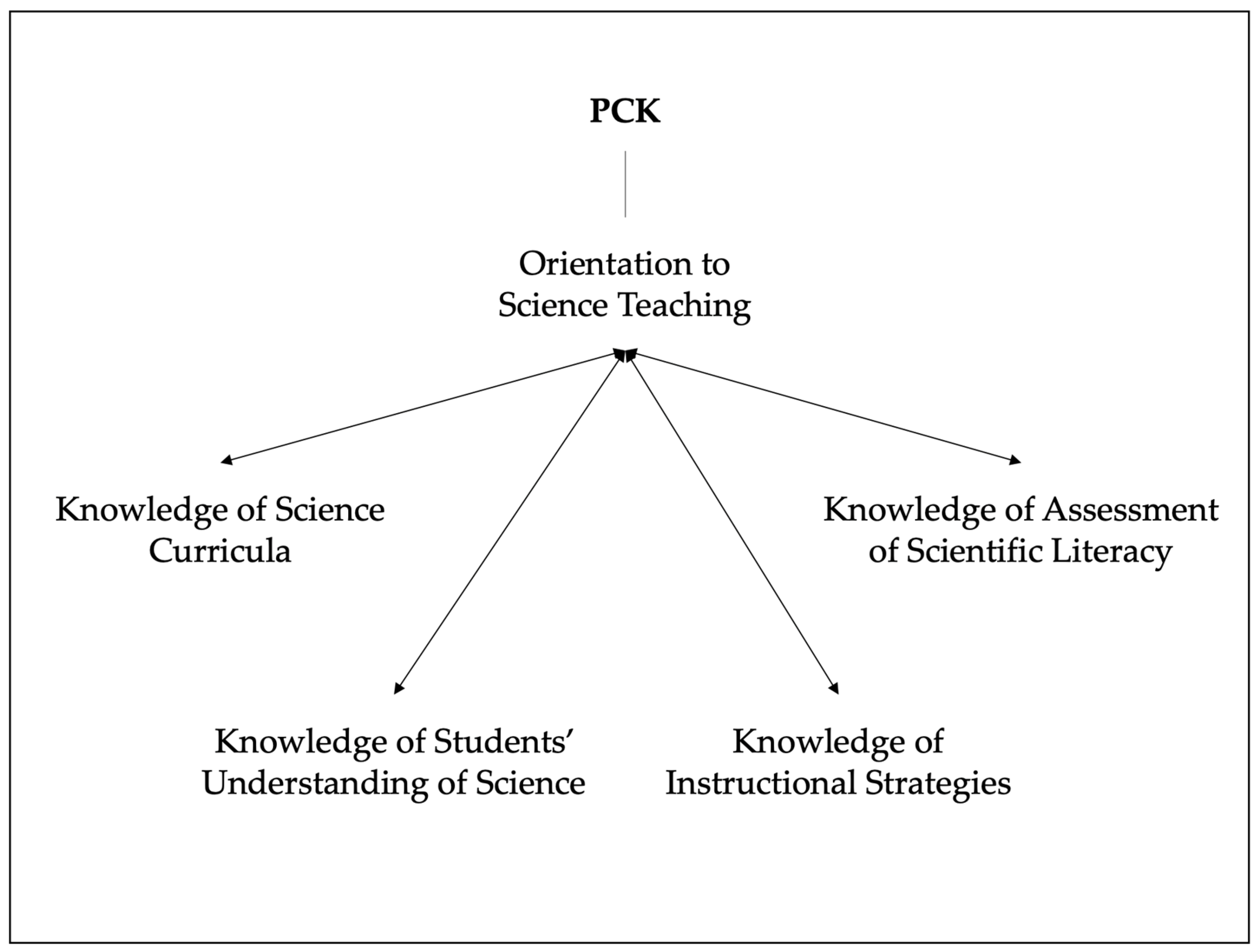
| Magnusson et al. [17] 1999 | Presented the most influential five-component model: orientations toward teaching science, curriculum, assessment, students, and instructional strategies. Viewed PCK as specialized knowledge transforming content for teaching, with reflection as a central element. |
| Morine-Dershimer & Kent [18] 1999 | Offered a six-component model interrelating students, curriculum, assessment, context, pedagogy and content. Represented components as rectangles connected by arrows, noting strong links between instructional goals, assessment, and curriculum. |
| Veal & MaKinster [19] 1999 | Developed a hierarchical taxonomy grounded in Bloom’s taxonomy, embedding student knowledge within content knowledge. Argued that understanding learners’ misconceptions underpins effective development of all other components. |
| Hashweh [20] 2005 | Proposed a heptagonal model centered on teacher pedagogical constructions (TPCs)—individualized, topic-specific knowledge structures formed through teaching and reflection. Defined PCK as the sum of an individual teacher’s TPCs. |
| Lee & Luft [21] 2008 | Identified seven PCK components that each teacher connects differently. Asserted that every teacher possesses a general PCK core consisting of content knowledge, goals, and knowledge of students. |
| Rollnick et al. [22] 2008 | Positioned PCK at the interface between knowledge domains (content, students, context, and pedagogy) and their manifestations in practice (e.g., strategies, representations, assessment, and curricular saliency). |
| Park & Oliver [1] 2008 | Expanded the Magnusson et al. [17] model to include teacher efficacy. Argued that PCK arises from the integration of six interdependent components, reinforced through reflection, and represented them as the vertices of a hexagon. |
| Abell et al. [23] 2009 | Visualized PCK components (curriculum, assessment, strategies, and students) within a framework filtered through orientations toward teaching science, highlighting their overarching influence. |
| Davidowitz & Rollnick [24] 2011 | Modified the model of Rollnick et al. [22] by adding beliefs about learning, students, and the teacher’s classroom role. Used double-headed arrows to show bidirectional interactions between components and beliefs. |
| Schneider & Plasman [25] 2011 | Provided a 30-year literature review rather than a new model, examining learning progressions-defined as “successively more sophisticated ways of thinking” across teachers’ career stages (prospective, beginning, experienced, very experienced). |
| Park & Chen [26] 2012 | Introduced a pentagonal model, asserting that PCK quality depends on the coherence and integration of five components: orientations, strategies, assessment, curriculum, and students. Positioned PCK at the center of the pentagon. |
| Mavhunga & Rollnick [27] 2013 | Presented the model of topic-specific PCK (TSPCK) applied in a pre-service teacher education program. Identified a mutual relationship between PCK and content transformation, suggesting that they develop concurrently. |
| Otto & Everett [28] 2013 | Presented a Venn diagram consisting of three intersecting domains—pedagogy, context, and content—to introduce the concept of PCK to prospective teachers, defining it as the integration of these three knowledge bases. |
| Sothayapetch et al. [29] 2013 | Represented PCK as an ellipse incorporating two smaller ellipses (content knowledge and pedagogical knowledge). Emphasized the importance of general pedagogical knowledge (GPK), including classroom management and communication. |
| Consensus Model [5] 2015 | Unified previous models by distinguishing five knowledge domains interacting with Topic-Specific Professional Knowledge (TSPK), which—through amplifiers and filters—is transformed into enacted, personal PCK. Introduced “PCK and Skills” (PCK&S), linking teacher knowledge directly to classroom enactment. |
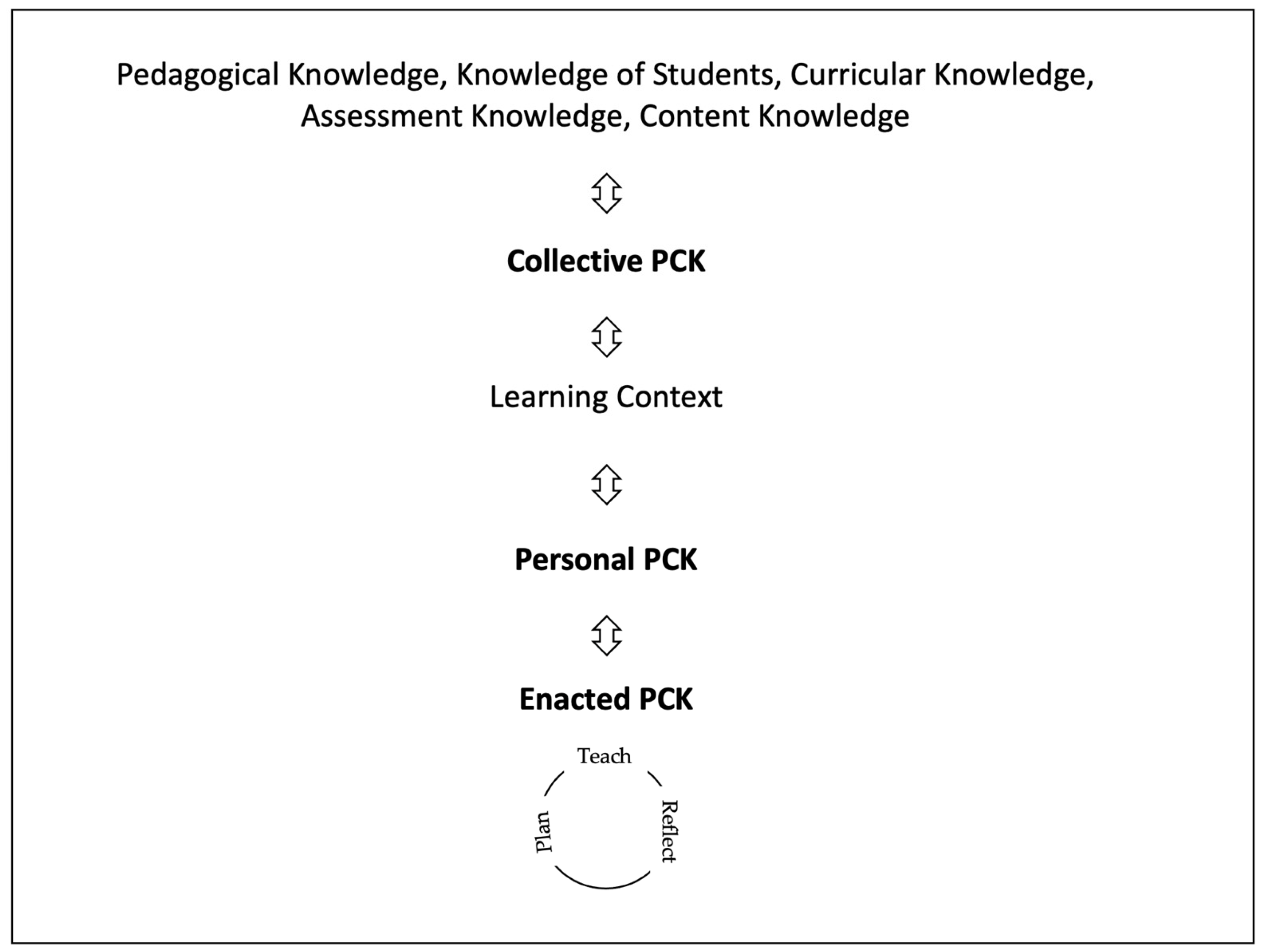
| Refined Consensus Model [6] 2019 | Conceptualized PCK as a complex system across three realms: collective (cPCK), personal (pPCK), and enacted (ePCK). Highlighted the cyclical process of planning, teaching, and reflecting, while acknowledging the influence of the learning context and the broader professional knowledge bases. |
Disclaimer/Publisher’s Note: The statements, opinions and data contained in all publications are solely those of the individual author(s) and contributor(s) and not of MDPI and/or the editor(s). MDPI and/or the editor(s) disclaim responsibility for any injury to people or property resulting from any ideas, methods, instructions or products referred to in the content. |
© 2026 by the authors. Licensee MDPI, Basel, Switzerland. This article is an open access article distributed under the terms and conditions of the Creative Commons Attribution (CC BY) license.
Share and Cite
Chaitidou, M.; Peikos, G. Pedagogical Content Knowledge in Science Education. Encyclopedia 2026, 6, 43. https://doi.org/10.3390/encyclopedia6020043
Chaitidou M, Peikos G. Pedagogical Content Knowledge in Science Education. Encyclopedia. 2026; 6(2):43. https://doi.org/10.3390/encyclopedia6020043
Chicago/Turabian StyleChaitidou, Maria, and Giorgos Peikos. 2026. "Pedagogical Content Knowledge in Science Education" Encyclopedia 6, no. 2: 43. https://doi.org/10.3390/encyclopedia6020043
APA StyleChaitidou, M., & Peikos, G. (2026). Pedagogical Content Knowledge in Science Education. Encyclopedia, 6(2), 43. https://doi.org/10.3390/encyclopedia6020043