
Value in Marketing and Sustainability


Definition
1. Introduction
1.1. Aim and Overview of This Entry
1.2. Conceptual Boundaries of the Entry
1.3. Purpose of the Entry
- Map the foundations of contemporary understandings of value in the marketing literature.
- Uncover the underlying conceptualisation of value in the different streams of marketing theory and their limitations in addressing contemporary global problems.
- Present the emerging marketing paradigm centred on value, i.e., value-dominant logic.
- Discuss the underlying conceptualisation of value in the current theoretical and practical approaches to sustainability and their limitations in addressing practical problems.
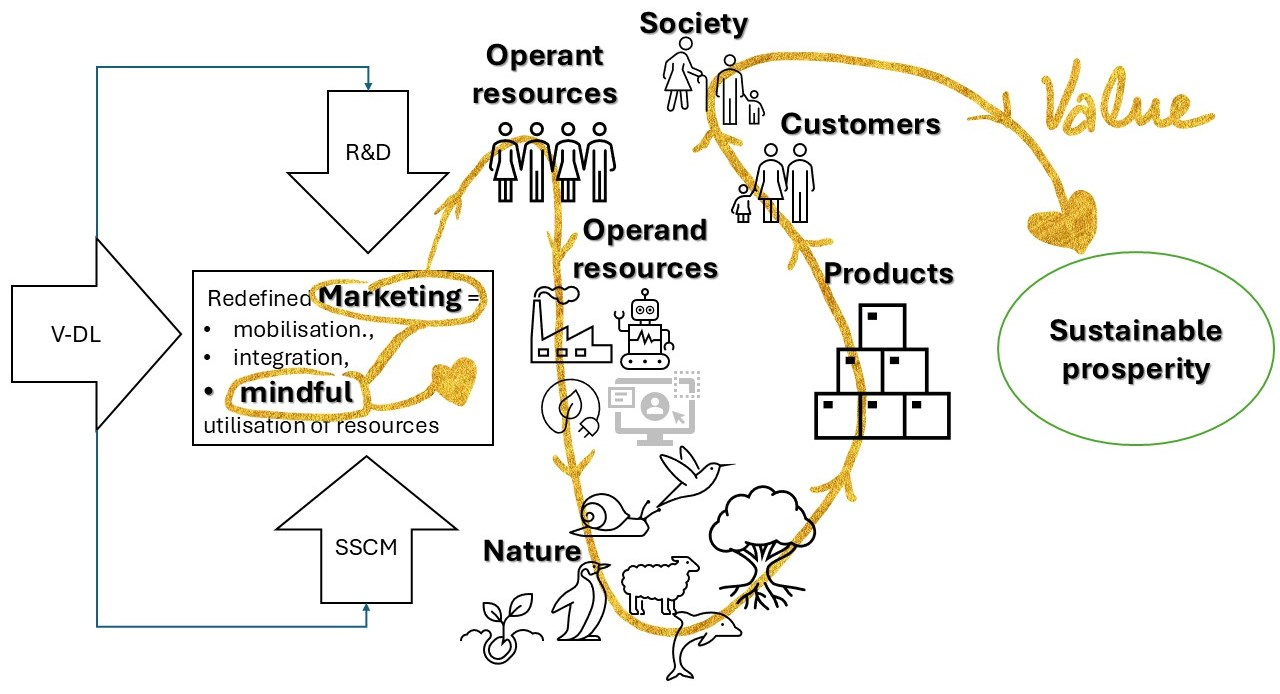
- Synthesise the discussion into a map of the value ecosystem and propose a definition of value for marketing capable of supporting a refocusing of the discipline on global sustainability and sustainable prosperity.
1.4. Structure of the Entry
2. Foundations of Conceptualisations of Value in the Western Philosophical Tradition
2.1. Definitions of Value
- The satisfaction and benefits derived from using something for a specific purpose (including the resources one controls or has access to).
- What is realised through the exchange of objects, money, skills, or anything that is perceived as useful for a purpose.
- The joy or admiration experienced in relation to an event, an occurrence, or an achievement.
2.2. Use Value and Exchange Value
2.3. Intrinsic, Extrinsic, and Pragmatic Value
2.4. Summary of the Conceptualisations of Value from the Perspective of Western Philosophy
2.5. A Note on Value and Values
3. The Concept of Value in the Marketing Literature
3.1. Value in the Context of Goods-Dominant Logic and the Services Marketing Literature
3.1.1. Branding as a Manipulation of Use Value and Exchange Value Perceptions
3.1.2. Product Characteristics as Expressions of Intrinsic and Extrinsic Value
- Physical (comprising its objectively perceivable characteristics such as weight and shape, or, for example, in the case of events, their type, time, and venue);
- Functional (the way in which the product “fulfills a certain function on the basis of certain laws” [64]);
- Economic (its exchange value or price, that is, its function as “the sign vehicle of other objects” [64]);
- Semantic (which means that the brand, the simulacrum of the product “is a cultural unit inserted into a system of cultural units with which it enters into certain relationships” [64].
3.1.3. Product Valuation
- What (the technical dimension of what the customer gets out of the customer-product interaction);
- How (the functional dimension which comprises all experiences related to the interaction with the product and the seller);
- When (the temporal dimension which refers to the time when all functional interactions are possible and to the time during which they actually occur);
- Where (the spatial dimension which refers to the place in which the customer-product and buyer-seller interactions occur).
3.1.4. Epistemological Variations in Conceptualisations of Value Manifestations in the Context of Consumer Behaviour
- Utilitarian (e.g., functional and practical, rational);
- Economic (e.g., monetary, efficiency, or convenience);
- Hedonic/aesthetic (e.g., sensory appeal, enjoyment, entertainment, or escapism);
- Social (e.g., values and status expression and signalling, or focal points for consumer-to-consumer interactions and group membership symbols);
- Emotional (e.g., self-gratification, brand–consumer values congruence, self-concept, or confidence).
3.2. Value in the Context of Service-Dominant Logic
3.2.1. Value Co-Creation
- Knowledge sharing (including idea generation, participation in the creative process, and resource investment in the process);
- Equity (comprising access to preference data and customer insights, transparency of objectives, and power sharing);
- Interaction (as in information flow and uninhibited expression of requirements as well as allowing customers to assume a proactive role);
- Experience (the core of use value, which encompasses the memorability of the experience, acknowledgement of the individuality of perception and evaluation, and room for experimentation);
- Personalization (which is close to the traditional customer centricity approach and partly overlaps with the philosophical description of use value);
- Relationship (which, further to the time and closeness dimensions, comprises interdependence and collaboration). The relationship dimension of the VCC is closely aligned with the fundamental conceptualisation of the International/Industrial Marketing and Purchasing (IMP) [147] literature stream which places emphasis on how the contents and format of exchange episodes between buyers and sellers form institutionalised relationships of mutual adaptation, which are characterised by their own atmosphere within a given environment comprising the social system and market structure and dynamics [147,148,149,150,151,152].
3.2.2. The Role of the Customer
3.3. A Synthesis of the Key Understandings of Value in the Main Streams of Marketing Literature
3.4. Value as Meaning
- Rituals, such as decorating, parties, and religious ceremonies, to signify making a house into one’s home;
- Secular pilgrimages like visiting places of historical interest or taking long, leisurely road trips;
- Quintessence, which could be because an otherwise mundane product is related to some valued experience (sort of like ‘as seen on TV’) or because they are perceived as possessing some “mystical totemic” quality or “affecting presence” [159];
- Gift giving;
- Inheritance;
- External sanction, such as having belonged to a person of exalted position or a glorious era, or being somehow connected to significant events or institutions of authority, such as museums.
3.5. The Axiology of Customer-Perceived Value
3.6. The Problem of Decoupling Value from Values
- Inputs in the form of configurations of operand and operant resources [10];
- Mechanisms of determining the interactions between actors and system components;
- Outputs in the form of utilitarian, aesthetic, social, and emotional benefits [116], as well as experiences, evaluations, and pure emotions such as satisfaction, satiation, or enjoyment.
- Extrinsic vs. intrinsic value (that is, a utilitarian function along the lines of a means-ends relationship, such as buying a hammer to hang a picture on the wall vs. “consumption experience [which] is appreciated as an end in itself… as self-justifying, ludic, or autotelic” [18], as in listening to music);
- Self-oriented vs. other-oriented value (related to acting with a focus on the self vs. beyond the self on multiple levels, from a “micro level (family, friends, colleagues) to an intermediate level (community, country, world) to the most macro level (the Cosmos, Mother Nature, the Deity)” [18]);
3.7. Value-Dominant Logic
“[S]uccessful companies can make [the hard decisions] if they stick to a course that aligns with society’s needs and that delivers value both today and tomorrow. Increasingly, society is looking to business to help shape a better world. People rightly want businesses to share their common values. I welcome this, because it fits with what I have been working on my entire professional life: To seek equity and justice.
[Our] mission, one I believe [a pharmaceutical company] is here on this Earth for: to help relieve human suffering on a mass scale. To do that, we must take on projects that are long, risky, and expensive—and we have to do our part to help ensure that these treatments get to everyone who needs them” [172].
“We made Earth our only shareholder… [i]nstead of ‘going public’, you could say we’re ‘going purpose’. Instead of extracting value from nature and transforming it into wealth for investors, we’ll use the wealth Patagonia creates to protect the source of all wealth” [174].
- Peaceful (as conflict is reduced when egotism is curtailed by respect and care for others);
- Integrative (as it is based on “respect for the intrinsic value of all creation” [31]);
- Unifying (as it overcomes the “existential choice between a desire to have and a desire to be, desire being defined by absence or lack of being” [182]);
- Holistic (as it encompasses the full socioeconomic and natural ecosystem and involves concern for the conservation and efficient use of all its operant and operand resources);
- Sustainable in itself and contributing to sustainable prosperity (as it does not accept negative externalities for anyone, so it guides actants towards reducing them and ultimately eliminating them).
4. The Concept of Value in the Context of Sustainability
5. Conclusions and Prospects
- Define value as the result of the combined, conscious, and creative actions of caring that promote sustainable prosperity;
- Conceptualise value as co-created by the interactions of various stakeholders;
- Acknowledge value as the connective tissue of a unique and indivisible socioeconomic-natural ecosystem equitably enjoyed by individuals, communities, organisations, institutions, markets, society, and the non-human inhabitants of the planet;
- Position VCC as the purpose of all economic activity and value as the centre of a purposeful business ecosystem;
- Redefine marketing as a mechanism for the mobilisation, integration, and mindful utilisation of operand and operant resources aimed at VCC;
- Allow humans in organisations, and organisations, to freely and consciously act as virtuous value enablers;
- Consider products as value-bearing entities aimed at supporting the pursuit of sustainable prosperity.
Funding
Institutional Review Board Statement
Informed Consent Statement
Data Availability Statement
Conflicts of Interest
Abbreviations
| S-DL | Service-Dominant Logic |
| G-DL | Goods- Dominant Logic |
| V-DL | Value- Dominant Logic |
| SL | Service Logic |
| WoM | Word Of Mouth |
| VCC | Value Co-Creation |
| PSS | Product/Service System |
| CPV | Customer Perceived Value |
| 3BL | The ‘triple bottom line’ |
| IMP | International/Industrial Marketing And Purchasing |
| UNSDGs | UN Sustainable Development Goals |
| R&D | Research and development |
| SSCM | Sustainable supply chain management |
| CCT | Consumer culture theory |
| MNC | Multinational corporation |
| VUCA | Volatile, Uncertain, Complex, and Ambiguous |
| UNSDGs | United Nations Sustainable Development Goals |
| B2B | Business-to-business |
References
- Fahy, J.; Jobber, D. Foundations of Marketing, 6th ed.; McGraw Hill: London, UK, 2019. [Google Scholar]
- Zeithaml, V.A. Consumer perceptions of price, quality, and value: A means-end model and synthesis of evidence. J. Mark. 1988, 52, 2–22. [Google Scholar] [CrossRef] [Scilit]
- Dahl, A.J.; Peltier, J.W.; Swan, E.L. Anticipatory value-in-use in early-stage digital health service transformations: How consumers assess value propositions before and after abrupt, exogenous shocks. J. Bus. Res. 2023, 163, 113910. [Google Scholar] [CrossRef] [Scilit]
- Blocker, C.P.; Barrios, A. The Transformative Value of a Service Experience. J. Serv. Res. 2015, 18, 265–283. [Google Scholar] [CrossRef] [Scilit]
- Brodie, R.J.; Benson-Rea, M. Country of origin branding: An integrative perspective. J. Prod. Brand Manag. 2016, 25, 322–336. [Google Scholar] [CrossRef] [Scilit]
- De La Paz, G.H. Modifying reality: Marketing for the 22nd century. J. Glob. Scholars Mark. Sci. 2014, 24, 1–16. [Google Scholar]
- Helmold, M. Market Segmentation, Targeting, Differentiation and Positioning, in Performance Excellence in Marketing, Sales and Pricing: Leveraging Change, Lean and Innovation Management; Springer International Publishing: Cham, Switzerland, 2022; pp. 105–116. [Google Scholar]
- Schimmelpfennig, C.; Hunt, J.B. Fifty years of celebrity endorser research: Support for a comprehensive celebrity endorsement strategy framework. Psychol. Mark. 2019, 37, 488–505. [Google Scholar] [CrossRef] [Scilit]
- Vock, M.; van Dolen, W.; de Ruyter, K. Understanding Willingness to Pay for Social Network Sites. J. Serv. Res. 2013, 16, 311–325. [Google Scholar] [CrossRef] [Scilit]
- Vargo, S.L.; Maglio, P.P.; Akaka, M.A. On value and value co-creation: A service systems and service logic perspective. Eur. Manag. J. 2008, 26, 145–152. [Google Scholar] [CrossRef] [Scilit]
- Zarkada, A.K.; Melanthiou, Y. Future Management for Sustainable Prosperity—Regenerating Mindsets, Rethinking Strategic Agility; Springer: Cham, Switzerland, 2026. [Google Scholar]
- Medberg, G.; Grönroos, C. Value-in-use and service quality: Do customers see a difference? J. Serv. Theory Pract. 2020, 30, 507–529. [Google Scholar] [CrossRef] [Scilit]
- Tirtakusuma, C.J.P.; Nuvriasari, A. Experiential Marketing, Value, and Service Quality: Impact on RedDoorz Customer Satisfaction. Econ. Bus. Horiz. 2025, 4, 513–524. [Google Scholar] [CrossRef] [Scilit]
- Blut, M.; Chaney, D.; Lunardo, R.; Mencarelli, R.; Grewal, D. Customer Perceived Value: A Comprehensive Meta-analysis. J. Serv. Res. 2024, 27, 501–524. [Google Scholar] [CrossRef] [Scilit]
- McKee, K.; Dahl, A.J.; Peltier, J.W. Personalised digital marketing value-in-use: Examining the influences on consumers’ continuum of interactive marketing avoidance behaviours. J. Res. Interact. Mark. 2025, 1–18. [Google Scholar]
- Pauluzzo, R.; Mason, M.C. A multi-dimensional view of consumer value to explain socially responsible consumer behaviour: A fuzzy-set analysis of Generation Y’s fast-fashion consumers. J. Mark. Theory Pract. 2021, 30, 191–212. [Google Scholar] [CrossRef] [Scilit]
- Trivedi, J.; Kasilingam, D.; Arora, P.; Soni, S. The effect of augmented reality in mobile applications on consumers’ online impulse purchase intention: The mediating role of perceived value. J. Consum. Behav. 2022, 21, 896–908. [Google Scholar] [CrossRef] [Scilit]
- Holbrook, M.B. (Ed.) Consumer Value: A Framework for Analysis and Research, 1st ed.; Routledge: London, UK, 1999. [Google Scholar]
- Holbrook, M.B. What is consumer research? J. Consum. Res. 1987, 14, 128–132. [Google Scholar] [CrossRef] [Scilit]
- American Marketing Association. Definitions of Marketing. Available online: https://www.ama.org/the-definition-of-marketing-what-is-marketing/ (accessed on 13 January 2025).
- Vargo, S.L.; Lusch, R.F. From goods to service(s): Divergences and convergences of logics. Ind. Mark. Manag. 2008, 37, 254–259. [Google Scholar] [CrossRef] [Scilit]
- Wirtz, J.; Lovelock, C. Services Marketing: People Technology Strategy, 8th ed.; World Scientific: Hackensack, NJ, USA, 2016. [Google Scholar]
- Hartley, N.; Green, T. Consumer construal of separation in virtual services. J. Serv. Theory Pract. 2017, 27, 358–383. [Google Scholar] [CrossRef] [Scilit]
- Heinonen, K. Reconceptualizing customer perceived value: The value of time and place. Manag. Serv. Qual. Int. J. 2004, 14, 205–215. [Google Scholar] [CrossRef] [Scilit]
- Heinonen, K.; Strandvik, T. Monitoring value-in-use of e-service. J. Serv. Manag. 2009, 20, 33–51. [Google Scholar] [CrossRef] [Scilit]
- Bitner, M.J.; Zeithaml, V.A.; Gremler, D.D. Technology’s impact on the gaps model of service quality. In Handbook of ServiceScience; Maglio, P.P., Kieliszewski, C.A., Spohrer, J.C., Eds.; Springer: New York, NY, USA, 2010; pp. 197–218. [Google Scholar]
- Schembri, S. Rationalising service logic, or understanding services as experience? Mark. Theory 2006, 6, 381–392. [Google Scholar]
- Edvardsson, B.; Tronvoll, B.; Gruber, T. Expanding understanding of service exchange and value co-creation: A social construction approach. J. Acad. Mark. Sci. 2010, 39, 327–339. [Google Scholar] [CrossRef] [Scilit]
- Kelly, S.; Johnston, P.; Danheiser, S. Value-ology: Aligning Sales and Marketing to Shape and Deliver Profitable Customer Value Propositions; Palgrave Macmillan: Cham, Switzerland, 2017. [Google Scholar]
- Mingione, M.; Leoni, L. Blurring B2C and B2B boundaries: Corporate brand value co-creation in B2B2C markets. J. Mark. Manag. 2019, 36, 72–99. [Google Scholar] [CrossRef] [Scilit]
- Panigyrakis, G.G.; Zarkada, A.K. New Philosophical Paradigms in Marketing: From amoral consumerism to axiological societing. In The Routledge Companion on the Future of Marketing; Moutinho, L., Bigne, E., Manrai, A.K., Eds.; Routledge: Oxford, UK, 2014. [Google Scholar]
- Scruton, R. A Short History of Modern Philosophy: From Descartes to Wittgenstein; Routledge: London, UK, 2002. [Google Scholar]
- Scruton, R. Modern Philosophy: An Introduction and Survey; A&C Black: London, UK, 2012. [Google Scholar]
- Plato. Theaetetus: Plato on Knowledge [Θεαίτητος: H γνωσιολογία του Πλάτωνος]; Zitros: Thessaloniki, Greece, 2015. [Google Scholar]
- Plato. Republic [Πολιτεία]; Polis: Athens, Greece, 2002. [Google Scholar]
- Plato. Symposium [Συμπόσιον]; Fexi: Athens, Greece, 1912. [Google Scholar]
- Gupta, A. Definitions. In The Stanford Encyclopedia of Philosophy; Zalta, E.N., Ed.; Stanford University: Stanford, CA, USA, 2021. [Google Scholar]
- Yaffe, P. Workings of science: Is science limited to the sciences? Ubiquity 2022, 2022, 1–11. [Google Scholar] [CrossRef] [Scilit]
- Aristotle. Posterior Analytics [Ἀναλυτικὰ Ὕστερα]; eBooks@Adelaide; The University of Adelaide Library: Adelaide, Australia, 2015. [Google Scholar]
- Locke, J. An Essay concerning Humane Understanding; Thomas Basset: London, UK, 1690. [Google Scholar]
- Agle, B.R.; Caldwell, C.B. Understanding Research on Values in Business. Bus. Soc. 1999, 38, 326–387. [Google Scholar] [CrossRef] [Scilit]
- Jones, D.G.B.; Tadajewski, M. Foundations of Marketing Thought; Routledge: London, UK, 2017. [Google Scholar]
- Berger, A.A. Marxism and Marketing. In Marketing and American Consumer Culture: A Cultural Studies Analysis; Berger, A.A., Ed.; Springer International Publishing: Cham, Switzerland, 2016; pp. 47–54. [Google Scholar]
- Varman, R. Postcolonialism, subalternity, and critical marketing. In Responsible Marketing for Well-Being and Society; Saren, M., Hassan, L.M., McGowan, M., Smith, N.C., Surman, E., Varman, R., Eds.; Routledge: London, UK, 2024; pp. 337–354. [Google Scholar]
- Hodgson, G.M. From Marx to Markets: An Intellectual Odyssey; Edward Elgar Publishing: Cheltenham, UK, 2025. [Google Scholar]
- Gordon, B.J. Aristotle and the Development of Value Theory. Q. J. Econ. 1964, 78, 115–128. [Google Scholar] [CrossRef] [Scilit]
- Bonazzi, M. Protagoras. In The Stanford Encyclopedia of Philosophy; Zalta, E.N., Nodelman, U., Eds.; Stanford University: Stanford, CA, USA, 2024. [Google Scholar]
- Mansfeld, J. Protagoras on epistemological obstacles and persons. In The Sophists and Their Legacy; Kerferd, G.B., Ed.; Cambridge University Press: Cambridge, UK, 1981; pp. 38–53. [Google Scholar]
- Mark, J.J. Protagoras of Abdera: Of All Things Man Is The Measure. In World History Encyclopedia; 2012; Available online: https://www.worldhistory.org/article/61/protagoras-of-abdera-of-all-things-man-is-the-meas/ (accessed on 10 December 2025).
- Kerferd, G.B. The Sophists and Their Legacy; Cambridge University Press: Cambridge, UK, 1981. [Google Scholar]
- Plato. Protagoras; Jowett, B., Ed.; Project Gutenberg: Salt Lake City, UT, USA, 2008. [Google Scholar]
- Barnes, J. Introduction. In The Nicomachean Ethics; Penguin Classics: London, UK, 2004. [Google Scholar]
- Aristotle. The Nicomachean Ethics; Brown, L., Ed.; Ross, D., Translator; Oxford University Press: Oxford, UK, 1954. [Google Scholar]
- Russell, B. What I Believe; Routledge: London, UK, 2013. [Google Scholar]
- Bourdieu, P. The forms of capital. In Handbook of Theory and Research for the Sociology of Education; Richardson, J., Ed.; Greenwood: New York, NY, USA, 1986; pp. 241–258. [Google Scholar]
- Bourdieu, P.; Wacquant, L. Symbolic capital and social classes. J. Class. Sociol. 2013, 13, 292–302. [Google Scholar] [CrossRef] [Scilit]
- Verter, B. Spiritual Capital: Theorizing Religion with Bourdieu against Bourdieu. Sociol. Theory 2003, 21, 150–174. [Google Scholar] [CrossRef] [Scilit]
- Floridi, L. Semantic Capital: Its Nature, Value, and Curation. Philos. Technol. 2018, 31, 481–497. [Google Scholar] [CrossRef] [Scilit]
- Schroeder, M. Value Theory. In The Stanford Encyclopedia of Philosophy; Zalta, E.N., Ed.; Metaphysics Research Lab CSLI Stanford University: Stanford, CA, USA, 2021. [Google Scholar]
- Aristotle. Topics; Max Bollinger: London, UK, 2016. [Google Scholar]
- Aristotle. Politics; Rackham, H., Translator; Wm. Heinemann: London, UK, 1959. [Google Scholar]
- Aristotle. Rhetoric [Ρητορική]; Kessinger Publishing: Whitefish, MT, USA, 2004. [Google Scholar]
- Varul, M.Z. Value: Exchange and Use Value. In Encyclopedia of Consumer Culture; Southerton, D., Ed.; SAGE Publications: Thousand Oaks, CA, USA, 2011; pp. 1501–1503. [Google Scholar]
- Eco, U. A Theory of Semiotics; Indiana University Press: Bloomington, IN, USA, 1979. [Google Scholar]
- Hirschman, E.; Holbrook, M. Postmodern Consumer Research: The Study of Consumption as Text; SAGE Publications: Thousand Oaks, CA, USA, 1992. [Google Scholar]
- Baudrillard, J. Simulacra and Simulation (The Body, In Theory: Histories Of Cultural Materialism); Glaser, S.F., Translator; The University of Michigan Press: Ann Arbor, MI, USA, 1994. [Google Scholar]
- Anderson, W.T. The Truth About the Truth: De-Confusing and Re-Constructing the Postmodern World (New Coscious Reader); Tarcher: New York, NY, USA, 1995. [Google Scholar]
- Southerton, D. Encyclopedia of Consumer Culture; SAGE Publications: Thousand Oaks, CA, USA, 2011. [Google Scholar]
- Wittgenstein, L. Lecture on Ethics; Zamuner, E., Di Lascioand, E.V., Levy, D.K., Eds.; Wiley Blackwell: West Sussex, UK, 2014. [Google Scholar]
- Wittgenstein, L. “Lecture on Ethics” Tractatus Logico-Philosophicus. In From Modernism to Postmodernism: An Anthology; Cahoone, L.E., Ed.; Wiley Blackwell: West Sussex, UK, 1996. [Google Scholar]
- Zimmerman, M.J.; Bradley, B. Intrinsic vs. Extrinsic Value. In The Stanford Encyclopedia of Philosophy; Zalta, E.N., Nodelman, U., Eds.; Stanford University: Stanford, CA, USA, 2025. [Google Scholar]
- Dewey, J. Human Nature and Conduct: An introduction to Social Psychology; Henry Holt and Company: New York, NY, USA, 1992. [Google Scholar]
- McDermid, D. Pragmatism. Available online: https://iep.utm.edu/pragmati/ (accessed on 10 October 2025).
- Beardsley, M.C. Intrinsic Value. Philos. Phenomenol. Res. 1965, 26, 1–17. [Google Scholar] [CrossRef] [Scilit]
- Jameson, F. Postmodernism, or, the Cultural Logic of Late Capitalism; Duke University Press: Durham, NC, USA, 1990. [Google Scholar]
- Lyotard, J.-F. The Postmodern Condition: A Report on Knowledge (La Condition postmoderne: Rapport sur le Savoir); University of Minnesota Press: Minneapolis, MN, USA, 1984. [Google Scholar]
- Harvey, D. The Condition of Postmodernity: An Enquiry into the Origins of Cultural Change; Wiley–Blackwell: Cambridge, MA, USA, 1989. [Google Scholar]
- Zarkada, A.K. Empowering Digital Transformation; Springer: Cham, Switzerland, 2025. [Google Scholar]
- van Raaij, W. Postmodern consumption. J. Econ. Psychol. 1993, 14, 541–563. [Google Scholar] [CrossRef] [Scilit]
- Firat, A.F.; Dholakia, N.; Venkatesh, A. Marketing in a postmodern world. Eur. J. Mark. 1995, 29, 40–56. [Google Scholar] [CrossRef] [Scilit]
- Proctor, T.; Kitchen, P. Communication in postmodern integrated marketing. Corp. Commun. Int. J. 2002, 7, 144–154. [Google Scholar] [CrossRef] [Scilit]
- Fırat, A.F.; Dholakia, N. Theoretical and philosophical implications of postmodern debates: Some challenges to modern marketing. Mark. Theory 2006, 6, 123–162. [Google Scholar] [CrossRef] [Scilit]
- Baudrillard, J. Symbolic Exchange and Death; SAGE Publications: Thousand Oaks, CA, USA, 2016. [Google Scholar]
- Dewey, J.; Bentley, A.F. Knowing and the Known; American Institute for Economic Research: Great Barrington, MA, USA, 2019. [Google Scholar]
- Firat, A.F.; Venkatesh, A. Postmodernity: The age of marketing. Int. J. Res. Mark. 1993, 10, 227–249. [Google Scholar] [CrossRef] [Scilit]
- Zarkada-Fraser, A. A classification of factors influencing participation in collusive tendering agreements. J. Bus. Ethics 2000, 23, 269–282. [Google Scholar] [CrossRef] [Scilit]
- Laczniak, G.; Shultz, C. Toward a Doctrine of Socially Responsible Marketing (SRM): A Macro and Normative-Ethical Perspective. J. Macromarketing 2020, 41, 201–231. [Google Scholar] [CrossRef] [Scilit]
- Malhotra, N.K.; Lee, O.F.C. Uslay Mind the gap: The mediating role of mindful marketing between market and quality orientations, their interaction, and consequences. Int. J. Qual. Reliab. Manag. 2012, 29, 607–625. [Google Scholar] [CrossRef] [Scilit]
- Sheth, J.N.; Sisodia, R.S. Does Marketing Need Reform?: Fresh Perspectives on the Future; Taylor & Francis: London, UK, 2015. [Google Scholar]
- Hess, H.W. The New Consumption Era. Am. Mark. J. 1935, 2, 16–25. [Google Scholar] [CrossRef] [Scilit]
- Fukuyama, F. The End of History and the Last Man; Free Press: New York, NY, USA, 1992. [Google Scholar]
- Harari, Y.N. Homo Deus: A Brief History of Tomorrow; Harper: New York, NY, USA, 2017. [Google Scholar]
- Kluckholn, C. Values and Value Orientations in the Theory of Action: An Exploration in Definition and Classifcation. In Toward a General Theory of Action; Parsons, T., Shills, E., Eds.; Harvard University Press: Cambridge, UK, 1951; pp. 388–433. [Google Scholar]
- Schwartz, S.H. Universals in the Content and Structure of Values: Theoretical Advances and Empirical Tests in 20 Countries. In Advances in Experimental Social Psychology; Zanna, M.P., Ed.; Academic Press: San Diego, CA, USA, 1992; pp. 1–65. [Google Scholar]
- Pirsig, R.M. Zen and the Art of Motorcycle Maintenance: An Inquiry into Values; William Morrow: New York, NY, USA, 1974. [Google Scholar]
- Tubadji, A. Value-Free Analysis of Values: A Culture-Based Development Approach. Sustainability 2020, 12, 9492. [Google Scholar] [CrossRef] [Scilit]
- Nguyen, T.K.G.; Ozawa, T.; Fan, P. Sanpo-yoshi, top management personal values, and ESG performance. J. Behav. Exp. Finance 2024, 41. [Google Scholar] [CrossRef] [Scilit]
- Richins, M.L.; Dawson, S. A Consumer Values Orientation for Materialism and Its Measurement: Scale Development and Validation. J. Consum. Res. 1992, 19, 303–316. [Google Scholar] [CrossRef] [Scilit]
- Jägel, T.; Keeling, K.; Reppel, A.; Gruber, T. Individual values and motivational complexities in ethical clothing consumption: A means-end approach. J. Mark. Manag. 2012, 28, 373–396. [Google Scholar] [CrossRef] [Scilit]
- Chen, S.-H.; Lee, K.-P. The Role of Personality Traits and Received Values in Persuation: An Elaboratiion Likelihood Model Perspective on Online Shopping. Soc. Behav. Pers. 2008, 36, 1379–1399. [Google Scholar] [CrossRef] [Scilit]
- De Pelsmacker, P.; Janssens, W.; Mielants, C. Consumer values and fair-trade beliefs, attitudes and buying behaviour. Int. Rev. Public Nonprofit Mark. 2005, 2, 50–69. [Google Scholar] [CrossRef] [Scilit]
- Carrigan, M.; de Pelsmacker, P. Will ethical consumers sustain their values in the global credit crunch? Int. Mark. Rev. 2009, 26, 674–687. [Google Scholar] [CrossRef] [Scilit]
- Shaw, D.; Grehan, E.; Shiu, E.; Hassan, L.; Thomson, J. An exploration of values in ethical consumer decision making. J. Consum. Behav. 2005, 4, 185–200. [Google Scholar] [CrossRef] [Scilit]
- Mansori, S.; Sambasivan, M.; Md-Sidin, S. Acceptance of novel products: The role of religiosity, ethnicity and values. Mark. Intell. Plan. 2015, 33, 39–66. [Google Scholar] [CrossRef] [Scilit]
- Hustvedt, G.; Bernard, J.C. Effects of social responsibility labelling and brand on willingness to pay for apparel. Int. J. Consum. Stud. 2010, 34, 619–626. [Google Scholar] [CrossRef] [Scilit]
- Li, S.; Kallas, Z. Meta-analysis of consumers’ willingness to pay for sustainable food products. Appetite 2021, 163, 105239. [Google Scholar] [CrossRef] [Scilit]
- Perks, H.; Gruber, T.; Edvardsson, B. Co-creation in Radical Service Innovation: A Systematic Analysis of Microlevel Processes. J. Prod. Innov. Manag. 2012, 29, 935–951. [Google Scholar] [CrossRef] [Scilit]
- Sakao, T.; Wasserbaur, R.; Mathieux, F. A methodological approach for manufacturers to enhance value-in-use of service-based offerings considering three dimensions of sustainability. CIRP Ann. 2019, 68, 33–36. [Google Scholar] [CrossRef] [Scilit]
- Batat, W. Experiential Marketing: Consumer Behaviour, Customer Experience and the 7Es; Routledge: London, UK, 2019. [Google Scholar]
- Kashif, M.; Zarkada, A.K. Value Co-destruction between Customers and Frontline Employees: A Social System Perspective. Int. J. Bank Mark. 2015, 33, 672–691. [Google Scholar] [CrossRef] [Scilit]
- Lumivalo, J.; Tuunanen, T.; Salo, M. Value Co-Destruction: A Conceptual Review and Future Research Agenda. J. Serv. Res. 2023, 27, 159–176. [Google Scholar] [CrossRef] [Scilit]
- Ingenbleek, P. Value-informed pricing in its organizational context: Literature review, conceptual framework, and directions for future research. J. Prod. Brand Manag. 2007, 16, 441–458. [Google Scholar] [CrossRef] [Scilit]
- Peng, L.; Zhang, W.; Wang, X.; Liang, S. Moderating effects of time pressure on the relationship between perceived value and purchase intention in social E-commerce sales promotion: Considering the impact of product involvement. Inf. Manag. 2019, 56, 317–328. [Google Scholar] [CrossRef] [Scilit]
- Marx, K. The Capital; Madison & Adams Press: Praha, Czech Republic, 2018. [Google Scholar]
- Mukhopadhyay, S. Using Alienation to Understand the Link Between Work and Capabilities. J. Hum. Dev. Capab. 2024, 25, 151–169. [Google Scholar] [CrossRef] [Scilit]
- Zeithaml, V.A.; Verleye, K.; Hatak, I.; Koller, M.; Zauner, A. Three Decades of Customer Value Research: Paradigmatic Roots and Future Research Avenues. J. Serv. Res. 2020, 23, 409–432. [Google Scholar] [CrossRef] [Scilit]
- Aristotle. Aristotle’s Metaphysics; Ross, W.D., Ed.; Oxford University Press: Oxford, UK, 1924. [Google Scholar]
- Schmitt, B.; Brakus, J.J.; Biraglia, A. Consumption Ideology. J. Consum. Res. 2021, 49, 74–95. [Google Scholar] [CrossRef] [Scilit]
- Gare, A.; Neesham, C. Creating an Effective Business Ethics: Is Virtue Ethics up to the Challenge? In Handbook of Philosophy of Management; Neesham, C., Segal, S., Eds.; Springer International Publishing: Cham, Switzerland, 2022; pp. 793–808. [Google Scholar]
- Petty, R.E.; Cacioppo, J.T. The Elaboration Likelihood Model of Persuasion. In Advances in Experimental Social Psychology; Berkowitz, L., Ed.; Academic Press: London, UK, 1986; Volume 19, pp. 123–205. [Google Scholar]
- Shahab, M.H.; Ghazali, E.; Mohtar, M. The role of elaboration likelihood model in consumer behaviour research and its extension to new technologies: A review and future research agenda. Int. J. Consum. Stud. 2021, 45, 664–689. [Google Scholar] [CrossRef] [Scilit]
- Tversky, A.; Kahneman, D. Judgment under Uncertainty: Heuristics and Biases. Science 1974, 185, 1124–1131. [Google Scholar] [CrossRef] [Scilit] [PubMed]
- Kahneman, D. Thinking, Fast and Slow; Penguin: London, UK, 2011. [Google Scholar]
- Palla, P.J.; Kyriacou, E.; Zarkada, A. The effect of involvement on attitude formation and strength in the digital domain. J. Mark. Commun. 2022, 29, 137–160. [Google Scholar] [CrossRef] [Scilit]
- Müller, R.-a. The Prominence of Branding Through History and its Relevance To Modern Brands: A Literature Review. In Changing Business Environment: Gamechangers, Opportunities and Risks—19th Annual International Conference of the Global Business and Technology Association; Delener, Ν., Schweikert, C., Eds.; Global Business and Technology Association: Vienna, Austria, 2017; pp. 508–519. [Google Scholar]
- Kaneva, N.; Klemmer, A. The rise of brandidates? A cultural perspective on political candidate brands in postmodern consumer democracies. J. Cust. Behav. 2016, 15, 299–313. [Google Scholar] [CrossRef] [Scilit]
- Schneiker, A. Telling the Story of the Superhero and the Anti-Politician as President: Donald Trump’s Branding on Twitter. Politi- Stud. Rev. 2018, 17, 210–223. [Google Scholar] [CrossRef] [Scilit]
- Speed, R.; Butler, P.; Collins, N. Human Branding in Political Marketing: Applying Contemporary Branding Thought to Political Parties and Their Leaders. J. Politi- Mark. 2015, 14, 129–151. [Google Scholar] [CrossRef] [Scilit]
- Mahajan, G. Value Dominant Logic. J. Creating Value 2017, 3, 217–235. [Google Scholar] [CrossRef] [Scilit]
- Parkinson, J.; Mulcahy, R.F.; Schuster, L.; Taiminen, H. A transformative value co-creation framework for online services. J. Serv. Theory Pract. 2019, 29, 353–374. [Google Scholar]
- Grönroos, C. Service logic revisited: Who creates value? And who co-creates? Eur. Bus. Rev. 2008, 20, 298–314. [Google Scholar] [CrossRef] [Scilit]
- Grönroos, C.; Gummerus, J. The service revolution and its marketing implications: Service logic vs service-dominant logic. Manag. Serv. Qual. Int. J. 2014, 24, 206–229. [Google Scholar] [CrossRef] [Scilit]
- Lusch, R.F.; Vargo, S.L. Service-dominant logic: Reactions, reflections and refinements. Mark. Theory 2006, 6, 281–288. [Google Scholar] [CrossRef] [Scilit]
- Vargo, S.L.; Lusch, R.F. Service-dominant logic: Continuing the evolution. J. Acad. Mark. Sci. 2008, 36, 1–10. [Google Scholar] [CrossRef] [Scilit]
- Vargo, S.L. Service-Dominant Logic: An Alternative Mindset for Innovation. Presentation at the 2009 Ministry of the Knowledge Economy Conference on Service Innovation through R&D, Seoul, Republic of Korea, 10 November 2008. [Google Scholar]
- Karpen, I.O.; Bove, L.L.; Lukas, B.A. Linking Service-Dominant Logic and strategic business practice: A conceptual model of a Service-Dominant orientation. J. Serv. Res. 2011, 15, 21–38. [Google Scholar] [CrossRef] [Scilit]
- Löbler, H. Service-Dominant Networks: An Evolution from the Service-Dominant Logic Perspective. J. Serv. Manage. 2013, 24, 420–424. [Google Scholar] [CrossRef] [Scilit]
- Lindhult, E.; Chirumalla, K.; Oghazi, P.; Parida, V. Value logics for service innovation: Practice-driven implications for service-dominant logic. Serv. Bus. 2018, 12, 457–481. [Google Scholar] [CrossRef] [Scilit]
- Vargo, S.; Lusch, R. The SAGE Handbook of Service-Dominant Logic; SAGE Publications: Thousand Oaks, CA, USA, 2018. [Google Scholar]
- Grönroos, C.; Voima, P. Critical service logic: Making sense of value creation and co-creation. J. Acad. Mark. Sci. 2012, 41, 133–150. [Google Scholar] [CrossRef] [Scilit]
- Vargo, S.L.; Lusch, R.F. Evolving to a New Dominant Logic for Marketing. J. Mark. 2004, 68, 1–17. [Google Scholar] [CrossRef] [Scilit]
- Vargo, S.L.; Lusch, R.F. Why “service”? J. Acad. Mark. Sci. 2007, 36, 25–38. [Google Scholar] [CrossRef] [Scilit]
- Payne, E.H.M.; Peltier, J.; Barger, V.A. Enhancing the value co-creation process: Artificial intelligence and mobile banking service platforms. J. Res. Interact. Mark. 2021, 15, 68–85. [Google Scholar] [CrossRef] [Scilit]
- Dalli, D.; Galvagno, M. Theory of value co-creation: A systematic literature review. Manag. Serv. Qual. Int. J. 2014, 24, 643–683. [Google Scholar] [CrossRef] [Scilit]
- Plé, L.; Cáceres, R.C. Not always co-creation: Introducing interactional co-destruction of value in service-dominant logic. J. Serv. Mark. 2010, 24, 430–437. [Google Scholar] [CrossRef] [Scilit]
- Ranjan, K.R.; Read, S. Value co-creation: Concept and measurement. J. Acad. Mark. Sci. 2014, 44, 290–315. [Google Scholar] [CrossRef] [Scilit]
- Ford, D. (Ed.) Understanding Business Markets: Interaction, Relationships and Networks; Academic Press: London, UK, 1990. [Google Scholar]
- IMP Group. An interaction approach. In Understanding Business Markets: Interaction, Relationships and Networks; Ford, D., Ed.; Academic Press: London, UK, 1990; pp. 7–26. [Google Scholar]
- Turnbull, P.; Ford, D.; Cunningham, M. Interaction, relationships and networks in business markets: An evolving perspective. J. Bus. Ind. Mark. 1996, 11, 44–62. [Google Scholar] [CrossRef] [Scilit]
- Ford, D.; Håkansson, H. IMP—Some things achieved: Much more to do. Eur. J. Mark. 2006, 40, 248–258. [Google Scholar] [CrossRef] [Scilit]
- Hakansson, H. (Ed.) International marketing and purchasing of industrial goods: An interaction approach; Wiley: Chichester, UK; New York, NY, USA, 1982. [Google Scholar]
- Ford, D.; Hakansson, H.; Johanson, J. How do companies interact? In Understanding Business Markets: Interaction, Relatioships, Networks; Ford, D., Ed.; Academic Press: London, UK, 1990; pp. 381–392. [Google Scholar]
- Grönroos, C. A service perspective on business relationships: The value creation, interaction and marketing interface. Ind. Mark. Manag. 2011, 40, 240–247. [Google Scholar] [CrossRef] [Scilit]
- Grönroos, C. Service-informed marketing reform. J. Serv. Mark. 2024, 38, 32–43. [Google Scholar] [CrossRef] [Scilit]
- Helkkula, A.; Kelleher, C.; Pihlström, M. Characterizing Value as an Experience:Implications for Service Researchers and Managers. J. Serv. Res. 2012, 15, 59–75. [Google Scholar] [CrossRef] [Scilit]
- Wilkie, W.L. Consumer Behaviour, 3rd ed.; Wiley: Chichester, UK; New York, NY, USA, 1986. [Google Scholar]
- Solomon, M.R.; Bamossy, G.; Askegaard, S.; Hogg, M.K. Consumer Behaviour: A European Perspective, 3rd ed.; Prentice Hall: Harlow, UK, 2006. [Google Scholar]
- Wells, V.; Foxall, G. (Eds.) Handbook of Developments in Consumer Behaviour; Edward Elgar Publishing: Cheltenham, UK, 2012. [Google Scholar]
- Belk, R.W.; Wallendorf, M.; Sherry, J.J.F. The Sacred and the Profane in Consumer Behavior: Theodicy on the Odyssey. J. Consum. Res. 1989, 16, 1–38. [Google Scholar] [CrossRef] [Scilit]
- Muniz, A.M.J.; O’Guinn, T.C. Brand Community. J. Consum. Res. 2001, 27, 412–432. [Google Scholar] [CrossRef] [Scilit]
- Carlson, B.D.; Suter, T.A.; Brown, T.J. Social versus psychological brand community: The role of psychological sense of brand community. J. Bus. Res. 2008, 61, 284–291. [Google Scholar] [CrossRef] [Scilit]
- Bhattacharjee, D.R.; Pradhan, D.; Swani, K. Brand communities: A literature review and future research agendas using TCCM approach. Int. J. Consum. Stud. 2021, 46, 3–28. [Google Scholar] [CrossRef] [Scilit]
- Helkkula, A.; Kelleher, C. Circularity of customer service experience and customer perceived value. J. Cust. Behav. 2010, 9, 37–53. [Google Scholar] [CrossRef] [Scilit]
- Levitt, T. Marketing myopia. Harv. Bus. Rev. 1960, 38, 24–47. [Google Scholar]
- Giddens, A. The Constitution of Society: Outline of the Theory of Structuration; University of California Press: Oakland, CA, USA, 1986. [Google Scholar]
- What Is Sanpoyoshi? Available online: http://sanpoyoshi.net/what_en/ (accessed on 10 October 2025).
- Shinohara, Y.; Kim, R.C. Sanpo-Yoshi and Corporate Social Responsibility in Japan. Strat. Anal. 2022, 46, 403–415. [Google Scholar] [CrossRef] [Scilit]
- Smith, N.C. Ethics and the Typology of Consumer Value. In Consumer Value: A Framework for Analysis and Research; Holbrook, M.B., Ed.; Routledge: London, UK, 1999. [Google Scholar]
- Williams, B. Ethics and the Limits of Philosophy; Harvard University Press: Cambridge, MA, USA, 1985. [Google Scholar]
- Mackie, J.L. Ethics: Inventing Right and Wrong; Penguin: London, UK, 1990. [Google Scholar]
- Survival International. What We Do. Available online: https://survivalinternational.org/ (accessed on 10 October 2025).
- Chief Executive Ken Frazier: ‘Society Is Looking To Business To Help Shape A Better World’—Remarks by Ken Frazier, Chief Executive’s 2021 CEO of the Year, as Prepared for Delivery. Available online: https://chiefexecutive.net/ken-frazier-society-is-looking-to-business-to-help-shape-a-better-world/ (accessed on 10 December 2025).
- Mahajan, G.; Kumar, V.; Tregua, M.; Bruni, R. Value-dominant logic: Organizational principles. Eur. J. Mark. 2023, 57, 1245–1271. [Google Scholar] [CrossRef] [Scilit]
- Chouinard, Y. Earth is Now our Only Shareholder. Available online: https://www.patagonia.com/ownership/?utm_source=em&utm_medium=email&utm_campaign=032924_waterproof_packs&utm_klaviyo_id=01GQMSEZBFS4EVN0XWT17JF1ZY&_kx=C6wWb5w05CnmwyrkOY1UzetDRt60iq6vAGrpv71GOr8.YgU9me (accessed on 10 December 2025).
- Plato. Menon [Μένων]; Fexi: Athens, Greece, 2013. [Google Scholar]
- Macintyre, A. How moral agents became ghosts or why the history of ethics diverged from that of the philosophy of mind. Synthese 1982, 53, 295–312. [Google Scholar] [CrossRef] [Scilit]
- MacIntyre, A.C. After Virtue, 3rd ed.; University of Notre Dame Press: Notre Dame, IN, USA, 2007. [Google Scholar]
- Schneewind, J.B. Modern moral philosophy. In A Companion to Ethics; Singer, P., Ed.; Blackwell Pub: Oxford, UK, 1997; pp. 147–157. [Google Scholar]
- Anscombe, G.E.M. Modern Moral Philosophy. Philosophy 1958, 33, 1–19. [Google Scholar] [CrossRef] [Scilit]
- Kragel, P.; Wager, T.D. Reproducible, generalizable brain models of affective processes. In Emotion in the Mind and Body; Neta, M., Haas, I.J., Eds.; Springer: Cham, Switzerland, 2019; pp. 221–263. [Google Scholar]
- Immordino-Yang, M.H.; McColl, A.; Damasio, H.; Damasio, A. Neural correlates of admiration and compassion. Proc. Natl. Acad. Sci. 2009, 106, 8021–8026. [Google Scholar] [CrossRef] [Scilit] [PubMed]
- Elliott, R. Existential consumption and irrational desire. Eur. J. Mark. 1997, 31, 285–296. [Google Scholar] [CrossRef] [Scilit]
- Miller, K. The Triple Bottom Line: What It Is & Why It’s Important. Available online: https://online.hbs.edu/blog/post/what-is-the-triple-bottom-line (accessed on 10 December 2025).
- Solomon, M.; Bamossy, G.; Askegaard, S.; Hogg, M. Consumer Behaviour: A European Perspective, 3rd ed.; Prentice-Hall: London, UK, 2006. [Google Scholar]
- Shankar, A.; Whittaker, J.; Fitchett, J.A. Heaven knows I’m miserable now. Mark. Theory 2006, 6, 485–505. [Google Scholar]
- Panigyrakis, G.; Zarkada, A. A philosophical investigation of the transition from integrated marketing communications to metamodern meaning co-creation. J. Glob. Sch. Mark. Sci. 2014, 24, 262–278. [Google Scholar] [CrossRef] [Scilit]
- Woodall, T. Driven to excess? Linking calling, character and the (mis)behaviour of marketers. Mark. Theory 2012, 12, 173–191. [Google Scholar] [CrossRef] [Scilit]
- Valdez Mendia, J.M.; Flores-Cuautle, J.J.A. Toward customer hyper-personalization experience—A data-driven approach. Cogent Bus. Manag. 2022, 9, 2041384. [Google Scholar] [CrossRef] [Scilit]
- Kim, Y.-E.; Lee, J.-W.; Lee, Y.-K. Relationship between Brand Personality and the Personality of Consumers, and its Application to Corporate Branding Strategy. J. Glob. Acad. Mark. Sci. 2008, 18, 27–57. [Google Scholar]
- Aaker, J.L. Dimensions of brand personality. J. Mark. Res. 1997, 34, 347–356. [Google Scholar] [CrossRef] [Scilit]
- Freling, T.H.; Crosno, J.L.; Henard, D.H. Brand personality appeal: Conceptualization and empirical validation. J. Acad. Mark. Sci. 2011, 39, 392–406. [Google Scholar] [CrossRef] [Scilit]
- Geuens, M.; Weijters, B.; De Wulf, K. A new measure of brand personality. Int. J. Res. Mark. 2009, 26, 97–107. [Google Scholar] [CrossRef] [Scilit]
- Lin, Y.-C.; Huang, P.-W. Effects of the Big Five Brand Personality Dimensions on Repurchase Intentions: Using Branded Coffee Chains as Examples. J. Foodserv. Bus. Res. 2012, 15, 1–18. [Google Scholar] [CrossRef] [Scilit]
- Rauschnabel, P.A.; Krey, N.; Babin, B.J.; Ivens, B.S. Brand management in higher education: The University Brand Personality Scale. J. Bus. Res. 2016, 69, 3077–3086. [Google Scholar] [CrossRef] [Scilit]
- Watkins, B.A.; Gonzenbach, W.J. Assessing university brand personality through logos: An analysis of the use of academics and athletics in university branding. J. Mark. High. Educ. 2013, 23, 15–33. [Google Scholar] [CrossRef] [Scilit]
- Zarkada, A.K. Marketing Solutions to the Challenges of a VUCA Environment: What Have We Accomplished and What More Can We Do? In Marketing Solutions to the Challenges of a VUCA Environment; Zarkada, A., Ed.; Springer: Cham, Switzerland, 2024. [Google Scholar]
- UNICEF ‘Not the New Normal’—2024 ‘One of the Worst Years in UNICEF’s History’ for Children in Conflict. Available online: https://www.unicef.org/moldova/en/press-releases/not-new-normal-2024-one-worst-years-unicefs-history-children-conflict (accessed on 10 December 2025).
- Asonye, C. There’s Nothing New About the ‘New Normal’. Here’s Why. Available online: https://www.weforum.org/stories/2020/06/theres-nothing-new-about-this-new-normal-heres-why/ (accessed on 10 December 2025).
- Anderson, J.; Rainie, L.; Vogels, E.A. Experts Say the ‘New Normal’ in 2025 Will Be Far More Tech-Driven, Presenting More Big Challenges. Available online: https://www.benton.org/headlines/experts-say-%E2%80%98new-normal%E2%80%99-2025-will-be-far-more-tech-driven-presenting-more-big-challenges (accessed on 10 December 2025).
- Taleb, N.N. The Black Swan: The Impact of the Highly Improbable; Random House Publishing Group: New York, NY, USA, 2007. [Google Scholar]
- Hermansson, F.; Arvidsson, R.; Svanström, M. Black swans swimming in product streams: Method for including unplanned events in life cycle assessment. Int. J. Life Cycle Assess. 2024, 29, 1818–1826. [Google Scholar] [CrossRef] [Scilit]
- Martinez, R.G. Apocalypse unleashed: A critical perspective on complexity science, catastrophes, and black swan events in international business. Crit. Perspect. Int. Bus. 2024, 20, 94–120. [Google Scholar] [CrossRef] [Scilit]
- Nakazawa, R. Beyond the Black Swan: How the Pandemic and Digital Innovations Intensified the Sustainability Imperative—Everywhere; Productivity Press: New York, NY, USA, 2024. [Google Scholar]
- Mecklin, J. Closer Than Ever: It is Now 89 Seconds to Midnight—2025 Doomsday Clock Statement. Available online: https://thebulletin.org/doomsday-clock/2025-statement/ (accessed on 10 December 2025).
- Mecklin, J. A Moment of Historic Danger: It Is Still 90 Seconds to Midnight—2024 Doomsday Clock Statement. Available online: https://thebulletin.org/doomsday-clock/2024-statement/ (accessed on 10 December 2025).
- Bushby, H. Permacrisis Declared Collins Dictionary Word of the Year. Available online: https://www.bbc.com/news/entertainment-arts-63458467 (accessed on 10 December 2025).
- United Nations The Sustainable Development Goals Report 2024. Available online: https://unstats.un.org/sdgs/report/2024/The-Sustainable-Development-Goals-Report-2024.pdf (accessed on 10 December 2025).

| Era | Premodern | Modern/Industrial | Postmodern/ Post-Industrial |
|---|---|---|---|
| Levels of organisation and presentation of concepts [84] | Self-Action (actors possess the power to produce results) | Interaction (results are produced by actions and reactions) | Transaction (attributions of ultimate, final, or independent entities, essences, or realities are inconsequential) |
| Nature of value | Intrinsic | Extrinsic | (irrelevant) |
| Locus of value realisation | Use value | Exchange value | Pragmatic value |
| Orders of simulacra, running parallel to the successive mutations of the law of value [83] | Counterfeit | Production | Simulation |
| Marketing Literature Stream | Goods-Dominant Logic | Services Marketing | Service-Dominant Logic | |||
|---|---|---|---|---|---|---|
| Traditional | Branding | Traditional | Experiential Marketing | |||
| Aspects of the conceptualisation of value | Nature of value | Use | Exchange | Use and exchange | Experiential | Co-created |
| Value is determined | As the balance of benefits and sacrifices | As the balance of expectations and experiences | Phenomenologically | |||
| Emphasis on | Outcome | Process | ||||
| Outcome | Tangible product | Perceptions | Service delivery | Customer experience | Integration | |
| Process | Transaction | Experience | Ongoing | |||
| Role of seller | Embeds value in the product | Embeds value in the brand | Produces value during service delivery | Creates experiences | Provides interaction opportunities | |
| Role of buyer | Consumes value | Displays value | Experiences value | Determines value | ||
| Role of marketing | Creates value | Crafts value significations | Manages service elements | Manages processes | Facilitates resource integration | |
| Key resources | Raw materials and technology | Communication | Skills, procedures, physical evidence, and technology | Operand and operant | ||
| Focus | Firm | Ecosystem | ||||
Disclaimer/Publisher’s Note: The statements, opinions and data contained in all publications are solely those of the individual author(s) and contributor(s) and not of MDPI and/or the editor(s). MDPI and/or the editor(s) disclaim responsibility for any injury to people or property resulting from any ideas, methods, instructions or products referred to in the content. |
© 2026 by the author. Licensee MDPI, Basel, Switzerland. This article is an open access article distributed under the terms and conditions of the Creative Commons Attribution (CC BY) license.
Share and Cite
Zarkada, A.K. Value in Marketing and Sustainability. Encyclopedia 2026, 6, 42. https://doi.org/10.3390/encyclopedia6020042
Zarkada AK. Value in Marketing and Sustainability. Encyclopedia. 2026; 6(2):42. https://doi.org/10.3390/encyclopedia6020042
Chicago/Turabian StyleZarkada, Anna K. 2026. "Value in Marketing and Sustainability" Encyclopedia 6, no. 2: 42. https://doi.org/10.3390/encyclopedia6020042
APA StyleZarkada, A. K. (2026). Value in Marketing and Sustainability. Encyclopedia, 6(2), 42. https://doi.org/10.3390/encyclopedia6020042