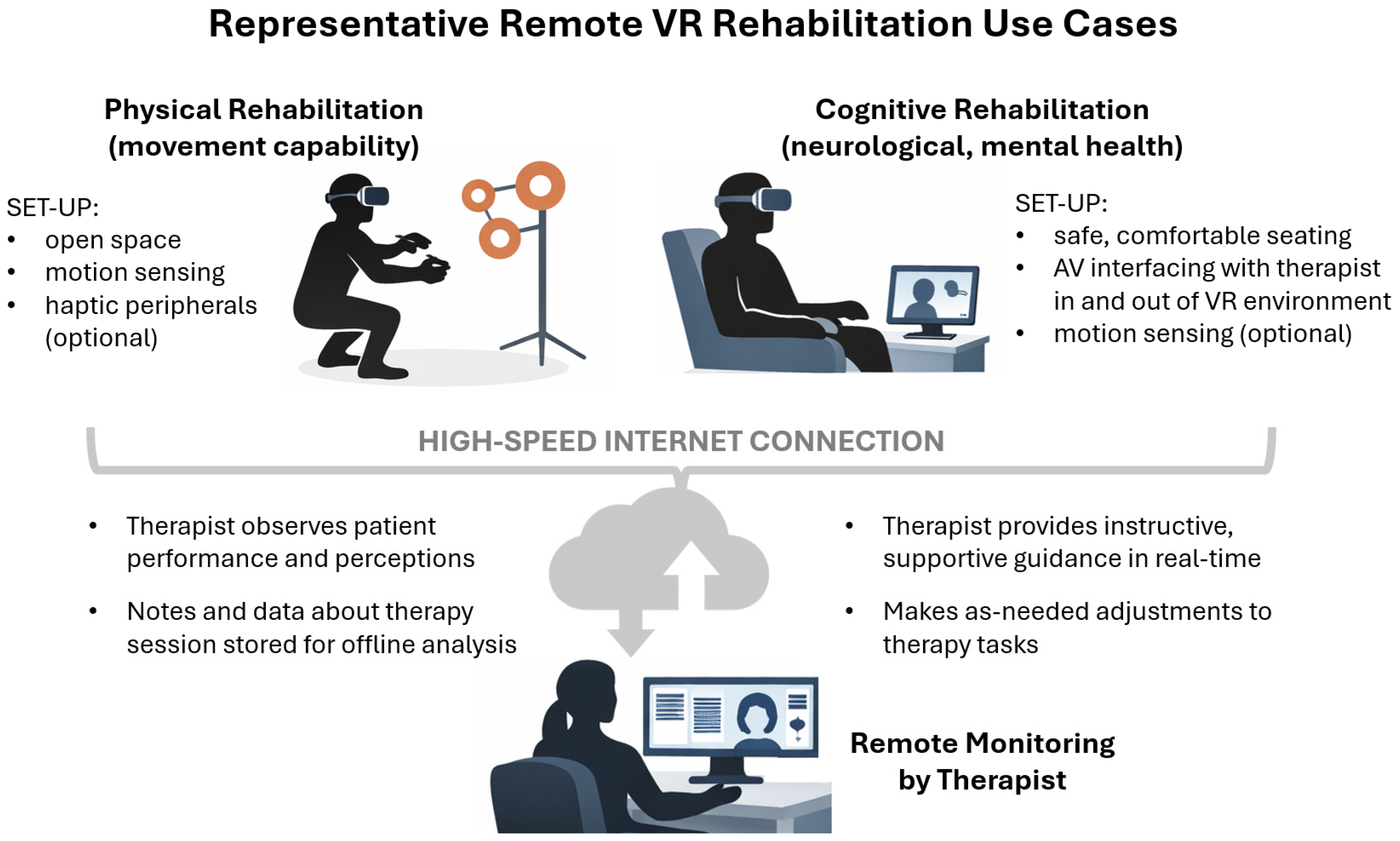
Virtual Reality as a Potential Cornerstone for Remote Rehabilitative Therapies


Abstract
1. Introduction
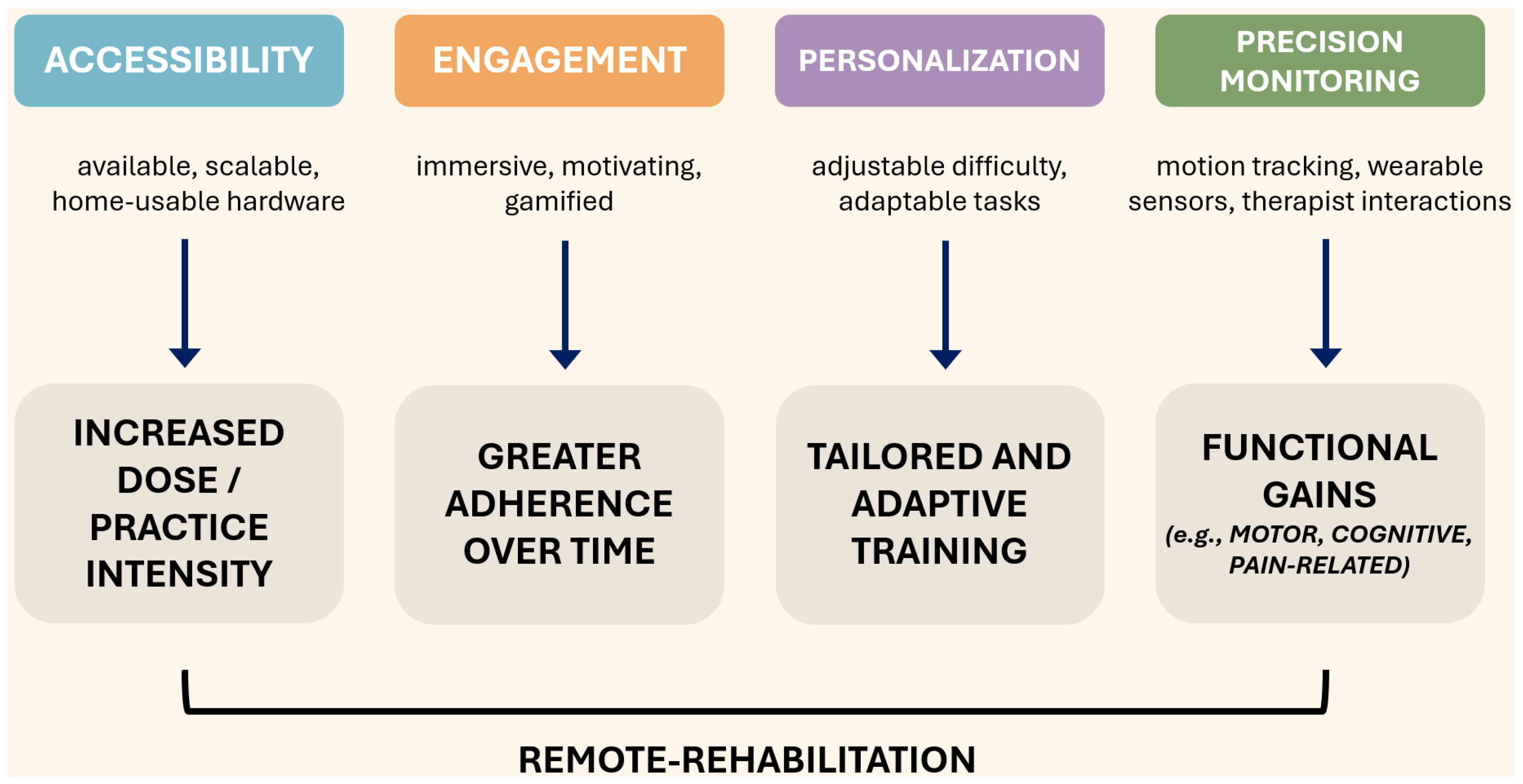
- How can VR increase therapeutic dosage through accessibility and engagement when delivered remotely?
- In what ways can VR enable greater personalization of therapy, especially when integrated with wearables and physiological monitoring?
- What forms of precision monitoring can VR provide to reduce therapist burden while ensuring patient safety and progress tracking?
- How can VR, in combination with artificial intelligence (AI) and telehealth platforms, advance the broader ecosystem of remote care?
2. Virtual Reality Therapies for Cognitive and Physical Rehabilitation
3. Beneficial Features of VR as a Remote Therapy
4. Considerations for Advancing Implementation of VR Remote Therapies in the Future
5. Discussion/Conclusions
Funding
Institutional Review Board Statement
Informed Consent Statement
Data Availability Statement
Acknowledgments
Conflicts of Interest
References
- Baldominos, A.; Saez, Y.; Del Pozo, C.G. An approach to physical rehabilitation using state-of-the-art virtual reality and motion tracking technologies. Procedia Comput. Sci. 2015, 64, 10–16. [Google Scholar] [CrossRef]
- Faria, A.L.; Andrade, A.; Soares, L.; Bermúdez i Badia, S. Benefits of virtual reality based cognitive rehabilitation through simulated activities of daily living: A randomized controlled trial with stroke patients. J. Neuroeng. Rehabil. 2016, 13, 96. [Google Scholar] [CrossRef]
- Fan, T.; Wang, X.; Song, X.; Zhao, G.; Zhang, Z. Research status and emerging trends in virtual reality rehabilitation: Bibliometric and knowledge graph study. JMIR Serious Games 2023, 11, e41091. [Google Scholar] [CrossRef] [PubMed]
- Demeco, A.; Zola, L.; Frizziero, A.; Martini, C.; Palumbo, A.; Foresti, R.; Buccino, G.; Costantino, C. Immersive virtual reality in post-stroke rehabilitation: A systematic review. Sensors 2023, 23, 1712. [Google Scholar] [CrossRef]
- Rogers, S.L.; Broadbent, R.; Brown, J.; Fraser, A.; Speelman, C.P. Realistic motion avatars are the future for social interaction in virtual reality. Front. Virtual Real. 2022, 2, 750729. [Google Scholar] [CrossRef]
- Kern, F.; Winter, C.; Gall, D.; Käthner, I.; Pauli, P.; Latoschik, M.E. Immersive virtual reality and gamification within procedurally generated environments to increase motivation during gait rehabilitation. In Proceedings of the 2019 IEEE Conference on Virtual Reality and 3D User Interfaces (VR), Osaka, Japan, 23–27 March 2019; IEEE: New York, NY, USA, 2019; pp. 500–509. [Google Scholar]
- Postolache, O.; Hemanth, D.J.; Alexandre, R.; Gupta, D.; Geman, O.; Khanna, A. Remote monitoring of physical rehabilitation of stroke patients using IoT and virtual reality. IEEE J. Sel. Areas Commun. 2020, 39, 562–573. [Google Scholar] [CrossRef]
- Kreimeier, J.; Schieber, H.; Lewis, N.; Smietana, M.; Reithmeier, J.; Cnejevici, V.; Prasad, P.; Eid, A.; Maier, M.; Roth, D. Towards Continuous Patient Care with Remote Guided VR-Therapy. In Proceedings of the 2024 IEEE Conference on Virtual Reality and 3D User Interfaces Abstracts and Workshops (VRW), Orlando, FL, USA, 16–21 March 2024; IEEE: New York, NY, USA, 2024; pp. 959–960. [Google Scholar] [CrossRef]
- Vibhuti; Kumar, N.; Kataria, C. Efficacy assessment of virtual reality therapy for neuromotor rehabilitation in home environment: A systematic review. Disabil. Rehabil. Assist. Technol. 2023, 18, 1200–1220. [Google Scholar] [CrossRef]
- Pedram, S.; Palmisano, S.; Perez, P.; Mursic, R.; Farrelly, M. Examining the potential of virtual reality to deliver remote rehabilitation. Comput. Hum. Behav. 2020, 105, 106223. [Google Scholar] [CrossRef]
- McGirt, M.J.; Holland, C.M.; Farber, S.H.; Zuckerman, S.L.; Spertus, M.S.; Theodore, N.; Pfortmiller, D.; Stanley, G. Remote cognitive behavioral therapy utilizing an in-home virtual reality toolkit (Vx Therapy) reduces pain, anxiety, and depression in patients with chronic cervical and lumbar spondylytic pain: A potential alternative to opioids in multimodal pain management. N. Am. Spine Soc. J. 2023, 16, 100287. [Google Scholar]
- Cieza, A.; Causey, K.; Kamenov, K.; Hanson, S.W.; Chatterji, S.; Vos, T. Global estimates of the need for rehabilitation based on the Global Burden of Disease study 2019: A systematic analysis for the Global Burden of Disease Study 2019. Lancet 2020, 396, 2006–2017. [Google Scholar] [CrossRef] [PubMed]
- Gimigliano, F.; Negrini, S. The World Health Organization “rehabilitation 2030: A call for action”. Eur. J. Phys. Rehabil. Med. 2017, 53, 155–168. [Google Scholar] [CrossRef]
- Cramer, S.C.; Dodakian, L.; Le, V.; See, J.; Augsburger, R.; McKenzie, A.; Zhou, R.J.; Chiu, N.L.; Heckhausen, J.; Cassidy, J.M. Efficacy of home-based telerehabilitation vs in-clinic therapy for adults after stroke: A randomized clinical trial. JAMA Neurol. 2019, 76, 1079–1087. [Google Scholar] [CrossRef]
- Kairy, D.; Lehoux, P.; Vincent, C.; Visintin, M. A systematic review of clinical outcomes, clinical process, healthcare utilization and costs associated with telerehabilitation. Disabil. Rehabil. 2009, 31, 427–447. [Google Scholar] [CrossRef]
- Greenhalgh, T.; Shaw, S.E.; Nishio, A.A.; Booth, A.; Byng, R.; Clarke, A.; Dakin, F.; Davies, R.; Faulkner, S.; Hemmings, N. Protocol: Remote care as the ‘new normal’? Multi-site case study in UK general practice. NIHR Open Res. 2022, 2, 46. [Google Scholar] [CrossRef] [PubMed]
- Kruse, C.; Heinemann, K. Facilitators and barriers to the adoption of telemedicine during the first year of COVID-19: Systematic review. J. Med. Internet Res. 2022, 24, e31752. [Google Scholar] [CrossRef]
- Dorsey, E.R.; Topol, E.J. State of Telehealth. N. Engl. J. Med. 2016, 375, 154–161. [Google Scholar] [CrossRef]
- Sveistrup, H. Motor rehabilitation using virtual reality. J. Neuroeng. Rehabil. 2004, 1, 10. [Google Scholar] [CrossRef]
- Grealy, M.A.; Johnson, D.A.; Rushton, S.K. Improving cognitive function after brain injury: The use of exercise and virtual reality. Arch. Phys. Med. Rehabil. 1999, 80, 661–667. [Google Scholar] [CrossRef] [PubMed]
- Howard, M.C. A meta-analysis and systematic literature review of virtual reality rehabilitation programs. Comput. Hum. Behav. 2017, 70, 317–327. [Google Scholar] [CrossRef]
- Strong, B.; Zeng, B.; McCarthy, P.; Roula, A.; Guo, L. A Framework to Design Virtual Reality Mirror Therapy (VRMT) for Motor Rehabilitation in Post-Stroke Survivors: Dosage, Motivation, Task Difficulty, Feedback and Mechanism. In Proceedings of the 2024 IEEE Gaming, Entertainment, and Media Conference (GEM), Turin, Italy, 5–7 June 2024; IEEE: New York, NY, USA, 2024; pp. 1–6. [Google Scholar] [CrossRef]
- Garrett, B.; Taverner, T.; Gromala, D.; Tao, G.; Cordingley, E.; Sun, C. Virtual reality clinical research: Promises and challenges. JMIR Serious Games 2018, 6, e10839. [Google Scholar] [CrossRef]
- Monardo, G.; Pavese, C.; Giorgi, I.; Godi, M.; Colombo, R. Evaluation of Patient Motivation and Satisfaction During Technology-Assisted Rehabilitation: An Experiential Review. Games Health J. 2021, 10, 13–27. [Google Scholar] [CrossRef]
- Hao, J.; Crum, G.; Siu, K. Effects of virtual reality on stroke rehabilitation: An umbrella review of systematic reviews. Health Sci. Rep. 2024, 7, e70082. [Google Scholar] [CrossRef]
- Wei, W.; Tang, H.; Luo, Y.; Yan, S.; Ji, Q.; Liu, Z.; Li, H.; Wu, F.; Yang, S.; Yang, X. Efficacy of virtual reality exercise in knee osteoarthritis rehabilitation: A systematic review and meta-analysis. Front. Physiol. 2024, 15, 1424815. [Google Scholar] [CrossRef] [PubMed]
- Lo, H.H.M.; Ng, M.; Fong, P.Y.H.; Lai, H.H.K.; Wang, B.; Wong, S.Y.; Sit, R.W.S. Examining the feasibility, acceptability, and preliminary efficacy of an immersive virtual reality–assisted lower limb strength training for knee osteoarthritis: Mixed methods pilot randomized controlled trial. JMIR Serious Games 2024, 12, e52563. [Google Scholar] [CrossRef] [PubMed]
- De Paolis, L.T.; De Luca, V. The impact of the input interface in a virtual environment: The Vive controller and the Myo armband. Virtual Real. 2020, 24, 483–502. [Google Scholar] [CrossRef]
- Hillis, K. Digital Sensations: Space, Identity, and Embodiment in Virtual Reality; University of Minnesota Press: Minneapolis, MN, USA, 1999; Volume 1, Available online: https://books.google.com/books?hl=en&lr=&id=fFd1GcXoS7YC&oi=fnd&pg=PR7&dq=virtual+reality+immersion+sensations&ots=Rc7pFFoR6b&sig=dUmP1GqT3juCDv92hsJYyaNXMio (accessed on 29 June 2024).
- Han, P.-H.; Chen, Y.-S.; Lee, K.-C.; Wang, H.-C.; Hsieh, C.-E.; Hsiao, J.-C.; Chou, C.-H.; Hung, Y.-P. Haptic around: Multiple tactile sensations for immersive environment and interaction in virtual reality. In Proceedings of the 24th ACM Symposium on Virtual Reality Software and Technology, Tokyo, Japan, 28–30 November 2018; ACM: New York, NY, USA, 2018; pp. 1–10. [Google Scholar] [CrossRef]
- Ventola, C.L. Virtual reality in pharmacy: Opportunities for clinical, research, and educational applications. Pharm. Ther. 2019, 44, 267. [Google Scholar]
- Gorini, A.; Riva, G. Virtual reality in anxiety disorders: The past and the future. Expert Rev. Neurother. 2008, 8, 215–233. [Google Scholar] [CrossRef]
- Gonçalves, R.; Pedrozo, A.L.; Coutinho, E.S.F.; Figueira, I.; Ventura, P. Efficacy of virtual reality exposure therapy in the treatment of PTSD: A systematic review. PLoS ONE 2012, 7, e48469. [Google Scholar] [CrossRef]
- Diniz Bernardo, P.; Bains, A.; Westwood, S.; Mograbi, D.C. Mood induction using virtual reality: A systematic review of recent findings. J. Technol. Behav. Sci. 2021, 6, 3–24. [Google Scholar] [CrossRef]
- Kosunen, I.; Salminen, M.; Järvelä, S.; Ruonala, A.; Ravaja, N.; Jacucci, G. RelaWorld: Neuroadaptive and Immersive Virtual Reality Meditation System. In Proceedings of the 21st International Conference on Intelligent User Interfaces, Sonoma, CA, USA, 7–10 March 2016; ACM: New York, NY, USA, 2016; pp. 208–217. [Google Scholar] [CrossRef]
- North, M.M.; North, S.M.; Coble, J.R. Virtual reality therapy: An effective treatment for the fear of public speaking. Int. J. Virtual Real. 1998, 3, 1–6. [Google Scholar] [CrossRef]
- Rothbaum, B.O.; Anderson, P.; Zimand, E.; Hodges, L.; Lang, D.; Wilson, J. Virtual reality exposure therapy and standard (in vivo) exposure therapy in the treatment of fear of flying. Behav. Ther. 2006, 37, 80–90. [Google Scholar] [CrossRef]
- Bravou, V.; Oikonomidou, D.; Drigas, A.S. Applications of virtual reality for autism inclusion. A review. Retos Nuevas Tend. Educ. Física Deporte Recreación 2022, 45, 779–785. [Google Scholar]
- Mazza, M.; Kammler-Sücker, K.; Leménager, T.; Kiefer, F.; Lenz, B. Virtual reality: A powerful technology to provide novel insight into treatment mechanisms of addiction. Transl. Psychiatry 2021, 11, 617. [Google Scholar] [CrossRef]
- Clay, F.; Howett, D.; FitzGerald, J.; Fletcher, P.; Chan, D.; Price, A. Use of immersive virtual reality in the assessment and treatment of Alzheimer’s disease: A systematic review. J. Alzheimers Dis. 2020, 75, 23–43. [Google Scholar] [CrossRef] [PubMed]
- Lindner, P. Better, Virtually: The Past, Present, and Future of Virtual Reality Cognitive Behavior Therapy. Int. J. Cogn. Ther. 2021, 14, 23–46. [Google Scholar] [CrossRef]
- Fluet, G.G.; Deutsch, J.E. Virtual reality for sensorimotor rehabilitation post-stroke: The promise and current state of the field. Curr. Phys. Med. Rehabil. Rep. 2013, 1, 9–20. [Google Scholar] [CrossRef] [PubMed]
- Gomes, T.T.; Schujmann, D.S.; Fu, C. Rehabilitation through virtual reality: Physical activity of patients admitted to the intensive care unit. Rev. Bras. Ter. Intensiva 2020, 31, 456–463. [Google Scholar] [CrossRef]
- de Araújo, A.V.L.; de Oliveira Neiva, J.F.; de Mello Monteiro, C.B.; Magalhães, F.H. Efficacy of Virtual Reality Rehabilitation after Spinal Cord Injury: A Systematic Review. BioMed Res. Int. 2019, 2019, 7106951. [Google Scholar] [CrossRef] [PubMed]
- Liu, M.; Wilder, S.; Sanford, S.; Glassen, M.; Dewil, S.; Saleh, S.; Nataraj, R. Augmented feedback modes during functional grasp training with an intelligent glove and virtual reality for persons with traumatic brain injury. Front. Robot. AI 2023, 10, 1230086. [Google Scholar] [CrossRef]
- Cheung, K.L.; Tunik, E.; Adamovich, S.V.; Boyd, L.A. Neuroplasticity and Virtual Reality. In Virtual Reality for Physical and Motor Rehabilitation; Weiss, P.L., Keshner, E.A., Levin, M.F., Eds.; Virtual Reality Technologies for Health and Clinical Applications; Springer New York: New York, NY, USA, 2014; pp. 5–24. [Google Scholar] [CrossRef]
- Kritikos, J.; Alevizopoulos, G.; Koutsouris, D. Personalized virtual reality human-computer interaction for psychiatric and neurological illnesses: A dynamically adaptive virtual reality environment that changes according to real-time feedback from electrophysiological signal responses. Front. Hum. Neurosci. 2021, 15, 596980. [Google Scholar] [CrossRef]
- Pardini, S.; Gabrielli, S.; Dianti, M.; Novara, C.; Zucco, G.M.; Mich, O.; Forti, S. The role of personalization in the user experience, preferences and engagement with virtual reality environments for relaxation. Int. J. Environ. Res. Public. Health 2022, 19, 7237. [Google Scholar] [CrossRef]
- Berton, A.; Longo, U.G.; Candela, V.; Fioravanti, S.; Giannone, L.; Arcangeli, V.; Alciati, V.; Berton, C.; Facchinetti, G.; Marchetti, A. Virtual reality, augmented reality, gamification, and telerehabilitation: Psychological impact on orthopedic patients’ rehabilitation. J. Clin. Med. 2020, 9, 2567. [Google Scholar] [CrossRef]
- Mubin, O.; Alnajjar, F.; Jishtu, N.; Alsinglawi, B.; Al Mahmud, A. Exoskeletons with virtual reality, augmented reality, and gamification for stroke patients’ rehabilitation: Systematic review. JMIR Rehabil. Assist. Technol. 2019, 6, e12010. [Google Scholar] [CrossRef]
- Levin, M.F.; Weiss, P.L.; Keshner, E.A. Emergence of virtual reality as a tool for upper limb rehabilitation: Incorporation of motor control and motor learning principles. Phys. Ther. 2015, 95, 415–425. [Google Scholar] [CrossRef]
- Han, J.; Lian, S.; Guo, B.; Li, X.; You, A. Active rehabilitation training system for upper limb based on virtual reality. Adv. Mech. Eng. 2017, 9, 168781401774338. [Google Scholar] [CrossRef]
- Nataraj, R.; Sanford, S. Control Modification of Grasp Force Covaries Agency and Performance on Rigid and Compliant Surfaces. Front. Bioeng. Biotechnol. 2021, 8, 1544. [Google Scholar] [CrossRef] [PubMed]
- Sigrist, R.; Rauter, G.; Riener, R.; Wolf, P. Augmented visual, auditory, haptic, and multimodal feedback in motor learning: A review. Psychon. Bull. Rev. 2013, 20, 21–53. [Google Scholar] [CrossRef]
- Sanford, S.; Collins, B.; Liu, M.; Dewil, S.; Nataraj, R. Investigating features in augmented visual feedback for virtual reality rehabilitation of upper-extremity function through isometric muscle control. Front. Virtual Real. 2022, 3, 943693. [Google Scholar] [CrossRef]
- Pourmand, A.; Davis, S.; Marchak, A.; Whiteside, T.; Sikka, N. Virtual reality as a clinical tool for pain management. Curr. Pain Headache Rep. 2018, 22, 53. [Google Scholar] [CrossRef]
- Chuan, A.; Zhou, J.J.; Hou, R.M.; Stevens, C.J.; Bogdanovych, A. Virtual reality for acute and chronic pain management in adult patients: A narrative review. Anaesthesia 2021, 76, 695–704. [Google Scholar] [CrossRef]
- Opriş, D.; Pintea, S.; García-Palacios, A.; Botella, C.; Szamosközi, Ş.; David, D. Virtual reality exposure therapy in anxiety disorders: A quantitative meta-analysis: Virtual Reality Exposure Therapy. Depress. Anxiety 2012, 29, 85–93. [Google Scholar] [CrossRef]
- Turner, W.A.; Casey, L.M. Outcomes associated with virtual reality in psychological interventions: Where are we now? Clin. Psychol. Rev. 2014, 34, 634–644. [Google Scholar] [CrossRef] [PubMed]
- Lohse, K.R.; Hilderman, C.G.; Cheung, K.L.; Tatla, S.; Van der Loos, H.M. Virtual reality therapy for adults post-stroke: A systematic review and meta-analysis exploring virtual environments and commercial games in therapy. PLoS ONE 2014, 9, e93318. [Google Scholar] [CrossRef]
- Lohse, K.R.; Lang, C.E.; Boyd, L.A. Is more better? Using metadata to explore dose–response relationships in stroke rehabilitation. Stroke 2014, 45, 2053–2058. [Google Scholar] [CrossRef]
- Wang, S.; Dey, S. Addressing response time and video quality in remote server based internet mobile gaming. In Proceedings of the 2010 IEEE Wireless Communication and Networking Conference, Sydney, NSW, Australia, 18–21 April 2010; IEEE: New York, NY, USA, 2010; pp. 1–6. [Google Scholar] [CrossRef]
- Jarschel, M.; Schlosser, D.; Scheuring, S.; Hoßfeld, T. Gaming in the clouds: QoE and the users’ perspective. Math. Comput. Model. 2013, 57, 2883–2894. [Google Scholar] [CrossRef]
- Zimmerli, L.; Jacky, M.; Lünenburger, L.; Riener, R.; Bolliger, M. Increasing patient engagement during virtual reality-based motor rehabilitation. Arch. Phys. Med. Rehabil. 2013, 94, 1737–1746. [Google Scholar] [CrossRef]
- Lyons, E.J. Cultivating Engagement and Enjoyment in Exergames Using Feedback, Challenge, and Rewards. Games Health J. 2015, 4, 12–18. [Google Scholar] [CrossRef]
- Radovick, S.; Hershkovitz, E.; Kalisvaart, A.; Koning, M.; Paridaens, K.; Kamel Boulos, M.N. Gamification concepts to promote and maintain therapy adherence in children with growth hormone deficiency. J 2018, 1, 71–81. [Google Scholar] [CrossRef]
- Emmelkamp, P.M.G.; Meyerbröker, K. Virtual Reality Therapy in Mental Health. Annu. Rev. Clin. Psychol. 2021, 17, 495–519. [Google Scholar] [CrossRef]
- Park, C.; Lee, B.-C. A systematic review of the effects of interactive telerehabilitation with remote monitoring and guidance on balance and gait performance in older adults and individuals with neurological conditions. Bioengineering 2024, 11, 460. [Google Scholar] [CrossRef]
- Baker, C.; Fairclough, S.H. Adaptive virtual reality. In Current Research in Neuroadaptive Technology; Elsevier: Amsterdam, The Netherlands, 2022; pp. 159–176. [Google Scholar] [CrossRef]
- Behar, C.; Lustick, M.; Foreman, M.H.; Webb, J.; Engsberg, J.R. Personalized virtual reality for upper extremity rehabilitation: Moving from the clinic to a home exercise program. J. Intellect. Disabil.-Diagn. Treat. 2016, 4, 160–169. [Google Scholar] [CrossRef]
- Liu, M.; Wilder, S.; Sanford, S.; Dewil, S.; Saleh, S.; Nataraj, R. EEG and Motor Effects of Multimodal Feedback to Train Functional Grasp after Traumatic Brain Injury. In Proceedings of the 2023 IEEE 36th International Symposium on Computer-Based Medical Systems (CBMS), L’Aquila, Italy, 22–24 June 2023. [Google Scholar]
- Caña-Pino, A.; Holgado-López, P. Wearable-Sensor and Virtual Reality-Based Interventions for Gait and Balance Rehabilitation in Stroke Survivors: A Systematic Review. Signals 2025, 6, 48. [Google Scholar] [CrossRef]
- Anthes, C.; García-Hernández, R.J.; Wiedemann, M.; Kranzlmüller, D. State of the art of virtual reality technology. In Proceedings of the 2016 IEEE Aerospace Conference, Big Sky, MT, USA, 5–12 March 2016; IEEE: New York, NY, USA, 2016; pp. 1–19. [Google Scholar] [CrossRef]
- Biswas, S.; Visell, Y. Haptic Perception, Mechanics, and Material Technologies for Virtual Reality. Adv. Funct. Mater. 2021, 31, 2008186. [Google Scholar] [CrossRef]
- Wiederhold, B.K.; Jang, D.P.; Kim, S.I.; Wiederhold, M.D. Physiological Monitoring as an Objective Tool in Virtual Reality Therapy. Cyberpsychol. Behav. 2002, 5, 77–82. [Google Scholar] [CrossRef] [PubMed]
- Gil, M.J.V.; Gonzalez-Medina, G.; Lucena-Anton, D.; Perez-Cabezas, V.; Ruiz-Molinero, M.D.C.; Martín-Valero, R. Augmented reality in physical therapy: Systematic review and meta-analysis. JMIR Serious Games 2021, 9, e30985. [Google Scholar] [CrossRef]
- Phan, H.L.; Le, T.H.; Lim, J.M.; Hwang, C.H.; Koo, K. Effectiveness of augmented reality in stroke rehabilitation: A meta-analysis. Appl. Sci. 2022, 12, 1848. [Google Scholar] [CrossRef]
- LaPiana, N.; Duong, A.; Lee, A.; Alschitz, L.; Silva, R.M.; Early, J.; Bunnell, A.; Mourad, P. Acceptability of a mobile phone–based augmented reality game for rehabilitation of patients with upper limb deficits from stroke: Case study. JMIR Rehabil. Assist. Technol. 2020, 7, e17822. [Google Scholar] [CrossRef] [PubMed]
- Evans, E.; Dass, M.; Muter, W.M.; Tuthill, C.; Tan, A.Q.; Trumbower, R.D. A wearable mixed reality platform to augment Overground walking: A feasibility study. Front. Hum. Neurosci. 2022, 16, 868074. [Google Scholar] [CrossRef] [PubMed]
- Lancere, L.; Jürgen, M.; Gapeyeva, H. Mixed reality and sensor real-time feedback to increase muscle engagement during deep core exercising. Virtual Real. 2023, 27, 3435–3449. [Google Scholar] [CrossRef]
- Farsi, A.; Cerone, G.L.; Falla, D.; Gazzoni, M. Emerging Applications of Augmented and Mixed Reality Technologies in Motor Rehabilitation: A Scoping Review. Sensors 2025, 25, 2042. [Google Scholar] [CrossRef]
- Mann, S.; Furness, T.; Yuan, Y.; Iorio, J.; Wang, Z. All Reality: Virtual, Augmented, Mixed (X), Mediated (X,Y), and Multimediated Reality. arXiv 2018. [Google Scholar] [CrossRef]
- Slater, M.; Sanchez-Vives, M.V. Enhancing our lives with immersive virtual reality. Front. Robot. AI 2016, 3, 74. [Google Scholar] [CrossRef]
- Billinghurst, M.; Clark, A.; Lee, G. A survey of augmented reality. Found. Trends® Human—Computer Interact. 2015, 8, 73–272. [Google Scholar] [CrossRef]
- Kakegawa, K.; Matsuda, T. Challenges and Prospects of Sensing Technology for the Promotion of Tele-Physiotherapy: A Narrative Review. Sensors 2024, 25, 16. [Google Scholar] [CrossRef] [PubMed]
- Ribeiro De Oliveira, T.; Biancardi Rodrigues, B.; Moura Da Silva, M.; Antonio, N.; Spinassé, R.; Giesen Ludke, G.; Ruy Soares Gaudio, M.; Iglesias Rocha Gomes, G.; Guio Cotini, L.; Da Silva Vargens, D.; et al. Virtual Reality Solutions Employing Artificial Intelligence Methods: A Systematic Literature Review. ACM Comput. Surv. 2023, 55, 214. [Google Scholar] [CrossRef]
- Le, D.-N.; Van Le, C.; Tromp, J.G.; Nguyen, G.N. Emerging Technologies for Health and Medicine: Virtual Reality, Augmented Reality, Artificial Intelligence, Internet of Things, Robotics, Industry 4.0; John Wiley & Sons: Hoboken, NJ, USA, 2018; Available online: https://books.google.com/books?hl=en&lr=&id=amatDwAAQBAJ&oi=fnd&pg=PR18&dq=artificial+intelligence+with+virtual+reality+for+predictive+analytics+patient+therapy&ots=HNcKUCXIwD&sig=8Z2pv8kBOkSPBKyBrmPMgHssWUU (accessed on 29 June 2024).
- Schork, N.J. Artificial Intelligence and Personalized Medicine. In Precision Medicine in Cancer Therapy; Von Hoff, D.D., Han, H., Eds.; Cancer Treatment and Research; Springer International Publishing: Cham, Switzerland, 2019; Volume 178, pp. 265–283. [Google Scholar] [CrossRef]
- Johnson, K.B.; Wei, W.; Weeraratne, D.; Frisse, M.E.; Misulis, K.; Rhee, K.; Zhao, J.; Snowdon, J.L. Precision Medicine, AI, and the Future of Personalized Health Care. Clin. Transl. Sci. 2021, 14, 86–93. [Google Scholar] [CrossRef] [PubMed]
- Kyriazakos, S.; Prasad, R.; Mihovska, A.; Pnevmatikakis, A.; op den Akker, H.; Hermens, H.; Barone, P.; Mamelli, A.; De Domenico, S.; Pocs, M. eWALL: An open-source cloud-based eHealth platform for creating home caring environments for older adults living with chronic diseases or frailty. Wirel. Pers. Commun. 2017, 97, 1835–1875. [Google Scholar] [CrossRef]
- Morland, L.A.; Poizner, J.M.; Williams, K.E.; Masino, T.T.; Thorp, S.R. Home-based clinical video teleconferencing care: Clinical considerations and future directions. Int. Rev. Psychiatry 2015, 27, 504–512. [Google Scholar] [CrossRef]
- Laver, K.E.; Lange, B.; George, S.; Deutsch, J.E.; Saposnik, G.; Crotty, M. Virtual reality for stroke rehabilitation. Cochrane Database Syst. Rev. 2017, 2018, CD008349. [Google Scholar] [CrossRef] [PubMed]
- Rebenitsch, L.; Owen, C. Review on cybersickness in applications and visual displays. Virtual Real. 2016, 20, 101–125. [Google Scholar] [CrossRef]
- Kairy, D.; Tousignant, M.; Leclerc, N.; Côté, A.-M.; Levasseur, M.; Researchers, T. The patient’s perspective of in-home telerehabilitation physiotherapy services following total knee arthroplasty. Int. J. Environ. Res. Public. Health 2013, 10, 3998–4011. [Google Scholar] [CrossRef] [PubMed]


| Clinical Domain | Representative Therapeutic Tasks | Key Outcomes Reported | Monitoring and Feedback Features |
|---|---|---|---|
| Neurological rehabilitation (e.g., stroke, TBI, Parkinson’s disease) | Upper-limb reaching and grasping, balance training, gait-related motor tasks | Improved motor function, increased practice repetitions, functional recovery | Motion tracking, kinematic metrics, task performance logging, augmented sensory feedback |
| Cognitive rehabilitation (e.g., mild cognitive impairment, Alzheimer’s disease) | Memory exercises, spatial navigation, attention and executive-function tasks | Improved cognitive performance, task accuracy, engagement | Response timing, task completion metrics, behavioral logging |
| Mental health therapy (e.g., anxiety disorders, PTSD) | Exposure therapy scenarios, stress-regulation and coping exercises | Symptom reduction, improved coping strategies, reduced avoidance behaviors | Session duration, therapist observation, optional physiological proxies |
| Musculoskeletal rehabilitation (e.g., orthopedic injury, osteoarthritis) | Guided therapeutic exercises, range-of-motion training, strengthening tasks | Reduced pain, improved range of motion, increased adherence | Repetition counts, joint kinematics, progress tracking |
| Pain management (acute and chronic) | Immersive distraction-based virtual experiences | Reduced perceived pain, decreased reliance on pharmacological intervention | Session timing, subjective pain reporting |
| Mixed cognitive–motor rehabilitation | Dual-task training combining motor actions with cognitive demands | Improved functional performance, dual-task ability, engagement | Multimodal sensing, adaptive task difficulty, performance trend analysis |
Disclaimer/Publisher’s Note: The statements, opinions and data contained in all publications are solely those of the individual author(s) and contributor(s) and not of MDPI and/or the editor(s). MDPI and/or the editor(s) disclaim responsibility for any injury to people or property resulting from any ideas, methods, instructions or products referred to in the content. |
© 2026 by the author. Licensee MDPI, Basel, Switzerland. This article is an open access article distributed under the terms and conditions of the Creative Commons Attribution (CC BY) license.
Share and Cite
Nataraj, R. Virtual Reality as a Potential Cornerstone for Remote Rehabilitative Therapies. Encyclopedia 2026, 6, 37. https://doi.org/10.3390/encyclopedia6020037
Nataraj R. Virtual Reality as a Potential Cornerstone for Remote Rehabilitative Therapies. Encyclopedia. 2026; 6(2):37. https://doi.org/10.3390/encyclopedia6020037
Chicago/Turabian StyleNataraj, Raviraj. 2026. "Virtual Reality as a Potential Cornerstone for Remote Rehabilitative Therapies" Encyclopedia 6, no. 2: 37. https://doi.org/10.3390/encyclopedia6020037
APA StyleNataraj, R. (2026). Virtual Reality as a Potential Cornerstone for Remote Rehabilitative Therapies. Encyclopedia, 6(2), 37. https://doi.org/10.3390/encyclopedia6020037