


Implementing Universal Design for Learning to Transform Science Education


Abstract
1. Introduction
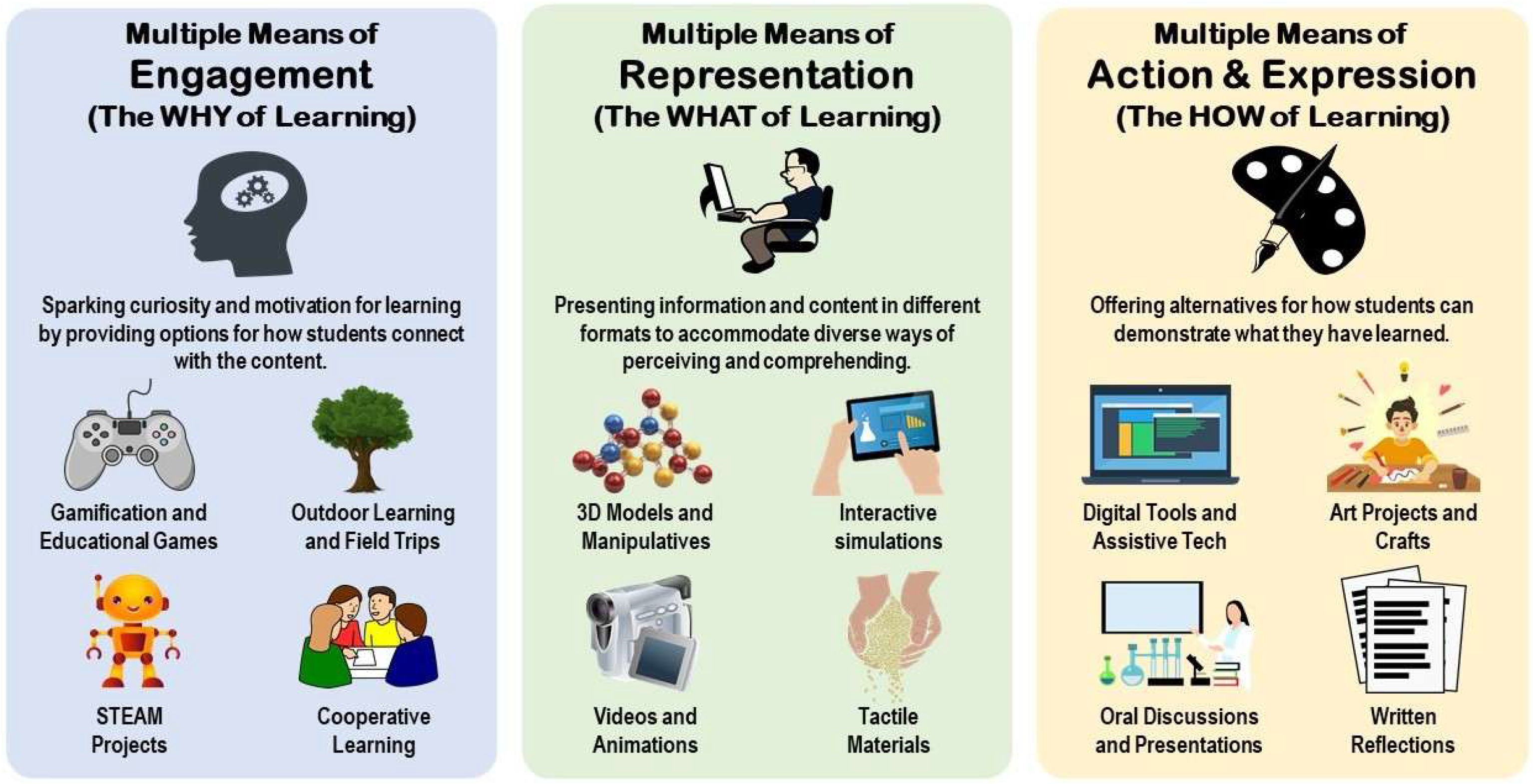
1.1. Understanding Universal Design for Learning: A Comprehensive Definition
1.2. Examining the Relevance of UDL in Science Education
2. Exploring Connections Between UDL and Science Education
2.1. Educational Stages: Addressing Age-Specific Needs
2.2. Science Methodologies Require Specific UDL Approaches
2.2.1. Inquiry-Based Science Education
2.2.2. STEM and STEAM Approaches
2.2.3. Other Active Learning Methodologies for Science
2.3. Science Disciplines: A Broad Range of Possibilities
2.4. Multiple Scenarios of Diversity
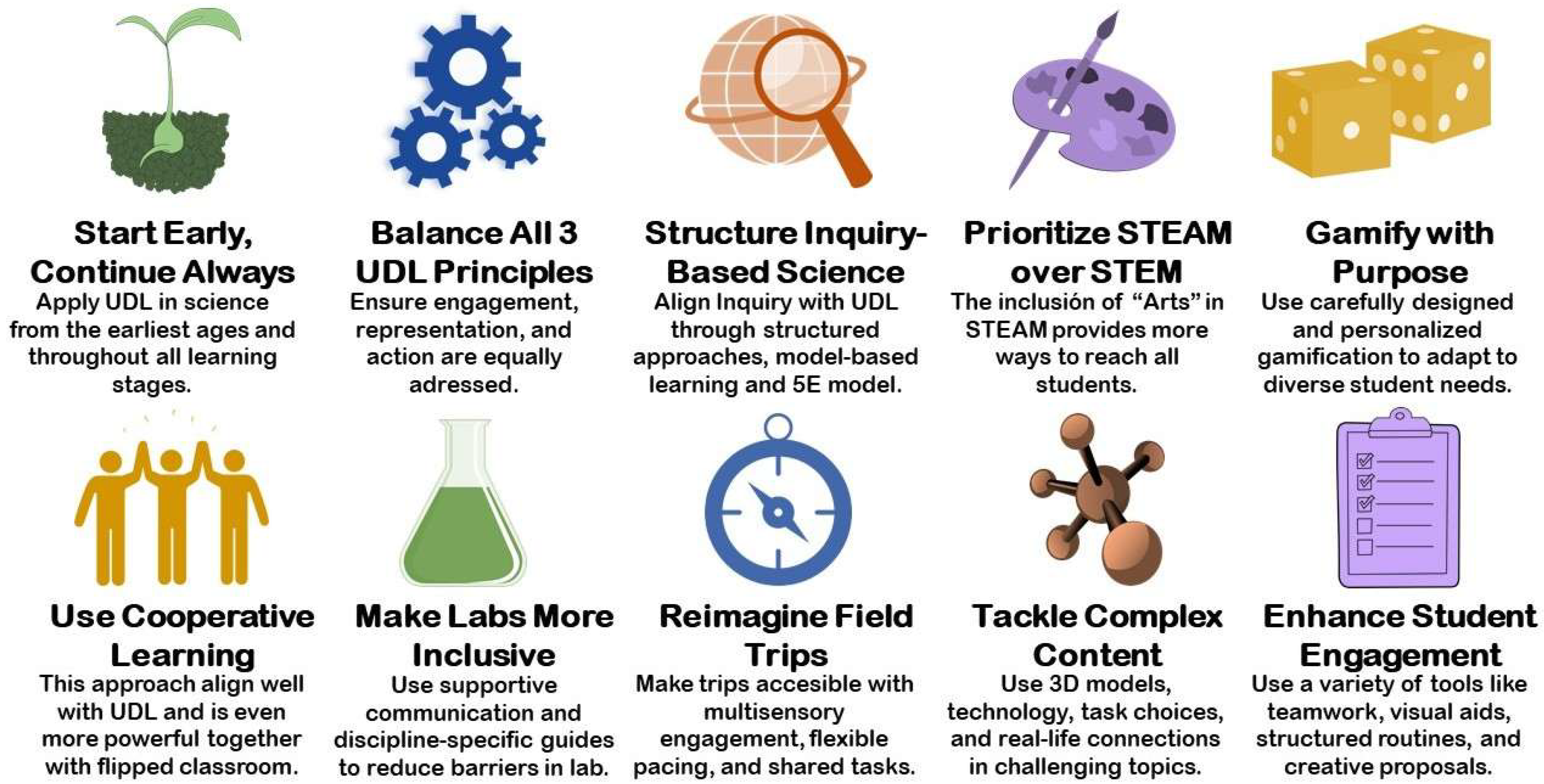
3. Conclusions and Prospects
Author Contributions
Funding
Institutional Review Board Statement
Informed Consent Statement
Data Availability Statement
Conflicts of Interest
Abbreviations
| AAPT | American Association of Physics Teachers |
| ADHD | Attention Deficit Hyperactivity Disorder |
| CAST | Center for Applied Special Technology |
| CL | Cooperative Learning |
| GBL | Game-Based Learning |
| IBSE | Inquiry-Based Science Education |
| NSTA | National Science Teachers Association |
| NoS | Nature of Science |
| OCD | Obsessive–Compulsive Disorder |
| PBL | Problem-Based Learning |
| SGT | Systemic Gamification Theory |
| STEAM | Science, Technology, Engineering, Arts, and Mathematics |
| STEM | Science, Technology, Engineering, and Mathematics |
| STREAMING | Science, Technology, Robotics, Engineering, Artificial Intelligence, Mathematics, Emotional Intelligence, Inclusion, and Gamification |
| UDL | Universal Design for Learning |
| UDI | Universal Design for Instruction |
References
- CAST. Universal Design for Learning Guidelines Version 2.2. 2018. Available online: https://udlguidelines.cast.org/more/downloads/#v2-2 (accessed on 29 November 2025).
- Rose, D.H.; Meyer, A. Teaching Every Student in the Digital Age: Universal Design for Learning; ASCD: Alexandria, VA, USA, 2002. [Google Scholar]
- CAST. Universal Design for Learning Guidelines Version 2.0. 2011. Available online: https://udlguidelines.cast.org/more/downloads/#v2-0 (accessed on 29 November 2025).
- CAST. Universal Design for Learning Guidelines Version 3.0. 2024. Available online: https://udlguidelines.cast.org/more/downloads/#v3-0 (accessed on 29 November 2025).
- Schreffler, J.; Vasquez, E., III; Chini, J.; James, W. Universal Design for Learning in Postsecondary STEM Education for Students with Disabilities: A Systematic Literature Review. Int. J. STEM Educ. 2019, 6, 8. [Google Scholar] [CrossRef]
- Lambert, R.; McNiff, A.; Schuck, R.; Imm, K.; Zimmerman, S. “UDL is a Way of Thinking”; Theorizing UDL Teacher Knowledge, Beliefs, and Practices. Front. Educ. 2023, 8, 1145293. [Google Scholar] [CrossRef]
- Meyer, A.; Rose, D.H.; Gordon, D. Universal Design for Learning: Theory and Practice; CAST Professional Publishing: Wakefield, MA, USA, 2014. [Google Scholar]
- Burgstahler, S. Universal Design of Instruction (UDI): Definition, Principles, Guidelines, and Examples. Disabilities, Opportunities, Internetworking, and Technology (DO-IT). Available online: https://files.eric.ed.gov/fulltext/ED506547.pdf (accessed on 29 November 2025).
- Roski, M.; Walkowiak, M.; Nehring, A. Universal Design for Learning: The More, the Better? Educ. Sci. 2021, 11, 164. [Google Scholar] [CrossRef]
- Egara, F.; Mosia, M. Equipping Pre-service Mathematics Teachers for Diverse Classrooms: Best Practices and Innovations. Open Books Proc. 2025, 9, 138. [Google Scholar] [CrossRef]
- European Agency for Special Needs and Inclusive Education. Empowering Teachers to Promote Inclusive Education: Literature Review; European Agency for Special Needs and Inclusive Education: Odense, Denmark, 2015. [Google Scholar]
- Shafik, W. The Interplay Between Global Sustainable Development Goals (SDGs) and Inclusivity. In Global Sustainable Transition with Inclusion: A Focus on the People with Disabilities and the Marginalized; Springer Nature: Singapore, 2025; pp. 69–95. [Google Scholar] [CrossRef]
- Bray, A.; Devitt, A.; Banks, J.; Sanchez Fuentes, S.; Sandoval, M.; Riviou, K.; Terrenzio, S. What Next for Universal Design for Learning? A Systematic Literature Review of Technology in UDL Implementations at Second Level. Br. J. Educ. Technol. 2024, 55, 113–138. [Google Scholar] [CrossRef]
- Barrera, M.; Moliner, O. How Does Universal Design for Learning Help Me to Learn? Students with Autism Spectrum Disorder Voices in Higher Education. Stud. High. Educ. 2023, 49, 899–912. [Google Scholar] [CrossRef]
- Creaven, A.M. Considering the Sensory and Social Needs of Disabled Students in Higher Education: A Call to Return to the Roots of Universal Design. Policy Futures Educ. 2024, 23, 259–266. [Google Scholar] [CrossRef]
- Ewe, L.P.; Galvin, T. Universal Design for Learning Across Formal School Structures in Europe—A Systematic Review. Educ. Sci. 2023, 13, 867. [Google Scholar] [CrossRef]
- Capp, M.J. Teacher Confidence to Implement the Principles, Guidelines, and Checkpoints of Universal Design for Learning. Int. J. Incl. Educ. 2020, 24, 706–720. [Google Scholar] [CrossRef]
- Flood, M.; Banks, J. Universal Design for Learning: Is it Gaining Momentum in Irish Education? Educ. Sci. 2021, 11, 341. [Google Scholar] [CrossRef]
- King-Sears, M.E.; Stefanidis, A.; Evmenova, A.S.; Rao, K.; Mergen, R.L.; Owen, L.S.; Strimel, M.M. Achievement of Learners Receiving UDL Instruction: A Meta-analysis. Teach. Teach. Educ. 2023, 122, 103956. [Google Scholar] [CrossRef]
- Suprihatiningrum, J.; Ristiyanti, S.; Maulidina, F.; Wulayalin, K.A. Science Teachers’ Experiences to Ensure Science for All Movement: From Theory to Practice. Sci. Educ. Int. 2025, 36, 259–267. [Google Scholar] [CrossRef]
- Costa, A.M.; Ferreira, M.E.; da Silva Loureiro, M.J. Scientific Literacy: The Conceptual Framework Prevailing over the First Decade of the Twenty-First Century. Rev. Colomb. Educ. 2021, 81, 195–228. [Google Scholar] [CrossRef]
- Turiman, P.; Omar, J.; Daud, A.M.; Osman, K. Fostering the 21st Century Skills through Scientific Literacy and Science Process Skills. Procedia-Soc. Behav. Sci. 2012, 59, 110–116. [Google Scholar] [CrossRef]
- Rappolt-Schlichtmann, G.; Daley, S.G.; Lim, S.; Lapinski, S.; Robinson, K.H.; Johnson, M. Universal Design for Learning and Elementary School Science: Exploring the Efficacy, Use, and Perceptions of a Web-Based Science Notebook. J. Educ. Psychol. 2013, 105, 1210–1225. [Google Scholar] [CrossRef]
- Pine, K.; Messer, D.; St. John, K. Children’s Misconceptions in Primary Science: A Survey of Teachers’ Views. Res. Sci. Technol. Educ. 2001, 19, 79–96. [Google Scholar] [CrossRef]
- Brown, P.L.; Concannon, J.P. Students’ Perceptions of Vocabulary Knowledge and Learning in a Middle School Science Classroom. Int. J. Sci. Educ. 2016, 38, 391–408. [Google Scholar] [CrossRef]
- Lemke, J.L. Talking Science: Language, Learning, and Values; Ablex Publishing Corporation: Norwood, NJ, USA, 1990. [Google Scholar]
- Lorenzo, M.G.; Reverdito, A.M.; Blanco, M.; Salerno, A. Difficulties of Undergraduate Students in the Organic Chemistry Laboratory. Probl. Educ. 21st Century 2012, 42, 74–81. [Google Scholar] [CrossRef]
- Baurhoo, N.; Asghar, A. Using Universal Design for Learning to Construct Inclusive Science Classrooms for Diverse Learners. Learn. Landsc. 2014, 7, 59–81. [Google Scholar] [CrossRef]
- Sukhai, M.A.; Mohler, C.E. Creating a Culture of Accessibility in the Sciences; Academic Press: San Diego, CA, USA, 2016. [Google Scholar]
- Moore, J.; Searles, S.; Holterman, L.A.; Simone, C.; Huggett, K. Universal Design for TBL®: Promoting Inclusion and Access for All Learners. Med. Sci. Educ. 2020, 30, 595–596. [Google Scholar] [CrossRef]
- Comarú, M.W.; Lopes, R.M.; Braga, L.A.M.; Mota, F.B.; Galvão, C. A Bibliometric and Descriptive Analysis of Inclusive Education in Science Education. Stud. Sci. Educ. 2021, 57, 241–263. [Google Scholar] [CrossRef]
- Meré-Cook, Y. Inclusive STEAM Education in Early Childhood: Strengths-Based Strategies for Supporting Children with Disabilities; Teachers College Press: New York, NY, USA, 2025. [Google Scholar]
- Tao, Y.; Oliver, M.; Venville, G. Long-Term Outcomes of Early Childhood Science Education: Insights from a Cross-National Comparative Case Study on Conceptual Understanding of Science. Int. J. Sci. Math. Educ. 2012, 10, 1269–1302. [Google Scholar] [CrossRef]
- Clements, D.H.; Vinh, M.; Lim, C.I.; Sarama, J. STEM for Inclusive Excellence and Equity. In Developing Culturally and Developmentally Appropriate Early STEM Learning Experiences; Routledge: London, UK, 2023; pp. 148–171. [Google Scholar]
- Chen, D.; Dote-Kwan, J. Preschoolers with Visual Impairments and Additional Disabilities: Using Universal Design for Learning and Differentiation. Young Excep. Child. 2021, 24, 70–81. [Google Scholar] [CrossRef]
- Lohmann, M.J.; Hovey, K.A.; Gauvreau, A.N. Universal Design for Learning (UDL) in Inclusive Preschool Science Classrooms. J. Sci. Educ. Stud. Disabil. 2023, 26, 1–12. [Google Scholar] [CrossRef]
- Guardino, C.; Hall, K.W.; Largo-Wight, E.; Hubbuch, C. Teacher and Student Perceptions of an Outdoor Classroom. J. Outdoor Environ. Educ. 2019, 22, 113–126. [Google Scholar] [CrossRef]
- Cooper, A. Nature and the Outdoor Learning Environment: The Forgotten Resource in Early Childhood Education. Int. J. Early Child. Environ. Educ. 2015, 3, 85–97. [Google Scholar]
- Mirza, M.A.; Khurshid, K.; Hasan, A.; Shah, Z.; Shah, F. Correlating Universal Design of Learning and Performance in Science at the Elementary School Level. In Handbook on Intelligent Techniques in the Educational Process: Vol 1 Recent Advances and Case Studies; Springer: Cham, Switzerland, 2022; pp. 269–298. [Google Scholar] [CrossRef]
- Hansen, A.K.; Hansen, E.R.; Dwyer, H.A.; Harlow, D.B.; Franklin, D. Differentiating for Diversity: Using Universal Design for Learning in Elementary Computer Science Education. In Proceedings of the 47th ACM Technical Symposium on Computing Science Education, Memphis, TN, USA, 2–5 March 2016; ACM: New York, NY, USA, 2016; pp. 376–381. [Google Scholar]
- Finnegan, L.A.; Dieker, L.A. Universal Design for Learning-Representation and Science Content: A Pathway to Expanding Knowledge, Understanding, and Written Explanations. Sci. Act. 2019, 56, 11–18. [Google Scholar] [CrossRef]
- Gaunt, L.; Quane, K.; Trewartha, B.; Porta, T. Universal Design for Learning for Mathematics Education. In Proceedings of the 47th Annual Conference of the Mathematics Education Research Group of Australasia, Canberra, Australia, 6–10 July 2025; MERGA: Sydney, Australia, 2025. [Google Scholar]
- Beames, S.; Christie, B.; Blackwell, I. Developing Whole School Approaches to Integrated Indoor/Outdoor Teaching. In Children Learning Outside the Classroom: From Birth to Eleven; Routledge: London, UK, 2017; pp. 82–93. [Google Scholar]
- Heugen, K. Bringing the Benefits of Nature to All Children. In The Active Learner, Highscope’s Journal for Early Educators; HighScope: Ypsilanti, MI, USA, 2019; pp. 12–13. Available online: https://highscope.org/wp-content/uploads/2019/05/HSActiveLearner_2019Spring_sample.pdf (accessed on 29 November 2025).
- Rao, K.; Ok, M.W.; Bryant, B.R. A Review of Research on Universal Design Educational Models. Remedial Spec. Educ. 2014, 35, 153–166. [Google Scholar] [CrossRef]
- Kaur, T.; Prendergast, M. Students’ Perceptions of Mathematics Writing and Its Impact on Their Enjoyment and Self-Confidence. Teach. Math. Its Appl. 2022, 41, 1–21. [Google Scholar] [CrossRef]
- Street, C.D.; Koff, R.; Fields, H.; Kuehne, L.; Handlin, L.; Getty, M.; Parker, D.R. Expanding Access to STEM for At-Risk Learners: A New Application of Universal Design for Instruction. J. Postsecond. Educ. Disabil. 2012, 25, 363–375. [Google Scholar]
- Skinner, M.E. Faculty Willingness to Provide Accommodations and Course Alternatives to Postsecondary Students with Learning Disabilities. Int. J. Spec. Educ. 2007, 22, 32–45. [Google Scholar]
- Cawley, J.F. Science for Students with Disabilities. Remedial Spec. Educ. 1994, 15, 67–71. [Google Scholar] [CrossRef]
- Joyce, J.; Harrison, J.R.; Gitomer, D.H. Modifications and Accommodations: A Preliminary Investigation into Changes in Classroom Artifact Quality. Int. J. Inclus. Educ. 2020, 24, 181–201. [Google Scholar] [CrossRef]
- Cretu, D.M.; Morandau, F. Initial Teacher Education for Inclusive Education: A Bibliometric Analysis of Educational Research. Sustainability 2020, 12, 4923. [Google Scholar] [CrossRef]
- Gottfried, M.A.; Hutt, E.L.; Kirksey, J.J. New Teachers’ Perceptions on Being Prepared to Teach Students with Learning Disabilities: Insights from California. J. Learn. Disabil. 2019, 52, 383–398. [Google Scholar] [CrossRef]
- Narot, P.K.; Srisuruk, P. Pre-service Curriculum and Perception of Prospective Student Teachers towards Inclusive Education. In Handbook of Research on Teacher Education: Innovations and Practices in Asia; Springer Nature: Singapore, 2022; pp. 721–735. [Google Scholar] [CrossRef]
- Moriña, A.; Carballo, R.; Doménech, A. Transforming Higher Education: A Systematic Review of Faculty Training in UDL and Its Benefits. Teach. High. Educ. 2025, 1, 1722–1739. [Google Scholar] [CrossRef]
- Fabre-Mitjans, N.; Jiménez-Valverde, G.; Guimerà-Ballesta, G.; Calafell-Subirà, G. Digital Gamification to Foster Attitudes Toward Science in Early Childhood Teacher Education. Appl. Sci. 2025, 15, 5961. [Google Scholar] [CrossRef]
- Jiménez-Valverde, G.; Heras-Paniagua, C.; Fabre-Mitjans, N.; Calafell-Subirà, G. Gamifying Teacher Education with FantasyClass: Effects on Attitudes Towards Physics and Chemistry Among Preservice Primary Teachers. Educ. Sci. 2024, 14, 822. [Google Scholar] [CrossRef]
- Zamora-Polo, F.; Corrales-Serrano, M.; Sánchez-Martín, J.; Espejo-Antúnez, L. Nonscientific University Students Training in General Science Using an Active-Learning Merged Pedagogy: Gamification in a Flipped Classroom. Educ. Sci. 2019, 9, 297. [Google Scholar] [CrossRef]
- National Research Council (NRC). Inquiry and the National Science Education Standards: A Guide for Teaching and Learning; The National Academies Press: Washington, DC, USA, 2000. [Google Scholar]
- Tsaliki, C.; Papadopoulou, P.; Malandrakis, G.; Kariotoglou, P. Evaluating Inquiry Practices: Can a Professional Development Program Reform Science Teachers’ Practices? J. Sci. Teach. Educ. 2022, 33, 815–836. [Google Scholar] [CrossRef]
- Tan, A.L.; Ong, Y.S.; Ng, Y.S.; Tan, J.H.J. STEM Problem Solving: Inquiry, Concepts, and Reasoning. Sci. Educ. 2023, 32, 381–397. [Google Scholar] [CrossRef] [PubMed]
- Sofianidis, A.; Skraparlis, C.; Stylianidou, N. Combining Inquiry, Universal Design for Learning, Alternate Reality Games, and Augmented Reality Technologies in Science Education: The IB-ARGI Approach and the Case of Magnetman. J. Sci. Educ. Technol. 2024, 33, 928–953. [Google Scholar] [CrossRef]
- National Research Council (NRC). National Science Education Standards; National Academy Press: Washington, DC, USA, 1996. [Google Scholar]
- Klahr, D.; Nigam, M. The Equivalence of Learning Paths in Early Science Instruction: Effects of Direct Instruction and Discovery Learning. Psychol. Sci. 2004, 15, 661–667. [Google Scholar] [CrossRef] [PubMed]
- Therrien, W.J.; Taylor, J.C.; Hosp, J.L.; Kaldenberg, E.R.; Gorsh, J. Science Instruction for Students with Learning Disabilities: A Meta-Analysis. Learn. Disabil. Res. Pract. 2011, 26, 188–203. [Google Scholar] [CrossRef]
- Scruggs, T.E.; Mastropieri, M.A.; Boon, R. Science Education for Students with Disabilities: A Review of Recent Research. Stud. Sci. Educ. 1998, 32, 21–44. [Google Scholar] [CrossRef]
- Watt, S.J.; Therrien, W.J.; Kaldenberg, E.; Taylor, J. Promoting Inclusive Practices in Inquiry-Based Science Classrooms. Teach. Except. Child. 2013, 45, 40–48. [Google Scholar] [CrossRef]
- Therrien, W.J.; Taylor, J.C.; Watt, S.; Kaldenberg, E.R. Science Instruction for Students with Emotional and Behavioral Disorders. Remedial Spec. Educ. 2014, 35, 15–27. [Google Scholar] [CrossRef]
- Toma, R.B. Confirmation and Structured Inquiry Teaching: Does it Improve Students’ Achievement Motivations in School Science? Can. J. Sci. Math. Technol. Educ. 2022, 22, 28–41. [Google Scholar] [CrossRef]
- Sebti, L.; Damiani, M.L. Engaging Students with Disabilities in Universally Designed Science Education. J. Sci. Educ. Stud. Disabil. 2021, 24, 13. [Google Scholar] [CrossRef]
- Ambitious Science Teaching Development Group. Tools for Ambitious Science Teaching. Available online: https://ambitiousscienceteaching.org/resource-type/type-tool/ (accessed on 30 November 2025).
- Koebley, S.; Wakeman, S.; Ruhter, L.; Pugalee, D.; Karvonen, M. Making Science-Inquiry Learning Accessible for Students with Complex Support Needs. J. Sci. Educ. Stud. Disabil. 2024, 27, 6. [Google Scholar] [CrossRef]
- van Garderen, D.; Decker, M.; Juergensen, R.; Abdelnaby, H. Using the 5E Instructional Model in an Online Environment with Pre-service Special Education Teachers. J. Sci. Educ. Stud. Disabil. 2020, 23, 8. [Google Scholar] [CrossRef]
- Hanuscin, D.; Van Garderen, D. Universal Design for Learning Science: Reframing Elementary Instruction in Physical Science; NSTA Press: Arlington, VA, USA, 2020. [Google Scholar]
- Israel, M.; Shehab, S. Increasing Science Learning and Engagement for Academically Diverse Students through Scaffolded Scientific Inquiry and Universal Design for Learning. In Towards Inclusion of All Learners through Science Teacher Education; Brill: Leiden, The Netherlands, 2018; pp. 201–211. [Google Scholar]
- Bonwell, C.C.; Eison, J.A. Active Learning: Creating Excitement in the Classroom; School of Education and Human Development, George Washington University: Washington, DC, USA, 1991. [Google Scholar]
- Doolittle, P.; Wojdak, K.; Walters, A. Defining Active Learning: A Restricted Systematic Review. Teach. Learn. Inq. 2023, 11. [Google Scholar] [CrossRef]
- Land, M.H. Full STEAM Ahead: The Benefits of Integrating the Arts into STEM. Procedia Comput. Sci. 2013, 20, 547–552. [Google Scholar] [CrossRef]
- Thoma, R.; Farassopoulos, N.; Lousta, C. Teaching STEAM through Universal Design for Learning in Early Years of Primary Education: Plugged-in and Unplugged Activities with Emphasis on Connectivism Learning Theory. Teach. Teach. Educ. 2023, 132, 104210. [Google Scholar] [CrossRef]
- Catterall, L.G. A Brief History of STEM and STEAM from an Inadvertent Insider. STEAM J. 2017, 3, 5. [Google Scholar] [CrossRef]
- Guyotte, K.W.; Sochacka, N.W.; Costantino, T.E.; Kellam, N.N.; Walther, J. Collaborative Creativity in STEAM: Narratives of Art Education Students’ Experiences in Transdisciplinary Spaces. Int. J. Educ. Arts 2015, 16, 15. [Google Scholar]
- Segarra, V.A.; Natalizio, B.; Falkenberg, C.V.; Pulford, S.; Holmes, R.M. STEAM: Using the Arts to Train Well-Rounded and Creative Scientists. J. Microbiol. Biol. Educ. 2018, 19. [Google Scholar] [CrossRef]
- Tan, W.L.; Samsudin, M.A.; Ismail, M.E.; Ahmad, N.J. Gender Differences in Students’ Achievements in Learning Concepts of Electricity via STEAM Integrated Approach Utilizing Scratch. Probl. Educ. 21st Century 2020, 78, 423–448. [Google Scholar] [CrossRef]
- Marino, M.T. Defining a Technology Research Agenda for Elementary and Secondary Students with Learning and Other High Incidence Disabilities in Inclusive Science Classrooms. J. Spec. Educ. Technol. 2010, 25, 1–27. [Google Scholar] [CrossRef]
- McCleery, J.A.; Tindal, G.A. Teaching the Scientific Method to At-Risk Students and Students with Learning Disabilities through Concept Anchoring and Explicit Instruction. Remedial Spec. Educ. 1999, 20, 7–18. [Google Scholar] [CrossRef]
- Lynch, S.; Taymans, J.; Watson, A.W.; Ochsendorf, R.J.; Pyke, C.; Szesze, M.J. Effectiveness of a Highly Rated Science Curriculum Unit for Students with Disabilities in General Education Classrooms. Except. Child. 2007, 73, 202–223. [Google Scholar] [CrossRef]
- Basham, J.D.; Marino, M.T. Understanding STEM Education and Supporting Students Through Universal Design for Learning. Teach. Except. Child. 2013, 45, 8–15. [Google Scholar] [CrossRef]
- Nasri, N.; Rahimi, N.M.; Nasri, N.M.; Talib, M.A.A. A Comparison Study Between Universal Design for Learning-Multiple Intelligence (UDL-MI) Oriented STEM Program and Traditional STEM Program for Inclusive Education. Sustainability 2021, 13, 554. [Google Scholar] [CrossRef]
- Gonzalez, M.; Fryer, C. A Collaborative Initiative: STEM and Universally Designed Curriculum for At-Risk Preschoolers. Natl. Teach. Educ. J. 2014, 7, 3. [Google Scholar]
- Gilleran Stephens, C.; Antwi, S.H.; Linnane, S. Universal Design for Learning (UDL): A Framework for Re-Design of an Environmental Education (EE) Outreach Program for a More Inclusive and Impactful Science Festival Event. Discov. Educ. 2025, 4, 217. [Google Scholar] [CrossRef]
- Silvarajan, L.; Kamarudin, N.; Mustakim, S.S. Bridging the Gap: How Universal Design for Learning Can Transform Biology Education: A Systematic Review. IIUM J. Educ. Stud. 2025, 13, 3–27. [Google Scholar] [CrossRef]
- Jesionkowska, J.; Wild, F.; Deval, Y. Active Learning Augmented Reality for STEAM Education—A Case Study. Educ. Sci. 2020, 10, 198. [Google Scholar] [CrossRef]
- Moon, N.W.; Todd, R.L.; Morton, D.L.; Ivey, E. Accommodating Students with Disabilities in Science, Technology, Engineering, and Mathematics (STEM); Center for Assistive Technology and Environmental Access, Georgia Institute of Technology: Atlanta, GA, USA, 2012; Volume 8, p. 21. [Google Scholar]
- Drigas, A.; Kefalis, C. STREAMING: A Comprehensive Approach to Inclusive STEM Education. Sci. Electron. Arch. 2024, 17, 5. [Google Scholar] [CrossRef]
- AccessSTEM. Disability Type. Available online: https://doit.uw.edu/programs/accessstem/ (accessed on 30 November 2025).
- Otegui, X.; Raimondi, C. Enhancing Pedagogical Practices in Engineering Education: Evaluation of a Training Course on Active Learning Methodologies. In Towards a Hybrid, Flexible and Socially Engaged Higher Education; Springer Nature: Cham, Switzerland, 2024; pp. 255–266. [Google Scholar] [CrossRef]
- Torralba, K.D.; Doo, L. Active Learning Strategies to Improve Progression from Knowledge to Action. Rheumatol. Dis. Clin. N. Am. 2020, 46, 1–19. [Google Scholar] [CrossRef]
- Kapp, K.M. The Gamification of Learning and Instruction: Game-Based Methods and Strategies for Training and Education; Pfeiffer: San Francisco, CA, USA, 2012. [Google Scholar]
- Sanchez, E. Game-Based Learning. In Encyclopedia of Education and Information Technologies; Springer: Cham, Switzerland, 2019. [Google Scholar]
- Kalogiannakis, M.; Papadakis, S.; Zourmpakis, A.I. Gamification in Science Education: A Systematic Review of the Literature. Educ. Sci. 2021, 11, 22. [Google Scholar] [CrossRef]
- Quintero, J.; Baldiris, S.; Cerón, J.; Garzón, J.; Burgos, D.; Vélez, G. Gamification as Support for Educational Inclusion: The Case of AR-mBot. In Proceedings of the 2022 International Conference on Advanced Learning Technologies (ICALT), Bucharest, Romania, 1–4 July 2022; IEEE: New York, NY, USA, 2022; pp. 269–273. [Google Scholar]
- Hunt, J.; Taub, M.; Marino, M.; Duarte, A.; Bentley, B.; Holman, K.; Banzon, A. Enhancing Engagement and Fraction Concept Knowledge with a Universally Designed Game-Based Curriculum. Learn. Disabil. Contemp. J. 2022, 20, 77–95. [Google Scholar]
- Coelho, F.; Abreu, A.M. Systemic Gamification Theory (SGT): A Holistic Model for Inclusive Gamified Digital Learning. Multimodal Technol. Interact. 2025, 9, 70. [Google Scholar] [CrossRef]
- Jiménez-Valverde, G.; Fabre-Mitjans, N.; Heras-Paniagua, C.; Guimerà-Ballesta, G. Tailoring Gamification in a Science Course to Enhance Intrinsic Motivation in Preservice Primary Teachers. Educ. Sci. 2025, 15, 300. [Google Scholar] [CrossRef]
- Altun, S. The Effect of Cooperative Learning on Students’ Achievement and Views on the Science and Technology Course. Int. Electron. J. Elem. Educ. 2015, 7, 451–467. [Google Scholar]
- Aparicio-Ting, F.; Kurz, E. I Get by with a Little Help from My Friends: Applying UDL to Group Projects. In Incorporating Universal Design for Learning in Disciplinary Contexts in Higher Education; Springer: Cham, Switzerland, 2021; pp. 52–63. [Google Scholar]
- Terson de Paleville, D. Flipped Team-Based Learning as Universal Design for Learning Physiology. Physiology 2024, 39, S948. [Google Scholar] [CrossRef]
- Curry, C.; Cohen, L.; Lightbody, N. Universal Design in Science Learning. Sci. Teach. 2006, 73, 32–37. [Google Scholar]
- Montgomery, T.D.; Green, B.M.; Oliech, C.G.; Evanseck, J.D. Learning from a Pandemic: Redesigning with Universal Design for Learning to Enhance Scientific Skills (Practice Brief). J. Postsecond. Educ. Disabil. 2024, 37, 73–79. [Google Scholar]
- Orndorf, H.C.; Waterman, M.; Lange, D.; Kavin, D.; Johnston, S.C.; Jenkins, K.P. Opening the Pathway: An Example of Universal Design for Learning as a Guide to Inclusive Teaching Practices. CBE—Life Sci. Educ. 2022, 21, ar28. [Google Scholar] [CrossRef]
- Lepore, T.; Lu, J.; Starowicz, R.; Hlusko, L.J. Student Perception of Accessibility and Disability in College Evolutionary Biology Courses: A Qualitative Study Using Reflexive Thematic Analysis. Int. J. Inclus. Educ. 2025, 1, 1–36. [Google Scholar] [CrossRef]
- Wojdak, K.; Smith, M.K.; Orndorf, H.; Ramirez, M.L. Evaluating Universal Design for Learning and Active Learning Strategies in Biology Open Educational Resources (OERs). Teach. Learn. Inq. 2024, 12, 1–22. [Google Scholar] [CrossRef]
- Casebolt, T.; Humphrey, K. Use of Universal Design for Learning Principles in a Public Health Course. Ann. Glob. Health 2023, 89, 48. [Google Scholar] [CrossRef] [PubMed]
- Dempsey, A.M.; Nolan, Y.M.; Lone, M.; Hunt, E. Examining Motivation of First-Year Undergraduate Anatomy Students through the Lens of Universal Design for Learning (UDL): A Single Institution Study. Med. Sci. Educ. 2023, 33, 945–953. [Google Scholar] [CrossRef]
- Bryans Bongey, S.; Cizadlo, G.; Kalnbach, L. Blended Solutions: Using a Supplemental Online Course Site to Deliver Universal Design for Learning (UDL). Campus-Wide Inf. Syst. 2010, 27, 4–16. [Google Scholar] [CrossRef]
- Lehner, E. Cogenerative Dialogue: Developing Biology Learning Accommodations for Students with Disabilities. World J. Educ. Res. 2016, 3, 97. [Google Scholar] [CrossRef][Green Version]
- Scanlon, E.; Schreffler, J.; James, W.; Vasquez, E.; Chini, J.J. Postsecondary Physics Curricula and Universal Design for Learning: Planning for Diverse Learners. Phys. Rev. Phys. Educ. Res. 2018, 14, 020101. [Google Scholar] [CrossRef]
- Stonehouse, C. Access for All: A Guide to Disability Good Practice for University Physics Departments. Inst. Phys. Guide 2008, 1. [Google Scholar]
- Dounas-Frazer, D.R.; Gillen, D.; Herne, C.M.; Howard, E.; Lindell, R.S.; McGrew, G.I.; Mumford, J.R.; Nguyen, N.H.; Osadchuk, L.C.; Crane, J.P.; et al. Increase Investment in Accessible Physics Labs: A Call to Action for the Physics Education Community. arXiv 2022, arXiv:2202.00816. [Google Scholar] [CrossRef]
- Lannan, A.; Chini, J.J.; Scanlon, E. Resources for Supporting Students with and without Disabilities in Your Physics Courses. Phys. Teach. 2021, 59, 192–195. [Google Scholar] [CrossRef]
- Chini, J.J.; Scanlon, E.M. Teaching Physics with Disabled Learners: A Review of the Literature. In International Handbook of Physics Education Research; AIP Publishing: Melville, NY, USA, 2023. [Google Scholar] [CrossRef]
- Bustamante, C.; Chini, J.J.; Scanlon, E. Supporting Students with ADHD in Introductory Physics Courses: Four Steps for Instructors. Phys. Teach. 2021, 59, 573–576. [Google Scholar] [CrossRef]
- Atika, I.N.; Buana, S.H.A.; Yusrika, A.Z. Development of a STEM-Based Physics Instructional Tool to Encourage Students’ Collaboration Skills in Inclusive High School. J. Penelit. Pendidik. IPA 2025, 11, 917–925. [Google Scholar] [CrossRef]
- Barrón-Hernández, A.R.; Ramírez-Díaz, M.H. Universal Learning Design in Physics Teaching: An Application Proposal. Rev. Científica 2023, 47, 71–86. [Google Scholar] [CrossRef]
- Nurramadhani, A.Z.; Pratama, K.P.S.; Amelia, L.; Kusuma, A.; Erika, F. Literature Review: Universal Design for Learning (UDL) Approach of Chemistry Learning in Inclusion Schools. Hydrog. J. Kependidik. Kim. 2024, 12, 1324–1337. [Google Scholar] [CrossRef]
- King-Sears, M.E.; Johnson, T.M. Universal Design for Learning Chemistry Instruction for Students with and without Learning Disabilities. Remedial Spec. Educ. 2020, 41, 207–218. [Google Scholar] [CrossRef]
- Rosmi, Y.F.; Jauhari, M.N. Universal Design for Learning pada Pembelajaran Pendidikan Jasmani Adaptif di Sekolah Inklusi. STAND J. Sports Teach. Dev. 2022, 3, 40–48. [Google Scholar] [CrossRef]
- Rai, R.; Choden, K.; Lhapchu, L.; Rinchen, S. Integrating Universal Design for Learning Principles in Chemistry Education. J. Res. Educ. Pedagog. 2025, 2, 464–477. [Google Scholar] [CrossRef]
- Baumann, T.; Melle, I. Evaluation of a Digital UDL-Based Learning Environment in Inclusive Chemistry Education. Chem. Teach. Int. 2019, 1, 20180026. [Google Scholar] [CrossRef]
- Reyes, C.T.; Lawrie, G.A.; Thompson, C.D.; Kyne, S.H. “Every Little Thing That Could Possibly Be Provided Helps”: Analysis of Online First-Year Chemistry Resources Using the Universal Design for Learning Framework. Chem. Educ. Res. Pract. 2022, 23, 385–407. [Google Scholar] [CrossRef]
- Miller, D.K.; Lang, P.L. Using the Universal Design for Learning Approach in Science Laboratories to Minimize Student Stress. J. Chem. Educ. 2016, 93, 1823–1828. [Google Scholar] [CrossRef]
- Higgins, A.K.; Maxwell, A.E. Universal Design for Learning in the Geosciences for Access and Equity in Our Classrooms. J. Appl. Instr. Des. 2021, 10, 69–83. [Google Scholar] [CrossRef]
- Carabajal, I.G.; Marshall, A.M.; Atchison, C.L. A Synthesis of Instructional Strategies in Geoscience Education Literature that Address Barriers to Inclusion for Students with Disabilities. J. Geosci. Educ. 2017, 65, 531–541. [Google Scholar] [CrossRef]
- Giles, S.; Jackson, C.; Stephen, N. Barriers to Fieldwork in Undergraduate Geoscience Degrees. Nat. Rev. Earth Environ. 2020, 1, 77–78. [Google Scholar] [CrossRef]
- Feig, A.D.; Atchison, C.; Stokes, A.; Gilley, B. Achieving Inclusive Field-Based Education: Results and Recommendations from an Accessible Geoscience Field Trip. J. Sch. Teach. Learn. 2019, 19, 66–87. [Google Scholar] [CrossRef]
- Stokes, A.; Feig, A.D.; Atchison, C.L.; Gilley, B. Making Geoscience Fieldwork Inclusive and Accessible for Students with Disabilities. Geosphere 2019, 15, 1809–1825. [Google Scholar] [CrossRef]
- García-Frank, A.; Fesharaki, O.; Iglesias-Álvarez, N. Tasting of Mineral Salts: An Inclusive Proposal for the Teaching of Geology. In INTED2021 Proceedings, Proceedings of the 15th International Technology, Education and Development Conference, Online, 8–9 March 2021; IATED: Valencia, Spain, 2021; pp. 3080–3087. [Google Scholar]
- Ríos-Reyes, C.A.; Portilla-Mendoza, K.A.; Carrillo-Hernández, Y.M.; Díaz-Gutiérrez, S.L.; Gutiérrez-Quintero, N.S.; Castellanos-Alarcón, O.M.; López-Alba, M. Inclusive Teaching of Palaeontology for People with and without Disabilities through Didactic Workshops. Int. J. Inclus. Educ. 2024, 29, 2358–2378. [Google Scholar] [CrossRef]
- Kelly, O.; Buckley, K.; Lieberman, L.J.; Arndt, K. Universal Design for Learning-A Framework for Inclusion in Outdoor Learning. J. Outdoor Environ. Educ. 2022, 25, 75–89. [Google Scholar] [CrossRef]
- Dillenschneider, C. Integrating Persons with Impairments and Disabilities into Standard Outdoor Adventure Education Programs. J. Exp. Educ. 2007, 30, 70–83. [Google Scholar] [CrossRef]
- Aguilar, O.M.; McCann, E.P.; Liddicoat, K. Inclusive Education. In Urban Environmental Education Review; Comstock Publishing Associates: Ithaca, NY, USA, 2017; pp. 1–15. [Google Scholar]
- Espinoza-Ramos, G.R. Making Education for Sustainable Development (ESD) More Inclusive and Engaging through Universal Design for Learning (UDL): A Case Study at the Westminster Business School. In An Agenda for Sustainable Development Research; Springer Nature: Cham, Switzerland, 2024; pp. 651–669. [Google Scholar]
- Murphy, C.; Smith, G.; Broderick, N. A Starting Point: Provide Children Opportunities to Engage with Scientific Inquiry and Nature of Science. Res. Sci. Educ. 2021, 51, 1759–1793. [Google Scholar] [CrossRef]
- Manassero-Mas, M.A.; Vázquez-Alonso, Á. Enseñar y Aprender a Pensar sobre la Naturaleza de la Ciencia: Un Juego de Cartas como Recurso en Educación Primaria. Rev. Eureka Enseñ. Divulg. Cienc. 2023, 20, 220201–220219. [Google Scholar] [CrossRef]
- Jiménez-Valverde, G.; Fabre-Mitjans, N.; Guimerà-Ballesta, G. Games and Playful Activities to Learn About the Nature of Science. Encyclopedia 2025, 5, 193. [Google Scholar] [CrossRef]
- Elsayed, R.; Daehler, K.; Clark, J.G.; Bloom, N.E. Promoting Inclusion and Engagement in STEM: A Practical Guide for Out-of-School-Time Professionals; WestEd: San Francisco, CA, USA; Northern Arizona University: Flagstaff, AZ, USA, 2022; Available online: https://planets-stem.org/wp-content/uploads/2024/11/A-Practical-Guide-082922-centered.pdf (accessed on 29 November 2025).
- Panzera-Gonçalves, J.; Marcolan Valverde, T.; Segatelli, T.M.; Oliveira, C.A. Teaching Cell Biology to a Student Who is Blind: Promoting Inclusion and Teacher Training in Higher Education. Int. J. Inclus. Educ. 2025, 1, 1–23. [Google Scholar] [CrossRef]
- Magaña-Cruz, E.; Vera, L.G.; Arguijo, J.A.; Peña, A.T.; Flores, L.G.; Reynaga-Peña, C.G. Engineering for UDL-Based Education: Translating Book Images into Interactive 3D Educational Materials for Health Sciences Subjects. Tecnol. Educ. Rev. CONAIC 2024, 11, 76–82. [Google Scholar]
- Hasley, A.O.; Jenkins, K.P.; Orndorf, H.; Gibson, J.P. Tactile Trees: Demystifying Phylogenies for Everyone with Universal Design for Learning. Am. Biol. Teach. 2024, 86, 281–288. [Google Scholar] [CrossRef]
- Toggerson, B.K. In Service of Equity: 3D-Printed Models in University Introductory Physics. Phys. Teach. 2022, 60, 565–568. [Google Scholar] [CrossRef]
- Ramos Aguiar, L.R.; Álvarez Rodríguez, F.J.; Madero Aguilar, J.R.; Navarro Plascencia, V.; Peña Mendoza, L.M.; Quintero Valdez, J.R.; Vázquez, J.R.; Mendieta, A.; Lazcano Ortiz, L.E. Implementing Gamification for Blind and Autistic People with Tangible Interfaces, Extended Reality, and Universal Design for Learning: Two Case Studies. Appl. Sci. 2023, 13, 3159. [Google Scholar] [CrossRef]
- Kouroupetroglou, G.; Kacorri, H. Deriving Accessible Science Books for the Blind Students of Physics. In Proceedings of the AIP Conference, Alexandroupolis, Greece, 9–13 September 2009; American Institute of Physics: Melville, NY, USA, 2010; Volume 1203, pp. 1308–1313. [Google Scholar]
- Wulayalin, K.A.; Suprihatiningrum, J. Creating Accessible Chemistry Content for Students with Disabilities: Findings from Schools Providing Inclusive Education in Indonesia. J. Penelit. Pendidik. IPA 2024, 10, 2199–2210. [Google Scholar] [CrossRef]
- Dwyer, P. The Neurodiversity Approach (es): What Are They and What Do They Mean for Researchers? Hum. Dev. 2022, 66, 73–92. [Google Scholar] [CrossRef]
- Chapman, R. Empire of Normality: Neurodiversity and Capitalism; Pluto Press: London, UK, 2023. [Google Scholar]
- Botha, M.; Chapman, R.; Giwa Onaiwu, M.; Kapp, S.K.; Stannard Ashley, A.; Walker, N. The Neurodiversity Concept Was Developed Collectively: An Overdue Correction on the Origins of Neurodiversity Theory. Autism 2024, 28, 1591–1594. [Google Scholar] [CrossRef]
- Kryukova, N.I.; Rastorgueva, N.E.; Popova, E.O.; Zakharova, V.L.; Aytuganova, J.I.; Bikbulatova, G.I. Examining the Implementations Related to Teaching Science to Students with Disabilities. Eurasia J. Math. Sci. Technol. Educ. 2023, 19, em2306. [Google Scholar] [CrossRef]
- Martin, W.B.; Yu, J.; Wei, X.; Vidiksis, R.; Patten, K.K.; Riccio, A. Promoting Science, Technology, and Engineering Self-Efficacy and Knowledge for All with an Autism Inclusion Maker Program. Front. Educ. 2020, 5, 75. [Google Scholar] [CrossRef]
- Moody, A.K.; Kubasko, D.S.; Walker, A.R. Strategies for Supporting Students Diagnosed with Autism Spectrum Disorders in STEM Education. J. Am. Acad. Spec. Educ. Prof. 2018, 44, 65. [Google Scholar] [CrossRef]
- Hite, R.; Childers, G.; Jones, G.; Corin, E.; Pereyra, M. Describing the Experiences of Students with ADHD Learning Science Content with Emerging Technologies. J. Sci. Educ. Stud. Disabil. 2021, 24, 12. [Google Scholar] [CrossRef]
- Leininger, M.; Taylor Dyches, T.; Prater, M.A.; Heath, M.A. Teaching Students with Obsessive-Compulsive Disorder. Intervent. Sch. Clin. 2010, 45, 221–231. [Google Scholar] [CrossRef]
- Scott, M.; Downey, D. Teaching Strategies for Third-Level Science Students with Dyslexia and/or Dyspraxia. In Proceedings of the International Conference on Engaging Pedagogy 2010 (ICEP10), Dublin, Ireland, 2 September2010. [Google Scholar]
- Nwikpo, M.N.; Chiemeka, P.C. Leveraging Digital Manipulatives in Remediation of Dyscalculia: A Theoretical Framework. Unizik Orient J. Educ. 2024, 12, 2. [Google Scholar]
- Boyle, S.; Rizzo, K.L.; Taylor, J.C. Reducing Language Barriers in Science for Students with Special Educational Needs. Asia-Pac. Sci. Educ. 2020, 6, 364–387. [Google Scholar] [CrossRef]
- Wusqo, I.U.; Pamelasari, S.D.; Khusniati, M.; Yanitama, A.; Pratidina, F.R. The Development and Validation of Science Digital Scrapbook in a Universal Design for Learning Environment. J. Phys. Conf. Ser. 2021, 1918, 052090. [Google Scholar] [CrossRef]
- Milakis, E.D. Collaborative Project-Based Learning as a Pedagogical Strategy for Inclusion in Gifted STEAM Education: Teachers’ Perspectives from Mixed-Ability Classrooms. Int. J. Multidiscip. Trends 2025, 7, 92–105. [Google Scholar] [CrossRef]
- Mendes, E.A. Gender Identity, Sexuality and Autism: Voices from Across the Spectrum; Jessica Kingsley Publishers: London, UK, 2019. [Google Scholar]
- Dowey, N.; Barclay, J.; Fernando, B.; Giles, S.; Houghton, J.; Jackson, C.; Khatwa, A.; Lawrence, A.; Mills, K.; Newton, A.; et al. A UK Perspective on Tackling the Geoscience Racial Diversity Crisis in the Global North. Nat. Geosci. 2021, 14, 256–259. [Google Scholar] [CrossRef]
- Steele, C.M.; Aronson, J. Stereotype Threat and the Intellectual Test Performance of African Americans. J. Pers. Soc. Psychol. 1995, 69, 797–811. [Google Scholar] [CrossRef]
- Heron, P.J.; Crameri, F.; Canaletti, E.F.; Harrison, D.; Hashemi, S.; Leigh, P.; Narayan, S.; Osowski, K.; Rantanen, R.; Williams, J.A. Art, Music, and Play as a Teaching Aid: Applying Creative Uses of Universal Design for Learning in a Prison Science Class. Front. Educ. 2025, 10, 1524007. [Google Scholar] [CrossRef]
- Crowther, G.J.; Adjapong, E.; Jenkins, L.D. Teaching Science with the “Universal Language” of Music: Alignment with the Universal Design for Learning Framework. Adv. Physiol. Educ. 2023, 47, 491–498. [Google Scholar] [CrossRef]
- Jaladanki, V.S.; Bhattacharya, K. Interactive Notebook Arts-Based Approach to Physics Instruction. Creat. Approaches Res. 2015, 8, 2. [Google Scholar]
Disclaimer/Publisher’s Note: The statements, opinions and data contained in all publications are solely those of the individual author(s) and contributor(s) and not of MDPI and/or the editor(s). MDPI and/or the editor(s) disclaim responsibility for any injury to people or property resulting from any ideas, methods, instructions or products referred to in the content. |
© 2026 by the authors. Licensee MDPI, Basel, Switzerland. This article is an open access article distributed under the terms and conditions of the Creative Commons Attribution (CC BY) license.
Share and Cite
Fabre-Mitjans, N.; Jiménez-Valverde, G. Implementing Universal Design for Learning to Transform Science Education. Encyclopedia 2026, 6, 24. https://doi.org/10.3390/encyclopedia6010024
Fabre-Mitjans N, Jiménez-Valverde G. Implementing Universal Design for Learning to Transform Science Education. Encyclopedia. 2026; 6(1):24. https://doi.org/10.3390/encyclopedia6010024
Chicago/Turabian StyleFabre-Mitjans, Noëlle, and Gregorio Jiménez-Valverde. 2026. "Implementing Universal Design for Learning to Transform Science Education" Encyclopedia 6, no. 1: 24. https://doi.org/10.3390/encyclopedia6010024
APA StyleFabre-Mitjans, N., & Jiménez-Valverde, G. (2026). Implementing Universal Design for Learning to Transform Science Education. Encyclopedia, 6(1), 24. https://doi.org/10.3390/encyclopedia6010024

