
From Airy’s Equation to the Non-Dissipative Lorenz Model: Turning Points, Quantum Tunneling, and Solitary Waves


Definition
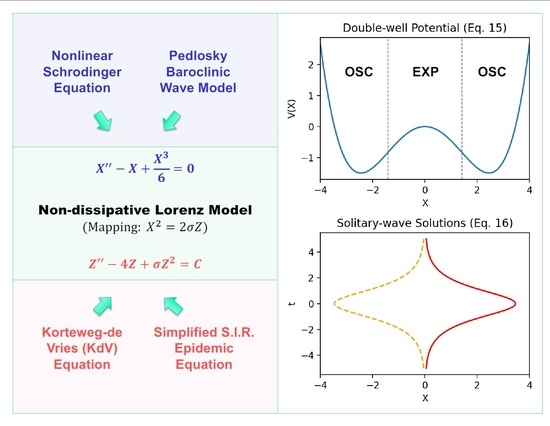
1. Introduction
2. Exploring Second Derivatives from a Calculus Perspective
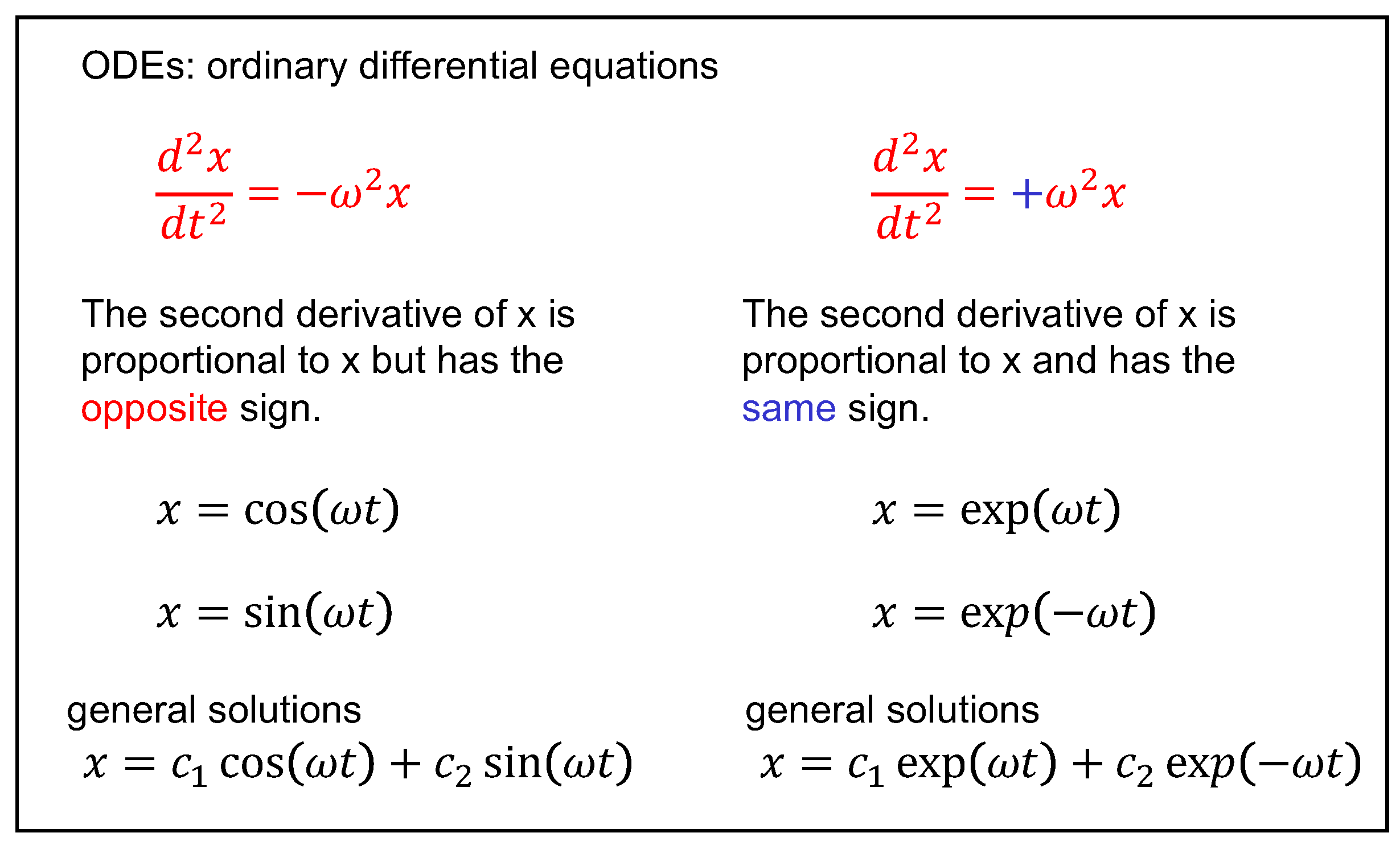
2.1. Second Derivatives of Sine and Cosine
2.2. Second Derivatives of Exponential Growth and Decay
2.3. A Unified Mathematical Description
- (a)
- (b)
2.4. A Note on Complex Numbers
3. Airy Equation and the Schrödinger Analogy
3.1. From the Schrödinger Equation to the Airy Equation
3.2. Linearizing the Potential near the Turning Point
3.3. Rescaling to the Standard Airy Form
3.4. Physical Interpretation
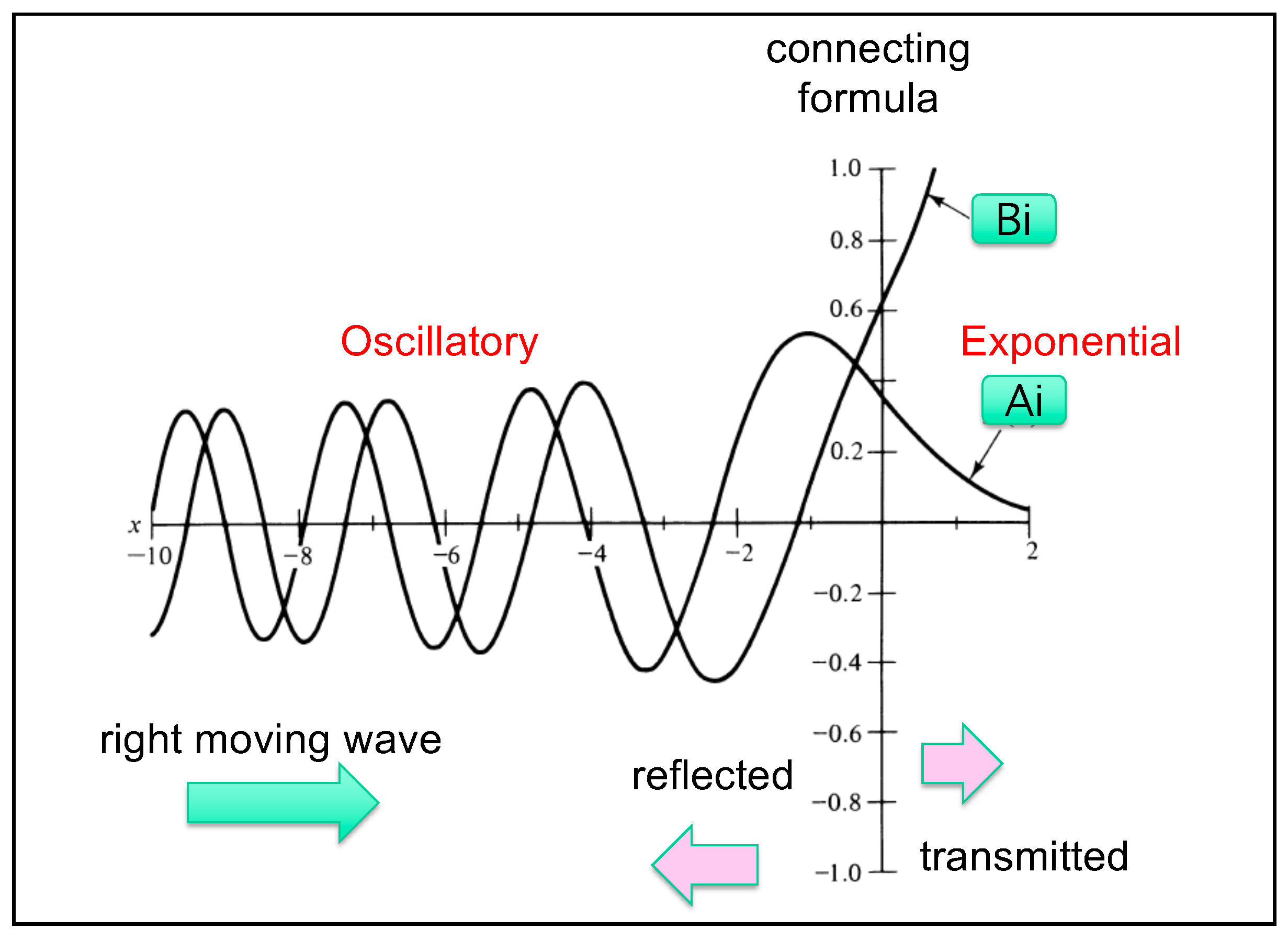
- For (corresponding to ), the solutions satisfy and are oscillatory, analogous to propagating waves.
- For (corresponding to ), the solutions satisfy and decay exponentially, representing the classically forbidden region.
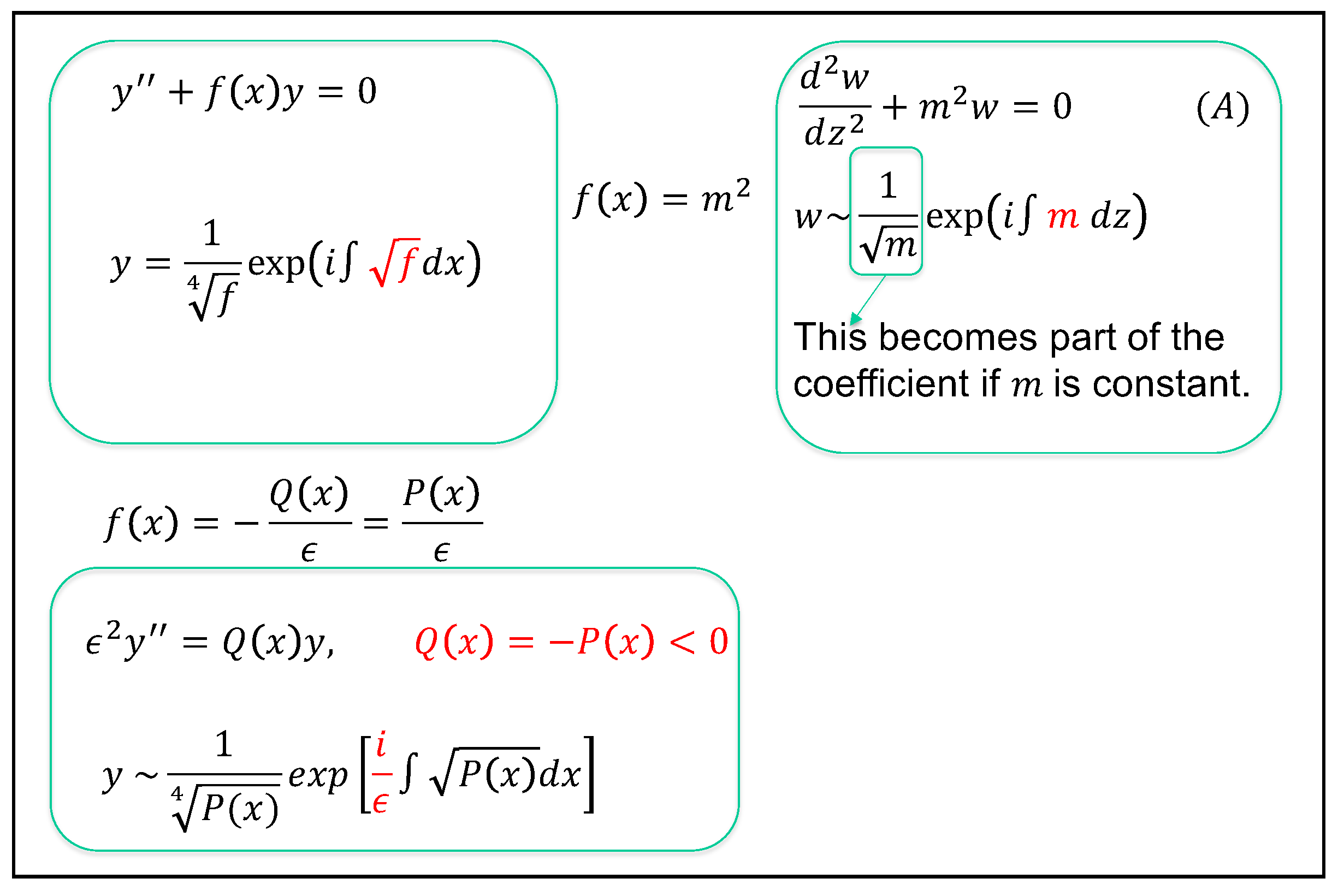
3.5. Review of the WKB (Liouville–Green) Method
3.5.1. Derivation Sketch
3.5.2. Oscillatory and Evanescent Regions
- If , is real, and the solution is oscillatory (propagating waves).
- If , is imaginary, and the exponentials become real, giving decaying or growing (evanescent) behavior.
- The turning point occurs where and the two regimes meet. Near this point, the WKB form fails, and the equation must be approximated by the Airy equation as shown earlier.
3.5.3. Alternative Formulation and Notation
3.5.4. Connection Between the WKB and Airy Approaches
4. The Non-Dissipative Lorenz Model and Solitary Waves
- (a)
- Multiply by the derivative
- (b)
- Integrate with respect to time
4.1. Connection to the Nonlinear Schrödinger (NLS) Equation
4.2. Potential Function and Comparison with the Linear Schrödinger Case
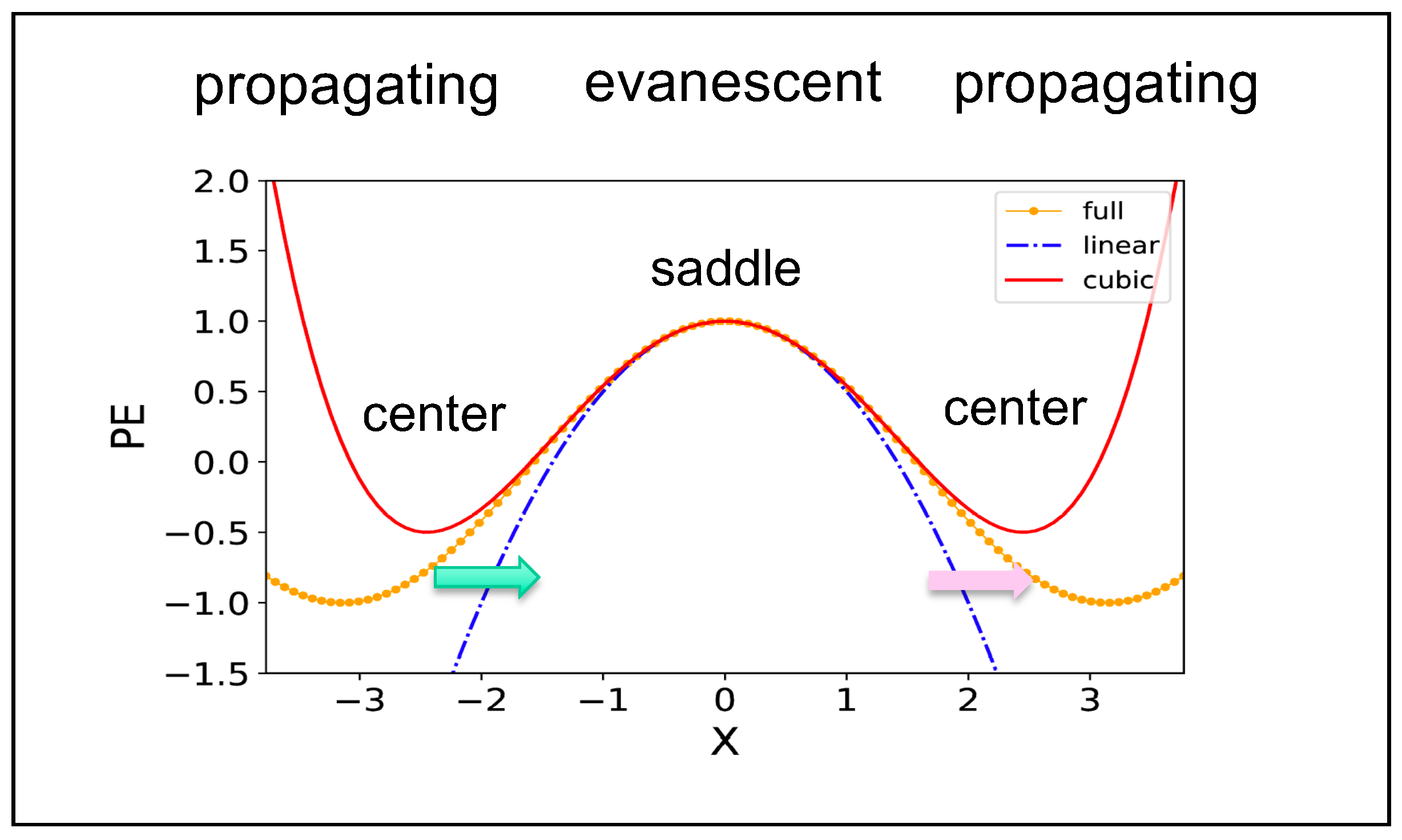
| Region I (left, oscillatory) | Region II (barrier, evanescent) | Region III (right, oscillatory). |
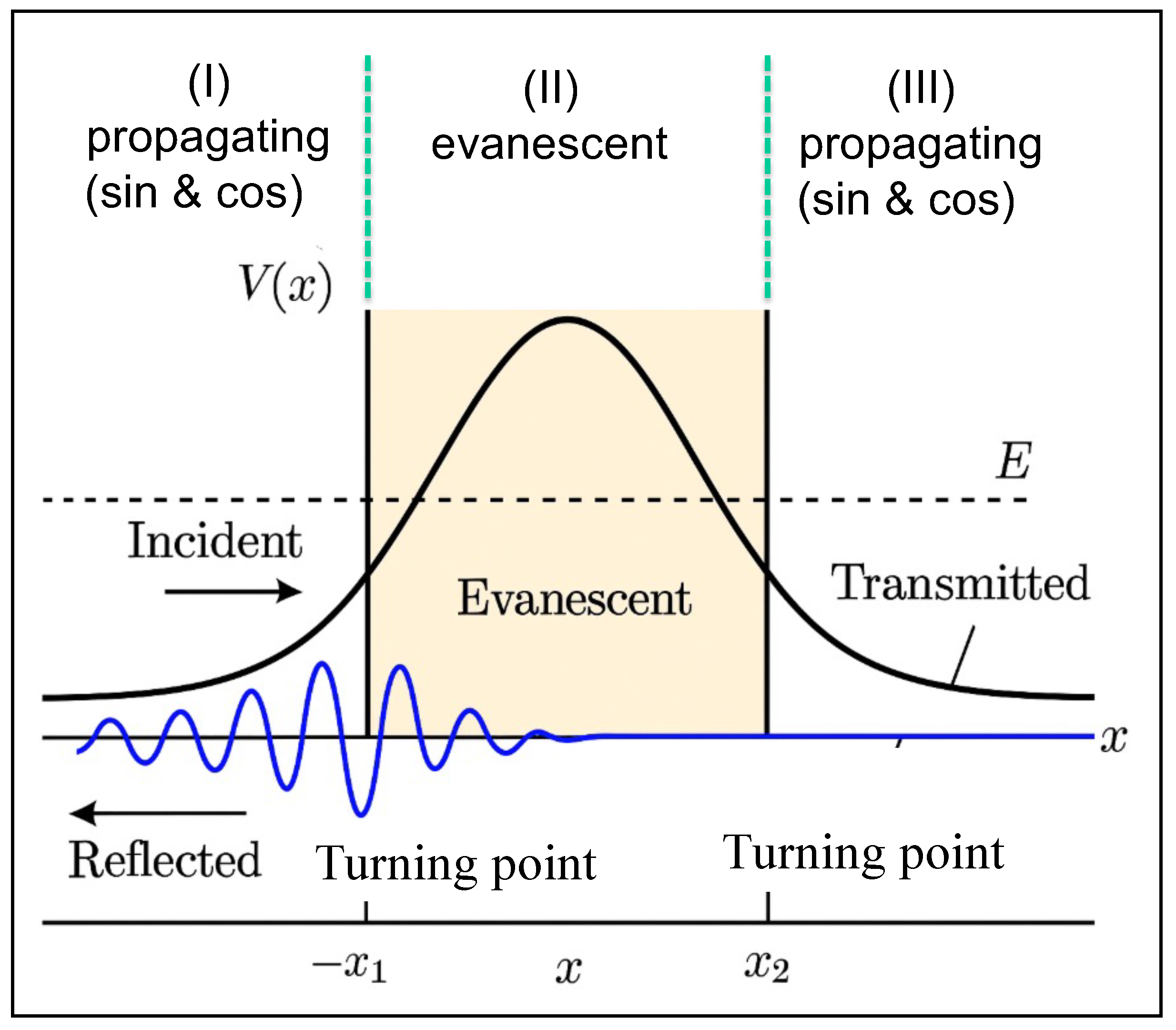
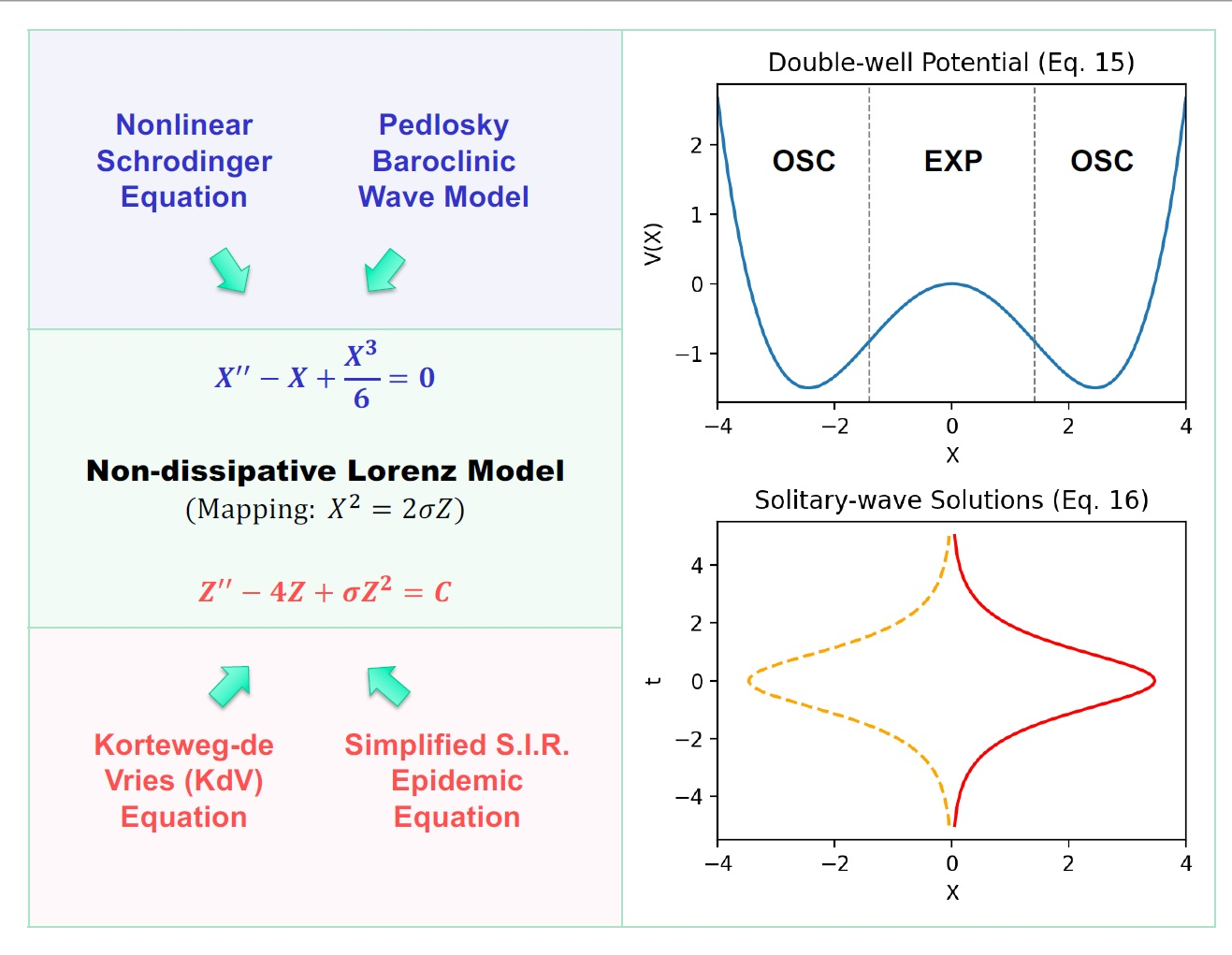
- Figure 5 (nonlinear Lorenz potential): double-well structure with one central maximum and two local minima, supporting localized (homoclinic) oscillations.
- Figure 6 (linear Schrödinger potential): single-barrier structure without local minima, defining three regions separated by two turning points associated with quantum tunneling.
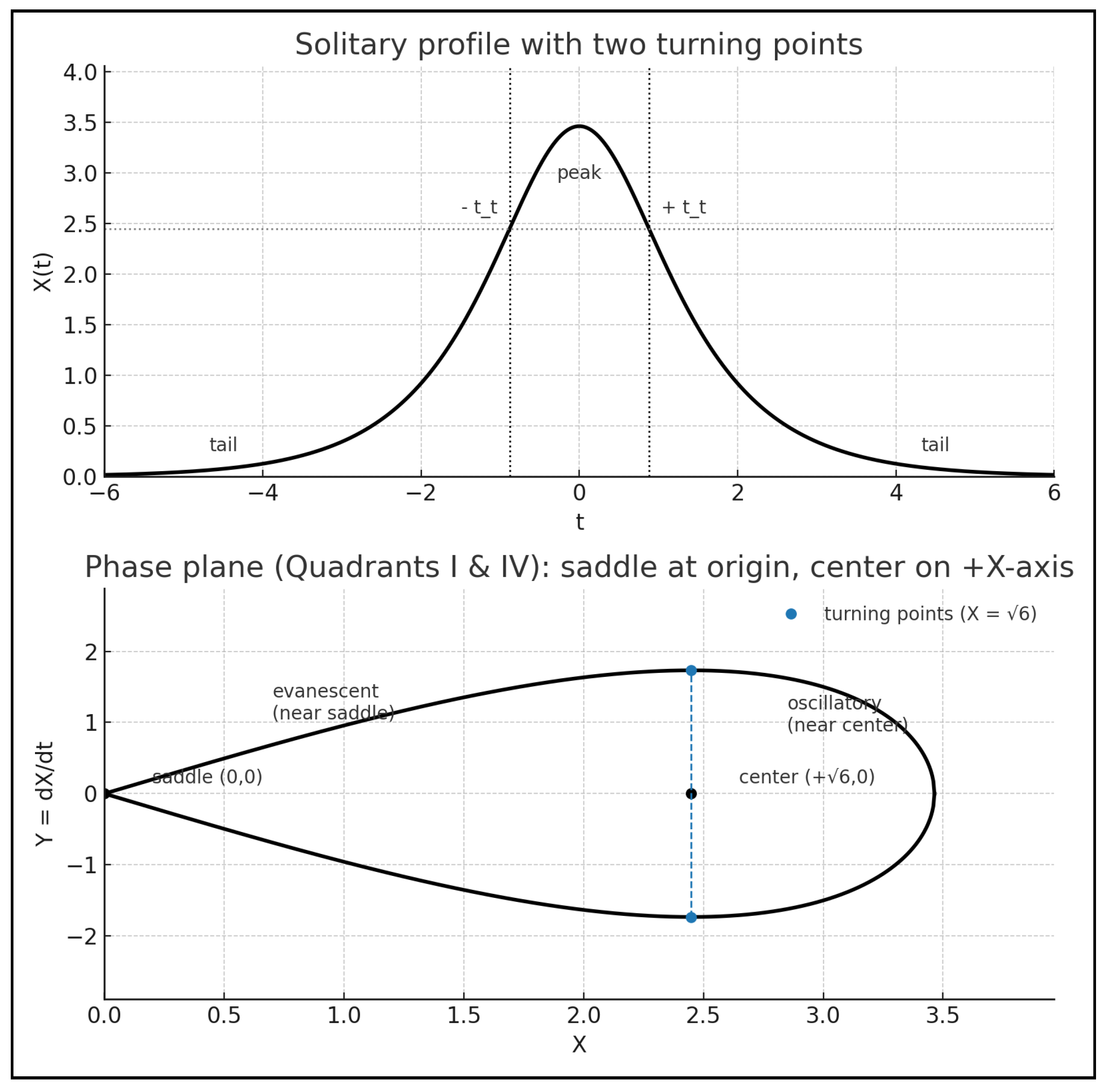
4.3. Solitary-Wave Solution
4.4. Physical Interpretation
5. Summary
Funding
Institutional Review Board Statement
Informed Consent Statement
Data Availability Statement
Acknowledgments
Conflicts of Interest
Appendix A. Connection Between the Nonlinear Schrödinger Equation and the Non-Dissipative Lorenz Equation
Appendix A.1. Approach A: Spectral Representation
Appendix A.2. Approach B: Traveling-Wave (Envelope) Reduction
| Key Insight: |
| Single spectral modes (Approach A) exhibit only phase dynamics (self-phase modulation) (Equation (A6)) To obtain the amplitude dynamics that connect to the non-dissipative Lorenz model, we must consider spatially modulated envelopes (Approach B). This demonstrates why envelope equations (Equation (A7)) are essential for solitary-wave formation. |
Appendix A.3. Physical Interpretation
Appendix B. Linear Schrödinger Equation (with )
Appendix B.1. Approach A: Spectral Representation (General V(x))
Appendix B.2. Approach B: Traveling-Wave (Envelope) Reduction
Appendix B.3. Comparison of the Two Approaches
- For a general static potential , the separation ansatz leads to Equation (A11),which is an ordinary differential equation (ODE) in the spatial variable x.
- For a traveling-envelope reduction with a nontrivial envelope function , the condition must be satisfied, leading to Equation (A16),which represents an ODE in the co-moving coordinate only when V is constant or co-moving with the envelope.
| Potential Type | Best Approach | Resulting Equation |
| Either | ODE in or x | |
| static | Separation of variables | Stationary ODE in x |
| co-moving | Traveling-wave reduction | ODE in |
Appendix B.4. Linear vs. Nonlinear Regimes: The Role of δ and Turning Points
| Region | Condition | Sign of | Behavior |
| I | Oscillatory (propagating) | ||
| II | Turning point | ||
| III | Exponential (evanescent) |
Appendix C. The Non-Dissipative Lorenz Model
Appendix C.1. Governing Equations
Appendix C.2. Full and Non-Dissipative Lorenz Models
Appendix C.3. Energy Relation and the Non-Dissipative Form
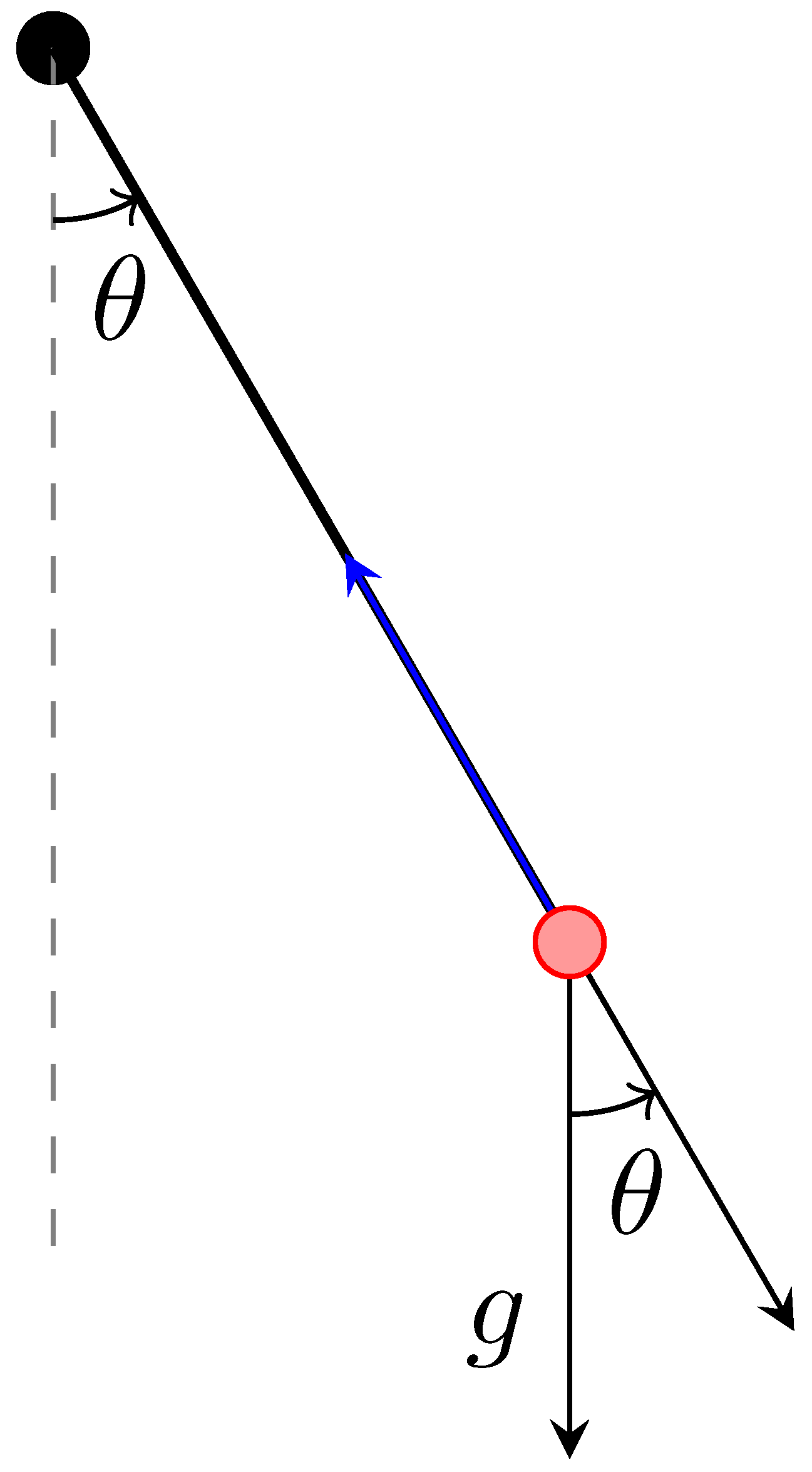
Appendix C.4. Connection to a Nonlinear Pendulum Equation
Appendix D. Effective Turning Points of the Non-Dissipative Lorenz Model
Appendix D.1. Three Complementary Regimes
Appendix D.2. Potential–Curvature Viewpoint and Effective Turning Points
- (I)
- Linear unstable: X″ = X.Here , so . The origin is a local maximum of U (saddle in phase space), giving exponential behavior.
- (II)
- Linear stable: X″ = −X.Here , so . The origin is a local minimum (center), giving small–amplitude oscillations.
- (III)
- The Airy Equation
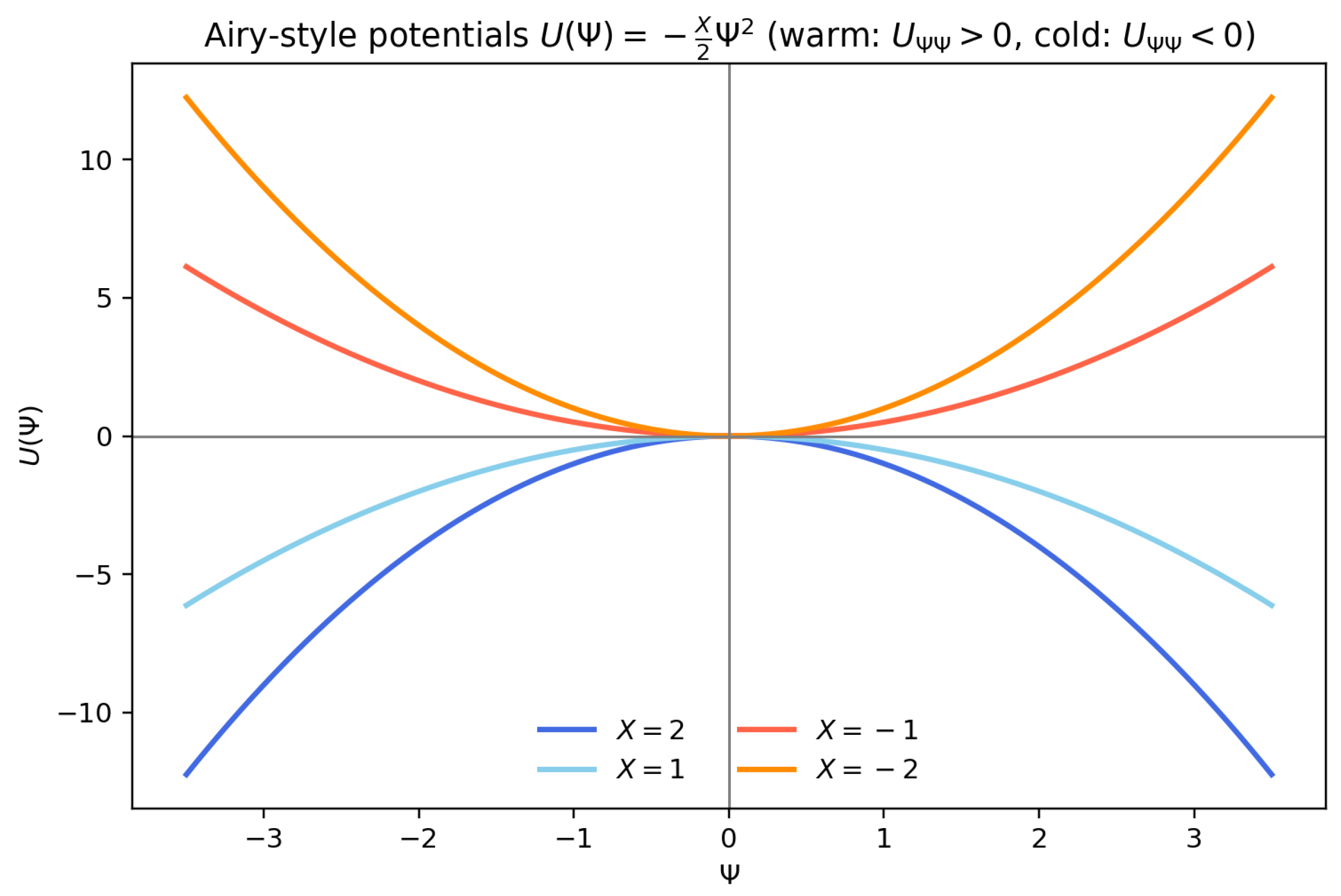
- (IV)
- Non-dissipative Lorenz model
Appendix D.3. Defining a Turning Point via the Curvature of the Potential Function
References
- Caldeira, A.O.; Leggett, A.J. Influence of Dissipation on Quantum Tunneling in Macroscopic Systems. Phys. Rev. Lett. 1981, 46, 211–214. [Google Scholar] [CrossRef] [Scilit]
- Clarke, J.; Cleland, A.N.; Devoret, M.H.; Esteve, D.; Martinis, J.M. Quantum Mechanics of a Macroscopic Variable: The Phase Difference of a Josephson Junction. Science 1988, 239, 992–997. [Google Scholar] [CrossRef] [Scilit] [PubMed]
- Devoret, M.H.; Martinis, J.M.; Clarke, J. Measurement of Macroscopic Quantum Tunneling out of a Zero-Voltage State of a Current-Biased Josephson Junction. Phys. Rev. Lett. 1985, 55, 1908–1911. [Google Scholar] [CrossRef] [Scilit] [PubMed]
- Gunn, J.B. The 1973 Nobel Prize for physics. Proc. IEEE 1974, 62, 823–824. [Google Scholar] [CrossRef] [Scilit]
- Martinis, J.M.; Devoret, M.H.; Clarke, J. Energy-Level Quantization in the Zero-Voltage State of a Current-Biased Josephson Junction. Phys. Rev. Lett. 1985, 55, 1543–1546. [Google Scholar] [CrossRef] [Scilit]
- The Royal Swedish Academy of Sciences. The Nobel Prize in Physics 2025—Popular Information. Available online: https://www.nobelprize.org/prizes/physics/2025/popular-information/ (accessed on 26 November 2025).
- The Royal Swedish Academy of Sciences. The Nobel Prize in Physics 2025—Popular Information. Available online: https://www.nobelprize.org/uploads/2025/10/press-physicsprize2025-figure2.jpg (accessed on 26 November 2025).
- Voss, R.F.; Webb, R.A. Macroscopic Quantum Tunneling in 1-µm Nb Josephson Junctions. Phys. Rev. Lett. 1981, 47, 265–268. [Google Scholar] [CrossRef] [Scilit]
- Bethe, H.A. Energy Production in Stars. Phys. Rev. 1939, 55, 103–147. [Google Scholar] [CrossRef] [Scilit]
- Gamow, G. Zur Quantentheorie des Atomkernes. Z. Für Phys. 1928, 51, 204–212. [Google Scholar] [CrossRef] [Scilit]
- Nobel Foundation. The Nobel Prize in Physics 1973. Available online: https://www.nobelprize.org/prizes/physics/1973/summary (accessed on 26 November 2025).
- Binnig, G.; Rohrer, H. Scanning Tunneling Microscopy—From Birth to Adolescence. 1987. Available online: https://www.nobelprize.org/uploads/2018/06/binnig-lecture.pdf (accessed on 26 November 2025).
- The Nobel Prize in Physics 1986. 1986. Available online: https://www.nobelprize.org/prizes/physics/1986/summary (accessed on 26 November 2025).
- Bender, C.M.; Orszag, S.A. Advanced Mathematical Methods for Scientists and Engineers: Asymptotic Methods and Perturbation Theory; Springer: New York, NY, USA, 1999. [Google Scholar]
- Dunster, T.M. Simplified Airy function asymptotic expansions for reverse generalised Bessel polynomials. arXiv 2025, arXiv:2506.20934. [Google Scholar] [CrossRef] [Scilit]
- Brillouin, L. La mécanique ondulatoire de Schrödinger: Une méthode générale de resolution par approximations successives. Comptes Rendus L’AcadéMie Sci. 1926, 183, 24–26. [Google Scholar]
- Gill, A.E. Atmosphere–Ocean Dynamics, 1st ed.; International Geophysics Series; Academic Press: Cambridge, MA, USA, 1982; Volume 30. [Google Scholar]
- Green, G. On the motion of waves in a variable canal of small depth and width. Trans. Camb. Philos. Soc. 1837, 6, 457–462. [Google Scholar]
- Kramers, H.A. Wellenmechanik und halbzahlige Quantisierung. Z. Für Phys. 1926, 39, 828–840. [Google Scholar] [CrossRef] [Scilit]
- Landau, L.D.; Lifshitz, E.M. Quantum Mechanics: Non-Relativistic Theory, 3rd ed.; Course of Theoretical Physics; Pergamon Press: Oxford, UK, 1977; Volume 3. [Google Scholar]
- Liouville, J. Sur le développement des fonctions et séries. J. Mathématiques Pures Appliquées 1837, 1, 16–35. [Google Scholar]
- Mathews, J.; Walker, R.L. Mathematical Methods of Physics, 2nd ed.; Addison–Wesley: Boston, MA, USA, 1970. [Google Scholar]
- Sakurai, J.J.; Napolitano, J. Modern Quantum Mechanics, 3rd ed.; Cambridge University Press: Cambridge, UK, 2017. [Google Scholar]
- Wentzel, G. Eine Verallgemeinerung der Quantenbedingungen für die Zwecke der Wellenmechanik. Z. Für Phys. 1926, 38, 518–529. [Google Scholar] [CrossRef] [Scilit]
- Haberman, R. Applied Partial Differential Equations with Fourier Series and Boundary Value Problems, 5th ed.; Pearson Education, Inc.: London, UK, 2013; p. 756. [Google Scholar]
- Shen, B.-W. Homoclinic Orbits and Solitary Waves within the Non-dissipative Lorenz Model and KdV Equation. Int. J. Bifurc. Chaos 2020, 30, 2050257. [Google Scholar] [CrossRef] [Scilit]
- Shen, B.-W. Lecture Notes on the WKB Method; Math 537: Ordinary Differential Equations, Fall 2020; San Diego State University: San Diego, CA, USA, 2020. [Google Scholar] [CrossRef]
- Blanchard, P.; Devaney, R.L.; Hall, G.R. Differential Equations (with CD-ROM), 3rd ed.; Brooks/Cole: Boston, MA, USA, 2005. [Google Scholar]
- Lorenz, E.N. Deterministic nonperiodic flow. J. Atmos. Sci. 1963, 20, 130–141. [Google Scholar] [CrossRef] [Scilit]
- Lorenz, E.N. The Essence of Chaos; University of Washington Press: Seattle, WA, USA, 1993; p. 227. [Google Scholar]
- Shen, B.-W. A Review of Lorenz’s Models from 1960 to 2008. Int. J. Bifurc. Chaos 2023, 33, 2330024. [Google Scholar] [CrossRef] [Scilit]
- Shen, B.-W. On periodic solutions in the non-dissipative Lorenz model: The role of the nonlinear feedback loop. Tellus A 2018, 70, 1471912. [Google Scholar] [CrossRef] [Scilit]
- Dalfovo, F.; Giorgini, S.; Pitaevskii, L.P.; Stringari, S. Theory of Bose–Einstein condensation in trapped gases. Rev. Mod. Phys. 1999, 71, 463–512. [Google Scholar] [CrossRef] [Scilit]
- Galati, L. Nonlinear Schrödinger Equations for Bose–Einstein Condensates. arXiv 2019, arXiv:1908.01921. [Google Scholar]
- Pitaevskii, L.; Stringari, S. Bose–Einstein Condensation and Superfluidity; International Series of Monographs on Physics; Oxford University Press: Oxford, UK, 2016. [Google Scholar]
- Pitaevskii, L.; Stringari, S. Bose–Einstein Condensation; Oxford University Press: Oxford, UK, 2003. [Google Scholar]
- Andrade, D.; Stuhlmeier, R. The nonlinear Benjamin–Feir instability: Hamiltonian dynamics, discrete breathers and steady solutions. J. Fluid Mech. 2023, 958, A17. [Google Scholar] [CrossRef] [Scilit]
- Benjamin, T.B.; Feir, J.E. The disintegration of wave trains on deep water. Part 1: Theory. J. Fluid Mech. 1967, 27, 417–430. [Google Scholar] [CrossRef] [Scilit]
- Maleewong, M.; Grimshaw, R. Examination of the effect of wind drift on water wave packets in the forced nonlinear Schrödinger equation. J. Ocean. Eng. Mar. Energy 2025, 11, 953–966. [Google Scholar] [CrossRef] [Scilit]
- Osborne, A.R. Nonlinear water wave equations. In Nonlinear Ocean Waves and the Inverse Scattering Transform; International Geophysics; Elsevier Academic Press: Amsterdam, The Netherlands, 2010; Volume 97, pp. 33–47. [Google Scholar] [CrossRef] [Scilit]
- Zakharov, V.E. Stability of periodic waves of finite amplitude on the surface of a deep fluid. J. Appl. Mech. Tech. Phys. 1968, 9, 190–194. [Google Scholar] [CrossRef] [Scilit]
- Bronski, J.C.; Hur, V.M.; Johnson, M.A. Modulational Instability in Equations of KdV Type. In New Approaches to Nonlinear Waves; Tobisch, E., Ed.; Lecture Notes in Physics; Springer: Cham, Switzerland, 2016; Volume 908. [Google Scholar] [CrossRef] [Scilit]
- Ablowitz, M.J.; Herbst, B.M.; Schober, C.M. Computational chaos in the nonlinear Schrödinger equation without homoclinic crossings. Phys. A Stat. Mech. Its Appl. 1996, 228, 212–235. [Google Scholar] [CrossRef] [Scilit]
- Shlizerman, E.; Rom-Kedar, V. Three types of chaos in the forced nonlinear Schrödinger equation. Phys. Rev. Lett. 2006, 96, 024104. [Google Scholar] [CrossRef] [Scilit]
- Chowdhury, S.; Mandi, L.; Chatterjee, P. Effect of externally applied periodic force on ion acoustic waves in superthermal plasmas. Phys. Plasmas 2018, 25, 042112. [Google Scholar] [CrossRef] [Scilit]
- Flamarion, M.V.; Pelinovsky, E. Interaction of interfacial waves with an external force: The Benjamin–Ono equation framework. Symmetry 2023, 15, 1478. [Google Scholar] [CrossRef] [Scilit]
- Flamarion, M.V.; Pelinovsky, E. Interactions of solitons with an external force field: Exploring the Schamel equation framework. Chaos Solitons Fractals 2023, 174, 113799. [Google Scholar] [CrossRef] [Scilit]
- Grimshaw, R.; Pelinovsky, E. Interaction of a solitary wave with an external force in the extended Korteweg–de Vries equation. Int. J. Bifurc. Chaos 2002, 12, 2409–2419. [Google Scholar] [CrossRef] [Scilit]
- Grimshaw, R.; Pelinovsky, E.; Sakov, P. Interaction of a solitary wave with an external force moving with variable speed. Stud. Appl. Math. 1996, 97, 235–276. [Google Scholar] [CrossRef] [Scilit]
- Grimshaw, R.; Pelinovsky, E.; Tian, X. Interaction of a solitary wave with an external force. Phys. D Nonlinear Phenom. 1994, 77, 405–433. [Google Scholar] [CrossRef] [Scilit]
- Ostrovsky, L.; Pelinovsky, E.; Shrira, V.; Stepanyants, Y. Localized wave structures: Solitons and beyond. Chaos 2024, 34, 062101. [Google Scholar] [CrossRef] [Scilit] [PubMed]
- Paxson, W.; Shen, B.-W. A KdV-SIR Equation and Its Analytical Solutions for Solitary Epidemic Waves. Int. J. Bifurc. Chaos 2022, 32, 2250199. [Google Scholar] [CrossRef] [Scilit]
- Shen, B.-W.; Pielke, R.A., Sr.; Zeng, X. 50th Anniversary of the Metaphorical Butterfly Effect since Lorenz (1972): Special Issue on Multistability, Multiscale Predictability, and Sensitivity in Numerical Models. Atmosphere 2023, 14, 1279. [Google Scholar] [CrossRef] [Scilit]
- Shen, B.-W.; Pielke, R.A., Sr.; Zeng, X. One Saddle Point and Two Types of Sensitivities Within the Lorenz 1963 and 1969 Models. Atmosphere 2022, 13, 753. [Google Scholar] [CrossRef] [Scilit]
- Shen, B.-W. Aggregated Negative Feedback in a Generalized Lorenz Model. Int. J. Bifurc. Chaos 2019, 29, 1950037. [Google Scholar] [CrossRef] [Scilit]
- Saltzman, B. Finite amplitude free convection as an initial value problem. J. Atmos. Sci. 1962, 19, 329–341. [Google Scholar] [CrossRef] [Scilit]
- Pedlosky, J. Finite-amplitude baroclinic waves with small dissipation. J. Atmos. Sci. 1971, 28, 587–597. [Google Scholar] [CrossRef] [Scilit]
- Pedlosky, J. Limit cycles and unstable baroclinic waves. J. Atmos. Sci. 1972, 29, 53–63. [Google Scholar] [CrossRef] [Scilit]
- Pedlosky, J. Geophysical Fluid Dynamics, 2nd ed.; Springer: New York, NY, USA, 1987; p. 710. [Google Scholar]
- Pedlosky, J.; Frenzen, C. Chaotic and periodic behavior of finite-amplitude baroclinic waves. J. Atmos. Sci. 1980, 37, 1177–1196. [Google Scholar] [CrossRef] [Scilit]



Disclaimer/Publisher’s Note: The statements, opinions and data contained in all publications are solely those of the individual author(s) and contributor(s) and not of MDPI and/or the editor(s). MDPI and/or the editor(s) disclaim responsibility for any injury to people or property resulting from any ideas, methods, instructions or products referred to in the content. |
© 2025 by the author. Licensee MDPI, Basel, Switzerland. This article is an open access article distributed under the terms and conditions of the Creative Commons Attribution (CC BY) license (https://creativecommons.org/licenses/by/4.0/).
Share and Cite
Shen, B.-W. From Airy’s Equation to the Non-Dissipative Lorenz Model: Turning Points, Quantum Tunneling, and Solitary Waves. Encyclopedia 2025, 5, 208. https://doi.org/10.3390/encyclopedia5040208
Shen B-W. From Airy’s Equation to the Non-Dissipative Lorenz Model: Turning Points, Quantum Tunneling, and Solitary Waves. Encyclopedia. 2025; 5(4):208. https://doi.org/10.3390/encyclopedia5040208
Chicago/Turabian StyleShen, Bo-Wen. 2025. "From Airy’s Equation to the Non-Dissipative Lorenz Model: Turning Points, Quantum Tunneling, and Solitary Waves" Encyclopedia 5, no. 4: 208. https://doi.org/10.3390/encyclopedia5040208
APA StyleShen, B.-W. (2025). From Airy’s Equation to the Non-Dissipative Lorenz Model: Turning Points, Quantum Tunneling, and Solitary Waves. Encyclopedia, 5(4), 208. https://doi.org/10.3390/encyclopedia5040208