1. Introduction
It is well known that direct current
transport measurements in various types of conducting media are not very effective, as the screening properties of conductors, particularly electrolytes, interfere [
1]. A more consistent approach is the
diagnosis of electrolytes, which identifies the properties of different relaxation times,
, as discussed in work [
1]. In fact, the relaxation problem formulation contains several requirements that are difficult to satisfy. The formalism [
1] requires a linear Ohm’s law in terms of the density
of the nanoparticles. It includes the effects of screening by the conducting medium of external perturbations, but it does not include the possibility of screening of centrally symmetric fields of each ion by the collective reaction of the surrounding charged nanoparticles. Moreover, this formalism ignores the intrinsic conductivity of dilute solutions, which significantly affects the final results.
A popular version of the theory that considers how ions interact with each other is explained by Debye, Huckel and Onsager [
2,
3,
4] (see also the main tutorials on this subject [
5,
6,
7,
8,
9,
10,
11]). In this version of the theory, the mobility of the ions
involved in the formation of charged particle fluxes begins to depend on
(see Formula (12) below for the details). Hence, Ohm’s law represented as
ceases to be a linear function of
and so is not appropriate for the theory [
1]. An alternative to the theory [
2,
3,
4] is proposed for the conductivity of electrolytes, with the force component defined according to Maxwell (see below for details). Within the scope of this review, we can discuss the physical significance of the time constant
, and the potential transition from the
regime, characterised by a
-like shape of the perturbing potential
, to the
time constant, which emerges in the impedance approximation for an electrolytic cell within a planar metal capacitor (see
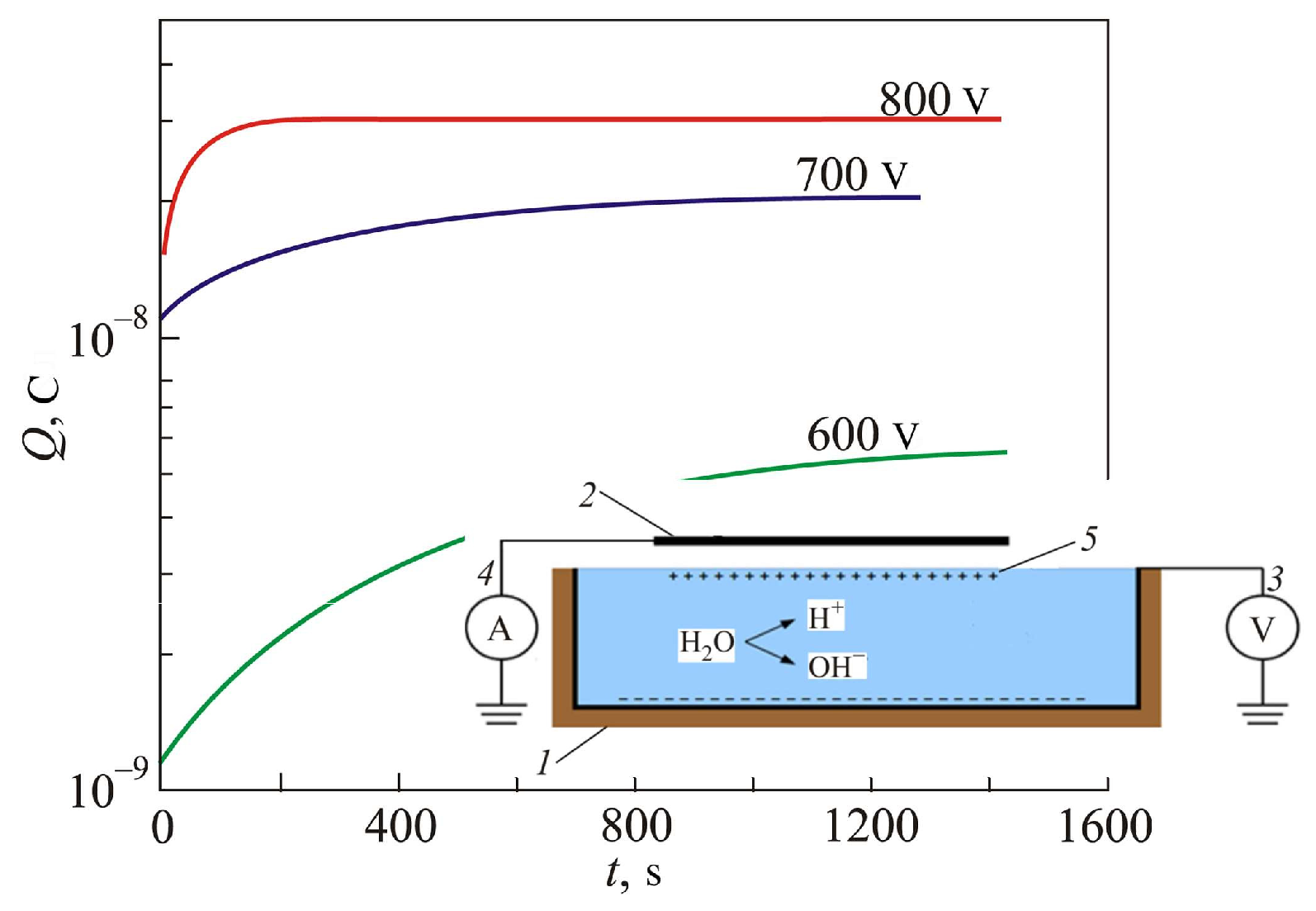
Figure 1). The current state of the art in electrolyte statistics and electrohydrodynamics of charged solutions allows for a comprehensive approach to solving problems arising in
diagnostics. This refers to the numerous instances in which the well-known Maxwell theory’s predictions regarding the effective AC conductivity of various colloidal media were violated (see reviews [
12,
13,
14]) and to the correct interpretation of these anomalies within the RC impedance approximation.
3. Relation of the Relaxation Time to the Time
A phenomenological theory for describing the relaxation properties of electrolytes has emerged since the publications of Gouy and Chapman (1909–1913), as noted in retrospect [
1]. This formalism employs Equation (6) to calculate
.
Let us assume
. In this case,
Here,
R is the resistance of the bulk of the cell with an electrolyte,
is the static electrolytic capacitance at the metal–electrolyte interfaces, and
S is the area of the contacting electrodes in plane-parallel geometry.
is the effective screening length at the metal–electrolyte interface (in general,
),
The properties of the function
in
Figure 1 are majorised by the dependence
being the solution (7) of Equation (6) under the conditions
. In this case, the time scales
(5) and
(7) are similar.
This statement emphasised by the authors of Ref. [
1] allows us to introduce the characteristic time
and take advantage of new opportunities to gain a better understanding of what is happening.
It should be noted that the time constant
arises from the analysis of the properties of Equation (1) in the context of Ohm’s law in the electrochemical representation. In this formalism, the force and diffusion components of the current are dependent on each other. The linearity of general Ohm’s law (1) with respect to the density
, as used in [
1], is contradicted by the results of the theory [
2,
3,
4], in which the mobility of electrolyte charges depends on the density
. In turn, the impedance time
from (7) avoids difficulties when analysing the properties of Equation (1). This time contains the product of the force part R of the electrolyte conductivity and its diffusion component C, expressed as the electrolytic capacitance of the cell. There is a possibility to replace the conductivity’s force component from [
2,
3,
4] in the definitions of the constants of Equation (6) with the force form of Ohm’s law presented by Equation (13) from Maxwell’s theory. This theory is generally used to describe the conducting properties of two-phase systems. By definition, the conductivity (13) of Maxwell’s theory is linear with respect to the nanoparticles density.
This combination is unique because the conductivity of the electrolyte, given by the relationship , can be measured in mode. The result (8) is only valid for solution (7) with the initial perturbation . Here, is the step function. The difference between (1) and (6) lies in the model assumption that the capacity (6) exists over the entire time interval, including the initial moment of the perturbation . In this case, the behaviour of is determined by Equation (1). Solving this problem in the region answers the question of whether a single characteristic time, accessible to observations, exists. The answer for is positive, which means that the relaxation processes can be used to solve the problem of ohmic processes in electrolytes.
-methods using periodic pumping are popular. For a field of type
, we obtain
The maximum of the imaginary part of
occurs at the frequency point
. As in (7), the definition of the parameter
in the periodic pumping problem (9) provides information about the combination
.
Another possible scenario is to use the phase relations between
and
. If
, then the corresponding current
is
The lock-in tester consistently measures the real and imaginary parts of the impedance. As a result, the following definition applies to the phase shift,
, between the current
and the control voltage
.
The combination can be extracted from the available data by measuring and representing— as a function of (11). As in Equations (7) and (9), the treatment of Equation (11) provides information about the parameter.
The lack of justification at the microscopic level [
1] for the phenomenology (6), (7) under
pumping conditions negates the attractiveness of techniques (9)–(11) (examples of their use are discussed below) compared to the more cumbersome method (7). So far, however, problem (1) with periodic pumping has not been solved.
4. Conductivity of Dilute Electrolytes According to Maxwell’s Theory
An important remark in the introduction and comments on Formula (1) concerns the real conductivity properties of the electrolyte. In the context of (1), electrohydrodynamics from [
1] confirm the existence of Equation (6), provided that the conductivity
of electrolyte ions is a linear function of their density
(otherwise, the second formula from (1) derived from Einstein’s rules does not work). The theory of Debye, Huckel, and Onsager [
2,
3,
4] is more complex. In fact, the conductance
, where
is the mobility of the free ions, containing two corrections depending on the density
, both relaxation and electrophoretic. The second of them,
, has a simpler structure and is the same for all types of ions. It is equal to (see Formula (26.29) from [
11])
where
is the dynamic viscosity of the fluid, and
is the Debye length. This length decreases with increasing
. This determines the electrolyte’s overall drop in conductivity with increasing nanoparticle concentration. Returning to Equation (6), we see that the density of the nanoparticles should affect the ion mobility, resulting in a dependence on
. The nonlinearity of Equation (6) should significantly affect the structure of its solution. It may turn out to be a power law instead of an exponential function (see, for example, the comments in [
17] regarding the properties of nonlinear relaxation equations). This change can be observed. For this reason, studying the asymptotics properties of
and determining the properties of
enables us to evaluate the linearity of Equation (6).
The possibility of a linear dependence of electrolyte conductivity on volume fraction among the properties of Equation (1) suggests an alternative to the Debye–Huckel–Onsager charge transfer mechanism [
2,
3,
4]. Maxwell’s mechanism [
18] seems appropriate. The conductivity
of finely dispersed two-phase mixtures is determined by Maxwell’s equations [
18]:
where
is the effective conductivity of nanoparticles,
is the conductivity of base liquid (water, alcohols), and
is the volume fraction of nanoparticles. When deriving Equation (13), which is valid in the linear region
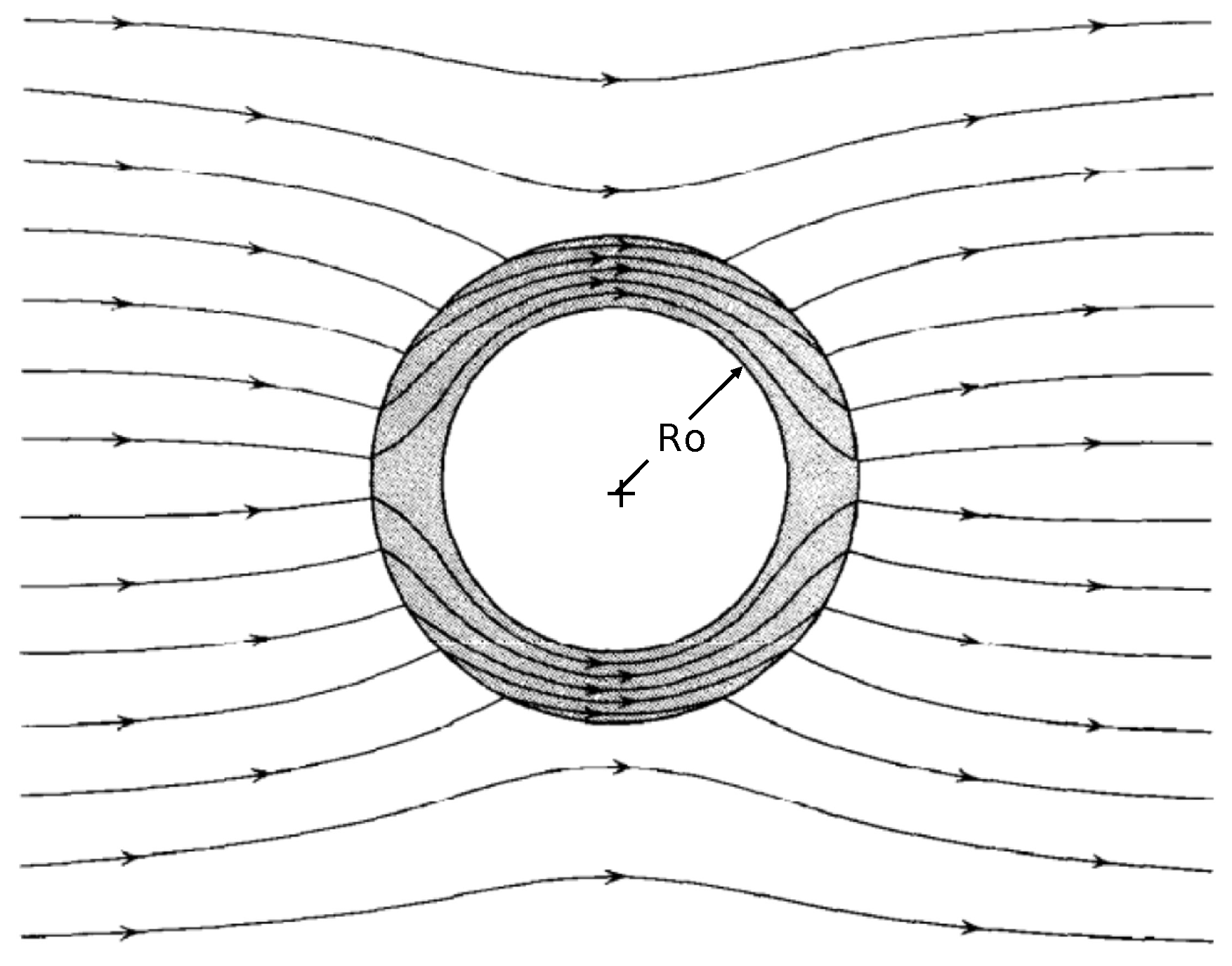
, it is assumed that the nanoparticles do not move when the external field is introduced. Their presence distorts the electrolyte current lines (see
Figure 2). This affects the effective conductivity
(13).
Figure 2 is related to nanoparticles of different nature.
In the case of spherical phase inclusions, the gray zone in
Figure 2 occupies the entire volume of each nanoparticle. Small, point-like charged particles with a Bohr radius of
are surrounded by a screening region with an increased density of counterions. According to Maxwell’s theory, this is equivalent to the including a phase with increased conductivity. In multi-charged systems (e.g.,
—colloids; the abbreviation is formed from the initials of the authors of the original papers [
19,
20]), the radius
of the central charged nucleus is significantly larger than the Bohr radius
(
). This nucleus is surrounded by a globular screening layer of thickness
with the following possible variants:
, or
. The density of the counterions increases inside such a layer (exceeding the bulk density). Consequently,
.
In the case of suspensions, the nanocluster nucleus (either dielectric or metal, with a radius of ) has no ionic conductivity. However, there are image forces of electrostatic origin at the boundaries of these nanoparticles. Consequently, the dielectric nanoparticles are surrounded by a layer deficient in intrinsic solvent ions, resulting in a value of . The metallic nanoparticles, which attract solvent ions, have an effective conductivity of .
The additive
to the base fluid conductivity is linear in
in the region of small
. This property distinguishes Maxwell’s transport theory from the Debye–Hückel approach. The behavior of
can be derived from the general Formula (13). Thus, if
,
Otherwise,
It is not immediately apparent how Maxwell’s formalism relates to charge transport in electrolytes. In the case of electrolytes, charges move under the influence of a homogeneous external field created within the conducting medium (1). The Maxwell transport Equation (13) describes how neutral inclusions with finite volume fraction affect the conductivity of an electrolyte (the mechanism of this influence is shown schematically in
Figure 2). If the screening properties of the intrinsic electrolyte are taken into account, the problems (1) and (13) overlap. In this case, any charges generated in the solution by the dissociation of the dopant must be screened by the ions of its intrinsic electrolyte. As a result, each charge is transformed into a neutral formation, as shown schematically in
Figure 2.
There are a number of ways in which the processes of neutralization of ions resulting from the dissociation of nanoparticles can be manifested. Recall the results of Wagner, Onsager, Samaras [
21,
22] (WOS) regarding the behavior of charges near the interface of two media with different dielectric constants, the structure of DLVO colloids in dilute electrolytes, and the metal–electrolyte interface [
23,
24]. Recall also the direct Maxwell theory calculations of conductivity for dilute colloidal solutions performed in these works.
In cases [
21,
22], we are referring to the statement
which the authors of these papers discovered. Here,
is the classical image force for a test point charge
q [
25], and
is the effective screening length. The values of the dielectric constants
are the dielectric constants values of the contacting media. The charge
q, which manifests classically in zone
, is self-screened and does not interact with the boundary in zone z >
. The force
appears when studying the properties of surface tension at the vacuum–electrolyte interface, where the value of surface tension is significantly renormalized [
25,
26].
In order to apply the solution of DLVO electrostatic problem [
23,
24], we reformulate the result (16). If these integrally neutral formations approach the interface from the electrolyte bulk, they must acquire a finite charge by partially losing ions to reach the state
, where
and
. A typical DLVO colloid of radius
has a charged nucleus with a charge
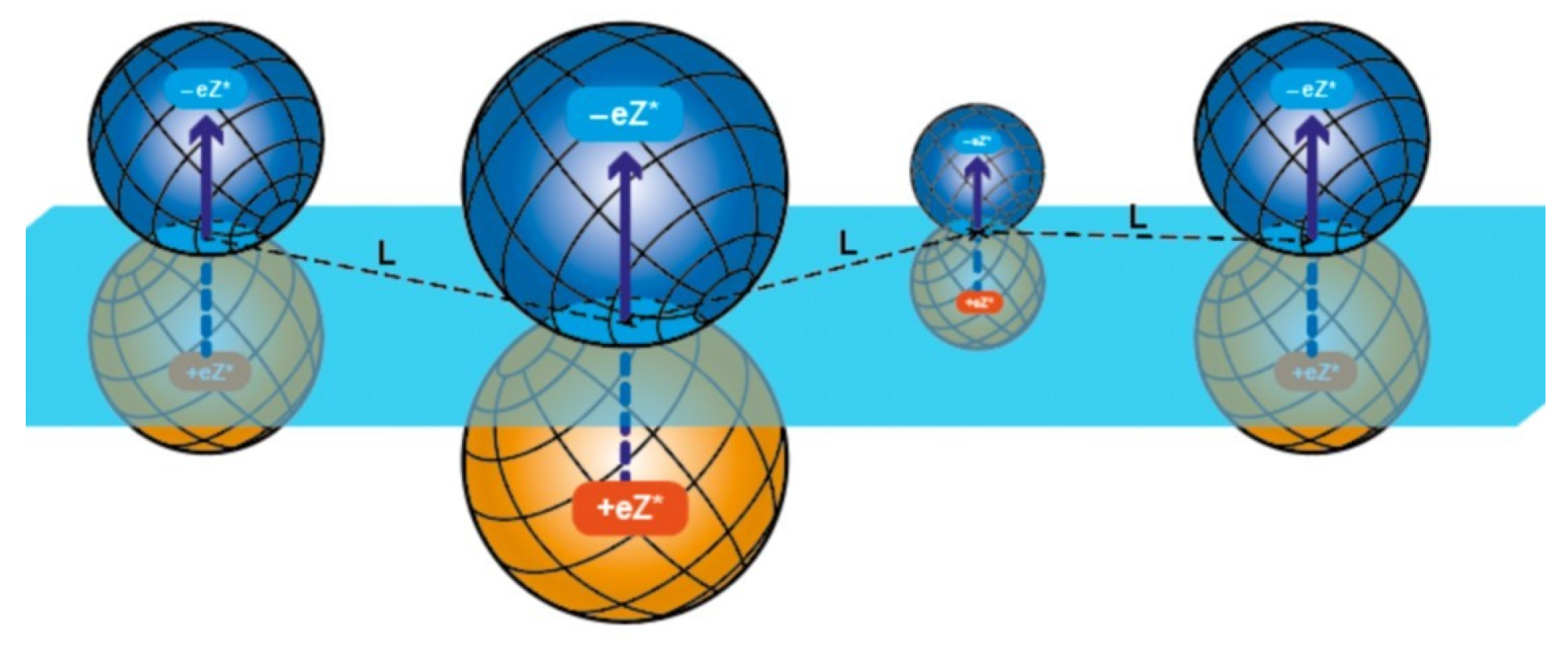
, which is completely screened by counterions of the electrolyte. The
colloids at the metal–electrolyte interface are shown in
Figure 3.
As of Maxwell’s formalism, it is only natural to present some successful examples of its use.
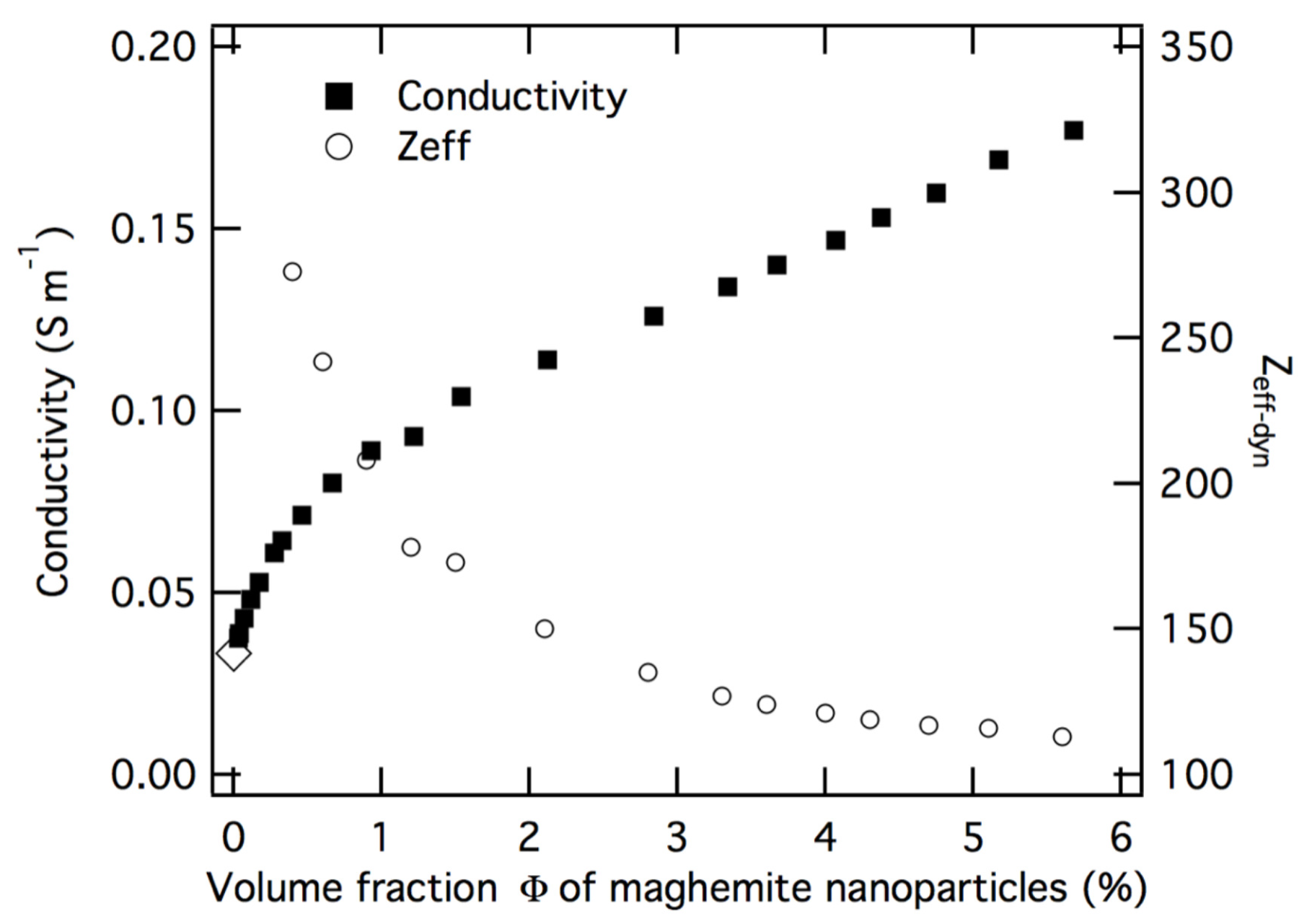
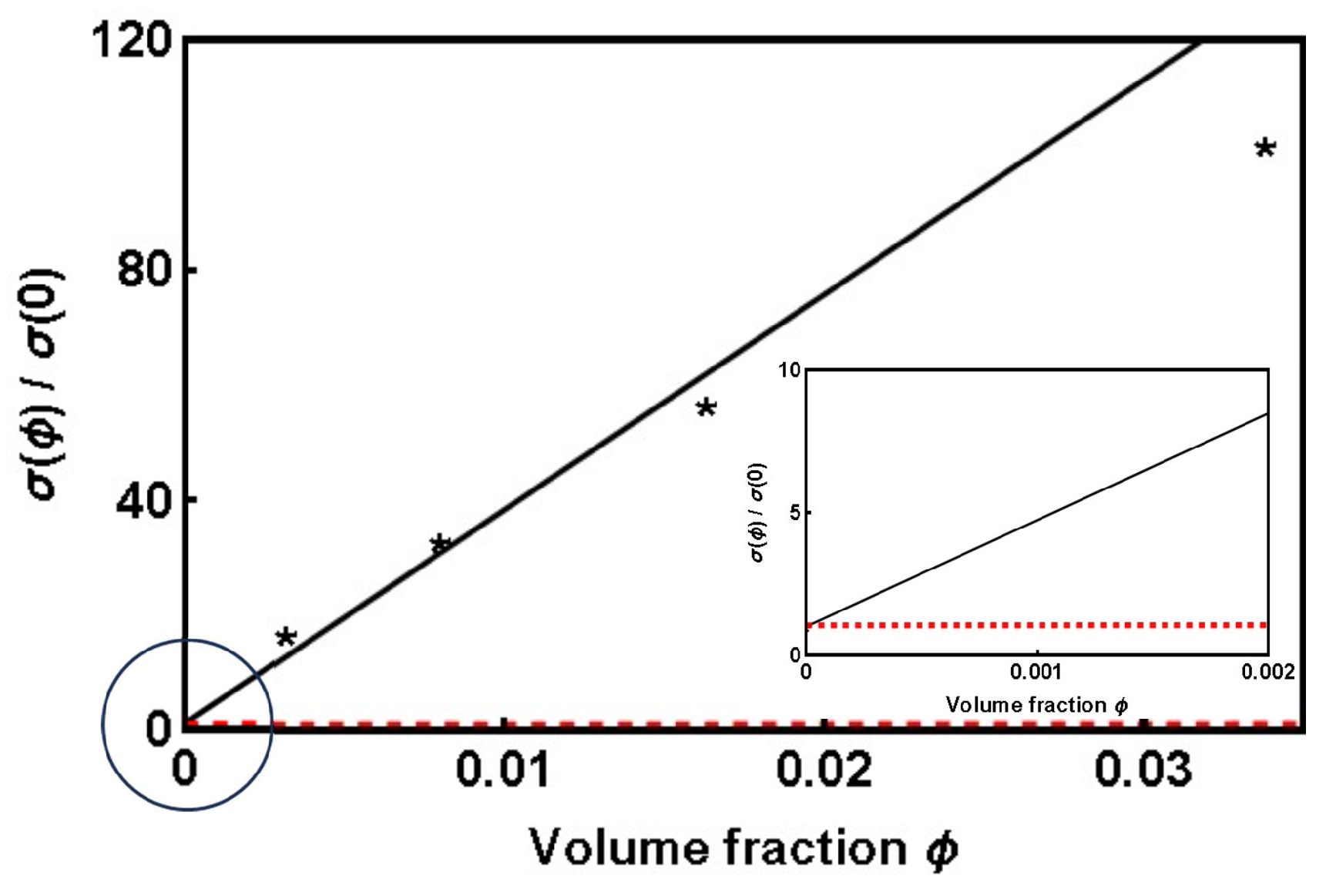
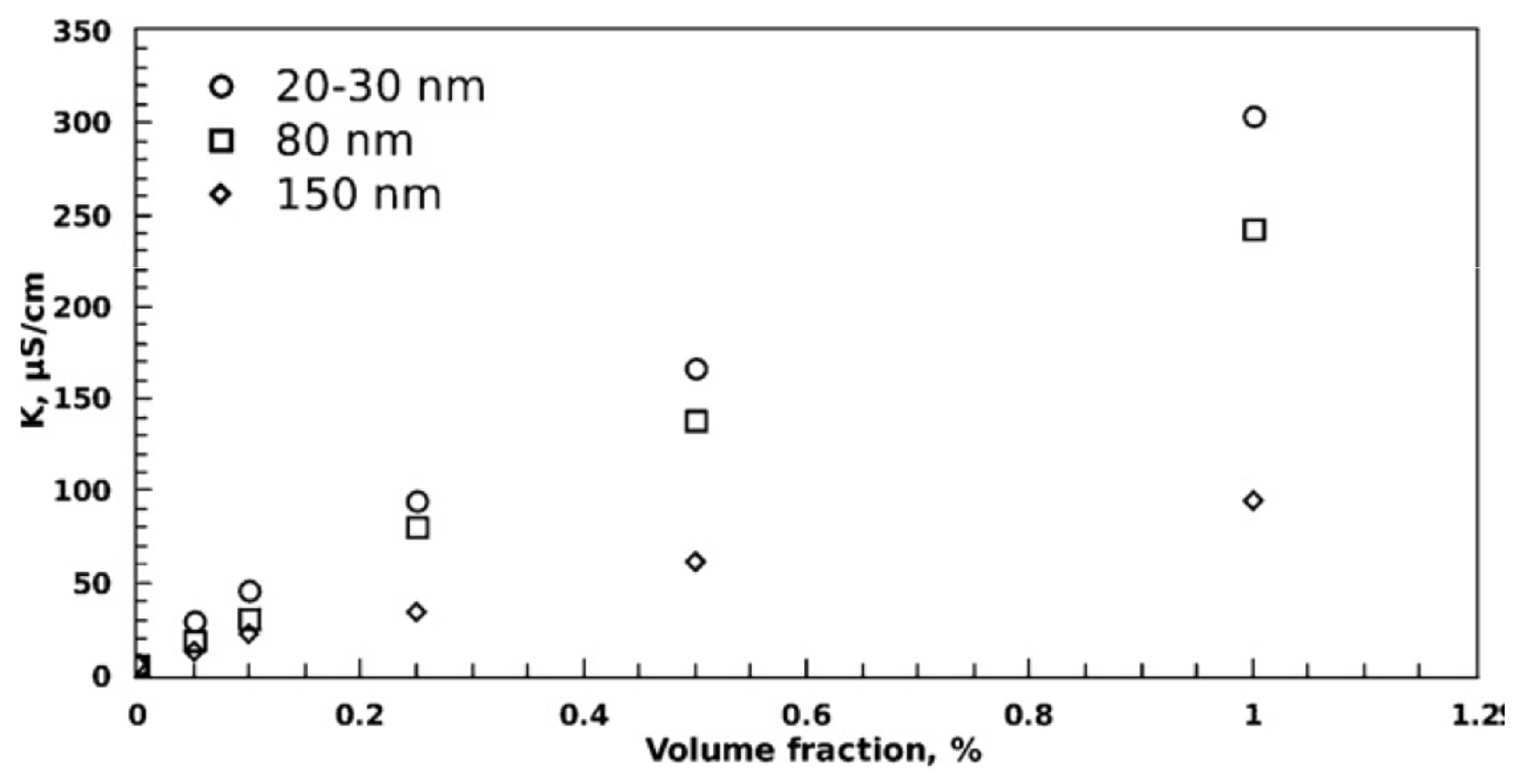
Figure 4 contains data from [
12] and shows the existence of the transient region
, which is defined as
. In the region
to the left of this area, adjacent screening spheres do not touch each other. In this region, according to (14),
should be linear in
. To the right of this transition region
, the overlap of the screened regions of DLVO colloids increases, and the laws of the proposed MSA (mean spherical approximation) formalism [
27,
28,
29,
30] are self-consistent. This theory is consistent with the results of the Debye–Hückel–Onsager theory [
2,
3,
4]. The observed data (black squares) in
Figure 4 is explained quantitatively by the appearance of a dynamic charge,
(white circles, right-hand ordinate), on each of the moving particles. The values of
increase as the volume fraction
decreases. To the right of this transition region, the overlap of the DLVO colloids screening regions increases, according to the authors [
27,
28,
29,
30]. As mentioned above, the effective conductivity of such a medium cannot be a linear function of the volume fraction of nanoparticles.
In the region where
, which is represented by the
ratio data in
Figure 5 of a colloidal medium from [
31] (similar to that in [
13]),
is linear in
. This behaviour is commonly observed in the linear transport of colloidal media, which contrasts sharply with the well-known percolation theory of conductivity in dilute solutions (i.e., weakly doped media) under conditions of
[
32].
5. Impedance Diagnostics of Dilute Electrolytes
The success of the Maxwell conductivity theory of colloidal solutions (
Figure 4 and
Figure 5) has coincided with a growing interest in Maxwell conductivity anomalies in dilute colloidal solutions (see reviews [
12,
13,
14]).
Experiments on the transport of nanoparticles in dilute nanosuspensions are of great interest for a variety of applications. One area of research is the study of Maxwell conductivity anomalies in these types of medium. Studies conducted by various authors using different nanosuspensions have shown that traditional methods for measuring the electrical conductivity of diluted media can yield unexpected results (see reviews [
13,
14]). According to Maxwell’s theory (estimations (13)–(15)), the conductivity values
increase linearly with an increase in the parameter
. However, this increase (or decrease) is anomalously large compared to the theoretical estimations (14) and (15).
For example,
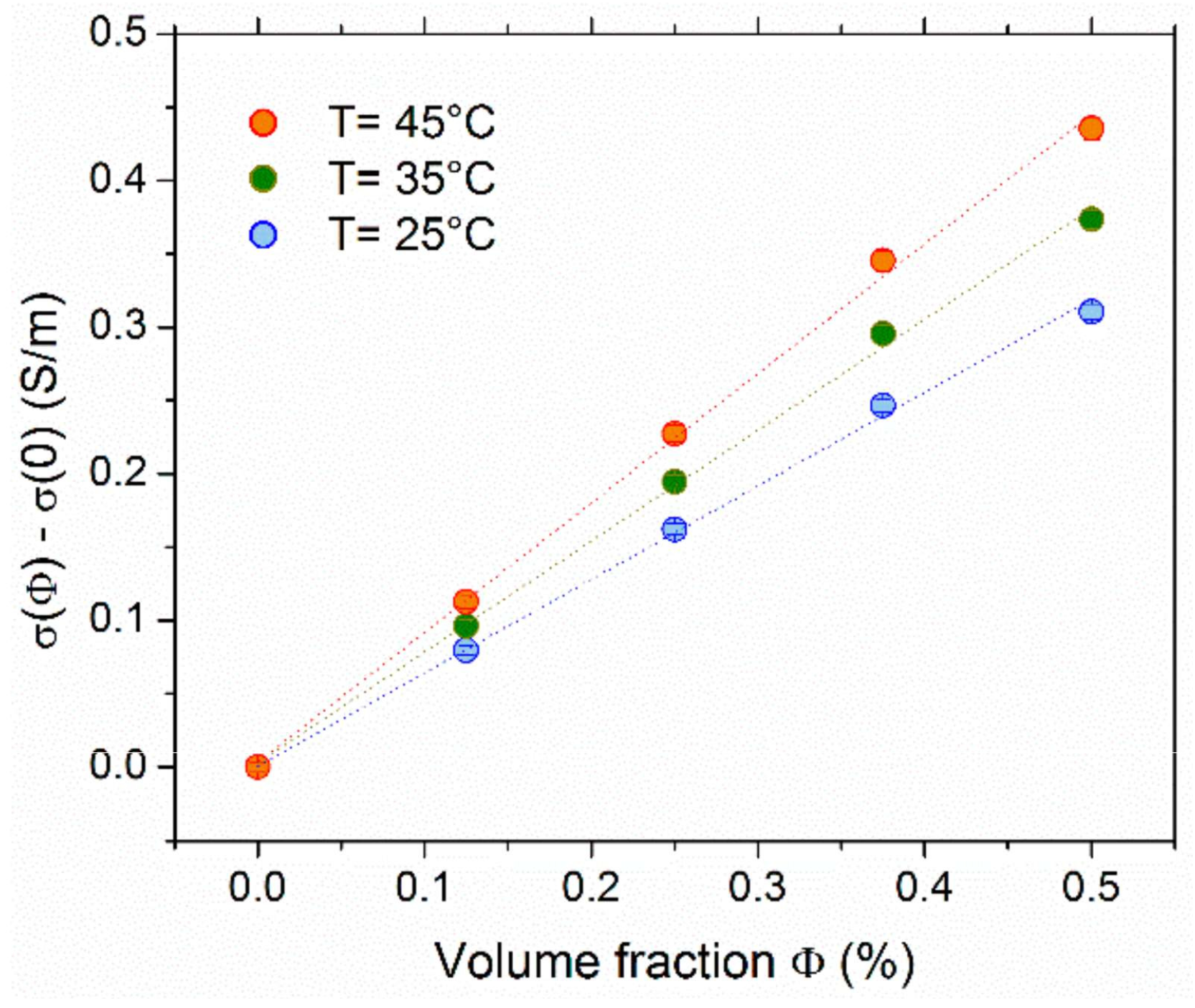
Figure 4 shows the conductivity data of the
water-based colloidal solution from [
12]. The experiment, conducted in the region left of
, demonstrates that
with a slope
is ten times greater than what Maxwell’s theory can account for. For comparison, the corresponding MSA method data are also shown in the same figure. These theories, developing the ideas of Debye, Huckel and Onsager [
2,
3,
4], provide a much better explanation of the data in
Figure 4 than the Maxwell approximation. However, as will be seen below, the Maxwell anomaly for the data to the left of the region where
) is explained by the
interpretation.
The anomaly is more pronounced for the diamond powder in alcohol (the average size
of the diamond nanoparticles is about
nm). According to
Figure 6 of the author’s data [
33], doping the alcohol with dielectric nanoparticles increases the conductivity of the suspension by approximately three orders of magnitude rather than decreasing it, as predicted by Equations (11) and (13) (see
Figure 6, where
!)
Clearly, it is not only the conductivity properties (14) in the limit of
that are affected. Additional factors must be contributing to the formation of the anomaly. Constructive suggestions are contained in [
34,
35]. They noted that in linear
diagnostics (4)–(9), it is not the conductivity of the medium that is measured but rather the time
. Not only the resistance
but also the electrolytic capacitance
of the metal–alcohol interfaces that are inevitably present in the measurement can both be sensitive to
. The very definition of time,
, in the form
was already taken into account by the pioneers of methods for accurate conductivity measurements of
(see details in the classic book on this topic, [
5]). The nature of the dependence
and its influence on the properties of
have not yet been discussed. The dependence
is most evident in experiments with dielectric nanoparticles. Base liquids (e.g., water or alcohol) favor the formation of a large electrolytic capacitance,
, at the metal–electrolyte interface, where
is the characteristic screening length for a given solvent (water, for example). For more details on the formation of
in this case, see [
34,
35]. The appearance of nanoparticles with a density of
in the bulk of the suspension is accompanied by their adsorption at the metal–electrolyte interface.
For neutral nanoparticles, the development of such a reversible process (single-layer adsorption according to Langmuir theory or its multilayer generalization BET theory [
36]) leads to the appearance of a dielectric layer at the metal boundary with a thickness
, which increases monotonically with the increase
in the suspension.
Identifying the origin of the dielectric layer
between the metal and the electrolyte enables us to trace its impact on the effective electrolytic capacitance
of the metal–electrolyte interface. By definition,
where
is the distribution of fields in the volume of the parallel-plate capacitor, and
is the external voltage on the control electrode. Assuming
we have from (17)
Here,
is the effective penetration length of the field into the electrolyte volume,
is the interval of the electrolyte volume occupied by the
dielectric layer,
is the volume occupied by the electrolyte with a dielectric constant
, and the distributions
and
arise from the solution of the system of equations in the sandwich approximation.
In the limit
, the quantity
is reduced to
and has an electrolytic origin. Otherwise, if
, the quantity
is determined by planar electrostatics.
In the transition region
, the general structure of
is formed from the asymptotic expressions (21) and (22) according to the rules for calculating the total capacitance
C of two capacitors
and
connected in series:
. The general calculations (17)–(22) confirm this rule and provide the definition of
,
as used in [
34,
35], but only asymptotically (in the sense of (21) and (22)). Nevertheless, this is sufficient to draw qualitative conclusions about the properties of
(17) and (18). Therefore, we can use the estimation (23) for
following from Equations (17) and (18)
According to (23), the capacitance
decreases monotonically with increasing film thickness
in the region
. The presence of a drop is suitable for observation if the initial capacitance
is large enough and the quality of the metal–electrolyte interface is good. Additionally, the sizes
of the nanoparticles must be relatively small,
The current state of the art in nanosuspension preparation [
13,
14] makes creating the necessary conditions quite possible.
Among the numerous publications and reviews on the subject [
13,
14], work [
33] provides data that confirms the hypothesis [
34,
35] that the electrolytic capacity of the metal–water interface depends on the variable volume density
. The primary source of information (data
Figure 7) for the final results presented in
Figure 6 is preserved [
33]. The authors of the papers discussed in reviews [
13,
14] seem to consider the information in
Figure 7 [
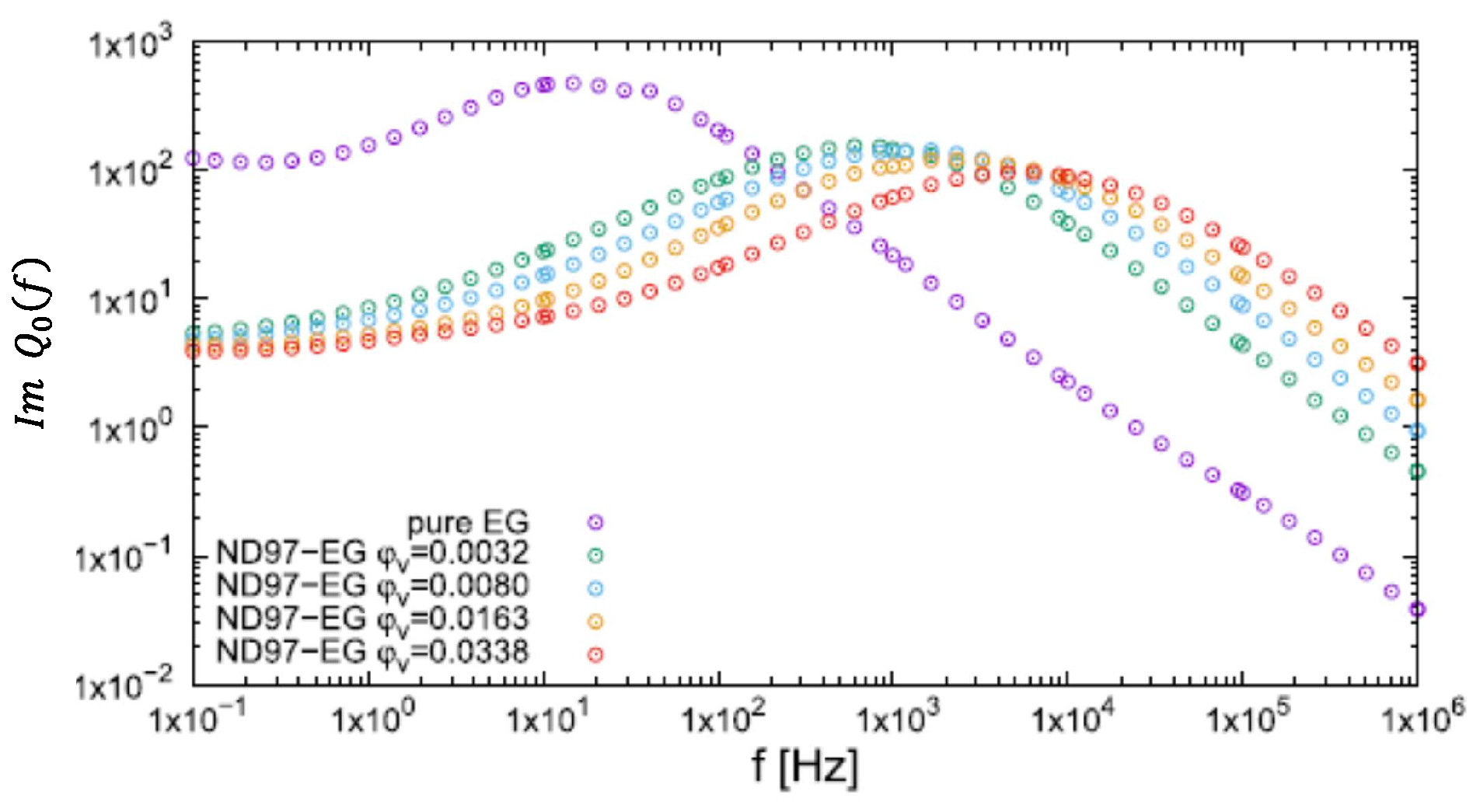
33] as auxiliary or intermediate material. These are the relaxation resonances in linear
diagnostics, based on Equation (6), in the presence of periodic pumping. Such resonances were studied in detail by the authors of Ref. [
33] and are shown in
Figure 7. Among the available scenarios for determining the relaxation time
, i.e., (7), (9) and (11), method (9) seems to be the clearest. However, its justification from first principles (1) is still missing. The
values resulting from the data in
Figure 7 for
and
[
33] samples are summarised in
Table 1. To demonstrate how sensitive the technique is to the composition of the nanoparticles used (diamond powder),
Figure 7 shows two sets of relaxation resonance data for suspensions with slightly different nanoparticles, as presented in
Table 1.
For both nanosuspensions, the data in
Table 1 shows a sharp decrease in the
time as the parameter
increases. Following convention (reviews [
12,
13,
14]), the impedance capacity does not change significantly when
is varied, i.e.,
. In this case, as in most of the works collected in the reviews [
12,
14], we have the result in the form of
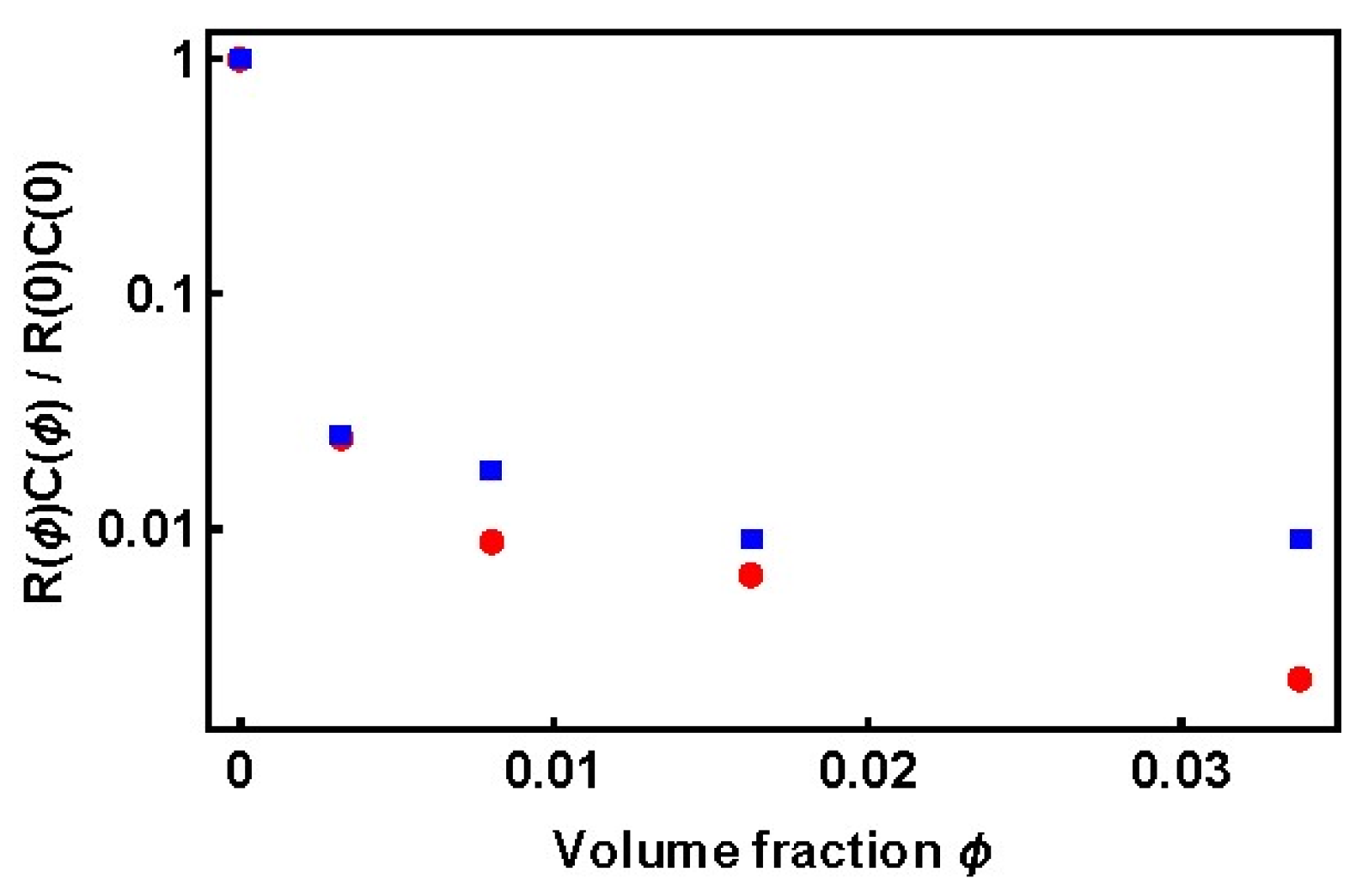
Figure 6, which reveals a giant conductivity anomaly compared to the results of Maxwell’s theory. The possible alternative is obvious. We assume that there are no anomalies in the conductivity of the electrolyte. In this case, the main reason for explaining the behaviour of
from the
Table 1 is that
. The graph of this dependence considering the asymptotic
in the form (15) is shown in
Figure 8.
It becomes evident that the significant dependence of the parameter
on the diamond powder density, as shown in
Table 1, arises mainly not from anomalies in the Maxwell conductivity behavior (as interpreted in most publications from [
12,
13,
14]) but from the strong dependence of
shown in the graphs of
Figure 8.
The reason for the strong dependence of capacitance on the concentration of nanoparticles in suspension (including diamond nanoparticles [
33]) remains to be explained. The answer to this question appears to be one of the main achievements of [
34,
35] and can in general be explained by Formula (23). The proposed addition concerns observable phenomena that help explain what happens to the conductivity of a dielectric suspension when the size
of individual nanoparticles changes. This refers to the data presented in
Figure 9 [
37], which preceded the publication of [
33]. This encourages further research in the region of smaller nanoparticle sizes,
. In experiments by Zila et al. [
33], this threshold shifts to
nm (
Figure 6 and
Figure 7). The single-layer Langmuir adsorption theory and its multilayer generalization (
theory [
36]) show that the thickness of an equilibrium-formed adsorbent layer depends on the size
, (
). The results in
Figure 9 show the opposite: the smaller the
, the thicker the
. This question deserves attention and can be resolved by applying existing concepts from the theory of surface phenomena at the metal–electrolyte interface (see the discussion in [
23,
24] regarding the data in
Figure 3).
If a nanoparticle in solution interacts with the interface according to a
law, then the Boltzmann distribution of such particles
in the vicinity of the interface has the following form:
The density
corresponds to its value in the volume of the solution, where
. In this expression, the plus sign indicates attraction of particles to the boundary, and the minus sign indicates repulsion.
The model we would like to use originates from the work of Wagner, Onsager and Samaras (WOS) [
21,
22]. In this model, the surface density
of nanoparticles is introduced by the following formula:
This integral must be calculated accurately, since the resulting characteristic potentials
are singular at the interface:
. Approximation (25) has been successfully used by the authors [
21,
22] to describe the effect of electrolyte properties on the surface tension of the electrolyte–vacuum interface. In this case, the V(z) interaction between the charges and the boundary is repulsive. Expression (25) converges at the boundaries of the integration interval. We use this method to describe the metal–electrolyte interface, as discussed in References [
23,
24]. In this scenario, the charge interaction V(z) is attractive, and expression (17) diverges at the lower limit. There is only one way to overcome the non-integrable singularity in the definition of
(25). It is necessary to assume that nanoparticles have finite minimum dimensions
. In this case, we have from (25)
Equation (27) (with the Boltzmann basis) resolves the question of the role of the parameter
in the formation of a layer with a thickness of
, confirming the consistency of the observations presented in
Figure 9 from [
37].
6. Summary
A unified system of equations has been proposed that enables the consistent analysis of relaxation phenomena in dilute colloidal solutions and nanosuspensions. It has been shown that, given the presence of Ohm’s law definitions in the system, a modification of Maxwell’s theory in finely dispersed two-phase media can be applied to the problem. It is shown that within the framework of the linear (Maxwell) relaxation theory, the characteristic time can be extracted from the experimental data in the combination . Here, is the ohmic resistance of the dilute electrolyte volume, and is the electrolytic capacitance of the metal–electrolyte interface, depending on the pumping mode (either the -shaped or periodic excitation) and the dimensionless density of the nanoparticle density in the dilute electrolyte. By monotonically increasing the density of nanoparticles, we stimulate not only a change in but also a change in the value of capacitance . Based on the theory outlined above along with modern knowledge of screening processes at the metal–electrolyte interface, it is possible to understand the reasons of the observed conductivity anomalies in colloidal media compared to Maxwell’s theory, especially in diluted nanosuspensions with dielectric nanoparticles. As it turns out, increasing the concentration of nanoparticles in solution monotonically not only changes (the expected effect) but also changes the capacitance (more significantly than ). As a consequence, the procedure for extracting information about from the data for requires independent data about the properties of . This problem is relatively easy to solve for suspensions containing dielectric nanoparticles.
This scenario is considered using the example of the suspension “alcohol + nanodiamond powder”. A consistent system of equations is proposed, which makes it possible to interpret relaxation phenomena in dilute colloidal solutions and nano-suspensions. It is shown that in the role of Ohm’s law, which is necessarily present in the system of definitions, its modification from Maxwell’s theory for transport in finely dispersed two-phase media can be used.
A retrospective [
1] of activity on diffusion kinetics in electrolytes contains references dating back to the end of the 18th century. Special interest in “Maxwell anomalies” in the conductivity of liquid suspensions emerged around 2010–2022, mainly due to potential applications (as even weak doping with impurities could probably significantly increase the conductivity of the suspension). Publications on this topic continue to appear (see [
38,
39,
40,
41,
42,
43]).
From a general perspective, a promising area for future research is studying (in situ) the phenomenon of adsorption of various impurities at the metal–electrolyte interface using transport methods, as discussed in this review.
Of particular interest is a detailed study of the cooperative effect associated with the formation of colloidal droplets at the metal–electrolyte interface filled with DLVO colloids, as shown in
Figure 3. This is a first-order phase transition associated with the tendency of a system of interacting particles (three- or two-dimensional) to pass from the gaseous to the liquid state. The effect can be consistently interpreted within the framework of van der Waals theory [
44]. This was experimentally observed in a series of studies with two-dimensional colloidal systems at the metal–electrolyte interface [
45,
46,
47,
48]. Moreover, the data [
47] indicate that the resulting droplets have a crystalline rather than a liquid structure (see
Figure 10 of [
47]). This result allows us to better understand the problem of the existence of Coulomb crystallization in colloidal
solutions of finite density. The existence of such a crystal is discussed by Alexander et al. [
49] when referencing data from [
50,
51,
52,
53,
54,
55,
56,
57,
58]. In fact, they are discussing a droplet phase transition with droplets in the form of individual crystallites (as can be seen in Figure 10 of [
47]).