
Article

A Practical and Scalable VIRADEL Workflow for SARS-CoV-2 Wastewater Surveillance in Resource-Limited Communities

by
Karla Farmer-Diaz
1,
Makeda Matthew-Bernard
1,
Sonia Cheetham
2,
Kerry Mitchell
3,
Calum N. L. Macpherson
4 and
Maria E. Ramos-Nino
1,*
1
Department of Microbiology, Immunology, and Pharmacology, School of Medicine, St. George’s University, St. George P.O. Box 7, Grenada
2
Department of Pathobiology, School of Veterinary Medicine, St. George’s University, St. George P.O. Box 7, Grenada
3
Department of Public Health and Preventive Medicine, School of Medicine, St. George’s University, St. George P.O. Box 7, Grenada
4
School of Graduate Studies, St. George’s University, St. George P.O. Box 7, Grenada
*
Author to whom correspondence should be addressed.
COVID 2026, 6(3), 35; https://doi.org/10.3390/covid6030035
Submission received: 27 January 2026 / Revised: 17 February 2026 / Accepted: 24 February 2026 / Published: 27 February 2026
(This article belongs to the Section COVID Public Health and Epidemiology)

Abstract

Wastewater-based epidemiology (WBE) allows for early surveillance of viral pathogens, including SARS-CoV-2. Simplified low-cost approaches are needed to deploy WBE surveillance in resource-limited small-island settings, where high sensitivity must be maintained. In this study, we optimized key upstream steps in an electronegative membrane virus adsorption–elution (VIRADEL) workflow, including sample acidification, composite sampling duration, and RT-qPCR inhibition mitigation. Wastewater influent was sampled at a pump station in Grenada using 12 h and 24 h time-weighted composite samples, concentrated using electronegative membrane VIRADEL with and without sample acidification (pH 3.5), and used Phi 6 (enveloped virus) and MS2 (non-enveloped virus) bacteriophages as process controls and PMMoV as a fecal-derived normalization target. Targets for SARS-CoV-2 N1 and a non-enveloped virus surrogate were measured by RT-qPCR. Quantitative wastewater data were compared to reported clinical cases in the community. Sample acidification significantly increased recovery of the enveloped process control, Phi 6 (p < 0.01) indicating improved efficiency in capturing enveloped viral targets during filtration. Twelve-hour composite samples had a false-negative percentage of 88%, while 24 h samples had only 6% false negatives and were able to mirror clinical case trends. Wastewater viral signals were detected 3–5 days prior to an increase in clinical cases. Hydraulic travel time within the contributing sewer network was not directly measured; therefore, the reported 3–5 day lead time reflects the combined effect of shedding dynamics, sampling integration, and sewer transport. This optimized workflow was deployed for nine months showing sustained analytical performance and operational feasibility.

1. Introduction

Wastewater-based epidemiology (WBE) has rapidly become a valuable surveillance tool for the detection and tracking of viral pathogens, including SARS-CoV-2. By enabling the monitoring of spatial and temporal fluctuations in viral RNA within wastewater, WBE provides an unbiased estimate of community-level infection dynamics and serves as an early-warning mechanism for emerging outbreaks, especially where asymptomatic infection and testing limitations hinder clinical surveillance [1,2,3].
Coronaviruses, notably SARS-CoV-1, MERS-CoV, and SARS-CoV-2, are zoonotic agents responsible for major respiratory and enteric disease outbreaks in humans since 2002. SARS-CoV-2, the causative agent of COVID-19, is shed in high quantities in respiratory secretions, feces, and, to a lesser extent, urine by both symptomatic and asymptomatic individuals. Although excretion of biological factors in feces is variable and not universal, SARS-CoV-2 RNA is detectable in wastewater globally due to combined contributions from feces, respiratory secretions, and other routes [3,4,5,6,7,8,9,10,11,12,13,14,15,16,17,18,19].
Early WBE studies demonstrated that SARS-CoV-2 RNA signals frequently anticipate increases in clinically reported case counts; the first detection in the Netherlands corresponded with the nation’s initial clinical case, with similar findings from France, Italy, Japan, Australia, and North America [9,10,20,21,22,23]. Time series comparisons indicate that viral RNA concentrations in wastewater are highly correlated with community infection trends [12,21,22], underscoring the epidemiological value of WBE as an early indicator. Wastewater surveillance is particularly crucial for regions with constrained clinical testing infrastructure or limited testing coverage of cases, including resource-limited and small-island contexts, defined here as settings characterized by limited access to specialized instrumentation, variable reagent availability, small technical teams, and decentralized wastewater infrastructure requiring adaptable, low-cost workflows [1,2,3,24]. To support broader public health objectives, more than 2000 sampling sites across at least 53 countries have implemented WBE for SARS-CoV-2 surveillance, spurring ongoing research to harmonize sampling, viral concentration, detection, and quantification protocols [11]. Yet, there remain significant challenges: Methods originally designed for non-enveloped enteric viruses may not recover enveloped viruses like SARS-CoV-2 efficiently, and site-specific adaptations are essential for robust detection, especially in decentralized wastewater infrastructure common in the Caribbean and low-resource settings [13,14,15,16,17,18].
We aimed to implement and validate a simple, inexpensive, scalable virus adsorption–elution (VIRADEL)-based workflow for SARS-CoV-2 wastewater surveillance in a small-island resource-constrained setting, through the optimization of select upstream steps (acidification of samples, composite sampling period, elution chemistry) and the evaluation of their effect on recovery, sensitivity, and concordance with clinical case data.

2. Materials and Methods

2.1. Virus and Bacteriophage Propagation

Phi 6 and MS2 bacteriophages were propagated via standard plaque assay protocols (Supplement S1).

2.2. Study Design and Wastewater Sampling

The pilot study was conducted in a community in Grenada to inform an optimized approach for SARS-CoV-2 wastewater surveillance under low-resource conditions. Raw influent wastewater was sampled from an influent pump station upstream of any treatment or influent storage using an ISCO 3710 autosampler (Teledyne ISCO, Lincoln, NE, USA). The influent pump station receives predominantly domestic wastewater from a small, discrete catchment typical of decentralized systems in small-island settings. Industrial inputs were not a feature of this catchment. Because upstream sewer travel time and in-network retention can influence apparent lead time between wastewater signal and reported clinical data, hydraulic travel/retention time was not directly measured and is considered in the interpretation of lead time results. Time-weighted composite samples were collected using two sampling strategies: (1) 24 h composites consisting of forty-eight 150 mL aliquots collected at 30 min intervals, and (2) 12 h composites consisting of twenty-four 200 mL aliquots collected at 30 min intervals. The 12 h and 24 h composite strategies were evaluated in separate pilot phases (as described in Results) and were not collected as paired 12 h and 24 h composites on the same days. Comparisons are therefore focused on detection performance (e.g., false-negative frequency) rather than paired inference.
Twenty composite samples were collected overall. Samples were transported on ice to the laboratory, where temperature and pH were recorded. Samples were processed immediately or stored at 4 °C for <24 h prior to concentration.

2.3. Viral Surrogates and Fecal Normalization Marker

Two viral surrogates and an internal fecal marker were utilized to assess recovery during the concentration, extraction, and amplification stages. Phi 6 (Pseudomonas phage), an enveloped dsRNA bacteriophage, was used as a process control for SARS-CoV-2 [25]; MS2 (coliphage), a non-enveloped RNA bacteriophage, was used as a non-enveloped virus process control [26]; and pepper mild mottle virus (PMMoV), an abundant human fecal RNA virus, was used as a fecal strength normalization marker [27]. PMMoV normalization was used to account for variation in fecal load and wastewater strength, which may reflect changes in contributing population size during the study period. Known quantities of Phi 6 and MS2 were spiked into 50 mL aliquots of wastewater prior to concentration. Phi 6 and MS2 were used for benchmark method recovery as enveloped and non-enveloped process controls, respectively; they are not assumed to be identical to SARS-CoV-2. PMMoV was used only to normalize fecal strength and matrix variability.

2.4. Virus Concentration by Electronegative Membrane Adsorption–Elution (VIRADEL)

Primary concentration (membrane adsorption): For each sample, 50 mL of wastewater was spiked with Phi 6 and MS2 (final concentration 1 × 10⁶ PFU/mL each) and concentrated using an electronegative membrane adsorption–elution protocol. Two filtration conditions were evaluated. In the non-acidified condition, samples were filtered directly through a 0.45 µm, 47 mm electronegative membrane. In the acidified condition, samples were adjusted to pH 3.5 with 2N HCl prior to filtration and then passed through a 0.45 µm, 47 mm electronegative membrane, as described above. Acidification to pH 3–4 is commonly used in electronegative membrane workflows to reduce electrostatic repulsion and enhance the adsorption of viral particles, particularly enveloped viruses, thereby improving recovery following elution [28,29,30].
Elution from membranes (secondary concentration): Following membrane filtration, two elution approaches were evaluated. In Method 1.1 (TRIS-EDTA-NaCl + BME elution), membranes were transferred to 2 mL bead-beating tubes containing garnet beads, 1000 µL TRIS-EDTA-NaCl buffer, and 10 µL β-mercaptoethanol (BME); tubes were intermittently vortexed and incubated at room temperature for 90 min. In Method 1.2 (beef extract–glycine elution), membranes were placed in a bottle-top vacuum filter system and eluted with a beef extract–glycine solution (3% [w/v] beef extract in 0.05 M glycine, pH 9.0).

2.5. RNA Extraction

RNA was extracted using a modified TRIzol phenol–chloroform protocol adapted from the TRIzol Plus RNA Purification Kit (Thermo Fisher Scientific, Waltham, MA, USA) (Supplement S2). RNA extracts were stored at −20 °C until analysis.

2.6. RT-qPCR Assays and Quantification

RT-qPCR was performed in 20 µL reactions using TaqMan Fast Virus 1-Step Master Mix on an Agilent AriaMx Real-Time PCR System with targets for SARS-CoV-2 N1 [31], E_Sarbeco [32], Phi 6 [33], MS2 [34], and PMMoV [35]. The CDC N1 assay was selected as a primary SARS-CoV-2 target because of its high analytical sensitivity, widespread use in wastewater surveillance, and strong performance in low-concentration environmental matrices. To strengthen target robustness and reduce reliance on a single SARS-CoV-2 locus, we included E_Sarbeco as a secondary SARS-CoV-2 target alongside N1. This dual-target approach supports the confirmation of detection patterns in the event of target-specific effects observed in environmental matrices (e.g., inhibition or very high target abundance affecting amplification dynamics). Primer-probe sequences and assay design details are provided in Supplementary Table S1. Reaction composition and thermal cycling parameters are summarized below, with full details available in Supplementary Tables S2 and S3. Briefly, reactions contained master mix, target-specific primers and probes, RNA template, and assay-specific additives (e.g., BSA/DMSO or MgCl2 where applicable). Thermal cycling consisted of a reverse transcription step at 50 °C, enzyme activation at 95 °C, followed by 42 amplification cycles with denaturation at 95 °C and annealing/extension at 55 °C. Positive controls included synthetic gBlock DNA constructs for E_Sarbeco, PMMoV, MS2, and Phi6 (Integrated DNA Technologies) containing non-viral spacer segments positioned between target regions to enhance construct stability and prevent unintended amplification interactions; complete sequences are provided in Supplementary Materials (Supplement S3). A cycle threshold (Ct) value < 40 was considered positive, per CDC guidance [31].
Wastewater results were compared with concurrent clinical SARS-CoV-2 diagnostic testing. Clinical case counts were obtained from a temporary community diagnostic center established during the public health emergency, defined as PCR- or antigen-confirmed SARS-CoV-2–positive tests reported on the date of specimen collection within the catchment population.

2.7. PCR Inhibition Mitigation

An inhibition mitigation experiment study was used to evaluate the effects of PCR additives dimethyl sulfoxide (DMSO, 0.05%) and bovine serum albumin (BSA, 2 mg/mL) [36,37,38] in reactions containing Phi 6/MS2-spiked wastewater and nuclease-free water. Differences in recovery of Phi 6/MS2 between acidified and non-acidified VIRADEL workflows were also evaluated using Student’s t-tests (α = 0.05).

2.8. Longitudinal Surveillance Implementation

This subsection describes how the optimized workflow from the pilot optimization was transitioned into routine surveillance operations for feasibility assessment over nine months. The surveillance program was conducted using 24 h composite sampling and the optimized VIRADEL workflow incorporating HCl acidification to pH 3.5, electronegative membrane filtration, and DMSO-based PCR enhancement. Selection of this workflow was also supported by improved Phi 6 recovery normalized to PMMoV (mean ΔCt (Phi6)/ΔCt (PMMoV) ratio 0.75 ± 0.08 for acidified samples vs. 0.86 ± 0.06 for non-acidified samples; p = 0.04).

2.9. Wastewater–Clinical Trend Comparison and Lead Time Analysis

To explore temporal relationships between wastewater SARS-CoV-2 concentrations and reported clinical cases, daily wastewater concentrations (log10 genome copies/L) and clinical case counts were aligned to a common daily time base. The two time series datasets (wastewater concentrations and clinical case counts) were smoothed using a 7-day rolling average, and days where both measures were zero were removed. Lead time was defined as the interval between sustained increases (or peaks) in wastewater signal and the corresponding increases (or peaks) in clinical case counts. The analysis was designed to assess temporal concordance and lead–lag relationships between datasets and was not intended to estimate absolute infection prevalence from wastewater concentrations. Time series processing and visualization were performed in R (version 4.x) using the tidyverse suite [39].

2.10. Statistical Analysis

Analyses were two-sided and statistical significance was set at α = 0.05. Viral recovery efficiency was assessed using Ct-based metrics normalized to PMMoV ΔCt (Phi6 or MS2)/ΔCt (PMMoV) ratio. Differences in viral recovery were assessed among concentration/elution workflows using one-way analysis of variance (ANOVA) followed by Tukey’s post hoc multiple comparisons test (Figure 1 and Figure 2). Pairwise comparisons between workflows were evaluated using Student’s t-tests (e.g., acidified vs. non-acidified workflows; PCR additive vs. no additive). Wastewater–clinical trend analyses were performed by first aligning daily SARS-CoV-2 concentrations (log10 genome copies/L) and clinical case counts on a common time scale, smoothing values using a 7-day rolling window average, and calculating lagged Spearman rank correlations over a ±14-day window to determine the magnitude of lead time. Analyses were performed using R software (version 4.x) [39].

3. Results

3.1. Acidification and Elution Strategy Jointly Drive VIRADEL Recovery

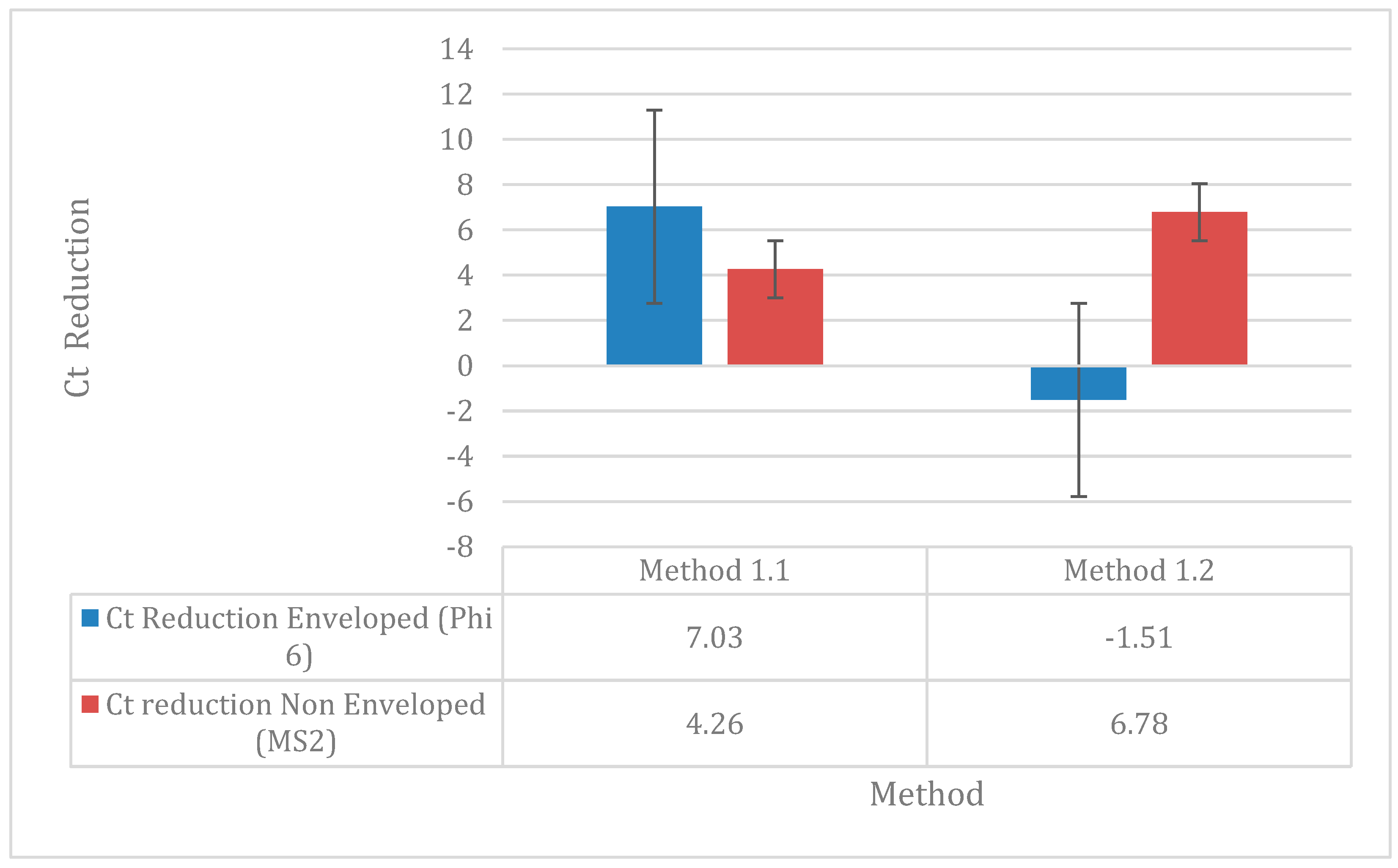
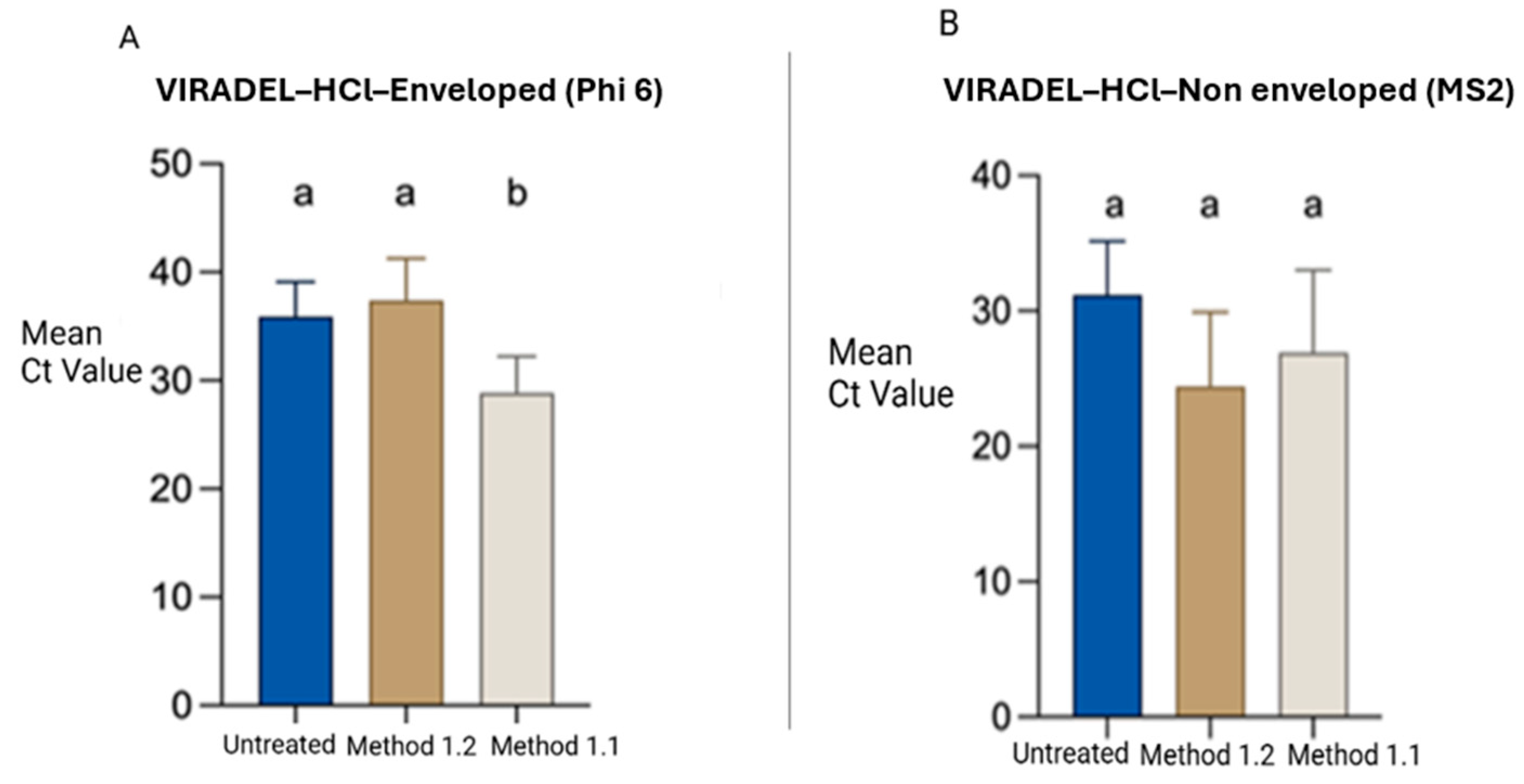
Ct reduction analysis using the ΔCt (Phi6 or MS2)/ΔCt (PMMoV) ratio (acidified workflow minus non-acidified workflow) showed significantly higher recovery of Phi 6 and MS2 from wastewater samples treated by acidified VIRADEL (pH 3.5) and eluted using the TRIS-EDTA/NaCl/BME method (Method 1.1) compared with the non-acidified controls (Figure 1). In contrast, the beef extract–glycine elution method (Method 1.2) improved recovery only of the non-enveloped surrogate. One-way ANOVA followed by Tukey’s post hoc test confirmed significant differences among methods (p < 0.05), with Method 1.1 providing the highest recovery of the enveloped surrogate (Figure 2). On the basis of these results, acidified VIRADEL coupled with TRIS-EDTA/NaCl/BME elution was selected as the primary concentration method for the subsequent surveillance.
Following evaluation of concentration and elution strategies, the effect of PCR additives was assessed as a downstream optimization step. Both DMSO and BSA produced small, non-significant reductions in Ct values for Phi 6 and MS2 (Supplement S4). Although the magnitude of improvement was limited, DMSO showed a consistent directional effect and negligible operational cost and was therefore retained in the workflow.

3.2. Comparison of 12 h and 24 h Composite Sampling

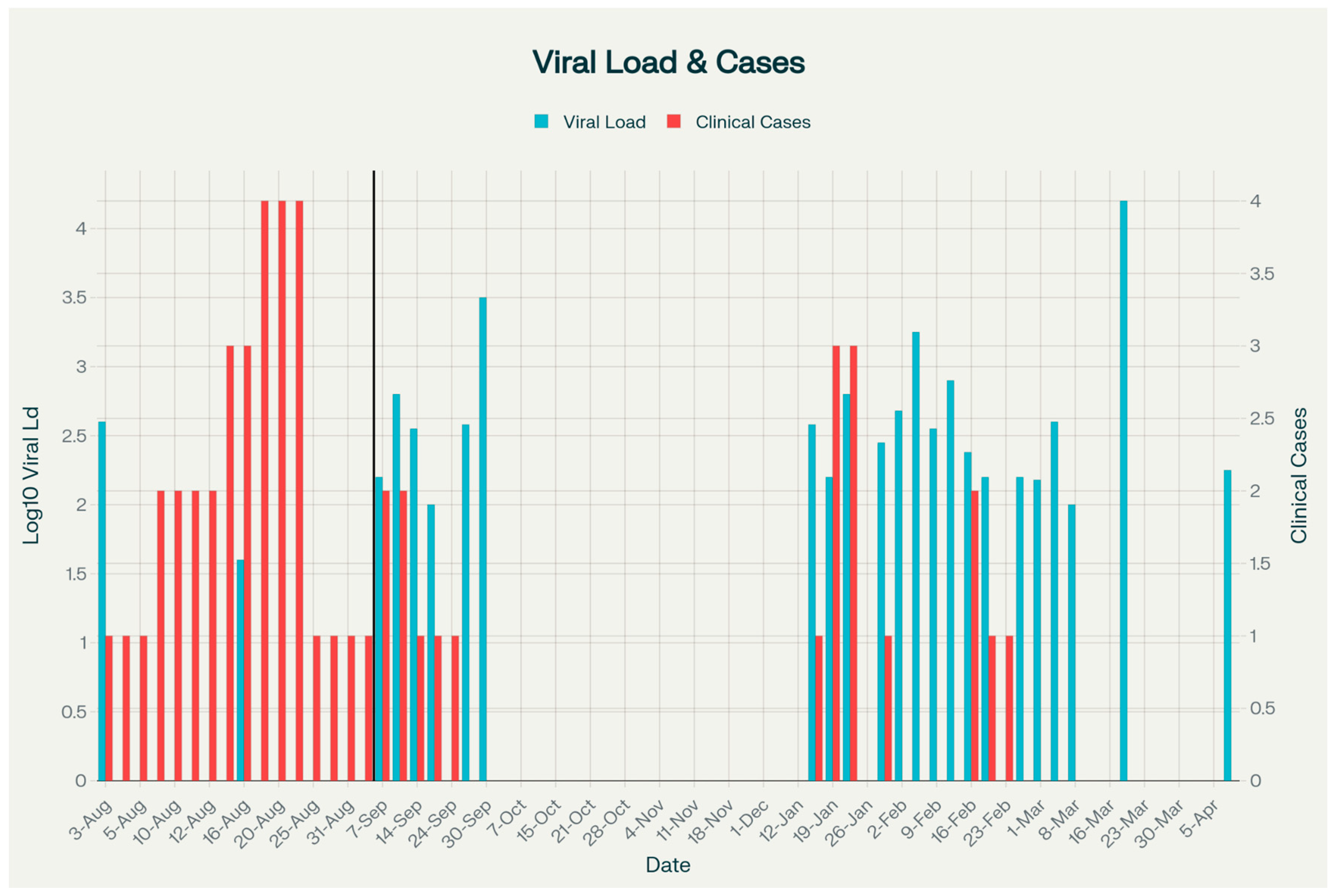
During the 12 h composite evaluation, which was conducted over 16 sampling days (3 August–2 September), SARS-CoV-2 RNA was detected in only 2 of the 16 sampling events (12.5%), despite all 16 days (100%) having at least one clinically confirmed COVID-19 case (Figure 3). Consequently, 14 of the 16 days represented false-negative wastewater results, corresponding to a false-negative rate of 88% (14/16).
In contrast, during the 24 h composite evaluation (after 2 September), SARS-CoV-2 RNA was detected in 22 of the 50 sampling days (44%), while 12 of the 50 days (24%) had clinically confirmed cases. False-negative wastewater results decreased markedly, with only 3 of the 50 days (6%) showing clinical case positivity without detectable SARS-CoV-2 RNA in the wastewater.
Because the 12 h and 24 h strategies were evaluated over different durations and sample counts, comparisons emphasize detection performance and false-negative frequency rather than paired statistical inference.

3.3. Wastewater–Clinical Trend Alignment and Lead Time

Visual inspection and lagged Spearman correlation analysis (±14 days) indicated that the relationship between wastewater viral loads and clinical case counts varied across the full time series, necessitating windowed, event-based lead time estimation. Two epidemiologically distinct waves were identified during the 24 h sampling period (7 September 2021–13 April 2022), defined by consecutive increases in 7-day-smoothed clinical positives above baseline. Seven-day-smoothed wastewater SARS-CoV-2 N1 concentrations (log10 genome copies/L) increased approximately 3–5 days before increases in seven-day-smoothed counts of laboratory-confirmed SARS-CoV-2 positive tests, a pattern observed during both the fall 2021 and January 2022 waves. Averaged across both waves, wastewater concentrations preceded clinical detections by approximately five days. Longitudinal wastewater and clinical trends across the surveillance period are shown in Figure 3.

4. Discussion

In this study, we implemented and optimized an electronegative membrane virus adsorption–elution (VIRADEL) workflow for SARS-CoV-2 wastewater surveillance, focusing on steps that most strongly influence SARS-CoV-2 detectability in resource-limited settings. Here, “decentralized” refers to wastewater infrastructure characterized by smaller, discrete catchments and pump station sampling points rather than a single centralized treatment plant with a large, well-characterized sewer shed. We show that upstream choices, particularly sample acidification and 24 h composite sampling, substantially reduce non-detects and improve alignment between wastewater SARS-CoV-2 N1 signals and laboratory-confirmed SARS-CoV-2 positive tests, while RT-qPCR additives provide only a marginal incremental benefit.

4.1. Acidification and Elution Strategy Control Recovery of Enveloped Viruses

The data in this study show that recovery of the enveloped surrogate Phi 6, and to a lesser extent the non-enveloped surrogate MS2, was strongly influenced by the interaction between acidification and elution strategy. Because SARS-CoV-2 is an enveloped virus, improved recovery of the enveloped process control under acidified filtration conditions supports enhanced recovery of SARS-CoV-2 targets within this workflow. Method 1.1, which acidified samples to pH 3.5 and used TRIS-EDTA/NaCl/BME for elution, produced significantly higher recovery than the non-acidified control and outperformed the beef extract–glycine method, which provided a benefit primarily for the non-enveloped surrogate virus. These findings are consistent with previous studies comparing sample concentration approaches [18,40,41].
This behavior is well-aligned with the known physicochemical properties of enveloped viruses, which adsorb inefficiently to electronegative membranes at neutral pH [25,28,29]. Lowering the pH to acidic conditions reduces electrostatic repulsion and allows virus–membrane interactions to dominate during filtration, thereby improving downstream recovery, as would be predicted by adsorption theory [30]. Critically, this effect was observed using real wastewater from a tropical, decentralized wastewater system with very high organic load, extending laboratory and temperate-system observations from earlier work [16,40]. Because this optimization can be achieved using relatively inexpensive reagents and minimal modifications to laboratory workflow, it represents a practical and scalable intervention for laboratories under resource constraints.

4.2. PCR Additives Provide Only Limited Incremental Benefit

In contrast to the substantial effects of acidification and elution strategy, the use of PCR additives (DMSO and BSA) produced only small, non-significant improvements in Ct values for Phi 6 and MS2. This observation is consistent with previous reports showing that PCR additives provide only modest mitigation of inhibition in complex environmental matrices [36]. Together, these findings suggest that, within this workflow, upstream decisions related to adsorption, elution, and sampling integration exert a much greater influence on overall analytical sensitivity than downstream additive-based inhibition mitigation. DMSO was operationally retained because it demonstrated a consistent (albeit non-significant) directional effect and did not materially increase cost or procedural complexity; however, the data indicate that it is not a primary driver of surveillance performance for SARS-CoV-2 detection in this matrix.

4.3. Composite Sampling Duration Is the Dominant Driver of Surveillance Sensitivity

The most consequential operational insight of this study is the outsized effect of composite sampling duration on surveillance sensitivity and timeliness. Twelve-hour composite sampling produced a false-negative rate of 88% despite ongoing clinical transmission, whereas 24 h composite sampling reduced the false-negative rate to 6% and produced wastewater trends that closely matched clinical case data.
This effect is almost certainly the result of a combination of diurnal variability in wastewater flow, intermittent viral shedding in a small population, and stochastic processes near the limit of detection. In a small catchment such as the pump station here, even short composite windows can easily miss viral shedding events entirely. Composite windows of 24 h and longer integrate over multiple daily cycles of activity, substantially increasing the probability of capturing viral signals. Extended composite sampling has been reported to produce a similar effect in larger, municipal systems [8,22,42,43,44], but this study demonstrates that it is even more important in small, decentralized systems typical of small-island settings.

4.4. Wastewater Provides a Consistent Early-Warning Signal

Under the optimized workflow and with 24 h composite sampling, SARS-CoV-2 signals in wastewater consistently preceded increases in clinical cases by approximately 3–5 days across two epidemiological waves. This lead time is consistent with observations from large-scale surveillance systems in other settings [21,45,46], and confirms that wastewater-based epidemiology can be used as an early-warning tool even in small, decentralized communities. In resource-limited settings with limited or no access to clinical testing, such lead times open windows for proactive public health response. Importantly, wastewater SARS-CoV-2 RNA concentrations were not interpreted as a direct proxy for the absolute number of infected individuals. Viral loads in wastewater are influenced by variability in shedding, dilution, hydraulic flow, catchment characteristics, and sampling design; therefore, the analyses presented here focus on temporal association and lead–lag relationships rather than reconstruction of exact infection prevalence.

4.5. Sustained Operational Feasibility in a Low-Resource Setting

Under the optimized workflow with 24 h composite sampling, increases in seven-day-smoothed wastewater SARS-CoV-2 N1 concentrations consistently preceded increases in seven-day-smoothed counts of laboratory-confirmed clinical positives by approximately 3–5 days across two epidemiological waves. This lead time aligns with observations from large-scale surveillance systems in other settings [21,45,46] and supports the use of wastewater-based epidemiology as an early-warning tool even in small, decentralized communities. In resource-limited environments with limited access to clinical testing, such lead times may provide valuable windows for proactive public health response. Importantly, wastewater SARS-CoV-2 RNA concentrations were not interpreted as a direct proxy for the absolute number of infected individuals.
Building on this early-warning capability, a key practical insight from this study is the sustained nine-month implementation of the optimized workflow under real-world practical conditions. The workflow was maintained despite staffing limitations, supply-chain disruptions, and decentralized infrastructure typical of small-island settings. Consistent achievement of same-day (<12 h) turnaround from sample collection to reporting demonstrates that the approach is not only analytically robust but also operationally sustainable under resource-constrained conditions. This real-world performance supports prior demonstrations of wastewater surveillance feasibility at larger scales [12,47,48] and extends those findings to a small-island, resource-limited context.

4.6. Implications for Pathogen-Agnostic Wastewater Surveillance

Because the optimized workflow was effective in recovering both enveloped (Phi 6) and non-enveloped (MS2) viruses, it is likely that the same principles, especially acidification, appropriate elution chemistry, and extended composite sampling, will also improve surveillance of other pathogens, including influenza, RSV, norovirus, hepatitis A, and emerging viral threats, as well as targets for antimicrobial resistance surveillance [48,49]. The successful sustained operation by a small team further supports the feasibility and scalability of pathogen-agnostic wastewater-based epidemiology in small-island and low-resource settings.

5. Conclusions

The integration of acidified electronegative membrane VIRADEL (pH 3.5) with 24 h composite sampling improved recovery of the enveloped process control and reduced false-negative SARS-CoV-2 detections in wastewater. Under the optimized workflow, wastewater SARS-CoV-2 N1 concentration trends aligned with, and preceded, laboratory-confirmed SARS-CoV-2 positives by approximately 3–5 days, supporting use as an early-warning complement to clinical surveillance in decentralized, resource-limited settings. These conclusions emphasize trend concordance and lead time rather than direct conversion of wastewater copies to exact case counts.

Supplementary Materials

The following supporting information can be downloaded at: https://www.mdpi.com/article/10.3390/covid6030035/s1. Phi 6 and MS2 bacteriophages were propagated via standard plaque assay protocols (Supplement S1); RNA was extracted using a modified TRIzol phenol–chloroform protocol adapted from the TRIzol Plus RNA Purification Kit (Thermo Fisher Scientific, Waltham, MA, USA) (Supplement S2); gBlock DNA constructs (Supplement S3); and Both DMSO and BSA produced small, non-significant reductions in Ct values for Phi 6 and MS2 (Supplement S4). Gene target sequences used in this study (Table S1); RT-PCR reactions for each assay (Table S2); Thermocycler parameters for all assays (Table S3).

Author Contributions

Conceptualization, K.F.-D., S.C., C.N.L.M. and M.E.R.-N.; methodology, K.F.-D., M.M.-B. and M.E.R.-N.; validation, K.F.-D. and M.M.-B.; formal analysis, K.F.-D., M.M.-B., K.M. and M.E.R.-N.; investigation, K.F.-D. and M.M.-B.; resources, K.F.-D. and M.M.-B.; data curation, K.F.-D., K.M. and M.E.R.-N.; writing—original draft preparation, K.F.-D. and M.E.R.-N.; writing—review and editing, K.F.-D., M.M.-B., M.E.R.-N., S.C., K.M. and C.N.L.M.; visualization, K.F.-D. and M.E.R.-N.; supervision, M.E.R.-N.; project administration, K.F.-D. and M.E.R.-N.; funding acquisition, K.F.-D. All authors have read and agreed to the published version of the manuscript.

Funding

This research received funding from the St. George’s University SGRI 22002.

Institutional Review Board Statement

Not applicable.

Informed Consent Statement

Not applicable.

Data Availability Statement

All data are provided in the article.

Acknowledgments

We would like to thank Ronald S. Campbell from the Physical Plant Department at SGU and Orlando Cato for facilitating sample collection.

Conflicts of Interest

The authors declare no conflicts of interest.

Abbreviations

The following abbreviations are used in this manuscript:
BMEβ-mercaptoethanol
BSAbovine serum albumin
CDCCenter for Disease Control and Prevention
COVID-19coronavirus disease 2019
Ctcycle threshold
dsRNAdouble-stranded RNA
DMSOdimethyl sulfoxide
HClhydrochloric acid
MERS-CoVMiddle East respiratory syndrome coronavirus
PFUplaque-forming units
PMMoVpepper mild mottle virus
qRT-PCRquantitative reverse transcription polymerase chain reaction
RT-qPCRreverse transcription quantitative polymerase chain reaction
RNAribonucleic acid
RR statistical software/environment
SARS-CoV-1severe acute respiratory syndrome coronavirus
SARS-CoV-2severe acute respiratory syndrome coronavirus 2
TRIStris(hydroxymethyl)aminomethane
VIRADELvirus adsorption–elution
WBEwastewater-based epidemiology

References

  1. Crank, K.; Chen, W.; Bivins, A.; Lowry, S.; Bibby, K. Contribution of SARS-CoV-2 RNA Shedding Routes to RNA Loads in Wastewater. Sci. Total Environ. 2022, 806, 150376. [Google Scholar] [CrossRef] [PubMed]
  2. Fu, S.; Wang, Q.; He, F.; Zhou, C.; Zhang, J.; Xia, W. The Decay of Coronavirus in Sewage Pipes and the Development of a Predictive Model for the Estimation of SARS-CoV-2 Infection Cases Based on Wastewater Surveillance. medRxiv 2022. [Google Scholar] [CrossRef]
  3. Li, X.; Kulandaivelu, J.; Guo, Y.; Zhang, S.; Shi, J.; O’Brien, J. SARS-CoV-2 Shedding Sources in Wastewater and Implications for Wastewater-Based Epidemiology. J. Hazard. Mater. 2022, 432, 128667. [Google Scholar] [CrossRef] [PubMed]
  4. Wu, Y.; Guo, C.; Tang, L.; Hong, Z.; Zhou, J.; Dong, X.; Yin, H.; Xiao, Q.; Tang, Y.; Qu, X.; et al. Prolonged Presence of SARS-CoV-2 Viral RNA in Faecal Samples. Lancet Gastroenterol. Hepatol. 2020, 5, 434–435. [Google Scholar] [CrossRef]
  5. Zhang, Y.; Xu, J.; Li, H.; Cao, B. A Novel Coronavirus (COVID-19) Outbreak. Chest 2020, 157, e99–e101. [Google Scholar] [CrossRef]
  6. Xiao, F.; Tang, M.; Zheng, X.; Liu, Y.; Li, X.; Shan, H. Evidence for Gastrointestinal Infection of SARS-CoV-2. Gastroenterology 2020, 158, 1831–1833.e3. [Google Scholar] [CrossRef]
  7. Wölfel, R.; Corman, V.M.; Guggemos, W.; Seilmaier, M.; Zange, S.; Müller, M.A.; Niemeyer, D.; Jones, T.C.; Vollmar, P.; Rothe, C.; et al. Virological Assessment of Hospitalized Patients with COVID-2019. Nature 2020, 581, 465–469. [Google Scholar] [CrossRef]
  8. Ahmed, W.; Angel, N.; Edson, J.; Bibby, K.; Bivins, A.; O’Brien, J.W.; Choi, P.M.; Kitajima, M.; Simpson, S.L.; Li, J.; et al. First Confirmed Detection of SARS-CoV-2 in Untreated Wastewater in Australia: A Proof of Concept for the Wastewater Surveillance of COVID-19 in the Community. Sci. Total Environ. 2020, 728, 138764. [Google Scholar] [CrossRef]
  9. Haramoto, E.; Malla, B.; Thakali, O.; Kitajima, M. First Environmental Surveillance for the Presence of SARS-CoV-2 RNA in Wastewater and River Water in Japan. Sci. Total Environ. 2020, 737, 140405. [Google Scholar] [CrossRef]
  10. Sherchan, S.P.; Shahin, S.; Ward, L.M.; Tandukar, S.; Aw, T.G.; Schmitz, B.; Ahmed, W.; Kitajima, M. First Detection of SARS-CoV-2 RNA in Wastewater in North America: A Study in Louisiana, USA. Sci. Total Environ. 2020, 743, 140621. [Google Scholar] [CrossRef]
  11. Bivins, A.; North, D.; Ahmad, A.; Ahmed, W.; Alm, E.; Been, F.; Bhattacharya, P.; Bijlsma, L.; Boehm, A.B.; Brown, J.; et al. Wastewater-Based Epidemiology: Global Collaborative to Maximize Contributions in the Fight Against COVID-19. Environ. Sci. Technol. 2020, 54, 7754–7757. [Google Scholar] [CrossRef]
  12. Xie, Y.; Challis, J.K.; Oloye, F.F.; Asadi, M.; Cantin, J.; Brinkmann, M.; McPhedran, K.N.; Hogan, N.; Sadowski, M.; Jones, P.D.; et al. RNA in Municipal Wastewater Reveals Magnitudes of COVID-19 Outbreaks Across Four Waves Driven by SARS-CoV-2 Variants of Concern. ACS EST Water 2022, 2, 1852–1862. [Google Scholar] [CrossRef]
  13. Carducci, A.; Federigi, I.; Dasheng, L.; Julian, R.T.; Marco, V. Making Waves: Coronavirus detection, presence and persistence in the water environment: State of the art and knowledge needs for public health. Water Res. 2020, 179, 115907. [Google Scholar] [CrossRef]
  14. Michael-Kordatou, I. Sewage Analysis as a Tool for the COVID-19 Pandemic Response and Management. J. Environ. Chem. Eng. 2020, 8, 104306. [Google Scholar] [CrossRef] [PubMed]
  15. Haramoto, E.; Kitajima, M.; Katayama, H.; Ito, T.; Ohgaki, S. Development of Virus Concentration Methods for Detection of Koi Herpesvirus in Water. J. Fish Dis. 2009, 32, 297–300. [Google Scholar] [CrossRef] [PubMed]
  16. Ahmed, W. Comparison of Virus Concentration Methods for the RT-qPCR-Based Recovery of Murine Hepatitis Virus. Sci. Total Environ. 2020, 739, 139960. [Google Scholar] [CrossRef] [PubMed]
  17. Zhang, D. SARS-CoV-2 in Wastewater: From Detection to Evaluation. Mater. Today Adv. 2022, 13, 100211. [Google Scholar] [CrossRef]
  18. Ahmed, W.; Harwood, V.J.; Gyawali, P.; Sidhu, J.P.S.; Toze, S. Comparison of Concentration Methods for Quantitative Detection of Sewage-Associated Viral Markers in Environmental Waters. Appl. Environ. Microbiol. 2015, 81, 2042–2049. [Google Scholar] [CrossRef]
  19. Lowry, S.A.; Wolfe, M.K.; Boehm, A.B. Respiratory Virus Concentrations in Human Excretions That Contribute to Wastewater: A Systematic Review and Meta-Analysis. J. Water Health 2023, 21, 831–848. [Google Scholar] [CrossRef]
  20. Byambasuren, O.; Cardona, M.; Bell, K.; Clark, J.; McLaws, M.-L.; Glasziou, P. Estimating the Extent of Asymptomatic COVID-19 and Its Potential for Community Transmission: Systematic Review and Meta-Analysis. J. Assoc. Med. Microbiol. Infect. Dis. Can. 2020, 5, 223–234. [Google Scholar] [CrossRef]
  21. Nemudryi, A.; Nemudraia, A.; Wiegand, T.; Surya, K.; Buyukyoruk, M.; Cicha, C.; Vanderwood, K.K.; Wilkinson, R.; Wiedenheft, B. Temporal Detection and Phylogenetic Assessment of SARS-CoV-2 in Municipal Wastewater. CR Med. 2020, 1, 100098. [Google Scholar] [CrossRef]
  22. Wurtzer, S.; Marechal, V.; Mouchel, J.M.; Moulin, L. Time Course Quantitative Detection of SARS-CoV-2 in Parisian Wastewaters Correlates with COVID-19 Confirmed Cases. medRxiv 2020. [Google Scholar] [CrossRef]
  23. La Rosa, G.; Iaconelli, M.; Mancini, P.; Bonanno Ferraro, G.; Veneri, C.; Bonadonna, L.; Lucentini, L.; Suffredini, E. First Detection of SARS-CoV-2 in Untreated Wastewaters in Italy. Sci. Total Environ. 2020, 736, 139652. [Google Scholar] [CrossRef]
  24. Peng, L.; Liu, J.; Xu, W.; Luo, Q.; Chen, D.; Lei, Z.; Huang, Z.; Li, X.; Deng, K.; Lin, B.; et al. SARS-CoV-2 Can Be Detected in Urine, Blood, Anal Swabs, and Oropharyngeal Swabs Specimens. J. Med. Virol. 2020, 92, 1676–1680. [Google Scholar] [CrossRef] [PubMed]
  25. Ye, Y.; Ellenberg, R.M.; Graham, K.E.; Wigginton, K.R. Survivability, Partitioning, and Recovery of Enveloped Viruses in Untreated Municipal Wastewater. Environ. Sci. Technol. 2016, 50, 5077–5085. [Google Scholar] [CrossRef]
  26. Blaise-Boisseau, S.; Hennechart-Collette, C.; Guillier, L.; Perelle, S. Duplex Real-Time qRT-PCR for the Detection of Hepatitis A Virus in Water and Raspberries Using the MS2 Bacteriophage as a Process Control. J. Virol. Methods 2010, 166, 48–53. [Google Scholar] [CrossRef]
  27. Kitajima, M.; Sassi, H.P.; Torrey, J.R. Pepper Mild Mottle Virus as a Water Quality Indicator. npj Clean Water 2018, 1, 19. [Google Scholar] [CrossRef]
  28. Boone, M.M.; Sharkey, M.E.; Williams, S.L.; Cosculluela, G.A. Comparison of Electronegative Filtration to Magnetic Bead–Based Concentration and V2G-qPCR to RT-qPCR for Quantifying SARS-CoV-2 RNA from Wastewater. ACS EST Water 2022, 2, 2004–2013. [Google Scholar]
  29. Shi, H.; Pasco, E.V.; Tarabara, V.V. Membrane-Based Methods of Virus Concentration from Water: Process Parameters and Their Effects on Virus Recovery. Environ. Sci. Water Res. Technol. 2017, 3, 778–792. [Google Scholar] [CrossRef]
  30. Gerba, C.P. Applied and Theoretical Aspects of Virus Adsorption to Surfaces. In Advances in Applied Microbiology; Elsevier: Amsterdam, The Netherlands, 1984; Volume 30, pp. 133–168. [Google Scholar]
  31. Lu, X.; Wang, L.; Sakthivel, S.; Whitaker, B.; Murray, J.; Kamili, S.; Lynch, B.; Malapati, L.; Burke, S.; Harcourt, J.; et al. US CDC Real-Time Reverse Transcription PCR Panel for Detection of Severe Acute Respiratory Syndrome Coronavirus 2. Emerg. Infect. Dis. J. 2020, 26, 1654. [Google Scholar] [CrossRef]
  32. Corman, V.M.; Landt, O.; Kaiser, M.; Molenkamp, R.; Meijer, A.; Chu, D.K.W.; Bleicker, T.; Brünink, S.; Schneider, J.; Schmidt, M.L.; et al. Detection of 2019 Novel Coronavirus (2019-nCoV) by Real-Time RT-PCR. Eurosurveillance 2020, 25, 2000045. [Google Scholar] [CrossRef]
  33. Verreault, D.; Marcoux-Voiselle, M.; Turgeon, N.; Moineau, S.; Duchaine, C.; Schaffner, D.W. Resistance of Aerosolized Bacterial Viruses to Relative Humidity and Temperature. Appl. Environ. Microbiol. 2015, 81, 7305–7311. [Google Scholar] [CrossRef] [PubMed]
  34. Gendron, L.; Verreault, D.; Veillette, M.; Moineau, S.; Duchaine, C. Evaluation of Filters for the Sampling and Quantification of RNA Phage Aerosols. Aerosol Sci. Technol. 2010, 44, 893–901. [Google Scholar] [CrossRef]
  35. Haramoto, E.; Kitajima, M.; Kishida, N.; Konno, Y.; Katayama, H.; Asami, M.; Akiba, M. Occurrence of Pepper Mild Mottle Virus in Drinking Water Sources in Japan. Appl. Environ. Microbiol. 2013, 79, 7413–7418. [Google Scholar] [CrossRef] [PubMed]
  36. Farell, E.M.; Alexandre, G. Bovine Serum Albumin Further Enhances the Effects of Organic Solvents on Increased Yield of Polymerase Chain Reaction of GC-Rich Templates. BMC Res. Notes 2012, 5, 257. [Google Scholar] [CrossRef]
  37. Musso, M.; Bocciardi, R.; Parodi, S.; Ravazzolo, R.; Ceccherini, I. Betaine, Dimethyl Sulfoxide, and 7-Deaza-dGTP, a Powerful Mixture for Amplification of GC-Rich DNA Sequences. J. Mol. Diagn. 2006, 8, 544–550. [Google Scholar] [CrossRef]
  38. Zhang, Z.; Yang, X.; Meng, L.; Liu, F.; Shen, C.; Yang, W. Enhanced Amplification of GC-Rich DNA with Two Organic Reagents. Biotechniques 2009, 47, 775–779. [Google Scholar] [CrossRef]
  39. Wang, W.; Li, R.; Chen, S.; Chen, L.; Jiang, Y.; Xiang, J.; Wu, J.; Li, J.; Chen, Z.; Wu, C. Wastewater-Based Surveillance of SARS-CoV-2 and Modeling of COVID-19 Infection Trends. Trop. Med. Infect. Dis. 2025, 10, 264. [Google Scholar] [CrossRef]
  40. Lu, D.; Huang, Z.; Luo, J.; Zhang, X.; Sha, S. Primary Concentration—The Critical Step in Implementing the Wastewater Based Epidemiology for the COVID-19 Pandemic: A Mini-Review. Sci. Total Environ. 2020, 747, 141245. [Google Scholar] [CrossRef]
  41. Pecson, B.M.; Darby, E.; Haas, C.N.; Amha, Y.M.; Bartolo, M.; Danielson, R.; Dearborn, Y.; Giovanni, G.D.; Ferguson, C.; Fevig, S.; et al. Reproducibility and Sensitivity of 36 Methods to Quantify the SARS-CoV-2 Genetic Signal in Raw Wastewater: Findings from an Interlaboratory Methods Evaluation in the U.S. Environ. Sci. Water Res. Technol. 2021, 7, 504–520. [Google Scholar] [CrossRef]
  42. Ort, C.; Lawrence, M.G.; Reungoat, J.; Mueller, J.F. Sampling for PPCPs in Wastewater Systems: Comparison of Different Sampling Modes and Optimization Strategies. Environ. Sci. Technol. 2010, 44, 6289–6296. [Google Scholar] [CrossRef]
  43. Hillary, L.S. Monitoring SARS-CoV-2 in Wastewater: Impacts of Sampling Strategy, Population Size and Sewershed Composition. Sci. Total Environ. 2021, 772, 145370. [Google Scholar]
  44. Medema, G.; Heijnen, L.; Elsinga, G.; Italiaander, R.; Brouwer, A. Presence of SARS-Coronavirus-2 RNA in Sewage and Correlation with Reported COVID-19 Prevalence in the Early Stage of the Epidemic in The Netherlands. Environ. Sci. Technol. Lett. 2020, 7, 511–516. [Google Scholar] [CrossRef] [PubMed]
  45. Peccia, J.; Zulli, A.; Brackney, D.E.; Grubaugh, N.D.; Kaplan, E.H.; Casanovas-Massana, A.; Ko, A.I.; Malik, A.A.; Wang, D.; Wang, M.; et al. Measurement of SARS-CoV-2 RNA in Wastewater Tracks Community Infection Dynamics. Nat. Biotechnol. 2020, 38, 1164–1167. [Google Scholar] [CrossRef] [PubMed]
  46. Bibby, K.; Bivins, A.; Wu, Z.; North, D. Making Waves: Plausible Lead Time for Wastewater Based Epidemiology as an Early Warning System for COVID-19. Water Res. 2021, 202, 117438. [Google Scholar] [CrossRef]
  47. Guo, Y. Wastewater-Based Epidemiology in Low- and Middle-Income Countries: Opportunities and Challenges. J. Hazard. Mater. 2023, 432, 128667. [Google Scholar]
  48. Karthikeyan, S. Rapid, Large-Scale Wastewater Surveillance and Automated Reporting for COVID-19. Nat. Biotechnol. 2021, 39, 1164–1170. [Google Scholar]
  49. Hellmér, M.; Paxéus, N.; Magnius, L.; Enache, L.; Arnholm, B.; Johansson, A.; Bergström, T.; Norder, H. Detection of Pathogenic Viruses in Sewage Provided Early Warnings of Hepatitis A Virus and Norovirus Outbreaks. Appl. Environ. Microbiol. 2014, 80, 6771–6781. [Google Scholar] [CrossRef]
Figure 1. Recovery of enveloped (Phi 6) and non-enveloped (MS2) viral surrogates using HCl-acidified VIRADEL. Ct reduction is expressed as the difference in the ΔCt (Phi6 or MS2)/ΔCt (PMMoV) ratio between treated samples and the corresponding untreated control.
Covid 06 00035 g001
Figure 2. Post hoc Tukey’s multiple comparisons test for HCl acidification using Method 1.2 and Method 1.1. Statistical differences at a 95% confidence level are indicated by different letters. (A) Enveloped; (B) Non-enveloped.
Covid 06 00035 g002
Figure 3. Surveillance trends for wastewater samples expressed as log10_viral load compared to the trends of clinical positive samples.
Covid 06 00035 g003
Disclaimer/Publisher’s Note: The statements, opinions and data contained in all publications are solely those of the individual author(s) and contributor(s) and not of MDPI and/or the editor(s). MDPI and/or the editor(s) disclaim responsibility for any injury to people or property resulting from any ideas, methods, instructions or products referred to in the content.