


Abstract
A rare but potentially fatal hyperinflammatory disease that develops following SARS-CoV-2 infection is called multisystem inflammatory syndrome in children (MIS-C). Mucocutaneous manifestations are common and frequently overlap with other pediatric inflammatory illnesses, including Kawasaki disease, and may serve as early diagnostic indicators. We describe a 6-year-old girl who was previously healthy but was hospitalized in the pediatric intensive care unit due to a high-grade fever, toxic appearance, and quickly progressing mucocutaneous symptoms, such as bilateral non-purulent conjunctivitis and broad maculopapular rash. Myocardial dysfunction, severe anemia and thrombocytopenia, respiratory failure necessitating mechanical ventilation, and hypotensive shock complicated the clinical course. Laboratory tests showed positive SARS-CoV-2 serology and significantly increased inflammatory markers. Several microbiological tests came up negative. Bacterial sepsis and Kawasaki diseases were not included. A diagnosis of MIS-C was made based on clinical, laboratory, and epidemiological data. In addition to supportive intensive care, the patient received systemic corticosteroids and intravenous immunoglobulin. After two weeks, she was released in a stable condition after gradually improving clinically and biochemically. This instance emphasizes how crucial it is to identify noticeable mucocutaneous manifestations as early warning signs of MIS-C. Immunomodulatory therapy must be started as soon as possible in order to minimize serious consequences and enhance the prognosis of afflicted infants.
1. Introduction
A post-infectious hyperinflammatory disease temporally linked to SARS-CoV-2 infection, Multisystem Inflammatory Syndrome in Children (MIS-C), usually appears several weeks after exposure. The symptoms of MIS-C, which were initially identified in early 2020, include a persistent fever, increased inflammatory markers, and involvement of several organ systems. Mucocutaneous signs are a crucial clinical component of MIS-C, appearing in about 45–90% of affected children, while cardiovascular and gastrointestinal manifestations are among the most commonly described abnormalities [1,2,3].
These symptoms, which might include polymorphic rashes, conjunctival injection, lip and oral mucosal alterations, palmoplantar erythema, and periungual desquamation, frequently mimic those seen in Kawasaki illness but are more varied [2,4].
Mucocutaneous signs can precede or coincide with more serious organ involvement and can act as early and obvious markers of systemic inflammation. During a diagnostic assessment, their presence can help physicians differentiate MIS-C from other infectious or inflammatory disorders. However, recognition may also be challenging by a broad spectrum of dermatologic and mucosal signs, such as erythematous macules, urticarial lesions, targetoid eruptions, and edema, particularly in unusual presentations [3,5].
Identification of mucocutaneous features is still crucial for early detection and timely therapeutic initiation because of the potential severity of MIS-C and its wide clinical overlap with other childhood inflammatory diseases [6].
The diagnostic usefulness of these manifestations is demonstrated here by reporting a case of MIS-C temporally associated with COVID-19 that is characterized by prominent mucocutaneous involvement. Written informed consent was obtained from the patient’s parents for publication of this case report and any accompanying images or identifying information.
2. Case Presentation
A 6-year-old girl with a toxic clinical condition marked by a high temperature and quickly worsening mucocutaneous symptoms was moved from the Department of Infectious Diseases to the Pediatric Intensive Care Unit (PICU).
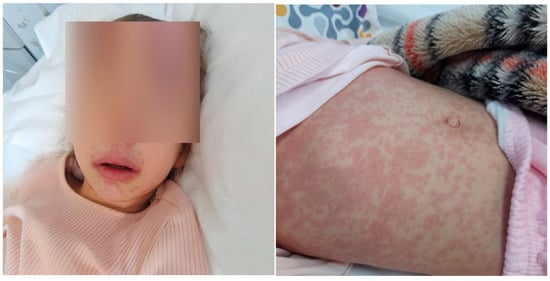
She looked quite sick, was lethargic, and had a fever (38.9 °C) at admission. A physical examination showed bilateral non-purulent conjunctivitis and a generalized maculopapular exanthem affecting the face, trunk, and upper extremities (Figure 1). There was no evidence of widespread or cervical lymphadenopathy.
Figure 1.
Mucocutaneous manifestations of MIS-C.
From a neurological perspective, the patient was noticeably sleepy and could only be awakened with mild stimulation. No meningeal signs were present. A respiratory assessment showed 88% oxygen saturation on room air and tachypnea (32 breaths per minute). Lung auscultation revealed crackles on inspiration along with loud breath sounds. The results of the cardiovascular examination showed significant hypotension (blood pressure of 65/40 mmHg) and tachycardia (heart rate of 141 beats per minute). She was put on nasal oxygen therapy immediately. Chest radiography and abdominal ultrasonography were performed and blood samples were obtained for laboratory testing (see Table 1).
Table 1.
Baseline and follow-up laboratory findings.
A pediatric cardiology consultation was requested due to suspicions of Kawasaki disease, and chest radiography and abdominal ultrasonography were carried out. Since the cardiac evaluation was normal, Kawasaki illness was ruled out.
Meropenem and vancomycin were started as part of a broad-spectrum intravenous antibiotic therapy because of the noticeably raised inflammatory markers. Thrombocytopenia and severe anemia required an immediate transfusion of platelets and packed red blood cells. Since there were signs of toxic shock and clinical deterioration, intravenous human immunoglobulin (IVIG) was given.
The patient’s condition worsened on the first day of hospitalization, necessitating endotracheal intubation and mechanical ventilation due to oxygen desaturation, continual low blood pressure episodes, and progressive respiratory failure. Inotropic therapy with dopamine was started because of persistent hypotension accompanied by fractional shortening (FS) and borderline left ventricular ejection fraction (LVEF).
All microbiological cultures, including those of blood, urine, cerebrospinal fluid, and stool, maintained their sterility. Hemodynamic stability was preserved with inotropic treatment in spite of ongoing severe illness and intermittent endotracheal tube leakage.
A diagnosis of multisystem inflammatory syndrome in children (MIS-C) was made based on the clinical presentation, history of SARS-CoV-2 exposure, and laboratory results, including positive SARS-CoV-2 serology and significantly elevated interleukin-6 (IL-6), ferritin, D-dimer, and other inflammatory markers (Table 1). In accordance with established protocols, the administration of corticosteroids and intravenous immunoglobulin (IVIG) was enhanced.
Clinical improvement showed gradually over the next few days. While ventilatory and inotropic support were gradually lowered, the patient needed continuous infusions of blood products (packed red blood cells, platelets, and plasma). She successfully underwent extubation and transitioned to nasal oxygen supply after six days of ventilatory assistance, which was stopped the next day. Hematologic values returned to normal, inflammatory markers decreased, and all microbiological cultures were sterile.
The patient was switched to oral therapy as their clinical condition continued to improve. D-dimer levels decreased gradually over the course of the follow-up. After two weeks in the hospital, she was sent home in a stable and better condition with advice for continuing outpatient therapy and close supervision.
3. Discussion
A rare but serious post-infectious consequence of SARS-CoV-2 infection, multisystem inflammatory syndrome in children (MIS-C) is characterized by systemic hyperinflammation and multiorgan dysfunction. It usually manifests as a persistent fever, mucocutaneous involvement, gastrointestinal symptoms, cardiovascular instability, and significantly elevated inflammatory markers two to six weeks after the initial infection [1,2]. Our patient’s clinical presentation, which included a high temperature, a diffuse maculopapular rash, conjunctivitis, hypotensive shock, respiratory involvement, and laboratory indications of hyperinflammation, was quite similar to MIS-C presentations that have been previously reported.
Similar to our case, studies have shown that most MIS-C patients have rashes, conjunctivitis, cracked or hyperemic lips, strawberry tongue, palmoplantar erythema, and other cutaneous abnormalities. These characteristics might be similar to those of Kawasaki illness, but MIS-C is usually linked to more varied rash patterns and wider systemic involvement [7,8].
MIS-C laboratory abnormalities frequently include leukocytosis with neutrophilia, anemia, thrombocytopenia, and significantly higher levels of proinflammatory cytokines such as interleukin-6 (IL-6), ferritin, procalcitonin, D-dimer, and C-reactive protein [9,10].
Increased illness severity and shock have been linked to severe thrombocytopenia, as seen in this instance. In our patient, a decreased left ventricular ejection fraction (LVEF) was also observed. The literature has often documented this finding. Kaushik et al., for instance, observed lower LVEF in 63% of patients, with a median value of 46.6% (IQR 39.5–52.8) [11].
An additional argument in favor of a non-infectious hyperinflammatory process as opposed to septic shock is the lack of positive bacterial cultures.
Rather than direct viral cytotoxicity, the pathogenesis of MIS-C is believed to include post-infectious immunological dysregulation. This is corroborated by the fact that positive or increasing serologic antibody titers are frequently observed in conjunction with negative SARS-CoV-2 polymerase chain reaction (PCR) results [12,13]. One of the primary diagnostic criteria for MIS-C was met in our patient after the normalization of IgM antibodies, and a notable increase in IgG titers throughout hospitalization clearly implied recent SARS-CoV-2 infection and a post-infectious immune response.
Kawasaki disease, toxic shock syndrome, bacterial sepsis, and macrophage activation syndrome are among the differential diagnoses. Patients with MISC tend to be older than those with Kawasaki disease, and they are more likely to have thrombocytopenia, cardiac dysfunction, gastrointestinal symptoms, shock, and elevated inflammatory marker levels [14]. In this instance, MISC is preferred over traditional Kawasaki disease due to the presence of hypotension, respiratory difficulties, and significantly elevated D-dimer, IL-6, and ferritin levels.
Immunomodulation and supportive care are key components of current MIS-C management approaches. When combined, intravenous immunoglobulin (IVIG) and systemic corticosteroids, which are regarded as first-line therapies, have been demonstrated to improve cardiac outcomes, reduce inflammation, and lower treatment failure rates [15,16]. Biologic drugs that target tumor necrosis factor-alpha (TNF-a), IL-1, or IL-6 may be necessary in refractory situations [17]. Since delayed treatment has been linked to an increased risk of cardiac dysfunction and a longer stay in an intensive care unit, early detection and timely therapeutic initiation are crucial.
Long-term cardiologic follow-up is advised; however, the long-term prognosis for children with MIS-C is generally good, with the majority of patients showing remission of inflammation and cardiac abnormalities within weeks to months [18]. Crucially, new research indicates that SARS-CoV-2 immunization significantly decreases the incidence and severity of MIS-C, highlighting the importance of vaccination in prevention [19].
Supplemental oxygen therapy via nasal cannula was initiated immediately. Blood samples were obtained for laboratory analysis (Table 1). Chest radiography and abdominal ultrasonography were performed. A pediatric cardiology consultation was requested due to initial suspicion of Kawasaki disease. However, cardiac evaluation was normal, and Kawasaki disease was subsequently excluded.
4. Conclusions
Recognition of mucocutaneous manifestations as early indicators of MIS-C is crucial. Timely immunomodulatory therapy, guided by laboratory markers and careful clinical assessment, can prevent severe complications and improve pediatric outcomes.
Author Contributions
Conceptualization, R.M.A. and B.Q.; software, G.P.; validation, R.M.A., K.S.A. and B.Z.A.; formal analysis, R.M.A. and K.S.A.; writing—original draft preparation, R.M.A., G.P. and B.Z.A.; writing—review and editing R.M.A., and B.Q.; visualization, B.Q.; supervision, R.M.A. All authors have read and agreed to the published version of the manuscript.
Funding
This research received no external funding.
Institutional Review Board Statement
This study was conducted in accordance with the Declaration of Helsinki and approved by the Ethics Council of the Kosovo Medical Chamber under protocol No. 155/2025, dated 22 July 2025.
Informed Consent Statement
Verbal and written consent were obtained from the parents.
Data Availability Statement
All data are contained within the manuscript.
Conflicts of Interest
The authors declare no conflicts of interest.
Abbreviations
The following abbreviations are used in this manuscript:
| MIS-C | Multisystem inflammatory syndrome in children |
| PICU | Pediatric Intensive Care Unit |
| LVEF | left ventricular ejection fraction |
| FS | Fractional shortening |
| IVIG | Intravenous immunoglobulin |
References
- Feldstein, L.R.; Rose, E.B.; Horwitz, S.M.; Collins, J.P.; Newhams, M.M.; Son, M.B.F.; Newburger, J.W.; Kleinman, L.C.; Heidemann, S.M.; Martin, A.A.; et al. Multisystem inflammatory syndrome in U.S. children and adolescents. N. Engl. J. Med. 2020, 383, 334–346. [Google Scholar] [CrossRef] [Scilit] [PubMed]
- Whittaker, E.; Bamford, A.; Kenny, J.; Kaforou, M.; Jones, C.E.; Shah, P.; Ramnarayan, P.; Fraisse, A.; Miller, O.; Davies, P.; et al. Clinical characteristics of children with a pediatric inflammatory multisystem syndrome temporally associated with SARS-CoV-2. JAMA 2020, 324, 259–269. [Google Scholar] [CrossRef] [Scilit] [PubMed]
- Toubiana, J.; Poirault, C.; Corsia, A.; Bajolle, F.; Fourgeaud, J.; Angoulvant, F.; Debray, A.; Basmaci, R.; Salvador, E.; Biscardi, S.; et al. Kawasaki-like multisystem inflammatory syndrome in children during the COVID-19 pandemic in Paris, France: Prospective observational study. BMJ 2020, 369, m2094. [Google Scholar] [CrossRef] [Scilit] [PubMed]
- Sati, H.; Alzraikat, N.; Milan, M.; Saliba, M.; Fawaz, A.; Boueri, M.; Semaan, S.; Chedid, M.L.; Yakdan, S. Skin manifestations in children with MIS-C and COVID-19: A narrative review. Int. J. Dermatol. 2024, 63, 32–40. [Google Scholar] [CrossRef] [Scilit] [PubMed]
- Brumfiel, C.M.; DiLorenzo, A.M.; Petronic-Rosic, V.M. Dermatologic manifestations of COVID-19-associated multisystem inflammatory syndrome in children. Clin. Dermatol. 2021, 39, 329–333. [Google Scholar] [CrossRef] [Scilit] [PubMed]
- Son, M.B.F.; Murray, N.; Friedman, K.; Young, C.C.; Newhams, M.M.; Feldstein, L.R.; Loftis, L.L.; Tarquinio, K.M.; Singh, A.R.; Heidemann, S.M.; et al. Multisystem inflammatory syndrome in children—Initial therapy and outcomes. N. Engl. J. Med. 2021, 385, 23–34. [Google Scholar] [CrossRef] [Scilit] [PubMed]
- Young, T.K.; Shaw, K.S.; Shah, J.K.; Noor, A.; Alperin, R.A.; Ratner, A.J.; Orlow, S.J.; Betensky, R.A.; Shust, G.F.; Kahn, P.J.; et al. Mucocutaneous Manifestations of Multisystem Inflammatory Syndrome in Children During the COVID-19 Pandemic. JAMA Dermatol. 2021, 157, 207–212. [Google Scholar] [CrossRef] [Scilit] [PubMed]
- Baykal Selçuk, L.; Ferhatosmanoğlu, A.; Gayretli Aydın, Z.G.; Aksu Arıca, D.; Yeşilbaş, O. Dermatologic manifestations of multisystem inflammatory syndrome in children during the COVID-19 pandemic. An. Bras. Dermatol. 2023, 98, 168–175. [Google Scholar] [CrossRef] [Scilit] [PubMed]
- Diorio, C.; Henrickson, S.E.; Vella, L.A.; McNerney, K.O.; Chase, J.; Burudpakdee, C.; Lee, J.H.; Jasen, C.; Balamuth, F.; Barrett, D.M.; et al. Multisystem inflammatory syndrome in children and COVID-19 are distinct presentations of SARS-CoV-2. J. Clin. Investig. 2020, 130, 5967–5975. [Google Scholar] [CrossRef] [Scilit] [PubMed]
- Carter, M.J.; Fish, M.; Jennings, A.; Doores, K.J.; Wellman, P.; Seow, J.; Acors, S.; Graham, C.; Timms, E.; Kenny, J.; et al. Peripheral immunophenotypes in children with multisystem inflammatory syndrome associated with SARS-CoV-2 infection. Nat. Med. 2020, 26, 1701–1707. [Google Scholar] [CrossRef] [Scilit] [PubMed]
- Kaushik, S.; Aydin, S.I.; Derespina, K.R.; Bansal, P.B.; Kowalsky, S.; Trachtman, R.; Gillen, J.K.; Perez, M.M.; Soshnick, S.H.; Conway, E.E., Jr.; et al. Multisystem inflammatory syndrome in children associated with severe acute respiratory syndrome coronavirus 2 infection (MIS-C): A Multi-institutional Study from New York City. J. Pediatr. 2020, 224, 24–29. [Google Scholar] [CrossRef] [Scilit] [PubMed]
- Thiriard, A.; Meyer, B.; Eberhardt, C.S.; Loevy, N.; Grazioli, S.; Adouan, W.; Fontannaz, P.; Marechal, F.; L’Huillier, A.G.; Siegrist, C.A.; et al. Antibody response in children with multisystem inflammatory syndrome related to COVID-19 (MIS-C) compared to children with uncomplicated COVID-19. Front. Immunol. 2023, 14, 1107156. [Google Scholar] [CrossRef] [Scilit] [PubMed]
- Ghazizadeh Esslami, G.; Mamishi, S.; Pourakbari, B.; Mahmoudi, S. Systematic review and meta-analysis on the serological, immunological, and cardiac parameters of the multisystem inflammatory syndrome (MIS-C) associated with SARS-CoV-2 infection. J. Med. Virol. 2023, 95, e28927. [Google Scholar] [CrossRef] [Scilit] [PubMed]
- McCrindle, B.W.; Manlhiot, C. SARS-CoV-2–related inflammatory multisystem syndrome in children: Different or shared etiology and pathophysiology as Kawasaki disease? JAMA 2020, 324, 246–248. [Google Scholar] [CrossRef] [Scilit] [PubMed]
- Mahmoud, S.; El-Kalliny, M.; Kotby, A.; El-Ganzoury, M.; Fouda, E.; Ibrahim, H. Treatment of MIS-C in Children and Adolescents. Curr. Pediatr. Rep. 2022, 10, 1–10. [Google Scholar] [CrossRef] [Scilit] [PubMed]
- Ouldali, N.; Toubiana, J.; Antona, D.; Javouhey, E.; Madhi, F.; Lorrot, M.; Léger, P.L.; Galeotti, C.; Claude, C.; Wiedemann, A.; et al. Association of IVIG plus methylprednisolone vs IVIG alone with course of fever in multisystem inflammatory syndrome in children. JAMA 2021, 325, 855–864. [Google Scholar] [CrossRef] [Scilit] [PubMed]
- Henderson, L.A.; Canna, S.W.; Friedman, K.G.; Gorelik, M.; Lapidus, S.K.; Bassiri, H.; Behrens, E.M.; Kernan, K.F.; Schulert, G.S.; Seo, P.; et al. American College of Rheumatology Clinical Guidance for Multisystem Inflammatory Syndrome in Children Associated With SARS-CoV-2 and Hyperinflammation in Pediatric COVID-19: Version 3. Arthritis Rheumatol. 2022, 74, e1–e20. [Google Scholar] [CrossRef] [Scilit] [PubMed]
- Penner, J.; Abdel-Mannan, O.; Grant, K.; Maillard, S.; Kucera, F.; Hassell, J.; Eyre, M.; Berger, Z.; Hacohen, Y.; Moshal, K.; et al. 6-month multidisciplinary follow-up and outcomes of patients with paediatric inflammatory multisystem syndrome (PIMS-TS) at a UK tertiary paediatric hospital: A retrospective cohort study. Lancet Child. Adolesc. Health 2021, 5, 473–482. [Google Scholar] [CrossRef] [Scilit] [PubMed]
- Levy, M.; Recher, M.; Hubert, H.; Javouhey, E.; Fléchelles, O.; Leteurtre, S.; Angoulvant, F. Multisystem Inflammatory Syndrome in Children by COVID-19 Vaccination Status of Adolescents in France. JAMA 2022, 327, 281–283. [Google Scholar] [CrossRef] [Scilit] [PubMed]

Disclaimer/Publisher’s Note: The statements, opinions and data contained in all publications are solely those of the individual author(s) and contributor(s) and not of MDPI and/or the editor(s). MDPI and/or the editor(s) disclaim responsibility for any injury to people or property resulting from any ideas, methods, instructions or products referred to in the content. |
© 2026 by the authors. Licensee MDPI, Basel, Switzerland. This article is an open access article distributed under the terms and conditions of the Creative Commons Attribution (CC BY) license.