
Does Low-Dose Oral Naltrexone Alleviate Symptoms of Long COVID? A Systematic Review and Meta-Analysis
Abstract
1. Introduction
2. Materials and Methods
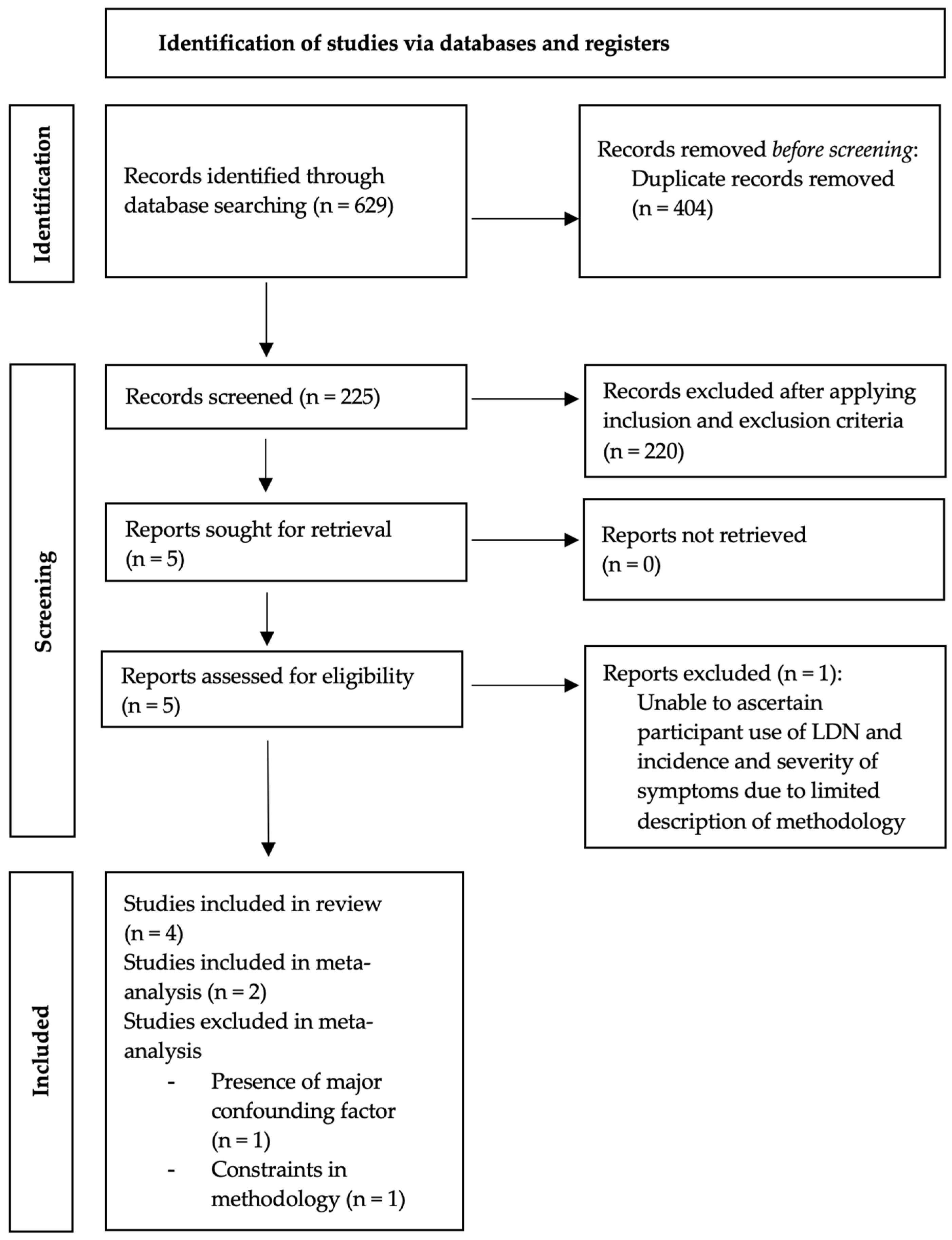
2.1. Search Strategy and Study Selection
2.2. Risk-of-Bias Assessment
2.3. Data Synthesis and Analysis
3. Results
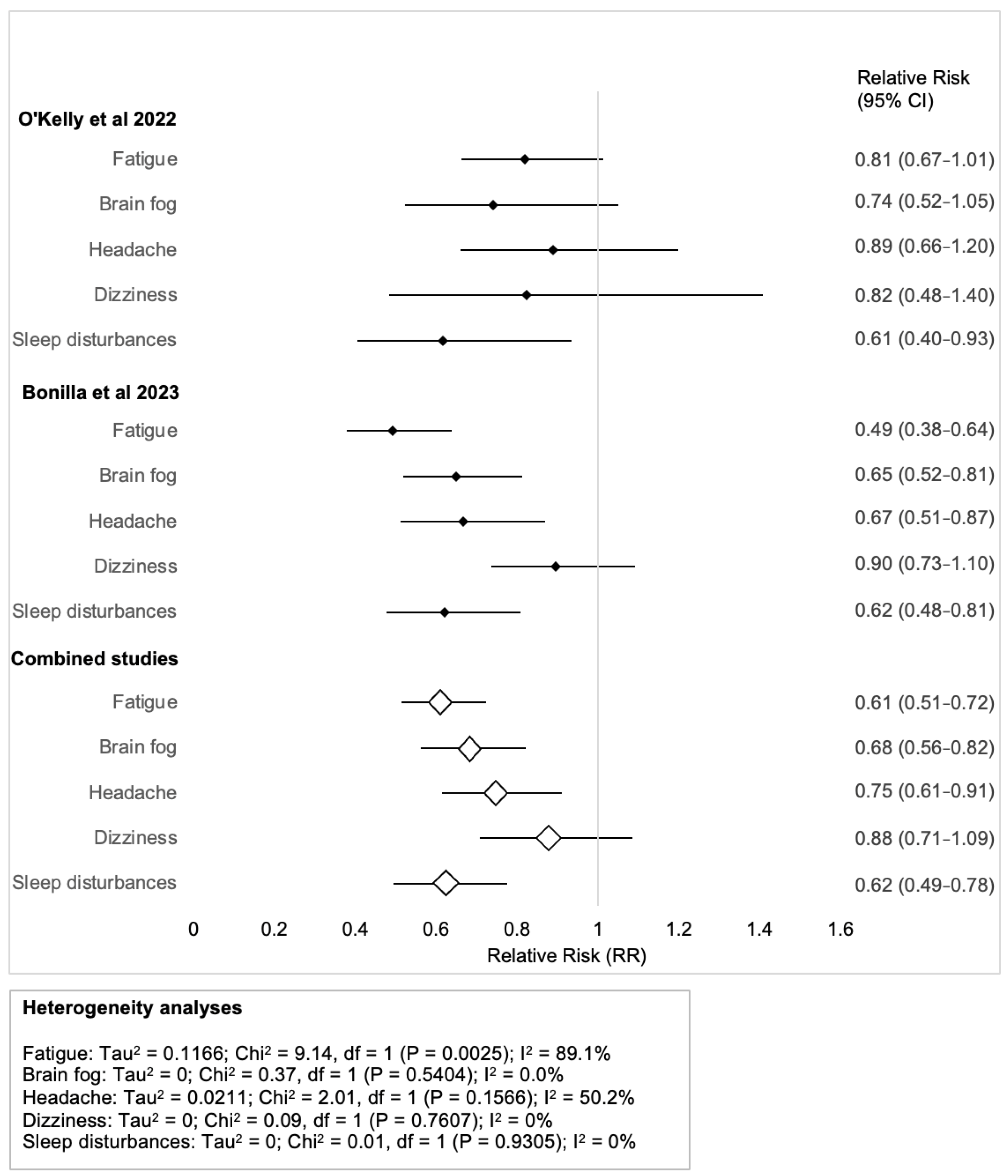
3.1. Meta-Analysis
3.2. Adverse Effects
4. Discussion
Implications of Systematic Review
5. Limitations
5.1. Systematic Review Design
5.2. Small Sample Size and Lack of Control Groups
5.3. Dose–Response Relationship and Onset of Symptom Improvement
5.4. Future Research
6. Conclusions
Supplementary Materials
Author Contributions
Funding
Institutional Review Board Statement
Informed Consent Statement
Data Availability Statement
Conflicts of Interest
References
- World Health Organisation. Post COVID-19 Condition (Long COVID). World Health Organisation 2022. Available online: https://www.who.int/europe/news-room/fact-sheets/item/post-covid-19-condition (accessed on 9 February 2025).
- Kozłowski, P.; Leszczyńska, A.; Ciepiela, O. Long COVID Definition, Symptoms, Risk Factors, Epidemiology and Autoimmunity: A Narrative Review. Am. J. Med. Open 2024, 11, 100068. [Google Scholar] [CrossRef]
- Pazukhina, E.; Garcia-Gallo, E.; Reyes, L.F.; Kildal, A.B.; Jassat, W.; Dryden, M.; Holter, J.C.; Chatterjee, A.; Gomez, K.; Søraas, A.; et al. Long Covid: A global health issue—A prospective, cohort study set in four continents. BMJ Glob. Health 2024, 9, 15245. [Google Scholar] [CrossRef]
- Costantino, V.; Grafton, Q.; Kompas, T.; Chu, L.; Honeyman, D.; Notaras, A.; MacIntyre, C.R. The public health and economic burden of long COVID in Australia, 2022–2024: A modelling study. Med. J. Aust. 2024, 221, 217–223. [Google Scholar] [CrossRef]
- Wolff Sagy, Y.; Feldhamer, I.; Brammli-Greenberg, S.; Lavie, G. Estimating the economic burden of long-Covid: The additive cost of healthcare utilisation among COVID-19 recoverees in Israel. BMJ Glob. Health 2023, 8, e012588. [Google Scholar] [CrossRef]
- Davis, H.E.; McCorkell, L.; Vogel, J.M.; Topol, E.J. Long COVID: Major findings, mechanisms and recommendations. Nat. Rev. Microbiol. 2023, 21, 133–146. [Google Scholar] [CrossRef]
- Mikkelsen, M.; Abramoff, B. COVID-19: Clinical Presentation and Diagnosis of Adults with Persistent Symptoms Following Acute Illness (“Long COVID”). UpToDate 2025. Available online: https://www.uptodate.com/contents/covid-19-clinical-presentation-and-diagnosis-of-adults-with-persistent-symptoms-following-acute-illness-long-covid/print (accessed on 9 February 2025).
- Mikkelsen, M.; Abramoff, B. COVID-19: Management of Adults with Persistent Symptoms Following Acute Illness (“Long COVID”). UpToDate 2025. Available online: https://www.uptodate.com/contents/covid-19-management-of-adults-with-persistent-symptoms-following-acute-illness-long-covid/print (accessed on 17 February 2025).
- Kenny, G.; Townsend, L.; Savinelli, S.; Mallon, P.W.G. Long COVID: Clinical characteristics, proposed pathogenesis and potential therapeutic targets. Front. Mol. Biosci. 2023, 10, 1157651. [Google Scholar] [CrossRef] [PubMed]
- O’Kelly, B.; Vidal, L.; McHugh, T.; Woo, J.; Avramovic, G.; Lambert, J.S. Safety and efficacy of low dose naltrexone in a long covid cohort; an interventional pre-post study. Brain Behav. Immun. Health 2022, 24, 100485. [Google Scholar] [CrossRef] [PubMed]
- Bonilla, H.; Tian, L.; Marconi, V.C.; Shafer, R.; McComsey, G.A.; Miglis, M.; Yang, P.; Bonilla, A.; Eggert, L.; Geng, L.N. Low-dose naltrexone use for the management of post-acute sequelae of COVID-19. Int. Immunopharmacol. 2023, 124, 110966. [Google Scholar] [CrossRef]
- Aitcheson, N.; Lin, Z.; Tynan, K. Low-dose naltrexone in the treatment of fibromyalgia A systematic review and narrative synthesis. Aust. J. Gen. Pract. 2023, 52, 189–195. [Google Scholar] [CrossRef]
- Younger, J.; Parkitny, L.; McLain, D. The use of low-dose naltrexone (LDN) as a novel anti-inflammatory treatment for chronic pain. Clin. Rheumatol. 2014, 33, 451–459. [Google Scholar] [CrossRef] [PubMed]
- Trofimovitch, D.; Baumrucker, S.J. Pharmacology Update: Low-Dose Naltrexone as a Possible Nonopioid Modality for Some Chronic, Nonmalignant Pain Syndromes. Sage J. 2019, 36, 907–912. [Google Scholar] [CrossRef]
- Toljan, K.; Vrooman, B. Low-Dose Naltrexone (LDN)—Review of Therapeutic Utilization. Med. Sci. 2018, 6, 82. [Google Scholar] [CrossRef]
- Sasso, E.M.; Eaton-Fitch, N.; Smith, P.; Muraki, K.; Marshall-Gradisnik, S. Low-Dose naltrexone restored TRPM3 ion channel function in natural killer cells from long COVID patients. Front. Mol. Biosci. 2025, 12, 1582967. [Google Scholar] [CrossRef]
- Sasso, E.M.; Muraki, K.; Eaton-Fitch, N.; Smith, P.; Lesslar, O.L.; Deed, G.; Marshall-Gradisnik, S. Transient receptor potential melastatin 3 dysfunction in post COVID-19 condition and myalgic encephalomyelitis/chronic fatigue syndrome patients. Mol. Med. 2022, 28, 98. [Google Scholar] [CrossRef] [PubMed]
- Löhn, M.; Wirth, K.J. Potential pathophysiological role of the ion channel TRPM3 in myalgic encephalomyelitis/chronic fatigue syndrome (ME/CFS) and the therapeutic effect of low-dose naltrexone. J. Transl. Med. 2024, 22, 630. [Google Scholar] [CrossRef]
- Tamariz, L.; Bast, E.; Klimas, N.; Palacio, A. Low-dose Naltrexone Improves post–COVID-19 condition Symptoms. Clin. Ther. 2024, 46, e101–e106. [Google Scholar] [CrossRef]
- Isman, A.; Nyquist, A.; Strecker, B.; Harinath, G.; Lee, V.; Zhang, X.; Zalzala, S. Low-dose naltrexone and NAD+ for the treatment of patients with persistent fatigue symptoms after COVID-19. Brain Behav. Immun. Health 2024, 36, 100733. [Google Scholar] [CrossRef]
- Schünemann, H.J.; Neumann, I.; Hultcrantz, M.; Brignardello-Petersen, R.; Zeng, L.; Murad, M.H.; Izcovich, A.; Morgano, G.P.; Baldeh, T.; Santesso, N.; et al. GRADE guidance 35: Update on rating imprecision for assessing contextualized certainty of evidence and making decisions. J. Clin. Epidemiol. 2022, 150, 225–242. [Google Scholar] [CrossRef] [PubMed]
- Bruun-Plesner, K.; Blichfeldt-Eckhardt, M.R.; Vaegter, H.B.; Lauridsen, J.T.; Amris, K.; Toft, P. Low-Dose Naltrexone for the Treatment of Fibromyalgia: Investigation of Dose–Response Relationships. Pain Med. 2020, 21, 2253–2261. [Google Scholar] [CrossRef] [PubMed]
- Polo, O.; Pesonen, P.; Tuominen, E. Low-dose naltrexone in the treatment of myalgic encephalomyelitis/chronic fatigue syndrome (ME/CFS). Fatigue 2019, 7, 207–217. [Google Scholar] [CrossRef]
- McLaughlin, P.J.; Odom, L.B.; Arnett, P.A.; Orehek, S.; Thomas, G.A.; Zagon, I.S. Low-dose naltrexone reduced anxiety in persons with multiple sclerosis during the COVID-19 pandemic. Int. Immunopharmacol. 2022, 113, 109438. [Google Scholar] [CrossRef] [PubMed]
- Hurt, R.T.; Yadav, S.; Schroeder, D.R.; Croghan, I.T.; Mueller, M.R.; Grach, S.L.; Aakre, C.A.; Gilman, E.A.; Stephenson, C.R.; Overgaard, J.; et al. Longitudinal Progression of Patients with Long COVID Treated in a Post-COVID Clinic: A Cross-Sectional Survey. J. Prim. Care Community Health 2024, 15, 21501319241258671. [Google Scholar] [CrossRef] [PubMed]
- Drugbank. Naltrexone: Uses, Interactions, Mechanism of Action | DrugBank Online. Drugbank n.d. Available online: https://go.drugbank.com/drugs/DB00704 (accessed on 20 February 2025).
- Shimonovich, M.; Pearce, A.; Thomson, H.; Keyes, K.; Katikireddi, S.V. Assessing causality in epidemiology: Revisiting Bradford Hill to incorporate developments in causal thinking. Eur. J. Epidemiol. 2021, 36, 873–887. [Google Scholar] [CrossRef] [PubMed]
- Naik, H.; Cooke, E.; Boulter, T.; Dyer, R.; Bone, J.N.; Tsai, M.; Cristobal, J.; McKay, R.J.; Song, X.; Nacul, L. Low-dose naltrexone for post-COVID fatigue syndrome: A study protocol for a double-blind, randomised trial in British Columbia. BMJ Open 2024, 14, e085272. [Google Scholar] [CrossRef]
- Griffith University. Low Dose Naltrexone in Myalgic Encephalomyelitis/Chronic Fatigue Syndrome (ME/CFS) and Long Coronavirus Disease (Long COVID) Symptoms. Australian New Zealand Critical Trials Registry 2025. Available online: https://anzctr.org.au/Trial/Registration/TrialReview.aspx?id=387311&showOriginal=true&isReview=true (accessed on 14 February 2024).
- Shehaby, E.; El Shehaby, D.M.; Mohammed, M.K.; Ebrahem, N.E.; Abd El-Azim, M.M.; Sayed, I.G.; Eweda, S.A. The emerging therapeutic role of some pharmacological antidotes in management of COVID-19. Egypt. J. Bronchol. 2022, 16, 5. [Google Scholar] [CrossRef]


| Inclusion Criteria | Exclusion Criteria |
|---|---|
| Patients 18 years of age or above with documented (clinical or biochemical) evidence of COVID-19 infection | Patients under 18 years of age |
| Persistent symptoms attributed to previous COVID-19 infection for 28 days or more | Patients currently infected with COVID-19 |
| Use of oral LDN |
| Authors | Design and Sample Size | Oral LDN Dose and Follow-Up Periods | Outcomes |
|---|---|---|---|
| O’Kelly et al., 2022 [10] * | Prospective interventional pre–post cohort study, n = 36 | 1–3 mg/day, 2–3 months | Significant improvement in perception of recovery, limitations in activities of daily living, energy levels, intensity, pain/discomfort, concentration difficulties, and sleep disturbances. |
| Statistically significant incidence reduction in chest pain/tightness, arthralgia, coughing, low mood, and personality changes (p < 0.05). | |||
| Subjects (n = 2) dropped out due to gastrointestinal upset and fatigue. | |||
| Bonilla et al., 2023 [11] * | Retrospective cohort study, n = 59 | 0.5–6 mg/day, 31–540 days | Significant reduction in the intensity of fatigue, sleep disturbances, and post-exertional malaise (p < 0.05). |
| No statistical differences in symptom incidence and intensity between subjects with long COVID symptoms < 365 days versus ≥ 365 days. | |||
| Tamariz et al., 2024 [19] | Retrospective cohort study, n = 24 | 1.5–4.5 mg/day, unknown | Statistically significant improvement in dyspnoea, brain fog, pain, fatigue provided as hazard ratios (p < 0.05). |
| Isman et al., 2024 [20] | Interventional single-arm study, n = 31 | 1.125 mg/day (days 0–4), 2.25 mg/day (days 5–8), 4.5 mg/day (day 9 onwards) | Statistically significant improvement in responses to total short-form 36 questionnaire and Chalder Fatigue Scale. |
| Adverse Effects | Frequency |
|---|---|
| Headache | 10% |
| Sleep disturbances | 9% |
| Light-headedness | 8.5% |
| Gastrointestinal disturbances | 5% |
| Brain fog | 5% |
| Fatigue | 2.5% |
Disclaimer/Publisher’s Note: The statements, opinions and data contained in all publications are solely those of the individual author(s) and contributor(s) and not of MDPI and/or the editor(s). MDPI and/or the editor(s) disclaim responsibility for any injury to people or property resulting from any ideas, methods, instructions or products referred to in the content. |
© 2025 by the authors. Licensee MDPI, Basel, Switzerland. This article is an open access article distributed under the terms and conditions of the Creative Commons Attribution (CC BY) license (https://creativecommons.org/licenses/by/4.0/).
Share and Cite
Du, A.; Nguyen, A.D.K. Does Low-Dose Oral Naltrexone Alleviate Symptoms of Long COVID? A Systematic Review and Meta-Analysis. COVID 2025, 5, 198. https://doi.org/10.3390/covid5120198
Du A, Nguyen ADK. Does Low-Dose Oral Naltrexone Alleviate Symptoms of Long COVID? A Systematic Review and Meta-Analysis. COVID. 2025; 5(12):198. https://doi.org/10.3390/covid5120198
Chicago/Turabian StyleDu, Aung, and Andrew Dang Khai Nguyen. 2025. "Does Low-Dose Oral Naltrexone Alleviate Symptoms of Long COVID? A Systematic Review and Meta-Analysis" COVID 5, no. 12: 198. https://doi.org/10.3390/covid5120198
APA StyleDu, A., & Nguyen, A. D. K. (2025). Does Low-Dose Oral Naltrexone Alleviate Symptoms of Long COVID? A Systematic Review and Meta-Analysis. COVID, 5(12), 198. https://doi.org/10.3390/covid5120198