1. Introduction
Platform-based work has become an increasingly visible feature of everyday life in cities across both developed and developing economies. Food delivery couriers, ride-hailing drivers, and digital freelancers are now integral to how individuals access goods and services, often through seamless digital interfaces that emphasize convenience and efficiency. Yet, despite their growing presence and social relevance, the working conditions under which platform workers perform their labor remain largely opaque to the general public and insufficiently understood in empirical research. Behind the apparent flexibility and autonomy promoted by digital labor platforms lie work arrangements frequently characterized by economic insecurity, algorithmic control, and limited opportunities for worker participation [
1,
2].
These developments have intensified scholarly interest in the quality of work in the gig economy and, more broadly, in the extent to which platform-based labor can meet fundamental standards of decent work. The Psychology of Working Theory (PWT [
3]) provides a particularly useful framework for addressing these questions. PWT conceptualizes decent work as a set of working conditions that fulfill basic human needs, including safe working environments, adequate compensation, sufficient rest, and organizational values that respect personal and social life. Importantly, decent work is theorized not merely as a normative ideal but as a psychological resource that supports well-being, work satisfaction, and sustainable engagement, especially among workers facing structural constraints and labor market vulnerability [
4,
5].
At the same time, platform work is embedded in broader institutional and regulatory contexts that shape the extent to which such conditions can be achieved. In many settings, including Central and Eastern Europe, platform workers often operate in labor markets characterized by comparatively weaker employment protections and higher levels of economic insecurity. In Hungary, recent regulatory changes affecting self-employment schemes, such as the reform of the KATA tax system, have sparked significant public debate and mobilization among platform workers, highlighting ongoing tensions around employment status, income stability, and access to social protections. These contextual dynamics underscore the importance of examining how workers interpret and evaluate their working conditions within specific institutional environments. This context has been increasingly discussed in recent research on platform work, labor regulation, and welfare state dynamics in Hungary and across Europe [
6,
7].
Within this broader framework, understanding how perceptions of decent work are formed is a critical yet underexplored issue in the context of platform labor. Organizational research on employee voice offers valuable insights in this regard. Voice refers to workers’ discretionary communication of ideas, concerns, or suggestions intended to improve work-related conditions [
8]. A substantial body of research in traditional employment settings shows that voice is associated with more favorable perceptions of the work environment and with desirable outcomes such as job satisfaction, commitment, and retention, as well as with lower withdrawal intentions [
8,
9]. For platform workers, whose employment relationships are often individualized and mediated by algorithms rather than direct human supervision, opportunities to express voice may play an especially important role in shaping whether work is perceived as fair, dignified, and sustainable.
Emerging evidence suggests that when workers perceive their work as meeting decent work standards, they report higher levels of job satisfaction and psychological well-being and lower levels of turnover intention and perceived precarity [
10,
11]. However, empirical research integrating voice, decent work perceptions, and worker outcomes remains limited, particularly in non-standard forms of employment such as platform work. Moreover, recent reviews have highlighted that platform workers are still underrepresented in the decent work literature and that most empirical studies rely heavily on samples from Western Europe, North America, or global online labor markets, leaving other regions largely unexplored [
12,
13].
This lack of geographical and occupational diversity is consequential, as platform work is highly heterogeneous and deeply embedded in national labor market institutions, welfare regimes, and economic conditions. Central and Eastern European countries, in particular, have received comparatively little attention, despite the rapid expansion of platform-mediated labor and relatively high levels of employment insecurity in these contexts. Addressing this gap is essential for advancing a more globally inclusive understanding of decent work and for testing whether core propositions of PWT generalize beyond well-studied regions and standard employment arrangements.
Against this backdrop, the present study examines how platform worker voice relates to key worker outcomes through perceptions of decent work and whether these processes vary across types of digital labor platforms. More specifically, the study tests (1) a mediation model in which platform worker voice is associated with job satisfaction, psychological well-being, turnover intention, and perceived job precarity through perceptions of decent work, and (2) a moderated mediation model in which platform type conditions both the formation of decent work perceptions and their associations with worker outcomes.
By doing so, this study makes three main contributions. First, it extends the Psychology of Working Theory to platform-based employment in an underexplored regional context, providing empirical evidence from Hungary. Second, it identifies platform worker voice as a key antecedent of decent work perceptions, thereby clarifying how workers actively construct evaluations of work quality in digitally mediated environments. Third, it demonstrates that the implications of decent work are contingent on structural differences across platform types, highlighting when and for whom decent work matters most. Beyond its theoretical contributions, the study offers practical insights for platform governance and labor policy aimed at improving the quality and sustainability of digital work.
2. Literature Review
2.1. Decent Work as a Psychological Resource in Platform-Based Employment
The rapid expansion of platform-mediated labor has intensified scholarly concern regarding the quality of work experienced by individuals operating outside standard employment relationships. The Psychology of Working Theory [
3] offers a comprehensive framework for examining these concerns by conceptualizing decent work as a set of working conditions that fulfill fundamental human needs. These conditions include physically and psychologically safe environments, adequate compensation, sufficient rest and free time, and organizational values that respect personal, family, and social life. Importantly, the theory emphasizes that decent work is not merely a normative benchmark but a psychologically meaningful resource that supports well-being, satisfaction, and sustainable participation in work, particularly among workers facing structural constraints and limited labor market power.
In the context of platform work, where employment protections are often weak and work is organized through opaque algorithmic systems, access to decent work conditions cannot be taken for granted. Empirical research has consistently shown that higher perceptions of decent work are associated with greater job satisfaction and psychological well-being, as well as with lower turnover intention and perceived employment precarity [
10,
11]. However, the mechanisms through which platform workers come to perceive their work as decent remain insufficiently understood, especially in labor markets characterized by heightened economic vulnerability. Addressing this gap requires greater attention to the processes through which workers interpret and evaluate their working conditions.
2.2. Platform Worker Voice as an Antecedent of Decent Work Perceptions
Organizational research on worker voice provides a useful lens for examining how perceptions of decent work may be shaped in platform-based employment. Voice refers to workers’ discretionary communication of ideas, concerns, or suggestions intended to improve work-related conditions [
8]. In traditional organizational settings, voice has been shown to foster perceptions of fairness, support, and inclusion, thereby contributing to more positive evaluations of the work environment and to desirable attitudinal and behavioral outcomes [
8,
9].
For platform workers, opportunities for voice are often limited, informal, or unevenly distributed, given the individualized and digitally mediated nature of platform governance. Nonetheless, when such opportunities exist, they may be particularly consequential. The ability to raise concerns, provide feedback, or participate in discussions about platform policies may signal recognition and respect, enhancing the likelihood that workers perceive their working conditions as meeting decent work standards. From the perspective of the Psychology of Working Theory, voice can therefore be conceptualized as a key mechanism through which workers actively negotiate and construct perceptions of decent work, even in structurally constrained employment arrangements. In this sense, platform worker voice is expected to be positively associated with perceptions of decent work.
2.3. Heterogeneity Across Platform Types and the Role of Context
Platform work is far from homogeneous. Different types of platforms entail distinct configurations of autonomy, control, income dependence, and exposure to risk [
2]. Delivery workers, such as food couriers, typically experience high levels of algorithmic control, intense time pressure, and physical demands, alongside limited opportunities for upward mobility [
1]. Transport workers, including ride-hailing drivers, often operate under similar algorithmic systems but may enjoy slightly greater flexibility in scheduling and task acceptance. In contrast, professional service platform workers, such as freelancers, generally report higher levels of autonomy, skill utilization, and bargaining power [
14].
These structural differences suggest that the role and impact of worker voice may vary substantially across platform types. For delivery workers operating in highly constrained and precarious conditions, opportunities for voice may represent rare chances to influence their work environment. Even modest levels of voice may therefore substantially enhance perceptions that working conditions align with decent work principles. Conversely, for professional service workers who already possess considerable autonomy and labor market mobility, additional voice opportunities may yield diminishing returns. Transport workers are likely to occupy an intermediate position between these two extremes.
The importance of such distinctions becomes particularly salient when considering national and institutional contexts. In countries such as Hungary, platform work has expanded rapidly within labor markets characterized by relatively high employment insecurity and more limited welfare protections compared to Western European contexts. These structural conditions may amplify the relevance of both voice and decent work perceptions, reinforcing the importance of examining how these processes unfold across different types of platform work.
2.4. Decent Work Perceptions and Worker Outcomes
Beyond their formation, perceptions of decent work are expected to have important implications for worker outcomes. The Conservation of Resources theory [
15] posits that resources acquire greater value when individuals face resource scarcity. In highly precarious forms of platform work, decent work perceptions may function as critical psychological resources that provide dignity, security, and meaning in otherwise unstable work environments. As a result, perceiving one’s work as decent is expected to be associated with higher job satisfaction and psychological well-being, and with lower turnover intention and perceived job precarity.
In contrast, workers who engage in platform work as a supplementary activity and maintain diverse income sources may be less reliant on platform-specific conditions for their overall well-being and career decisions [
14]. These considerations further underscore the importance of accounting for platform type when examining the consequences of decent work perceptions.
2.5. Integrating Mediation and Moderation: A Conditional Process Perspective
Integrating the arguments above, this study proposes a conditional process model in which platform worker voice influences worker outcomes indirectly through perceptions of decent work, with platform type shaping both the formation of these perceptions and their consequences. Specifically, platform type is expected to moderate the association between platform worker voice and perceived decent work, as well as the associations between perceived decent work and worker outcomes. In turn, these moderation processes imply that the indirect effects linking voice to outcomes through decent work may vary across platform types.
This integrated perspective suggests that identical levels of voice may generate markedly different returns depending on the structural conditions under which platform work is performed, with the strongest benefits expected to accrue to workers in more precarious arrangements.
2.6. Hypotheses Development
Based on the Psychology of Working Theory and prior research on organizational voice, this study examines whether platform worker voice is associated with perceptions of decent work and whether these perceptions help explain key worker outcomes in platform-based employment.
H1. Platform worker voice is positively associated with perceptions of decent work.
Extensive evidence indicates that perceiving work as decent is associated with more favorable worker outcomes and reduced withdrawal tendencies. Accordingly, perceptions of decent work are expected to be related to both positive and negative outcomes in platform work.
H2a–H2d. Perceptions of decent work are positively associated with (a) job satisfaction and (b) psychological well-being, and negatively associated with (c) turnover intention and (d) perceived job precarity.
Integrating these relationships, the present study proposes that perceptions of decent work function as a mediating mechanism linking platform worker voice to worker outcomes.
H3a–H3d. Perceptions of decent work mediate the relationships between platform worker voice and (a) job satisfaction, (b) psychological well-being, (c) turnover intention, and (d) perceived job precarity.
Given the heterogeneity of platform-based employment, the strength of these relationships is unlikely to be uniform across platform types. Differences in algorithmic control, autonomy, and income dependence suggest that the role of voice and decent work may vary across delivery, transport, and professional service platforms.
H4. Platform type moderates the positive association between platform worker voice and perceptions of decent work, such that this association is strongest among delivery workers, intermediate among transport workers, and weakest among professional service workers.
Platform type may also condition the extent to which perceptions of decent work translate into worker outcomes.
H5a–H5d. Platform type moderates the associations between perceptions of decent work and (a) job satisfaction, (b) psychological well-being, (c) turnover intention, and (d) perceived job precarity, with stronger effects observed among delivery workers than among transport and professional service workers.
Finally, integrating the proposed mediation and moderation processes, this study advances a conditional process perspective.
H6. Platform type moderates the indirect effects of platform worker voice on worker outcomes through perceptions of decent work, such that the indirect effects are strongest among delivery workers, weaker among transport workers, and weakest among professional service workers.
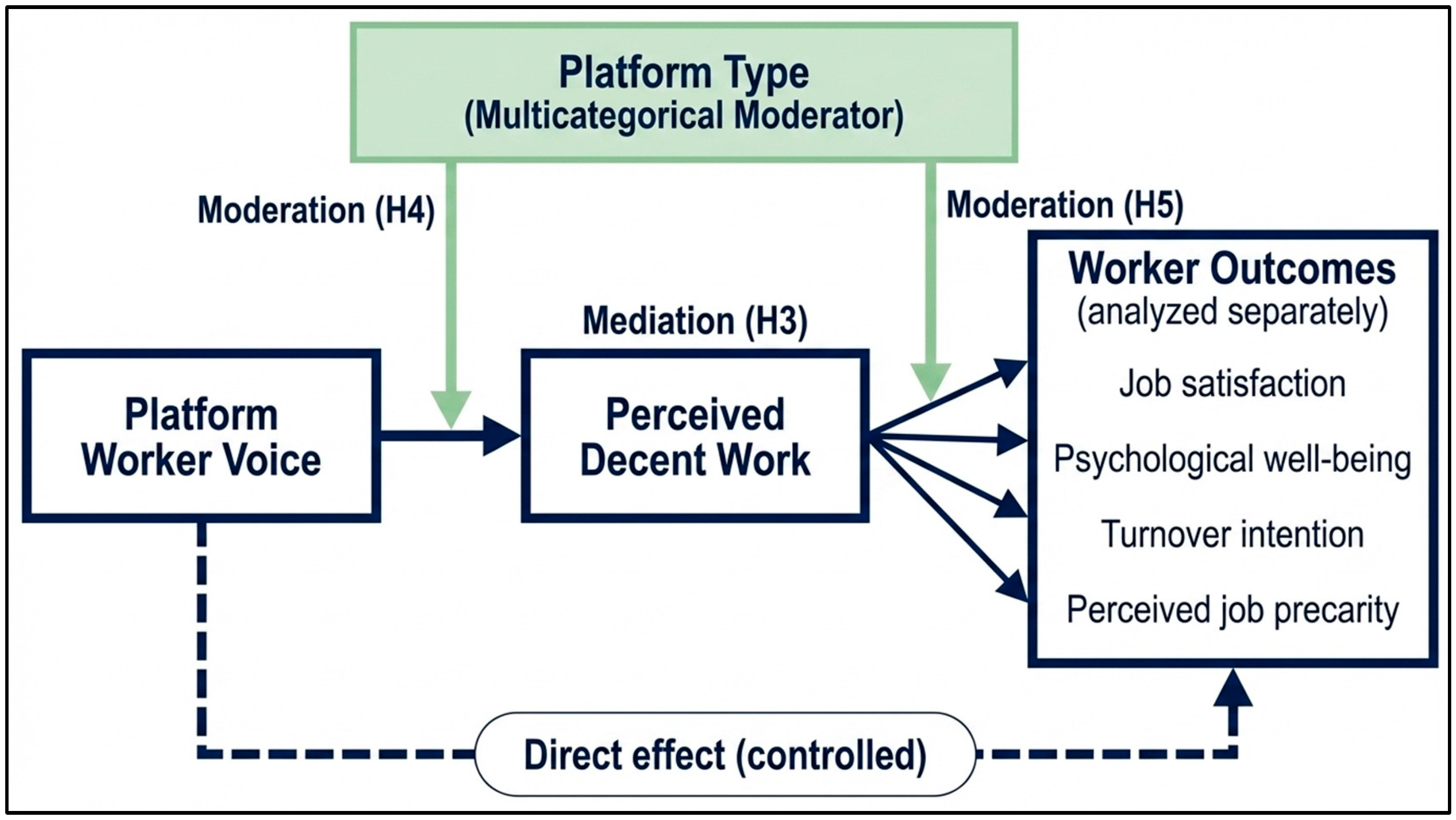
The conceptual model guiding the present study is depicted in
Figure 1. The model proposes that platform worker voice is associated with worker outcomes through perceptions of decent work, while platform type moderates both the association between voice and decent work and the associations between decent work and worker outcomes. This integrated framework reflects a conditional process model combining mediation and moderation.
Platform worker voice is proposed to be associated with worker outcomes through perceptions of decent work. Platform type (delivery, transport, and professional service platforms) is modeled as a multicategorical moderator of both the association between platform worker voice and perceived decent work and the associations between perceived decent work and worker outcomes. The model represents a moderated mediation framework. The dashed line indicates the direct effect of platform worker voice on worker outcomes, which is controlled for in the analyses.
3. Method
3.1. Participants
A total of 856 platform workers participated in the study. The sample was predominantly male (59.7%, n = 511), followed by female participants (38.2%, n = 327), and a smaller proportion who identified as other or non-binary (2.1%, n = 18). Most participants resided in Budapest (70.6%, n = 604), while 29.4% (n = 252) lived in other cities.
In terms of platform sector, 55.5% of participants worked in delivery services (food or package delivery) (n = 475), 31.9% in transport services (ride-hailing or taxi-like services) (n = 273), and 12.6% in professional services (freelance or remote work) (n = 108).
Participants had a mean age of 33.32 years (SD = 9.92; range = 18–55). On average, they reported working 31.19 h per week (SD = 10.54; range = 10–60), earning a mean monthly income of 161,715.70 Hungarian forints (SD = 22,043.90; range = 150,000–298,704), and having 1.95 years of experience in platform work (SD = 1.38; range = 0.5–8). Economic dependency on platform work averaged 68.80% (SD = 20.21; range = 20–100).
3.2. Procedure
The study protocol was reviewed and approved by the Ethics Committee the Universidad Complutense de Madrid (approval certificate dated 28 March 2025). All procedures were conducted in accordance with the ethical principles outlined in the Declaration of Helsinki for research involving human participants. Prior to participation, respondents were informed about the voluntary nature of the study, their right to withdraw at any time without penalty, and the anonymous treatment of their responses. Informed consent was obtained electronically from all participants before they proceeded to the main questionnaire.
This study employed a cross-sectional survey design. Data were collected in Hungary, primarily in Budapest, in collaboration with Corvinus University of Budapest. The survey was administered online using the Qualtrics platform and was optimized for mobile devices, allowing participants to complete the questionnaire using their smartphones.
Participants were recruited using a convenience sampling strategy. The survey link was disseminated through multiple channels, including social media platforms (e.g., Facebook and LinkedIn) and networks and associations representing platform workers and advocating for their labor rights. Due to the broad and open dissemination of the survey link, the specific recruitment source for each individual respondent was not systematically tracked.
Before accessing the main questionnaire, respondents completed an initial screening stage designed to ensure eligibility for participation. Specifically, participants were required to answer three screening questions confirming that they met the inclusion criteria. Only individuals who fulfilled these criteria were granted access to the full survey.
Data collection took place between 1 May and 30 May 2025. Given the fully online nature of the study, the exact timing of participation—and thus the provision of informed consent—varied across respondents and corresponded to the moment each participant completed the questionnaire.
3.3. Measures
All study variables were assessed using self-report measures administered in Hungarian. Original English-language scales were translated into Hungarian following a standard back-translation procedure. First, all instruments were translated by a professional bilingual translator who was not familiar with the study objectives or the theoretical constructs involved. Subsequently, an independent bilingual researcher, a member of the research team, back-translated the items into English. The original and back-translated versions were then compared, and minor discrepancies were discussed and resolved to ensure semantic equivalence and conceptual accuracy.
Unless otherwise indicated, items were rated on a 5-point Likert-type scale, with higher scores reflecting higher levels of the construct. Composite scores were computed by averaging item responses, such that higher values indicated greater endorsement of each construct. The full questionnaire is available upon request for replication purposes.
Platform worker voice was measured using six items adapted from the Employee Voice Scale developed by Van Dyne and LePine [
9], reworded to fit the context of platform-based work. The items capture workers’ proactive communication of concerns, suggestions, and ideas aimed at improving working conditions and platform practices (e.g., “I speak up to the platform about problems or concerns regarding working conditions”). Responses ranged from 1 (strongly disagree) to 5 (strongly agree). Internal consistency was good (Cronbach’s α = 0.85). A mean score was computed, with higher scores indicating greater perceived voice.
Perceptions of decent work were assessed using the 15-item Decent Work Scale developed by Duffy et al. [
5]. This scale measures core dimensions of decent work, including safe working conditions, adequate compensation, sufficient rest and free time, organizational values aligned with personal and family values, and access to healthcare. Participants indicated their agreement with each statement on a 5-point Likert scale ranging from 1 (strongly disagree) to 5 (strongly agree). The scale demonstrated excellent internal consistency in the present sample (Cronbach’s α = 0.94). A composite mean score was calculated, with higher values reflecting more favorable perceptions of decent work.
Job satisfaction was measured using a brief three-item scale commonly employed in organizational research [
16]. Items assessed participants’ overall satisfaction and positive evaluation of their platform work (e.g., “All in all, I am satisfied with my job on this platform”). Responses ranged from 1 (strongly disagree) to 5 (strongly agree). The scale showed acceptable reliability (Cronbach’s α = 0.78). Item responses were averaged, with higher scores indicating greater job satisfaction.
Psychological well-being was assessed using an adapted version of the WHO-5 Well-Being Index. The five items captured positive affect and vitality experienced during the previous two weeks (e.g., “I have felt cheerful and in good spirits”). For consistency with the other measures, items were rated on a 5-point scale ranging from 1 (at no time) to 5 (all of the time). The scale demonstrated good internal consistency (Cronbach’s α = 0.85). A mean score was computed, with higher values indicating higher levels of psychological well-being.
Turnover intention was measured using three items adapted from Cammann et al. [
17], assessing participants’ thoughts and intentions regarding leaving platform work (e.g., “I often think about quitting working on this platform”). Responses ranged from 1 (strongly disagree) to 5 (strongly agree). Reliability was acceptable (Cronbach’s α = 0.75). A composite mean score was calculated, with higher scores indicating stronger intentions to discontinue platform work.
Perceived job precarity was assessed using six items adapted from the job precarity literature and tailored to platform-based employment. Items captured perceptions of instability, insecurity, and vulnerability associated with platform work (e.g., “My work situation on this platform feels unstable”). Responses were provided on a 5-point Likert scale ranging from 1 (strongly disagree) to 5 (strongly agree). The scale demonstrated good internal consistency (Cronbach’s α = 0.86). A mean score was computed, with higher values indicating greater perceived job precarity.
Consistent with prior research on platform work and decent work, several sociodemographic and work-related variables were included as control variables in the analyses. These included age (in years), gender, city of primary work (Budapest vs. other cities), average weekly working hours on platforms, monthly income derived from platform work, years of experience in the platform economy, and economic dependency on platform work (percentage of total personal income derived from platform-based activities).
3.4. Data Analyses
All analyses were conducted using IBM SPSS Statistics version 29 and the PROCESS macro (version 5.0;). Composite scores were computed by averaging the items of each scale. Continuous predictors and covariates were mean-centered prior to analysis.
Descriptive statistics, zero-order correlations, and internal consistency coefficients (Cronbach’s alpha) were computed for all study variables. Average weekly working hours, monthly income from platform work, and city of work (capital city vs. other cities) were included as covariates in all models.
To test the proposed hypotheses, a series of regression-based conditional process analyses were conducted using PROCESS 5.0. First, simple mediation hypotheses (H1–H3) were examined using PROCESS Model 4, which estimates the indirect effect of platform worker voice on worker outcomes through perceptions of decent work.
Next, first-stage moderation (H4) was tested using PROCESS Model 7, which assesses whether the association between platform worker voice and perceptions of decent work varies as a function of platform type. Platform type was specified as a multicategorical moderator and dummy coded, with professional service platforms as the reference category.
Second-stage moderation (H5) and conditional indirect effects (H6) were tested using PROCESS Model 14. This model examines whether the associations between perceptions of decent work and worker outcomes are moderated by platform type and whether the indirect effects of platform worker voice on outcomes through perceptions of decent work vary across platform types.
Indirect and conditional indirect effects were estimated using bias-corrected bootstrap confidence intervals based on 5000 resamples. Effects were considered statistically significant when the 95% confidence interval did not include zero.
4. Results
4.1. Measurement Properties and Construct Validity
To further examine the psychometric properties of the study measures and address potential concerns regarding construct validity, a confirmatory factor analysis (CFA) was conducted including all substantive items. The results indicated that all items loaded significantly on their intended latent factors, with standardized factor loadings ranging from 0.68 to 0.87, providing strong evidence of convergent validity.
Internal consistency was satisfactory to excellent across all constructs. Cronbach’s alpha values ranged from 0.75 to 0.94, and composite reliability coefficients (McDonald’s ω) ranged from 0.86 to 0.95. In addition, average variance extracted (AVE) values exceeded the recommended threshold of 0.50 for all constructs, further supporting convergent validity.
Discriminant validity was assessed using the heterotrait–monotrait ratio of correlations (HTMT). All HTMT values were well below the conservative cutoff of 0.85, indicating that the constructs are empirically distinct.
Taken together, these findings provide robust evidence for the reliability, convergent validity, and discriminant validity of the measures used in this study. In addition, the pattern of results suggests that common method bias is unlikely to account for the observed relationships among the study variables.
4.2. Common Method Variance
Given that all study variables were assessed using self-report measures collected from a single source at one point in time, the potential influence of common method variance (CMV) was carefully considered. To mitigate and assess its impact, both procedural and statistical remedies were implemented.
At the procedural level, participants were assured of the anonymity and confidentiality of their responses and informed that there were no right or wrong answers, thereby reducing evaluation apprehension and social desirability bias. The survey was administered online, allowing respondents to complete the questionnaire privately and at their own pace. In addition, well-validated scales with clear and concise item wording were used, and the questionnaire captured both positive and negative associations across variables, reducing the likelihood of consistency-driven responding.
At the statistical level, CMV was examined using Harman’s single-factor test. An exploratory factor analysis including all substantive items indicated that the first unrotated factor did not account for the majority of the total variance, suggesting that no single factor dominated the covariance structure of the measures.
Taken together, these findings suggest that common method variance is unlikely to represent a major threat to the validity of the observed relationships. Although CMV cannot be entirely ruled out given the study design, the combination of procedural precautions and statistical evidence provides reasonable confidence in the robustness of the results.
4.3. Descriptive Statistics and Correlations
Table 1 presents the descriptive statistics and zero-order correlations among all study variables. On average, participants reported moderate levels of platform worker voice and perceptions of decent work. Mean levels of job satisfaction and psychological well-being were also moderate, whereas turnover intention and perceived job precarity were slightly above the scale midpoint.
As shown in
Table 1, platform worker voice was positively and moderately associated with perceptions of decent work and showed weaker but statistically significant positive associations with job satisfaction and psychological well-being. In contrast, platform worker voice was negatively associated with both turnover intention and perceived job precarity.
Perceptions of decent work were strongly and positively related to job satisfaction and psychological well-being, and strongly and negatively related to turnover intention and perceived job precarity. In addition, job satisfaction and psychological well-being were negatively correlated with both turnover intention and perceived job precarity, as expected.
4.5. First-Stage Moderation Analyses
Hypothesis 4 proposed that platform type would moderate the positive association between platform worker voice and perceptions of decent work, such that this association would be strongest among delivery workers, intermediate among transport workers, and weakest among professional service workers.
Results indicated that platform worker voice was positively and significantly associated with perceptions of decent work (b = 0.51,
p < 0.001; see
Table 3). However, the interaction terms between platform worker voice and platform type were not statistically significant. Specifically, neither the interaction with transport platforms nor the interaction with professional service platforms reached statistical significance.
Consistent with these findings, the overall test of the interaction was not significant (ΔR
2 = 0.004, F(2, 846) = 1.90,
p = 0.15; see
Table 3). These results indicate that the strength of the association between platform worker voice and perceptions of decent work does not differ significantly across platform types. Accordingly, Hypothesis 4 was not supported.
4.6. Second-Stage Moderation and Moderated Mediation Analyses
Hypotheses 5a–5d examined whether platform type moderates the associations between perceptions of decent work and worker outcomes. In addition, Hypothesis 6 proposed that platform type moderates the indirect effects of platform worker voice on outcomes through perceptions of decent work.
These hypotheses were tested using PROCESS Model 14 with 5000 bootstrap samples. In this model, platform type was specified as a multicategorical moderator of the second-stage paths linking perceptions of decent work to worker outcomes. Delivery workers were used as the reference category, allowing for comparisons with transport and professional service platform workers.
4.7. Job Satisfaction
Supporting Hypothesis 5a, platform type significantly moderated the association between perceptions of decent work and job satisfaction (ΔR
2 = 0.009, F(2, 845) = 4.81,
p = 0.008; see
Table 4). Specifically, the positive association between decent work and job satisfaction was significantly stronger among delivery workers than among both transport workers and professional service workers.
Consistent with Hypothesis 6, conditional indirect effects indicated that the indirect association between platform worker voice and job satisfaction via perceptions of decent work varied across platform types. As shown in
Table 4, the indirect effect was strongest among delivery workers and significantly weaker among both transport and professional service workers. The indices of moderated mediation were statistically significant for both comparisons, providing support for moderated mediation in the case of job satisfaction.
4.8. Psychological Well-Being
The interaction between perceptions of decent work and platform type in predicting psychological well-being was marginally significant (ΔR
2 = 0.005, F(2, 845) = 2.84,
p = 0.059; see
Table 5). Examination of the interaction terms indicated that the positive association between decent work and psychological well-being was significantly weaker among professional service workers than among delivery workers. In contrast, no significant differences were observed between delivery and transport workers. Accordingly, Hypothesis 5b received partial support.
Conditional indirect effects followed a similar pattern. As shown in
Table 5, the indirect effect of platform worker voice on psychological well-being through perceptions of decent work was significantly weaker among professional service workers than among delivery workers, whereas no significant differences were found between delivery and transport workers. These results provide partial support for Hypothesis 6 with respect to psychological well-being.
4.9. Turnover Intention
Supporting Hypothesis 5c, platform type significantly moderated the association between perceptions of decent work and turnover intention (ΔR
2 = 0.008, F(2, 845) = 3.98,
p = 0.019; see
Table 6). Specifically, the negative association between decent work and turnover intention was significantly stronger among delivery workers than among transport workers. No significant differences were observed between delivery and professional service workers.
Conditional indirect effects showed a similar pattern. As presented in
Table 6, the indirect association between platform worker voice and turnover intention via perceptions of decent work was significantly stronger among delivery workers than among transport workers. The index of moderated mediation was significant for this comparison, providing partial support for Hypothesis 6 with respect to turnover intention.
4.10. Perceived Job Precarity
The interaction between perceptions of decent work and platform type in predicting perceived job precarity did not reach statistical significance (ΔR
2 = 0.004, F(2, 845) = 2.25,
p = 0.106; see
Table 7), providing no support for Hypothesis 5d.
However, conditional indirect effects revealed a different pattern. As shown in
Table 7, the indirect association between platform worker voice and perceived job precarity via perceptions of decent work was significantly stronger among delivery workers than among professional service workers, whereas no significant differences were observed between delivery and transport workers. Accordingly, Hypothesis 6 received partial support for perceived job precarity.
4.11. Summary of Hypothesis Testing
Overall, the results supported Hypotheses 1, 2a–2d, and 3a–3d. Hypothesis 4 was not supported. Hypotheses 5a–5d and Hypothesis 6 received partial support, with the pattern of results varying across outcomes.
Specifically, platform type moderated the associations between perceptions of decent work and worker outcomes for job satisfaction and turnover intention, and to a lesser extent for psychological well-being, but not for perceived job precarity. At the same time, conditional indirect effects indicated that the indirect associations between platform worker voice and outcomes via perceptions of decent work varied across platform types in most cases. Across outcomes, these effects were generally strongest among delivery workers.
5. Discussion
The mediation results reveal a clear and coherent pattern. Platform worker voice was positively associated with perceived decent work, and, in turn, decent work was strongly related to all four outcomes in the expected directions—namely, higher job satisfaction and psychological well-being and lower turnover intention and perceived job precarity. Importantly, the indirect effects were significant across all outcomes, and the direct effects of voice became non-significant once decent work was included in the models. This pattern suggests that voice is linked to these outcomes primarily through workers’ perceptions of access to decent working conditions, rather than exerting an independent effect on satisfaction, well-being, turnover, or precarity.
The positive association between voice and decent work (H1) is consistent with research showing that decent work perceptions are sensitive to contextual and organizational resources. Conditions that enhance workers’ sense of agency, recognition, and influence over their work environment tend to be associated with more favorable evaluations of work quality. Within platform-based employment, where formal participation channels are often limited, the opportunity to express concerns or suggestions may be particularly salient. In this sense, voice can be understood as a resource that contributes to how workers interpret and evaluate whether their work meets decent work standards.
The results for H2a–H2d also align with a well-established body of research linking decent work to both positive attitudinal and well-being outcomes, as well as to reduced withdrawal tendencies. Perceiving one’s work as meeting basic standards of safety, fairness, and sustainability appears to be consistently associated with higher levels of satisfaction and psychological well-being and with lower intentions to leave or disengage from work. These findings reinforce the idea that decent work captures a set of conditions that are central to workers’ overall evaluation of their work experience.
The full mediation pattern observed for H3a–H3d further suggests that, in this sample, voice relates to job satisfaction, psychological well-being, turnover intention, and perceived job precarity primarily insofar as it is associated with higher perceived decent work. This is consistent with perspectives that position decent work as a proximal mechanism through which broader work characteristics are translated into downstream outcomes. Taken together, these findings highlight the central role of decent work perceptions as an explanatory link between workers’ ability to express voice and their broader evaluations of work quality and withdrawal-related tendencies in platform-based employment.
5.1. First-Stage Moderation: Platform Type and the Voice–Decent Work Association
Hypothesis 4 proposed that the positive association between platform worker voice and perceptions of decent work would vary across platform types, reflecting differences in labor-process characteristics among delivery, transport, and professional service platforms. Contrary to this expectation, the results indicated that voice was strongly and positively associated with perceptions of decent work across the full sample, and that this relationship did not differ significantly across platform types.
This pattern suggests that the psychological function of voice—namely, the experience of being able to express concerns and be heard—may operate as a broadly relevant resource in platform-based work. Rather than being contingent on the specific characteristics of different platform segments, voice appears to contribute to decent work perceptions in a relatively consistent way across contexts.
One possible explanation is that evaluations of work quality often rely on foundational experiences such as dignity, fairness, and recognition, which tend to be salient across different forms of employment. From this perspective, voice may carry a similar interpretive weight across platform types because it signals a basic feature of work quality: whether the platform is perceived as responsive and minimally respectful toward workers.
A complementary explanation is that opportunities for voice in platform work may be constrained in broadly similar ways across segments. Although delivery, transport, and professional service platforms differ in terms of autonomy, task structure, and skill requirements, they often share key features such as app-mediated communication and limited formal representation. As a result, any perceived opportunity to provide input may be similarly meaningful across groups.
Importantly, the absence of moderation does not imply that platform types are equivalent in terms of absolute levels of voice or decent work. Rather, it indicates that the strength of the association between voice and decent work is comparable across contexts. This distinction suggests that efforts to enhance workers’ opportunities to express concerns and provide feedback may have broadly similar benefits for decent work perceptions across different platform segments, even if baseline conditions vary.
5.2. Second-Stage Moderation and Conditional Indirect Effects
In contrast to the null findings for first-stage moderation, platform type played a more consistent role in shaping the associations between perceptions of decent work and worker outcomes. Specifically, the relationship between decent work and job satisfaction was significantly stronger among delivery workers than among transport and professional service workers, and a similar pattern emerged for turnover intention. For psychological well-being, partial support was observed, with weaker effects among professional service workers relative to delivery workers. Although the interaction for perceived job precarity did not reach conventional levels of statistical significance, the conditional indirect effects nevertheless suggested meaningful differences across platform types, particularly between delivery and professional service workers.
Taken together, these findings indicate that the consequences of perceiving one’s work as decent are not uniform across platform contexts. Rather, decent work appears to function as a more consequential psychological resource under conditions of greater employment vulnerability. When workers face higher levels of insecurity, constrained control, or material strain, improvements in perceived work quality may translate more strongly into changes in satisfaction, well-being, and withdrawal-related outcomes.
From this perspective, the consistently stronger effects observed among delivery workers are theoretically coherent. Delivery work is often characterized by greater exposure to time pressure, safety risks, and algorithmic control, as well as more limited bargaining power. Under such conditions, perceiving one’s work as “decent” may represent a more substantial shift in how workers evaluate their situation, thereby producing stronger downstream effects on job attitudes and turnover intentions.
The moderated mediation results reinforce this interpretation. The indirect effects linking platform worker voice to outcomes through perceptions of decent work were generally strongest among delivery workers and weaker among transport and, in some cases, professional service workers. This suggests that while voice is similarly related to decent work perceptions across platform types, the consequences of those perceptions—and thus the strength of the indirect pathway—are amplified in more vulnerable segments of platform work.
Finally, the weaker and less consistent moderation observed for perceived job precarity may reflect the more structural nature of this outcome. Perceived precarity captures broader evaluations of instability and insecurity that may be less sensitive to variations in psychological resources than more proximal outcomes such as satisfaction or turnover intention. Nevertheless, the conditional indirect effects indicate that decent work remains relevant for understanding perceived insecurity, even when interaction effects are not statistically significant.
5.3. Theoretical Contributions
This study extends the individual-level decent work literature by examining a voice → decent work → outcomes pathway in a platform-work context and by assessing whether these relationships vary across platform types. Consistent with prior research, perceptions of decent work were positively associated with job satisfaction and psychological well-being, and negatively associated with turnover intention and perceived job precarity [
18,
19,
20]. These findings replicate well-established patterns in the literature, reinforcing the robustness of decent work as a predictor of key attitudinal and well-being outcomes in a novel employment setting [
21].
A second contribution concerns the role of voice as an antecedent of decent work. Previous research has often treated opportunities for voice as a component or indicator of decent work, while empirical models have more frequently positioned decent work as a predictor of downstream outcomes [
22]. By contrast, the present findings show that platform worker voice is strongly associated with perceptions of decent work and that decent work fully mediates the associations between voice and all focal outcomes. This suggests that voice can be understood as a proximal psychological resource that shapes whether work is experienced as decent, rather than simply reflecting decent work once it is established [
23]. In doing so, the study helps clarify construct boundaries within the decent work literature and highlights the active role of workers in interpreting work quality under nonstandard employment conditions [
24].
Third, the moderation results refine how context is conceptualized in models of decent work. Although theoretical accounts emphasize structural differences across work arrangements, the absence of first-stage moderation indicates that the association between voice and perceptions of decent work is relatively stable across platform types. In contrast, platform type consistently moderated several second-stage relationships, particularly those linking decent work to job satisfaction and turnover intention. This pattern suggests that contextual differences across platform segments are more relevant for understanding the consequences of perceiving work as decent than for explaining how such perceptions are formed [
25,
26].
Finally, by documenting moderated mediation for the most behaviorally proximal outcomes, this study adds nuance to the broader conclusion that decent work is beneficial across domains [
27]. Rather than operating uniformly across contexts, the indirect effects of voice via decent work were strongest among delivery workers and weaker among workers in less constrained platform segments [
28]. These findings shift the focus from whether decent work matters to when and for whom it matters most, highlighting the importance of considering structural heterogeneity within platform-based employment.
5.4. Limitations
Several limitations of the present study should be acknowledged. First, the cross-sectional design precludes strong causal inferences regarding the directionality of the relationships examined. Although the proposed mediation and moderated mediation models are theoretically grounded and consistent with prior research, the temporal ordering of platform worker voice, perceptions of decent work, and worker outcomes cannot be definitively established. Longitudinal or experimental designs would be necessary to more rigorously test causal pathways and dynamic processes over time [
29].
Second, all variables were assessed using self-report measures collected from a single source. Although procedural and statistical remedies were implemented to mitigate concerns related to common method variance, shared method bias cannot be entirely ruled out. Future research could benefit from multi-source designs, such as combining worker self-reports with platform-level indicators or objective measures of working conditions where feasible [
30].
Third, the use of a convenience sample limits the generalizability of the findings. Participants were recruited through online platforms and worker networks, which may have led to an overrepresentation of workers who are more engaged, digitally connected, or motivated to express their views about working conditions [
31]. Although the sample captured variation across platform types, it may not fully reflect the diversity of platform workers within each segment.
Fourth, the study focused on platform workers in Hungary, a context that remains underrepresented in the decent work and platform work studies but is also characterized by specific labor market conditions, regulatory frameworks, and economic structures. While this strengthens the contribution of the study, caution is warranted when extrapolating the findings to other national or institutional settings. Replication across different countries and regulatory environments would help clarify the extent to which the observed patterns are context-specific or more generalizable.
Finally, platform type was operationalized using a broad categorical classification (delivery, transport, and professional services). Although this approach captures meaningful structural differences, substantial heterogeneity likely exists within each category, including variation in platform governance, compensation systems, and degrees of algorithmic control. Future research could address this limitation by incorporating more fine-grained platform-level characteristics.
5.5. Practical Implications
Despite these limitations, the findings offer several practical implications for platform operators, worker organizations, and policymakers seeking to improve working conditions in the platform economy.
First, the results highlight the central role of worker voice as a mechanism linked to perceptions of decent work across platform types. Even in highly digitalized and algorithmically managed environments, opportunities for workers to express concerns, provide feedback, or participate in decision-making processes appear to meaningfully shape how work quality is perceived. Platform operators may therefore benefit from implementing accessible, transparent, and responsive voice channels that go beyond formal complaint systems and actively signal recognition and responsiveness [
32,
33].
Second, improving perceptions of decent work appears to be a particularly effective strategy for enhancing job satisfaction and reducing turnover intention among delivery platform workers, who consistently showed the strongest effects. Given the high levels of churn and instability commonly reported in this segment, interventions that strengthen perceptions of fairness, security, and dignity—such as clearer compensation structures, more predictable scheduling, and transparent performance evaluation criteria—may yield disproportionate benefits, as in other more regulated employment sectors [
34,
35].
Third, the differential patterns observed across outcomes suggest that a “one-size-fits-all” approach to platform governance is unlikely to be effective. Although enhancing decent work perceptions is broadly beneficial, the magnitude of its effects varies across platform types and outcomes. This underscores the importance of tailoring policies and organizational practices to the specific structural conditions of each platform segment rather than assuming uniform needs across all forms of platform-based work.
Finally, from a policy perspective, the findings reinforce the relevance of decent work as a meaningful psychological construct in nonstandard employment contexts. Regulatory efforts aimed at improving platform work conditions may benefit from incorporating workers’ subjective evaluations of work quality alongside objective indicators. Policies that support collective representation, worker participation, and transparent communication may indirectly enhance well-being and reduce perceived precarity by strengthening perceptions of decent work [
36].
6. Conclusions
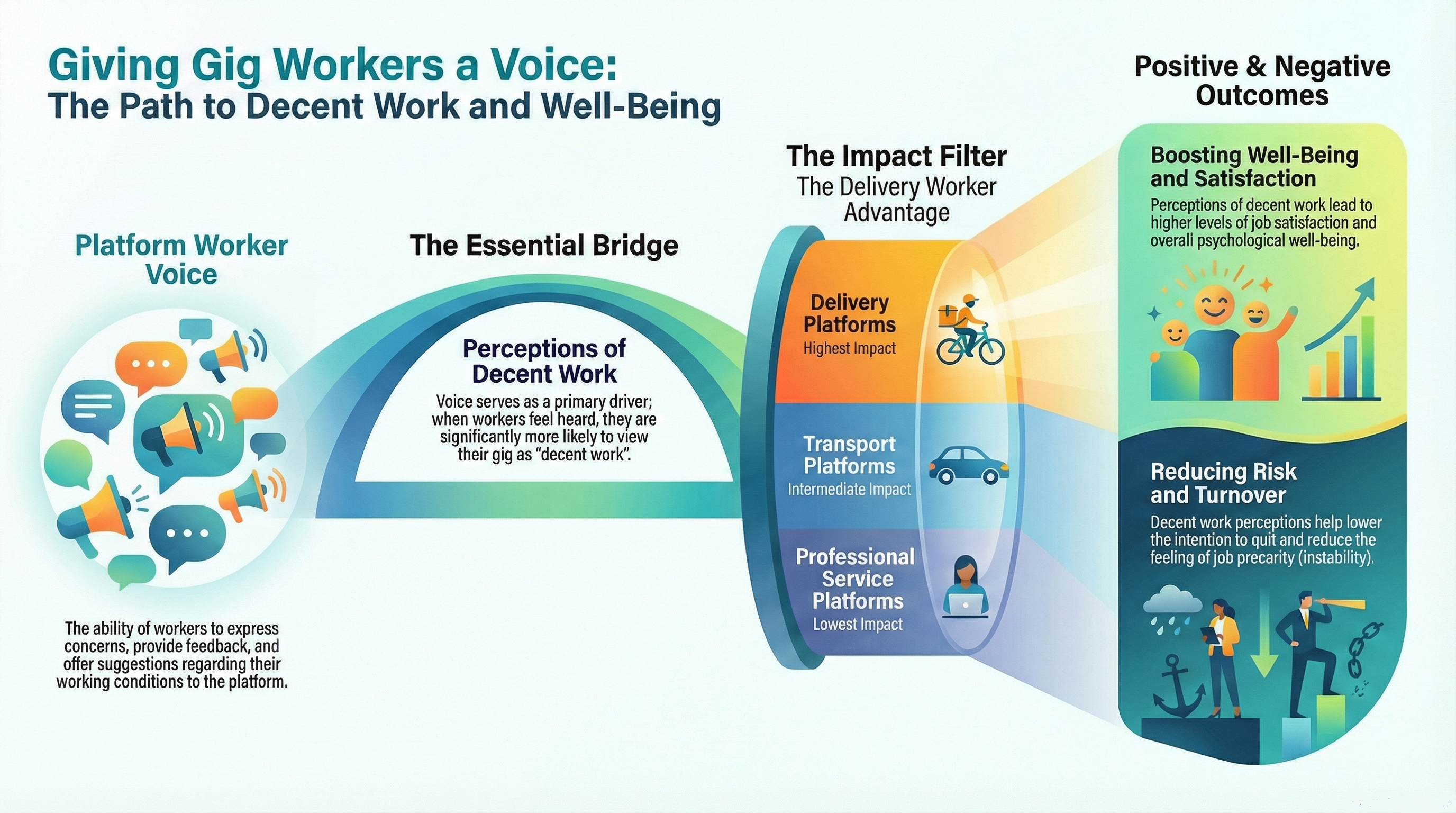
This study examined the role of platform worker voice in shaping perceptions of decent work and, through them, key worker outcomes in platform-based employment. The findings indicate that voice is consistently associated with higher perceptions of decent work and that these perceptions serve as a central psychological mechanism linking voice to job satisfaction, psychological well-being, turnover intention, and perceived job precarity.
Although the association between voice and decent work did not vary across platform types, platform type systematically conditioned how perceptions of decent work translated into downstream outcomes. In particular, both the effects of decent work and the indirect effects of voice through decent work were generally strongest among delivery workers, highlighting the importance of contextual heterogeneity within the platform economy.
Taken together, these results underscore the value of integrating organizational constructs such as voice with the Psychology of Working framework to better understand work quality in nonstandard and precarious employment contexts. By focusing on platform workers in an underrepresented national setting, this study contributes to a more nuanced and context-sensitive understanding of how decent work perceptions are formed and why they matter across different segments of the platform economy.