1. Introduction
A central challenge in industrial and organizational psychology and human resource management (HRM) is how organizations can secure, develop, and sustainably leverage human capital as a source of long-term value. Prior research has shown that the pursuit of short-term outcomes may increase burnout and psychological distress through excessive job demands and insufficient resources, thereby leading to adverse consequences such as turnover [
1,
2,
3]. Organizations are increasingly expected to adopt management approaches that simultaneously enhance organizational performance and employee well-being [
4,
5,
6,
7].
Within this context, one concept that has attracted growing attention is Human Capital Sustainability Leadership (HCSL), which has been proposed as a form of leadership that contributes to organizational sustainability while fostering human capital over the long term rather than depleting it [
8]. HCSL integrates multiple leadership components, namely ethical, sustainable, mindful, and servant leadership, and is positioned as a comprehensive framework that supports healthy organizations and sustainable development [
8]. Prior research has further suggested that HCSL may be associated with desirable outcomes such as job satisfaction and work engagement [
9].
In Japan, the HCSLS-J was developed to assess HCSL, and its associations with constructs such as trust, mentoring, well-being, and mental health have been reported [
10]. However, existing research has primarily relied on a variable-centered approach, examining relationships between total scores or subscale scores and outcomes [
9]. Much remains unknown regarding what specific configurations or patterns HCSL takes in actual workplaces, and how such patterns are linked to distinct outcome profiles. For example, leaders may exhibit strong ethical standards while displaying limited day-to-day consideration or developmental support, suggesting the possibility of imbalanced combinations across leadership facets [
11,
12,
13]. Such configurational diversity implies that even when total scores are comparable, outcomes and risks may differ meaningfully.
To address this issue, a person-centered approach that identifies latent subgroups based on within-person patterns across indicators is useful, and latent profile analysis (LPA) is a well-established method in this tradition [
14,
15,
16]. Because LPA extracts profiles according to similarities in both the levels and shapes of multiple indicators, it is well suited to examining how the four dimensions of HCSL co-occur in practice, and whether profiles include not only uniformly high patterns but also partially elevated ones.
Assessing the sustainability of the extracted profiles requires more than a single outcome indicator. In the sustainable HRM literature, sustainability is often conceptualized in terms of mutual gains, namely the simultaneous achievement of organizational performance and worker well-being [
6,
7]. Evaluating only one side of this equation risks overlooking the other side, such as potential costs to health or adaptation. Consistent with this view, conservation of resources (COR) theory and the job demands–resources (JD-R) model reveal that resources such as high-quality interpersonal relationships and support can foster adaptation through resource gain and amplification processes, whereas excessive demands and insufficient resources can lead to depletion and psychological distress [
1,
2,
3,
17,
18]. From this perspective, the outcomes of HCSL should be evaluated along two dimensions: whether it enriches relationships with others and whether it preserves or enhances the leader’s own adaptation and health.
The present study conceptualizes the outcomes of HCSL profiles along two axes: relationship capital as an outward-facing output and personal adaptation as an indicator of inward resource maintenance. Relationship capital is conceptualized as the aggregate of resources embedded in relationships, including collaboration potential and knowledge sharing grounded in trust and reciprocity [
19,
20]. As core elements of relationship capital, this study focuses on supervisor–subordinate trust [
21] and mentoring as developmental support behavior that promotes subordinates’ growth [
22]. Personal adaptation is captured by combining life satisfaction, a representative indicator of life evaluation [
23], and K6, a measure of psychological distress [
24,
25]. This framework enables an assessment of whether relationship capital formation and the maintenance of the leaders’ own adaptation and health are simultaneously achieved, rather than treating HCSL simply as “good” or “bad,” thereby allowing a more valid and interpretable examination of profile-specific sustainability.
The purpose of this study is to conduct LPA using the four dimensions of the HCSLS-J (ethical, sustainable, mindful, and servant) and to clarify which latent HCSL profiles emerge among Japanese managers. In addition, the study examines how the extracted profiles relate to relationship capital (mentoring and trust) and personal adaptation (life satisfaction and mental health). By integrating the findings into a two-axis map, the study aims to enhance practical interpretability. Based on these considerations, this study addresses the following research questions (RQs): RQ1: Which HCSL profiles are identified by LPA based on the HCSLS-J? RQ2: How do relationship capital and personal adaptation differ across the extracted profiles? RQ3: How are the profiles positioned within the two-axis framework of relationship capital and personal adaptation, and what implications does this positioning have for leadership development?
2. Methods
2.1. Data Collection and Procedure
This study was conducted as a secondary analysis of the dataset previously reported in Tani et al. [
10]. The primary data collection was conducted online by a research agency. Prior to the survey, individuals were briefed that the research examined work, work styles, and leadership, and were informed that responses would be anonymized and used only for statistical analysis and academic research. They were informed of their right to participate voluntarily or withdraw at any time without any consequences on their workplace performance evaluations. All participants were presented with an informed consent form, and they provided electronic informed consent by clicking a button prior to completing the survey. Participants subsequently received points from the survey company as compensation.
2.2. Participants
A total of 553 individuals responded (response rate: 79.57%). After excluding those who did not consent and those who met the exclusion criteria, the final analytic sample consisted of 527 participants (500 men, 27 women; 94.88% men; mean age = 53.72 years, SD = 8.77; effective response rate: 95.30%). Eighteen items were available in the original dataset to assess participant characteristics. In the present secondary analysis, the variables used as participant characteristics were sex, age group, marital status, presence of children, organizational tenure, employment status, organizational size, number of subordinates, hierarchical position, and management training experience.
2.3. Measures
2.3.1. Human Capital Sustainability Leadership
Human capital sustainability leadership was assessed using the Japanese version of the HCSLS-J [
10], adapted from the original HCSL Scale [
8]. The scale comprises 16 items across four first-order dimensions (ethical, sustainable, mindful, and servant; 4 items each), with example items including “I act by giving an example of doing tasks in an ethically correct manner” (ethical), “I create sustainable learning conditions that I take care to preserve” (sustainable), “I put myself in the shoes of my collaborators when they are doing tasks” (mindful), and “I encourage my collaborators when I realize that they encounter difficulties” (servant). The scale is conceptualized as a second-order factor integrating these components. Consistent with the original scale, items are rated on a 5-point Likert scale (1 =
none to 5 =
very much).
2.3.2. Relationship Capital
Mentoring behavior was assessed using the Intraorganizational Mentoring Behavior Scale [
26], which measures mentoring behaviors provided by supervisors to subordinates with three items each assessing career support functions (e.g., “Provided opportunities for challenging work”) and psychosocial support functions (e.g., “Often listened to their worries about work”). The scale comprises six items rated on a 4-point Likert scale (1 =
not at all to 4 =
a great deal). In the source study, internal consistency was acceptable (Cronbach’s
α = 0.85). This scale was developed as part of the “Life Pattern Study,” a joint research project of the Public Interest Incorporated Association International Economy and Work Research Institute and the Institute of Applied Social Psychology + connect Co., Ltd.
Trust-fostering behavior was assessed using a revised version of the Scale of Supervisor’s and Subordinate’s Trust [
27]. While the original scale consists of 20 items, the revised version used here includes 10 items assessing the extent to which supervisors perceive themselves as embodying elements that foster subordinates’ trust (e.g., “I try to be considerate of my coworkers”). Items are rated on a 4-point Likert scale (1 =
disagree to 4 =
agree), and internal consistency was high (Cronbach’s
α = 0.90).
2.3.3. Personal Adaptation
Life satisfaction was assessed with a single-item measure of life evaluation based on the OECD Guidelines on Measuring Subjective Well-Being [
23]: “All things considered, how satisfied are you with your life as a whole these days?” Because the online survey platform was optimized for smartphone use, the original 11-point response format (0–10) was modified to a 10-point scale (1–10) so that all response options were visible on the screen.
Mental health was assessed using the Kessler Psychological Distress Scale (K6) [
24,
25], a six-item measure of psychological distress including symptoms of depression and anxiety. Items are rated on a 5-point Likert scale (0 =
none of the time to 4 =
all of the time), and an example item is “During the past 30 days, about how often did you feel nervous?” Higher total scores indicate poorer mental health. Internal consistency was high (Cronbach’s
α = 0.93). For ease of interpretation, K6 scores were reverse-scored (−K6) so that higher values indicate better mental health.
2.4. Data Analysis
LPA was conducted on the four HCSL dimensions (ethical, sustainable, mindful, and servant) using jamovi (v2.6.44) with the snowRMM module (v5.9.1). Competing models were compared based on information criteria (AIC, BIC, and SABIC), entropy, and likelihood ratio tests (BLRT), while also considering class interpretability and minimum class size. To further evaluate solution stability, candidate solutions around the retained model were re-estimated in Rj using multiple random starts with different random initializations.
To examine whether profile membership was associated with participants’ background characteristics, chi-square tests of independence were conducted for sex, age group, marital status, presence of children, organizational tenure, employment status, organizational size, number of subordinates, hierarchical position, and management training experience.
Differences in the four outcomes (mentoring, trust, life satisfaction, and mental health) across the profiles were examined using a one-way MANOVA. Following a significant multivariate omnibus effect, univariate one-way ANOVAs were conducted for each outcome, and partial eta squared (ηp
2) was reported. Because Levene’s tests indicated heteroscedasticity for some outcomes and profile sizes were unequal, Games–Howell post hoc tests were used for all pairwise comparisons. To quantify the magnitude of pairwise differences, we computed Hedges’
g [
28], a small-sample bias-corrected standardized mean difference, and reported 95% confidence intervals.
To facilitate interpretation, we constructed a bubble plot in which bubble area is proportional to the sample size of each profile. In this plot, relationship capital was operationalized as the mean of standardized mentoring and trust scores, and personal adaptation was operationalized as the mean of standardized life satisfaction and mental health scores. All four outcomes were converted to z-scores using the full-sample mean and standard deviation. Because higher K6 scores indicate poorer mental health, K6 was reverse-scored (−K6) prior to computing the personal adaptation index so that higher values indicate better mental health.
3. Results
3.1. Latent Profiles of Human Capital Sustainability Leadership
We conducted LPA using the four HCSL indicators (ethical, sustainable, mindful, and servant). Among the tested model specifications, Model 3 was retained because it provided the most favorable overall balance of fit indices, classification quality, minimum class size, and substantive interpretability. Within Model 3, comparison of the profile solutions (
Table 1) supported retention of the 5-profile solution. Specifically, the 5-profile solution showed the lowest BIC (8475.84), high classification quality (entropy = 0.90), and a significant bootstrap likelihood ratio test (BLRT
p = 0.010). Compared with the 4-profile solution, the 5-profile solution showed a lower BIC (8475.84 vs. 8507.57) and slightly higher entropy (0.90 vs. 0.88), and was therefore retained as the preferred solution. In contrast, the six-profile solution did not improve model fit (BLRT
p = 0.990) and showed lower entropy (0.77).
As an exploratory stability check, the 4- and 5-profile solutions under Model 3 were re-estimated using multiple random starts with different random initializations. Valid solutions were obtained in 47 of 200 runs for the 4-profile solution and in 32 of 200 runs for the 5-profile solution. However, the near-best solutions were not repeatedly reproduced across runs. In addition, the best BIC from this follow-up analysis was slightly lower for the 4-profile solution than for the 5-profile solution (8481.68 vs. 8483.36). These findings did not provide strong additional support for the stability of the 5-profile solution.
The five-profile solution yielded the following profiles: High (
n = 328, 62.2%), Moderate (
n = 111, 21.1%), Very High (
n = 55, 10.4%), Low (
n = 18, 3.4%), and Unbalanced (
n = 15, 2.8%).
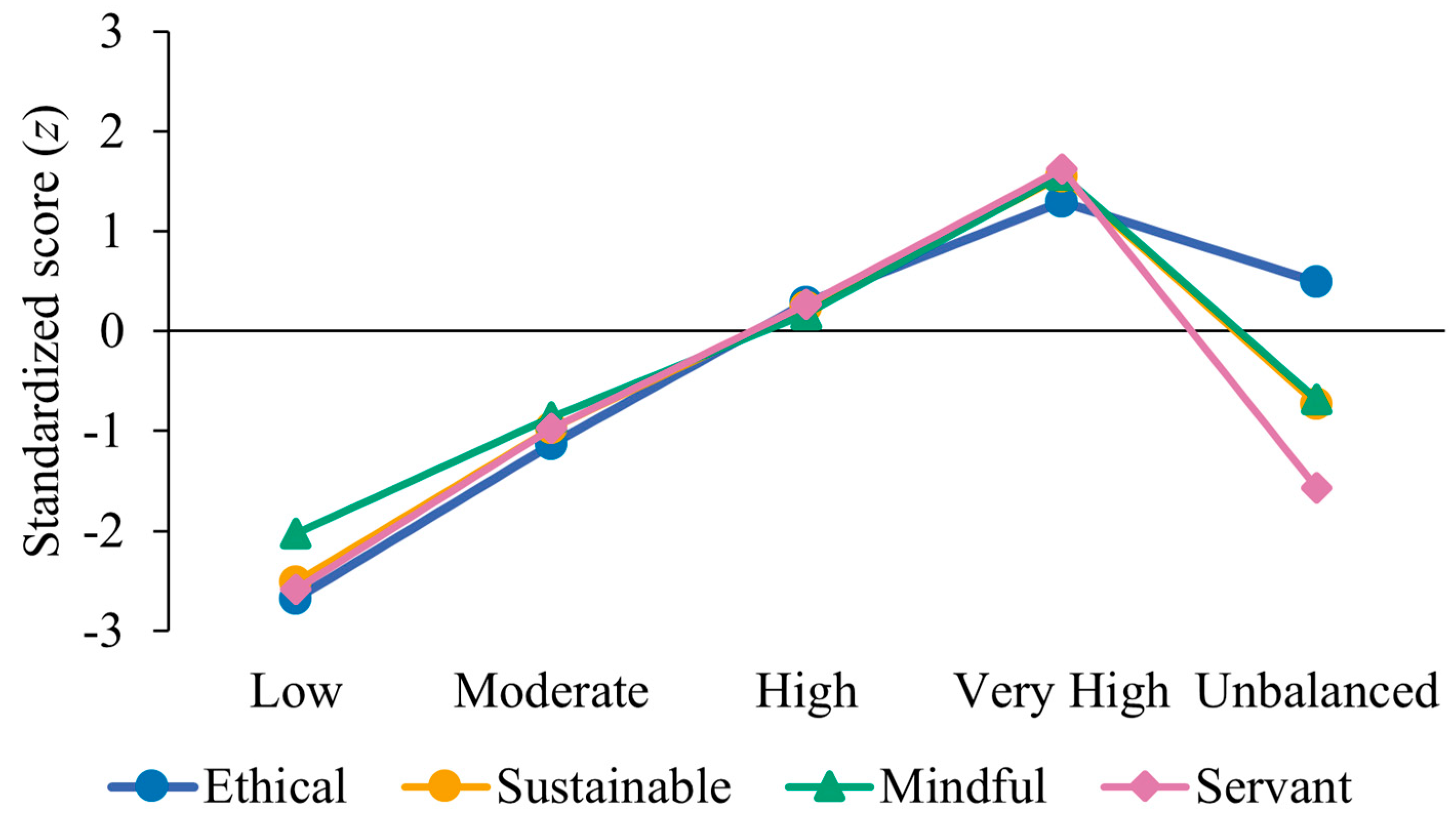
Figure 1 visualizes the standardized indicator patterns (
z-scores), and descriptive statistics are provided in
Table 2. The Very High and High profiles showed uniformly elevated levels across all four HCSL indicators, whereas the Moderate and Low profiles showed uniformly lower levels. The Unbalanced profile was characterized by high ethical leadership (
M = 17.00,
SD = 1.46) combined with lower levels of sustainable (
M = 12.67,
SD = 2.09), mindful (
M = 12.40,
SD = 3.02), and servant leadership (
M = 10.33,
SD = 1.29).
3.2. Sociodemographic Characteristics and Profile Membership
To explore whether profile membership was associated with participants’ backgrounds, chi-square tests of independence were conducted. The results revealed no significant differences in profile distribution across the examined sociodemographic and organizational variables, including sex (p = 0.429), age group (p = 0.166), marital status (p = 0.224), presence of children (p = 0.472), organizational tenure (p = 0.649), employment status (p = 0.157), organizational size (number of employees; p = 0.496), number of subordinates (p = 0.663), hierarchical position (p = 0.710), and management training experience (p = 0.295).
3.3. Differences in Outcomes Across Profiles
Overall, the Very High and High profiles showed the most favorable combination of relationship capital and personal adaptation, whereas the Moderate and Low profiles showed less favorable patterns across both domains. The Unbalanced profile showed a mixed pattern, with comparatively weaker relationship capital but relatively more favorable adaptation. To examine differences in the four outcomes (mentoring, trust, mental health (K6; higher scores indicate poorer mental health), and life satisfaction) across the five profiles, we first conducted a one-way MANOVA (
Table 3). The multivariate omnibus test was significant (Pillai’s Trace = 0.53,
F(16, 2088) = 19.84,
p < 0.001). Follow-up univariate ANOVAs (
Table 3) indicated significant profile differences for mentoring (
F(4, 522) = 49.13,
p < 0.001, η
p2 = 0.274), trust (
F(4, 522) = 79.15,
p < 0.001, η
p2 = 0.378), life satisfaction (
F(4, 522) = 15.48,
p < 0.001, η
p2 = 0.106), and mental health (
F(4, 522) = 16.03,
p < 0.001, η
p2 = 0.109).
The Very High profile showed the most favorable outcome pattern, with the highest mentoring (M = 20.49, SD = 3.30), trust (M = 37.51, SD = 3.67), and life satisfaction (M = 7.91, SD = 1.71), alongside low K6 scores indicating better mental health (M = 4.96, SD = 5.32). The High profile also showed favorable outcomes (mentoring: M = 17.36, SD = 2.39; trust: M = 31.14, SD = 3.70; life satisfaction: M = 6.94, SD = 1.79; K6: M = 4.57, SD = 4.57). The Moderate profile showed lower mentoring and trust (mentoring: M = 14.96, SD = 2.85; trust: M = 26.78, SD = 3.77), lower life satisfaction (M = 5.84, SD = 1.79), and higher K6 scores indicating poorer mental health (M = 8.67, SD = 5.88). The Unbalanced profile showed low mentoring (M = 13.00, SD = 3.70) and mid-range trust (M = 27.60, SD = 3.92), with low K6 scores indicating better mental health (M = 3.87, SD = 4.72). The Low profile showed high K6 scores (M = 8.94, SD = 7.80) despite mid-range mentoring and trust.
3.4. Post Hoc Comparisons and Effect Sizes
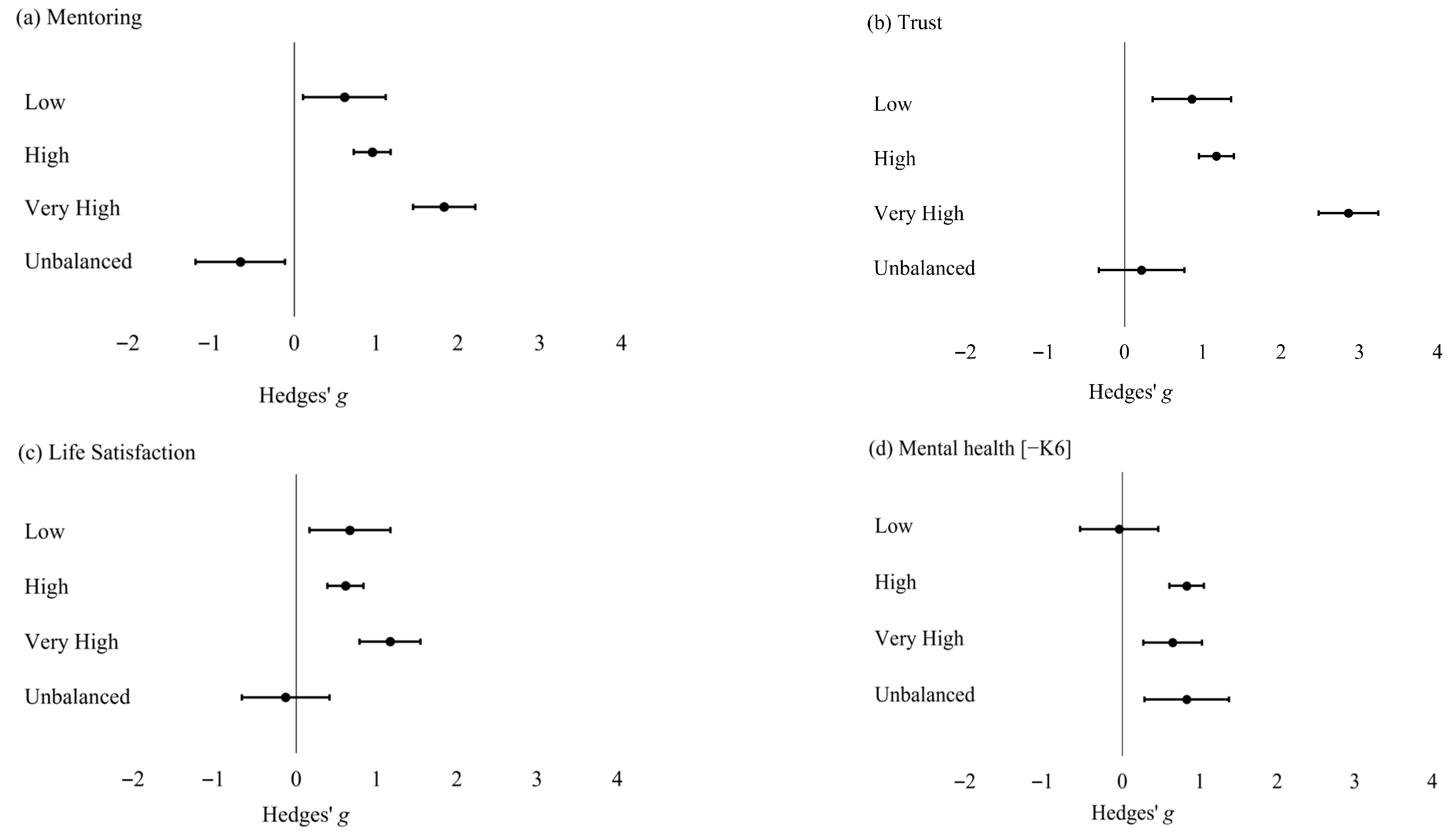
Figure 2 illustrates the magnitude and direction of the pairwise differences relative to the Moderate profile. In particular, the High and Very High profiles consistently showed more favorable scores across mentoring, trust, life satisfaction, and mental health, whereas the Unbalanced profile showed a more selective pattern of differences. Given heteroscedasticity for some outcomes and unequal profile sizes, we conducted Games–Howell post hoc tests for all pairwise comparisons: full results are reported in
Supplementary Table S1.
Figure 2a–d summarize Hedges’
g (95% CI) for comparisons with the Moderate profile as the reference group. For ease of interpretation,
Figure 2d presents mental health using reversed K6 scores (−K6) such that higher values indicate better mental health; however, statistical tests were conducted on the original K6 scores.
Relative to the Moderate profile, the High and Very High profiles showed higher mentoring, trust, and life satisfaction (all
p < 0.001), with corresponding effect size estimates in the medium-to-large range (
Figure 2;
Table S1). For mental health, both profiles also showed better scores than the Moderate profile (both
p < 0.001).
For the Unbalanced and Low profiles, several comparisons did not reach statistical significance after post hoc testing (
Table S1).
3.5. Integrated Interpretation Using the Profile Map
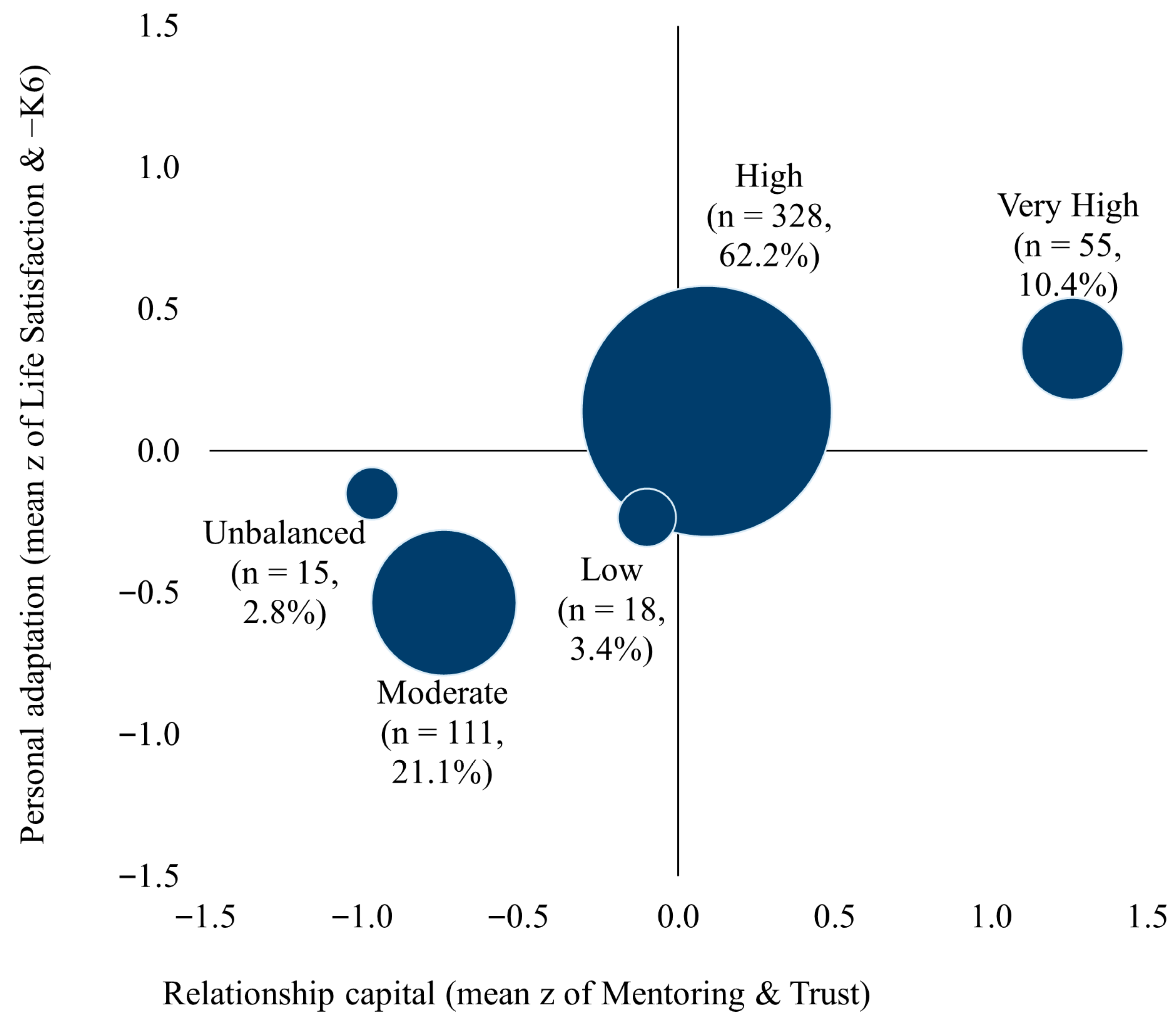
As shown in
Figure 3, the Very High profile was located in the most favorable area of the map, whereas the Moderate profile was positioned in the least favorable region. The Unbalanced profile occupied a distinctive position characterized by relatively preserved adaptation despite weaker relationship capital.
Figure 3 integrates the outcomes into two interpretable dimensions: relationship capital (mean
z of mentoring and trust) and personal adaptation (mean
z of life satisfaction and reversed K6). The High profile also fell in the positive region on both dimensions, whereas the Moderate profile clustered in the lower left quadrant. Bubble sizes in
Figure 3 reflect the unequal distribution of participants across profiles, with the High profile comprising the largest proportion of the sample. This map should be viewed as a heuristic summary of profile differences rather than as evidence of causal processes.
4. Discussion
This study used a person-centered approach to examine HCSL among Japanese managers. Moving beyond a variable-centered view of HCSL as a single overall score, we identified five latent profiles based on the four HCSLS-J dimensions and examined how these profiles differed in relationship capital and personal adaptation. In doing so, the study addressed three questions: whether HCSL is better understood in terms of distinct latent profiles rather than a simple low-to-high continuum, how those profiles differ in sustainability-relevant outcomes, and how they can be interpreted within a two-axis framework with implications for leadership development. This approach complements the original HCSL framework, which conceptualizes HCSL as an integrated construct comprising ethical, sustainable, mindful, and servant leadership in the service of healthy organizations and sustainable well-being [
8]. It is also consistent with latent profile research suggesting that meaningful differences may emerge not only in overall level but also in the relative configuration of component dimensions, although smaller classes should be interpreted cautiously until replicated [
16].
4.1. Profiles Identified by LPA
For RQ1, which asked what kinds of HCSL profiles can be identified among Japanese managers, the findings suggest that HCSL may not be fully captured by a simple low-to-high continuum. The Very High and High profiles appeared to represent integrated forms of HCSL, as all four dimensions were consistently elevated. By contrast, the Unbalanced profile suggested that ethical leadership can be high even when the other HCSL dimensions are less elevated. This pattern is theoretically meaningful because prior work on ethical leadership has argued that being a moral person is not sufficient in itself; leaders must also function as moral managers who make values visible and behaviorally salient in organizational life [
11]. From this perspective, the Unbalanced profile may reflect an ethical orientation that is present at the level of values or self-understanding but is not equally reflected in everyday relational and developmental leadership behaviors.
The Moderate and Low profiles were both characterized by generally low HCSL, but they should not be treated as fully interchangeable. Moderate appeared to reflect a broadly attenuated profile, whereas Low, although small, may represent a more specific low-HCSL subgroup rather than merely a more extreme version of Moderate. Thus, even among profiles characterized by generally low HCSL, there may be meaningful heterogeneity in their practical implications. At the same time, these interpretations, particularly those of the Low and Unbalanced profiles, should remain tentative because the exploratory stability check did not provide strong additional support for the stability of the 5-profile solution [
16].
4.2. Differences in Relationship Capital and Personal Adaptation Across Profiles
For RQ2, which asked how the extracted profiles differ in relationship capital and personal adaptation, the Very High and High profiles exhibited the most favorable overall pattern. These groups combined stronger mentoring and trust with higher life satisfaction and lower psychological distress than the less favorable profiles. This pattern is consistent with the HCSL perspective, which links leadership to flourishing workers and healthy organizations [
8]. It is also compatible with the JD-R model, which proposes that job resources support goal attainment, buffer the impact of job demands, and foster learning and development, whereas high job demands deplete emotional and cognitive resources over time [
1,
17]. Longitudinal evidence suggests that job resources may initiate gain spirals through work engagement and proactive functioning [
18]. These findings are also in line with Van De Voorde et al. [
7], who argued that happiness-related and relationship-related well-being often fit a mutual gains perspective, even when health-related well-being may not always improve to the same extent.
However, the comparison between the High and Very High profiles suggests that the benefits of elevated HCSL may not increase proportionally across all domains. Although the Very High profile displayed the strongest relationship capital and the highest life satisfaction, its psychological distress was not clearly lower than that of the High profile. This pattern does not support the conclusion that higher levels are necessarily associated with worse outcomes. Rather, it suggests that extremely high HCSL may yield diminishing returns, or a ceiling-like pattern, for personal adaptation relative to relational outcomes. In light of Van De Voorde et al. [
7], this pattern may be understood as reflecting both mutual gains and conflicting outcomes, in the sense that relational and happiness-related outcomes may continue to improve, whereas health-related outcomes may not improve proportionally. From a practical perspective, the High profile may therefore represent a more realistic developmental benchmark, whereas the Very High profile may be better viewed as an aspirational upper range.
The Unbalanced profile was especially informative because it appeared to separate personal adaptation from relationship capital. This group showed comparatively weak mentoring and trust, yet more favorable adaptation than the Moderate profile. One tentative interpretation is that this profile reflects a more self-protective mode of functioning in which leaders preserve their own adaptation while limiting costly relational investment. Although this interpretation remains provisional, and the underlying mechanisms were not directly measured in the present study, this pattern may be broadly consistent with the COR argument that individuals seek to retain valued resources under threat of loss when resources are constrained [
3,
17]. It may also be tentatively consistent with boundary work research suggesting that individuals use tactics to reduce strain and protect functioning under competing demands [
29]. Importantly, this profile can also be interpreted in light of Treviño et al. [
11] and van Dierendonck [
12]. Ethicality by itself may not guarantee active developmental support, because ethical leadership requires explicit moral management, whereas servant leadership more directly emphasizes follower development, trust, stewardship, and helping subordinates grow. In this sense, the Unbalanced profile suggests that high ethicality alone may be insufficient to produce strong relationship capital.
The Moderate profile appears to represent the clearest hidden depletion pattern. Although self-rated HCSL was not the lowest, this profile combined weak relationship capital with low personal adaptation. In JD-R terms, such a pattern is consistent with the health impairment process, in which sustained demands exhaust physical, emotional, and cognitive resources over time [
1,
17]. COR theory similarly predicts that stress arises when valued resources are threatened, lost, or fail to generate sufficient return following investment [
3]. Relatedly, Demerouti et al. [
30] showed that work pressure, work-home interference, and exhaustion can reinforce one another over time, suggesting that depletion processes may become self-reinforcing. From an organizational perspective, the Moderate profile may therefore be easy to overlook despite substantial relational and psychological risk.
The Low profile, although small, may be distinct from Moderate rather than simply a more extreme version of it. Both profiles showed poor adaptation, but the Low profile did not necessarily display uniformly worse relational outcomes than Moderate. Mentoring and trust in the Low group appeared somewhat less impaired than might be expected from its very low HCSL self-ratings. This raises the possibility that Low reflects a pattern in which leaders evaluate themselves very negatively while still maintaining some degree of interpersonal support. COR theory is informative here because it suggests that individuals with limited resources may still attempt to use whatever resources remain, sometimes in ways that are costly or self-defeating, and that investment without sufficient return may itself be experienced as loss [
3]. One exploratory interpretation is that Low may involve low self-evaluation alongside partially preserved support behavior under constrained resources. However, because latent profile research cautions against overinterpreting small classes, this interpretation should remain provisional and hypothesis-generating [
16].
4.3. Two-Axis Integration and Implications for Leadership Development
For RQ3, which asked how the extracted profiles can be integrated into a two-axis framework and what this implies for practice, the present findings suggest that the two-axis framework helped clarify the practical meaning of the profiles. Relationship capital may be understood as a relational resource grounded in goodwill and in the structure and content of social ties [
19]. This framing is appropriate because trust in direct leaders is foundational for workplace functioning [
21], and mentoring is associated with a broad range of relational, motivational, and developmental outcomes, even if average effects are modest [
22]. Within this framework, the Very High and High profiles occupied the most favorable positions, Moderate occupied the least favorable position, Unbalanced suggested preserved personal adaptation despite weak relationship capital, and Low appeared unfavorable but potentially somewhat distinct from Moderate. This pattern is also consistent with Van De Voorde et al. [
7], who argued that research should move beyond simple contrasts and instead examine combinations of different well-being outcomes.
Taken together, the findings imply that leadership development should not focus only on raising HCSL scores in general, but also on helping leaders simultaneously build relationship capital and preserve their own adaptation. For the High profile, the developmental task may be to maintain a sustainable balance between supporting others and sustaining the self. In practice, this may involve reflection on workload, boundary management, and routines that help sustain supportive leadership without overextension [
17,
29]. For the Unbalanced profile, practical intervention may be more effective when it emphasizes environmental adjustments rather than relying primarily on improvements in individual interpersonal skill [
31]. In practice, this may involve structured one-to-one routines, explicit feedback norms, and predictable communication rules that make low-burden relational behaviors easier to enact in everyday work [
32]. Such an approach may be particularly useful for managers who are less inclined or less skilled in relationship building, because it supports interpersonal exchange through workplace structure as well as individual effort [
33].
For the Moderate profile, however, the priority may be restoring resources and reducing demands before asking managers to become more supportive. In practice, this may require workload review, recovery support, and manager coaching before stronger developmental expectations are introduced [
1,
3,
17]. For the Low profile, a tentative two-step approach may be warranted: first, support recovery and workload adjustment [
1,
3,
17]; second, if future research supports the present exploratory interpretation, consider interventions aimed at reducing overly negative self-appraisal and supporting more sustainable enactment of limited supportive behaviors. This may be implemented through stepwise goal setting, gradual increases in achievable supportive behaviors, and opportunities for guided reflection. This profile-sensitive approach is consistent with the need for a differentiated interpretation of well-being configurations and with prior work emphasizing the importance of examining combinations of well-being outcomes [
7]. However, because the present evidence is cross-sectional and primarily self-reported, these practical implications should be regarded as provisional rather than prescriptive.
4.4. Limitations and Future Directions
Several limitations should be noted. First, because the data were cross-sectional, the direction of causality cannot be determined. Future longitudinal studies tracking changes in the same managers over time would help clarify how these profiles develop, persist, or shift. Second, the sample consisted almost entirely of male Japanese managers, who accounted for approximately 95% of the respondents. This reflects the gender composition of managerial positions in Japan: women represented 11.9% of managers in fiscal year 2019 [
34], the year in which the survey was conducted, and even the most recent figure for fiscal year 2024 indicates only a modest increase to 13.1% [
35]. Accordingly, the sample may be considered broadly representative of the current composition of Japanese management. However, the generalizability of the findings to samples consisting only of women managers remains limited, and further research focusing specifically on women managers is warranted.
Third, because the study relied primarily on self-report measures, common method bias remains a possible alternative explanation for some of the observed associations. Podsakoff et al. [
36] argued that common method variance can inflate observed relationships among constructs and should therefore be treated as a serious validity concern. Fourth, some of the identified profiles, particularly the Low and Unbalanced profiles, were based on small sample sizes. Their statistical stability and generalizability therefore require cautious interpretation. We acknowledge that additional stability checks, including split-sample validation, sensitivity analyses, and bootstrap-based procedures, would provide a stronger test of profile robustness. In the present dataset, however, the very small size of the Low and Unbalanced profiles means that repeated subsampling or resampling would likely yield highly unstable estimates that are difficult to interpret with confidence [
37]. More rigorous robustness testing would be feasible in larger datasets, independent replication samples, or prospective studies designed to support repeated resampling and validation procedures. Accordingly, the findings should be regarded as provisional until they are replicated in larger or independent samples and examined in future studies incorporating additional robustness checks, in line with recommendations in the latent profile literature [
16]. In addition, an exploratory random-starts re-estimation did not provide strong additional support for the stability of the 5-profile solution. Although valid solutions were obtained, the near-best solutions were not repeatedly reproduced across runs, and the best BIC in the follow-up analysis slightly favored the 4-profile solution. The 5-profile solution, particularly the Low and Unbalanced profiles, should be interpreted cautiously.
Fifth, distal outcome differences were examined after profile assignment using MANOVA/ANOVA rather than an auxiliary approach such as BCH that explicitly accounts for classification uncertainty. Given the high entropy of the selected solution, the risk of substantial bias may be limited, but future studies should test the robustness of these outcome differences using BCH or related three-step methods. Sixth, some contextual variables central to JD-R theory, such as job demands and job resources, were not directly measured. The present study does not allow us to test mediating pathways linking HCSL, resources, and adaptation, or moderation patterns involving the interaction between job demands and HCSL. Future research should examine these mechanisms directly using designs that incorporate job demands and job resources as explicit variables. More broadly, future research should also adopt longitudinal and multi-source designs and examine additional variables such as leadership self-efficacy, self-criticism, emotional labor, and boundary management in order to clarify the mechanisms underlying these profiles.




 ,
,