
Emerging Public Health Concerns of Micro- and Nanoplastics in Humans: Detection and Health Impact

 , , , , ,
  , and
, and
Abstract
1. Introduction
2. Literature Search Strategy and Review Methodology
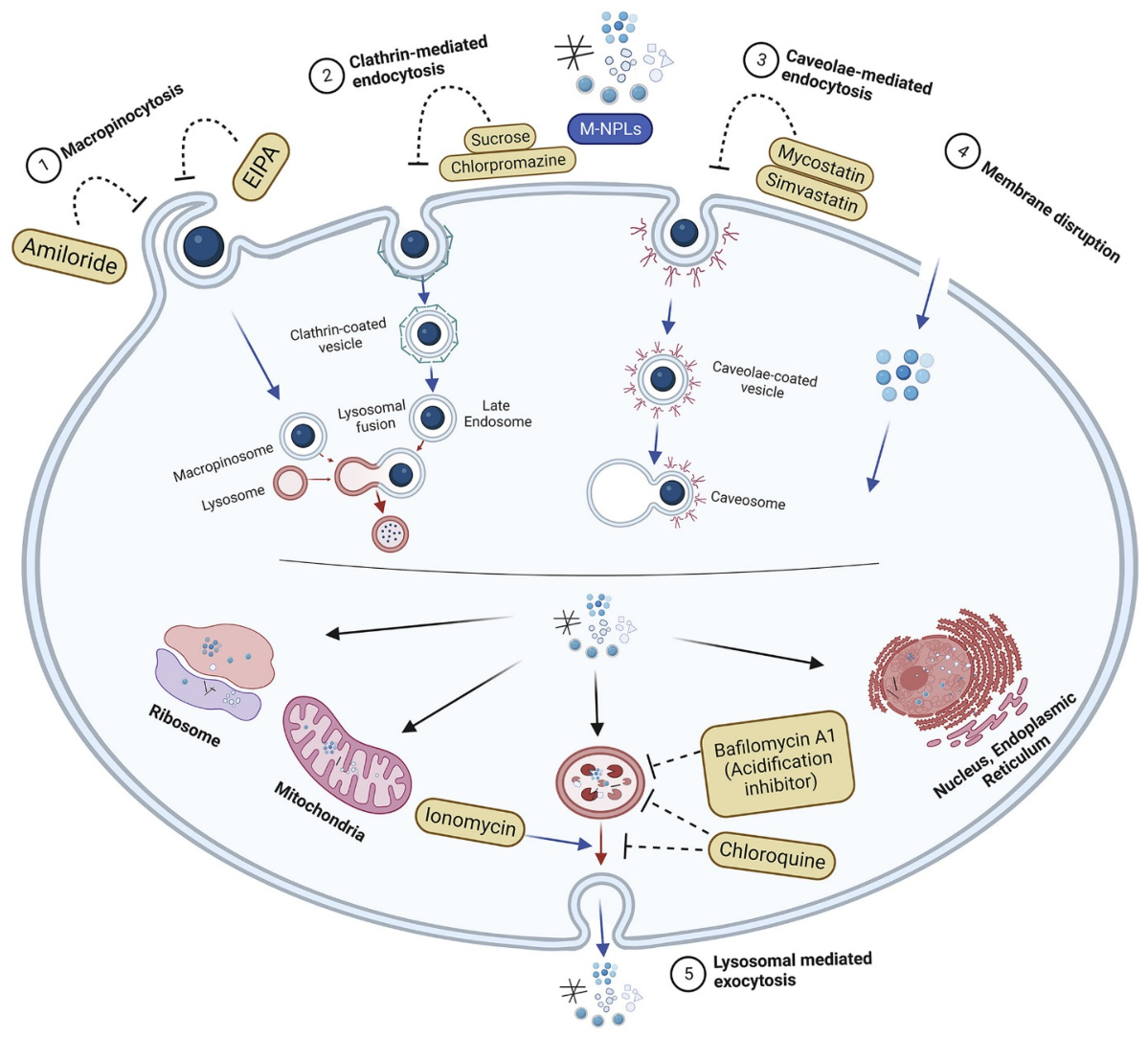
3. Cellular and Molecular Mechanisms Underlying Microplastic-Induced Toxicity
4. Types of Microplastics Clinically Relevant in Humans
4.1. Polymer Types: The Material of Concern
4.2. Physical Form and Biological Interactions
4.3. Size Distribution: The Nano-Dimension of Concern
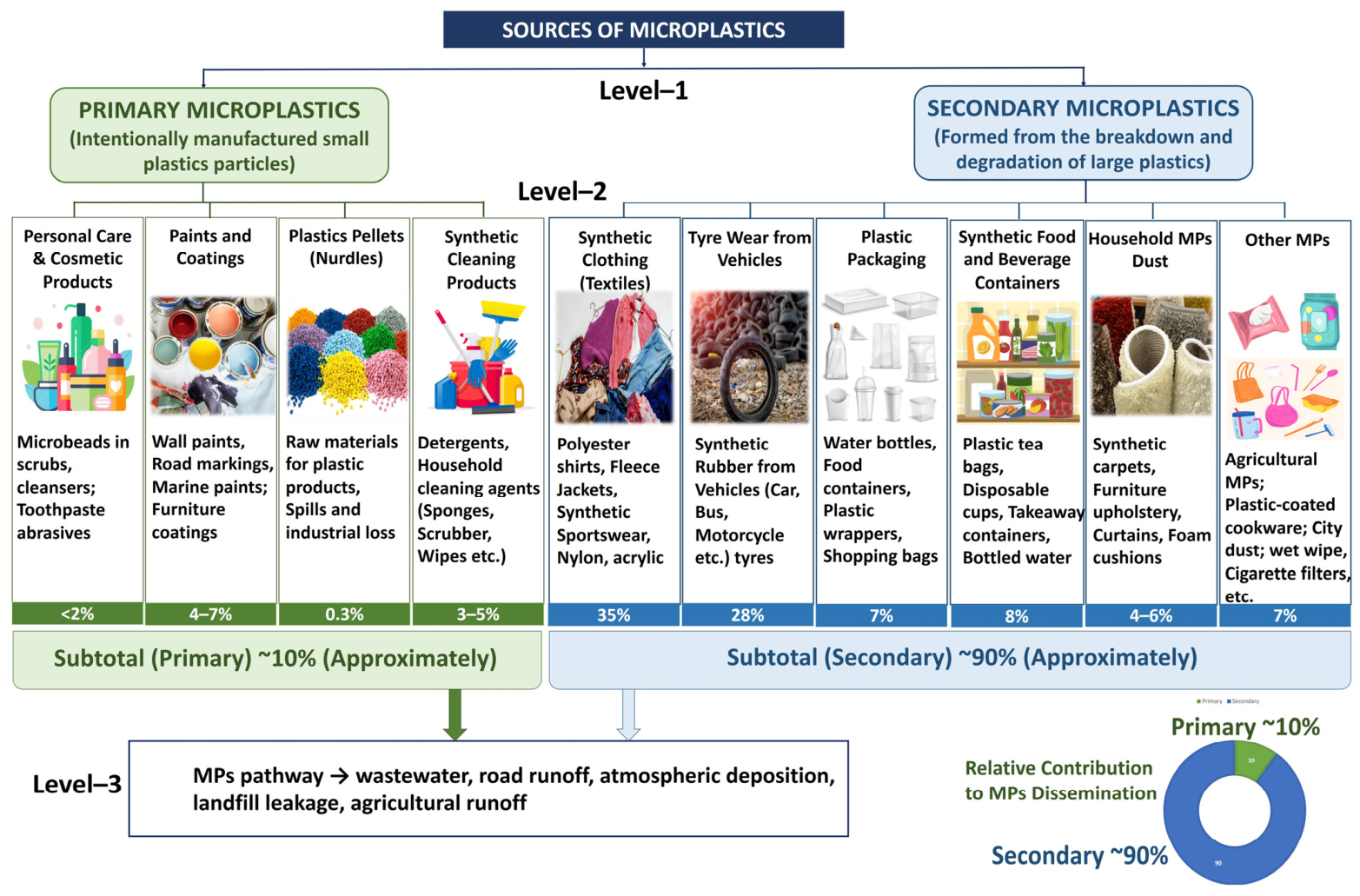
4.4. Common Sources of MPs in Daily Life
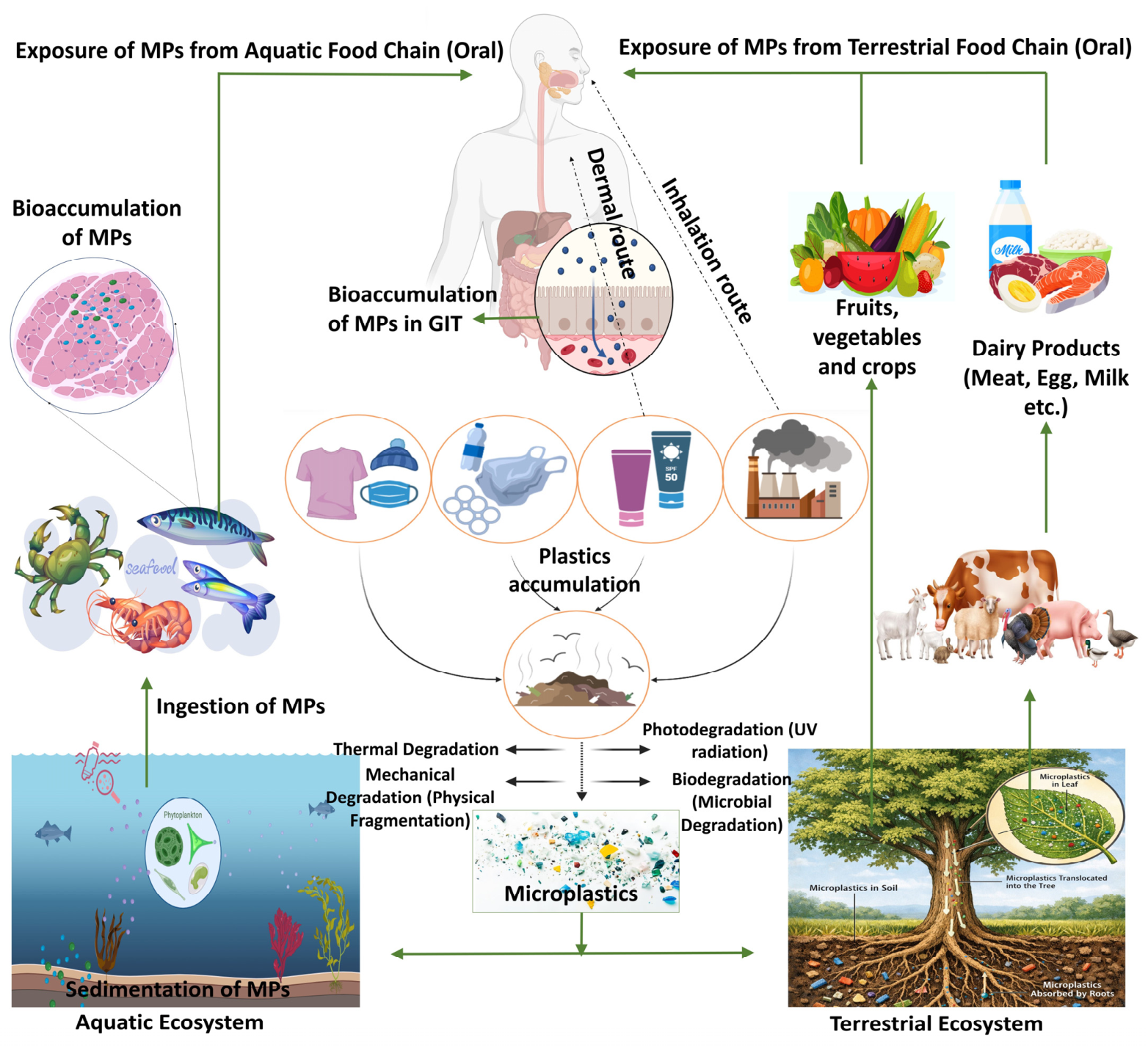
5. Exposure Routes of Microplastics and Nanoplastics into the Human Body
5.1. Ingestion: The Pervasive Dietary Pathway
5.2. Inhalation: An Unavoidable Atmospheric Burden
5.3. Dermal Exposure: An Emerging Frontier
5.4. Translocation Mechanisms and Systemic Distribution
6. Current Evidence of Microplastics in Human Body Fluids

| Sample Type | Country | Published Year | No. of Positive Samples | MPs Types | Particle Size | Detection Method | References |
|---|---|---|---|---|---|---|---|
| Blood | Italy | 2024 | 181 | PE, PVC | N/A | Py–GC/MS | [11] |
| Blood | Netherlands | 2022 | 16 | PET, PS, PE, PMMA and PP | ≥0.7 μm | Py-GC/MS | [5] |
| Blood | China | 2023 | 15 | PET, PU, PS, PA, PVC, PE, PP, PC, PMMA | 184 μm | LD-IR and SEM | [10] |
| Blood | UK | 2024 | 18 | PE, EPDM, EVA, EVOH, PA | 5 µm–800 µm | μ-FTIR spectroscopy | [9] |
| Blood | Korea | 2024 | 32 | PS, PP | N/A | μ-FTIR | [8] |
| Umbilical Vein Blood | China | 2024 | 12 | PA, PU | >20–100 μm | LD-IR | [13] |
| Amniotic Fluid | China | 2024 | 12 | PA, PU | >20–100 μm | LD-IR | [13] |
| Fetal Cord Blood | China | 2024 | 9 | PP, PE, PS, PVC | 100–400 μm | Micro-Raman spectroscopy | [14] |
| Breast milk | Italy | 2022 | 26 | PP, PVC, PE, PS, PES, and PEMA | 2~12 μm | μ-Raman | [6] |
| Breast milk | China | 2023 | 7 | PA, PU, PE, PET, PP, PVC, POM, EVA, PTFE, CPE, PB, PMMA, PLA, PS | >20 μm | LD-IR | [15] |
| Breast milk | Poland | 2025 | N/A | PE, PS | N/A | Raman spectroscopy, FTIR | [16] |
| Breast milk | Thailand | 2024 | 23 | PP, PE, PS, PVC | N/A | Raman micro spectroscopy | [84] |
| Semen | China | 2025, 2023, 2025 | 11 | PVC, PE, PA, PS, PP and PET | 21.76–286.71 μm | LD-IR and Py-GC/MS | [17,18,85] |
| Semen | Italy | 2023, 2023, 2025 | 6 | PP, PS, PET, PVS, PC, POM, Acrylic | 2–5 μm | Raman microspectroscopy | [3,86,87] |
| Semen | China | 2024 | 40 | PS, PE, PVC, PP, PET, PA, PU, PC | 0.72–7.02 μm | Raman microspectroscopy | [77] |
| Semen | China | 2026, 2025 | 34 | PET, BR, CPE | 20.3–189.7 μm | LD-IR | [88,89] |
| Semen | Spain | 2025 | 24 | PA, PTFE, PE, PU, PP, PET, PS, PVC, PLA | N/A | LD-IR | [90] |
| Semen | China | 2025 | 51 | PE, PVC | N/A | Py-GC/MS | [91] |
| Semen | Turkey | 2025 | 82 | Fiber-type | ≥30 µm | Light microscopy following (KOH) digestion | [92] |
| Semen | Italy | 2021 | N/A | BPA, phthalates | 0.1 µm to 5 mm | Raman microspectroscopy | [19] |
| Semen | USA | 2024, 2024 | 23 | PVC, PET, PE, PVC, N66, N6, SBR, PU, PP, ABS, PMMA, PET, PC, PS | N/A | Py-GC/MS | [93,94] |
| Semen | China | 2022 | N/A | PS, PVC, PA66, PMMA | N/A | Py-GC/MS | [95] |
| Semen | China | 2024 | N/A | PS | <5000 μm | N/A | [96] |
| Urine | Italy | 2024 | 10 | PE, PS | 3–13 μm | Micro-Raman spectroscopy | [81] |
| Urine | Italy | 2022 | 4 | PVA, PVC, PP, and PE MPs | 4~15 μm | μ-Raman | [97] |
| Sputum | China | 2022 | 22 | PU, PES | >500 μm | μ-FTIR | [83] |
| Saliva | Iran | 2025 | 2000 | PE, PET, PS, PVC | 100–500 μm | N/A | [82] |
| Maternal amniotic fluid | China | 2025, 2021 | 25 | PE and PP | 20–100 μm | LD-IR, spectroscopic analysis | [98,99] |
| CSF | China | 2025, 2024 | 28 | PS, PE, PP, PVC | N/A | Microscopic spectroscopy | [100,101] |
| CSF | China | 2025 | 32 | PP, PVC, PE, PS | 0.001–5000 μm | N/A | [102] |
| BALF | Iran | 2025 | 30 | PE, PS, PP, PET | 20–500 μm | μ-Raman | [103] |
| BALF | Turkey | 2025, 2024 | 10 | PA, PET, PVC, PU | 4.19 μm–792.00 μm | μ-Raman spectroscopy | [104,105] |
| Plural fluid | Iran | 2025 | 2 | PE, PP, PET, N-6 PS, PMMA/acrylic, rubber, polyester, FEP, PFA PPTA/Kevlar, SBS, PVA, PS, PVP, PU, SAN, ABS, cellulose (dyed) cotton, CA | <100 μm | Micro-Raman and SEM/EDS analysis | [106] |
7. Evidence of Microplastics in Human Tissues and Organs
| Sample Type | Country | Published Year | No. of Positive Samples | MPs Types | Particle Size | Detection Method | References |
|---|---|---|---|---|---|---|---|
| Placenta | Germany | 2021 | N/A | PE, PP, PS, PE, PET, PVK, PC | 5 to 10 μm | Raman microspectroscopy | [106] |
| Placenta | Italy | 2022 | 4 | PP with some other non-identify fragments | 5 to 10 μm | μRaman | [6] |
| Placenta | China | 2023 | 17 | PSF. Mainly PVC (43.27%), PP (14.55%), PBS (10.90%) | 20–307.29 μm | LD-IR | [12] |
| Placenta | China | 2023 | 18 | PU, PA, PE, PET, PC | 20–500 μm | LD-IR | [15] |
| Placenta | USA | 2024 | 62 | PE, PVC, Nylon, Rayon, PS | >1 μm | Py-GC-MS, ATR-FTIR, fluorescence microscopy | [28] |
| Prostate tissue | China | 2021, 2025 | 22 | PA, PET, PVC, PS, PP, PE | 20 to 100 μm | Py-GC/MS, LD-IR, SEM | [20,116] |
| Penile cancerous tissue | China | 2025 | 29 | PE, PP, PVC, PA | 20–50 µm | LD-IR, spectroscopy | [117] |
| Penile tissue | USA | 2024 | 4 | PET, PP, PMMA | 2 μm to 500 μm | LD-IR, SEM | [118] |
| Lungs | UK | 2022 | 11 | PP, PET, resin | N/A | μ-FTIR | [107] |
| Lung tissue | Brazil | 2021 | 13 | PP, PE, cotton, PVC, CA, PA, PS, PU | 1.6–16.8 μm | N/A | [108] |
| Lung granule nodules | China | 2022 | 100 | Cotton, PA, PE, denim, phenoxy resin | >20 μm | μ-FTIR | [109] |
| Liver | Germany | 2022 | 17 | PS, PVC, PET, PMMA, POM, and PP | 4 to 30 μm | μ-Raman | [110] |
| Small intestine | China | 2024 | 6 | PVC-dominant; also identified: PE, PP, PS, PET, PA | 20–100 μm | LD-IR spectroscopy | [7] |
| Large intestine | China | 2024 | 6 | PVC-dominant; also identified: PE, PP, PS, PET, PA | 20–100 μm | LD-IR spectroscopy | [7] |
| GI tissue | Italy | 2025 | N/A | PE, PP, PS, PVC | N/A | FTIR, Raman, Py-GC/MS | [119] |
| Tonsil | China | 2024 | 6 | PVC-dominant; also identified: PE, PP, PS, PET, PA | 20–100 μm | LD-IR spectroscopy | [7] |
| Thymus | China | 2024 | 24 | PS | 5 μm | Fluorescence microscopy | [120] |
| Integumentary system (face skin) | Iran | 2021 | 2000 | PE, PET, PS, PVC | 100–500 μm | N/A | [121] |
| Integumentary system (hand skin) | Iran | 2021 | 2000 | PE, PET, PS, PVC | 100–500 μm | N/A | [121] |
| Integumentary system | Iran | 2021 | 2000 | PE, PET, PS, PVC | 100–500 μm | N/A | [121] |
| Cardiovascular system | China | 2023 | 15 | PET, PU, PS, PA, PVC, PE, PP, PC, PMMA | 184 μm | LD-IR and SEM | [10] |
| Cardiovascular system | China | 2022 | 24 | LDPE, pigment, chromium oxide, phthalocyanine | 2.1–26.0 μm | Raman spectrometer | [39] |
| Cardiovascular system | United Kingdom | 2023 | 4 | AR, PVP, nylon-EVA, nylon-EVA TL | 16–1074 μm | μ-FTIR spectroscopy | [23] |
| Testes | China | 2023 | 4 | PS, PVC, PE, and PP | 20~100 μm | LD-IR and Py-GC/MS | [18] |
| Kidney | Italy | 2024 | 10 | PE, PS | 1 to 29 μm | Micro-Raman spectroscopy | [81] |
| Kidney | China | 2025 | 28 | PE, PVC | 20–500 µm | Py-GC/MS, LD-IR, SEM | [111] |
| Kidney | Brazil | 2024 | N/A | PE, PP, PS, PVC | 0.001–5000 μm | FTIR, Raman, LD-IR, Py-GC/MS, and SEM | [122] |
| Renal carcinoma tissue | China | 2025 | N/A | PE, PVC, FKM | N/A | Py-GC/MS, LDIR, SEM | [21] |
| Brain | USA | 2025 | 20 | PE, PP, PVC, SBR, ABS, PET, N-6, N-66, PMMA, PU, PC, PS | Largely 100–200 nm in length and <40 nm in width | Py-GC/MSATR-FTIR spectroscopy; SEM with EDS; TEM; polarization wave microscopy | [79] |
| Brain | Turkey | 2025 | N/A | PE, PP, PVC, styrene-butadiene rubber | N/A | Py-GC/MS, ATR-FTIR Spectroscopy, EDS | [113] |
| Brain (olfactory bulb) | Brazil | 2025, 2021 | 8 | Polypropylene | 5.5–26 μm | Micro-Fourier transform infrared spectroscopy | [60,108] |
| Bones | China | 2025 | 8 | PP, PET, PCEVA, PS, PU | 138.9 ± 105.7 µm | Raman microspectroscopy | [34] |
| Bone marrow | China | 2024 | 16 | PE, PS, PVC, PA66, PP | <100 μm | Py-GC/MS, LD-IR, SEM | [123] |
| Carotid plaque (tissue) | China | 2025 | 20 | PP (23.1%), PE (20.3%), SBR (19.8%), PVC (18.5%), PS (5.7%), ABS, PET, PMMA, PC, PA6, PA66, PU (<5% each) | N/A | Py-GC/MS | [112] |
| Umbilical cord | China | 2024 | 12 | PA, PU | >20–100 μm | LD-IR | [13] |
| Ovarian and reproductive tissues | Slovakia | 2026 | N/A | PS, PE, PP | MPs (1 µm–5 mm), NPs (<1 µm) | FTIR, Raman spectroscopy, SEM | [124] |
| Uterus (endometrium) | China | 2025, 2024 | 22 | PA, PU, PET, PP, PS, and PE | 2 to 200 μm | Raman microspectroscopy | [4,33] |
| Sample Type | Country | Published Year | No. of Positive | MPs Types | Particle Size | Detection Method | References |
|---|---|---|---|---|---|---|---|
| Meconium | Germany | 2024 | 2 | PE, PP, PS | >50 μm | FTIR | [73,107] |
| Meconium | China | 2021 | 3 | PA, PU, PE, PET, PP, PVC, POM, EVA, PTFE, CPE, PS, PMMA, PLA, PS | >20 μm | LD-IR | [15] |
| Meconium | China | 2024 | 9 | PP, PE, PS, PVC, PET | 100–400 μm | Micro-Raman spectroscopy | [14] |
| Infant feces | China | 2023 | 12 | PA, PU, PE, PET, PP, PVC, POM, EVA, PTFE, CPE, PS, PMMA, PLA, PS, PB | >20 μm | LD-IR | [15] |
| Feces | Austria | 2023, 2019 | 8 | PP, PET, PS, PE, POM, PC, PA, PVC, PU | 50–500 μm | FTIR | [86,125] |
| Feces | Hong Kong, China | 2022 | 8 | PS, PP, PE, PET, PVC | 40.2–4812.9 μm | FTIR | [126] |
| Feces | China | 2021 | 27 | PET, PA, PP, PE, PC, PVC, POM, PTFE, EVA, PS, PMMA, PBT, AS, PET, TPU | 4.4–333.2 μm | Raman spectroscopy | [127] |
| Feces | China | 2021 | 25 | PET, PA, PP, PE, PC, PVC, POM, PTFE, EVA, PS, PMMA, PBT, AS, PET, TPU | 1.7–393.8 μm | Raman spectroscopy | [127] |
| Feces | Indonesia | 2021 | 11 | HDPE, LDPE, LLDPE, PP, PS, PET | <5000 μm | Raman spectroscopy | [128] |
| Feces | Indonesia | 2021 | 11 | PET, PS, PP, PE, HDPE, LDPE | <5000 μm | Raman spectroscopy | [99] |
| Fetal membrane | China | 2024 | 12 | PA, PU | >20–100 μm | LD-IR | [13] |
8. Detection Technologies for Microplastics in Human
9. Analytical Challenges and Standardization Issues
9.1. Lack of Standardized Protocols
9.2. Risk of Contamination During Analysis
9.3. Distinguishing Nanoplastics from Background Noise
9.4. Limitations of Current Quantification Approaches
9.5. Need for QA/QC and Inter-Laboratory Validation
9.6. Biomonitoring Limitations and Toxicological Uncertainty
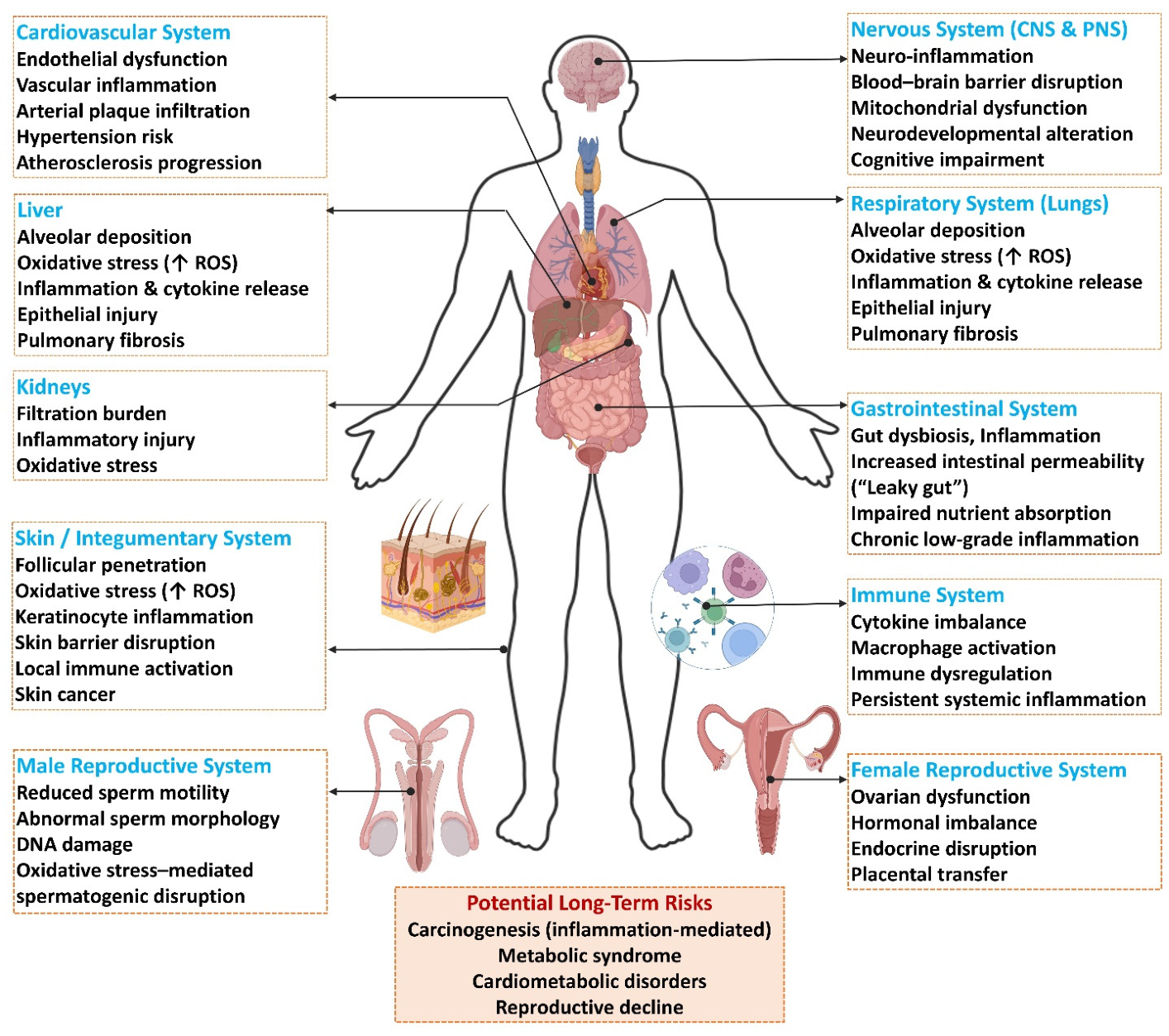
10. Toxicological and Clinical Implications of Microplastics in the Human Body
10.1. Local vs. Systemic Toxicity
10.2. Impact on Reproductive Health
10.3. Cardiopulmonary Implications
10.4. Gastrointestinal and Metabolic Effects
10.5. Transfer to Fetus and Developmental Risks
10.6. Risk Associated with Associated Chemicals and Additives
| Mechanism/Effect of MPs | Toxicological and Clinical Implications | Affected Body System/Site | Immune Response (Antigen/Antibody) | Cancer Carrier Potential | References |
|---|---|---|---|---|---|
| Local deposition in lungs | MPs inhaled into the lungs can trigger inflammation, oxidative stress, epithelial injury, and fibrosis. | Respiratory tract (alveoli, bronchi) | Recognized as foreign particles, MPs stimulate macrophages and cytokine release. | Chronic inflammation may increase susceptibility to lung cancer. | [71,159,160] |
| Systemic circulation | Once translocated, MPs cause cytokine imbalance, oxidative damage, and accumulate in organs. | Blood, immune system, liver, kidneys | MPs mimic antigens, leading to antibody production and immune dysregulation. | Persistent systemic inflammation is linked to tumor development. | [161,162] |
| Male reproductive toxicity | Reduced sperm motility and abnormal morphology have been observed with MP exposure. | Testes, semen | Oxidative stress disrupts spermatogenesis. | DNA damage may raise the risk of testicular cancer. | [163,164] |
| Female reproductive toxicity | MPs interfere with ovarian function, hormone signaling, and can cross the placenta. | Ovaries, placenta | Act as endocrine disruptors, altering estrogen and progesterone pathways. | Endocrine disruption is associated with ovarian and breast cancers. | [165,166,167] |
| Cardiovascular infiltration | MPs have been found in arterial plaques, contributing to endothelial dysfunction, hypertension, and atherosclerosis. | Arteries, myocardium | Immune cell infiltration promotes vascular inflammation. | Embedded MPs may accelerate cardiovascular cancers. | [146,147,168] |
| Gastrointestinal dysbiosis | MPs disrupt gut microbiota and cause leaky gut, malabsorption, and systemic inflammation. | Intestines, gut microbiome | MPs act as antigens, disturbing gut immune balance. | Chronic gut inflammation is linked to colorectal cancer. | [150,151] |
| Fetal transfer and developmental risks | MPs cross the placental barrier, affecting fetal growth, immunity, and neurodevelopment. | Placenta, fetus, neonatal brain | Fetal immune priming occurs as MPs are transferred. | Early-life exposure may predispose to pediatric cancers. | [152,153,167] |
| Chemical leaching (BPA, PFAS, phthalates) | MPs release harmful additives that disrupt endocrine and neurological functions. | Multiple organs (liver, brain, reproductive system) | Chemicals act as haptens, sensitizing the immune system. | BPA and PFAS are linked to breast, prostate, and liver cancers. | [158,169,170] |
| Heavy metal adsorption | MPs can carry heavy metals, intensifying systemic toxicity and oxidative stress. | Liver, kidneys, circulatory system | Metal-loaded MPs activate immune responses and generate ROS. | Heavy metal-associated MPs are implicated in carcinogenesis. | [12,171,172] |
11. Public Health Implications of Microplastics
11.1. Population-Level Exposure and Burden
MPs in Dental Materials and Dentistry
11.2. Vulnerable Populations
11.3. Potential Long-Term Health Outcomes
11.4. Risk Assessment and Uncertainties
11.5. Regulatory and Policy Considerations
11.6. Public Health Strategies and Preventive Measures
12. Surveillance, Innovation, and Policy Integration
13. Knowledge Gaps and Future Research Directions
13.1. Harmonized Detection Methods
13.2. Exploration of Nanoplastics
13.3. Longitudinal Human Studies
13.4. Standardized Reporting of MP Concentration
13.5. Mechanistic Studies Linking MPs to Diseases
13.6. Improving Contamination-Free Workflows
13.7. Epidemiological Studies Linking Burden to Lifestyle/Exposure
14. Conclusions
Author Contributions
Funding
Data Availability Statement
Acknowledgments
Conflicts of Interest
Abbreviations
| ABS | Acrylonitrile Butadiene Styrene |
| AK | Alkyd Resin |
| ANXA2 | Annexin A2 |
| AR | Alkyd Resin (abbreviated in vascular study) |
| ATR-FTIR | Attenuated Total Reflectance–Fourier Transform Infrared Spectroscopy |
| BALF | Bronchoalveolar Lavage Fluid |
| BBB | Blood–Brain Barrier |
| BMI | Body Mass Index |
| BPA | Bisphenol A |
| BR | Butadiene Rubber |
| CA | Cellulose Acetate |
| ccRCC | Clear Cell Renal Cell Carcinoma |
| CNS | Central Nervous System |
| CPE | Chlorinated Polyethylene |
| CSF | Cerebrospinal Fluid |
| EPDM | Ethylene Propylene Diene Monomer |
| EVA | Ethylene Vinyl Acetate |
| EVOH | Ethylene Vinyl Alcohol |
| FEP | Fluorinated Ethylene Propylene |
| FKM | Fluoroelastomer (Fluororubber) |
| FTIR | Fourier Transform Infrared Spectroscopy |
| GI | Gastrointestinal |
| GGN | Ground-Glass Nodule |
| HDL-C | High-Density Lipoprotein Cholesterol |
| IL-17 | Interleukin 17 |
| ILD | Interstitial Lung Disease |
| KOH | Potassium Hydroxide |
| LD-IR | Laser Direct Infrared Spectroscopy |
| LDPE | Low-Density Polyethylene |
| mTOR | Mammalian Target of Rapamycin |
| MPs | Microplastics |
| μFTIR | Micro-Fourier Transform Infrared Spectroscopy |
| μm | Micrometer |
| μRaman | Micro-Raman Spectroscopy |
| N6 | Nylon 6 |
| N66 | Nylon 66 |
| nm | Nanometer |
| NPs | Nanoplastics |
| PA | Polyamide |
| PA66 | Polyamide 66 |
| PB | Polybutylene |
| PBS | Polybutylene Succinate |
| PC | Polycarbonate |
| PE | Polyethylene |
| PEMA | Poly (ethyl methacrylate) |
| PES | Polyester |
| PET | Polyethylene Terephthalate |
| PFA | Perfluoroalkoxy Alkane |
| Phthalates | Phthalic Acid Esters |
| PLA | Polylactic Acid |
| PM0.1 | Particulate Matter ≤0.1 µm |
| PM2.5 | Particulate Matter ≤2.5 µm |
| PMMA | Polymethyl Methacrylate |
| POM | Polyoxymethylene |
| PP | Polypropylene |
| PPTA | Poly (p-phenylene terephthalamide) (Kevlar) |
| PS | Polystyrene |
| PSF | Polysulfone |
| PTFE | Polytetrafluoroethylene |
| PU | Polyurethane |
| PVC | Polyvinyl Chloride |
| PVA | Polyvinyl Alcohol |
| PVP | Polyvinylpyrrolidone |
| Py-GC/MS | Pyrolysis–Gas Chromatography–Mass Spectrometry |
| Raman | Raman Spectroscopy |
| SAN | Styrene Acrylonitrile |
| SBR | Styrene–Butadiene Rubber |
| SEM | Scanning Electron Microscopy |
| ULK1 | Unc-51 Like Autophagy Activating Kinase 1 |
References
- WHO. Microplastics in Drinking-Water; WHO: Geneva, Switzerland, 2019; p. 101. [Google Scholar]
- Ramsperger, A.F.R.M.; Bergamaschi, E.; Panizzolo, M.; Fenoglio, I.; Barbero, F.; Peters, R.; Undas, A.; Purker, S.; Giese, B.; Lalyer, C.R.; et al. Nano- and Microplastics: A Comprehensive Review on Their Exposure Routes, Translocation, and Fate in Humans. NanoImpact 2023, 29, 100441. [Google Scholar] [CrossRef] [PubMed]
- Enyoh, C.E.; Ovuoraye, P.E.; Qingyue, W.; Wang, W. Examining the Impact of Nanoplastics and PFAS Exposure on Immune Functions through Inhibition of Secretory Immunoglobin A in Human Breast Milk. J. Hazard. Mater. 2023, 459, 132103. [Google Scholar] [CrossRef] [PubMed]
- de Souza, A.S.; Ferreira, P.G.; Pereira, P.R.; de Jesus, I.S.; de Oliveira, R.P.R.F.; de Carvalho, A.S.; Rodrigues, L.C.D.; Paschoalin, V.M.F.; Futuro, D.O.; Ferreira, V.F. Micro- and Nanoplastics on Human Health and Diseases: Perspectives and Recent Advances. Microplastics 2025, 4, 64. [Google Scholar] [CrossRef]
- Leslie, H.A.; van Velzen, M.J.M.; Brandsma, S.H.; Vethaak, A.D.; Garcia-Vallejo, J.J.; Lamoree, M.H. Discovery and Quantification of Plastic Particle Pollution in Human Blood. Environ. Int. 2022, 163, 107199. [Google Scholar] [CrossRef] [PubMed]
- Ragusa, A.; Notarstefano, V.; Svelato, A.; Belloni, A.; Gioacchini, G.; Blondeel, C.; Zucchelli, E.; De Luca, C.; D’avino, S.; Gulotta, A.; et al. Raman Microspectroscopy Detection and Characterisation of Microplastics in Human Breastmilk. Polymers 2022, 14, 2700. [Google Scholar] [CrossRef] [PubMed]
- Zhu, L.; Kang, Y.; Ma, M.; Wu, Z.; Zhang, L.; Hu, R.; Xu, Q.; Zhu, J.; Gu, X.; An, L. Tissue Accumulation of Microplastics and Potential Health Risks in Human. Sci. Total Environ. 2024, 915, 170004. [Google Scholar] [CrossRef] [PubMed]
- Lee, D.W.; Jung, J.; Park, S.A.; Lee, Y.; Kim, J.; Han, C.; Kim, H.C.; Lee, J.H.; Hong, Y.C. Microplastic Particles in Human Blood and Their Association with Coagulation Markers. Sci. Rep. 2024, 14, 30419. [Google Scholar] [CrossRef] [PubMed]
- Leonard, S.V.L.; Liddle, C.R.; Atherall, C.A.; Chapman, E.; Watkins, M.; Calaminus, S.D.J.; Rotchell, J.M. Microplastics in Human Blood: Polymer Types, Concentrations and Characterisation Using ΜFTIR. Environ. Int. 2024, 188, 108751. [Google Scholar] [CrossRef] [PubMed]
- Yang, Y.; Xie, E.; Du, Z.; Peng, Z.; Han, Z.; Li, L.; Zhao, R.; Qin, Y.; Xue, M.; Li, F.; et al. Detection of Various Microplastics in Patients Undergoing Cardiac Surgery. Environ. Sci. Technol. 2023, 57, 10911–10918. [Google Scholar] [CrossRef] [PubMed]
- Marfella, R.; Prattichizzo, F.; Sardu, C.; Fulgenzi, G.; Graciotti, L.; Spadoni, T.; D’Onofrio, N.; Scisciola, L.; La Grotta, R.; Frigé, C.; et al. Microplastics and Nanoplastics in Atheromas and Cardiovascular Events. N. Engl. J. Med. 2024, 390, 900–910. [Google Scholar] [CrossRef] [PubMed]
- Carvajal, B.; Vivero Sun, R.; Piderit, F.; Zazueta, A.; Tapia, C.V.; Gotteland, M.; Magne, F. Microplastics in Female Reproductive and Pregnancy Organs: A Systematic Review. Life 2026, 16, 746. [Google Scholar] [CrossRef] [PubMed]
- Sun, H.; Su, X.; Mao, J.; Liu, Y.; Li, G.; Du, Q. Microplastics in Maternal Blood, Fetal Appendages, and Umbilical Vein Blood. Ecotoxicol. Environ. Saf. 2024, 287, 117300. [Google Scholar] [CrossRef] [PubMed]
- Zhu, M.; Li, X.; Lin, W.; Zeng, D.; Yang, P.; Ni, W.; Chen, Z.; Lin, B.; Lai, L.; Ouyang, Z.; et al. Microplastic Particles Detected in Fetal Cord Blood, Placenta, and Meconium: A Pilot Study of Nine Mother-Infant Pairs in South China. Toxics 2024, 12, 850. [Google Scholar] [CrossRef] [PubMed]
- Liu, S.; Lin, G.; Liu, X.; Yang, R.; Wang, H.; Sun, Y.; Chen, B.; Dong, R. Detection of Various Microplastics in Placentas, Meconium, Infant Feces, Breastmilk and Infant Formula: A Pilot Prospective Study. Sci. Total Environ. 2023, 854, 158699. [Google Scholar] [CrossRef] [PubMed]
- Dąbrowska, A.; Komorowska, W.; Kriszt, B.; Szabó, I. Feasibility of Raman and FTIR Spectroscopy for Direct Microplastic Search in the Human Milk Samples: Comparative Qualitative Study. Ecotoxicol. Environ. Saf. 2025, 296, 118159. [Google Scholar] [CrossRef] [PubMed]
- Doroftei, B.; Savuca, A.; Cretu, A.M.; Maftei, R.; Anton, N.; Ilea, C.; Doroftei, M.; Puha, B. Microplastics and Human Fertility: A Comprehensive Review of Their Presence in Human Samples and Reproductive Implication. Ecotoxicol. Environ. Saf. 2025, 303, 118939. [Google Scholar] [CrossRef] [PubMed]
- Zhao, Q.; Zhu, L.; Weng, J.; Jin, Z.; Cao, Y.; Jiang, H.; Zhang, Z. Detection and Characterization of Microplastics in the Human Testis and Semen. Sci. Total Environ. 2023, 877, 162713. [Google Scholar] [CrossRef] [PubMed]
- D’Angelo, S.; Meccariello, R. Microplastics: A Threat for Male Fertility. Int. J. Environ. Res. Public Health 2021, 18, 2392. [Google Scholar] [CrossRef] [PubMed]
- Deng, C.; Zhu, J.; Fang, Z.; Yang, Y.; Zhao, Q.; Zhang, Z.; Jin, Z.; Jiang, H. Identification and Analysis of Microplastics in Para-Tumor and Tumor of Human Prostate. eBioMedicine 2024, 108, 105360. [Google Scholar] [CrossRef] [PubMed]
- Zhang, K.; Yu, S.; Chen, S.; Zhou, Z.; Zhan, Y.; Zhang, X. Multimodal Detection and Analysis of Microplastics in Human Clear Cell Renal Cell Carcinoma. Environ. Pollut. 2025, 383, 126729. [Google Scholar] [CrossRef] [PubMed]
- Osman, A.I.; Hosny, M.; Eltaweil, A.S.; Omar, S.; Elgarahy, A.M.; Farghali, M.; Yap, P.S.; Wu, Y.S.; Nagandran, S.; Batumalaie, K.; et al. Microplastic Sources, Formation, Toxicity and Remediation: A Review. Environ. Chem. Lett. 2023, 21, 2129–2169. [Google Scholar] [CrossRef] [PubMed]
- Rotchell, J.M.; Jenner, L.C.; Chapman, E.; Bennett, R.T.; Bolanle, I.O.; Loubani, M.; Sadofsky, L.; Palmer, T.M. Detection of Microplastics in Human Saphenous Vein Tissue Using ΜFTIR: A Pilot Study. PLoS ONE 2023, 18, e0280594. [Google Scholar] [CrossRef] [PubMed]
- Barbosa, F.; Adeyemi, J.A.; Bocato, M.Z.; Comas, A.; Campiglia, A. A Critical Viewpoint on Current Issues, Limitations, and Future Research Needs on Micro- and Nanoplastic Studies: From the Detection to the Toxicological Assessment. Environ. Res. 2020, 182, 109089. [Google Scholar] [CrossRef] [PubMed]
- Lamoree, M.H.; van Boxel, J.; Nardella, F.; Houthuijs, K.J.; Brandsma, S.H.; Béen, F.; van Duursen, M.B.M. Health Impacts of Microplastic and Nanoplastic Exposure. Nat. Med. 2025, 31, 2873–2887. [Google Scholar] [CrossRef] [PubMed]
- Shi, R.; Xia, P.; Yang, X.; Zhang, X.; Liu, S.; Shen, R.; Tan, H.; Deng, Y.; Zhang, Y. Health Impacts of Micro- and Nanoplastics: Key Influencing Factors, Limitations, and Future Perspectives. Arch. Toxicol. 2025, 100, 875–892. [Google Scholar] [CrossRef] [PubMed]
- Di Fiore, C.; Ishikawa, Y.; Wright, S.L. A Review on Methods for Extracting and Quantifying Microplastic in Biological Tissues. J. Hazard. Mater. 2024, 464, 132991. [Google Scholar] [CrossRef] [PubMed]
- Garcia, M.A.; Liu, R.; Nihart, A.; Hayek, E.E.l.; Castillo, E.; Barrozo, E.R.; Suter, M.A.; Bleske, B.; Scott, J.; Forsythe, K.; et al. Quantitation and Identification of Microplastics Accumulation in Human Placental Specimens Using Pyrolysis Gas Chromatography Mass Spectrometry. Toxicol. Sci. 2024, 199, 81–88. [Google Scholar] [CrossRef] [PubMed]
- Khan, A.; Jia, Z. Recent Insights into Uptake, Toxicity, and Molecular Targets of Microplastics and Nanoplastics Relevant to Human Health Impacts. iScience 2023, 26, 106061. [Google Scholar] [CrossRef] [PubMed]
- Yang, Y.; Chen, Y.; Gao, Y.; Jin, Y.; Xu, F. Mapping Research Frontiers in Microplastics-Induced Oxidative Stress: A Bibliometric Analysis (2010–2024). Front. Environ. Sci. 2025, 13, 1555341. [Google Scholar] [CrossRef]
- Zhao, X.; You, F. Microplastic Human Dietary Uptake from 1990 to 2018 Grew across 109 Major Developing and Industrialized Countries but Can Be Halved by Plastic Debris Removal. Environ. Sci. Technol. 2024, 58, 8709–8723. [Google Scholar] [CrossRef] [PubMed]
- Suman, T.Y.; Rajendiran, K.; Kwak, I.S. Microplastics and Nanoplastics in Human Health: A Comprehensive Review of Exposure Pathways, Cellular Mechanisms, and Toxicological Implications. Arch. Toxicol. 2025, 100, 811–836. [Google Scholar] [CrossRef] [PubMed]
- Qin, X.; Cao, M.; Peng, T.; Shan, H.; Lian, W.; Yu, Y.; Shui, G.; Li, R. Features, Potential Invasion Pathways, and Reproductive Health Risks of Microplastics Detected in Human Uterus. Environ. Sci. Technol. 2024, 58, 10482–10493. [Google Scholar] [CrossRef] [PubMed]
- Yang, Q.; Peng, Y.; Wu, X.; Cao, X.; Zhang, P.; Liang, Z.; Zhang, J.; Zhang, Y.; Gao, P.; Fu, Y.; et al. Microplastics in Human Skeletal Tissues: Presence, Distribution and Health Implications. Environ. Int. 2025, 196, 109316. [Google Scholar] [CrossRef] [PubMed]
- Yu, Q.; Chuang, C.Y.A.; Jiang, Y.; Zhong, H.; Cundy, A.; Kwong, R.W.M.; Min, C.; Zhu, X.; Ji, R. Exploring Environmental Nanoplastics Research: Networks and Evolutionary Trends. Rev. Environ. Contam. Toxicol. 2023, 261, 12. [Google Scholar] [CrossRef]
- Kannan, K.; Vimalkumar, K. A Review of Human Exposure to Microplastics and Insights Into Microplastics as Obesogens. Front. Endocrinol. 2021, 12, 724989. [Google Scholar] [CrossRef] [PubMed]
- Najahi, H.; Banni, M.; Nakad, M.; Abboud, R.; Assaf, J.C.; Operato, L.; Belhassen, M.; Gomes, L.; Hamd, W. Plastic Pollution in Food Packaging Systems: Impact on Human Health, Socioeconomic Considerations and Regulatory Framework. J. Hazard. Mater. Adv. 2025, 18, 100667. [Google Scholar] [CrossRef]
- Liu, S.; Wang, C.; Yang, Y.; Du, Z.; Li, L.; Zhang, M.; Ni, S.; Yue, Z.; Yang, K.; Wang, Y.; et al. Microplastics in Three Types of Human Arteries Detected by Pyrolysis-Gas Chromatography/Mass Spectrometry (Py-GC/MS). J. Hazard. Mater. 2024, 469, 133855. [Google Scholar] [CrossRef] [PubMed]
- Wu, P.; Lin, S.; Cao, G.; Wu, J.; Jin, H.; Wang, C.; Wong, M.H.; Yang, Z.; Cai, Z. Absorption, Distribution, Metabolism, Excretion and Toxicity of Microplastics in the Human Body and Health Implications. J. Hazard. Mater. 2022, 437, 129361. [Google Scholar] [CrossRef] [PubMed]
- Bossio, S.; Ruffolo, S.A.; Lofaro, D.; Perri, A.; La Russa, M.F. Endocrine Toxicity of Micro- and Nanoplastics, and Advances in Detection Techniques for Human Tissues: A Comprehensive Review. Endocrines 2025, 6, 23. [Google Scholar] [CrossRef]
- Božičević, L.; Altmann, K.; Hildebrandt, J.; Knigge, X.; Vrček, V.; Peranić, N.; Kalčec, N.; Vinković Vrček, I. Estrogenic Activity of Plastic Nanoparticle Mixtures under in Vitro Settings. Environ. Sci. Nano 2024, 11, 2112–2126. [Google Scholar] [CrossRef]
- Ullah, S.; Ahmad, S.; Guo, X.; Ullah, S.; Ullah, S.; Nabi, G.; Wanghe, K. A Review of the Endocrine Disrupting Effects of Micro and Nano Plastic and Their Associated Chemicals in Mammals. Front. Endocrinol. 2023, 13, 1084236. [Google Scholar] [CrossRef] [PubMed]
- Alqahtani, S.; Alqahtani, S.; Saquib, Q.; Mohiddin, F. Toxicological Impact of Microplastics and Nanoplastics on Humans: Understanding the Mechanistic Aspect of the Interaction. Front. Toxicol. 2023, 5, 1193386. [Google Scholar] [CrossRef] [PubMed]
- Han, S.W.; Choi, J.; Ryu, K.Y. Recent Progress and Future Directions of the Research on Nanoplastic-Induced Neurotoxicity. Neural Regen. Res. 2024, 19, 331–335. [Google Scholar] [CrossRef] [PubMed]
- Kopatz, V.; Wen, K.; Kovács, T.; Keimowitz, A.S.; Pichler, V.; Widder, J.; Vethaak, A.D.; Hollóczki, O.; Kenner, L. Micro- and Nanoplastics Breach the Blood–Brain Barrier (BBB): Biomolecular Corona’s Role Revealed. Nanomaterials 2023, 13, 1404. [Google Scholar] [CrossRef] [PubMed]
- Murthy, M.K. Unraveling the Molecular Pathways Linking Polystyrene Exposure and Depression. Environ. Sci. Pollut. Res. 2025, 32, 26702–26737. [Google Scholar] [CrossRef] [PubMed]
- Martínez-Ibarra, A.; Martínez-Razo, L.D.; MacDonald-Ramos, K.; Morales-Pacheco, M.; Vázquez-Martínez, E.R.; López-López, M.; Rodríguez Dorantes, M.; Cerbón, M. Multisystemic Alterations in Humans Induced by Bisphenol A and Phthalates: Experimental, Epidemiological and Clinical Studies Reveal the Need to Change Health Policies. Environ. Pollut. 2021, 271, 116380. [Google Scholar] [CrossRef] [PubMed]
- Moghazy, M.; Papathanasiou, M.; Tzoupis, H.; Papavasileiou, K.D.; Xing, C.; Lauschke, V.M.; Afantitis, A.; Melagraki, G. A Systematic Literature Review of Reproductive Toxicological Studies on Phthalates. Int. J. Mol. Sci. 2025, 26, 8761. [Google Scholar] [CrossRef] [PubMed]
- Sree, C.G.; Buddolla, V.; Lakshmi, B.A.; Kim, Y.J. Phthalate Toxicity Mechanisms: An Update. Comp. Biochem. Physiol. Part-C Toxicol. Pharmacol. 2023, 263, 109498. [Google Scholar] [CrossRef] [PubMed]
- Dzierżyński, E.; Blicharz-Grabias, E.; Komaniecka, I.; Panek, R.; Forma, A.; Gawlik, P.J.; Puźniak, D.; Flieger, W.; Choma, A.; Suśniak, K.; et al. Post-Mortem Evidence of Microplastic Bioaccumulation in Human Organs: Insights from Advanced Imaging and Spectroscopic Analysis. Arch. Toxicol. 2025, 99, 4051–4066. [Google Scholar] [CrossRef] [PubMed]
- Hong, A.R.; Kim, J.S. Biological Hazards of Micro- and Nanoplastic with Adsorbents and Additives. Front. Public Health 2024, 12, 1458727. [Google Scholar] [CrossRef] [PubMed]
- Rozman, U.; Klun, B.; Kuljanin, A.; Skalar, T.; Kalčíková, G. Insights into the Shape-Dependent Effects of Polyethylene Microplastics on Interactions with Organisms, Environmental Aging, and Adsorption Properties. Sci. Rep. 2023, 13, 22147. [Google Scholar] [CrossRef] [PubMed]
- de Bruin, C.R.; de Rijke, E.; van Wezel, A.P.; Astefanei, A. Methodologies to Characterize, Identify and Quantify Nano- and Sub-Micron Sized Plastics in Relevant Media for Human Exposure: A Critical Review. Environ. Sci. Adv. 2022, 1, 238–258. [Google Scholar] [CrossRef]
- Abdolahpur Monikh, F.; Vijver, M.G.; Kortet, R.; Lynch, I.; Peijnenburg, W.J.G.M. Emerging Investigator Series: Perspectives on Toxicokinetics of Nanoscale Plastic Debris in Organisms. Environ. Sci. Nano 2022, 9, 1566–1577. [Google Scholar] [CrossRef]
- Liu, W.; Liao, H.; Wei, M.; Junaid, M.; Chen, G.; Wang, J. Biological Uptake, Distribution and Toxicity of Micro(Nano)Plastics in the Aquatic Biota: A Special Emphasis on Size-Dependent Impacts. TrAC Trends Anal. Chem. 2024, 170, 117477. [Google Scholar] [CrossRef]
- Ali, N.; Katsouli, J.; Marczylo, E.L.; Gant, T.W.; Wright, S.; Bernardino de la Serna, J. The Potential Impacts of Micro-and-Nano Plastics on Various Organ Systems in Humans. eBioMedicine 2024, 99, 104901. [Google Scholar] [CrossRef] [PubMed]
- Otorkpa, O.J.; Otorkpa, C.O. Health Effects of Microplastics and Nanoplastics: Review of Published Case Reports. Environ. Anal. Health Toxicol. 2024, 39, e2024020. [Google Scholar] [CrossRef] [PubMed]
- Paul, M.B.; Böhmert, L.; Thünemann, A.F.; Loeschner, K.; Givelet, L.; Fahrenson, C.; Braeuning, A.; Sieg, H. Influence of Artificial Digestion on Characteristics and Intestinal Cellular Effects of Micro-, Submicro- and Nanoplastics. Food Chem. Toxicol. 2024, 184, 114423. [Google Scholar] [CrossRef] [PubMed]
- Razaviarani, V.; Saudagar, A.; Gallage, S.; Shrinath, S.; Arab, G. Comprehensive Investigation on Microplastics from Source to Sink. Clean Technol. Environ. Policy 2024, 26, 1755–1782. [Google Scholar] [CrossRef]
- Kung, H.C.; Wu, C.H.; Cheruiyot, N.K.; Mutuku, J.K.; Huang, B.W.; Chang-Chien, G.P. The Current Status of Atmospheric Micro/Nanoplastics Research: Characterization, Analytical Methods, Fate, and Human Health Risk. Aerosol Air Qual. Res. 2023, 23, 220362. [Google Scholar] [CrossRef]
- Bhattacharyya, S.; Greer, M.L.; Salehi, M. Impact of Micro- and Nanoplastics Exposure on Human Health: Focus on Neurological Effects from Ingestion. Front. Public Health 2025, 13, 1681776. [Google Scholar] [CrossRef] [PubMed]
- Zhang, J.; Liu, Y.; Zhao, L.; Peng, C.; Wang, L. Microplastics and Nanoplastics in Drinking Water and Beverages: Occurrence and Human Exposure. J. Environ. Expo. Assess. 2024, 3, 24. [Google Scholar] [CrossRef]
- Vdovchenko, A.; Resmini, M. Mapping Microplastics in Humans: Analysis of Polymer Types, and Shapes in Food and Drinking Water—A Systematic Review. Int. J. Mol. Sci. 2024, 25, 7074. [Google Scholar] [CrossRef] [PubMed]
- Hore, M.; Bhattacharyya, S.; Roy, S.; Sarkar, D.; Biswas, J.K. Human Exposure to Dietary Microplastics and Health Risk: A Comprehensive Review. Rev. Environ. Contam. Toxicol. 2024, 262, 14. [Google Scholar] [CrossRef]
- Heo, S.J.; Moon, N.; Kim, J.H. A Systematic Review and Quality Assessment of Estimated Daily Intake of Microplastics through Food. Rev. Environ. Health 2024, 40, 371–392. [Google Scholar] [CrossRef] [PubMed]
- Dileepan, A.G.B.; Jeyaram, S.; Arumugam, N.; Almansour, A.I.; Santhamoorthy, M. Identification and Occurrence of Microplastics in Drinking Water Bottles and Milk Packaging Consumed by Humans Daily. Environ. Monit. Assess. 2025, 197, 261. [Google Scholar] [CrossRef] [PubMed]
- Peijnenburg, W. Airborne Microplastics Enter Plant Leaves and End up in Our Food. Nature 2025, 641, 601–602. [Google Scholar] [CrossRef] [PubMed]
- Tsochatzis, E.D.; Theodoridis, G.; Corredig, M. Analysis of Oligomers to Assess Exposure to Microplastics from Foods. A perspective. Front. Nutr. 2023, 10, 1186951. [Google Scholar] [CrossRef] [PubMed]
- Haldar, S.; Muralidaran, Y.; Míguez, D.; Mulla, S.I.; Mishra, P. Eco-Toxicity of Nano-Plastics and Its Implication on Human Metabolism: Current and Future Perspective. Sci. Total Environ. 2023, 861, 160571. [Google Scholar] [CrossRef] [PubMed]
- Eberhard, T.; Casillas, G.; Zarus, G.M.; Barr, D.B. Systematic Review of Microplastics and Nanoplastics in Indoor and Outdoor Air: Identifying a Framework and Data Needs for Quantifying Human Inhalation Exposures. J. Expo. Sci. Environ. Epidemiol. 2024, 34, 185–196. [Google Scholar] [CrossRef] [PubMed]
- Gou, Z.; Wu, H.; Li, S.; Liu, Z.; Zhang, Y. Airborne Micro- and Nanoplastics: Emerging Causes of Respiratory Diseases. Part. Fibre Toxicol. 2024, 21, 50. [Google Scholar] [CrossRef] [PubMed]
- Méndez Rodríguez, K.B.; Jiménez Avalos, J.A.; Fernández Macias, J.C.; González Palomo, A.K. Microplastics: Challenges of Assessment in Biological Samples and Their Implication for in Vitro and in Vivo Effects. Environ. Sci. Pollut. Res. Int. 2023, 30, 119733–119749. [Google Scholar] [CrossRef] [PubMed]
- Roslan, N.S.; Lee, Y.Y.; Ibrahim, Y.S.; Anuar, S.T.; Yusof, K.M.K.K.; Lai, L.A.; Brentnall, T. Detection of Microplastics in Human Tissues and Organs: A Scoping Review. J. Glob. Health 2024, 14, 04179. [Google Scholar] [CrossRef] [PubMed]
- Aristizabal, M.; Jiménez-Orrego, K.V.; Caicedo-León, M.D.; Páez-Cárdenas, L.S.; Castellanos-García, I.; Villalba-Moreno, D.L.; Ramírez-Zuluaga, L.V.; Hsu, J.T.S.; Jaller, J.; Gold, M. Microplastics in Dermatology: Potential Effects on Skin Homeostasis. J. Cosmet. Dermatol. 2024, 23, 766–772. [Google Scholar] [CrossRef] [PubMed]
- Awolesi, O.; Oni, P.; Arwenyo, B.; Awolesi, O.; Oni, P.; Arwenyo, B. Microplastics and Nano-Plastics: From Initiation to Termination. J. Geosci. Environ. Prot. 2023, 11, 249–280. [Google Scholar] [CrossRef]
- Morales-Cano, K.L.; Hermida-Castellanos, L.; Adame-Adame, C.M.; Peláez, L.A.P.; Peña-Montes, C.; Morales-Cano, K.L.; Hermida-Castellanos, L.; Adame-Adame, C.M.; Peláez, L.A.P.; Peña-Montes, C. Micro(Nano)Plastics as Carriers of Toxic Agents and Their Impact on Human Health. In Advances and Challenges in Microplastics; IntechOpen: London, UK, 2023; Volume 185. [Google Scholar] [CrossRef]
- Li, N.; Yang, H.; Dong, Y.; Wei, B.; Liang, L.; Yun, X.; Tian, J.; Zheng, Y.; Duan, S.; Zhang, L. Prevalence and Implications of Microplastic Contaminants in General Human Seminal Fluid: A Raman Spectroscopic Study. Sci. Total Environ. 2024, 937, 173522. [Google Scholar] [CrossRef] [PubMed]
- EFSA Panel on Contaminants in the Food Chain (CONTAM). Presence of Microplastics and Nanoplastics in Food, with Particular Focus on Seafood. Eur. Food Saf. Auth. 2016, 14, e04501. [CrossRef]
- Nihart, A.J.; Garcia, M.A.; El Hayek, E.; Liu, R.; Olewine, M.; Kingston, J.D.; Castillo, E.F.; Gullapalli, R.R.; Howard, T.; Bleske, B.; et al. Bioaccumulation of Microplastics in Decedent Human Brains. Nat. Med. 2025, 31, 1114–1119. [Google Scholar] [CrossRef] [PubMed]
- Lee, S.E.; Kim, D.Y.; Jeong, T.S.; Park, Y.S. Micro- and Nano-Plastic-Induced Adverse Health Effects on Lungs and Kidneys Linked to Oxidative Stress and Inflammation. Life 2025, 15, 392. [Google Scholar] [CrossRef] [PubMed]
- Massardo, S.; Verzola, D.; Alberti, S.; Caboni, C.; Santostefano, M.; Eugenio Verrina, E.; Angeletti, A.; Lugani, F.; Ghiggeri, G.M.; Bruschi, M.; et al. MicroRaman Spectroscopy Detects the Presence of Microplastics in Human Urine and Kidney Tissue. Environ. Int. 2024, 184, 108444. [Google Scholar] [CrossRef] [PubMed]
- Gupta, M.; Sehrawat, P.; Gupta, G.; Singhal, N.; Kansal, S.K. Detection and quantification of microplastics in milk from Chandigarh, India: A pilot study highlighting SFEC-based spectral validation. Food Addit. Contam. Part A 2026, 43, 594–614. [Google Scholar] [CrossRef] [PubMed]
- Huang, S.; Huang, X.; Bi, R.; Guo, Q.; Yu, X.; Zeng, Q.; Huang, Z.; Liu, T.; Wu, H.; Chen, Y.; et al. Detection and Analysis of Microplastics in Human Sputum. Environ. Sci. Technol. 2022, 56, 2476–2486. [Google Scholar] [CrossRef] [PubMed]
- Saraluck, A.; Techarang, T.; Bunyapipat, P.; Boonchuwong, K.; Pullaput, Y.; Mordmuang, A. Detection of Microplastics in Human Breast Milk and Its Association with Changes in Human Milk Bacterial Microbiota. J. Clin. Med. 2024, 13, 4029. [Google Scholar] [CrossRef] [PubMed]
- Kumar, N.; Mangla, M. Microplastics and Impaired Male Reproductive Health-Exploring Biological Pathways of Harm: A Narrative Review. Biol. Reprod. 2025, 112, 1028–1038. [Google Scholar] [CrossRef] [PubMed]
- Montano, L.; Giorgini, E.; Notarstefano, V.; Notari, T.; Ricciardi, M.; Piscopo, M.; Motta, O. Raman Microspectroscopy Evidence of Microplastics in Human Semen. Sci. Total Environ. 2023, 901, 165922. [Google Scholar] [CrossRef] [PubMed]
- Trela, K.; Tuteja, A.; Więcko, L.; Olczyk, L.; Burzykowska, K.; Gęborys, K.; Mohaissen, R.; Tyla, M.; Stabrawa, P. The Microplastics and Human Health: Focus on the Reproductive System. Qual. Sport 2025, 48, 67035. [Google Scholar] [CrossRef]
- Broggiato, M.; Pezzana, S.; Scaccabarozzi, C.; Parisi, F.; Vanetti, C.; Montalvo, C.K.G.; Savasi, V.M.; Fenizia, C. Plastic Pollution in Human Reproduction: Should We Worry? Reprod. Biomed. Online 2026, 52, 105343. [Google Scholar] [CrossRef] [PubMed]
- Guo, Y.; Rong, M.; Fan, Y.; Teng, X.; Jin, L.; Zhao, Y. The Presence of Microplastics in Human Semen and Their Associations with Semen Quality. Toxics 2025, 13, 566. [Google Scholar] [CrossRef] [PubMed]
- Gomez-Sanchez, E.; Peñalver-Soler, R.M.; Almunia, N.; Pérez-Álvarez, M.C.; Luque, M.D.; Campillo, N.; Flores Monreal, A.; Arroyo-Manzanares, N.; Ruiz-Moreno, Y.; Jiménez, R.; et al. O-280 Unveiling the Hidden Danger: Detection and Characterisation of Microplastics in Human Follicular and Seminal Fluids. Hum. Reprod. 2025, 40, deaf097.280. [Google Scholar] [CrossRef]
- Kong, F.; Fang, L.; Gui, Y.; Lan, H.; Zhao, P.; Zhang, Y.; Jiang, L.; Zhang, S.; Tong, X. Polyethylene and Polyvinyl Chloride Nanoplastics in Human Follicular Fluid and Seminal Plasma: Impact on Fertilization and Sperm Quality. ACS Nano 2025, 19, 27159–27172. [Google Scholar] [CrossRef] [PubMed]
- Ilki, F.Y. Increased Seminal Microplastic Burden in Men with Varicocele: A Controlled Clinical Study. Int. Urol. Nephrol. 2025, 58, 2089–2094. [Google Scholar] [CrossRef] [PubMed]
- Hu, C.J.; Garcia, M.A.; Nihart, A.; Liu, R.; Yin, L.; Adolphi, N.; Gallego, D.F.; Kang, H.; Campen, M.J.; Yu, X. Microplastic Presence in Dog and Human Testis and Its Potential Association with Sperm Count and Weights of Testis and Epididymis. Toxicol. Sci. 2024, 200, 235–240. [Google Scholar] [CrossRef] [PubMed]
- Wehrli, L.; Martin, O.V.; Trasande, L.; Damdimopoulou, P. Reproductive Toxicity of Micro- and Nanoplastics: Insights from Experimental and Human Studies. J. Intern. Med. 2025, 298, 532–561. [Google Scholar] [CrossRef] [PubMed]
- Yang, W.; Wu, L.; Li, G.; Shi, L.; Zhang, J.; Liu, L.; Chen, Y.; Yu, H.; Wang, K.; Xin, L.; et al. Atlas and Source of the Microplastics of Male Reproductive System in Human and Mice. Environ. Sci. Pollut. Res. Int. 2024, 31, 25046–25058. [Google Scholar] [CrossRef] [PubMed]
- Jiang, J.; Shu, Z.; Qiu, L. Adverse Effects and Potential Mechanisms of Polystyrene Microplastics (PS-MPs) on the Blood-Testis Barrier. Environ. Geochem. Health 2024, 46, 238. [Google Scholar] [CrossRef] [PubMed]
- Pironti, C.; Notarstefano, V.; Ricciardi, M.; Motta, O.; Giorgini, E.; Montano, L. First Evidence of Microplastics in Human Urine, a Preliminary Study of Intake in the Human Body. Toxics 2022, 11, 40. [Google Scholar] [CrossRef] [PubMed]
- Kusyk, D.; Górna, I.; Kowalówka, M.; Banaszak, M.; Jakubowski, K.; Drzymała-Czyż, S. Microplastics in Humans: A Critical Review of Biomonitoring Evidence and Immune–Metabolic Associations. Appl. Sci. 2025, 15, 12289. [Google Scholar] [CrossRef]
- Wibowo, A.T.; Nugrahapraja, H.; Wahyuono, R.A.; Islami, I.; Haekal, M.H.; Fardiansyah, Y.; Sugiyo, P.W.W.; Putro, Y.K.; Fauzia, F.N.; Santoso, H.; et al. Microplastic Contamination in the Human Gastrointestinal Tract and Daily Consumables Associated with an Indonesian Farming Community. Sustainability 2021, 13, 12840. [Google Scholar] [CrossRef]
- Shi, X.; Wang, Y.; Xu, L. An Overview of Research on the Association between Microplastics and Central Nervous System Disorders. Front. Public Health 2025, 13, 1629181. [Google Scholar] [CrossRef] [PubMed]
- Xie, J.; Ji, J.; Sun, Y.; Ma, Y.; Wu, D.; Zhang, Z. Blood-Brain Barrier Damage Accelerates the Accumulation of Micro- and Nanoplastics in the Human Central Nervous System. J. Hazard. Mater. 2024, 480, 136028. [Google Scholar] [CrossRef] [PubMed]
- He, P.; Wang, F.; Xi, G.; Li, Y.; Wang, F.; Wang, H.; Li, L.; Ma, X.; Han, Y.; Shi, Y. Association of Microplastics in Human Cerebrospinal Fluid with Alzheimer’s Disease-Related Changes. J. Hazard. Mater. 2025, 494, 138748. [Google Scholar] [CrossRef] [PubMed]
- Jahedi, F.; Haghighi Fard, N.J.; Ahmadi, M.; Takdastan, A.; Shoushtari, M.H.; Dehbandi, R.; Turner, A. Microplastics in Urine, Sputum and Lung Lavage Fluid from Patients with Respiratory Illnesses. Environ. Res. 2025, 274, 121278. [Google Scholar] [CrossRef] [PubMed]
- Goldsworthy, A.; O’Callaghan, L.A.; Tronstad, O.; Suen, J.; Chen, H.; Rauert, C.; Blum, C.B.; Tajouri, L.; Olsen, M.; Thomas, K.V.; et al. Micro- and Nanoplastic-Induced Respiratory Disease and Dysfunction: A Scoping Review. Microplastics 2025, 4, 79. [Google Scholar] [CrossRef]
- Özgen Alpaydin, A.; Uçan, E.S.; Köktürk, M.; Atamanalp, M.; Kalyoncu, Ç.; Yiğit, S.; Uçar, A.; Şimşek, G.Ö.; Tertemiz, K.C.; Karaçam, V.; et al. Microplastics, as a Risk Factor in the Development of Interstitial Lung Disease- a Preliminary Study. Environ. Pollut. 2024, 363, 125054. [Google Scholar] [CrossRef] [PubMed]
- Momeni, M.K.; Taghipour, H.; Ghayebzadeh, M.; Mohammadi, M.; Keikhaee, R. Isolation and Characterization of Microplastics from the Human Respiratory System: Sputum, Broncho-Alveolar Lavage Fluid, and Pleural Fluid Simultaneously. Environ. Pollut. 2025, 365, 125389. [Google Scholar] [CrossRef] [PubMed]
- Braun, T.; Ehrlich, L.; Henrich, W.; Koeppel, S.; Lomako, I.; Schwabl, P.; Liebmann, B. Detection of Microplastic in Human Placenta and Meconium in a Clinical Setting. Pharmaceutics 2021, 13, 921. [Google Scholar] [CrossRef] [PubMed]
- Jenner, L.C.; Rotchell, J.M.; Bennett, R.T.; Cowen, M.; Tentzeris, V.; Sadofsky, L.R. Detection of Microplastics in Human Lung Tissue Using ΜFTIR Spectroscopy. Sci. Total Environ. 2022, 831, 154907. [Google Scholar] [CrossRef] [PubMed]
- Amato-Lourenço, L.F.; Carvalho-Oliveira, R.; Júnior, G.R.; dos Santos Galvão, L.; Ando, R.A.; Mauad, T. Presence of Airborne Microplastics in Human Lung Tissue. J. Hazard. Mater. 2021, 416, 126124. [Google Scholar] [CrossRef] [PubMed]
- Chen, Q.; Gao, J.; Yu, H.; Su, H.; Yang, Y.; Cao, Y.; Zhang, Q.; Ren, Y.; Hollert, H.; Shi, H.; et al. An Emerging Role of Microplastics in the Etiology of Lung Ground Glass Nodules. Environ. Sci. Eur. 2022, 34, 25. [Google Scholar] [CrossRef]
- Horvatits, T.; Tamminga, M.; Liu, B.; Sebode, M.; Carambia, A.; Fischer, L.; Püschel, K.; Huber, S.; Fischer, E.K. Microplastics Detected in Cirrhotic Liver Tissue. eBioMedicine 2022, 82, 104147. [Google Scholar] [CrossRef] [PubMed]
- Wang, T.; Li, N.; Zhao, Z.; Zhang, Y.; Lin, L.; Ding, Y.; Feng, R.; Yang, Z.; Du, W.; Zeng, Y. Microplastic Contamination in Kidney Transplant Donor Tissues and Its Association with Early Post-Transplant Blood Pressure Changes in Recipients: A Multi-Modal Analytical Study. J. Hazard. Mater. 2025, 497, 139728. [Google Scholar] [CrossRef] [PubMed]
- Li, K.; Li, W.; Sun, Y.; Ma, T.; Yuan, L.; Rong, Y.; Liu, X.; Fu, Y.; Yu, X.; Xu, X. Medical Microplastics: Research Progress on Exposure Pathways, Toxic Effects, and Detection Methods. Microplastics 2026, 5, 61. [Google Scholar] [CrossRef]
- Cui, C.; Guo, Z.; Liu, Y.; Han, N.; Song, J.; Chen, Y.; Zheng, Y.; Sheng, C.; Balmer, L.; Li, H.; et al. Tissue-Specific Distribution of Microplastics in Human Blood and Carotid Plaques: A Paired Sample Analysis. Environ. Int. 2025, 203, 109743. [Google Scholar] [CrossRef] [PubMed]
- Gecegelen, E.; Ucdal, M.; Dogu, B.B. A Novel Risk Factor for Dementia: Chronic Microplastic Exposure. Front. Neurol. 2025, 16, 1581109. [Google Scholar] [CrossRef] [PubMed]
- Giri, S.; Lamichhane, G.; Pandey, J.; Khadka, D. Micro (Nano) Plastics in Human Carcinogenesis: Emerging Evidence and Mechanistic Insights. Microplastics 2025, 4, 78. [Google Scholar] [CrossRef]
- Wang, M.; Liu, Q.; Zhang, X.; Jiang, H.; Zhang, X. Identification and Analysis of Microplastics in Human Penile Cancer Tissues. Sci. Total Environ. 2025, 969, 178815. [Google Scholar] [CrossRef] [PubMed]
- Codrington, J.; Varnum, A.A.; Hildebrandt, L.; Pröfrock, D.; Bidhan, J.; Khodamoradi, K.; Höhme, A.L.; Held, M.; Evans, A.; Velasquez, D.; et al. Detection of Microplastics in the Human Penis. Int. J. Impot. Res. 2024, 37, 377–383. [Google Scholar] [CrossRef] [PubMed]
- Cornelli, U.; Casella, C.; Belcaro, G.; Cesarone, M.R.; Marucci, S.; Rondanelli, M.; Recchia, M.; Zanoni, G. Definition of Emerging Microplastic Syndrome Based on Clinical and Epidemiological Evidence: A Narrative Review. Microplastics 2025, 4, 93. [Google Scholar] [CrossRef]
- Xia, Q.; Wei, Y.; Hu, L.J.; Zeng, F.M.; Chen, Y.W.; Xu, D.; Sun, Y.; Zhao, L.W.; Li, Y.F.; Pang, G.H.; et al. Inhalation of Microplastics Induces Inflammatory Injuries in Multiple Murine Organs via the Toll-like Receptor Pathway. Environ. Sci. Technol. 2024, 58, 18603–18618. [Google Scholar] [CrossRef] [PubMed]
- Abbasi, S.; Turner, A. Human Exposure to Microplastics: A Study in Iran. J. Hazard. Mater. 2021, 403, 123799. [Google Scholar] [CrossRef] [PubMed]
- de Oliveira, R.B.; Pelepenko, L.E.; Masaro, D.A.; Lustosa, G.M.M.M.; de Oliveira, M.C.; Roza, N.A.V.; Marciano, M.A.; dos Reis, L.M.; Kamel, S.; Louvet, L.; et al. Effects of Microplastics on the Kidneys: A Narrative Review. Kidney Int. 2024, 106, 400–407. [Google Scholar] [CrossRef] [PubMed]
- Guo, X.; Wang, L.; Wang, X.; Li, D.; Wang, H.; Xu, H.; Liu, Y.; Kang, R.; Chen, Q.; Zheng, L.; et al. Discovery and Analysis of Microplastics in Human Bone Marrow. J. Hazard. Mater. 2024, 477, 135266. [Google Scholar] [CrossRef] [PubMed]
- Rísová, V.; Gajdošová, L.; Saade, R.; El, O.; Sečanská, H.; Kopáni, M.; Polák, Š. Plastic Particles and Female Fertility: Pathways, Toxicity, and Analytical Challenges. Microplastics 2026, 5, 3. [Google Scholar] [CrossRef]
- Schwabl, P.; Koppel, S.; Konigshofer, P.; Bucsics, T.; Trauner, M.; Reiberger, T.; Liebmann, B. Detection of Various Microplastics in Human Stool: A Prospective Case Series. Ann. Intern. Med. 2019, 171, 453–457. [Google Scholar] [CrossRef] [PubMed]
- Ho, Y.W.; Lim, J.Y.; Yeoh, Y.K.; Chiou, J.C.; Zhu, Y.; Lai, K.P.; Li, L.; Chan, P.K.S.; Fang, J.K.H. Preliminary Findings of the High Quantity of Microplastics in Faeces of Hong Kong Residents. Toxics 2022, 10, 414. [Google Scholar] [CrossRef] [PubMed]
- Yan, Z.; Liu, Y.; Zhang, T.; Zhang, F.; Ren, H.; Zhang, Y. Analysis of Microplastics in Human Feces Reveals a Correlation between Fecal Microplastics and Inflammatory Bowel Disease Status. Environ. Sci. Technol. 2021, 56, 414–421. [Google Scholar] [CrossRef] [PubMed]
- Luqman, A.; Nugrahapraja, H.; Wahyuono, R.A.; Islami, I.; Haekal, M.H.; Fardiansyah, Y.; Putri, B.Q.; Amalludin, F.I.; Rofiqa, E.A.; Götz, F.; et al. Microplastic Contamination in Human Stools, Foods, and Drinking Water Associated with Indonesian Coastal Population. Environments 2021, 8, 138. [Google Scholar] [CrossRef]
- Buesen, R.; Vogel, S.; Thoma, T.; Strauss, V.; Gröters, S.; Becker, K.; Müller, F.; Gründling, T.; Pfohl, P.; Vogel, A.; et al. RESEARCH Open Access Oral Toxicity of Small Microplastic of Polyamide Assessed by a Standardized Guideline Study. Microplast. Nanoplast. 2025, 5, 31. [Google Scholar] [CrossRef]
- Gqomfa, B.; Dlangamandla, C.; Ntwampe, S.K.; Chidi, B.S.; Maphanga, T. Current Techniques for Identifying, Quantifying, and Characterizing Micro and Nanoplastics with Emphasis on Strengths, Limitations, and Challenges. Discov. Environ. 2025, 3, 282. [Google Scholar] [CrossRef]
- ‘A Bombshell’: Doubt Cast on Discovery of Microplastics throughout Human Body|Plastics|The Guardian. Available online: https://www.theguardian.com/environment/2026/jan/13/microplastics-human-body-doubt (accessed on 20 February 2026).
- Enyoh, C.E.; Wang, Q.; Chowdhury, T.; Wang, W.; Lu, S.; Xiao, K.; Chowdhury, M.A.H. New Analytical Approaches for Effective Quantification and Identification of Nanoplastics in Environmental Samples. Processes 2021, 9, 2086. [Google Scholar] [CrossRef]
- Ośko, J.; Kadac-Czapska, K.; Jażdżewska, K.; Nowak, N.; Kowalczyk, P.; Grembecka, M. Nanoplastics: From Separations to Analysis—Challenges and Limitations. Separations 2025, 12, 185. [Google Scholar] [CrossRef]
- Zea Cobos, A.G.; Amón, J.; León, E.; Caballero, P. Standardization of FTIR-Based Methodologies for Microplastics Detection in Drinking Water: A Meta-Analysis Indeed and Practical Approach. Water 2024, 16, 3170. [Google Scholar] [CrossRef]
- Rauert, C.; Charlton, N.; Bagley, A.; Dunlop, S.A.; Symeonides, C.; Thomas, K.V. Assessing the Efficacy of Pyrolysis–Gas Chromatography–Mass Spectrometry for Nanoplastic and Microplastic Analysis in Human Blood. Environ. Sci. Technol. 2025, 59, 1984–1994. [Google Scholar] [CrossRef] [PubMed]
- Cerasa, M.; Teodori, S.; Pietrelli, L. Searching Nanoplastics: From Sampling to Sample Processing. Polymers 2021, 13, 3658. [Google Scholar] [CrossRef] [PubMed]
- Isibor, P.O. Regulations and Policy Considerations for Nanoparticle Safety. In Environmental Nanotoxicology: Combatting the Minute Contaminants; Springer: Cham, Switzerland, 2024; pp. 295–316. [Google Scholar] [CrossRef]
- Bhardwaj, G.; Abdulkadhim, M.; Joshi, K.; Wankhede, L.; Das, R.K.; Brar, S.K. Exposure Pathways, Systemic Distribution, and Health Implications of Micro- and Nanoplastics in Humans. Appl. Sci. 2025, 15, 8813. [Google Scholar] [CrossRef]
- Cheng, Y.; Yang, Y.; Bai, L.; Cui, J. Microplastics: An Often-Overlooked Issue in the Transition from Chronic Inflammation to Cancer. J. Transl. Med. 2024, 22, 959. [Google Scholar] [CrossRef] [PubMed]
- Meng, X.; Ge, L.; Zhang, J.; Xue, J.; Gonzalez-Gil, G.; Vrouwenvelder, J.S.; Li, Z. Systemic Effects of Nanoplastics on Multi-Organ at the Environmentally Relevant Dose: The Insights in Physiological, Histological, and Oxidative Damages. Sci. Total Environ. 2023, 892, 164687. [Google Scholar] [CrossRef] [PubMed]
- Microplastics and Our Health: What the Science Says. Available online: https://med.stanford.edu/news/insights/2025/01/microplastics-in-body-polluted-tiny-plastic-fragments.html (accessed on 19 February 2026).
- Sexton, K.; Callahan, M.A.; Bryan, E.F. Estimating Exposure and Dose to Characterize Health Risks: The Role of Human Tissue Monitoring in Exposure Assessment. Environ. Health Perspect. 1995, 103, 13. [Google Scholar] [CrossRef]
- Inam, Ö. Impact of Microplastics on Female Reproductive Health: Insights from Animal and Human Experimental Studies: A Systematic Review. Arch. Gynecol. Obstet. 2025, 312, 77–92. [Google Scholar] [CrossRef] [PubMed]
- Abbas, G.; Ahmed, U.; Ahmad, M.A. Impact of Microplastics on Human Health: Risks, Diseases, and Affected Body Systems. Microplastics 2025, 4, 23. [Google Scholar] [CrossRef]
- Wang, S.; Lu, W.; Cao, Q.; Tu, C.; Zhong, C.; Qiu, L.; Li, S.; Zhang, H.; Lan, M.; Qiu, L.; et al. Microplastics in the Lung Tissues Associated with Blood Test Index. Toxics 2023, 11, 759. [Google Scholar] [CrossRef] [PubMed]
- Prattichizzo, F.; Ceriello, A.; Pellegrini, V.; La Grotta, R.; Graciotti, L.; Olivieri, F.; Paolisso, P.; D’Agostino, B.; Iovino, P.; Balestrieri, M.L.; et al. Micro-Nanoplastics and Cardiovascular Diseases: Evidence and Perspectives. Eur. Heart J. 2024, 45, 4099–4110. [Google Scholar] [CrossRef] [PubMed]
- Oraee, S.; Alinejadfard, M.; Mahdavi, S.; Rajai Firouzabadi, S.; Hatami, S.; Mohammadi, I.; Zarinfar, Y.; Khaheshi, I. The Association between Micro- and Nano-Plastics and Cardiovascular Outcomes: A Comprehensive Review. Toxicol. Environ. Health Sci. 2025, 17, 203–218. [Google Scholar] [CrossRef]
- Zheng, H.; Vidili, G.; Casu, G.; Navarese, E.P.; Sechi, L.A.; Chen, Y. Microplastics and Nanoplastics in Cardiovascular Disease-a Narrative Review with Worrying Links. Front. Toxicol. 2024, 6, 1479292. [Google Scholar] [CrossRef] [PubMed]
- Yang, Y.; Zhang, F.; Jiang, Z.; Du, Z.; Liu, S.; Zhang, M.; Jin, Y.; Qin, Y.; Yang, X.; Wang, C.; et al. Microplastics Are Associated with Elevated Atherosclerotic Risk and Increased Vascular Complexity in Acute Coronary Syndrome Patients. Part. Fibre Toxicol. 2024, 21, 34. [Google Scholar] [CrossRef] [PubMed]
- Bora, S.S.; Gogoi, R.; Sharma, M.R.; Anshu; Borah, M.P.; Deka, P.; Bora, J.; Naorem, R.S.; Das, J.; Teli, A.B. Microplastics and Human Health: Unveiling the Gut Microbiome Disruption and Chronic Disease Risks. Front. Cell. Infect. Microbiol. 2024, 14, 1492759. [Google Scholar] [CrossRef] [PubMed]
- Thin, Z.S.; Chew, J.; Ong, T.Y.Y.; Raja Ali, R.A.; Gew, L.T. Impact of Microplastics on the Human Gut Microbiome: A Systematic Review of Microbial Composition, Diversity, and Metabolic Disruptions. BMC Gastroenterol. 2025, 25, 583. [Google Scholar] [CrossRef] [PubMed]
- Medley, E.A.; Spratlen, M.J.; Yan, B.; Herbstman, J.B.; Deyssenroth, M.A. A Systematic Review of the Placental Translocation of Micro- and Nanoplastics. Curr. Environ. Health Rep. 2023, 10, 99–111. [Google Scholar] [CrossRef] [PubMed]
- van Kaam, S.; Westerink, R.H.S.; Kasteel, E.E.J. The Plastic Brain Part II: New Insights into Micro- and Nanoplastics Neurotoxicity. Microplastics Nanoplastics 2025, 5, 44. [Google Scholar] [CrossRef]
- Christopher, E.A.; Christopher-de Vries, Y.; Devadoss, A.; Mandemaker, L.D.B.; van Boxel, J.; Copsey, H.M.; Dusza, H.M.; Legler, J.; Meirer, F.; Muncke, J.; et al. Impacts of Micro- and Nanoplastics on Early-Life Health: A Roadmap towards Risk Assessment. Microplast. Nanoplast. 2024, 4, 13. [Google Scholar] [CrossRef]
- What’s the Difference Among Microplastics, Phthalates, BPA, and PFAS?—ChopChop USA. Available online: https://chopchopusa.com/blogs/news/the-difference-among-microplastics-phthalates-bpa-and-pfas (accessed on 19 February 2026).
- The Plastic Chemicals Hiding in Your Food—Consumer Reports. Available online: https://www.consumerreports.org/health/food-contaminants/the-plastic-chemicals-hiding-in-your-food-a7358224781/ (accessed on 19 February 2026).
- Massive Review Highlights Health Risks of Plastic-Associated Chemicals|Food Packaging Forum. Available online: https://foodpackagingforum.org/news/massive-review-highlights-health-risks-of-plastic-associated-chemicals (accessed on 19 February 2026).
- Symeonides, C.; Aromataris, E.; Mulders, Y.; Dizon, J.; Stern, C.; Barker, T.H.; Whitehorn, A.; Pollock, D.; Marin, T.; Dunlop, S. An Umbrella Review of Meta-Analyses Evaluating Associations between Human Health and Exposure to Major Classes of Plastic-Associated Chemicals. Ann. Glob. Health 2024, 90, 52. [Google Scholar] [CrossRef] [PubMed]
- Du, Z.; Yu, X.; Li, X.; Zhang, L.; Lin, Y.; He, Y.; Wu, Y. Mechanism of Microplastics in Respiratory Disease from 2020 to 2024: Visualization and Bibliometric Analysis. Front. Med. 2025, 12, 1586772. [Google Scholar] [CrossRef] [PubMed]
- Microplastics May Play Role in Idiopathic Pulmonary Fibrosis|AJMC. Available online: https://www.ajmc.com/view/microplastics-may-play-role-in-idiopathic-pulmonary-fibrosis (accessed on 19 February 2026).
- Yang, W.; Jannatun, N.; Zeng, Y.; Liu, T.; Zhang, G.; Chen, C.; Li, Y. Impacts of Microplastics on Immunity. Front. Toxicol. 2022, 4, 956885. [Google Scholar] [CrossRef] [PubMed]
- Skaba, D.; Fiegler-Rudol, J.; Dembicka-Mączka, D.; Wiench, R. Nanoplastics and Immune Disruption: A Systematic Review of Exposure Routes, Mechanisms, and Health Implications. Int. J. Mol. Sci. 2025, 26, 5228. [Google Scholar] [CrossRef] [PubMed]
- Mottola, F.; Carannante, M.; Palmieri, I.; Ibello, L.; Montano, L.; Pezzullo, M.; Mosca, N.; Potenza, N.; Rocco, L. Impact of Polystyrene Microplastics on Human Sperm Functionality: An In Vitro Study of Cytotoxicity, Genotoxicity and Fertility-Related Genes Expression. Toxics 2025, 13, 605. [Google Scholar] [CrossRef] [PubMed]
- Wang, N.; Jin, P.; Wang, L.; Luo, X.; He, J.; Zhang, L.; Shen, H. Recent Advances in Microplastics Research: Impacts on Mammalian Sperm and Reproductive Health. Front. Environ. Sci. Eng. 2025, 19, 79. [Google Scholar] [CrossRef]
- Balali, H.; Morabbi, A.; Karimian, M. Concerning Influences of Micro/Nano Plastics on Female Reproductive Health: Focusing on Cellular and Molecular Pathways from Animal Models to Human Studies. Reprod. Biol. Endocrinol. 2024, 22, 141. [Google Scholar] [CrossRef] [PubMed]
- Raghuvir, S.; Alex, S.; Clegg, D. A Review of the Impact of Micro- and Nanoplastics on Female Reproduction: What We Know and Gaps in Knowledge. Int. J. Gynaecol. Obstet. 2025, 172, 1430–1436. [Google Scholar] [CrossRef] [PubMed]
- Xia, G.; Wan, T.; Chen, Z.; Liu, C.; Li, R. Developmental Toxicity of Micro (Nano) Plastics (MNPs) Exposure in Mammals: A Mini-Review. Toxics 2025, 13, 224. [Google Scholar] [CrossRef] [PubMed]
- Sivakumar, R.; Senghor Kadalangudi Aravaanan, A.; Vellore Mohanakrishnan, V.; Kumar, J. From Environment to Endothelium: The Role of Microplastics in Vascular Aging. Microplastics 2025, 4, 52. [Google Scholar] [CrossRef]
- El Hayek, E.; Campen, M.; Jorgensen, B. Modifying exposure to plastic-associated chemicals in daily living. Nat. Med. 2026, 32, 1594–1595. [Google Scholar] [CrossRef] [PubMed]
- Khorsandi, I.; Blank, L.; Thatcher, S.; Ahmed, A.-B.; Batra, K.; DeAndrea, G.; Merchant, A. Hidden danger in everyday cooking: Microplastic release from plastic cutting boards and impact on health and the environment. Toxicol. Environ. Health Sci. 2026. [Google Scholar] [CrossRef]
- Liu, G.; Dave, P.H.; Kwong, R.W.M.; Wu, M.; Zhong, H. Influence of Microplastics on the Mobility, Bioavailability, and Toxicity of Heavy Metals: A Review. Bull. Environ. Contam. Toxicol. 2021, 107, 710–721. [Google Scholar] [CrossRef] [PubMed]
- Ponce-Cusi, R.; Barletta-Carrillo, C.; Pilco-Ferreto, N. Microplastics and Nanoplastics in Cancer Progression: Biology and Public Health. Biomedicines 2025, 14, 1. [Google Scholar] [CrossRef] [PubMed]
- Pletz, M. Ingested Microplastics: Do Humans Eat One Credit Card per Week? J. Hazard. Mater. Lett. 2022, 3, 100071. [Google Scholar] [CrossRef]
- Mason, S.A.; Welch, V.G.; Neratko, J. Synthetic Polymer Contamination in Bottled Water. Front. Chem. 2018, 6, 407. [Google Scholar] [CrossRef] [PubMed]
- Barboza, L.G.A.; Dick Vethaak, A.; Lavorante, B.R.B.O.; Lundebye, A.K.; Guilhermino, L. Marine Microplastic Debris: An Emerging Issue for Food Security, Food Safety and Human Health. Mar. Pollut. Bull. 2018, 133, 336–348. [Google Scholar] [CrossRef] [PubMed]
- Gasperi, J.; Wright, S.L.; Dris, R.; Collard, F.; Mandin, C.; Guerrouache, M.; Langlois, V.; Kelly, F.J.; Tassin, B. Microplastics in Air: Are We Breathing It In? Curr. Opin. Environ. Sci. Health 2018, 1, 1–5. [Google Scholar] [CrossRef]
- Prata, J.C. Airborne Microplastics: Consequences to Human Health? Environ. Pollut. 2018, 234, 115–126. [Google Scholar] [CrossRef] [PubMed]
- Chaudhary, M.; Giri, A.K.; Giri, A. Micro and Nanoplastics in Dentistry: Emerging Sources, Health Implications, and Mitigation Pathways: A Narrative Review. Saudi Dent. J. 2026, 38, 30. [Google Scholar] [CrossRef] [PubMed]
- Di Spirito, F.; Folliero, V.; Di Palo, M.P.; De Benedetto, G.; Aulisio, L.; Martina, S.; Rinaldi, L.; Franci, G. Micro- and Nanoplastics and the Oral Cavity: Implications for Oral and Systemic Health, Dental Practice, and the Environment—A Narrative Review. J. Funct. Biomater. 2025, 16, 332. [Google Scholar] [CrossRef] [PubMed]
- Ali, S.S.; Alsharbaty, M.H.M.; Al-Tohamy, R.; Khalil, M.A.; Schagerl, M.; Al-Zahrani, M.; Sun, J. Microplastics as an Emerging Potential Threat: Toxicity, Life Cycle Assessment, and Management. Toxics 2024, 12, 909. [Google Scholar] [CrossRef] [PubMed]
- Šimunović, L.; Bačić, I.; Meštrović, S. Micro- and Nanoplastics in Dentistry: Challenges in Obtaining High-Quality Evidence. Materials 2025, 18, 4269. [Google Scholar] [CrossRef] [PubMed]
- Akhtar, N.; Tahir, A.; Qadir, A.; Masood, R.; Gulzar, Z.; Arshad, M. Profusion of Microplastics in Dental Healthcare Units; Morphological, Polymer, and Seasonal Trends with Hazardous Consequences for Humans. J. Hazard. Mater. 2024, 479, 135563. [Google Scholar] [CrossRef] [PubMed]
- Murashov, V.; Geraci, C.L.; Schulte, P.A.; Howard, J. Nano- and Microplastics in the Workplace. J. Occup. Environ. Hyg. 2021, 18, 489. [Google Scholar] [CrossRef] [PubMed]
- WHO. Dietary and Inhalation Exposure to Nano- and Microplastic Particles and Potential Implications for Human Health; WHO: Geneva, Switzerland, 2022; pp. 1–154. [Google Scholar]
- Drakaki, E.; Stavros, S.; Dedousi, D.; Potiris, A.; Mavrogianni, D.; Zikopoulos, A.; Moustakli, E.; Skentou, C.; Thomakos, N.; Rodolakis, A.; et al. The Effect of Bisphenol and Its Cytotoxicity on Female Infertility and Pregnancy Outcomes: A Narrative Review. J. Clin. Med. 2024, 13, 7568. [Google Scholar] [CrossRef] [PubMed]
- Gore, A.C.; Chappell, V.A.; Fenton, S.E.; Flaws, J.A.; Nadal, A.; Prins, G.S.; Toppari, J.; Zoeller, R.T. Executive Summary to EDC-2: The Endocrine Society’s Second Scientific Statement on Endocrine-Disrupting Chemicals. Endocr. Rev. 2015, 36, 593–602. [Google Scholar] [CrossRef] [PubMed]
- Hauser, R.; Calafat, A.M. Phthalates and Human Health. Occup. Environ. Med. 2005, 62, 806–818. [Google Scholar] [CrossRef] [PubMed]
- Araújo, A.M.; Mota, C.; Ramos, H.; Faria, M.A.; Carvalho, M.; Ferreira, I.M.P.L.V.O. The Neurotoxic Threat of Micro- and Nanoplastics: Evidence from In Vitro and In Vivo Models. Arch. Toxicol. 2025, 99, 3505–3525. [Google Scholar] [CrossRef] [PubMed]
- Zhang, X.; Yu, C.; Wang, P.; Yang, C. Microplastics and Human Health: Unraveling the Toxicological Pathways and Implications for Public Health. Front. Public Health 2025, 13, 1567200. [Google Scholar] [CrossRef] [PubMed]
- EUROqCHARM Final Conference—EUROqCHARM. Available online: https://www.euroqcharm.eu/en/calendar/euroqcharm-final-conference (accessed on 19 February 2026).
- Microplastics—Environment—European Commission. Available online: https://environment.ec.europa.eu/topics/plastics/microplastics_en (accessed on 19 February 2026).
- Janssen, P.H.M.; Rijpkema, W.A.; Bisharat, L.; Orbons, M.; Jaspers, M.; Dickhoff, B.H.J. Microplastics matter: Practical implications of the EU REACH restriction for the pharmaceutical industry. Front. Drug Deliv. 2026, 6, 1854462. [Google Scholar] [CrossRef] [PubMed]
- Microplastics and Nanoplastics in Foods|FDA. Available online: https://www.fda.gov/food/environmental-contaminants-food/microplastics-and-nanoplastics-foods (accessed on 20 February 2026).
- Packaging & Food Contact Substances (FCS)|FDA. Available online: https://www.fda.gov/food/food-ingredients-packaging/packaging-food-contact-substances-fcs (accessed on 20 February 2026).
- Skaggs Partner, K.C. Regulation of Plastic Additives Used in Contact with Food; Keller and Heckman: Washington, DC, USA, 2023. [Google Scholar]
- Plastic Pollution. Available online: https://www.unep.org/plastic-pollution (accessed on 20 February 2026).
- Kumar, P.; Lata, K.; Gacem, A.; Tariq, M.; Singh, S.; Sharma, A.; Yadav, V.K.; Bhutto, J.K.; Kumar, M.; Alreshidi, M.A.; et al. A Review on the Environmental Fate, Toxicological Risks, and Cutting-Edge Degradation Methods of Microplastics Contamination. Environ. Sci. Eur. 2025, 37, 114. [Google Scholar] [CrossRef]
- Prata, J.C. Microplastics in Wastewater: State of the Knowledge on Sources, Fate and Solutions. Mar. Pollut. Bull. 2018, 129, 262–265. [Google Scholar] [CrossRef] [PubMed]
- Aliani, S.; Lusher, A.; Suaria, G.; Primpke, S.; Roscher, L.; De Witte, B.; Vanavermaete, D.; Verlé, K.; Nikiforov, V.; Herzke, D.; et al. Toward harmonised monitoring of plastic pollution: Description of a systematic review to evaluate and apply reproducible methods. Micropl. Nanopl. 2026, 6, 25. [Google Scholar] [CrossRef]
- Lamichhane, G.; Acharya, A.; Marahatha, R.; Modi, B.; Paudel, R.; Adhikari, A.; Raut, B.K.; Aryal, S.; Parajuli, N. Microplastics in Environment: Global Concern, Challenges, and Controlling Measures. Int. J. Environ. Sci. Technol. 2022, 20, 4673–4694. [Google Scholar] [CrossRef] [PubMed]
- Singh, P.K.; Kumar, U.; Kumar, I.; Dwivedi, A.; Singh, P.; Mishra, S.; Seth, C.S.; Sharma, R.K. Critical Review on Toxic Contaminants in Surface Water Ecosystem: Sources, Monitoring, and Its Impact on Human Health. Environ. Sci. Pollut. Res. 2024, 31, 56428–56462. [Google Scholar] [CrossRef] [PubMed]
- Khaleel, G.; Sharanagat, V.S.; Upadhyay, S.; Desai, S.; Kumar, K.; Dhiman, A.; Suhag, R. Sustainable Approach Toward Biodegradable Packaging Through Naturally Derived Biopolymers: An Overview. J. Packag. Technol. Res. 2024, 9, 19–46. [Google Scholar] [CrossRef]
- Munhoz, D.R.; Harkes, P.; Beriot, N.; Larreta, J.; Basurko, O.C. Microplastics: A Review of Policies and Responses. Microplastics 2022, 2, 1–26. [Google Scholar] [CrossRef]
- Ali, W.; Doyen, P.; Amara, R. Marine plastic pollution and bioplastic alternatives: A review. Environ. Chem. Lett. 2026. [Google Scholar] [CrossRef]
- Seifi, M.; Niazi, S.; Johnson, G.; Nodehi, V.; Yunesian, M. Exposure to Ambient Air Pollution and Risk of Childhood Cancers: A Population-Based Study in Tehran, Iran. Sci. Total Environ. 2019, 646, 105–110. [Google Scholar] [CrossRef] [PubMed]
- Primpke, S.; Christiansen, S.H.; Cowger, W.; De Frond, H.; Deshpande, A.; Fischer, M.; Holland, E.B.; Meyns, M.; O’Donnell, B.A.; Ossmann, B.E.; et al. Critical Assessment of Analytical Methods for the Harmonized and Cost-Efficient Analysis of Microplastics. Appl. Spectrosc. 2020, 74, 1012–1047. [Google Scholar] [CrossRef] [PubMed]
- Zhang, Q.; Hu, M.; Wu, H.; Niu, Q.; Lu, X.; He, J.; Huang, F. Plasma Polybrominated Diphenyl Ethers, Urinary Heavy Metals and the Risk of Thyroid Cancer: A Case-Control Study in China. Environ. Pollut. 2021, 269, 116162. [Google Scholar] [CrossRef] [PubMed]
- Zhang, Y.; Kang, S.; Allen, S.; Allen, D.; Gao, T.; Sillanpää, M. Atmospheric Microplastics: A Review on Current Status and Perspectives. Earth. Sci. Rev. 2020, 203, 103118. [Google Scholar] [CrossRef]
- Zuri, G.; Karanasiou, A.; Lacorte, S. Human Biomonitoring of Microplastics and Health Implications: A Review. Environ. Res. 2023, 237, 116966. [Google Scholar] [CrossRef] [PubMed]
- Nene, A.; Sadeghzade, S.; Viaroli, S.; Yang, W.; Uchenna, U.P.; Kandwal, A.; Liu, X.; Somani, P.; Galluzzi, M. Recent Advances and Future Technologies in Nano-Microplastics Detection. Environ. Sci. Eur. 2025, 37, 7. [Google Scholar] [CrossRef]
- Park, E.J.; Han, J.S.; Park, E.J.; Seong, E.; Lee, G.H.; Kim, D.W.; Son, H.Y.; Han, H.Y.; Lee, B.S. Repeated-Oral Dose Toxicity of Polyethylene Microplastics and the Possible Implications on Reproduction and Development of the next Generation. Toxicol. Lett. 2020, 324, 75–85. [Google Scholar] [CrossRef] [PubMed]
- Prüst, M.; Meijer, J.; Westerink, R.H.S. The Plastic Brain: Neurotoxicity of Micro- and Nanoplastics. Part. Fibre Toxicol. 2020, 17, 24. [Google Scholar] [CrossRef] [PubMed]
- Yong, C.Q.Y.; Valiyaveettil, S.; Tang, B.L. Toxicity of Microplastics and Nanoplastics in Mammalian Systems. Int. J. Environ. Res. Public Health 2020, 17, 1509. [Google Scholar] [CrossRef] [PubMed]
- Hoang, H.G.; Nguyen, N.S.H.; Zhang, T.; Tran, H.T.; Mukherjee, S.; Naidu, R. A Review of Microplastic Pollution and Human Health Risk Assessment: Current Knowledge and Future Outlook. Front. Environ. Sci. 2025, 13, 1606332. [Google Scholar] [CrossRef]
- Cowger, W.; Booth, A.M.; Hamilton, B.M.; Thaysen, C.; Primpke, S.; Munno, K.; Lusher, A.L.; Dehaut, A.; Vaz, V.P.; Liboiron, M.; et al. Reporting Guidelines to Increase the Reproducibility and Comparability of Research on Microplastics. Appl. Spectrosc. 2020, 74, 1066–1077. [Google Scholar] [CrossRef] [PubMed]
- Prata, J.C.; da Costa, J.P.; Lopes, I.; Duarte, A.C.; Rocha-Santos, T. Environmental Exposure to Microplastics: An Overview on Possible Human Health Effects. Sci. Total Environ. 2020, 702, 134455. [Google Scholar] [CrossRef] [PubMed]
- Microplastics—ECHA. Available online: https://echa.europa.eu/hot-topics/microplastics (accessed on 20 February 2026).
- Kadac-Czapska, K.; Ośko, J.; Knez, E.; Grembecka, M. Microplastics and Oxidative Stress—Current Problems and Prospects. Antioxidants 2024, 13, 579. [Google Scholar] [CrossRef] [PubMed]
- Hermsen, E.; Mintenig, S.M.; Besseling, E.; Koelmans, A.A. Quality Criteria for the Analysis of Microplastic in Biota Samples: A Critical Review. Environ. Sci. Technol. 2018, 52, 10230–10240. [Google Scholar] [CrossRef] [PubMed]
- Senathirajah, K.; Attwood, S.; Bhagwat, G.; Carbery, M.; Wilson, S.; Palanisami, T. Estimation of the Mass of Microplastics Ingested—A Pivotal First Step towards Human Health Risk Assessment. J. Hazard. Mater. 2021, 404, 124004. [Google Scholar] [CrossRef] [PubMed]
- From Pollution to Solution: A Global Assessment of Marine Litter and Plastic Pollution. Available online: https://www.unep.org/resources/pollution-solution-global-assessment-marine-litter-and-plastic-pollution (accessed on 20 February 2026).
- Guidelines for the Monitoring and Assessment of Plastic Litter in the Ocean|GESAMP. Available online: https://www.gesamp.org/publications/guidelines-for-the-monitoring-and-assessment-of-plastic-litter-in-the-ocean (accessed on 20 February 2026).


| Polymer Type | Common Sources | Detected in Humans | Clinical Concerns | References |
|---|---|---|---|---|
| Polyethylene (PE) | Food packaging (films, bags), disposable plastics, bottles | Blood, placenta, feces, lung, liver, arterial plaque, colon | Inflammation, oxidative stress, carrier for additives; component of atherosclerotic plaques; potential for tissue accumulation | [15,22,39] |
| Polypropylene (PP) | Food containers, bottle caps, textiles, furniture | Blood, placenta, feces, lung, arterial plaque, colon | Endocrine disruption (potential), inflammation; high prevalence in the GI tract; component of atherosclerotic plaques | [40,41,42] |
| Polyethylene Terephthalate (PET) | Beverage bottles, synthetic fibers (clothing), food packaging | Blood, placenta, feces, lung, arterial plaque | Fibrous forms in lungs, potential respiratory irritation; component of atherosclerotic plaques; systemic circulation | [15,22,39] |
| Polystyrene (PS) | Disposable cutlery, food containers, insulation | Blood, feces, placenta, brain (animal models) | Cytotoxicity, oxidative stress, neurotoxicity (especially NPs); potential for blood–brain barrier crossing | [22,43,44,45,46] |
| Polyvinyl Chloride (PVC) | Pipes, flooring, cling film, and medical devices | Arterial plaque, feces | Leaching of plasticizers (e.g., phthalates) with endocrine-disrupting effects; component of atherosclerotic plaques | [15,47,48,49] |
| Polyamide | Synthetic fibers (clothing, carpets), fishing nets | Feces, lung | Fibrous forms, potential for respiratory and gastrointestinal accumulation | [22] |
| Alkyd Resin | Paints, coatings, varnishes | Human vein tissue | Detected in blood vessels; origin and clinical significance are still emerging | [23,50] |
| Shape | Typical Origin | Size Range (μm/nm) | Detected in Humans | Biological Interactions/Effects | References |
|---|---|---|---|---|---|
| Fragments | Mechanical degradation of larger plastic items (e.g., packaging) | Varied, often irregular (µm to mm) | Blood, feces, lung, liver, arterial plaque, placenta | Physical obstruction, inflammatory responses, carrier for adsorbed chemicals, tissue accumulation | [15,23,39] |
| Fibers | Abrasion of synthetic textiles (clothing, carpets), fishing gear | Typically elongated (10–100 of µm in length) | Lung, blood, feces, placenta | Respiratory irritation, physical entanglement, transport through airways, potential for inflammatory lung disease | [22,23] |
| Spherules | Primary microplastics (cosmetics, industrial abrasives) or secondary fragmentation | Generally uniform (µm to sub-µm) | Feces, placenta | Cellular uptake, oxidative stress (especially NPs), and less physical abrasion than irregular shapes | [22] |
| Films/Sheets | Breakdown of plastic films (e.g., packaging, bags) | Thin, sheet-like (µm thickness, variable area) | Feces | Gastrointestinal irritation, surface area for chemical leaching, is less studied in human tissues directly |
| Size Category | Description | Ability to Cross Biological Barriers | Primary Human Accumulation Sites | Hypothesized Pathophysiological Effects | References |
|---|---|---|---|---|---|
| Large MPs (>100 µm) | Visible fragments | Limited crossing of intact barriers; primarily confined to the GI/respiratory tract | Gastrointestinal tract, upper respiratory tract, lungs, feces | Physical obstruction, localized inflammation, expulsion | [2,60] |
| Small MPs (1–100 μm) | Most commonly ingested or inhaled | Limited crossing of intact barriers; some uptake via M-cells or damaged epithelia | Gastrointestinal tract, lung tissue (deeper regions), feces, arterial plaque | Localized inflammation, macrophage uptake, potential for chronic irritation, and early-stage plaque formation | [2,15] |
| Nanoplastics (<1 μm) | Extremely small MPs | Enhanced crossing of most biological barriers (gut, lung, BBB, placenta, cell membranes) | Blood, liver, spleen, kidney, heart, brain, placenta, fetal tissues, cellular cytoplasm | Systemic inflammation, oxidative stress, cytotoxicity, genotoxicity, neurotoxicity, and developmental toxicity | [36,43,45,61] |
| Method | Principle (Very Short) | Time for Detection | Success Rate in Human Samples | Types of MPs Detected | References |
|---|---|---|---|---|---|
| Enzymatic Digestion | Protein/lipid degradation using enzymes (Proteinase-K, lipase) | 24–72 h | High preservation of polymer integrity | All polymers (minimal damage) | [5,6,111] |
| Oxidative Digestion (H2O2/Fenton) | Organic matrix oxidation | 12–48 h | Moderate–High; may damage some polymers | PE, PP, PS, PET | [7,108] |
| Alkaline Digestion (KOH/NaOH) | Tissue dissolution via base hydrolysis | 24–48 h | High for soft tissues; may affect PET/PA | Fibers, fragments | [92,97] |
| Filtration and Density Separation (ZnCl2/NaCl) | Separation based on density differences | 4–12 h | High recovery (>70–90%) | Low/high-density polymers | [2,119] |
| FTIR/μFTIR | Infrared spectral fingerprinting | Minutes/ sample | 70–95%; size limit 10–20 µm | PE, PP, PET, PVC, PS | [15,108] |
| Raman/μRaman | Inelastic light scattering | Minutes/ sample | High; detects particles down to 1 µm | Wide polymer range; nanoplastics possible | [6,7,86] |
| Pyrolysis–GC/MS | Thermal degradation polymer-specific fragments | 1–2 h/sample | Quantitative mass detection (no particle count) | All polymers incl. PET, PMMA | [5,28] |
| SEM/TEM | Electron imaging of morphology | 2–6 h | High morphological resolution | Fibers, fragments, nanoplastics | [10,109] |
| AFM | Surface topography at nanoscale | 1–3 h | High for nanoplastics | <100 nm particles | [36] |
| Fluorescence (Nile Red) | Hydrophobic dye binding | <2 h | Rapid screening; false positives possible | PE, PP, PS | [2] |
| AFM-IR | Combines AFM imaging and IR spectroscopy | Experimental | Ultra-high resolution | Nano-sized MPs | [25] |
| Hyperspectral Imaging | Spectral pixel mapping | Rapid screening | Emerging; high-throughput | Mixed polymer matrices | [26] |
| NanoSIMS | Isotopic surface mass analysis | Experimental | Ultra-sensitive | Nanoplastics | [61] |
| Lab-on-chip Sensors | Microfluidic detection platforms | Minutes | Emerging rapid detection | Small MPs/NPs | [25,30] |
Disclaimer/Publisher’s Note: The statements, opinions and data contained in all publications are solely those of the individual author(s) and contributor(s) and not of MDPI and/or the editor(s). MDPI and/or the editor(s) disclaim responsibility for any injury to people or property resulting from any ideas, methods, instructions or products referred to in the content. |
© 2026 by the authors. Licensee MDPI, Basel, Switzerland. This article is an open access article distributed under the terms and conditions of the Creative Commons Attribution (CC BY) license.
Share and Cite
Hossain, H.; Sayeed, S.S.B.; Muktadir, M.A.; Ahmed, S.; Rahman, M.; Ali, M.H.; Ria, S.I.; Mia, M.; Badhon, T.H.; Ahsan, G.; et al. Emerging Public Health Concerns of Micro- and Nanoplastics in Humans: Detection and Health Impact. Micro 2026, 6, 50. https://doi.org/10.3390/micro6030050
Hossain H, Sayeed SSB, Muktadir MA, Ahmed S, Rahman M, Ali MH, Ria SI, Mia M, Badhon TH, Ahsan G, et al. Emerging Public Health Concerns of Micro- and Nanoplastics in Humans: Detection and Health Impact. Micro. 2026; 6(3):50. https://doi.org/10.3390/micro6030050
Chicago/Turabian StyleHossain, Hemayet, Snigdha Sharmin Binte Sayeed, Md. Al Muktadir, Sojib Ahmed, Mostafizor Rahman, Md. Hasan Ali, Sadia Islam Ria, Milon Mia, Tajmir Hossain Badhon, Golam Ahsan, and et al. 2026. "Emerging Public Health Concerns of Micro- and Nanoplastics in Humans: Detection and Health Impact" Micro 6, no. 3: 50. https://doi.org/10.3390/micro6030050
APA StyleHossain, H., Sayeed, S. S. B., Muktadir, M. A., Ahmed, S., Rahman, M., Ali, M. H., Ria, S. I., Mia, M., Badhon, T. H., Ahsan, G., Hosen, M. M., Chowdhury, M. S. R., & Rahman, M. M. (2026). Emerging Public Health Concerns of Micro- and Nanoplastics in Humans: Detection and Health Impact. Micro, 6(3), 50. https://doi.org/10.3390/micro6030050