
Article

Simulation Study on Navigation Control of Microrobots in Vascular Blind Zone Environments
1
Department of Mechanical and Electrical Engineering, Shenzhen Polytechnic University, Shenzhen 518000, China
2
Shenzhen Key Laboratory of Modern Design and Manufacturing Technology, Shenzhen 518000, China
*
Author to whom correspondence should be addressed.
Micro 2026, 6(3), 49; https://doi.org/10.3390/micro6030049
Submission received: 27 April 2026 / Revised: 22 June 2026 / Accepted: 28 June 2026 / Published: 2 July 2026

Abstract

Magnetically actuated microrobots have exhibited broad application prospects in biomedical fields. To advance their clinical application, extensive research has attempted to enhance the navigation robustness of microrobots in the body. In the vascular environment, microrobots are easily obscured by blood cells and disturbed by fluid flow, leading to the failure of external sensors and the formation of navigation blind zones. However, most existing navigation methods are based on ideal environment assumptions and struggle to address the challenges posed by navigation blind zones. The study proposes a navigation framework integrating Extended Kalman Filter (EKF) and a Proportional–Integral–Derivative (PID) controller. The EKF fuses sensor measurements and the microrobot kinematic model to sustain continuous state estimation when sensors fail inside blind zones. The simulation results show that this navigation framework achieves pixel-level positioning accuracy under ideal conditions and a 100% navigation success rate. In the presence of blind zone interference, this navigation framework can effectively suppress the divergence of position errors and significantly improve navigation robustness. The study proposes a theoretical framework for microrobot navigation in vascular blind zones. Further physical prototype experiments are required to verify its practical performance.

1. Introduction

In recent years, microrobots have exhibited extensive application prospects in biomedical fields such as targeted drug delivery [1,2], cell transportation [3,4,5], and microscale manipulation [6,7,8,9,10]. With their wireless propulsion and miniaturized features, microrobots possess various advantages for targeted delivery, providing novel technical approaches for precision medicine [11,12,13]. To advance the clinical application of microrobots, it is crucial to investigate their autonomous navigation and positioning within complex vascular models. Currently, the intravascular navigation of microrobots mainly relies on visual feedback and closed-loop control methods [14,15]. For example, Liu et al. employed visual feedback to control magnetically actuated microrobots, achieving automatic trajectory tracking for multiple paths [14]. Li et al. stabilized target-tracking movements of magnetic microrobots in in vitro experiments using vision-based PID controllers [16]. Pawashe et al. successfully implemented vision-based servo control for magnetic microrobots using a customized PI controller [17]. Xu et al. designed a dual closed-loop path-following PI control system [18]. Regarding imaging feedback, Huang et al. proposed an in vivo autonomous navigation method for magnetically actuated microrobots based on optical coherence tomography (OCT) imaging feedback, realizing robotic tracking within the portal veins of mice. Although microrobots have been applied in extracorporeal scenarios such as microstructure manipulation due to their high-precision control performance, their navigation in complex in vivo environments remains a major challenge [19].
Path planning is also an essential module for microrobot navigation. According to the environment modeling approach, existing path planning algorithms are classified into sampling-based [20,21,22,23], dynamic-based [24,25], and searching-based [26,27,28]. Ma et al. adopted improved RRT to plan paths for microrobots in a simulated plant leaf vein environment [20]. Kai et al. optimized an informed-RRT* sampling strategy for vascular microrobot navigation [22]. Nevertheless, RRT and RRT* tend to converge to local optima in narrow confined spaces, which limits their reliability for vascular path planning. The dynamic path planning algorithm is used to control microrobots to avoid unknown and moving obstacles. Zeng et al. proposed the obstacle avoidance planning algorithm based on the multi-module enhanced dynamic window approach, which addresses the low success rate of microrobots traversing obstacle-dense environments by employing the DWA algorithm [24]. Nevertheless, DWA is essentially a local planning strategy without global environmental awareness, so it may lead to detours or local stagnation in complex bifurcated vascular networks. Once visual signals are blocked in blind zones, DWA cannot work properly. As a typical heuristic search algorithm, A* has been widely used in microrobot navigation. Fan et al. successfully implemented automated directional conveyance in a complex micro maze using the A* algorithm for peanut-shaped microrobots [26]. The A* algorithm utilizes prior environmental information to guide the search process, achieving a good balance between computational efficiency and global path optimality.
Although existing autonomous navigation methods have achieved certain precision in path tracking, their navigation robustness remains severely challenged in the unique and complex in vivo vascular environment. Owing to fluid disturbances and collisions from fast-moving blood cells and thrombi, microrobots frequently lose visual positioning signals and enter blind zones, resulting in external sensor positioning failures and causing microrobots to enter “blind zone” states within short durations [29,30]. However, most current research is based on the ideal assumptions of unobstructed environments and stable blood flow, with limited exploration of reliable navigation capabilities in blind zone conditions. Although Nelson’s group developed magnetically actuated microrobots capable of “upstream movement” within blood vessels, they failed to propose effective solutions for short-term positioning failures [31]. While light-driven microrobots exhibit high-precision navigation potential, their susceptibility to tissue absorption in complex in vivo environments impairs their anti-interference performance. As a result, existing control methods still face significant limitations in enhancing the anti-interference capability of microrobots within blind zones.
To address the above challenges, this study proposes a theoretical navigation framework integrating EKF and PID controller, aiming to enhance the anti-interference capability of microrobots during navigation in vascular blind zones. To verify the effectiveness of the proposed navigation framework, we developed a microrobot simulation system: first, a discretized vascular model was constructed as the navigation test environment; second, the A* algorithm was employed to plan the globally optimal movement path for the microrobot; subsequently, a PID controller was adopted to drive the microrobot to track the planned trajectory; finally, EKF was applied for high-precision position estimation by fusing camera measurement data and the data derived from the microrobot’s motion model. The simulation results demonstrate that the proposed navigation framework can effectively cope with short-term positioning disturbances in the established 2D vascular models and achieves favorable robustness under simulated blind zones. Further validation is still required to confirm its performance when facing disturbances in physical experiments and realistic physiological environments.

2. Materials and Methods

2.1. Motion Model of Magnetically Actuated Microrobots

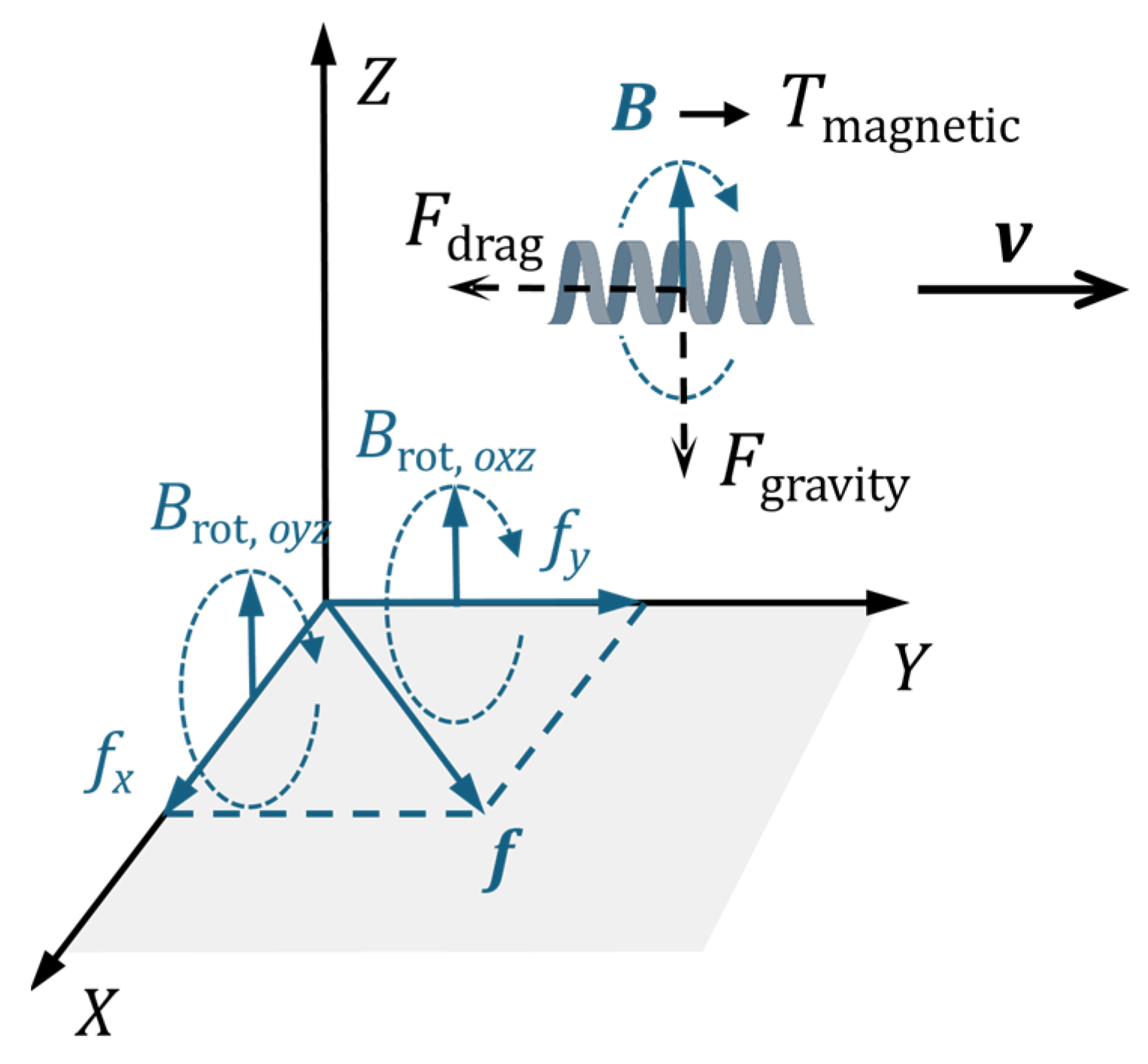
This study investigates a class of microrobots actuated by external fields (e.g., magnetic field [32,33], electric field [34,35], acoustic field [36,37] or chemical gradients [38]) to achieve precise control over their velocity and direction. Specifically, the target prototype in this study is a torque-driven helical microrobot powered by rotating magnetic torque. As shown in Figure 1, we define the magnetic field rotational frequencies as the control vectors. Meanwhile, the microrobot is subjected to magnetic driving torque, fluid drag and gravitational force during navigation. The driving setup employs three-axis orthogonal Helmholtz coils, which can generate a three-dimensional uniform rotating magnetic field to supply driving torque. Restricted by the experimental environment, the magnetically actuated microrobot only moves within a two-dimensional plane, hence only X-axis and Y-axis magnetic field rotating frequencies are adjusted to constitute the two-dimensional control vector f = [ f x , f y ] T . Benefiting from the approximate linear correlation between the frequency of rotating magnetic field and the velocity of the microrobot, the proposed PID controller is designed to output this frequency vector for closed-loop position control. The relationship between its dynamic characteristics and the parameters of the rotating magnetic field is described as follows:
v = f F B r
where v = [ v x , v y ] T is the resultant velocity vector of the magnetically actuated microrobot; f = [ f x , f y ] T is the two-dimensional rotational frequency vector of the rotating magnetic field, with f x and f y denoting the rotating frequency along the horizontal and vertical directions, respectively; F B r is the dimensionless propulsion coefficient function determined by the amplitude B r of the applied rotating magnetic field, which describes the quantitative relationship between magnetic field parameters and the velocity of the magnetically actuated microrobot; The motion model and parameter definitions follow the classical modeling methods for magnetically actuated microrobots widely adopted in the literature.

2.2. Navigation System Design

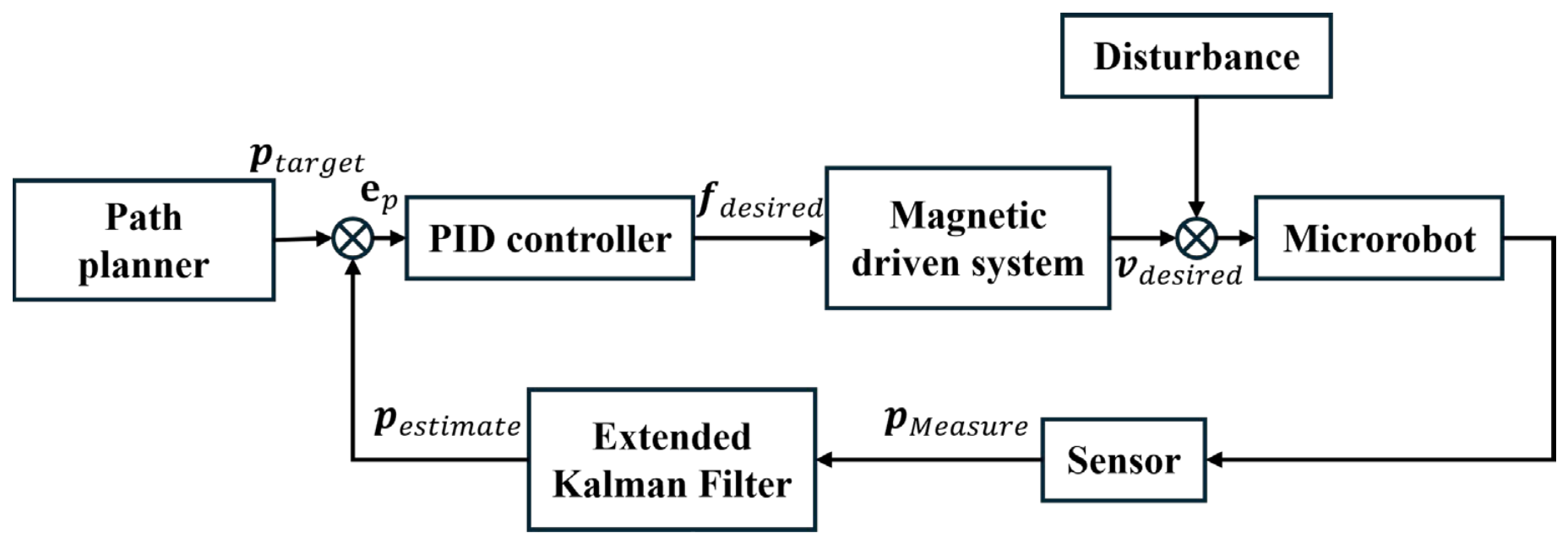
The overall architecture of the proposed navigation system is illustrated in Figure 2, which consists of four core modules: path planning, a PID controller, EKF position estimation, and a magnetic field drive system. The path planning module generates a globally optimal shortest path based on the vascular model and transmits the next target point closest to the microrobot to the PID controller. The PID controller calculates positioning errors using the current position estimated by the EKF module and adjusts velocity commands for the next movement cycle to eliminate such errors. The magnetic field drive system responds to velocity commands to propel the microrobot. The EKF module integrates sensor measurements with motion model prediction results to achieve high-precision position estimation of the microrobot.

2.3. Path Planning

As analyzed above, sampling-based and DWA algorithms have evident limitations in narrow vascular spaces and blind zones. Here, we adopt the A* algorithm for global path planning. It is well compatible with our grid-based environment model and can output the shortest reference trajectories to support the PID controller and EKF estimator under blind zone conditions. The vascular model is discretized into a two-dimensional grid map, where the cost value from the starting node to the target node is calculated, and the minimum value represents the shortest path. The cost function f ( n ) is defined as:
f ( n ) = g ( n ) + α h ( n )
g ( n ) = i = 1 k x i x i 1 ) 2 + ( y i y i 1 ) 2
h ( n ) = x n x g ) 2 + ( y n y g ) 2
where, g ( n ) represents the actual movement cost from the starting node to the current node n , calculated using Euclidean distance, and serves as the heuristic function. h ( n ) denotes the straight-line distance between the current node n and the target node. The heuristic weight coefficient α is set to 1.0 in all experiments to balance the search efficiency of the algorithm and the optimality of the planned path.

2.4. PID Controller

The motion control of microrobots in vascular environments faces multiple disturbances including environmental constraints and fluid turbulence. To address this, a discrete PID controller is designed to eliminate the motion tracking error of microrobots. The PID controller generates desired velocity commands based on the error between the real-time estimated position and target position. The control law adopts a discrete PID form:
f d e s i r e d ( k ) = K p e p ( k ) + K i j = 0 k e p ( j ) + K d e p ( k ) e p ( k 1 ) T s
where, e p ( k )   =   p target p k ,   T s ,   K p ,   K i ,   K d represent the position error vector; the sampling period; and the proportional, integral, and derivative coefficients, respectively. In the simulation experiments, the controller parameters were set to K p = 0.8, K i = 0.1, and K d = 0.05. The controller parameters were tuned via repeated simulations to minimize average tracking error, ensure fast response and suppress oscillation under both normal and blind zone conditions. The proportional gain K p was adjusted to improve tracking sensitivity; the integral gain K i was set to eliminate static error; and the derivative gain K d was tuned to suppress oscillation caused by environmental disturbances. After repeated comparative tests, the above parameters were selected as they achieved the optimal balance between positioning accuracy and motion stability in the implemented navigation system.

2.5. Extended Kalman Filter

Accurate state estimation is essential for achieving reliable navigation in visual measurement systems that suffer from Gaussian noise and random blind zone interference. This study employs an EKF framework to integrate robot kinematic models with sensor measurement data, enabling the optimal state estimation of microrobot systems.
(1)
State space modeling
The state vector of a microrobot is defined as a joint vector of its position and velocity in the two-dimensional plane:
x k = [ x k , y k , v x , k , v y , k ] T
The discrete-time state transition equation is based on the uniform motion assumption of the microrobot:
x k + 1 = F x k + B u k + w k
where u k denotes the control input vector at discrete time step k, which represents the output two-dimensional rotational frequency vector f k = [ f x ,   k , f y ,   k ] T of the PID controller in this system.
The state transition matrix F is expressed as:
F = 1 0 T s 0 0 1 0 T s 0 0 1 0 0 0 0 1
The control input matrix B is expressed as:
B = 0.5 T s 2 0 0 0.5 T s 2 T s 0 0 T s
The process noise w k follows a zero-mean Gaussian distribution, which is expressed as:
w k N ( 0 , Q )
Q = diag ( σ x 2 , σ y 2 , σ v x 2 , σ v y 2 )
where, σ x = σ y = 0.1   p i x e l s , and σ v x = σ v y = 0.05 pixels/step, which were set according to the actual noise level of visual imaging systems and the motion characteristics of microrobots.
(2)
Nonlinear observation model
The visual system provides the position information of the microrobot with Gaussian noise, with the observation equation as follows:
z k = H x k + v k
H = 1 0 0 0 0 1 0 0
where the observation noise v k N ( 0 , R ) , and covariance matrix R = diag ( σ o b s 2 , σ o b s 2 ) , with σ o b s = 0.5 pixels, which is consistent with the positioning accuracy of typical optical imaging equipment in practical applications.
(3)
EKF recursive estimation (under ideal conditions)
The EKF algorithm realizes recursive state estimation of the microrobot under ideal conditions through two core phases: prediction and update. When valid sensor measurement z k is obtained, the EKF executes complete prediction phase and measurement update steps.
Prediction phase:
x ^ k k 1 = F x ^ k 1 k 1 + B u k 1
P k k 1 = F P k 1 k 1 F T + Q
where x ^ k k 1 are the prior state estimates at time step k, P k k 1 are the prior covariance matrices representing estimation uncertainty.
Measurement update:
K k = P k k 1 H T ( H P k k 1 H T + R ) 1
x ^ k k = x ^ k k 1 + K k ( z k H x ^ k k 1 )
P k k = ( I K k H ) P k k 1 ( I K k H ) T + K k R K k T
where K k is the Kalman gain, z k is the position measurement vector from the sensor, x ^ k k are the posterior state estimates at time step k, P k k are the posterior covariance matrices representing estimation uncertainty.
(4)
EKF recursive estimation (under blind zones)
A blind zone refers to the state where visual sensor data is completely lost. The EKF will immediately switch to the blind zone mode once valid sensor data disappears. The EKF skips the measurement update step entirely and only retains the prediction update process. The calculation formulas are:
Prediction phase:
x ^ k k 1 = F x ^ k 1 k 1 + B u k 1
P k k 1 = F P k 1 k 1 F T + Q b l i n d
where the process noise covariance is increased to Q b l i n d   =   100 Q to reflect the growing model uncertainty under blind zones.
Measurement update:
x ^ k k = x ^ k k 1
P k k = P k k 1

3. Results

3.1. Vascular Modeling

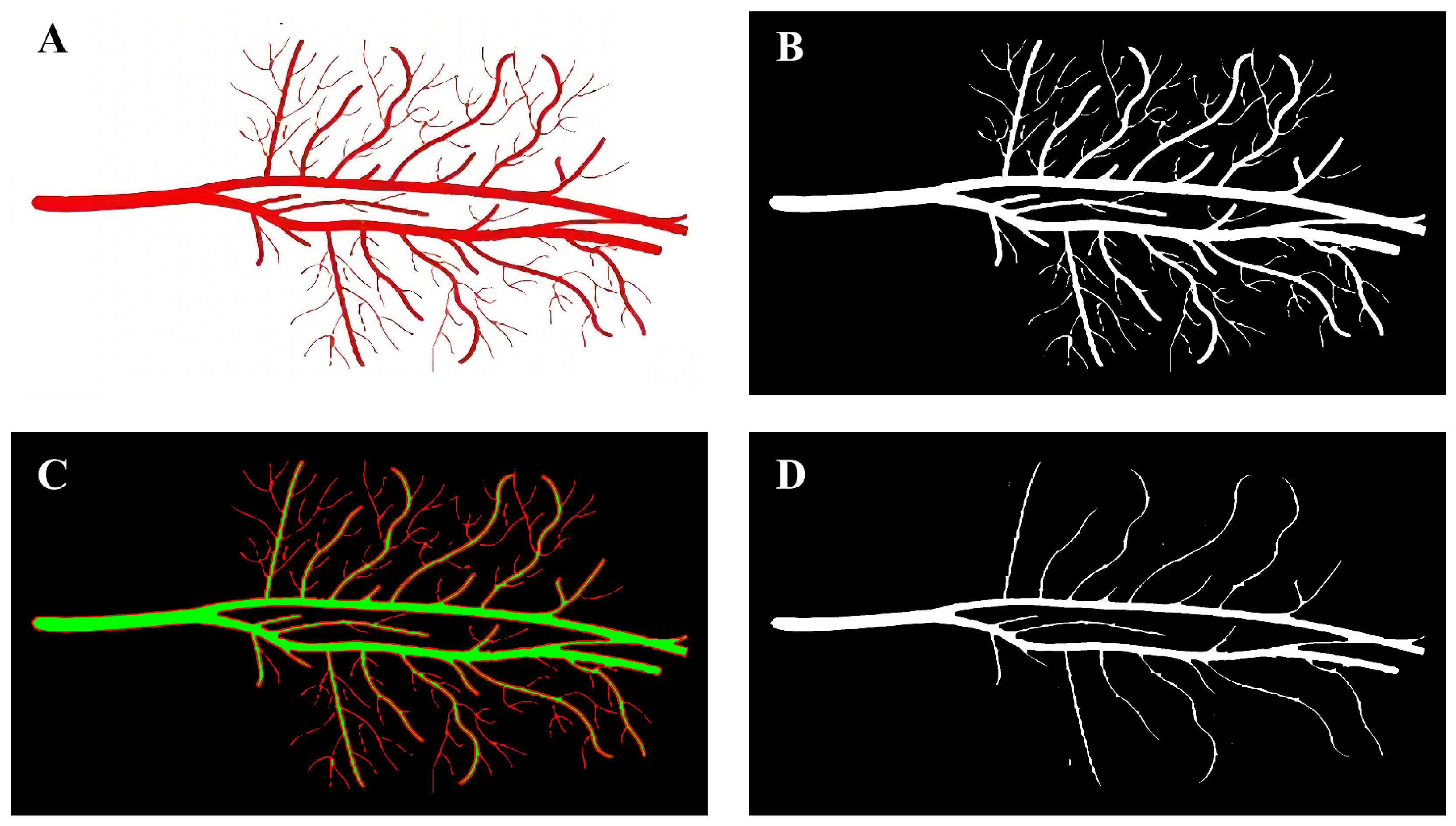
To enable the precise navigation of microrobots in vascular environments, a vascular simulation model that mimics the branching structure of real blood vessels was first constructed in this study. As shown in Figure 3A,B, the study converts the vascular branching structure into a discrete representation suitable for path planning via binarization, where the white regions denote the accessible areas for the microrobot. Considering that microrobots in blood vessels are susceptible to disturbances such as Brownian motion and blood cell collisions, which may easily cause the microrobot to collide with the vessel wall, morphological erosion was performed on the microrobot’s navigable area to reserve a buffer space between the vessel wall and the microrobot’s moving path. As shown in Figure 3C, the red region represents the buffer space, with a buffer distance of 5 pixels; the green region represents the microrobot’s navigable area. The buffer distance was determined according to the grid resolution and microrobot size to prevent unintended collisions between the microrobot and vascular walls. The final binary environment map integrated with the buffer space is shown in Figure 3D, where the black region indicates the obstacle area and the white region indicates the safe navigable area.

3.2. Navigation Test Under Ideal Conditions

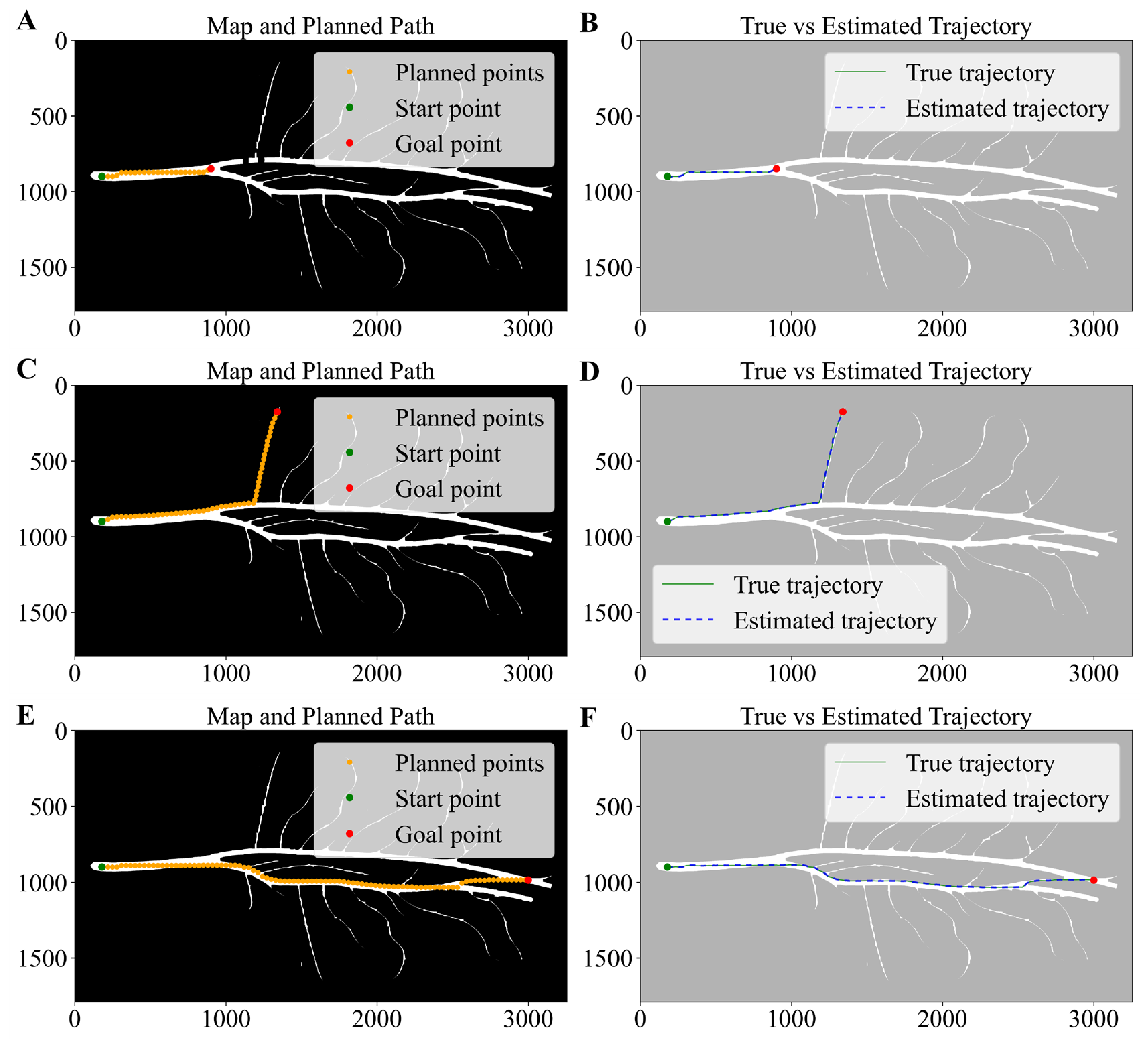
This study conducted navigation tests of microrobots under ideal, interference-free conditions within the established vascular simulation model. The microrobot was initialized at the entrance of the main branch of the vascular model, and three target points at different spatial distances were set within the model (G1: near, G2: medium, G3: far). Figure 4A,C,E show the shortest paths planned by the A* algorithm for the microrobot from the start point to G1, G2, and G3, respectively; Figure 4B,D,F display the true motion trajectories of the microrobot under the proposed navigation system and the trajectories estimated by the EKF. It can be observed that, under ideal conditions without blind zone interference, the microrobot successfully reaches all target points, and the true motion trajectory is highly consistent with the estimated trajectory. This result indicates that the microrobot can accurately track the planned path under the guidance of the navigation system.
Furthermore, the navigation performance metrics for the three target points were quantitatively analyzed with 1000 repeated simulation experiments conducted for each group. As shown in Table 1, the pixel distances from the microrobot’s starting point to the three target points are 731.09, 1641.53, and 2861.97, respectively; the path planning times using the A* algorithm were 1.09 s, 1.99 s, and 4.88 s, respectively, with planning time showing a positive correlation between the path planning time and the target pixel distance; the simulated step counts required for the microrobot to reach the target points were 149.51, 333.22, and 580.82 steps, respectively. The navigation success rate of the microrobot reached 100% for all three target points. The average positioning errors were 0.75, 0.76, and 0.70 pixels, respectively, while the maximum errors were 2.19, 2.88, and 2.39 pixels, respectively. These results demonstrate that the navigation system maintains stable and high positioning accuracy across different distance scenarios.

3.3. Navigation Test Under Blind Zone Interference

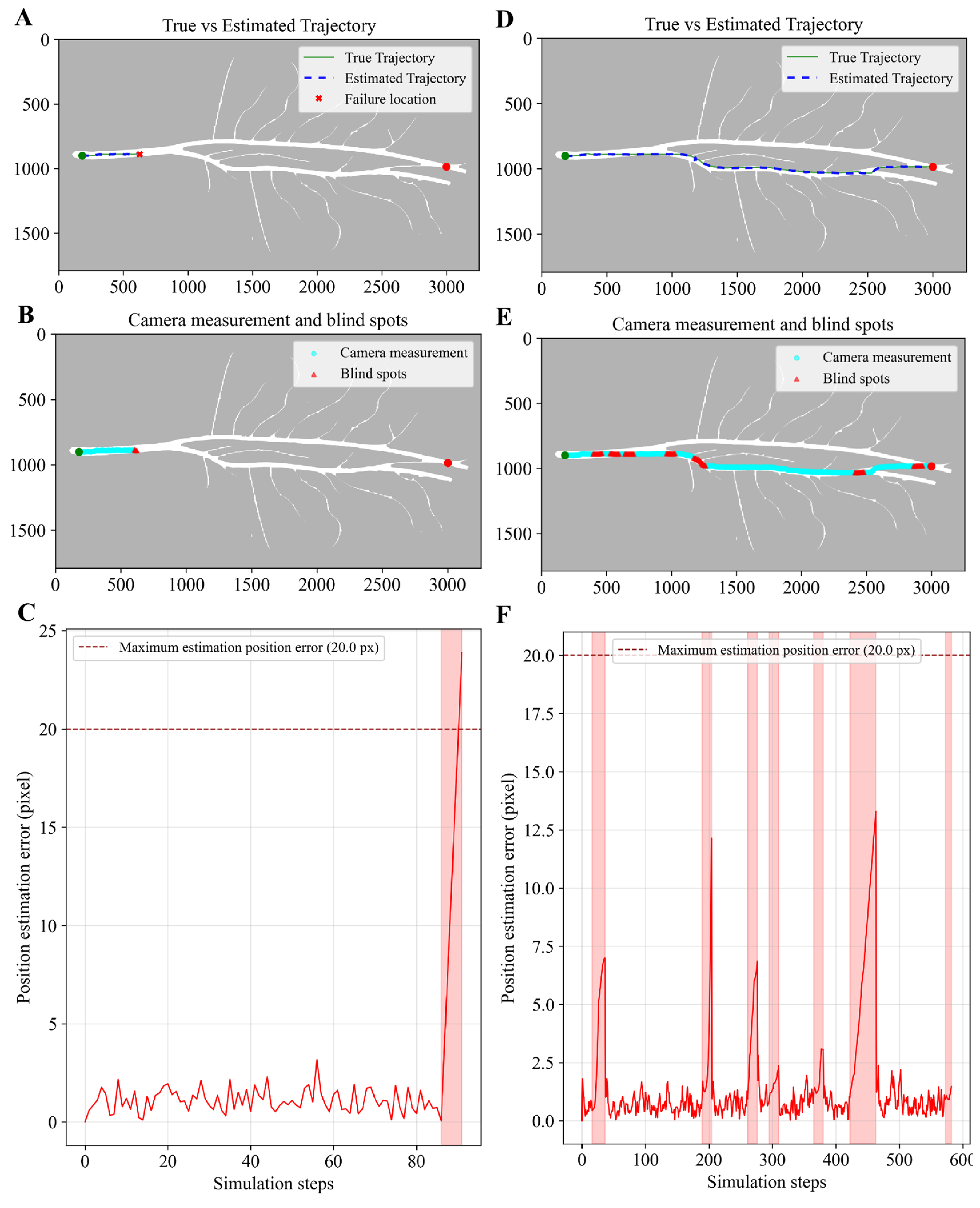
To evaluate the anti-interference robustness of the navigation framework, the impact of blind zone interference on the navigation performance of microrobots was further investigated. Blind zones were randomly set at different positions along the planned trajectory and maintained for several simulation cycles to simulate the actual scenario where microrobots are obscured by blood cells in vascular environments. When the microrobot is in the blind zone, the camera cannot provide real-time feedback on its actual position. A navigation failure was defined as a positioning error exceeding 20 pixels.
Two sets of comparative simulation experiments were conducted in this study. The first set was performed with the EKF estimation module disabled (Figure 5A–C). As shown in Figure 5C, before the appearance of the blind zone, the microrobot’s position error stably remained within 3 pixels. When the first blind zone appeared, the position error rapidly accumulated and exceeded the predefined navigation failure threshold. The second set was performed with the EKF estimation module enabled (Figure 5D–F). As shown in Figure 5E, the green line indicates the true motion trajectory of the microrobot as captured by the camera, while the red line indicates the locations and durations of the blind zones during navigation. The results demonstrate that, even in the presence of blind zone interference, the microrobot can ultimately overcome the positioning disturbance and successfully reach the target destination. As shown in Figure 5F, when the microrobot is outside the blind zone, its position error consistently remains within 0–3 pixels; when the blind zone appears, the error temporarily increases, but as the blind zone disappears and the EKF module performs error correction, it rapidly converges back to a stable range. A comparison of the results from the two sets of simulation experiments verifies that the proposed navigation framework can effectively cope with blind zone interference and exhibits favorable navigation robustness in vascular environments.
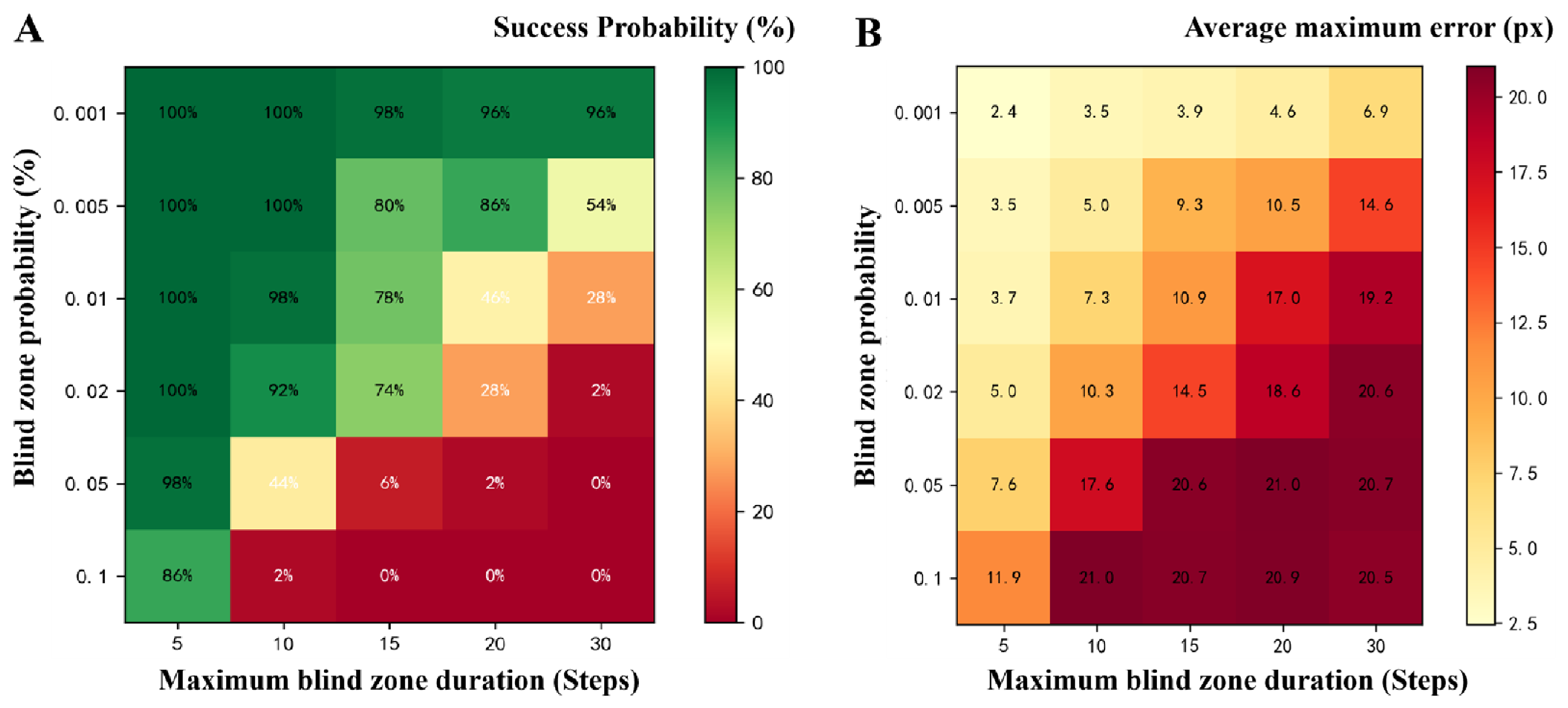
To further explore the impact of blind zone interference intensity on the navigation performance of microrobots, this study varied the occurrence probability of a blind zone from 0.001 to 0.1 and the duration of blind zones from 5 to 30 simulation cycles. For each combination of interference parameters, 1000 repeated simulation experiments were conducted. As shown in Figure 6A, the navigation success probability of the microrobot shows a clear downward trend as the occurrence probability of blind zones increases and their duration lengthens: Under low-intensity interference (occurrence probability ≤ 0.005; duration ≤ 10 simulation steps), the navigation success probability remains stable at over 98%, indicating that the EKF module can effectively compensate for short-term sensor data loss caused by blind zones. Under moderate-intensity interference (occurrence probability: 0.005–0.02; duration: 10–20 simulation steps), the navigation success probability decreases rapidly when the probability is 0.02 and the duration is 20 steps, and the success probability drops to only 28%. Under high-intensity interference (occurrence probability ≥ 0.02; duration > 20 simulation steps), the microrobot’s navigation success probability approaches 0%. The average maximum positioning error shown in Figure 6B exhibits an opposite trend: Under low-intensity interference, the positioning error of the microrobot is only 2.4–3.9 pixels. As the interference intensity increases, the microrobot’s position error rapidly exceeds the 20-pixel failure threshold. The experimental results indicate that the intensity of blind zone interference has a significant impact on the navigation performance. Nevertheless, the proposed navigation framework still demonstrates good anti-interference capability under low-to-moderate-intensity blind zone interference, which provides experimental evidence and a basis for the subsequent optimization of the framework.

3.4. Computational Real-Time Performance Analysis

Real-time performance is a prerequisite for the in vivo deployment of microrobots in future practical applications. We evaluate the execution time of the proposed navigation framework in the simulation environment. All tests are conducted on a desktop computer equipped with an Intel Core i5-12400 CPU and 8 GB memory. The simulation is implemented in VSCode using Python 3.10.12. The execution time of each module within a single control cycle is measured as follows: EKF state estimation takes 13.5 ms, and PID control law calculation takes 3.3 ms. The total execution time for a complete control iteration is approximately 20.0 ms, corresponding to a frame rate of around 50 fps. Furthermore, the module execution time remains nearly identical under normal working conditions and blind zone scenarios. Since the simulation cannot fully replicate sensor data acquisition and microrobot position extraction, we note that these extra procedures only occupy a few milliseconds in physical tests. Overall, the proposed navigation framework runs at tens of hertz in the simulation environment. The computational performance analysis demonstrates its potential to meet the real-time demands of conventional practical experiments. Nevertheless, the practical control frequency is substantially constrained by the specific microrobot platform, actuation system, sensing modality and feedback latency [39]. As widely reported in related studies, even highly efficient algorithms in simulations will see a drop in practical control frequency due to extra latency from image acquisition, signal transmission and hardware response. For most magnetic microrobot systems designed for vascular navigation, the actual control frequency is typically limited to 20 Hz or below [23,40,41].

4. Discussion

The simulation results demonstrate that the proposed navigation framework can effectively cope with vascular blind zones caused by blood cell occlusion. Nevertheless, the present study still has several limitations worthy of further investigation. The study adopts a 2D static vascular model and does not incorporate the comprehensive impacts of complex in vivo blood environments. These reasonable simplifications allow us to focus on the core problem of blind zone positioning failure and do not affect the reliability of our core conclusions. As the current study is purely simulation-based, deploying the proposed framework on physical experimental platforms will introduce unforeseen disturbances and cause notable deviations from simulation predictions. Accordingly, we arrange our follow-up research into three progressive stages. In the first stage, we will employ physical microrobots for experiments within a 2D static microfluidic channel, to preliminarily validate the feasibility of the proposed navigation framework in real experimental environments. Meanwhile, we will refine the navigation framework according to experimental results, such as adopting an adaptive PID algorithm to improve anti-interference performance. In the second stage, we will increase environmental complexity to mimic the characteristics of physiological blood. We will introduce continuous flow fluid in microfluidic channels to replicate the flow fluctuations of physiological blood. In the third stage, we will extend the experiments to an in vitro 3D vascular model for comprehensive evaluation.

5. Conclusions

To address short-term positioning failure in blind zones caused by blood cell occlusion, this study proposed and validated a microrobot navigation framework integrating the EKF with a PID controller. First, a two-dimensional discrete vascular environment model with safety buffer boundaries was constructed via image processing and morphological erosion operations. A global optimal collision-free path was generated using the A* algorithm, while a position error feedback-based PID controller was designed to drive precise trajectory tracking of the microrobot. The key contribution of this study is the integration of the EKF algorithm into the navigation control system, which effectively fuses the microrobot’s kinematic prediction model with sensor measurement data containing Gaussian noise and intermittent loss. Multiple groups of comparative simulation experiments demonstrated that, under ideal interference-free conditions, the navigation framework achieves high-precision path tracking with average positioning errors at the pixel level. In complex scenarios with random blind zone interference, compared to traditional vision-only navigation methods, this approach significantly suppresses the divergence of positioning errors, avoids trajectory deviations and vessel wall collisions caused by target positioning loss, and ensures the successful completion of predetermined navigation tasks. Although there are inevitable differences between simulation environments and real in vivo conditions, the simulation results conclusively show that the navigation framework combining the EKF and PID controller can effectively compensate for the limitations of single visual navigation, enhancing the robustness of microrobots in simulated blind zone environments.

Author Contributions

J.X. proposed the idea and conceived the experiments. J.X., L.L. and S.W. jointly conducted the simulation experiments. J.X., L.L. and S.W. jointly analyzed and discussed the results. J.X. drafted the manuscript and secured funding. All authors have read and agreed to the published version of the manuscript.

Funding

This research received no external funding.

Data Availability Statement

The original contributions presented in this study are included in the article material. Further inquiries can be directed to the corresponding author.

Conflicts of Interest

The authors declare no conflicts of interest.

References

  1. Dogan, N.O.; Suadiye, E.; Unangst, J.; Dayan, C.B.; Richter, G.; Cingoz, A.; Bagci-Onder, T.; Sitti, M. Genetically Engineered Human Cell-Based Microrobots for Selective Cancer Cell Death. Sci. Adv. 2026, 12, eaea9831. [Google Scholar] [CrossRef] [PubMed]
  2. Nguyen, K.T.; Go, G.; Jin, Z.; Darmawan, B.A.; Yoo, A.; Kim, S.; Nan, M.; Lee, S.B.; Kang, B.; Kim, C.S.; et al. A Magnetically Guided Self-Rolled Microrobot for Targeted Drug Delivery, Real-Time X-Ray Imaging, and Microrobot Retrieval. Adv. Healthc. Mater. 2021, 10, e2001681. [Google Scholar] [CrossRef] [PubMed]
  3. Harder, P.; Iyisan, N.; Wang, Y.; Ozkale, B. A Soft Microrobot for Single-Cell Transport, Spheroid Assembly, and Dual-Mode Drug Screening. Adv. Mater. 2026, 38, e08807. [Google Scholar] [CrossRef] [PubMed]
  4. Xie, L.; Liu, J.; Yang, Z.; Chen, H.; Wang, Y.; Du, X.; Fu, Y.; Song, P.; Yu, J. Microrobotic Swarms for Cancer Therapy. Research 2025, 8, 0686. [Google Scholar] [CrossRef] [PubMed]
  5. Yang, L.D.; Zhang, Y.B.; Wang, Q.Q.; Chan, K.F.; Zhang, L. Automated Control of Magnetic Spore-Based Microrobot Using Fluorescence Imaging for Targeted Delivery with Cellular Resolution. IEEE Trans. Autom. Sci. Eng. 2020, 17, 490–501. [Google Scholar] [CrossRef]
  6. Liu, D.; Liu, X.; Li, P.; Tang, X.; Kojima, M.; Huang, Q.; Arai, T. Magnetic Driven Two-Finger Micro-Hand with Soft Magnetic End-Effector for Force-Controlled Stable Manipulation in Microscale. Micromachines 2021, 12, 410. [Google Scholar] [CrossRef] [PubMed]
  7. Zhao, Y.; Deng, Y.; Chen, J.N.; Kojima, M.; Huang, Q.; Arai, T.; Liu, X.M. High-Speed Cell Assembly with Piezo-Driven Two-Finger Microhand. Appl. Sci. 2024, 14, 617. [Google Scholar] [CrossRef]
  8. Ceron, S.; Gardi, G.; Petersen, K.; Sitti, M. Fluidic Torque-Enabled Object Manipulation by Microrobot Collectives. Sci. Adv. 2026, 12, aea9947. [Google Scholar] [CrossRef] [PubMed]
  9. Wang, Q.Q.; Zhang, J.C.; Yu, J.F.; Lang, J.; Lyu, Z.; Chen, Y.F.; Zhang, L. Untethered Small-Scale Machines for Microrobotic Manipulation: From Individual and Multiple to Collective Machines. ACS Nano 2023, 17, 13081–13109. [Google Scholar] [CrossRef] [PubMed]
  10. Wang, B.; Chan, K.F.; Yuan, K.; Wang, Q.Q.; Xia, X.F.; Yang, L.D.; Ko, H.; Wang, Y.X.J.; Sung, J.J.Y.; Chiu, P.W.Y.; et al. Endoscopy-Assisted Magnetic Navigation of Biohybrid Soft Microrobots with Rapid Endoluminal Delivery and Imaging. Sci. Robot. 2021, 6, eabd2813. [Google Scholar] [CrossRef] [PubMed]
  11. Lin, J.L.; Cong, Q.Z.; Zhang, D.D. Magnetic Microrobots for In Vivo Cargo Delivery: A Review. Micromachines 2024, 15, 664. [Google Scholar] [CrossRef] [PubMed]
  12. Ma, H.; Li, R.F.; Yu, Z.L. Micro/Nanomotors in Targeted Drug Delivery: Advances, Challenges, and Future Directions. Int. J. Pharm. 2025, 674, 125471. [Google Scholar] [CrossRef] [PubMed]
  13. Zhang, W.W.; Deng, Y.G.; Zhao, J.H.; Zhang, T.; Zhang, X.; Song, W.P.; Wang, L.; Li, T.L. Amoeba-Inspired Magnetic Venom Microrobots. Small 2023, 19, 2207360. [Google Scholar] [CrossRef] [PubMed]
  14. Wang, J.Y.; Jiao, N.D.; Tung, S.; Liu, L.Q. Automatic Path Tracking and Target Manipulation of a Magnetic Microrobot. Micromachines 2016, 7, 212. [Google Scholar] [CrossRef] [PubMed]
  15. Zheng, L.S.; Jia, Y.J.; Dong, D.R.; Lam, W.; Li, D.F.; Ji, H.B.; Sun, D. 3d Navigation Control of Untethered Magnetic Microrobot in Centimeter-Scale Workspace Based on Field-of-View Tracking Scheme. IEEE Trans. Robot. 2022, 38, 1583–1598. [Google Scholar] [CrossRef]
  16. Li, D.F.; Niu, F.Z.; Li, J.Y.; Li, X.J.; Sun, D. Gradient-Enhanced Electromagnetic Actuation System with a New Core Shape Design for Microrobot Manipulation. IEEE Trans. Ind. Electron. 2020, 67, 4700–4710. [Google Scholar] [CrossRef]
  17. Pawashe, C.; Floyd, S.; Diller, E.; Sitti, M. Two-Dimensional Autonomous Microparticle Manipulation Strategies for Magnetic Microrobots in Fluidic Environments. IEEE Trans. Robot. 2012, 28, 467–477. [Google Scholar] [CrossRef]
  18. Xu, T.T.; Guan, Y.M.; Liu, J.; Wu, X.Y. Image-Based Visual Servoing of Helical Microswimmers for Planar Path Following. IEEE Trans. Autom. Sci. Eng. 2020, 17, 325–333. [Google Scholar] [CrossRef]
  19. Huang, H.W.; Chao, Q.W.; Sakar, M.S.; Nelson, B.J. Optimization of Tail Geometry for the Propulsion of Soft Microrobots. IEEE Robot. Autom. Lett. 2017, 2, 727–732. [Google Scholar] [CrossRef]
  20. Huan, Z.J.; Wang, J.M.; Zhu, L.; Zhong, Z.X.; Ma, W.C.; Chen, Z.F. Navigation and Closed-Loop Control of Magnetic Microrobot in Plant Vein Mimic Environment. Front. Plant Sci. 2023, 14, 1133944. [Google Scholar] [CrossRef] [PubMed]
  21. Liu, Y.Y.; Wang, H.Y.; Wu, X.Y.; Qu, J.T.; Liu, X.Y.; Fan, Q.G. Autonomous Navigation of Magnetic Microrobots with Improved Planning and Control in Complex Environments. IEEE Trans. Autom. Sci. Eng. 2025, 22, 2421–2432. [Google Scholar] [CrossRef]
  22. Kang, K.S.; Huang, H.L.; Zi-qi, S.U.; Wang, H.Z. The Improved Informed-Rrt* Algorithm, Which Optimizes the Sampling Strategy and Integrates an Artificial Potential Field. J. Field Robot. 2025, 42, 4033–4052. [Google Scholar] [CrossRef]
  23. Liu, Y.Z.; Wang, Y.B.; Fang, K.W.; Chen, H.; Zeng, G.J.; Yu, J.F. Radar-Based Control of a Helical Microswimmer in 3-Dimensional Space with Dynamic Obstacles. Cyborg Bionic Syst. 2025, 6, 0158. [Google Scholar] [CrossRef] [PubMed]
  24. Zeng, D.Q.; Chen, H.T.; Yu, Y.Q.; Hu, Y.M.; Deng, Z.W.; Zhang, P.Z.; Xie, D.F. Microrobot Path Planning Based on the Multi-Module Dwa Method in Crossing Dense Obstacle Scenario. Micromachines 2023, 14, 1181. [Google Scholar] [CrossRef] [PubMed]
  25. Tang, X.Q.; Li, Y.K.; Liu, X.M.; Liu, D.; Chen, Z.; Arai, T. Vision-Based Automated Control of Magnetic Microrobots. Micromachines 2022, 13, 337. [Google Scholar] [CrossRef] [PubMed]
  26. Fan, X.J.; Sun, M.M.; Lin, Z.H.; Song, J.M.; He, Q.; Sun, L.N.; Xie, H. Automated Noncontact Micromanipulation Using Magnetic Swimming Microrobots. IEEE Trans. Nanotechnol. 2018, 17, 666–669. [Google Scholar] [CrossRef]
  27. Mora-Aquino, G.; Rodríguez-Morales, A.L.; López-Huerta, F.; Delgado-Alvarado, E.; Elvira-Hernández, E.A.; Herrera-May, A.L. Recent Advances in Bioinspired Walking Microbots: Design, Manufacturing, and Challenges. Sens. Actuators 2024, 372, 115321. [Google Scholar] [CrossRef]
  28. Dong, D.R.; Xing, L.X.; Zheng, L.S.; Jia, Y.J.; Sun, D. Automated 3-D Electromagnetic Manipulation of Microrobot with a Path Planner and a Cascaded Controller. IEEE Trans. Control. Syst. Technol. 2022, 30, 2672–2680. [Google Scholar] [CrossRef]
  29. Wang, Q.L.; Wang, Q.Q.; Ning, Z.P.; Chan, K.F.; Jiang, J.L.; Wang, Y.Q.; Su, L.; Jiang, S.; Wang, B.; Ip, B.Y.M.; et al. Tracking and Navigation of a Microswarm under Laser Speckle Contrast Imaging for Targeted Delivery. Sci. Robot. 2024, 9, adh1978. [Google Scholar] [CrossRef] [PubMed]
  30. Landers, F.C.; Hertle, L.; Pustovalov, V.; Sivakumaran, D.; Oral, C.M.; Brinkmann, O.; Meiners, K.; Theiler, P.; Gantenbein, V.; Veciana, A.; et al. Clinically Ready Magnetic Microrobots for Targeted Therapies. Science 2025, 390, 710–715. [Google Scholar] [CrossRef] [PubMed]
  31. Pancaldi, L.; Dirix, P.; Fanelli, A.; Lima, A.M.; Stergiopulos, N.; Mosimann, P.J.; Ghezzi, D.; Sakar, M.S. Flow Driven Robotic Navigation of Microengineered Endovascular Probes. Nat. Commun. 2020, 11, 6356. [Google Scholar] [CrossRef] [PubMed]
  32. Wu, S.; Chang, Y.L.; Leanza, S.; Sim, J.; Lu, L.; Li, Q.; Stone, D.; Zhao, R.R. Magnetic Milli-Spinner for Robotic Endovascular Surgery. Adv. Mater. 2026, 38, e08180. [Google Scholar] [CrossRef] [PubMed]
  33. Li, X.Y.; Rong, W.B.; Wang, L.F.; Jia, H.D.; Meng, X.H.; Xie, H. Development of Ph-Dependent Magnetically Actuated Millirobot for Colon-Targeted Delivery of Diverse Drug Types. Micromachines 2026, 17, 610. [Google Scholar] [CrossRef] [PubMed]
  34. Zehavi, M.; Rachbuch, I.; Park, S.; Miloh, T.; Velev, O.D.; Yossifon, G. Programmable Motion of Optically Gated Electrically Powered Engineered Microswimmer Robots. Small 2025, 21, 2501317. [Google Scholar] [CrossRef] [PubMed]
  35. Torres-Andrés, J.; Coelho, R.C.V.; Oswald, P.; Sagués, F.; Ignés-Mullol, J. Soft Colloidal Robots: Magnetically Guided Liquid Crystal Torons for Targeted Micro-Cargo Delivery. Small 2026, e11651. [Google Scholar] [CrossRef] [PubMed]
  36. Su, X.Y.; Wang, L.; Wang, Z.Z.; Yang, L.; Li, M.J.; Zhu, D.Z.; Li, Z.J.; Yuan, W.Z.; Chang, H.L.; Wang, B.L. Acoustic Shape-Morphing Micromachines. Nat. Commun. 2026, 17, 2238. [Google Scholar] [CrossRef] [PubMed]
  37. Liu, X.R.; Tang, H.C.; Li, N.; He, L.J.; Tian, Y.; Hao, B.; Xue, J.N.; Yang, C.Y.; Sung, J.J.Y.; Zhang, L.; et al. Miniature Magneto-Ultrasonic Machines for Wireless Robotic Sensing and Manipulation. Sci. Robot. 2025, 10, adu4851. [Google Scholar] [CrossRef] [PubMed]
  38. Byun, J.; Jang, S.; Wu, Y.; Choi, J.; Bozuyuk, U.; Ko, J.; Karacakol, A.C.; Kim, E.H.; Chun, S.; Aghakhani, A.; et al. Microrobotic Copper-Rich Electrochemical Interfacing for Targeted Cancer Theranostics in the Gut. Sci. Adv. 2026, 12, eaeb5934. [Google Scholar] [CrossRef] [PubMed]
  39. Kusui, E.; Sekine, C.; Goto, T.; Kinoshita, R.; Nishimura, Y.; Sekiguchi, S.; Ando, S.; Oishi, Y.; Matsui, Y.; Fuchiwaki, O. Sub-Micrometer-Precision Path Following of Piezo-Actuated Mobile Robot. Adv. Intell. Syst. 2026, 8, e202501141. [Google Scholar] [CrossRef]
  40. Wu, D.; Wang, X.W.; Li, R.; Wang, C.W.; Ren, Z.G.; Pan, D.; Ren, P.L.; Hu, Y.L.; Xin, C.; Zhang, L. Femtosecond Laser-Assisted Printing of Hard Magnetic Microrobots for Swimming Upstream in Subcentimeter-per-Second Blood Flow. Sci. Adv. 2025, 11, adw1272. [Google Scholar] [CrossRef] [PubMed]
  41. Su, L.; Jin, D.D.; Xia, N.; Hao, B.; Jiang, Y.H.; Wang, Q.L.; Yang, H.J.; Wang, X.; Chan, K.F.; Ma, X.; et al. Modular Magnetic Microrobot System for Robust Endoluminal Navigation and High-Radial Force Stent Delivery in Complex Ductal Anatomy. Sci. Adv. 2025, 11, ady4339. [Google Scholar] [CrossRef] [PubMed]
Figure 1. Schematic illustration of the proposed helical microrobot. The magnetic field control vector f = [ f x , f y ] T consists of two components f x and f y along the x and y directions, which are generated by uniform rotating magnetic fields in the OYZ and OXZ planes, respectively. The major physical forces acting on the helical microrobot include magnetic driving torque Tmagnetic, fluid drag force Fdrag and gravitational force Fgravity.
Micro 06 00049 g001
Figure 2. Architecture diagram of the microrobot navigation system.
Micro 06 00049 g002
Figure 3. Results of vascular modeling: (A) original vascular simulation image showing branching structure; (B) binary image; (C) image with buffer space, where the red region represents the vascular wall buffer space and the green region represents the navigable area (buffer space width set to 5 pixels); (D) final binary map of the microrobot’s navigable area.
Micro 06 00049 g003
Figure 4. Navigation test for different target points under ideal conditions without blind zone interference: (A) planned trajectory for G1; (B) true motion trajectory and estimated trajectory for G1; (C) planned trajectory for G2; (D) true motion trajectory and estimated trajectory for G2; (E) planned trajectory for G3; (F) true motion trajectory and estimated trajectory for G3 (n = 1000 simulations).
Micro 06 00049 g004
Figure 5. Comparison of the microrobot navigation performance in blind zones with and without the proposed EKF state estimation. With the EKF module disabled, (A) shows the true and estimated motion trajectories of the microrobot; in (B), the green line shows the position changes in the microrobot as captured by the camera, with the red line indicating that the microrobot is currently in a blind zone and cannot obtain its real-time position from the camera; and (C) shows the position error curve of the microrobot. With the EKF module activated, (D) shows the true motion trajectory and EKF-estimated trajectory of the microrobot; in (E), the green line indicates the position changes in the microrobot as captured by the camera, with the red line indicating the blind zone duration and location; and (F) shows the position error curve of the microrobot (n = 1000 simulations).
Micro 06 00049 g005
Figure 6. Impact of blind zone interference intensity on the navigation performance of the microrobot: (A) Navigation success probability. (B) Average maximum position error (n = 1000 simulations).
Micro 06 00049 g006
Table 1. Navigation performance indicators for different target points. Each experiment was repeated 1000 times.
Target Point
(Coordinates)
Pixel
Distance
Path Planning Time (s)Average Simulation StepsAverage
Error (Pixels)
Maximum Error (Pixels)Success Rate
G1: (850, 900)731.091.09149.520.752.19100%
G2: (175, 1340)1641.531.99333.220.762.88100%
G3: (985, 4000)2861.974.88580.800.702.39100%
Disclaimer/Publisher’s Note: The statements, opinions and data contained in all publications are solely those of the individual author(s) and contributor(s) and not of MDPI and/or the editor(s). MDPI and/or the editor(s) disclaim responsibility for any injury to people or property resulting from any ideas, methods, instructions or products referred to in the content.