
Article

Formation of Nano-Sized Silicon Oxynitride Layers on Monocrystalline Silicon by Nitrogen Implantation

1
Department of Applied Physics, Faculty of Applied Mathematics and Informatics, Technical University of Sofia, 8 St. Kliment Ohridski Blvd., 1756 Sofia, Bulgaria
2
Institute of Solid State Physics, 72, Blvd. Tsarigradsko Chaussee, 1784 Sofia, Bulgaria
3
Faculty of Physics, Sofia University “St. Kliment Ohridski”, 5 J. Bourchier Blvd., 1164 Sofia, Bulgaria
4
National Centre of Excellence Mechatronics and Clean Technologies, Sofia University “St. Kliment Ohridski”, 5 J. Bourchier Blvd., 1164 Sofia, Bulgaria
5
Institute of Physical Chemistry—Ilie Murgulescu, Romanian Academy, 202 Splaiul Independentei, 060021 Bucharest, Romania
*
Authors to whom correspondence should be addressed.
Micro 2026, 6(2), 24; https://doi.org/10.3390/micro6020024
Submission received: 29 January 2026 / Revised: 14 March 2026 / Accepted: 27 March 2026 / Published: 30 March 2026
(This article belongs to the Topic Surface Engineering and Micro Additive Manufacturing)

Abstract

Nitridation of different materials using ion implantation is of considerable interest for many applications. As electronic components, oxynitride (SiOxNy) layers exhibit beneficial properties such as precise compositional variability, refractive index tunability, oxidation resistance, and low mechanical stress. In the present study we investigate nanoscale SiOxNy synthesized using ion implantation methods. To introduce N+ ions into a shallow Si subsurface region, both conventional ion beam implantation and plasma immersion ion implantation with subsequent high-temperature treatment in dry O2 are used. The optical and morphological properties and chemical bonding of formed SiOxNy layers were studied by applying spectroscopic ellipsometry in the range of VIS-Near IR (SE) and IR (IR-SE), Raman spectroscopy and Atomic Force Microscopy (AFM). Monte Carlo modeling of implant profiles contributed to understanding physical and chemical processes and predicted different influences of the incorporated N+ ions on the oxidation mechanism, confirmed by the thickness dependence of SiOxNy/Si layers obtained from the SE data analysis. IR-SE spectral analysis established the formation of Si-O, Si-N, Si-N-O and Si-Si chemical bonds in the grown layers. The occurrence of amorphization of the Si crystal lattice due to incorporation of high-energy N+ ions into the Si lattice is confirmed by the Raman and ellipsometry results. The free Si atoms can congregate, forming nanocrystalline clusters. AFM imaging revealed that both implantation methods left the surface of the resulting SiOxNy layers considerably smooth with similar roughness parameter values. The results of the studies imply that the technological approaches used allow the production of high-quality nanoscale silicon oxynitride films with appropriate tunable composition and properties for possible application in advanced electronic devices for nanoelectronics, optoelectronics and sensor applications.

1. Introduction

In modern nanoelectronics, SiO2/Si structure still plays a decisive role, and the interface region becomes even more important with the ever-decreasing sizes of devices. Over the years, special attention has been drawn to nitrogen-containing ultrathin SiO2 layers on Si, mostly as oxynitrides (SiOxNy), to replace conventional thermal SiO2. It has been shown that even the introduction of small amounts of nitrogen improves certain properties of the devices [1,2,3,4]. For application as electronic components, these layers offer beneficial properties such as precise composition variability, refractive index tunability, resistance to oxidation and low mechanical stress [5]. The most important advantage of these films is their compatibility with contemporary silicon-based electronics [6]. Moreover, nitride oxides have improved radiation hardness compared to pure thermal oxides [7]. Experimental results have shown that the implantation of nitrogen into the buried oxide (BOX) layers can increase the BOX’s hardness to total-dose irradiation [8].
The production of nano-thin layers and nanostructures is associated with solving several problems related to the possibilities of obtaining elements with controllable properties at the nano level in terms of their composition, structure and spatial architecture in the device. In oxynitride technology, it is of prime importance to control the atomic concentration in the thin SiOxNy layers [3,9,10,11].
During recent decades, several technologies have been applied to the synthesis of SiOxNy films. The most common methods are chemical vapor (CVD) or physical vapor (PVD) depositions, high-temperature oxidation of SiNx or nitridation of SiO2 involving implantation processes. The performance of SiNxOy by such preparation technologies and their applicability are discussed in detail in [12]. Nitridation of different materials using ion implantation is of considerable interest for other applications, such as composition modification or creating buried layers.
In our research, the method of producing high-quality nanolayers is the synthesis of SiOxNy at elevated temperatures after modification of a considerably thin Si surface region by nitrogen ion implantation. The implantation method offers controllable construction of three-dimensional structures in a common matrix by varying the implantation dose and energy.
In this article the results of a detailed study of the formation of nano-sized silicon oxynitride layers (SiOxNy) on monocrystalline silicon (c-Si) substrates through N+ ion implantation followed by high-temperature oxidation is presented and discussed. The substantial advantage of using N+ implantation in c-Si compared to the growth of silicon oxides in NO or N2O environments is the possibility for precise control over the formation of nanoscale SiOxNy layers and their compositions.
In order to form nano-sized SiOxNy layers, we have applied two different approaches to introduce nitrogen into silicon, namely (i) by conventional ion beam implantation (further used in the article as abbreviation CLIM) of nitrogen through previously grown SiO2 on Si and, as a next step, the removal of the implanted SiO2 part, leaving N+-containing Si surface region, and (ii) by plasma implantation (PLIM) of N+ ion into bare silicon by immersion in a nitrogen plasma environment. These CLIM and PLIM implanted silicon samples underwent standard thermal oxidation in dry oxygen to synthesize nano-sized SiOxNy. In both cases, the control of the concentration, position and bonding of N atoms is very crucial, because the presence of incorporated N atoms above a certain amount may cause reliability problems [3,4,9]. A sequence of experiments has been conducted in order to establish the effect of implantation and technological conditions on the structure and optical and morphological properties of the silicon oxynitride layers formed.
The purpose of our paper is to substantiate the formation of a thin SiOxNy layer by the proposed technological sequence by revealing the chemical bonding condition. The optical and vibrational properties of formed SiOxNy layers were studied by applying Raman spectroscopy and two spectroscopic ellipsometric methods. The first is covering the visible and near IR range (denoted further as SE) and the second, the middle IR spectral range (denoted further as IR-SE). Although these optical methods are indirect, they could provide the exact information about the chemical bonds formed by technological processes. The morphological properties of the grown layers were studied by Atomic Force Microscopy (AFM).
The novelty of the proposed technology for the synthesis of nano-scaled SiOxNy is that nitriding the thin subsurface Si region ensures the delivery of nitrogen atoms before the start of the oxidation process. The available nitrogen atoms will provide a competitive process of SiNxOy formation depending on the bond energies of Si-Si (2.3 eV), Si-O (4.68 eV) and Si-N (3.68 eV) [13].

2. Materials and Methods

2.1. Sample Preparation

The experiments were carried out on Cz-grown p-type Si(100) and n-type Si(111) substrates with resistivity of (4–10) Ω cm. The substrates underwent a standard Radio Corporation of America (RCA) cleaning [14]. All chemicals used in the RCA cleaning are Merck’s “Suprapur” products with 99.99% purity. Some of the Si substrates were oxidized in advance up to 120 nm at 1000 °C in dry O2 ambient at atmospheric pressure, and they were further used in the conventional ion implantation (CLIM) experiments.
The formation of nano-scaled oxynitride layers proceeded in two technological ways. By the PLIM technology, nitrogen ions were incorporated into a shallow Si surface region through plasma ion immersion implantation in a planar plasma reactor without external heating of the substrates. The Si substrates were subjected to plasma with N+ ion energy of 4 keV and fluence ranging from1016 cm−2 to 1018 cm−2. By using the CLIM technique, the beam of N+ ions was directed at normal incidence into the Si substrate through the previously grown thermal oxides with an energy of 45 keV and fluencies of 1015, 1016 and 1017 cm−2. The projected range was calculated by the SRIM simulation code based on the Monte Carlo method so that the maximum nitrogen concentration would be at the SiO2–Si interface. After implantation, the SiO2 layers were etched back to the bare silicon surface by conventional wet etching with diluted (2%) HF. This step was undertaken to resemble the PLIM subsurface region conditions prior to the oxidation process.
The formation of nanoscale oxynitride was accomplished by subjecting all the implanted samples with bare silicon surfaces to a high-temperature treatment in dry O2 ambient containing less than 3 ppm residual H2O at atmospheric pressure at 1050 °C for 10 or 20 min. For comparison purposes, in all oxidation runs, virgin silicon substrates, which had undergone only an RCA cleaning procedure, were oxidized together with the implanted samples, and they further served as reference ones.
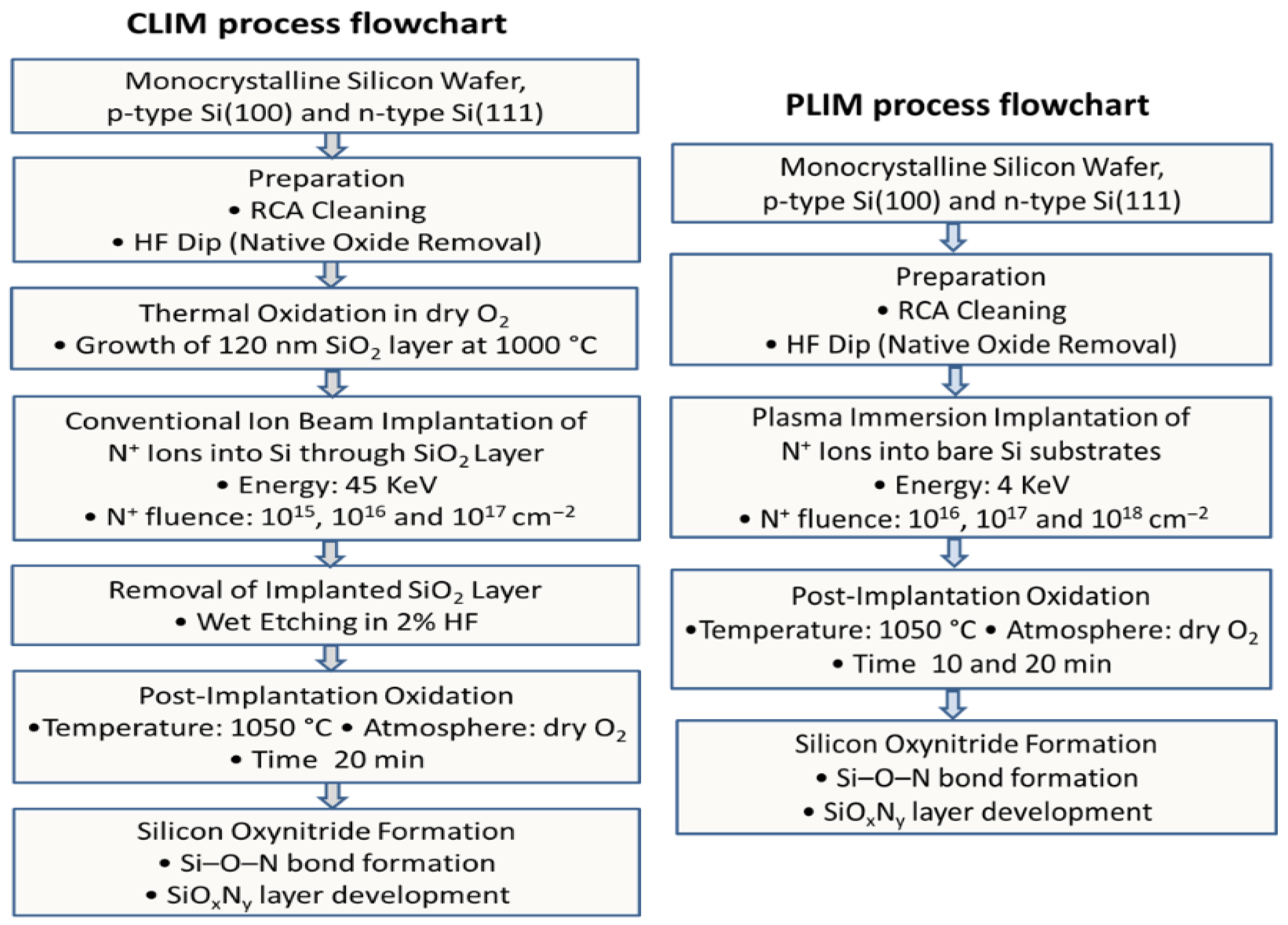
The technological sequence of sample preparation is schematically presented in Figure 1.

2.2. Characterization Methods

The properties of the formed SiOxNy layers depend to a greater extent on the profile of the implanted nitrogen species, as well as on the defects generated during the implantation process. For that reason, detailed modeling was performed based on the Monte Carlo method using the SRIM simulation code to extract the distribution of the implanted ions in depth, depending on ion energy, fluence and subsequent diffusion.
Raman spectroscopy was applied to estimate the structural stress induced by the technological processes, examining the shift in the Raman phonon mode of Si at 520 cm−1, which is sensitive to lattice strain [15]. The micro-Raman spectra were measured on a LabRAM HR Visible Raman spectrometer (Horiba Jobin-Yvon, Paris, France) with a spectral resolution of 1 cm−1, a He-Ne laser at an excitation wavelength of 633 nm, and a laser spot size of 2 μm.
The morphology of the sample’s surface was examined by atomic force microscopic (AFM) measurements performed in non-contact mode on a XE-100 AFM from Park Systems (Park Systems Corporate, Suwon, Republic of Korea). All scans were made with NCHR sharp tips from Nanosensors™ (Neuchatel, Switzerland), with less than 8 nm tip radius, ~125 μm length, ~30 μm width and ~42 N/m spring constant/~330 kHz resonance frequency. The AFM images were recorded at the scale of (1 × 1) μm2. To display the 3D AFM images, Gwyddion 2.65 (2024 version) was used. For the evaluation of the surface amplitude and spatial parameters, the Scanning Probe Image Processor software (SPIPTM v. 4.6.0.0) was used.
The ellipsometric studies were performed using two J.A. Woollam Co. (Lincoln, NE, USA) variable-angle ellipsometers working in two separate spectral regions, i.e., in the UV–vis-NIR region of (190–1690) nm (SE) and the IR spectral range of (400–4000) cm−1 (IR-SE) with a resolution of 4 cm−1. The measurements were carried out at incidence angles of 65°, 70° and 75°.

3. Results and Discussion

3.1. Monte Carlo Modeling of the Nitrogen Implantation Process

Implantation is a complicated process involving formation of defects and complexes in the target, such as vacancies, substitutional and interstitial atoms, nitrogen dimers and nitrogen–vacancy pairs. Any further technological step at elevated temperatures will influence the defect centers due to diffusion of atoms and reaction processes. For low-mass implants, such as N+, because of the low displacement cascade densities, mostly simple vacancy/interstitial pairs are formed. However, above some threshold of about 1015 cm−2, microstructural disorder and nucleation of amorphous regions can be created, which become stable with increasing annealing temperature [16].
Generation of defects is a more complicated process for PLIM technology. Because of the lack of mass separation, the implanted species are atomic nitrogen (N+), and molecular (N2+) ions from the plasma with energies up to implantation voltages are present [17].
The amount of nitrogen present in the Si substrate implanted by CLIM or PLIM at different fluences and different depth distributions will influence the subsequent oxidation process. Modeling of profiles of the implanted ions can contribute to our understanding of the physical and chemical processes that determine and help in developing technological schemes for high-performance devices.
The introduction of N+ ions through the 120 nm SiO2 layer by CLIM at 45 keV was aimed at the Si/SiO2 interface. After the SiO2 removal, the remaining shallow Si layer, rich in nitrogen, can be converted into a thin SiOxNy layer through the following oxidation. The formation of thin SiOxNy with similar thickness was attempted by oxidation of the Si surface enriched with nitrogen by PLIM treatment at a low–energy N+ implantation at an energy of 4 keV.
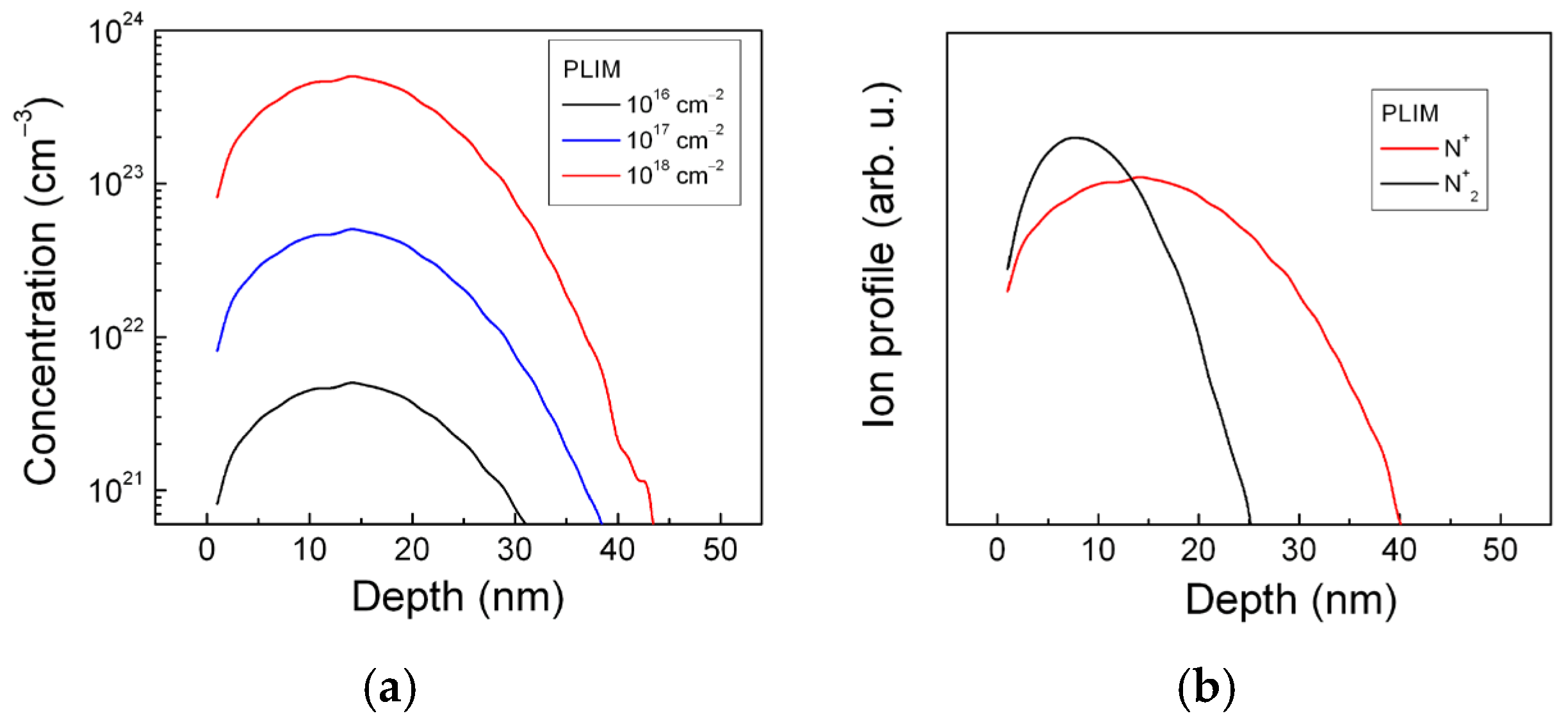
The concentration distributions of the implanted N+ ion by PLIM are displayed in Figure 2a, while the depth profiles of nitrogen as N+ and N2+ species are presented in Figure 2b.
However, regarding Figure 2b, it should be remembered that the real concentration of N+ ions contributes to about 90% and N2+ to about 10% of all implanted ions [17]. Nevertheless, it has been shown that N2+ can serve as a precursor for the formation of N–N dimers.
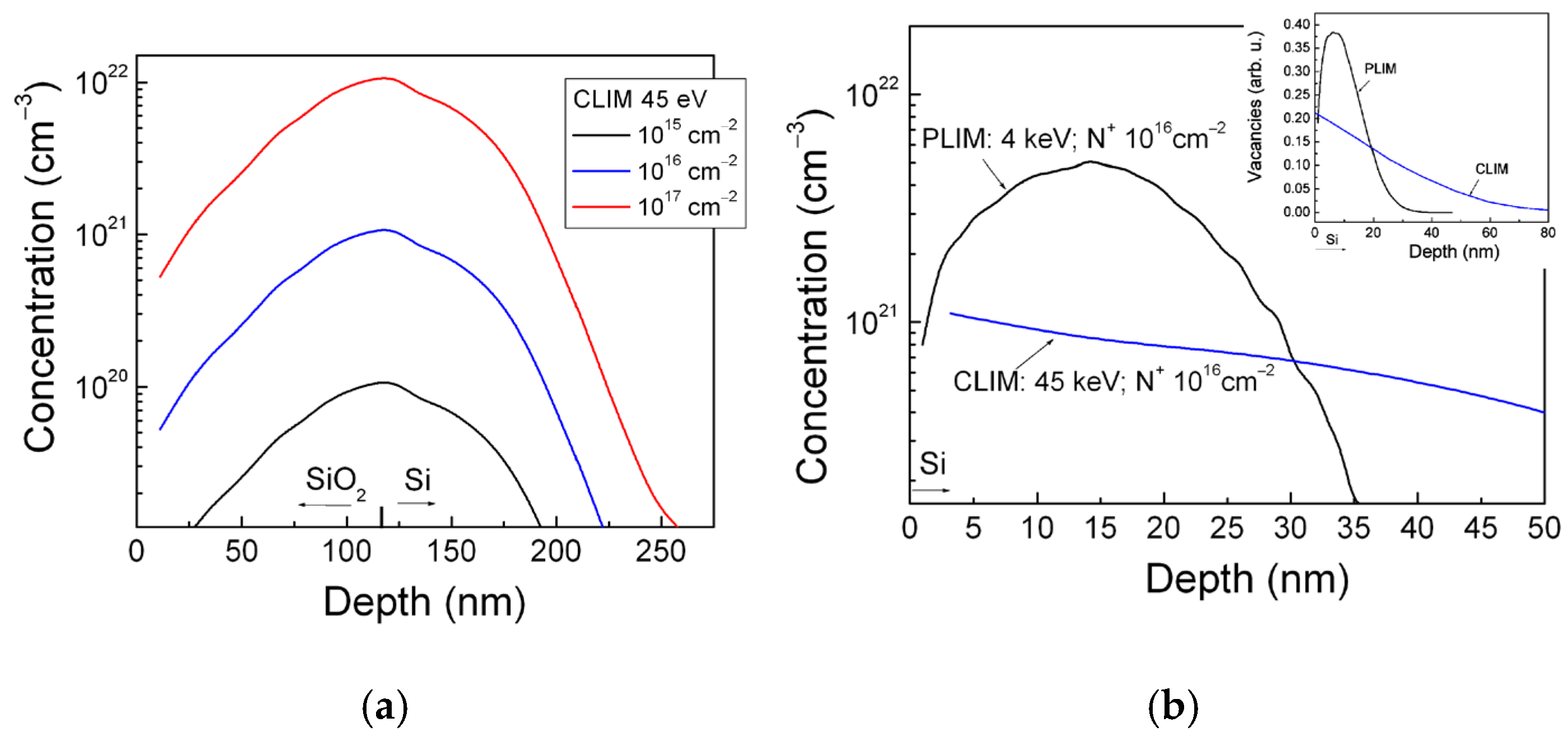
In Figure 3a, the distributions of N+ ions implanted through SiO2 can be seen, with the interface Si/SiO2 marked by the arrow. Comparison of the nitrogen ion distributions present in the modified Si subsurface, either by CLIM and after removal of the SiO2 layer or by PLIM of bare Si, is made in Figure 3b. The concentrations and their distributions for both cases differ substantially. The available nitrogen in the Si substrate before oxidation is expected to influence the oxidation mechanism in a different way. The thickness values presented in the next section give clear evidence for that.
In the case of CLIM implantation profiles, after the thick SiO2 is etched back, the distribution of N+ ions decreases gradually in the nanoscale Si subsurface region, appearing as nearly straight lines in Figure 3b. In the inset, profiles of the Si vacancy defects are included.

3.2. Spectroscopic Ellipsometry

The optical and vibrational properties of the synthesized layers were studied in detail by ellipsometric measurements. The SE and IR-SE spectra were collected in the spectral range from 196 to 1690 nm and from 400 to 4000 cm−1, respectively. Since the dielectric layers are transparent in the visible and near-IR region (190–1690 nm), the thickness and the complex refractive index of the layers were estimated from the SE-data analysis using the Cauchy equation. The accuracy in the determination of the films’ thickness was ±0.2 nm, while the accuracy of the refractive index (n) values was ±0.005. The IR-SE measurements in the given spectral region allowed us to detect both the transverse optical (TO) and longitudinal optical (LO) vibrational modes of the chemical bonds [18], which cannot be performed by conventional IR spectroscopy. This is particularly important for our layers because the characteristic peaks associated with the Si-O and Si-N vibrational bands overlap in the range of 800–1300 cm−1 [19].
In the ellipsometric modeling, multilayer optical models were applied, with the surface roughness considered as a distinct top layer on the underlying base layer formed during the oxidation process, and its composition was considered as 50% air and 50% material.
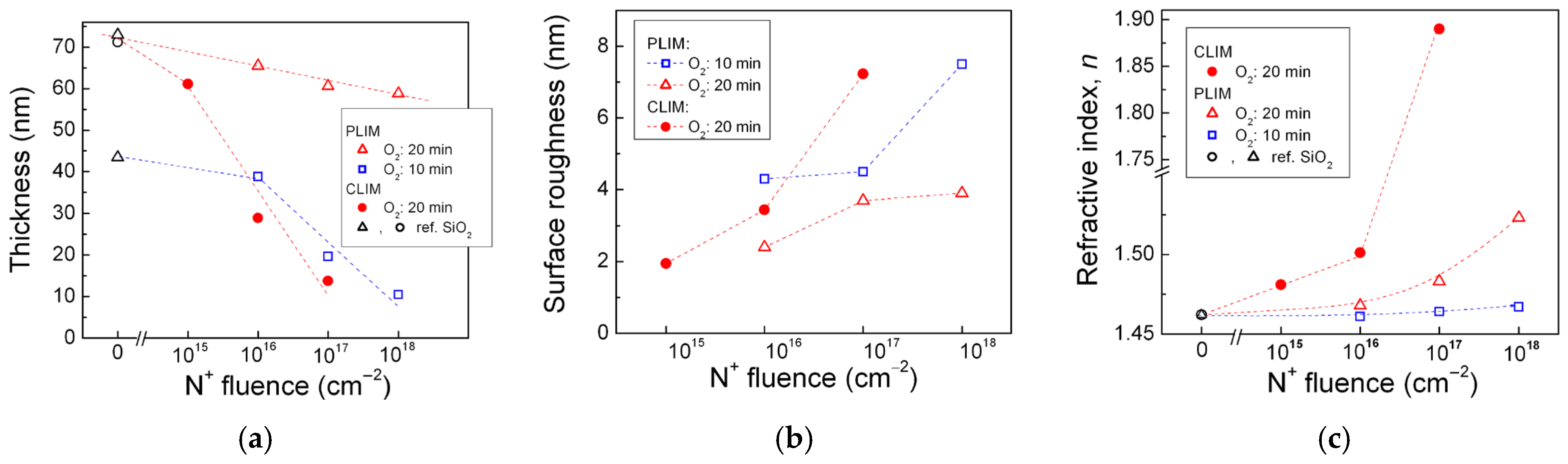
In Figure 4, the layer thickness, surface roughness, and refractive index are presented for the sample N+ implanted using both kinds of implantation techniques. As can be seen, with increasing nitrogen concentration in the Si near-surface region, layer growth slows down in PLIM-implanted samples and drops drastically in CLIM-implanted ones (Figure 4a). This can be explained by the nitrogen retarding effect [20] on the motion of oxygen atoms through the implanted layers and thus decreasing the oxidation rate of Si [21]. This is supported by the results from the SRIM modeling presented in Figure 3b, where it can be seen that after etching back the SiO2 layer, the CLIM N+ implant concentration remains high deep in the Si substrate. This, together with the higher vacancy defect concentration, is the reason for the observed sharper reduction in the oxidation rate compared to that of PLIM samples.
Neither of the ion implantation methods causes severe damage to the ion beam-treated surfaces, and they even leave a relatively smooth surface after the oxidation procedure, as seen in Figure 4b. The surface roughness is in the range of 2–8 nm, with a tendency to increase with increasing nitrogen concentration in the Si near-surface region. However, defects generated by the implantation cannot be excluded. As evidenced by the small oxidation rate (Figure 4a) and also by higher surface roughening (Figure 4b) for the CLIM-implanted samples, greater structural damage is obvious. In that case, the concentration of silicon vacancies is higher than for PLIM, despite the comparable concentration of N+ ions for both implantations (see the inset in Figure 3b).
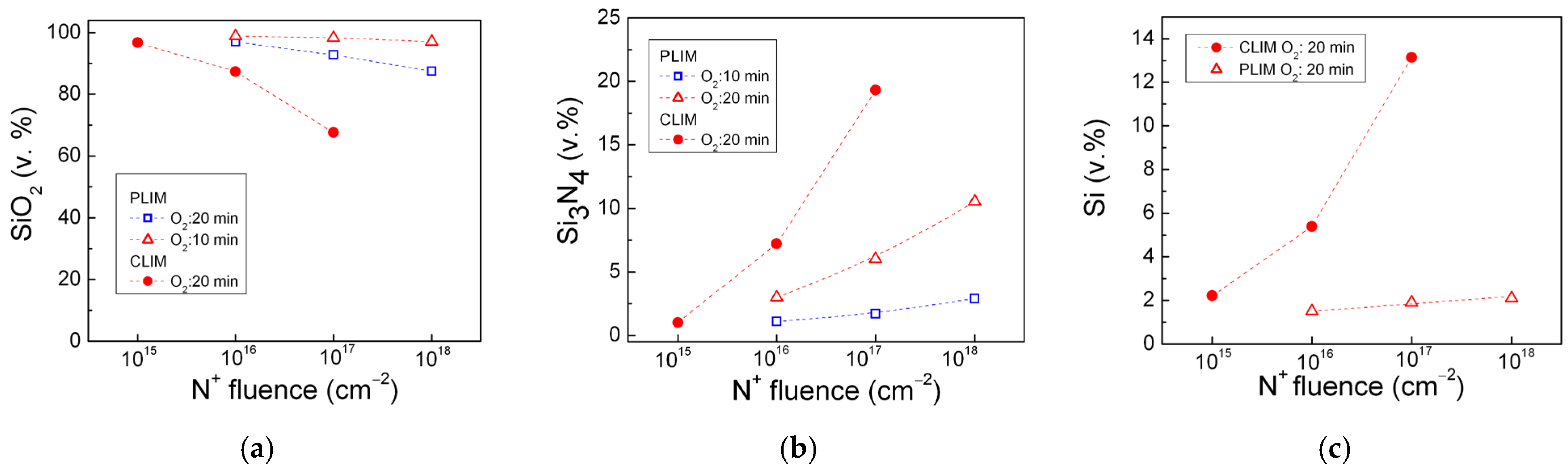
The n = 1.462 value for the reference oxides (Figure 4c) is typical for stoichiometric SiO2 thermally grown at a temperature of 1000 °C or higher [22]. The n values higher than this are an indication that, in addition to silicon oxide, other components such as silicon nitride, silicon oxynitride and/or silicon particles with n > 1.462 contribute to the observed increase (Figure 4c). This is why the refractive index dispersion data was analyzed by applying the Bruggeman effective medium approximation (BEMA) theory [23,24], considering the composition of the formed layers as a mixture of Si, SiO2, Si3N4 components and voids. The dielectric function of each component was taken from the literature [22]. The results are summarized in Figure 5. As can be seen in Figure 5b, the volume fractions of Si3N4 are lower in PLIM samples despite the higher nitrogen concentration compared to CLIM samples. Because of the shallow PLIM-implanted Si region with high vacancy density (Figure 3b), nitrogen atoms can diffuse out at high oxidation temperatures, leaving the Si surface with low nitrogen content. As a result, lower volume fractions of Si3N4 (Figure 5b) and thicker layers (Figure 4a) are observed in PLIM samples as compared to CLIM samples.
It is reasonable that at 1050 °C, formation of SiON is favorable, and thus, the SiO2 content decreases with increasing N+ fluence. This is reflected in a slight increase in the refractive index of the layers grown in the PLIM samples while the refractive index sharply increases for the CLIM-implanted ones. Furthermore, due to the generation of implantation defects in the silicon lattice, the liberated Si atoms can agglomerate in nano-sized clusters, which can even crystallize due to the high temperature, as we have observed by HRTEM in [25], where it was shown that at 1000 °C, silicon nanoclusters already crystallized.
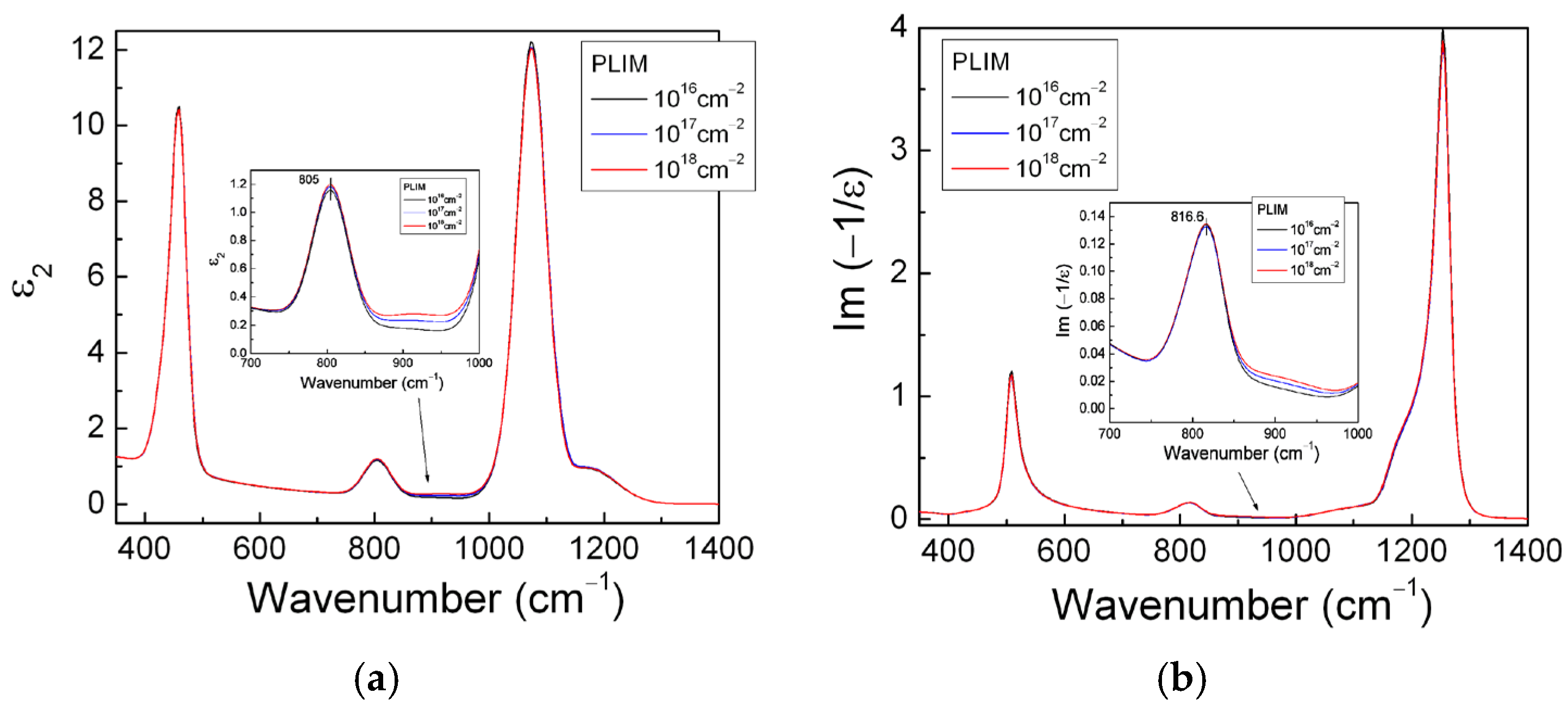
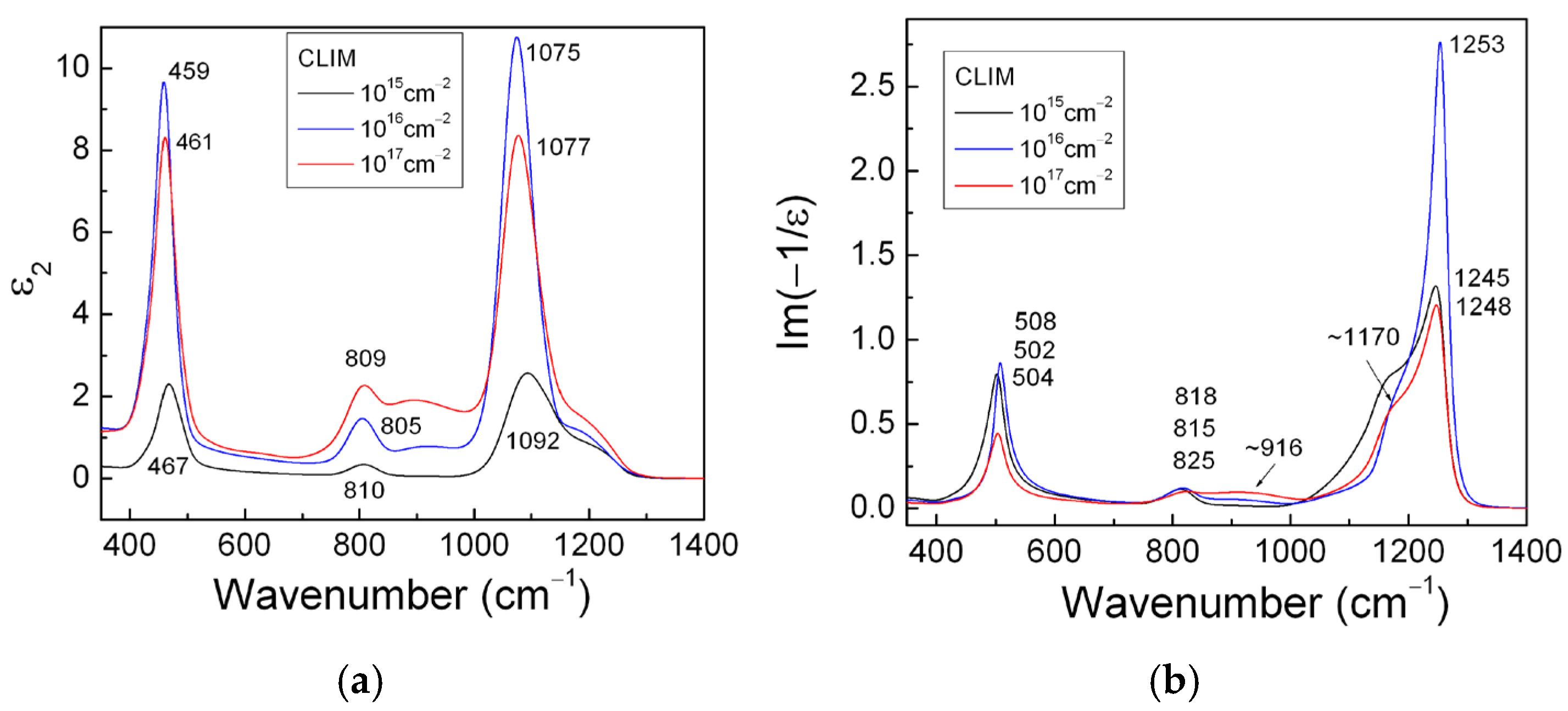
Figure 6 gives the IR-SE spectra of the imaginary part ε2 of the dielectric function ε and of the dielectric loss function Im(−1/ε) of the layers formed by oxidation of PLIM- and CLIM-implanted Si substrates. The spectra are presented only in the 350–1400 cm−1 frequency region because no bands connected with vibration of Si–H, N–H or O–H chemical bonds around 2170, 3350 and 3640 cm−1, respectively, were detected. Moreover, all characteristic vibration bands of Si–O, Si–O–N and Si–N chemical bonds appear in the spectral range below 1400 cm−1 [19,26,27,28].
For PLIM-implanted and oxidized Si substrates, the spectra of the dielectric functions are presented in Figure 6a,b. As can be seen, the increase in the concentration of N+ implants leads to a slight increase in the intensity in the 800–1000 cm−1 region without an essential shift in peak positions (insets in Figure 6a,b). During the 20 min oxidation, the whole implanted Si sub-surface region is oxidized, according to the thickness data in Figure 5a, as well as the implantation profile given in Figure 3b. The IR-SE spectra exhibit strong characteristic peaks of Si-O vibration modes and weak features of Si-N and Si-O-N vibrations, whose peak positions we have considered in detail in [29], where Si-N, Si-N-O and Si-Si chemical bonds have been identified in the silicon oxide network and confirmed by the XPS results. In Table 1, for convenience, data is included for PLIM samples oxidized at 20 min, where the detected vibrational modes of proper chemical bonds in the grown layers are summarized.
For the CLIM-implanted samples, all IR-SE spectra, shown in Figure 7a,b are strongly dependent on the N+ fluence. In the region of 800–1000 cm−1, several peaks are superimposed. The peak related to TO Si-O bending vibrations appears at 800–805 cm−1, while the LO vibration mode of Si-Si bond is around 815–820 cm−1 [28]. The broad shoulder centered around 930 cm−1 is assigned to the TO mode of nitrogen in Si-N bonds with different configurations [27,28,30].
The position of the main vibrational band of Si-O bonds, appearing in the 1000–1100 cm−1 region in the ε2 spectra and as a shoulder in Im(−1/ε) ones, moves toward lower frequencies with increasing N+ fluence. At low N+ fluence, the growing oxide is stoichiometric SiO2 with four- and sixfold Si-O4-Si rings, while it is sub-stoichiometric SiOx with Si-O3-Si complexes [26].
The broad band appearing in Im(−1/ε) spectra as a shoulder in the 1100–1200 cm−1 spectral range (Figure 7b) is attributed to the stretching mode of O atoms in suboxides but overlaps with bands around 1150 cm−1 of nitrogen vibrations in stoichiometric Si3N4 configurations [19].
The shape of the IR-SE spectra as a whole and the wide and strong frequency regions related to the vibrations of Si-O-N and Si-N bonds together are strong evidence that silicon oxynitride layers are successfully synthesized by the technological sequence used. The existence of the band, associated with the vibration of Si atoms in Si–Si bonds, indicates the occurrence of amorphization of the Si crystal lattice due to the incorporation of high-energy N+ ions into the Si lattice. This is in good accordance with the Raman observations presented in the next section.
Further support of these results for formation of SiOxNy layers comes from our previous XPS studies [29,31], where, from the positions of the Si 2p, O 1s and N 1s peaks in the emission spectra, Si-O-N bonding with different configurations was inferred and assigned to N(–SiO3)x and O–N–Si2.

3.3. Raman Spectroscopy

In this section, the results are presented from the application of Raman spectroscopy, since it provides information on the vibrational energy modes of the sample in order to identify the molecular bonds and to reveal the SiNxOy layer composition.
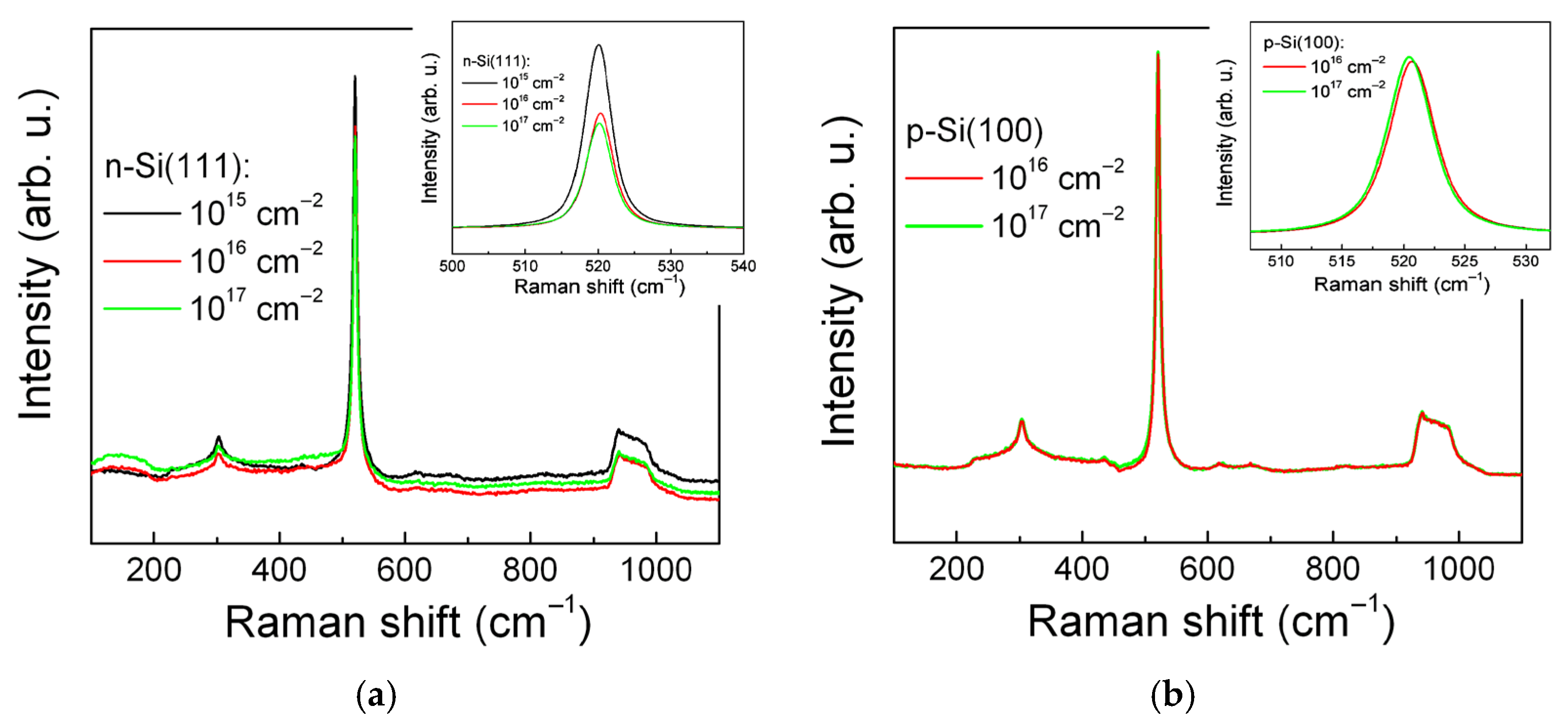
In Figure 8, the Raman spectra are displaced for the layers formed on n-Si(111) and p-Si(100) samples, CLIM implanted with three N+ ion fluences and oxidized. For better visibility, the main Raman band of the Si-Si bonds is given separately in the insets of Figure 8. The known Si-related bands are observed in the spectral region from 150 to1100 cm−1. The Raman peak positions were determined by fitting the spectra with Lorentzian functions.
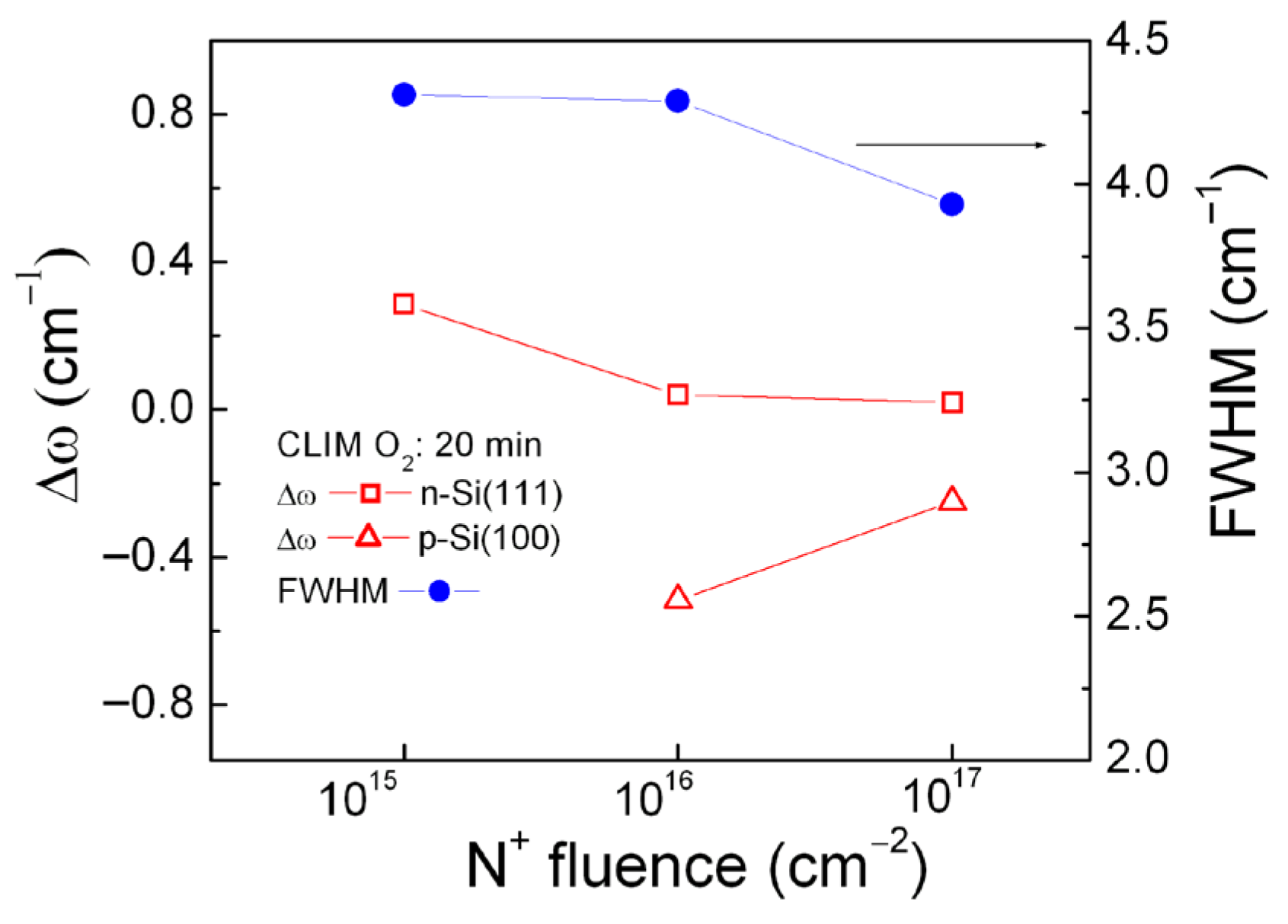
For all samples, the main Si-Si peak is located around 520 cm−1, but its position varies depending on the N+ fluence, expressed as frequency shifts Δω relative to the stress-free position. In all samples, the full width at half maximum (FWHM) of this peak, as well as the peak intensity, are determined. The results reveal changes depending on the ion fluence.
The Δω shifts and FWHM values are shown in Figure 9 for all implanted Si substrates after layer formation during the post-implantation oxidation. The samples built on n-Si(111) show positive Δω values, while the Δω shifts for the p-Si(100) samples exhibit negative values. These results show a clear tendency in the shifts in Δω towards smaller values for both types of samples with increasing ion fluence.
The positions of Raman peaks are usually related to the presence of internal stress/strain in the layers. So, the shifts in our samples on n-Si(111) can be attributed to the presence of compressive stress/strain, and those on p-Si(100) can be attributed to tensile stress/strain. It should be remembered and emphasized that the two types of samples, n- and p-Si, have different orientations of the Si wafers, namely (100) for p-Si and (111) for n-Si. Tensile stress has been established by Raman studies in high-energy (150 keV) N+-implanted p-Si(100) [32], as well as in Si wafers subjected to tensile stress [33].
The observed reduction in Raman shifts Δω and the decrease in FWHM values with increasing N+ fluence (Figure 9) are indicative of a decrease in stress/strain levels.
The intensity of the peaks shows a tendency to decrease with increasing fluence, more pronounced for n-Si(111), which can be indicative of the appearance of disorders and can be related to the persistence of unannealed implantation-induced defects.
Some estimations [33] were made for uniaxial strain (εxx) values, which were expressed by the Raman shift Δω = xx, where Δω is taken in cm−1 and b is a constant equal to −337. However, the values of b should be taken with caution, as the equation was derived for the Si(001) surface and may need substantiation for other Si orientations. Nevertheless, in our experiments, the smallest strain for both Si(111) and Si(100) would be about 0.06%. Since the strain is related to a change in the length of the bonds, it should be caused by the implantation process, mainly as a residual secondary effect.
In [34], the structural stress (σ) can be calculated from the relation σ = CSiΔω, σ is given in MPa and Δω is taken in cm−1. The constant Csi was chosen to be equal to −434 N/cm from experimental and theoretical studies, regardless of the Si orientation. Therefore, in our case, it is reasonable to assume the value Csi = −434 N/cm and calculate the stress from the observed Raman shifts. For the samples implanted with 1017 cm−2 N+ fluence, taking Δω = 0.039 cm−1, σ = 7.8 MPa is obtained. The stress is probably a result of the oxidation process, when the two lattices of the crystalline Si and the growing amorphous layer have to match, generating mechanical stress in the structure. The high post-implantation temperature is obviously not enough to anneal most of the implantation damage. Although Δω decreases, it remains higher than that of the oxidized samples. In any case, the decrease in the stress/strain level with the increase in the ion fluence indicates structure ordering probably related to the reduced oxidation rate due to the retardation effect of the implanted nitrogen atoms, allowing for relaxation of the layer network.
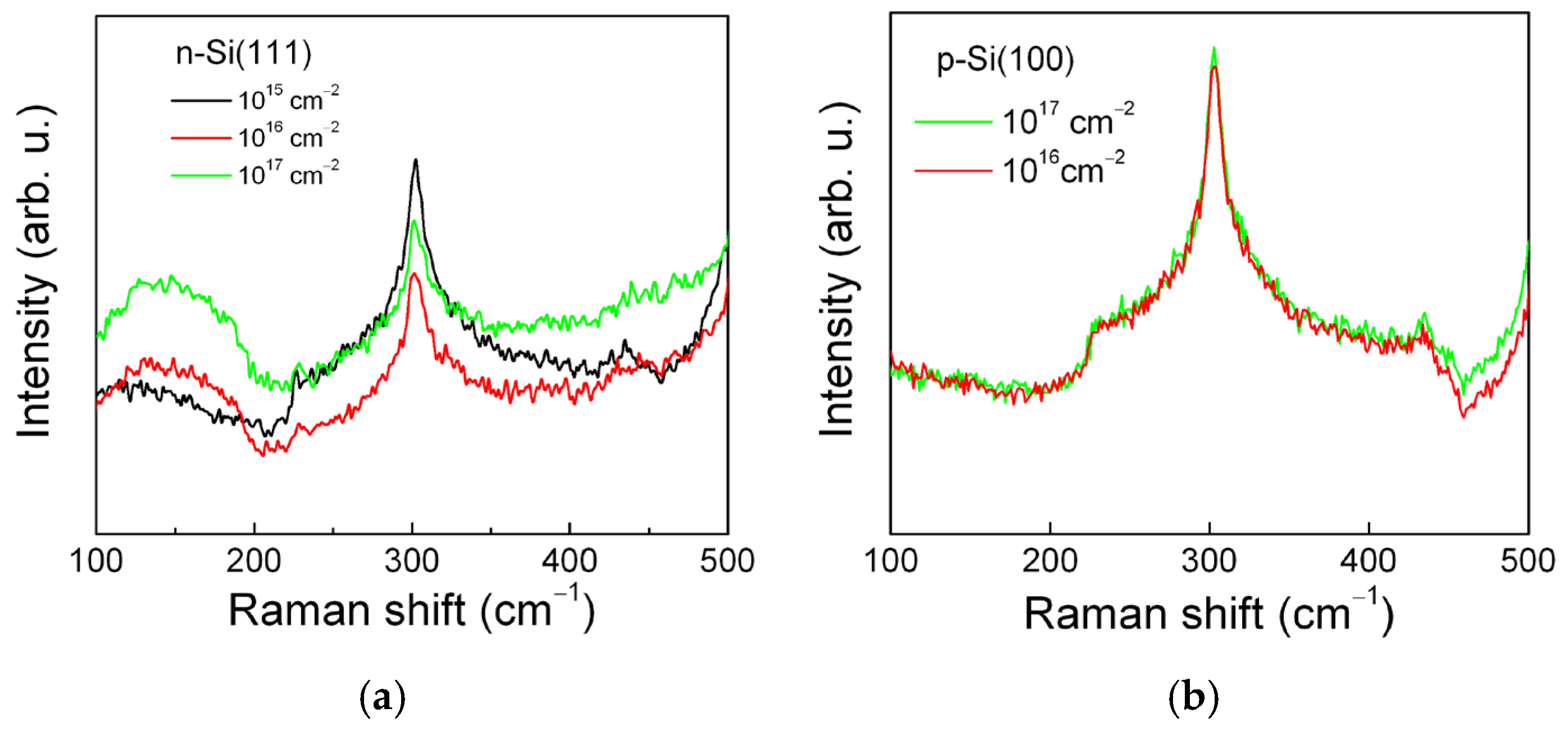
Both the decrease in stress and the presence of a disorder point in the same direction, namely implantation-induced modification of the sub-surface Si structure. Additional information can be obtained from the positions and intensities of small peak structures beyond the typical Si bands. The Raman spectra in the frequency region between 100 and 500 cm−1 are presented in Figure 10. In all samples, peaks can be observed at 235 cm−1 and 435 cm−1. Furthermore, a broad band centered at 145 cm−1 is detected in layers grown on n-Si(111). In [35], bands at the same positions were found in Si implanted with N+ by applying plasma-based ion implantation (PBII).
The larger differences for n-Si(111) than for p-Si(100) are an indication of the stronger influence of the N+ implantation process on the destruction of the crystal structure of silicon with (111) orientation (perhaps due to close packing). According to previous studies, the broad peaks below 200 and around 480 cm−1 [32,36] are attributed to some degree of amorphization and/or Si-N bonding. In the study of SiNx thin layers, Debieu et al. [37] have ascribed the broad Raman bands at 150 and 480 cm−1 to the presence of amorphous Si regions/particles, which cause the evolution of these bands into narrower and more pronounced bands. In our experiments, the formation of nanocrystalline Si inclusions can be expected because of the high-temperature oxidation rather than the amorphization of the layer. This is more evident from the sharper peaks at 140 and 435 cm−1 in the n-Si (111) samples. In p-Si(100) samples, these peaks are at the same position, but they are less pronounced. However, some degree of amorphization in the n-Si(111) sub-surface region cannot be excluded and could be the reason for the appearance of a broad Raman band between 100 and 200 cm−1 with increased intensity as the N+ fluence increases. Additional indication of a remaining disorder is the band shape at 435 cm−1, which almost entirely flattens at the highest fluence of 1017 cm−2. For the p-Si samples, no band between 100 and 200 cm−1 is observed, suggesting a lower degree of implantation-induced disordering. According to the model developed in [38], the band at 431 cm−1 is ascribed to nanocrystals with sizes of 6–9 nm and the composition of two coordinated Si atoms.
In support of the formation of Si nanocrystallites is the observed increase in concentration of Si particles in the growing layers, as seen in Figure 5c, which is much more pronounced for CLIM-implanted samples. The atomic Si inclusions created by implantation remain stable during oxidation transformation in nanocrystalline particles promoted by nitrogen implants and high temperature. Further evidence for Si inclusions can be found in our previous XPS study [31], where, in addition to the Si 2p peak at 103.5 eV due to Si4+ in oxide and/or oxynitride bonding, a Si0 peak at a low binding energy of 99 eV indicates Si-Si bonds. The results from the Raman spectra for PLIM-implanted samples exhibit no substantial dependence on N+ fluence. This is in accordance with the SE data in Figure 5a, where the SiO2 content is above 80 v. %.

3.4. AFM Imaging of Surface Morphology

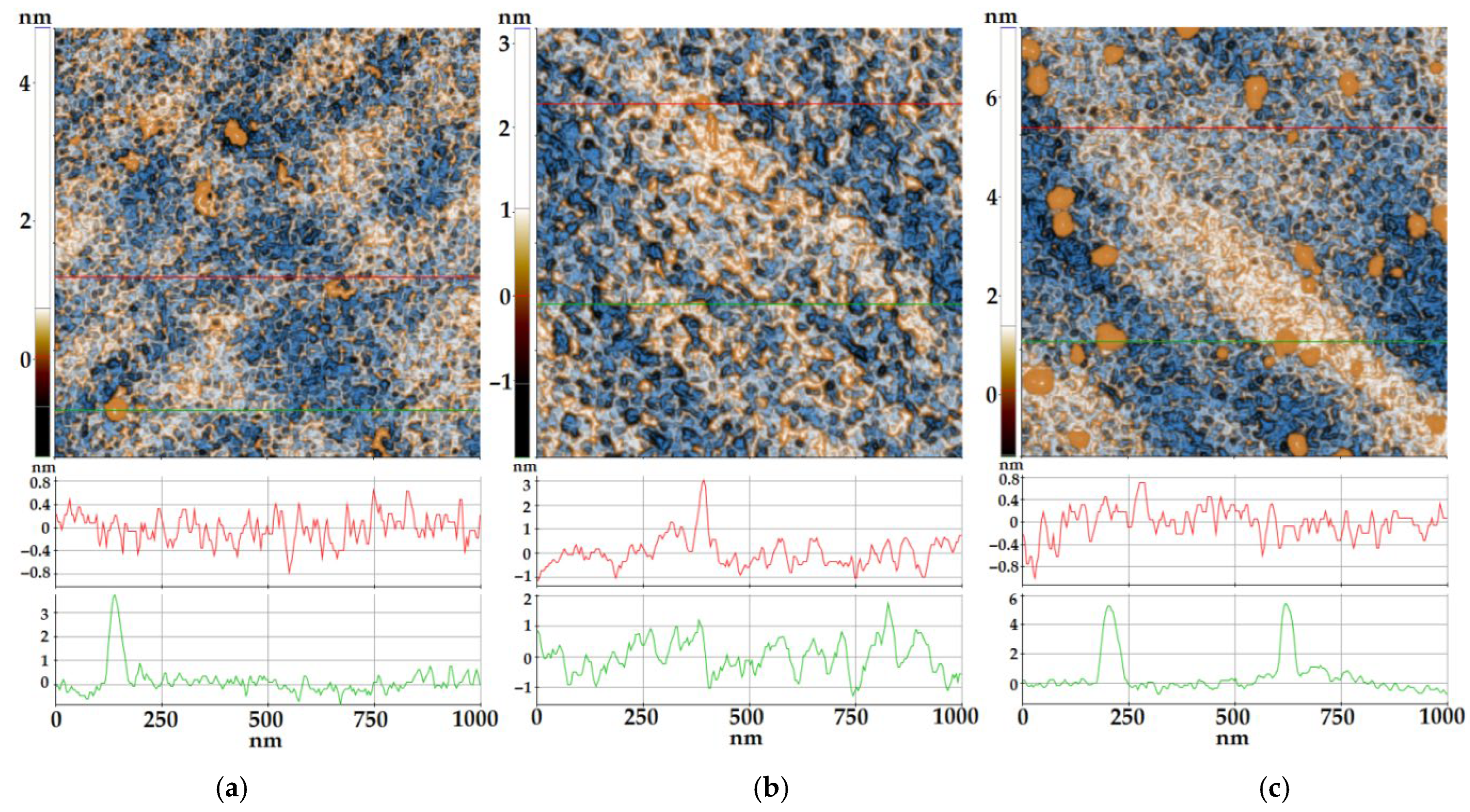
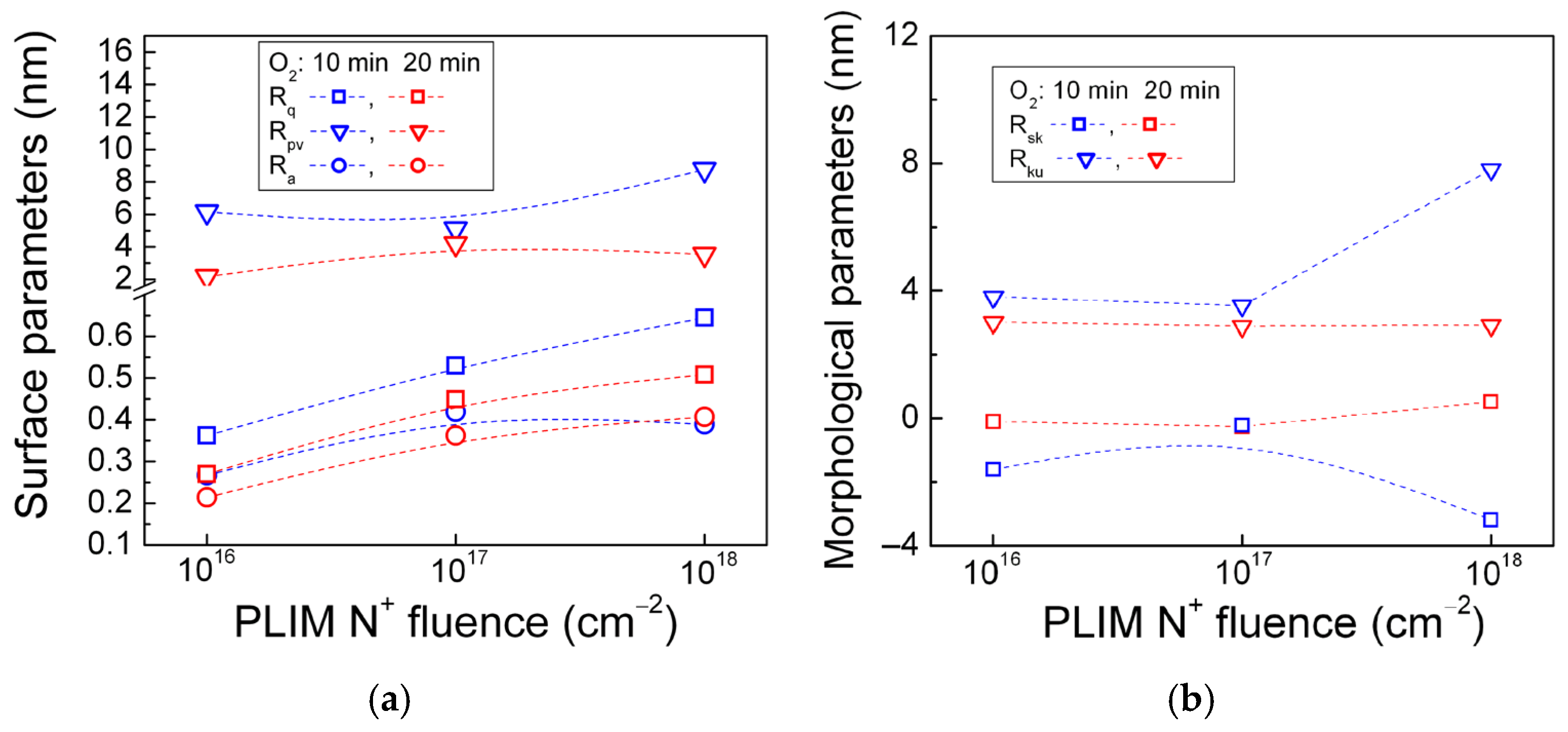
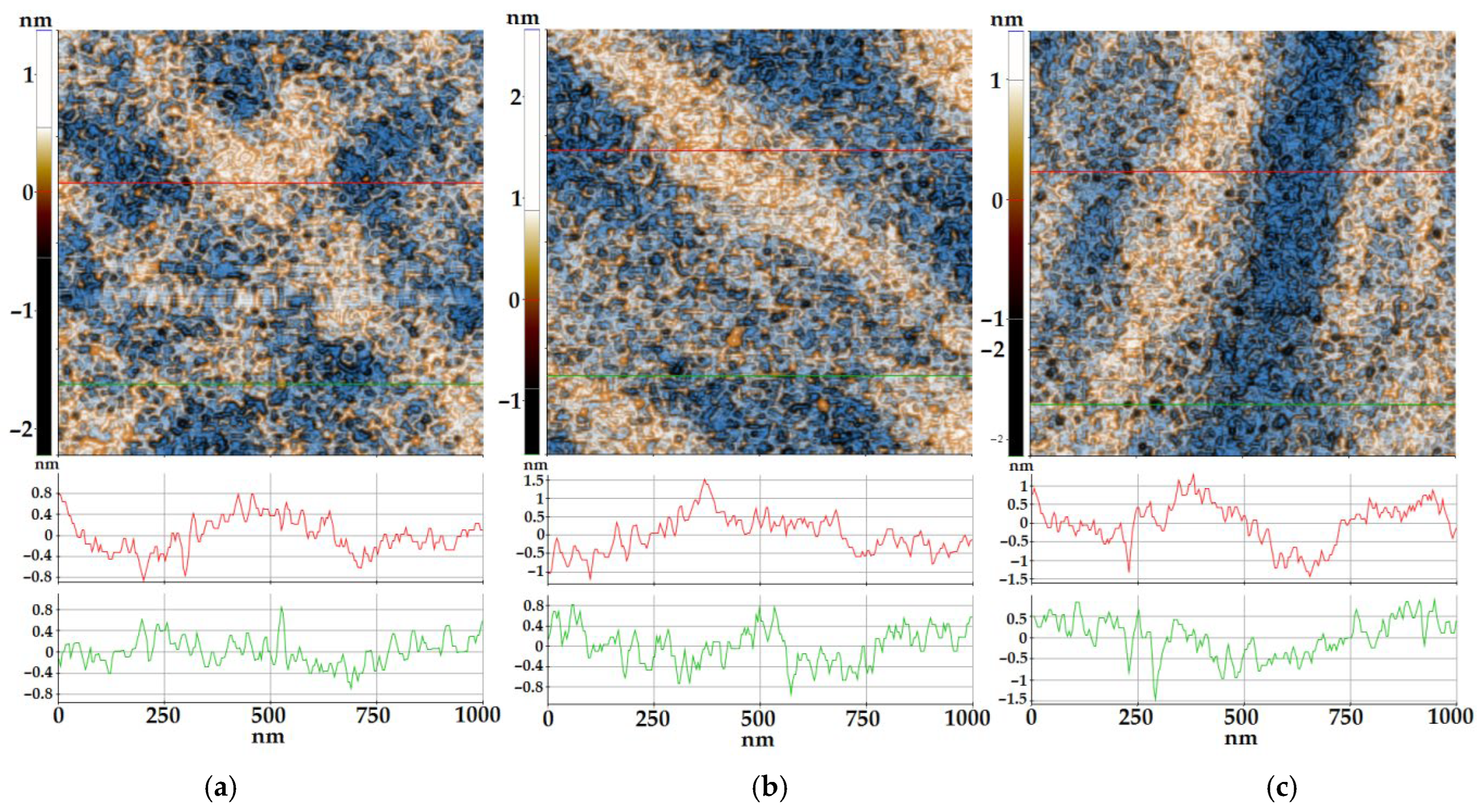
Figure 11 shows the two-dimensional AFM images, presented in enhanced-contrast mode, for the surfaces formed on plasma immersion N+ ion implantation followed by oxidation of p-Si(100) substrates in dry O2 for 10 min. The surface roughness (Ra, Rq and Rpv) and morphological (Rsk and Rku) parameters are summarized in Figure 12. All surfaces are relatively smooth with peak-to-valley (Rpv) parameters of less than 10 nm. The average (Ra) and RMS (Rq) roughness values are below 1 nm at the scanned scale. The values of these quantities increase with increasing N+ ion fluence (see Figure 12a, empty blue square and circle symbols, respectively). The surface of all samples exhibits small circular pits, visible as dark blue spots, probably formed during N+ ion implantation. Additionally, some clusters of the materials are observed in the form of hemispherical protrusions (visible as yellow bumps with a height of a few nanometers (2–6 nm)). Such features can be seen in the line scans given below each 2D image (Figure 11). As suggested by the line scans, the surface of the samples exhibits a zig-zag (up-down) profile, located in a vertical range of less than 2 nm (from −1 to +1 nm).
The surface roughness (Ra, Rq and Rpv) and morphological (Rsk and Rku) parameters show a clear tendency to increase with the N+ fluence and to decrease with enhanced oxidation time (Figure 12). The skewness (Rsk) and kurtosis (Rku) are related to the surface morphology as they mathematically describe the randomness of the height profile by Rku and the asymmetry of the height distribution by Rsk [39,40]. The Rku parameter can be an indicator of the presence of defects as “hills”, while for a Gaussian-like height distribution, its value is close to 3. The slightly larger values over 3, obtained for the 1016 and 1017 cm−2 N+ fluences, are due to the presence of random protruding particles. For the highest N+ fluence of 1018 cm−2, the Rku = 7.86 nm value testifies to the presence of the hill-like defects on the sample surface. The observed negative values of the Rsk skewness parameter can be a result of the presence of a significant number of pit-like defects formed during the implantation process.
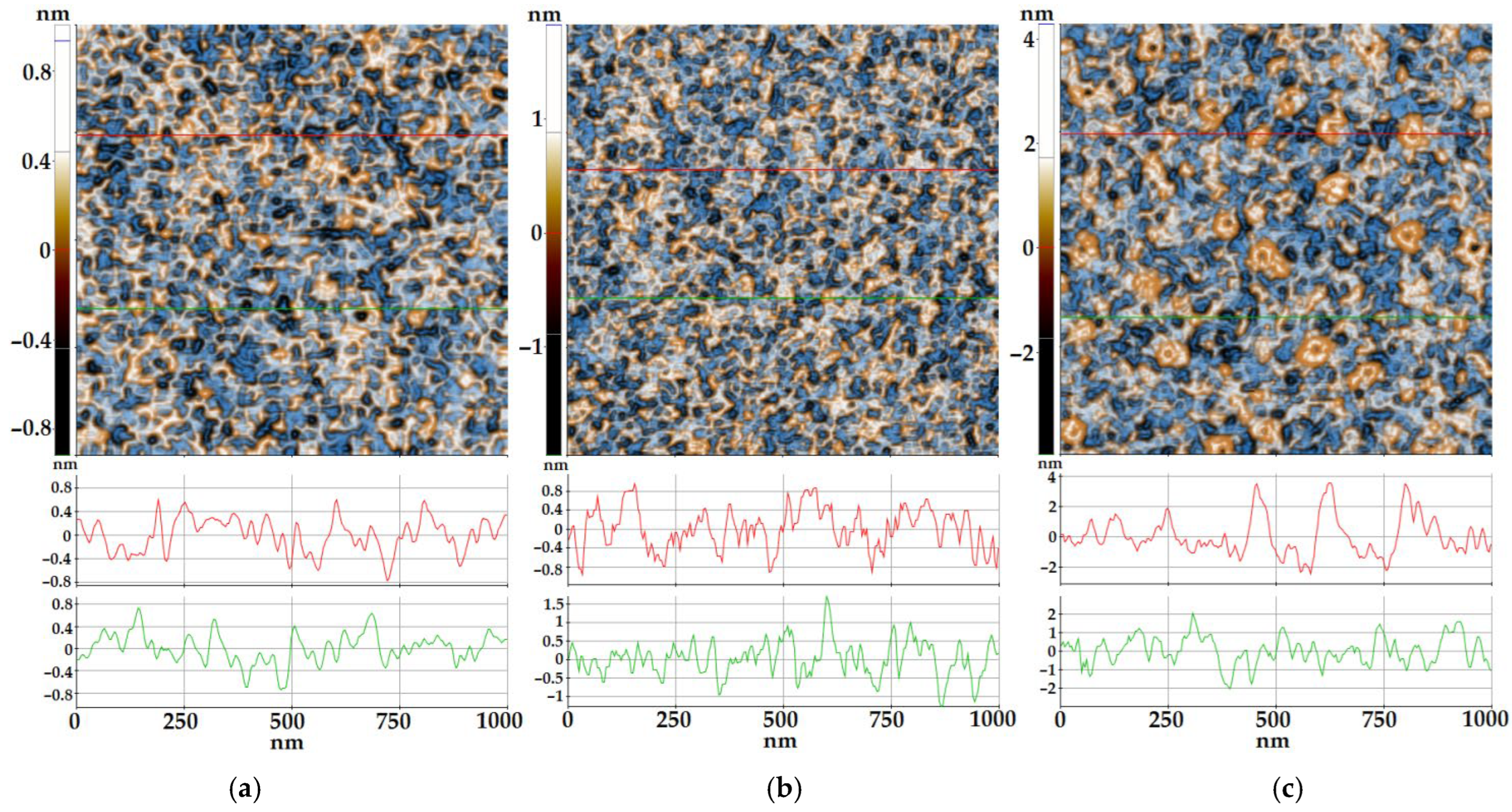
Figure 13 shows the two-dimensional AFM images presented in enhanced-contrast mode for the surfaces formed on p-Si(100) substrate PLIM N+ implanted and oxidized in dry O2 for 20 min. As can be seen, longer oxidation time leads to a reduction in protruding clusters of the material. The average and RMS roughness values, similar to samples oxidized for 10 min, increase with increasing the N+ fluence, being less than 1 nm at the scanned scale (see Figure 12). Also, the zig-zag profile is superimposed on wavy-like areas (see the shape of the red line-scans in Figure 13). The pits formed during implantation (dark blue spots in the 2D images) are clearly visible and are especially pronounced for the N+ fluence of 1018 cm−2.
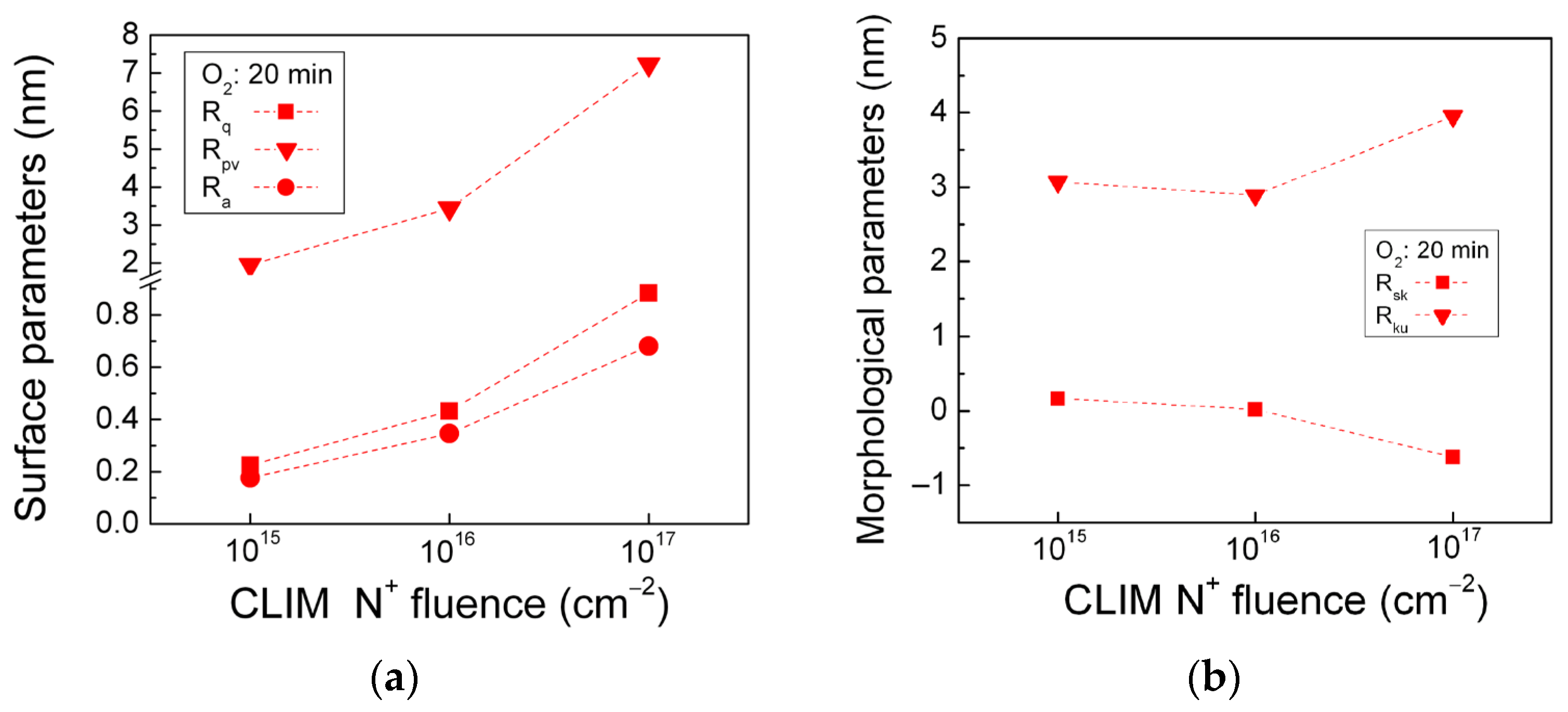
Figure 14 shows the two-dimensional AFM images in enhanced-contrast view mode for the surfaces formed by oxidization in dry O2 for 20 min of the p-Si(100) substrates CLIM implanted with N+ fluence in the 1015–1017 cm−2 range. As observed, the CLIM samples show roughness parameters (Ra, Rq and Rpv) specific to smooth surfaces, which gradually increase with increasing N+ fluence (Figure 14a and Figure 15a). All samples exhibit superficial pits (shallow nano-pores, visible as dark blue spots in the AFM images) as a mark of the implantation process. Similarly to the surfaces formed on p-Si(100) substrates by plasma-immersion N+ implantation followed by oxidation in dry O2 for 10 min (Figure 11), random small protruding particles with diameters of the same order as the pits are present for the samples implanted with 1015 and 1016 cm−2 N+ fluences (Figure 14a,b). For the sample implanted with 1017 cm−2 N+ fluence, they become well-formed (see the “yellow” donut-like clusters of material in Figure 14c).
The effect of the N+ fluence on the morphology of the surfaces formed on CLIM N+ implanted and oxidized Si substrates in O2 for 20 min is illustrated in Figure 14. The frequent presence of convex protruding “donuts-like” defects increases not only the roughness parameters of Ra, Rq and Rpv (Figure 15a) but also the kurtosis parameter Rku (Figure 15b). Even the pits are slightly deeper for the highest N+ fluence of 1017 cm−2, leading to a negative skewness of Rsk (Figure 15b).
The morphological analysis based on the AFM images reveals that both implantation methods lead to similar values of the roughness parameters, which, in general, are characteristic of smooth surfaces. The obtained values of the studied surface quantities are also close to those often reported for Si wafers [41,42]. Depending on the technological processing to which the samples were subjected, some textural differences can be observed, such as the appearance of clusters of the materials visible as quasi-spherical protrusions. However, the textural and morphological features do not alter the smoothness required for various electronic and optoelectronic applications.

4. Conclusions

In the present research, the ion implantation technology was applied to form nano-sized SiOxNy layers on silicon substrates. Contrary to methods used most often, nitrogen was delivered into the Si substrate before standard oxidation at an elevated temperature. The layers were fabricated either by exposing the Si to conventional ion beam implantation (CLIM) or by immersion in a nitrogen plasma environment (PLIM).
The presence of nitrogen leads to the retardation of the oxidation rates being dependent on ion fluence. Smaller layer thickness and higher refractive index as compared to the values of stoichiometric thermally grown SiO2 were found in all samples. The volume fractions of SiO2, Si3N4 and atomic Si from SE measurements and Bruggeman EMA modeling allow drawing conclusions about the chemical composition of the layers depending on the amount of incorporated nitrogen atoms. Support comes from SRIM simulation of the N+ ion and Si vacancy distributions into the Si substrate, band shapes and positions in Raman spectra, and AFM studies. Evidence about nitrogen content was gained from an analysis of the dielectric functions from IR-SE spectra.
The effect of nitrogen incorporation in the layers is much more pronounced in CLIM samples. The layers in this case reveal SiOxNy composition with a varying amount of nitrogen. The layers grown on PLIM samples incorporate a smaller amount of nitrogen and can be regarded as a SiO2 layer with low nitrogen concentration.
The two different technological schemes using CLIM and PLIM and standard processing steps that were implemented to synthesize SiOxNy layers on silicon have shown the possibility of fabricating layers controllably, tailoring their properties for advanced applications.
Ion implantation has been applied to engineer doping profiles because of the possibility to precisely introduce atoms at specific locations, but its application range is far wider, including imaging technology and an increase in surface hardness, improving the wear resistance to novel trends to create qubits for application in quantum computing.

Author Contributions

Conceptualization, A.S. and S.A.; writing—original draft preparation, A.S., S.A., E.V., M.A., M.G. and H.S.; writing—review and editing, A.S., S.A., M.A. and M.G.; data curation, H.S., M.N., A.S., M.A., S.A., E.V. and M.G.; supervision, A.S. and S.A.; project administration, A.S., S.A. and M.G. All authors have read and agreed to the published version of the manuscript.

Funding

This research received no external funding.

Institutional Review Board Statement

Not applicable.

Informed Consent Statement

Not applicable.

Data Availability Statement

The data presented in this study are available on request from the corresponding authors.

Acknowledgments

The authors gratefully acknowledge the support of this work in the framework of Academic Exchange Programs between the Bulgarian Academy of Sciences and the Romanian Academy. Part of this study was conducted in the framework of the research program “Surface Chemistry and Catalysis” of the Institute of Physical Chemistry “Ilie Murgulescu” of the Romanian Academy. Evgenia Valcheva acknowledges the partial support by Project BG16RFPR002-1.014-0006 “National Centre of Excellence Mechatronics and Clean Technologies”, co-funded by the European Union, under “Research Innovation and Digitization for Smart Transformation” program 2021–2027.

Conflicts of Interest

The authors declare no conflicts of interest.

References

  1. Hill, W.L.; Vogel, E.M.; Misra, V.; McLarty, P.K.; Wortman, J.J. Low-pressure rapid thermal chemical vapor deposition of oxynitride gate dielectrics for n-channel and p-channel MOSFETs. IEEE Trans. Electron. Devices 1996, 43, 15–19. [Google Scholar] [CrossRef]
  2. Evtukh, A.; Kizjak, A.; Bratus’, O.; Voitovych, M.; Romanyuk, V.; Mamykin, S.; Antonin, S.; Muriy, Y.; Klymenko, V.; Sarikov, A. Structure and electrical conductivity of nanocomposite SiOxNy(Si) and SiAlzOxNy(Si) films. J. Alloys Compd. 2023, 960, 170879. [Google Scholar] [CrossRef]
  3. Kapetanakis, E.; Skarlatos, D.; Tsamis, C.; Normand, P.; Tsoukalas, D. Influence of implantation energy on the electrical properties of ultrathin gate oxides grown on nitrogen implanted Si substrates. Appl. Phys. Lett. 2003, 82, 4764–4766. [Google Scholar] [CrossRef]
  4. Zhuo, Z.; Sannomiya, Y.; Kanetani, Y.; Yamada, T.; Ohmi, H.; Kakiuchi, H.; Yasutake, K. Interface properties of SiOxNy layer on Si prepared by atmospheric-pressure plasma oxidation-nitridation. Nanoscale Res. Lett. 2013, 8, 201. [Google Scholar] [CrossRef]
  5. Dong, J.; Du, P.; Zhang, X. Characterization of the Young’s modulus and residual stresses for a sputtered silicon oxynitride film using micro-structures. Thin Solid Films 2013, 545, 414–418. [Google Scholar] [CrossRef]
  6. Soman, A.; Antony, A. Broad range refractive index engineering of SixNy and SiOxNy thin films and exploring their potential applications in crystalline silicon solar cells. Mater. Chem. Phys. 2017, 197, 181–191. [Google Scholar] [CrossRef]
  7. Lo, G.Q.; Shih, D.K.; Ting, W.C.; Kwong, D.L. Radiation effects in ultrathin nitrided oxides prepared by rapid thermal processing. Appl. Phys. Lett. 1989, 55, 840–842. [Google Scholar] [CrossRef]
  8. Zheng, Z.-S.; Liu, Z.-L.; Zhang, G.-Q.; Li, N.; Li, G.-H.; Ma, H.-Z.; Zhang, E.-X.; Zhang, Z.-X.; Wang, X. Improvement of the radiation hardness of SIMOX buried layers using nitrogen implantation. Semicond. Sci. Technol. 2005, 20, 481–484. [Google Scholar] [CrossRef]
  9. Skarlatos, D.; Perego, M.; Tsamis, C.; Ferrari, S.; Fanciulli, M.; Tsoukalas, D. Nitrogen distribution during oxidation of low and medium energy nitrogen-implanted silicon. Nucl. Instrum. Methods Phys. Res. Sect. B 2004, 216, 75–79. [Google Scholar] [CrossRef]
  10. Yang, Y.; Li, H.; Hu, Z.; Guo, J.; Li, X.; Liu, P.; Yu, X. Study on Oxygen Control of Large Diameter N-type Monocrystalline Silicon with Large Thermal Field. Silicon 2024, 16, 753–763. [Google Scholar] [CrossRef]
  11. Huang, T.; Jin, C.; Yu, J.; Yang, Y.; Zhuge, L.; Wu, X.; Sha, Z. One-Step Synthesis of Silicon Oxynitride Films Using a Steady-State and High-Flux Helicon-Wave Excited Nitrogen Plasma. Plasma Chem. Plasma Process. 2017, 37, 1237–1247. [Google Scholar] [CrossRef]
  12. Shi, Y.; He, L.; Guang, F.; Li, L.; Xin, Z.; Li, R. A Review: Preparation, Performance, and Applications of Silicon Oxynitride Film. Micromachines 2019, 10, 552. [Google Scholar] [CrossRef]
  13. Silverberg, M.S. Chemistry: The Molecular Nature of Matter and Change, 3rd ed.; Mc Graw-Hill: New York, NY, USA, 2003. [Google Scholar]
  14. Kern, W.; Puotinen, D. Cleaning Solutions Based on Hydrogen Peroxide for Use in Silicon Semiconductor Technology. RCA Rev. 1970, 31, 187–206. [Google Scholar]
  15. De Wolf, I. Raman spectroscopy: Chips and stress. Spectrosc. Eur. 2003, 15, 6–13. [Google Scholar]
  16. Dennis, J.R.; Hale, E.B. Crystalline To Amorphous Transformation In Ion-implanted Silicon: A Composite Model. J. Appl. Phys. 1978, 49, 1119–1127. [Google Scholar] [CrossRef]
  17. Vajo, J.J.; Williams, J.D.; Wei, R.; Wilson, R.G.; Matossian, J.N. Plasma ion implantation of nitrogen into silicon: Characterization of the depth profiles of implanted ions. J. Appl. Phys. 1994, 76, 5666–5675. [Google Scholar] [CrossRef]
  18. Berreman, D.W. Infrared Absorption at Longitudinal Optic Frequency in Cubic Crystal Films. Phys. Rev. 1963, 130, 2193–2198. [Google Scholar] [CrossRef]
  19. Lisovskyy, I.P.; Voitovych, M.V.; Sarikov, A.V.; Zlobin, S.O.; Lukianov, A.N.; Oberemok, O.S.; Dubikovsky, O.V. Infrared study of the structure of silicon oxynitride films produced by plasma enhanced chemical vapor deposition. J. Non-Cryst. Solids 2023, 617, 122502. [Google Scholar] [CrossRef]
  20. Lu, H.C.; Gusev, E.P.; Gustafsson, T.; Garfunkel, E. Effect of near-interfacial nitrogen on the oxidation behavior of ultrathin silicon oxynitrides. J. Appl. Phys. 1997, 81, 6992–6995. [Google Scholar] [CrossRef]
  21. Szekeres, A.; Alexandrova, S.; Vlaikova, E.; Halova, E. Oxidation of Si Surface Nitrogenated by Plasma Immersion N+ Ion Implantation. Bulg. J. Phys. 2012, 39, 178–185. [Google Scholar]
  22. Palik, E.D. (Ed.) Handbook of Optical Constants of Solids; Academic Press: New York, NY, USA, 1994. [Google Scholar]
  23. Stroud, D. The effective medium approximations: Some recent developments. Superlattices Microstruct. 1998, 23, 567–573. [Google Scholar] [CrossRef]
  24. Torquato, S. Effective-Medium Approximations. In Random Heterogeneous Materials. Interdisciplinary Applied Mathematics; Springer: New York, NY, USA, 2002; Volume 16. [Google Scholar] [CrossRef]
  25. Szekeres, A.; Nikolova, T.; Paneva, A.; Cziraki, A.; Kovacs, G.J.; Lisovskyy, I.; Mazunov, D.; Indutnyy, I.; Shepeliavyi, P. Silicon Nanoparticles in Thermally Annealed Thin Silicon Monoxide Films. Mater. Sci. Eng. B 2005, 124–125, 504–507. [Google Scholar] [CrossRef]
  26. Lisovskii, I.P.; Litovchenko, V.G.; Lozinskii, V.B.; Frolov, S.I.; Flietner, H.; Fussel, W.; Schmidt, E.G. IR study of short-range and local order in SiO2 and SiOx films. J. Non-Cryst. Solids 1995, 187, 91–95. [Google Scholar] [CrossRef]
  27. Hallam, B.; Tjahjono, B.; Wenham, S. Effect of PECVD silicon oxynitride film composition on the surface passivation of silicon wafers. Sol. Energy Mater. Sol. Cells 2012, 96, 173–179. [Google Scholar] [CrossRef]
  28. Topka, K.C.; Diallo, B.; Puyo, M.; Papavasileiou, P.; Lebesgue, C.; Genevois, C.; Tison, Y.; Charvillat, C.; Samelor, D.; Laloo, R.; et al. Critical Level of Nitrogen Incorporation in Silicon Oxynitride Films: Transition of Structure and Properties, toward Enhanced Anticorrosion Performance. ACS Appl. Electron. Mater. 2022, 4, 1741–1755. [Google Scholar] [CrossRef]
  29. Gartner, M.; Szekeres, A.; Alexandrova, S.; Osiceanu, P.; Anastasescu, M.; Stoica, M.; Marin, A.; Vlaikova, E.; Halova, E. Infrared ellipsometry as an investigation tool of thin layers grown into plasma immersion N+ implanted silicon. Appl. Surf. Sci. 2012, 258, 7195–7201. [Google Scholar] [CrossRef]
  30. Zheng, J.; Song, X.; Li, X.; Pu, Y. Large-Scale Production of Amorphous Silicon Oxynitride Nanowires by Nickel-Catalyzed Transformation of Silicon Wafers in NH3 Plasma. J. Phys. Chem. C 2008, 112, 27–34. [Google Scholar] [CrossRef]
  31. Alexandrova, S.; Halova, E.; Bakalova, S.; Szekeres, A.M.; Marin, A.; Osiceanu, P.; Gartner, M.; Koujuharova, N. XPS study of nanoscale SiOxNy layers synthesized by plasma immersion implantation of nitrogen. J. Phys. Conf. Ser. 2014, 514, 012035. [Google Scholar] [CrossRef]
  32. Perez-Rodriguez, A.; Romano-Rodríguez, A.; Morante, J.R.; Esteve, J.; Montserrat, J. Raman spectroscopy analysis of nitrogen ion implantation in silicon and correlation with transmission electron microscopy. Mater. Res. Soc. Symp. Proc. 1993, 279, 177–182. [Google Scholar] [CrossRef]
  33. Peng, C.Y.; Huang, C.F.; Fu, Y.C.; Yang, Y.H.; Lai, C.Y.; Chang, S.T.; Liu, C.W. Comprehensive study of the Raman shifts of strained silicon and germanium. J. Appl. Phys. 2009, 105, 083537. [Google Scholar] [CrossRef]
  34. Wu, X.; Yu, J.; Ren, T.; Liu, L. Micro-Raman spectroscopy measurement of stress in silicon. Microelectron. J. 2007, 38, 87–90. [Google Scholar] [CrossRef]
  35. Nakao, S. Structural changes of Si surfaces by nitrogen implantation using plasma based ion implantation. Nucl. Instrum. Methods Phys. Res. B 2009, 267, 1303–1306. [Google Scholar] [CrossRef]
  36. Kumar, N.; Volodin, V.A.; Goryainov, S.V.; Chernyshev, A.K.; Kozakov, A.T.; Scrjabin, A.A.; Chkhalo, N.I.; Mikhailenko, M.S.; Pestov, A.E.; Zorina, M.V. Raman scattering studies of low energy Ar+ ion implanted monocrystalline silicon for synchrotron applications. Nucl. Instrum. Methods Phys. Res. Sect. B Beam Interact. Mater. At. 2023, 534, 97–102. [Google Scholar] [CrossRef]
  37. Debieu, O.; Nalini, R.P.; Cardin, J.; Portier, X.; Perrière, J.; Gourbilleau, F. Structural and optical characterization of pure Si-rich nitride thin films. Nanoscale Res. Lett. 2013, 8, 31. [Google Scholar] [CrossRef]
  38. Gao, Y.; Yin, P. Origin of asymmetric broadening of Raman peak profiles in Si nanocrystals. Sci. Rep. 2017, 7, 43602. [Google Scholar] [CrossRef]
  39. Whitehouse, D.J. Surface Characterization and Roughness Measurement in Engineering. In Photomechanics. Topics in Applied Physics; Rastogi, P.K., Ed.; Springer: Berlin/Heidelberg, Germany, 2000; Volume 77. [Google Scholar] [CrossRef]
  40. Ruzova, T.A.; Haddadi, B. Surface roughness and its measurement methods—Analytical review. Results Surf. Interfaces 2025, 19, 100441. [Google Scholar] [CrossRef]
  41. Gartner, M.; Szekeres, A.M.; Simeonov, S.; Covei, M.; Anastasescu, M.; Preda, S.; Calderon-Moreno, J.M.; Predoana, L.; Stroescu, H.; Mitrea, D.; et al. Structure, optical and electrical properties of Nb(Zn) doped sol-gel ITO films: Effect of substrates and dopants. Molecules 2024, 29, 5480. [Google Scholar] [CrossRef]
  42. Bodner, T.; Behrendt, A.; Prax, E.; Wiesbrock, F. Correlation of surface roughness and surface energy of silicon-based materials with their priming reactivity. Monatshefte Chem. 2012, 143, 717–722. [Google Scholar] [CrossRef]
Figure 1. Schematic images of the technological procedures for CLIM and PLIM implantation methods.
Micro 06 00024 g001
Figure 2. Concentration distributions of (a) N+ ions at varying fluencies; comparison of the profiles of N+ and N2+ introduced implants (b).
Micro 06 00024 g002
Figure 3. Concentration distributions of (a) CLIM introduced N+ ions at varying fluence through the SiO2 layer; (b) comparison of the ion distributions in Si available before oxidation.
Micro 06 00024 g003
Figure 4. Thickness of the layers (a), roughness of the top layer (b) and the layers’ refractive index (c) for samples formed by oxidation of N+-implanted Si substrates in dry O2 for 10 and 20 min. The refractive index values were taken at a wavelength of λ = 633 nm.
Micro 06 00024 g004
Figure 5. Volume fraction of layer components of SiO2(a) Si3N4 (b) and Si (c) depending on N+ fluence for samples formed by oxidation of the N+ implanted Si substrates in dry O2 for 10 and 20 min.
Micro 06 00024 g005
Figure 6. IR-SE spectra of the imaginary part ε2 (a) of the dielectric function ε and of the dielectric loss function Im(−1/ε) (b) of the layers formed by oxidation of PLIM N+-implanted Si substrates in dry O2 for 20 min.
Micro 06 00024 g006
Figure 7. IR-SE spectra of the imaginary part ε2 (a) of the dielectric function ε and of the dielectric loss function Im(−1/ε) (b) of the layers formed by oxidation of CLIM N+-implanted Si substrates in dry O2 for 20 min.
Micro 06 00024 g007
Figure 8. Raman spectra in the low-frequency range from 100 to 1100 cm−1 of the layers grown on n-Si(111) (a) and p-Si(100) (b) substrates implanted with different N+-ions fluences. In the insets, the main Raman band of the Si-Si bonds is presented.
Micro 06 00024 g008
Figure 9. Frequency shift Δω and FWHM parameter of the Raman spectra as a function of N+ fluence for samples that underwent post-implantation oxidation.
Micro 06 00024 g009
Figure 10. Raman spectra in the low-frequency range from 100 to 500 cm−1 of the layers grown on n-Si(111) (a) and p-Si(100) (b) substrates implanted with different N+-ion fluences.
Micro 06 00024 g010
Figure 11. AFM 2D images with enhanced contrast of surfaces formed on oxidized in dry O2 for 10 min p-Si(100) substrates PLIM implanted with N+ fluence of 1016 cm−2 (a), 1017 cm−2 (b) and 1018 cm−2 (c). Two arbitrary line scans are plotted for each sample accordingly.
Micro 06 00024 g011
Figure 12. Effect of the N+ fluence on the surface (a) and morphological (b) parameters of surfaces formed on p-Si(100) substrate PLIM N+ implanted and oxidized in dry O2 for 10 min (blue empty symbols) and 20 min (red empty symbols). Dashed lines are plotted as eye guidance following the parameters variation with N+ ion fluence.
Micro 06 00024 g012
Figure 13. AFM 2D images presented in enhanced-contrast mode of surfaces formed on oxidized in dry O2 for 20 min p-Si(100) substrate PLIM implanted with N+ fluence of 1016 cm−2 (a), 1017 cm−2 (b) and 1018 cm−2 (c). Two arbitrary line scans are plotted for each sample accordingly.
Micro 06 00024 g013
Figure 14. AFM 2D images presented in enhanced-contrast mode of surfaces formed on oxidized in dry O2 for 20 min p-Si(100) substrate CLIM implanted with N+ fluence of 1015 cm−2 (a), 1016 cm−2 (b) and 1017 cm−2 (c). Two arbitrary line scans are plotted for each sample accordingly.
Micro 06 00024 g014
Figure 15. Effect of the N+ fluence on the surface (a) and morphological (b) parameters of surfaces formed on p-Si(100) substrate CLIM N+ implanted and oxidized in dry O2 for 20 min (full red symbols).
Micro 06 00024 g015
Table 1. IR-SE peak positions of vibrational modes and related chemical bonds in the layers formed by oxidation of PLIM and CLIM N+-implanted Si substrates in dry O2 for 20 min.
N+ ImplantationN+ Ion
Fluence
(cm−2)
Vibrational Modes (TO/LO) of Chemical Bonds (cm−1)
TO
Si-O
LO
Si-O
TO
Si-O
LO
Si-Si
TO
Si-N
TO
Si-O
LO
Si-N-O
LO
Si-O
PLIM1016458508804--107411841226
1017458508804815926107411841233
1254
1018458508804817932107411841254
CLIM1015468504802812916109111741227
1249
1016467508802818925107411421206
1252
1017461502802825932107911841232
1252
Disclaimer/Publisher’s Note: The statements, opinions and data contained in all publications are solely those of the individual author(s) and contributor(s) and not of MDPI and/or the editor(s). MDPI and/or the editor(s) disclaim responsibility for any injury to people or property resulting from any ideas, methods, instructions or products referred to in the content.