
Article

Effect of Order on the Spin Gapless Semiconducting Behavior of Mn2CoAl
Department of Materials Science, School of Natural Sciences, University of Patras, GR-26504 Patra, Greece
Micro 2026, 6(1), 20; https://doi.org/10.3390/micro6010020
Submission received: 9 February 2026 / Revised: 24 February 2026 / Accepted: 6 March 2026 / Published: 10 March 2026
(This article belongs to the Section Microscale Materials Science)

Abstract

Employing ab initio electronic structure methods, in this study, I examine the effect of order on the spin gapless semiconducting behavior of the Mn2CoAl Heusler compound. The occurrence of atomic disorder in general destroys the spin gapless semiconductivity observed in the inverse XA lattice structure; however, in some cases, novel magnetic configurations emerge. In the case of structures derived from the XA structure, where only Mn-Co or Mn-Al atoms are mixed, Mn2CoAl alloy presents a half-metallic magnetic character. In the case of full disorder (A2 lattice structure), where atoms occupy all sites with the same probability, the ground state is an antiferromagnetic metallic one. The L21 and B2 lattice structures, where Mn atoms occupy both sites of a similar local environment, correspond to a ferromagnetic state of very high spin magnetic moment per formula unit. The present study encompasses a much larger variety of disordered structures in comparison with other studies in the literature. It concludes that the control and minimization of the concentration of impurities at anti-sites is imperative to achieving optimal performance in spintronic devices based on spin gapless semiconducting Mn2CoAl.

1. Introduction

Spin gapless semiconductors (SGS) are a unique class of materials that bridge the gap between half-metals and semiconductors [1]. In an SGS, one spin channel acts as a standard semiconductor (with a bandgap), while the other has a zero-width bandgap (conduction and valence bands touch at the Fermi level). This electronic structure leads to unique properties—such as 100% spin polarization, high Curie temperatures, and ultra-fast carrier mobility—enabling a variety of technological applications. Most research interest has been focused on spintronic-related applications [2,3], since SGS can generate fully spin-polarized currents with minimal energy dissipation and thus SGS materials can serve as highly efficient spin injectors into semiconductors due to their high spin polarization and conductivity matching [4]. SGS materials can be also incorporated as electrodes in Spin Field-Effect Transistors (Spin-FETs) which can overcome the physical limits of traditional silicon MOSFETs [5]. Other applications of SGS in spitronics concern the reconfigurable magnetic diodes and transistors [6] and ultra-fast low-power devices based on the Quantum Anomalous Hall Effect [7]. In addition to spitronics, SGS materials can also find application as thermoelectric-energy-harvesting materials for converting waste heat into electricity since they often possess a high Seebeck coefficient [8]. Other technological fields which have an interest in SGS materials include optoelectronics due to their zero-bandgap property [9] and wearable electronics and flexible sensors [10].
Among SGS materials, of particular interest are those belonging to the so-called Heusler family, a class of materials renowned for their tunable magnetic and electronic properties. This is a huge family of intermetallic compounds containing more than 1000 members, which mostly crystallize in high-symmetry cubic structures [11]. Within this class of materials, one can find the Mn2CoAl compound, which has garnered significant attention primarily because it is the first experimentally realized SGS material [1]. Mn2CoAl is classified as a full-Heusler compound with an inverse cubic XA structure (prototype Hg2CuTi, space group F 4 ¯ 3 m , No. 216) [12]. Ouardi and collaborators were the first to grow bulk samples of Mn2CoAl in the XA structure (lattice parameter of approximately a = 5.798 Å) and have confirmed its SGS character [1]. Rani et al. have shown that in bulk Mn2CoAl, its band structure allows for threshold-less excitation of charge carriers leading to unique transport properties [13]. Mn2CoAl is a ferrimagnet with a high Curie temperature, exceeding 700 K [1,12]. Its total spin magnetic moment per formula unit experimentally reaches a value of 2 μ B (Bohr magnetons) [1,14,15] in accordance with the Slater–Pauling rule ( M t = Z t 24 , where M t is the total magnetic moment and Z t is the number of valence electrons per formula unit), characterizing the inverse full-Heusler compounds [16,17,18]. In addition to bulk samples, high-quality thin films, crucial for device applications, have been grown experimentally [14]. Buckley and collaborators have grown a series of Mn2CoAl thin films with various techniques [19]. They carried out magnetotransport measurements in all cases and concluded that disorder should occur (they suspected Mn/Al disorder without being able to reach definitive conclusions), unlike the bulk sample grown by Ouardi et al., for which almost perfect crystallinity was present [1].
First-principles (ab initio) electronic band structures based on Density Functional Theory (DFT) have been widely used to study the properties of Mn2CoAl. All ab initio studies have confirmed the SGS character of Mn2CoAl with a zero gap in the majority-spin electronic band structure [16,18,20]. Muhui and collaborators have predicted that the XA structure is energetically favorable with respect to the usual L21 structure of full-Heusler compounds [21]. Defects and atomic disorder have been shown to play a crucial role in the emergence of the SGS property in Mn2CoAl [21,22]. Interface engineering in devices can result in high magnetoresistance ratios [20]; tetragonalization often occurs in low-dimensional samples due to strain effects and can result in the appearance of Perpendicular Magnetic Anisotropy [23]. Finally, Jakobsson and collaborators have studied the temperature-dependent properties of Mn2CoAl [24]. They have shown that the exchange interactions are effectively short-range as a direct consequence of the SGS nature of Mn2CoAl and the dominant interaction is a result of the antiferromagnetic coupling between nearest neighboring Mn atoms; this stabilizes the ferromagnetic ground state. Monte Carlo simulations based on these exchange constants resulted in a predicted Curie temperature of 720 K. This is extremely close to the experimental value obtained by Ouardi and collaborators [1,24]. Ab initio calculations have also been used to predict SGS behavior among equiatomic-quaternary-ordered Heusler compounds [25].
Driven by the significant scientific interest in Mn2CoAl and the crucial role atomic disorder plays in its potential device applications, as suggested in the work of Buckley and collaborators [19], in this study, I investigate the effect of atomic order on the material’s spin gapless semiconducting character. Using state-of-the-art first-principles electronic band structure calculations, I demonstrate that atomic order profoundly impacts the electronic and magnetic properties of Mn2CoAl, giving rise to novel phenomena. These findings parallel those of previous studies on the ferromagnetic half-metallic full-Heusler compounds Co2MnAl and Co2MnSi, where atomic order was similarly found to dictate physical properties [26].

2. Computational Details

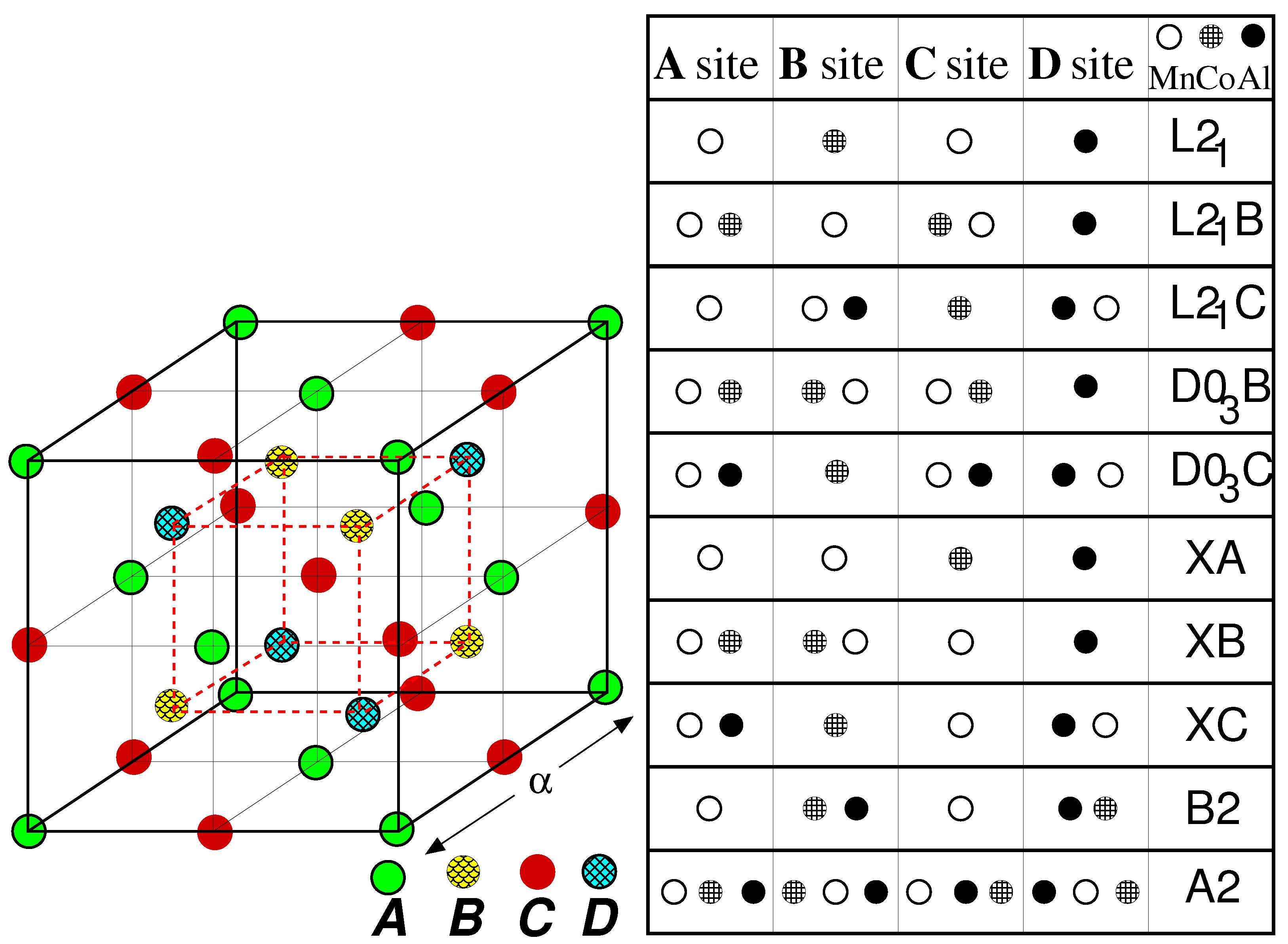
As detailed by the authors of [27], nine distinct structures can be derived from the perfect cubic L21 structure adopted by full-Heusler compounds (see Figure 1, left panel) by exchanging atoms within the unit cell. In a perfect L21A structure (commonly referred to in the literature simply as L21), the lattice consists of four interpenetrating fcc sub-lattices occupied in the sequence Mn-Co-Mn-Al. The site occupancy for these variations is detailed in the right panel of Figure 1. It is important to note that the B2 structure represents the limiting case of B2A, occurring when the B and D sites are fully disordered. Additionally, the XA structure (often called the inverse Heusler structure) exhibits the sequence Mn-Mn-Co-Al. This configuration typically arises when the valence of the X atom in X2YZ is lower than that of the Y atom; as previously discussed, this constitutes the ground state of the Mn2CoAl compound. Two further structures, L21B and L21C, can be derived from the XA case, as illustrated in Figure 1. For all calculations in this study, the experimental lattice constant of 5.798 Å for Mn2CoAl was employed [1].
The electronic structure calculations are performed using the full-potential, non-orthogonal, local–orbital minimum-basis band structure scheme (FPLO) (version FPLO5.00-20) [28] within a local-spin density approximation (LSDA) [29]. Disorder was simulated using the coherent potential approximation (CPA) [30,31] and the self-consistent potentials were calculated on a 20 × 20 × 20 k-mesh. CPA works by replacing the random, disordered lattice with a periodic lattice of “effective” atoms, whose potential is determined self-consistently to ensure that the average scattering from a single impurity is zero [30,31]. This approximation neglects the short-range disorder and thus clustering effects which may occur in some samples upon growth [30,31].

3. Results and Discussion

As I mentioned above, in full Heusler compounds of the X2YZ type chemical formula, when the valence of the X transition metal is lower than that of the Y transition metal atom, the XA structure usually occurs where the sequence of the atoms is X-X-Y-Z and not X-Y-X-Z, as in the L21 case (see Figure 1). This is also the case for the Mn2CoAl Heusler compound. For the L21 structure, the Mn atoms sitting at the A and C sites have very large spin magnetic moments, exceeding 2.7 μ B. The Co atom also has a spin magnetic moment of about 1.6 μ B; as a result, the total spin magnetic moment per formula unit reaches a very large value of 7 μB. This behavior is a result of the fact that the Mn atoms are next-nearest neighbors and their spin magnetic moments have to be parallel.
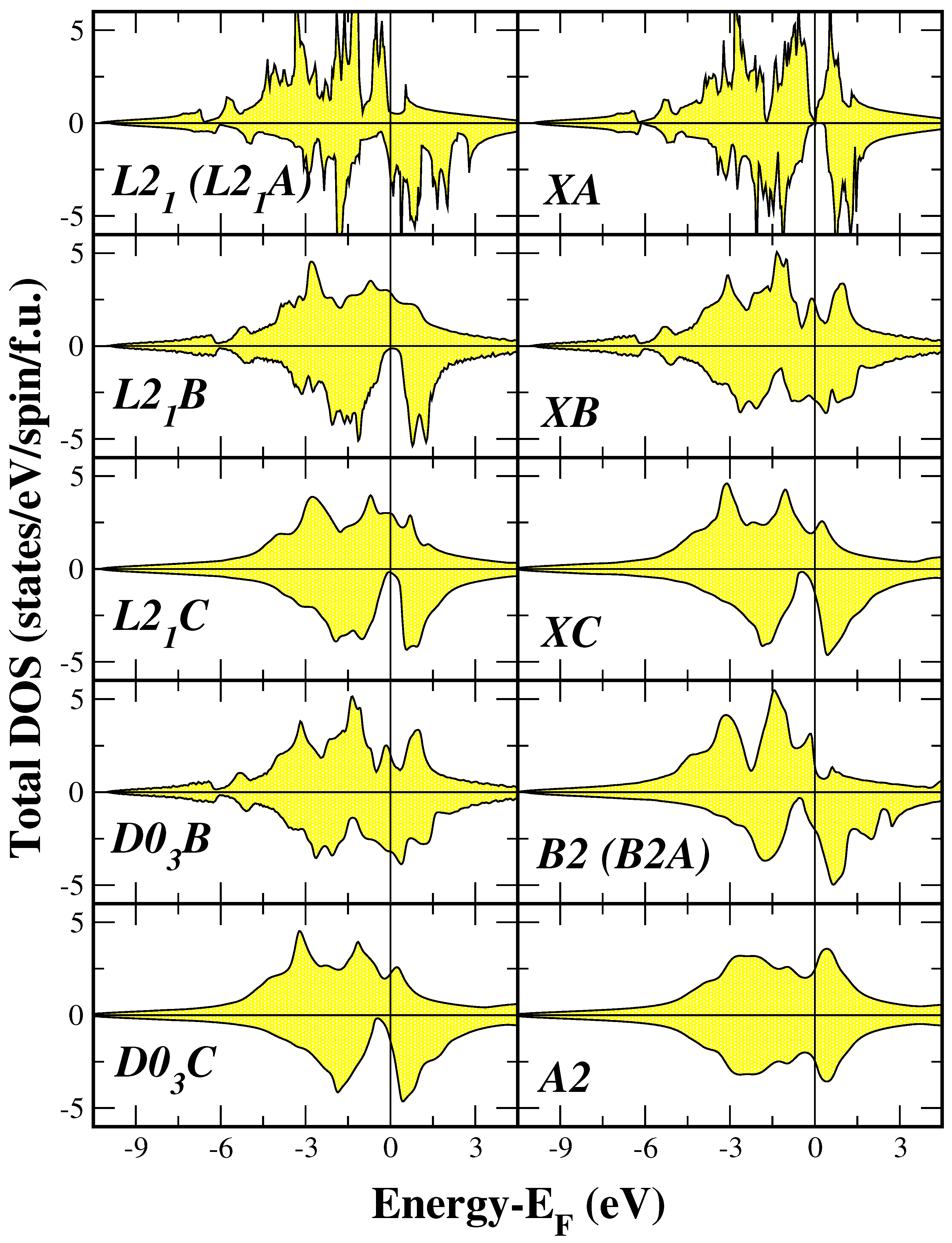
In the case of the XA structure, the Mn atoms do not form a sub-lattice of octahedral symmetry; hybridization between the transition metal atoms are more complex [17]. The two Mn atoms sitting at the A and B sites are now nearest neighbors and due to their short distance, the spin magnetic moments of the two Mn atoms are anti-parallel. Thus, now, the total spin magnetic moment is exactly 2 μ B in accordance to the Slater–Pauling rule [17]. This magnetic arrangement is more stable than the L21 structure. In accordance with previous calculations [1,16], the Mn2CoAl in the XA structure is an SGS material as depicted in Figure 2. The total density of states (DOS) shows a zero gap in the majority-spin channel exactly at the Fermi level and a small energy gap in the minority-spin channel. Thus, the majority-spin electronic band structure is that of a gapless semiconductor and the minority-spin electronic band structure is that of a usual semiconductor. In the case of the L21 structure, the SGS character of the XA structure is lost and the compound exhibits usual metallic behavior for both spin channels.
From the XA structure one can derive the L21B where the A and C sites are occupied with the same probability by Mn and Co atoms, and the L21C structure where the B and D sites are equally occupied by Mn and Al atoms. Interestingly, as shown in Table 1, the Mn atoms at the A and C sites as well as the Mn atoms at the B and D sites have spin magnetic moments similar to those of the Mn atoms in the XA structure. The same is true for the Co atoms. Furthermore, the total spin magnetic moment for both L21B and L21B is exactly 2 μ B, as in the XA structure. This means that the Slater–Pauling rule is valid. This gives a hint that Mn2CoAl in both structures is probably at least half-metallic. This is confirmed by the total DOS presented in Figure 2. The majority-spin electronic band structure is metallic, while the minority-spin electronic band structure is semiconducting, leading to 100% spin polarization at the Fermi level.
I will continue this discussion by assessing cases involving the migration of Mn atoms. In the XB and XC cases, I considered the (Mn0.75Co0.25)(Co0.75Mn0.25)MnAl and (Mn0.75Al0.25)CoMn( Z 0.75 Co0.25) alloys, respectively; in the D03B and D03C cases, I considered the (Mn0.75Co0.25)(Co0.5Mn0.5)(Mn0.75Co0.25)Al and (Mn0.75Al0.25)Co(Mn0.5Al0.75)(Al0.5Mn0.5) alloys. In the XB and XC structures, the Mn atoms at the A and C sites are no longer equivalent; interestingly, their spin magnetic moments are almost identical.
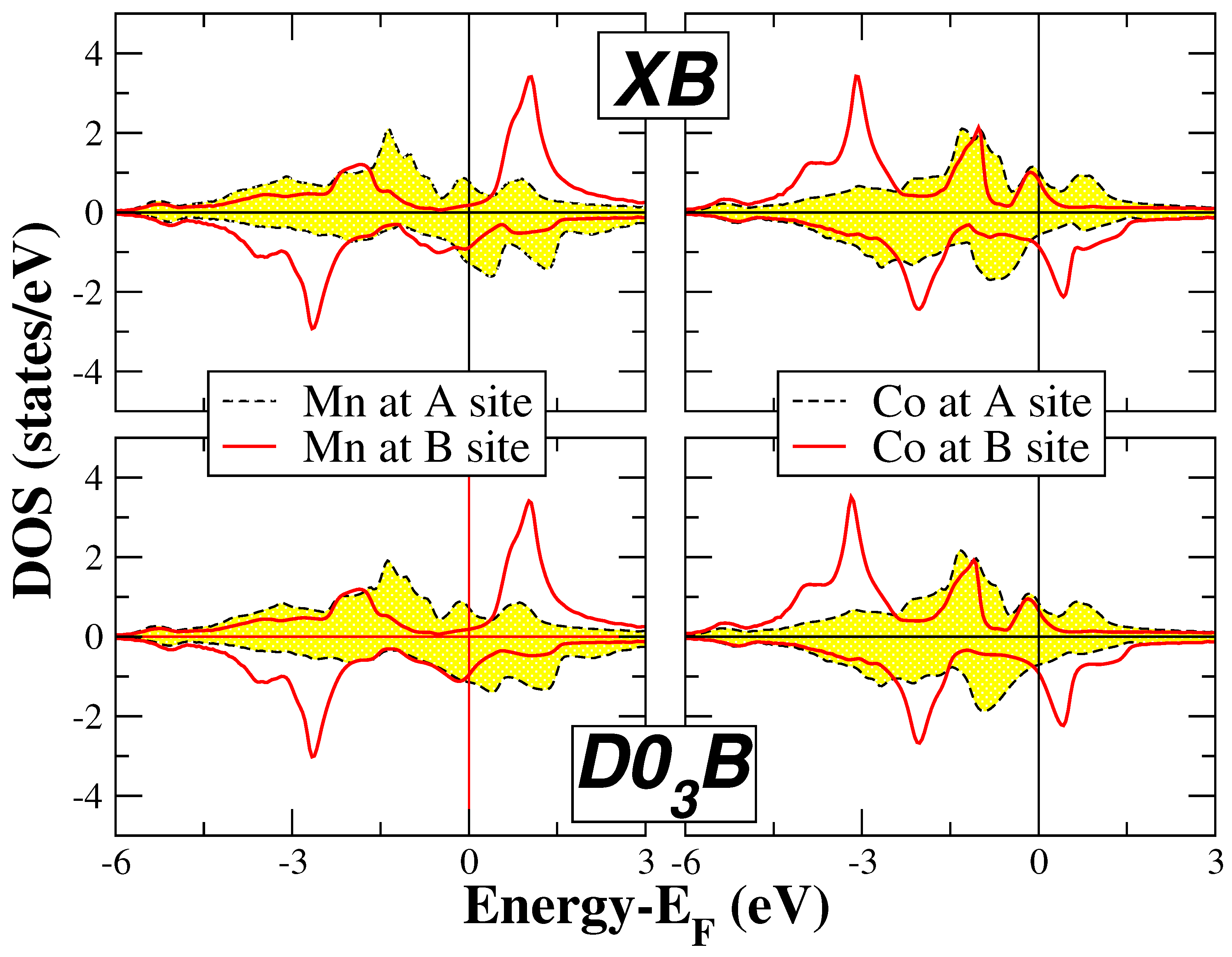
In the XC and D03C structures, where the Al atom is involved, Mn2CoAl presents a usual metallic behavior, as shown in Figure 2. The total spin magnetic moment is slightly less than 2 μ B for the XB and D03B structures and about 4.6 μ B for the XC and D03C structures. In the former case, Mn at Co atoms sitting at various sites are mixed while in the latter Mn and Al atoms are mixed. In the XB and D03B cases, where Mn and Co atoms occupy the same site, the spin magnetic moments of Mn and Co atoms at the same site are anti-parallel, resulting in the smaller value of the total spin magnetic moment. Mn at the A site and Co at the B site have positive spin magnetic moments for both XB and D03B structures, while Co at the A sites and Mn at the B sites have negative spin magnetic moments. This is also reflected in the atom-resolved DOS presented in Figure 3. Mn(Co) atoms at the A(B) sites have similar shape of DOS for both XB and D03B structures, emphasizing the role of nearest neighbors on the properties of Mn2CoAl. Similar conclusions can be drawn when comparing the DOS of the XC and D03C lattice structures.
The next case under study is the B2 structure [Mn(Co0.5Al0.5)Mn(Al0.5Co0.5)]. This is the limiting case of the B2A structure, when both B and D sites are randomly occupied by the Co and Al atoms. The results for both the total DOS in Figure 2 and the spin magnetic moments in Table 1 resemble the results for the L21 lattice structure. This is expected since B2 disorder does not affect the A and C sites, which are exclusively occupied by Mn atoms. Both A and C sites have the same local environment (same nearest neighbors rotated by 90°). Thus, the e u and t 1 u states located around the Fermi level, which obey the octahedral group symmetry and are exclusively located at the A and C sites [17], are not affected by the Co-Al disorder. The smoother curve for the B2 case with respect to the L21 structure is due to the use of CPA.
The A2 structure is the completely disordered lattice structure, where the two Mn atoms, the Co atom, and the Al atom occupy the four sites with equal probability. CPA assumes that, at each site, there is a pseudoatom which consists of 50% of Mn character, 25% of Co character and 25% of Al character. Extensive calculations have shown that the most stable magnetic configuration in the case of the A2 structure is the antiferromagnetic one, when the pseudoatoms at the A and C sites have exactly opposite spin magnetic moment with respect to the pseudoatoms at the B and D sites. This results in an antiferromagnetic metallic behavior as shown in Figure 2. At each site, the Mn atom has a sizable spin magnetic moment of ±1.68 μ B; Co has a spin magnetic moment of 1.32 μ B, which is anti-parallel to the spin moment of the Mn atom at the same site; the Al atoms carry no net spin magnetic moment. The total spin magnetic moment is exactly zero, as shown in Table 1.
Finally, we should also discuss the stability of each structure as derived from total energy calculations. In the last column in Table 1 we present the total energy difference per formula unit between each structure and the XA one which is the ground state also in our calculations. We remark that the L21B lattice structure which is directly derived from the XA, as discussed above, is the second most stable with an energy difference of just 0.1 eV from the XA structure followed by the L21C lattice structure. The other fully ordered structure L21 is less stable than most of the disordered arrangements. The least stable structures are the B2 which is derived from the L21 and the fully disordered A2 structure.

4. Summary and Conclusions

I have performed a comprehensive ab initio study on the Mn2CoAl Heusler alloy to determine the effect of atomic disorder on its potential as a spin gapless semiconductor (SGS). The main findings can be summarized as follows:
  • Sensitivity to ordering: The SGS behavior is unique to the ordered inverse XA lattice structure. Atomic disorder generally destroys the SGS gap, significantly altering the material’s electronic profile.
  • Partial disorder: In cases of partial disorder derived from the XA structure (specifically Mn-Co or Mn-Al mixing), the electronic structure transforms into a half-metallic magnetic state, retaining high spin polarization but losing the spin gapless semiconducting nature.
  • Full disorder (A2 Phase): In the fully disordered A2 structure, where atoms occupy lattice sites with equal probability, the system stabilizes in an antiferromagnetic metallic ground state.
  • High-magnetic state: When Mn atoms occupy exclusively the A and C sites (L21 and B2 structures), Mn2CoAl adopts a high-magnetic state and the total spin magnetic moment per unit cell reaches a value of 7 μ B.
These results highlight that the functional properties of Mn2CoAl are heavily dependent on structural integrity. Therefore, synthesizing high-quality samples with minimized anti-site disorder is a crucial prerequisite for utilizing this material effectively in SGS-based spintronic devices.

Funding

This research received no external funding.

Institutional Review Board Statement

Not applicable.

Informed Consent Statement

Not applicable.

Data Availability Statement

The data presented in this study are available on request from the author.

Conflicts of Interest

The author declares no conflict of interest.

Abbreviations

The following abbreviations are used in this manuscript:
CPAcoherent potential approximation
DOSdensity of states
f.u.formula unit
FPLOfull-potential non-orthogonal local–orbital minimum- basis band structure approach
LSDAlocal spin-density approximation
SGSspin gapless semiconductor

References

  1. Ouardi, S.; Fecher, G.H.; Kübler, J.; Felser, C. Realization of spin gapless semiconductors: The Heusler compound Mn2CoAl. Phys. Rev. Lett. 2013, 110, 100401. [Google Scholar] [CrossRef]
  2. Žutić, I.; Fabian, J.; Das Sarma, S. Spintronics: Fundamentals and Applications. Rev. Mod. Phys. 2004, 76, 323. [Google Scholar] [CrossRef]
  3. Felser, C.; Fecher, G.H.; Balke, B. Spintronics: A Challenge for Materials Science and Solid-State Chemistry. Angew. Chem. Int. Ed. 2007, 46, 668. [Google Scholar] [CrossRef]
  4. Ram, S.B.; Sharma, V.; Vishwakarma, C. Room temperature electrical spin injection from a new spin gapless ferromagnetic semiconducting inverse Heusler alloy Mn2CoSi in p-Si. J. Appl. Phys. 2019, 125, 173903. [Google Scholar]
  5. Şaşıo glu, E.; Bodewei, P.; Hinsche, N.F.; Mertig, I. Multifunctional steep-slope spintronic transistors with spin-gapless-semiconductor or spin-gapped-metal electrodes. Phys. Rev. Appl. 2025, 23, 044022. [Google Scholar] [CrossRef]
  6. Aull, T.; Şaşıoğlu, E.; Maznichenko, I.V.; Ostanin, S.; Ernst, A.; Mertig, I.; Galanakis, I. Ab initio design of quaternary Heusler compounds for reconfigurable magnetic tunnel diodes and transistors. Phys. Rev. Mater. 2019, 3, 124415. [Google Scholar] [CrossRef]
  7. Wang, X.L. Dirac spin-gapless semiconductors: Promising platforms for massless and dissipationless spintronics and new (quantum) anomalous spin Hall effects. Natl. Sci. Rev. 2017, 4, 252. [Google Scholar] [CrossRef]
  8. Lamontagne, L.K.; Laurita, G.; Gaultois, M.W.; Knight, M.; Ghadbeigi, L.; Sparks, T.D.; Gruner, M.E.; Pentcheva, R.; Brown, C.M.; Seshadri, R. High Thermopower with Metallic Conductivity in P-Type Li-Substituted PbPdO2. Chem. Mat. 2016, 28, 3367. [Google Scholar] [CrossRef]
  9. Du, M.; Cui, X.; Yoon, H.H.; Das, S.; Uddin, M.G.; Du, L.; Li, D.; Sun, Z. Switchable photoresponse mechanisms implemented in single van der Waals semiconductor/metal heterostructure. ACS Nano 2022, 16, 568. [Google Scholar] [CrossRef]
  10. Yang, Q.; Kou, L.; Hu, X.; Wang, Y.; Lu, C.; Krasheninnikov, A.V.; Sun, L. Strain robust spin gapless semiconductors/half-metals in transition metal embedded MoSe2 monolayer. J. Phys. Condens. Matter 2020, 32, 365305. [Google Scholar] [CrossRef] [PubMed]
  11. Graf, T.; Felser, C.; Parkin, S.S.P. Simple rules for the understanding of Heusler compounds. Prog. Solid State Chem. 2011, 39, 1–50. [Google Scholar] [CrossRef]
  12. Yang, Y. Mini-review of interesting properties in Mn2CoAl bulk and films. Front. Chem. 2022, 10, 1054337. [Google Scholar] [CrossRef]
  13. Rani, D.; Bainsla, L.; Alam, A.; Suresh, K.G. Spin-gapless semiconductors: Fundamental and applied aspects. J. Appl. Phys. 2020, 128, 220902. [Google Scholar] [CrossRef]
  14. Jamer, M.E.; Assaf, B.A.; Devakul, T.; Heiman, D. Magnetic and transport properties of Mn2CoAl oriented films. Appl. Phys. Lett. 2013, 103, 142403. [Google Scholar]
  15. Marchenkov, V.V.; Irkhin, V.Y. Magnetic States and Electronic Properties of Manganese-Based Intermetallic Compounds Mn2YAl and Mn3Z (Y = V, Cr, Fe, Co, Ni; Z = Al, Ge, Sn, Si, Pt). Materials 2021, 16, 6351. [Google Scholar] [CrossRef]
  16. Skaftouros, S.; Özdoğan, K.; Şaşıo glu, E.; Galanakis, I. Search for spin gapless semiconductors: The case of inverse Heusler compounds. Appl. Phys. Lett. 2013, 102, 022402. [Google Scholar] [CrossRef]
  17. Skaftouros, S.; Özdoğan, K.; Şaşıo glu, E.; Galanakis, I. Generalized Slater-Pauling rule for the inverse Heusler compounds. Phys. Rev. B 2013, 87, 024420. [Google Scholar] [CrossRef]
  18. Galanakis, I.; Özdoğan, K.; Şaşıo glu, E. Spin-filter and spin-gapless semiconductors: The case of Heusler compounds. AIP Adv. 2016, 6, 055606. [Google Scholar] [CrossRef]
  19. Buckley, R.G.; Butler, T.; Pot, C.; Strickland, N.M.; Granville, S. Exploring Disorder in the Spin Gapless Semiconductor Mn2CoAl. Mater. Res. Express 2019, 6, 106113. [Google Scholar] [CrossRef]
  20. Zhang, Y.; Granville, S. Two-channel anomalous Hall effect originating from the intermixing in Mn2CoAl/Pd thin films. Phys. Rev. B 2022, 106, 144414. [Google Scholar] [CrossRef]
  21. Muthui, Z.W. Effect of vacancies on the electronic and magnetic properties of Heusler compound Mn2CoAl. AIP Adv. 2024, 14, 015334. [Google Scholar] [CrossRef]
  22. Galanakis, I.; Özdoğan, K.; Şaşıo glu, E.; Blügel, S. Conditions for spin-gapless semiconducting behavior in Mn2CoAl inverse Heusler compound. J. Appl. Phys. 2014, 115, 093908. [Google Scholar] [CrossRef]
  23. Faleev, S.V.; Ferrante, Y.; Jeong, J.; Samant, M.G.; Jones, B.; Parkin, S.S.P. Origin of the Tetragonal Ground State of Heusler Compounds. Phys. Rev. Appl. 2017, 7, 034022. [Google Scholar] [CrossRef]
  24. Jakobsson, A.; Mavropoulos, P.; Şaşıoğlu, E.; Blügel, S.; Ležaić, M.; Sanyal, B.; Galanakis, I. First-principles calculations of exchange interactions, spin waves, and temperature dependence of magnetization in inverse-Heusler-based spin gapless semiconductors. Phys. Rev. B 2015, 91, 174439. [Google Scholar] [CrossRef]
  25. Xu, G.Z.; Liu, E.K.; Du, Y.; Li, G.J.; Liu, G.D.; Wang, W.H.; Wu, G.H. A new spin gapless semiconductors family: Quaternary Heusler compounds. EPL Europhys. Lett. 2013, 102, 17007. [Google Scholar] [CrossRef]
  26. Özdoğan, K.; Galanakis, I. Effect of order on the half-metallic gap in Heusler compounds. J. Appl. Phys. 2011, 110, 076101. [Google Scholar] [CrossRef]
  27. Webster, P.J.; Ziebeck., K.R.A. Alloys and Compounds of d-Elements with Main Group Elements. Part 2. In Landolt-Börnstein, New Series, Group III; Wijn, H.R.J., Ed.; Springer: Berlin/Heidelberg, Germany, 1988; Volume 19c, pp. 75–184. [Google Scholar]
  28. Koepernik, K.; Eschrig, H. Full-potential nonorthogonal local-orbital minimum-basis band-structure scheme. Phys. Rev. B 1999, 59, 1743. [Google Scholar] [CrossRef]
  29. Perdew, J.P.; Wang, Y. Accurate and simple analytic representation of the electron-gas correlation energy. Phys. Rev. B 1992, 45, 13244. [Google Scholar] [CrossRef] [PubMed]
  30. Koepernik, K.; Velický, B.; Hayn, R.; Eschrig, H. Self-consistent LCAO-CPA method for disordered alloys. Phys. Rev. B 1997, 55, 5717. [Google Scholar] [CrossRef]
  31. Koepernik, K.; Velický, B.; Hayn, R.; Eschrig, H. Analytic properties and accuracy of the generalized Blackman-Esterling-Berk coherent-potential approximation. Phys. Rev. B 1998, 58, 6944. [Google Scholar] [CrossRef]
Figure 1. (Color online) (Left) panel: cubic lattice structure of the Mn2CoAl Heusler compound with four inequivalent sites. (Right) panel: chemical elements per site for all considered structures.
Micro 06 00020 g001
Figure 2. (Color online) Total DOS per formula unit for all studied structures of Mn2CoAl compound. Positive DOS values concern the majority-spin (spin-up) electrons and negative DOS values the minority-spin (spin-down) electrons. DOS has been shifted so that the zero energy value is the Fermi level.
Micro 06 00020 g002
Figure 3. (Color online) Atom-resolved DOS per Mn or Co atom sitting at the A or B sites for the XB and D02B structures. Details as in Figure 2.
Micro 06 00020 g003
Table 1. Atom-resolved and total spin magnetic moments in μ B for all structures resulting from the parent Mn2CoAl compound. For the notation, see Figure 1 and text. Note that, for the A2 structure, we have an antiferromagnet since atoms sitting at the A and C sites and atoms sitting at the B and D sites have anti-parallel spin magnetic moments. The last column is the total energy difference per formula unit between each lattice structure and the XA which is the ground state.
A-SiteB-SiteC-SiteD-SiteTotal Δ E (eV)
L212.73(Mn)1.62(Co)2.73(Mn)−0.06(Al)7.030.803
L21B−1.30(Mn)2.49(Mn)0.87(Co)−0.05(Al)2.000.106
0.87(Co) −1.30(Mn)
L21C−1.17(Mn)2.43(Mn)0.79(Co)−0.05(Al)2.000.394
−0.05(Al) 2.43(Mn)
D03B1.70(Mn)1.64(Co)1.70(Mn)−0.01(Al)1.920.629
−0.36(Co)−2.51(Mn)−0.36(Co)
D03C2.58(Mn)1.35(Co)2.58(Mn)−0.06(Al)4.610.824
−0.09(Al) −0.09(Al)−1.06(Mn)
XA−1.37(Mn)2.51(Mn)0.92(Co)−0.06(Al)2.000.000
XB1.76(Mn)1.55(Co)1.61(Mn)−0.01(Al)1.720.613
−0.59(Co)−2.49(Mn)
XC2.60(Mn)1.36(Co)2.58 (Mn)−0.06(Al)4.640.750
−0.09(Al) −1.04(Mn)
B22.63(Mn)1.64(Co)2.63(Mn)−0.09(Al)6.810.948
−0.09(Al) 1.64(Co)
A21.68(Mn), −1.32(Co), 0.00(Al)0.001.047
−1.68(Mn), 1.32(Co), −0.00(Al)
Disclaimer/Publisher’s Note: The statements, opinions and data contained in all publications are solely those of the individual author(s) and contributor(s) and not of MDPI and/or the editor(s). MDPI and/or the editor(s) disclaim responsibility for any injury to people or property resulting from any ideas, methods, instructions or products referred to in the content.