Article

PARAFAC- and PCA-Resolved Excitation–Emission Matrix Fluorescence of Ultra-Fine Polyamide-Derived Carbon Quantum Dots for Mechanistic Microplastic Discrimination

by
Christian Ebere Enyoh
* and
Qingyue Wang
Graduate School of Science and Engineering, Saitama University, 255 Shimo-Okubo, Sakura-ku, Saitama City 338-8570, Saitama, Japan
*
Author to whom correspondence should be addressed.
Micro 2026, 6(1), 15; https://doi.org/10.3390/micro6010015
Submission received: 7 January 2026 / Revised: 3 February 2026 / Accepted: 5 February 2026 / Published: 12 February 2026

Abstract

The rapid and selective discrimination of microplastics (MPs) is a critical analytical challenge, particularly as current carbon quantum dot (CQD)-based sensors often rely on single-wavelength “turn-on/off” or staining mechanisms that lack polymer-specific resolution. This work addresses these limitations by presenting a mechanism-driven fluorescence sensing platform using ultra-fine polyamide-derived carbon quantum dots (PACQDs; ~1.4 nm) to identify three prevalent MPs: polyamide (PA), polypropylene (PP), and polyethylene terephthalate (PET). Excitation–emission matrix (EEM) spectroscopy reveals polymer-specific photophysical responses: PAMPs and PPMPs induce fluorescence enhancement of 11.66% and 11.43%, respectively, whereas PETMPs cause net quenching (−4.61%) alongside a distinct, red-shifted emission band. Despite a common scatter-dominated peak at 290/308 nm, quantitative discrimination is achieved via integrated intensity and red/blue emission ratios (0.0137 for PAMPs, 0.0098 for PPMPs, and 0.0072 for PETMPs). Multivariate analysis reinforces this discrimination. Parallel factor analysis (PARAFAC) resolves the EEM data into three fluorescent components representing the intrinsic CQDs core and two interaction-induced surface states with a rank 3 model reducing the relative reconstruction error from 0.1625 to 0.1285. Principal component analysis (PCA) yields clear separation of the polymer classes, with the first two principal components capturing ~88% of the total spectral variance. ATR–FTIR spectroscopy provides direct molecular evidence for the underlying mechanisms: amide–amide coupling and interfacial rigidification for PAMPs; hydrophobic interaction without spectral shifts for PPMPs; and a synergistic interaction involving hydrogen bonding and π–π stacking for PETMPs. In particular, these polymer-specific fluorescence fingerprints are largely preserved in tap water, despite elevated background intensity and partial contrast attenuation, demonstrating the resilience of the EEM–chemometric approach under realistic matrix conditions. Collectively, the strong agreement between fluorescence metrics, multivariate signatures, and interfacial chemistry establishes a robust structure–property framework and positions PACQDs as a rapid, label-free, and matrix-tolerant platform for reliable microplastic discrimination in environmental analysis.

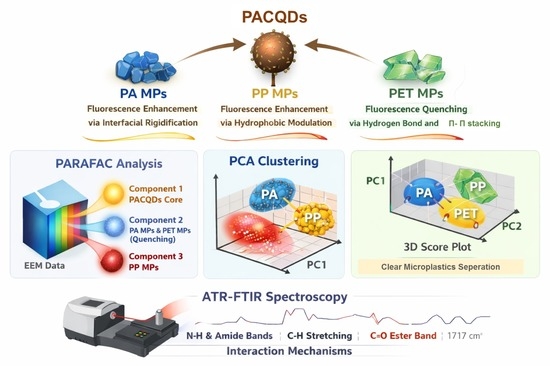
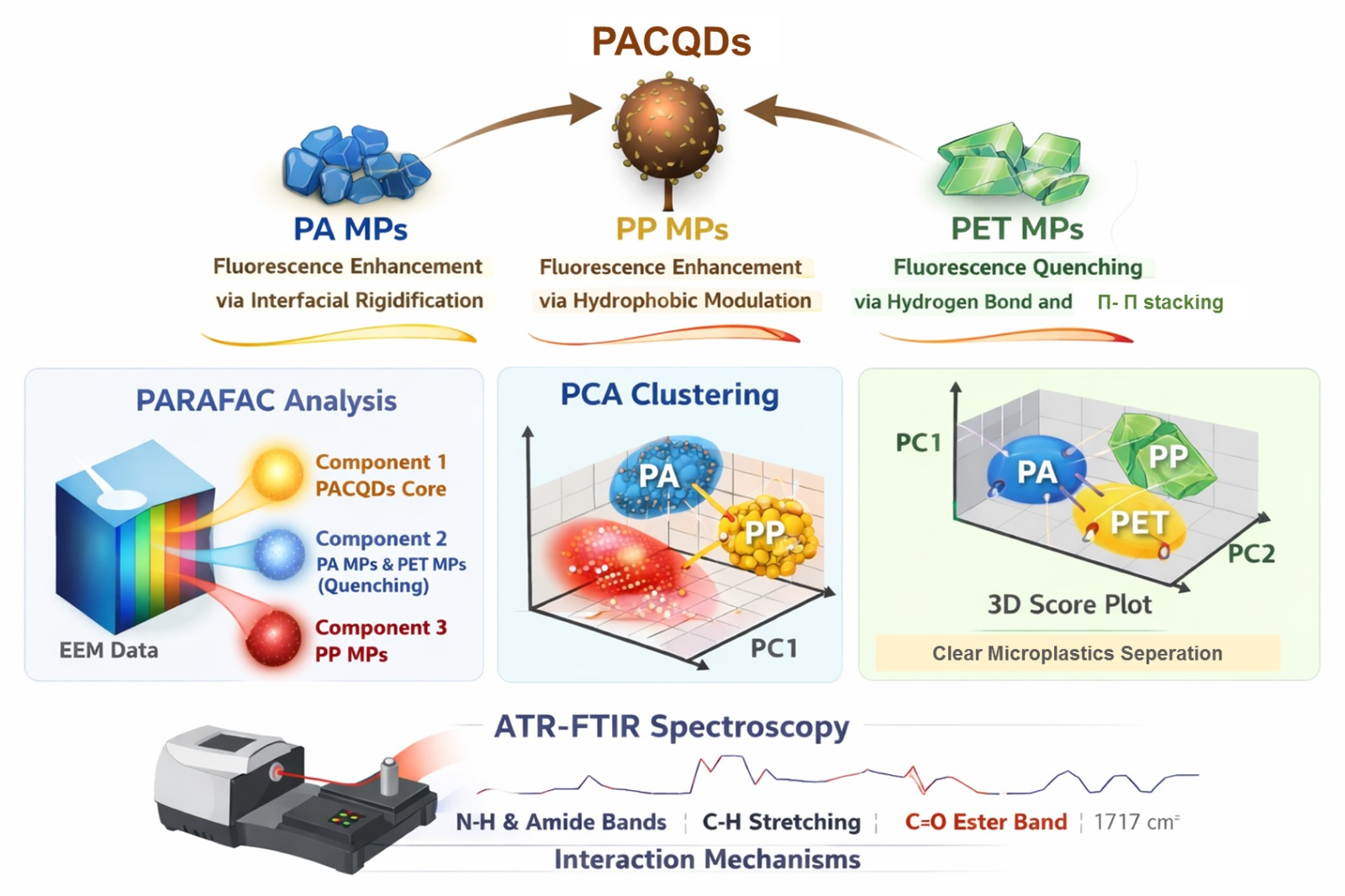
Graphical Abstract

1. Introduction

The pervasive presence of microplastics (MPs) in aquatic and terrestrial environments has emerged as a critical global concern due to their persistence, ubiquity, and potential ecological and human health impacts [1]. Among the diverse classes of MPs, polyamide (PA)-, polyethylene terephthalate (PET)-, and polypropylene (PP)-based particles are particularly prevalent owing to their extensive industrial and consumer applications [2]. Despite growing awareness, reliable discrimination and mechanistic characterization of MPs in complex environmental matrices remains challenging, largely due to their heterogeneous sizes, surface chemistries, and overlapping physicochemical signatures [3]. Conventional methods, including microscopy, FTIR/Raman spectroscopy, and pyrolysis–GC–MS, are accurate but labor-intensive, costly, and require extensive sample preparation [4,5]. Consequently, there is a pressing need for sensitive, selective, and mechanistically informative analytical strategies capable of resolving subtle differences among MP types.
Fluorescence-based sensing has emerged as an attractive strategy for MP detection due to its high sensitivity, rapid response, and compatibility with aqueous environments [6,7]. Nevertheless, many fluorescent probes exhibit limited selectivity, insufficient stability, or weak affinity for hydrophobic polymer surfaces, restricting their broader applicability [6]. Carbon quantum dots (CQDs) have gained considerable interest as sensing materials because of their tunable emission, excellent photostability, water dispersibility, and surface-rich functional chemistry [8]. Advances in heteroatom-doped CQDs have further enhanced their optical performance and surface reactivity, enabling more selective interactions with environmental contaminants [9,10]. Recent studies have begun to explore CQDs for MP detection. For example, Jini [11] reported solid fluorescent green carbon dots derived from Araucaria araucana resin as a “turn-off” probe for MPs released from disposable facemasks and cosmetic products, with dynamic quenching confirmed by Stern–Volmer analysis. Paramparambath [12] demonstrated that microwave-synthesized CQDs could directly stain MPs, promoting agglomeration and enhanced fluorescence at trace MP levels. Feng [13] developed phosphorescent naphthalene-doped carbon nitride quantum dots capable of selectively detecting PAMPs via hydrogen-bond-driven interactions, representing one of the earliest polymer-specific MP sensing approaches. Despite these advances, most reported CQDs-based MP sensors rely on single-excitation or single-wavelength fluorescence measurements, which limit their ability to resolve overlapping emission features and obscures mechanistic insight into polymer-specific interactions. This constraint often results in intensity-based discrimination with reduced robustness in complex matrices.
Polyamide-derived carbon quantum dots (PACQDs) offer a promising alternative by leveraging the structural “memory” of polymeric precursors, which can impart enhanced chemical affinity toward related polymers [14]. Such PACQDs provide a powerful platform for probing MP–nanomaterial interactions through excitation-dependent fluorescence modulation, including enhancement, quenching, and spectral shifting, thereby enabling more selective and mechanistically informed MP discrimination. Excitation–emission matrix (EEM) fluorescence spectroscopy provides a powerful multidimensional framework for capturing complex fluorescence responses arising from such interactions [3]. Unlike single-wavelength measurements, EEMs encode comprehensive spectral information that reflects multiple emissive states and interaction pathways simultaneously. However, the inherent complexity of EEM datasets necessitates advanced multivariate analysis to extract meaningful chemical and mechanistic insights. Principal component analysis (PCA) has been widely employed to reduce dimensionality and highlight variance-driven discrimination among samples, while parallel factor analysis (PARAFAC) enables decomposition of EEMs into chemically interpretable fluorescent components associated with distinct excitation–emission profiles [15,16].
In the context of MP sensing, the combined application of EEM spectroscopy with PCA and PARAFAC offers a unique opportunity not only for classification but also for mechanistic elucidation. PCA provides an overview of global spectral variance and clustering behavior [17], whereas PARAFAC resolves underlying independent fluorescent components, allowing for attribution of observed fluorescence modulation to specific interaction pathways [15]. Despite these advantages, no study has systematically integrated EEM–PCA–PARAFAC to investigate CQDs–MP interactions, and mechanistic interpretations linking multivariate outcomes to physical and chemical interaction processes remain limited.
In this study, we report a comprehensive EEM-based multivariate investigation of fluorescence modulation pathways governing interactions between polyamide-derived carbon quantum dots and representative MPs, including PA, PP, and PET. By coupling excitation–emission matrix spectroscopy with PCA, PARAFAC decomposition, and distance-based discrimination analysis, we resolve distinct fluorescence modulation signatures and identify multiple underlying emissive components contributing to MP-specific responses. The integration of PCA and PARAFAC enables clear discrimination among MP types while providing mechanistic information into interfacial rigidification, surface interaction, and microenvironmental effects influencing PACQDs fluorescence. This work establishes an analytically robust and mechanistically interpretable framework for MP discrimination using CQD-based fluorescence sensing. The findings not only advance the fundamental understanding of PACQDs–MP interaction pathways but also demonstrate the utility of EEM-resolved multivariate analysis as a powerful tool for next-generation environmental sensing and MP characterization.

2. Materials and Methods

2.1. Preparation of Fluorescent PACQDs

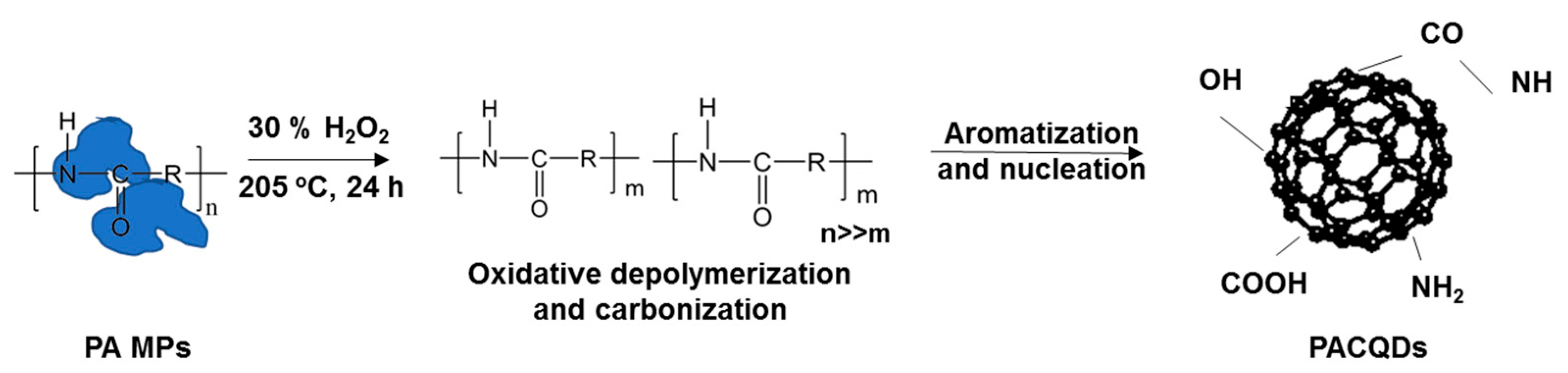
PACQDs were synthesized following a previously reported one-step solvothermal protocol [14]. Briefly, PAMPs were produced by mechanically shredding PA waste (2.02 g) and used as the combined carbon and nitrogen source. The PAMPs were dispersed in 20 mL of 30% H2O2, transferred to a Teflon-lined autoclave, and heated at 205 °C for 24 h. After natural cooling, a homogeneous brown PACQDs dispersion was obtained (Scheme 1). The product was redispersed in ultrapure water, centrifuged at 12,000 rpm for 5 min to remove large particulates, and further purified using 10 kDa MWCO Amicon Ultra centrifugal filters (Merck KGaA, Darmstadt, Germany) at 6000 rpm for 5 min. The final PACQD suspension had a concentration of 0.05 g/mL.

2.2. Characterization Studies

Morphological characterization was carried out using a fluorescence microscope (MX6300, Meiji Techno Co., Saitama, Japan) equipped with a 4K Moticam4000 camera. For imaging, 20 µL of PACQDs solution (0.05 g/mL) was deposited onto a glass slide and observed under visible light at 100× magnification in nanoscale. Particle size distribution was determined using Motic Image Plus 2.3S software and independently verified by dynamic light scattering (DLS) using a Malvern Zetasizer Nano ZS (Malvern Panalytical, Malvern, UK). Surface morphology of the microplastics was examined by scanning electron microscopy (SEM) using a VP-SEM SU-1510 system (Hitachi Ltd., Tokyo, Japan) operated at an accelerating voltage of 15 kV. Samples were mounted on aluminum stubs and sputter-coated with an approximately 15 nm conductive layer using an E102 ion sputter coater (Hitachi Ltd., Tokyo, Japan) at ~4 psi and 16 mA for 4 min to ensure adequate surface conductivity. Surface functional groups were identified by attenuated total reflectance Fourier transform infrared spectroscopy (ATR-FTIR; JASCO FTIR-6100, Tokyo, Japan), with background correction performed prior to each measurement.

2.3. MP Solutions and Interactions with PACQDs

PA, PP, and PET MP suspensions were prepared by dispersing 1 mg of each polymer in 1 mL of deionized water under vigorous mixing to ensure homogeneous dispersion. Thereafter, 100 µL of the purified PACQDs solution was introduced into each MP suspension and gently mixed. The mixtures were allowed to equilibrate for 10 min at room temperature to facilitate interfacial interactions between the PACQDs and the MP surfaces (upon addition of PACQDs solution, pH dropped to 3.4 ± 0.1; this was taken as the study pH). Following equilibration, excitation–emission matrix (EEM) fluorescence measurements were performed using the 3D scanning mode of a JASCO FP-8050 fluorescence spectrophotometer operating in fluorescence measurement mode. The instrumental parameters were set as follows: excitation wavelength range of 250–400 nm with a step interval of 5 nm, emission wavelength range of 300–750 nm with a step interval of 2 nm, excitation and emission slit widths of 5 nm, response time of 20 ms, sensitivity set to medium, and a scanning speed of 5000 nm min−1. Spectra were acquired with one accumulation per scan. To minimize elastic scattering artifacts, the wavelength limit function was enabled, restricting emission wavelengths to ≥excitation + 10 nm and ≤2 × excitation − 20 nm. Fluorescence intensity was recorded using an automatic vertical scale (0–1000 a.u.). All EEM spectra were collected under identical instrumental conditions to ensure direct comparability between samples, and deionized water was used as the blank for background subtraction. The raw EEM datasets obtained from the spectrofluorometer were subsequently subjected to systematic preprocessing prior to multivariate analysis. To assess batch-to-batch reproducibility, PACQDs synthesized in independent batches under identical conditions were evaluated using the same EEM acquisition protocol. Consistent excitation–emission peak positions, ΔEEM spatial distributions, and characteristic ratiometric features (e.g., shoulder-to-core intensity ratios) were observed across batches. While minor variations in absolute fluorescence intensity were noted, these did not affect the relative spectral fingerprints or the outcomes of multivariate classification, confirming the robustness and reproducibility of the PACQDs used in this study.

2.4. EEM Data Preprocessing

To ensure reliable interpretation of the fluorescence response and to minimize instrumental and optical artifacts, the acquired EEM datasets were preprocessed following established protocols for fluorescence spectroscopy and chemometric analysis.

2.4.1. Removal of Rayleigh and Raman Scattering

First- and second-order Rayleigh scattering regions, which arise from elastic light scattering and can obscure true fluorescence signals, were excluded from the EEMs [15]. This was achieved by applying wavelength-dependent masks corresponding to the excitation wavelength and its harmonics, consistent with the wavelength limits enforced during acquisition (Emission ≥ Excitation + 10 nm; Emission ≤ 2 × Excitation − 20 nm). Raman scattering contributions from water were minimized by background subtraction using the deionized water blank measured under identical instrumental conditions. The masked regions were treated as missing values and excluded from subsequent multivariate analyses to prevent distortion of variance structure.

2.4.2. Logarithmic Transformation

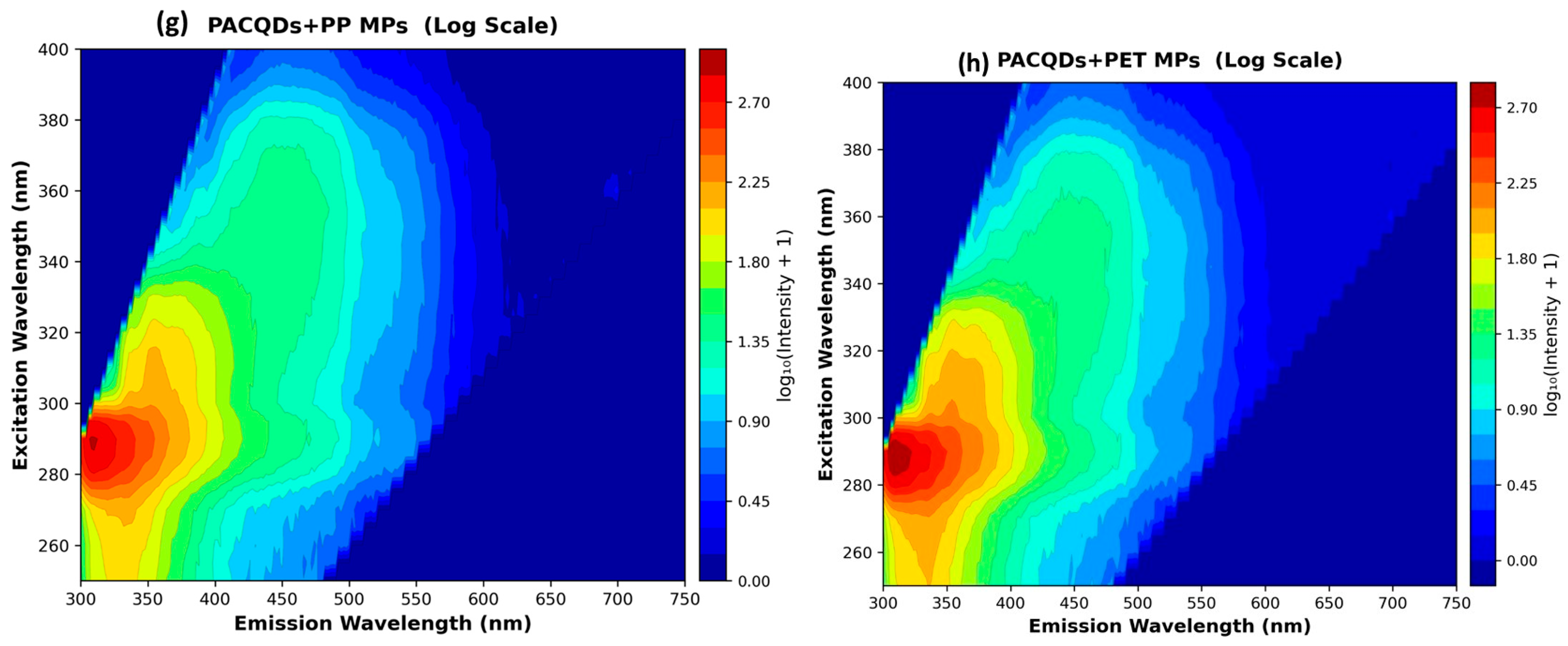
In addition to linear-scale visualization, a logarithmic transformation of the normalized EEM intensity data was applied to enhance the visibility of low-intensity fluorescence features. Log-scale EEMs are particularly effective for revealing secondary emission bands and subtle spectral shoulders that are often masked by the dominant core emission in linear plots [3]. The log-transformed EEMs enabled improved discrimination between enhancement-driven (PA, PP) and quenching-driven (PET) interactions by highlighting changes in emission bandwidth, contour asymmetry, and low-energy surface-state emissions.

2.5. Data Readiness and Multivariate Analysis

The preprocessed EEM datasets free of scattering artifacts and evaluated in both linear and logarithmic scales were subsequently used as input matrices for principal component analysis (PCA) and parallel factor analysis (PARAFAC) to resolve distinct fluorescence modulation pathways associated with PA, PP, and PET MPs. All multivariate analyses were performed using Python (v. 3.9)-based scientific libraries, and visualization was conducted using reconstructed excitation–emission contour plots and multivariate score representations.

2.5.1. Principal Component Analysis (PCA)

PCA was employed as an unsupervised multivariate technique [18] to reduce the dimensionality of the EEM dataset and to visualize spectral variance associated with PACQDs + MP interactions. Each EEM was unfolded into a two-dimensional matrix by concatenating emission spectra across all excitation wavelengths, resulting in a data matrix X ∈ RN × K, where N is the number of samples and K = nex × nem represents the total number of spectral variables. PCA decomposes the unfolded data matrix X into orthogonal latent variables according to Equation (1) [18,19]:
X = TPT + E
where T is the score matrix representing the projection of samples onto the principal components, P is the loading matrix describing the contribution of each spectral variable to the components, and E is the residual error matrix. The principal components are obtained by eigenvalue decomposition of the covariance matrix:
C = 1 N 1 X T X
The proportion of variance explained by each principal component iii is given by
E x p l a i n e d   v a r i a n c e i = λ i j = 1 K λ j
where λi is the eigenvalue corresponding to the i-th principal component. PCA score plots were used to evaluate clustering and separation among PACQDs and PACQDs + MP systems, while loading vectors were reshaped back into excitation–emission space to identify spectral regions contributing most strongly to discrimination.

2.5.2. Parallel Factor Analysis (PARAFAC)

Parallel factor analysis (PARAFAC) was applied directly to the three-way EEM dataset to resolve independent fluorescent components [15,16] and provide mechanistic insight into PACQDs + MP interactions. The EEM dataset was arranged as a third-order tensor X ∈ RI × J × K, where I corresponds to samples, J to excitation wavelengths, and K to emission wavelengths [19]. PARAFAC decomposes the EEM tensor into a sum of trilinear components according to Equation (4):
χ i j k = f = 1 F a i f b j f c k f + e i j k
where F is the number of components (rank); aif represents the sample-mode scores; bjf and ckf are the excitation and emission loading vectors for component f, respectively; and eijk is the residual error. The model parameters were estimated using an alternating least squares (ALS) algorithm, iteratively minimizing the sum of squared residuals:
m i n i , j , k χ i j k f = 1 F a i f b j f c k f 2
Non-negativity constraints were applied to all modes to ensure physically meaningful fluorescence profiles. The convergence criterion was defined by a relative change in fit below a predefined tolerance or by reaching the maximum number of iterations.
Selection of PARAFAC Model Rank
The optimal number of PARAFAC components was determined by comparing models of different ranks based on relative reconstruction error and interpretability [20]. The relative reconstruction error (RRE) was calculated as
R R E = χ χ ^ F χ F
where χ ^ is the reconstructed tensor from the PARAFAC model and ‖⋅‖F denotes the Frobenius norm. Models were evaluated for decreasing reconstruction error, stability of excitation–emission loadings, and consistency with known fluorescence features of PACQDs. Therefore, PARAFAC models with two and three components were evaluated. Increasing the model rank from two to three resulted in a substantial reduction in relative reconstruction error (from 0.1625 to 0.1285), indicating that a two-component model was insufficient to capture the full spectral complexity of the EEM dataset. The three-component model additionally resolved interaction-specific fluorescence features while maintaining spectral interpretability. Consequently, a three-component PARAFAC model was selected for further analysis.

2.6. Tap Water Matrix Study

Tap water was collected directly from the research building at Saitama University and used without further treatment to evaluate matrix effects on the PACQDs–MPs sensing system. Microplastic suspensions (PA, PP, and PET) were prepared by spiking 1 mg of each polymer into 1 mL of tap water to obtain a nominal concentration of 1 g L−1. Subsequently, 100 µL of the purified PACQDs solution was added to each suspension and gently mixed. The mixtures were allowed to equilibrate for 10–15 min at room temperature to facilitate interfacial interactions between PACQDs and the MP surfaces. Following equilibration, EEM fluorescence measurements and photographic visualization under UV illumination were performed under the same instrumental and experimental conditions used for the deionized water studies to enable direct comparison of matrix effects.

3. Results and Discussion

3.1. Characterization of PACQDs and PA, PP, PET MPs

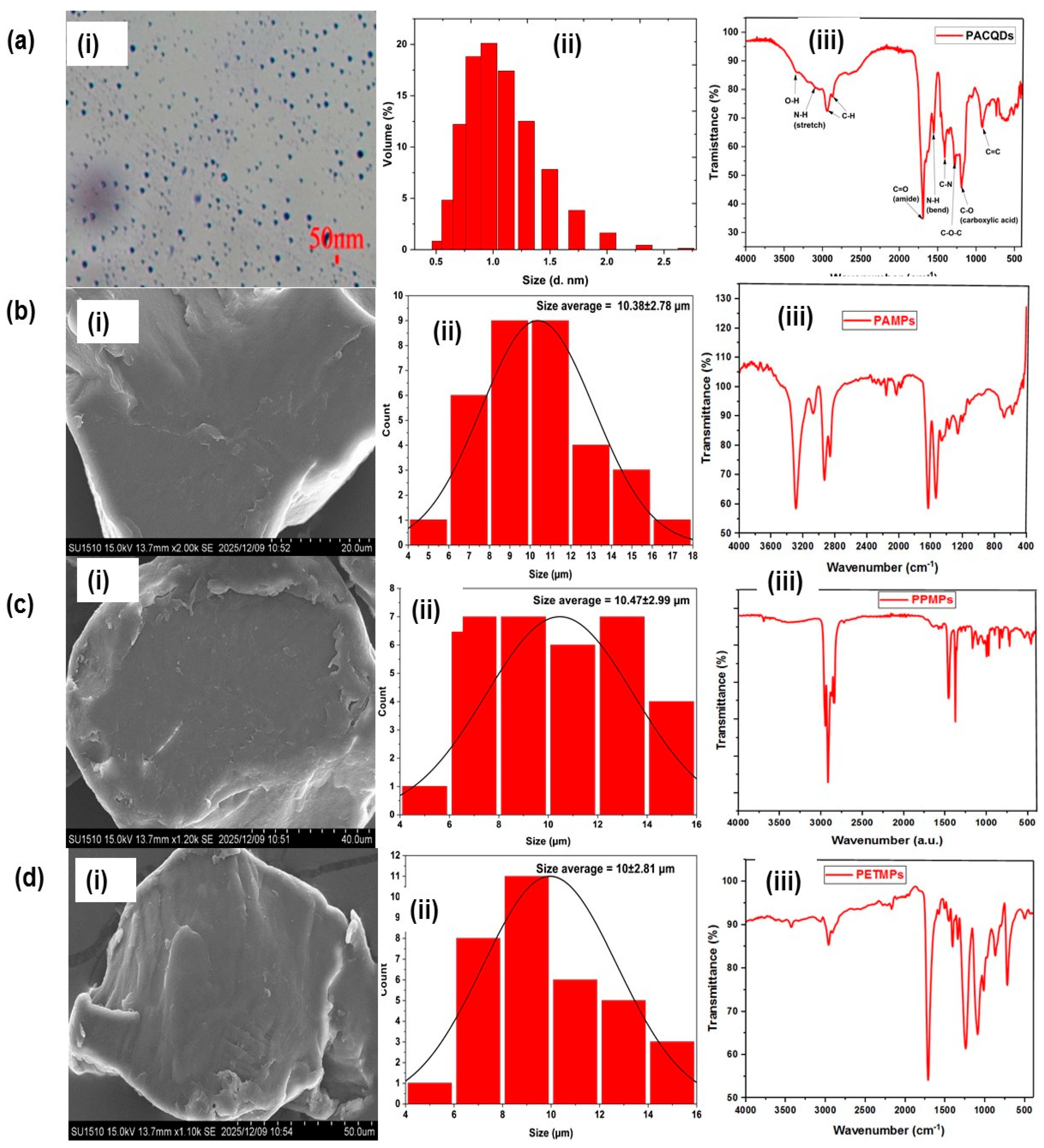
The structural and chemical characterization of the PACQDs (Figure 1a) and the selected MPs viz PA (Figure 1b), PP (Figure 1b), and PET (Figure 1c) confirm their integrity and distinct physicochemical features, which are essential for the proposed fluorescence sensing mechanism. The physical dimensions and morphological features of the nanomaterials and MPs were examined using electron microscopy and particle size analysis. Fluorescence images of the PACQDs reveal well-dispersed, quasi-spherical nanoparticles with a narrow size distribution (Figure 1(ai)). Statistical analysis indicates a dominant particle size centered at approximately 1.0 nm, confirming the ultra-fine nature of the quantum dots (Figure 1(aii)). In contrast, SEM images of the MPs display the characteristic irregular, fragmented morphologies typical of mechanically generated MPs (Figure 1(bi,ci,di)). Size distribution analysis shows comparable particle dimensions across the polymer types, with PAMPs exhibiting a mean size of 10.38 ± 2.78 μm, PPMPs 10.47 ± 2.99 μm, and PETMPs 10.00 ± 2.81 μm (Figure 1(bii,cii,dii)). The similarity in particle size minimizes morphological bias and ensures that observed fluorescence differences arise primarily from chemical interactions rather than size effects. FTIR spectroscopy was employed to establish the molecular fingerprints of the PACQDs and MPs, identifying the functional groups responsible for their interfacial interactions (Figure 1(aiii,biii,ciii,diii)). The PACQDs exhibit a highly functionalized surface, characterized by broad O–H/N–H stretching bands (3200–3500 cm−1), a prominent amide C=O vibration (~1650 cm−1), and C–O stretching associated with carboxylic acid groups (~1200 cm−1). These amide and oxygen-containing functionalities provide multiple interaction sites and underpin the chemical recognition capability of the PACQDs. The PAMPs spectrum (Figure 1(biii)) displays characteristic N–H stretching (~3295 cm−1) and well-defined amide I and II bands at ~1632 and ~1535 cm−1, respectively, closely mirroring the surface chemistry of the PACQDs. In contrast, PPMPs are dominated by aliphatic C–H stretching (2800–3000 cm−1) and bending modes, confirming their nonpolar, hydrocarbon-rich nature and lack of functional groups for specific interactions (Figure 1(ciii)). PETMPs are readily identified by a sharp ester C=O stretching band at ~1717 cm−1 and distinct aromatic C=C vibrations in the 1500–1600 cm−1 region, providing multiple interaction sites for hydrogen bonding and π–π stacking (Figure 1(biii)).

3.2. EEM Fluorescence Fingerprinting of PACQDs + MP Interactions

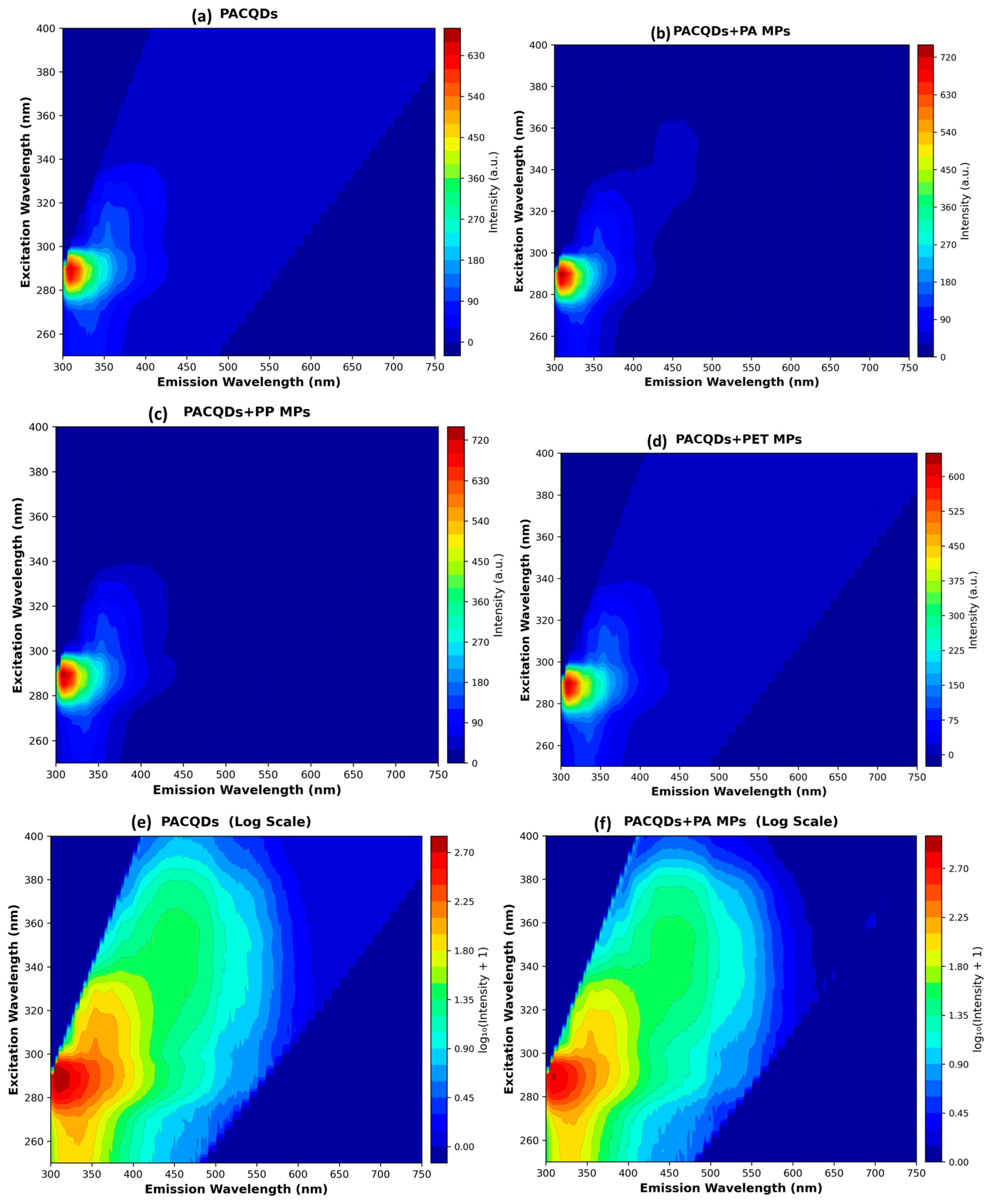
The EEM fluorescence spectroscopy revealed distinct and reproducible spectral signatures upon interaction of PACQDs with three major MP types: PET, PP, and PA. The differential fluorescence responses provide mechanistic information into the nature of PACQDs–MPs interactions while establishing a robust analytical foundation for MP discrimination. The 2D EEM is presented in Figure 2 and the 3D EEM in Figure S1.
Pure PACQDs exhibited characteristic fluorescence with an excitation maximum at 290 nm and emission maximum at 300–330 nm, yielding a peak intensity of approximately 630–650 a.u. (Figure 2a,e). This excitation–emission profile is consistent with π–π* electronic transitions within the sp2-hybridized carbon domains typical of nitrogen-doped CQDs derived from polyamide precursors [14]. The relatively tight contour distribution indicates well-defined quantum confinement and minimal heterogeneity in the PACQDs population. The moderate Stokes shift of approximately 10–40 nm suggests efficient radiative recombination from the lowest excited singlet state with minimal energy dissipation through vibrational relaxation. The absence of significant long-wavelength emission (>500 nm) in the baseline PACQDs indicates that surface defect states, if present, contribute minimally to the overall fluorescence. This spectral purity is advantageous for sensor applications, as it establishes a well-defined baseline against which MP-induced changes can be sensitively detected.
The interaction of PACQDs with PA microplastics produced a distinctive fluorescence signature characterized by both intensity enhancement and spectral broadening (Figure 2b). The maximum peak intensity increased to approximately 720 a.u., representing 11.7% enhancement relative to baseline PACQDs. More significantly, the EEM contour revealed a pronounced expansion of the fluorescence envelope, with secondary emission extending into the 400–450 nm range and outer contours reaching 550–650 nm in log-scale representation (Figure 2f). This spectral expansion is indicative of new electronic states formed through chemical interactions between PACQDs and PA polymer chains. Several complementary mechanisms likely contribute to this phenomenon. First, the structural similarity between polyamide-derived PACQDs and PAMPs creates favorable conditions for hydrogen bonding interactions between surface amide groups (-CONH-). These non-covalent interactions may facilitate PACQDs adsorption onto PA surfaces, where restricted molecular motion reduces non-radiative decay pathways, thereby enhancing radiative emission efficiency. Second, the formation of hydrogen-bonded complexes may create new surface states with altered electronic structures. These states, existing at lower energy than the core PACQDs transitions, would naturally emit at longer wavelengths, explaining the observed, red-shifted emission shoulder. The asymmetric contour shape in log-scale representation (Figure 2f) further supports this interpretation, as it indicates a heterogeneous population of emissive species rather than simple intensity amplification of the baseline spectrum. The log-scale analysis (Figure 2f) reveals that this “cloud expansion” is not merely an artifact of enhanced intensity but represents genuine population of low-energy emissive states. The outer contours (log10 intensity > 1.35) extend significantly further in the PA sample compared to the baseline, confirming that new fluorescent centers with emission maxima at longer wavelengths are indeed formed. This spectral signature is particularly valuable for analytical purposes, as it provides a ratiometric discrimination parameter (long-wavelength/short-wavelength emission) that is less sensitive to absolute concentration variations than peak intensity alone. From a mechanistic perspective, the PA-induced spectral changes align with the concept of aggregation-induced emission (AIE) enhancement [21]. Upon adsorption to PA surfaces, PACQDs may undergo controlled aggregation that restricts intramolecular rotations and vibrations, converting non-radiative decay pathways into radiative transitions [22]. Simultaneously, the hydrogen-bonding network between PACQDs and PA chains may passivate surface trap states that would otherwise quench fluorescence. The net result is enhanced emission intensity coupled with activation of previously dark or weakly emissive states at longer wavelengths.
PPMPs induced fluorescence enhancement of similar magnitude to PAMPs (peak intensity ~720 a.u., 11.4% enhancement, Table 1), yet the spectral distribution remained essentially unchanged from baseline PACQDs (Figure 2c). This critical distinction intensity enhancement without spectral shift provides compelling evidence for a fundamentally different interaction mechanism compared to PA. The tight, symmetric contour distribution in both linear and log-scale representations (Figure 2c,g) indicates that PP does not induce formation of new emissive species or alter the electronic structure of PACQDs. Instead, enhanced fluorescence likely arises from environmental effects that modulate the fluorescence of existing PACQDs transitions. PP is a highly hydrophobic, nonpolar polymer lacking functional groups capable of specific chemical interactions (Figure 1(ciii)). PP-induced PACQDs aggregation may occur, but unlike the hydrogen-bonded aggregates formed with PA, PP-associated aggregates would lack the intermolecular electronic coupling necessary to generate new low-energy emissive states. Instead, PP aggregates might simply concentrate PACQDs at the polymer surface, creating local regions of enhanced fluorescence without fundamentally altering the photophysics of individual PACQDs. The log-scale analysis is particularly informative in distinguishing PP from PA interactions (Figure 2g). While both samples show similar peak intensities, the outer contour shapes differ markedly. PP contours maintain the same compact, symmetric morphology as baseline PACQDs, merely expanding uniformly in all directions proportional to the intensity increase. In contrast, PA contours (Figure 2f) exhibit pronounced asymmetry with preferential extension toward longer emission wavelengths. This shape-based discrimination provides a powerful analytical metric that is orthogonal to simple intensity measurements. From an analytical chemistry perspective, the PP response validates an important aspect of the detection method: intensity enhancement alone is insufficient for unambiguous MP identification. The spectral shape descriptors extracted from log-scale analysis particularly contour symmetry, emission bandwidth, and long-wavelength tail intensity are essential complementary parameters for discriminating between MP types that produce similar peak intensities through different mechanisms.
PET MPs induced fluorescence quenching, reducing peak intensity to approximately 600 a.u., representing a 4.6% decrease relative to baseline PACQDs (Figure 2d, Table 1). This unique quenching response provides an orthogonal discrimination parameter that distinguishes PET from the fluorescence-enhancing polymers (PP and PA). The contour analysis reveals that quenching is not spectrally uniform but shows selectivity transitions, providing mechanistic insights into the PACQDs-PET interaction. The primary emission peak centered at Ex. 290 nm/Em 300–330 nm exhibits substantial intensity reduction, as evidenced by the shrinkage of the high-intensity contour core. However, log-scale analysis (Figure 2h) reveals an intriguing subtlety: the secondary emission shoulder at Ex 320 nm/Em 420 nm (corresponding to surface state transitions) shows less pronounced quenching than the core transition. This differential quenching pattern suggests that the mechanism selectively targets specific electronic states within the PACQDs structure. The most plausible explanation for PET-induced quenching involves photoinduced electron transfer (PET) [23] from photoexcited PACQDs to electron-deficient sites on the PET polymer. PET contains aromatic terephthalate moieties with electron-withdrawing ester carbonyl groups, creating π-conjugated systems with relatively low-lying LUMO (lowest unoccupied molecular orbital) levels [24,25]. Upon photoexcitation, electrons in the PACQDs excited state can transfer to these acceptor sites on PET, creating a charge-separated state that relaxes non-radiatively rather than through fluorescence emission. Additionally, π–π stacking interactions between the aromatic domains of PACQDs and the terephthalate rings of PET may facilitate close electronic coupling necessary for efficient electron transfer. Such π–π interactions would preferentially affect the core aromatic transitions, consistent with the observed selective quenching pattern. The maintenance of surface state fluorescence suggests that functional groups at the PACQDs periphery remain relatively unperturbed by PET interaction, further supporting a core-selective quenching mechanism.
From a structural perspective, PET differs from PA and PP in possessing both aromatic rings and polar ester groups. This unique combination may prevent the formation of extensive hydrogen-bonding networks (unlike PA) or hydrophobic aggregation (unlike PP) that lead to fluorescence enhancement. Instead, the aromatic character dominates the interaction, facilitating electron transfer quenching that outweighs any potential passivation effects. The analytical utility of PET-induced quenching is substantial. While intensity reduction could potentially be confounded by factors such as PACQDs concentration variation or instrumental drift, the combination of quenching with unchanged spectral shape provides a robust signature.
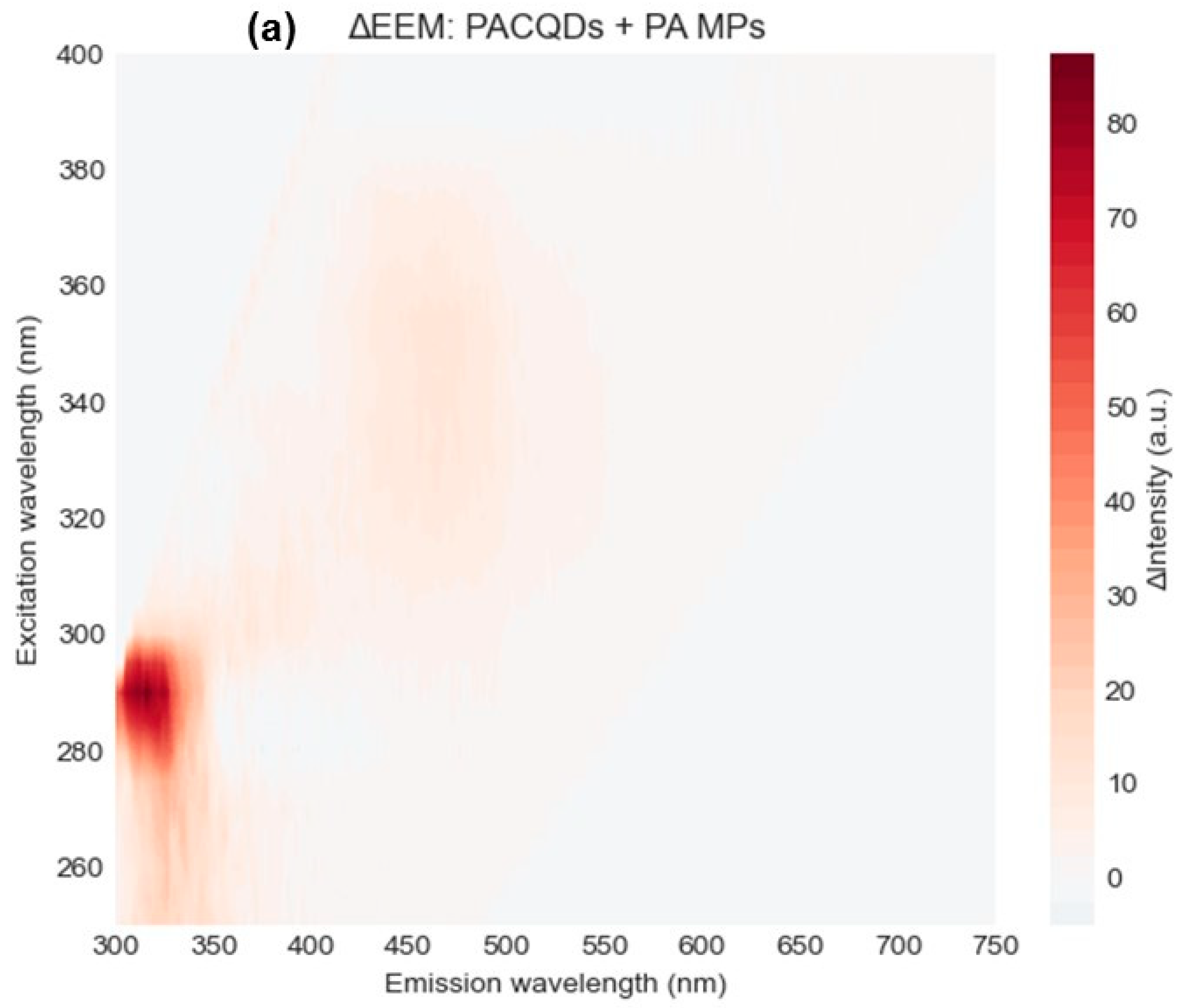
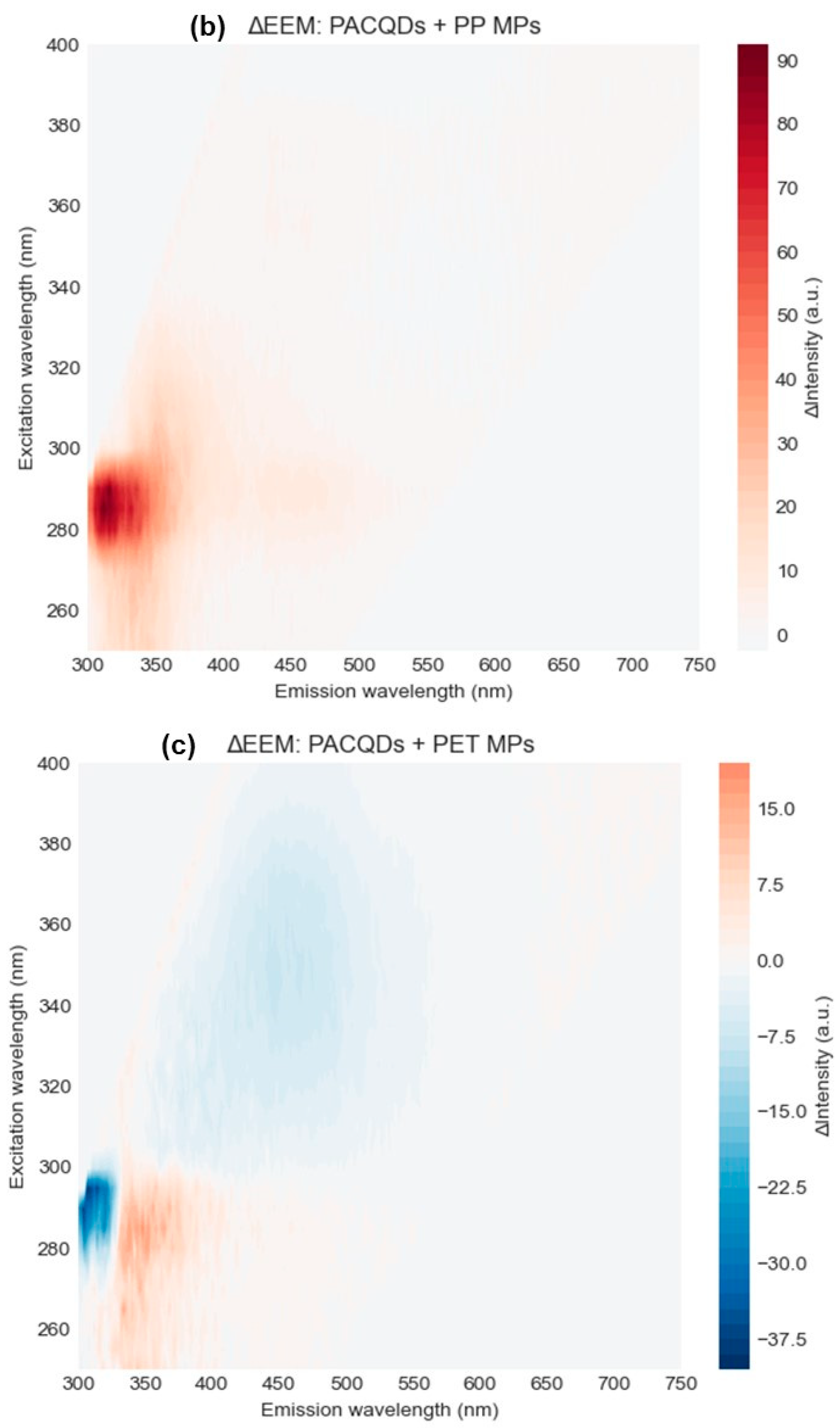
Difference excitation–emission matrices (ΔEEM = Sample − PACQDs)
Difference excitation–emission matrices (ΔEEM = Sample − PACQDs) revealed three mechanistically distinct fluorescence responses (Figure 3), which are further quantified in Table S1. PAMPs induced a bimodal enhancement, with the primary core peak (Ex 290/Em 320 nm) increasing by +75 ± 5 a.u. and the shoulder region (Ex 290/Em 380 nm) by +50 ± 10 a.u., yielding a shoulder/core ratio of 0.67 and a net fluorescence increase of +125 a.u. PPMPs produced spatially localized enhancement, with the core peak increasing by +85 ± 5 a.u. but minimal shoulder enhancement (+5 ± 3 a.u.), resulting in a shoulder/core ratio of 0.06 and a net change of +90 a.u. PETMPs, in contrast, showed selective quenching of the core emission (−30 ± 5 a.u.) with minor shoulder enhancement (+12 ± 3 a.u.), giving a negative shoulder/core ratio (−0.40) and a net fluorescence decrease of −18 a.u. The ΔEEM analysis, combined with these quantitative features, provides clear mechanistic insight (Figure 3). PAMP exhibits extended, bimodal enhancement consistent with strong chemical interactions and formation of new emissive states. PP shows localized, unimodal enhancement consistent with fluorescence improvement without structural modification. PET displays a biphasic response with core quenching and minor shoulder enhancement, indicative of photoinduced electron transfer [26]. Importantly, the shoulder/core ratio serves as a robust discriminator (Table S1): high values in PA reflect strong secondary emission, near-zero values in PP indicate purely physical enhancement, and negative values in PET signify electron-transfer-mediated quenching. These ratiometric metrics reduce dependence on absolute intensity calibration and enhance method robustness across varying sample concentrations.

3.3. Discrimination Strategy and Analytical Metrics

The discrimination of MPs using PACQDs was first evaluated using conventional fluorescence metrics extracted from the EEM data (Table 1). While all samples exhibit a common primary excitation/emission maximum at 290/308 nm reflecting the intrinsic emissive core of the PACQDs, distinct quantitative differences in fluorescence intensity and spectral redistribution emerge upon interaction with different polymer types. These differences form the basis of the analytical discrimination strategy.
The integrated fluorescence intensity increases markedly in the presence of polyamide (PAMPs) and polypropylene (PPMPs), reaching 139,016.7 and 141,259.9, respectively, corresponding to enhancement factors of 11.66% and 11.43%. In contrast, polyethylene terephthalate (PETMPs) induces a net decrease in total emission (116,716.8), resulting in a negative enhancement factor (−4.61%). This clear divergence in intensity response provides a first-level distinction between PET and the other polymers but is insufficient on its own to differentiate PA from PP due to their comparable enhancement magnitudes. Further discrimination is achieved by partitioning the EEM into blue (short-wavelength) and red (long-wavelength) emission regions. Both PAMPs and PPMPs enhance the blue-region integrated intensity relative to pristine PACQDs, consistent with reduced non-radiative decay pathways arising from interfacial rigidification (PA) and hydrophobic shielding (PP). However, the red-region response reveals polymer-specific behavior. PAMPs exhibit an increased red-region contribution (1637.98), yielding the highest red/blue ratio (0.0137), whereas PPMPs show a reduced red contribution (1230.15) and a lower ratio (0.0098). PETMPs display a pronounced suppression of red-region emission (765.94), reflected in the lowest red/blue ratio (0.0072), consistent with fluorescence quenching and energy redistribution. Importantly, the peak excitation and emission wavelengths remain unchanged across all samples, indicating that discrimination cannot be achieved through peak position shifts alone. Instead, the modulation of integrated intensity and relative spectral contributions provides complementary analytical descriptors. The minimum intensity values, remaining close to zero for all systems, confirm the absence of artefactual baseline distortions and validate the robustness of the extracted metrics. Collectively, these results demonstrate that while simple fluorescence intensity metrics can partially discriminate PET from PA and PP, overlap between PA- and PP-induced enhancement necessitates a multivariate approach. This limitation directly motivates the use of EEM–PARAFAC and PCA analyses, which leverage the full three-dimensional fluorescence information to resolve subtle but mechanistically meaningful differences in emission modulation pathways, enabling reliable and statistically robust microplastic discrimination.

3.4. Multivariate Analysis of EEM Matrix

3.4.1. PCA

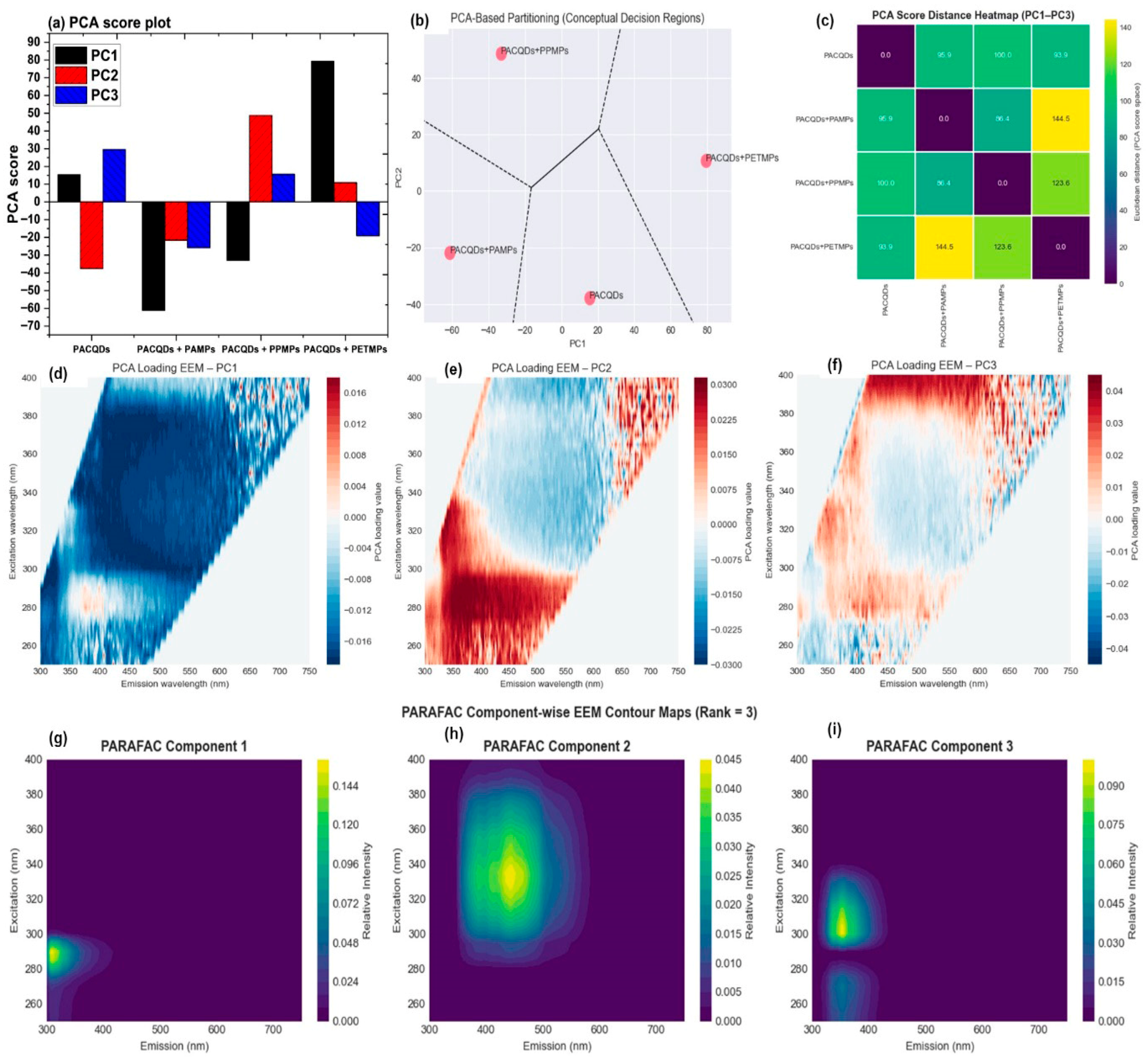
The application of PCA to the EEM fluorescence data provides compelling statistical evidence for the discriminative capability of PACQDs in detecting different MP polymers. The PCA scores reveal distinct clustering patterns that directly correspond to the unique interactions between PACQDs and each polymer type (Figure 4a). The first principal component (PC1) accounts for the largest variance in the dataset (63.53%) and serves as the primary differentiator between enhancing and quenching interactions. PET MPs stand as a significant outlier with a high positive PC1 value of 79.3. This numerical position correlates directly with the unique fluorescence quenching observed in the EEM maps, which is driven by π–π stacking between the aromatic rings of PET and the graphitic core of the PACQDs. In contrast, the MPs that cause fluorescence enhancement, PA MPs (−61.4) and PP MPs (−33.2), are both localized on the negative side of the PC1 axis. The fact that PA is positioned significantly further from the PACQDs baseline (15.3) than PP suggests that the chemical enhancement (via multipoint hydrogen bonding) of PA creates a more profound electronic impact on the CQDs than the physical enhancement (via passivation) caused by PP. While PC1 separates the samples by intensity trends, PC2 (24.48%) captures qualitative changes in the shape and position of the fluorescence contours, such as red-shifting versus spectral stability. PP MPs exhibit the highest positive PC2 value at 48.7. Since PP causes intensity enhancement without shifting the emission wavelength, this coordinate represents the “pure intensity” boost derived from surface passivation. Conversely, the negative PC2 value for PA MPs (−21.7) highlights its unique spectral expansion. Even though both PA and PP increase the overall signal, PC2 successfully distinguishes PA by recognizing the new low-energy emission states the red-shifted “cloud” that was clearly identified in the log-scale maps (Figure 2f). Finally, PC3 captures subtle variations in the secondary “shoulders” and the asymmetry of the emission peaks. The baseline PACQDs maintain a high PC3 value of 29.5, which mathematically distinguishes the “clean” intrinsic fluorescence of the probe from the modified states of the MP-laden samples. Both PA (−25.9) and PET (−19.2) share negative PC3 values. This commonality likely relates to the significant alteration of surface functional group transitions (n → π*) through either chemical bonding in the case of PA or electronic quenching in the case of PET. These results demonstrate that PCA effectively discriminates the samples based on chemically meaningful spectral variations without any prior labeling or supervision (Figure 4b). The excellent separation, particularly of the PA-bound sample along the dominant PC1 axis, quantitatively validates the high selectivity of PACQDs toward PA MPs. Furthermore, quantitative separation between PACQDs and polymer-interacting systems was further assessed using Euclidean distances calculated from PCA score space (PC1–PC3) (Figure 4c). All polymer-containing samples exhibited large distances (>90) relative to pristine PACQDs, confirming substantial fluorescence fingerprint modulation upon polymer interaction. Critically, the PACQDs + PAMP and PACQDs + PETMP systems showed the greatest mutual separation (distance = 144.49), indicating markedly distinct excitation–emission responses. These results demonstrate that PCA-derived EEM features provide robust discrimination between polymer types, even in the absence of supervised classification.
The statistical validity of the PACQDs sensing platform is further reinforced by the PCA, which condenses the multidimensional EEM datasets into a clear diagnostic framework (Figure 4b). This model effectively clusters the MPs into unique spatial coordinates based on three primary axes of variance and the score distance displayed in a heatmap (Figure 4c). As the primary driver of variance, PC1 serves to separate the samples based on the direction of their fluorescence response; it clearly distinguishes the quenching behavior of PET (positive score) from the enhancement behaviors of PA and PP (negative scores) (Figure 4d). PC2 provides the crucial qualitative distinction between the two enhancing polymers; it separates PP (high positive score), which exhibits pure intensity growth, from the red-shifted and expanded emission profile characteristic of PA (Figure 4e). PC3 resolves subtle alterations in the probe’s electronic environment, effectively isolating the baseline PACQDs from those samples where MP interaction has modified the underlying surface state transitions (Figure 4f). The clear spatial resolution between these clusters demonstrates that the PACQDs probe does not merely detect the presence of MPs but possesses the molecular recognition capabilities required to identify them by their specific chemical class.

3.4.2. Parallel Factor Analysis (PARAFAC)

Parallel factor analysis (PARAFAC) was employed to decompose the complex EEM datasets into three distinct fluorescent components (C1, C2, and C3), providing a more refined look at the chemical interactions than raw intensity alone. While PCA looks at the variance of the entire map, the PARAFAC represents the relative “concentration” or contribution of each underlying fluorescence contribution within each sample system. Sample-mode scores obtained from the three-component PARAFAC model reveal distinct fluorescence contributions across the investigated systems (Figure S2, Table S2), while PARAFAC contour plots are shown in Figure 4g–i. The baseline (PACQDs) scores are nearly balanced (approx. 0.47–0.48), representing the stable equilibrium of the probe’s intrinsic fluorophores (Table S2). In contrast, C2 exhibits a pronounced enhancement in the presence of PAMPs (0.610) and significant suppression for PETMPs (0.362), suggesting polymer-dependent modulation of surface-associated emissive states. PP shows a dominant increase in C3 (0.552) and C1 (0.540). This reflects the physical enhancement effect, which boosts the intensity of the existing fluorophores without the deep spectral shifts seen in PA due to hydrogen bonding (Figure 5a). This PARAFAC result strengthens the PCA findings by showing that the “enhancement” for PA and PP is not identical; they amplify different chemical components of the PACQDs. PET’s quenching is likewise revealed as a component-specific suppression rather than a total signal loss. The component-wise EEM contour map for the PARAFAC decomposition provides a multi-layered understanding of how PACQDs interact with different MP polymers (Figure 4g–i). PARAFAC provides the final layer of evidence by decomposing the signal into three independent fluorescent components (C1, C2, C3). C2 is the primary diagnostic marker for chemical interactions (Figure 4h); it is significantly enhanced by PA but quenched by PET. C3 serves as the primary indicator for physical interactions, reaching its highest value with PP (Figure 4i).

3.5. ATR-FTIR Analysis of PACQD Interaction with MPs and Mechanistic Interpretation

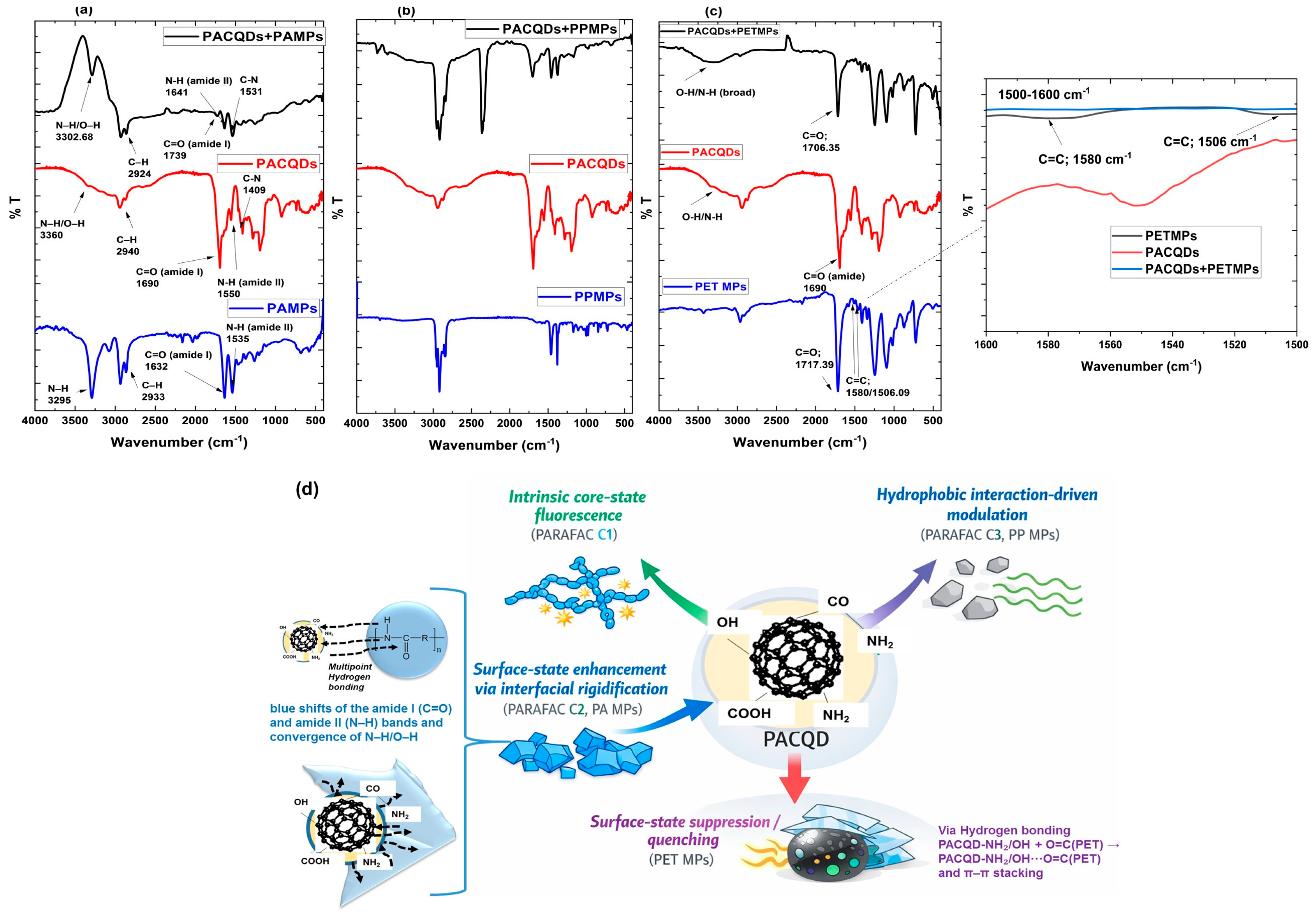
Fourier transform infrared (FTIR) spectroscopy provides direct molecular-level evidence for the specific interaction mechanism between PACQDs and PET MPs. The ATR-FTIR spectra are presented in Figure 5. ATR-FTIR analysis of PACQDs/PAMP MP interaction reveals a strong, specific interaction between PACQDs and PAMPs (Figure 5a), dominated by amide–amide coupling and interfacial rigidification. Upon composite formation, pronounced positive (blue) shifts are observed in the amide vibrational bands. The amide I (C=O stretching) band shifts from 1632–1690 cm−1 to 1739 cm−1, while the amide II (N–H bending) band shifts from 1535–1550 cm−1 to 1641 cm−1. These substantial upshifts indicate restricted vibrational motion and reduced conformational freedom, consistent with the formation of a rigidified hydrogen-bonded interface [21,22]. This mechanism is often observed in aggregation-induced emission (AIE) phenomena [26]. Supporting this interpretation, the N–H/O–H stretching region converges and broadens around 3302 cm−1, reflecting the establishment of an extensive, constrained hydrogen-bonding network. The C–N stretching vibration shifts upward from 1409 to 1531 cm−1, confirming direct involvement of nitrogen functionalities in interfacial stiffening, while concurrent downshifts in C–O/C–O–C vibrations (e.g., 1259 → 1231 cm−1) indicate cooperative rearrangement of oxygen-containing groups. Importantly, the absence of new covalent-bond signatures confirms that the interaction is non-covalent, driven by hydrogen-bond reorganization and physical adsorption. This rigidified interfacial environment provides a direct molecular explanation for the observed fluorescence enhancement, as restricted molecular motion suppresses non-radiative decay pathways. In contrast, the ATR-FTIR spectrum of the PACQD + PPMP composite (Figure 5b) shows no discernible shifts or intensity changes in the characteristic PACQD amide I (~1690–1700 cm−1) and amide II (~1540–1560 cm−1) bands, indicating that amide and N–H groups do not participate in specific interactions with PP (Figure 5b). The PPMPs retain their dominant aliphatic C–H stretching bands (2950–2835 cm−1) and C–H bending modes (~1455 and 1375 cm−1) without perturbation, and no new bands appear across the fingerprint region. This spectral invariance confirms the absence of hydrogen bonding, π–π interactions, or covalent coupling at the PACQD + PP MP interface. Given the nonpolar, chemically inert nature of PP, the association is best attributed to hydrophobic interactions between PP surfaces and the graphitic domains of PACQDs. Such hydrophobic adsorption promotes interfacial confinement without altering vibrational signatures, providing a mechanistic basis for fluorescence enhancement via hydrophobic shielding and reduced non-radiative relaxation, rather than chemical bonding.
For PETMPs (Figure 5c), the ATR-FTIR spectroscopy for the interaction provides clear molecular evidence for a dual-binding interaction between PACQDs and PET MPs (Figure 5c). First, hydrogen bonding is confirmed by an 11 cm−1 red shift of the PET carbonyl (C=O) stretching vibration from 1717 to 1706 cm−1, indicating bond weakening as the ester carbonyl acts as a hydrogen-bond acceptor to PACQD surface –NH/–OH groups. This interaction is further supported by broadening of the O–H/N–H stretching band (~3400 cm−1). Second, strong evidence for π–π stacking is provided by the complete disappearance of the PET aromatic C=C stretching bands at ~1506 and 1580 cm−1 in the composite spectrum (inset of Figure 5c), a hallmark of close, parallel stacking between aromatic rings and sp2-hybridized graphitic domains. The persistence of the C–O–C ester vibration (~1250 cm−1) without shift confirms that the interaction is site-specific and non-reactive. Together, these features substantiate a synergistic “dual-clamp” mechanism, combining hydrogen bonding and π–π stacking, which explains the distinct fluorescence quenching response of PET relative to other polymers.
Generally, ATR-FTIR analysis differentiates three interaction pathways: rigidification-driven enhancement for PAMPs, hydrophobic-adsorption-driven enhancement for PPMPs, and dual-binding-induced quenching for PET MPs. These molecular-level distinctions provide a robust structural foundation for the polymer-specific fluorescence responses observed in PACQDs-based MP sensing.

Integrated Mechanistic Model from PARAFAC, PCA, and ATR-FTIR

Multivariate fluorescence analysis and ATR-FTIR collectively resolve three distinct PACQDs–MP interaction pathways that govern the observed fluorescence responses (Figure 5d). PARAFAC decomposition separated the EEM dataset into three independent components (C1–C3), while PCA clearly clustered the samples according to polymer type, confirming that each interaction mode produces a unique photophysical fingerprint. PARAFAC component C1, dominant across all samples, corresponds to intrinsic PACQDs core-state fluorescence, reflecting the graphitic π–π* transitions that remain largely unaffected by microplastic presence. This invariant component explains the strong common variance captured by PC1 in PCA. PARAFAC C2, which loads strongly for polyamide MPs, is associated with surface-state fluorescence enhancement driven by interfacial rigidification. ATR-FTIR provides direct molecular evidence for this pathway, showing pronounced blue shifts of the amide I (C=O) and amide II (N–H) bands and convergence of N–H/O–H stretching vibrations, indicative of a constrained hydrogen-bonding network. This rigidified interface suppresses non-radiative decay, producing the enhanced emission captured by C2 and the positive PC2 scores. PARAFAC C3 differentiates PP MPs and reflects hydrophobic interaction-driven fluorescence modulation. ATR-FTIR shows no band shifts or new vibrational features, confirming the absence of specific chemical bonding. Instead, hydrophobic association between PPMP surfaces and PACQDs graphitic domains promotes surface adsorption and local solvent exclusion, yielding moderate fluorescence enhancement without spectral perturbation. This mechanism is encoded in C3 and resolved by PCA along higher-order components. In contrast, PET MPs exhibit surface-state suppression, arising from dual hydrogen bonding and π–π stacking, as confirmed by carbonyl red shifts and disappearance of aromatic C=C bands in ATR-FTIR. These strong, multipoint interactions promote non-radiative pathways, leading to fluorescence quenching and a distinct PCA position. Overall, the strong agreement between PARAFAC-resolved fluorescence components, PCA clustering, and ATR-FTIR interaction chemistry establishes a direct structure–property relationship, enabling mechanistic discrimination of microplastics based on their interfacial interactions with PACQDs.

3.6. EEM Evaluation in Tap Water

To assess the influence of matrix effects on the fluorescence response and discrimination capability of the PACQDs platform, EEM measurements were extended from deionized water to tap water. Tap water represents a more chemically complex and environmentally relevant matrix, containing dissolved inorganic ions and residual organic constituents that may interfere with fluorescence signals through quenching, background emission, or competitive interactions. Evaluating PACQDs–MP interactions under these conditions provides a critical test of method robustness and helps bridge the gap between controlled laboratory studies and practical environmental applications.
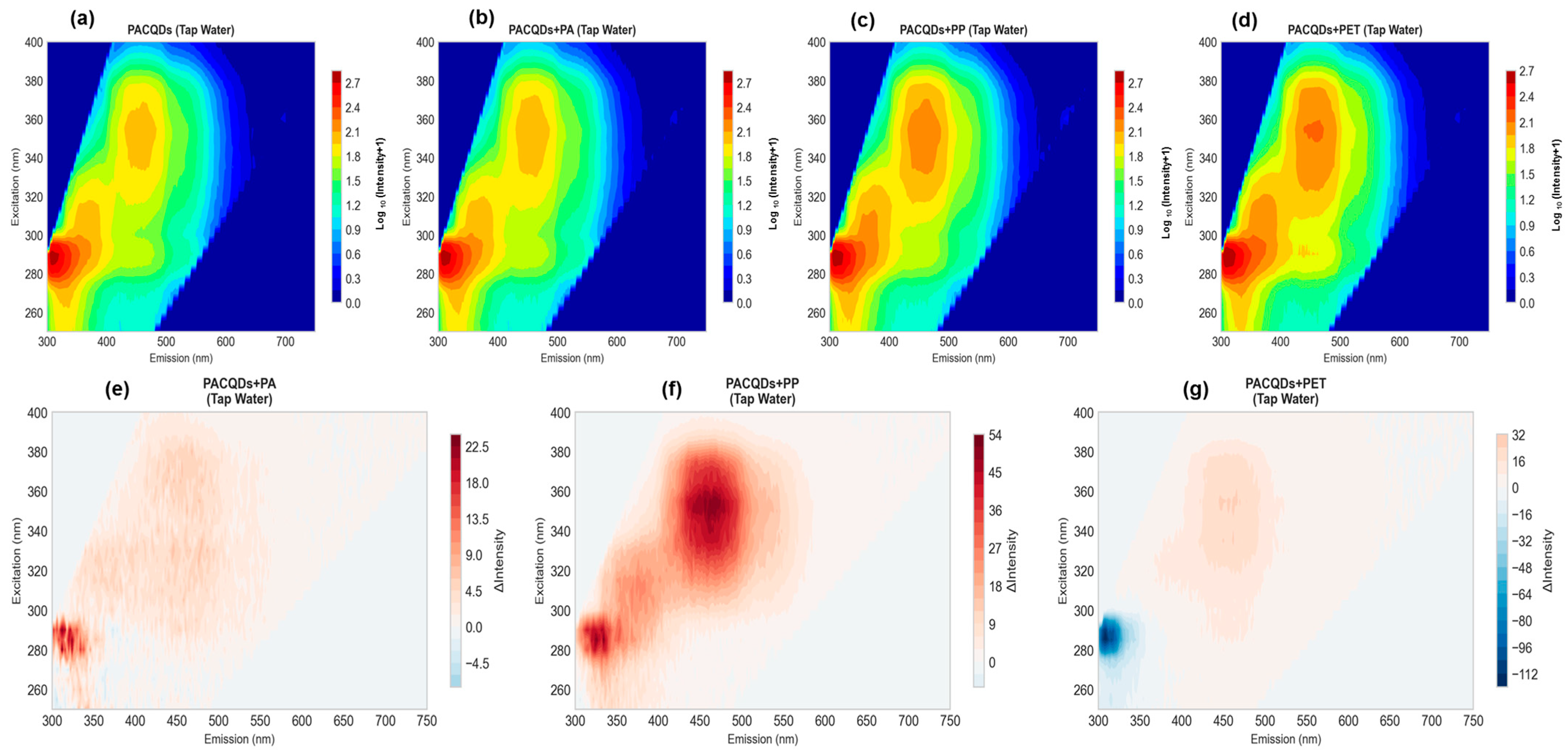
Figure 6a–d present the log-scaled EEM fluorescence landscapes of PACQDs and PACQDs–MP systems in tap water, with the corresponding fluorescence metrics summarized in Table S3. In tap water, the intrinsic EEM profile of PACQDs exhibits a modest increase in background intensity and slight broadening of the emission contours, particularly toward longer wavelengths (Figure 6a). Quantitatively, this is reflected by a decrease in maximum emission intensity (from 662.9 to 570.5 a.u.) accompanied by a substantial increase in total integrated fluorescence (from 1.23 × 10⁵ to 1.74 × 10⁵ a.u.) (Table S3). Concurrently, the green-to-blue and red-to-blue intensity ratios increase markedly (0.276 → 0.841 and 0.013 → 0.050, respectively), indicating a redistribution of emission toward surface-state-dominated, longer-wavelength regions. These changes are attributed to dissolved inorganic ions and trace organic constituents in tap water that weakly screen surface charges or stabilize emissive defect states. The excitation maximum (290 nm), emission maximum (308 nm), and Stokes shift (18 nm) remain unchanged (Table S3), confirming that the core photophysical framework of the PACQDs is preserved under matrix conditions. Upon interaction with MPs, the polymer-specific fluorescence fingerprints observed in deionized water are largely retained in tap water, albeit with matrix-induced modulation of intensity balance. For PAMPs (Figure 6b), enhanced fluorescence intensity and an expanded emission footprint persist in tap water, consistent with hydrogen-bond-mediated surface rigidification. Although the maximum intensity decreases relative to pure water (740.3 → 582.6 a.u.), the total fluorescence increases (1.39 × 10⁵ to 1.82 × 10⁵ a.u.), and a slight red shift in emission maximum (308 to 310 nm) and increased Stokes shift (18 to 20 nm) are observed (Table S3). The pronounced rise in the green-to-blue ratio (0.307 → 0.862) further supports matrix-assisted stabilization of PAMPs–PACQDs interactions rather than competitive quenching. For PP (Figure 6c), the EEM landscapes show predominantly localized enhancement near the original emission maximum, indicating that hydrophobic adsorption remains the dominant interaction mechanism even in the presence of background ions. This behavior is corroborated by a moderate decrease in peak intensity (738.7 to 595.7 a.u.) but a strong increase in total integrated fluorescence (1.41 × 10⁵ to 2.20 × 10⁵ a.u.), the highest among all systems. The near-unity green-to-blue ratio in tap water (0.990) reflects significant redistribution of emission without displacement of the excitation or emission maxima, suggesting matrix-mediated amplification rather than alteration of the interaction pathway. In contrast, PET-associated PACQDs exhibit the strongest matrix-induced attenuation of core emission (Figure 6d), with maximum intensity decreasing from 632.4 to 458.4 a.u., while total fluorescence increases from 1.17 × 10⁵ to 1.87 × 10⁵ a.u. (Table S3). This behavior is accompanied by the most pronounced increase in green-to-blue ratio (0.228 to 1.099) and red-to-blue ratio (0.008 to 0.064), indicating broadening and flattening of the emission distribution (Table S3). These quantitative trends align with the EEM contours showing suppressed core emission and enhanced red-shifted regions, supporting the persistence of π–π stacking and electron-transfer-assisted quenching mechanisms under matrix conditions. Compared to deionized water (Figure 2e–h), all PACQDs–MPs systems in tap water exhibit elevated baseline fluorescence and reduced contrast between core and shoulder regions, as reflected by increased total intensities and higher green- and red-to-blue ratios across all samples. This partial attenuation of contrast arises from matrix-induced background fluorescence and competitive surface interactions. Nevertheless, the preservation of excitation–emission peak positions and polymer-specific intensity redistribution patterns demonstrates that relative spatial and ratiometric features of the EEMs, rather than absolute intensity, remain diagnostic. Therefore, the combined EEM landscapes and fluorescence metrics confirm that while tap water introduces measurable matrix effects, it does not obscure the mechanistic fluorescence signatures required for MPs discrimination. These results underscore the robustness of the PACQDs–EEM–chemometric framework as a transitional analytical platform bridging controlled laboratory studies and more complex environmental water matrices, while highlighting the need for future validation in waters with higher organic load and ionic strength.

3.6.1. ΔEEM Responses in Tap Water

Figure 6e–g presents the difference excitation–emission matrices (ΔEEM = PACQDs + MPs − PACQDs) for PAMPs, PPMPs, and PETMPs in tap water and compared with pure/deionized water (Figure 3), enabling direct visualization of polymer-induced fluorescence modulation relative to the PACQDs baseline under different matrix conditions. In tap water, PA retains its enhancement-dominated behavior (Figure 6e); however, the magnitude and spatial contrast of the ΔEEM features are reduced and more diffuse. This attenuation is attributed to competitive interactions with dissolved ions and background species, yet the absence of net quenching confirms that hydrogen-bond-driven interactions remain operative under matrix conditions. PP shows a broadened enhancement footprint with increased intensity in the higher-emission region (Em ≈ 380–480 nm) (Figure 6f). This amplification likely arises from matrix-assisted aggregation or altered dielectric environments that enhance PACQDs emission upon PP association. Despite this broadening, the unimodal enhancement signature remains distinct from the bimodal PA response, preserving mechanistic discriminability. PET displays a markedly different ΔEEM signature. PET continues to induce selective quenching of the core emission (negative ΔEEM values) accompanied by weak enhancement in longer-wavelength regions, consistent with π–π stacking–assisted photoinduced electron transfer. This quenching behavior becomes more pronounced in tap water (Figure 6g), with deeper negative ΔEEM values at the core region and expanded quenching contours. The amplification of quenching under matrix conditions suggests that dissolved ions or background species facilitate charge-transfer pathways or enhance PET–PACQDs electronic coupling, reinforcing the electron-transfer-driven mechanism. Across all polymers, tap water introduces increased baseline variability and reduced ΔEEM contrast; however, the sign, spatial distribution, and topology of the ΔEEM features remain polymer-specific. Critically, discrimination is preserved when based on relative enhancement–quenching patterns and spatial features rather than absolute intensity values. These results demonstrate that ΔEEM analysis provides a resilient, mechanism-sensitive framework capable of mitigating moderate matrix effects while retaining diagnostic power for microplastic discrimination.

3.6.2. Matrix Effect Maps (ΔEEM = Tap Water − Pure Water)

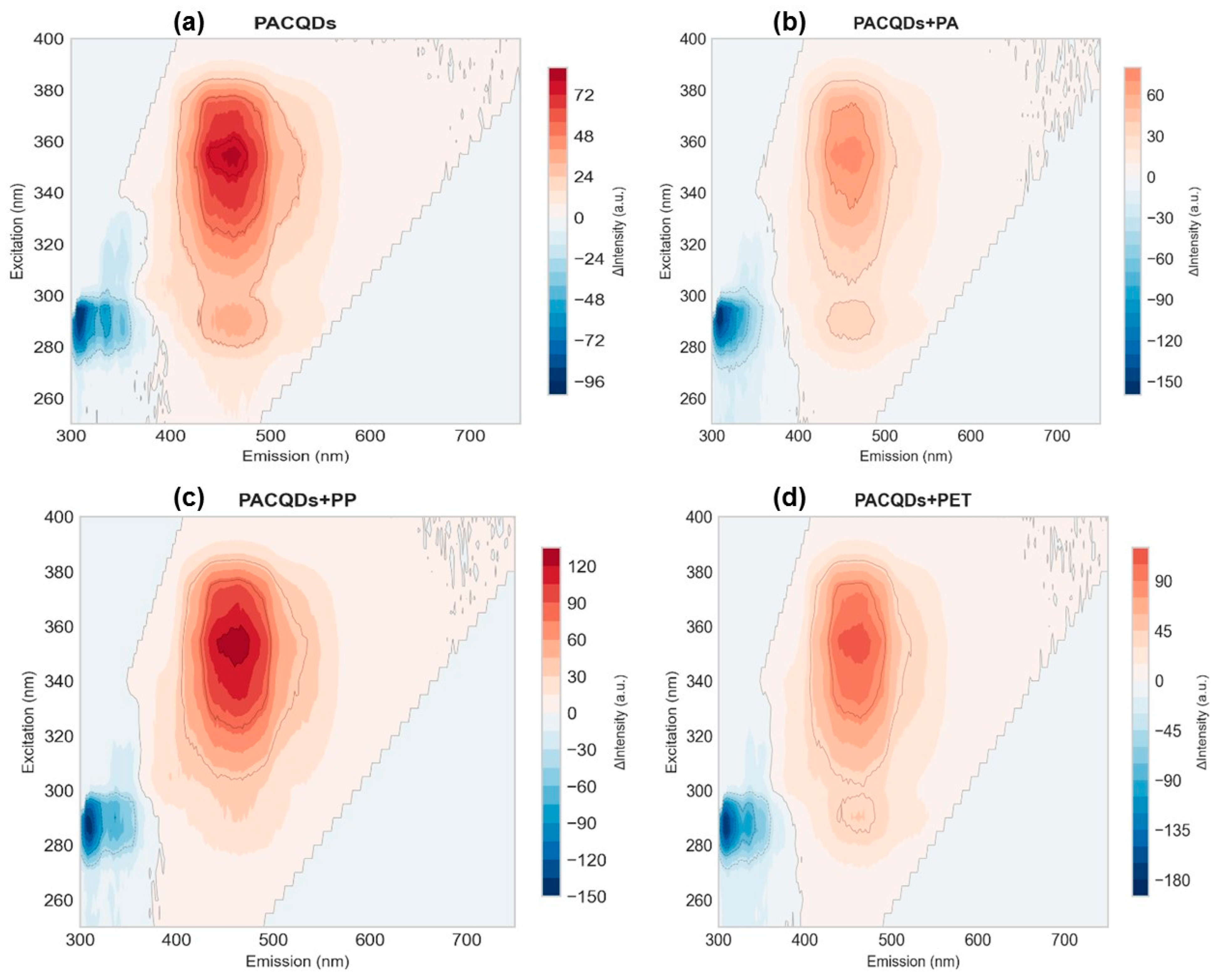
Figure 7 presents matrix effect maps obtained by subtracting pure water EEMs from tap water EEMs (ΔEEM = tap water − pure water) for PACQDs alone and in the presence of PA, PP, and PET MPs. These maps directly visualize how the tap water matrix modifies fluorescence responses relative to controlled conditions. For PACQDs alone (Figure 7a), tap water induces a pronounced enhancement in the higher-emission region (Em ≈ 380–480 nm) accompanied by localized quenching near the core emission (Ex ≈ 290 nm/Em ≈ 300–320 nm). This pattern is consistent with matrix-induced modulation of surface-state emission, likely arising from ionic strength effects, weak coordination with dissolved ions, or residual organic constituents present in tap water. The overall excitation–emission topology of PACQDs remains intact, indicating that the matrix alters emission intensity distribution rather than fundamentally changing the emissive states.
In the presence of PAMPs (Figure 7b), the matrix effect map closely resembles that of PACQDs alone but with attenuated magnitude. The persistence of broad enhancement across the shoulder region (Em ≈ 360–420 nm) indicates that hydrogen-bond-mediated PACQDs–PAMP interactions remain dominant, while competitive binding or electrostatic screening by matrix species partially suppresses intensity contrast. The absence of strong negative features confirms that tap water does not induce additional quenching pathways for PA-associated PACQDs. For PPMPs (Figure 7c), tap water produces the largest positive ΔEEM enhancement among the tested polymers, with an intense and spatially extended increase in emission centered around Em ≈ 420–480 nm. This pronounced enhancement suggests that matrix components may promote PACQDs clustering or modify the local dielectric environment upon PP association, amplifying hydrophobic adsorption–driven fluorescence enhancement. Despite this amplification, the enhancement remains unimodal and distinct from the bimodal PAMP response, preserving mechanistic differentiation. In contrast, PET exhibits a markedly different matrix response (Figure 7d). While some enhancement is observed in the shoulder region, the matrix effect map reveals deepened quenching in the core emission region, exceeding that observed in pure water. This behavior indicates that tap water constituents facilitate or strengthen π–π stacking–assisted photoinduced electron transfer between PET and PACQDs, possibly through ionic screening that enhances electronic coupling. The enhanced quenching reinforces the electron-transfer-driven mechanism proposed for PET. These matrix effect maps demonstrate that tap water introduces polymer-dependent modulation of fluorescence intensity, rather than uniform suppression or enhancement. Crucially, the direction (enhancement vs. quenching), spatial localization, and relative magnitude of matrix-induced changes remain mechanistically consistent with the interaction pathways identified in pure water. This confirms that the PACQDs–ΔEEM framework retains discriminatory power under moderate matrix complexity when analysis is based on spatial fingerprints and relative intensity patterns rather than absolute fluorescence values.

3.6.3. Visual Confirmation of Polymer-Specific Fluorescence Modulation in Tap Water

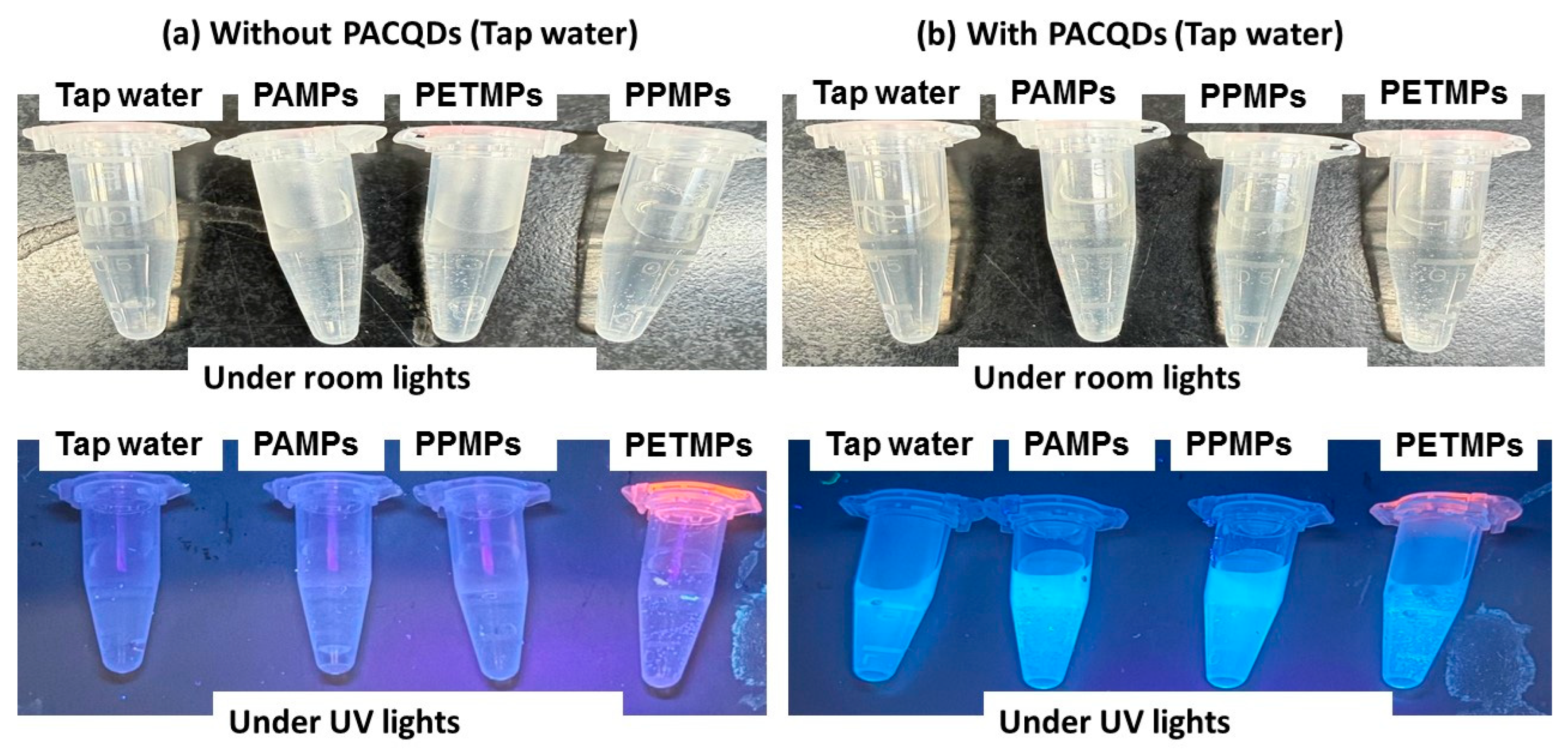
The tap water fluorescence images under room and UV lights are shown in Figure 8. The photographic images provide direct visual confirmation of the matrix-tolerant fluorescence response of the PACQDs–MP system in tap water. Under ambient lighting, all samples remain visually transparent, indicating negligible light scattering or coloration from the MPs or the tap water matrix. Under UV illumination, neither tap water nor MP-spiked tap water without PACQDs exhibits detectable fluorescence, confirming that background emission from dissolved constituents or the polymers themselves is minimal. Upon introduction of PACQDs, a strong blue fluorescence emerges, which is distinctly modulated by the different MPs. PAMPs and PPMPs induce noticeable fluorescence enhancement, consistent with interaction-driven surface rigidification and hydrophobic adsorption mechanisms, respectively. In contrast, PETMPs produce visible fluorescence quenching, in agreement with the EEM and ΔEEM results that attribute this behavior to π–π stacking and electron-transfer-assisted interactions. The clear visual differentiation among the polymer systems demonstrates that the PACQDs platform preserves polymer-specific fluorescence signatures in tap water, reinforcing its robustness against moderate matrix effects and highlighting its potential for rapid, qualitative screening in realistic aqueous environments.


4. Conclusions

This study establishes a robust, mechanism-informed fluorescence sensing platform based on polyamide-derived carbon quantum dots (PACQDs) for the selective discrimination of common microplastics, specifically polyamide (PA), polypropylene (PP), and polyethylene terephthalate (PET). By integrating excitation–emission matrix (EEM) fluorescence spectroscopy with multivariate chemometric analysis (PCA and PARAFAC) and complementary ATR-FTIR characterization, clear structure–property relationships are elucidated between polymer-specific interfacial interactions and their resulting photophysical responses.
PACQDs exhibit distinct, polymer-dependent fluorescence modulation pathways: pronounced fluorescence enhancement for PA arising from amide–amide hydrogen-bond-mediated surface rigidification; localized modulation centered near the native emission maximum for PP driven by hydrophobic adsorption; and selective fluorescence quenching accompanied by red-shifted emission for PET, governed by synergistic hydrogen bonding and π–π stacking interactions. These interaction-specific fluorescence fingerprints are consistently resolved through PARAFAC and PCA, enabling statistically robust classification and reliable discrimination of the target polymers. Complementary ATR-FTIR analysis provides molecular-level validation of the proposed mechanisms, confirming that the observed fluorescence responses originate from non-covalent interfacial interactions rather than chemical modification of either the PACQDs or the polymer substrates.
In particular, the preservation of polymer-specific EEM fingerprints under tap water conditions demonstrates that the sensing strategy is resilient to moderate matrix complexity when based on multivariate and ratiometric features rather than single-wavelength or absolute intensity metrics. By moving beyond conventional intensity-based detection approaches, this work advances microplastic sensing toward a multivariate, mechanism-driven analytical framework.
The PACQDs platform is rapid, label-free, and compatible with standard fluorescence instrumentation, offering a practical and scalable alternative to more resource-intensive microplastic characterization techniques. Future work will focus on expanding the polymer library, validating performance in more complex environmental matrices with higher organic load, and translating this approach into portable, field-deployable sensing formats. Overall, this study provides a strong foundation for the development of next-generation optical tools for microplastic discrimination and environmental pollution assessment.

Supplementary Materials

The following supporting information can be downloaded at: https://www.mdpi.com/article/10.3390/micro6010015/s1, Figure S1. 3D EEM for PACQDs and MPs interaction; Table S1. Quantitative Feature Table; Table S2 Sample-mode scores (Rank = 3); Figure S2. Bar plots of PARAFAC sample mode scores; Table S3. Flourescence metrics in tap water and compared with pure water; Figure S3. Contour plots of EEM; Figure S4. Regional fluorescence intensity comparison.

Author Contributions

Conceptualization, C.E.E.; methodology, C.E.E.; software, C.E.E.; validation, C.E.E. and Q.W.; formal analysis, C.E.E.; investigation, C.E.E. and Q.W.; resources, C.E.E.; data curation, C.E.E.; writing—original draft preparation, C.E.E.; writing—review and editing, C.E.E. and Q.W.; visualization, C.E.E.; supervision, C.E.E. and Q.W.; project administration, C.E.E. and Q.W.; funding acquisition, C.E.E. and Q.W. All authors have read and agreed to the published version of the manuscript.

Funding

This research was supported by the Japan Society for the Promotion of Science (JSPS KAKENHI Award number: 24KF0131) through a Special Research Fellowship application, and also through partial funding from the Special Funds for Innovative Area Research and Basic Research (Category B) (No. 22H03747, FY2022–FY2024; No. 24K20941, FY2024–FY2026; and No. 25K03267, FY2025–FY2028) of Grant-in-Aid for Scientific Research of the Japanese Ministry of Education, Culture, Sports, Science, and Technology (MEXT).

Data Availability Statement

Data will be made available on reasonable request.

Conflicts of Interest

The authors declare no conflicts of interest.

References

  1. Sunny, A.R.; Sazzad, S.A.; Islam, M.A.; Mithun, M.H.; Hussain, M.; Raposo, A.; Bhuiyan, M.K.A. Microplastics in Aquatic Ecosystems: A Global Review of Distribution, Ecotoxicological Impacts, and Human Health Risks. Water 2025, 17, 1741. [Google Scholar] [CrossRef]
  2. Doherty, V.F.; Aneyo, I.A.; Fatunsin, O.T.; Enyoh, C.E.; Yahaya, T.O.; Emeronye, I.G.; Amolegbe, O.A.; Amaeze, N.H.; Anyiam, F.E.; Oloidi, A.A.; et al. Assessment of fishes, sediment and water from some inland rivers across the six geopolitical zones in Nigeria for microplastics. Environ. Anal. Health Toxicol. 2024, 39, e2024018. [Google Scholar] [CrossRef] [PubMed]
  3. Iqrar, S.A.; Bibi, A.; Chinnambedu Murugesan, R.; Hill, D.; Rozhin, A. Excitation–Emission Fluorescence Mapping Analysis of Microplastics That Are Typically Pollutants. Photochem 2024, 4, 488–500. [Google Scholar] [CrossRef]
  4. Verla, A.W.; Enyoh, C.E.; Verla, E.N. Microplastics, an Emerging Concern: A Review of Analytical Techniques for Detecting and Quantifying Microplatics. Anal. Methods Environ. Chem. J. 2019, 2, 13–30. [Google Scholar] [CrossRef]
  5. Przygoda-Kuś, P.; Kosiorowska, K.E.; Urbanek, A.K.; Mirończuk, A.M. Current Approaches to Microplastics Detection and Plastic Biodegradation. Molecules 2025, 30, 2462. [Google Scholar] [CrossRef]
  6. Liu, J.; Niu, J.; Wu, W.; Zhang, Z.; Ning, Y.; Zheng, Q. Recent advances in the detection of microplastics in the aqueous environment by electrochemical sensors: A review. Mar. Pollut. Bull. 2025, 214, 117695. [Google Scholar] [CrossRef]
  7. Xiao, S.; Filippini, A.; Casadei, M.; Caracciolo, G.; Digiacomo, L.; Rossetta, A. Fast and portable fluorescence lifetime analysis for early warning detection of micro- and nanoplastics in water. Environ. Res 2024, 244, 117936. [Google Scholar] [CrossRef]
  8. Loskutova, A.; Seitkali, A.; Aliyev, D.; Bukasov, R. Quantum Dot-Based Luminescent Sensors: Review from Analytical Perspective. Int. J. Mol. Sci. 2025, 26, 6674. [Google Scholar] [CrossRef]
  9. Zhao, H.; Jiang, Z.; Wang, C.; Li, Y. Preparation of N, Cl Co-Doped Lignin Carbon Quantum Dots and Detection of Microplastics in Water. Crystals 2023, 13, 983. [Google Scholar] [CrossRef]
  10. Enyoh, C.E.; Wang, Q. Box–Behnken design and machine learning optimization of PET fluorescent carbon quantum dots for removing fluoxetine and ciprofloxacin with molecular dynamics and docking studies as potential antidepressant and antibiotic. Sep. Purif. Technol. 2025, 362, 131975. [Google Scholar] [CrossRef]
  11. Jini, A.R.; Simiyon, G.G.; Vergheese, T.M. Selective Identification and Quantification of Microplastics Using Solid Fluorescent Green Carbon Dots (SFGCDs)—A Novel, Naked Eye Sensing Fluoroprobe. J. Fluoresc. 2025, 35, 8959–8972. [Google Scholar] [CrossRef] [PubMed]
  12. Paramparambath, S.; Roshan, S.; Geetha, M.; Subramanian, V.; Al-Ejji, M.; Cabibihan, J.J.; Sadasivuni, K.K. Revolutionizing microplastic detection in water through quantum dot fluorescence. J. Environ. Sci. Health. Part A Toxic/Hazard. Subst. Environ. Eng. 2025, 60, 293–305. [Google Scholar] [CrossRef] [PubMed]
  13. Feng, Q.; Hu, X.; Chen, J.; Guo, L. Phosphorescent Naphthalene-Doped Carbon Nitride Quantum Dots for Selective Detection of Polyamide Microplastics. Anal. Chem. 2025, 97, 11066–11072. [Google Scholar] [CrossRef]
  14. Enyoh, C.E.; Qingyue, W.; Suzuki, M. A novel near-infrared fluorescence switching sensor based on polyamide derived carbon quantum dots for sequential detections of perfluorobutane sulfonic acid and Fe3+ ions. Discov. Mater. 2026, 6, 61. [Google Scholar] [CrossRef]
  15. Engelen, S.; Frosch, S.; Jørgensen, B.M. A fully robust PARAFAC method for analyzing 1746 fluorescence data. J. Chemom. 2009, 23, 124–131. [Google Scholar] [CrossRef]
  16. Chang, B.; Yang, T.; Fan, S.; Zhen, L.; Zhong, X.; Yang, F.; Liu, Y.; Shao, C.; Hu, F.; Xu, C.; et al. Molecular-level insights of microplastic-derived soluble organic matter and heavy metal interactions in different environmental occurrences through EEM-PARAFAC and FT-ICR MS. J. Hazard. Mater. 2025, 487, 137050. [Google Scholar] [CrossRef]
  17. Dongping, L.; Miaoxin, B.; Xin, Y.; Yonghui, S.; Fang, Y.; Feng, Q.; Huibin, Y. Applying EEM spectra with absolute principal component coefficients to explore characteristic fingerprints and fractions of DOM from diverse land-use soils in a large-scale irrigation area. CATENA 2024, 238, 107903. [Google Scholar] [CrossRef]
  18. Enyoh, C.E.; Wang, Q. Automated Classification of Undegraded and Aged Polyethylene Terephthalate Microplastics from ATR-FTIR Spectroscopy using Machine Learning Algorithms. J. Polym. Environ. 2024, 32, 4143–4158. [Google Scholar] [CrossRef]
  19. Jacokes, Z.; Adoremos, I.; Hussain, A.R.; Newman, B.T.; Pelphrey, K.A.; Van Horn, J.D.; ACE GENDAAR Consortium. Unsupervised Dimensionality Reduction Techniques for the Assessment of ASD Biomarkers. Biocomputing 2025, 30, 614–630. [Google Scholar] [CrossRef] [PubMed]
  20. Mei, J.; Leung, N.L.C.; Kwok, R.T.K.; Lam, J.W.Y.; Tang, B.Z. Aggregation-Induced Emission: Together We Shine, United We Soar! Chem. Rev. 2015, 115, 11718–11940. [Google Scholar] [CrossRef]
  21. Zhang, J.; Zhang, H.; Lam, J.W.Y.; Tang, B.Z. Restriction of Intramolecular Motion(RIM): Investigating AIE Mechanism from Experimental and Theoretical Studies. Chem. Res. Chin. Univ. 2021, 37, 1–15. [Google Scholar] [CrossRef]
  22. Zhang, X.; Liu, W.; Yang, M.; Li, Z. The Fabrication and Mechanism of a Crystalline Organic Fluorescent Probe Based on Photoinduced Electron Transfer. Molecules 2023, 28, 6774. [Google Scholar] [CrossRef]
  23. Enyoh, C.E.; Wang, Q. Combined experimental and molecular dynamics removal processes of contaminant phenol from simulated wastewater by polyethylene terephthalate microplastics. Environ. Technol. 2022, 45, 1183–1202. [Google Scholar] [CrossRef] [PubMed]
  24. Enyoh, C.E.; Wang, Q. Adsorption and toxicity characteristics of ciprofloxacin on differently prepared polyethylene terephthalate microplastics from both experimental and theoretical perspectives. J. Water Process Eng. 2023, 53, 103909. [Google Scholar] [CrossRef]
  25. Zhu, J.; Hu, L.; Meng, X.; Li, F.; Wang, W.; Shi, G.; Wang, Z. Synergism of Photo-Induced Electron Transfer and Aggregation-Induced Quenching Mechanisms for Highly Sensitive Detection of Silver Ion and Captopril. Molecules 2023, 28, 3650. [Google Scholar] [CrossRef] [PubMed]
  26. Aggregation-Induced Emission. In Aggregation-Induced Emission: Fundamentals and Applications; Qin, A., Tang, B.Z., Eds.; Wiley: Hoboken, NJ, USA, 2013; Volumes 1 and 2, Chapter 14. [Google Scholar] [CrossRef]
Scheme 1. Proposed formation mechanism of PACQDs via H2O2-assisted oxidative cutting and carbonization. Polyamide chains undergo hydroxyl radical–induced amide bond cleavage, forming low-molecular-weight fragments that subsequently aromatize and nucleate into carbon cores. Surface functional groups (–OH, –NH2, –COOH, –C=O) originate from oxidative and hydrolytic transformations during the reaction.
Micro 06 00015 sch001
Figure 1. Morphological and structural characterization of PACQDs and microplastics. (a) PACQDs: (i) fluorescent micrograph image showing spherical morphology and high dispersion; (ii) particle size distribution histogram indicating a mean diameter of ~1.0 nm; (iii) FTIR spectrum highlighting amide and carboxylic surface functional groups. (b) PAMPs: (i) SEM image showing irregular fragment morphology; (ii) size distribution histogram (mean: 10.38 ± 2.78 μm); (iii) FTIR spectrum confirming characteristic amide I and II bands. (c) PPMPs: (i) SEM image of polypropylene fragments; (ii) size distribution histogram (mean: 10.47 ± 2.99 μm); (iii) FTIR spectrum showing dominant aliphatic C–H vibrations. (d) PETMPs: (i) SEM image of polyethylene terephthalate fragments; (ii) size distribution histogram (mean: 10 ± 2.81 μm); (iii) FTIR spectrum identifying ester carbonyl and aromatic C=C stretching modes.
Micro 06 00015 g001
Figure 2. Excitation–emission matrix (EEM) fluorescence fingerprints of PACQDs–microplastic interactions. Linear-scale contour plots (ad) and log-scale contour plots (eh) showing fluorescence response of polyamide-derived carbon quantum dots (PACQDs) alone and upon interaction with polyamide (PA), polypropylene (PP), and polyethylene terephthalate (PET) microplastics. Individual color scales used to maximize feature visibility. Log-scale representation reveals weak spectral features and contour shape differences critical for polymer discrimination.
Micro 06 00015 g002aMicro 06 00015 g002b
Figure 3. Difference excitation–emission matrices (ΔEEM = Sample − PACQDs). Positive values (red/orange) indicate enhancement; negative values (blue) indicate quenching. (a) PACQDs + PA: Bimodal enhancement pattern with primary peak increase (+60-90 a.u. at Ex 290/Em 330 nm) and pronounced secondary shoulder (+40-60 a.u. at Em 360–420 nm), indicative of new emissive states formed via chemical bonding. (b) PACQDs + PP: Spatially localized enhancement (+80-90 a.u.) confined to original emission wavelength with no secondary features, consistent with physical surface passivation increasing quantum yield without altering electronic structure. (c) PACQDs + PET: Biphasic response showing selective core-state quenching (−22 to −37 a.u. at Em 310–330 nm) with minor surface-state enhancement (+15 a.u. at Em 360–400 nm), diagnostic of photoinduced electron transfer. The shoulder region enhancement (Em 360–420 nm) uniquely discriminates PA from PP despite similar peak intensities, while PET’s negative signature enables unambiguous identification. Diverging color scale (blue–white–red) emphasizes both enhancement and quenching phenomena.
Micro 06 00015 g003aMicro 06 00015 g003b
Figure 4. PCA and PARAFAC of EEM data for MP discrimination. (a) PCA score plot: Distribution of PACQDs and microplastic-laden samples (PAMPs, PPMPs, PETMPs) across the first three principal components, highlighting distinct clustering based on fluorescence response. (b) Conceptual decision regions: PCA-based partitioning of the score space, illustrating the predictive boundaries for different polymer classes. (c) Score distance heatmap: Euclidean distances between sample clusters in the PCA space, quantifying the high selectivity of the PACQDs probe. (df) PCA loading EEMs: Weighting maps for PC1, PC2, and PC3. Red regions indicate spectral bands enhanced by polymer interactions (e.g., surface passivation in PP and H-bonding in PA), while blue regions signify suppressed or redistributed bands (e.g., quenching in PET). (gi) Component-wise EEM for PARAFAC component 1, 2, and 3.
Micro 06 00015 g004
Figure 5. ATR-FTIR spectra for the interaction of PACQDs with (a) PAMPs, (b) PPMPs, and (c) PETMPs; (d) schematic illustration of the three fluorescence modulation pathways governing PACQDs + MP interactions as resolved by PARAFAC, PCA, and confirmed ATR-FTIR analyses.
Micro 06 00015 g005
Figure 6. EEM fluorescence analysis of PACQDs and PACQDs–microplastic systems in tap water. (ad) Log-scaled EEM maps of PACQDs, PACQDs + PAMPs, PACQDs + PPMPs, and PACQDs + PETMPs, showing polymer-dependent modulation of PACQDs emission under matrix conditions. (eg) Differential EEM (ΔEEM) maps relative to the PACQDs baseline, highlighting PA-induced fluorescence enhancement, localized PP-associated enhancement, and PET-induced core emission quenching with red-shifted enhancement. The preserved spatial fluorescence patterns demonstrate polymer-selective discrimination in tap water despite matrix effects.
Micro 06 00015 g006
Figure 7. Matrix effect map for (a) PACQDs, and interaction with (b) PAMPs, (c) PPMPs, (d) PETMPs.
Micro 06 00015 g007
Figure 8. Images of tap water and MP tap water solutions with PACQDs (a) and after PACQDs are introduced (b). There was no fluorescence shown in the tap water, spiked tap water except when PACQDs were added. PETMPs induced fluorescence quenching while PAMPs and PPMPs induced enhancement of the blue emission.
Micro 06 00015 g008
Table 1. Discrimination strategy and analytical metrics for PACQD and MP interactions.
SamplePACQDsPACQDs + PAMPsPACQDs + PPMPsPACQDs + PETMPs
Integrated Intensity123,134.4 ± 0.72139,016.7 ± 1.70141,259.9 ± 0.81116,716.8 ± 1.26
Minimum Intensity−0.0093200−0.01244
Peak Excitation (nm)290290290290
Peak Emission (nm)308308308308
Blue Region Intensity (integrated)108,664.7 ± 0.31119,746.3 ± 1.25125,218 ± 1.48106,264.9 ± 2.18
Red Region Intensity (integrated)1233.04 ± 0.231637.98 ± 0.251230.15 ± 0.72765.94 ± 4.11
Red/Blue Ratio0.01130.01370.00980.0072
Enhancement Factor (%)011.6611.43−4.61
Disclaimer/Publisher’s Note: The statements, opinions and data contained in all publications are solely those of the individual author(s) and contributor(s) and not of MDPI and/or the editor(s). MDPI and/or the editor(s) disclaim responsibility for any injury to people or property resulting from any ideas, methods, instructions or products referred to in the content.