Article

Algorithmic Reconstruction of Multimodal Copper Wire Explosion Products from Extinction Spectra

by
László Égerházi
1,*,
Erika Griechisch
1 and
Tamás Szörényi
2
1
Department of Medical Physics and Informatics, Albert Szent-Györgyi Medical School, University of Szeged, H-6720 Szeged, Hungary
2
Department of Optics and Quantum Electronics, University of Szeged, H-6720 Szeged, Hungary
*
Author to whom correspondence should be addressed.
Micro 2026, 6(1), 14; https://doi.org/10.3390/micro6010014
Submission received: 19 December 2025 / Revised: 20 January 2026 / Accepted: 5 February 2026 / Published: 6 February 2026
(This article belongs to the Section Analysis Methods and Instruments)

Abstract

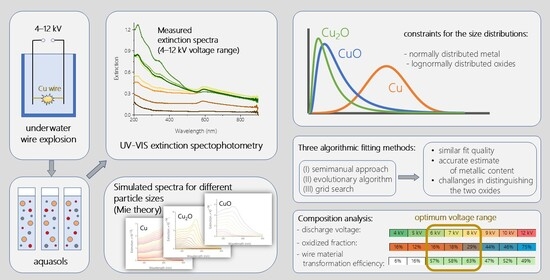
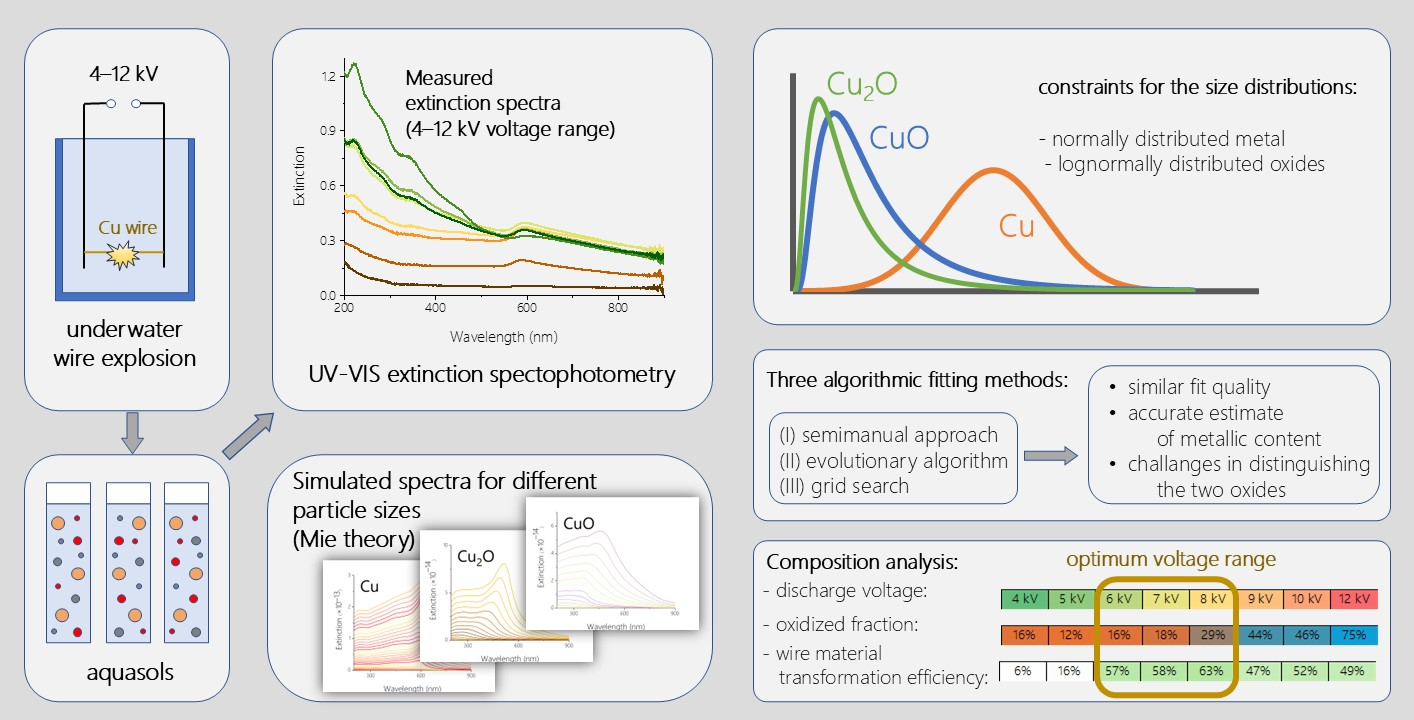
Wire explosion (WE) inherently generates particle ensembles spanning the nano- to microscale, posing challenges for conventional characterization methods in terms of capturing the full particle population. To address this issue, spectrophotometric analysis combined with algorithmic spectrum reconstruction based on Mie theory and constrained distribution models were employed to characterize copper WE products formed in aqueous surroundings within the 4–12 kV discharge voltage range. Three independent fitting strategies, specifically a semimanual fitting, an evolutionary algorithm, and a grid search, were applied to retrieve the size distributions and relative shares of copper and copper oxide particles as a function of discharge voltage. Based on experimental and theoretical findings, lognormal and normal distributions across the 10–300 nm diameter range were assumed as constraints for oxide and metallic fractions, respectively. The reconstructed metallic copper population exhibited mean diameters ranging from 123 to 181 nm, while oxidized fractions followed lognormal distributions centred near 10 nm mode diameters. Voltage-dependent trends revealed an optimal discharge regime between 6 kV and 8 kV, where the exploded fraction reached approximately 63% and the metallic mass share exceeded 80%. These results confirmed that spectrophotometry represents an essential tool for the quantitative characterization of such complex, wide-range systems.

Graphical Abstract

1. Introduction

Copper nanoparticles (CuNPs) are among the most extensively studied nanomaterials, since they represent a cost-effective alternative to noble metals like gold or silver nanoparticles in a wide range of applications [1]. This versatility stems from their unique electrical and thermal conductivity, catalytic activity, and optical properties, which are complemented by antimicrobial effects [2,3,4]. Selected innovative applications include conductive inks [5], catalytic agents [6], pharmaceutical uses with a focus on nanomedicine [7], and antimicrobial coatings for the food industry [8]. As a consequence of their broad applicability, numerous synthesis strategies have been developed. While some methods primarily serve laboratory-scale research and optimization, many have been designed with industry-level scalability in mind [9]. Chemical routes for CuNP production can generally be categorized into five main groups: chemical reduction, microemulsion techniques, photochemical synthesis, electrochemical methods, and thermal decomposition [1]. Physical methods include pulsed laser ablation [10,11,12], ball milling [13], and wire explosion [1]. A distinct class of approaches comprises the so-called ’green methods’. In the strict sense, this term refers to CuNP preparation techniques using living sources such as bacteria, fungi, or plants [14]. In a broader interpretation, however, any method can be considered ’green’ if it avoids potential environmental impact, such as the use of organic solvents or the generation of hazardous by-products [15].
As a well-established method [16], wire explosion, WE (also referred to as the exploding wire method) regained attention in the early 2000s as a physical NP generation technique [17,18,19,20] that aligns with green production principles outlined above. WE involves the rapid Joule heating of a metal wire in vacuum, under a gaseous atmosphere, or in a liquid, using high-current pulses with durations ranging from nanoseconds to microseconds [21]. Current densities in the wire as high as 104 to 106 A/mm2 result in plasma formation [22], and the wire material undergoes phase transitions leading to the ejection of vapour and molten droplets upon an explosive disintegration [23]. Similar to other physical NP generation techniques, the properties of the particles produced can be tuned by adjusting the experimental parameters, particularly the energy injected into the wire through the discharge voltage [24].
Although the experimental setup itself is simple and robust, and the method offers attractive NP production rates [25], the underlying complex, non-deterministic processes involving plasma expansion and shock wave formation results in multimodal particle size distributions ranging between a few nanometres and several hundred nanometres due to concurrent vapour condensation and melt fragmentation [20,26,27,28,29,30]. Theoretical and experimental findings have shown that, regardless of the material, two main particle populations can typically be distinguished in WE products: a smaller-sized population with a lognormal size distribution, formed by condensation from the vapour phase in the plasma, and a larger-sized population with a normal size distribution, originating from the disintegration of the molten phase [20,24,26,27,28,29,30,31,32,33,34,35,36,37,38,39]. In underwater WE of metals prone to oxidation, such as copper, the process is further complicated by the size dependence of the extent and rate of oxidation, with smaller nanoparticles exhibiting higher oxidation degrees due to their increased specific surface area [23,40,41,42]. In the terminology adopted throughout our research series [41,42], particles with diameters below 100 nm are referred to as “nanoparticles”, while those exceeding 100 nm are termed “fine particles”, in accordance with conventional definitions used in nanomaterials research. Although these categories do not necessarily coincide with the two size populations described above, the smaller population consists predominantly of nanoparticles, whereas the larger population mainly comprises fine particles.
Accurate determination of the particle size distribution across such a broad size range is highly demanding when relying on direct imaging techniques such as scanning or transmission electron microscopy [20,28,29,30,32]. These approaches, although capable of providing high-resolution structural information, require the acquisition and statistical evaluation of hundreds of micrographs at multiple magnifications to adequately capture both nano- and submicron-sized fractions and micron-sized fragments. Consequently, the process becomes extremely labour-intensive and prone to sampling bias, as each magnification setting represents a limited portion of the overall ensemble. In contrast, optical spectrophotometry enables the simultaneous probing of an enormously large ensemble of particles in a single measurement, offering statistically representative insights [34,35,36]. This approach not only complements microscopy-based sizing but also provides composition-sensitive information through wavelength-dependent extinction behaviour, thereby distinguishing metallic and oxidized species within the same population.
However, these extinction-based studies require extensive spectrum reconstruction due to the inherent heterogeneity of WE products. In our previous publications [41,42], we confirmed the bimodal size distribution by manually reconstructing optical extinction spectra as the weighted sum of the extinction spectra of the constituent metallic (copper) and oxidized (Cu2O and CuO in our model) particles, computed based on the Mie theory. Furthermore, we pointed out the sensitivity of spectrophotometry to subtle changes in the size distribution or oxidation state in copper WE products.
In the present work, we adopt the assumption of lognormal and normal distributions for the two respective particle populations, thereby reducing the degrees of freedom of the particle ensemble. This enables the application of algorithmic fitting methods, which are expected to be more systematic and robust than entirely manual fitting. We compare the performance and error margins of three methods at 6 kV discharge voltage, which lies in the mid-range of commonly used WE discharge voltages, to estimate the methodological uncertainty relative to the experimental deviation. The first method is a semimanual fitting procedure involving stepwise regional optimization. The second approach belongs to evolutionary algorithms, representing non-deterministic techniques. These are designed to optimize a fitness function that evaluates the quality of an individual solution and is particularly effective in cases where traditional mathematical methods struggle to find a satisfactory solution. The core idea is to mimic the steps of biological evolution—selection, recombination or crossover, and mutation—within the framework of an iterative process [43,44]. The third technique is a grid search method employing a ‘brute force’ approach used to find individuals with the lowest cost value. It is most commonly used for hyperparameter optimization in machine learning but can also be applied as a general optimization method. Here, an initial parameter set (an ‘individual’) must first be specified. Around this initial set, a grid of candidate values is generated, and the cost function is evaluated for each point in the grid. The best-performing individual—i.e., the parameter set with the lowest cost value is selected [45,46].

2. Materials and Methods

2.1. Wire Explosion Setup and Optical Characterization

In the experimental arrangement, illustrated in [41,42], an underdamped RLC circuit was formed with a Cu wire 70 µm in diameter and 20 mm in length, submerged in 100 mL of double-distilled water. Eight aquasols were prepared by triggering wire explosions with high-current pulses in the microsecond range, generated by discharging a 435 nF capacitor charged to 4 kV, 5 kV, 6 kV, 7 kV, 8 kV, 9 kV, 10 kV, and 12 kV. For each voltage, five consecutive explosions—typically separated by 1 min—were performed, and the combined product was sonicated for 10 min at room temperature to prevent aggregation and stabilize the aquasols. At 6 kV, two additional independent experiments were carried out to investigate the reproducibility of the WE process in terms of particle size distribution and chemical composition.
In each experiment, aliquots of approximately 4 cm3 were collected from the container after the final explosion and transferred into matched HELLMA QS 1.000 cuvettes (Hellma GmbH & Co. KG, Müllheim, Germany). Extinction spectra were recorded over the 200–900 nm range with a SHIMADZU UV-2101PC UV–VIS double-beam spectrophotometer (Shimadzu Europe GmbH, Duisburg, Germany), using distilled water in the reference arm. Over the course of several hours, the extinction of the aquasols gradually decreased as particles in the samples settled. Once sedimentation was complete, the extinction spectrum of the supernatant—attributed to dissolved ionic species in the solution—was recorded and subsequently used as the baseline in the fitting procedures.

2.2. Input Datasets for the Spectral Decomposition

Figure 1 shows extinction spectra in the 200–900 nm range, recorded by spectrophotometry for capacitor charging voltages between 4 kV and 12 kV, exhibiting a clear voltage dependence. Below 550 nm, the UV–VIS segment steepens progressively with increasing voltage up to 8 kV, and its spectral features become more pronounced. A peak close to 220 nm is present at all voltages but becomes particularly apparent from 8 kV onward, while a shoulder near 340 nm appears only from 6 kV upward. In the VIS–IR segment beyond 550 nm, a plasmon peak emerges at about 590 nm for voltages above 4 kV, reaching its highest prominence between 6 kV and 8 kV. Above 600 nm, extinction gently declines with increasing wavelength for all spectra.
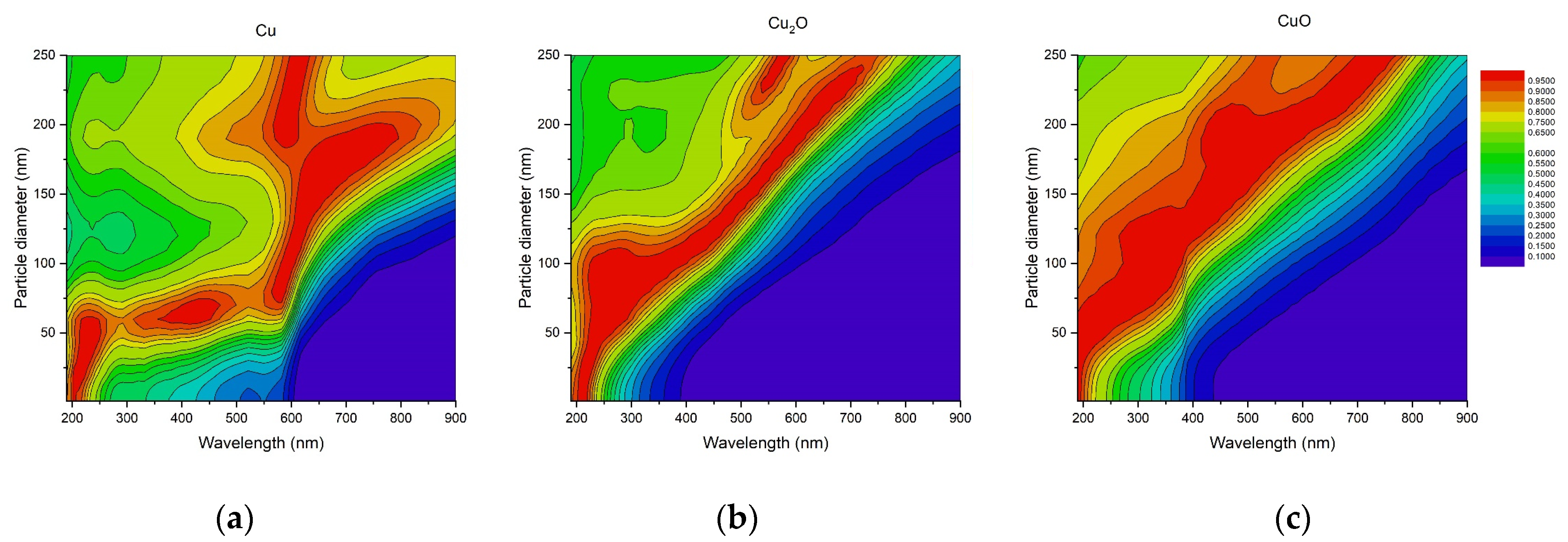
For spectrum deconvolution, elementary extinction spectra of isolated spherical Cu, CuO, and Cu2O nanoparticles were calculated using MiePlot v4.632 [47], developed by Philip Laven based on the Bohren–Huffman–Mie algorithm [48]. Modelling was carried out with 0.5 nm spectral resolution over the 200–900 nm wavelength range, assuming an aqueous environment and plane-wave illumination. For copper and water, the built-in dispersion functions were applied, originally published by Johnson and Christy [49] and Segelstein [50], while those for copper(I) and copper(II) oxides were derived from the literature [51,52,53,54]. The elementary spectra normalized to their respective maxima are presented in Figure 2a–c in form of contour plots. The extinction spectra exhibit distinct features characteristic of particle size and oxidation state, enabling reliable spectral deconvolution; however, the distinction between Cu2O and CuO becomes ambiguous for particles smaller than approximately 100 nm in diameter.
Figure 2a indicates that extinction of Cu particles smaller than ~60 nm in diameter mainly contributes to the 200–250 nm domain, likely associated with an interband transition [55,56]. At about 60 nm, this maximum shifts across the 300–500 nm spectral range, and a strong localized surface plasmon resonance (LSPR) peak characteristic of copper [57] emerges near 600 nm for particle sizes of 70 nm and above. Between 150 nm and 180 nm, the plasmon peak slightly broadens and redshifts, and it reappears near its original position from ~190 nm onward, possibly due to radiative damping suppressing the redshift [58,59]. Absolute extinction cross-section values increase markedly with particle size. At 600 nm, for instance, the extinction cross-section amounts to 1.70 × 10⁻¹⁴ m2, 8.99 × 10⁻¹⁴ m2, and 2.06 × 10⁻¹³ m2 for copper particles of 80 nm, 160 nm, and 240 nm in diameter, respectively, consistent with literature [60,61].
Figure 2b reveals that Cu2O nanoparticles exhibit significant extinction in the 200–250 nm wavelength domain [62]. With increasing particle size, this peak broadens and a narrower secondary maximum develops that gradually migrates from 400 nm to 700 nm. For particles above 200 nm, an additional extinction feature appears, shifting from 500 nm to 600 nm, presumably corresponding to a higher-order Mie resonance of one of the UV resonance peaks [63]. The contour map of CuO particles (Figure 2c) is largely similar to that of Cu2O, as also confirmed in [64], except that the extinction band shifting from 200 nm to 700 nm is generally broader and the higher-order harmonic structure appears more systematically. Further differences are that CuO particles smaller than 50 nm contribute primarily to the <200 nm wavelength domain [65], and the UV contribution of 50–100 nm particles is less pronounced than that of the Cu2O particles. Nevertheless, the strong similarity between the extinction patterns of Cu2O and CuO nanoparticles makes their distinction challenging, representing a methodological limitation that will be quantified later. In the reconstruction process, this uncertainty in separating the individual contributions of Cu2O and CuO is mitigated by merging the oxidized fractions.
Overall, nano-sized oxide particles exhibit negligible extinction in the spectral range corresponding to the copper LSPR [63,66], whereas larger oxide particles contribute to this range but exert only a moderate influence on the UV and short-wavelength visible regions [63]. The absence of significant extinction in the vicinity of the copper LSPR peak is characteristic not only of homogeneous oxide nanoparticles but also of core–shell structures that mimic partially oxidized copper particles, as demonstrated by a discrete-dipole approximation study [67].

2.3. Computational Methods

The size distribution of metallic particles w m d was modelled as a normal distribution within the 10–300 nm diameter range, using 10 nm bins:
w m d = A m · e x p d μ m 2 2 σ m 2 ,
where d is the particle diameter, A m is a scaling factor, and μ m and σ m are the mean and standard deviation of the distribution of the metallic particles, respectively. The contribution of oxidized particles (Cu2O and CuO) was approximated by separate lognormal distributions w o d for each oxide, defined over the 10–150 nm diameter range with 10 nm bin size:
w o d = A o · e x p ln d μ o * 2 2 σ o * 2 ,
where A o is a scaling factor for the oxidized particles, μ o * is the mean of the logarithmic diameter distribution, while   σ o * determines the width of the distribution of the oxidized species on a logarithmic scale. Using this formalism, the fitting procedures aim to optimize ten parameters that unambiguously define the 30, 15, and 15 bin weights for Cu, Cu2O, and CuO, respectively, along with the contribution of the baseline component. These ten key parameters are as follows:
  • The scaling factors A C u , A C u 2 O , and A C u O for copper, copper(I) oxide, and copper(II) oxide, respectively;
  • The mean μ C u and standard deviation σ C u of the copper size distribution;
  • The logarithmic means μ C u 2 O * and μ C u O * , and the logarithmic standard deviations σ C u 2 O * and σ C u O * , of the oxide distributions;
  • The weight of the baseline.
In this study, the consistency of results obtained from three different spectrum deconvolution methods, a semimanual fitting procedure, an evolutionary algorithm, and a grid search approach is evaluated. The goodness of the fits is quantitatively characterized by the normalized root mean square deviation (NRMSD) between the measured and reconstructed extinction spectra, defined as the ratio of the root mean square deviation between the measured and modelled datasets normalized to the measured average extinction along the whole spectral range. During the semimanual fitting procedure (SM), an initial approximation of the measured spectrum was achieved through manual adjustment of the key parameters, yielding typically 3–6% NRMSD. This rough fit served as a reasonable starting point for the subsequent algorithmic optimization. The primary goal of this visually guided tuning was to determine the appropriate scaling factors A C u , A C u 2 O , and A C u O , as our SM method favoured modifying the means and standard deviations rather than the preset scaling factors. The fitting followed an iterative strategy based on isolating the material classes and minimizing the mean square deviation between the measured and reconstructed functions using the minimize function of the SciPy Python library (version 1.15.3) with its default quasi-Newton optimization methods. In each step, either the baseline weight was adjusted, or a parameter triplet for one of the three material classes, comprising a scaling factor, a mean (linear or logarithmic), and a standard deviation (linear or logarithmic), was modified, while keeping the remaining parameters unchanged. These optimizations were carried out within manually defined spectral windows. The unmasking pattern first isolated the contributions of the baseline and the oxidized components, which dominate the UV–VIS region, then reconstructed the copper LSPR peak localized in the visible to near-infrared range. The fitting typically began with narrow unmasked regions in the UV (e.g., 200–300 nm or 250 nm–350 nm), where the baseline weight and the parameter triplets of the three material classes were optimized sequentially. The unmasked region was then gradually extended up to 550 nm to further refine the parameters of the oxidized components. Afterwards, the Cu parameter triplet was optimized by unmasking the VIS–IR range (typically 500–900 nm), enabling an accurate reconstruction of the LSPR peak. As a final step, the UV region was unmasked again to readjust the baseline, and then all parameters were fine-tuned across the full spectral range. The overall process, typically consisting of 25–30 optimization cycles, was largely consistent for all spectra, with only slight adjustments in the unmasking pattern to enable the accurate reconstruction of distinct spectral features. Visual inspection throughout the SM optimization helped avoid overfitting, particularly in broader spectral ranges.
In evolutionary algorithms (EAs), an initial population of candidate solutions is generated at the beginning, from which new populations are derived in each step. During selection, two parents are chosen based on their fitness values in the current population. They are then combined through crossover to produce one or more offspring, which are slightly modified via mutation. The cycle repeats until the desired population size is reached. Iterations continue until a termination condition is satisfied, such as reaching a maximum number of generations, or when the fitness function no longer improves over a specified number of iterations. In the present implementation, each individual encoded a set of the 10 key parameters listed above, and the fitness function was defined as the NRMSD between the measured and reconstructed extinction spectra. The initial population was generated by sampling parameter values from normal distributions centred on the output of the SM fit for a 6 kV reference sample. The standard deviations of these distributions were chosen to reflect the typical scale of each parameter, ensuring that the initial population covered a sufficiently broad yet physically realistic region of the parameter space. In each iteration step, a population of 100 individuals was generated, from which the 50 best individuals with the lowest fitness values were selected as parents. To generate children, a single-point crossover was applied, characterized by the crossover rate of 0.5, which defines the probability of performing crossover. In this process, a cutting point was randomly selected based on a uniform distribution. For the first child, parameters up to the cutting point were inherited from the first parent, while the remaining parameters originated from the second parent. To produce the second child, the roles of the parents were reversed, with the respective parameter segments swapped. Offspring were modified through mutation, characterized by a mutation rate (the probability that mutation is applied to an individual) and a mutation strength (the standard deviation of a normal distribution used to introduce Gaussian noise to the parameters of the individual). In our algorithm, the mutation rate was set to 0.4, and the mutation strength was set to {1 × 10¹⁰, 1× 10¹⁰, 1× 10⁹; 10.0, 10.0; 10.0, 10.0, 10.0, 10.0; 1.0} for the 10 key parameters, respectively. This relatively high mutation rate helps maintain diversity and reduces the risk of premature convergence, while the chosen mutation strength ensures that the perturbations are large enough to enable effective exploration of the search space, without destabilizing promising solutions. If the mutated individual exhibited a higher fitness value (i.e., worse performance), the unmutated version was retained. To account for the non-deterministic nature of EAs, final bin weights were obtained through averaging over ten independent runs.
For computational efficiency, the grid search method (GS) was implemented in four consecutive stages. In each stage, all ten key parameters were refined around a central point, with gradually increased grid resolution. The central point was identical to the parameter set used in the EA. In the first stage, a grid was constructed around the first three parameters ( μ C u 2 O * , σ C u 2 O * , and A C u 2 O ). In the second stage, the best-performing individual from the first grid served as the new initial parameter set, and the search was refined with an emphasis on the next three parameters ( μ C u O * , σ C u O * , and A C u O ). The third stage used the best candidate from the previous stage as the starting point to refine the grid for the copper-specific parameters ( μ C u , σ C u , and A C u ). Finally, in the fourth stage, the baseline weight was optimized using a one-dimensional grid. No early stopping or adaptive resolution control was applied. Therefore, the entire grid was evaluated in each stage to ensure exhaustive coverage of the parameter space [45,46].

3. Results

3.1. Evaluation Uncertainty of Extinction Spectrum Deconvolution

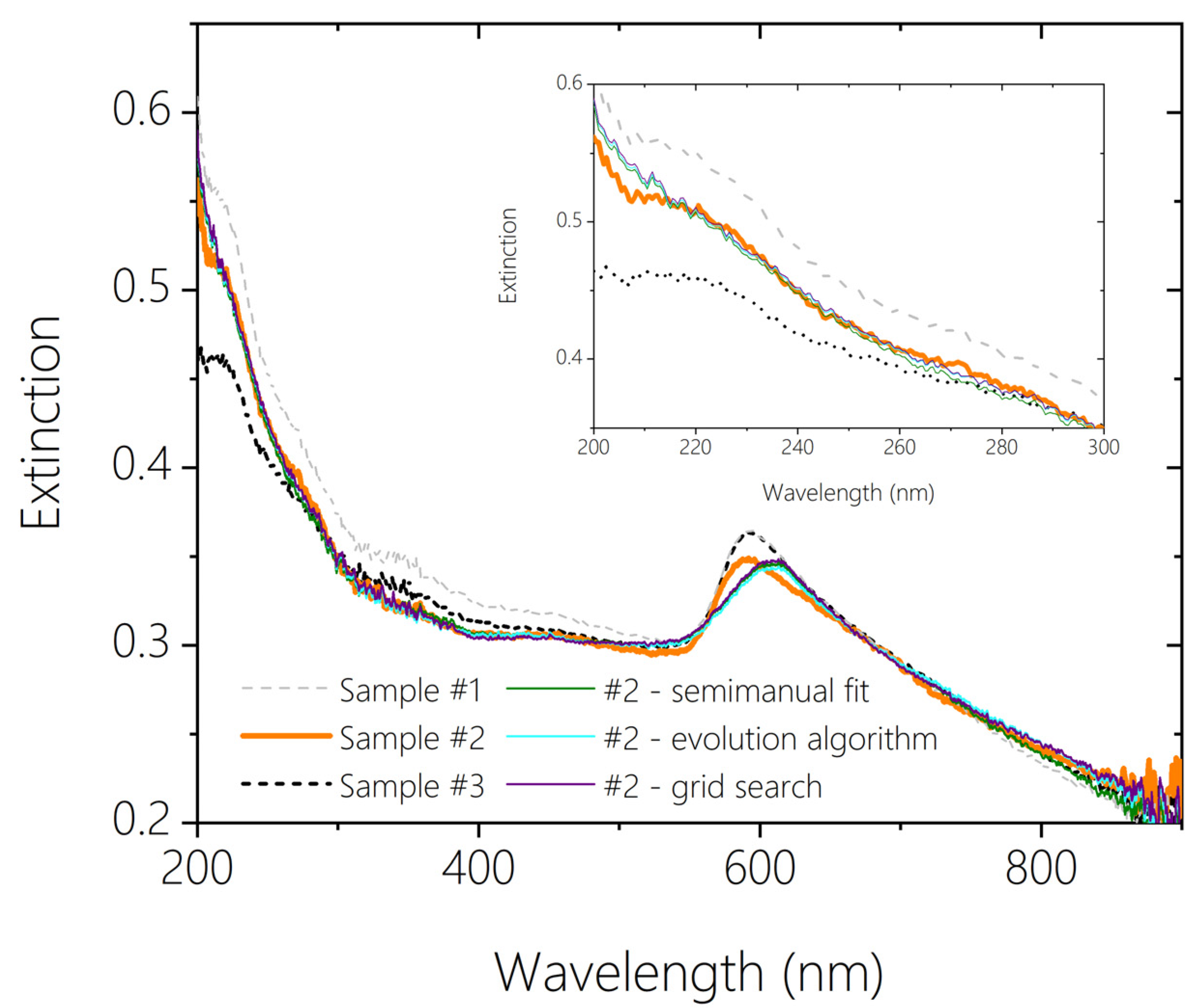
To assess and compare the performance of the three deconvolution approaches, the measured extinction curves of three samples, prepared by WE at 6 kV discharge voltage under identical experimental conditions, were reconstructed with the semimanual fitting, the evolutionary algorithm, and the grid search method. In Figure 3, the quality and consistency of the obtained fits are illustrated through the example of the extinction curve of one of the samples, which was reconstructed with the least accuracy. To facilitate comparison between the deviation of the fits relative to the experimental uncertainty, Figure 3 also includes the measured extinction spectra of the other two samples [42]. While the three reconstructions of the demonstrated sample practically overlapped, all three methods failed to capture the exact curvature of the LSPR peak and the shoulder in the deep UV as shown in the magnified inset of Figure 3. These discrepancies were also evident in the case of the other two samples, but to a more moderate degree, especially concerning the LSPR peak.
Table 1 presents the NRMSD values characterizing the agreement between the measured and reconstructed extinction spectra, providing an indicator of the performance of the fitting methods. Besides the three reconstruction approaches applied in the present study, assuming normally distributed copper and lognormally distributed copper oxides, Table 1 also includes NRMSD values for a manual fitting method reported in [42]. This earlier method did not apply any constraints in the form of predefined particle size distributions and was primarily intended to reproduce the visual appearance of the measured spectra as closely as possible. Although the constrained models were expected to yield less accurate fits due to their restricted flexibility, comparable NRMSD values were achieved: 1.94 ± 0.04%, 2.16 ± 0.23%, and 1.80 ± 0.09%.
As representative examples of the fitted parameters, Table 1 also lists the means and standard deviations of the normal distributions used to approximate the size distribution of the Cu particles in the ensemble. Regarding the means of the copper distributions, excellent consistency was observed among the three techniques with μ C u values of 145.0 ± 1.1 nm, 163.7 ± 5.1 nm, and 151.3 ± 0.9 nm for samples #1, #2, and #3, respectively. The standard deviations of the distributions, σ C u were associated with larger uncertainty (145.5 ± 4.6 nm, 127.8 ± 13.6 nm, and 144.2 ± 6.2 nm, respectively), especially in the case of sample #2, where GS predicted a much broader distribution than the other two methods. In agreement with their nearly overlapping LSPR peaks, μ C u and σ C u for samples #1 and #3 were in good agreement, while the reconstructed distribution of Cu particles in sample #2 was slightly narrower and minimally shifted toward larger particle sizes. Although less pronounced, the closer agreement between samples #1 and #3 was also reflected in the scaling factors, which were found to be 5.78 ± 0.16 × 1011 cm−3, 5.53 ± 0.52 × 1011 cm−3, and 5.65 ± 0.17 × 1011 cm−3 for samples #1, #2, and #3, respectively.
The modelled distributions of the oxidized particles exhibited weaker consistency across the three reconstruction methods: the distribution parameters derived from the EA and GSs were in almost complete agreement, while the SM fitting generally underestimated the means of the oxide distributions. Since no systematic correlation was found between the spectral appearance of the corresponding curves in the UV region (where the oxidized particles are expected to have the primary contribution) and the logarithmic means and standard deviations of the obtained distributions, we present these parameters in an averaged form for the three samples, separately for Cu2O and CuO:
μ C u 2 O * = 2.62 ± 0.79   nm ,   σ C u 2 O * = 0.70 ± 0.07   nm ;
μ C u O * = 2.19 ± 0.86   nm ,   σ C u O * = 0.69 ± 0.29   nm .
These values indicate that the mode of the reconstructed lognormal distribution for Cu2O numerically corresponds to a slightly larger particle diameter (2.1 nm) than that of the CuO particles (1.7 nm).
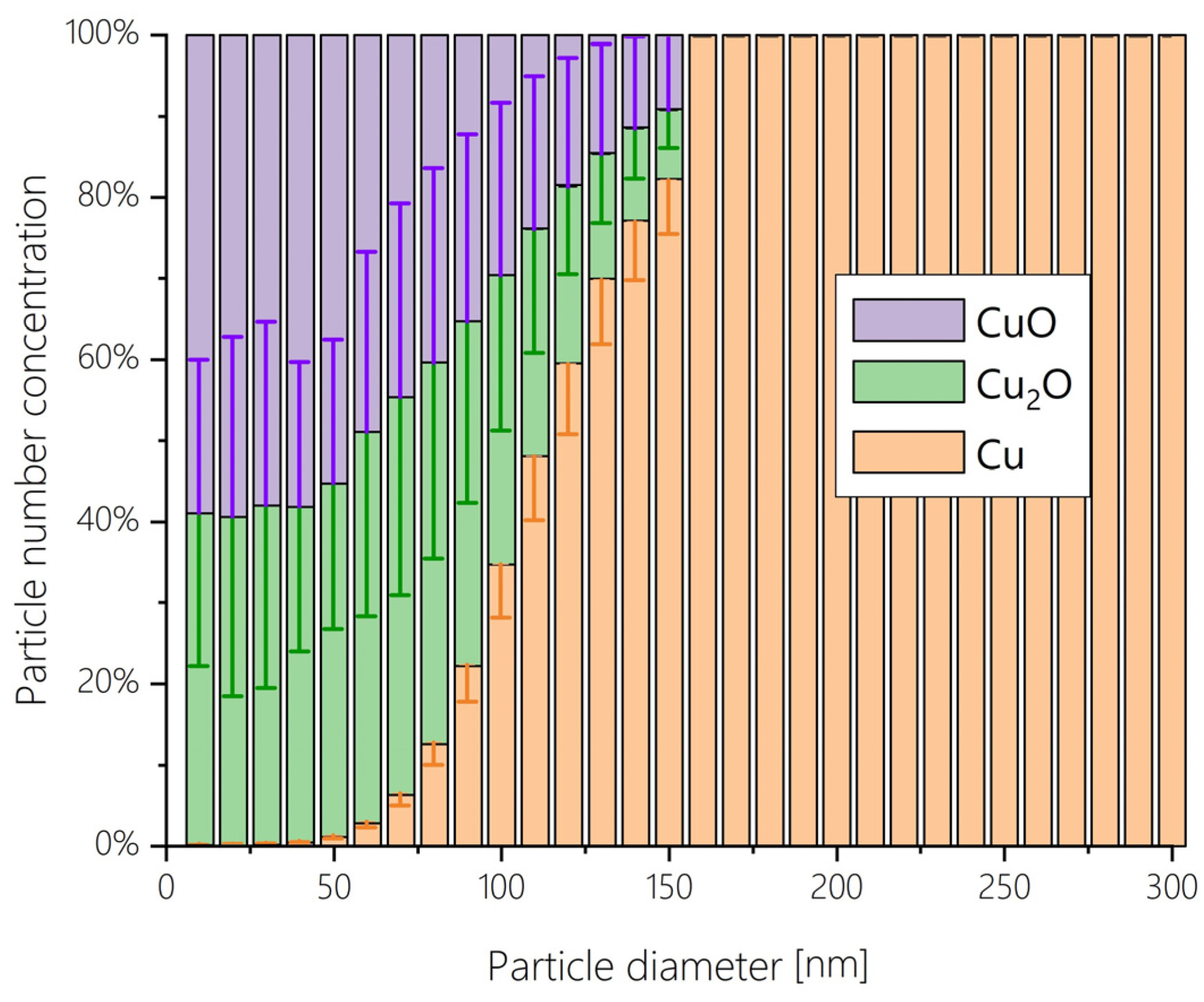
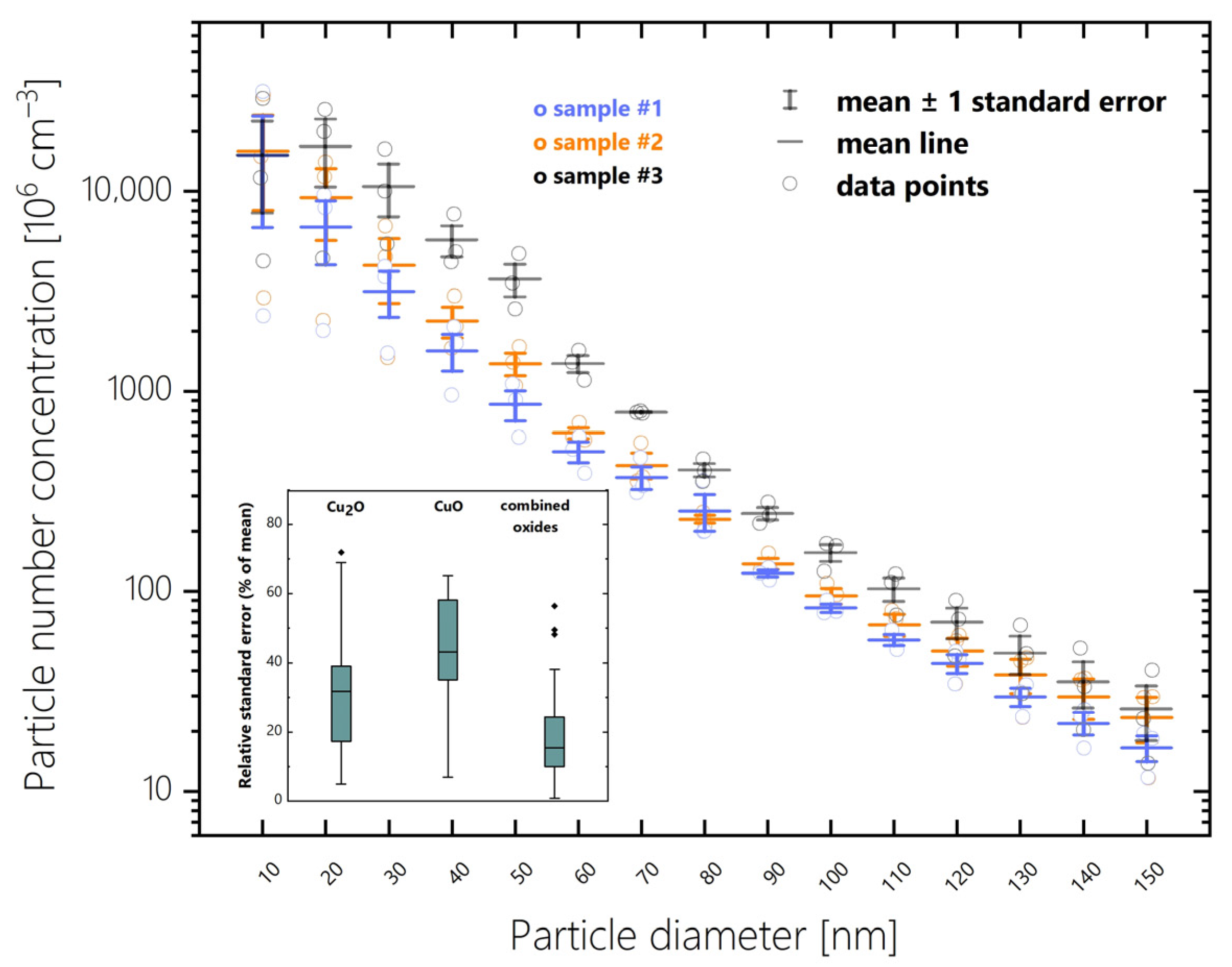
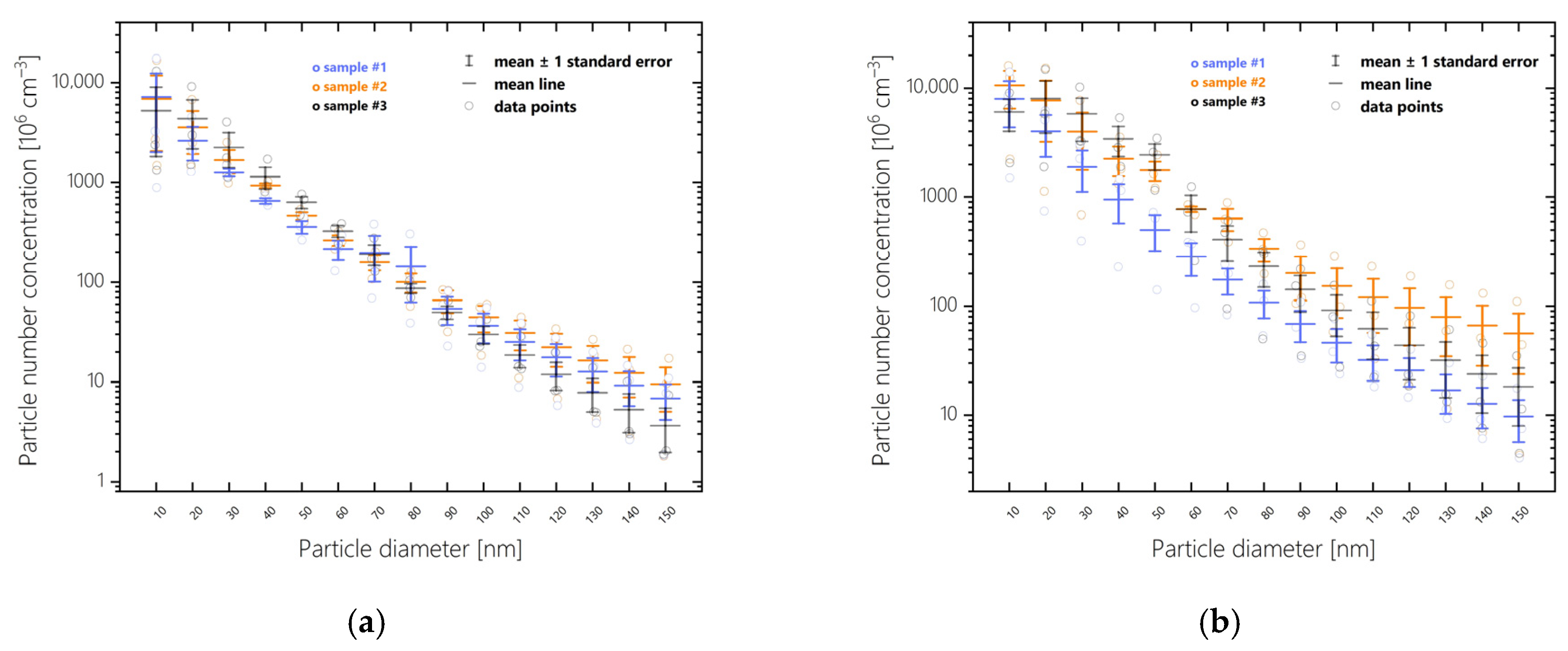
As illustrated in Figure 4a for Cu2O and Figure 4b for CuO, the large deviation in the parameters of the lognormal distributions of the oxides was similarly reflected in the particle number concentrations. These logarithmic plots demonstrate the average particle number concentrations in 10 nm size bins, with ±1 standard error shown as vertical error bars, obtained from the outputs of the SM, EA, and GS approaches. For reference, the individual data points are represented as circles in lighter colours.

3.2. Voltage-Dependent Trends in the WE Products

Extinction spectra of the aquasols produced at discharge voltages ranging between 4 kV and 12 kV were deconvoluted using the three methods, and their outputs were aggregated by discharge voltage for further analysis, including the 6 kV samples presented earlier. Table 2 summarizes the average NRMSD values characterizing the goodness of the fits, as well as the averaged means and standard deviations of the reconstructed copper distributions. According to the NRMSD values, the three methods reconstructed the measured extinction spectra within the 6–8 kV discharge voltage regime the most accurately and consistently (with the lowest NRMSD value of 1.81 ± 0.11% at 8 kV). Outside this window, a rising trend was observed towards both lower and higher voltages, with a maximum NRMSD value as high as 6.62 ± 1.47% at 4 kV.
While the NRMSD values exhibited a clear voltage dependency, the means of the Cu distributions remained nearly identical (165 ± 19 nm) across the voltages, particularly above 6 kV. The standard deviations of the Cu distributions (129 ± 35 nm) did not exhibit any pronounced correlation with the discharge voltage either. Based on the uncertainty in distinguishing the oxidized fractions identified at 6 kV, the parameters of the size distributions of Cu2O and CuO were not included in Table 2. Instead, an approximate yet informative analysis of the size distribution and chemical composition was performed by constructing composition matrices for each sample, categorizing the particles by both composition (metallic vs. oxidized) and size (nano-sized ≤ 100 nm vs. fine > 100 nm in diameter) in a 2 × 2 tabular format [42].
Based on particle number contributions to the total particle count, this analysis indicated that, on average, 90.9 ± 10% of the particle ensemble consisted of oxidized nanoparticles, with the remaining portion split almost equally between fine-sized metallic and oxidized particles, and metallic nanoparticles contributing only 1–2%. Even these statistics suggested systematic tendencies, such as an increasing proportion of nano-sized oxide (from 68.1% to 97.4%) and decreasing total metallic content (from 16.0% to 0.5%) as discharge voltage increased from 4 kV to 12 kV. However, the large deviations of these results—sometimes comparable in magnitude to the averages derived from the three evaluation methods—indicated that particle number concentrations are not reliable quantitative descriptors of these trends. This is consistent with the conclusion drawn from the investigation of experimental reproducibility of WE at 6 kV in [42].
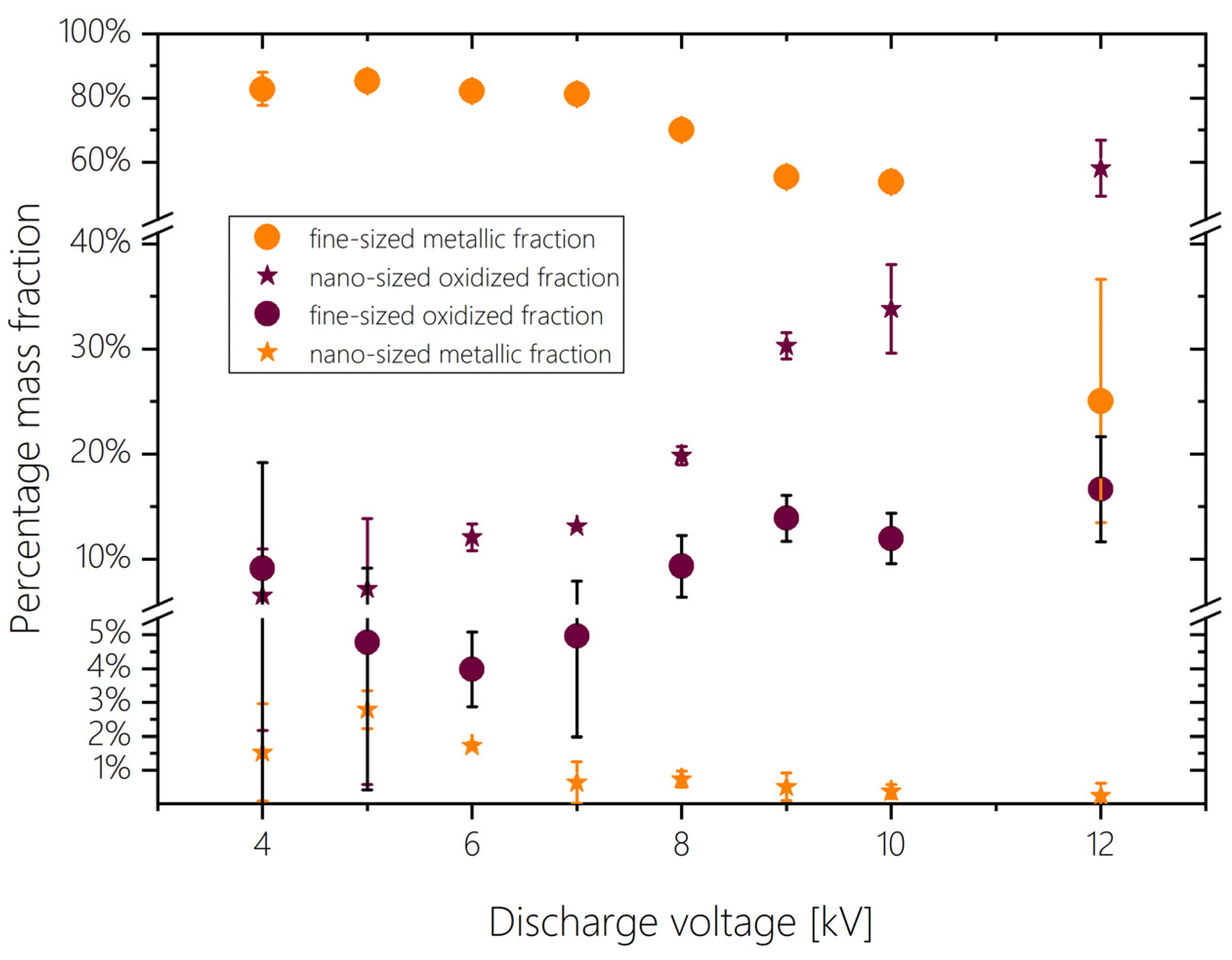
To provide a more robust interpretation, a complementary analysis based on particle mass contributions to the total mass of the product was conducted, using the same 4-field matrix representation. The voltage dependency of the composition matrix values representing particle mass statistics is demonstrated in Figure 5.
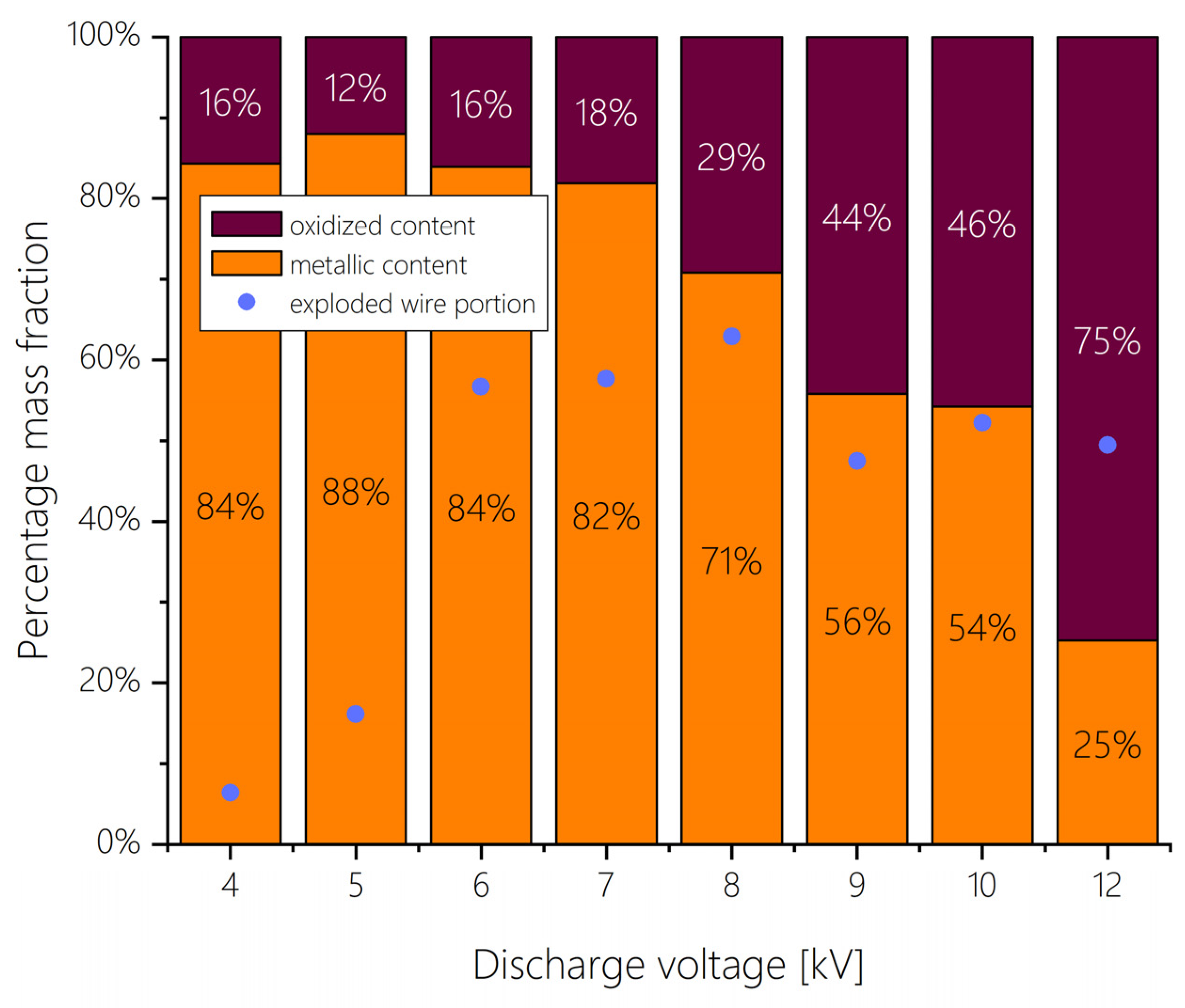
Contrary to the particle number statistics, particle mass-based analysis attributed a much greater role to metallic content. At discharge voltages up to 7 kV, fine-sized copper particles accounted for 80–85% of the total mass of WE products, while the contribution of nano-sized copper particles remained around 1%. Nano-sized and fine oxidized particles together made up approximately 15% of the mass, with the nano-sized fraction showing a tendency to increase with rising voltage. Above 7 kV, the mass fraction of fine-sized metallic particles decreased sharply to as low as 25% at 12 kV. Concomitantly, the mass shares of nano-sized and fine oxidized particles increased to 58% and 17%, respectively. The nano-sized metallic particles effectively disappeared at these higher voltages.

4. Discussion

The EA and the GSs showed some improvement in the reconstruction quality of the sample that was previously fitted with the least accuracy. SM fitting proved to offer quick qualitative orientation, providing rough fits suitable as a starting point for more advanced fitting algorithms. With additional effort, it also enabled reliable spectrum reconstructions, due to its ability to focus on specific spectral regions. However, this method was highly sensitive to local minima due to the applied masking and required substantial user intervention, thereby introducing a degree of subjectivity [68]. Unlike SM fitting, EA could effectively map the entire parameter space and was less prone to being trapped in local minima. These advantages largely stemmed from the method’s non-deterministic nature, which also introduced drawbacks: the inherent stochasticity could only be mitigated through repeated runs, but the computational cost and runtime increased with the number of generations and population size [69]. GS stood out for its determinism and reproducibility; however, its computational cost increased exponentially with both the resolution of the grid and the number of parameters [70].
In spite of the aforementioned operational differences, the three presented constrained methods (based on normally distributed metallic and lognormally distributed oxide particles) reconstructed the extinction spectra with favourable NRMSD values of approximately 2% for the three samples produced at 6 kV discharge voltage (Table 1), comparable to the results of the entirely manual fitting, which imposed no constraints on the particle size distributions. Above all, this finding supported the plausibility of assuming normally distributed metallic and lognormally distributed oxidized particles. NMRSD values for the entire sample series in Table 2 reinforced this assumption, suggesting that the size distributions predicted by this model were the closest to the actual size distributions within the discharge voltage range of 6 kV to 8 kV (with NRMSD values below 2%), and deviations were more likely at both lower and higher voltages.
On the other hand, since for the 6 kV sample, the performance of the three evaluation methods was found to be equivalent and no systematic inconsistencies were observed among the reconstruction outputs, they were considered appropriate for assessing the computational ambiguity in the evaluation of copper WE products, complementing the experimental ambiguity discussed in [42].
A practical approach to evaluate compositional uncertainty due to experimental and computational factors is to determine the relative contributions of the components (Cu, Cu2O, and CuO) across particle size bins and then aggregate these values across the three samples and the three reconstruction methods, as illustrated in Figure 6. This analysis revealed that the standard deviations of the Cu concentrations—which reflect the uncertainty in determining the metallic content—varied between 0.04% (at 20 nm) and 8.78% (at 120 nm). In contrast, the standard deviations for Cu2O and CuO concentrations were significantly higher, ranging from 4.65% to 24.54%, with a minimum at 150 nm diameter and a maximum in the 60–70 nm diameter domain. On one hand, this finding confirms that in underwater WE, the oxidation of copper particles involves less consistent and predictable physical processes than the formation of the metallic particles themselves, as suggested by many theoretical [27,31,36] and experimental [23,32] studies in the literature. However, it should also be considered that for Cu2O and CuO nanoparticles, the extinction spectra and their particle size dependent behaviour are highly similar, as demonstrated by Figure 2b,c. This similarity inherently limits the ability of spectrophotometry-based analysis to reliably distinguish between the copper oxides. This assumption is further supported by plotting the standard deviations of the total oxide concentrations per particle size bins, in a manner analogous to the separate analysis of Cu2O and CuO in Figure 4a,b.
In Figure 7, the error bars represent the standard errors of the combined oxidized fractions per size bins, derived from the individual particle number concentrations of Cu2O and CuO. It is apparent that the error bars, reflecting the inconsistency among the methods, narrowed radically, especially for particle size classes larger than 50 nm. This observation is further supported by the inset of Figure 7, which compares the variability of the standard errors of the particle concentrations (expressed as a percentage of the corresponding means) for the separate and combined oxides. The fact that combining Cu2O and CuO fractions reduces the variability of evaluation results confirms that the uncertainty in determining the contribution of oxidized particles primarily arises from the ambiguity between the two oxides. Consequently, it is reasonable to distinguish CuO and Cu2O during the fitting procedure to achieve high accuracy in spectrum deconvolution. However, the contributions of the two oxides should be merged afterwards for a reliable interpretation of the result. Based on the trends in Figure 6, it should also be noted that restricting the size domain of the oxidized particles to 0–150 nm range might have limited the accuracy of spectrum reconstruction, since oxidized fractions can be expected up to approximately 200 nm. Nonetheless, this contribution of larger particles is negligibly in terms of mass contribution and probably only affects the visual appearance of the reconstructed spectra around the LSPR peak and further decreases thereby NRMSD.
The voltage-dependence of the chemical composition of WE products can be more concisely represented by merging the nano- and fine-sized particle classes, as shown in Figure 8. This stacked bar chart confirms that oxidized fraction increases radically above 7 kV, providing a useful reference for optimizing the WE process for high metallic yield. However, this interpretation should be refined by considering how large a portion of the exploded wire mass was converted into copper in the WE product, a quantity referred to here as exploded fraction (EF). The voltage dependence of this measure of efficiency, calculated as the total copper mass in the particles (including both metallic and oxidized forms) relative to the original wire mass, is represented by the blue dots in Figure 8. EF amounts to 6.4% at 4 kV, indicating that the corresponding current was insufficient to initiate efficient wire fragmentation. With increasing voltage, EF rose steeply, reaching its maximum of 62.9% at 8 kV, then stabilized at approximately 50% at higher voltages. The trends in oxide content and EF shown together in Figure 8 define an optimal discharge voltage window for underwater copper WE, ranging between 6 kV and 8 kV. Within this domain, the efficiency of the transformation of the wire material into nano and fine particles is highest, while the extent of oxidation remains moderate.

5. Conclusions

This study compared three different algorithmic spectrum deconvolution methods—semimanual fitting, evolutionary algorithm, and grid search—to derive the particle size distribution and chemical composition of aquasols produced by underwater wire explosion of copper in a discharge voltage domain ranging from 4 kV to 12 kV. Assuming normally distributed metallic and lognormally distributed oxidized particles, extinction spectra could be reconstructed with high accuracy, and the uncertainty in determining the individual contributions of Cu2O and CuO was mitigated by merging the oxidized fractions. Although the semimanual approach requires significant user intervention and is subject to some extent of subjectivity, its ability to effectively focus on the spectral behaviour over limited wavelength domains makes this method appropriate for providing rough initial fits serving as starting parameter sets for more complex algorithms. Evolutionary algorithms allow a more extended search across a wider parameter space, thereby having a larger chance of finding the global optimum. Their stochastic nature, however, only provides stable results if several runs are averaged. As a deterministic local optimization technique, grid search is excellent for fine-tuning, but it requires reliable initial parameter sets because the computational cost rises drastically with the extension of the scanned parameter space. Therefore, in real applications, these methods are more appropriate for sequential rather than parallel use for spectral decomposition, within a spectrophotometric framework that enables simultaneous mapping of particle size distributions across both the nanoscale and submicron domains.
Particle mass-based analyses proved to be more reliable in terms of consistency among the three evaluation methods than particle number-based analyses. Considering the voltage-dependent trends in oxide formation and material conversion efficiency obtained from the mass-based analysis, a voltage range between 6 kV and 8 kV was identified as optimal for achieving high metallic content. These insights provide a basis for optimizing the copper wire explosion process for scalable nanoparticle production with minimal oxidation.
The present methodological analysis demonstrates that spectrophotometry-based evaluation offers an efficient solution for the reliable characterization of broad and multimodal particle size distributions. Beyond overcoming the limitations of direct imaging techniques, this approach simultaneously provides additional information, including the relative contributions of metallic and oxidized species, as well as the voltage-dependent transformation efficiency of the wire material.
The Cu–Cu2O–CuO system has proven to be an effective test case for validating the reconstruction methodology proposed in our research series. This system is sufficiently complex to challenge the fitting algorithms, yet the spectral contrast between its constituent fractions (except for the partial overlap between the nanosized oxidized phases) still allows reliable differentiation and quantitative reconstruction. Having established the robustness of the approach in this chemically and morphologically intricate material system, the methodology can readily be extended to other particle systems to reveal their size distribution and chemical composition across the nano- and submicron scales. The same computational framework can be applied to other metal–oxide systems, such as the metallic and oxidized forms of Zn, Ni, and Ag [71,72,73,74], provided that the dielectric functions of the respective phases are known and sufficiently distinctive. Moreover, the approach can be adapted for analyzing core–shell structures by introducing composite dielectric functions derived from effective-medium approximations [66]. This offers a clear advantage over conventional imaging-based techniques, from which compositional details of the individual particles are often difficult to resolve. From a practical perspective, several technologically important noble metals, including Au and Pt, are chemically inert even under extreme synthesis conditions. In such cases, oxidation does not significantly affect their optical response, and the analysis can be simplified to determining the size distribution of the metallic particles [75,76]. Nevertheless, the advantages of spectrophotometric evaluation—its simplicity and ability to statistically characterize large particle populations in parallel—remain significant, particularly when employed as a complementary tool alongside conventional microscopic screening methods such as TEM.

Author Contributions

Conceptualization, L.É. and T.S.; methodology, L.É. and E.G.; software, E.G. and L.É.; validation, L.É. and T.S.; formal analysis, E.G. and L.É.; investigation, T.S. and L.É.; resources, T.S.; data curation, L.É.; writing—original draft preparation, L.É., E.G. and T.S.; writing—review and editing, L.É., T.S. and E.G.; visualization, L.É.; supervision, T.S.; project administration, T.S.; funding acquisition, T.S. All authors have read and agreed to the published version of the manuscript.

Funding

This research received no external funding.

Institutional Review Board Statement

Not applicable.

Informed Consent Statement

Not applicable.

Data Availability Statement

The raw data supporting the conclusions of this article will be made available by the authors on request.

Acknowledgments

Sándor Szatmári is gratefully acknowledged for providing the special high-current, short-pulse power supply. During the preparation of this manuscript, the authors used Consensus AI platform for assistance with academic language revision. The authors have reviewed and edited the output and take full responsibility for the content of this publication.

Conflicts of Interest

The authors declare no conflicts of interest.

Abbreviations

The following abbreviations are used in this manuscript:
CuNPCopper Nanoparticle
EAEvolutionary Algorithm
EFExploded Fraction
GSGrid Search
IRInfrared
NPNanoparticle
SMSemimanual (fitting)
UVUltraviolet
VISVisible
WEWire Explosion

References

  1. Khodashenas, B.; Ghorbani, H.R. Synthesis of Copper Nanoparticles: An Overview of the Various Methods. Korean J. Chem. Eng. 2014, 31, 1105–1109. [Google Scholar] [CrossRef]
  2. Purohit, P.; Samadi, A.; Bendix, P.M.; Laserna, J.J.; Oddershede, L.B. Optical Trapping Reveals Differences in Dielectric and Optical Properties of Copper Nanoparticles Compared to Their Oxides and Ferrites. Sci. Rep. 2020, 10, 1198. [Google Scholar] [CrossRef]
  3. Zamir Anvari, J.; Karimzadeh, R.; Mansour, N. Thermo-Optic Properties and Nonlinear Responses of Copper Nanoparticles in Polysiloxane oil. J. Opt. 2010, 12, 035212. [Google Scholar] [CrossRef]
  4. Crisan, M.C.; Teodora, M.; Lucian, M. Copper Nanoparticles: Synthesis and Characterization, Physiology, Toxicity and Antimicrobial Applications. Appl. Sci. 2021, 12, 141. [Google Scholar] [CrossRef]
  5. Zhang, P.; Sun, Q.; Fang, S.; Guo, H.; Liu, K.; Zhang, L.; Zhu, Q.; Wang, M. Fabrication of Nano Copper Highly Conductive and Flexible Printed Electronics by Direct Ink Writing. ACS Appl. Mater. Interfaces 2025, 17, 1847–1860. [Google Scholar] [CrossRef]
  6. Pathak, R.; Punetha, V.D.; Bhatt, S.; Punetha, M. A Review on Copper-Based Nanoparticles as a Catalyst: Synthesis and Applications in Coupling Reactions. J. Mater. Sci. 2024, 59, 6169–6205. [Google Scholar] [CrossRef]
  7. Devaraji, M.; Thanikachalam, P.V.; Elumalai, K. The Potential of Copper Oxide Nanoparticles in Nanomedicine: A Comprehensive Review. Biotechnol. Notes 2024, 5, 80–99. [Google Scholar] [CrossRef]
  8. Shankar, S.; Rhim, J.-W. Effect of Copper Salts and Reducing Agents on Characteristics and Antimicrobial Activity of Copper Nanoparticles. Mater. Lett. 2014, 132, 307–311. [Google Scholar] [CrossRef]
  9. Cioffi, N.; Ditaranto, N.; Torsi, L.; Sabbatini, L. Approaches to Synthesis and Characterization of Spherical and Anisotropic Copper Nanomaterials. In Nanotechnologies for the Life Sciences; Kumar, C.S.S.R., Ed.; Wiley: Hoboken, NJ, USA, 2008. [Google Scholar]
  10. Amendola, V.; Meneghetti, M. Laser Ablation Synthesis in Solution and Size Manipulation of Noble Metal Nanoparticles. Phys. Chem. Chem. Phys. 2009, 11, 3805. [Google Scholar] [CrossRef]
  11. Goncharova, D.A.; Kharlamova, T.S.; Lapin, I.N.; Svetlichnyi, V.A. Chemical and Morphological Evolution of Copper Nanoparticles Obtained by Pulsed Laser Ablation in Liquid. J. Phys. Chem. C 2019, 123, 21731–21742. [Google Scholar] [CrossRef]
  12. Begildayeva, T.; Lee, S.J.; Yu, Y.; Park, J.; Kim, T.H.; Theerthagiri, J.; Ahn, A.; Jung, H.J.; Choi, M.Y. Production of Copper Nanoparticles Exhibiting Various Morphologies via Pulsed Laser Ablation in Different Solvents and Their Catalytic Activity for Reduction of Toxic Nitroaromatic Compounds. J. Hazard. Mater. 2021, 409, 124412. [Google Scholar] [CrossRef]
  13. Barai, K.; Tiwary, C.S.; Chattopadhyay, P.P.; Chattopadhyay, K. Synthesis of Free Standing Nanocrystalline Cu by Ball Milling at Cryogenic Temperature. Mater. Sci. Eng. A 2012, 558, 52–58. [Google Scholar] [CrossRef]
  14. Saxena, R.; Kotnala, S.; Bhatt, S.C.; Uniyal, M.; Rawat, B.S.; Negi, P.; Riyal, M.K. A Review on Green Synthesis of Nanoparticles toward Sustainable Environment. Sustain. Chem. Clim. Action 2025, 6, 100071. [Google Scholar] [CrossRef]
  15. Abuzeid, H.M.; Julien, C.M.; Zhu, L.; Hashem, A.M. Green Synthesis of Nanoparticles and Their Energy Storage, Environmental, and Biomedical Applications. Crystals 2023, 13, 1576. [Google Scholar] [CrossRef]
  16. Thrush, B.A. The Exploding Wire Phenomenon. Nature 1960, 187, 726–727. [Google Scholar] [CrossRef]
  17. Lerner, M.I.; Shamanskii, V.V. Synthesis of Nanoparticles by High-Power Current Pulses. J. Struct. Chem. 2004, 45, S111–S114. [Google Scholar] [CrossRef]
  18. Kim, W.; Park, J.; Suh, C.; Lee, J.; Kim, J.; Oh, Y.-J. A New Method for the Production of Alloy Nanoparticles by Electrical Wire Explosion. Mater. Trans. 2007, 48, 1973–1974. [Google Scholar] [CrossRef]
  19. Sen, P.; Ghosh, J.; Abdullah, A.; Kumar, P. Vandana Preparation of Cu, Ag, Fe and Al Nanoparticles by the Exploding Wire Technique. J. Chem. Sci. 2003, 115, 499–508. [Google Scholar] [CrossRef]
  20. Pervikov, A.; Toropkov, N.; Kazantsev, S.; Bakina, O.V.; Glazkova, E.; Lerner, M. Preparation of Nano/Micro Bimodal Aluminum Powder by Electrical Explosion of Wires. Materials 2021, 14, 6602. [Google Scholar] [CrossRef]
  21. Lee, Y.S.; Tay, W.H.; Yap, S.L.; Wong, C.S.; Ahmad, Z.; Chia, S.-P.; Ratnavelu, K.; Muhamad, M.R. Copper Nanoparticle Synthesis by the Wire Explosion Technique. AIP Conf. Proc. 2009, 1150, 452–455. [Google Scholar]
  22. Oreshkin, V.I.; Baksht, R.B. Wire Explosion in Vacuum. IEEE Trans. Plasma Sci. 2020, 48, 1214–1248. [Google Scholar] [CrossRef]
  23. Park, S.; Lee, H.; Chung, K.-J. Liquid–Vapor Phase Transition Process during Underwater Electrical Wire Explosion. AIP Adv. 2023, 13, 065002. [Google Scholar] [CrossRef]
  24. Aravinth, S.; Sankar, B.; Chakravarthi, S.R.; Sarathi, R. Generation and Characterization of Nano Tungsten Oxide Particles by Wire Explosion Process. Mater. Charact. 2011, 62, 248–255. [Google Scholar] [CrossRef]
  25. Maqsood, K.; Ullah, S.; Rehman, A.U.; Bashir, H.; Shah, S.S.A.; Nazir, M.A. Recent Progress of Metallic Nanomaterials in Energy, Biomedical and Environment Sector. Next Res. 2025, 2, 100887. [Google Scholar] [CrossRef]
  26. Pervikov, A.; Lerner, M.; Krukovskii, K. Structural Characteristics of Copper Nanoparticles Produced by the Electric Explosion of Wires with Different Structures of Metal Grains. Curr. Appl. Phys. 2017, 17, 201–206. [Google Scholar] [CrossRef]
  27. Tkachenko, S.I.; Vorob’ev, V.S.; Malyshenko, S.P. The Nucleation Mechanism of Wire Explosion. J. Phys. Appl. Phys. 2004, 37, 495–500. [Google Scholar] [CrossRef]
  28. Lee, Y.S.; Bora, B.; Yap, S.L.; Wong, C.S. Effect of Ambient Air Pressure on Synthesis of Copper and Copper Oxide Nanoparticles by Wire Explosion Process. Curr. Appl. Phys. 2012, 12, 199–203. [Google Scholar] [CrossRef]
  29. Kwon, Y.-S.; Jung, Y.-H.; Yavorovsky, N.A.; Illyn, A.P.; Kim, J.-S. Ultra-Fine Powder by Wire Explosion Method. Scr. Mater. 2001, 44, 2247–2251. [Google Scholar] [CrossRef]
  30. Tokoi, Y.; Cho, H.-B.; Suzuki, T.; Nakayama, T.; Suematsu, H.; Niihara, K. Particle Size Determining Equation in Metallic Nanopowder Preparation by Pulsed Wire Discharge. Jpn. J. Appl. Phys. 2013, 52, 055001. [Google Scholar] [CrossRef]
  31. Bora, B.; Wong, C.S.; Bhuyan, H.; Lee, Y.S.; Yap, S.L.; Favre, M. Understanding the Mechanism of Nanoparticle Formation in Wire Explosion Process. J. Quant. Spectrosc. Radiat. Transf. 2013, 117, 1–6. [Google Scholar] [CrossRef]
  32. Kwon, Y.S.; An, V.V.; Ilyin, A.P.; Tikhonov, D.V. Properties of Powders Produced by Electrical Explosions of Copper–Nickel Alloy Wires. Mater. Lett. 2007, 61, 3247–3250. [Google Scholar] [CrossRef]
  33. Ju Park, E.; Won Lee, S.; Bang, I.C.; Park, H.W. Optimal Synthesis and Characterization of Ag Nanofluids by Electrical Explosion of Wires in Liquids. Nanoscale Res. Lett. 2011, 6, 223. [Google Scholar] [CrossRef]
  34. Kinemuchi, Y.; Sangurai, C.; Suzuki, T.; Suematsu, H.; Jiang, W.; Yatsui, K. Synthesis of Nanosize Powders of Aluminum Nitride by Pulsed Wire Discharge. In Proceedings of the PPPS-2001 Pulsed Power Plasma Science 2001. 28th IEEE International Conference on Plasma Science and 13th IEEE International Pulsed Power Conference. Digest of Papers (Cat. No.01CH37251), Las Vegas, NV, USA, 17–22 June 2001; IEEE: New York, NY, USA, 2001; Volume 2, pp. 1830–1833. [Google Scholar]
  35. Peng, C.; Wang, J.; Zhou, N.; Sun, G. Fabrication of Nanopowders by Electrical Explosion of a Copper Wire in Water. Curr. Appl. Phys. 2016, 16, 284–287. [Google Scholar] [CrossRef]
  36. Tkachenko, S.I.; Kuskova, N.I. Dynamics of Phase Transitions at Electrical Explosion of Wire. J. Phys. Condens. Matter 1999, 11, 2223–2232. [Google Scholar] [CrossRef]
  37. Antony, J.K.; Vasa, N.J.; Chakravarthy, S.R.; Sarathi, R. Understanding the Mechanism of Nano-Aluminum Particle Formation by Wire Explosion Process Using Optical Emission Technique. J. Quant. Spectrosc. Radiat. Transf. 2010, 111, 2509–2516. [Google Scholar] [CrossRef]
  38. Minin, I.V.; Uchaikin, S.; Rogachev, A.; Starý, O. (Eds.) Progress in Material Science and Engineering; Studies in Systems, Decision and Control; Springer International Publishing: Cham, Switzerland, 2021; Volume 351. [Google Scholar]
  39. Liu, H.; Zhao, J.; Zhang, R.; Guo, C.; Zhang, Q. Dimensional Effects of Electrically Exploding Aluminum Wires in Argon Gas: Experimental Investigation. J. Appl. Phys. 2020, 128, 073301. [Google Scholar] [CrossRef]
  40. Park, E.; Park, H.W.; Lee, J. Synthesis of Hierarchical Copper Oxide Composites Prepared via Electrical Explosion of the Wire in Liquids Method. Colloids Surf. A Physicochem. Eng. Asp. 2015, 482, 710–717. [Google Scholar] [CrossRef]
  41. Égerházi, L.; Kovács, B.; Szörényi, T. Spectroscopic Quantification of the Nanoparticle Production Efficiency of Copper Wire Explosion. J. Appl. Phys. 2021, 129, 195902. [Google Scholar] [CrossRef]
  42. Égerházi, L.; Szörényi, T. The Potential of Wire Explosion in Nanoparticle Production in Terms of Reproducibility. Materials 2024, 17, 3450. [Google Scholar] [CrossRef]
  43. Bäck, T.; Schwefel, H.-P. An Overview of Evolutionary Algorithms for Parameter Optimization. Evol. Comput. 1993, 1, 1–23. [Google Scholar] [CrossRef]
  44. Slowik, A.; Kwasnicka, H. Evolutionary Algorithms and Their Applications to Engineering Problems. Neural Comput. Appl. 2020, 32, 12363–12379. [Google Scholar] [CrossRef]
  45. Belete, D.M.; Huchaiah, M.D. Grid Search in Hyperparameter Optimization of Machine Learning Models for Prediction of HIV/AIDS Test Results. Int. J. Comput. Appl. 2022, 44, 875–886. [Google Scholar] [CrossRef]
  46. Stuke, A.; Rinke, P.; Todorović, M. Efficient Hyperparameter Tuning for Kernel Ridge Regression with Bayesian Optimization. Mach. Learn. Sci. Technol. 2021, 2, 035022. [Google Scholar] [CrossRef]
  47. Laven, P. MiePlot Software Download Site. Available online: http://www.philiplaven.com/mieplot.htm (accessed on 11 July 2024).
  48. Bohren, C.F.; Huffman, D.R. Absorption and Scattering of Light by Small Particles, 1st ed.; Wiley: Hoboken, NJ, USA, 1998. [Google Scholar]
  49. Johnson, P.B.; Christy, R.W. Optical Constants of the Noble Metals. Phys. Rev. B 1972, 6, 4370–4379. [Google Scholar] [CrossRef]
  50. Segelstein, D.J. The Complex Refractive Index of Water. M.Sc. Thesis, University of Missiouri-Kansas City, Kansas City, MO, USA, 1981. [Google Scholar]
  51. Tahir, D.; Tougaard, S. Electronic and Optical Properties of Cu, CuO and Cu2O Studied by Electron Spectroscopy. J. Phys. Condens. Matter 2012, 24, 175002. [Google Scholar] [CrossRef]
  52. Palik, E.D.; Palik, E.D. Handbook of Optical Constants of Solids, Author and Subject Indices for Volumes I, II, and III, 1st ed.; Elsevier: Amsterdam, The Netherlands, 1997. [Google Scholar]
  53. Drobny, V.F.; Pulfrey, L. Properties of Reactively-Sputtered Copper Oxide Thin Films. Thin Solid Films 1979, 61, 89–98. [Google Scholar] [CrossRef]
  54. Meyer, B.K.; Polity, A.; Reppin, D.; Becker, M.; Hering, P.; Klar, P.J.; Sander, T.; Reindl, C.; Benz, J.; Eickhoff, M.; et al. Binary Copper Oxide Semiconductors: From Materials towards Devices. Phys. Status Solidi B 2012, 249, 1487–1509. [Google Scholar] [CrossRef]
  55. Creighton, J.A.; Eadon, D.G. Ultraviolet–Visible Absorption Spectra of the Colloidal Metallic Elements. J. Chem. Soc. Faraday Trans. 1991, 87, 3881–3891. [Google Scholar] [CrossRef]
  56. Desarkar, H.S.; Kumbhakar, P.; Mitra, A.K. Effect of Ablation Time and Laser Fluence on the Optical Properties of Copper Nano Colloids Prepared by Laser Ablation Technique. Appl. Nanosci. 2012, 2, 285–291. [Google Scholar] [CrossRef]
  57. Kluczyk, K.; Jacak, W.A. Size Effect in Plasmon Resonance of Metallic Nanoparticles: RPA versus COMSOL. Acta Phys. Pol. A 2016, 129, A-83–A-86. [Google Scholar] [CrossRef]
  58. Scaffardi, L.B.; Schinca, D.C.; Lester, M.; Videla, F.A.; Santillán, J.M.J.; Ekeroth, R.M.A. Size-Dependent Optical Properties of Metallic Nanostructures. In UV-VIS and Photoluminescence Spectroscopy for Nanomaterials Characterization; Kumar, C., Ed.; Springer: Berlin/Heidelberg, Germany, 2013; pp. 179–229. [Google Scholar]
  59. Melikyan, A.; Minassian, H. On Surface Plasmon Damping in Metallic Nanoparticles. Appl. Phys. B 2004, 78, 453–455. [Google Scholar] [CrossRef][Green Version]
  60. Xu, Y.; Deng, L.; Kuang, D.; Xie, H.; Shan, D.; Wang, X.; Huang, S.; Luo, H. Cu@C Core-Shell Nanoparticles with Efficient Optical Absorption: DDA-Based Simulation and Experimental Validation. Results Phys. 2020, 16, 102885. [Google Scholar] [CrossRef]
  61. Pò, C.L.; Iacono, V.; Boscarino, S.; Grimaldi, M.G.; Ruffino, F. Monte Carlo Approach to the Evaluation of Nanoparticles Size Distribution from the Analysis of UV-Vis-NIR Spectra. Micromachines 2023, 14, 2208. [Google Scholar] [CrossRef]
  62. Quintero, M.; Manrique-Moreno, M.; Riascos, H.; Torres-Palma, R.A.; Castro-Narvaez, S.; Ávila-Torres, Y.P. Laser Ablation for the Synthesis of Cu/Cu2O/CuO and Its Development as Photocatalytic Material for Escherichia coli Detoxification. Int. J. Mol. Sci. 2024, 25, 6817. [Google Scholar] [CrossRef]
  63. Mohammadparast, F.; Ramakrishnan, S.B.; Khatri, N.; Tirumala, R.T.A.; Tan, S.; Kalkan, A.K.; Andiappan, M. Cuprous Oxide Cubic Particles with Strong and Tunable Mie Resonances for Use as Nanoantennas. ACS Appl. Nano Mater. 2020, 3, 6806–6815. [Google Scholar] [CrossRef]
  64. Tyurnina, A.E.; Shur, V.Y.; Kozin, R.V.; Kuznetsov, D.K.; Pryakhina, V.I.; Burban, G.V. Synthesis and Investigation of Stable Copper Nanoparticle Colloids. Phys. Solid State 2014, 56, 1431–1437. [Google Scholar] [CrossRef]
  65. Ramakrishnan, S.B.; Khatri, N.; Addanki Tirumala, R.T.; Mohammadparast, F.; Karuppasamy, K.; Kalkan, A.K.; Andiappan, M. Cupric Oxide Mie Resonators. J. Phys. Chem. C 2022, 126, 16272–16279. [Google Scholar] [CrossRef]
  66. Ghodselahi, T.; Vesaghi, M.A.; Shafiekhani, A. Study of Surface Plasmon Resonance of Cu@Cu2O Core–Shell Nanoparticles by Mie Theory. J. Phys. D Appl. Phys. 2009, 42, 015308. [Google Scholar] [CrossRef]
  67. Liu, Z.; Xu, B.; Cheng, Y.; Si, M.; Chu, X.; Sun, M.; Fang, Y. Spectral Analysis of Oxidation on Localized Surface Plasmon Resonance of Copper Nanoparticles Thin Film. Spectrochim. Acta. A. Mol. Biomol. Spectrosc. 2023, 303, 123202. [Google Scholar] [CrossRef] [PubMed]
  68. Maiwald, T.; Timmer, J. Dynamical Modeling and Multi-Experiment Fitting with PottersWheel. Bioinformatics 2008, 24, 2037–2043. [Google Scholar] [CrossRef]
  69. Oliveto, P.S.; Witt, C. On the Runtime Analysis of the Simple Genetic Algorithm. Theor. Comput. Sci. 2014, 545, 2–19. [Google Scholar] [CrossRef]
  70. Bergstra, J.; Bengio, Y. Random Search for Hyper-Parameter Optimization. J. Mach. Learn. Res. 2012, 13, 281–305. [Google Scholar]
  71. Talam, S.; Karumuri, S.R.; Gunnam, N. Synthesis, Characterization, and Spectroscopic Properties of ZnO Nanoparticles. ISRN Nanotechnol. 2012, 2012, 372505. [Google Scholar] [CrossRef]
  72. Hong, S.-J.; Mun, H.-J.; Kim, B.-J.; Kim, Y.-S. Characterization of Nickel Oxide Nanoparticles Synthesized under Low Temperature. Micromachines 2021, 12, 1168. [Google Scholar] [CrossRef]
  73. Kayed, K. The Optical Properties of Individual Silver Nanoparticles in Ag/Ag2O Composites Synthesized by Oxygen Plasma Treatment of Silver Thin Films. Plasmonics 2020, 15, 1439–1449. [Google Scholar] [CrossRef]
  74. Sun, W.; Wei, W.; Liu, Q.; Yan, T.; Wang, Q.; Lin, H.; Tao, C.; Zhang, D.; Hong, R. Ag–Ag2O Composite Structure with Tunable Localized Surface Plasmon Resonance as Ultrastable, Sensitive and Cost-Effective SERS Substrate. J. Alloys Compd. 2020, 839, 155729. [Google Scholar] [CrossRef]
  75. Amendola, V.; Meneghetti, M. Size Evaluation of Gold Nanoparticles by UV−vis Spectroscopy. J. Phys. Chem. C 2009, 113, 4277–4285. [Google Scholar] [CrossRef]
  76. Gharibshahi, E.; Saion, E.; Ashraf, A.; Gharibshahi, L. Size-Controlled and Optical Properties of Platinum Nanoparticles by Gamma Radiolytic Synthesis. Appl. Radiat. Isot. 2017, 130, 211–217. [Google Scholar] [CrossRef]
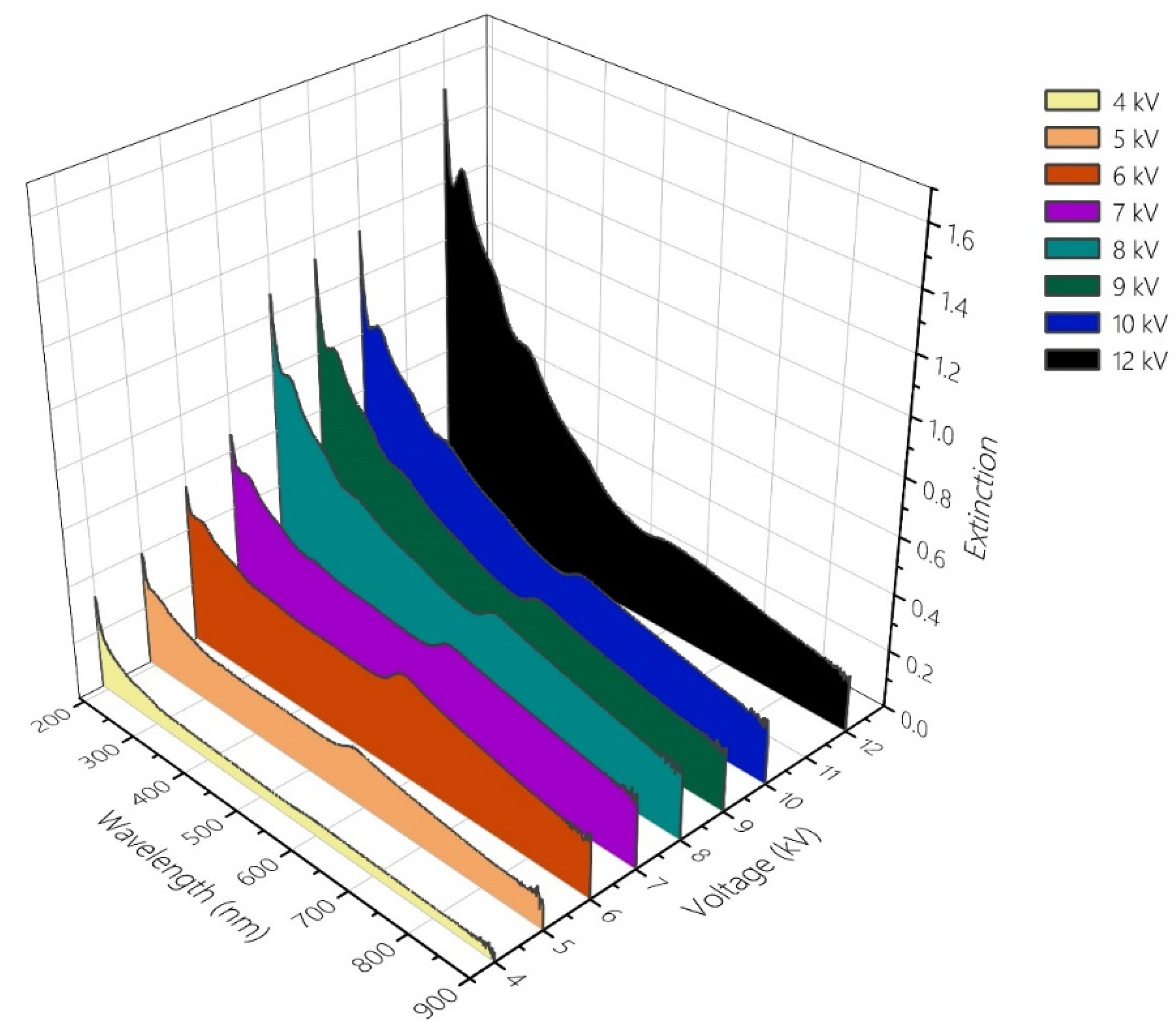
Figure 1. Spectrophotometric extinction spectra of aquasols, produced by underwater wire explosion of copper at capacitor charging voltages between 4 kV and 12 kV [41,42].
Micro 06 00014 g001
Figure 2. (ac) Normalized extinction cross-sections of individual spherical particles of (a) Cu, (b) Cu2O, and (c) CuO, shown as a function of wavelength and particle diameter, calculated using Mie theory in an aqueous environment [41,42].
Micro 06 00014 g002
Figure 3. Comparison of measured and algorithmically reconstructed extinction spectra of a selected copper WE sample produced at 6 kV using three different reconstruction methods. The inset highlights fitting discrepancies in the deep UV region. (Measured spectra of the other two samples are shown for reference) [42].
Micro 06 00014 g003
Figure 4. (a,b) Reconstructed particle number concentrations of (a) Cu2O and (b) CuO particles in 10 nm diameter bins for three WE samples produced at 6 kV, obtained by averaging the outputs of semimanual fitting, evolutionary algorithm, and grid search (circles represent the individual data points forming the basis of the averaging).
Micro 06 00014 g004
Figure 5. Voltage-dependent mass fractions of four particle categories in copper WE products, grouped by size (nano-sized: ≤100 nm, fine: >100 nm) and composition (metallic or oxidized). Values represent averages derived from the three evaluation methods, error bars represent standard deviations. (Note: two breaks were inserted into the vertical axis to improve visibility of the markedly different percentage ranges within a single plot.).
Micro 06 00014 g005
Figure 6. Relative contributions of Cu, Cu2O, and CuO to the total particle number concentration per size bin, averaged across the three WE samples produced at 6 kV and three evaluation methods, illustrating the experimental and evaluation uncertainty together. Error bars indicate standard deviations.
Micro 06 00014 g006
Figure 7. Particle size distributions of the oxidized fractions (Cu2O and CuO combined) for the three WE samples produced at 6 kV. The inset shows the distributions of the relative standard errors of the concentrations per particle size bin (expressed as a percentage of the corresponding means) for the individual oxides and their combined total.
Micro 06 00014 g007
Figure 8. Relative mass fractions of metallic and oxidized content in copper WE products across different discharge voltages, with nano- and fine-sized particle classes combined. Blue dots indicate the proportion of the exploded wire mass incorporated into the WE products as copper content (exploded fraction).
Micro 06 00014 g008
Table 1. Comparison of NRMSD values and the parameters of the normal distributions of Cu particles, obtained by four reconstruction methods.
Manual
Fitting [42]
Semimanual FittingEvolutionary AlgorithmGrid Search
NRMSDNRMSDCu MeanCu
STD
NRMSDCu
Mean
Cu
STD
NRMSDCu
Mean
Cu
STD
sample #11.81%1.90%145.4 nm146.3 nm2.03%143.8 nm149.6 nm1.95%145.9 nm140.5 nm
sample #22.27%2.42%160.1 nm118.5 nm2.09%169.6 nm122.1 nm1.98%161.5 nm142.7 nm
sample #31.73%1.71%152.2 nm137 nm2.42%151.3 nm148.3 nm1.89%150.4 nm147.2 nm
Table 2. Average NRMSD values and parameters of the reconstructed Cu particle size distributions at discharge voltages ranging from 4 kV to 12 kV.
Discharge VoltageNRMSDCu MeanCu STD
4 kV6.62 ± 1.47%164 ± 33 nm116 ± 92 nm
5 kV3.41 ± 0.77%123 ± 41 nm203 ± 146 nm
6 kV2.00 ± 0.06%156 ± 5 nm139 ± 5 nm
7 kV1.85 ± 0.19%177 ± 13 nm111 ± 28 nm
8 kV1.81 ± 0.11%171 ± 1 nm151 ± 69 nm
9 kV2.40 ± 0.86%178 ± 15 nm108 ± 8 nm
10 kV2.26 ± 0.38%181 ± 15 nm112 ± 4 nm
12 kV4.31 ± 0.55%172 ± 64 nm95 ± 61 nm
Disclaimer/Publisher’s Note: The statements, opinions and data contained in all publications are solely those of the individual author(s) and contributor(s) and not of MDPI and/or the editor(s). MDPI and/or the editor(s) disclaim responsibility for any injury to people or property resulting from any ideas, methods, instructions or products referred to in the content.