Article

Computational Modeling of the Functionalization of C60 and Its Doped Derivatives with a Novel Arylalkanone


by
Navaratnarajah Kuganathan
1,* and
Tharmarajah Manoranjan
2
1
Department of Materials, Imperial College London, London SW7 2AZ, UK
2
Department of Chemistry, University of Jaffna, Jaffna 40000, Sri Lanka
*
Author to whom correspondence should be addressed.
Micro 2026, 6(1), 13; https://doi.org/10.3390/micro6010013
Submission received: 6 December 2025 / Revised: 30 January 2026 / Accepted: 3 February 2026 / Published: 6 February 2026

Abstract

The functionalization of molecules on C60 is a promising engineering approach, as non-covalently governed fullerene surfaces facilitate reversible host–guest recognition, tunable electronic communication, and conformationally adaptive molecular adsorption. In this work, spin-resolved simulations using density functional theory (DFT) were conducted to examine the interaction between a newly identified arylalkanone isolated from the medicinal species Myristica ceylanica and the nanocarbon framework of C60 fullerene, including doped configurations incorporating group III elements (B, Al, Ga, In and Tl). The results indicate that the arylalkanone binds to pristine C60 through an exothermic, energetically favourable binding process, supporting thermodynamically viable molecular uptake. Among the doped models, B substitution exhibits the greatest overall thermodynamic preference; however, Al doping produces the most pronounced enhancement in binding energy, identifying the Al-doped configuration as the most effective surface-uptake architecture in relative terms. Across all complexes, a small amount of charge transfer is noted, signifying weak yet persistent electronic coupling between the ligand and the carbon carrier. Additionally, all doped fullerenes demonstrate induced magnetic behaviour, a property of increasing relevance in spintronics research, suggesting that these complexes may hold future value in spin-dependent electronic and molecular-recognition-guided nanoscale biomedical engineering.

1. Introduction

Having a deeper understanding of the non-covalent interactions that involve fullerenes plays a key role in supramolecular fullerene chemistry [1]. In recent years, one of the most important developments in the field of non-covalent interaction has been the revival of a long-overlooked interaction: π-electron–curvature complementarity, a unique binding mode enabled by the convex, highly curved carbon surface of C60 [2]. Unlike conventional π–π stacking between two planar aromatic systems, this interaction arises from the geometric and electronic complementarity between a spherical, electron-rich π-surface (such as that of C60) and concave or planar π-systems. The curvature of C60 results in regions of high π-electron density that are more polarizable than those of flat aromatics, strengthening dispersive attractions while also promoting shape-selective recognition in solution-phase assemblies. This recognition mechanism has revived interest because it helps explain why many aromatic organic molecules, even those that do not form strong interactions with one another, bind favourably to fullerenes [3,4,5,6,7,8,9,10]. The resurgence of this concept has reshaped supramolecular fullerene chemistry, particularly in the design of host–guest complexes, self-assembled materials, and radical-quenching nanosystems where reversibility, electronic communication, and nanoscale surface adaptability are critical. By reframing fullerene binding through surface curvature rather than classical functional group chemistry, researchers have opened new theoretical and practical directions in fullerene-based supramolecular engineering [11,12,13,14,15].
Myristica ceylanica displays a broad spectrum of biologically active properties, underscoring its ecological significance and medicinal potential [16]. The species demonstrates pronounced antimicrobial activity, largely due to its complex mixture of phytochemicals, which inhibit a range of pathogenic bacteria and fungi [17]. Although detailed phytochemical analyses of Myristica ceylanica are scarce, polyphenolic compounds, particularly flavonoid-derived antioxidants, which are widely reported in the Myristicaceae family are known to provide strong protection against oxidative damage, a cellular stress mechanism closely associated with neurodegenerative and cardiovascular diseases [18,19,20]. Although direct anti-inflammatory studies on Myristica ceylanica are lacking, related Myristica species have demonstrated significant anti-inflammatory effects by regulating key pro-inflammatory mediators, suggesting potential therapeutic relevance for inflammatory conditions such as arthritis [21,22].
In a recent study, the structural characterization of a previously undescribed arylalkanone, 1-(2′,6′-dihydroxyphenyl)-4-hydroxy-9-(3″,4″-dihydroxyphenyl)-nonan-1-one from Myristica ceylanica, was successfully achieved using advanced spectroscopic methods [23]. The compound class falls within arylalkanones, a phytochemical group known for diverse biological activities. The structure of the molecule, which contains two phenolic rings linked by a hydroxylated aliphatic ketone backbone, suggests a high radical-scavenging potential due to multiple –OH substituents, a hallmark of Polyphenols [23]. The discovery is pharmacologically meaningful, as phenolic arylalkanones are widely investigated for their roles in antimicrobial, enzymatic inhibition, and cytoprotective mechanisms.
Many theoretical investigations have explored the interaction of both pristine and doped C60 fullerene with various foreign species, including atoms and molecules [24,25,26,27,28,29,30,31,32]. In the present study, spin-polarised DFT calculations are employed to analyse the intermolecular association between the arylalkanone and pristine C60, along with its doped counterparts. Group III elements were chosen as dopants because their trivalent valence configuration introduces controlled electron-deficient (p-type) sites into the C60 framework while largely preserving the π-conjugated carbon network. This enables systematic tuning of frontier molecular orbitals, adsorption strength, and spin polarization without severe structural distortion. Additionally, the wide range of atomic sizes and orbital characteristics across the group (from B to Tl) allows a comparative assessment of periodic and relativistic effects on host–guest interactions and electronic properties. The work further aims to clarify the binding character and interaction strength, while probing the fundamental physicochemical features of the resulting complexes, including charge transfer, modulation of the electronic structure, and spin-dependent magnetic behaviour.

2. Computational Methods

Electronic structure calculations were performed using DFT as implemented in the VASP 5.3.5 (Vienna Ab Initio Simulation Package, Vienna, Austria) code [33], which solves the standard Kohn–Sham (KS) equations with plane-wave basis sets and projector augmented-wave (PAW) potentials [34]. A plane-wave cut-off energy of 500 eV was employed for all simulations. Exchange–correlation effects were treated using the generalized gradient approximation (GGA) with the Perdew–Burke–Ernzerhof (PBE) functional [35]. Geometry optimizations were performed with a conjugate gradient algorithm [36] until the forces on all atoms were below 0.001 eV/Å.
For C60, its derivatives, and the Arylalkanone molecule, a single k-point was used for structural optimization. Bulk metal structures were optimized using a 4 × 4 × 4 Monkhorst–Pack k-point grid [37]. These molecular systems were placed in a cubic supercell of dimensions 15 Å × 15 Å × 15 Å to prevent interactions between periodic images. Dispersion interactions were included using the semi-empirical DFT-D3 method of Grimme et al. [38].
The substitution energy was calculated using two different reference schemes. In the first approach, the substitution energy is defined with respect to isolated gas-phase atoms as
E s u b = E C 60 + E M E M . C 59 E C
where E C 60 is the total energy of the isolated C60 molecule, E M . C 59 is the energy of the C60 structure containing one dopant atom, and E M and E C are the energies of an isolated metal atom M and a carbon atom. In the second approach, the substitution energy is calculated using an alternative reference for the metal atom obtained from their bulk reference phases. The substitution energies obtained from both methods are reported in Section 3.2. The space groups of bulk phases considered for B, Al, Ga, In, Tl and C were R 3 ¯ m R , F m 3 ¯ m , R 3 ¯ m H , I4/mmm, P 6 3 / m m c and P 6 3 / m m c , respectively.
The binding energy of the Arylalkanone molecule on the C60 surface was calculated using
E b i n d = E A r . C 60 E C 60 E A r
where E A r . C 60 is the total energy of the molecule adsorbed on C60, and E A r represents the energy of the isolated gas-phase Arylalkanone molecule.
Bader charge analysis [39] was used to determine the charge distribution on the dopant atoms and their nearest-neighbour carbon atoms.

3. Results

3.1. Modelling of C60 and Arylalkanone

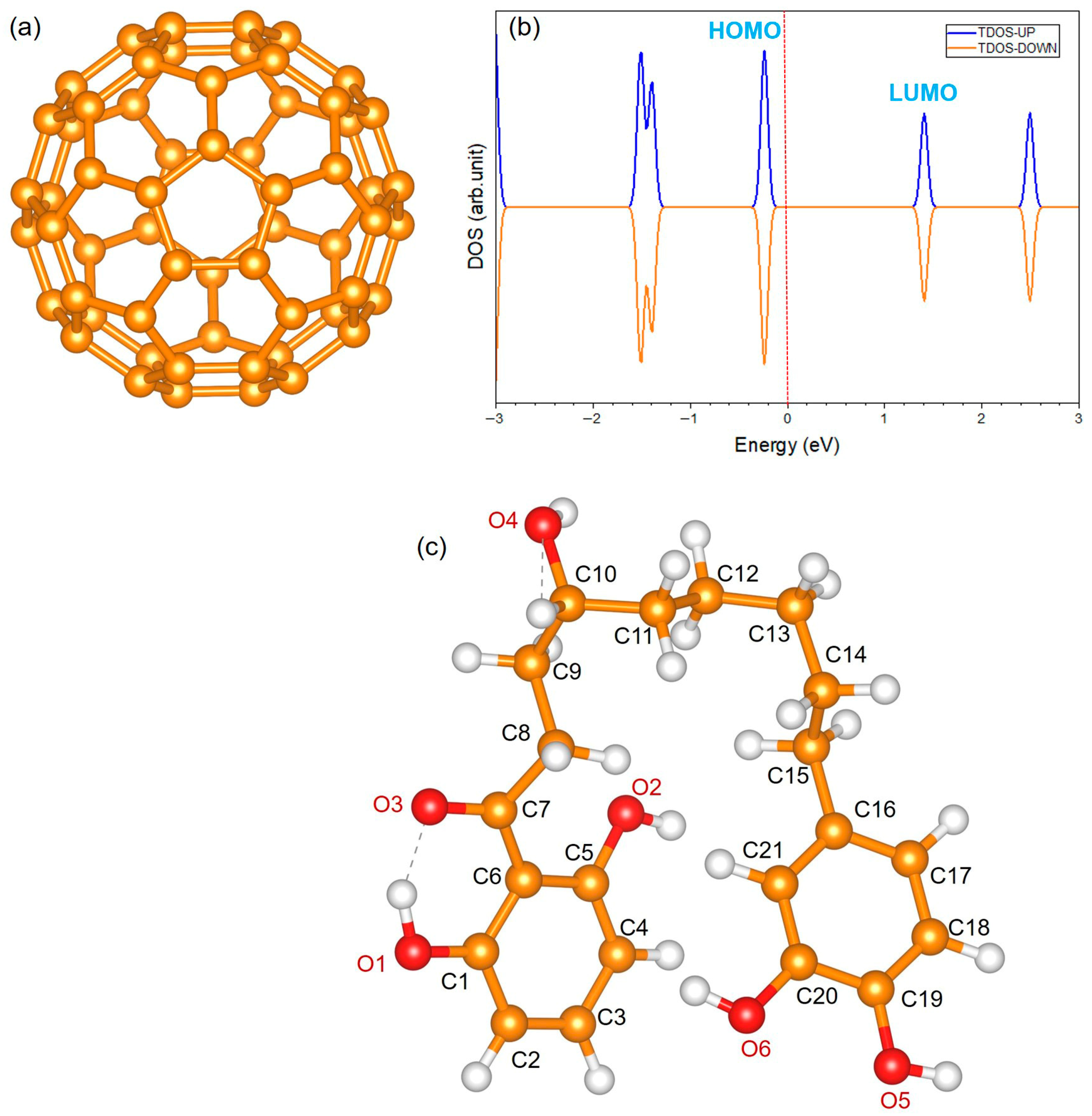
The optimized C60 structure (see Figure 1a) yields C–C and C=C bond lengths of 1.45 Å and 1.40 Å, respectively, in close agreement with the corresponding experimental values of 1.43 Å and 1.39 Å [40] and previous theoretical results [41]. The computed HOMO–LUMO gap is 1.50 eV, consistent with the 1.64 eV value reported in a previous DFT study [42]. Furthermore, our results indicate that the C60 molecule is non-magnetic (see Figure 1b), in line with earlier predictions [43].
Next, we optimized the aryl-alkanone molecule (see Figure 1c) and compared its key bond lengths and bond angles with the experimental values reported for Malabaricone A [1-(2,6-dihydroxyphenyl)-9-phenylnonan-1-one] isolated from Myristica malabarica. The selected bonds and angles used for this comparison are summarized in Table 1. Although a crystal structure for the fully hydroxylated aryl-alkanone derivative is not currently available, the molecular scaffold closely resembles that of the Malabaricone family [44]. The primary difference lies in the substitution pattern where Malabaricones contain H or methoxy (–OMe) groups, the modeled aryl-alkanone structure features hydroxyl (–OH) groups at all corresponding positions. The structural parameters computed in this study will support the interpretation of future experimental structure elucidation.
The calculated C–C and C–O bond lengths are very close to the values reported for Malabaricone A trends with high fidelity, deviating by ≤0.03 Å for most local bonds (e.g., C1-O1: 1.34 Å vs. 1.36 Å; C1-C2: 1.41 Å vs. 1.38 Å), confirming that the structural model captures the correct hybridized bonding environment. The internal bond angles around the functional group also remain consistent, with only minor shifts observed for angles involving the bond-center hydrogen complex (e.g., O1-C1-C2: 118.3° vs. 117.3°; C2-C1-C6: 120.7° vs. 121.7°), indicating minimal angular strain despite bond-length elongation at sites coordinating to heavier or more weakly donating dopants. The presence of mixed coordination motifs (e.g., C6-C7-O3 and C10-O4/C20-O6 linkages) preserves chemically reasonable geometries, while slight compression or expansion of cage-adjacent angles suggests local relaxation of π-bond character rather than global symmetry breaking. Collectively, the agreement between these two similar systems validates the chosen computational setup and supports the reliability of subsequent electronic structure analyses.

3.2. Doped-C60 Structures and Their Thermodynamic Stability, Electronic Properties and Magnetic Behaviour

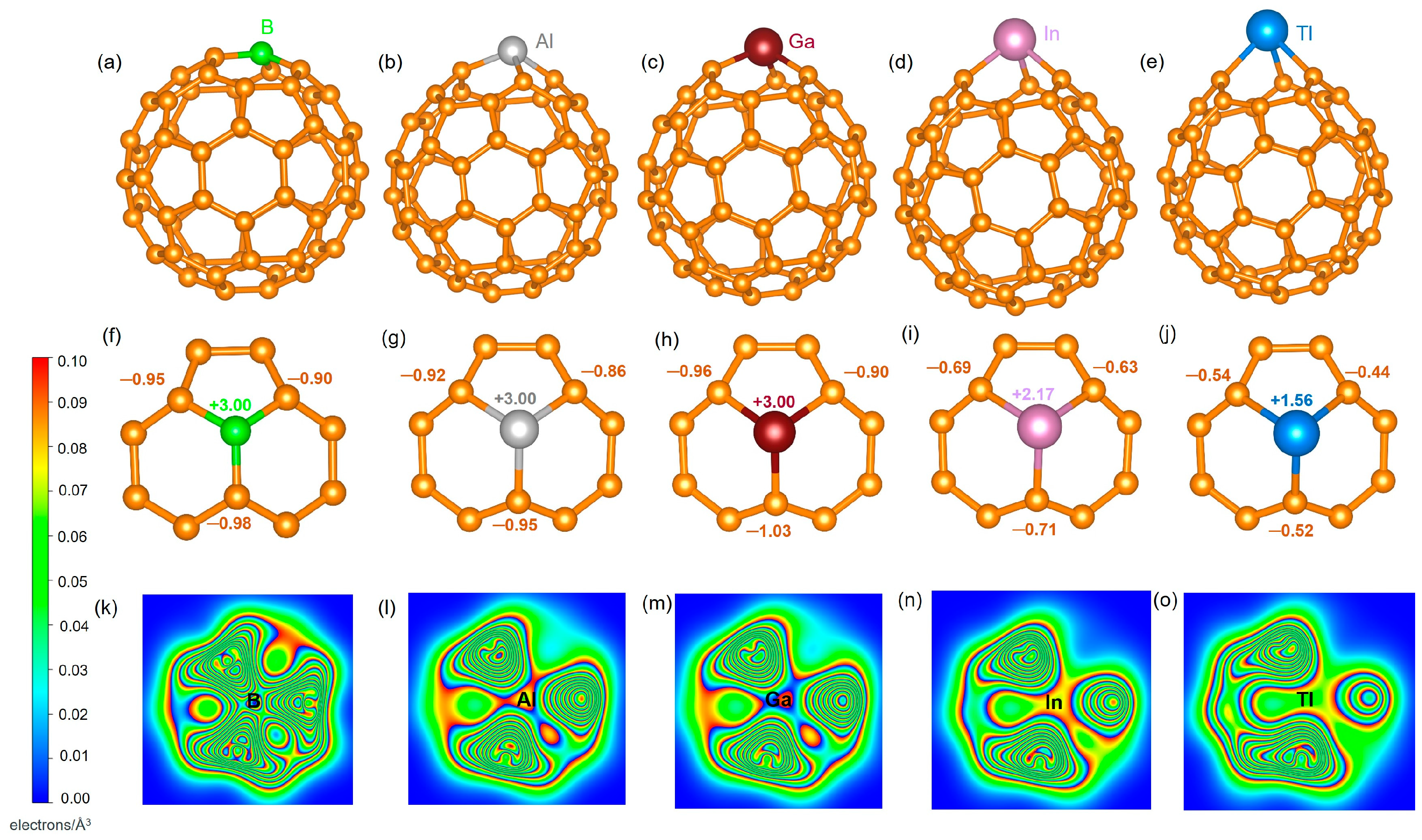
Next, we examined the surface doping of C60 with group III elements. The main objective is to compare the binding efficiency of arylalkanone on doped C60 structures and pristine C60. The structural and electronic trends reveal how dopants interact with the C60 cage as their atomic size increases (see Figure 2a–e). In all cases, the dopant relaxes toward a hexagonal face and forms a threefold coordination with neighbouring carbon atoms; however, the strength and character of this interaction vary markedly across the series (see Figure 2f–j). This results in strong, directional M–C bonding and a pronounced charge buildup on the adjacent carbons, as reflected in the localized charge density contours (see Figure 2k–o). The Bader charge analysis indicates that B, Al, and Ga carry an effective positive charge of approximately +3 |e|, reflecting a pronounced redistribution of electronic density toward the neighboring C atoms and the C60 cage due to covalent σ-bonding and polarization effects, rather than a literal transfer of three electrons. In contrast, the heavier In and Tl dopants donate significantly less charge and exhibit weaker bonding due to their larger atomic radii and more diffuse p orbitals, which limit orbital overlap and force the atoms farther from the cage.
Table 2 reveals systematic trends in the structural, energetic, and electronic properties. As the atomic radius of the dopant increases from B to Tl, the substitution energy (Esub) rises monotonically, indicating that incorporating larger atoms into the fullerene framework becomes progressively less favourable. This is consistent with the increasing local distortion of the carbon cage, as reflected by the gradual increase in the dopant–carbon bond lengths (M–C). For example, the M–C distances expand from ~1.52–1.55 Å for B to ~2.33–2.36 Å for Tl, closely following the trend in atomic radii. Doping with B is energetically favoured because the atomic radius of sp2-hybridised carbon (0.73 Å) is close to that of B, leading to minimal lattice distortion. While the lighter dopants provide nearly full charge transfer to the fullerene, the heavier dopants (In and Tl) exhibit markedly diminished charge transfer, with Tl contributing only about 1.56 |e| (see Figure 2i,j). This diminished donation is consistent with their lower electronegativity and the weaker coupling between the larger, more spatially diffuse valence orbitals of the heavy atoms and the π-system of C60. This reduction in charge donation correlates with their lower electronegativity and the weaker interaction between the larger, more diffuse valence orbitals of the heavy atoms and the π-system of C60. Previous simulation studies have reported varying charge transfer values, which strongly depend on the computational methodology employed, including methods such as natural bond orbital (NBO) analysis [45,46,47]. Despite the substantial variations in substitution energies and charge transfer, the magnetic moments of all doped structures remain close to 1 µB. This suggests that a single unpaired electron persists across the dopant series, and that the magnetic behaviour is relatively insensitive to dopant size or charge donation within this group.
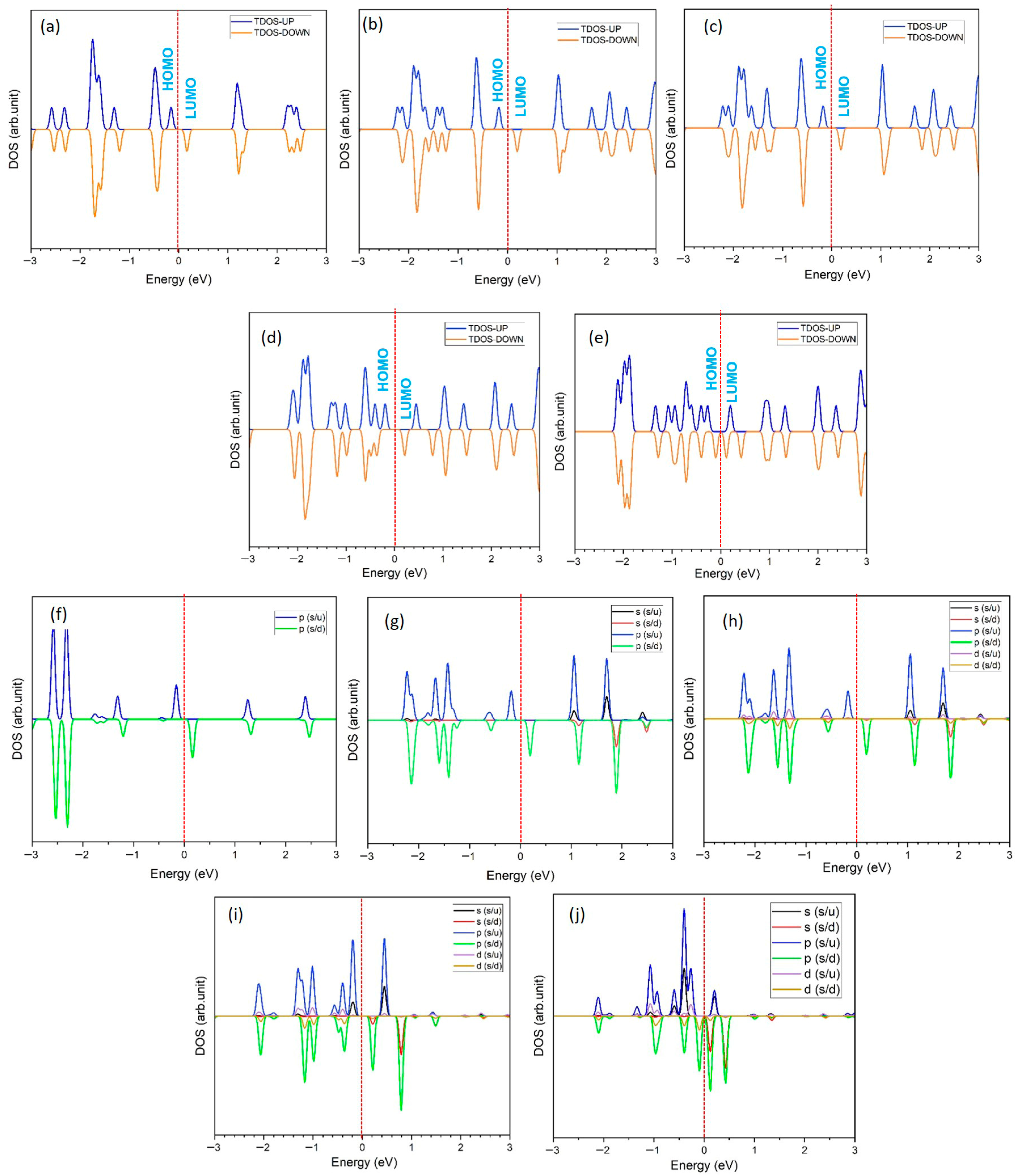
The total density of states (see Figure 3a–e) and projected density of states (see Figure 3f–j) reveal how each dopant modifies the electronic structure of the fullerene cage. For B-doped C60, the DOS closely resembles that of pristine C60, reflecting the small size mismatch between B and sp2-hybridized carbon and the minimal structural distortion this causes. As the dopant size increases from Al to Tl, the DOS features broaden and shift, indicating stronger perturbations of the carbon framework and increased hybridization between the dopant and cage states. The atomic-projected DOS shows that lighter dopants (B, Al, Ga) contribute mainly through their p-orbitals, whereas heavier dopants (In, Tl) exhibit significant s–p mixing, with states near the Fermi level. The progressive appearance of dopant-induced states near the Fermi energy leads to a narrowing of the HOMO–LUMO gap, especially for In and Tl, reflecting enhanced metallic character. Despite these changes, the spin-up and spin-down DOS remain nearly symmetric across all doped systems, consistent with the small magnetic moments calculated for each configuration.

3.3. Binding of Arylalkanone with Pristine C60

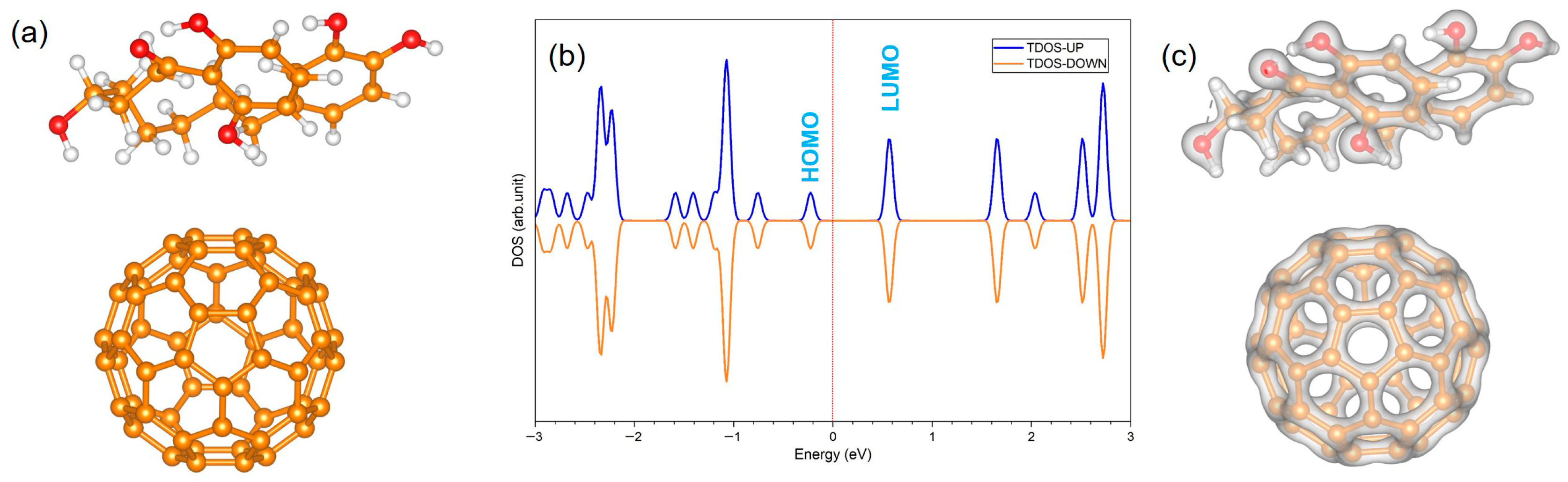
Figure 4 illustrates the binding behaviour of an arylalkanone molecule on a pristine C60 surface, providing structural and electronic benchmarks for comparison with the doped systems. The optimized geometry confirms that binding is weak and non-covalent in nature, as expected for physisorption dominated by van der Waals interactions rather than directional bond formation (see Figure 4a). The binding energy values further emphasize the crucial role of dispersion forces in stabilizing the host–guest complex. On the undoped carbon cage, binding is energetically unfavorable (0.03 eV) in the absence of van der Waals corrections, indicating that the interaction cannot form a stable bound state when long-range correlation is neglected. However, after inclusion of dispersion effects, the binding energy becomes strongly exothermic (−0.42 eV), confirming a substantial energetic gain and a transition from non-binding to physical adsorption stabilization.
The non-covalent nature is further supported by the DOS profile (see Figure 4b), where the electronic states of the adsorbate introduce only minor and shallow perturbations near the Fermi level, with no new mid-gap or hybrid interface peaks indicating negligible frontier orbital mixing between the guest molecule and the π-conjugated network of the host. The charge-density plot (see Figure 4c), displays a diffuse isosurface spread primarily over the carbon framework, without localized electron accumulation between the cage and molecule, reaffirming the absence of covalent bonding or significant interfacial charge polarization. A charge transfer of 0.10 e from the carbon nanostructure C60 fullerene to the arylalkanone was observed, indicating electron density migration from the fullerene surface to the ligand.

3.4. Binding of Arylalkanone on the Surface of Doped-C60

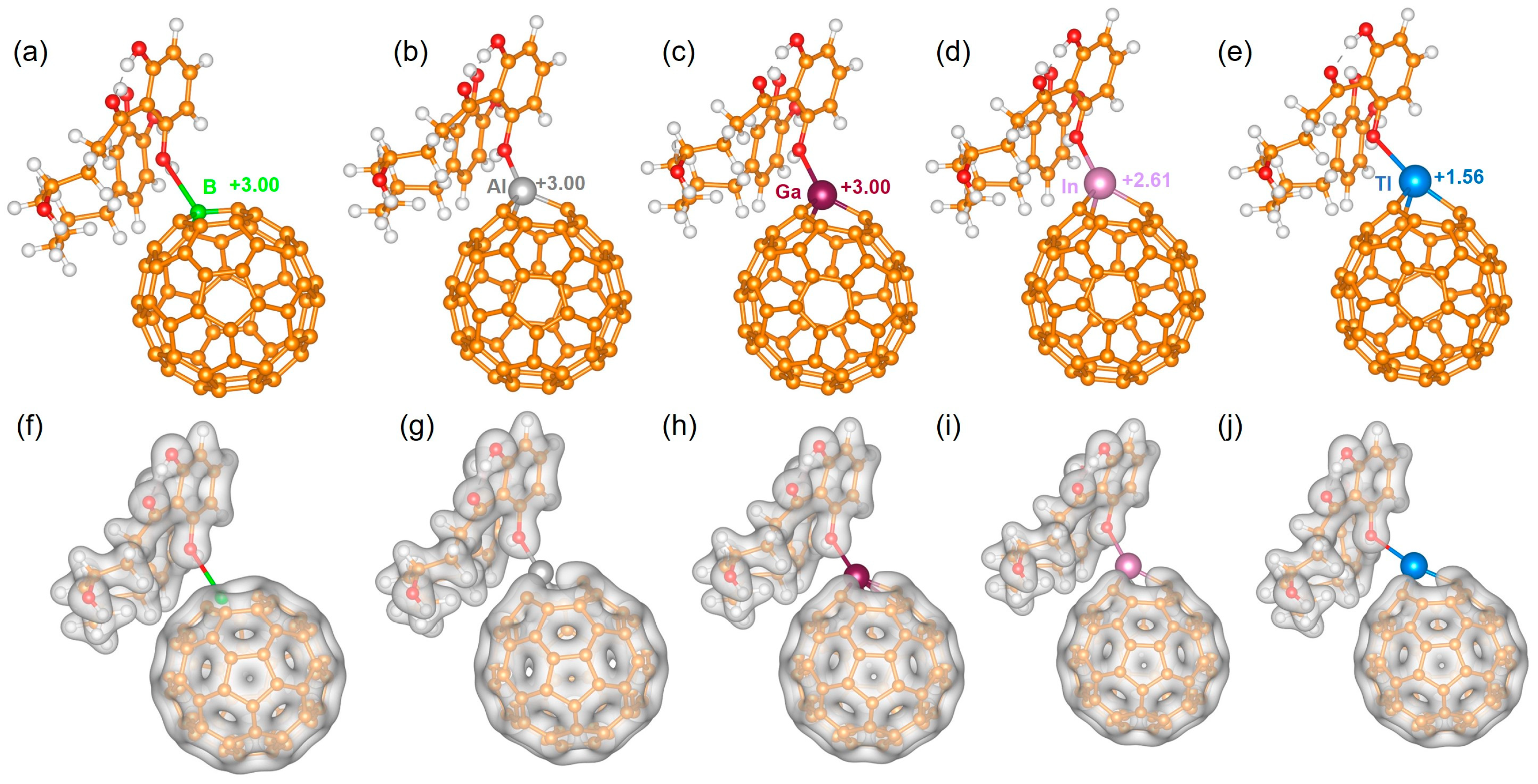
The optimized geometries shown in Figure 5 reveal that the interaction strength between the arylalkanone and the single-atom-doped C60 cage depends strongly on the dopant electronic character and atomic size. The lightest dopant, B, forms the longest B-O distance, consistent with its very low binding energy of −0.44 eV and weak dopant-to-cage charge redistribution (see Figure 5a). In contrast, the presence of Al results in the most stable binding energy (−1.43 eV), accompanied by the highest electron withdrawal from the dopant site, reflecting significant charge redistribution and stronger chemisorptive character (see Figure 5b and Table 3). The systems doped with heavier p-block metals, including Gallium, Indium, and Thallium, display moderate binding energies, with a gradual reduction in charge transfer from the dopant to oxygen-adsorbed carbon, consistent with increasing metallic radius, relativistic effects, and decreasing electronegativity along the group. The optimized M–O bond lengths follow the same trend, where the shortest distance in the Al-doped structure (1.95 Å) confirms strong chemical bonding (see Figure 5c), while elongated bonds in the heavier metal-doped systems (2.22–2.67 Å) suggest weaker dopant–oxygen overlap and partial ionic contributions (see Figure 5d,e). The charge-density maps (see Figure 5f–j) show that there is no direct delocalization between arylalkanone and C60. Despite differences in binding strength, all adsorbed configurations retain integer-like total magnetic moments (~1.00 μB), implying that binding preserves an unpaired spin state, and that magnetism is governed primarily by the carbon cage rather than the specific dopant identity, except for the Boron-doped system, which shows a slightly reduced moment (0.94 μB), consistent with weaker perturbation of the fullerene π-electron network.

4. Conclusions

Using quantum simulations based on DFT, this study demonstrated that the phytochemical arylalkanone from Myristica ceylanica binds exothermically to C60 fullerene, confirming spontaneous binding. Although B doping is thermodynamically preferred, Al-doped systems exhibit the strongest binding enhancement, while all configurations show minor charge transfer and dopant-induced magnetism, indicating promise for both targeted nano-delivery and emerging spin-based technologies. The induced magnetism of doped fullerene systems also opens up future opportunities for theranostic tracking and crossover applications in spintronics and nanoscale quantum devices.

Author Contributions

Conceptualization, N.K. and T.M.; methodology, N.K.; software, N.K.; validation, N.K. and T.M.; formal analysis, N.K.; investigation, N.K.; resources, N.K.; data curation, N.K.; writing—original draft preparation, N.K. and T.M.; writing—review and editing, N.K. and T.M.; visualization, N.K. All authors have read and agreed to the published version of the manuscript.

Funding

This research received no external funding.

Institutional Review Board Statement

Not applicable.

Informed Consent Statement

Not applicable.

Data Availability Statement

The original data presented in this study are included in the article, and additional information is available from the corresponding author upon request.

Acknowledgments

We acknowledge HPC services at Imperial College London for providing computational services. During the preparation of this manuscript, the authors used ChatGPT5.1 for the purpose of rephrasing the sentences and grammar. The authors have reviewed and edited the output and take full responsibility for the content of this publication.

Conflicts of Interest

The authors declare no conflicts of interest.

References

  1. Yekymov, E.; Bounioux, C.; Itzhak-Cohen, R.; Zeiri, L.; Shahnazaryan, E.; Katz, E.A.; Yerushalmi-Rozen, R. All carbon non-covalent exohedral hybrids: C60 aggregates on nanotube networks. J. Energy Chem. 2018, 27, 957–961. [Google Scholar] [CrossRef]
  2. Petroselli, M.; Ballester, P. Molecular Balances as Physical Organic Chemistry Tools to Quantify Non-Covalent Interactions. Chem. A Eur. J. 2025, 31, e202404351. [Google Scholar] [CrossRef]
  3. Zhang, Y.; Wang, W.; Wang, Y.-B. The C60⋯piperidine complex: An excellent model system to evaluate computational methods for noncovalent interactions between fullerenes and saturated organic molecules. J. Chem. Phys. 2025, 163, 214304. [Google Scholar] [CrossRef]
  4. Li, M.-M.; Wang, Y.-B.; Zhang, Y.; Wang, W. The Nature of the Noncovalent Interactions between Benzene and C60 Fullerene. J. Phys. Chem. A 2016, 120, 5766–5772. [Google Scholar] [CrossRef]
  5. Ferrero, S.; Barbero, H.; Miguel, D.; García-Rodríguez, R.; Álvarez, C.M. Porphyrin-based systems containing polyaromatic fragments: Decoupling the synergistic effects in aromatic-porphyrin-fullerene systems. RSC Adv. 2020, 10, 36164–36173. [Google Scholar] [CrossRef]
  6. Steinberg, B.D.; Jackson, E.A.; Filatov, A.S.; Wakamiya, A.; Petrukhina, M.A.; Scott, L.T. Aromatic π-Systems More Curved Than C60. The Complete Family of All Indenocorannulenes Synthesized by Iterative Microwave-Assisted Intramolecular Arylations. J. Am. Chem. Soc. 2009, 131, 10537–10545. [Google Scholar] [CrossRef]
  7. Litvinov, A.L.; Konarev, D.V.; Kovalevsky, A.Y.; Neretin, I.S.; Slovokhotov, Y.L.; Coppens, P.; Lyubovskaya, R.N. Molecular complexes of fullerene C60 with aromatic hydrocarbons containing flexible phenyl substituents. CrystEngComm 2002, 4, 618–622. [Google Scholar] [CrossRef]
  8. Hüffer, T.; Sun, H.; Kubicki, J.D.; Hofmann, T.; Kah, M. Interactions between aromatic hydrocarbons and functionalized C60 fullerenes—Insights from experimental data and molecular modelling. Environ. Sci. Nano 2017, 4, 1045–1053. [Google Scholar] [CrossRef]
  9. Sikorska, C.; Puzyn, T. The performance of selected semi-empirical and DFT methods in studying C60 fullerene derivatives. Nanotechnology 2015, 26, 455702. [Google Scholar] [CrossRef]
  10. Borowik, A.; Prylutskyy, Y.; Kawelski, Ł.; Kyzyma, O.; Bulavin, L.; Ivankov, O.; Cherepanov, V.; Wyrzykowski, D.; Kaźmierkiewicz, R.; Gołuński, G.; et al. Does C60 fullerene act as a transporter of small aromatic molecules? Colloids Surf. B Biointerfaces 2018, 164, 134–143. [Google Scholar] [CrossRef]
  11. Miklitz, M.; Turcani, L.; Greenaway, R.L.; Jelfs, K.E. Computational discovery of molecular C60 encapsulants with an evolutionary algorithm. Commun. Chem. 2020, 3, 10. [Google Scholar] [CrossRef]
  12. Chen, J.-R.; Wei, P.-S.; Ju, Y.-R.; Tsai, S.-Y.; Yen, P.-Y.; Kao, C.-H.; Wang, Y.-H.; Chuang, W.-T.; Wu, K.-Y. Triggering the Vapochromic Behavior in C60 via the Supramolecular Wrapping of st-PMMA. ACS Appl. Mater. Interfaces 2023, 15, 23593–23601. [Google Scholar] [CrossRef]
  13. Leonhardt, V.; Fimmel, S.; Krause, A.-M.; Beuerle, F. A covalent organic cage compound acting as a supramolecular shadow mask for the regioselective functionalization of C60. Chem. Sci. 2020, 11, 8409–8415. [Google Scholar] [CrossRef]
  14. Fuertes-Espinosa, C.; García-Simón, C.; Pujals, M.; Garcia-Borràs, M.; Gómez, L.; Parella, T.; Juanhuix, J.; Imaz, I.; Maspoch, D.; Costas, M.; et al. Supramolecular Fullerene Sponges as Catalytic Masks for Regioselective Functionalization of C60. Chem 2020, 6, 169–186. [Google Scholar] [CrossRef]
  15. Li, Z.-T. Supramolecular chemistry: From aromatic foldamers to solution-phase supramolecular organic frameworks. Beilstein J. Org. Chem. 2015, 11, 2057–2071. [Google Scholar] [CrossRef]
  16. Megawati, M.; Darmawan, A.; Hudiyono, S. Medicinal properties, phytochemistry, and pharmacology of Myristicaceae family: A review. J. Appl. Pharm. Sci. 2014, 14, 038–058. [Google Scholar] [CrossRef]
  17. Imoniye, F.E.; Igeleke, C.L.; Enerijiofi, K.E. Antimicrobial activities and phytochemical analyses of Myristica fragrans Seed extracts on Some Clinical Microbial Isolates. Niger. J. Pure Appl. Sci. 2025, 38, 5225–5235. [Google Scholar] [CrossRef]
  18. Panche, A.N.; Diwan, A.D.; Chandra, S.R. Flavonoids: An overview. J. Nutr. Sci. 2016, 5, e47. [Google Scholar] [CrossRef]
  19. Pietta, P.-G. Flavonoids as Antioxidants. J. Nat. Prod. 2000, 63, 1035–1042. [Google Scholar] [CrossRef]
  20. Bayani, U.; Ajay, V.S.; Paolo, Z.; Mahajan, R.T. Oxidative Stress and Neurodegenerative Diseases: A Review of Upstream and Downstream Antioxidant Therapeutic Options. Curr. Neuropharmacol. 2009, 7, 65–74. [Google Scholar] [CrossRef]
  21. Zhao, W.; Song, F.; Hu, D.; Chen, H.; Zhai, Q.; Lu, W.; Zhao, J.; Zhang, H.; Chen, W.; Gu, Z.; et al. The Protective Effect of Myristica fragrans Houtt. Extracts Against Obesity and Inflammation by Regulating Free Fatty Acids Metabolism in Nonalcoholic Fatty Liver Disease. Nutrients 2020, 12, 2507. [Google Scholar] [CrossRef]
  22. Matulyte, I.; Jekabsone, A.; Jankauskaite, L.; Zavistanaviciute, P.; Sakiene, V.; Bartkiene, E.; Ruzauskas, M.; Kopustinskiene, D.M.; Santini, A.; Bernatoniene, J. The Essential Oil and Hydrolats from Myristica fragrans Seeds with Magnesium Aluminometasilicate as Excipient: Antioxidant, Antibacterial, and Anti-inflammatory Activity. Foods 2020, 9, 37. [Google Scholar] [CrossRef]
  23. Manoranjan, T.; Wickramasinghe, A.; Kumar, V.; Kuganathan, N. A New Arylalkanone Derived from Myristica ceylanica (Myristicaceae). Lett. Org. Chem. 2025, 22, 824–828. [Google Scholar] [CrossRef]
  24. Kuganathan, N.; Chroneos, A. Hydrogen Adsorption on Ru-Encapsulated, -Doped and -Supported Surfaces of C60. Surfaces 2020, 3, 408–422. [Google Scholar] [CrossRef]
  25. Kuganathan, N.; Selvanantharajah, N.; Iyngaran, P.; Abiman, P.; Chroneos, A. Cadmium trapping by C60 and B-, Si-, and N-doped C60. J. Appl. Phys. 2019, 125, 054302. [Google Scholar] [CrossRef]
  26. Kuganathan, N.; Srikaran, R.; Chroneos, A. Stability of Coinage Metals Interacting with C60. Nanomaterials 2019, 9, 1484. [Google Scholar] [CrossRef]
  27. Kuganathan, N. Activation of CO2 on the Surfaces of Bare, Ti-Adsorbed and Ti-Doped C60. Fuels 2022, 3, 176–183. [Google Scholar] [CrossRef]
  28. Kuganathan, N.; Fossati, P.C.M.; Gkanas, E.; Chroneos, A. Dinitrogen activation by zirconium dimer loaded C60. AIP Adv. 2019, 9, 055331. [Google Scholar] [CrossRef]
  29. Wang, Z.; Chen, J.; Sun, Q.; Peijnenburg, W.J.G.M. C60-DOM interactions and effects on C60 apparent solubility: A molecular mechanics and density functional theory study. Environ. Int. 2011, 37, 1078–1082. [Google Scholar] [CrossRef]
  30. Mahdi, W.A.; Alhowyan, A.; Obaidullah, A.J. Computational study of carboplatin interaction with PEG-functionalized C60 fullerene as a drug carrier using DFT and molecular dynamics simulations. Sci. Rep. 2025, 15, 13707. [Google Scholar] [CrossRef]
  31. Leitherer, S.; Coto, P.B.; Ullmann, K.; Weber, H.B.; Thoss, M. Charge transport in C60-based single-molecule junctions with graphene electrodes. Nanoscale 2017, 9, 7217–7226. [Google Scholar] [CrossRef]
  32. Javaid, S.; Javed Akhtar, M. An ab-initio density functional theory investigation of fullerene/Zn-phthalocyanine (C60/ZnPc) interface with face-on orientation. J. Appl. Phys. 2015, 118, 045305. [Google Scholar] [CrossRef]
  33. Kresse, G.; Furthmüller, J. Efficient iterative schemes for ab initio total-energy calculations using a plane-wave basis set. Phys. Rev. B 1996, 54, 11169–11186. [Google Scholar] [CrossRef]
  34. Blöchl, P.E. Projector augmented-wave method. Phys. Rev. B 1994, 50, 17953–17979. [Google Scholar] [CrossRef]
  35. Perdew, J.P. Density functional theory and the band gap problem. Int. J. Quantum Chem. 1985, 28, 497–523. [Google Scholar] [CrossRef]
  36. Press, W.H.; Teukolsky, S.A.; Vetterling, W.T.; Flannery, B.P. The art of scientific computing. In Numerical Recipes in C, 2nd ed.; Cambridge University Press: Cambridge, UK, 1992. [Google Scholar]
  37. Monkhorst, H.J.; Pack, J.D. Special points for Brillouin-zone integrations. Phys. Rev. B 1976, 13, 5188–5192. [Google Scholar] [CrossRef]
  38. Grimme, S.; Antony, J.; Ehrlich, S.; Krieg, H. A consistent and accurate ab initio parametrization of density functional dispersion correction (DFT-D) for the 94 elements H-Pu. J. Chem. Phys. 2010, 132, 154104. [Google Scholar] [CrossRef] [PubMed]
  39. Bader, R.F.W. The zero-flux surface and the topological and quantum definitions of an atom in a molecule. Theor. Chem. Acc. 2001, 105, 276–283. [Google Scholar] [CrossRef]
  40. Hawkins, J.M. Osmylation of C60: Proof and characterization of the soccer-ball framework. Acc. Chem. Res. 1992, 25, 150–156. [Google Scholar] [CrossRef]
  41. Mahdy, A.M.E. DFT study of hydrogen storage in Pd-decorated C60 fullerene. Mol. Phys. 2015, 113, 3531–3544. [Google Scholar] [CrossRef]
  42. Goclon, J.; Winkler, K.; Margraf, J.T. Theoretical investigation of interactions between palladium and fullerene in polymer. RSC Adv. 2017, 7, 2202–2210. [Google Scholar] [CrossRef]
  43. Umran, N.M.; Kumar, R. Theoretical investigation of endohedral complexes of Si and Ge with C60 molecule. Phys. B Condens. Matter 2014, 437, 47–52. [Google Scholar] [CrossRef]
  44. Bauri, A.K.; Foro, S.; Lindner, H.J.; Nayak, S.K. Malabaricone A isolated from a methanol extract of Myristica malabarica. Acta Crystallogr. Sect. E 2006, 62, o1338–o1339. [Google Scholar] [CrossRef]
  45. Bilge, M. A Dft Investigation of the Interaction of B- And Al-Doped C60 Fullerenes with Cyclopropylpipezarine. J. Struct. Chem. 2018, 59, 1271–1275. [Google Scholar] [CrossRef]
  46. Raimi, M.A.; Nwokoye, C.R.; Effiong, S.S.; Aidoo, E.K.; Agwupuye, J.A.; Runde, M. Exploring Group 13 (B, Al, Ga, In) mono-doped fullerenes (C59X) for methane adsorption: A DFT and QTAIM investigation. J. Nanopart. Res. 2025, 27, 201. [Google Scholar] [CrossRef]
  47. Kalika, E.B.; Katin, K.P.; Kochaev, A.I.; Kaya, S.; Elik, M.; Maslov, M.M. Fluorinated carbon and boron nitride fullerenes for drug Delivery: Computational study of structure and adsorption. J. Mol. Liq. 2022, 353, 118773. [Google Scholar] [CrossRef]
Figure 1. (a) The optimized structure of C60, (b) its corresponding DOS plot and (c) the optimised structure of arylalkanone. The dotted red vertical line indicates the Fermi energy.
Micro 06 00013 g001
Figure 2. Optimized (relaxed) structures of C60 doped with a single (a) B, (b) Al, (c) Ga, (d) In, or (e) Tl atom. Configurations where the dopant forms threefold coordination with neighbouring C atoms (fj) are also displayed. Charge density plots (ko) illustrating charge localization on the nearest-neighbour C atoms are included as well.
Micro 06 00013 g002
Figure 3. Total DOS plots of (a) B, (b) Al, (c) Ga, (d) In and (e) Tl substituted C60 configurations. Corresponding atomic DOS plots of dopants (fj) are also provided. The dotted red vertical line indicates the Fermi energy.
Micro 06 00013 g003
Figure 4. (a) Optimized geometry of a single arylalkanone bound on pristine carbon cage C60, (b) corresponding total density of states profile, and (c) charge density distribution illustrating the non-covalent host–guest interaction.
Micro 06 00013 g004
Figure 5. Optimized geometries of C60 doped with a single atom—(a) B, (b) Al, (c) Ga, (d) In, and (e) Tl—interacting with an arylalkanone molecule. The associated charge density plots (fj) illustrating the dopant–molecule interaction are also included.
Micro 06 00013 g005
Table 1. Selected bond lengths and bond angles for the optimized structure, with experimentally reported values [44] for Malabaricone A given in parentheses.
Selected Bonds Bond Length (Å)Selected Bond AnglesBond Angles (°)
C1-O11.34 (1.36)O1-C1-C2118.3 (117.3)
C1-C21.41 (1.38)O1-C1-C6120.9 (120.9)
C1-C61.44 (1.42)C2-C1-C6120.7 (121.7)
C2-C31.39 (1.37)C3-C2-C1119.5 (119.4)
C4-C51.39 (1.37)C2-C3-C4121.2 (121.2)
C5-O21.37 (1.35)C5-C4-C3119.7 (119.9)
C5-C61.42 (1.42)O2-C5-C4120.8 (120.6)
C6-C71.47 (1.47)O2-C5-C6117.8 (118.1)
C7-O31.26 (1.24)C4-C5-C6121.4 (121.3)
C10-O41.44 C1-C6-C7117.4 (119.1)
C20-O61.37C7-C8-C9114.9 (113.4)
C19-C201.41C18-C19-O5123.7
C19-O51.37C21-C20-O6123.4
Table 2. Substitution energies of group-3 dopants on the C60 surface, along with the Bader charges on the dopants, the distances between each dopant and its nearest-neighbor carbon atoms, and the magnetic moments of the resulting doped configurations. The values reported in the parentheses were calculated using atoms as reference states.
StructureAtomic Radius of Dopant (Å) E s u b (eV)Bader Charge on DopantM-C (Å)Magnetic Moment (µ)
vdw-Freevdw
B.C600.840.81 (2.37)0.80 (2.36)+3.001.52, 1.55 (2)0.97
Al.C601.212.99 (7.44)3.04 (7.49)+3.001.89, 1.91 (2)0.99
Ga.C601.223.42 (8.79)3.48 (8.85)+3.001.91, 1.94 (2)0.99
In.C601.425.04 (10.66)5.10 (10.72)+2.172.14, 2.18 (2)0.97
Tl.C601.456.19 (11.81)6.26 (11.87)+1.562.33, 2.36 (2)1.00
Table 3. Calculated binding energies (Ebind), Bader charge transfer for dopant [Q (M) (e)] and adjacent carbon atoms [Q (C) (e)], optimized bond lengths of dopant–oxygen (M–O) and dopant–carbon (M–C) bonds, and total magnetic moments (µ) of the adsorbed systems.
Structure E b i n d (eV)Q (M) (e)Q (C) (e)M-O (Å)M-C (Å)µ
vdw-Freevdw
Ar.B.C60−0.05−0.44+3.00−0.86, −0.93, −0.992.681.53, 1.55 (2)0.94
Ar.Al.C60−0.87−1.43+3.00−0.71, −0.82, −0.831.951.92, 1.93, 1.941.00
Ar.Ga.C60−0.41−0.83+3.00−0.85, −0.90, −0.902.221.93, 1.96, 1.981.00
Ar.In.C60−0.75−0.94+2.61−0.62, −0.68, −0.712.322.14, 2.17, 2.181.00
Ar.Tl.C60−0.06−0.54+1.56−0.54, −0.56, −0.612.672.23, 2.28, 2.311.00
Disclaimer/Publisher’s Note: The statements, opinions and data contained in all publications are solely those of the individual author(s) and contributor(s) and not of MDPI and/or the editor(s). MDPI and/or the editor(s) disclaim responsibility for any injury to people or property resulting from any ideas, methods, instructions or products referred to in the content.