Article

Filtration of Emulsions: The Population Balance Modeling

by
Simon Papine-Paktoris
1,
Julia Trancoso Fernandes dos Santos
2,
Simon Ivar Andersen
3 and
Alexander A. Shapiro
4,*
1
Ecole des Mines de Paris, Universite PSL, CEDEX 05, 75272 Paris, France
2
Novonesis, Biologiens Vej 2, 2800 Kongens Lyngby, Denmark
3
DOTC—Danish Offshore Technology Center, Technical University of Denmark, DTU b. 375, 2800 Kongens Lyngby, Denmark
4
CERE—Center for Energy Resources Engineering, Department of Chemical and Biochemical Engineering, Technical University of Denmark, DTU b. 229, 2800 Kongens Lyngby, Denmark
*
Author to whom correspondence should be addressed.
Submission received: 28 November 2025 / Revised: 3 January 2026 / Accepted: 6 January 2026 / Published: 11 January 2026
(This article belongs to the Section Physics of Liquids)

Abstract

Filtration of emulsions is an important operation in multiple processes of chemical, environmental, and petroleum engineering. The primary concern of the present study is cleaning of water produced from a petroleum reservoir. The produced water is filtered from the oil droplets before being dumped into the sea or reinjected into the reservoir. Efficiency of filtration is determined, in particular, by the droplet size distribution and interfacial properties. We have developed a new population balance model of emulsion filtration, based on the Boltzmann–Smoluchowski approach. The model accounts for the droplet size distribution, as well as for the different mechanisms of the droplet capture: attachment to the surface and straining in the pore constrictions. The model can not only be applied to filtering of the produced water, but also to more general emulsion processing. It is capable of reproducing experimental data on the droplet production history and dynamic permeability decline. The sensitivity study indicates low sensitivity of the permeability decline curves to the model parameters. The production histories or other kinds of experimental data are necessary to discriminate between the different parametrizations of the model.

1. Introduction

Filtration of oil-in-water emulsions is an important operation in wastewater treatment [1]. The present study has emerged in connection with the problem of filtering and reinjection of the water produced from petroleum reservoirs.
Produced water (PW) stands out as the largest volume of waste effluent in oil fields, with an estimated production of almost 4 barrels of oily water generated for each barrel of oil [2]. PW composition is affected by the fluids, minerals, and production chemicals it has been in contact with, and also influenced by location, age, and the different processes taking place in the reservoir [3,4,5]. The major strategies for produced water management generally rely on reinjection, disposal in a waste well, discharge into the sea or evaporation ponds. It is often assumed that the strong dilution of PW during discharge is sufficient to mitigate any harmful effect on the environment, which explains why 40% of PW is, nowadays, discharged into the ocean [3]. Since the early 2000s, however, environmental regulations and reservoir requirements, such as the EU Water Framework Directive (WFD) and Oslo–Paris Convention or the Convention for the Protection of the Marine Environment of the North-East Atlantic (OSPAR), have agreed on zero discharge of pollutants into the sea. These new stricter guidelines have made PW reinjection into reservoirs a more attractive management option [6].
The major limitation for implementation of reinjection is the risk of uncontrolled injectivity decline of the formation. Permeability reduction occurs due to reservoir pores plugging by components still present in the water after treatment, mostly particles and droplets [5,7,8,9]. A good understanding of the retention mechanisms of these elements is essential for building predictive models of injectivity and defining water quality specifications for injection.
Preparation of water for damping or reinjection often involves filtration [10]. Similar processes characterize membrane filtration of the produced water and injectivity decline under its reinjection. In both cases, the oil droplets are captured by the porous medium, either by attachment to the internal surface, or by straining in the capillary constrictions.
The process of deep-bed filtration has been extensively studied in relation to suspensions of solid particles [11,12,13,14,15,16,17,18,19]. Nevertheless, different authors [20,21,22,23,24] have experimentally shown that the formation damage caused by droplets can be as severe as the one caused by particles, and the damage caused by droplets and particles in combination is even more prominent.
Although all particle retention mechanisms, like straining, interception, inertia forces, sedimentation/creaming, flocculation, diffusion, and hydrodynamic effects [11,12,13,25], are also valid for droplets, new phenomena are possible due to their different physical properties, adding complexity to filtration mechanisms. A significant distinction between filtration of suspensions and emulsions is that the droplets may fully merge, forming larger droplets. Unlike particles, the merging droplets “lose individuality”, and are unlikely to separate again into the same droplets, from which the larger droplet was formed. Agglomeration may happen with both dispersed and captured droplets. The size distribution of droplets in unstable emulsions varies in time and space. This process requires stochastic modeling. However, there are very few works in which the stochastic approach to filtration of emulsions has been followed.
A possible way of modeling this phenomenon is to consider an emulsion as a two-phase liquid and apply the classical Buckley–Leverett theory of two-phase flows in porous media [26,27] or its modifications [28,29,30,31]. Devereux [32,33], motivated by McAuliffe’s experimental observations [34], modified the theory of Buckley and Leverett by considering the different velocities for internal (dispersed) and external phases. He suggested that the internal phase is affected by the retarding force of the capillary origin. If the droplet sizes are much smaller than pores, an emulsion may be described as a single liquid with a modified viscosity or internal stresses, and droplet capture as an adsorption-like process [35,36,37].
Several models were suggested for stable emulsions, where coagulation does not happen. In particular, the stochastic model of Soo and Radke makes it possible to obtain an averaged filtration coefficient based on the pore size distribution (more generally, distribution of the capture sites for the droplets) [20,21,38,39,40]. Well-documented experiments carried out by Soo and Radke served the basis for further model comparison, e.g., for the pore network model. It should be noted that, on the macroscopic level, there should be no difference between filtration of stable emulsions and of the suspensions, although the individual capture mechanisms may be different for particles and droplets. Then, all the models developed for deep bed filtration of suspensions, listed above, are applicable to stable emulsions, probably, with minor modifications.
To the best of our knowledge, the stochastic (Markov process-based) approach to unstable emulsions was first developed by J. Litwiniszyn [41,42,43] followed by the works of Fan et al. [44,45,46]. Alternatively, the RSA (random sequential adsorption) approach was based on direct stochastic computer modeling in combination with averaging [47], and later applied to the well injectivity decline problem [22,23].
In several areas, instability of emulsions is described by the Smoluchowski coagulation equation [48] for the droplet or particle population balances [49,50]. To the best of our knowledge, however, the Smoluchowski coagulation equation, in its original or modified form, has never been applied to the problem of filtration of emulsions, although coagulation is one of the phenomena that may be observed during such filtration. This is the goal of the present work.
We develop a model for filtration of an emulsion in a porous medium, based on the approach of population balances. The droplets in an emulsion may or may not coagulate. They may be captured in the pore constrictions (straining) or adsorbed on the internal pore surface (interception). Thus, four different cases are considered, as described in Section 2.1. The governing equations for the model are formulated and brought to dimensionless form in Section 2.2. Special attention is given to the permeability decline equation (Section 2.2.2). Section 2.2.4 discusses the governing dimensionless parameters for the different cases. These parameters are adjusted to the experimental data of Soo and Radke [20] in Section 3.2, for which discretization of the system and a numerical optimization algorithm are developed (Section 3.1). The data of Soo and Radke, produced over forty years ago, are perfect for experimental validation of the models, due to their thoroughness and consistency in reporting the experimental parameters. Reproduction of the experimental data by our model is satisfactory. Sensitivity of the model to its parameters is also studied (Section 3.3). It turns out that the production data is much more sensitive than the permeability decline curves, so the choice and adjustment of a model based only on permeability decline may be insufficient.

2. Model

2.1. Physical Assumptions

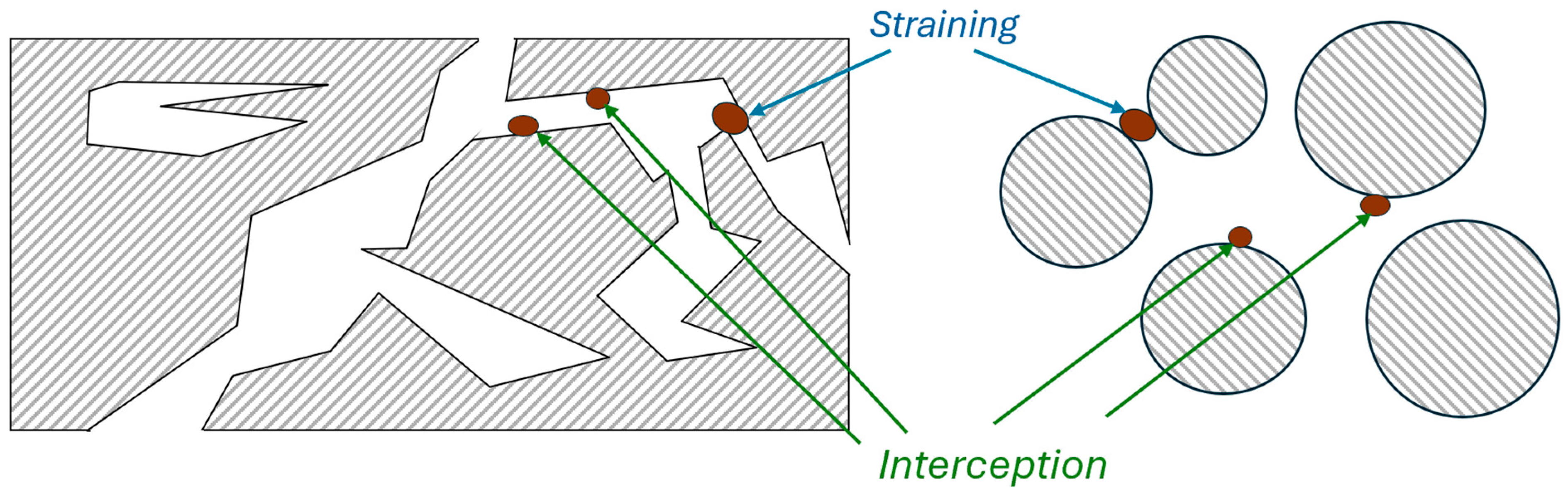
We consider the 1D process of injection of an emulsion into a porous filter. The dispersed droplets in the emulsion may be irreversibly captured by the porous medium. This capture can occur in two ways (Figure 1): when the droplets lodge in pore constrictions of smaller sizes than their own (straining) or when droplets attach themselves to the pore walls due to van der Waals, electric, gravitational, capillary, and hydrodynamic forces (interception). The droplets in it are only slightly deformable and the pressure gradients are not large, so squeezing through constrictions and snap-off are excluded. If such a droplet is captured in a constriction, it plugs the conducting paths, remaining immobile due to the Jamin effect. This physical picture is very similar to that of a deep-bed filtration process.
Unlike previous filtration models, however, we assume that droplets can coalesce in addition to being filtered. Coalescence relies on the affinity of the droplets among themselves, which, when meeting in the flow, may or may not overcome the energy barriers between their surfaces. From a process point of view, this energy barrier can be evaluated as a process parameter, since the interfacial properties can be altered by chemical additives (e.g., surfactants, corrosion inhibitors, and other production chemicals). In the present work, we will only distinguish between agglomerating and non-agglomerating droplets, without further analysis of the nature of this phenomenon. A study of the capability of droplets to coalesce can be found elsewhere [51,52,53].
Apart from the affinity of the droplets to each other, we consider their affinity to the inner surface of the porous medium. If the droplets can attach to the surface, their capture by interception is possible. Otherwise, the only capture mechanism is straining in the constrictions.
In sum, the droplets may either attach or not attach to the inner surface and to each other. These 2 × 2 choices generate the four cases of study considered in this work (Table 1).
In the following section, we derive a system of transport equations describing the most general case 1. Other cases may be obtained from this case 1 by setting some parameters to zero in the governing system of equations, as also listed in the table.
The injected emulsion is assumed to be initially monodisperse so that all the droplets are of the same volume v d . Generalization of polydisperse suspensions is straightforward: Consider a discrete series of droplets of volumes v d ,   2 v d ,   3 v d and assume that multiple droplet volumes are present in the injection stream. This, however, would result in more adjustment parameters and less transparent results. In the experimental work, with which we will compare our theory, care is taken regarding homogeneity of the injected droplets.
Other assumptions regarding droplet transport and capture are as follows. The flow is one-dimensional; the convective dispersion or Brownian motion of the droplets on macroscale is neglected (although on the pore scale, this may be one of the capture mechanisms); similarly, the surface motion of the droplets is not accounted for (see [54] for a similar mechanism for particles); capture of the droplets, by either surface or constrictions, as well as their coalescence, is irreversible. We neglect collective flow phenomena, like modification of the local velocity fields by the captured droplets, also affecting the suspended droplets.
We consider relatively slow flows, excluding such effects as detachment and remobilization of the droplets, squeezing through a constriction, or breakage/snap-off [55,56]. The detachment of solid particles was studied in detail in recent works [57,58], while, to the best of our knowledge, the mechanism of detachment of droplets may be more complicated since it involves significant droplet deformation. For modeling of droplet re-mobilization at the level of droplet ensembles, a formalism like the maximum retention function [59,60] may be introduced. However, this needs a separate study. Breakage of the droplets might be studied within a formalism similar to that developed below (Section 2.2 and further) but will need separate model development and independent experimental validation. This is outside the framework of the present study. Finally, we neglect possible variation in the shapes of the droplets. This variation might affect coagulation kernels (coefficients β , λ in the following subsections). The microfluidic studies indicate that the droplets can significantly change their shapes in confined media, if the interfacial tensions are low (the surface-active components are present) and/or the flow rates are high. Such processes, along with the multiplicity of other phenomena observed in microfluidics experiments, will not be considered here. However, the multicomponent nature of the mixture is reflected indirectly in the coagulation and sorption coefficients of the model.

2.2. Mathematical Statement

2.2.1. Governing System of Equations

As formulated above, a monodisperse emulsion of droplets with the same volume v d is injected into the porous filter. Then, due to agglomeration, droplets of different sizes i v d   ( i = 1 ,   2 , ) are formed. We denote the concentration of droplets of size i v d by c i . Here, by concentration, we mean a numerical concentration: the number, in a unit volume, of droplets of the corresponding size that are not captured by porous medium. The number of deposited droplets of size i v d may be split into two values: the droplets intercepted by the surface, σ s i , and the droplets strained in the constrictions, σ c i . In the following, subscripts s (“surface”) and c (“constriction”) will be used to denote the corresponding values.
In practical applications, the volumetric concentrations may be of higher interest than the numerical droplet size distributions. Within the considered model, the volumetric concentrations of the suspended and deposited droplets are calculated as
c v = i = 1 i v d c i ;   σ v = i = 1 i v d σ s i + i = 1 i v d σ c i
Under the described conditions, the transfer equation for the i th kind of particles assumes the form of
ϵ c i t + η U c i x = b i d i d c i d s i
Here, ϵ is porosity and U is the superficial flow velocity. The different b (birth) and d (death) terms describe the transformations due to coagulation and deposition of the droplets. Parameter η is responsible for correction of the droplet velocity compared to the velocity of the flow (see discussion in [17]).
The term b i is responsible for the appearance of droplets of size i due to coagulation of the droplets of sizes j , k , such that j + k = i . Similarly, the death term d i describes the disappearance of droplets of size i when they get attached to a droplet of any other size j . According to the discrete Smoluchowski formalism, it is expressed in terms of the coefficients β j k accounting for the frequencies of collisions of the particles of the corresponding sizes:
b i = 1 2 j + k = i β j k c j c k ;   d i = j = 1 β i j c i c j
The “death” terms d c i and d s i describe disappearance of the droplets from the flow, due to their capture in the constrictions and on the surface, respectively. Capture in the constrictions happens in two ways: either a droplet may be strained in an empty constriction, or it may join another droplet of size k v d , which was captured previously. The frequency coefficients of the corresponding events will be denoted by λ c 0 i and λ c k i , respectively. While capture frequency in the empty constrictions is proportional to the suspended concentration c i , capture on the previously deposited droplets of size k is proportional to the product of the suspended concentration and concentration of the deposited droplets, σ c k . Thus, the term d c i has the form of
d c i = λ c 0 i U c i + c i k λ c k i U σ c k
The multiplier U in this expression accounts for the fact that the faster the flow the more events of capture happen. This is a common assumption in the filtration theory [11]. The resulting filtration coefficients λ have a dimension of m 1 and, thus, measure the deposition per unit length of the filter. Alternative assumptions may be considered. This is not a restriction for the present work where velocity is assumed to be constant. Similarly, the term d s i describing capture by the surface (interception) has the form of
d s i = λ s 0 i U c i + c i k λ s k i U σ s k
Evolution of the number of the strained particles σ c i is described by a balance equation
σ c i t = λ c 0 i U c i + k + j = i λ c j k U c k σ c j σ c i k λ c i k U c k
The first term on the right-hand side describes formation of the captured droplets by straining of the corresponding suspended droplets in unoccupied constrictions. The second and the third terms are analogous to the birth and death terms b i , d i in Equation (2) (cf. Equation (3)). Formation of a strained droplet of size i occurs if a suspended droplet of size k sticks to an already attached droplet of size j , such as i = j + k . The multiplier 1 / 2 (cf. Equation (3)) is unnecessary in this case, since the product c k σ c j is not symmetrical. Similarly, the last term in Expression (5) describes the disappearance of a droplet of size i if any other droplet coagulates with it. This expression is similar to Equation (4), though the summation is by a different variable.
The equation for evolution of σ s i resembles Equation (5):
σ s i t = λ s 0 i U c i + k + j = i λ s j k U c k σ s j σ s i k λ s i k U c k
Let us discuss the forms of the coefficients in Equations (3)–(6). The collision frequencies β i j in Equation (3) are assumed to be constant (more complex assumptions may be found in, e.g., [61,62]). The same is assumed about the coefficients λ s j k , λ c j k   ( j 1 ) , since these coefficients also describe agglomeration between the droplets, though one of the droplets is captured. However, the values of coefficients λ s 0 i , λ c 0 i depend on the occupation of the “sites” (surface or constrictions) where the capture may occur. We accept a Langmuir-like model of droplet capture where the probability of capture is proportional to the number of free (unoccupied) sites. The coefficients λ s 0 i , λ c 0 i assume the form
λ c 0 k σ c 1 , , σ c n = Λ c 0 k 1 j σ c j σ c 0 ,   j σ c j σ c 0 < 1 ;   0 ,   o t h e r w i s e
λ s 0 k σ s 1 , , σ s n = Λ s 0 k 1 j σ s j σ s 0 ,   j σ s j σ s 0 < 1 ;   0 ,   o t h e r w i s e
Here, σ c 0 , σ s 0 are maximum capacities of the constrictions and surface sites, correspondingly. The sums in the parentheses reflect the fractions of the occupied sites. When these fractions become unity, droplet capture on free spaces becomes impossible, and the only possible capture occurs by coagulation with already captured droplets.
Equations (7) and (8) mean that the capacity of a filter is determined by the numbers but not the sizes of the deposited droplets. This seems to be a plausible assumption for straining in constrictions, where a single droplet plugs a conducting path, no matter how large it is. For interception, however, this assumption looks less obvious. The droplets captured by the internal surface occupy a certain part of this surface and a certain part of the porous volume. Their contribution to the filter capacity, more likely, obeys a rule like
λ s 0 k σ s 1 , , σ s n = Λ s 0 k 1 j j v d ζ σ s j v d ζ σ s 0 ,
where ζ is a dimension between 2 and 3. This, however, would add another free parameter to an already overloaded model. In this work, we keep the modeling dependence in the form of (8).
Equations (2), (5) and (6), with the terms and coefficients defined in this subsection, form a closed system of equations for variables c i , σ c i , σ s i . It may be solved subject to the proper initial and boundary conditions. The conditions corresponding to injection of a monodisperse emulsion to an initially empty filter have the form of
t = 0 : c i = σ c i = σ s i = 0 ;
x = 0 ;   c 1 = c 10 ;   c i = 0   ( i 2 )

2.2.2. The Permeability Decline Equation

Permeability decline is caused by deposited droplets plugging the filter. Strained and intercepted droplets plug it in a different way. Here we suggest a model accounting for both kinds of plugging.
Consider first the effect of the droplets deposited on the filter surface. We use the Kozeni–Carman equation [63], according to which permeability of a porous medium is proportional to the cube of its porosity and inversely proportional to the square of the specific surface. The deposited droplets plug part of the volume, so that the porosity decreases. Since the volume of a droplet formed by j primary droplets is equal to j v d , the reduction in accessible porosity is
ϵ a c c = ϵ 0 1 j j v d σ s j
Changes in the internal surface are more difficult to determine. They depend on the ways the droplets occupy the surface and the shapes that they assume. Additionally, some parts of the newly formed surface may be inaccessible for attachment of the suspended droplets. We assume that, under moderate interception, the effect of changes in internal surface on permeability may be neglected.
Thus, if the change in permeability is assumed to be caused only by the changes in porosity, the expression for permeability reduction, compared to the initial filter permeability k 0 , would be
k = k 0 1 j j v d σ s j 3
However, the permeability may also be reduced due to straining. This reduction is more difficult to determine, since it depends on the connectivity of the (random) pore network. When the droplets are captured in the constrictions, they may plug the conducting paths more efficiently than when they are deposited on the internal surfaces. However, this plugging efficiency depends on whether the alternative paths are available, which is difficult to determine. The detailed analysis of these phenomena would require consideration of modification of the local velocity fields at the micro level, which is outside the scope of the present work. Here we take a phenomenological approach. It is often assumed in the filtration literature [11] that the efficiency of plugging is inversely proportional to the total amount of plugged constrictions, equal to the total number of the captured droplets. Then the expression for permeability reduction, accounting for both interception and straining, becomes
k = k 0 1 j j v d σ s j 3 1 + β c j σ c j
Here, β c is an empirical coefficient. In some works (e.g., [64]), the denominator is taken in a power α , which is another empirical coefficient in the formula. We will show below that the experimental data used in this work for comparison with the model may be fitted by Expression (9) with sufficient accuracy, so that a more complex expression is unnecessary.
It should be remarked that, while the reduction in permeability by interception depends on the total volume of the droplets, j j v d σ s j , reduction by straining is determined by the total number of them, j σ c j . Thus, it is assumed that a strained droplet plugs the corresponding conducting path independent of its volume. Validity of this assumption must be verified by comparison with the experiments and microscopic observations.
In the Darcy law, the coefficient under pressure gradient involves, apart from permeability, viscosity of the fluid. Under filtration of emulsions, a complex question arises of whether and how viscosity of a filtered emulsion varies. This effect would be reasonable to assume in one-liquid models [35,36,37]: when the droplets get attached, their concentration in the emulsion decreases, and its effective viscosity decreases correspondingly. In the models where the dispersed droplets are considered as a separate phase, it would be more reasonable to interpret the emulsion viscosity as viscosity of the carrying liquid. Still, filtration may have some effect on viscosity, since it affects the exchange of the different components between the dispersed droplets and the carrying phase. These phases usually contain large molecules (e.g., surface-active), and the rates of exchange by these molecules depend on the spatial droplet distributions and their varying sizes. Since we consider the two-liquid model, the effect on viscosity may only be produced by the component exchange between external and internal liquids. We neglect this effect in the present study, which is one of the limitations of the model.

2.2.3. Simplifications and Dimensionless Form

The system of equations formulated in Section 2.2.1 contains many parameters and constants, which are difficult to determine, either experimentally or theoretically. A direct attempt to history-match an experiment on droplet filtration by the solution of this system would result in a very multiparametric optimization problem, so that the optimal parameters might be chosen in multiple ways and fit virtually any experimental data. There seems to be no a priori information that might establish relationships between the different parameters (although microfluidics experiments on coalescence of the droplets might shed light on some of them [52,53]). In this paper, we take the simplest possible assumptions about the determining parameters of the system:
  • All the coagulation constants β i j are equal (their value will be denoted by β );
  • All the constants Λ c 0 k describing primary straining (see Equation (7)) are equal to the same constant Λ c 0 . Similarly, all the constants Λ s 0 k for primary interception (Equation (8)) are equal to Λ s 0 .
  • Similar assumptions are made regarding the coefficients for secondary interception and straining λ s j k , λ c j k   ( j 1 ) . All the coefficients λ s j k are equal to λ s , while λ c j k are equal to λ c .
  • Porosity ϵ in the transport Equation (2) may be considered as a constant.
Setting the values of coagulation and droplet capture constants to be constant and equal to each other might be considered an oversimplification. Other hypotheses about these values might be considered as well. For example, these constants might be considered to be proportional to the droplet volumes or their surfaces. In this work, we have not investigated such possibilities, restricting ourselves to the simplest assumptions. As shown below, they are sufficient for satisfactory description of the available experimental data.
Further, the system of equations is brought to the dimensionless form. As usual, we introduce the characteristic distance equal to the filter size L ; the characteristic time equal to the time ϵ L / U needed for injection of one pore volume; and the characteristic concentration equal to the injected concentration c 10 . The dimensionless variables are introduced according to the rules
T = U t ϵ L ;   X = x L ;   C i = c i c 10 ;   s c i = σ c i c 10 ;   s s i = σ s i c 10
The dimensionless parameters in the equations become
B = L U β c 10 ;   Λ c d 0 = L Λ c 0 ;   s c 0 = σ c 0 c 10 ;   Λ s d 0 = L Λ s 0 ;   s s 0 = σ s 0 c 10 ;   Λ c d = L Λ c c 10 ,
so that the dimensionless system of governing equations assumes the form of
C i T + η C i X = B i D i D c i D s i ,
s c i T = ϵ Λ c d 0 h 1 j s c j s c 0 C i + ϵ Λ c d k + j = i C k s c j ϵ Λ c d s c i k C k
s s i T = ϵ Λ s d 0 h 1 j s s j s s 0 C i + ϵ Λ s d k + j = i C k s s j ϵ Λ s d s s i k C k
Here
B i = B 2 j + k = i C j C k ;
D i = B C i j = 1 C j
D c i = Λ c d 0 h 1 j s c j s c 0 C i + Λ c d C i k s c k
D s i = Λ s d 0 h 1 j s s j s s 0 C i + Λ s d C i k s s k
This system contains eight adjustment parameters: η ,   B ,   Λ c d 0 ,   Λ c d ,   Λ s d 0 ,   Λ s d ,   s c 0 ,   s s 0 . These parameters may be chosen to match the droplet production history and, eventually, the deposition profiles of the droplets in the filter, if they are measured. An additional parameter Β c = β c c 10 is contained in the dimensionless permeability reduction equation:
k k 0 = 1 V d j j s s j 3 1 + Β c j s c j
Here, V d = v d c 10 is volumetric concentration (volume per volume) of the injected droplets.

2.2.4. Different Cases

The system of equations formulated at the end of the previous section describes the most general case (case 1 in Table 1) where the droplets may coalesce, as well as deposit both in constrictions and on the surface. Other cases are obtained from this general case by setting some parameters in the system to zero.
Consider for example case 2 where the droplets attach to the surface but cannot coalesce. Parameter B in this case is obviously equal to zero. Additionally, it may be assumed that parameters Λ c d , Λ s d are zero: the droplets cannot coalesce, either with the droplets that have been attached to the surface or strained in the constrictions. The dynamics of the system are determined by attachment and straining of single droplets. With time, the sites where the droplets may be attached become occupied, and filtration becomes less efficient.
In case 3, the droplets can coalesce but are captured only by straining. In this case, parameters Λ s d 0 , Λ s d are equal to zero. Finally, in case 4, the droplets cannot coalesce and can only be captured in the constrictions. In such a case, all the parameters B , Λ c d , Λ s d , Λ s d 0 are equal to zero, and the system of governing equations is reduced to the classical system of particle filtration [11].

3. Sample Calculations

3.1. Algorithm

The system of Equations (10)–(12) is solved by the method of lines [65]. The system is discretized in space, but not in time. For example, discretized Equation (10) at the j th point in the space becomes
d C i j Δ X , T d T = η C i ( j 1 ) Δ X , T C i j Δ X , T Δ X + B i D i D c i D s i
This creates 3 × N x × N d ordinary differential equations for time-dependent variables C i j Δ X , T ;   σ c i j Δ X , T ;   σ s i j Δ X , T . This system is implemented in Matlab, where it is solved by a standard method for solving the initial-value problem for a system of ODEs. The numerical experiment shows that the number of steps by X equal to N x = 50 and the number of separate droplet sizes N d = 10 provide sufficient accuracy, and their further increase does not significantly affect the results. The resulting system of 1500 ODEs is solved by an ordinary laptop in a matter of a few seconds, although adjustment to experimental data takes considerably more time. Convergence of the scheme is checked by increasing the numbers of spatial steps and droplet sizes.
There are two kinds of experimental data to adjust the parameters of the model: droplet production history c t o t ( X = 1 , T ) , and permeability decline k t o t / k 0 . In the particle filtration literature, deposition profiles are sometimes also reported [54]. However, we have not found such data for the emulsions.
It should be remarked that the total concentration c t o t is usually reported as volumetric (volume of the droplets per unit volume of the emulsion). In terms of our model, it is computed as (cf. Equation (1))
c v = i = 1 N d i v d c i = v d c 10 i = 1 N d i C i = C 10 i = 1 N d i C i ,
where C 10 is the injected volumetric concentration.
The total permeability k t o t is calculated as an average over the filter. Since most of the droplets are deposed close to the inlet, with time, permeability becomes dependent on X . The effective permeability is calculated by the Law of the serial conductances:
1 k t o t ( T ) = 0 1 d X k X , T j = 1 N x Δ X k j Δ X , T ,
where local permeabilities k j Δ X , T are calculated based on Law (9) by computed values s c j ( j Δ X , T ) , s s j ( j Δ X , T ) .
Optimization is carried out by application of the standard optimization routines. It should be remarked that the system of (10) to (12) is independent of the permeability equation (Equation (13)), and adjustment of the parameters in this system may be carried out separately. Parameters in this system may be adjusted based on the droplet production history. Equation (13) for permeability decline contains just one extra adjustment parameter Β c . It was adjusted using the data on permeability decline after parameters η ,   B ,   Λ c d 0 ,   Λ c d ,   Λ s d 0 ,   Λ s d ,   s c 0 ,   s s 0 were determined.
Such a two-step procedure of parameter adjustment has created a difficulty related to the fact that the system of (10) to (12) is symmetric regarding c - and s - parameters. If all the values Λ c d 0 ,   Λ c d ,   s c 0 will be interchanged with Λ s d 0 ,   Λ s d ,   s s 0 , the concentration and production profiles predicted by the model will be the same. This is not an error, but a property of the physical assumptions behind the model of the process. The model describes interception and straining of the droplets in a generalist way, so that they become indistinguishable. Though, Model (9) of the permeability damage distinguishes between them.
An obvious way to solve this problem would be to include permeability decline data into fitting of the parameters Λ i ,   s i . Unfortunately, such fitting does not work. The reason is that (as we demonstrate further) the permeability damage curves are not sensitive to these parameters, while the production history is very sensitive to them. Including the permeability profiles into a combined algorithm of parameter fitting would result in almost “random” values of Λ i ,   s i , and much worse approximation of the production history, while the permeability decline would still be well approximated. We observed it in early experiments with the code.
Another possibility might be to fix, in any way, some of the parameters Λ c d 0 ,   Λ c d ,   s c 0 , or Λ s d 0 ,   Λ s d ,   s s 0 , and optimize only the rest of the set. For example, it might be assumed that these sets of parameters are equal or, alternatively, that the capacity s s 0 of the surface is much higher than the capacity of the constrictions s c 0 . Our numerical experiments indicate, however, that this decreases the accuracy of fitting, since the production history is sensitive to all the parameters. Hence, we preferred to keep the parameters different and to find them by optimization. The fact that, at the end, the two sets Λ c d 0 ,   Λ c d ,   s c 0 and Λ s d 0 ,   Λ s d ,   s s 0 , are not equal is probably explained by the order in which they are adjusted inside the computer code.

3.2. Comparison with the Experiments

We have compared our model with the experimental data of five emulsion filtration experiments of Soo and Radke [20] (see also [40]). These are, to the best of our knowledge, the most detailed reported data in the literature.
The experiments of Soo and Radke were performed with stable emulsions, which corresponds to case 2 described in Section 2.2.4. In this case, the production history is determined by five parameters: Λ c d 0 ,   Λ s d 0 ,   s c 0 ,   s s 0 ,   η . Additionally, parameter Β c = β c c 10 determines the permeability decline. Other parameters, responsible for coagulation of suspended or deposited droplets, were set to zero. Neglect of coagulation makes full experimental validation of the model problematic with regard to describing this phenomenon. We, however, have failed to find sufficiently detailed experimental reports in the literature where a filtered emulsion could also coagulate.
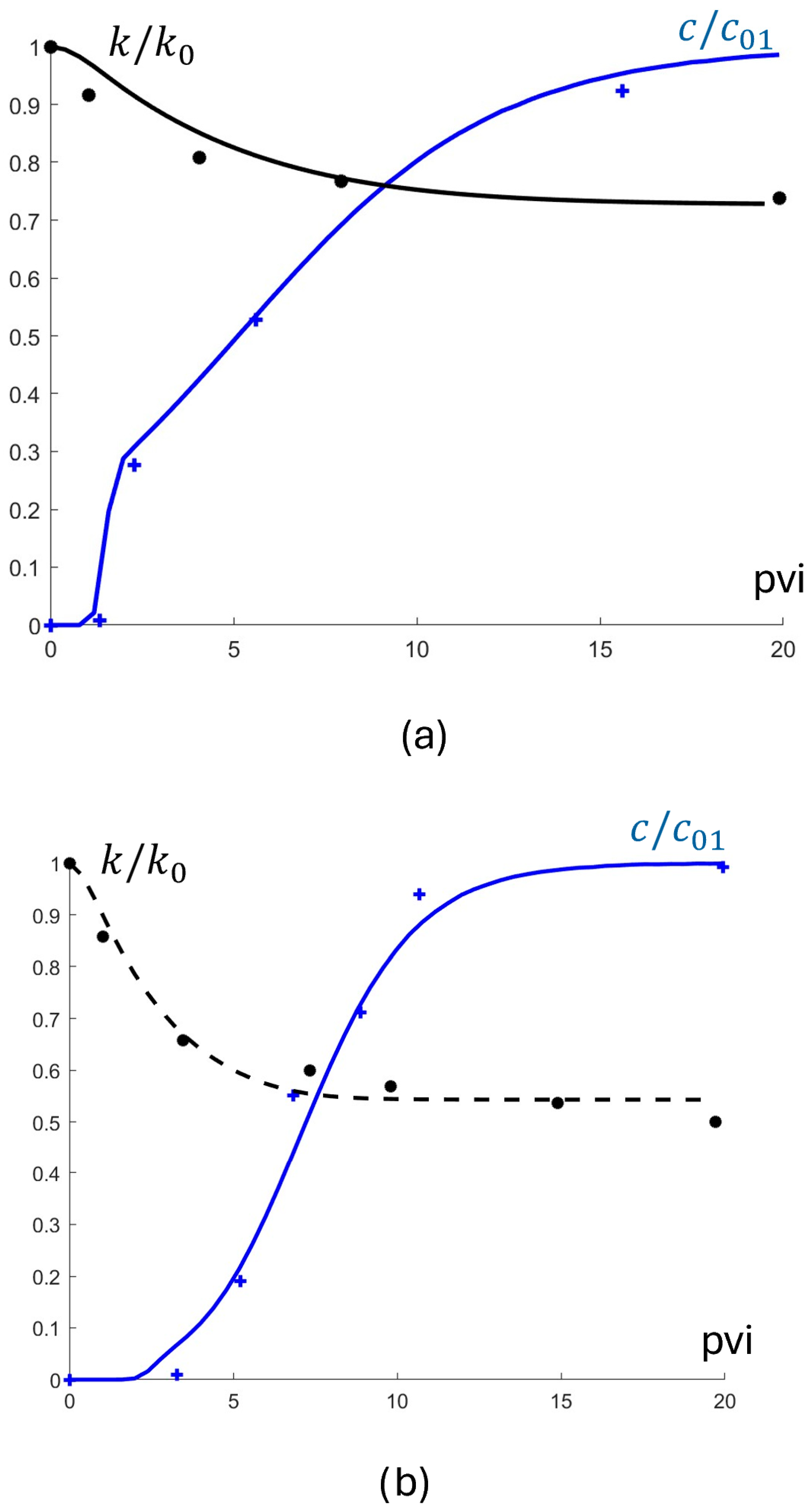
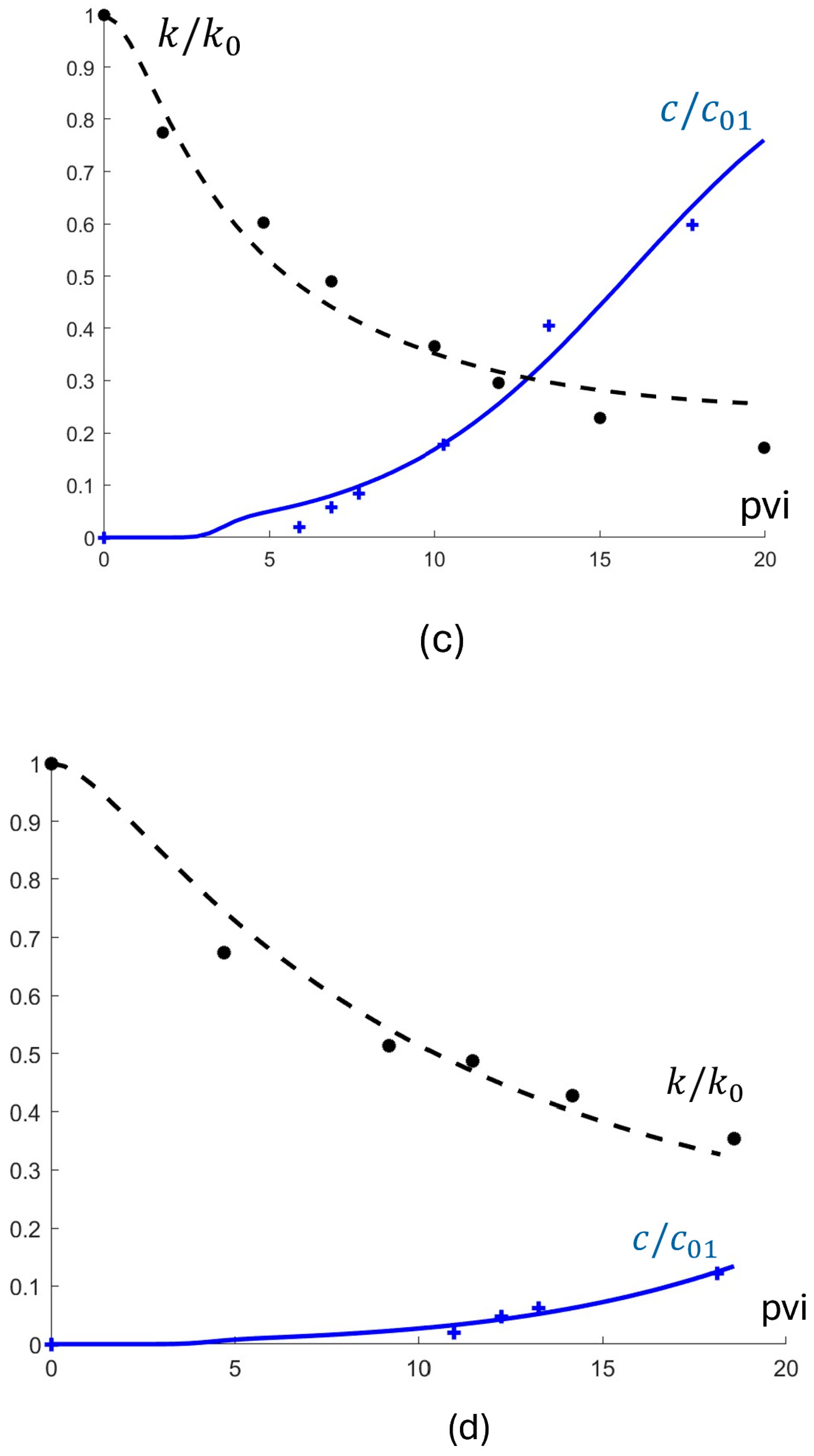
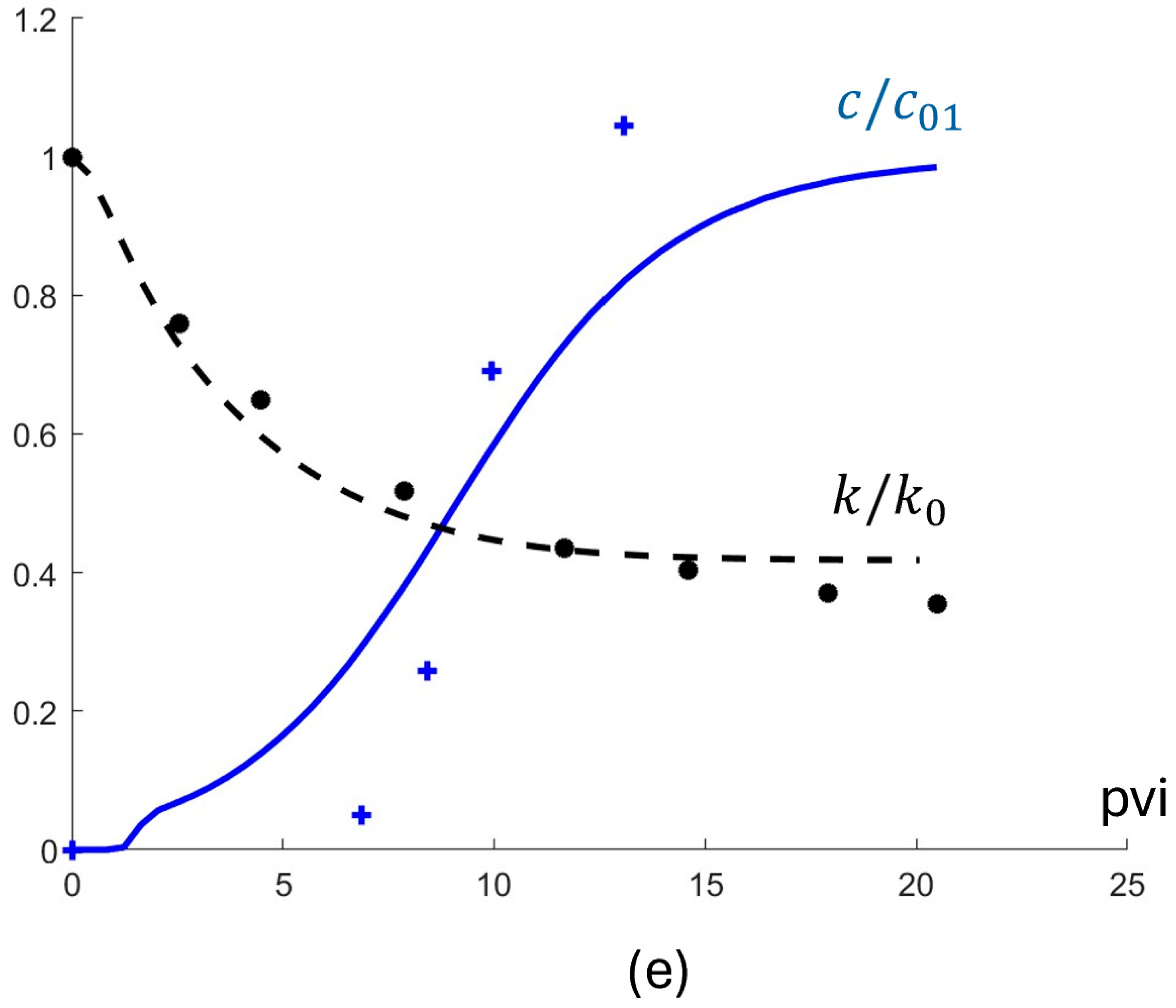
Comparison of the model with experimental data is presented in Figure 2. The different cases are distinguished by the size of the injected droplets [20,40]. Larger droplets correspond to a later increase in the production curve and higher decrease in permeability.
The accuracy may be considered very satisfactory, accounting for a random factor in the experiments and the fact that the model only approximately corresponds to the experimental conditions (in particular, the injected emulsions were not strictly monodispersed). The parameters of the model for all five cases are presented in the Supplementary Material. In all cases, the value of η is less than unity, meaning that the droplets are considerably delayed with regard to the flow. It should be remarked that the model is capable of reproducing complex and different shapes of the curves, which indicates its physical soundness.
Approximation of the permeability decline is, in general, much more accurate than that of the production profiles. The experimental data also indicate that, in some cases, like (b), the outlet concentration reaches the injected concentration. In these cases, the complete saturation of the porous medium is achieved, and the capture of the droplets stops. This indicates the necessity of the limits s c 0 , s s 0 in modeling.

3.3. Sample Calculations and Parameter Sensitivity

It may be asked whether such a large number of parameters as reported in Section 3.1 is necessary for modeling the experimental data, or if a smaller parameter set may be sufficient. Partly, the large number of parameters may be validated by the complex and varying shapes of the production curves. Some model parameters may in principle be correlated to physical properties of the system and be found in independent experiments. For example, the coagulation coefficients β and, probably, even the capture coefficients λ may be determined in microfluidics studies, like [53]. This is outside the scope of the present work.
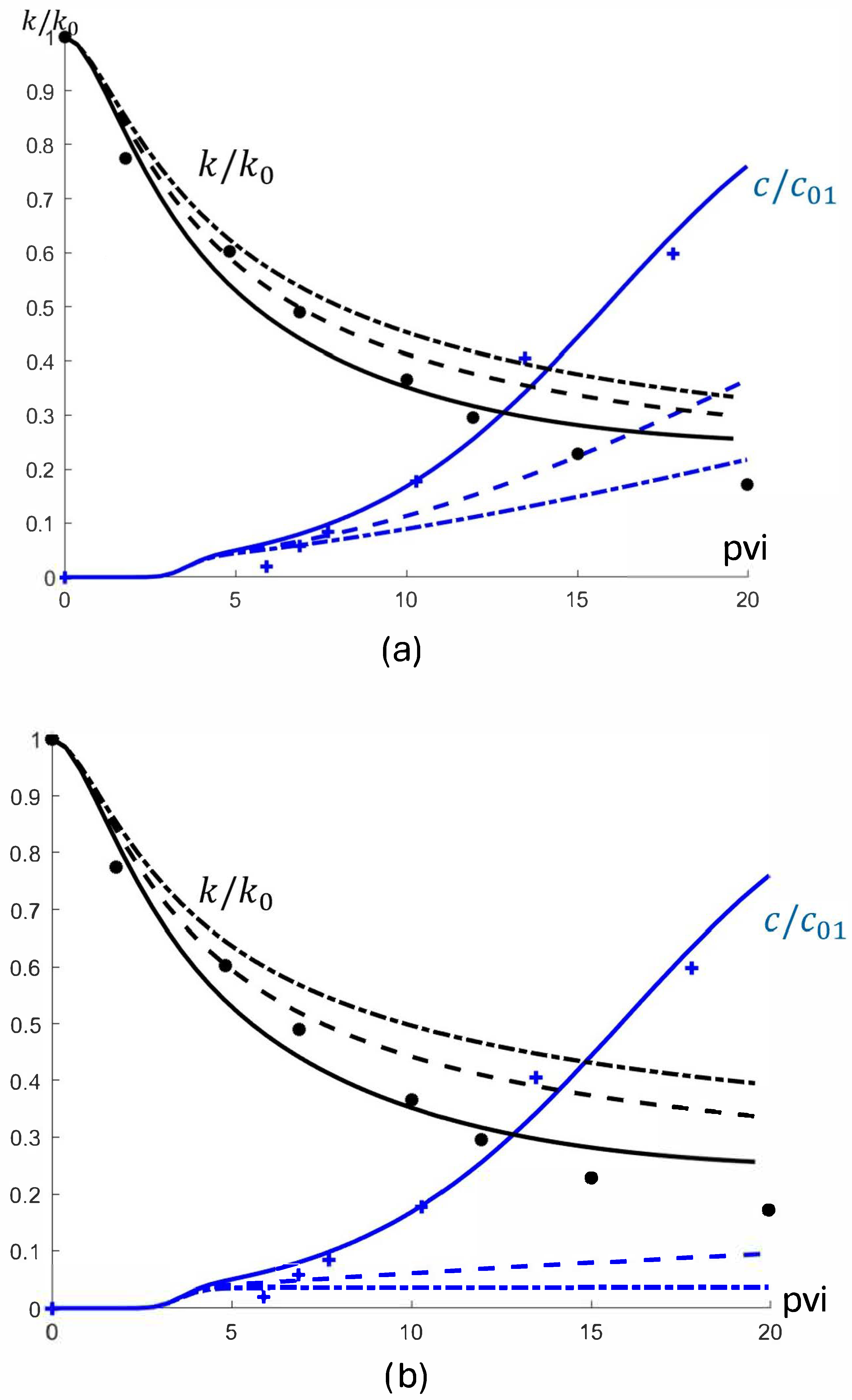
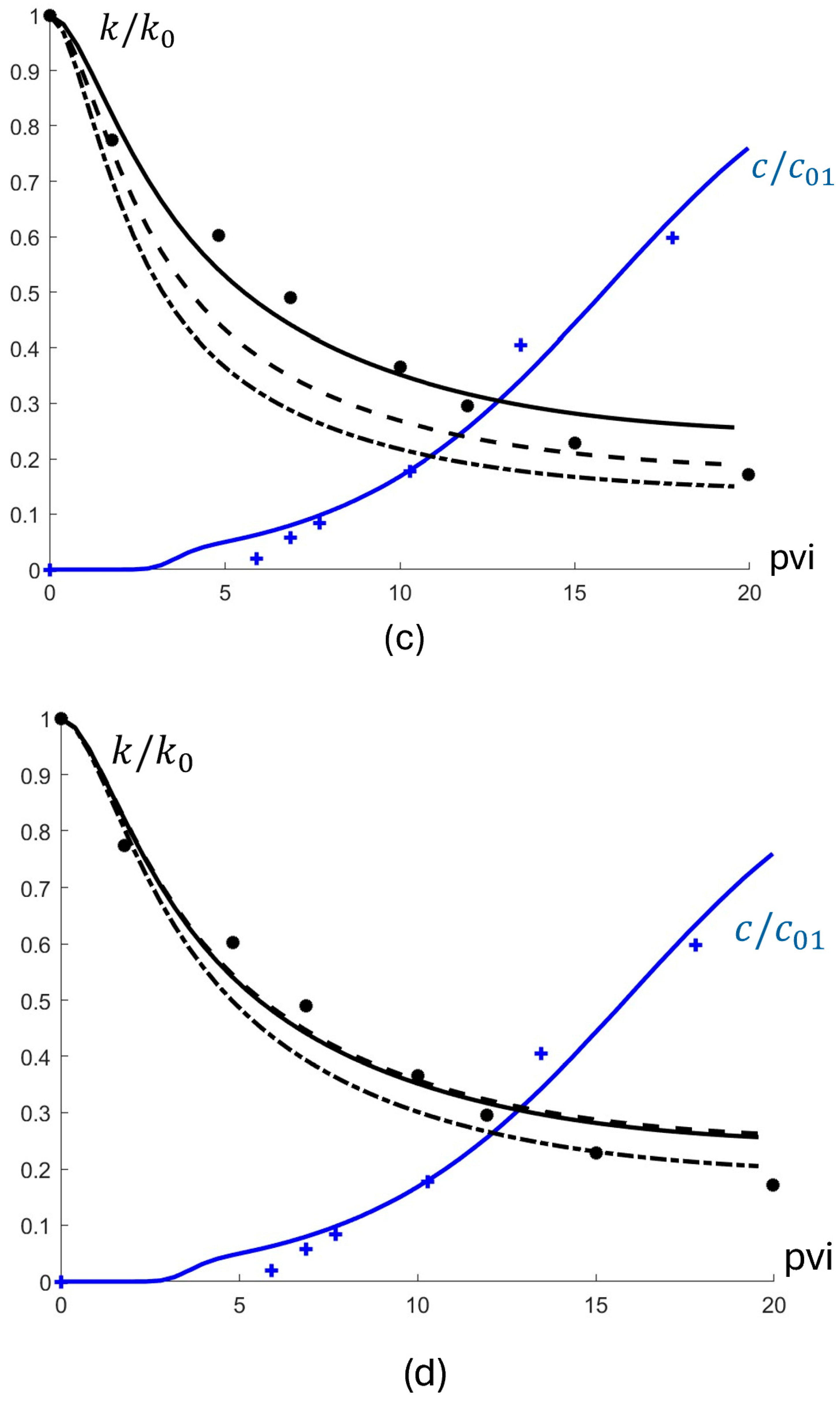
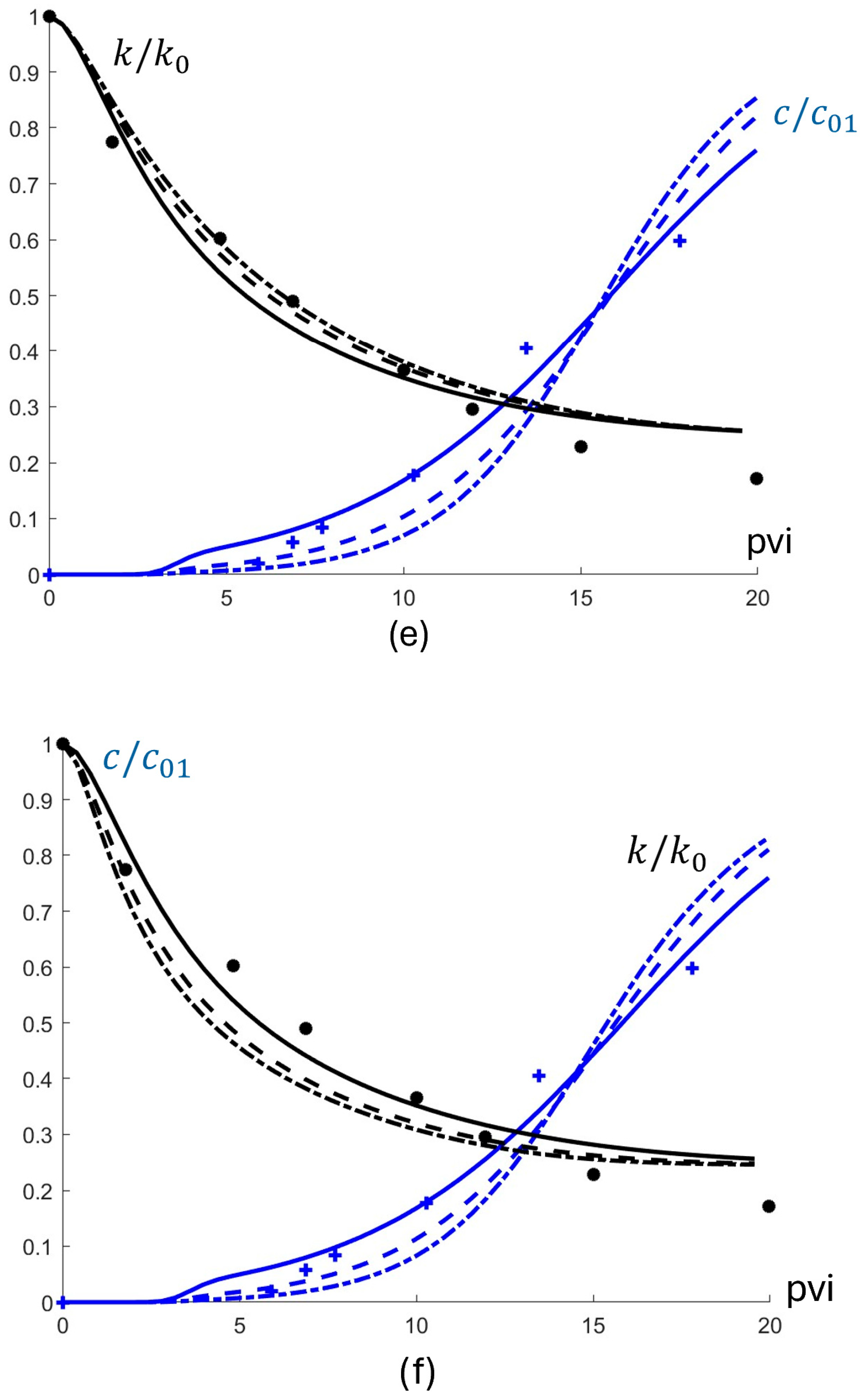
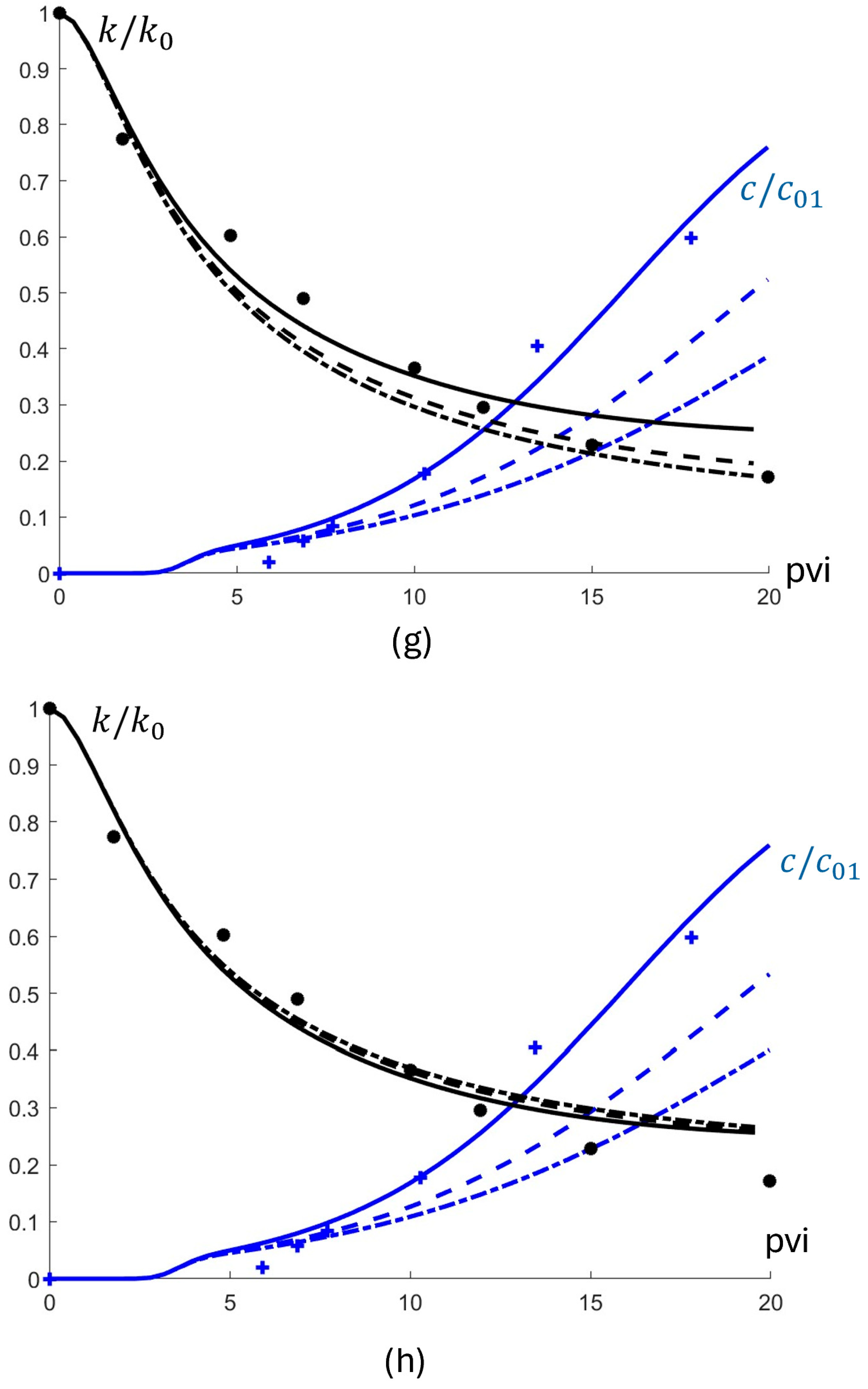
An alternative way is to perform a sensitivity study of experimental dependencies on the model parameters. We have performed the sensitivity study of the model, using case (c) in Figure 2 as a basic case for computations. This case was selected since it represents one of the most reasonable fits of the experimental data by the model; meanwhile, the normalized output concentration of the droplets does not reach unity, which indicates that in this case, complete occupation of the capture sites by droplets does not occur. The results of computations are shown in Figure 3. The basic parameters for calculation are reported in the Supplementary Material. These parameters varied one by one, as described below.
As written above, the data [20] correspond to stable emulsions, where coagulation does not take place. The first test, shown in Figure 3a, describes the behavior of the system under increasing coagulation kernel ( B = 0 ,   1 ,   2 , correspondingly). It is seen that coagulation drastically affects the droplet production curve, strongly decreasing this production. Meanwhile, the permeability decline curve is much less affected. For the explanation, it should be remembered that the dimensionless concentration of the droplets is reported as “volume per volume”. When a larger droplet is captured, more volume is eliminated from the production stream, so that coagulation makes filtration more efficient. Regarding the effect on permeability, capture of a large droplet in a constriction results, according to the model, in the same permeability reduction as capture of a small droplet. Coagulation results in a smaller number of strained droplets, hence, in a smaller reduction in the permeability. Interception on the surface is counted by its volumetric effect and should be (almost) the same with or without coagulation. In sum, coagulation diminishes the effect on permeability decline, as reflected in Figure 3a. However, the effect is not significant. The behavior of the model agrees with the experimental data of Hofman and Stein [66] who noticed that unstable emulsions tend to plug the porous medium more strongly than the stable ones. Unfortunately, only permeability reduction was reported in that work.
For unstable suspensions allowing for coagulation, it may be logical to assume that it may happen not only with the suspended droplets, but also on the surface, where the suspended droplets may get attached to already captured droplets. The second test, depicted in Figure 3b, describes this situation. In this test, the value of B varies as in the first test, while the values of Λ c and Λ s , responsible for secondary capture, assume the values of 0, 0.14, and 0.28 when B is 0, 1, and 2, respectively. The results, shown in Figure 3b, indicate an even higher effect of coagulation on the droplet production. The effect on permeability decline is also somewhat higher, although not to such an extent as on production history.
In order to distinguish between interception and straining, we have varied the interception parameter Β c and the dimensionless droplet volume V d (cf. Equation (13)). We used the values of 3.08 and 4.08, compared to the original fitted value of 2.08 (Figure 3c). As expected, the permeability decline increases with the increase in Β c . For comparison, Figure 3d shows the dependence of the permeability decline on the value of V d . Decreasing this value by 100 times almost does not change the original permeability decline curve (the dashed line), while increasing it 10 times moves the curve a little down (dot-dashed line). It is seen that the permeability decline is much more sensitive to straining than to interception.
Figure 3e,f shows the dependence of the production history and permeability decline on the primary capture parameters Λ c d 0 , Λ s d 0 . In the first subfigure, Λ c d 0 has values of 1.3, 2.3, and 3.3; in the second subfigure, Λ s d 0 acquires values of 1.35, 2.35, and 3.35, correspondingly. The dependence of the production profiles on these parameters is non-monotonous. If they increase, the droplets become initially captured faster. However, at later times, the surface or straining sites become occupied, and more droplets penetrate through the filter. Hence the production history plots decrease with Λ c d 0 , Λ s d 0 at the initial times, and increase with these values at later times, as shown in the plots. The permeability decline is only slightly affected by these parameters.
It is even less affected by variation in the limiting deposition constants s c , s s . This is illustrated in Figure 3g,h, where s c has values of 1.43, 2.43, and 3.43 and s s has values of 1.71, 2.71, and 3.71, correspondingly. The production histories deviate at later times, where capture of the droplets becomes affected by the limiting capacities. At earlier times, they are almost indistinguishable.
Comparison of all the cases makes it possible to conclude that the production histories are much more strongly affected by the parameter variation than the permeability decline curves. They exhibit more individual and complex behavior. In order to discriminate between the different parametrizations of a model and, probably, even between the different models, it is insufficient to evaluate only their capability of predicting the permeability decline. It is also important to consider other kinds of data, if they are available. This, however, is not always the case. It may happen that all or nearly all the droplets are captured by the filter, so that the production histories cannot be reported. Consistent and well-described experimental data is one of the largest problems in this area.

4. Conclusions

We have developed a population balance model describing filtration of polydisperse emulsions. The emulsion droplets may be captured in constrictions (straining) and on the internal surface of the porous medium (interception). Agglomeration of the droplets and their attachment to already captured droplets are accounted for in the model. The corresponding formula for permeability decline is suggested based on the Kozeny–Carman equation and common empirical relation for straining.
The model is compared with the experimental data of Soo and Radke [20,21]. The comparison is reasonable, accounting for many factors neglected (e.g., that the injected emulsion is somewhat polydisperse). A two-step optimization procedure is proposed to adjust the model to the experimental data.
To account for coagulation, we have carried out a sensitivity analysis of the model, varying its parameters one by one. The most important finding is that the production profiles are much more sensitive to the model parameters than to the permeability decline curves. Hence, the information about the model, contained in the permeability decline curves, is insufficient to discriminate between the different sets of parameters and, probably, even between the different models of the process.
Out of all the parameters, the model is most sensitive to the coagulation kernel and the capacities of the adsorption sites. The model is less sensitive to the primary capture coefficients. The dependence on these parameters is non-monotonous: with their increase, the particle capture increases at earlier times but decreases later.

Supplementary Materials

The following supporting information can be downloaded at https://www.mdpi.com/article/10.3390/liquids6010004/s1: Table S1: In the table below, the parameters used for comparison with the experimental data, as shown in Figure 2, are collected. The porosity was reported to be 0.34.

Author Contributions

Conceptualization, S.P.-P., J.T.F.d.S., S.I.A. and A.A.S.; methodology, J.T.F.d.S. and A.A.S.; software, S.P.-P., J.T.F.d.S. and A.A.S.; validation, S.P.-P., J.T.F.d.S., S.I.A. and A.A.S.; formal analysis, S.P.-P., J.T.F.d.S., S.I.A. and A.A.S.; investigation, S.P.-P. and A.A.S.; resources, J.T.F.d.S. and S.I.A.; data curation, J.T.F.d.S. and S.I.A.; writing—original draft, J.T.F.d.S. and A.A.S.; writing—review and editing, S.P.-P., J.T.F.d.S., S.I.A. and A.A.S.; visualization, S.P.-P.; supervision, S.I.A. and A.A.S.; project administration, J.T.F.d.S., S.I.A. and A.A.S.; funding acquisition, S.I.A. and A.A.S. All authors have read and agreed to the published version of the manuscript.

Funding

This research received no external funding.

Data Availability Statement

The original contributions presented in this study are included in the article/Supplementary Material. Further inquiries can be directed to the corresponding author(s).

Acknowledgments

The work is supported by DOTC—Danish Offshore Technology Center, DTU.

Conflicts of Interest

The authors declare no conflicts of interest. There is no commercial interests to be declared. Julie moved to Novonesis after finishing this work at the DTU.

Abbreviations

The following abbreviations are used in this manuscript:
b i Birth term, m 3 s 1
B i Dimensionless birth term
B Dimensionless agglomeration coefficient
c Numerical   concentration ,   m 3
C Dimensionless concentration
c v Volumetric   concentration   m 3 / m 3
d i Death   term ,   m 3 s 1
D i Dimensionless death term
k Permeability ,   m 2
L Length   of   the   filter ,   m
s Dimensionless concentration of deposited droplets
t Time ,   s
T Dimensionless time
U Filtration   velocity ,   m / s
v d Volume   of   a   sin gle   ( primary )   droplet ,   m 3
V d Dimensionless volume of a single droplet
x Spatial   coordinate ,   m
X Dimensionless spatial coordinate
β Agglomeration   coefficient ,   m 3 / s
β c Permeability   reduction   coefficient ,   m 3
Β c Dimensionless permeability reduction coefficient
ϵ Porosity
λ Filtration   ( deposition )   coefficient ,   m 1
Λ Reduced   deposition   coefficient ,   m 1
η Velocity correction coefficient for droplets, dimensionless
σ Concentration   of   deposited   droplets ,   m 3
Subscripts
c Constriction (straining)
s Surface (interception)
v Volumetric

References

  1. Gebreslase, G.A.; Bousquet, G.; Bouyer, D. Review on membranes for the filtration of aqueous based solution: Oil in Water Emulsion. J. Membr. Sci. Technol. 2018, 8, 1000188. [Google Scholar] [CrossRef]
  2. Dudek, M.; Vik, E.A.; Aanesen, S.V.; Øye, G. Colloid chemistry and experimental techniques for understanding fundamental behaviour of produced water in oil and gas production. Adv. Colloid Interface Sci. 2020, 276, 102105. [Google Scholar] [CrossRef]
  3. Fakhru’l-Razi, A.; Pendashteh, A.; Abdullah, L.C.; Biak, D.R.A.; Madaeni, S.S.; Abidin, Z.Z. Review of technologies for oil and gas produced water treatment. J. Hazard. Mater. 2009, 170, 530–551. [Google Scholar] [CrossRef] [PubMed]
  4. Igunnu, E.T.; Chen, G.Z. Produced water treatment technologies. Int. J. Low-Carbon Technol. 2014, 9, 157–177. [Google Scholar] [CrossRef]
  5. Zheng, B.; Chen, W.; Thanyamanta, K.; Hawboldt, B.; Zhang, B.; Liu, B. Offshore produced water management: A review of current practice and challenges in harsh/Arctic environments. Mar. Pollut. Bull. 2016, 104, 7–19. [Google Scholar] [CrossRef]
  6. Paige, R.W.; Murray, L.R. Re-injection of produced water–Field experience and current understanding. In Proceedings of the 1994 Eurock SPEIISRM Rock Mechanics in Petroleum Engineering Conference, Delft, The Netherlands, 29–31 August 1994. [Google Scholar] [CrossRef]
  7. Azizov, I.; Dudek, M.; Øye, G. Emulsions in porous media from the perspective of produced water re-injection—A review. J. Pet. Sci. Eng. 2021, 206, 109057. [Google Scholar] [CrossRef]
  8. Sharma, M.M.; Pang, S.; Morgenthaler, L. Injectivity decline in water injection wells: An offshore Gulf of Mexico case study. SPE Prod. Facilities 2000, 15, 6–13. [Google Scholar] [CrossRef]
  9. Ray, J.P.; Engelhardt, F.R. (Eds.) Produced Water: Technological/Environmental Issues and Solutions; Proceedings of the 1992 International Produced Water Symposium; Springer: New York, NY, USA, 1992. [Google Scholar] [CrossRef]
  10. Al-Ghouti, M.A.; Al-Kaabi, M.A.; Ashfaq, M.Y.; Da’na, D.A. Produced water characteristics, treatment and reuse: A review. J. Water Process Eng. 2019, 28, 222–239. [Google Scholar] [CrossRef]
  11. Herzig, J.P.; Leclerc, D.M.; Le Goff, P.L. Flow of Suspensions through Porous Media—New differential equation for clogged beds is derived. Ind. Eng. Chem. 1970, 62, 8–35. [Google Scholar] [CrossRef]
  12. Elimelech, M.; Gregory, J.; Williams, R.; Jia, X. Particle Deposition and Aggregation: Measurement, Modelling and Simulation (Colloid and Surface Engineering); Butterworth-Heinemann: Oxford, UK, 1998. [Google Scholar]
  13. Jegatheesan, V.; Vigneswaran, S. Deep bed filtration: Mathematical models and observations. Crit. Rev. Environ. Sci. Technol. 2005, 35, 515–569. [Google Scholar] [CrossRef]
  14. Shapiro, A.; Yuan, H. Application of stochastic approaches to modelling suspension flow in porous media. In Random Walks: Prin Ciples, Processes and Application; Nova Science Publishers: Hauppauge, NY, USA, 2011. [Google Scholar]
  15. Yuan, H.; Shapiro, A. Colloid transport and retention: Recent advances in colloids filtration theory. In Colloids: Classification, Properties and Applications; Nova Science Publishers: Hauppauge, NY, USA, 2012. [Google Scholar]
  16. Yuan, H.; You, Z.; Shapiro, A.; Bedrikovetsky, P. Improved population balance model for straining-dominant deep bed filtration using network calculations. Chem. Eng. J. 2013, 226, 227–237. [Google Scholar] [CrossRef]
  17. Shapiro, A.; Santos, A.; Bedrikovetsky, P.; Medvedev, O. A stochastic model for filtration of particulate suspensions with incomplete pore plugging. Transp. Porous Media 2007, 67, 135–164. [Google Scholar] [CrossRef]
  18. Bedrikovetsky, P.; Osipov, Y.; Kuzmina, L.; Malgaresi, G. Exact upscaling for transport of size-distributed colloids. Water Res. Res. 2019, 55, 1011–1039. [Google Scholar] [CrossRef]
  19. Bradford, S.A.; Lin, D. A theoretical model to predict the influence of physicochemical conditions on colloid transport, attachment, detachment, and blocking in porous media. J. Hydrol. 2025, 650, 132483. [Google Scholar] [CrossRef]
  20. Soo, H.; Radke, C.J. Flow Mechanism of Dilute, Stable Emulsions in Porous Media. Ind. Eng. Chem. Fundam. 1984, 23, 343–347. [Google Scholar] [CrossRef]
  21. Soo, H.; Radke, C.J. Velocity effects in emulsion flow through porous media. J. Colloid Interface Sci. 1984, 102, 462–476. [Google Scholar] [CrossRef]
  22. Buret, S.; Nabzar, L.; Jada, A. Emulsion Deposition in Porous Media: Impact on Well Injectivity. In Proceedings of the 2008 SPE EUROPEC/EAGE Annual Conference and Exhibition, Rome, Italy, 9–12 June 2008. [Google Scholar]
  23. Buret, S.; Nabzar, L.; Jada, A. Water quality and well injectivity: Do residual oil-in-water emulsions matter? SPE J. 2010, 15, 557–568. [Google Scholar] [CrossRef]
  24. Ochi, J.; Oughanem, R. An experimental investigation of formation damage induced by PWRI in unconsolidated sands. In Proceedings of the SPE International Conference and Exhibition on Formation Damage Control, Lafayette, LA, USA, 7–9 February 2018; pp. 1–15. [Google Scholar] [CrossRef]
  25. Rege, S.D.; Fogler, H.S. A network model for deep bed filtration of solid particles and emulsion drops. AIChE J. 1988, 34, 1761–1772. [Google Scholar] [CrossRef]
  26. Buckley, S.E.; Leverett, M.C. Mechanism of Fluid Displacement in Sands. Trans. AIME 1942, 146, 107–116. [Google Scholar] [CrossRef]
  27. Muskat, M. Physical Principles of Oil Production; McGraw-Hill Book Company Inc.: New York, NY, USA, 1949. [Google Scholar]
  28. Bedrikovetsky, P. Mathematical Theory of Oil and Gas Recovery; Kluwer: Dordrecht, The Netherlands, 1993. [Google Scholar]
  29. Spielman, L.A.; Goren, S.L. Progress in Induced Coalescence and a New Theoretical Framework for Coalescence by Porous Media. Ind. Eng. Chem. 1970, 62, 10–24. [Google Scholar] [CrossRef]
  30. Shatov, V.A.; Lyubimenko, V.A.; Bel’kov, V.M. Mathematical model of the filtration of an emulsion in fibrous materials. Colloid J. Russ. Acad. Sci. 1992, 54, 175–181. [Google Scholar]
  31. Verigin, N.N. On filtration of emulsions in a porous medium. Dokl. Acad. Nauk. Mech. 1993, 333, 28–31. (In Russian) [Google Scholar]
  32. Devereux, O.F. Emulsion Flow in Porous Solids I. A Flow Model. Chem. Eng. J. 1974, 7, 121–128. [Google Scholar] [CrossRef]
  33. Devereux, O.F. Flow in Porous Solids II. Experiments with a Crude Oil-in-Water Emulsion in Porous Sandstone. Chem. Eng. J. 1974, 7, 129–136. [Google Scholar] [CrossRef]
  34. McAuliffe, C.D. Oil-in-Water Emulsions and Their Flow Properties in Porous Media. J. Pet. Technol. 1973, 25, 727–733. [Google Scholar] [CrossRef]
  35. Jin, L.; Wojtanowicz, A.K. Progression of injectivity damage with oily waste water in linear flow. Pet. Sci. 2014, 11, 550–562. [Google Scholar] [CrossRef]
  36. Jin, L.; Wojtanowicz, A.K.; Ge, J. An analytical model predicts pressure increase during waste water injection to prevent fracturing and seismic events. In Proceedings of the SPE Health, Safety, Security, Environment, & Social Responsibility Conference–North America, New Orleans, LA, USA, 18–20 April 2017; Volume 2017, pp. 193–211. [Google Scholar] [CrossRef]
  37. Sherwood, J.D. A model for static filtration of emulsions and foams. Chem. Eng. Sci. 1993, 48, 3355–3361. [Google Scholar] [CrossRef]
  38. Soo, H.; Dilute, F.O. Stable Emulsion in Porous Media. Ph.D. Thesis, University of California, Berkeley, CA, USA, 1984. [Google Scholar]
  39. Soo, H.; Radke, C.J. A filteration model for the flow of dilute stable emulsions in porous media—I. Theory. Chem. Eng. Sci. 1986, 41, 263–272. [Google Scholar] [CrossRef]
  40. Soo, H.; Williams, M.C.; Radke, C.J. A filtration model for the flow of dilute, stable emulsions in porous media—II. Parameter evaluation and estimation. Chem. Eng. Sci. 1986, 41, 273–281. [Google Scholar] [CrossRef]
  41. Litwiniszyn, J. Colmatage considered as certain stochastic process. Acad. Poloinaise Des. Sci. 1963, 11, 117–122. [Google Scholar]
  42. Litwiniszyn, J. On Suspension Flow in a Porous Medium. J. Engng Sci. 1967, 5, 435–454. [Google Scholar] [CrossRef]
  43. Litwiniszyn, J. The Phenomenon of Colmatage Considered in the Light of Markov Processes. In Bulletin De L’Academie Polonaise Des Sciences; Paostwowe Wydawnictwo Naukowe: Warsaw, Poland, 1968; Volume VI, pp. 183–189. [Google Scholar]
  44. Hsu, E.; Fan, L.T. Experimental study of deep bed filtration—A stochastic treatment. AIChE J. 1984, 30, 267–273. [Google Scholar] [CrossRef]
  45. Fan, L.T.; Hwang, S.H. An Experimental Study of Deep-Bed Filtration: Stochastic Analysis. Powder Technol. 1985, 44, 1–11. [Google Scholar] [CrossRef]
  46. Fan, L.T.; Nassar, R.; Hwang, S.H.; Chou, S.T. Analysis of Deep Bed Filtration Data: Modeling as a Birth-Death Process. AIChE J. 1985, 31, 1781–1790. [Google Scholar] [CrossRef]
  47. Lopez, P.; Omari, A.; Chauveteau, G. Simulation of surface deposition of colloidal spheres under flow. Colloids Surf. A Physicochem. Eng. Asp. 2004, 240, 1–8. [Google Scholar] [CrossRef]
  48. Smoluchowski, M. Drei Vorträge über Diffusion, Brownsche Molekularbewegung und Koagulation von Kolloidteilchen. Phys. Z. 1916, 17, 557–585. (In German) [Google Scholar]
  49. Chen, P.; Sanyal, J.; Duduković, M.P. Numerical simulation of bubble columns flows: Effect of different breakup and coalescence closures. Chem. Eng. Sci. 2005, 60, 1085–1101. [Google Scholar] [CrossRef]
  50. Jeldres, R.I.; Fawell, P.D.; Florio, B.J. Population balance modelling to describe the particle aggregation process: A review. Powder Technol. 2018, 326, 190–207. [Google Scholar] [CrossRef]
  51. Coulaloglou, C.A.; Tavlarides, L.L. Description of interaction processes in agitated liquid-liquid dispersions. Chem. Eng. Sci. 1977, 32, 1289–1297. [Google Scholar] [CrossRef]
  52. Wang, T.; Andersen, S.I.; Shapiro, A. Coalescence of oil droplets in microchannels under brine flow. Colloids Surf. A Physicochem. Eng. Asp. 2020, 598, 124864. [Google Scholar] [CrossRef]
  53. Aliti, L.; Shapiro, A.; Andersen, S.I. Microfluidic Study of Oil Droplet Stability in Produced Water with Combinations of Production Chemicals. Energy Fuels 2023, 37, 1836–1847. [Google Scholar] [CrossRef]
  54. Yuan, H.; Shapiro, A. Modeling Non-Fickian Transport and Hyperexponential Deposition for Deep Bed Filtration. Chem. Eng. J. 2010, 162, 974–988. [Google Scholar] [CrossRef]
  55. Zhang, Z.; Drapacia, C.; Chen, X.; Xu, J. Droplet squeezing through a narrow constriction: Minimum impulse and critical velocity. Phys. Fluids 2017, 29, 072102. [Google Scholar] [CrossRef]
  56. Li, Z.; Gu, Z.; Li, R.; Wang, C.; Chen, C.; Yu, C.; Zhang, Y.; Shu, Q.; Su, J. Investigation on droplet dynamic snap-off process in a short, abrupt constriction. Chem. Eng. Sci. 2021, 235, 116496. [Google Scholar] [CrossRef]
  57. Hashemi, A.; Nguyen, C.; Loi, G.; Khazali, N.; Yang, Y.; Dang-Le, B.; Russell, T.; Bedrikovetsky, P. Colloidal detachment in porous media: Stochastic model and upscaling. Chem. Eng. J. 2023, 474, 145436. [Google Scholar] [CrossRef]
  58. Ting, H.Z.; Yang, Y.; Tian, Z.F.; Carageorgos, T.; Bedrikovetsky, P. Image interpretation for kaolinite detachment from solid substrate: Type curves, stochastic model. Colloids Surf. A Physicochem. Eng. Asp. 2022, 650, 129451. [Google Scholar] [CrossRef]
  59. Ting, H.Z.; Yang, Y.; Tian, Z.F.; Carageorgos, T.; Bedrikovetsky, P. Detachment of inclined spheroidal particles from flat substrates. Powder Technol. 2023, 427, 118754. [Google Scholar] [CrossRef]
  60. Bedrikovetsky, P.; Zainijahromi, A.; Siqueira, F.D.; Furtado, C.A.; de Souza, A.L.S. Particle detachment under velocity alternation during suspension transport in porous media. Trasnp. Porous Media 2012, 91, 173–197. [Google Scholar] [CrossRef]
  61. Zhao, L.; Torlapati, J.; Boufadel, M.C.; King, T.; Robinson, B.; Lee, K. VDROP: A comprehensive model for droplet formation of oils and gases in liquids- Incorporation of the interfacial tension and droplet viscosity. Chem. Eng. J. 2014, 253, 93–106. [Google Scholar] [CrossRef]
  62. Zhao, L.; Boudafel, M.C.; Socolofsky, S.A.; Adams, E.; King, T.; Lee, K. Evolution of droplets in subsea oil and gas blowouts: Development and validation of the numerical model VDROP-J. Mar. Pollut. Bull. 2014, 83, 58–69. [Google Scholar] [CrossRef]
  63. Erdim, E.; Akgiray, Ö.; Ibrahim, D. A revisit of pressure drop-flow rate correlations for packed beds of spheres. Powder Technol. 2015, 283, 488–504. [Google Scholar] [CrossRef]
  64. Nguyen, C.; Loi, G.; Russell, T.; Shafian, S.R.M.; Zulkifli, N.N.; Chee, S.C.; Razali, N.; Zeinijahromi, A.; Bedrikovetsky, P. Well inflow performance under fines migration during water-cut increase. Fuel 2022, 327, 124887. [Google Scholar] [CrossRef]
  65. Schiesser, W.E. Method of Lines PDE Analysis in Biomedical Science and Engineering; Wiley: Hoboken, NJ, USA, 2016. [Google Scholar]
  66. Hofman, J.M.A.; Stein, H.N. Permeability reduction of porous media on transport of emulsions through them. Colloids Surf. 1991, 61, 317–329. [Google Scholar] [CrossRef]
Figure 1. Illustration of straining and interception in channeling and granular porous media.
Liquids 06 00004 g001
Figure 2. Comparison of the model with experimental data of Soo and Radke [20]. Blue lines: droplet production profiles; black lines: permeability decline curves; crosses: experimental data for the droplet production; circles: experimental points for permeability decline. The horizontal axis shows pore volumes injected (pvi).
Liquids 06 00004 g002aLiquids 06 00004 g002bLiquids 06 00004 g002c
Figure 3. Sensitivity study of the model to its parameters. Blue lines: droplet breakthrough curves; black lines: permeability decline. The order of lines is solid (basic case); dashed; dot-dashed. (a) Variation in the coagulation kernel B . (b) Variation in B and secondary capture parameters Λ c , Λ s . (c) Variation in permeability decline parameter B c . (d) Variation in the droplet volume V d . (e,f) Variation in the primary capture parameters Λ c d 0 , Λ s d 0 , correspondingly. (g,h) Variation in the capacities of the constrictions and surface s c , s s , correspondingly. The horizontal axis shows pore volumes injected (pvi). Dots: experimental data on permeability decline; crosses: experimental data on production history.
Liquids 06 00004 g003aLiquids 06 00004 g003bLiquids 06 00004 g003cLiquids 06 00004 g003d
Table 1. Cases of study considered in this work for model development. See explanation of the symbols in Section 2.2.
Droplet-Droplet
CoalescenceNo Coalescence
Droplet-Porous medium Constriction + SurfaceCase 1Case 2
B = Λ s d = Λ c d = 0
ConstrictionCase 3
Λ s d = Λ s d 0 = 0
Case 4
B = Λ s d = Λ s d 0 = Λ c d = 0
Disclaimer/Publisher’s Note: The statements, opinions and data contained in all publications are solely those of the individual author(s) and contributor(s) and not of MDPI and/or the editor(s). MDPI and/or the editor(s) disclaim responsibility for any injury to people or property resulting from any ideas, methods, instructions or products referred to in the content.