
Filtration of Emulsions: The Population Balance Modeling

 , , and
Abstract
1. Introduction
2. Model
2.1. Physical Assumptions
2.2. Mathematical Statement
2.2.1. Governing System of Equations
2.2.2. The Permeability Decline Equation
2.2.3. Simplifications and Dimensionless Form
- All the coagulation constants are equal (their value will be denoted by );
- All the constants describing primary straining (see Equation (7)) are equal to the same constant . Similarly, all the constants for primary interception (Equation (8)) are equal to .
- Similar assumptions are made regarding the coefficients for secondary interception and straining , . All the coefficients are equal to , while are equal to .
- Porosity in the transport Equation (2) may be considered as a constant.
2.2.4. Different Cases
3. Sample Calculations
3.1. Algorithm
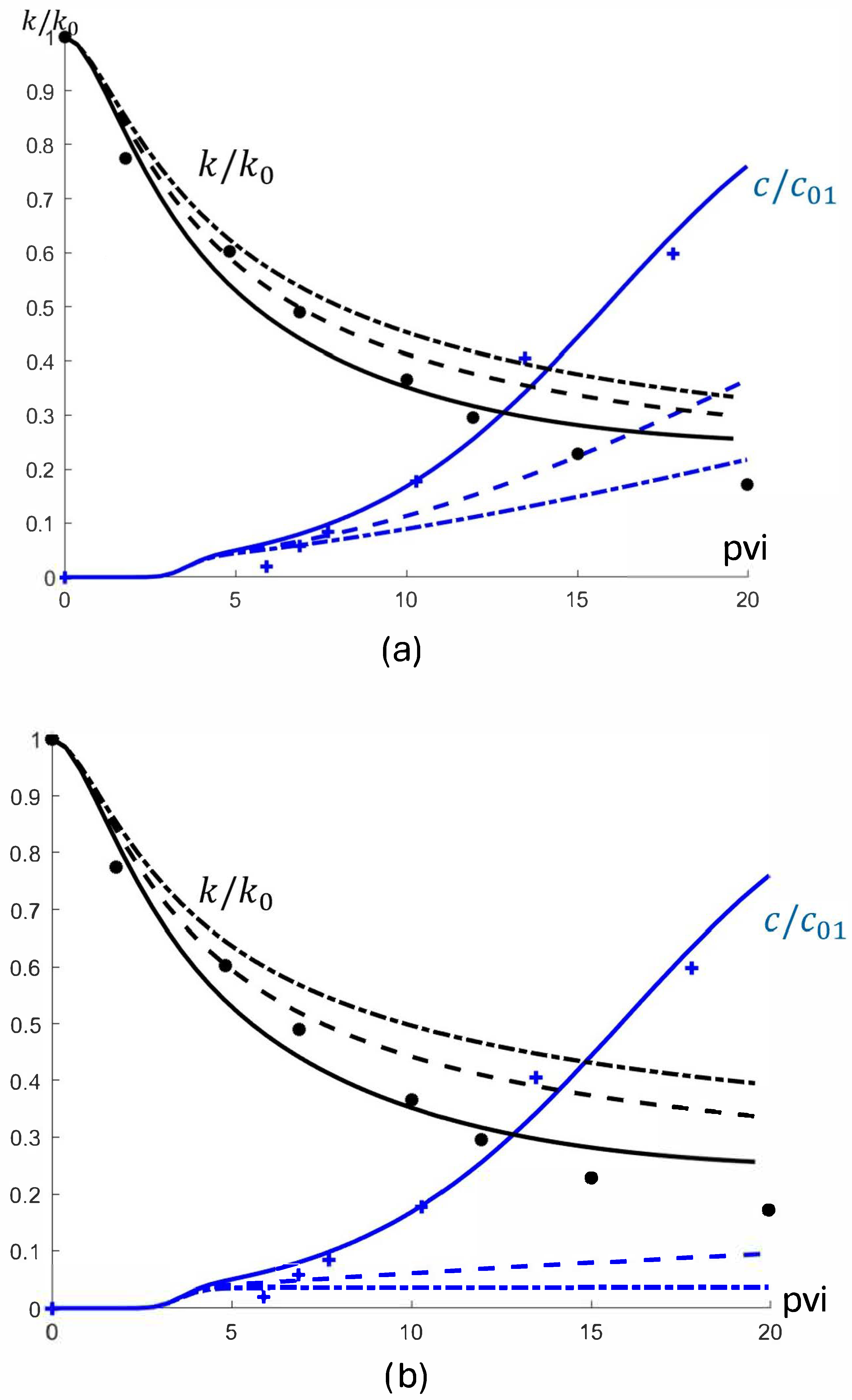
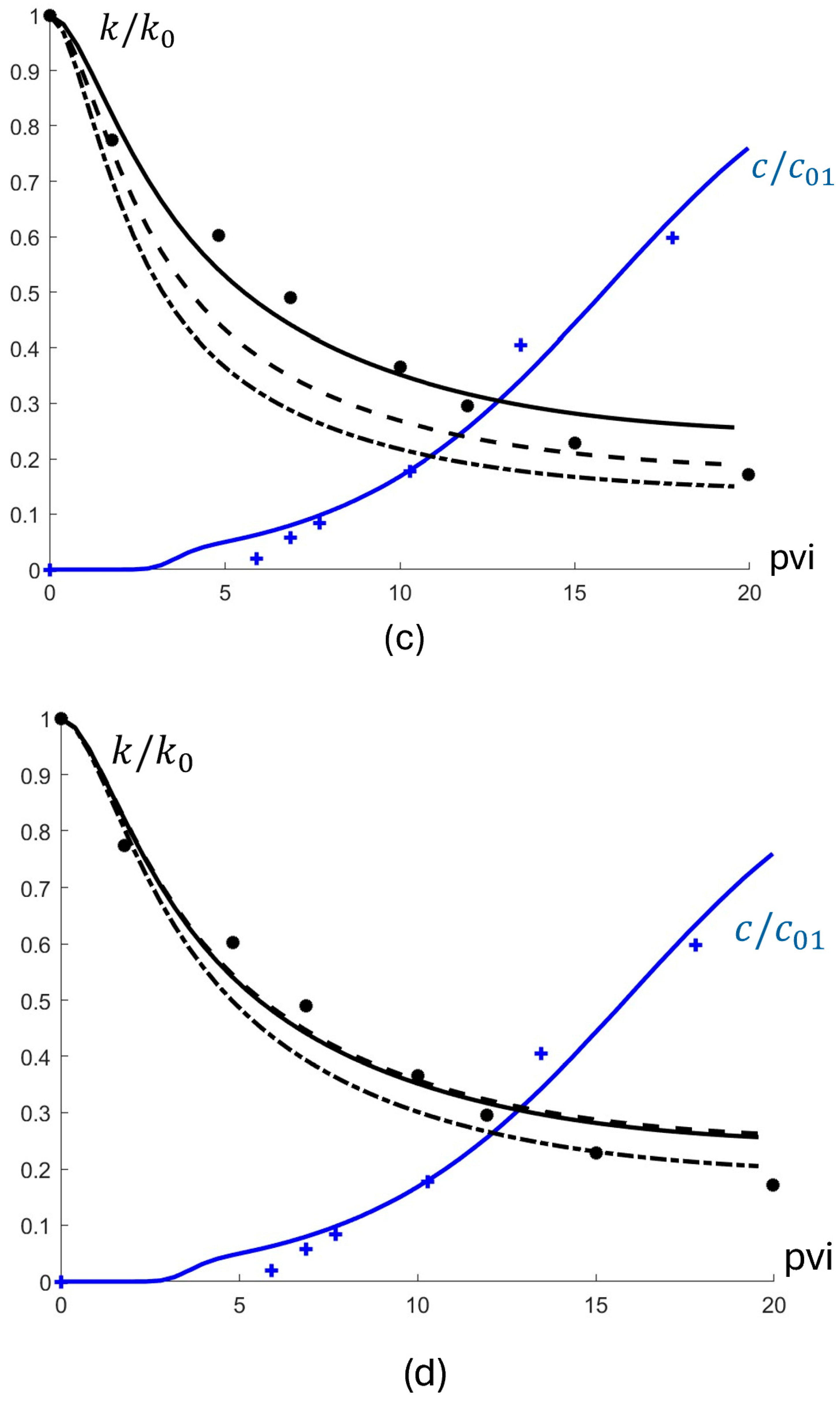
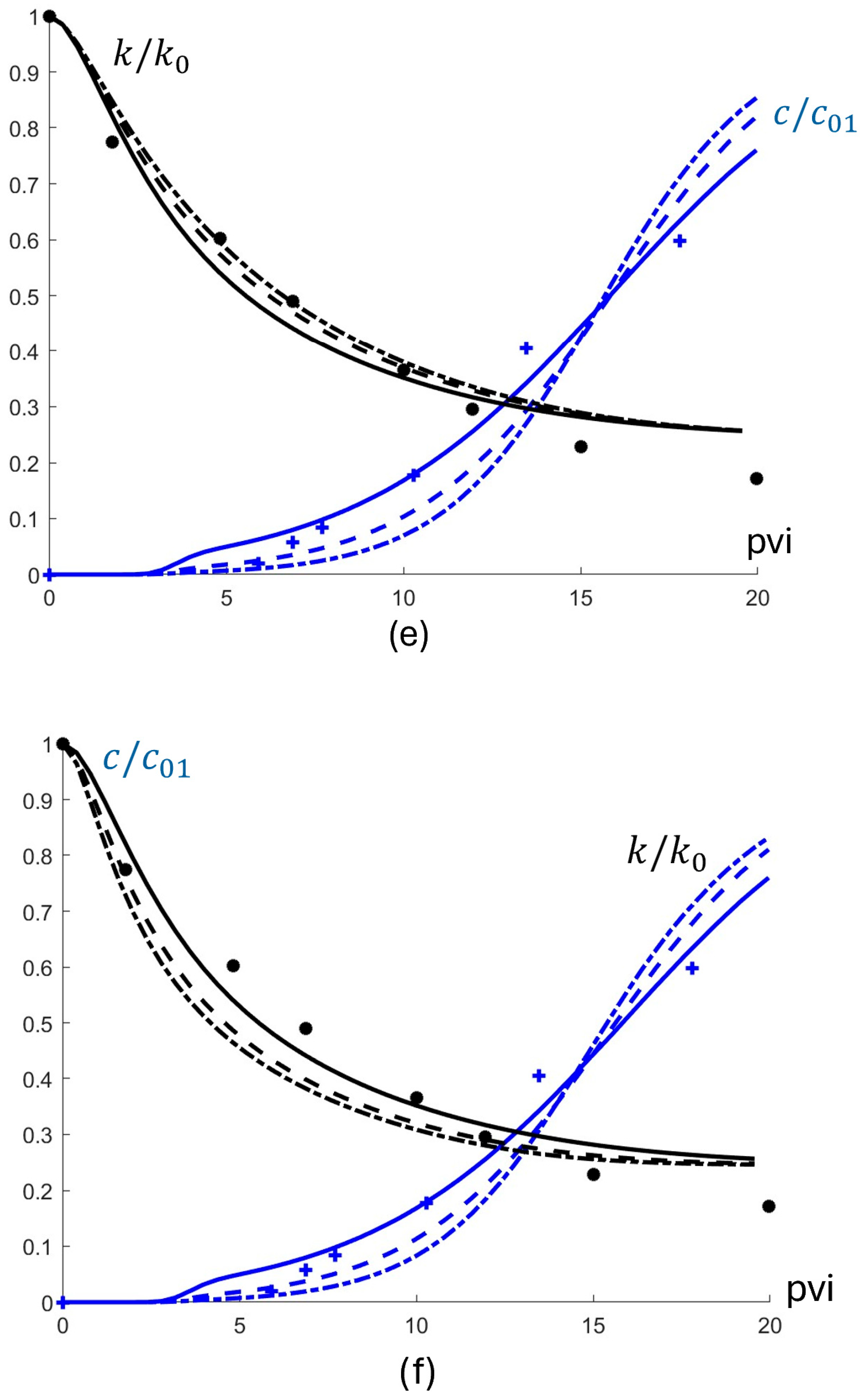
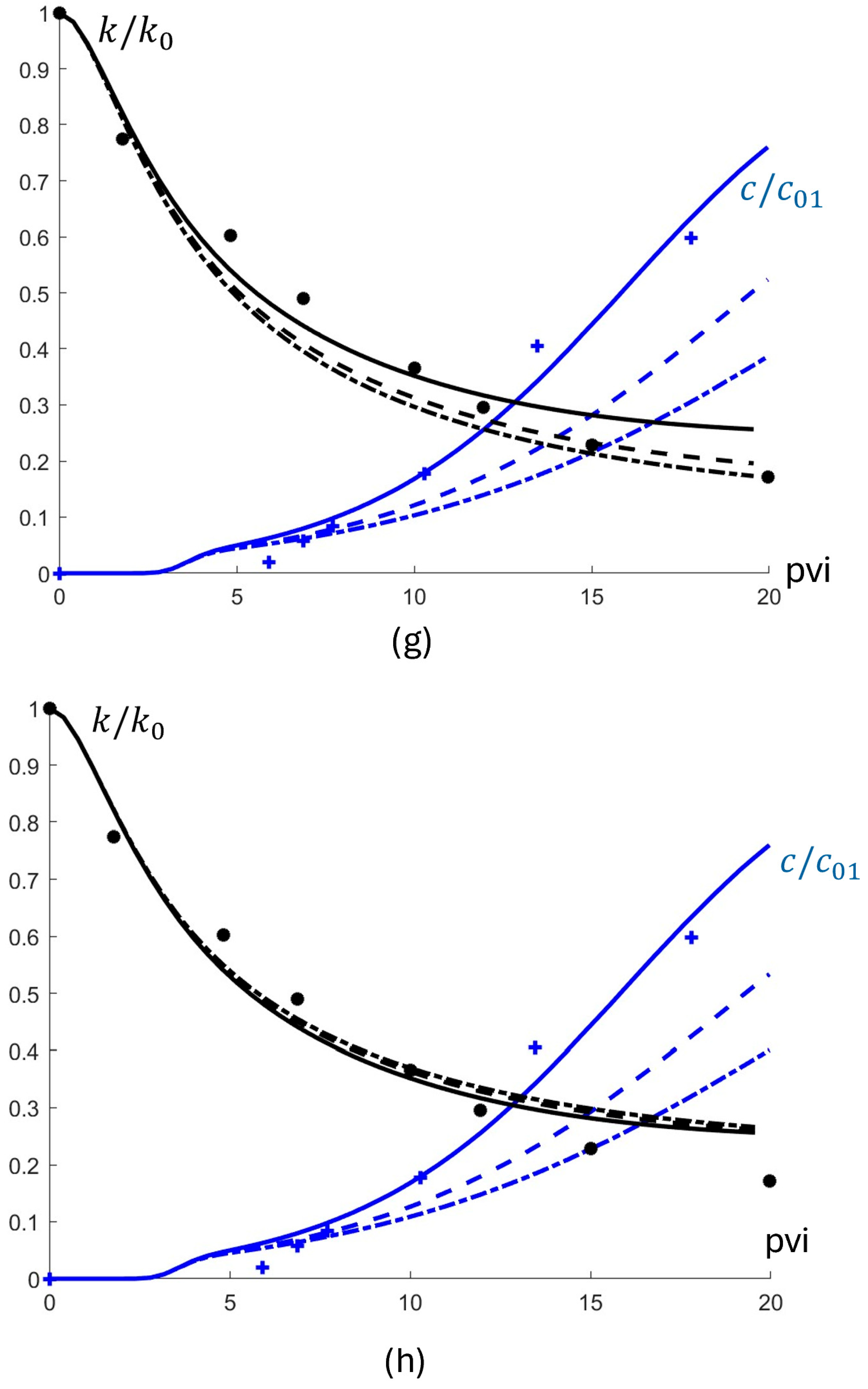
3.2. Comparison with the Experiments
3.3. Sample Calculations and Parameter Sensitivity
4. Conclusions
Supplementary Materials
Author Contributions
Funding
Data Availability Statement
Acknowledgments
Conflicts of Interest
Abbreviations
| Birth term, | |
| Dimensionless birth term | |
| Dimensionless agglomeration coefficient | |
| Dimensionless concentration | |
| Dimensionless death term | |
| Dimensionless concentration of deposited droplets | |
| Dimensionless time | |
| Dimensionless volume of a single droplet | |
| Dimensionless spatial coordinate | |
| Dimensionless permeability reduction coefficient | |
| Porosity | |
| Velocity correction coefficient for droplets, dimensionless | |
| Subscripts | |
| Constriction (straining) | |
| Surface (interception) | |
| Volumetric | |
References
- Gebreslase, G.A.; Bousquet, G.; Bouyer, D. Review on membranes for the filtration of aqueous based solution: Oil in Water Emulsion. J. Membr. Sci. Technol. 2018, 8, 1000188. [Google Scholar] [CrossRef]
- Dudek, M.; Vik, E.A.; Aanesen, S.V.; Øye, G. Colloid chemistry and experimental techniques for understanding fundamental behaviour of produced water in oil and gas production. Adv. Colloid Interface Sci. 2020, 276, 102105. [Google Scholar] [CrossRef]
- Fakhru’l-Razi, A.; Pendashteh, A.; Abdullah, L.C.; Biak, D.R.A.; Madaeni, S.S.; Abidin, Z.Z. Review of technologies for oil and gas produced water treatment. J. Hazard. Mater. 2009, 170, 530–551. [Google Scholar] [CrossRef] [PubMed]
- Igunnu, E.T.; Chen, G.Z. Produced water treatment technologies. Int. J. Low-Carbon Technol. 2014, 9, 157–177. [Google Scholar] [CrossRef]
- Zheng, B.; Chen, W.; Thanyamanta, K.; Hawboldt, B.; Zhang, B.; Liu, B. Offshore produced water management: A review of current practice and challenges in harsh/Arctic environments. Mar. Pollut. Bull. 2016, 104, 7–19. [Google Scholar] [CrossRef]
- Paige, R.W.; Murray, L.R. Re-injection of produced water–Field experience and current understanding. In Proceedings of the 1994 Eurock SPEIISRM Rock Mechanics in Petroleum Engineering Conference, Delft, The Netherlands, 29–31 August 1994. [Google Scholar] [CrossRef]
- Azizov, I.; Dudek, M.; Øye, G. Emulsions in porous media from the perspective of produced water re-injection—A review. J. Pet. Sci. Eng. 2021, 206, 109057. [Google Scholar] [CrossRef]
- Sharma, M.M.; Pang, S.; Morgenthaler, L. Injectivity decline in water injection wells: An offshore Gulf of Mexico case study. SPE Prod. Facilities 2000, 15, 6–13. [Google Scholar] [CrossRef]
- Ray, J.P.; Engelhardt, F.R. (Eds.) Produced Water: Technological/Environmental Issues and Solutions; Proceedings of the 1992 International Produced Water Symposium; Springer: New York, NY, USA, 1992. [Google Scholar] [CrossRef]
- Al-Ghouti, M.A.; Al-Kaabi, M.A.; Ashfaq, M.Y.; Da’na, D.A. Produced water characteristics, treatment and reuse: A review. J. Water Process Eng. 2019, 28, 222–239. [Google Scholar] [CrossRef]
- Herzig, J.P.; Leclerc, D.M.; Le Goff, P.L. Flow of Suspensions through Porous Media—New differential equation for clogged beds is derived. Ind. Eng. Chem. 1970, 62, 8–35. [Google Scholar] [CrossRef]
- Elimelech, M.; Gregory, J.; Williams, R.; Jia, X. Particle Deposition and Aggregation: Measurement, Modelling and Simulation (Colloid and Surface Engineering); Butterworth-Heinemann: Oxford, UK, 1998. [Google Scholar]
- Jegatheesan, V.; Vigneswaran, S. Deep bed filtration: Mathematical models and observations. Crit. Rev. Environ. Sci. Technol. 2005, 35, 515–569. [Google Scholar] [CrossRef]
- Shapiro, A.; Yuan, H. Application of stochastic approaches to modelling suspension flow in porous media. In Random Walks: Prin Ciples, Processes and Application; Nova Science Publishers: Hauppauge, NY, USA, 2011. [Google Scholar]
- Yuan, H.; Shapiro, A. Colloid transport and retention: Recent advances in colloids filtration theory. In Colloids: Classification, Properties and Applications; Nova Science Publishers: Hauppauge, NY, USA, 2012. [Google Scholar]
- Yuan, H.; You, Z.; Shapiro, A.; Bedrikovetsky, P. Improved population balance model for straining-dominant deep bed filtration using network calculations. Chem. Eng. J. 2013, 226, 227–237. [Google Scholar] [CrossRef]
- Shapiro, A.; Santos, A.; Bedrikovetsky, P.; Medvedev, O. A stochastic model for filtration of particulate suspensions with incomplete pore plugging. Transp. Porous Media 2007, 67, 135–164. [Google Scholar] [CrossRef]
- Bedrikovetsky, P.; Osipov, Y.; Kuzmina, L.; Malgaresi, G. Exact upscaling for transport of size-distributed colloids. Water Res. Res. 2019, 55, 1011–1039. [Google Scholar] [CrossRef]
- Bradford, S.A.; Lin, D. A theoretical model to predict the influence of physicochemical conditions on colloid transport, attachment, detachment, and blocking in porous media. J. Hydrol. 2025, 650, 132483. [Google Scholar] [CrossRef]
- Soo, H.; Radke, C.J. Flow Mechanism of Dilute, Stable Emulsions in Porous Media. Ind. Eng. Chem. Fundam. 1984, 23, 343–347. [Google Scholar] [CrossRef]
- Soo, H.; Radke, C.J. Velocity effects in emulsion flow through porous media. J. Colloid Interface Sci. 1984, 102, 462–476. [Google Scholar] [CrossRef]
- Buret, S.; Nabzar, L.; Jada, A. Emulsion Deposition in Porous Media: Impact on Well Injectivity. In Proceedings of the 2008 SPE EUROPEC/EAGE Annual Conference and Exhibition, Rome, Italy, 9–12 June 2008. [Google Scholar]
- Buret, S.; Nabzar, L.; Jada, A. Water quality and well injectivity: Do residual oil-in-water emulsions matter? SPE J. 2010, 15, 557–568. [Google Scholar] [CrossRef]
- Ochi, J.; Oughanem, R. An experimental investigation of formation damage induced by PWRI in unconsolidated sands. In Proceedings of the SPE International Conference and Exhibition on Formation Damage Control, Lafayette, LA, USA, 7–9 February 2018; pp. 1–15. [Google Scholar] [CrossRef]
- Rege, S.D.; Fogler, H.S. A network model for deep bed filtration of solid particles and emulsion drops. AIChE J. 1988, 34, 1761–1772. [Google Scholar] [CrossRef]
- Buckley, S.E.; Leverett, M.C. Mechanism of Fluid Displacement in Sands. Trans. AIME 1942, 146, 107–116. [Google Scholar] [CrossRef]
- Muskat, M. Physical Principles of Oil Production; McGraw-Hill Book Company Inc.: New York, NY, USA, 1949. [Google Scholar]
- Bedrikovetsky, P. Mathematical Theory of Oil and Gas Recovery; Kluwer: Dordrecht, The Netherlands, 1993. [Google Scholar]
- Spielman, L.A.; Goren, S.L. Progress in Induced Coalescence and a New Theoretical Framework for Coalescence by Porous Media. Ind. Eng. Chem. 1970, 62, 10–24. [Google Scholar] [CrossRef]
- Shatov, V.A.; Lyubimenko, V.A.; Bel’kov, V.M. Mathematical model of the filtration of an emulsion in fibrous materials. Colloid J. Russ. Acad. Sci. 1992, 54, 175–181. [Google Scholar]
- Verigin, N.N. On filtration of emulsions in a porous medium. Dokl. Acad. Nauk. Mech. 1993, 333, 28–31. (In Russian) [Google Scholar]
- Devereux, O.F. Emulsion Flow in Porous Solids I. A Flow Model. Chem. Eng. J. 1974, 7, 121–128. [Google Scholar] [CrossRef]
- Devereux, O.F. Flow in Porous Solids II. Experiments with a Crude Oil-in-Water Emulsion in Porous Sandstone. Chem. Eng. J. 1974, 7, 129–136. [Google Scholar] [CrossRef]
- McAuliffe, C.D. Oil-in-Water Emulsions and Their Flow Properties in Porous Media. J. Pet. Technol. 1973, 25, 727–733. [Google Scholar] [CrossRef]
- Jin, L.; Wojtanowicz, A.K. Progression of injectivity damage with oily waste water in linear flow. Pet. Sci. 2014, 11, 550–562. [Google Scholar] [CrossRef]
- Jin, L.; Wojtanowicz, A.K.; Ge, J. An analytical model predicts pressure increase during waste water injection to prevent fracturing and seismic events. In Proceedings of the SPE Health, Safety, Security, Environment, & Social Responsibility Conference–North America, New Orleans, LA, USA, 18–20 April 2017; Volume 2017, pp. 193–211. [Google Scholar] [CrossRef]
- Sherwood, J.D. A model for static filtration of emulsions and foams. Chem. Eng. Sci. 1993, 48, 3355–3361. [Google Scholar] [CrossRef]
- Soo, H.; Dilute, F.O. Stable Emulsion in Porous Media. Ph.D. Thesis, University of California, Berkeley, CA, USA, 1984. [Google Scholar]
- Soo, H.; Radke, C.J. A filteration model for the flow of dilute stable emulsions in porous media—I. Theory. Chem. Eng. Sci. 1986, 41, 263–272. [Google Scholar] [CrossRef]
- Soo, H.; Williams, M.C.; Radke, C.J. A filtration model for the flow of dilute, stable emulsions in porous media—II. Parameter evaluation and estimation. Chem. Eng. Sci. 1986, 41, 273–281. [Google Scholar] [CrossRef]
- Litwiniszyn, J. Colmatage considered as certain stochastic process. Acad. Poloinaise Des. Sci. 1963, 11, 117–122. [Google Scholar]
- Litwiniszyn, J. On Suspension Flow in a Porous Medium. J. Engng Sci. 1967, 5, 435–454. [Google Scholar] [CrossRef]
- Litwiniszyn, J. The Phenomenon of Colmatage Considered in the Light of Markov Processes. In Bulletin De L’Academie Polonaise Des Sciences; Paostwowe Wydawnictwo Naukowe: Warsaw, Poland, 1968; Volume VI, pp. 183–189. [Google Scholar]
- Hsu, E.; Fan, L.T. Experimental study of deep bed filtration—A stochastic treatment. AIChE J. 1984, 30, 267–273. [Google Scholar] [CrossRef]
- Fan, L.T.; Hwang, S.H. An Experimental Study of Deep-Bed Filtration: Stochastic Analysis. Powder Technol. 1985, 44, 1–11. [Google Scholar] [CrossRef]
- Fan, L.T.; Nassar, R.; Hwang, S.H.; Chou, S.T. Analysis of Deep Bed Filtration Data: Modeling as a Birth-Death Process. AIChE J. 1985, 31, 1781–1790. [Google Scholar] [CrossRef]
- Lopez, P.; Omari, A.; Chauveteau, G. Simulation of surface deposition of colloidal spheres under flow. Colloids Surf. A Physicochem. Eng. Asp. 2004, 240, 1–8. [Google Scholar] [CrossRef]
- Smoluchowski, M. Drei Vorträge über Diffusion, Brownsche Molekularbewegung und Koagulation von Kolloidteilchen. Phys. Z. 1916, 17, 557–585. (In German) [Google Scholar]
- Chen, P.; Sanyal, J.; Duduković, M.P. Numerical simulation of bubble columns flows: Effect of different breakup and coalescence closures. Chem. Eng. Sci. 2005, 60, 1085–1101. [Google Scholar] [CrossRef]
- Jeldres, R.I.; Fawell, P.D.; Florio, B.J. Population balance modelling to describe the particle aggregation process: A review. Powder Technol. 2018, 326, 190–207. [Google Scholar] [CrossRef]
- Coulaloglou, C.A.; Tavlarides, L.L. Description of interaction processes in agitated liquid-liquid dispersions. Chem. Eng. Sci. 1977, 32, 1289–1297. [Google Scholar] [CrossRef]
- Wang, T.; Andersen, S.I.; Shapiro, A. Coalescence of oil droplets in microchannels under brine flow. Colloids Surf. A Physicochem. Eng. Asp. 2020, 598, 124864. [Google Scholar] [CrossRef]
- Aliti, L.; Shapiro, A.; Andersen, S.I. Microfluidic Study of Oil Droplet Stability in Produced Water with Combinations of Production Chemicals. Energy Fuels 2023, 37, 1836–1847. [Google Scholar] [CrossRef]
- Yuan, H.; Shapiro, A. Modeling Non-Fickian Transport and Hyperexponential Deposition for Deep Bed Filtration. Chem. Eng. J. 2010, 162, 974–988. [Google Scholar] [CrossRef]
- Zhang, Z.; Drapacia, C.; Chen, X.; Xu, J. Droplet squeezing through a narrow constriction: Minimum impulse and critical velocity. Phys. Fluids 2017, 29, 072102. [Google Scholar] [CrossRef]
- Li, Z.; Gu, Z.; Li, R.; Wang, C.; Chen, C.; Yu, C.; Zhang, Y.; Shu, Q.; Su, J. Investigation on droplet dynamic snap-off process in a short, abrupt constriction. Chem. Eng. Sci. 2021, 235, 116496. [Google Scholar] [CrossRef]
- Hashemi, A.; Nguyen, C.; Loi, G.; Khazali, N.; Yang, Y.; Dang-Le, B.; Russell, T.; Bedrikovetsky, P. Colloidal detachment in porous media: Stochastic model and upscaling. Chem. Eng. J. 2023, 474, 145436. [Google Scholar] [CrossRef]
- Ting, H.Z.; Yang, Y.; Tian, Z.F.; Carageorgos, T.; Bedrikovetsky, P. Image interpretation for kaolinite detachment from solid substrate: Type curves, stochastic model. Colloids Surf. A Physicochem. Eng. Asp. 2022, 650, 129451. [Google Scholar] [CrossRef]
- Ting, H.Z.; Yang, Y.; Tian, Z.F.; Carageorgos, T.; Bedrikovetsky, P. Detachment of inclined spheroidal particles from flat substrates. Powder Technol. 2023, 427, 118754. [Google Scholar] [CrossRef]
- Bedrikovetsky, P.; Zainijahromi, A.; Siqueira, F.D.; Furtado, C.A.; de Souza, A.L.S. Particle detachment under velocity alternation during suspension transport in porous media. Trasnp. Porous Media 2012, 91, 173–197. [Google Scholar] [CrossRef]
- Zhao, L.; Torlapati, J.; Boufadel, M.C.; King, T.; Robinson, B.; Lee, K. VDROP: A comprehensive model for droplet formation of oils and gases in liquids- Incorporation of the interfacial tension and droplet viscosity. Chem. Eng. J. 2014, 253, 93–106. [Google Scholar] [CrossRef]
- Zhao, L.; Boudafel, M.C.; Socolofsky, S.A.; Adams, E.; King, T.; Lee, K. Evolution of droplets in subsea oil and gas blowouts: Development and validation of the numerical model VDROP-J. Mar. Pollut. Bull. 2014, 83, 58–69. [Google Scholar] [CrossRef]
- Erdim, E.; Akgiray, Ö.; Ibrahim, D. A revisit of pressure drop-flow rate correlations for packed beds of spheres. Powder Technol. 2015, 283, 488–504. [Google Scholar] [CrossRef]
- Nguyen, C.; Loi, G.; Russell, T.; Shafian, S.R.M.; Zulkifli, N.N.; Chee, S.C.; Razali, N.; Zeinijahromi, A.; Bedrikovetsky, P. Well inflow performance under fines migration during water-cut increase. Fuel 2022, 327, 124887. [Google Scholar] [CrossRef]
- Schiesser, W.E. Method of Lines PDE Analysis in Biomedical Science and Engineering; Wiley: Hoboken, NJ, USA, 2016. [Google Scholar]
- Hofman, J.M.A.; Stein, H.N. Permeability reduction of porous media on transport of emulsions through them. Colloids Surf. 1991, 61, 317–329. [Google Scholar] [CrossRef]



| Droplet-Droplet | |||
|---|---|---|---|
| Coalescence | No Coalescence | ||
| Droplet-Porous medium | Constriction + Surface | Case 1 | Case 2 |
| Constriction | Case 3 | Case 4 | |
Disclaimer/Publisher’s Note: The statements, opinions and data contained in all publications are solely those of the individual author(s) and contributor(s) and not of MDPI and/or the editor(s). MDPI and/or the editor(s) disclaim responsibility for any injury to people or property resulting from any ideas, methods, instructions or products referred to in the content. |
© 2026 by the authors. Licensee MDPI, Basel, Switzerland. This article is an open access article distributed under the terms and conditions of the Creative Commons Attribution (CC BY) license.
Share and Cite
Papine-Paktoris, S.; Trancoso Fernandes dos Santos, J.; Andersen, S.I.; Shapiro, A.A. Filtration of Emulsions: The Population Balance Modeling. Liquids 2026, 6, 4. https://doi.org/10.3390/liquids6010004
Papine-Paktoris S, Trancoso Fernandes dos Santos J, Andersen SI, Shapiro AA. Filtration of Emulsions: The Population Balance Modeling. Liquids. 2026; 6(1):4. https://doi.org/10.3390/liquids6010004
Chicago/Turabian StylePapine-Paktoris, Simon, Julia Trancoso Fernandes dos Santos, Simon Ivar Andersen, and Alexander A. Shapiro. 2026. "Filtration of Emulsions: The Population Balance Modeling" Liquids 6, no. 1: 4. https://doi.org/10.3390/liquids6010004
APA StylePapine-Paktoris, S., Trancoso Fernandes dos Santos, J., Andersen, S. I., & Shapiro, A. A. (2026). Filtration of Emulsions: The Population Balance Modeling. Liquids, 6(1), 4. https://doi.org/10.3390/liquids6010004