Article

Queue-Responsive Adaptive Signal Control vs. Webster Optimization: A Multi-Criteria Simulation Assessment at a Signalized Intersection


Department of Civil Engineering, Faculty of Engineering, Çankaya University, Ankara 06815, Türkiye
*
Author to whom correspondence should be addressed.
Future Transp. 2026, 6(2), 92; https://doi.org/10.3390/futuretransp6020092
Submission received: 21 March 2026 / Revised: 16 April 2026 / Accepted: 19 April 2026 / Published: 21 April 2026

Abstract

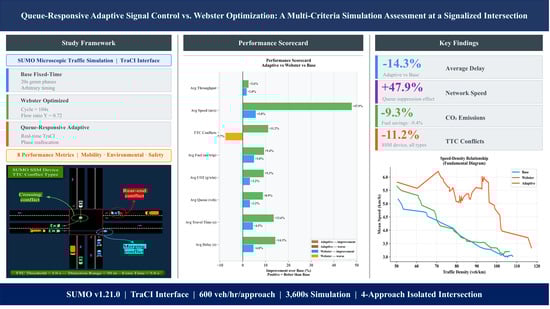
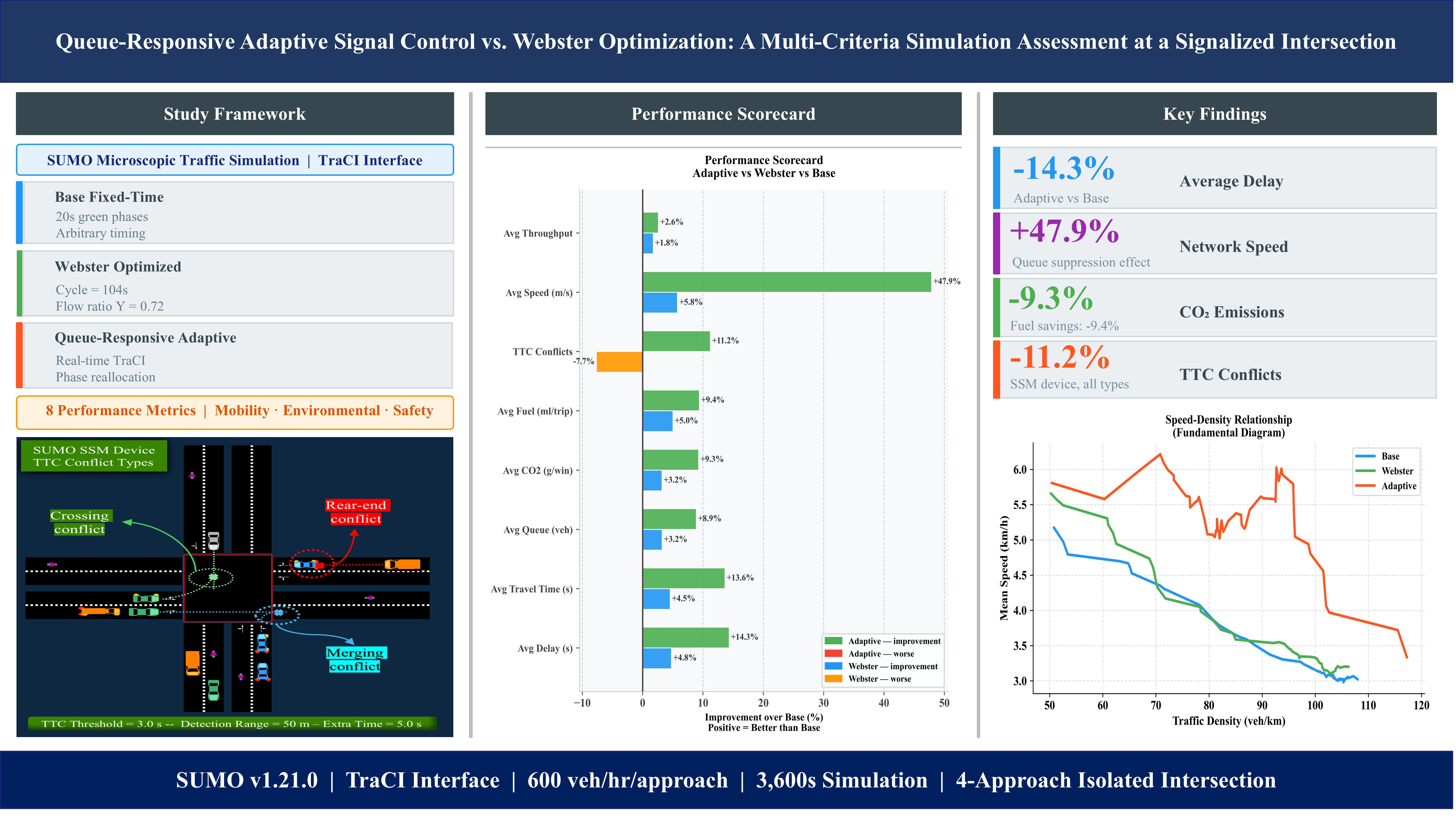
Traffic signal control at signalized intersections plays a key role in mitigating urban congestion, reducing vehicle emissions, and improving road safety. This study examines three signal control strategies at a four-approach isolated intersection simulated using the Simulation of Urban Mobility (SUMO) microscopic traffic simulator: a baseline fixed-time plan, a Webster-optimized fixed-time plan, and a queue-responsive adaptive controller implemented through the Traffic Control Interface (TraCI). The strategies were evaluated under balanced traffic demand of 600 vehicles per hour per approach over a 3600 s simulation period. Performance was assessed using eight indicators related to mobility, environmental impact, and safety, including average delay, travel time, queue length, network speed, throughput, CO2 emissions, fuel consumption, and time-to-collision events. The results indicate that the adaptive controller produced the greatest improvements, reducing delay by 14.3%, travel time by 13.6%, CO2 emissions by 9.3%, fuel consumption by 9.4%, and TTC conflicts by 11.2%, while increasing network speed by 47.9%. The Webster-optimized plan achieved moderate improvements, lowering delay by 4.8% and fuel consumption by 5.0% without additional infrastructure requirements. Overall, the findings suggest that both signal re-timing and queue-responsive adaptive control can enhance intersection performance, with the preferred approach depending on available infrastructure and implementation costs.

Graphical Abstract

1. Introduction

Urban traffic congestion remains one of the most persistent challenges facing modern transportation systems. Rapid urbanization, increasing vehicle ownership, and limited roadway expansion have intensified congestion levels in many cities worldwide, leading to longer travel times, higher fuel consumption, increased vehicular emissions, and elevated crash risk [1,2]. Among the various elements of urban road networks, signalized intersections represent critical operational bottlenecks where conflicting traffic streams must be regulated through traffic signal control [3,4]. Inefficient signal timing can significantly amplify delays and queue formation, causing stop-and-go traffic conditions that negatively affect mobility, environmental sustainability, and road safety [5].
Effective traffic signal control strategies are therefore essential for improving intersection performance and mitigating congestion impacts. Traditional signal control systems commonly rely on fixed-time signal plans, where green phase durations are predetermined and remain unchanged regardless of real-time traffic conditions [6]. While fixed-time control is relatively simple to implement and requires minimal infrastructure, its inability to respond to fluctuating traffic demand often leads to suboptimal performance under dynamic traffic conditions [7]. To address these limitations, traffic engineers have developed optimized signal timing methods and adaptive control approaches that dynamically adjust signal phases based on observed traffic conditions.
Previous studies have highlighted the significant impact of signalized intersections on urban traffic performance. For example, Azmain et al. [8] reported that inadequate signal timing at a congested intersection resulted in severe queue spillbacks and poor operational performance, with the intersection operating at Level of Service F during peak periods. By implementing optimized signal timing strategies, the study demonstrated substantial reductions in vehicle delay and notable improvements in intersection performance. Similarly, Schicktanz et al. [9] showed that congestion at signalized intersections not only increases vehicle delay but also negatively affects traffic safety. Their microscopic analysis revealed that during congested conditions the mean delay at an urban intersection increased significantly while safety indicators such as post-encroachment time decreased, suggesting a higher potential risk of conflicts. These findings emphasize the critical role of effective signal control strategies in improving both traffic efficiency and road safety at signalized intersections.
To mitigate congestion and improve intersection performance, several traffic signal control strategies have been developed over the past decades. Traditional signal control systems typically rely on fixed-time signal plans, where green phase durations are predetermined based on historical traffic data and remain constant regardless of real-time traffic conditions. One of the most widely used analytical approaches for determining optimal signal timing is the classical formulation developed by Webster [10], which provides a mathematical method for estimating the optimal signal cycle length that minimizes average vehicle delay at an intersection. The Webster formulation considers the relationship between traffic flow, saturation flow, and lost time within a signal cycle to determine the optimal cycle length for signalized intersection operation.
Building upon this foundational work, numerous studies have proposed improvements and modifications to the Webster-based signal timing approach. Rrecaj et al. [11] introduced a modified Webster model aimed at improving cycle length estimation under varying saturation conditions and high traffic demand levels. Similarly, Zhang et al. [12] developed an optimization approach that integrates a modified Webster delay function with a genetic algorithm to obtain improved signal timing plans, reporting substantial reductions in intersection delay. Despite their widespread use in practice, fixed-time signal control strategies often struggle to adapt to dynamic traffic conditions. As traffic demand fluctuates throughout the day, pre-timed signal plans may become suboptimal, leading to inefficient signal operation and increased vehicle delays. Research has therefore emphasized the need for more robust signal timing approaches capable of maintaining stable performance under varying traffic conditions [13].
To address the limitations of fixed-time signal control, adaptive traffic signal control (ATSC) systems have been developed to dynamically adjust signal timings in response to real-time traffic conditions. Unlike pre-timed strategies, adaptive approaches continuously monitor traffic states such as vehicle flow, queue length, and delay, allowing signal phases to be modified according to fluctuating demand.
Recent studies have increasingly explored reinforcement learning (RL) and data-driven techniques to enhance adaptive signal control performance. For instance, Maadi et al. [14] proposed an RL-based adaptive signal control framework for connected and automated vehicle environments, demonstrating notable reductions in queue length and stop delay compared with conventional control strategies. Similarly, Cao et al. [15] and Wang et al. [16] developed deep reinforcement learning–based signal optimization approaches capable of dynamically adjusting signal phases based on traffic state information, achieving improvements in travel time and intersection efficiency. More recent work has also investigated adaptive control frameworks that incorporate connected vehicle data and stochastic optimization to address uncertainty in vehicle arrivals and traffic demand [17]. In addition, advanced RL architectures such as prioritized double deep Q-networks have been proposed to improve learning efficiency and reduce queue length and waiting time at signalized intersections [18].
With the rapid development of artificial intelligence, reinforcement learning (RL) and deep reinforcement learning (DRL) have become promising approaches for traffic signal optimization. Unlike traditional rule-based or analytical methods, RL-based controllers learn optimal signal policies through interaction with the traffic environment, enabling them to adapt to complex and dynamic traffic conditions. Recent studies have shown that deep neural networks can significantly enhance the learning capability of RL models for traffic signal control.
For example, Tan et al. [19] demonstrated that deep reinforcement learning models can effectively capture complex traffic state patterns and generalize learned control policies to new traffic scenarios, achieving lower average vehicle delays compared with other learning-based approaches. Similarly, Zai and Yang [20] proposed an improved DRL framework incorporating attention mechanisms and long short-term memory networks, which significantly reduced queue length, waiting time, and emissions under various traffic conditions. Other research has focused on multi-agent reinforcement learning to coordinate signals across multiple intersections. Hu and Li [21] developed a multi-agent DRL model that integrates local and global agents to coordinate signal operations across a network, resulting in improved traffic efficiency and reduced vehicle waiting time. More recently, Bie et al. [22] introduced a spatiotemporal graph attention–based multi-agent DRL framework capable of addressing heterogeneous intersection characteristics, demonstrating superior performance in reducing vehicle delay and improving travel speed across complex urban networks.
Signalized intersections are also significant sources of vehicle emissions due to frequent acceleration, deceleration, and idling caused by signal control operations. Inefficient signal timing can therefore increase fuel consumption and pollutant emissions, including CO, HC, NOx, and CO2. Recent research has emphasized the importance of incorporating environmental considerations into traffic signal optimization.
For instance, Fan et al. [23] analyzed the impact of signal control strategies on emissions in mixed traffic environments and showed that optimized signal timing can significantly reduce pollutant emissions, particularly for heavy-duty vehicles. Similarly, Wang et al. [24] proposed a multi-objective signal optimization framework that considers both traffic efficiency and emission reduction, demonstrating that appropriate signal timing strategies can effectively lower emission levels at urban intersections. Earlier work by Zhao et al. [25] also highlighted that signal timing parameters influence vehicle emissions differently depending on traffic conditions and vehicle composition, indicating that emission-oriented optimization may lead to different signal timing solutions than those based solely on delay minimization.
In addition to traffic efficiency and environmental performance, traffic safety is another critical aspect of intersection operation. Traditional safety evaluations rely primarily on historical crash data; however, crash-based analyses often require long observation periods and may not capture the dynamic interactions between vehicles. To address these limitations, surrogate safety measures (SSM) derived from vehicle trajectories have increasingly been used to assess potential collision risks.
Measures such as time-to-collision (TTC) and post-encroachment time (PET) have been widely applied to identify traffic conflicts and evaluate safety performance at intersections. Astarita et al. [26] demonstrated that surrogate safety indicators derived from microscopic traffic simulation can effectively represent crash risk when validated against real crash data. Similarly, Patel et al. [27] developed an artificial intelligence–based framework for analyzing intersection safety using trajectory data and SSM, showing that TTC and PET can provide valuable insights into risky traffic interactions. Recent research has further applied conflict-based safety analysis to investigate vehicle interactions and identify critical conflict thresholds, highlighting the usefulness of SSM in proactive traffic safety evaluation [28].
Parallel to reinforcement learning approaches, a distinct line of research has applied multi-objective evolutionary and swarm intelligence algorithms to traffic signal optimization. Niu et al. [29] formulated intersection signal control as a multi-objective optimization problem targeting maximum traffic capacity, minimum average stops, and minimum delay simultaneously. Solving this formulation using genetic algorithm and particle swarm optimization, the authors demonstrated delay reductions of 32.3% and 31.4%, respectively, at a real-world intersection in Siping City, confirming the effectiveness of heuristic search methods for phase timing optimization under realistic demand conditions.
At the network level, Beklaryan et al. [30] proposed a simulation model for intelligent transportation systems incorporating a parallel real-coded genetic algorithm with fuzzy clustering (FCGA) for adaptive traffic light control in a multi-agent Manhattan-type network implemented in AnyLogic. The proposed fuzzy clustering-based adaptive controller demonstrated superior performance over conventional collective and local adaptive control strategies, with the FCGA used to optimize individual traffic light phase durations, observation radii, and threshold coefficients across spatially heterogeneous network scenarios. Building on this framework, Akopov and Beklaryan [31] developed a parallel hybrid biobjective genetic algorithm (BORCGA-BOPSO) that combines evolutionary search with particle swarm optimization and density-based fuzzy clustering for large-scale road network optimization with smart traffic lights. The proposed algorithm achieved significant traffic improvement through individualized phase parameter tuning while accounting for vehicle-to-vehicle (V2V), vehicle-to-pedestrian (V2P), and vehicle-to-infrastructure (V2I) interactions under non-stationary periodic demand conditions.
More recently, hybrid approaches combining deep reinforcement learning with swarm optimization have been explored to further improve adaptive signal control performance. Khalid et al. [32] proposed a DQN-SSO framework integrating Deep Q-Network reinforcement learning with Salp Swarm Optimization for adaptive traffic management, achieving waiting time reductions of 10–18% relative to standard DQN and Double DQN baselines across both localized and fully saturated traffic scenarios. Similarly, Alanazi et al. [33] developed a TD3-based deep reinforcement learning framework with prioritized experience replay for real-time signal optimization across multiple intersections, reporting queue length reductions of up to 25 vehicles and a 17.9% decrease in simulated accident rates relative to baseline approaches. While these advanced AI-driven methods demonstrate considerable performance potential, their computational demands, infrastructure requirements, and limited interpretability present practical deployment challenges at isolated intersections, motivating the evaluation of analytically grounded Webster optimization and real-time queue-responsive adaptive control as examined in the present study.
Beyond road traffic, real-time optimization under operational constraints has been explored across transport modes, including genetic algorithm and peer-to-peer negotiation approaches for railway bottleneck dispatching [34] and reinforcement learning frameworks for short-term train rescheduling on single-track corridors [35], reflecting the broader applicability of adaptive optimization methods across transportation systems.
Despite the substantial progress in traffic signal control research, several limitations remain in existing literature. Many studies primarily focus on improving traffic efficiency by minimizing delay or queue length through optimized signal timing strategies. Other research has investigated environmental impacts such as vehicle emissions, while some studies have examined intersection safety using SSM. However, these aspects are often evaluated independently, with limited studies conducting a comprehensive assessment that simultaneously considers mobility performance, environmental impacts, and traffic safety under different signal control strategies.
Furthermore, while recent research has extensively explored adaptive and artificial intelligence–based traffic signal control methods, traditional signal timing approaches such as Webster-based fixed-time control remain widely used in practice due to their simplicity and ease of implementation. Nevertheless, comparative evaluations between classical fixed-time control strategies and adaptive traffic signal control methods under consistent simulation environments are still relatively limited. There is a need for systematic analyses that assess the operational, environmental, and safety implications of different signal control strategies using microscopic traffic simulation and trajectory-based safety indicators.
Against this background, the present study makes three specific contributions to existing literature. First, while prior simulation-based studies have compared adaptive control against arbitrary fixed-time baselines, few have included Webster-optimized fixed-time control as an explicit intermediate comparator, leaving the performance ceiling of analytical re-timing as a standalone improvement pathway insufficiently characterized. Second, existing comparative studies typically evaluate mobility outcomes in isolation, with limited studies simultaneously addressing environmental and safety dimensions within a single controlled simulation framework. The present study provides a unified multi-criteria assessment spanning eight performance metrics across mobility, environmental, and safety dimensions under identical demand and network conditions. Third, the study quantifies Webster optimization behavior under near-saturated demand conditions and identifies the nonlinear relationship between queue suppression and network speed gain, offering mechanistic findings of direct practical relevance to signal timing practitioners.
This study aims to evaluate and compare traffic signal control strategies at a signalized intersection using microscopic traffic simulation. The specific objectives are:
  • Compare three signal control approaches:
    • Conventional fixed-time signal plan
    • Webster-optimized fixed-time signal plan
    • Queue-responsive adaptive signal control strategy
  • Conduct simulation experiments using:
    • SUMO microscopic traffic simulator
    • Real-time signal control through the TraCI interface
  • Evaluate performance across multiple dimensions:
    • Mobility indicators: Vehicle delay, queue length
    • Environmental indicators: CO2 emissions, fuel consumption
    • Safety indicators: SSM, e.g., TTC
  • Integrate evaluation dimensions within a unified simulation framework to provide a comprehensive understanding of how signal control strategies affect overall intersection performance.

2. Methodology

2.1. Methodology Overview

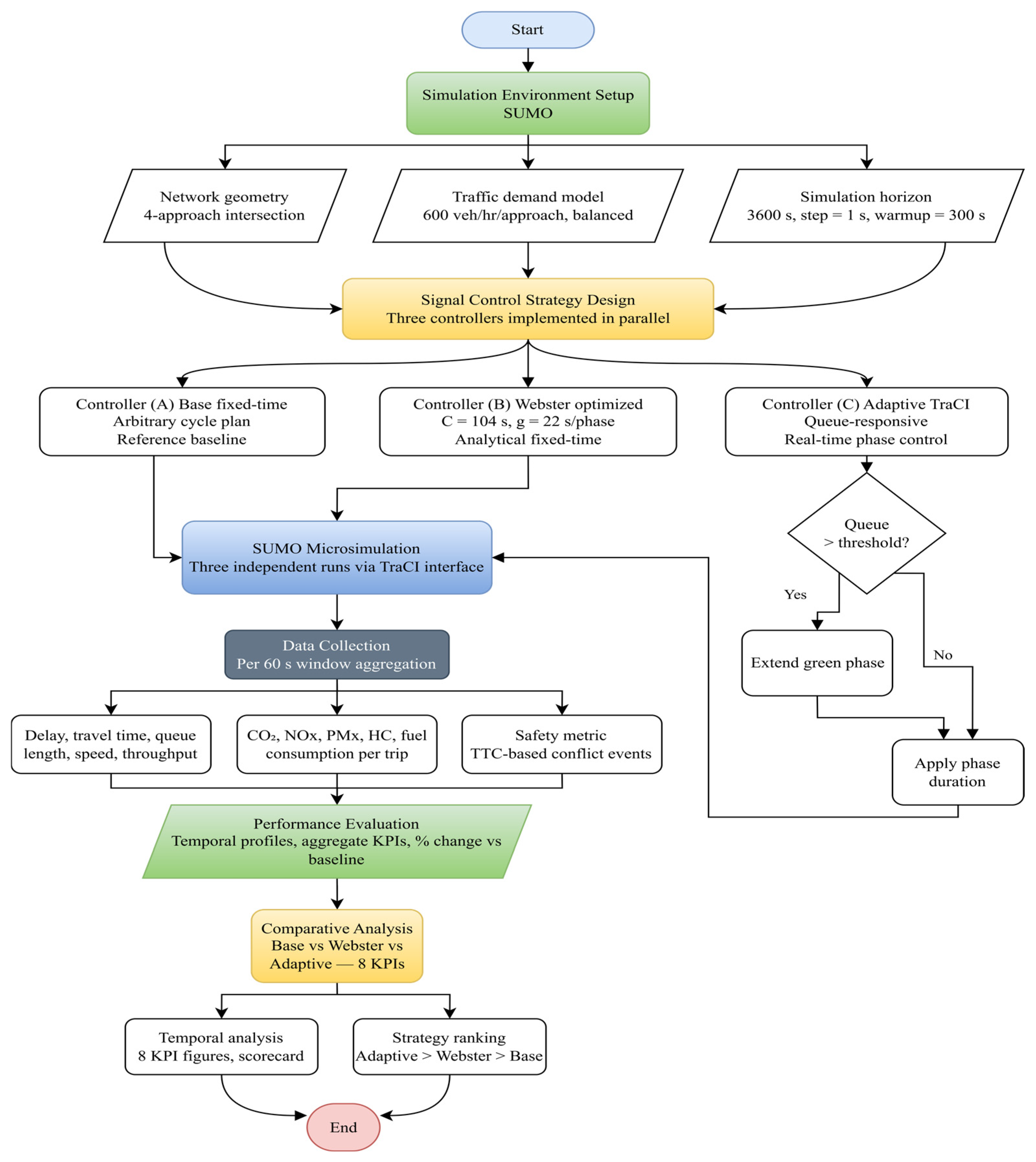
The methodology employs a simulation-based comparative framework implemented in SUMO and interfaced through TraCI for real-time signal control. As illustrated in Figure 1, the study follows four sequential stages: simulation environment configuration, signal control strategy design, output data collection, and performance evaluation. Three signal control strategies are examined, including a fixed-time base plan, Webster optimized fixed-time plan, and a queue-responsive adaptive controller. Each strategy is executed as an independent simulation run under identical network geometry and traffic demand conditions. Eight performance metrics representing mobility, environmental, and safety aspects are collected and compared across the three strategies. The subsequent subsections describe each component of the methodology in the sequence presented in Figure 1.

2.2. Simulation Environment and Network Configuration

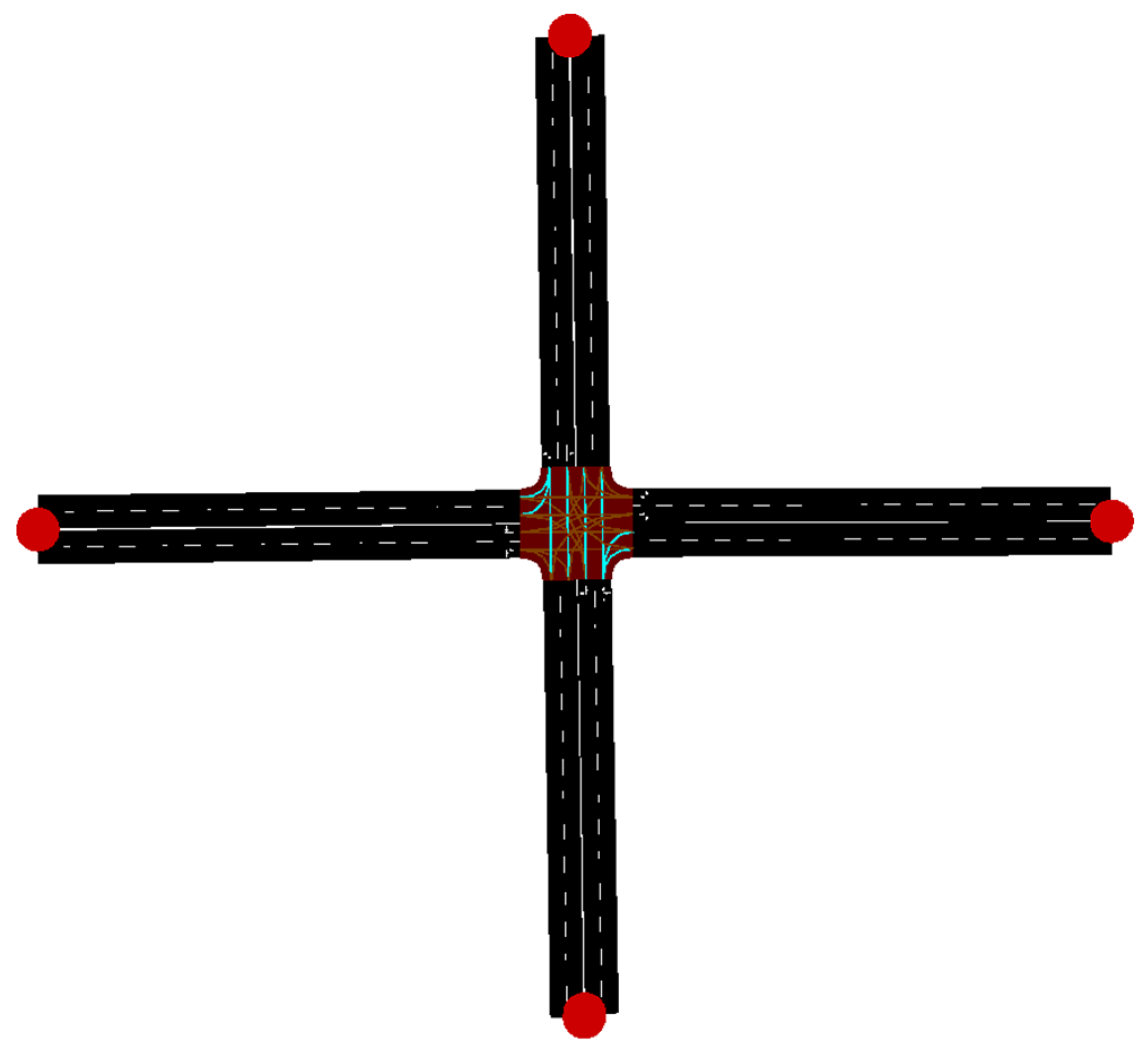
The simulation environment is constructed within the SUMO microscopic traffic simulator, an open-source platform widely adopted in signalized intersection research for its high-fidelity vehicle dynamics, emissions modeling, and external control support via the TraCI API. The study network represents a four-approach signalized intersection with two lanes per approach, yielding eight lanes across the intersection. Approach lengths range from 79.56 m to 89.04 m, and the free-flow speed is set to 13.89 m/s (50 km/h), consistent with urban arterial conditions. The intersection operates under a four-phase signal plan, with one dedicated green phase per approach direction, North, East, South, and West, separated by yellow and red-amber clearance intervals. The network geometry and lane configuration as rendered in SUMO are presented in Figure 2, and the key simulation parameters are summarized in Table 1.

2.3. Traffic Demand Modeling

Traffic demand is specified as a balanced, stationary flow assigned uniformly to each of the four approach directions, yielding a total intersection volume of 2400 vehicles per hour. Each approach distributes its volume across three turning movements: straight-through (50%), left-turn (25%), and right-turn (25%), as detailed in Table 2. Vehicles are generated continuously throughout the simulation horizon using constant departure rates, with lane assignment governed by a best-fit policy and vehicles entering at maximum allowable speed.
The simulated traffic stream comprises a mixed vehicle composition of three types: passenger cars, light trucks, and motorcycles, applied uniformly across all approaches and movements. Each vehicle type is assigned to distinct physical and behavioral parameters as summarized in Table 3. The demand scenario is intentionally symmetric across all approaches to isolate the effect of signal control strategy on intersection performance, independent of directional demand imbalance.

2.4. Signal Control Strategy Design

Three signal control strategies are implemented and evaluated independently under identical network and demand conditions. Each strategy governs the green phase durations for the four approach directions, North, East, South, and West, while the yellow and red-amber clearance intervals remain fixed at 3 s each across all strategies.

2.4.1. Base Fixed-Time Controller

The base fixed-time controller serves as the reference baseline against which the two optimized strategies are assessed. A uniform green duration of 20 s is assigned to each of the four phases, with each green interval followed by a 3 s yellow clearance and a 3 s red-amber transition, producing a cycle length of 104 s. The timing plan is static throughout the simulation and does not respond to prevailing traffic conditions. This controller represents the class of arbitrary fixed-time plans commonly encountered in practice, where signal timing has not been formally optimized.

2.4.2. Webster-Optimized Fixed-Time Controller

The Webster-optimized controller applies Webster’s classical cycle length formula to derive an analytically optimal fixed-time plan from traffic flow data collected during the simulation warmup period. Flow rates are measured per approach per lane over the first 300 s of simulation, from which the critical flow ratio for each phase i is computed as shown in Equation (1):
y i = q i / S
where qi is the flow rate in vehicles per hour per lane for phase i, and S is the saturation flow rate, set to 1800 vehicles per hour per lane. The sum of critical flow ratios Y is given by Equation (2):
Y = Σ yi
The optimal cycle length is computed as shown in Equation (3):
C = (1.5L + 5)/(1 − Y)
where L is the total lost time per cycle, calculated as the product of the number of phases and the lost time per phase (4 × 4 = 16 s). The cycle length is constrained to the range [40, 180] seconds. Effective green time is distributed proportionally across phases according to each phase’s flow ratio as shown in Equation (4):
gi = (yi/Y) × (CL)
Under the balanced demand conditions of this study, the measured flow per approach converges to 324 vehicles per hour per lane, yielding Y = 0.72, an optimal cycle length of 104 s, and equal green splits of 22 s per phase. The computed timing plan is applied as a new fixed-time program at t = 300 s and maintained unchanged for the remainder of the simulation.

2.4.3. Queue-Responsive Adaptive Controller

The adaptive controller operates through the TraCI interface, evaluating queue conditions at the end of each signal cycle and adjusting green phase durations in real time. The complete control procedure is formalized in Algorithm 1. At each cycle review interval, the queue length on every approach lane is retrieved from the simulator. A weighted demand score is computed for each phase, incorporating queue length, cumulative waiting time, and mean approach speed, with weights of 0.35, 0.35, and 0.30, respectively. Green durations are then reallocated proportionally to the demand scores subject to a minimum green of 15 s, a maximum green of 60 s, and a total cycle budget constrained between 80 and 160 s, as detailed in Algorithm 1. Phase adjustments are smoothed using a rolling average over the five most recent cycle readings, and the magnitude of change per phase per update is limited to 5 s to prevent abrupt timing shifts. Yellow and red-amber intervals are not modified by the adaptive logic.
Algorithm 1. Queue-Responsive Adaptive Signal Control.
   Input: GREEN_PHASES = {N, E, S, W}
         MIN_GREEN = 15 s, MAX_GREEN = 60 s
         MIN_BUDGET = 80 s, MAX_BUDGET = 160 s
         MAX_CHANGE = 5 s, SMOOTH_WINDOW = 5 cycles
         W_queue = 0.35, W_wait = 0.35, W_speed = 0.30
         CYCLE_REVIEW = 120 s
   Output: Adjusted green durations g_i for each phase i
   1:  Initialize g_i = 20 s for all i
   2:  while simulation_time < 3600 s do
   3:      Execute current signal plan via TraCI
   4:      if simulation_time mod CYCLE_REVIEW == 0 then
   5:        for each phase i in GREEN_PHASES do
   6:          q_i ← mean queue length on approach lanes (veh)
   7:          w_i ← cumulative waiting time on approach (s)
   8:          v_i ← mean approach speed (m/s)
   9:          score_i ← W_queue × q_i + W_wait × w_i
               + W_speed × (1/max(v_i, 0.1))
   10:       end for
   11:       total_score ← Σ score_i
   12:       budget ← clamp (total_score_scaled, MIN_BUDGET, MAX_BUDGET)
   13:       for each phase i do
   14:         raw_g_i ← (score_i/total_score) × budget
   15:         g_i_new ← clamp (raw_g_i, MIN_GREEN, MAX_GREEN)
   16:         g_i_smoothed ← mean (last SMOOTH_WINDOW values of g_i)
   17:            Δg_i ← clamp (g_i_smoothed − g_i, −MAX_CHANGE, +MAX_CHANGE)
   18:         g_i ← g_i + Δg_i
   19:       end for
   20:       Apply updated {g_i} to signal controller via TraCI
   21:     end if
   22: end while
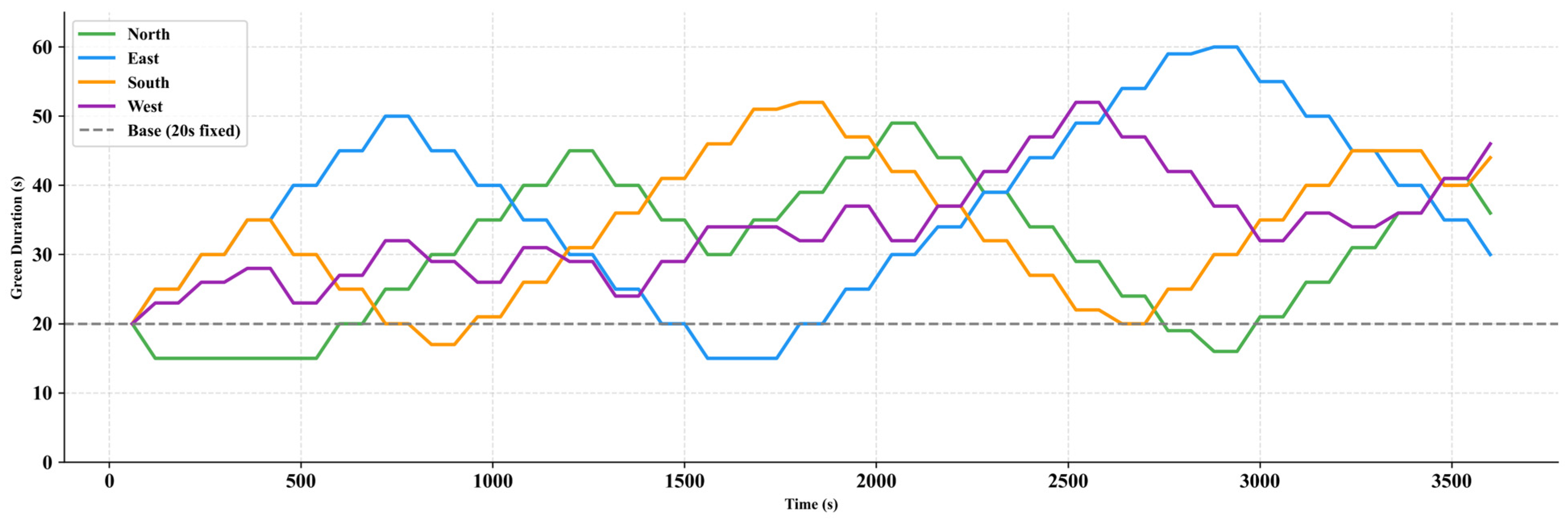
The temporal evolution of green phase durations under the adaptive controller is presented in Figure 3. The dashed reference line at 20 s denotes the base fixed-time green duration. As observed, all four approach directions exhibit dynamic green allocation that deviates substantially from the fixed baseline, with durations ranging from the minimum of 15 s to the enforced maximum of 60 s, reflecting the controller’s continuous response to real-time queue demand across the simulation horizon.

2.5. Simulation Execution, Data Collection, and Performance Evaluation

Three simulation runs are executed independently, one per signal control strategy, under identical network geometry, traffic demand, and simulation parameters. Each run is initialized with a warmup period of 300 s during which vehicles load the network and queue conditions stabilize. Performance data collection begins only after the warmup period has elapsed to ensure that reported metrics reflect steady-state intersection operation rather than transient loading effects.
Output data are collected and aggregated over successive 60 s time windows throughout the active simulation period from t = 300 s to t = 3600 s, yielding 55 observation windows per run. At each window boundary, lane-level measurements are exported for all eight approach lanes. The collected metrics span three performance dimensions: mobility, environmental, and safety. The mathematical definitions, units, collection levels, and data sources for all metrics are summarized in Table 4.
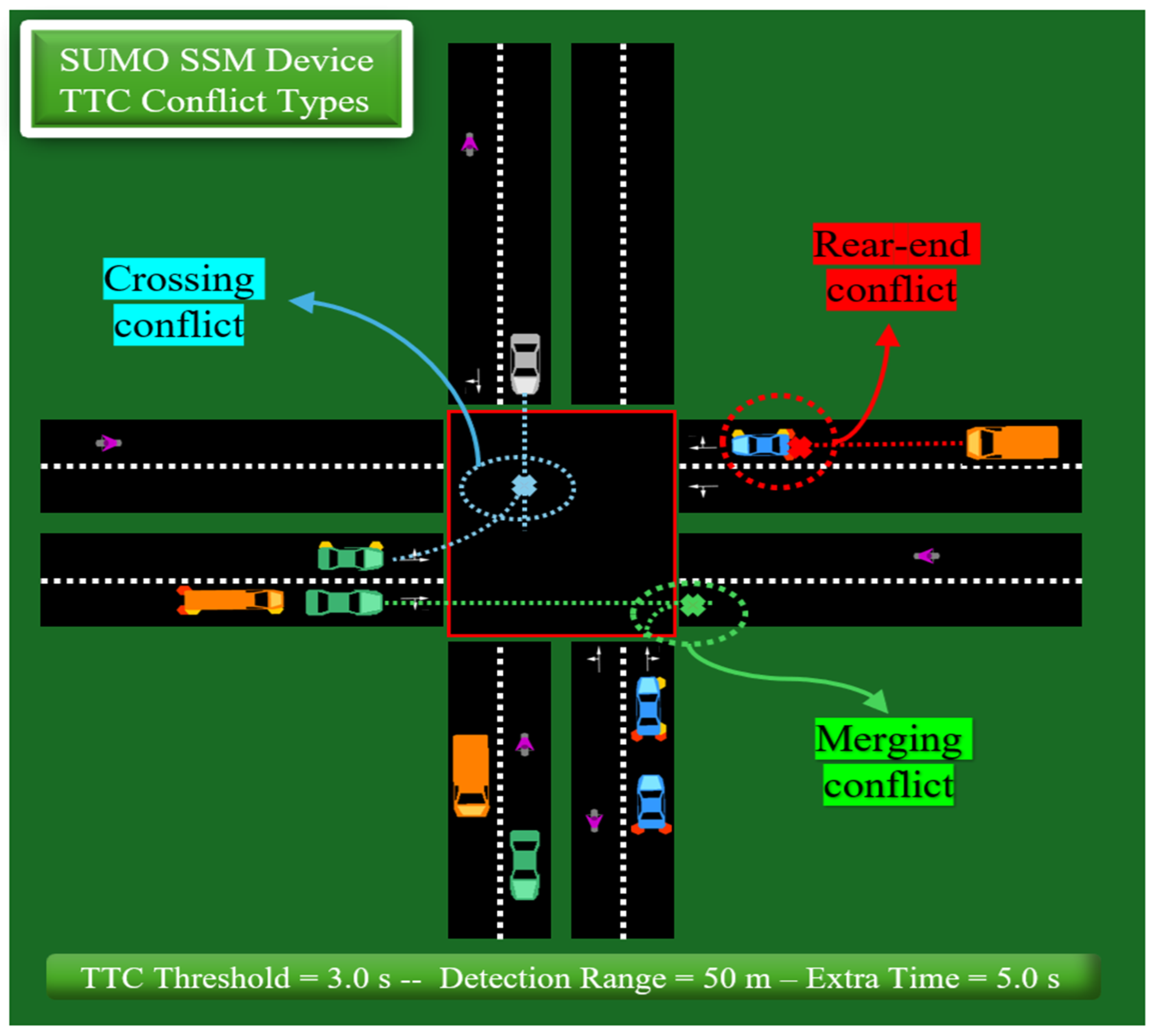
Mobility metrics include mean vehicle delay, mean travel time, mean queue length per lane, mean network speed, and vehicle throughput. Delay is computed as the difference between actual travel time and free-flow travel time for each completed trip. Environmental metrics include total mass emissions of CO2, CO, NOx, PMx, and HC per window, derived from SUMO’s lane-level emission outputs, as well as mean fuel consumption per completed trip. Fuel consumption is converted from the raw SUMO output in mg/s to milliliters per trip using the fuel density of 0.74 kg/L for petrol. Safety is assessed using the TTC surrogate from the SUMO SSM device, which identifies rear-end, crossing, and merging conflicts between vehicle pairs at intersections. Any pair with a minimum TTC under 3.0 s is recorded as a conflict event. The three conflict types detected by the SSM device are illustrated in Figure 4.
Controller performance is quantified through pairwise comparison against the base fixed-time plan, with improvement expressed as a percentage change for each metric. A consistent ranking is established across all three performance dimensions to provide a multi-criteria assessment of the three signal control strategies.

3. Results

3.1. Mobility Metrics

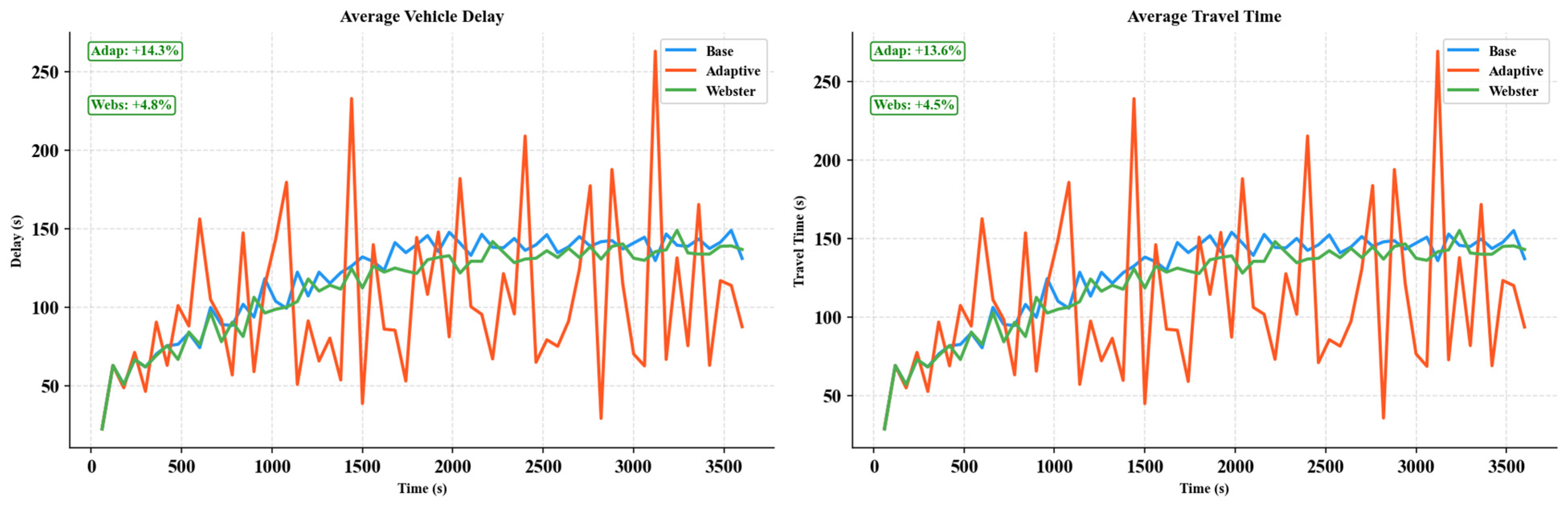
The temporal evolution of average vehicle delay and travel time is depicted in Figure 5. The adaptive controller yielded a mean delay of 102.30 s, corresponding to a statistically notable reduction of 14.3% relative to the base fixed-time plan (119.43 s). The Webster-optimized plan demonstrated an intermediate improvement, reducing mean delay by 4.8% to 113.72 s, attributable to the marginal increase in optimal cycle length from the arbitrary 20 s green phases to the Webster-prescribed 22 s. Consistent trends were observed for mean travel time, wherein the adaptive and Webster controllers achieved reductions of 13.6% (108.37 s) and 4.5% (119.79 s), respectively, compared to the base case (125.49 s). The progressive divergence between the adaptive and base trajectories beyond t = 500 s suggests that the adaptive controller’s benefit compounds as queue dissipation efficiency improves over the simulation horizon.
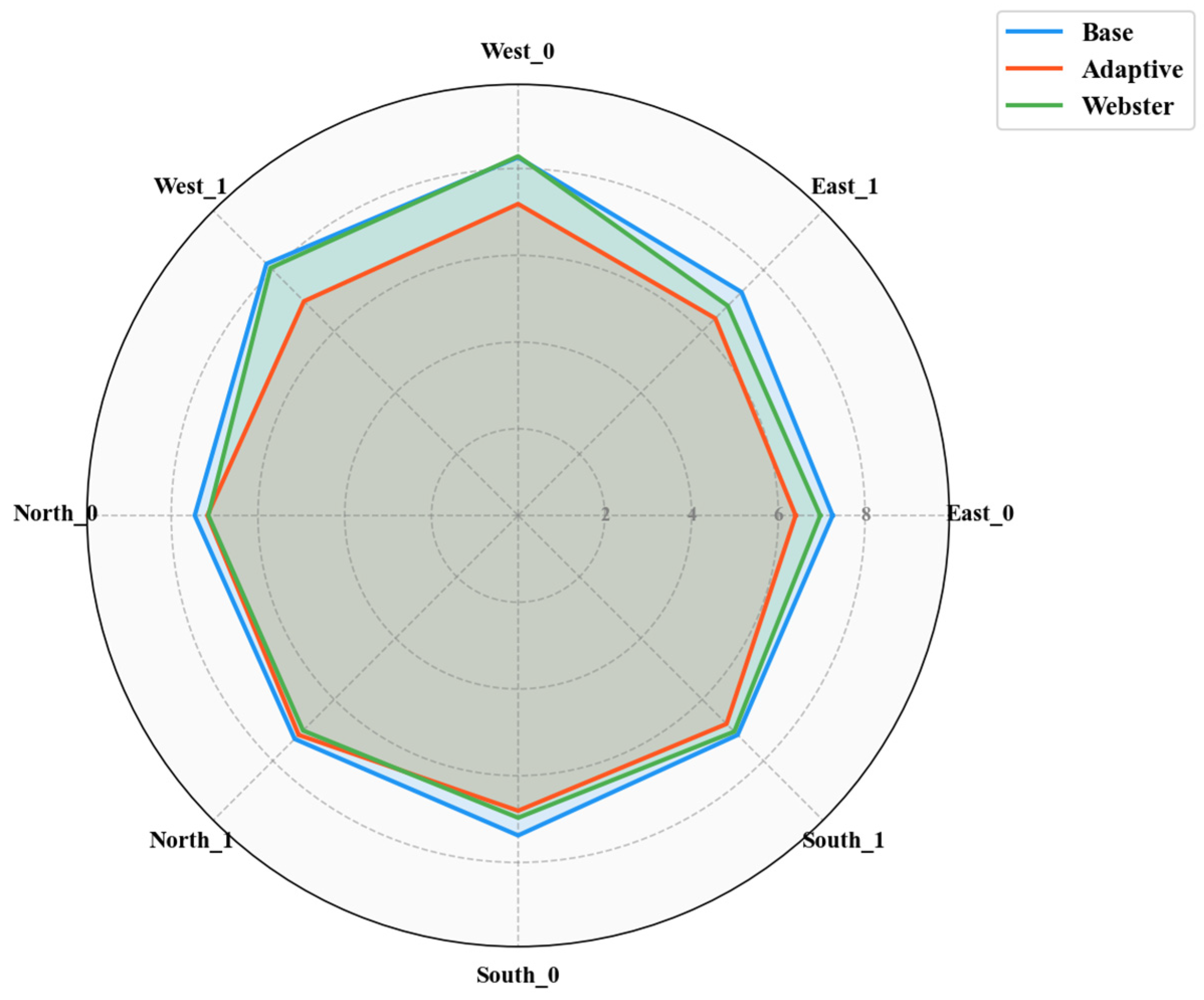
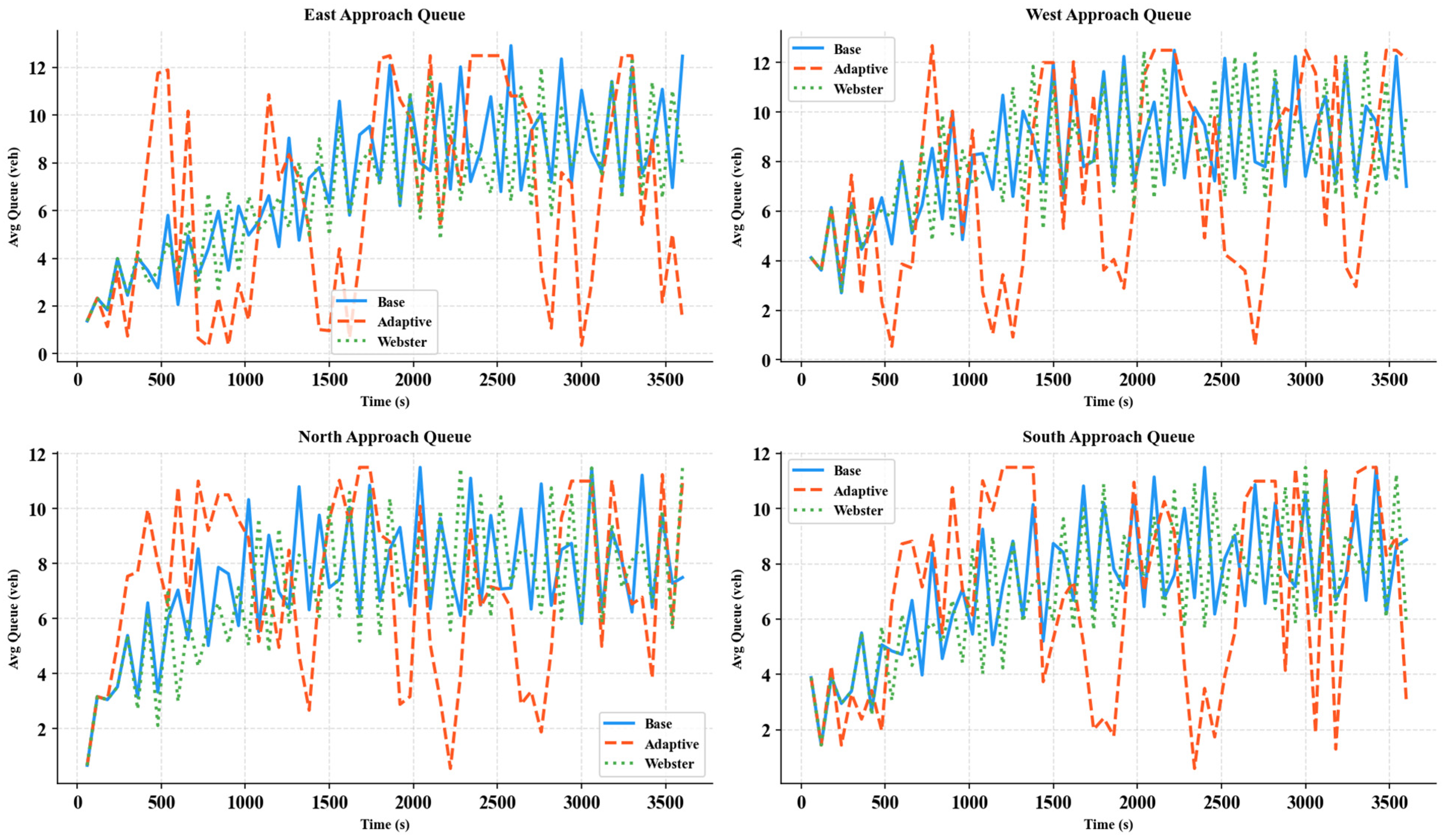
The mean queue length per lane and its temporal evolution are presented in Figure 6 and Figure 7, respectively. As depicted in Figure 6, the adaptive controller achieved the smallest queue footprint across most lanes, with an overall mean reduction of 8.9% (6.87 veh/lane) relative to the base fixed-time condition (7.54 veh/lane). The Webster plan yielded a marginal overall reduction of 3.2% (7.29 veh/lane); however, a slight queue increase was observed on the West approach lanes under Webster, attributable to the marginally longer cycle length (104 s) introducing extended red phases on competing approaches. The temporal profiles (Figure 7) reveal that the adaptive controller exhibited pronounced queue oscillations during the early simulation period (t < 500 s), reflecting the controller’s initial learning and phase adjustment phase, before stabilizing to consistently lower queue levels beyond t = 1000 s. The Webster and base controllers exhibited broadly comparable queue trajectories throughout the simulation horizon, with Webster demonstrating marginal improvements, particularly evident in the North and South approaches. Queue distributions remained symmetric across all four approaches under all three strategies, consistent with the uniform demand of 600 veh/h per approach.
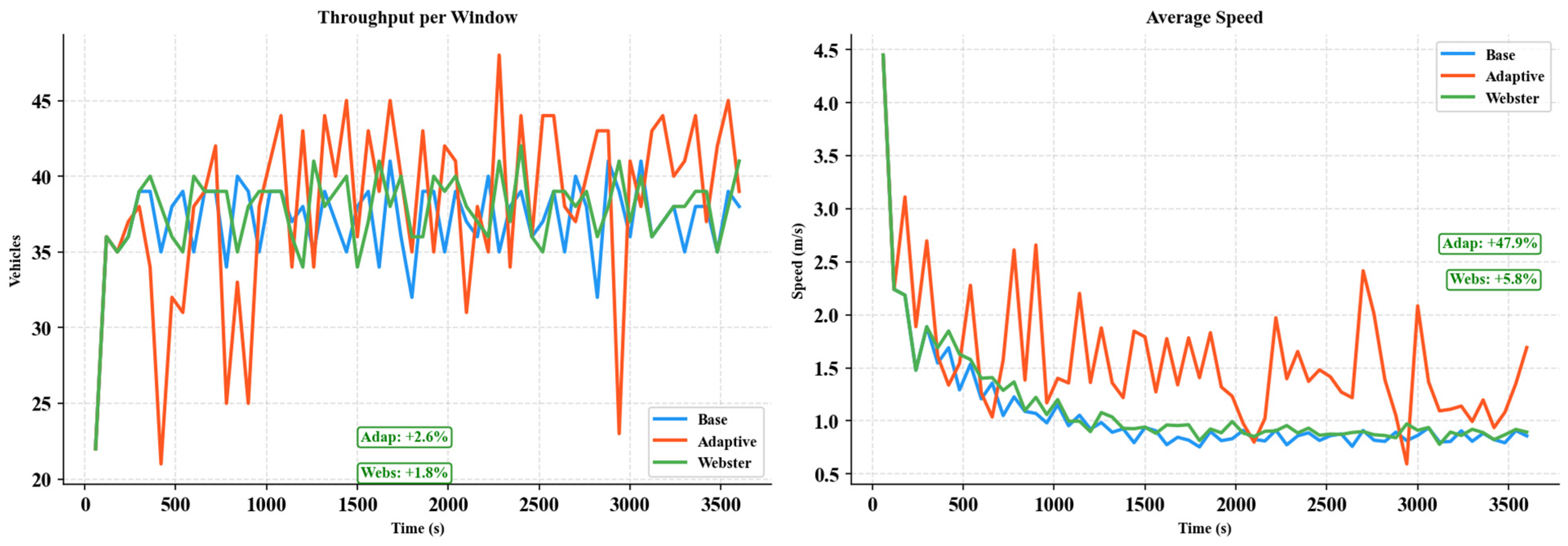
Figure 8 presents the per-window vehicle throughput and mean network speed. The adaptive controller achieved a substantial improvement in mean network speed of 47.9% (1.59 m/s versus 1.07 m/s for the base case), reflecting a significant reduction in vehicle idling and stop-and-go behavior at the intersection. The Webster plan yielded a more modest speed improvement of 5.8% (1.14 m/s). Throughput remained broadly comparable across all three controllers, with marginal increases of 2.6% and 1.8% recorded for the adaptive and Webster plans, respectively. The convergence of throughput values across controllers suggests that the intersection operated near capacity under all strategies, with performance differentiation manifesting primarily through delay and speed metrics rather than volume processed.
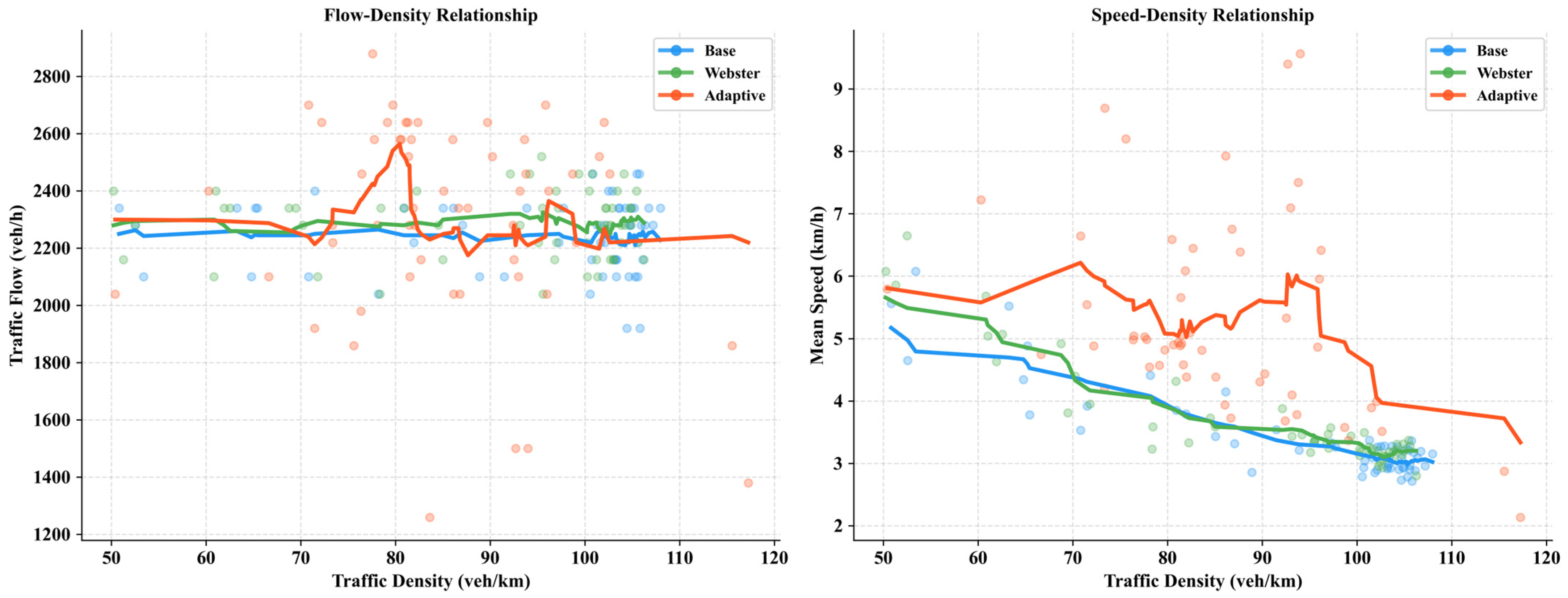
To further characterize the traffic flow regime under each controller, Figure 9 presents the fundamental diagram illustrating the flow-density and speed-density relationships aggregated across the simulation horizon. The flow-density panel confirms that all three controllers operate within the congested traffic regime, with densities ranging from approximately 50 to 120 veh/km, consistent with the near-saturated demand conditions (Y = 0.72) of the study. The adaptive controller achieved the lowest mean traffic density (85.26 veh/km) and the highest mean flow (2306 veh/h), reflecting its capacity to dissipate queues more effectively through real-time phase reallocation. The speed-density panel reveals a clear separation between the adaptive controller and the fixed-time strategies, with the adaptive plan sustaining higher mean speeds across the full density range. The base and Webster plans exhibit closely overlapping speed-density profiles, consistent with their comparable queue and delay performance reported above. These diagrams confirm that the performance hierarchy established across individual metrics is also reflected in the fundamental traffic flow characteristics of the intersection.

3.2. Environmental Impact

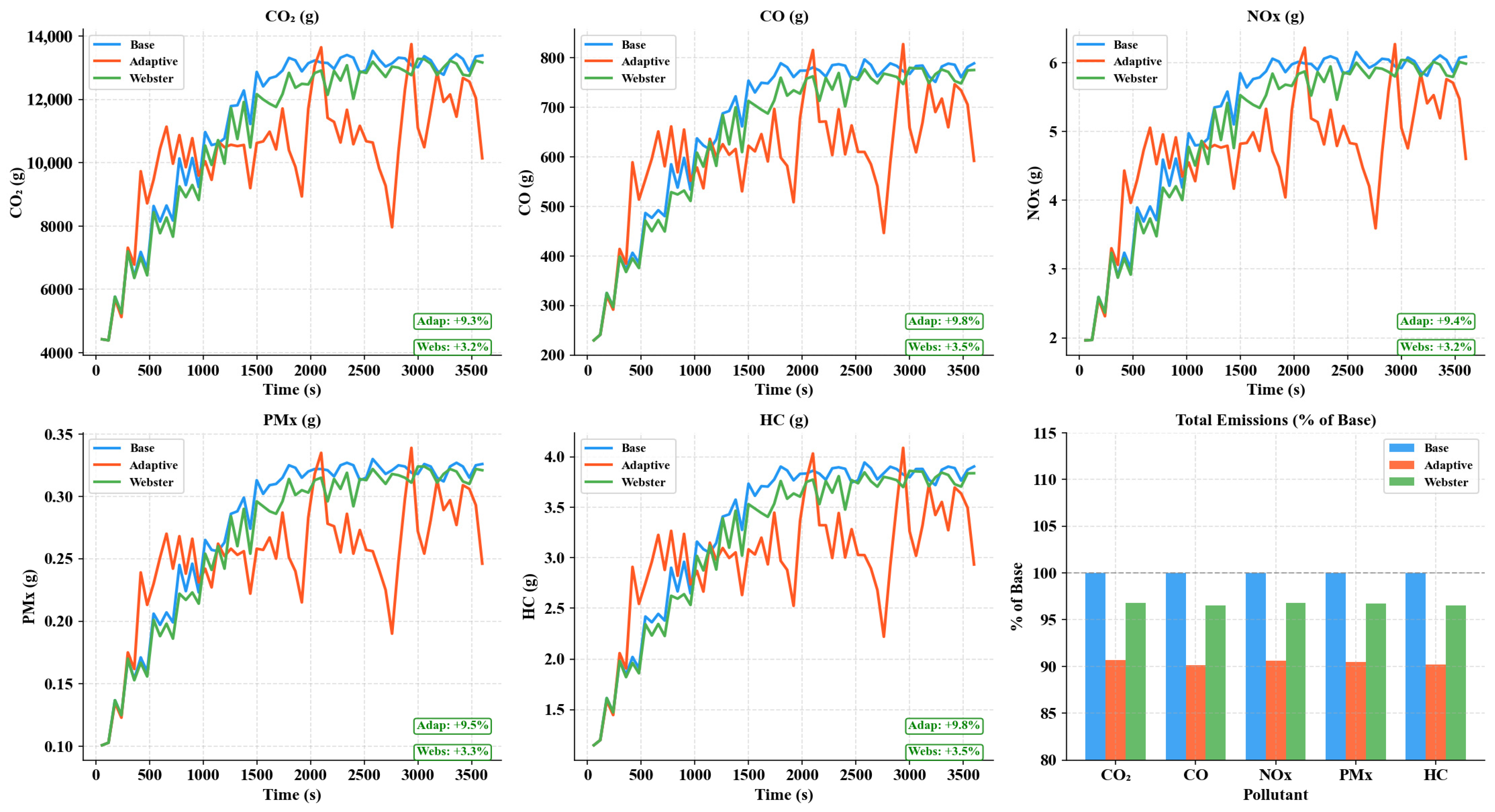
The temporal profiles and normalized total emissions of key vehicular pollutants are presented in Figure 10. The adaptive controller achieved consistent reductions across all monitored emission species relative to the base fixed-time plan, with the most pronounced improvement observed for CO2, wherein total emissions were reduced by 9.3% (10,306.86 g versus 11,360.03 g for the base case). The Webster-optimized plan yielded intermediate reductions across all pollutants, with a CO2 reduction of 3.2% (10,997.50 g). The normalized emission comparison (Figure 10, bottom-right panel) corroborates these findings, demonstrating that both optimized strategies consistently performed below the base 100% reference line across all five pollutants (CO2, CO, NOx, PMx, and HC). The convergent emission trajectories observed between the base and Webster plans reflect the marginal nature of the cycle length adjustment, whereas the adaptive controller’s emission reductions are attributable to its capacity to minimize unnecessary idling and stop-and-go cycles through real-time phase optimization.
Consistent reductions were observed across all monitored emission species under both optimized strategies. The mean per-window emissions under the adaptive controller were: CO 599.97 g, NOx 4.68 g, PMx 0.25 g, and HC 2.97 g, representing reductions of 9.8%, 9.3%, 9.4%, and 9.8%, respectively, relative to the base plan (CO 665.40 g, NOx 5.16 g, PMx 0.28 g, HC 3.30 g). The Webster plan yielded intermediate reductions of 3.5%, 3.2%, 3.3%, and 3.5% across the same pollutants (CO 642.12 g, NOx 4.99 g, PMx 0.27 g, HC 3.18 g).
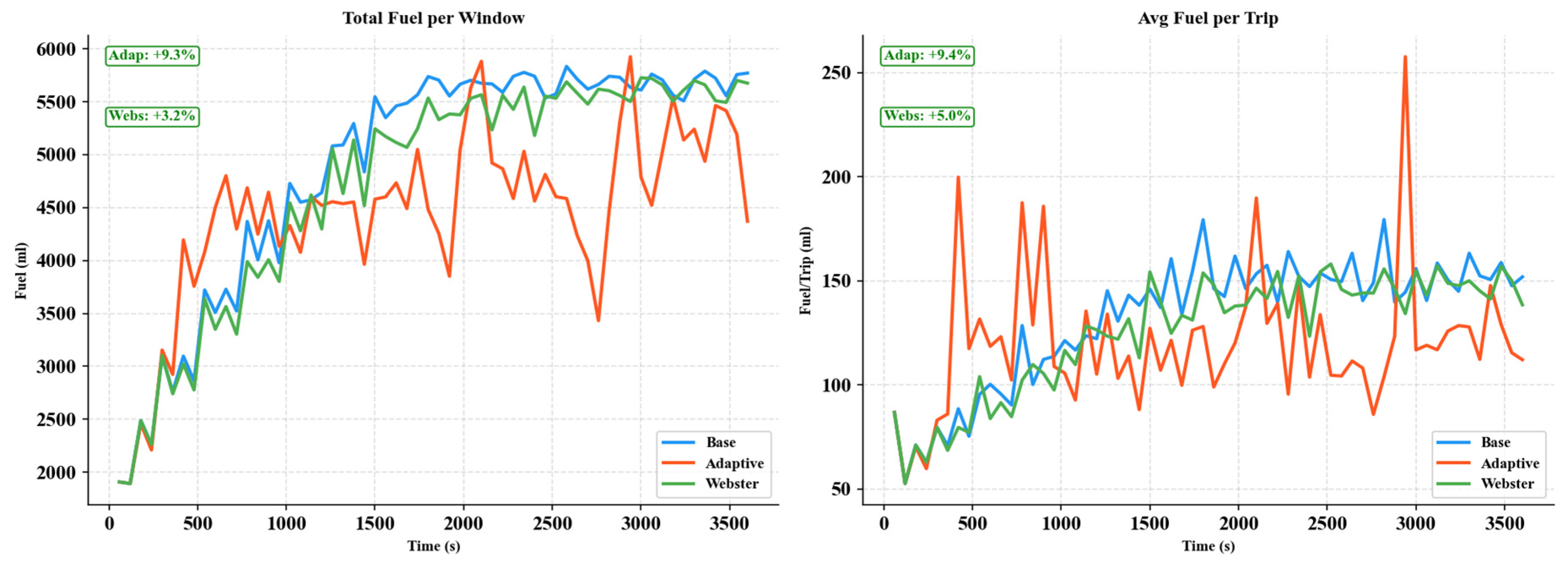
Figure 11 illustrates the temporal variation in total fuel consumption per 60 s window and mean fuel consumption per completed trip. The adaptive controller achieved a mean per-trip fuel reduction of 9.4% (119.73 mL versus 132.16 mL for the base case), consistent with its demonstrated reductions in vehicle delay and idling time. The Webster plan yielded a moderate per-trip reduction of 5.0% (125.53 mL). The total fuel consumption profiles (Figure 11, left panel) further reveal that the adaptive controller maintained consistently lower fuel consumption throughout the simulation horizon, with the differential between controllers becoming more pronounced beyond t = 1000 s. The Webster plan exhibited fuel consumption profiles closely tracking the base case during the initial warmup period (t < 300 s), after which the optimized fixed-time plan was applied, resulting in a modest but sustained reduction for the remainder of the simulation.

3.3. Safety Analysis

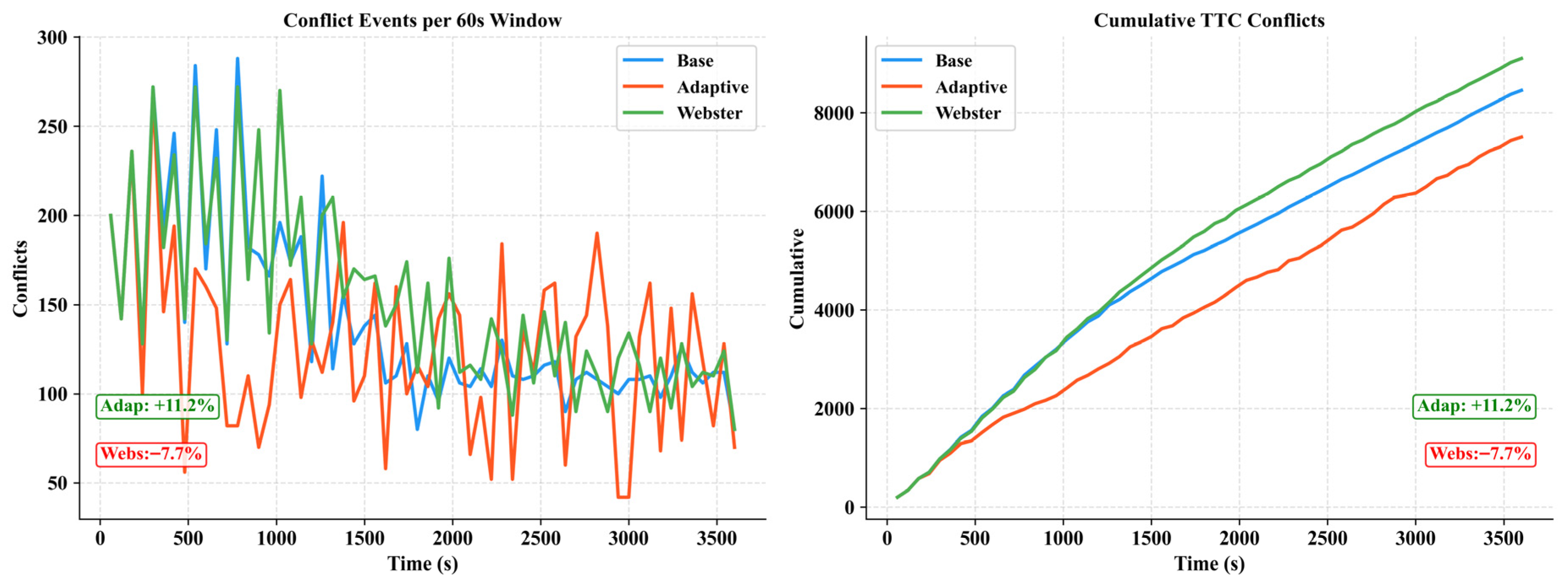
The per-window TTC conflict events and cumulative conflict count under the three signal control strategies are presented in Figure 12. TTC conflicts were identified using the SUMO SSM device with a threshold of 3.0 s, capturing rear-end, crossing, and merging conflict types between all vehicle pairs within the intersection network. The adaptive controller demonstrated the most favorable safety performance, achieving a cumulative conflict reduction of 11.2% (7504 events) relative to the base fixed-time plan (8452 events) over the full simulation horizon. In contrast, the Webster-optimized plan yielded a marginal increase of 7.7% in cumulative conflicts (9100 events), indicating that the modest cycle length adjustment introduced by the Webster formulation did not confer measurable safety benefits under the prevailing demand conditions.
The cumulative conflict profiles (Figure 12, right panel) provide further insight into the safety trajectories of the three controllers. The adaptive controller exhibited a consistently lower conflict accumulation rate throughout the simulation, with the divergence from the base trajectory becoming increasingly pronounced beyond t = 500 s, suggesting that the adaptive controller’s phase optimization contributed to a progressive reduction in vehicular conflict exposure over time. The base and Webster cumulative profiles remained broadly comparable throughout the simulation horizon, with the Webster plan recording a slightly elevated conflict count attributable to the marginally longer cycle introducing extended clearance intervals during which conflict-prone vehicle interactions occurred. These findings indicate that dynamic real-time signal adaptation is a more effective mechanism for safety improvement than static cycle optimization under near-saturated demand conditions.

3.4. Comparative Performance Summary

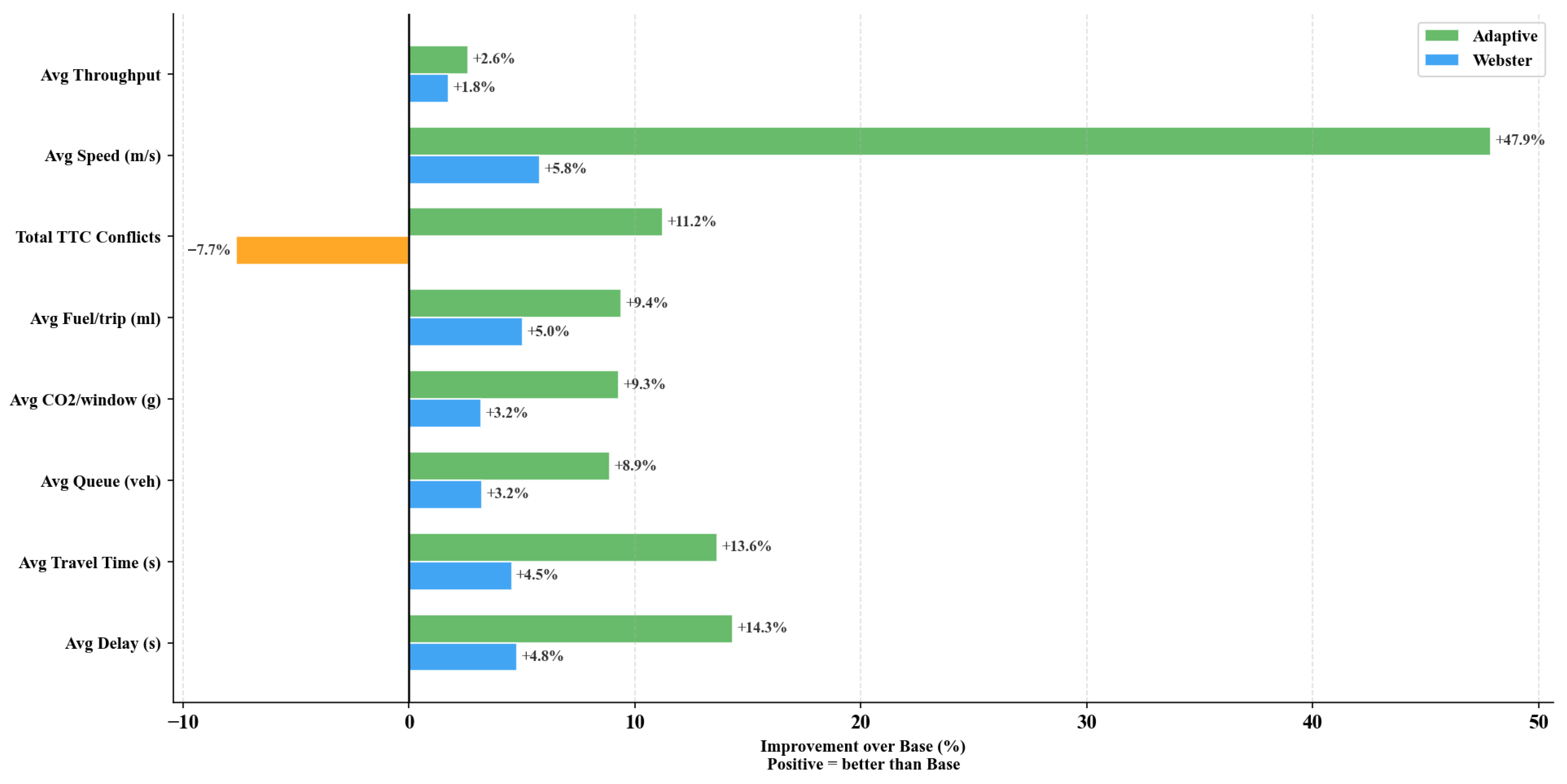
The aggregate performance of the three signal control strategies across all evaluation metrics is synthesized in Figure 13. The multi-criteria scorecard demonstrates a consistent hierarchical ordering across virtually all performance dimensions, wherein the adaptive controller outperformed both the Webster-optimized and base fixed-time plans, with Webster occupying an intermediate position.
As presented in Table 5, the adaptive controller achieved meaningful improvements across all primary metrics, with delay reduction (14.3%) and speed improvement (47.9%) representing the most substantial gains relative to the base condition. The Webster-optimized plan delivered moderate but consistent improvements across traffic performance and environmental metrics, with reductions ranging from 3.2% to 5.0% (Table 5), validating the utility of mathematically grounded cycle optimization even in the absence of real-time sensing capability. Regarding TTC safety conflicts (Table 5), the Webster plan recorded a marginal deterioration of 7.7%, attributable to the slightly longer cycle introducing extended clearance intervals during which conflict-prone vehicle interactions occurred, while the adaptive controller remained the only strategy to achieve meaningful safety gains, reducing cumulative TTC conflicts by 11.2%. through real-time phase adaptation that smoothed vehicle arrival and departure patterns across all conflict types.

4. Discussion

The simulation results presented in Section 4 demonstrate a consistent performance hierarchy across all three signal control strategies, with the adaptive controller outperforming the Webster-optimized plan, which in turn surpassed the arbitrary base fixed-time plan across the majority of evaluated metrics. The base fixed-time plan, operating on an arbitrary 20 s green phase with no demand sensitivity, represents the lower performance bound. The Webster-optimized plan, derived from measured flow data via an analytically grounded formulation, represents the theoretical optimum achievable under static fixed-time operation. The adaptive controller, leveraging real-time queue and delay feedback to dynamically reallocate green time across phases, represents the upper performance bound under the simulated conditions. The following subsections contextualize these findings within the broader literature, interpret the underlying traffic engineering mechanisms driving the observed results, and critically examine the limitations and practical implications of the study.

4.1. Contextualization Against Existing Literature

The delay reduction of 14.3% achieved by the adaptive controller in the present study is broadly consistent with findings reported in the signal control optimization literature. A comparable SUMO-based investigation employing an AI-driven adaptive scheme documented a 21.6% reduction in average waiting time, a 12.9% reduction in CO2 emissions, and a 15.6% improvement in fuel efficiency relative to a fixed-cycle baseline [45]. The magnitude of improvement reported in that study exceeds the present findings, a discrepancy attributable to differences in intersection saturation levels, as the performance advantage of adaptive control is well-documented to diminish as the degree of saturation approaches capacity. A simulation study conducted under near-saturated traffic conditions reported a mean total intersection delay reduction of 15.42% over multiple signal cycles through real-time adaptive optimization [46], a result that closely corroborates the 14.3% improvement recorded in the present study under a flow ratio of Y = 0.72. Under undersaturated conditions, performance improvements of adaptive and reinforcement learning-based signal controllers have been reported at 40% and 70%, respectively, relative to fixed-time baselines [14], further establishing that the magnitude of adaptive control benefit is strongly modulated by prevailing intersection saturation.
The concurrent reduction in mean travel time of 13.6% achieved by the adaptive controller is similarly consistent with the broader literature. A large-scale study of adaptive signal deployment across China’s 100 most congested cities reported peak-hour trip time reductions of 11% under full adaptive implementation [47], with the marginal difference from the present study’s findings attributable to network-level effects and multi-intersection coordination dynamics absent in the single-intersection configuration evaluated here. The queue length reduction of 8.9% observed under adaptive control is corroborated by prior simulation evidence. Microsimulation evaluations of adaptive signal control along signalized corridors have reported operational performance improvements of 2% to 20% across multiple performance metrics, depending on saturation level [48], with queue length reductions falling within this range under moderate-to-high demand conditions comparable to those examined in the present study.
The environmental co-benefits, a 9.3% reduction in CO2 emissions and a 9.4% reduction in mean fuel consumption per trip under adaptive control, are consistent with the established relationship between delay reduction and vehicular emission generation at signalized intersections. A deep reinforcement learning-based fuel-economic traffic signal control scheme demonstrated that the high frequency of stop-and-go movements and extended waiting times at intersections substantially reduce vehicle fuel efficiency, and that adaptive signal control can directly mitigate these losses by smoothing traffic flows and reducing per-vehicle stop events [49]. The proportional co-reduction in fuel consumption and CO2 observed in the present study is further corroborated by prior simulation evidence demonstrating that delay mitigation and emission reduction at signalized intersections are mechanistically coupled through the suppression of idle acceleration cycles, as adaptive green time allocation reduces the frequency and duration of vehicle deceleration and re-acceleration events that dominate intersection-level fuel consumption [50].
The 11.2% reduction in cumulative TTC conflicts achieved by the adaptive controller represents a safety co-benefit that has received comparatively limited attention in the signal control optimization literature. In the present study, TTC conflicts were detected using the SUMO SSM device, which captures rear-end, crossing, and merging conflict types between all vehicle pairs within the intersection network, providing a more comprehensive safety assessment than lane-level rear-end detection alone. TTC has been established as a reliable surrogate safety measure within simulation environments, with SUMO-based studies confirming its sensitivity to variations in vehicle speed profiles and intersection control strategies [51]. The marginal increase of 7.7% in cumulative conflicts recorded under the Webster plan is consistent with the principle that static cycle optimization does not alter the fundamental conflict dynamics at the intersection, whereas the slightly longer cycle introduces extended clearance intervals during which conflict-prone vehicle interactions occur. Real-time phase adaptation under the adaptive controller modulates vehicle arrival and departure patterns in a manner that inherently reduces conflict exposure frequency across all conflict types.
While the present study evaluates a queue-responsive heuristic adaptive controller, it is instructive to theoretically position this approach relative to more computationally advanced methods reported in the recent literature. Evolutionary and swarm intelligence algorithms, including GA and PSO-based optimization, have demonstrated delay reductions of up to 32.3% at isolated intersections under uncongested conditions [29], and network-level BORCGA-BOPSO frameworks have achieved significant traffic improvement across large-scale Manhattan-type road networks through individualized smart traffic light parameter tuning [31]. However, these methods operate primarily as offline optimization tools, requiring pre-computed timing parameters that cannot adapt to real-time demand fluctuations, a limitation that becomes particularly consequential under near-saturated conditions such as those examined in the present study (Y = 0.72), where cycle-by-cycle demand variation renders static solutions suboptimal. Deep reinforcement learning approaches, including DQN-SSO [32] and TD3-based frameworks [33], offer stronger real-time adaptability and have reported waiting time reductions of 10–18% and accident rate reductions of 17.9%, respectively, but require substantial training data, offline learning phases, and higher computational infrastructure relative to the rule-based controller evaluated here. Fuzzy clustering-based adaptive controllers [30] offer interpretable decision-making and have demonstrated superior performance over conventional local adaptive strategies in multi-agent network simulations, though their application to isolated intersection control under near-saturated signalized conditions remains less characterized in the literature. The present study’s queue-responsive adaptive controller occupies a pragmatic middle ground, offering real-time demand responsiveness and meaningful performance gains without the training overhead, infrastructure requirements, or deployment complexity of AI-driven approaches, representing a viable improvement pathway for practitioners operating under infrastructure and computational constraints.

4.2. Mechanistic Interpretation

The performance hierarchy observed across the three controllers is mechanistically attributable to fundamental differences in how each strategy allocates green time relative to real-time demand. The base fixed-time control operates with predetermined phase durations bearing no relationship to instantaneous queue states, generating systematic residual queues that accumulate across successive cycles and produce the sustained high delay.
The Webster-optimized plan reduces this inefficiency through mathematically derived cycle length and green split allocation. The resulting 4.8% delay reduction is consistent with the theoretical expectation that Webster optimization minimizes average uniform delay under steady-state demand. However, Webster’s formula overestimates cycle length at high degrees of saturation [52], and the flow ratio of Y = 0.72 observed in the present study falls within this near-saturated regime, which accounts for the conservatively long cycle of 104 s and the modest improvement margin. The inability of the Webster plan to respond to cycle-by-cycle demand variation constitutes its primary mechanistic limitation.
The adaptive controller resolves this limitation through continuous reallocation of green time based on real-time queue length, waiting time, and approach speed. This prevents residual queue accumulation and produces disproportionate speed gains of 47.9% relative to the 14.3% delay reduction, reflecting the nonlinear relationship between queue dissipation and mean network speed. The environmental and safety co-benefits are mechanistically downstream of these primary improvements: CO2 and fuel reductions arise from suppression of stop-and-go cycles, while TTC conflict reduction of 11.2% results from more uniform vehicle speed profiles and smoother vehicle arrival patterns at the stop line, reducing rear-end, crossing, and merging conflict exposure across all approach directions.

4.3. Limitations

Several limitations of the present study warrant acknowledgment. First, the evaluation is confined to a single isolated intersection, and the reported performance improvements do not account for network-level effects such as queue spillback from adjacent intersections, signal coordination along arterial corridors, or demand redistribution arising from route choice responses to congestion. The benefits of adaptive control have been shown to diminish or change in character when evaluated at the network level relative to isolated intersection assessments, and the generalizability of the present findings to coordinate multi-intersection networks requires further investigation. It is noted, however, that the isolated intersection framework is a deliberate methodological choice that enables unconfounded attribution of performance differences to signal control strategy alone, consistent with the approach adopted in recent simulation-based studies at signalized intersections [8,9,46].
Second, the simulation employs a balanced and stationary demand of 600 vehicles per hour per direction throughout the 3600 s horizon. Real-world intersections exhibit time-varying demand patterns including morning and evening peaks, stochastic arrival headways, and directional imbalances. The performance advantage of adaptive control relative to fixed-time strategies is demand-pattern dependent, and results obtained under uniform balanced demand may not fully reflect the controller’s behavior under asymmetric or highly variable demand conditions.
Third, the SUMO microscopic simulation environment, while widely validated for intersection-level traffic analysis, employs idealized car-following and lane-changing models that do not fully replicate the behavioral variability of real-world drivers. The TTC-based conflict measure similarly represents a simulation surrogate for safety rather than observed crash or near-miss data, and its correspondence to field safety outcomes is subject to the assumptions embedded in the surrogate safety methodology.

4.4. Practical Implications

The findings carry several actionable implications for traffic engineers and transportation agencies considering signal control upgrades. The Webster-optimized controller demonstrates that meaningful reductions in delay (4.8%), fuel consumption (5.0%), and emissions (3.2%) can be achieved without any additional field hardware, relying solely on analytically derived timing parameters computed from standard turning movement count data. This represents a low-cost, zero-infrastructure improvement pathway suitable for agencies with constrained capital budgets or where detector infrastructure is unavailable. Given that a substantial proportion of signalized intersections in practice continue to operate on arbitrary or outdated fixed-time plans, systematic re-timing using Webster’s method constitutes a readily deployable first step toward improved intersection performance.
The adaptive controller achieves 14.3% delay reduction, 9.4% fuel savings, and a 11.2% reduction in TTC conflict events, offering considerably greater performance but entails corresponding infrastructure requirements. Real-world deployment of queue-responsive adaptive control requires per-lane vehicle detection, reliable communication between detectors and the signal controller, and software capable of computing and applying revised phase durations within each cycle. These requirements imply additional capital expenditure for detector installation, integration engineering, and ongoing operations and maintenance. Deployment decisions should therefore be informed by a formal benefit–cost analysis weighing anticipated reductions in delay, fuel, emissions, and crash costs against site-specific infrastructure investment, following structured decision frameworks developed for adaptive signal control deployment.
From an environmental and public health perspective, the cumulative emission reductions achievable through widespread adoption of adaptive control across urban signal networks could be substantial. The per-intersection CO2 reduction of 9.3% and fuel reduction of 9.4% observed in this study, if representative of network-level outcomes, translate directly to measurable reductions in roadway-source greenhouse gas and criteria pollutant emissions. This positions adaptive signal control as a low-capital complement to broader urban decarbonization strategies, particularly in dense corridors where intersection delay constitutes a significant fraction of total vehicle running time. Future work incorporating multi-intersection network simulations, field-calibrated demand profiles, and empirical validation against detectors and probe-vehicle data would strengthen the evidence base for deployment prioritization and policy formulation.

5. Conclusions

This study evaluated three signal control strategies at a four-approach signalized intersection simulated in SUMO: a fixed-time base plan, a Webster-optimized fixed-time plan, and a queue-responsive TraCI-based adaptive controller. Comparative analysis across delay, travel time, queue length, throughput, speed, vehicular emissions, fuel consumption, and TTC-based conflict measures consistently ranked the adaptive controller first, the Webster controller second, and the base fixed-time plan third.
The adaptive controller reduced average vehicle delay by 14.3% and average travel time by 13.6% relative to the base plan, while achieving a 9.3% reduction in CO2 emissions, a 9.4% reduction in mean fuel consumption per trip, and an 11.2% reduction in TTC conflict events. The Webster controller delivered more modest but practically significant improvements across all metrics, with delays reduced by 4.8% and fuel consumption by 5.0%, at no additional infrastructure cost. The nonlinear relationship between delay reduction and speed improvement, with the adaptive controller producing a 47.9% increase in mean network speed against a 14.3% delay reduction, reflects the compounding benefit of queue suppression on downstream vehicle kinematics and was identified as the primary mechanism linking signal control strategy to emission and fuel outcomes.
These results demonstrate that both re-timing and adaptive control offer viable, scalable pathways for reducing intersection-level delay, energy consumption, and safety risk. Webster optimization represents an immediately actionable intervention requiring only traffic count data and analytical re-timing, while adaptive control provides greater performance gains commensurate with its higher infrastructure requirements. Future work should extend this evaluation to multi-intersection arterial networks, incorporate time-varying and stochastic demand profiles, and pursue field validation to quantify the simulation-to-reality transfer of the performance improvements reported here.
For future studies, several directions are recommended:
  • Predictive and learning-based control: Integrating short-term demand forecasting or reinforcement learning-based phase selection could yield further performance gains, particularly under asymmetric or time-varying demand conditions.
  • Connected and automated vehicle integration: Probe-vehicle trajectory data as supplementary controller input would provide richer, higher-frequency state information than loop-detector queue estimates alone.
  • Multi-intersection network evaluation: Extending the network to include adjacent intersections would enable assessment of spillback effects and corridor-level preservation of single-intersection gains.
  • Mixed traffic composition: Introducing heavy vehicles, motorcycles, and non-motorized users would improve the realism of both the demand model and emission accounting.
  • Field deployment and empirical validation: Deployment at a real instrumented intersection with before-and-after data collection remains the critical next step for validating simulation-derived performance estimates.

Author Contributions

M.A. Conceptualization, Methodology, Software, Validation, Formal analysis, Investigation, Data curation, Visualization, Writing—original draft, Writing—review and editing. A.A. Methodology, Validation, Writing—review and editing, Visualization, Supervision. All authors have read and agreed to the published version of the manuscript.

Funding

The research received no external funding.

Institutional Review Board Statement

Not applicable.

Informed Consent Statement

Not applicable.

Data Availability Statement

The original contributions presented in this study are included in the article. Further inquiries can be directed to the corresponding author.

Acknowledgments

An AI-based language model (ChatGPT-4o, OpenAI) was used solely for grammar and readability improvements; the authors reviewed and approved all final content.

Conflicts of Interest

The authors declare no conflicts of interest.

References

  1. Mystakidis, A.; Koukaras, P.; Tjortjis, C. Advances in traffic congestion prediction: An overview of emerging techniques and methods. Smart Cities 2025, 8, 25. [Google Scholar] [CrossRef]
  2. Almusawi, A.; Albdairi, M.; Qadri, S.S.S.M. Assessing traffic performance: Comparative study of human and automated HGVs in urban intersections and highway segments. Int. J. Integr. Eng. 2024, 16, 409–427. [Google Scholar] [CrossRef]
  3. Qadri, S.S.S.M.; Almusawi, A.; Albdairi, M.; Esirgün, E. Optimizing traffic signal timing at urban intersections: A simheuristic approach using GA and SUMO. In Proceedings of the Innovations in Intelligent Systems and Applications Conference (ASYU 2024), Istanbul, Türkiye, 16–18 October 2024; IEEE: New York, NY, USA, 2024. [Google Scholar] [CrossRef]
  4. Almusawi, A.; Albdairi, M.; Qadri, S.S.S.M. Microscopic insights into autonomous vehicles’ impact on travel time and vehicle delay. Proc. IET Conf. Proc. 2023, 2023, 442–450. [Google Scholar] [CrossRef]
  5. Santana-Mancilla, P.C.; Guerrero-Ibáñez, A.; Contreras-Castillo, J.; García-Mancilla, J.; Anido-Rifón, L. Sustainable urban mobility: Leveraging generative AI for symmetry-aware traffic light optimization. Symmetry 2025, 17, 2083. [Google Scholar] [CrossRef]
  6. Eom, M.; Kim, B.-I. The traffic signal control problem for intersections: A review. Eur. Transp. Res. Rev. 2020, 12, 50. [Google Scholar] [CrossRef]
  7. El-Qoraychy, F.-Z.; Du, W.; Abbas-Turki, A.; Dridi, M.; Créput, J.-C.; Mualla, Y.; Koukam, A. Distributed PSO for dynamic intersection management: Enhancing traffic flow and safety in connected autonomous vehicles. Expert Syst. Appl. 2026, 303, 130200. [Google Scholar] [CrossRef]
  8. Azmain, M.; Paul, D.; Alkasimi, A.S.; Abdulaal, J.A.E.; Abdulaal, M.J. Operational analysis and capacity improvement strategies for signalized intersections: Case study on Miami, Florida. Future Transp. 2026, 6, 2. [Google Scholar] [CrossRef]
  9. Schicktanz, C.; Klitzke, L.; Gimm, K. Microscopic analysis of the impact of congestion on traffic safety and efficiency at a signalized intersection: A case study. In Proceedings of the IEEE International Conference on Intelligent Transportation Systems (ITSC 2023), Bilbao, Spain, 24–28 September 2023; IEEE: New York, NY, USA, 2023; pp. 2827–2834. [Google Scholar] [CrossRef]
  10. Webster, F.V. Traffic Signal Settings. Road Research Technical Paper No. 39 (Webster Report). 1958. Available online: https://trid.trb.org/View/113579 (accessed on 18 April 2026).
  11. Rrecaj, A.A.; Mazrekaj, R.; Hoxha, G. A modified Webster model for a useful traffic signal timing plan. In Proceedings of the Joint International Conference: 10th Textile Conference and 4th Conference on Engineering and Entrepreneurship, Tirana, Albania, 19–20 October 2023; Springer: Berlin/Heidelberg, Germany, 2024; pp. 108–120. [Google Scholar] [CrossRef]
  12. Zhang, H.; Yuan, H.; Chen, Y.; Yu, W.; Wang, C.; Wang, J.; Gao, Y. Traffic light optimization based on modified Webster function. J. Adv. Transp. 2021, 2021, 3328202. [Google Scholar] [CrossRef]
  13. Yin, Y. Robust optimal traffic signal timing. Transp. Res. Part B Methodol. 2008, 42, 911–924. [Google Scholar] [CrossRef]
  14. Maadi, S.; Stein, S.; Hong, J.; Murray-Smith, R. Real-time adaptive traffic signal control in a connected and automated vehicle environment: Optimisation of signal planning with reinforcement learning under vehicle speed guidance. Sensors 2022, 22, 7501. [Google Scholar] [CrossRef]
  15. Cao, K.; Wang, L.; Zhang, S.; Duan, L.; Jiang, G.; Sfarra, S.; Zhang, H.; Jung, H. Optimization control of adaptive traffic signal with deep reinforcement learning. Electronics 2024, 13, 198. [Google Scholar] [CrossRef]
  16. Wang, L.; Wang, Y.-X.; Li, J.-K.; Liu, Y.; Pi, J.-T. Adaptive traffic signal control method based on offline reinforcement learning. Appl. Sci. 2024, 14, 10165. [Google Scholar] [CrossRef]
  17. Jia, S.; Wong, S.C.; Wong, W. Adaptive signal control at partially connected intersections: A stochastic optimization model for uncertain vehicle arrival rates. Transp. Res. Part B Methodol. 2025, 193, 103161. [Google Scholar] [CrossRef]
  18. Zheng, Y.; Luo, J.; Gao, H.; Zhou, Y.; Li, K. Pri-DDQN: Learning adaptive traffic signal control strategy through a hybrid agent. Complex Intell. Syst. 2024, 11, 47. [Google Scholar] [CrossRef]
  19. Tan, J.; Yuan, Q.; Guo, W.; Xie, N.; Liu, F.; Wei, J.; Zhang, X. Deep reinforcement learning for traffic signal control model and adaptation study. Sensors 2022, 22, 8732. [Google Scholar] [CrossRef]
  20. Zai, W.; Yang, D. Improved deep reinforcement learning for intelligent traffic signal control using ECA-LSTM network. Sustainability 2023, 15, 13668. [Google Scholar] [CrossRef]
  21. Hu, T.-Y.; Li, Z.-Y. A multi-agent deep reinforcement learning approach for traffic signal coordination. IET Intell. Transp. Syst. 2024, 18, 1428–1444. [Google Scholar] [CrossRef]
  22. Bie, Y.; Ji, Y.; Ma, D. Multi-agent deep reinforcement learning collaborative traffic signal control method considering intersection heterogeneity. Transp. Res. Part C Emerg. Technol. 2024, 164, 104663. [Google Scholar] [CrossRef]
  23. Fan, J.; Najafi, A.; Sarang, J.; Li, T. Analyzing and optimizing the emission impact of intersection signal control in mixed traffic. Sustainability 2023, 15, 16118. [Google Scholar] [CrossRef]
  24. Wang, S.; Zhao, Y.; Zhang, S.; Wang, D.; Wang, C.; Gong, B. A multi-objective optimization method for single intersection signals considering low emissions. Sustainability 2024, 16, 3522. [Google Scholar] [CrossRef]
  25. Zhao, H.-X.; He, R.-C.; Yin, N. Modeling of vehicle CO2 emissions and signal timing analysis at a signalized intersection considering fuel vehicles and electric vehicles. Eur. Transp. Res. Rev. 2021, 13, 5. [Google Scholar] [CrossRef]
  26. Astarita, V.; Caliendo, C.; Giofrè, V.P.; Russo, I. Surrogate safety measures from traffic simulation: Validation of safety indicators with intersection traffic crash data. Sustainability 2020, 12, 6974. [Google Scholar] [CrossRef]
  27. Patel, D.; Hosseini, P.; Jalayer, M. A framework for proactive safety evaluation of intersection using surrogate safety measures and non-compliance behavior. Accid. Anal. Prev. 2023, 192, 107264. [Google Scholar] [CrossRef] [PubMed]
  28. Singh, D.; Das, P.; Ghosh, I. Conflict-based safety evaluations at unsignalized intersections using surrogate safety measures. Heliyon 2024, 10, e27665. [Google Scholar] [CrossRef] [PubMed]
  29. Niu, S.; Wang, J.; Li, S.; Zhang, X. Optimization method of intersection signal control scheme based on heuristic algorithm. In Proceedings of the 3rd International Conference on Internet of Things and Smart City (IoTSC 2023), Chongqing, China, 14 June 2023; p. 127080I. [Google Scholar] [CrossRef]
  30. Beklaryan, A.L.; Beklaryan, L.A.; Akopov, A.S. Simulation model of an intelligent transportation system for the “smart city” with adaptive control of traffic lights based on fuzzy clustering. Bus. Inform. 2023, 17, 70–86. [Google Scholar] [CrossRef]
  31. Akopov, A.S.; Beklaryan, L.A. Traffic improvement in Manhattan road networks with the use of parallel hybrid biobjective genetic algorithm. IEEE Access 2024, 12, 19532–19552. [Google Scholar] [CrossRef]
  32. Khalid, K.; Bouayad, A.; Fardousse, K. Adaptive traffic lights control system using deep Q-network and salp swarm optimization. IEEE Access 2025, 13, 114199–114207. [Google Scholar] [CrossRef]
  33. Alanazi, F.; Armghan, A.; Tanveer, M.; Yousef, A. Adaptive traffic signal control using deep reinforcement learning: Toward smarter and safer urban mobility. PLoS ONE 2026, 21, e0339207. [Google Scholar] [CrossRef]
  34. Liu, J.; Chen, L.; Roberts, C.; Nicholson, G.; Ai, B. Algorithm and peer-to-peer negotiation strategies for train dispatching problems in railway bottleneck sections. IET Intell. Transp. Syst. 2019, 13, 1717–1725. [Google Scholar] [CrossRef]
  35. Liu, J.; Lin, Z.; Liu, R. A reinforcement learning approach to solving very-short term train rescheduling problem for a single-track rail corridor. J. Rail Transp. Plan. Manag. 2024, 32, 100483. [Google Scholar] [CrossRef]
  36. Wang, Z. Using floating cars to measure travel time delay: How accurate is the method? Transp. Res. Rec. J. Transp. Res. Board 2004, 1870, 84–93. [Google Scholar] [CrossRef]
  37. Zhang, H.-S.; Zhang, Y.; Hu, D.-C. Estimation method of average travel time for road sections. J. Traffic Transp. Eng. 2008, 8, 89–96. [Google Scholar]
  38. Ban, X.; Herring, R.; Margulici, J.D.; Bayen, A.M. Optimal sensor placement for freeway travel time estimation. In Transportation and Traffic Theory 2009: Golden Jubilee (ISTTT18), Boston, MA, USA, 2009; Lam, W.H.K., Wong, S.C., Lo, H.K., Eds.; Springer: Boston, MA, USA, 2009; pp. 697–721. [Google Scholar] [CrossRef]
  39. Hall, F.L. Traffic stream characteristics. In Traffic Flow Theory (FHWA); Federal Highway Administration: Washington, DC, USA, 1996. Available online: https://www.fhwa.dot.gov/publications/research/operations/tft/chap2.pdf (accessed on 18 April 2026).
  40. Gartner, N.H.; Messer, C.J.; Rathi, A.K. Traffic Flow Theory: A State-of-the-Art Report; Transportation Research Board: Washington, DC, USA, 2002. Available online: https://rosap.ntl.bts.gov/view/dot/35775 (accessed on 18 April 2026).
  41. Krajzewicz, D.; Behrisch, M.; Wagner, P.; Luz, R.; Krumnow, M. Second generation of pollutant emission models for SUMO. In Modeling Mobility with Open Data; Behrisch, M., Weber, M., Eds.; Lecture Notes in Mobility; Springer: Cham, Switzerland, 2015; pp. 203–221. [Google Scholar] [CrossRef]
  42. SUMO. HBEFA3-Based Emission Model. Available online: https://sumo.dlr.de/docs/Models/Emissions/HBEFA3-based.html (accessed on 10 April 2026).
  43. Minderhoud, M.M.; Bovy, P.H.L. Extended time-to-collision measures for road traffic safety assessment. Accid. Anal. Prev. 2001, 33, 89–97. [Google Scholar] [CrossRef] [PubMed]
  44. SUMO. SSM Device. Available online: https://sumo.dlr.de/docs/Simulation/Output/SSM_Device.html (accessed on 10 April 2026).
  45. Zrigui, I.; Khoulji, S.; Kerkeb, M.L. Adaptive traffic signal control using AI and distributed systems for smart urban mobility. J. Theor. Appl. Inf. Technol. 2025, 103, 3532–3547. [Google Scholar]
  46. Agarwal, A.; Sahu, D.; Mohata, R.; Jeengar, K.; Nautiyal, A.; Saxena, D.K. Dynamic traffic signal control for heterogeneous traffic conditions using Max Pressure and reinforcement learning. Expert Syst. Appl. 2024, 254, 124416. [Google Scholar] [CrossRef]
  47. Wu, K.; Ding, J.; Lin, J.; Zheng, G.; Sun, Y.; Fang, J.; Xu, T.; Zhu, Y.; Gu, B. Big-data empowered traffic signal control could reduce urban carbon emission. Nat. Commun. 2025, 16, 2013. [Google Scholar] [CrossRef]
  48. Stevanovic, A.Z.; Zlatkovic, M. Evaluation of InSync adaptive traffic signal control in microsimulation environment. In Proceedings of the 92nd Annual Meeting of the Transportation Research Board, Washington, DC, USA, 13–17 January 2013. [Google Scholar]
  49. Boukerche, A.; Zhong, D.; Sun, P. FECO: An efficient deep reinforcement learning-based fuel-economic traffic signal control scheme. IEEE Trans. Sustain. Comput. 2022, 7, 144–156. [Google Scholar] [CrossRef]
  50. Singh, A.; Obaidat, M.S.; Singh, S.; Aggarwal, A.; Kaur, K.; Sadoun, B.; Kumar, M.; Hsiao, K.-F. A simulation model to reduce fuel consumption through efficient road traffic modelling. Simul. Model. Pract. Theory 2022, 121, 102658. [Google Scholar] [CrossRef]
  51. Wang, J.; Topilin, I.; Feofilova, A.; Shao, M.; Wang, Y. Cooperative intelligent transport systems: The impact of C-V2X communication technologies on road safety and traffic efficiency. Sensors 2025, 25, 2132. [Google Scholar] [CrossRef]
  52. Zakariya, A.Y.; Rabia, S.I. Estimating the minimum delay optimal cycle length based on a time-dependent delay formula. Alex. Eng. J. 2016, 55, 2509–2514. [Google Scholar] [CrossRef]
Figure 1. Methodology flowchart.
Futuretransp 06 00092 g001
Figure 2. Network layout of the simulated four-approach signalized intersection displayed in SUMO netedit, showing the four approach arms (North, South, East, West) each comprising two inbound and two outbound lanes.
Futuretransp 06 00092 g002
Figure 3. Green phase durations under the queue-responsive adaptive controller for all four approach directions. Dashed line indicates the base fixed-time green duration (20 s).
Futuretransp 06 00092 g003
Figure 4. TTC conflict types detected by the SUMO SSM device at the simulated intersection. Red dashed circle: rear-end conflict; blue dashed ellipse: crossing conflict; green dashed ellipse: merging conflict; red rectangle: intersection conflict zone. SSM parameters: TTC threshold = 3.0 s, detection range = 50 m, extra time = 5.0 s.
Futuretransp 06 00092 g004
Figure 5. Temporal variation in mean vehicle delay and travel time under three signal control strategies.
Futuretransp 06 00092 g005
Figure 6. Comparison of mean queue length per lane across all approaches under three signal control strategies.
Futuretransp 06 00092 g006
Figure 7. Temporal evolution of mean queue length per approach direction under three signal control strategies.
Futuretransp 06 00092 g007
Figure 8. Per-window vehicle throughput and mean network speed under three signal control strategies.
Futuretransp 06 00092 g008
Figure 9. Fundamental diagram of traffic flow under three signal control strategies showing flow-density and speed-density relationships.
Futuretransp 06 00092 g009
Figure 10. Temporal profiles and normalized total emissions of key vehicular pollutants under three signal control strategies.
Futuretransp 06 00092 g010
Figure 11. Temporal variation in total fuel consumption and mean fuel consumption per trip.
Futuretransp 06 00092 g011
Figure 12. Per-window Time-to-Collision conflict events and cumulative conflict count under three signal control strategies.
Futuretransp 06 00092 g012
Figure 13. Multi-criteria performance comparison of Webster-optimized and adaptive signal control relative to the base fixed-time plan.
Futuretransp 06 00092 g013
Table 1. Simulation environment and network configuration parameters.
ParameterValue
SimulatorSUMO (Simulation of Urban MObility)
Intersection typeFour-approach signalized
Lanes per approach2
Total lanes8
Approach lengths79.56–89.04 m
Free-flow speed13.89 m/s (50 km/h)
Control interfaceTraCI API
Simulation duration3600 s
Time step1 s
Warmup period300 s
Signal phases4 (N, E, S, W)
Base cycle length104 s
Yellow interval3 s per phase
Red-amber interval3 s per phase
Table 2. Traffic demand and vehicle composition.
ApproachTotal (veh/h)Car 70% (veh/h)Light Truck 20% (veh/h)Motorcycle 10% (veh/h)
North60042012060
South60042012060
East60042012060
West60042012060
Total24001680480240
Table 3. Vehicle type composition and behavioral parameters.
ParameterPassenger CarLight TruckMotorcycle
Proportion (%)702010
Length (m)4.562.2
Max speed (m/s)13.8913.8916.67
Acceleration (m/s2)2.623.5
Deceleration (m/s2)4.545
Min gap (m)2.52.51.5
Car-following sensitivity (σ)0.50.50.5
Table 4. Performance metrics, mathematical definitions, units, and data collection procedure.
MetricFormulaUnitCollection LevelSUMO APIRefs.
Mean vehicle delay d ¯ = 1 N i = 1 N T i a c t u a l T i f r e e f l o w s/tripPer completed triptripinfo output[36]
Mean travel time T ¯ = 1 N i = 1 N T i a c t u a l s/tripPer completed triptripinfo output[37]
Mean queue length q l ¯ = 1 K k = 1 K H l k veh/laneLane-level, per windowtraci.lane.getLastStepHaltingNumber()[38]
Mean network speed v ¯ = 1 L K l L k = 1 K v l ¯ k m/sLane-level, per windowtraci.lane.getLastStepMeanSpeed()[39]
Vehicle throughput Φ = i = 1 N 1 t i a r r i v e t w 1 , t w veh/windowPer windowtraci.simulation.getArrivedIDList()[40]
CO2 emissions E C O 2 w = Δ t l k e C O 2 , l ˙ k 1 1000 g/windowLane-level, per windowtraci.lane.getCO2Emission()[41,42]
CO emissions E C O w = Δ t l k e C O , l ˙ k 1 1000 g/windowLane-level, per windowtraci.lane.getCOEmission()[41,42]
NOx emissions E N O x w = Δ t l k e N O x , l ˙ k 1 1000 g/windowLane-level, per windowtraci.lane.getNOxEmission()[41,42]
PMx emissions E P M x w = Δ t l k e P M x , l ˙ k 1 1000 g/windowLane-level, per windowtraci.lane.getPMxEmission()[41,42]
HC emissions E H C w = Δ t l k e H C , l ˙ k 1 1000 g/windowLane-level, per windowtraci.lane.getHCEmission()[41,42]
Mean fuel consumption F ¯ = 1 N i = 1 N f i ˙ Δ t ρ f u e l , ρ f u e l = 0.74 kg/LmL/tripPer completed triptraci.lane.getFuelConsumption()[41,42]
TTC conflict events T T C r e a r e n d : T T C = g i j v i v j
T T C c r o s s i n g / m e r g i n g : T T C = d B v B
C o n f l i c t t h r e s h o l d : T T C < 3.0   s
events/windowPer window, post-simulationSSM device output file[43,44]
Table 5. Quantitative results of multi-criteria performance evaluation: Webster-optimized and adaptive signal control versus base fixed-time plan.
MetricBaseWebsterΔ WebsterAdaptiveΔ Adaptive
Avg Delay (s)119.430113.720−4.8%102.300−14.3%
Avg Travel Time (s)125.490119.790−4.5%108.370−13.6%
Avg Queue (veh)7.5407.290−3.2%6.870−8.9%
Avg CO2 (g)11,360.03010,997.500−3.2%10,306.860−9.3%
Avg Fuel/trip (mL)132.160125.530−5.0%119.730−9.4%
TTC Conflicts84529100+7.7%7504−11.2%
Avg Speed (m/s)1.0701.1400.0581.5900.479
Avg Throughput37.07037.7200.01838.0300.026
Disclaimer/Publisher’s Note: The statements, opinions and data contained in all publications are solely those of the individual author(s) and contributor(s) and not of MDPI and/or the editor(s). MDPI and/or the editor(s) disclaim responsibility for any injury to people or property resulting from any ideas, methods, instructions or products referred to in the content.