Article

Evaluation of Situation Awareness in Motorcycle Riders Using a Video-Based Approach Assessment

by
Rahmad Hendri Pramudita
1,
Maya Arlini Puspasari
1,*,
Martino Luis
2 and
Titis Wijayanto
3
1
Department of Industrial Engineering, Faculty of Engineering, Universitas Indonesia, Depok 16424, Indonesia
2
Exeter Digital Enterprise Systems Laboratory, Department of Engineering, Faculty of Environment, Science and Economy, University of Exeter, Exeter EX4 4RN, UK
3
Department of Mechanical and Industrial Engineering, Universitas Gadjah Mada, Yogyakarta 55281, Indonesia
*
Author to whom correspondence should be addressed.
Future Transp. 2026, 6(2), 78; https://doi.org/10.3390/futuretransp6020078
Submission received: 13 February 2026 / Revised: 21 March 2026 / Accepted: 26 March 2026 / Published: 30 March 2026
(This article belongs to the Special Issue Traffic Accident Analyses and Road Safety)

Abstract

Traffic accidents represent a significant threat to individuals, with motorcycles frequently involved. Despite concerted efforts by organizations like the World Health Organization and governments worldwide, reducing accident rates remains a challenge. Notably, Indonesia has witnessed a surge in traffic accidents, with motorcycles being a prominent mode of transport. This study aims to evaluate situational awareness and motorcycle riders’ behavior among Indonesians, with respect to factors such as riding time and age. This study involves laboratory-based research and uses quantitative primary data collected with the Situation Awareness Global Assessment Technique (SAGAT), the Situation Present Assessment Method (SPAM), and the Motorcycle Rider Behavior Questionnaire (MRBQ). The results indicate that overall situation awareness is low, with the lowest level among young riders. Nighttime situational awareness is also lower than during the daytime. Recommendations to improve situation awareness include periodic training with scenario-based sessions for motorcycle riders, strict adherence to driving regulations, the potential integration of motorcycle simulators, and prioritizing the program to enhance young riders’ situation awareness. These recommendations aim to boost rider safety and reduce motorcycle accidents.

1. Introduction

Traffic accidents are currently a leading cause of death for children and adults aged from 5 to 29 years old [1], and 75% of these accidents involve males [2]. The Global Status Report on Road Safety, released by the World Health Organization, reported that road traffic accidents are the 8th leading cause of death worldwide and are projected to be the 5th in 2030. The WHO estimates that 130 million deaths and injuries will occur over the next decade if we do not take significant measures to reduce the accident rate [1].
A 2018 news report on road accidents in Indonesia stated that the country was among the nations with the third-highest number of traffic accidents worldwide [3]. In Southeast Asia from 2006 to 2022, Indonesia was the highest contributor to traffic accident casualties (injuries), except in 2020 [4]. Indonesia has actually been following the instructions of the five-pillar recommendations outlined in the Global Plan for Road Safety in 2011 and 2021 to decrease the number of traffic accidents by approximately 50% in deaths and injuries by 2030 [1,5]; however, based on data gathered in 2024 from [6], the number of traffic accidents in Indonesia increased from 100,028 cases in 2020 to 139,258 cases in 2022.
Motorcycles are the third most used form of transportation in Indonesia, with 85% of users [7]. Motorcycles are also the leading cause of traffic accidents [8], with a death rate approximately 30 times higher than that of car accidents [9]. Data from the Integrated Road Safety Management System for 2021 show that motorcycles accounted for 81% of traffic accidents in Indonesia in 2020 [10]. Previous research has reported that traffic accidents are often caused by human factors, as humans are directly involved in driving and decision-making on the road [11,12]. According to the 2023 report from Jasa Raharja, human factors accounted for 84% and road factors for 15% of traffic accidents [13]. Data from the Indonesian National Police showed that humans (61%) are the primary contributors to traffic accidents, followed by infrastructure and environment (30%) and vehicles (9%) [14]. Zuraida et al. (2022) pointed out that human factors contribute to the principal causes of road accidents [15].
The need for a method to better understand the complexity of human characteristics in motorcycle accidents led to the development of the Motorcycle Rider Behavior Questionnaire (MRBQ). Elliott et al. (2007) were the first to study and develop a motorcycle behavior assessment [16]. They suggest that the MRBQ is a useful tool for assessing various behaviors that may lead to traffic incidents. This study measures riding behavior using four important subscales derived from the literature: errors, speed violations, stunts, and safety equipment [16,17,18,19,20,21]. The meaning of “error” refers to instances of judgment errors or lapses in observation that might risk others. “Speed violations” are deliberate behaviors that are less detrimental than stunts. “Safety equipment” is used to improve safety and reduce the risk of injury or harm in various activities and environments. “Stunts” refer to intentional or unintentional behaviors performed on motorcycles, often involving unconventional, high-risk, or visually impressive maneuvers [16].
Situation awareness is an aspect of riders’ decision-making that can influence safe riding behavior. The higher the situation awareness, the safer the riding. However, Scott-Parker et al. [2] found that many traffic accidents are caused by drivers’ low situational awareness. Khairul et al. (2021), Liu et al. (2023), and Kass et al. (2007) have supported this conclusion [22,23,24]. Bellet et al. (2012) and Soewardi et al. (2019) conclude that behavior is due to overconfidence [25,26]. Furthermore, young riders are considered a vulnerable group at risk of traffic accidents due to limited experience and unsafe riding behaviors [27]. In addition, riders tend to overlook vulnerable periods during both the morning and the night, as traffic accidents occur more frequently and with higher intensity at night than in the morning or afternoon [3,28].
Several researchers have studied the rate of situation awareness across various factors. Febrianti et al. [29] studied the situation awareness rate and behavior of city transportation drivers as a function of distance traveled. Van et al. [30] examine how passive mobile phone use affects both situation awareness and driving performance. Liu et al. [31] investigate the effects of motivation and noise on situation awareness using the Situation Awareness Global Assessment Technique (SAGAT) and electroencephalography. Wijayanto et al. [32] also examined the effects of differences between day and night, as well as sleep disturbances, on situation awareness and driving performance. Moreover, Rizalmi et al. [33] use the Quantitative Analysis of Situation Awareness (QASA) and driving performance to evaluate the influence of passenger interaction with the driver under sleep disturbance conditions. In their study, Wijayanto et al. [34] discuss the effects of sleep disturbances on situation awareness and driver performance. Wang et al. [35] evaluate the influence of environmental altitude on situation awareness, driving behavior, and workload using the Situation Awareness Rating Technique. Kass et al. [24] tested the impact of mobile phone conversations on situation awareness and the performance of novice and experienced drivers, using driving performance as the criterion. Briggs et al. [36] studied the effects of attention and situation awareness on event detection and reaction time. Scott-Parker et al. [2] assessed age differences to determine each driver’s situational awareness rate. In addition, several researchers assessed motorcyclists’ situation awareness using age and distance variables [22,26]. Salmon et al. (2013) examined differences in verbal protocols provided during journeys by drivers of cars, motorcycles, and bicycles to assess situation awareness [37]. Most prior studies have focused on car drivers’ situational awareness, with limited exploration of motorcycle riders’ situational awareness. In addition, research exploring the effects of situation awareness on motorcycle riders’ age, riding time, and riding behavior remains limited. Situational awareness was often evaluated using probe-based methods, such as the SAGAT, administered in a driving simulator [38]. However, the simulation can potentially affect participants’ situational awareness [38]. In contrast, video-based scenarios provide a controlled environment in which identical traffic situations can be presented to all participants without the additional cognitive load of controlling the vehicle in a simulator. This allows researchers to focus directly on the perception and interpretation of traffic situations when evaluating situational awareness. Furthermore, several studies have examined situation awareness using video-based methods, supporting the validity of this approach [22,39].
Therefore, this study aims to evaluate the situation awareness of Indonesian motorcycle riders, considering age and time factors based on situation awareness (SAGAT and SPAM) and motorcycle rider behavior. The results of this study can serve as a point of reference for future similar research and as recommendations to improve riders’ situation awareness, especially for motorcycle riders in Indonesia.

2. Materials and Methods

2.1. Participants

This study focuses on private motorcycle riders in the Gresik district, who use motorcycles for daily activities. A total of 30 motorcycle riders, consisting of 16 young riders (17–25 years old) and 14 adult riders (above 25 years old), participated in this study. 14 males and 16 females participated in this study. Moreover, there were 10 students and 20 office workers. Participants were recruited using convenience sampling methods. All participants were confirmed to hold valid driving licenses (SIM C category in Indonesia), to ride automatic motorcycles, and to be deemed suitable for this study. They rode motorcycles for an average of 14 h per week. None of the participants had any sleep disorders and did not consume medicines, illegal drugs, alcoholic beverages, or smoke. They were also healthy individuals with normal or corrected-to-normal vision. In addition, participants averaged 7 h of sleep per day over the last week. The demographic information of riders was shown in Table 1. As the research location, Gresik is one of the most populous districts in East Java, Indonesia. The population of Gresik Regency in 2023 was 1,296,688 (male: 651,463; female: 645,225). In 2023, there were 1169 accidents in Gresik, with 219 fatalities [40]. According to previous literature, similar studies focusing on situation awareness had participant counts ranging from 12 to 30 [23,24,32,33,34,36,37]. Based on the distribution of participants’ ages and their involvement in motorcycle accidents, as reported by Abdul Manan et al. (2012), participants are classified as young (17–25 years old) or adult (more than 25 years old) motorcycle riders, with sessions held in the morning and at night [41]. The calculation using G*Power 3.1.9.7 software (Dusseldorf, Germany) yielded an expected effect size (d) of 0.87, with α = 0.05 and a target power of 0.80. Based on a two-tailed t-test, the minimum required sample size was 22 participants.
This study adheres to the Helsinki Guidelines for medical studies involving humans, and the Research and Community Engagement Ethical Committee, Faculty of Public Health, Universitas Indonesia, approves the experimental procedures (Ethical number: Ket-328/UN2.F10.D11/PPM.00.02/2024). When participants arrived at the location, the facilitators gave instructions about the procedural techniques. Written informed consent to participate was obtained from the participants. Participants who agreed to participate in data collection received Rp 100,000 (approximately $5.94) per experiment.

2.2. Apparatus

An observation and research study on the situation awareness of motorcycle riders was conducted in a laboratory. The equipment to capture videos included one unit of a 125 cc Vario automatic motorcycle, one unit of a GoPro Hero 7 Black camera (San Mateo, CA, USA), 126 GB of external memory, personal protective equipment (helmet, gloves, jacket, and shoes), a voice recorder, and a PC to play recording videos for data collection in the morning and at night.
The video recordings were captured in real-world traffic environments to enhance ecological validity. The recordings were conducted on actual road segments totaling approximately 23 km, representing typical urban and suburban riding conditions. Environmental factors, including traffic density, visibility conditions, and roadway lighting, were maintained at representative levels to reflect commonly encountered traffic situations. Vehicle speed complied with applicable traffic regulations, ensuring a naturalistic riding profile throughout the recordings. Each video stimulus lasted 45 min. To ensure consistency across stimuli, all recordings were standardized for camera position, route segment, and video duration. The camera was mounted at a fixed position to replicate the rider’s forward field of view, ensuring that participants observed a perspective comparable to that of an actual rider.

2.3. Experiment Procedure

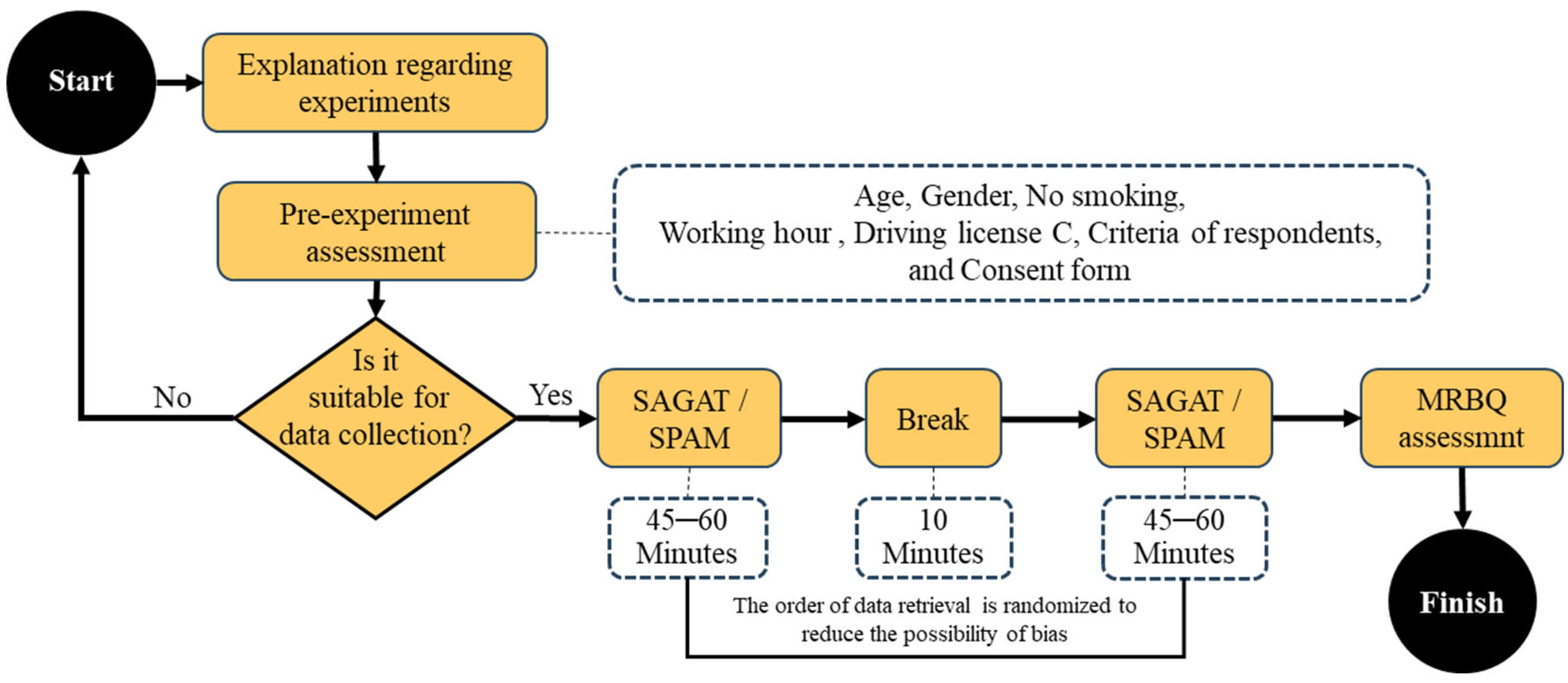
Participants in this study were recruited based on specified qualifications. The inclusion criteria are as follows: males and females who are young riders (17–25 years old) and adult riders (above 25 years old), have valid motorcycle driving licenses (SIM C), are students or employees, do not smoke, have the willingness to participate, and sign an informed consent form. The exclusion criteria of this study are smokers, people who consume alcohol and drugs regularly, and people who are in poor health. The day before data collection, participants were informed about the study details, including the risks and benefits. The participants in this study were randomly assigned to two distinct categories (morning and night sessions). Participants were asked to read and complete a consent form before the study began. Thereafter, the participants were instructed to sleep regularly, at least 7 h, avoid caffeine-containing drinks, and refrain from taking any medications for 24 h. Finally, participants were asked to bring their driving license ID (SIM C) and arrive at the research site at 06:00 AM local time for morning data collection or at 06:00 PM local time for night data collection. Figure 1 shows the details of the experimental procedure.
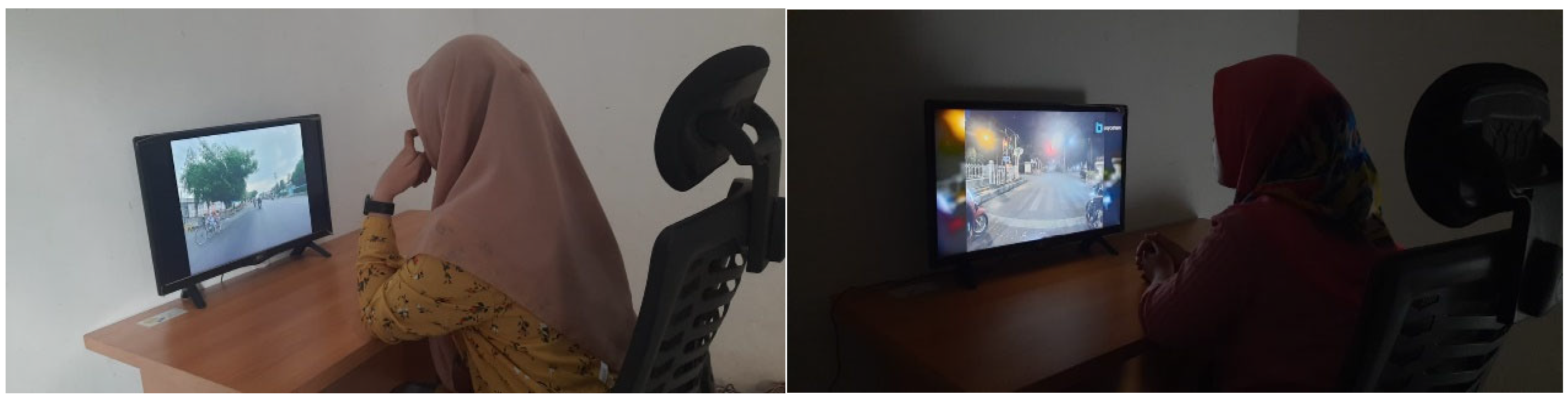
On the day of data collection, the prerequisite procedures were double-checked for all participants. If they qualified, they could proceed to the next section; otherwise, they would need to reschedule. Data collection lasted approximately 2 h across two scenarios: an assessment using the SAGAT and SPAM questionnaires. After the session ended, participants were asked to fill out the Motorcycle Rider Behavior Questionnaire (MRBQ). There was no incomplete response in this experiment; all participants completed the study. Figure 2 shows the data collection process.

2.4. Measurement

In this study, several measures of situation awareness (SAGAT and SPAM), covering three levels (perception, comprehension, and projection), and the MRBQ were administered to Indonesian motorcycle riders. There is still debate among previous studies about which method is most sensitive for measuring situation awareness [42]; therefore, SAGAT, based on the freeze-probing technique, and SPAM, based on the real-time probing technique, were used in this study. MRBQ is used to measure riding behavior in motorcyclists and is still rarely associated with riders’ situation awareness. For this reason, SAGAT, SPAM, and MRBQ were used in this research.
The situation awareness queries used in this study were developed using the Goal-Directed Task Analysis (GDTA) framework, which served as the conceptual foundation for both the SAGAT and SPAM measures. Specifically, GDTA was first employed to identify task goals, relevant environmental elements, and information requirements, which were then translated into structured SAGAT freeze-probe questions and SPAM real-time queries. Sample questions derived from these frameworks are provided in the Appendix A. All items were reviewed by an expert in transportation safety and human factors to evaluate their clarity, relevance, and suitability for measuring drivers’ situation awareness. Prior to the main data collection, a pilot test was conducted with 6 participants to assess the instrument’s practicality and comprehensibility. The pilot allowed the identification and correction of unclear items and minor procedural issues.

2.4.1. Situation Awareness

The level of situation awareness was measured using SAGAT through a freeze-probing procedure during task execution. At predetermined freeze points, the simulation video was paused, and the screen blanked, after which participants were required to answer predefined multiple-choice questions designed to evaluate their perception, comprehension, and projection of the surrounding riding environment. A total of 27 questions were administered across three freeze points, each lasting no more than 6 min. Responses were recorded on paper, and each item was scored dichotomously (1 = correct, 0 = incorrect).
Situation awareness was also measured using the SPAM, which employed questions aligned with those used in SAGAT. Participants responded to three questions per event and were instructed to answer as quickly and accurately as possible. Similar to SAGAT, responses were scored as correct (1) or incorrect (0).
For both SAGAT and SPAM, individual scores were calculated as the total number of correct responses and subsequently converted into percentages relative to the maximum possible score. In addition, scores were aggregated by situation awareness levels—Level 1 (perception), Level 2 (comprehension), and Level 3 (projection)—to enable level-specific analysis.
The development of situation awareness questions was guided by Goal-Directed Task Analysis (GDTA), which identifies the information requirements that riders need to achieve task goals. This approach ensures that the questions reflect dynamic situational demands rather than static knowledge (e.g., rules or procedures), thereby capturing the cognitive processes underlying real-time decision-making. The GDTA framework was informed by observations, experimental design considerations, and prior literature, and was validated through pilot testing with representative participants. This process enabled the formulation of questions aligned with the hierarchical structure of goals, sub-goals, and decisions associated with motorcycle riding tasks.
The other domains that needed to be developed could use the same process, with some modifications to the existing GDTA [43]. This study develops questions based on the design, experimental capability, and GDTA, informed by observations and the prior literature. Several subjects were used to validate the analytical findings [44]. The assessment includes the main objectives and sub-objectives of the motorcyclist identifying activity. Some choices must be made for each sub-objective, depending on the level of situational awareness for each decision.

2.4.2. Motorcycle Rider Behavior Questionnaire

The MRBQ consists of 34 items that measure deviant driving behaviors. It is divided into four categories: error, speed violation, stunt, and equipment safety. Riders reported frequency of involvement in each behavior on a 5-point scale (1 = never; 2 = very rarely; 3 = sometimes; 4 = often; 5 = almost always). Participants were asked to complete the questionnaire about their habits over the past 7 years. The MRBQ results were used to identify differences in overall variables identified through descriptive analysis and to conduct Pearson correlation analyses.

2.5. Statistical Analysis

In this study, the dependent variables were drivers’ level of situation awareness, assessed using SAGAT and SPAM, and riding behavior, assessed using the Motorcycle Rider Behavior Questionnaire (MRBQ). The independent variables were riding time (morning vs. nighttime) and rider age (young vs. adult).
Prior to the main statistical analyses, the Shapiro–Wilk test was conducted to assess the normality assumption of the data. A two-way ANOVA was performed to examine the main effects of riding time and age, as well as their interaction, on situation awareness (SAGAT and SPAM) scores. When the assumption of normality was violated, the non-parametric alternative (Kruskal–Wallis test) was applied to evaluate group differences. A paired-samples t-test was conducted to compare SAGAT and SPAM scores.
For MRBQ, a mixed-design two-way ANOVA (MRBQ dimensions × age group) was conducted to examine differences across MRBQ categories and between age groups. Furthermore, correlation analyses were conducted to assess the relationships between situation awareness and the MRBQ dimensions (errors, speed violations, stunts, and safety equipment use). All statistical analyses were performed using JASP, with a significance level of p < 0.05. Data are presented as mean ± standard deviation (SD).

3. Results

3.1. Statistical Data Analysis

Overall, participants demonstrated relatively low levels of situation awareness, with no individual achieving more than 60% correct responses. Adult participants showed slightly higher performance (18.5–55.6%) than younger participants (18.5–48.1%), although the difference was not statistically significant.
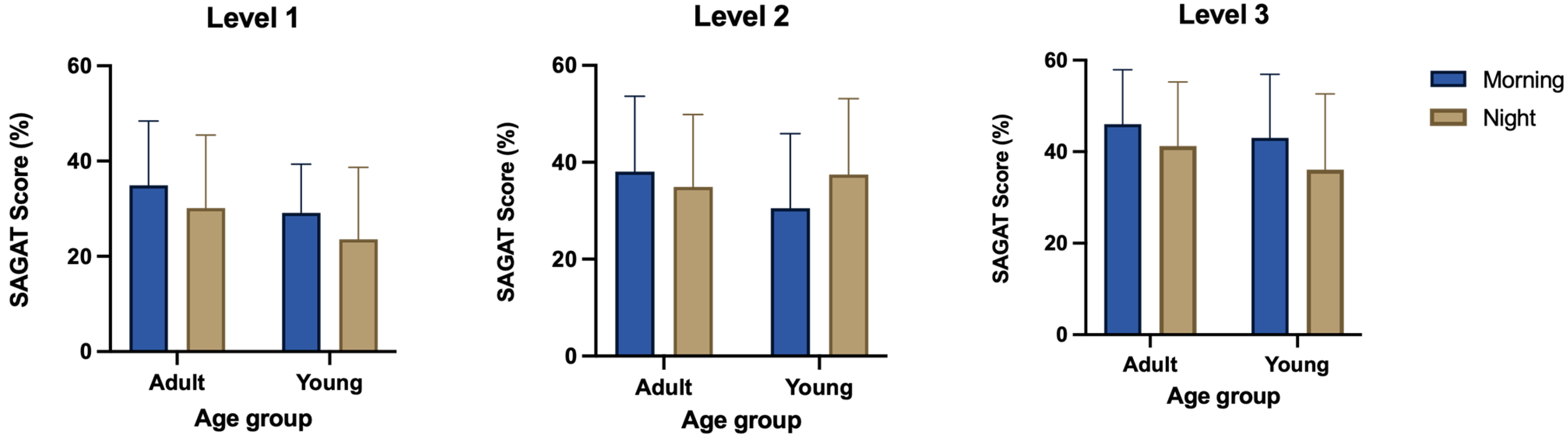
A two-way ANOVA revealed no significant main effects of riding time (F(1, 26) = 0.98, p = 0.331, ηp2 = 0.036) or age (F(1, 26) = 1.90, p = 0.180, ηp2 = 0.068). The interaction between time and age was also not significant (F(1, 26) = 0.15, p = 0.699, ηp2 = 0.006). Descriptively, SAGAT scores were slightly higher in the morning than at nighttime for both groups. Adult participants had mean scores of 39.67 (SD = 10.88) in the morning and 35.41 (SD = 5.99) at nighttime, whereas younger participants had mean scores of 34.23 (SD = 7.60) in the morning and 32.38 (SD = 8.56) at nighttime.
When examined across situation awareness levels, no significant effects of age, time, or their interaction were found for SAGAT Level 1, Level 2, or Level 3 (all p > 0.05). Overall, these findings indicate that SAGAT did not detect differences in situation awareness across levels as a function of age or riding time (Figure 3).
A two-way ANOVA revealed a significant main effect of riding time on SPAM scores (F(1, 26) = 8.82, p = 0.006, ηp2 = 0.253), indicating that situation awareness was significantly higher in the morning compared to nighttime. No significant main effect of age was observed (F(1, 26) = 0.12, p = 0.733, ηp2 = 0.005), and the interaction between age and time was also not significant (F(1, 26) = 0.03, p = 0.873, ηp2 < 0.001).
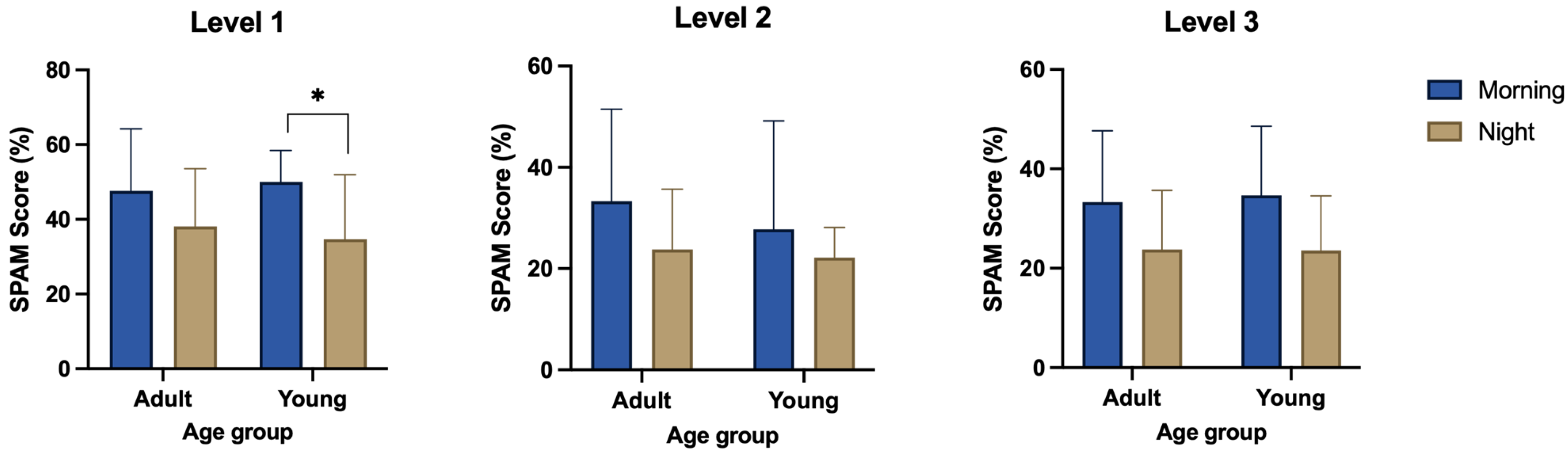
Descriptive statistics showed that both adult and young participants exhibited higher SPAM scores in the morning condition. Adult participants had mean scores of 38.09 (SD = 12.81) in the morning and 28.54 (SD = 8.19) at nighttime, while younger participants had mean scores of 37.46 (SD = 8.49) in the morning and 26.83 (SD = 7.06) at nighttime.
When examined across situation awareness levels, a significant main effect of time was observed (F(1, 26) = 5.27, p = 0.030, ηp2 = 0.168), indicating higher Level 1 performance in the morning than at nighttime. No significant effects of age (F(1, 26) = 0.01, p = 0.929, ηp2 < 0.00), or interaction (F(1, 26) = 0.28, p = 0.599, ηp2 = 0.011) were found. Post hoc comparisons confirmed a significant difference between time conditions (mean difference = 12.43, p = 0.030). Within-group comparisons indicated a significant difference in the young group (p = 0.049), with situation awareness level 1 higher in the morning than at night, but not in the adults (p = 0.239) (Figure 4).
For Level 2 (comprehension), no significant main effects of age, time, or interaction were observed (all p > 0.05). Meanwhile, for Level 3, a significant main effect of time was found (F(1, 26) = 4.84, p = 0.037, ηp2 = 0.157), indicating higher Level 3 performance in the morning condition. No significant effects of age (F(1, 26) = 0.02, p = 0.900, ηp2 < 0.001) or interaction (F(1, 26) = 0.03, p = 0.867, ηp2 = 0.001) were observed.
Post hoc comparisons confirmed a significant difference between time conditions (mean difference = 10.32, p = 0.037). However, within-group comparisons did not reach statistical significance for either adults (p = 0.176) or young participants (p = 0.095).
To further examine differences among measurement techniques, a mixed-design ANOVA was conducted with the SA method (SAGAT vs. SPAM) as a within-subjects factor and riding time as a between-subjects factor. The analysis revealed no significant main effect of SA method (F(1, 28) = 1.71, p = 0.202, ηp2 = 0.058), indicating that overall situation awareness scores did not differ significantly between SAGAT and SPAM. The interaction between the SA method and time approached significance but did not reach the conventional threshold (F(1, 28) = 3.26, p = 0.082, ηp2 = 0.104). However, a significant main effect of riding time was observed (F(1, 28) = 6.95, p = 0.014, ηp2 = 0.199), indicating differences in situation awareness between morning and nighttime conditions across methods. Post hoc analysis revealed that SAGAT scores did not differ significantly between morning and nighttime (p = 0.342). Conversely, SPAM scores were significantly higher in the morning than at night (mean difference = 10.13, p = 0.004).
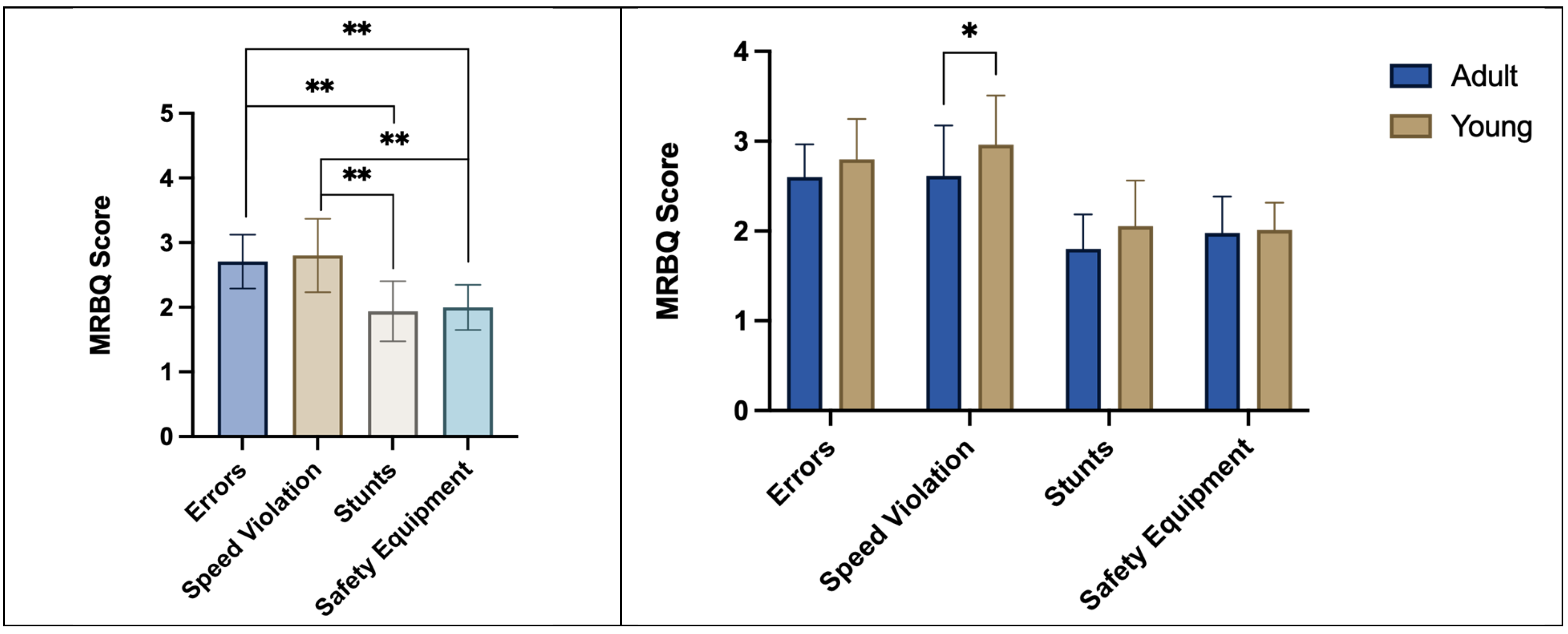
Figure 5 shows the distribution of riding behavior across MRBQ components. Descriptively, speed violations exhibited the highest scores, followed by errors, whereas stunts were the least frequently reported behavior. Use of safety equipment showed moderate scores compared with other components. A two-way mixed ANOVA revealed a significant main effect of MRBQ component (F(3, 84) = 44.70, p < 0.001), indicating that riding behaviors differed significantly across categories. In contrast, no significant main effect of age was observed (F(1, 28) = 3.34, p = 0.078), nor a significant interaction between MRBQ component and age (F(3, 84) = 0.95, p = 0.423). Post hoc comparisons (Bonferroni-adjusted) further clarified these differences. Stunts and safety equipment scores were significantly lower than both error and speed violation scores (all p < 0.001). Similarly, speed violations were significantly higher than stunts and safety equipment (all p < 0.001). Furthermore, the speed violation in young participants was significantly higher than adult participants.

3.2. Pearson Correlation

The Pearson correlation of situation awareness and MRBQ examined the strength and direction of the linear association between these variables. Table 2 shows that situation awareness using SPAM in the morning correlates positively with stunts (r(13) = 0.689, p < 0.010). The reported correlation indicates a moderately strong positive association between morning situation awareness and stunts.
Table 3 shows that nighttime situation awareness, as measured by SPAM, is negatively correlated with error (r(13) = −0.546, p < 0.050). It suggests that situation awareness increases and the tendency to make errors decreases at night. Moreover, nighttime situation awareness using SPAM is positively correlated with equipment safety (r(13) = 0.595, p < 0.050). It indicates that as awareness increases, there is a higher inclination to use safer safety equipment.

4. Discussions

4.1. Effects of Riding Time and Age on Situation Awareness

The effect of the riding time on situational awareness was significant in SPAM measurement, with higher levels in the morning. This is consistent with the findings of Wijayanto et al. (2016) and Grüner et al. (2017) [32,45]. This result could be a specific concern for improving nighttime situation awareness. Wijayanto et al. (2016) reported that morning awareness is higher because respondents are not sleep-deprived, thereby reducing their perceptual knowledge of the virtual driving environment [32]. It shows a significant association with respondents’ subjective drowsiness levels. As drivers’ drowsiness increases, their perception of the driving environment decreases, making their driving more dangerous. These might happen at night or the following morning during sleep deprivation. The next factor is low luminance, which degrades human vision at night and thus increases the risk of nocturnal traffic accidents [46]. Grüner et al. (2017) identify factors that lead to better situation awareness in the morning than at night [45]. Those factors are stable environment factors such as the impact of illumination on eye movements, weather conditions, road environment, road geometry, and road type; various environmental factors such as situation of traffic (oncoming vehicle, glare, intersections, and preceding vehicles), and the salience of objects, signs, and pedestrians; stable organismic factors such as driving experience, personality, visual and mental capacity (age); and variable organismic factors such as alertness, fatigue, and drugs.
Adult drivers have slightly better situational awareness than younger motorcyclists, though the difference is not statistically significant. These findings are similar to the previous research [2,22,47]. Younger motorcyclists may have reduced situational awareness due to their age, limited riding experience, and possibly limited exposure to real-world riding conditions [22]. Furthermore, Sari (2017) highlights that younger riders have lower situational awareness due to a lack of understanding of various factors [47]. These adverse elements include a lack of understanding of traffic rules, violations of traffic signs, and safety violations such as not wearing riding safety equipment. Scott-Parker et al. (2020) stated that one factor contributing to reduced situational awareness among motorcyclists is limited riding experience, particularly among younger riders who often have minimal exposure to driving situations [2]. Soewardi et al. (2019) reported that most young riders had low situational awareness [26]. They tended to feel overconfident because they had too many perceptions; however, their riding technique remained unstable because they were too indifferent to understand the surrounding events, road conditions, traffic, and other factors. Therefore, it suddenly encouraged them to do unstable or dangerous maneuvers.
The comparison of situation awareness between the SPAM and SAGAT techniques showed no significant difference; however, within SPAM, situational awareness differed significantly between morning and nighttime, indicating that SPAM is more sensitive than SAGAT. This is consistent with previous research, which showed that SPAM was more sensitive than SAGAT in terms of situation awareness and workload differences; however, it was also more intrusive [39,43]. Another study also found that SAGAT increased the mental load of participants, and SPAM was more predictive of the assessment of the air traffic controller [48]. Although previous studies reported that SPAM may introduce intrusiveness due to real-time probing, the present study did not directly measure participants’ perceived intrusiveness or workload during SPAM trials. Consequently, the SPAM results should be interpreted with caution, as part of the observed difference may reflect the methodological characteristics of the measurement technique rather than purely differences in situation awareness. Some researchers noted that differences in video playback could account for lower SPAM scores, because the freeze step in the SAGAT experiment terminated the video, whereas in SPAM, the video continues playing after the question is spoken and the participant answers [39]. In short, the measurement using the real-time probing (SPAM) offers greater sensitivity despite its intrusiveness.
Many factors can contribute to low situational awareness, such as physiological factors, fatigue, mental state, routines, and preparation. In addition, a lack of knowledge of traffic rules contributes to this problem. A previous study suggested that licensing processes in certain contexts may not adequately ensure driver readiness [49]. In a developing country like Indonesia, challenges in law enforcement and licensing may affect driver competence and safety awareness [49]. Therefore, the issue must be addressed seriously. Structured socialization and training programs that emphasize situation-awareness-based scenarios to improve understanding of regulations and traffic signs could be considered prerequisites for obtaining a license. Moreover, using training simulators across several sessions may help ensure that riders meet passing criteria for situational awareness [22].

4.2. Correlation of Rider Behavior to Situation Awareness

The results of the motorcycle rider behavior questionnaire indicate that riding stunts were rarely reported. Meanwhile, participants frequently committed speed violations, consistent with findings from [16,18,20]. Furthermore, errors are also the second-highest variable after speed violations. Both speed violations and errors increase the likelihood of traffic accidents by directly affecting the safe operation of a potentially hazardous system, such as road traffic. Speeding violations, such as exceeding the speed limit and participating in unauthorized races, can result from decreased response time and control, increasing the risk of collisions and loss of control. Similarly, traffic errors, such as failing to notice pedestrians, failing to yield the right of way, or being distracted while driving, can lead to dangerous situations on the path, increasing the likelihood of accidents [18]. Speeding violations significantly increased the risk of “blame” crashes, indicating that interventions to address violative behavior, such as speeding, are critical for reducing the risk of traffic accidents [16]. Previous research by Sakashita et al. (2014) reported that, within a three-year observation period, breaking speed limits was closely linked to receiving speeding tickets [20]. As people more frequently admitted to speeding, their odds of receiving these penalties increased. Similarly, making errors while driving increases the risk of a near-crash. A common threat in these reasons is speed, such as going too fast around a corner or struggling to control the motorcycle at high speeds [20]. Moreover, some participants rarely use safety equipment. Özkan et al. (2012) reported that cultural beliefs, the type of safety equipment used, external influences, and psychological and social models all affect young people’s use of safety equipment, particularly when riding a motorcycle [18]. These characteristics help explain why young people rarely use safety equipment, especially when riding motorcycles.
The results shown in Table 2 show a moderately strong positive association between morning situation awareness and stunts. While higher awareness is generally associated with safer driving, studies of novice drivers indicate that increased cognitive engagement can coexist with violations and risky maneuvers, particularly under time pressure or in competitive traffic conditions [50]. Heightened vigilance may also enable recognition of opportunities for risky actions [51]. Furthermore, morning commutes often involve risky driving behaviors, as drivers who are pressured by lateness or congestion ignore speed limits, engage in speeding, and compete to overtake others [52].
The results shown in Table 3 show that nighttime situation awareness is negatively correlated with error. It suggests that situation awareness increases and the tendency to make errors decreases at night. This is because participants are more cautious at night when riding, avoiding dangerous situations such as riding between rows of cars and increasing stopping distance to anticipate braking or maneuvering [53]. Moreover, nighttime situation awareness using SPAM is positively correlated with equipment safety. It indicates that as awareness increases, there is a higher inclination to use safer riding equipment. By wearing personal protective equipment, such as helmets, windproof jackets, and other protective gear, motorcycle riders can enhance safety and reduce the risk of injury during night riding [54].

5. Conclusions

In conclusion, by using video recordings from motorcycle riders’ perspectives and accounting for differences in riding time, this study aims to enhance motorcycle safety research by developing and validating techniques to objectively measure riders’ situation awareness. The novelty of this study lies in its exploration of situational awareness among motorcycle riders, as prior research on motorcycle riders remains limited, particularly regarding age, riding time, and riding behavior. This study significantly contributes to the development and teaching of safe riding skills, especially for young and inexperienced motorcycle riders. Overall, the findings of this study suggest that motorcyclists have low situational awareness. Considering age comparisons, younger riders exhibit lower situation awareness than adult riders. In terms of time, nighttime is notably more dangerous for riders, as they are less alert than in the morning.
The theoretical implication of this study is to provide fresh insights into the diverse states of awareness among motorcycle riders across age groups and time of day. Moreover, this study provides a snapshot of Indonesian riders’ behavior, revealing that situational awareness correlates positively with stunts in the morning and with safety equipment, and negatively with error correction at night. Assessing SAGAT, SPAM, and MRBQ simultaneously also provides a new perspective on riders’ situation awareness relative to their riding behavior. The practical implications of this study suggest that the police and the Department of Transportation could strengthen law enforcement practices and provide training programs to better support drivers in obtaining a license. Training for young riders must be prioritized, especially to increase their situational awareness ability [2]. One potential approach is to use structured safety education programs that incorporate scenario-based training, allowing riders to practice identifying potential hazards under different traffic conditions, such as day and night riding, and increasing riders’ situational awareness by 30% [55]. Such training may include guided discussions of traffic scenarios, hazard perception exercises, or simulator-based learning environments.
Finally, this study has several limitations that should be addressed in future research. The sample was restricted to motorcycle riders in the Gresik region of East Java Province, Indonesia, and recruitment was conducted using convenience sampling. As a result, the gender distribution and exclusion of smokers reflect practical constraints rather than deliberate stratification, which limits validity and generalizability to the broader riding population. Future studies should aim to include more representative samples of riders and expand to diverse geographies and road user groups. In addition, the sample size is relatively small. Larger-scale studies are strongly recommended to obtain more robust data and a more comprehensive understanding of riders’ situation awareness. Furthermore, this study used self-reported sleep duration; future research should incorporate objective measures (e.g., actigraphy, wearable sleep trackers) and chronotype assessments to better control for circadian influences and individual sleep needs. It should also be noted that the MRBQ measures self-reported riding behaviors over an extended recall period. Therefore, the MRBQ results in this study should be interpreted as reflecting general behavioral tendencies rather than precise estimates of the frequency of risky riding behaviors.

Author Contributions

Conceptualization, R.H.P., M.A.P., M.L. and T.W.; methodology, M.A.P. and T.W.; software, M.A.P.; validation, M.L. and T.W.; formal analysis, R.H.P. and M.A.P.; investigation, R.H.P.; resources, M.A.P.; data curation, R.H.P.; visualization, R.H.P.; supervision, M.A.P.; project administration, R.H.P.; funding acquisition, M.A.P.; writing—original draft, R.H.P. and M.A.P.; writing—review and editing, M.L. and T.W. All authors have read and agreed to the published version of the manuscript.

Funding

This research was funded by the Directorate of Research and Community Service (DRPM) Universitas Indonesia under the PUTI Postgraduate Grant in 2024, grant number NKB-122/UN2.RST/HKP.05.00/2024.

Institutional Review Board Statement

The study was conducted in accordance with the Declaration of Helsinki, and approved by the Research and Community Engagement Ethical Committee Faculty of Public Health Universitas Indonesia (protocol code Ket- 328/UN2.F10.D11/PPM.00.02/2024 and date of approval 10 May 2024).

Informed Consent Statement

Informed consent was obtained from all subjects involved in the study.

Data Availability Statement

The original data presented in the study are openly available in FigShare (https://doi.org/10.6084/m9.figshare.31397745).

Conflicts of Interest

The authors declare no conflicts of interest.

Appendix A

Situation Awareness (SAGAT and SPAM)
SA 1. Apa jenis Tanda Larangan yang Anda lihat (pertama kali)?
A. Tanda larang parkir        D. Tanda dilarang berhenti
B. Tanda dilarang mendahului      E. Tanda larangan melebihi batas kecepatan
C. Tanda larang putar balik
SA 2. Dengan adanya tanda larangan mendahului, maka saya diizinkan untuk mendahului kendaraan lain, meskipun jalan sedang tidak ramai?
A. Benar   B. Salah   C. Ragu-ragu   D. Tidak tahu   E. Tidak berlaku
SA 3. Apa yang terjadi jika saat ingin mendahului, tiba-tiba Anda melihat tanda larangan mendahului di depan Anda?
A. Tetap melanjutkan upaya mendahului.
B. Memperlambat dan membatalkan upaya mendahului.
C. Menggunakan klakson untuk memberi tahu pengemudi di depan.
D. Terus mendahului dengan kecepatan konstan.
E. Tidak Tahu
----------------------------------------------------------------------------------------------------------------------------------------------
SA 1. Apa jenis lampu yang Anda temui di persimpangan?
A. Lampu lalu lintas             B. Lampu peringatan     C. Lampu jalan
D. Lampu peringatan dan lampu jalan     E. Lampu lalu lintas dan lampu jalan
SA 2. Siapa yang memiliki prioritas untuk melanjutkan perjalanan saat lampu peringatan mati?
A. Pengendara dengan kecepatan tinggi      D. Pengendara dari kanan
B. Pengendara dari kiri            E. Pengendara yang pertama kali mencapai persimpangan
C. Pengendara dari depan
SA 3. Apa yang terjadi jika Anda melihat, dari jarak 100 m di depan Anda, terdapat lampu peringatan mati di persimpangan?
A. Berhenti dan menunggu.          B. Mempercepat
C. Berkendara sesuai kecepatan sebelumnya    D. Memperlambat
E. Tidak Tahu
MRBQ
A. Errors (Kesalahan)
Errors diartikan sebagai perilaku pengemudi yang menyimpang dari jalur yang benar dalam mencapai tujuan yang diinginkan. Errors merupakan jenis kesalahan yang dapat dilihat sebagai penyimpangan yang tidak disengaja dan mencerminkan masalah dalam pemrosesan informasi.
1. Seberapa sering Anda tidak sengaja mengambil lajur tanpa mengetahui keberadaan kendaraan lain yang sudah ada di lajur tersebut?
1 = Tidak pernah  2 = Sangat jarang  3 = Kadang-kadang  4 = Sering  5 = Hampir selalu
2. Seberapa sering Anda terlambat menyadari kendaraan di depan Anda telah berhenti?
1 = Tidak pernah  2 = Sangat jarang  3 = Kadang-kadang  4 = Sering  5 = Hampir selalu
3. Seberapa sering Anda telat menyadari kendaraan di depan telah melambat?
1 = Tidak pernah  2 = Sangat jarang  3 = Kadang-kadang  4 = Sering  5 = Hampir selalu
4. Seberapa sering Anda tidak melihat seseorang keluar dari kendaraan yang diparkir saat Anda sedang melaju?
1 = Tidak pernah  2 = Sangat jarang  3 = Kadang-kadang  4 = Sering  5 = Hampir selalu
5. Seberapa sering Anda telat berhenti saat lampu merah menyala?
1 = Tidak pernah  2 = Sangat jarang  3 = Kadang-kadang  4 = Sering  5 = Hampir selalu
6. Seberapa sering Anda tidak memperhatikan pejalan kaki di persimpangan jalan?
1 = Tidak pernah  2 = Sangat jarang  3 = Kadang-kadang  4 = Sering  5 = Hampir selalu
7. Seberapa sering Anda tidak memperhatikan pejalan kaki yang sedang menyeberang ketika Anda sedang berbelok ke jalan samping dari jalan utama?
1 = Tidak pernah  2 = Sangat jarang  3 = Kadang-kadang  4 = Sering  5 = Hampir selalu
8. Seberapa sering ketika Anda mengantri untuk belok kiri di jalan utama, Anda terlalu memperhatikan lalu lintas sehingga hampir menabrak kendaraan di depan?
1 = Tidak pernah  2 = Sangat jarang  3 = Kadang-kadang  4 = Sering  5 = Hampir selalu
9. Seberapa sering Anda lalai terhadap tanda “Stop” sehingga hampir mengalami tabrakan dengan kendaraan lain?
1 = Tidak pernah  2 = Sangat jarang  3 = Kadang-kadang  4 = Sering  5 = Hampir selalu
10. Seberapa sering Anda mencoba menyalip seseorang yang Anda tidak sadari memberikan tanda belok kanan?
1 = Tidak pernah  2 = Sangat jarang  3 = Kadang-kadang  4 = Sering  5 = Hampir selalu
11. Seberapa sering Anda mengalami kesulitan mengendalikan sepeda motor saat berkendara dengan kecepatan tinggi?
1 = Tidak pernah  2 = Sangat jarang  3 = Kadang-kadang  4 = Sering  5 = Hampir selalu
12. Seberapa sering Anda mengalami selip/tergelincir yang disebabkan oleh jalan basah, lubang, dan halangan lain?
1 = Tidak pernah  2 = Sangat jarang  3 = Kadang-kadang  4 = Sering  5 = Hampir selalu
13. Seberapa sering Anda perlu mengganti persneling (menurunkan kecepatan untuk motor matic) saat melewati tikungan?
1 = Tidak pernah  2 = Sangat jarang  3 = Kadang-kadang  4 = Sering  5 = Hampir selalu
14. Seberapa sering Anda mengalami masalah di jalan ketika helm Anda berkabut?
1 = Tidak pernah  2 = Sangat jarang  3 = Kadang-kadang  4 = Sering  5 = Hampir selalu
B. Speed Violation (Pelanggaran Kecepatan)
Pelanggaran kecepatan adalah pelanggran yang disengaja terhadap batas kecepatan yang telah ditetapkan sesuai aturan peraturan lalu lintas.
1. Seberapa sering Anda berkendara sangat cepat ketika berada di tikungan sehingga Anda merasa akan kehilangan kendali?
1 = Tidak pernah  2 = Sangat jarang  3 = Kadang-kadang  4 = Sering  5 = Hampir selalu
2. Seberapa sering Anda mengalami insiden atau kecelakaan saat melewati tikungan?
1 = Tidak pernah  2 = Sangat jarang  3 = Kadang-kadang  4 = Sering  5 = Hampir selalu
3. Seberapa sering Anda sengaja berkendara sangat dekat dengan kendaraan di depan sehingga sulit untuk berhenti dalam keadaan darurat?
1 = Tidak pernah  2 = Sangat jarang  3 = Kadang-kadang  4 = Sering  5 = Hampir selalu
4. Seberapa sering Anda melebihi batas kecepatan di jalan antarkota (maksimal 80 km/jam)?
1 = Tidak pernah  2 = Sangat jarang  3 = Kadang-kadang  4 = Sering  5 = Hampir selalu
5. Seberapa sering Anda melebihi batas kecepatan di kawasan perkotaan (maksimal 50 km/jam)?
1 = Tidak pernah  2 = Sangat jarang  3 = Kadang-kadang  4 = Sering  5 = Hampir selalu
6. Seberapa sering Anda melebihi batas kecepatan di kawasan perumahan (maksimal 30 km/jam)?
1 = Tidak pernah  2 = Sangat jarang  3 = Kadang-kadang  4 = Sering  5 = Hampir selalu
7. Seberapa sering Anda mengabaikan batas kecepatan kendaraan saat berkendara di malam hari dalam kondisi normal (tidak hujan dan jalan tidak berlubang)?
1 = Tidak pernah  2 = Sangat jarang  3 = Kadang-kadang  4 = Sering  5 = Hampir selalu
8. Seberapa sering Anda melaju cepat untuk mengalahkan pengendara di sebelah Anda (setelah Anda berhenti di lampu merah)?
1 = Tidak pernah  2 = Sangat jarang  3 = Kadang-kadang  4 = Sering  5 = Hampir selalu
9. Seberapa sering Anda berkendara di antara dua jalur lalu lintas yang bergerak cepat?
1 = Tidak pernah  2 = Sangat jarang  3 = Kadang-kadang  4 = Sering  5 = Hampir selalu
C. Stunts (Aksi)
Stunts adalah aksi atau perilaku yang dilakukan pengendara sepeda motor dalam melakukan manuver atau aktivitas yang seringkali dianggap berbahaya saat berkendara.
1. Seberapa sering Anda berkendara dengan kecepatan tinggi di jalan?
1 = Tidak pernah  2 = Sangat jarang  3 = Kadang-kadang  4 = Sering  5 = Hampir selalu
2. Seberapa sering Anda terlibat balapan dengan pengendara lain?
1 = Tidak pernah  2 = Sangat jarang  3 = Kadang-kadang  4 = Sering  5 = Hampir selalu
3. Seberapa sering Anda mengangkat roda depan motor secara sengaja?
1 = Tidak pernah  2 = Sangat jarang  3 = Kadang-kadang  4 = Sering  5 = Hampir selalu
4. Seberapa sering Anda sengaja melakukan putaran roda?
1 = Tidak pernah  2 = Sangat jarang  3 = Kadang-kadang  4 = Sering  5 = Hampir selalu
5. Seberapa sering pengemudi lain dengan sengaja mengganggu Anda sehingga membahayakan Anda?
1 = Tidak pernah  2 = Sangat jarang  3 = Kadang-kadang  4 = Sering  5 = Hampir selalu
6. Seberapa sering Anda berkendara dalam keadaan mabuk dan menggunakan obat-obatan terlarang?
1 = Tidak pernah  2 = Sangat jarang  3 = Kadang-kadang  4 = Sering  5 = Hampir selalu
D. Safety Equipment (Peralatan Keamanan)
Safety Equipment adalah perlengkapan atau alat-alat yang dirancang dan digunakan untuk melindungi keselamatan pengendara motor yang diguankan sehari-hari.
1. Seberapa sering Anda menggunakan celana pelindung sepeda motor (kulit atau non-kulit)?
1 = Tidak pernah  2 = Sangat jarang  3 = Kadang-kadang  4 = Sering  5 = Hampir selalu
2. Seberapa sering Anda menggunakan sepatu atau sepatu boots untuk sepeda motor?
1 = Tidak pernah  2 = Sangat jarang  3 = Kadang-kadang  4 = Sering  5 = Hampir selalu
3. Seberapa sering Anda menggunakan jaket pelindung sepeda motor (kulit atau non-kulit)?
1 = Tidak pernah  2 = Sangat jarang  3 = Kadang-kadang  4 = Sering  5 = Hampir selalu
4. Seberapa sering Anda menggunakan pelindung tubuh/pelindung benturan (misalnya untuk siku, bahu, atau lutut)?
1 = Tidak pernah  2 = Sangat jarang  3 = Kadang-kadang  4 = Sering  5 = Hampir selalu
5. Seberapa sering Anda menggunakan pakaian dengan warna terang/neon/dapat memancarkan cahaya?
1 = Tidak pernah  2 = Sangat jarang  3 = Kadang-kadang  4 = Sering  5 = Hampir selalu
6. Seberapa sering Anda apakah Anda menyalakan lampu depan saat berkendara di siang hari?
1 = Tidak pernah  2 = Sangat jarang  3 = Kadang-kadang  4 = Sering  5 = Hampir selalu
7. Seberapa sering Anda menggunakan sarung tangan sepeda motor?
1 = Tidak pernah  2 = Sangat jarang  3 = Kadang-kadang  4 = Sering  5 = Hampir selalu

References

  1. WHO. Global Plan for the Decade of Action for Road Safety 2021–2030; Report; WHO: Geneva, Switzerland, 2021. [Google Scholar]
  2. Scott-Parker, B.; De Regt, T.; Jones, C.; Caldwell, J. The situation awareness of young drivers, middle-aged drivers, and older drivers: Same but different? Case Stud. Transp. Policy 2020, 8, 206–214. [Google Scholar] [CrossRef]
  3. Saputra, R.; Nurhuda, S.F. Indonesia Peringkat Tiga Terbesar Kecelakaan di Dunia. VIVA. 2019. Available online: https://www.viva.co.id/otomotif/1131203-indonesia-peringkat-tiga-terbesar-kecelakaan-di-dunia (accessed on 13 August 2024).
  4. ASEANstats. Number of Traffic Accident Casualties (Injuries) by Road. Available online: https://data.aseanstats.org/indicator/ASE.TRP.ROD.E.031 (accessed on 3 July 2024).
  5. WHO. Global Plan 2011–2020. 2011. Available online: https://cdn.who.int/media/docs/default-source/documents/un-road-safety-collaboration/global_plan_doa_2011-2020.pdf?sfvrsn=a34009ff_3&download=true (accessed on 25 March 2026).
  6. Badan Pusat Statistik. Jumlah Kecelakaan, Korban Mati, Luka Berat, Luka Ringan, dan Kerugian Materi, 2024. 2025. Available online: https://www.bps.go.id/id/statistics-table/2/NTEzIzI=/jumlah-kecelakaan--korban-mati--luka-berat--luka-ringan--dan-kerugian-materi.html (accessed on 5 August 2024).
  7. Von Kameke, L. Statista. Share of Households Owning a Motorcycle in Asia as 2023, by Country. 2023. Available online: https://www.statista.com/statistics/1373225/asia-household-share-owning-a-motorcycle-by-country/?srsltid=AfmBOorGP0HlVK0OGswg3ceYJc8chv0q_uHQJ4xSQ4gExHURb0GYPV0P (accessed on 15 October 2025).
  8. Boniface, R.; Museru, L.; Kiloloma, O.; Munthali, V. Factors associated with road traffic injuries in Tanzania. Pan Afr. Med. J. 2016, 23, 46. [Google Scholar] [CrossRef] [PubMed]
  9. SWOV Institute for Road Safety Research. Motorcyclists. SWOV Fact Sheet 2017. Available online: https://www.swov.nl/en/facts-figures/factsheet/motorcyclists (accessed on 15 October 2025).
  10. Rasyid, H. Target Penurunan Angka Kecelakaan Sulit Tercapai, Tiga Jiwa Meninggal Setiap Jam. 2022. Available online: https://www.gridoto.com/read/223334221/target-penurunan-angka-kecelakaan-sulit-tercapai-tiga-jiwa-meninggal-setiap-jam-berikut-laporannya (accessed on 6 December 2024).
  11. Homonnai, P.; Mándoki, P. Analysis of Technical Errors Made by Motorcycle Riders. Period. Polytech. Transp. Eng. 2023, 51, 147–154. [Google Scholar] [CrossRef]
  12. Massie, D.L.; Campbell, K.L.; Williams, A.F. Traffic Accident involvement rates by driver age and gender. Accid. Anal. Prev. 1995, 27, 73–87. [Google Scholar] [CrossRef]
  13. Mahardhika, L.A. Jasa Raharja: Ini Penyebab Utama Kecelakaan per Semester I/2023. 2023. Available online: https://ekonomi.bisnis.com/read/20230801/98/1680314/jasa-raharja-ini-penyebab-utama-kecelakaan-per-semester-i2023 (accessed on 18 October 2024).
  14. Kementerian Komunikasi dan Digital. Rata-Rata Tiga Orang Meninggal Setiap Jam Akibat Kecelakaan Jalan. 2017. Available online: https://www.komdigi.go.id/berita/artikel-gpr/detail/rata-rata-tiga-orang-meninggal-setiap-jam-akibat-kecelakaan-jalan (accessed on 7 November 2024).
  15. Zuraida, R.; Wijayanto, T.; Iridiastadi, H. Fatigue during Prolonged Simulated Driving: An Electroencephalogram Study. Int. J. Technol. 2022, 13, 286–296. [Google Scholar] [CrossRef]
  16. Elliott, M.A.; Baughan, C.J.; Sexton, B.F. Errors and violations in relation to motorcyclists’ crash risk. Accid. Anal. Prev. 2007, 39, 491–499. [Google Scholar] [CrossRef] [PubMed]
  17. Kumar, A.; Kumar, P.; Kumar, V. Effects of Road Conditions, Traffic Patterns, and Human-Made Features on Road Safety: Review Article. World Sci. J. Mod. Res. Methodol. 2023, 2, 2835–3072. [Google Scholar] [CrossRef]
  18. Özkan, T.; Lajunen, T.; Dogruyol, B.; Yildirim, Z.; Çoymak, A. Motorcycle accidents, rider behaviour, and psychological models. Accid. Anal. Prev. 2012, 49, 124–132. [Google Scholar] [CrossRef] [PubMed]
  19. Puspasari, M.A.; Madani, S.T.; Iqbal, B.M.; Muslim, E.; Sanjaya, B.P.; Pribadyo, C.Y.P.; Junistya, K.N.; Ghanny, A.; Syaifullah, D.H.; Arista, S.A. Effect of Distraction and Driving Behaviour to Traffic Accidents in Jakarta Using Partial Least Squares Structural Equation Modeling (PLS-SEM). Int. J. Technol. 2023, 14, 1548–1559. [Google Scholar] [CrossRef]
  20. Sakashita, C.; Senserrick, T.; Lo, S.; Boufous, S.; De Rome, L.; Ivers, R. The Motorcycle Rider Behavior Questionnaire: Psychometric properties and application amongst novice riders in Australia. Transp. Res. Part F Traffic Psychol. Behav. 2014, 22, 126–139. [Google Scholar] [CrossRef]
  21. Uttra, S.; Jomnonkwao, S.; Watthanaklang, D.; Ratanavaraha, V. Development of Self-Assessment Indicators for Motorcycle Riders in Thailand: Application of the Motorcycle Rider Behavior Questionnaire (MRBQ). Sustainability 2020, 12, 2785. [Google Scholar] [CrossRef]
  22. Khairul, M.; Ibrahim, A.; Hamzah, A.; Anwar, K.; Kassim, A.; My, G. Measurement of Riding Situation Awareness Among Malaysian Motorcyclists Using a Video-Based Assessment Approach. Int. J. Road Saf. 2021, 2, 4–9. Available online: www.ijrs.my (accessed on 25 March 2026).
  23. Liu, Y.; Chen, N.; Rau, P.L.P. The effects of motivation and noise on situation awareness: A study based on SAGAT and EEG. Int. J. Ind. Ergon. 2023, 97, 103491. [Google Scholar] [CrossRef]
  24. Kass, S.J.; Cole, K.S.; Stanny, C.J. Effects of distraction and experience on situation awareness and simulated driving. Transp. Res. Part F Traffic Psychol. Behav. 2007, 10, 321–329. [Google Scholar] [CrossRef]
  25. Bellet, T.; Banet, A. Towards a conceptual model of motorcyclists’ Risk Awareness: A comparative study of riding experience effect on hazard detection and situational criticality assessment. Accid. Anal. Prev. 2012, 49, 154–164. [Google Scholar] [CrossRef]
  26. Soewardi, H.; Ayu Kiranti, A.D. Situation Awareness Analysis on Motorcycle Riders using Quantitative Analysis of Situational Awareness. IOP Conf. Ser. Mater. Sci. Eng. 2019, 528, 012022. [Google Scholar] [CrossRef]
  27. Symons, J.; Howard, E.; Sweeny, K.; Kumnick, M.; Sheehan, P. Reduced Road Traffic Injuries for Young People: A Preliminary Investment Analysis. J. Adolesc. Health 2019, 65, S34–S43. [Google Scholar] [CrossRef]
  28. Ackaah, W.; Apuseyine, B.A.; Afukaar, F.K. Road traffic crashes at night-time: Characteristics and risk factors. Int. J. Inj. Control. Saf. Promot. 2020, 27, 392–399. [Google Scholar] [CrossRef]
  29. Febrianti, A.A.; Desrianty, A.; Yuniar, Y. Tingkat Kewaspadaan dan Perilaku Pengemudi Angkutan Kota Berdasarkan Karakteristik Jarak Tempuh Trayek Menggunakan Metode Quasa dan Driver Behaviour Questionnaire. Proceedings 2013. Available online: https://api.semanticscholar.org/CorpusID:236067251 (accessed on 25 March 2026).
  30. Van Dam, J.; Kass, S.J.; VanWormer, L. The effects of passive mobile phone interaction on situation awareness and driving performance. J. Transp. Saf. Secur. 2020, 12, 1007–1024. [Google Scholar] [CrossRef]
  31. Liu, Y.; Lan, Z.; Cui, J.; Sourina, O.; Müller-Wittig, W. Inter-subject transfer learning for EEG-based mental fatigue recognition. Adv. Eng. Inform. 2020, 46, 101157. [Google Scholar] [CrossRef]
  32. Wijayanto, T.; Wibirama, S.; Maryoto, Z.Z.; Winadi, M.N.; Bait, M. Effects of morning-night differences and sleep deprivation on situation awareness and driving performance. In 2016 IEEE International Conference on Industrial Engineering and Engineering Management (IEEM); IEEE: New York, NY, USA, 2016; pp. 267–271. [Google Scholar] [CrossRef]
  33. Rizalmi, S.R.; Wijayanto, T.; Rossano, R.; Trapsilawati, F.; Marcillia, S.R.; Lufityanto, G. The Effect of Passenger Interaction on Situation Awareness and Driving Performance in Sleep-Deprived Condition. In 2019 5th International Conference on Science and Technology (ICST); IEEE: New York, NY, USA, 2019; pp. 1–4. [Google Scholar] [CrossRef]
  34. Wijayanto, T.; Marcillia, S.R.; Lufityanto, G.; Wisnugraha, B.B.; Alma, T.G.; Abdianto, R.U. The effect of situation awareness on driving performance in young sleep-deprived drivers. IATSS Res. 2021, 45, 218–225. [Google Scholar] [CrossRef]
  35. Wang, X.; Bo, W.; Yang, W.; Cui, S.; Chu, P. Effect of High-Altitude Environment on Driving Safety: A Study on Drivers’ Mental Workload, Situation Awareness, and Driving Behaviour. J. Adv. Transp. 2020, 2020, 7283025. [Google Scholar] [CrossRef]
  36. Briggs, G.F.; Hole, G.J.; Turner, J.A.J. The impact of attentional set and situation awareness on dual tasking driving performance. Transp. Res. Part F Traffic Psychol. Behav. 2018, 57, 36–47. [Google Scholar] [CrossRef]
  37. Salmon, P.M.; Young, K.L.; Cornelissen, M. Compatible cognition amongst road users: The compatibility of driver, motorcyclist, and cyclist situation awareness. Saf. Sci. 2013, 56, 6–17. [Google Scholar] [CrossRef]
  38. Metz, B.; Wörle, J.; Metzulat, M.; Neukum, A. How to assess situation awareness while driving with automation? Impact of visual attention during AD mode on measures of situation awareness. Accid. Anal. Prev. 2025, 220, 108142. [Google Scholar] [CrossRef] [PubMed]
  39. Akbar, G.H.; Wijayanto, T.; Hartono, B. Situation Awareness Measurement in Pedestrian Environments: A Comparison between Freeze-probing and Realtime-Probing Technique. Res. Sq. 2022. [Google Scholar] [CrossRef]
  40. Badan Pusat Statistik Kabupaten Gresik. Kabupaten Gresik Dalam Angka. 2024. Available online: https://gresikkab.bps.go.id/id/publication/2024/02/28/2c29690a44f3c18f8946cb6a/kabupaten-gresik-dalam-angka-2024.html (accessed on 3 November 2024).
  41. Abdul Manan, M.M.; Várhelyi, A. Motorcycle fatalities in Malaysia. IATSS Res. 2012, 36, 30–39. [Google Scholar] [CrossRef]
  42. Endsley, M.R. A Systematic Review and Meta-Analysis of Direct Objective Measures of Situation Awareness: A Comparison of SAGAT and SPAM. Hum. Factors J. Hum. Factors Ergon. Soc. 2021, 63, 124–150. [Google Scholar] [CrossRef]
  43. Jones, D.G.; Endsley, M.R. Use of Real-Time Probes for Measuring Situation Awareness. Int. J. Aviat. Psychol. 2004, 14, 343–367. [Google Scholar] [CrossRef]
  44. Endsley, M.R. Situation Awareness: A Comparison of Measures Human-Autonomy Interaction View Project. 2000. Available online: https://www.researchgate.net/publication/259703417 (accessed on 7 December 2024).
  45. Grüner, M.; Ansorge, U. Mobile eye tracking during real-world night driving: A selective review of findings and recommendations for future research. J. Eye Mov. Res. 2017, 10, 1–18. [Google Scholar] [CrossRef]
  46. Plainis, S.; Murray, I.J.; Pallikaris, I.G. Road traffic casualties: Understanding the night-time death toll. Inj. Prev. 2006, 12, 125–128. [Google Scholar] [CrossRef] [PubMed]
  47. Sari, A.P. Analisis Tingkat Situation Awareness Pengendara Motor Berdasarkan Tingkat Usia Dengan Metode Quantitative Analysis of Situational Awareness. Bachelor’s Thesis, Universitas Brawijaya, Malang, Indonesia, 2017. [Google Scholar]
  48. Fujino, M.; Lee, J.; Hirano, T.; Saito, Y.; Itoh, M. Comparison of SAGAT and SPAM for Seeking Effective Way to Evaluate Situation Awareness and Workload During Air Traffic Control Task. Proc. Hum. Factors Ergon. Soc. Annu. Meet. 2020, 64, 1836–1840. [Google Scholar] [CrossRef]
  49. Laksmita Aditia Herdian Mulya. Rasionalitas Pengguna Jasa Calo Dalam Pengurusan Sim Baru Di Polres Sidoarjo. Paradigma 2017, 5, 1–23. [Google Scholar]
  50. Faridiaghdam, A.; Mirzahossein, H.; Rassafi, A.A.; Khanpour, A. Exploring the cognitive and behavioral factors impacting novice young drivers: Structural equation modeling of situational awareness, driving skills, reported crash history, and violations, using a driving simulator. Transp. Res. Part F Traffic Psychol. Behav. 2025, 111, 130–144. [Google Scholar] [CrossRef]
  51. De Zwart, R.; Jansen, R.J.; Bolstad, C.; Endsley, M.R.; Ventsislavova, P.; de Winter, J.; Young, M.S. When is more actually better? expert opinions on assessment of situation awareness in relation to safe driving. Transp. Res. Part F Traffic Psychol. Behav. 2025, 108, 54–72. [Google Scholar] [CrossRef]
  52. Fuller, R.; Bates, H.; Gormley, M.; Hannigan, B.; Stradling, S.; Broughton, P.; Kinnear, N.; O’Dolan, C.; School of Psychology, Trinity College; Transport Research Institute, Napier University. The Conditions for Inappropriate High Speed: A Review of the Research Literature from 1995 to 2006; Department for Transport: London, UK, 2008; pp. 1–96. [Google Scholar]
  53. Bougard, C.; Espié, S.; Larnaudie, B.; Moussay, S.; Davenne, D. Effects of Time of Day and Sleep Deprivation on Motorcycle-Driving Performance. PLoS ONE 2012, 7, e39735. [Google Scholar] [CrossRef]
  54. Lumente, D.I.; Telew, A.; Bawiling, N.S. Faktor-Faktor yang Mempengaruhi Perilaku Aman Berkendara (Safety Riding) pada Pengemudi Ojek Online di Kota Manado; Jurnal Kesehatan Masyarakat UNIMA: Jawa Barat, Indonesia, 2021. [Google Scholar]
  55. Shulima, A.; Susanti, L.; Zadry, H.R.; Huda, A.N. Improving Young Riders’ Situational Awareness Through Driving Simulation: A University-Based Study in Indonesia. INVOTEK J. Inov. Vokasional Teknol. 2025, 25, 153–164. [Google Scholar] [CrossRef]
Figure 1. Technical experiment.
Futuretransp 06 00078 g001
Figure 2. Data collection from the experiment in the morning and at night.
Futuretransp 06 00078 g002
Figure 3. SAGAT Scores in the Morning and Night across the age group.
Futuretransp 06 00078 g003
Figure 4. SPAM Scores in the Morning and Night across the age group. * p < 0.05.
Futuretransp 06 00078 g004
Figure 5. Mean MRBQ score. * p < 0.05; ** p < 0.01.
Futuretransp 06 00078 g005
Table 1. The demographic information of riders.
VariablesClassificationFrequency%
GenderMale1446.67%
Female1653.33%
AgeYoung (17–25 years old)1653.33%
Adult (Above 25 years old)1446.67%
ProfessionStudent1033.33%
Worker2066.67%
Last EducationSenior middle school2170.00%
Junior college13.33%
Undergraduate826.67%
Valid driving licensesYes30100%
No00%
Table 2. Correlation of situation awareness in the morning.
SPAMSAGATErrorsSpeed ViolationStuntsSafety Equipment
SPAMPearson correlation10.440−0.0070.2750.689 **0.266
Sig. (two-tailed) 0.1010.9790.3200.0040.339
N151515151515
SAGATPearson correlation0.44010.2690.228−0.0430.414
Sig. (two-tailed)0.101 0.3320.4150.8790.125
N151515151515
ErrorsPearson correlation−0.0070.26910.4180.1180.037
Sig. (two-tailed)0.9790.332 0.1210.6760.896
N151515151515
Speed violationPearson correlation0.2750.2280.41810.3250.685 **
Sig. (two-tailed)0.3200.4150.121 0.2370.005
N151515151515
StuntsPearson correlation0.689 **−0.0430.1180.32510.157
Sig. (two-tailed)0.0040.8790.6760.237 0.576
N151515151515
Safety equipmentPearson correlation0.2660.4140.0370.685 **0.1571
Sig. (two-tailed)0.3390.1250.8960.0050.576
N151515151515
**. Correlation is significant at the 0.01 level (two-tailed).
Table 3. Correlation of situation awareness at night.
SPAMSAGATErrorsSpeed ViolationStuntsSafety Equipment
SPAMPearson correlation1−0.160−0.546 *0.052−0.0690.595 *
Sig. (two-tailed) 0.5680.0350.8550.8060.019
N151515151515
SAGATPearson correlation−0.16010.015−0.314−0.3850.086
Sig. (two-tailed)0.568 0.9570.2550.1560.761
N151515151515
ErrorsPearson correlation−0.546 *0.01510.618 *0.601 *−0.257
Sig. (two-tailed)0.0350.957 0.0140.0180.356
N151515151515
Speed violationPearson correlation0.052−0.3140.618 *10.868 **0.097
Sig. (two-tailed)0.8550.2550.014 0.0000.732
N151515151515
StuntsPearson correlation−0.069−0.3850.601 *0.868 **1−0.074
Sig. (two-tailed)0.8060.1560.0180.000 0.793
N151515151515
Safety equipmentPearson correlation0.595 *0.086−0.2570.097−0.0741
Sig. (two-tailed)0.0190.7610.3560.7320.793
N151515151515
*. Correlation is significant at the 0.05 level (two-tailed). **. Correlation is significant at the 0.01 level (two-tailed).
Disclaimer/Publisher’s Note: The statements, opinions and data contained in all publications are solely those of the individual author(s) and contributor(s) and not of MDPI and/or the editor(s). MDPI and/or the editor(s) disclaim responsibility for any injury to people or property resulting from any ideas, methods, instructions or products referred to in the content.