Climate Implications of Truck Platooning Adoption: Insights from System Dynamics Modeling


Abstract
1. Introduction
2. Literature Review
2.1. System Dynamics and Its Application in Sustainable ROAD Transportation
2.2. Emissions Reduction Using Truck Platooning
2.3. Contributions of This Study
3. System Definition
3.1. Truck Platooning System
3.2. Existing Trucking System
3.3. System Boundary
4. Model Development
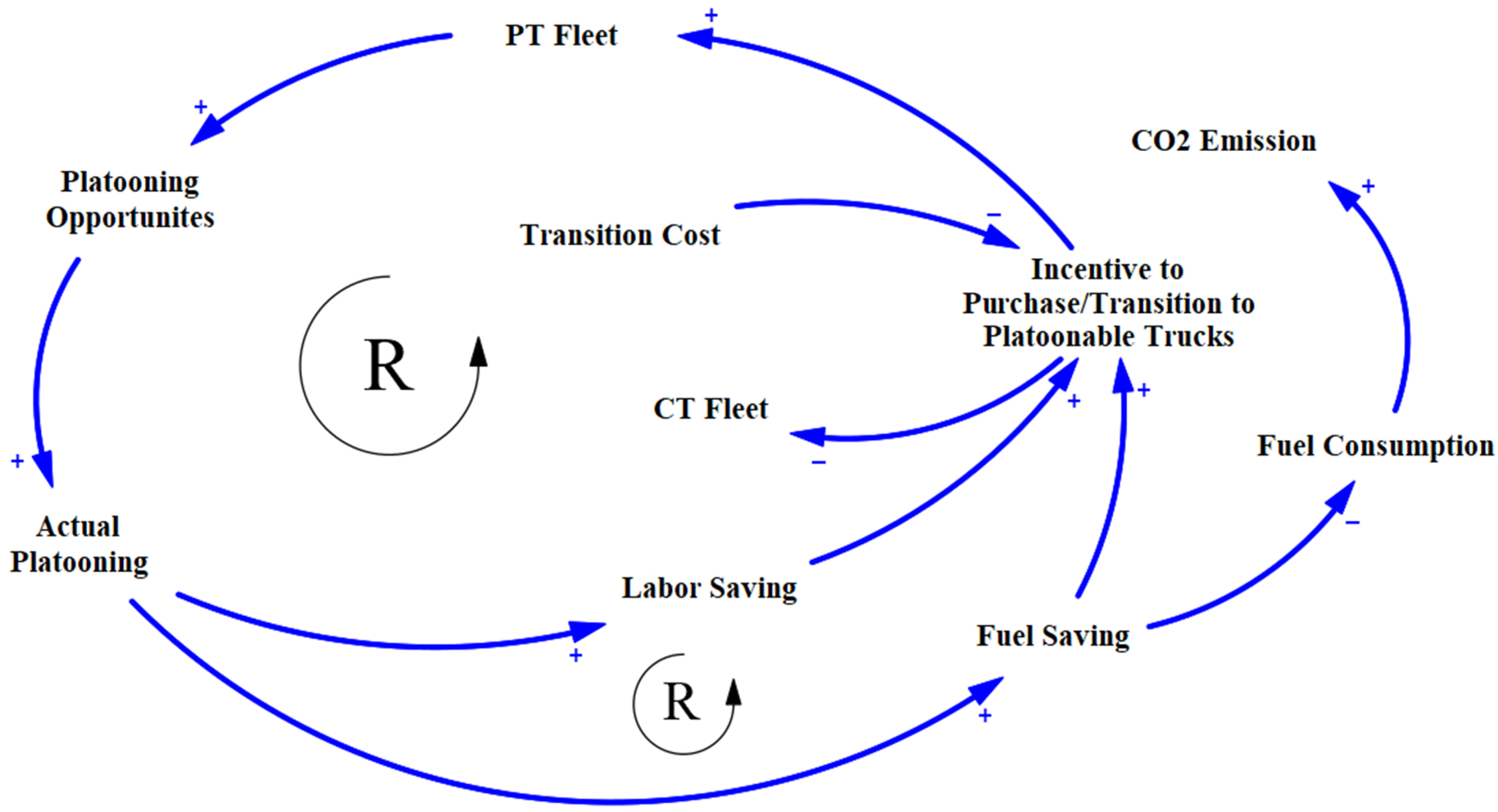
4.1. Casual Loop Diagram (CLD)
- PT Fleet ⇒ Platooning Opportunities ⇒ Actual Platooning ⇒ Labor Saving ⇒ Incentive to Purchase/Transition Platoonable Trucks ⇒ PT Fleet (positive feedback loop).
- PT Fleet ⇒ Platooning Opportunities ⇒ Actual Platooning ⇒ Fuel Saving ⇒ Incentive to Purchase/Transition Platoonable Trucks ⇒ PT Fleet (positive feedback loop).
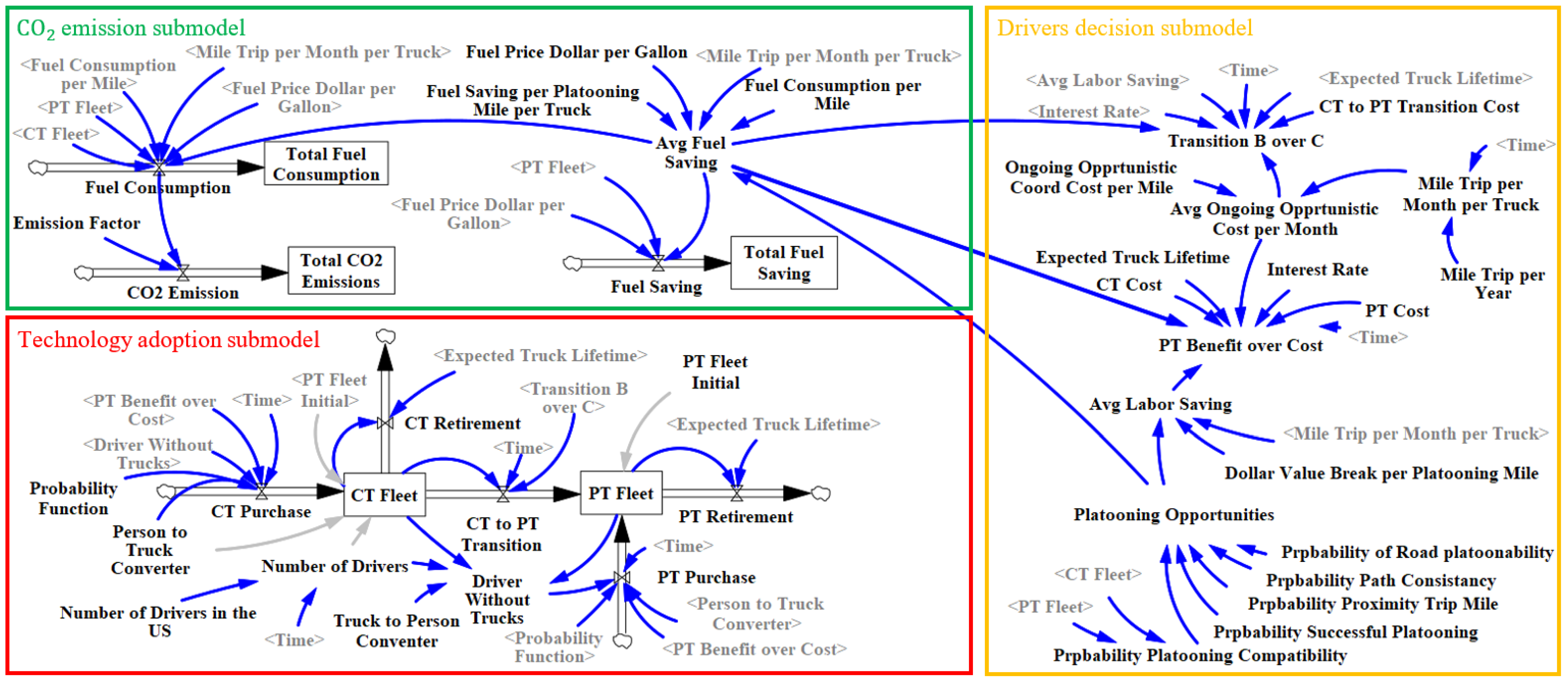
4.2. Stock and Flow Diagram (SFD)
4.2.1. Technology Adoption Submodel
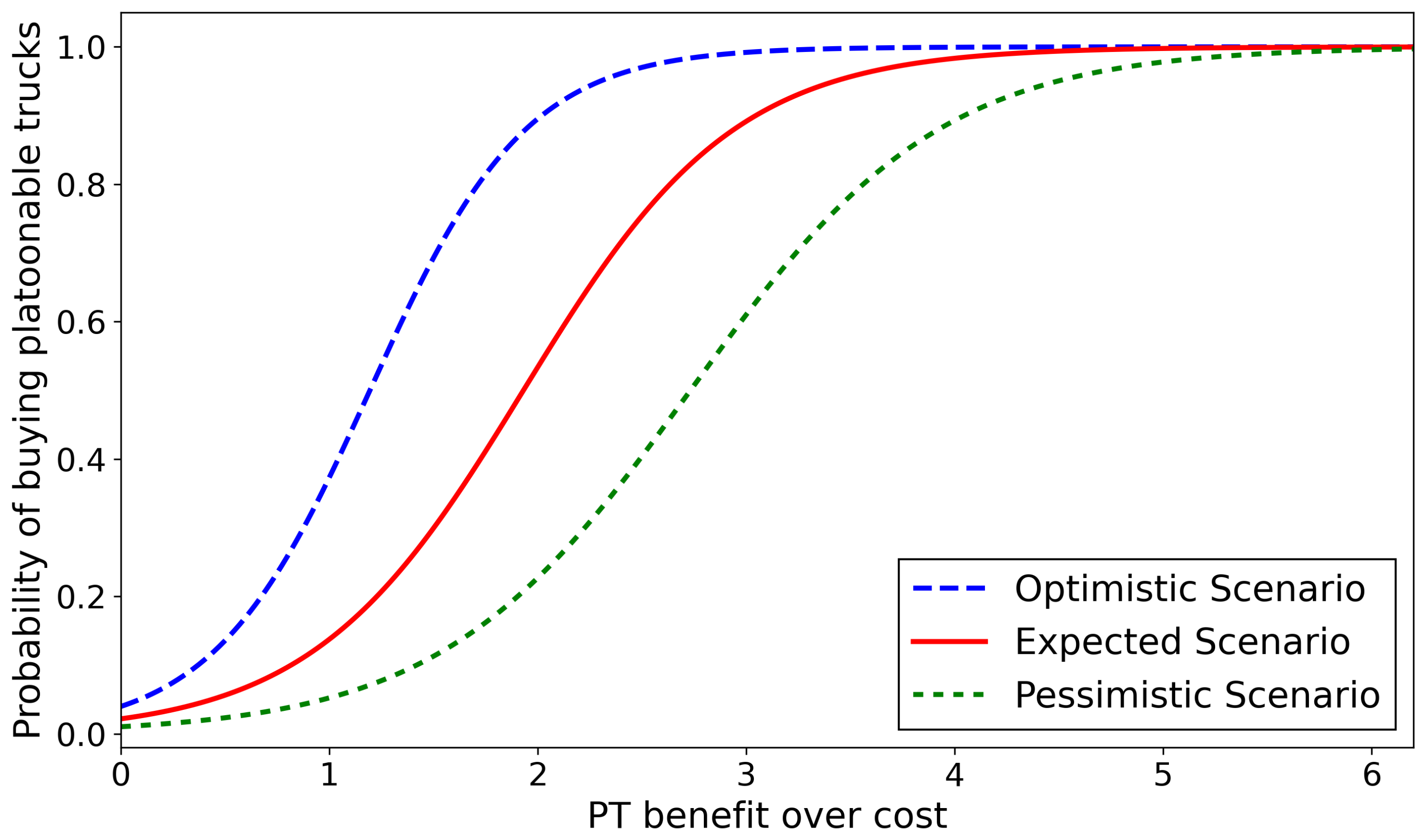
4.2.2. Driver Decision Submodel
4.2.3. CO2 Emission Submodel
4.3. Parameter Identification and Assumptions
5. Model Implementation and Results
Sensitivity Analysis
6. Conclusions
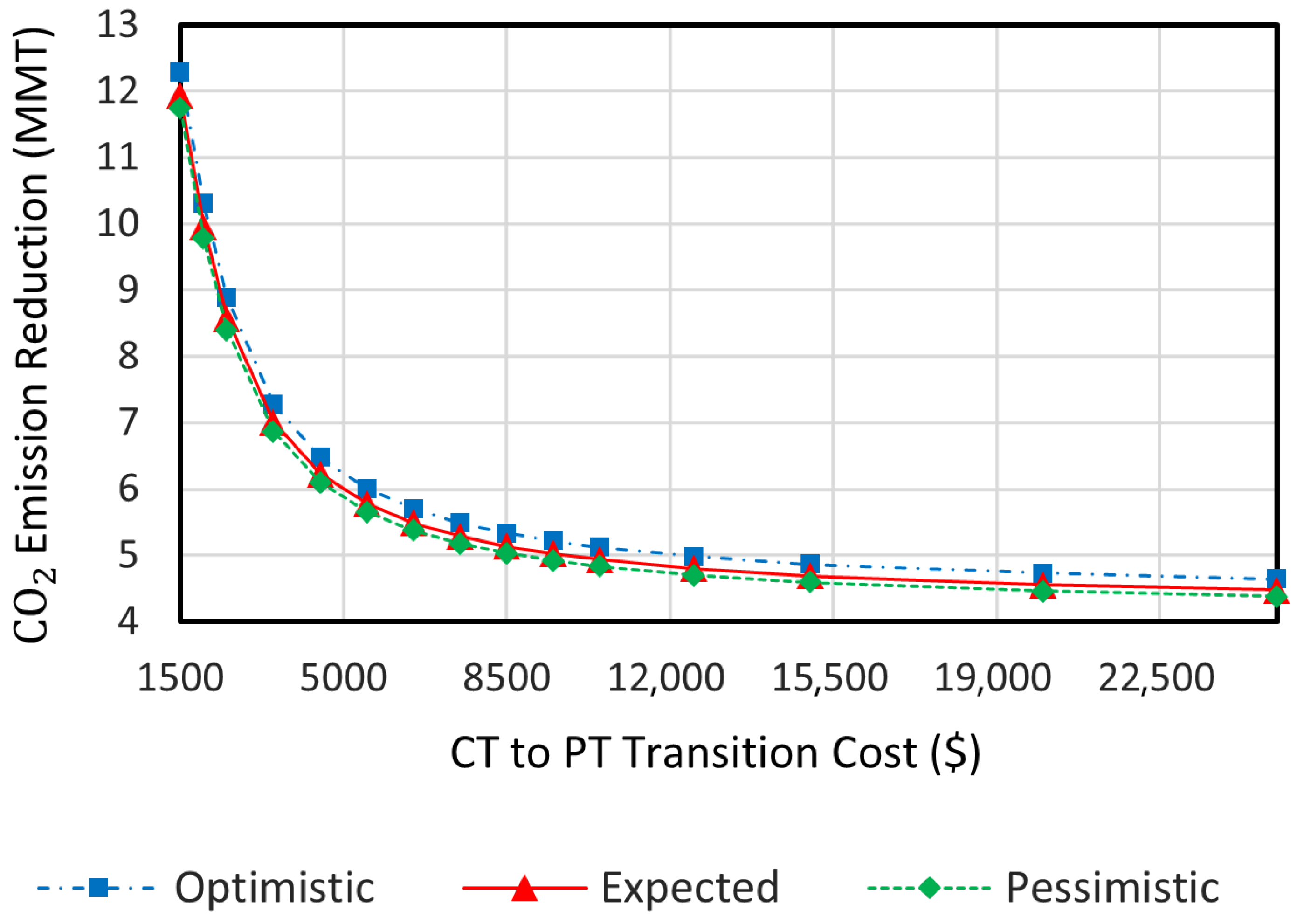
- Targeted subsidies for transition costs: The model demonstrates that CO2 emission reductions decrease rapidly as the cost to transition a conventional truck to a platoonable one increases from $1500 to $10,000. However, for costs exceeding $10,000, the decrease in emissions becomes more gradual. Policymakers should consider implementing financial incentives, such as tax credits or direct grants, designed specifically to reduce the effective out-of-pocket transition costs for fleet operators to below the $10,000 threshold.
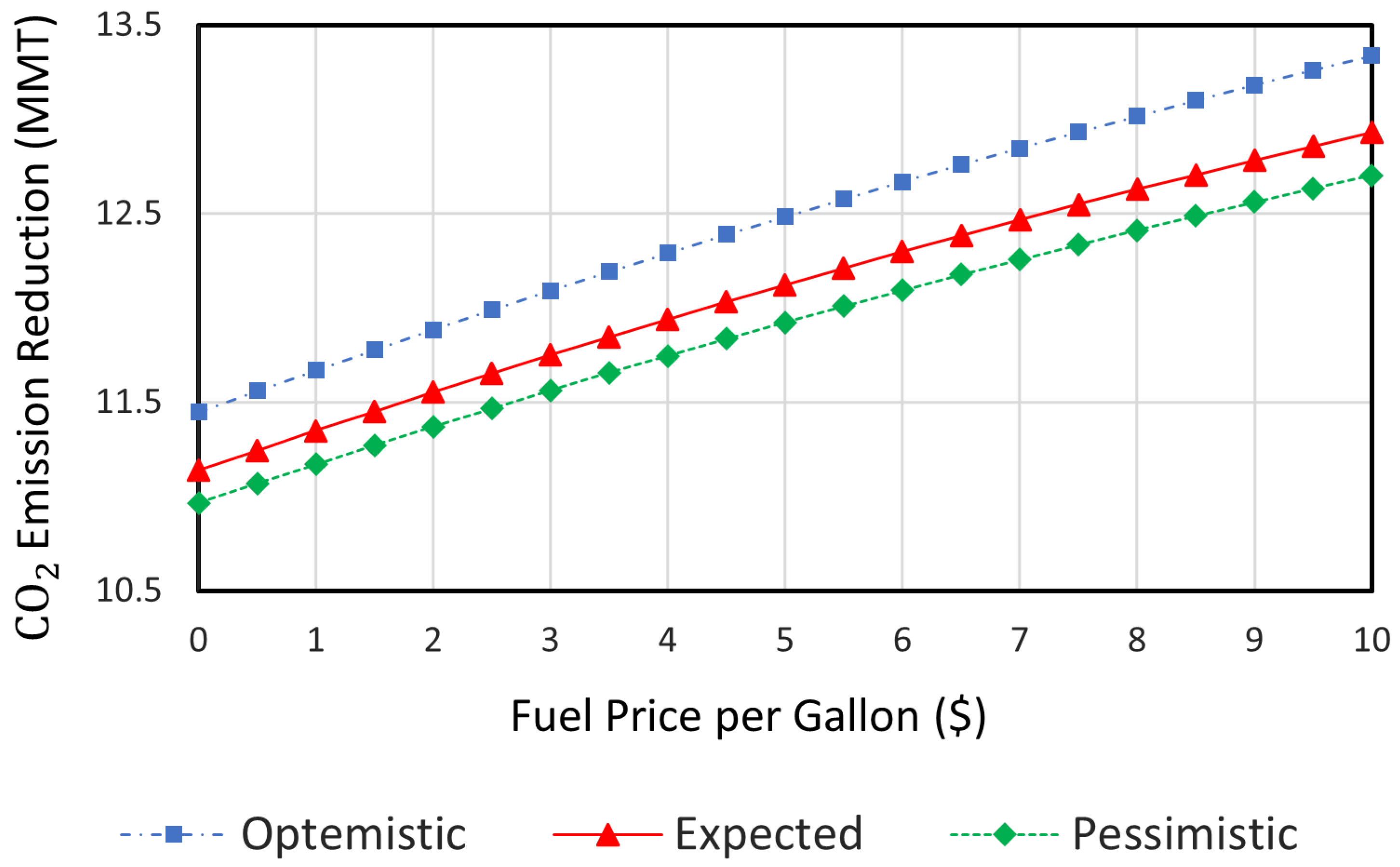
- Fuel pricing and carbon mechanisms: Sensitivity analysis reveals a strong positive correlation between fuel price and emission reduction within practical pricing bounds. Although this relationship is ultimately non-linear and will diminish as market penetration approaches saturation, raising effective fuel prices in the trucking industry can still significantly contribute to reducing CO2 emissions by encouraging the more rapid diffusion of truck platooning technology. Implementing carbon taxes or cap-and-trade systems could serve as a powerful indirect policy tool to accelerate this market penetration.
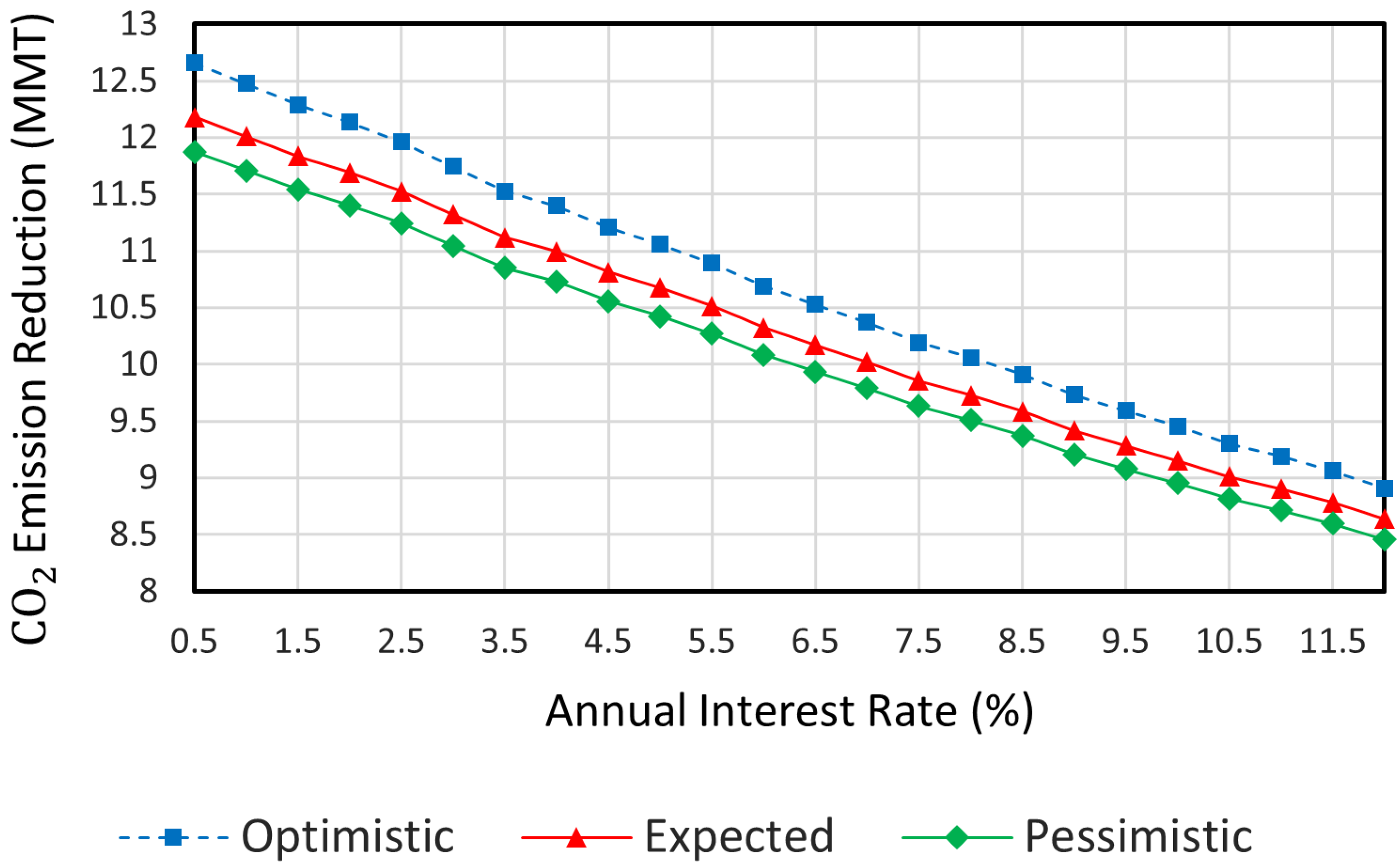
- Favorable financing structures: The model shows an almost linear pattern of decreasing CO2 emission reduction with an increasing annual interest rate in the economy. State or federal programs that provide low-interest loans for fleet modernization could enhance the benefit-over-cost ratio for prospective adopters, facilitating faster uptake of the technology.
Author Contributions
Funding
Institutional Review Board Statement
Informed Consent Statement
Data Availability Statement
Conflicts of Interest
References
- BTS. Moving Goods in the United States, Freight Facts and Figures, Freight Movement. 2022. Available online: https://data.bts.gov/stories/s/Moving-Goods-in-the-United-States/bcyt-rqmu/ (accessed on 22 March 2026).
- FAF. Moving Goods in the United States, Freight Facts and Figures, Weight of Shipments by Transportation Mode. Version 5.5. 2023. Available online: https://www.bts.gov/faf (accessed on 22 March 2026).
- Strocko, E.; Sprung, M.J.; Nguyen, L.X.; Rick, C.; Sedor, J. Freight Facts and Figures 2013; United States Federal Highway Administration: Washington, DC, USA, 2014.
- Dadsena, K.K.; Sarmah, S.P.; Naikan, V.N.A.; Mathiyazhagan, K.; Rodrigues, V.S. Performance measurement of road freight transportation: A case of trucking industry. Transp. Policy 2023, 137, 125–140. [Google Scholar] [CrossRef]
- Pathak, D.K.; Shankar, R.; Choudhary, A. Performance assessment framework based on competitive priorities for sustainable freight transportation systems. Transp. Res. Part D Transp. Environ. 2021, 90, 102663. [Google Scholar] [CrossRef]
- EPA. Inventory of U.S. Greenhouse Gas Emissions and Sinks. 2021. Available online: https://www.epa.gov/ghgemissions/inventory-us-greenhouse-gas-emissions-and-sinks-1990-2021 (accessed on 22 March 2026).
- UCS. Truck Electrification: Cutting Oil Consumption and Reducing Pollution. 2012, pp. 1–8. Available online: https://www.ucsusa.org/resources/truck-electrification (accessed on 22 March 2026).
- Nowakowski, C.; Shladover, S.E.; Lu, X.-Y.; Thompson, D.; Kailas, A. Cooperative Adaptive Cruise Control (CACC) for Truck Platooning: Operational Concept Alternatives; University of California: Berkeley, CA, USA, 2015. [Google Scholar]
- Yan, X.; Xu, M.; Sun, X. Electric truck routing and platooning problem considering vehicle charging and driver assignment on highway networks. Transp. Res. Part C Emerg. Technol. 2025, 173, 105072. [Google Scholar] [CrossRef]
- Bergenhem, C.; Shladover, S.; Coelingh, E.; Englund, C.; Tsugawa, S. Overview of platooning systems. In Proceedings of the 19th ITS World Congress, Vienna, Austria, 22–26 October 2012. [Google Scholar]
- Liang, K.-Y.; Mårtensson, J.; Johansson, K.H. Heavy-duty vehicle platoon formation for fuel efficiency. IEEE Trans. Intell. Transp. Syst. 2015, 17, 1051–1061. [Google Scholar] [CrossRef]
- McAuliffe, B.; Croken, M.; Ahmadi-Baloutaki, M.; Raeesi, A. Fuel-Economy Testing of a Three-Vehicle Truck Platooning System; University of California: Berkeley, CA, USA, 2017. [Google Scholar]
- Bai, J.; Chang, X.; Trivedi, K.S.; Han, Z. Resilience-driven quantitative analysis of vehicle platooning service. IEEE Trans. Veh. Technol. 2021, 70, 5378–5389. [Google Scholar] [CrossRef]
- Paddeu, D.; Denby, J. Decarbonising road freight: Is truck automation and platooning an opportunity? Clean Technol. Environ. Policy 2021, 24, 1021–1035. [Google Scholar] [CrossRef]
- He, X.; Wu, X. Eco-driving advisory strategies for a platoon of mixed gasoline and electric vehicles in a connected vehicle system. Transp. Res. Part D Transp. Environ. 2018, 63, 907–922. [Google Scholar]
- Larsen, R.; Rich, J.; Rasmussen, T.K. Hub-based truck platooning: Potentials and profitability. Transp. Res. Part E Logist. Transp. Rev. 2019, 127, 249–264. [Google Scholar]
- Paddeu, D.; Calvert, T.; Clark, B.; Parkhurst, G. New Technology and Automation in Freight Transport and Handling Systems; University of the West of England: Bristol, UK, 2019. Available online: https://assets.publishing.service.gov.uk/government/uploads/system/uploads/attachment_data/file/781295/automation_in_freight.pdf (accessed on 22 March 2026).
- Bakermans, B.A. Truck Platooning: Enablers, Barriers, Potential and Impacts. Master’s Thesis, Delft University of Technology, Delft, The Netherlands, 2016. [Google Scholar]
- Bayer, S. Business dynamics: Systems thinking and modeling for a complex world. Interfaces 2004, 34, 324–327. [Google Scholar]
- Davies, J.; Grant, M.; Venezia, J.; Aamidor, J. Greenhouse gas emissions of the US transportation sector: Trends, uncertainties, and methodological improvements. Transp. Res. Rec. 2007, 2017, 41–46. [Google Scholar]
- Trappey, A.J.C.; Trappey, C.V.; Hsiao, C.-H.; Ou, J.J.R.; Chang, C.-T. System dynamics modelling of product carbon footprint life cycles for collaborative green supply chains. Int. J. Comput. Integr. Manuf. 2012, 25, 934–945. [Google Scholar] [CrossRef]
- Kim, K. A Transportation Planning Model for State Highway Management: A Decision Support System Methodology to Achieve Sustainable Development. Ph.D. Thesis, Virginia Polytechnic Institute and State University, Blacksburg, VA, USA, 1998. [Google Scholar]
- Wang, J.; Lu, H.; Peng, H. System dynamics model of urban transportation system and its application. J. Transp. Syst. Eng. Inf. Technol. 2008, 8, 83–89. [Google Scholar] [CrossRef]
- Fong, W.-K.; Matsumoto, H.; Lun, Y.-F. Application of System Dynamics model as decision making tool in urban planning process toward stabilizing carbon dioxide emissions from cities. Build. Environ. 2009, 44, 1528–1537. [Google Scholar] [CrossRef]
- Barisa, A.; Rosa, M. A system dynamics model for CO2 emission mitigation policy design in road transport sector. Energy Procedia 2018, 147, 419–427. [Google Scholar] [CrossRef]
- Esfandabadi, Z.S.; Ravina, M.; Diana, M.; Zanetti, M.C. Conceptualizing environmental effects of carsharing services: A system thinking approach. Sci. Total Environ. 2020, 745, 141169. [Google Scholar]
- Wen, L.; Wang, A. System dynamics model of Beijing urban public transport carbon emissions based on carbon neutrality target. Environ. Dev. Sustain. 2022, 25, 12681–12706. [Google Scholar] [CrossRef]
- Tsugawa, S.; Jeschke, S.; Shladover, S.E. A review of truck platooning projects for energy savings. IEEE Trans. Intell. Veh. 2016, 1, 68–77. [Google Scholar] [CrossRef]
- Chan, E. SARTRE automated platooning vehicles. Towards Innov. Freight Logist. 2016, 2, 137–150. [Google Scholar]
- Ellis, M.; Gargoloff, J.I.; Sengupta, R. Aerodynamic drag and engine cooling effects on class 8 trucks in platooning configurations. SAE Int. J. Commer. Veh. 2015, 8, 732–739. [Google Scholar] [CrossRef]
- Gheyssens, T.; Van Raemdonck, G. Effect of the frontal edge radius in a platoon of bluff bodies. SAE Int. J. Commer. Veh. 2016, 9, 371–380. [Google Scholar] [CrossRef]
- Humphreys, H.; Bevly, D. Computational Fluid Dynamic Analysis of a Generic 2 Truck Platoon; SAE Technical Paper; SAE International: Warrendale, PA, USA, 2016. [Google Scholar]
- Kaluva, S.T.; Pathak, A.; Ongel, A. Aerodynamic drag analysis of autonomous electric vehicle platoons. Energies 2020, 13, 4028. [Google Scholar] [CrossRef]
- Gnatowska, R.; Sosnowski, M. The influence of distance between vehicles in platoon on aerodynamic parameters. EPJ Web Conf. 2018, 180, 02030. [Google Scholar] [CrossRef]
- Marcu, B.; Browand, F. Aerodynamic Forces Experienced by a 3-Vehicle Platoon in a Crosswind; SAE Technical Paper; SAE International: Warrendale, PA, USA, 1999. [Google Scholar]
- Hammache, M.; Michaelian, M.; Browand, F. Aerodynamic Forces on Truck Models, Including Two Trucks in Tandem; SAE Technical Paper; SAE International: Warrendale, PA, USA, 2002. [Google Scholar]
- Ebrahim, H.; Dominy, R. Wake and surface pressure analysis of vehicles in platoon. J. Wind Eng. Ind. Aerodyn. 2020, 201, 104144. [Google Scholar] [CrossRef]
- Hong, P.; Marcu, B.; Browand, F.; Tucker, A. Drag Forces Experienced by Two, Full-Scale Vehicles at Close Spacing; University of California: Berkeley, CA, USA, 1998. [Google Scholar]
- Combes, F. A micro-economic model of the market uptake of truck platooning. Transp. Res. Part E Logist. Transp. Rev. 2023, 178, 103269. [Google Scholar]
- Choobchian, P.; Zou, B.; Spearing, L. Truck platooning technology diffusion: System dynamics with matching platform consideration. Transp. Res. Interdiscip. Perspect. 2024, 28, 101277. [Google Scholar] [CrossRef]
- Maier, M.W. Architecting principles for systems-of-systems. Syst. Eng. 1998, 1, 267–284. [Google Scholar] [CrossRef]
- Boardman, J.; Sauser, B. System of systems—The meaning of of. In 2006 IEEE/SMC International Conference on System of Systems Engineering; IEEE: Piscataway, NJ, USA, 2006. [Google Scholar]
- Kim, E.; Kim, Y.; Park, J. The necessity of introducing autonomous trucks in logistics 4.0. Sustainability 2022, 14, 3978. [Google Scholar] [CrossRef]
- Tam, K.; Hopcraft, R.; Crichton, T.; Jones, K. The potential mental health effects of remote control in an autonomous maritime world. J. Int. Marit. Saf. Environ. Aff. Shipp. 2021, 5, 40–55. [Google Scholar] [CrossRef]
- Gittleman, M.; Monaco, K. Truck-driving jobs: Are they headed for rapid elimination? ILR Rev. 2020, 73, 3–24. [Google Scholar] [CrossRef]
- Janssen, G.R.; Zwijnenberg, J.; Blankers, I.J.; de Kruijff, J.S. Truck Platooning: Driving the Future of Transportation; ATA Technology and Maintenance Council (TMC): Washington, DC, USA, 2015. [Google Scholar]
- Forrester, J.W. Urban dynamics. Ind. Manag. Rev. 1970, 11, 67. [Google Scholar] [CrossRef]
- Al-Qadi, I.L.; Okte, E.; Ramakrishnan, A.; Zhou, Q.; Sayeh, W. Truck Platooning on Flexible Pavements in Illinois; Illinois Center for Transportation: Rantoul, IL, USA, 2021. [Google Scholar]
- Saeed, K. Defining a Problem or Constructing a Reference Mode; Department of Social Science and Policy Studies, Worcester Polytechnic Institute: Worcester, MA, USA, 1998. [Google Scholar]
- Egilmez, G.; Tatari, O. A dynamic modeling approach to highway sustainability: Strategies to reduce overall impact. Transp. Res. Part A Policy Pract. 2012, 46, 1086–1096. [Google Scholar]
- Meadows, D.H. Thinking in Systems: A Primer; Chelsea Green Publishing: White River Junction, VT, USA, 2008. [Google Scholar]
- Newnan, D.G.; Eschenbach, T.G.; Lavelle, J.P. Engineering Economic Analysis; Oxford University Press: Oxford, UK, 2004. [Google Scholar]
- Alam, A.; Mårtensson, J.; Johansson, K.H. Look-ahead cruise control for heavy duty vehicle platooning. In 16th International IEEE Conference on Intelligent Transportation Systems (ITSC 2013); IEEE: Piscataway, NJ, USA, 2013; pp. 928–935. [Google Scholar]
- Tsugawa, S.; Kato, S.; Aoki, K. An automated truck platoon for energy saving. In 2011 IEEE/RSJ International Conference on Intelligent Robots and Systems; IEEE: Piscataway, NJ, USA, 2011; pp. 4109–4114. [Google Scholar]
- Bishop, R.; Bevly, D.; Switkes, J.; Park, L. Results of initial test and evaluation of a driver-assistive truck platooning prototype. In 2014 IEEE Intelligent Vehicles Symposium Proceedings; IEEE: Piscataway, NJ, USA, 2014; pp. 208–213. [Google Scholar]
- EIA. Carbon Dioxide Emissions Coefficients. 2016. Available online: https://www.eia.gov/environment/emissions/co2_vol_mass.php (accessed on 22 March 2026).
- Marzano, V.; Tinessa, F.; Fiori, C.; Tocchi, D.; Papola, A.; Aponte, D.; Cascetta, E.; Simonelli, F. Impacts of truck platooning on the multimodal freight transport market: An exploratory assessment on a case study in Italy. Transp. Res. Part A Policy Pract. 2022, 163, 100–125. [Google Scholar] [CrossRef]
- Yan, X.; Xu, M.; Xie, C. Local container drayage problem with improved truck platooning operations. Transp. Res. Part E Logist. Transp. Rev. 2023, 169, 102992. [Google Scholar] [CrossRef]
- Volvo. Volvo Trucks and FedEx demonstrate Truck Platooning. 2018. Available online: https://www.volvogroup.com/en/news-and-media/news/2018/jun/news-2971141.html (accessed on 22 March 2026).
- Scania. Automated Platooning—Step by Step. 2018. Available online: https://www.scania.com/group/en/home/newsroom/news/2018/automated-platooning-step-by-step.html (accessed on 22 March 2026).
- Adler, A. Daimler Truck Boosts Electric Truck Range with New Battery Chemistry. FreightWaves, 19 September 2022. Available online: https://www.freightwaves.com/news/daimler-truck-boosts-electric-truck-range-with-new-battery-chemistry (accessed on 22 March 2026).
- BTS. U.S. Vehicle-Miles. 2020. Available online: https://www.bts.gov/content/us-vehicle-miles (accessed on 22 March 2026).
- BTS. Number of U.S. Aircraft, Vehicles, Vessels, and Other Conveyances. 2020. Available online: https://www.bts.gov/content/number-us-aircraft-vehicles-vessels-and-other-conveyances (accessed on 22 March 2026).
- FRB. Interest Rate in the United States. Board of Governors of the Federal Reserve System, 2023. Available online: https://www.federalreserve.gov/releases/h15/ (accessed on 22 March 2026).
- AAA. $4 GAS: The Tipping Point for Most Americans. 2023. Available online: https://gasprices.aaa.com/aaa-4-gas-the-tipping-point-for-most-americans/ (accessed on 22 March 2026).
- Muratori, M.; Holden, J.; Lammert, M.; Duran, A.; Young, S.; Gonder, J. Potentials for Platooning in US Highway Freight Transport; National Renewable Energy Laboratory (NREL): Golden, CO, USA, 2017. [Google Scholar]
- DOE. Average Fuel Economy by Major Vehicle Category. 2023. Available online: https://afdc.energy.gov/data/10310 (accessed on 22 March 2026).
- Conrad, J.L., IV. Costs and challenges of log truck transportation in Georgia, USA. Forests 2018, 9, 650. [Google Scholar] [CrossRef]
- DOT. Freight Performance Measurement: Travel Time in Freight-Significant Corridors. U.S. Department of Transportation; Federal Highway Administration, 2006. Available online: https://ops.fhwa.dot.gov/freight/freight_analysis/perform_meas/fpmtraveltime/traveltimebrochure.pdf (accessed on 22 March 2026).
- U.S. Environmental Protection Agency. Control of Air Pollution from New Motor Vehicles: Heavy-Duty Engine and Vehicle Standards; Final Rule. 88 FR 4296, January 24, 2023. Available online: https://www.epa.gov/system/files/documents/2023-01/new-motor-veh-air-poll-control-hd-eng-veh-stnd-frm-2022-12-20.pdf (accessed on 22 March 2026).
- Durabak. How Much Does a Semi-Truck Cost? Durabak, 5 September 2021. Available online: https://www.durabakcompany.com/blogs/durabak/how-much-does-a-semi-truck-cost (accessed on 13 September 2023).
- Nelson, B.K. Time series analysis using autoregressive integrated moving average (ARIMA) models. Acad. Emerg. Med. 1998, 5, 739–744. [Google Scholar] [CrossRef]
- Box, G.E.P.; Jenkins, G.M.; Reinsel, G.C.; Ljung, G.M. Time Series Analysis: Forecasting and Control; John Wiley & Sons: Hoboken, NJ, USA, 2015. [Google Scholar]
- Hosseinpanahi, D.; Zadtootaghaj, P.; Lin, J.; Mohammadian, A.; Zou, B. Machine Learning Models for Bike-Sharing Demand Forecasting. Future Transp. 2026, 6, 26. [Google Scholar]
- Quan, M. The Logit Function: A Tool for New Things. Itron, 19 August 2020. Available online: https://www.itron.com/na/blog/forecasting/the-logit-function-a-tool-for-new-things (accessed on 22 March 2026).
- FHWA. Greenhouse Gas Equivalencies Calculator. 2021. Available online: https://www.fhwa.dot.gov/policyinformation/statistics/2020/vm1.cfm (accessed on 22 March 2026).
- Federal Register. Light-Duty Vehicle Greenhouse Gas Emission Standards and Corporate Average Fuel Economy Standards. 2010. Available online: https://www.govinfo.gov/content/pkg/FR-2010-05-07/pdf/2010-8159.pdf (accessed on 22 March 2026).
- EIA. Annual Energy Outlook 2020. 2020. Available online: https://www.eia.gov/outlooks/aeo/excel/aeotab_4.xlsx (accessed on 22 March 2026).
- EPA. U.S. Annual National Emission Factor, Year 2019 Data (eGRID). 2021. Available online: https://www.epa.gov/egrid (accessed on 22 March 2026).
- EIA. Approximate Heat Content of Natural Gas for End-Use Sector Consumption. Monthly Energy Review, December 2022. 2022. Available online: https://www.eia.gov/totalenergy/data/monthly/pdf/sec12_5.pdf (accessed on 22 March 2026).
- EPA. Inventory of U.S. Greenhouse Gas Emissions and Sinks: 1990–2020. Annex 2 (Methodology for Estimating CO2 Emissions from Fossil Fuel Combustion), Table A-41. 2022. Available online: https://www.epa.gov/system/files/documents/2022-04/us-ghg-inventory-2022-annexes.pdf (accessed on 22 March 2026).
- McAuliffe, B.; Lammert, M.; Lu, X.-Y.; Shladover, S.; Surcel, M.-D.; Kailas, A. Influences on Energy Savings of Heavy Trucks Using Cooperative Adaptive Cruise Control; SAE Technical Paper; SAE International: Warrendale, PA, USA, 2018. [Google Scholar]




| Variable Name | Type | Unit | Definition |
|---|---|---|---|
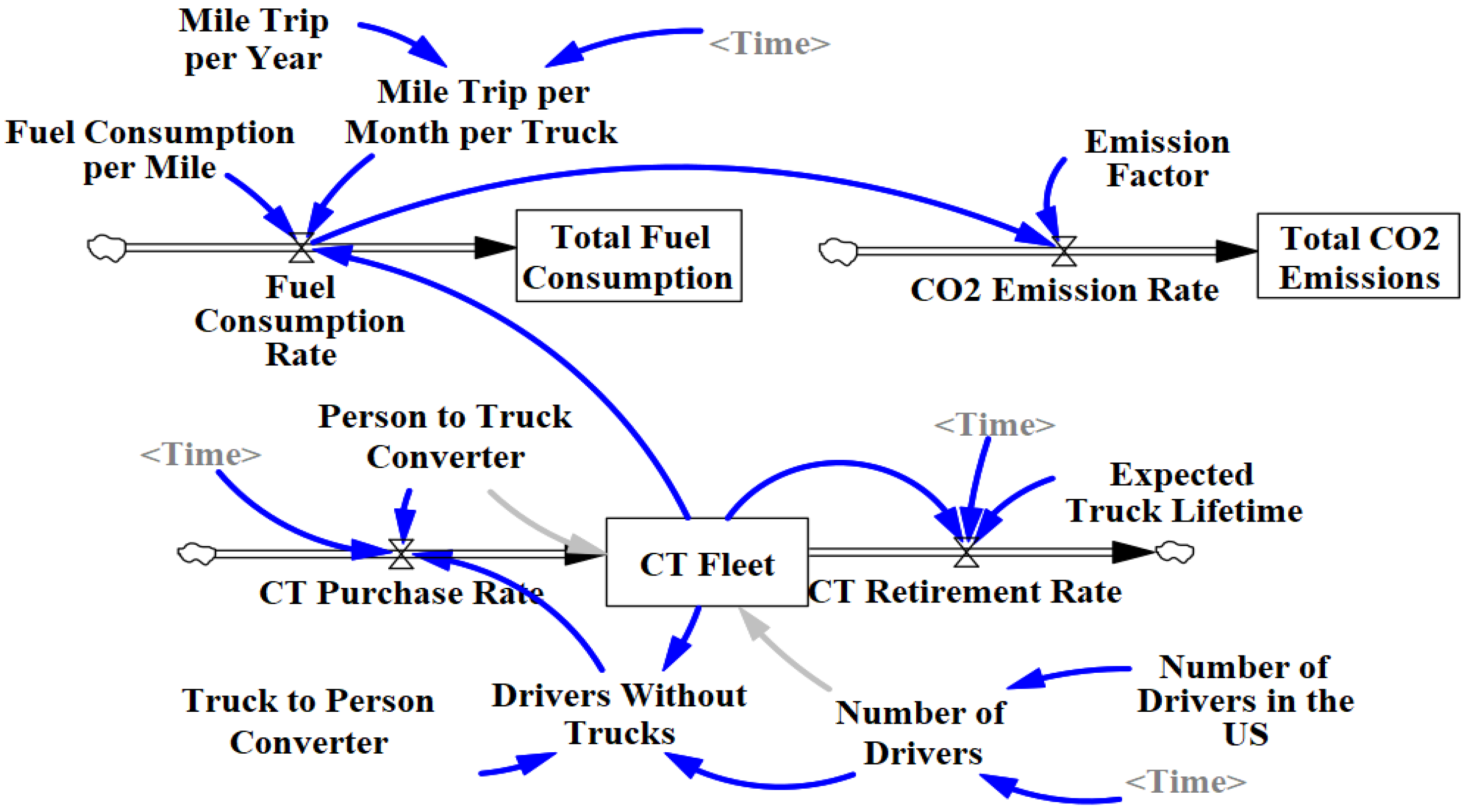
| CT Fleet | level | vehicle | CT Fleet Initial + (CT Purchase − CT Retirement) |
| Number of Drivers | auxiliary | person | Number of Drivers in the US (Time) |
| CT Purchase | auxiliary | vehicle per month | Drivers Without Trucks × Person to Truck Converter |
| Drivers Without Truck | auxiliary | person | Number of Drivers − CT Fleet × Truck to Person Converter |
| CT Retirement | rate | vehicle per month | CT Fleet/Expected Truck Lifetime |
| Fuel Consumption | rate | gallon per month | CT Fleet × Fuel Consumption per Mile × Mile Trip per Month per Truck |
| Total Fuel Consumption | level | gallon | (Fuel Consumption) |
| CO2 Emission | rate | kilograms of CO2 per month | Total Fuel Consumption × Emission Factor |
| Total CO2 Emissions | level | kilograms | (CO2 Emission) |
| Submodel | Variable Name | Type | Unit | Definition |
|---|---|---|---|---|
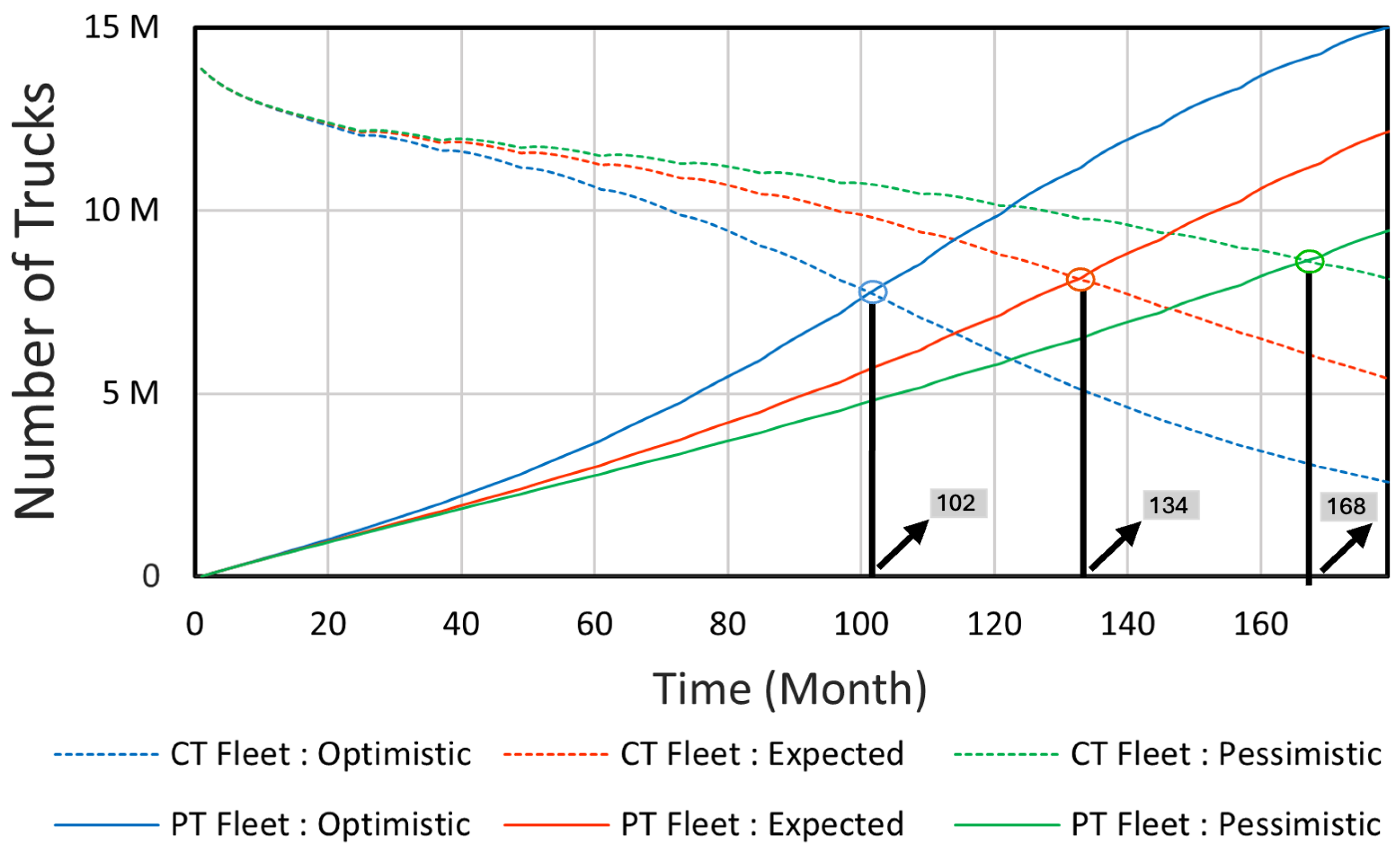
| Technology adoption | CT Fleet | level | vehicle | CT Fleet Initial + (CT Purchase Rate(t) − CT Retirement Rate(t) − CT Transition to PT(t)) |
| CT Flee Initial | auxiliary | vehicle | Number of Drivers × Person to Truck Converter − PT Fleet Initial | |
| CT Purchase | rate | vehicle per month | Drivers without Truck × Person to Truck Converter × (1 – Probability Function(B over C)) | |
| Drivers Without Truck | auxiliary | person | Person Converter − PT Fleet × Truck to Person Converter | |
| CT Retirement | rate | vehicle per month | CT Fleet/Expected Truck Lifetime | |
| CT to PT Transition | rate | vehicle per month | ||
| PT Fleet | level | vehicle | PT Fleet Initial + (PT Purchase(t) + CT Transition to PT Cost(t) − PT Retirement(t)) | |
| PT Purchase | rate | vehicle per month | Drivers Without Truck × Person to Truck Convector× (Probability Function(B over C)) | |
| PT Retirement | rate | vehicle per month | PT Fleet/Expected Truck Lifetime | |
| CO2 emission | Fuel Saving | rate | gallon per truck per month | Avg Fuel Saving × PT Fleet/Fuel Price Dollar per Gallon |
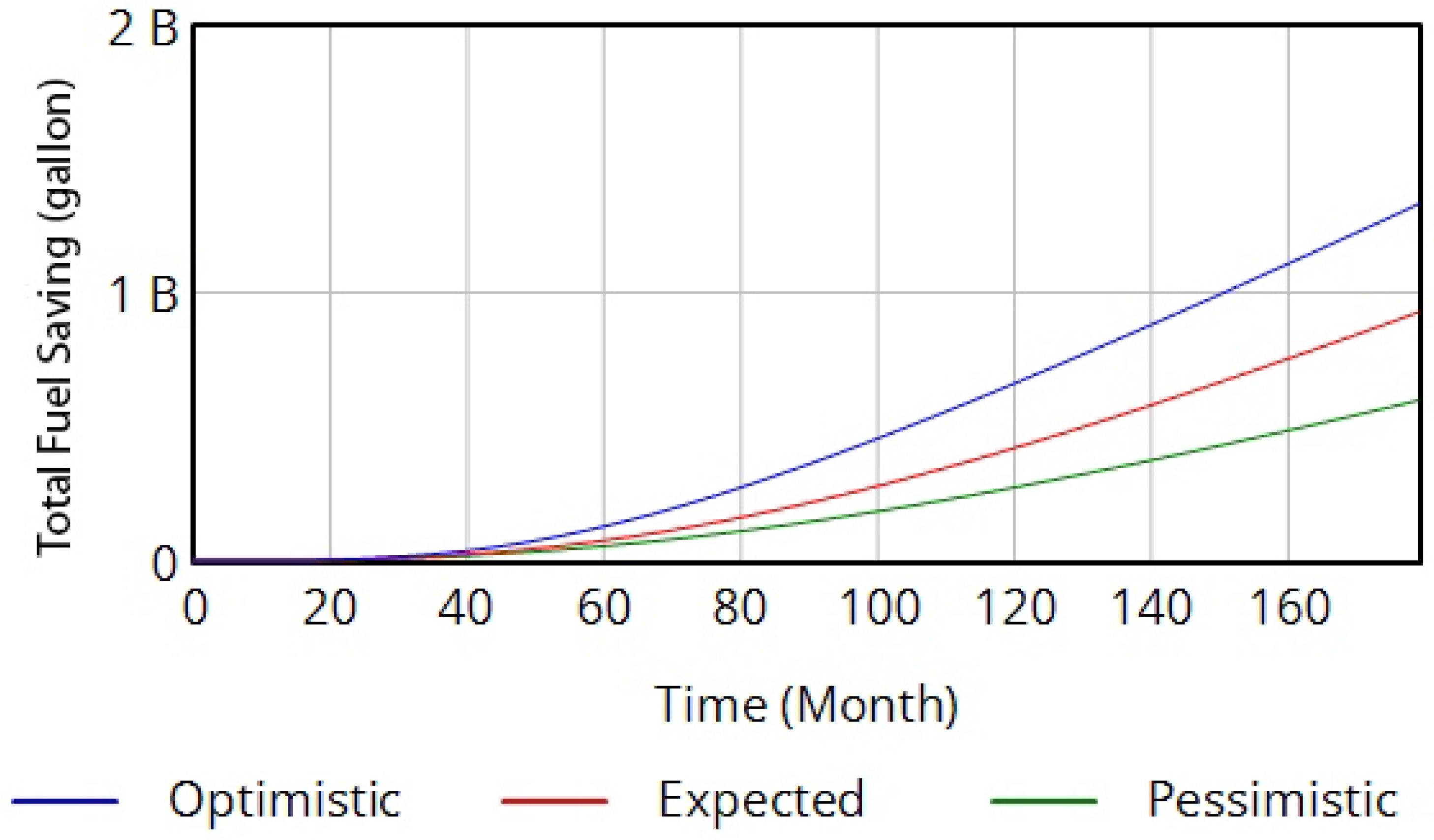
| Total Fuel Saving | level | gallon | (Fuel Saving Rate(t)) | |
| Fuel Consumption | rate | gallon per month | CT Fleet × Fuel Consumption per Mile × Mile Trip per Month per Truck + (Fuel Consumption per Mile) × Mile Trip per Month per Truck × (PT Fleet) − (Avg Fuel Saving × PT Fleet/Fuel Price Dollar per Gallon) | |
| Total Fuel Consumption | level | gallon | (Fuel Consumption Rate(t)) | |
| CO2 Emission Rate | rate | kilograms of CO2 released per month | Fuel Consumption Rate × Emission Factor | |
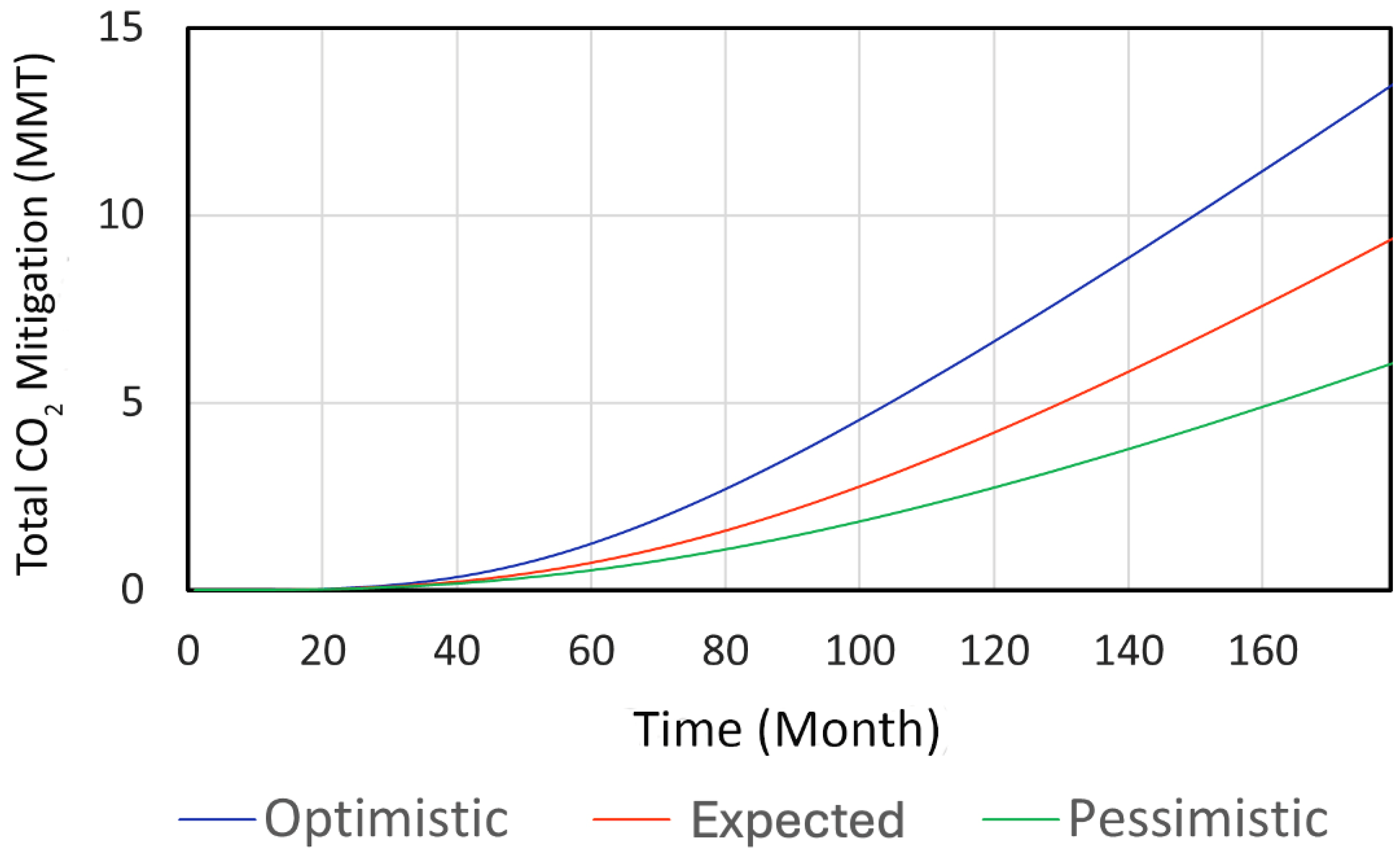
| Total CO2 Emissions | level | kilograms | (CO2 Emission Rate(t)) | |
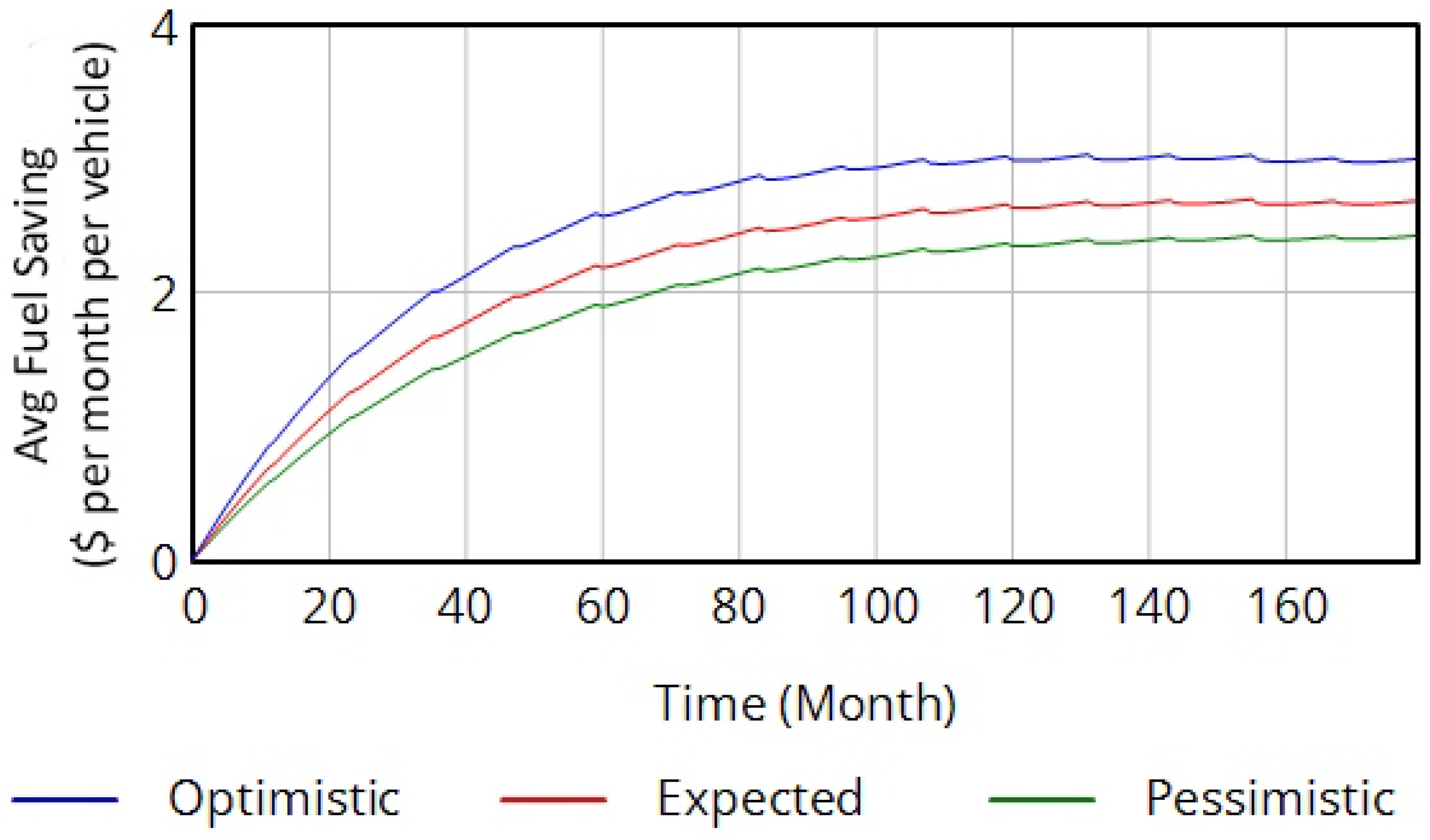
| Drivers Decision | Avg Fuel Saving | auxiliary | dollar per truck per month | Fuel Price Dollar per Gallon × Fuel Consumption per Mile × Mile Trip per Month per Truck × Fuel Saving per Platooning Mile per Truck × Platooning Opportunities |
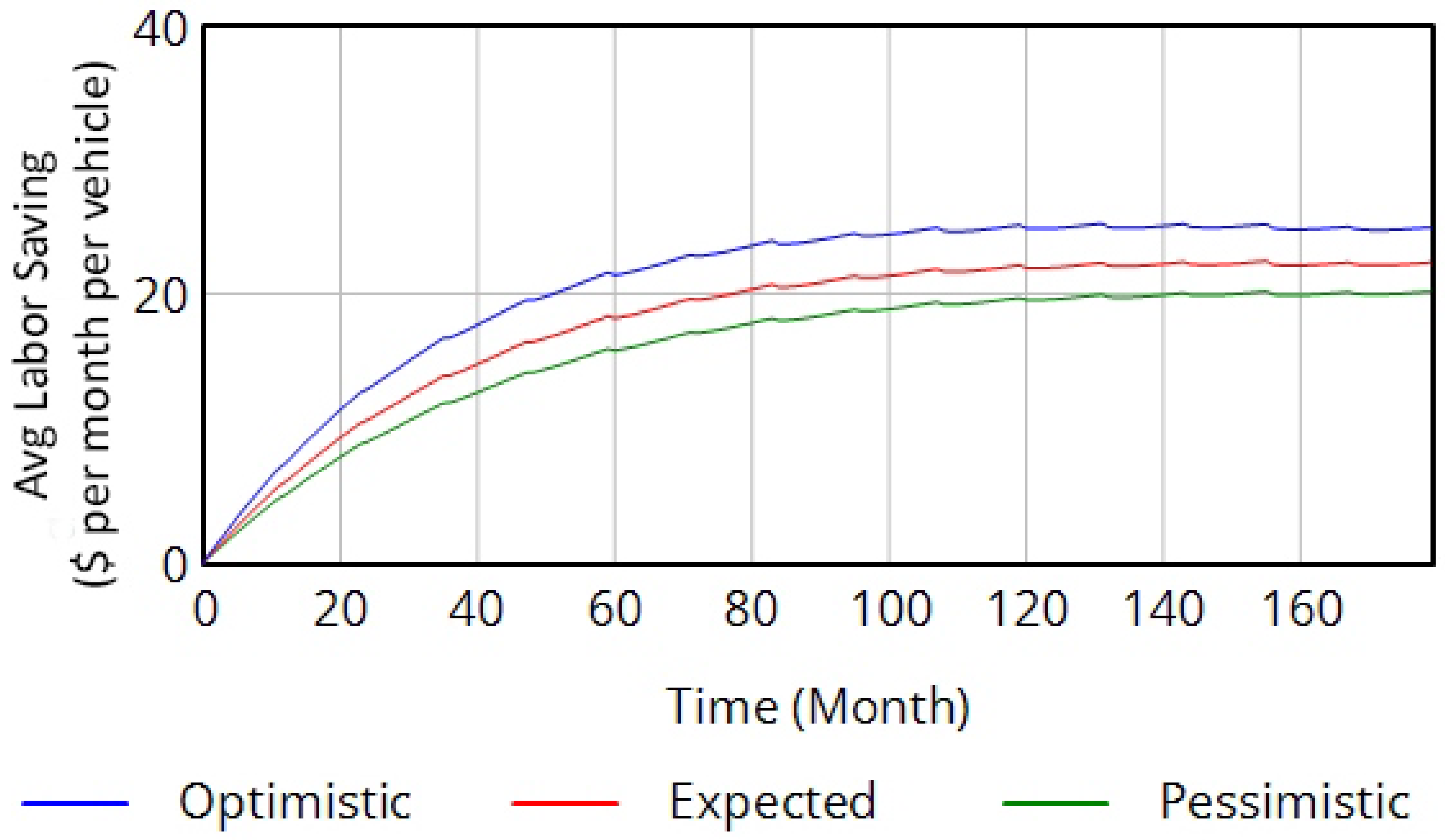
| Avg Labor Saving | auxiliary | dollar per truck per month | Mile Trip per Month per Truck × Dollar Value Break per Platooning Mile × Platooning Opportunities | |
| PT B over C | auxiliary | gallon per truck per month | (Avg Fuel Saving + Avg Labor Saving − Avg Ongoing Opportunistic Cost per Month) × (−1 + pow(1 + Interest Rate, Expected Truck Lifetime))/Interest Rate × pow(1 + Interest Rate, Expected Truck Lifetime)/(PT Cost − CT Cost) | |
| Platooning Opportunities | auxiliary | - | Probability of Proximity Trip Mile × Probability Path Consistency × Probability Successful Platooning × Probability Platooning Compatibility × Proportion of Road platoonability | |
| Probability Platooning Compatibility | auxiliary | - | PT Fleet/(PT Fleet + CT Fleet) | |
| Avg Ongoing Opportunistic Cost per Month | auxiliary | dollar per month per vehicle | Ongoing Opportunistic Coordination Cost per Mile × Mile Trip per Month per Truck | |
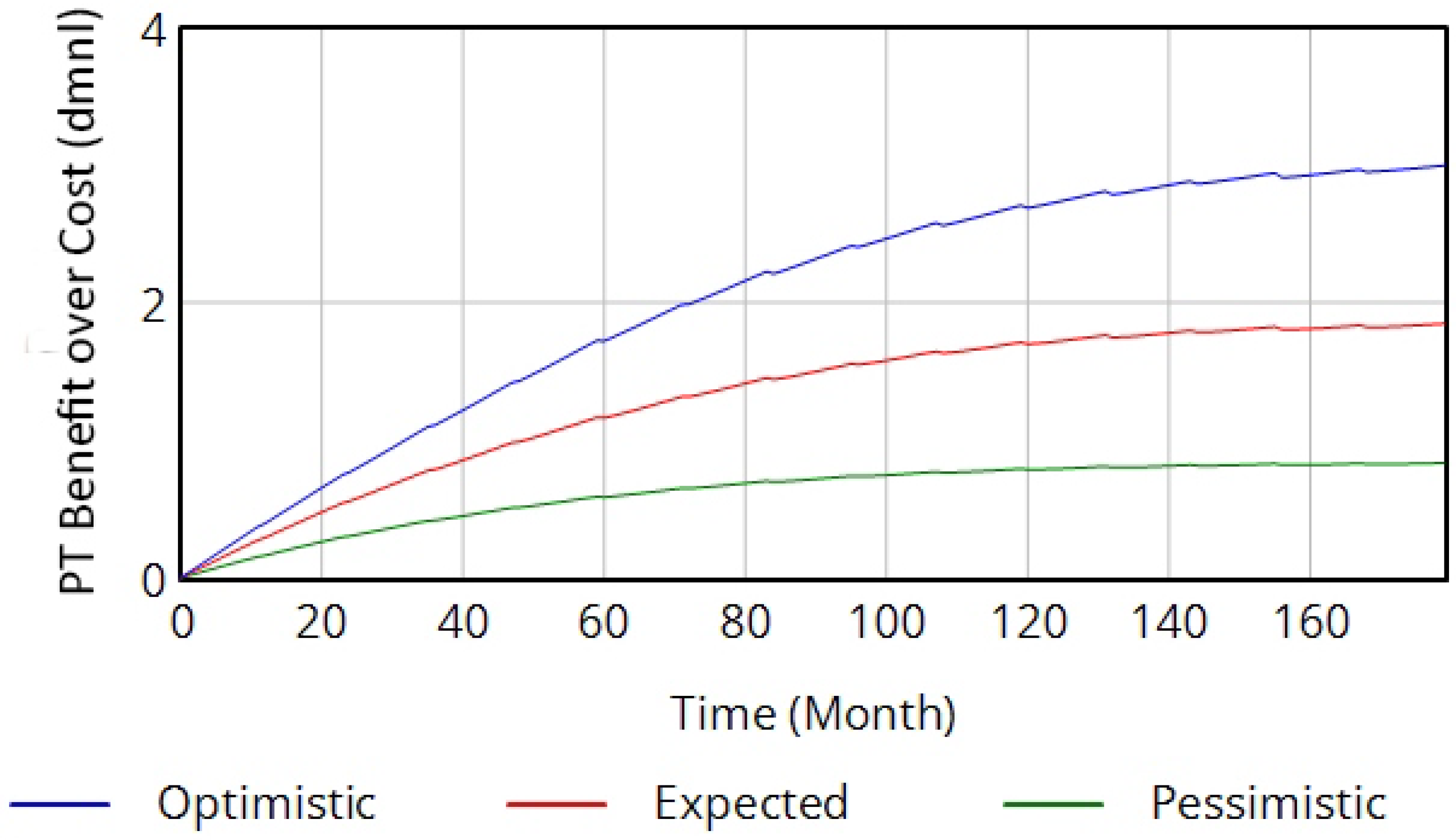
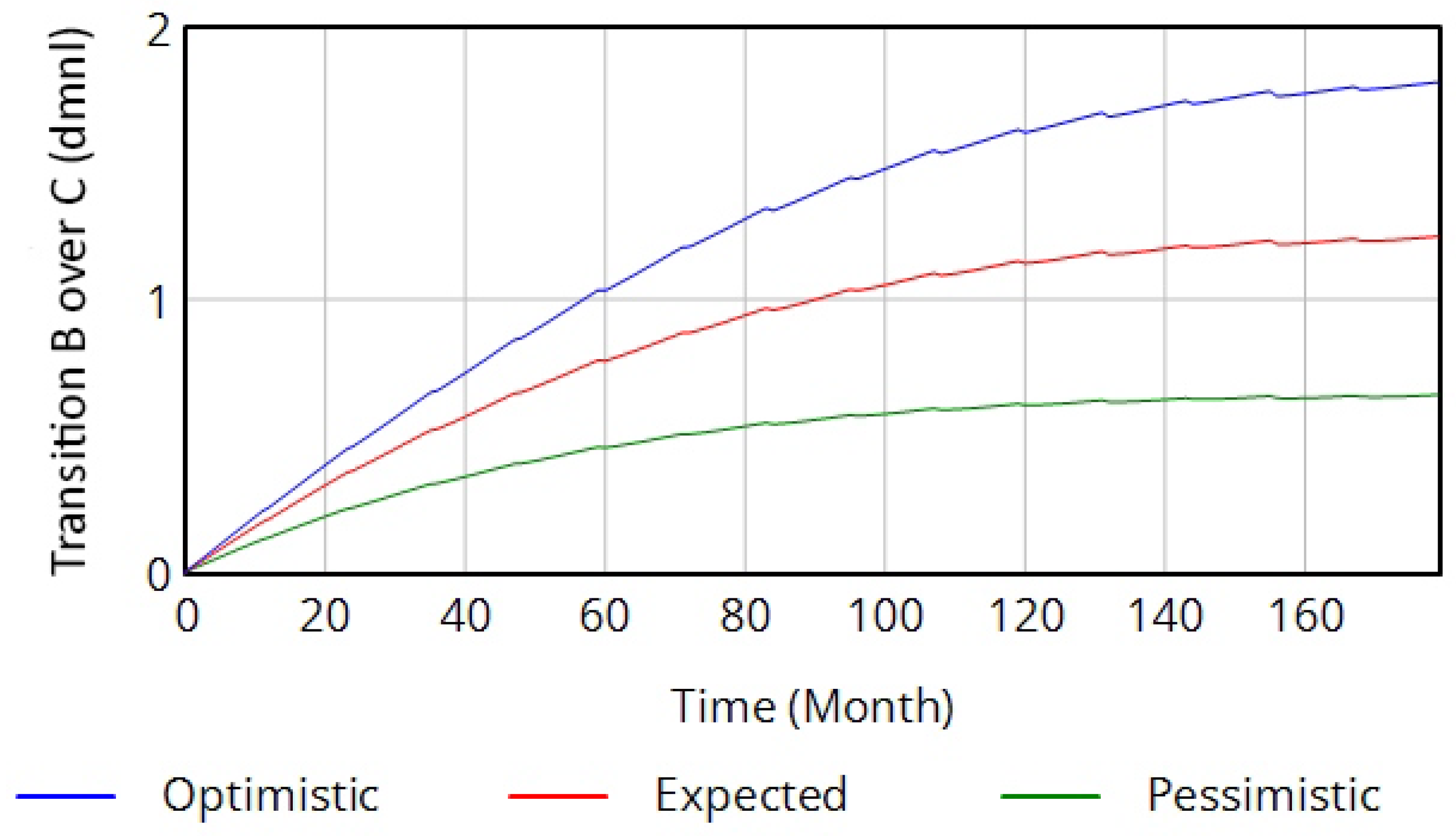
| Transition B over C | auxiliary | - | (Avg Fuel Saving + Avg Labor Saving − Avg Ongoing Opportunistic Cost per Month) × (−1 + pow(1 + Interest Rate, Expected Truck Lifetime))/Interest Rate × pow(1 + Interest Rate, Expected Truck Lifetime)/(CT to PT Transition Cost) |
| Parameter Name | Type | Unit | Value | Reference |
|---|---|---|---|---|
| PT Fleet Initial | constant | vehicle | 1000 | Assumption 1 |
| CT Fleet Initial | constant | vehicle | 13,859,181 | [62,63] |
| Platoonable Truck Price | constant | dollar per vehicle | 150,000 | Assumption 2 |
| Conventional Truck Price | constant | dollar per vehicle | 135,000 | [59,60,61] |
| Interest Rate (%) | constant | per year | 5 | [64] |
| CT to PT Transition Cost | constant | dollar per vehicle | 11,000 | Assumption 3 |
| Fuel Price | constant | dollar per gallon | 4 | [65] |
| Fuel Saving per Platooning Mile per Truck (%) | constant | – | 5 | [53] |
| Probability Proximity Trip Mile a | constant | – | 0.5 | Assumption 4 |
| Probability Path Consistency b | constant | – | 0.5 | Assumption 4 |
| Probability Road Platoonability c | constant | – | 0.6 | [66] |
| Probability Successful Platooning d | constant | – | 0.75 | Assumption 4 |
| Fuel Consumption per Truck | constant | gallon per mile | 0.05 | [67] |
| Ongoing Opportunity Coordinating Cost | constant | dollar | 0.005 | [40] |
| Model timescale | constant | month | 180 | Assumption 5 |
| Hour Cost of Trucking | constant | dollar | 10 | [68] |
| Average Truck Speed | constant | mile per hour | 50 | [69] |
| Expected Truck Lifetime | constant | months | 180 | [70] |
| Emission Factor | constant | kilograms of CO2 released per gallon of diesel consumed | 10.19 | [56] |
Disclaimer/Publisher’s Note: The statements, opinions and data contained in all publications are solely those of the individual author(s) and contributor(s) and not of MDPI and/or the editor(s). MDPI and/or the editor(s) disclaim responsibility for any injury to people or property resulting from any ideas, methods, instructions or products referred to in the content. |
© 2026 by the authors. Licensee MDPI, Basel, Switzerland. This article is an open access article distributed under the terms and conditions of the Creative Commons Attribution (CC BY) license.
Share and Cite
Hosseinpanahi, D.; Zou, B.; Choobchian, P. Climate Implications of Truck Platooning Adoption: Insights from System Dynamics Modeling. Future Transp. 2026, 6, 70. https://doi.org/10.3390/futuretransp6020070
Hosseinpanahi D, Zou B, Choobchian P. Climate Implications of Truck Platooning Adoption: Insights from System Dynamics Modeling. Future Transportation. 2026; 6(2):70. https://doi.org/10.3390/futuretransp6020070
Chicago/Turabian StyleHosseinpanahi, Danesh, Bo Zou, and Pooria Choobchian. 2026. "Climate Implications of Truck Platooning Adoption: Insights from System Dynamics Modeling" Future Transportation 6, no. 2: 70. https://doi.org/10.3390/futuretransp6020070
APA StyleHosseinpanahi, D., Zou, B., & Choobchian, P. (2026). Climate Implications of Truck Platooning Adoption: Insights from System Dynamics Modeling. Future Transportation, 6(2), 70. https://doi.org/10.3390/futuretransp6020070