


Smart Crosswalks for Advancing Road Safety in Urban Roads: Conceptualization and Evidence-Based Insights from Greek Incident Records


Abstract
1. Introduction
1.1. Technological Innovations in Road Safety
1.2. Pedestrian Vulnerability: The Role of Safer Intersections
1.3. Aim and Objectives
- To present the main architecture, components, and key issues related to the technology of smart crosswalks based on the implementation knowledge so far;
- To assess records of road incidents with pedestrians in urban road networks from the Greek territory over a long analysis period;
- To highlight the need for a deployment framework by identifying key challenges and future opportunities for this emerging technology, based on quantifiable improvements in pedestrian safety derived from the analyzed data.
2. Smart Crosswalk Technology: Architecture and Components
2.1. Basic Design of an Active Smart Crosswalk
2.1.1. Core Elements
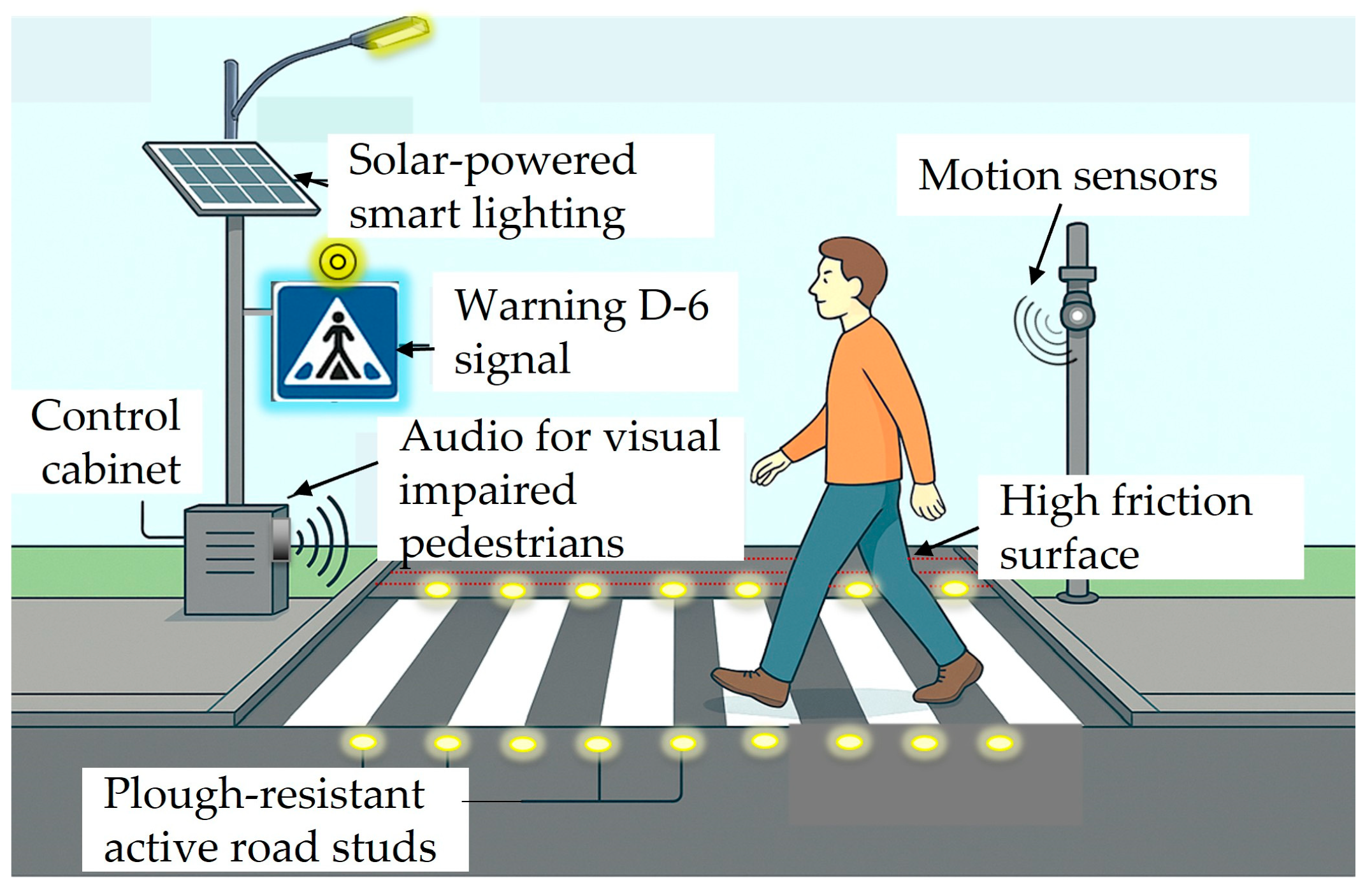
- Warning D-6 Sign: The warning signaling system is a core element of a smart crosswalk, automatically triggered upon pedestrian detection. It typically involves activating pulsating yellow lights to alert drivers for the presence of pedestrians at the crosswalk. With advanced signaling technologies, the system can also adjust the duration of warnings based on prevailing conditions. Also, the D-6 sign can be illuminated during the night to help both pedestrians and drivers notice the exact location of the crosswalk.
- Plough-Resistant Active Road Studs: These are active spot retroreflectors mounted at least in front of each conditional stop line or in both sides of the crosswalk. They are double-sided with yellow warning LEDs. The shape of the spot retroreflectors ensures smooth passage of vehicles. They are activated when a pedestrian is detected. The active retroreflector is made of high-impact, clear polyethylene with IP68 protection [32]. The insert is equipped with three LEDs for each direction—from the oncoming side and from the horizontal marking side. The bodies of the retroreflectors are permanently placed in the abrasive layer of the roadway, and the active elements are connected by cables covered with roadway filler.
- Audio for Visually Impaired Pedestrians: The audio system for visually impaired pedestrians emits directional acoustic signals—typically pulsed tones or voice messages—synchronized with pedestrian phases of the traffic signal. Activated via push-button, sensor input, or remote trigger, it provides real-time feedback on signal status and crossing initiation. Integrated with tactile indicators and accessibility standards, it enhances spatial orientation and crossing safety in complex urban environments.
- Motion Sensors: A motion sensor detects pedestrian movement near or on a crosswalk using infrared or microwave signals. When motion is identified, the sensor activates the crossing system—triggering lights, alerts, or vehicle warnings. This enhances visibility and response time, ensuring safer pedestrian passage, especially in low-visibility or high-traffic conditions.
- Control Cabinet: The control cabinet houses the core electronic components that manage smart crosswalk systems. It integrates power supply units, communication modules, signal controllers, and input/output interfaces for sensors, lighting, and audio devices. Designed for outdoor environments, it features weatherproof enclosures, surge protection, and remote diagnostics to ensure reliable, continuous system operation.
- Solar-Powered Smart Lighting: This system utilizes high-efficiency photovoltaic panels to power LED-based illumination at crosswalks. It includes integrated solar charge controllers, energy storage units, and automatic brightness adjustment based on ambient light or pedestrian detection. Designed for autonomous operation, it enhances crosswalk visibility without requiring grid connectivity, supporting sustainable and low-maintenance infrastructure deployment.
- High-Friction Surface: The implementation of high-friction, anti-slip surface coatings at crosswalks is intended to improve safety by minimizing the risk of vehicle skidding—particularly in areas where vehicles approach at higher speeds. By increasing surface traction, these treatments significantly reduce stopping distances under variable weather and road conditions, thereby enhancing drivers’ ability to respond in time and protect crossing pedestrians. Drivers can probably perceive high-friction surfaces as being rougher, but the increase in surface friction coefficient is much more prevailing. To improve tire–road interaction, it is a common international practice to improve skid resistance through specialty sealing applications, thermosetting resin binders, including epoxy- and polyurethane-modified binders, and other forms of polyester and resin esters in combination with appropriate aggregates, i.e., type and gradation [33].
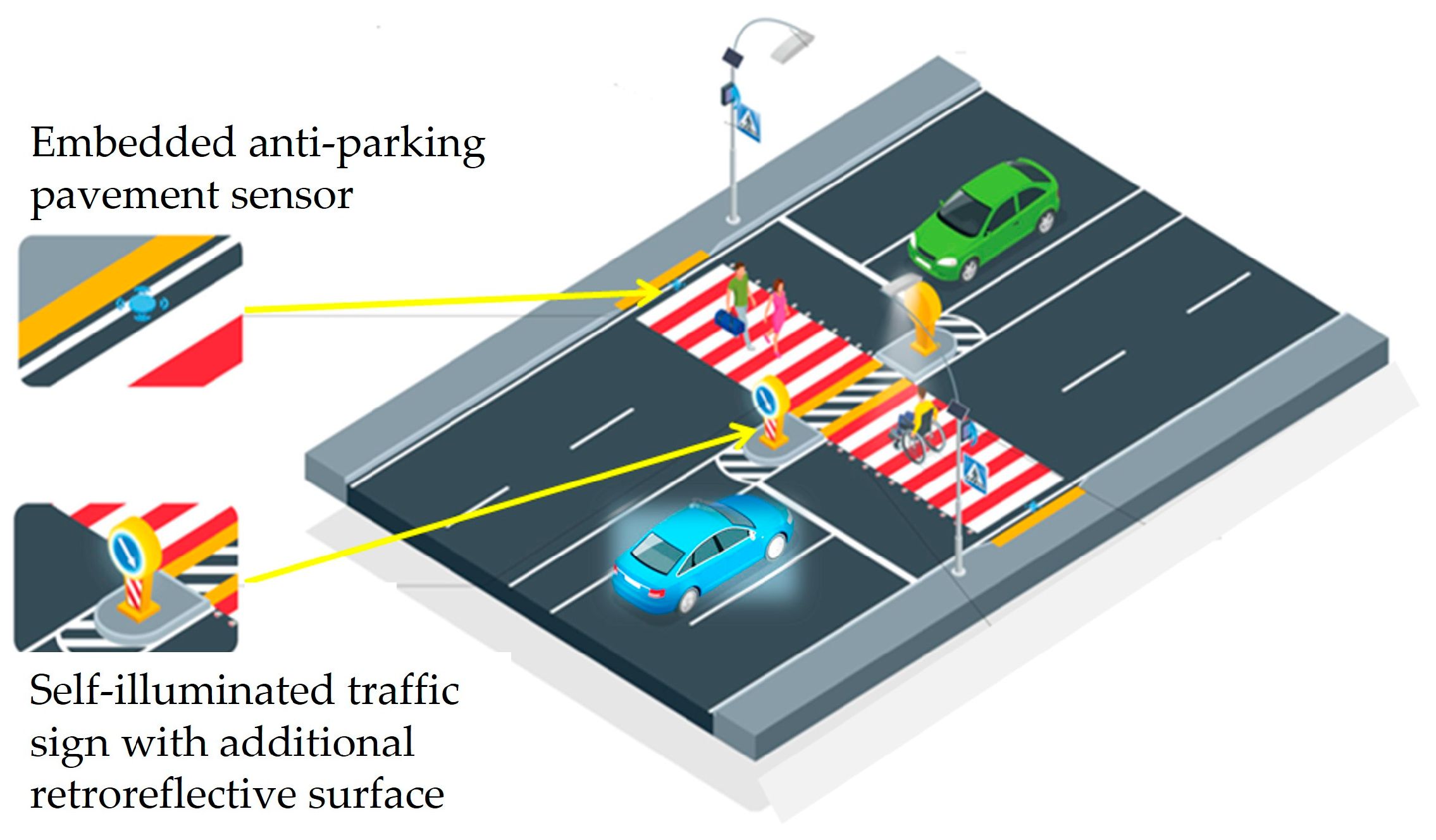
- Embedded Anti-Parking Pavement Sensor: The embedded anti-parking pavement sensor is installed directly within the road surface to detect and prevent unauthorized vehicle stopping or parking. It operates through magnetic, infrared, or pressure-based detection, sending real-time signals to control systems or warning devices. Designed with durable, weather-resistant housing, it ensures continuous monitoring and contributes to safer, obstruction-free crosswalk and traffic flow.
- Self-Illuminated Traffic Sign with Additional Retroreflective Surface: The self-illuminated traffic sign combines active LED-based lighting with a retroreflective surface to ensure maximum visibility under varying environmental conditions. In compliance with relative traffic code regulations, the integrated illumination enhances recognition at night or during low-light scenarios, while the retroreflective layer guarantees visibility when external light sources, such as vehicle headlights, are present. This dual system significantly improves driver awareness and pedestrian safety near crosswalks.
2.1.2. Infrastructure-Related Aspects
2.2. Integration of LED Technology: Installation and Operational Considerations
2.2.1. Planning and Design
2.2.2. Materials and Components
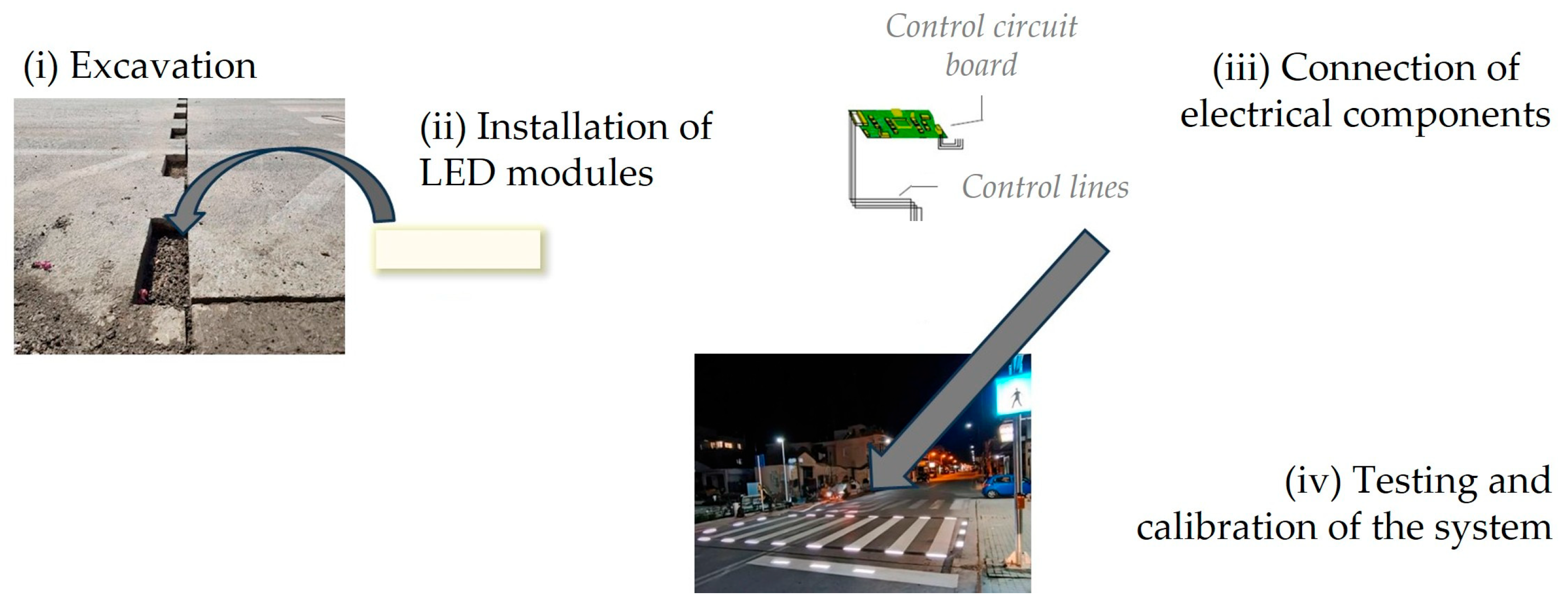
- LED panels/modules: engineered to be embedded into the road surface and withstand external stressors.
- Wiring and connectors: weather-resistant, durable systems are required to ensure consistent power delivery and data transmission.
- Power source: a stable energy supply—either from the electrical grid or renewable sources such as solar panels—is essential.
- Control systems: these enable real-time modulation of LED brightness, color, and operational patterns in response to traffic or environmental inputs.
2.2.3. Installation Process
2.2.4. Maintenance Requirements
- Regular inspections to detect wear, damage, or malfunction.
- Surface cleaning to maintain light visibility.
- Component replacement as needed to address any failures in LEDs or associated hardware.
2.2.5. Practical Applicability
- Dynamic Road Markings: LEDs enable adaptive traffic management by changing lane directions or signaling hazards in real time.
- Enhanced Visibility: in fog, snow, or heavy rain, LEDs improve visual guidance, thereby enhancing road safety.
2.2.6. Key Considerations
3. Effectiveness of Smart Crosswalks
3.1. Detection Accuracy
3.2. System Limitations
3.3. System Compliance
- A system that continuously monitors the real-time positions and speeds of both pedestrians and vehicles, differentiating between pedestrian–vehicle conflict scenarios based on situational context. It can employ tailored warning mechanisms accordingly, including auditory prompts directed at pedestrians and dual alerts for both pedestrians and drivers via intelligent crosswalk signals utilizing flashing red and yellow lights. These measures effectively mitigate conflicts and reduce the risk of traffic crashes.
- A holistic framework that may integrate considerations of pedestrians’ psychological safety distances and incorporates modifications to vehicle behavior models based on an enhanced vehicle stopping sight distance approach. This integration not only enhances vehicle braking safety but also minimizes the psychological discomfort experienced by pedestrians during the braking process.
3.4. Maintenance and Lifecycle Costs
4. Evidence-Based Analysis of Incident Records at Crosswalk Areas
- First, the gradual modernization of road networks across cities likely played a role, making pedestrian routes more visible and accessible.
- Second, the gradual choice for constructing and maintaining upgraded crosswalks, with better signage, road markings, and lighting, likely achieved a difference in pedestrian compliance.
- Another critical contributor could be the advancement of vehicle technology. The growing presence of new-generation vehicles equipped with automatic emergency braking (AEB) and pedestrian detection systems enhances overall safety of the road–vehicle ecosystem. These systems can compensate for human error, especially in scenarios where pedestrians cross roads unsafely or unexpectedly.
5. Toward a Wider Applicability Framework
5.1. Discussion Points and Current Challenges
5.2. Future Prospects
6. Conclusions
- Research evidence confirms the technical feasibility of smart crosswalks, highlighting key components, such as detection systems, LED signaling, and real-time monitoring, which enable smooth and efficient integration into intelligent urban infrastructure.
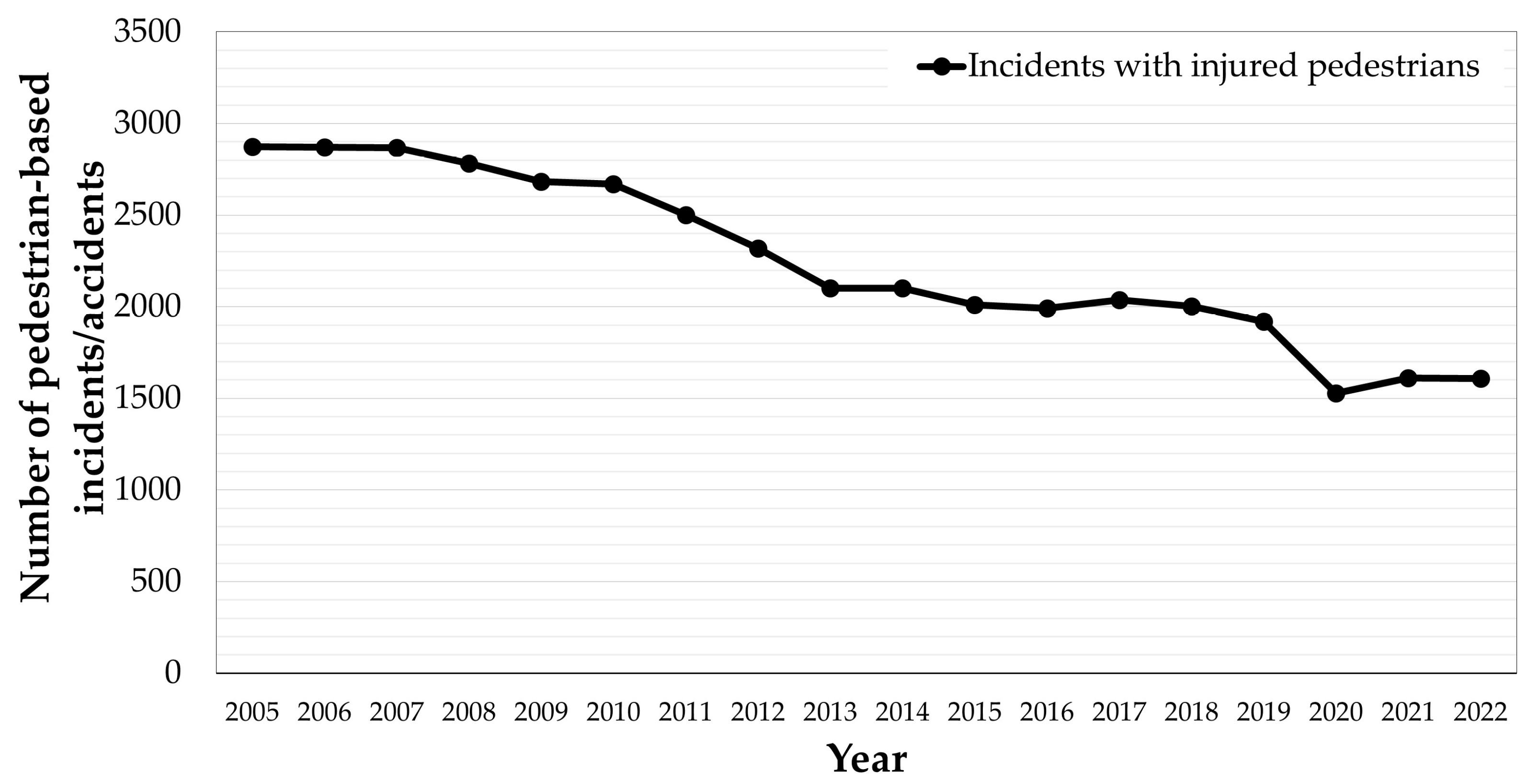
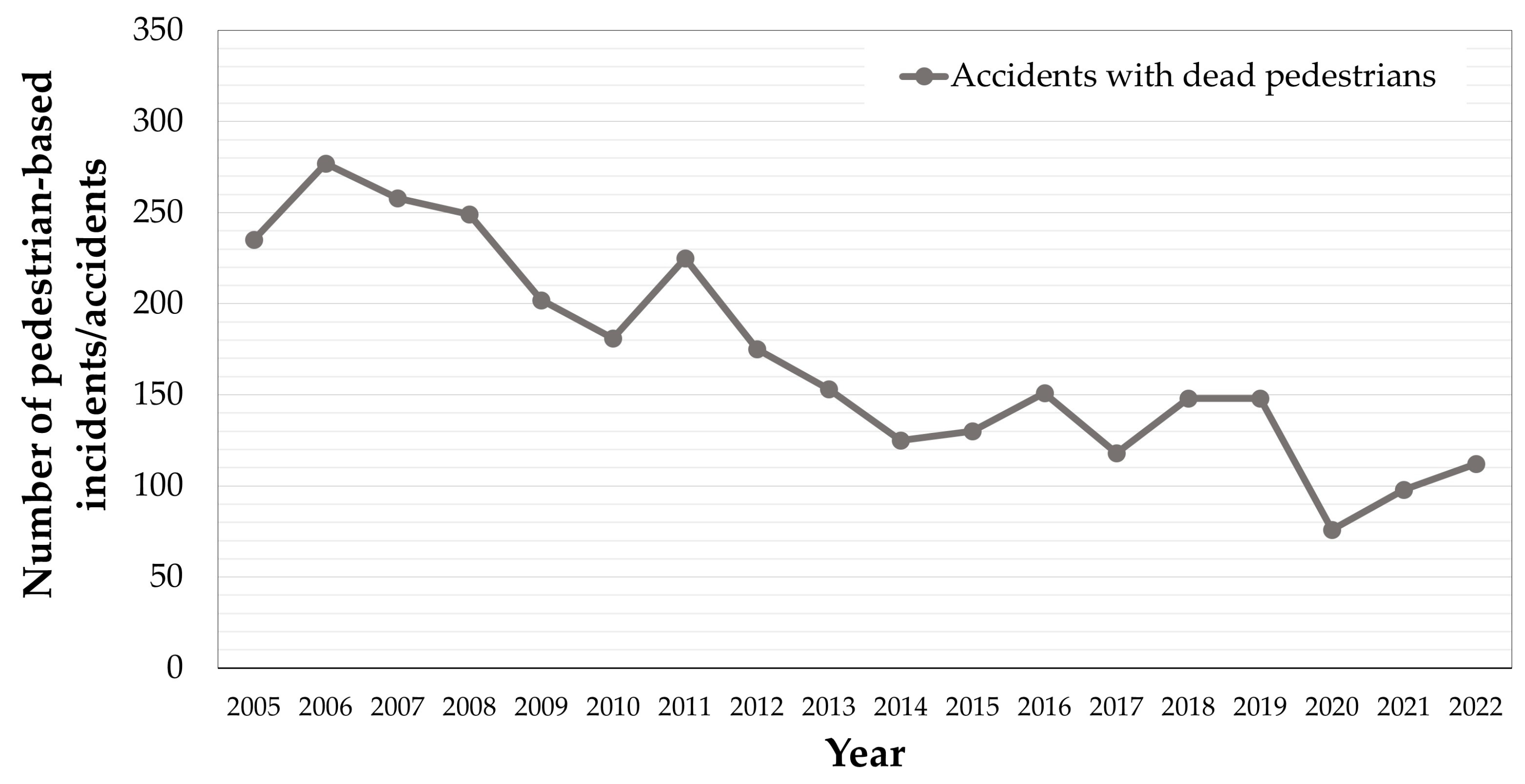
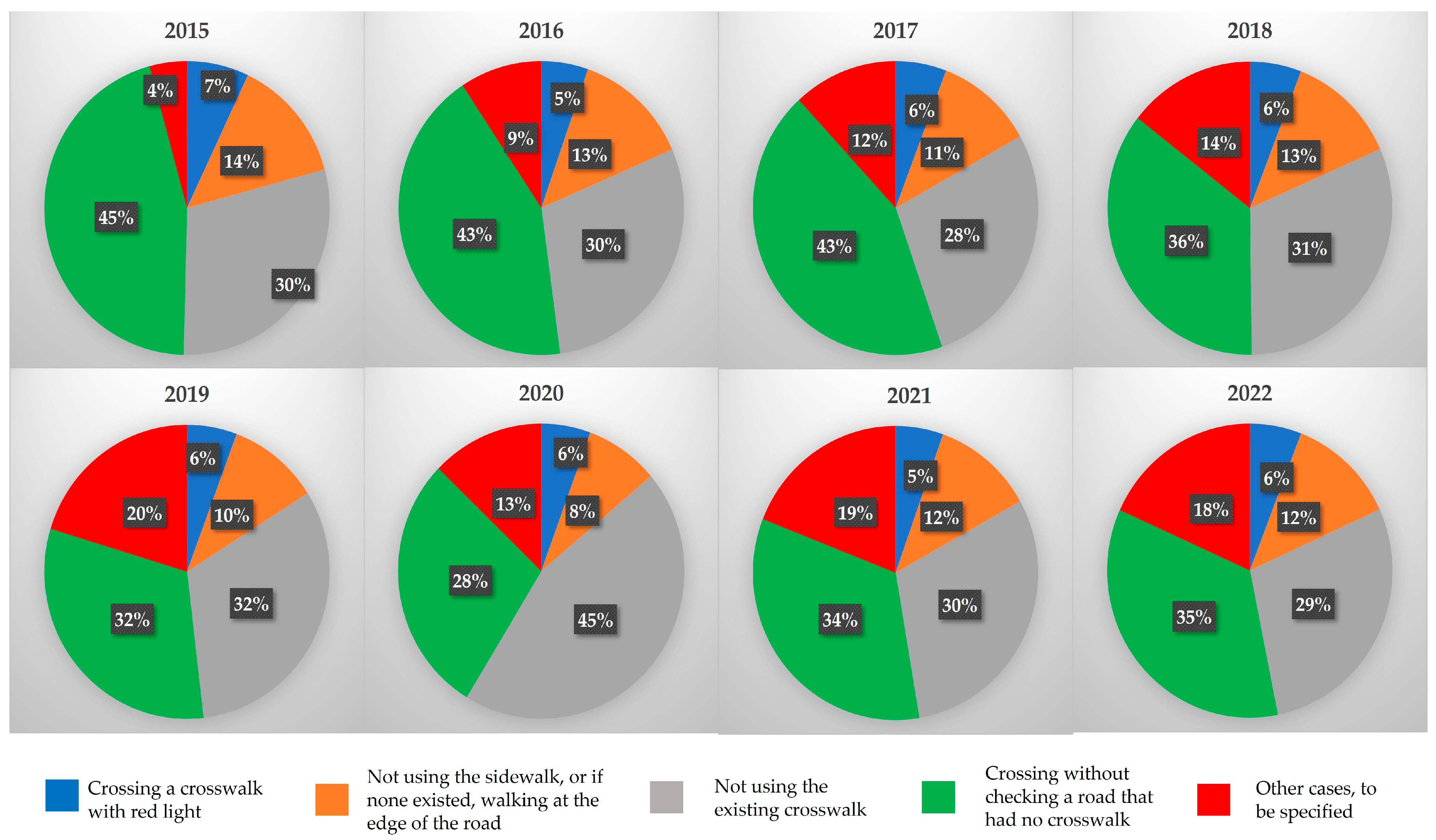
- The analysis of long-term Greek incident records involving pedestrians (analysis period: 2005–2022), showed a clear reduction in pedestrian injuries and fatalities at a rate of 44% and 52%, respectively. The percentage of incidents occurring in areas with no crosswalks decreased by nearly 10% during the last decade. This indicates that, among others, infrastructural interventions like improved crosswalk design can be translated into measurable benefits for pedestrian safety.
- Further deploying a framework for more targeted upgrades revealed challenges such as requirements and standards for modular construction and predictive maintenance, the need for user education through driver-awareness campaigns, and integration of funding in implementation action plans (e.g., pilot sections, initiatives toward smart mobility, etc.).
Funding
Data Availability Statement
Conflicts of Interest
References
- World Health Organization. Global Status Report on Road Safety 2023; World Health Organization: Geneva, Switzerland, 2023; Available online: https://www.who.int/publications/i/item/9789240086456 (accessed on 1 October 2025).
- Nikolaou, D.; Folla, K.; Yannis, G. Impact of Socioeconomic and Transport Indicators on Road Safety during the Crisis Period in Europe. Int. J. Inj. Contr. Saf. Promot. 2021, 28, 479–485. [Google Scholar] [CrossRef] [Scilit] [PubMed]
- Khanmohamadi, M.; Guerrieri, M. Smart Intersections and Connected Autonomous Vehicles for Sustainable Smart Cities: A Brief Review. Sustainability 2025, 17, 3254. [Google Scholar] [CrossRef] [Scilit]
- AAA Foundation for Traffic Safety. Traffic Fatalities on Urban Roads and Streets in Relation to Speed Limits and Speeding, United States, (Research Brief) 2010–2019; AAA Foundation for Traffic Safety: Washington, DC, USA, 2022; Available online: https://aaafoundation.org/wp-content/uploads/2022/07/Traffic-Fatalities-on-Urban-Streets-2010-2019-July-2022.pdf (accessed on 1 October 2025).
- Gkyrtis, K.; Pomoni, M. Use of Historical Road Incident Data for the Assessment of Road Redesign Potential. Designs 2024, 8, 88. [Google Scholar] [CrossRef] [Scilit]
- Gkyrtis, K. Theoretical Considerations from the Modelling of the Interaction between Road Design and Fuel Consumption on Urban and Suburban Roadways. Modelling 2024, 5, 737–751. [Google Scholar] [CrossRef] [Scilit]
- Wang, C.; Wang, Y.; Peeta, S. Cooperative Roundabout Control Strategy for Connected and Autonomous Vehicles. Appl. Sci. 2022, 12, 12678. [Google Scholar] [CrossRef] [Scilit]
- Gkyrtis, K.; Kokkalis, A. An Overview of the Efficiency of Roundabouts: Design Aspects and Contribution toward Safer Vehicle Movement. Vehicles 2024, 6, 433–449. [Google Scholar] [CrossRef] [Scilit]
- Toh, C.K.; Sanguesa, J.A.; Cano, J.C.; Martinez, F.J. Advances in smart roads for future smart cities. Proc. R. Soc. Math. Phys. Eng. Sci. 2020, 476, 20190439. [Google Scholar] [CrossRef] [Scilit]
- Khanmohamadi, M.; Guerrieri, M. Advanced Sensor Technologies in CAVs for Traditional and Smart Road Condition Monitoring: A Review. Sustainability 2024, 16, 8336. [Google Scholar] [CrossRef] [Scilit]
- Kosti´c, Z.; Angus, A.; Yang, Z.; Duan, Z.; Seskar, I.; Zussman, G.; Raychaudhuri, D. Smart City Intersections: Intelligence Nodes for Future Metropolises. arXiv 2022, arXiv:2205.01686. [Google Scholar] [CrossRef] [Scilit]
- Yusuf, S.A.; Khan, A.; Souissi, R. Vehicle-to-everything (V2X) in the autonomous vehicles domain—A technical review of communication, sensor, and AI technologies for road user safety. Transp. Res. Interdiscip. Perspect. 2024, 23, 100980. [Google Scholar]
- Elassy, M.; Al-Hattab, M.; Takruri, M.; Badawi, S. Intelligent transportation systems for sustainable smart cities. Transp. Eng. 2024, 16, 100252. [Google Scholar] [CrossRef] [Scilit]
- Qian, H.B. The Research on the Influence of Intersection Transition Signal to Driver’s Psychology and Traffic Safety. Ph.D. Thesis, Tongji University, Shanghai, China, 2009. [Google Scholar]
- Koh, P.P.; Wong, Y.D.; Chandrasekar, P. Safety evaluation of pedestrian behaviour and violations at signalised pedestrian crossings. Saf. Sci. 2014, 70, 143–152. [Google Scholar] [CrossRef] [Scilit]
- Yin, Y.; Ma, S.Q. A study of traffic characteristics of pedestrian crossing the street and countermeasure. Technol. Econ. Areas Commun. 2013, 15, 18–22+26. [Google Scholar]
- Zhai, L.G.; Ding, J.Y.; Zhang, J.G. Characteristic analysis of pedestrian’s crossing streets and self-protection countermeasures. J. Liaoning Police Acad. 2004, 4, 61–63. [Google Scholar]
- Qu, D.; Li, H.; Liu, H.; Wang, S.; Zhang, K. Crosswalk Safety Warning System for Pedestrians to Cross the Street Intelligently. Sustainability 2022, 14, 10223. [Google Scholar] [CrossRef] [Scilit]
- World Health Organization. Promoting Walking and Cycling: A Toolkit of Policy Options; Electronic Version; World Health Organization: Geneva, Switzerland, 2025; ISBN 978-92-4-010990-2. Available online: https://www.who.int/publications/i/item/9789240109902 (accessed on 1 October 2025).
- Uttley, J.; Fotios, S. The effect of ambient light condition on road traffic collisions involving pedestrians on pedestrian crossings. Accid. Anal. Prev. 2017, 108, 189–200. [Google Scholar] [CrossRef] [Scilit]
- Pawlak, A.; Pawelec, A.; Kossakowski, P.G. Evaluation of the Efficiency of Solutions Used at Active Pedestrian Crossings. Electronics 2025, 14, 409. [Google Scholar] [CrossRef] [Scilit]
- Szagala, P.; Brzezinski, A.; Kiec, M.; Budzynski, M.; Wachnicka, J.; Pazdan, S. Pedestrian Safety at Midblock Crossings on Dual Carriageway Roads in Polish Cities. Sustainability 2022, 14, 5703. [Google Scholar] [CrossRef] [Scilit]
- Bella, F.; Ferrante, C. Drivers’ Yielding Behavior in Different Pedestrian Crossing Configurations: A Field Survey. J. Adv. Transp. 2021, 2021, 8874563. [Google Scholar] [CrossRef] [Scilit]
- Forde, A.; Daniel, J. Pedestrian walking speed at un-signalized midblock crosswalk and its impact on urban street segment performance. J. Traffic Transp. Eng. 2021, 8, 57–69. [Google Scholar] [CrossRef] [Scilit]
- O’Dell, A.; Morris, A.; Filtness, A.; Barnes, J. The Impact of Pedestrian Distraction on Safety Behaviours at Controlled and Uncontrolled Crossings. Future Transp. 2023, 3, 1195–1208. [Google Scholar] [CrossRef] [Scilit]
- Budzynski, M.; Gobis, A.; Guminska, L.; Jelinski, L.; Kiec, M.; Tomczuk, P. Assessment of the Influence of Road Infrastructure Parameters on the Behaviour of Drivers and Pedestrians in Pedestrian Crossing Areas. Energies 2021, 14, 3559. [Google Scholar] [CrossRef] [Scilit]
- Yang, Z.; Liu, P.; Xu, X.; Xu, C. Multi objective Evaluation of Midblock Crosswalks on Urban Streets Based on TOPSIS and Entropy Methods. Transp. Res. Rec. 2016, 2586, 59–71. [Google Scholar] [CrossRef] [Scilit]
- Stapleton, S.; Kirsch, T.; Gates, T.J.; Savolainen, P.T. Factors Affecting Driver Yielding Compliance at Uncontrolled Midblock Crosswalks on Low-Speed Roadways. Transp. Res. Rec. 2017, 2661, 95–102. [Google Scholar] [CrossRef] [Scilit]
- Lantieri, C.; Costa, M.; Vignali, V.; Acerra, E.M.; Marchetti, P.; Simone, A. Flashing in-curb LEDs and beacons at unsignalized crosswalks and driver’s visual attention to pedestrians during nighttime. Ergonomics 2021, 64, 330–341. [Google Scholar] [CrossRef] [Scilit]
- Pazzini, M.; Cameli, L.; Vignali, V.; Simone, A.; Lantieri, C. Video-Based Analysis of a Smart Lighting Warning System for Pedestrian Safety at Crosswalks. Smart Cities 2024, 7, 2925–2939. [Google Scholar] [CrossRef] [Scilit]
- Ziółkowski, R.; Pérez-Acebo, H.; Gonzalo-Orden, H.; Linares-Unamunzaga, A. Changes in Safety Performance on Single-Carriageway Roads After Installation of Additional Lighting at Pedestrian Crossing. Land 2024, 13, 2134. [Google Scholar] [CrossRef] [Scilit]
- Kuchta, R. Declaration of Performance for the Active “Cat’s Eye”, DVS, Electronics for Road Engineering, Tarnów. 2018. Available online: https://euroasfalt.pl/pl/products/s-2-niski-profil-punktowy-element-odblaskowy (accessed on 13 June 2025).
- Austroads. Technical Specification ATS 3466, High Friction Surface Treatment, Austroads, Sydney, NSW; 2023. Available online: https://austroads.gov.au/__data/assets/pdf_file/0035/748682/ATS-3466_High_Friction_Surface_Treatment.pdf (accessed on 6 November 2025).
- Euroasphalt. Available online: https://euroasfalt.pl/pl/category-product/nawierzchnia-antyposlizgowa (accessed on 13 June 2025).
- Plati, C.; Pomoni, M.; Loizos, A.; Yannis, G. Stochastic Prediction of Short-Term Friction Loss of Asphalt Pavements: A Traffic Dependent Approach. In Lecture Notes in Civil Engineering, Proceedings of the 9th International Conference on Maintenance and Rehabilitation of Pavements—Mairepav9, Dübendorf, Switzerland, 1–3 July 2020; Raab, C., Ed.; Springer: Cham, Switzerland, 2020; Volume 76. [Google Scholar] [CrossRef] [Scilit]
- Pomoni, M.; Plati, C.; Loizos, A. How Can Sustainable Materials in Road Construction Contribute to Vehicles’ Braking? Vehicles 2020, 2, 55–74. [Google Scholar] [CrossRef] [Scilit]
- Saad, W.K.; Hashim, Y.; Jabbar, W.A. Design and Implementation of Portable Smart Wireless Pedestrian Crossing Control System. IEEE Access 2020, 8, 106109–106120. [Google Scholar] [CrossRef] [Scilit]
- Smartpass Technology. Available online: https://2s.design/en/portfolio/smart-pedestrian-crosswalk-system (accessed on 14 June 2025).
- Solar Roadways. Available online: https://solarroadways.com/ (accessed on 1 October 2025).
- Jedlinski, M.; Sosik-Filipiak, K. The Role of Crosswalks in the Smart City Concept Implementation from the “iGen” Perspective. Energies 2022, 15, 5661. [Google Scholar] [CrossRef] [Scilit]
- Pomoni, M. Exploring Smart Tires as a Tool to Assist Safe Driving and Monitor Tire–Road Friction. Vehicles 2022, 4, 744–765. [Google Scholar] [CrossRef] [Scilit]
- Hellenic Statistical Authority (ELSTAT). Road Crash Data. Available online: https://www.statistics.gr/en/statistics/-/publication/SDT04/2000 (accessed on 10 June 2025).
- Sosik-Filipiak, K.; Ostrowski, P.; Iwan, S. Pedestrian Safety in Road Traffic in the Era of the SARS-CoV-2 Pandemic in the Example of Szczecin. Sustainability 2023, 15, 11000. [Google Scholar] [CrossRef] [Scilit]
- Yannis, G.; Michelaraki, E. Effectiveness of 30 km/h speed limit—A literature review. J. Saf. Res. 2025, 92, 490–503. [Google Scholar] [CrossRef] [Scilit]
- Oikonomou, M.G.; Ziakopoulos, A.; Yannis, G. Advancing traffic microsimulation: A systematic review of parameter selection for connected and autonomous vehicles. J. Simul. 2025, 1–38. [Google Scholar] [CrossRef] [Scilit]
- Pomoni, M.; Laiou, A.; Plati, C.; Yannis, G.; Loukea, M.; Bekiaris, E. Future Trends in Transport Workforce Based on Demographic, Behavioural, Cultural and Socioeconomic Factors. Transp. Res. Procedia 2020, 48, 2811–2820. [Google Scholar] [CrossRef] [Scilit]
- Pechteep, P.; Luathep, P.; Jaensirisak, S.; Kronprasert, N. Analysis of Factors Influencing Driver Yielding Behavior at Midblock Crosswalks on Urban Arterial Roads in Thailand. Sustainability 2024, 16, 4118. [Google Scholar] [CrossRef] [Scilit]
- Mateo Sanguino, T.D.J.; Redondo González, M.J.; Davila Martin, J.M.; Lozano Domínguez, J.M. Enhanced Road Safety with Photoluminescent Pedestrian Crossings in Urban Contexts. Infrastructures 2024, 9, 60. [Google Scholar] [CrossRef] [Scilit]
- Ministry of Digital Governance. Digital Transformation Bible 2020–2025. 2022. Available online: https://digitalstrategy.gov.gr (accessed on 2 August 2025).
- Trikala Municipality. Smart Infrastructure Implementation Report. 2023. Available online: https://trikalacity.gr (accessed on 2 August 2025).
- European Commission. Sustainable and Smart Mobility Strategy—Putting European transport on track for the future. 2020. Available online: https://transport.ec.europa.eu (accessed on 2 August 2025).
- Bajwa, M.U.; Saleh, W.; Fountas, G. Identifying a Framework for Implementing Vision Zero Approach to Road Safety in Low- and Middle-Income Countries: A Qualitative Perspective. Safety 2025, 11, 93. [Google Scholar] [CrossRef] [Scilit]
- SMART Grants Program. Strengthening Mobility and Revolutionizing Transportation (SMART). Available online: https://www.transportation.gov/grants/SMART (accessed on 2 August 2025).
- Lee, M.B.; Lee, C.T.; Abas, M.A.; Chong, W. Advancing pedestrian safety in the era of autonomous vehicles: A bibliometric analysis and pathway to effective regulations. J. Traffic Transp. Eng. 2025, 12, 772–794. [Google Scholar] [CrossRef] [Scilit]

Disclaimer/Publisher’s Note: The statements, opinions and data contained in all publications are solely those of the individual author(s) and contributor(s) and not of MDPI and/or the editor(s). MDPI and/or the editor(s) disclaim responsibility for any injury to people or property resulting from any ideas, methods, instructions or products referred to in the content. |
© 2025 by the author. Licensee MDPI, Basel, Switzerland. This article is an open access article distributed under the terms and conditions of the Creative Commons Attribution (CC BY) license (https://creativecommons.org/licenses/by/4.0/).
Share and Cite
Pomoni, M. Smart Crosswalks for Advancing Road Safety in Urban Roads: Conceptualization and Evidence-Based Insights from Greek Incident Records. Future Transp. 2025, 5, 180. https://doi.org/10.3390/futuretransp5040180
Pomoni M. Smart Crosswalks for Advancing Road Safety in Urban Roads: Conceptualization and Evidence-Based Insights from Greek Incident Records. Future Transportation. 2025; 5(4):180. https://doi.org/10.3390/futuretransp5040180
Chicago/Turabian StylePomoni, Maria. 2025. "Smart Crosswalks for Advancing Road Safety in Urban Roads: Conceptualization and Evidence-Based Insights from Greek Incident Records" Future Transportation 5, no. 4: 180. https://doi.org/10.3390/futuretransp5040180
APA StylePomoni, M. (2025). Smart Crosswalks for Advancing Road Safety in Urban Roads: Conceptualization and Evidence-Based Insights from Greek Incident Records. Future Transportation, 5(4), 180. https://doi.org/10.3390/futuretransp5040180

