Article

A Heuristic Approach for Truck and Drone Delivery System

by
Sorin Ionut Conea
1,2,* and
Gloria Cerasela Crisan
1,2
1
Faculty of Sciences, “Vasile Alecsandri” University of Bacău, 157 Cal. Mărășești, 600115 Bacău, Romania
2
Faculty of Computer Science, “Alexandru Ioan Cuza” University, 16 Berthelot St., 700506 Iasi, Romania
*
Author to whom correspondence should be addressed.
Future Transp. 2025, 5(4), 181; https://doi.org/10.3390/futuretransp5040181 (registering DOI)
Submission received: 14 October 2025 / Revised: 24 November 2025 / Accepted: 26 November 2025 / Published: 1 December 2025

Abstract

In the rapidly evolving landscape of logistics and last-mile delivery, optimizing efficiency and minimizing costs are paramount. This paper introduces a novel heuristic approach designed to enhance the efficiency of a truck-and-drone delivery system. Our method addresses the complex challenge of coordinating the movements of a truck, which serves as a mobile depot, and an unmanned aerial vehicle (UAV or drone), which performs rapid, short-distance deliveries. Our system proposes a two-step heuristic. For truck routes, we utilized the Concorde Solver to determine the optimal path, based on real-world road distances between locations in Bacău County, Romania. This data was meticulously collected and processed as a Traveling Salesman Problem (TSP) instance with precise geographical information. Concurrently, a drone is deployed for specific deliveries, with routes calculated using the Haversine formula to determine accurate distances based on geographical coordinates. A crucial aspect of our model is the integration of the drone’s limited autonomy, ensuring that each mission adheres to its operational capacity. Computational experiments conducted on a real-world dataset including 93 localities from Bacău County, Romania, demonstrate the effectiveness of the proposed two-stage heuristic. Compared to the optimal truck-only route, the hybrid truck-and-drone system achieved up to 15.59% cost reduction and 38.69% delivery time savings, depending on the drone’s speed and autonomy parameters. These results confirm that the proposed approach can substantially enhance delivery efficiency in realistic distribution scenarios.

1. Introduction

In today’s rapidly evolving logistics landscape, producers and retailers are increasingly developing innovative supply chain configurations, integrating various delivery modalities to reach consumers directly at their doorstep. This trend responds to new consumer behaviors and purchasing patterns, which highly value speed and efficiency in deliveries. The design and optimization of such integrated systems, especially those leveraging drones, has become a major focus in contemporary research, as highlighted by recent studies on the role of drones in supply chain management and logistics [1]. The complexity of integrated delivery systems presents significant optimization challenges, and much of the foundational work in this domain draws upon well-known combinatorial optimization problems. The Traveling Salesman Problem (TSP), which aims to find the shortest route visiting a set of locations exactly once and returning to the origin, is frequently addressed in the context of truck-and-drone logistics [2,3]. Similarly, the Vehicle Routing Problem (VRP), an extension of the TSP that considers multiple vehicles, is crucial for coordinating truck-and-drone fleets in delivery operations [4,5]. These research areas continue to explore new methods and solutions to efficiently integrate emerging technologies into modern delivery systems.
In this paper, we introduce a new two-phase heuristic approach for a delivery system utilizing trucks and drones. In the first phase, we solve the Traveling Salesman Problem (TSP) using a Concorde Solver [6] to determine the optimal truck route. Subsequently, based on this established truck route, we allocate drones for deliveries, prioritizing nodes that offer the most significant savings in terms of distance covered. To the best of our knowledge, this is the first approach that considers four parameters simultaneously: α (drone efficiency), AD (drone autonomy), SL (system launch), and SR (system recovery).
This work is structured as follows: Section 2 presents a literature review on current applications of UAVs in delivery systems, highlighting their evolving roles across various domains. Section 3 introduces the main drone-assisted last-mile delivery models, and presentsthe classical Traveling Salesman Problem (TSP) and its drone-assisted variant, the Flying Sidekick Traveling Salesman Problem (FSTSP). Section 3 details the proposed method, including the heuristic allocation algorithm and the data used in the study. Section 4 presents the computational experiment, evaluating the influence of key parameters on delivery performance. The discussion of the results is provided in Section 5, and Section 6 concludes the paper while outlining directions for future work.
The main contribution of this study lies in the development of a two-stage heuristic that integrates both truck-and-drone operations while ensuring that only one vehicle is active at any given moment. Unlike previous studies that assume simultaneous movement or simplified cost models, our approach incorporates four operational parameters simultaneously—the drone launch time (SL), recovery time (SR), speed factor (α), and autonomy (AD). This integration enables a more realistic evaluation of hybrid delivery efficiency. Furthermore, we apply the proposed method to a real-world dataset consisting of 93 localities from Bacău County, Romania, using real road distances for trucks and geodetic (Haversine) distances for drones. This combination of real spatial data, multi-parameter modeling, and computational validation distinguishes our work from existing FSTSP and TSP-D formulations in the literature.

2. Related Work and Technologies

2.1. Literature Review on UAVs in Delivery Systems

Unmanned Aerial Vehicles (UAVs), commonly known as drones, have rapidly transitioned from specialized military tools to versatile instruments transforming a multitude of civilian sectors. In the realm of logistics and delivery, drones are pioneering “last-mile” solutions, promising faster, more efficient, and often more sustainable parcel delivery. Major companies like DHL and FedEx have actively explored and piloted drone delivery services, aiming to overcome urban congestion and reach remote areas, a trend extensively covered in recent research on the potential and challenges of these systems [7,8]. Their utility extends significantly to precision agriculture, where drones equipped with multispectral cameras monitor crop health, assess irrigation needs, and optimize pesticide application, leading to increased yields and reduced resource consumption [9,10]. Furthermore, their role in the military and defense sector remains crucial, evolving from surveillance and reconnaissance to combat operations and intelligence gathering, fundamentally altering modern warfare tactics [11,12].
The applications of drones are continually expanding into diverse fields. In photogrammetry and mapping, drones capture high-resolution aerial imagery, enabling the creation of detailed 2D maps and 3D models for urban planning, construction site monitoring, and geological surveys [13,14]. Infrastructure inspection, including bridges, power lines, and wind turbines, has been revolutionized by drones, offering safer, faster, and more cost-effective alternatives to traditional methods [15,16]. Drones are also increasingly vital in search-and-rescue operations, locating missing persons in difficult terrains or disaster zones [17], and in environmental monitoring, tracking wildlife, assessing deforestation, and monitoring pollution levels [18,19]. Lastly, their contribution to public safety, such as assisting law enforcement with accident scene reconstruction or crowd management, continues to grow [20,21].

2.2. Drone-Assisted Last-Mile Delivery Models

In the field of last-mile logistics, several drone-integrated delivery models have emerged to address the inefficiencies and environmental costs associated with traditional vehicle-based approaches. One of the foundational models is the Flying Sidekick Traveling Salesman Problem (FSTSP), introduced in [22], where a truck and a drone cooperate in the delivery process: the drone is launched from the truck to serve a customer and then returns, while the truck continues its route. Each customer is visited exactly once, and the objective is to minimize the total delivery time under drone endurance constraints. Building on this, the Traveling Salesman Problem with Drone (TSP-D) generalizes the concept by allowing both the truck and the drone to visit subsets of customers, with constraints such as synchronized launch and recovery, unit payload for drones, and mandatory return to the truck or depot after each drone sortie [23]. Further extensions, such as the Parallel Drone Scheduling TSP (PDSTSP), introduce the use of multiple drones launched from the same truck to serve customers simultaneously, increasing operational complexity but also delivery efficiency [24]. The Vehicle Routing Problem with Drone (VRP-D) generalizes TSP-D for multiple trucks and drones, often across multiple depots, and introduces routing and scheduling decisions at a fleet level [4]. More recent formulations like the TSP-D with Heterogeneous Delivery Times (TSPD-HD) account for varying service durations between drones and trucks, offering a more realistic delivery time structure [25]. Finally, in purely drone-based delivery networks (Drone TSP or DTSP), the focus shifts to optimizing drone-only tours under battery, payload, and airspace constraints, suitable for lightweight and urgent deliveries [26]. These diverse formulations reflect a growing research interest in leveraging UAVs to improve last-mile delivery, each model addressing specific logistical, technological, or regulatory dimensions of the problem.
Previous studies have extensively analyzed collaborative truck–drone delivery systems under various assumptions. Murray and Chu [22] introduced the original FSTSP model, where both vehicles operate simultaneously, minimizing the total makespan but neglecting launch and recovery delays. El-Adle et al. [23] extended this approach to a generalized TSP-D yet still relied on idealized Euclidean distances and ignored drone endurance variations. More recent exact methods, such as those of Roberti and Ruthmair [3] and Schmidt et al. [4], provide optimal solutions for small instances but remain computationally infeasible for large-scale, real-world datasets. In contrast, our work introduces a heuristic model that explicitly integrates four operational parameters—drone launch (SL), recovery (SR), speed factor (α), and autonomy (AD)—while using real road distances for the truck and geodetic distances for the drone. This makes the proposed approach both computationally efficient and closer to practical implementation compared to existing literature.

2.3. The Traveling Salesman Problem (TSP)

The Traveling Salesman Problem (TSP) is a central problem in combinatorial optimization, defined as the task of finding a minimum-cost Hamiltonian cycle in a complete graph G = (V, E). Here, V = {1, 2, …, n} represents the nodes (cities), and C = c i j 1 i , j n is the cost matrix associated with the edges. This problem can be symmetric c i j = c j i   for any pair (i, j) or asymmetric, if there is a pair (i, j) such as c i j c j i , and in specific cases, it can be Euclidean (when costs satisfy the triangle inequality). Classified as an NP-hard problem, determining the optimal solution becomes computationally prohibitive for large instances, as the computation time grows exponentially with the number of nodes. Solution methods fall into two major categories. Exact methods can guarantee optimality but are feasible only for small to medium-sized instances; a leading example in this category is Concorde [6], renowned for its ability to exactly solve instances with thousands of nodes. For large-scale instances, research focuses on approximation methods and heuristics/meta-heuristics. These approaches do not guarantee optimality but can provide high-quality solutions [27]. Prominent examples include the Lin-Kernighan heuristic [28], alongside meta-heuristics like Tabu Search, Genetic Algorithms, and Ant Colony Optimization [29,30,31]. These methods are essential for the extensive practical applications of TSP in fields such as logistics, route planning (including modern approaches involving drones and trucks), manufacturing, and telecommunications.

2.4. FSTSP (Flying Sidekick Traveling Salesman Problem)

The Flying Sidekick Traveling Salesman Problem (FSTSP) is a prominent variant of the TSP that models parcel delivery by a cooperative truck-and-drone system. The core objective is to minimize the total time (makespan) required for both vehicles to service a set of customers and return to a single depot [22]. The computational experiment presented in Section 6 maintains this objective but also considers the total length of the paths of the two vehicles. In this paradigm, customers are served either by the truck or by the drone. The drone, operating within its flight endurance limit (e), performs specific three-node sorties (i, j, k): launching from node i, visiting customer j, and rendezvousing with the truck at node k. The time parameters, including truck travel time ( τ i j ), drone flight time ( τ i j ), drone launch time (SL), and recovery time (SR), are crucial. A key operational parameter is α, representing the drone’s speed advantage over the truck. The problem delineates sets of nodes N = {0, 1, …, c + 1} (where 0 is the depot and c + 1 is the same depot) and a subset C′ ⊆ C of customers serviceable by the drone. The intricate coordination of these elements, especially the valid sortie conditions ( τ i j + τ j k e   a n d   j C ,   j i ,   k i , j ) , define the combinatorial complexity of the FSTSP [22].

3. Proposed Method

In [32], a taxonomy was proposed to classify the main hybrid transportation models used in delivery systems. This taxonomy provides a clear framework for analyzing various approaches, taking into account the specific characteristics of each delivery model. Based on this classification, the present paper falls under category 3, “Drone delivery with truck-assisting,” as illustrated in Figure 1. This category describes a system where drones not only perform direct delivery but are also supported by trucks or other vehicles to extend their range and facilitate the efficient distribution of goods across larger or more difficult-to-reach areas.

3.1. Method Description

In our approach, drone batteries are automatically replaced while the truck is in motion. This automated process ensures that drones are ready for consecutive missions without requiring additional stops or manual intervention, thereby maintaining high operational efficiency and minimizing downtime. As a result, the system supports a continuous delivery flow by synchronizing the truck’s mobility with the drones’ operational readiness.
In [33], a solution is presented that could be implemented in truck-and-drone delivery to automate the battery replacement process without driver intervention. This approach eliminates part of the drone’s preparation time, contributing to a more efficient and seamless delivery operation.
For the truck route optimization, the Concorde TSP Solver [6] was employed as an exact method for solving the Traveling Salesman Problem. Concorde implements a branch-and-cut algorithm capable of producing provably optimal routes for instances with up to several thousand nodes. In this study, the solver was used to generate the baseline optimal truck route based on the real road distance matrix, serving as the input for the second heuristic stage involving the drone.
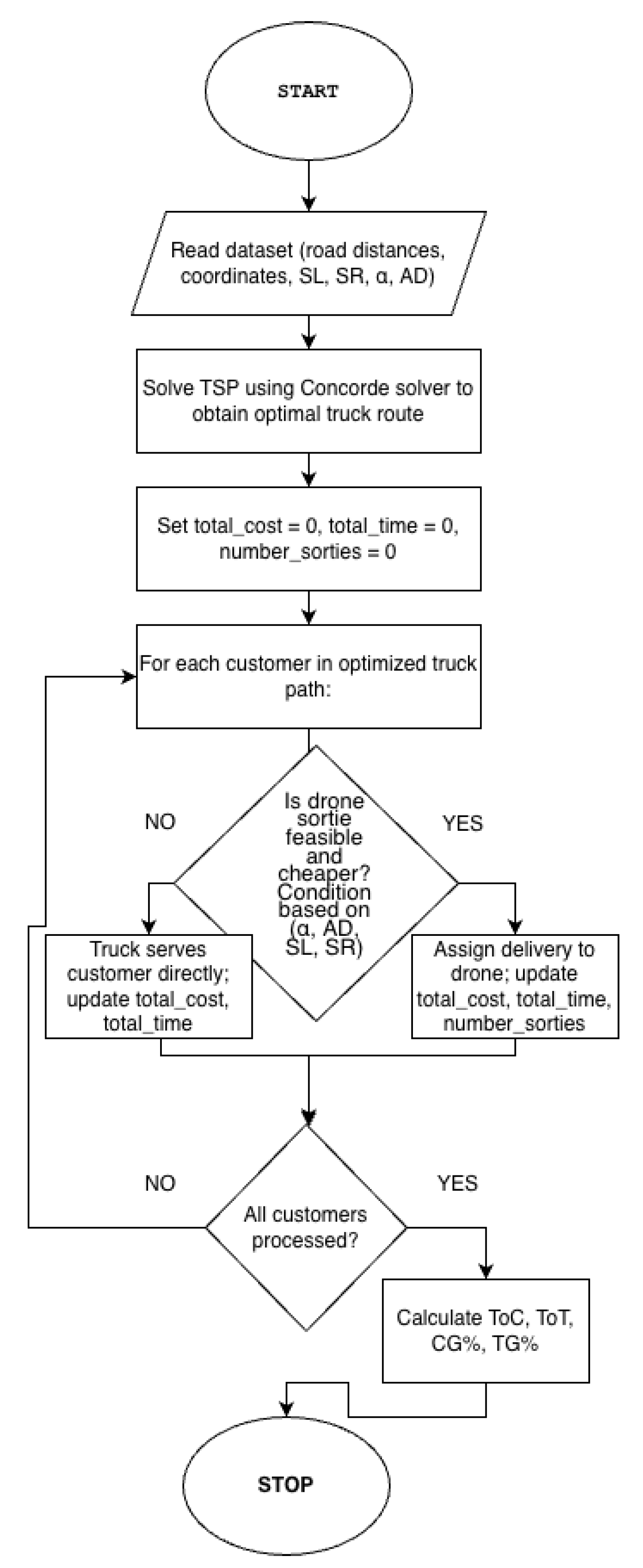
In our heuristic algorithm, drone allocation is achieved through an iterative local decision-making process based on a cost evaluation. We consider the length of the travel path as the cost. Starting from the truck’s current location and analyzing the next client from the initial TSP route (the pre-calculated optimum route received as input) that requires service, the algorithm evaluates two options: either the truck continues to serve this client, or the drone takes over the mission. First, a “hypothetical cost” for the truck is calculated, that is, how much it would cost the truck to travel from its current location to the target client. Concurrently, the cost of a complete drone mission from the truck’s current location to the target client and back is determined. This cost is based on the flight distance (calculated using the Haversine formula), the speed factor α, the launch cost SL, and the recovery cost SR. If the drone mission is feasible (the drone autonomy AD allows the flight) and its cost is lower than the truck’s hypothetical cost, the drone is allocated for the delivery; in this case, the final total cost of the route is reduced by the generated savings, and the truck remains stationary at its current location, allowing the drone to complete its mission. Otherwise, the truck takes over the delivery, physically moving to the respective client, and the final total cost is not adjusted, with the truck continuing its optimized route. This sequential process is repeated for all clients, ensuring a greedy allocation of tasks to minimize the total cost. The time complexity of our algorithm, as described, is linear, specifically O(c), where c represents the number of clients. This efficiency stems from the fact that the algorithm traverses the initial TSP route only once, and all operations performed within each step (Haversine distance calculations, lookups in the distance matrix, set operations for drone-served clients, and cost updates) are executed in constant time (O(1)).
The core innovation of the proposed heuristic lies in the local decision-making process that dynamically evaluates, for each customer, whether delivery by the drone is more efficient than continuing with the truck. Unlike most existing approaches that schedule all sorties beforehand, our algorithm iteratively updates costs and routes based on feasibility and savings, using real-world distances and drone operational parameters. This step-wise, adaptive decision rule forms the essential contribution of the paper.
The optimal truck route is first determined using the Concorde TSP Solver [6], which provides the minimum-length Hamiltonian cycle based on real road distances between the 93 delivery points. For the drone, the aerial distance between any two nodes i and j is computed using the Haversine formula:
d i j D = 2 R a r c s i n s i n 2 ϕ j ϕ i 2 + c o s ( ϕ i ) c o s ( ϕ j ) s i n 2 λ j λ i 2
where R = 6371 km  is the Earth’s radius, and ϕ , λ are the latitude and longitude of the corresponding points.
The truck cost for a segment (i, j) is computed as C i j T = d i j T , and the time of the truck T i j T = d i j T v T , where v T = 50   km / h is the truck speed.
The drone cost and time for a sortie (i, j, k) are given by
C i j k D = d i j D + d j k D , T i j k D = C i j k D α v T + S L + S R ,
where α is the drone speed factor and SL, SR are launch and recovery times (in hours).
A drone sortie is feasible if C i j k D A D , where AD is the drone autonomy (maximum distance per mission).
The decision rule of the heuristic compares the hypothetical cost/time of the truck vs. drone: If   C i j k D < C i j T and sortie is feasible, assign drone to node j .
The pseudocode for the drone insertion follows: the heuristic iterates through all savings candidates and evaluates each potential drone sortie according to its cost efficiency and feasibility conditions.
number_sorties = 0
 SORT savings_candidates DESC on saving_value
 FOR EACH (saving_value) IN savings_candidates:
  IF saving_value > 0 AND customer_to_serve_by_drone NOT IN drone_served_customers:
    drone_missions.ADD(
    launch_node = prev_node_truck,
    delivery_node = customer_to_serve_by_drone,
    recovery_node = next_node_truck,
    cost = actual_drone_cost )
  drone_served_customers.ADD(customer_to_serve_by_drone)
  UPDATE costs, number_sorties = number_sorties + 1
  REMOVE customer_to_serve_by_drone FROM optimized_truck_path
  END IF
END FOR
The overall workflow of this two-stage process is illustrated in Figure 2, which summarizes the sequence of operations from input data processing to the computation of total cost (ToC) and total time (ToT).

3.2. The Data Used

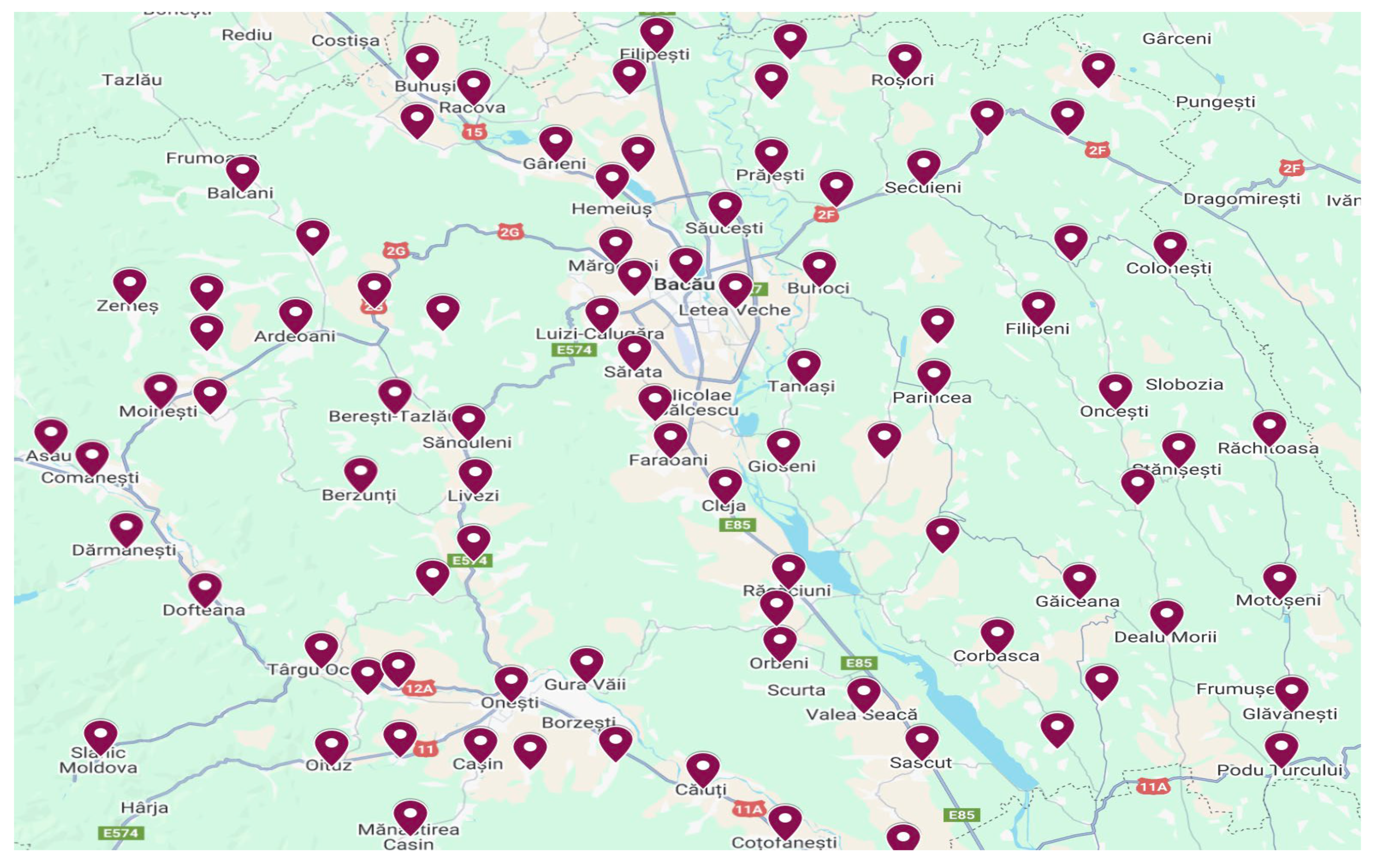
The data used in this study includes all 93 localities in the Bacău County. The geographical coordinates of these localities were obtained through a data scraping process, recorded in the GEO norm format. These coordinates were essential for defining the drone’s flight path, with distances precisely calculated using the Haversine formula. For optimizing truck routes, the same geographical data was utilized. Road distances were determined with the aid of the Google Maps API, which allowed for the creation of a 93 × 93 distance matrix. This matrix was then input into the Concorde exact solver [6], which provided the optimal solution for this specific instance, resulting in a total distance of 1057 km. Figure 3 presents an illustrative geographical representation of the dataset corresponding to the 93 localities within Bacău County, Romania. For visualization clarity, only a subset of the nodes is displayed, while maintaining their true spatial distribution. The map was generated from geographic coordinates in KML (Keyhole Markup Language) format and visualized using Google My Maps, providing an overview of the spatial layout and distances between the delivery points.

4. Computational Experiment

The computational experiment was performed on a MacBook Pro M1 Pro 2021 with 32 GB RAM running macOS Ventura 13.2, as well as on a server equipped with two Intel Xeon E5-2650 V4 processors, 384 GB RAM, and Windows Server 2025 Datacenter. The source code, written in Python 3.13, along with the dataset, is available for future research from the corresponding author.
This computational experiment aims to systematically and simultaneously evaluate the impact of four key operational parameters, SL (Drone Launch Speed), SR (Drone Recovery Speed), α (Drone Speed Factor), and AD (Drone Autonomy), on critical performance metrics within the context of the Flying Sidekick Traveling Salesman Problem (FSTSP), involving collaborative truck-and-drone operations.
Table 1 presents two evaluations for the proposed heuristic approach: the total cost of the hybrid system (ToC) in kilometers, and the total time (ToT) needed by the hybrid system to reach the depot in hours. Additionally, the number of sorties (NS) is also reported for the considered dataset. ToC and ToT are computed using Equations (2) and (3):
T o C = T r C + D r C
T o T = T r T + D r T + N S ( L T + R T )
where TrC (truck cost), DrC (drone cost, penalties included), and NS (number of sorties) are reported by the application and TrT (truck traveling time), DrT (drone flying time), RT (drone recovery time) are computed using Equations (4) and (5):
T r T = T r C / t r u c k _ s p e e d
D r T = D r C / a l p h a t r u c k _ s p e e d
The value for the parameter truck_speed is 50 km/hr, and LT and RT are computed by considering the penalties SL and SR as minutes and transforming them into hours (with Table 1 showing only two decimals).
The results from Table 1 are compared against the cost and travel time when only the truck serves all the delivery points, using the initial, optimum solution provided by Concorde: TrOC (truck only cost) = 1057 km, TrOT (truck only time) = 21.14 h. The column CG (cost gain) reports the percentage of cost gain; the column TG reports the percentage of time gain when using the proposed method.

5. Discussion

The total cost of the system offers a positive gain for only 15 cases: 1 case when alpha is 2, 5 cases when alpha is 3, and 9 cases when alpha is 4. This means that the gain appears when the drone speed is higher and therefore when a higher number of sorties are set. We decided to compute the cost of the system as the sum of the kilometers traveled by the two vehicles, although the drone’s “cost” per kilometer is far less than the truck one. But the kilometers traveled by each vehicle more clearly show the work division between the two vehicles.
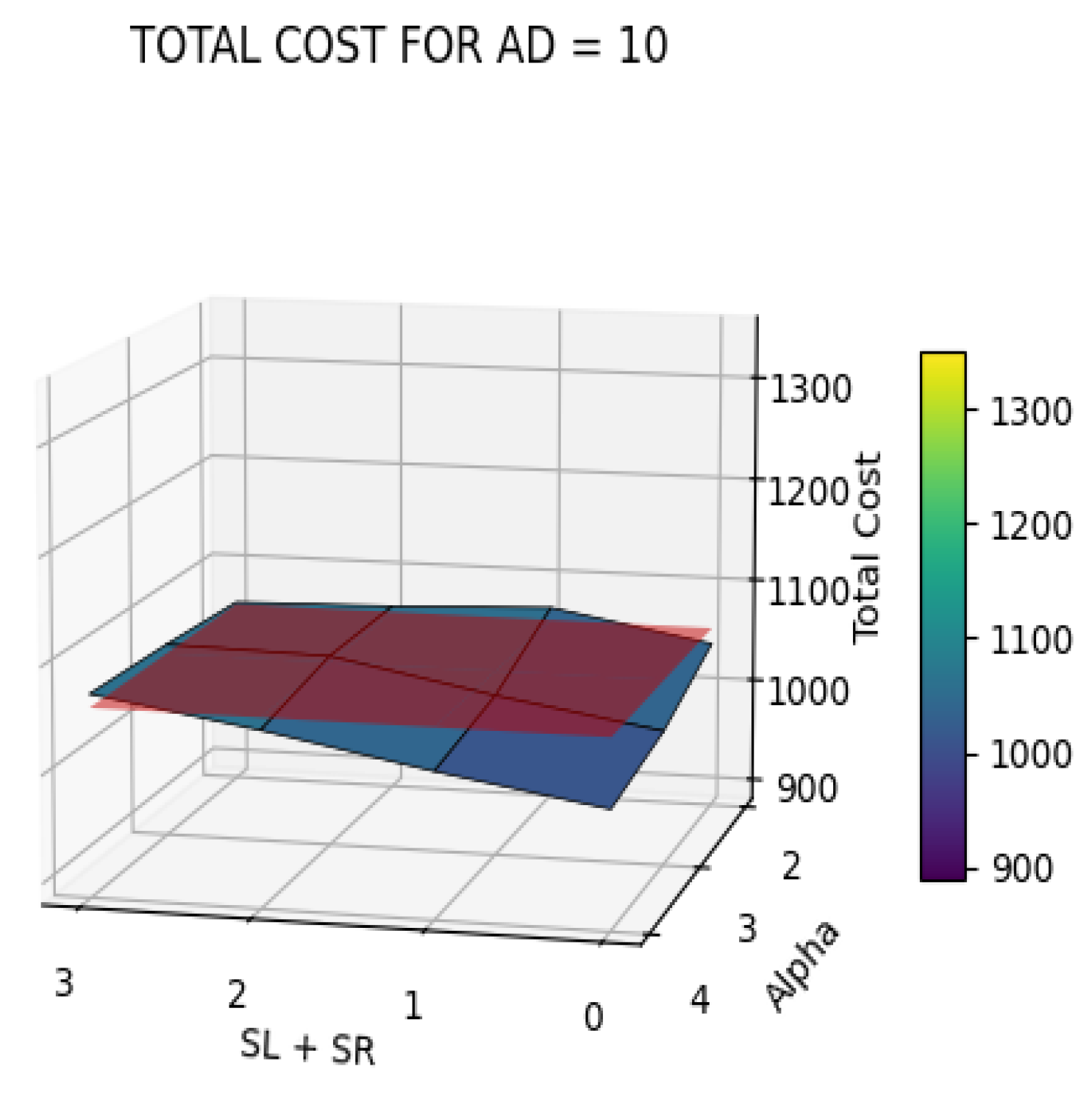
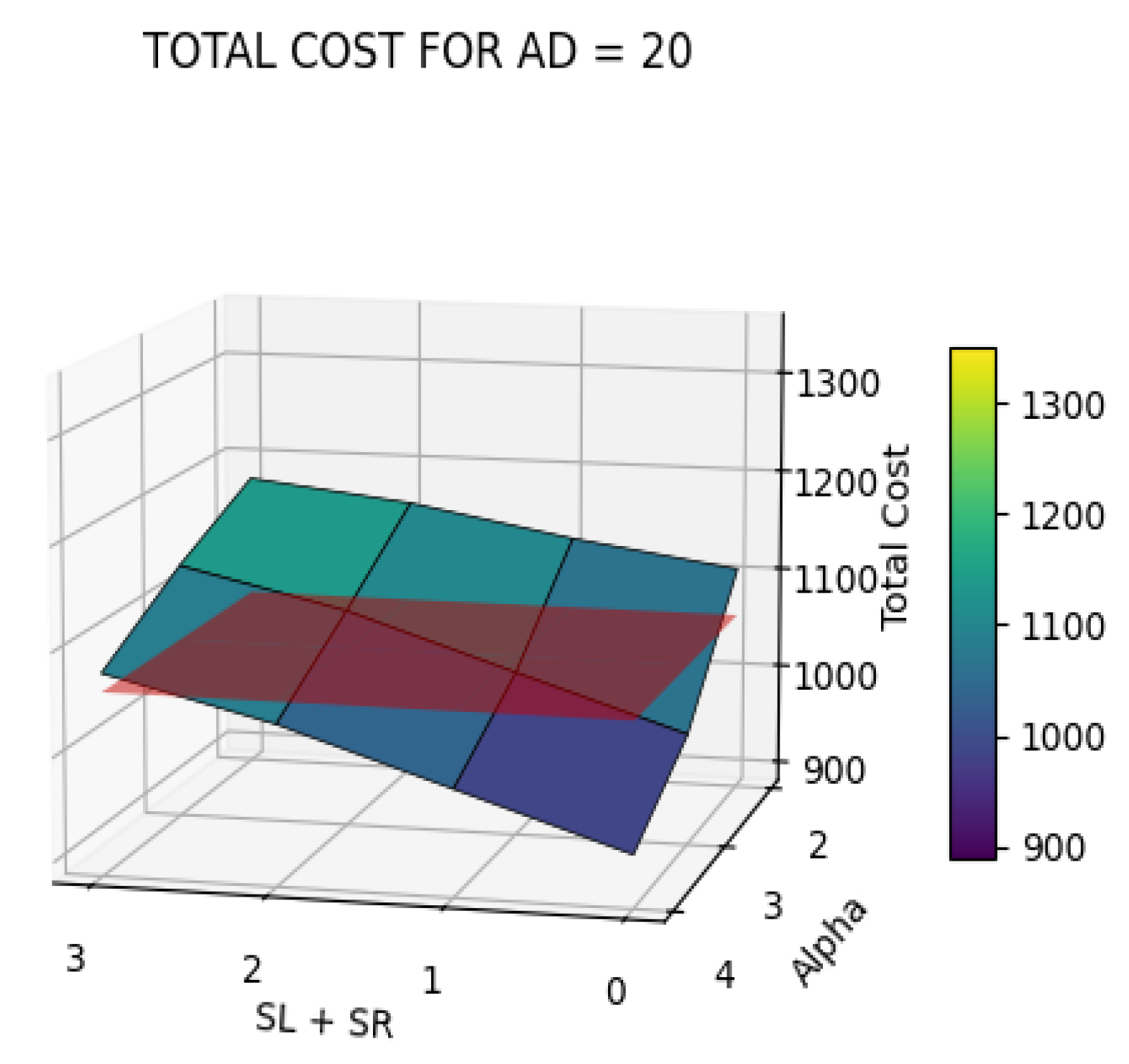
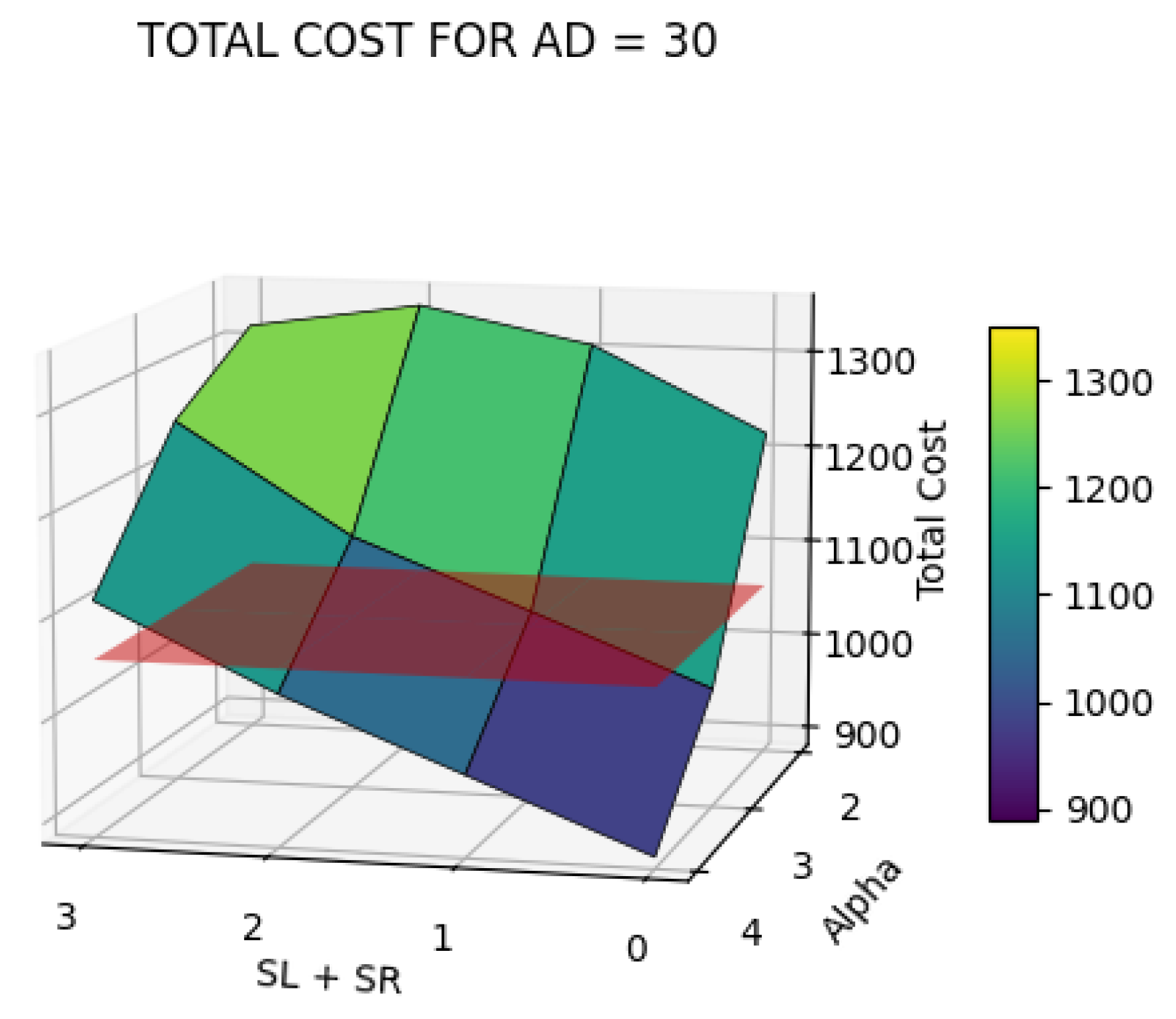
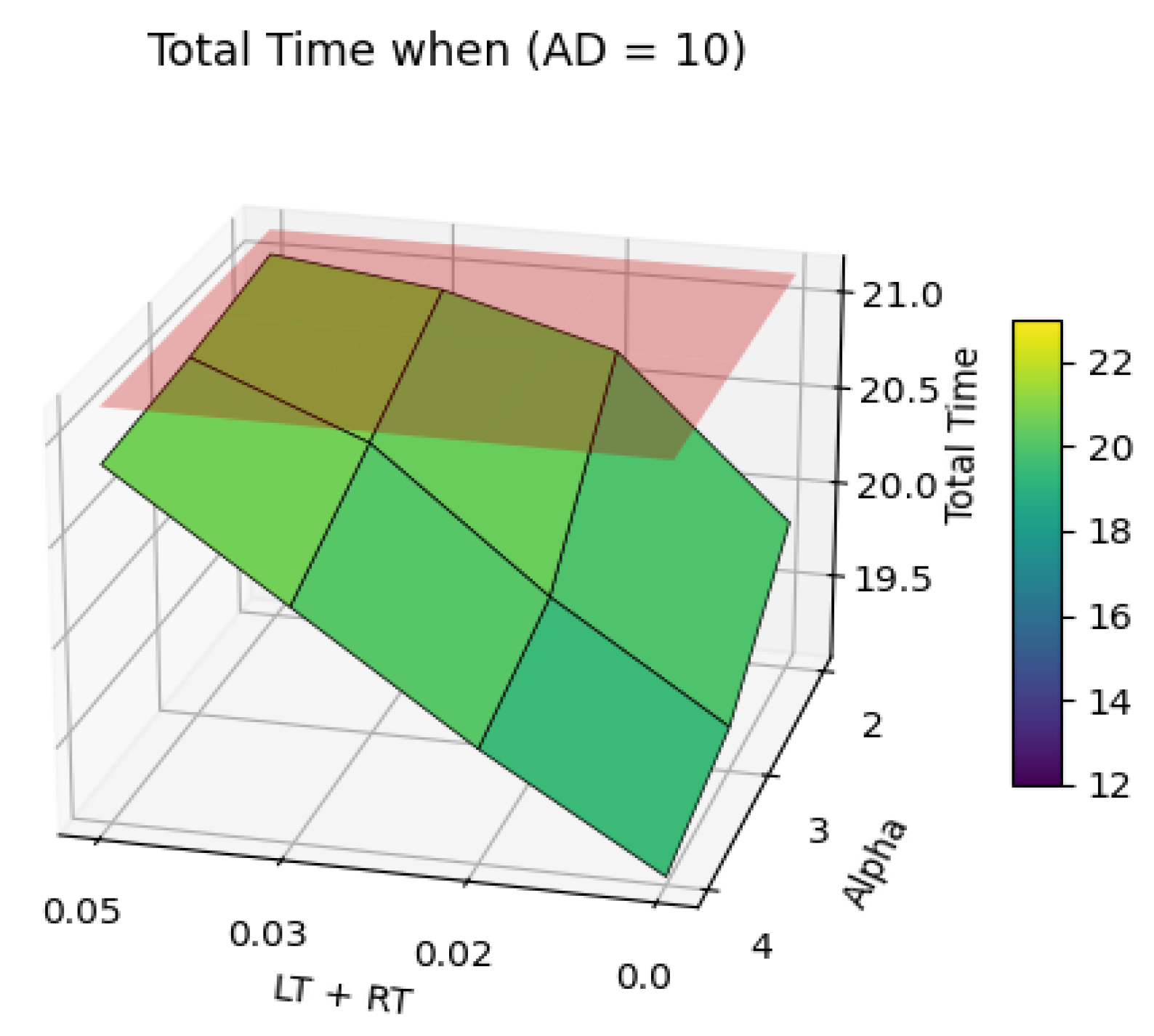
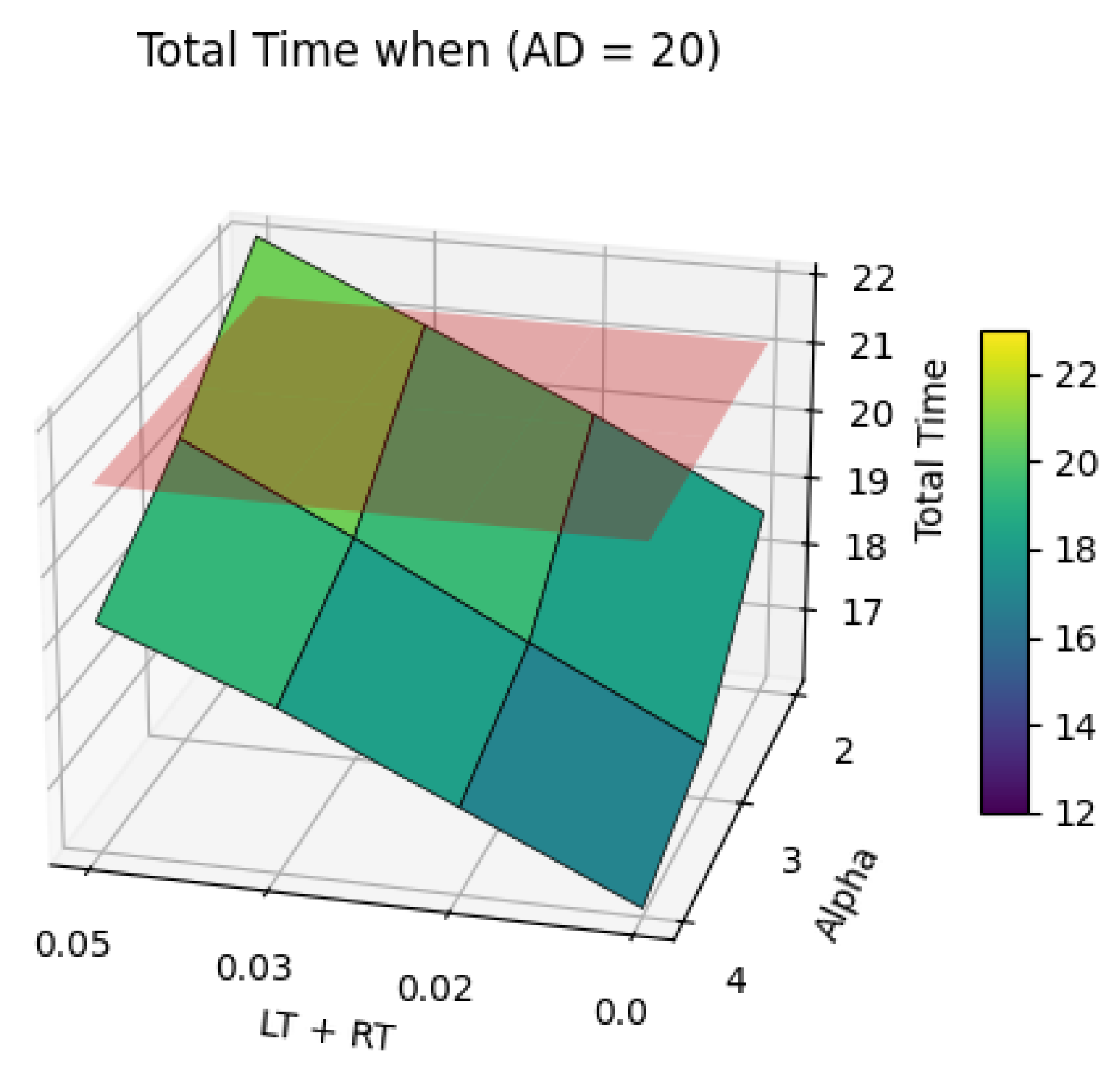
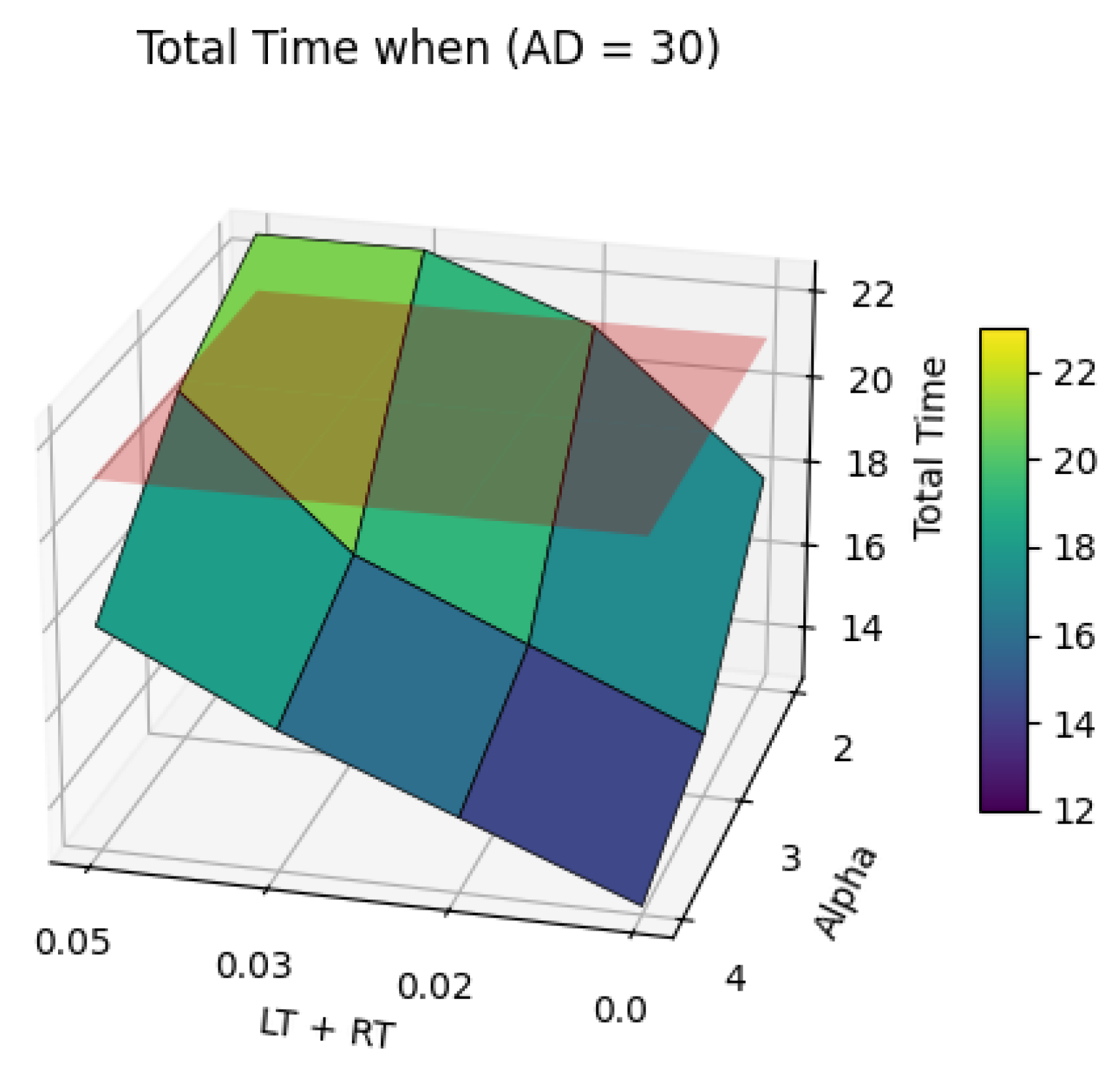
The travel time needed by both vehicles to arrive at the depot after serving all the customers is a measure in line with the cost defined in [22]. For this second measure, our proposal provides better results than the truck-only best solution in 33 cases out of 36. Again, the speed of the drone is directly proportional to the reported gain. The representations of the ToC and ToT are in Figure 4, Figure 5, Figure 6, Figure 7, Figure 8 and Figure 9. Figure 4, Figure 5 and Figure 6 show the ToC values when AD is 10, 20, and 30, respectively. Figure 7, Figure 8 and Figure 9 show the ToT values when AD is 10, 20 and 30, respectively.
The figures were generated using the Python programming language and the Matplotlib library (3.10.7), along with the mpl_toolkits.mplot3d extension for three-dimensional data visualization. These are 3D surface plots, used to illustrate the variation in a dependent variable (such as total cost or total time) with respect to two discrete parameters. The resulting surface provides an intuitive visual representation of trends and critical points within the experimental setup. All figures have a red plan representing the corresponding value of the truck-only initial solution.
From Figure 4, Figure 5 and Figure 6, we can conclude that the higher autonomy the higher variability (range/max_value) in ToC values (7.28% for AD = 10, 20.76% for AD = 20 and 33.43% for AD = 30%).
The results from Table 1 show that ToC does not depend on the drone speed, the ToC variability is 22% for α = 2, 21% for α = 3, and 20% for α = 4.
Figure 7, Figure 8 and Figure 9 show that the influence of AD on ToT is important (9.1% for AD = 10, 27.15% for AD = 20, and 42.32% for AD = 30). Extracting ToT from Table 1, we notice the same great influence of α on ToT (variability is 21%, for α = 2, 32% for α = 3, and 38% for α = 4).
In conclusion, the ToC and ToT metrics have different behavior; ToC seems to be independent of α, while ToT depends on this parameter; both metrics clearly depend on the AD parameter.
It should be noted that several scenarios in Table 1 yield negative values for the cost gain (CG%) or time gain (TG%). These cases correspond to combinations of low drone speed (α = 2), reduced autonomy (AD = 10–20), and high launch or recovery penalties (SL, SR ≥ 1.0). Under these conditions, the total time required for drone preparation and reintegration exceeds the travel time saved by aerial deliveries. Similarly, when autonomy is limited, the drone performs many short sorties that do not significantly reduce the truck’s overall route length, thereby increasing the cumulative cost. These results confirm that the proposed system is advantageous only when the drone operates at sufficiently high speed and autonomy, and when operational penalties are minimal. In practical terms, this emphasizes the importance of selecting appropriate drone models and optimizing launch–recovery mechanisms to fully realize the potential of hybrid delivery systems.
The last value reported by our application, NS (number of sorties), has an interesting behavior:
  • If no penalties are applied (SL = SR = 0), NS depends strictly on AD: NS = 25 if AD = 10; NS = 52 if AD = 20; NS = 70 if AD = 30. In this case, the drone speed has no impact on NS.
  • If penalties are small (SL = SR = 0.5), NS is influenced by the drone speed only if the drone is slow: NS = 22/44/59 if α = 2 and AD = 10/20/30; NS = 25/52/70 if α > 2 and AD = 10/20/30;
  • If each penalty is larger than 0.5, then the value of NS is influenced by all the parameters. If the optimization problem considers also minimizing NS, then the study must be oriented on high-speed drones, which really impact this variable.
These results show that the hybrid delivery system formed by a truck and a drone offers an efficient alternative for timely deliveries. For example, in case of medical emergencies, or in case of disasters, this system could reach remote points faster.

Experimental Assumptions and Their Rationale

To ensure the reproducibility and interpretability of the computational results, several simplifying assumptions were adopted in the experimental design. These assumptions are common in heuristic studies of truck–drone collaborative delivery systems and were chosen to balance realism with computational tractability.
The truck speed was fixed at vT = 50 km/h, representing an average effective speed across both urban and non-urban areas within Bacău County. While actual speeds vary between approximately 30 km/h in urban zones and 70–80 km/h on intercity roads, this average value was selected to simplify comparisons between scenarios and to isolate the influence of the drone-related parameters (α, AD, SL, SR) from variable road conditions. This approximation allows the model to reflect overall travel efficiency without overfitting to local traffic patterns.
The drone’s relative speed factor α (ranging from 2 to 4) was treated as constant within each scenario. This assumes stable flight conditions and allows for direct observation of how drone autonomy (AD) interacts with its relative velocity.
The launch and recovery operations were modeled as fixed penalties (SL and SR, expressed in minutes) to represent the average operational delay due to mechanical handling, system checks, and communication synchronization. Although, in real-world deployments, these times may vary, using fixed values simplifies performance comparison and enables sensitivity analysis on their impact.
The autonomy parameter AD was varied across values of 10 km, 20 km, and 30 km, representing short-, medium-, and long-range delivery capabilities. The assumption of constant battery endurance per sortie abstracts away from altitude or payload effects, focusing instead on operational feasibility.
These assumptions lead to an idealized but interpretable experiment. While real-world variability (e.g., traffic congestion, wind, and charging delays) may influence individual deliveries, the comparative nature of the study remains valid. The main performance indicators—cost gain (CG%) and time gain (TG%)—capture relative improvements between the hybrid and truck-only systems, which are robust to such simplifications.

6. Conclusions and Future Work

The proposed method shows promising results when applied to a dataset with 93 real localities from Romania. One important feature is that at any moment in time, only one vehicle operates. This means that when the truck travels, the drone can charge or use an automated system for loading the next parcel [34]. When the drone flies, the driver can charge, fuel the truck, or take a break. These simultaneous preparation phases of the next steps can (as the experiment showed) increase the speed of the deliveries.
The main scientific contribution of this study lies in the development of a two-stage heuristic that integrates four operational parameters—drone launch time (SL), recovery time (SR), speed factor (α), and autonomy (AD)—within an asynchronous truck–drone delivery model. When tested on a real dataset, the proposed system achieved up to 15.59% cost reduction and 38.69% delivery time savings compared to the optimal truck-only route. The approach is generalizable to other geographical datasets since it relies only on real road and geodetic distances as input data and can be adapted to various delivery technologies and operational scenarios by adjusting the key parameters (α, SL, SR, AD).
We intend to include in our study the charging stations and to consider the case of an electric truck. This supplementary set of points may or may not be visited by the truck, based on the truck’s battery depletion. Another idea is to treat the problem as a multi-objective optimization one by considering at least the two metrics independently treated here: the total length and the total time.

Author Contributions

Conceptualization, S.I.C. and G.C.C.; methodology, S.I.C. and G.C.C.; software, S.I.C.; validation, G.C.C.; formal analysis, G.C.C.; investigation, S.I.C.; resources, S.I.C.; data curation, S.I.C. and G.C.C.; writing—original draft preparation, S.I.C.; writing—review and editing, S.I.C. and G.C.C.; visualization, S.I.C.; supervision, G.C.C.; project administration, S.I.C. and G.C.C.; funding acquisition, G.C.C. All authors have read and agreed to the published version of the manuscript.

Funding

The research was funded by the Ministry of Education, through the National Council for the Financing of Higher Education, Romania, grant number CNFIS-FDI-2025-F-0483: Improving the quality of RDI activities at “Vasile Alecsandri” University of Bacău through national and international cooperation (acronym: Connect-UBc).

Data Availability Statement

The data and the code are available at request from the corresponding author.

Conflicts of Interest

The authors declare no conflict of interest.

References

  1. Jahani, H.; Khosravi, Y.; Kargar, B.; Ong, K.L.; Arisian, S. Exploring the role of drones and UAVs in logistics and supply chain management: A novel text-based literature review. Int. J. Prod. Res. 2024, 63, 1873–1897. [Google Scholar] [CrossRef]
  2. Dienstknecht, M.; Boysen, N.; Briskorn, D. The traveling salesman problem with drone resupply. OR Spectr. 2022, 44, 1045–1086. [Google Scholar] [CrossRef]
  3. Roberti, R.; Ruthmair, M. Exact methods for the traveling salesman problem with drone. Transp. Sci. 2019, 53, 234–252. [Google Scholar] [CrossRef]
  4. Schmidt, J.; Tilk, C.; Irnich, S. Exact Solution of the Vehicle Routing Problem with Drones; Johannes Gutenberg-Universität Mainz: Mainz, Germany, 2023; Working Paper No. 2311; Available online: https://download.uni-mainz.de/RePEc/pdf/Discussion_Paper_2311.pdf (accessed on 13 October 2025).
  5. Imran, N.; Won, M. VRPD DT: Vehicle Routing Problem with Drones under Dynamically Changing Traffic Conditions. arXiv 2024, arXiv:2404.09065. [Google Scholar] [CrossRef]
  6. NEOS Server. Concorde TSP Solver. Available online: https://neos-server.org/neos/solvers/co:concorde/TSP.html (accessed on 1 June 2025).
  7. DHL Group. DHL Launches Its First Regular Fully Automated and Intelligent Urban Drone Delivery Service. Available online: https://group.dhl.com/en/media-relations/press-releases/2019/dhl-launches-its-first-regular-fully-automated-and-intelligent-urban-drone-delivery-service.html (accessed on 1 June 2025).
  8. FedEx. Wing Drones Transport FedEx Deliveries Directly to Homes. Available online: https://www.fedex.com/ro-ro/about/sustainability/our-approach/wing-drones-transport-fedex-deliveries-directly-to-homes.html (accessed on 1 June 2025).
  9. Guebsi, R.; Mami, S.; Chokmani, K. Drones in precision agriculture: A comprehensive review of applications, technologies, and challenges. Drones 2024, 8, 686. [Google Scholar] [CrossRef]
  10. Chauhan, A.; Kumar, N.; Soni, S.; Hafeez, A.; Singh, S.; Khan, M.; Husain, M.; Chauhan, A. Implementation of drone technology for farm monitoring & pesticide spraying: A review. Inf. Process. Agric. 2022, 10, 192–203. [Google Scholar]
  11. Kindervater, K. The emergence of lethal surveillance: Watching and killing in the history of drone technology. Secur. Dialogue 2016, 47, 223–238. [Google Scholar] [CrossRef]
  12. Kim, J.; Kwon, O.; Yang, T.; Kim, J.; Cho, N.; Choi, M.; Lee, M. A study on the advancement of intelligent military drones: Focusing on reconnaissance operations. IEEE Access 2024, 12, 55964–55975. [Google Scholar] [CrossRef]
  13. Honarmand, M.; Shahriari, H. Geological mapping using drone-based photogrammetry: An application for exploration of vein-type Cu mineralization. Minerals 2021, 11, 585. [Google Scholar] [CrossRef]
  14. Pal, P.; Anil, N.; Snehith, S.; Bansod, S.; Singh, S.; Srikanth, K.; Kumar, Y. Revolutionizing spatial data collection: The advancements and applications of 3D mapping with drone technology (photogrammetry). In Proceedings of the 2023 IEEE International Conference on Cloud Computing in Emerging Markets (CCEM), Bengaluru, India, 2–4 November 2023; pp. 244–248. [Google Scholar]
  15. Pant, S.; Maldague, X.; Genest, M.; Nooralishahi, P.; Ibarra-Castanedo, C.; Deane, S.; Avdelidis, N.; López, F. Drone-based non-destructive inspection of industrial sites: A review and case studies. Drones 2021, 5, 106. [Google Scholar]
  16. Valenzuela, H.; Antón, N.; Villarino, A.; Cubillos, X.; Domínguez, M. UAV applications for monitoring and management of civil infrastructures. Infrastructures 2025, 10, 106. [Google Scholar] [CrossRef]
  17. Lyu, M.; Huang, H.; Huang, C.; Zhao, Y. Unmanned aerial vehicles for search and rescue: A survey. Remote Sens. 2023, 15, 3266. [Google Scholar] [CrossRef]
  18. Holzinger, A.; Kieseberg, P.; Tschiatschek, S.; Eresheim, S.; Stampfer, K.; Buchelt, A.; Nothdurft, A.; Gollob, C.; Adrowitzer, A. Exploring artificial intelligence for applications of drones in forest ecology and management. For. Ecol. Manag. 2024, 549, 121530. [Google Scholar]
  19. Bezyk, Y.; Arsen, A.; Pawnuk, M.; Jońca, J.; Sówka, I. Drone-assisted monitoring of atmospheric pollution—A comprehensive review. Sustainability 2022, 14, 11516. [Google Scholar]
  20. Velfl, L.; Bureš, V.; Důbravová, H. Review of the application of drones for smart cities. IET Smart Cities 2024, 6, 312–332. [Google Scholar] [CrossRef]
  21. Balachandran, W.; Hunaiti, Z.; Al-Dosari, K. Systematic review on civilian drones in safety and security applications. Drones 2023, 7, 210. [Google Scholar] [CrossRef]
  22. Murray, C.; Chu, A. The flying sidekick traveling salesman problem: Optimization of drone-assisted parcel delivery. Transp. Res. Part C 2015, 54, 86–109. [Google Scholar] [CrossRef]
  23. El-Adle, A.; Haouari, M.; Ghoniem, A. Parcel delivery by vehicle and drone. J. Oper. Res. Soc. 2019, 72, 398–416. [Google Scholar] [CrossRef]
  24. Chung, S.H.; Sah, B.; Lee, J. Optimization for drone and truck cooperation logistics systems: A review of the state of the art and future directions. Comput. Oper. Res. 2020, 123, 105004. [Google Scholar] [CrossRef]
  25. Ponza, M. Optimization Models for Drone Deliveries. Master’s Thesis, University of Padua, Padua, Italy, 2016. [Google Scholar]
  26. Bartolini, N.; Attenni, G.; Arrigoni, V.; Maselli, G. Drone-based delivery systems: A survey on route planning. IEEE Access 2023, 11, 123476–123504. [Google Scholar] [CrossRef]
  27. Yang, Z.; Qiao, W. Solving large-scale function optimization problem by using a new metaheuristic algorithm based on quantum dolphin swarm algorithm. IEEE Access 2019, 7, 138972–138989. [Google Scholar] [CrossRef]
  28. Lin, S.; Kernighan, B. An effective heuristic algorithm for the traveling–salesman problem. Oper. Res. 1973, 21, 498–516. [Google Scholar] [CrossRef]
  29. Glover, F.; Laguna, M. Tabu Search; Kluwer Academic Publishers: Boston, MA, USA, 1997. [Google Scholar]
  30. Mitchell, M. An Introduction to Genetic Algorithms; MIT Press: Cambridge, MA, USA, 1996. [Google Scholar]
  31. Dorigo, M.; Stützle, T. Ant Colony Optimization; MIT Press: Cambridge, MA, USA, 2004. [Google Scholar]
  32. Zhang, R.; Dou, L.; Xin, B.; Chen, C.; Deng, F.; Chen, J. A review on the truck and drone cooperative delivery problem. Unmanned Syst. 2023, 12, 823–847. [Google Scholar] [CrossRef]
  33. Vilkki, A.; Tikanmäki, A.; Röning, J. Automatic Jig-Assisted Battery Exchange for Lightweight Drones. Machines 2024, 12, 818. [Google Scholar] [CrossRef]
  34. Melnyk, V. Method for Automatic Loading and Unloading of Shipments in an Unmanned Aircraft and Mechanism for Automatic Loading and Unloading of Shipments in an Unmanned Aircraft. EP Patent EP3957562A1, 23 February 2022. [Google Scholar]
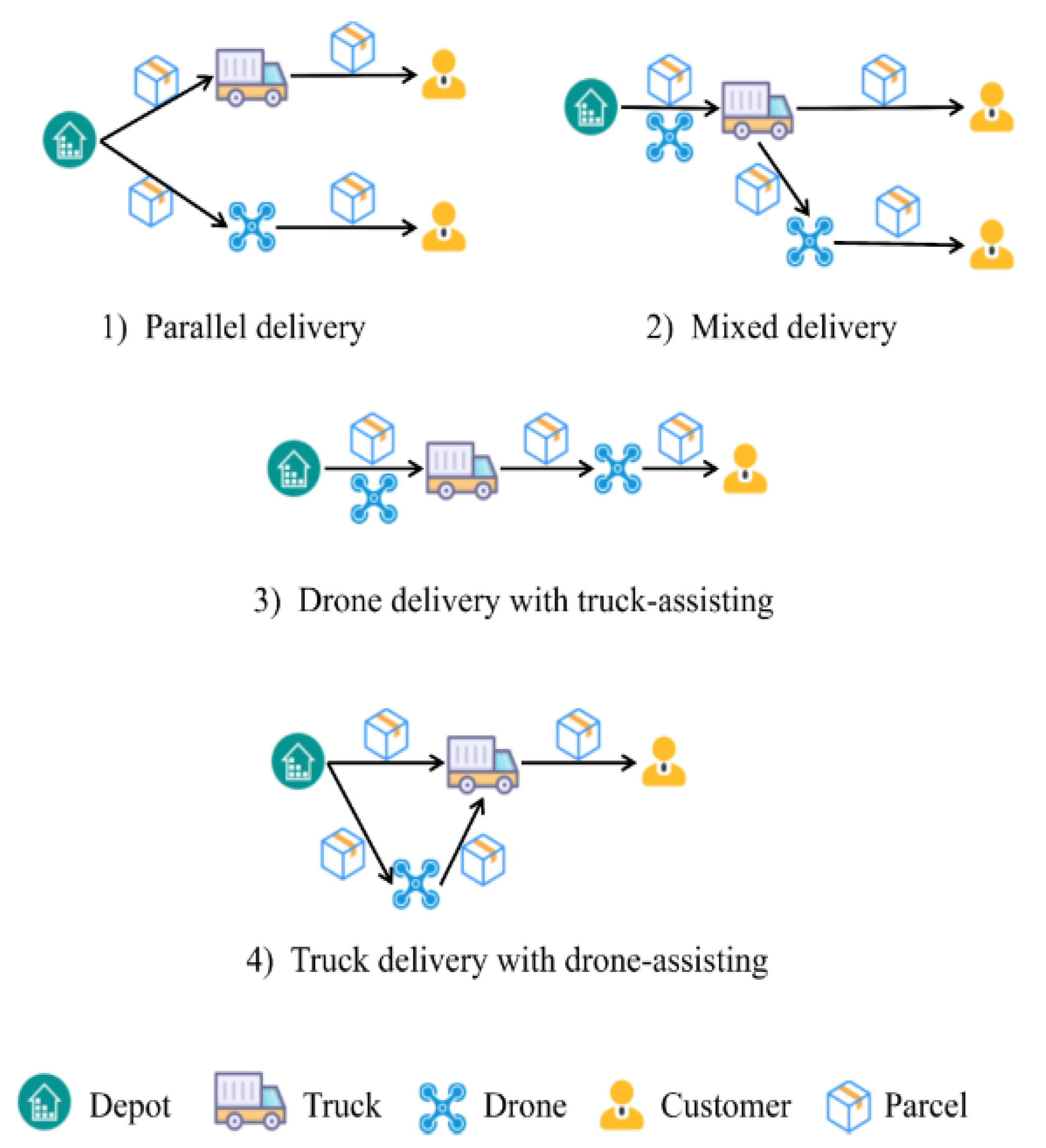
Figure 1. The flow direction of parcels [32].
Futuretransp 05 00181 g001
Figure 2. Flow diagram.
Futuretransp 05 00181 g002
Figure 3. Partial geographical representation of the 93 localities in Bacău County.
Futuretransp 05 00181 g003
Figure 4. ToC when AD = 10.
Futuretransp 05 00181 g004
Figure 5. ToC when AD = 20.
Futuretransp 05 00181 g005
Figure 6. ToC when AD = 30.
Futuretransp 05 00181 g006
Figure 7. ToT when AD = 10.
Futuretransp 05 00181 g007
Figure 8. ToT when AD = 20.
Futuretransp 05 00181 g008
Figure 9. ToT when AD = 30.
Futuretransp 05 00181 g009
Table 1. Values for the total cost and total time when four parameters are considered (SL, SR, alpha, AD), and the comparisons against the optimum TSP solution with only the truck making the deliveries.
SLSRAlphaADNSTrC
(km)
DrC
(km)
ToC
(km)
CG %LT + RT
(h)
ToT
(h)
TG %
0.00.021025942.4099.011041.411.47%0.0019.846.16%
0.50.521022960.50108.731069.23−1.16%0.0220.662.25%
1.01.021014980.5082.181062.68−0.54%0.0320.901.14%
1.51.52109996.7062.201058.90−0.18%0.0521.010.63%
0.00.031025942.4066.001008.404.60%0.0019.298.76%
0.50.531025942.4091.001033.402.23%0.0219.876.00%
1.01.031024951.70111.021062.72−0.54%0.0320.572.68%
1.51.531015980.2085.521065.72−0.82%0.0520.921.02%
0.00.041025942.4049.50991.906.16%0.0019.109.67%
0.50.541025942.4074.501016.903.79%0.0219.647.11%
1.01.041025945.7099.671045.371.10%0.0320.254.23%
1.51.541022960.50109.361069.86−1.22%0.0520.861.34%
0.00.022052758.90345.321104.22−4.47%0.0018.6311.87%
0.50.522044782.70345.161127.86−6.70%0.0219.846.15%
1.01.022038809.40347.711157.11−9.47%0.0320.930.99%
1.51.522030876.20299.561175.76−11.24%0.0522.02−4.16%
0.00.032052758.90230.21989.116.42%0.0016.7120.94%
0.50.532052758.90282.211041.111.50%0.0217.9315.20%
1.01.032051764.90329.001093.90−3.49%0.0319.199.22%
1.51.532044797.70333.341131.04−7.00%0.0520.383.61%
0.00.042052758.90172.66931.5611.87%0.0016.0424.12%
0.50.542052758.90224.66983.566.95%0.0217.1718.79%
1.01.042052758.90276.661035.562.03%0.0318.2913.46%
1.51.542050756.00319.131075.13−1.72%0.0519.229.10%
0.00.023070566.60651.251217.85−15.22%0.0017.8415.59%
0.50.523059699.70604.701304.40−23.41%0.0221.020.55%
1.01.023053727.70612.741340.44−26.82%0.0322.45−6.19%
1.51.523049688.90624.151313.05−24.22%0.0522.47−6.29%
0.00.033070566.60434.171000.775.32%0.0014.2332.70%
0.50.533070566.60504.171070.77−1.30%0.0215.8624.98%
1.01.033069572.70566.841139.54−7.81%0.0317.5317.06%
1.51.533056732.00518.901250.90−18.34%0.0520.901.14%
0.00.043070566.60325.62892.2215.59%0.0012.9638.69%
0.50.543070566.60395.62962.228.97%0.0214.4831.52%
1.01.043070566.60465.621032.222.34%0.0315.9924.35%
1.51.543068593.20522.271115.47−5.53%0.0517.8815.44%
Disclaimer/Publisher’s Note: The statements, opinions and data contained in all publications are solely those of the individual author(s) and contributor(s) and not of MDPI and/or the editor(s). MDPI and/or the editor(s) disclaim responsibility for any injury to people or property resulting from any ideas, methods, instructions or products referred to in the content.