3. Measures of Heterogeneity
How do we measure a forest’s irregularities? One might count trees, compare their heights, or note the angles at which they lean. Each measure captures part of the picture, but none tells the whole story. Similarly, heterogeneity can be quantified in several ways, each with its own strengths and limitations.
The Q statistic, introduced by Cochran in 1954 [
1], is the oldest test for heterogeneity. It asks whether differences between studies exceed what would be expected by chance. In forest terms, random tilts are normal, but if many trunks lean sharply, something real makes the forest uneven. Q distinguishes these cases. In practice, Q sums the squared deviation of each study from the pooled mean, weighting precise studies more heavily. If studies align, Q stays small; if some diverge, Q grows.
- 2.
Interpretation.
Under the null hypothesis of homogeneity, Q follows an approximate chi-square (χ
2) distribution with degrees of freedom (
df) equal to the number of studies minus one (
df =
k − 1) [
2,
3]. The χ
2 distribution is a reference curve for scatter expected by chance—a “null model” of a perfectly straight forest: if observed Q greatly exceeds this baseline, variation is unlikely to be random. Degrees of freedom (
df) serve to calibrate this test because they define the χ
2 curve against which Q is compared when calculating the
p-value. In a small grove, with few studies and therefore low
df, the test has limited information and low power: even meaningful heterogeneity may remain undetected. In a vast forest, with numerous studies and therefore high
df, even small or clinically trivial deviations may become statistically detectable.
In short, a larger Q suggests greater departure from homogeneity, but its interpretation depends strongly on study precision and the number of included studies; df adjusts the yardstick for judging whether the observed departure is extreme enough to reject homogeneity. A small p-value (e.g., <0.05) suggests that observed variability exceeds what would typically be expected by chance.
- 3.
Limitations.
Because Q depends on
df, it is strongly influenced by the number of studies. With few, it has low power and may miss true heterogeneity; with many, it becomes oversensitive, flagging trivial differences [
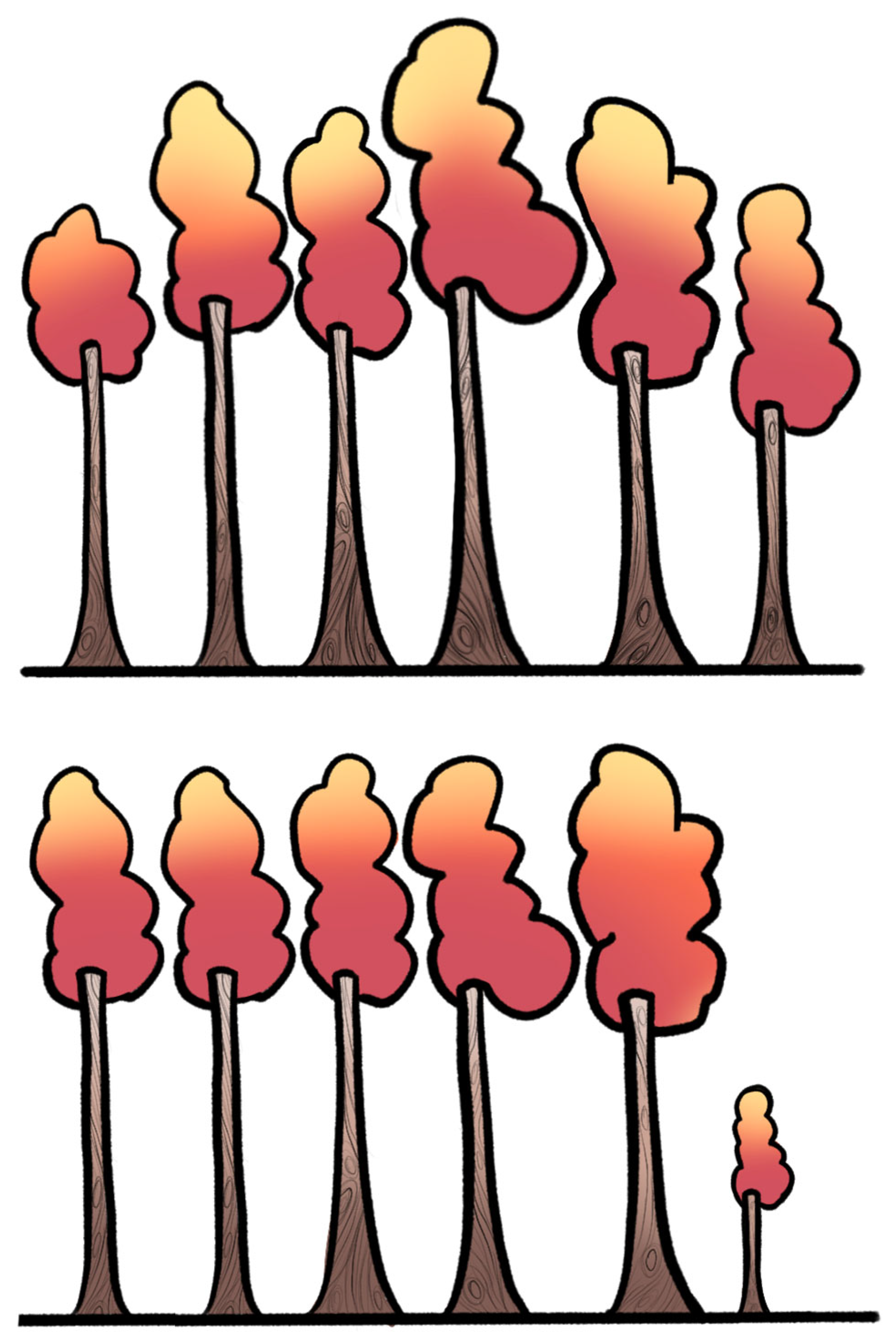
4]. Another key limitation is that Q reflects the amount of excess variation but not its structure. Two meta-analyses can have the same Q value but exhibit very different patterns of irregularity—numerous small deviations versus one extreme outlier. In forest terms, Q can tell us that the skyline is uneven, but not why: whether the irregularity arises from many trees differing slightly in height, or from a dramatically shorter single trunk (
Figure 2). Q is helpful as a first signal, but never sufficient on its own.
The I
2 statistic, introduced by Higgins and Thompson in 2002 [
5,
6], is the proportion of total variability in effect estimates attributable to heterogeneity rather than chance. It is derived from Q and its
df. I
2 is a percentage: 0% means the observed scatter is attributable to sampling error alone; higher values indicate that a larger proportion of the observed variability is attributable to between-study differences. For example, I
2 = 50% suggests that approximately half of the observed variability (not half of the studies!) is attributable to heterogeneity rather than sampling error.
- 2.
Interpretation.
Guidelines sometimes classify I
2 values as: 0–40% possibly unimportant, 30–60% moderate, 50–90% substantial, and 75–100% considerable. These thresholds are rough guides. Two forests may both yield I
2 = 50% and still look very different: one where tilts are barely noticeable, another where several trunks are almost falling. For this reason, the Cochrane Handbook cautions against applying thresholds rigidly [
7].
- 3.
Limitations.
I
2 does not measure the actual size of heterogeneity, only its proportion. In meta-analyses involving highly precise studies, even small absolute differences can yield high I
2 values. Conversely, with small, imprecise studies, I
2 may appear low despite an obvious spread, or it may overestimate heterogeneity due to noise [
8]. Another limitation is instability with few studies: in a small forest, I
2 may under- or overestimate heterogeneity, and its apparent precision can be misleading. In summary, I
2 is a useful descriptor of relative heterogeneity; however, it does not reveal the actual magnitude of heterogeneity and should not be interpreted in isolation.
The τ2 statistic is the main measure of between-study variance in a meta-analysis. Variance describes how spread out a set of numbers is. If all studies give almost identical results, the variance is close to zero; if results differ widely, the variance is larger. While Q detects whether heterogeneity exists and I2 quantifies the proportion of observed variability beyond chance, τ2 quantifies the absolute magnitude of between-study variance on the squared effect-size scale, whereas τ expresses the between-study standard deviation on the effect-size scale. For example, in a meta-analysis of weight loss (in kilograms), τ describes the typical between-study spread directly in kilograms, whereas τ2 is the variance parameter used by the random-effects model to represent that dispersion.
In forest terms, I2 describes how much of the visible unevenness reflects systematic differences across the forest, whereas τ2 indicates how large those underlying differences are.
- 2.
Interpretation.
Fixed-effect models assume that all studies estimate the same underlying effect. Any differences are attributed to sampling error, so between-study variance is constrained to zero, and τ2 is therefore not allowed to vary in the model.
Random-effects models, by contrast, acknowledge that true effects may differ across studies due to variation in populations, interventions, or methods. Here, τ2 captures the actual variance of these true effects—the average squared distance between them. If τ2 = 0, the forest is uniform; as τ2 grows, the trunks lean at increasingly different angles.
Strictly, τ2 denotes the true between-study variance, whereas 2 denotes the empirical estimate calculated from the included studies using an estimator such as REML, Paule–Mandel, or DerSimonian–Laird. For readability, this tutorial follows common usage and refers to τ2 throughout, but any reported numerical value of τ2 should be understood as an estimate of the true between-study variance.
Estimating τ2 is not trivial. Several methods exist:
DerSimonian–Laird (DL). The most widely known and historically dominant estimator [
9]. DL is simple and computationally convenient, which explains its widespread use in standard meta-analytic software. It is directly linked to Cochran’s Q, the same statistic underlying the standard χ
2 test for homogeneity. However, this same dependence on Q contributes to its limitations: with few studies, sparse data, unbalanced weights, or substantial true heterogeneity, DL may underestimate τ
2, pull between-study variance toward zero, and produce overly narrow confidence intervals. Given these limitations, reliance on DL as the default estimator warrants caution.
Restricted maximum likelihood (REML). Widely recommended in contemporary methodological guidance [
10,
11]. Unlike DL, REML incorporates uncertainty in the pooled effect when estimating τ
2 and is often less biased under many common meta-analytic conditions, particularly when the number of studies is small or heterogeneity is high.
Paule–Mandel. A moment-based estimator that, like REML, provides more stable estimates of between-study variance than DL, particularly in the presence of substantial heterogeneity or when study weights are unbalanced. It has been shown to perform well in terms of bias and coverage across a range of realistic meta-analytic scenarios.
Bayesian estimators. In Bayesian statistics, τ
2 is not treated as a fixed number but as an uncertain quantity, described by a probability distribution. We start with a
prior (what we already know or assume) and update it with the data to get a
posterior (what seems plausible after seeing the evidence) [
12]. The advantage is that we can make direct probability statements, like “
there is a 70% chance that heterogeneity is above a clinically important level.” This approach is flexible, especially when data are scarce, but the results depend on how the
prior is chosen, so the choice must be made transparently.
Once τ
2 is estimated, it influences not only descriptive measures of heterogeneity but also statistical inference, particularly the calculation of confidence intervals around the pooled effect. In random-effects meta-analysis, these confidence intervals can be calculated in different ways. The conventional Wald-type approach—the default output in software such as Review Manager 5 (RevMan 5), version 5.4 (The Cochrane Collaboration, Copenhagen, Denmark, 2020)—is simple, but it may underestimate uncertainty when the number of studies is small or when between-study variance is present (τ
2 ≠ 0). This can make the pooled effect look more precise than it really is. The Hartung–Knapp–Sidik–Jonkman (HKSJ) adjustment, recommended in contemporary guidance such as the Cochrane Handbook [
7], was developed to provide more robust confidence intervals for the pooled effect in random-effects models by using a
t-based adjustment to better reflect uncertainty when few studies are available. HKSJ intervals are often wider, but not always, and should not be interpreted as a universal solution. In very small meta-analyses (e.g.,
k < 3) or in highly consistent evidence bases, HKSJ may be unstable or even yield unexpectedly narrow intervals; modified approaches, such as truncated Knapp–Hartung adjustments, may be considered. Therefore, HKSJ should be viewed as a useful inferential adjustment or sensitivity analysis, not as a substitute for judgment regarding the number of studies, heterogeneity, and clinical compatibility.
A key point is that τ
2 and I
2 are not interchangeable. Two meta-analyses may both report I
2 = 50%, meaning that approximately half of the observed variability is attributable to between-study heterogeneity. τ
2 indicates whether this variability is small or large on the squared effect-size scale, while τ expresses the corresponding between-study standard deviation on the effect-size scale.
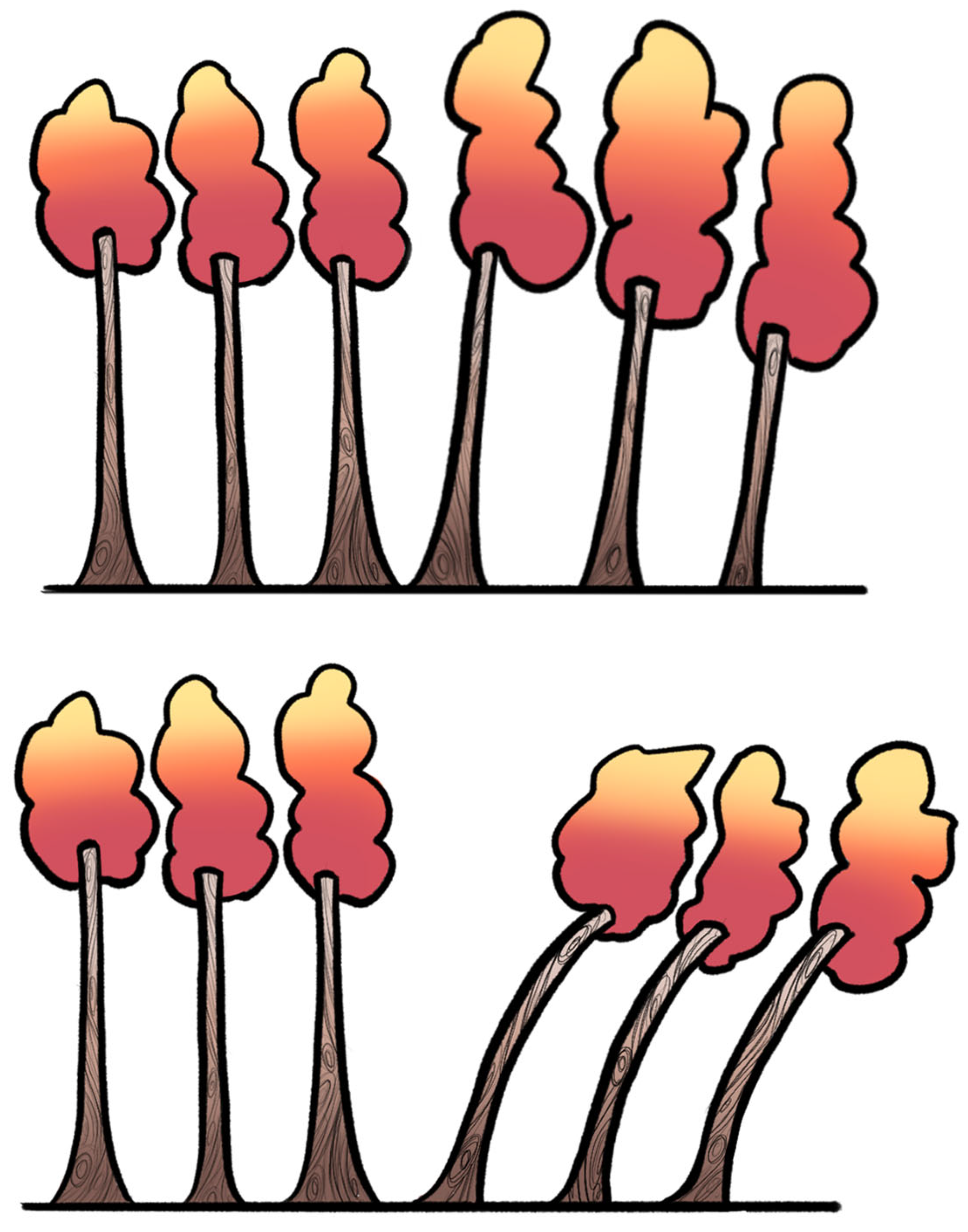
Figure 3 illustrates this: both panels are conceptually constructed to represent similar proportional heterogeneity, yet in one, the tilt is subtle; in the other, dramatic. Thus, τ
2, not I
2, sets the scale of absolute between-study heterogeneity and strongly influences random-effects weights, the width of pooled confidence intervals, the span of prediction intervals, and the stability of meta-regression.
- 3.
Limitations.
τ2 is less intuitive than Q or I2 because it is a variance estimated on the squared effect-size scale; its square root, τ, is expressed in the same units as the effect estimate and is often easier to interpret clinically. A τ2 value of 0.04 has different implications depending on the effect-size metric. On a log risk-ratio scale, it corresponds to τ = 0.20. Since risk ratios are analyzed on the logarithmic scale, τ must be converted back to the risk-ratio scale to understand the multiplicative spread of true effects across studies. By contrast, for a mean difference measured in kilograms, the same τ2 corresponds to τ = 0.20 kg, so the between-study standard deviation—not the variance itself—is interpreted directly in kilograms. Its meaning is relative to the chosen metric. Another limitation is its instability with few studies. When the forest has only a handful of trees, τ2 can swing wildly depending on the estimator—sometimes suggesting that trunks are almost perfectly aligned; other times that the woodland is chaotic. Finally, τ2 is often reported without confidence intervals. Yet its uncertainty can be large, especially in small meta-analyses, and ignoring it risks giving a false sense of certainty. In summary, τ2 is harder to interpret but plays a central structural role, as it measures the real size of heterogeneity and governs pooled results. Because τ2 underpins inference, prediction intervals (PIs) are the most direct clinical extension of it.
A confidence interval (CI) reflects the precision of the pooled effect, but says nothing about what a new study might show. PIs extend τ
2 by translating between-study variance into a range of plausible effects for future settings [
13,
14,
15]. Because they incorporate both sampling error and heterogeneity, PIs are usually wider than CIs.
In forest terms, the CI indicates the precision of the average tilt, while the PI shows the range of tilts likely to be found in other forests. Clinically, this matters: a pooled risk ratio may appear beneficial, with its confidence interval entirely below 1, yet the PI can cross the no-effect line, warning that in some contexts the intervention may not work or could even harm. In clinical terms, the PI asks whether the effect is likely to remain clinically meaningful in a new but comparable setting.
PIs become unstable when the number of studies (k) is small (e.g., <10–15), often yielding misleading coverage. This stems from their reliance on τ2; when τ2 is unstable, PIs inherit the instability. Hence, the importance of obtaining a robust τ2, since all downstream measures of heterogeneity depend on it.
PIs should be viewed as a conceptual tool that shows the plausible range of effects, rather than as a statistically robust interval in small meta-analyses.
5. Minimal Mathematical Expressions Needed to Interpret Heterogeneity Clinically
This tutorial is intended for clinicians and applied researchers, not for mathematical derivations of meta-analytic estimators. Nevertheless, a few formal expressions are useful because they explain why heterogeneity statistics may behave differently in practice. In particular, they clarify why Q is sensitive to both precision and the number of studies, why I2 is a relative rather than an absolute measure, why τ2 is scale-dependent, and why prediction intervals widen when between-study variance is large.
Here, is the effect estimate from the study , is the pooled effect, and is the study weight. Because larger and more precise studies receive greater weight, small differences between precise studies can produce a large Q. Clinically, Q should therefore be interpreted as a signal that variability exceeds sampling error, not as a measure of how important that variability is.
I2 is derived from Q and expresses the proportion of observed variability attributed to between-study differences. This formula explains why I2 may be high when studies are very precise: if sampling error is small, even modest between-study variability may represent a large proportion of the total variability. Conversely, imprecise studies may yield a lower I2 despite clinically relevant dispersion. I2 is therefore a relative measure, not a direct measure of the magnitude of heterogeneity.
Note: the expression above is the conventional Q-based formulation of I2. Some software implementations of random-effects meta-analysis, including REML-based output, may report I2 using an equivalent τ2-based formulation. These approaches are closely related but may yield slightly different numerical values in finite samples.
In a random-effects model, each study is allowed to estimate its own true effect , distributed around an average effect . The parameter represents the between-study variance. Unlike I2, τ2 is a variance defined on the squared effect-size scale, whereas τ is expressed in the same units as the effect estimate. Its interpretation, therefore, depends on the metric used. A given τ2 value has different implications for log risk ratios, odds ratios, hazard ratios, mean differences, or standardized mean differences. It is therefore more directly related to absolute heterogeneity, but also less immediately intuitive and estimator-dependent.
This expression shows why PIs are usually wider than CIs: they incorporate both uncertainty around the average effect and between-study heterogeneity. When is large, or when few studies make unstable, the PI widens. Clinically, this interval is often the most interpretable expression of heterogeneity because it asks what effect might be expected in a future comparable setting.
6. Worked Quantitative Example: Divergence Between Proportional and Absolute Heterogeneity
To illustrate why I2 and τ2 should not be interpreted interchangeably, three simulated meta-analytic datasets were created from hypothetical comparisons between an intervention group and a control group, using event and non-event counts. These examples are not intended to represent a specific clinical intervention, but to show how heterogeneity statistics may behave under different combinations of within-study precision, between-study variability, and number of included studies. To keep the examples focused on heterogeneity rather than sparse-data methods, the simulated datasets deliberately avoided zero-event cells. Real meta-analyses may involve zero events, rare outcomes, imbalanced group sizes, or other complexities that require additional analytic choices, such as continuity corrections or alternative effect-size estimators.
Random-effects models were fitted using restricted maximum likelihood (REML). The primary analyses were performed using Stata 19.0 (StataCorp LLC, College Station, TX, USA) with the official
meta suite. The simulated datasets are provided as
Supplementary Files S1–S3, and the reproducible Stata and R code is provided as
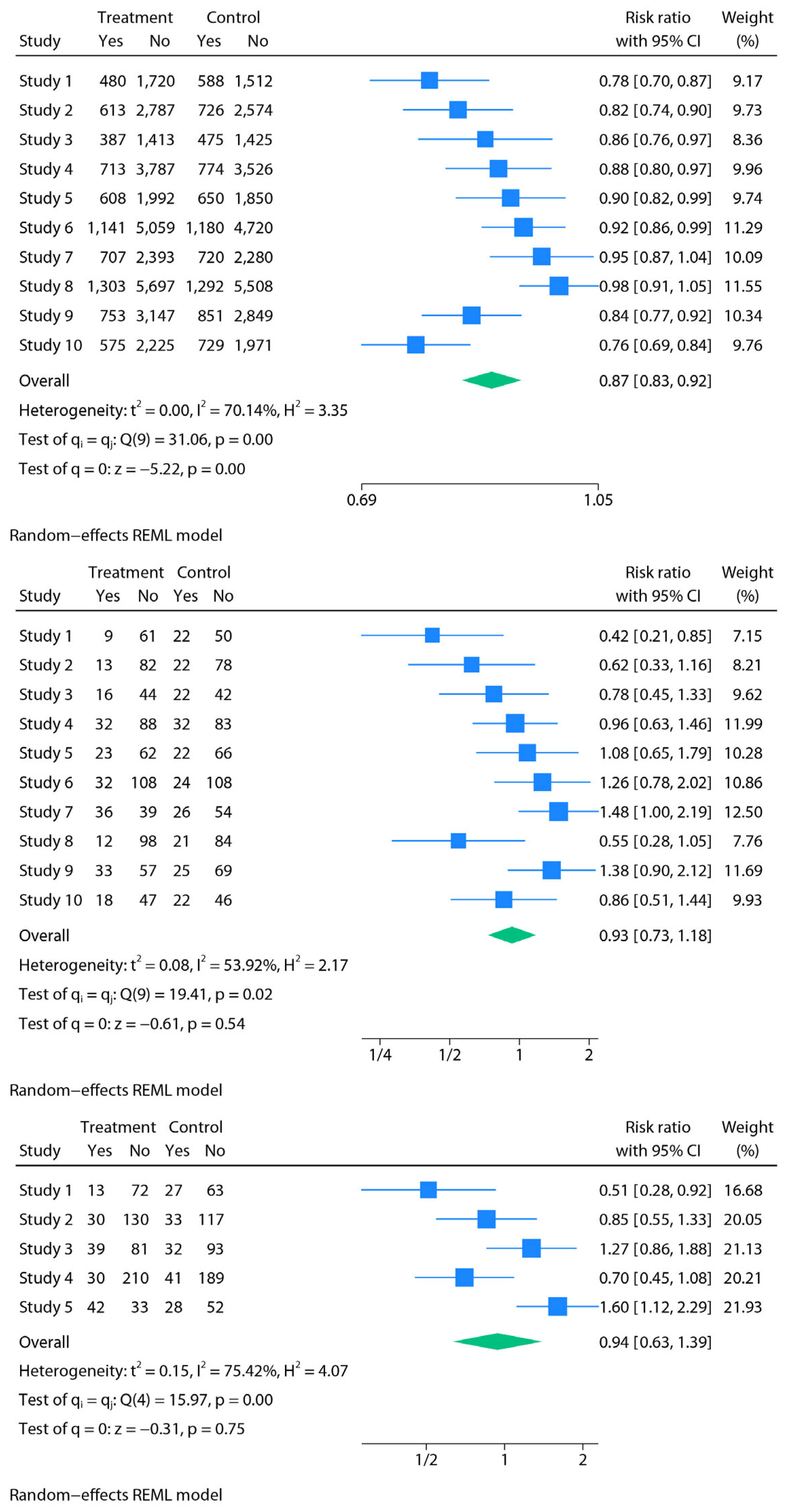
Supplementary File S4. The corresponding forest plots are shown in
Figure 4. The main text reports the key numerical results and their interpretation, whereas the
Supplementary Files provide the underlying datasets and code to ensure reproducibility.
In
Supplementary File S1 (
k = 10), the studies are relatively precise, and the absolute between-study variance is small. The random-effects REML model yielded τ
2 = 0.0049, I
2 = 70.14% (as reported by the REML-based software output), and Q = 31.06 (
p < 0.01). The pooled risk ratio was 0.870 (95% CI, 0.825–0.916), whereas the 95% PI ranged from 0.731 to 1.034. This example shows that I
2 may be high even when the absolute magnitude of heterogeneity, expressed by τ
2 on the log risk-ratio scale, is small. In such a case, I
2 is high partly because within-study sampling error is small, so even modest between-study dispersion represents a large proportion of the total observed variability.
In
Supplementary File S2 (
k = 10), the studies are less precise, and the dispersion of absolute effects is larger. Here, τ
2 increased to 0.0773, whereas I
2 was lower than in the previous example, at 53.92%, with Q = 19.41 (
p = 0.02). The pooled risk ratio was 0.929 (95% CI, 0.732–1.178), and the 95% PI was much wider, ranging from 0.462 to 1.870. This illustrates the complementary problem: a lower I
2 does not necessarily imply lower absolute heterogeneity or greater clinical consistency. Larger τ
2 and wider prediction intervals indicate that true effects may vary substantially across settings, even though the proportion of observed variability attributed to heterogeneity, as measured by I
2, is lower.
Supplementary File S3 (
k = 5) illustrates the instability that arises when the number of studies is small. With only five studies, the REML model yielded τ
2 = 0.1488, I
2 = 75.42%, Q = 15.97 (
p < 0.01), and a pooled risk ratio of 0.939 (95% CI, 0.635–1.390). The 95% PI was extremely wide, ranging from 0.236 to 3.745. This example reinforces that prediction intervals are highly sensitive to the estimated τ
2 and become particularly fragile in small meta-analyses.
Importantly, these examples do not imply that τ2 is a standalone or uncertainty-free measure. The estimated τ2 remains estimator-dependent, and its uncertainty may be substantial, particularly when the number of studies is small. For this reason, τ2 should be reported with the estimator used and, where available, with an uncertainty interval, such as a 95% CI.
Together, these examples show that Q, I2, τ2, and PIs answer different questions. Q provides a formal test of whether observed variability exceeds what would be expected by sampling error alone, but it is sensitive to study precision and the number of included studies. I2 describes the proportion of observed variability attributable to between-study differences, τ2 quantifies the absolute between-study variance, and the PI translates this variance into the expected range of effects in a future comparable setting. Therefore, heterogeneity should not be classified using Q or I2 alone. A transparent interpretation should jointly consider Q, I2, τ2, the effect-size scale, the estimator used for τ2, the number of studies, and the width and clinical implications of the PI.
7. Operational Interpretation: Combining Q, I2, τ2, and Prediction Intervals
In practice, Q, I2, τ2, and PIs should be interpreted sequentially rather than as competing statistics. Cochran’s Q should be used as an initial signal that observed variability may exceed what would be expected by sampling error alone, but it should not determine model choice or pooling decisions by itself because it has low power with few studies and excessive sensitivity with large, precise evidence bases. I2 should then be used to describe the proportion of observed variability attributable to between-study differences, while remembering that it is not a measure of the absolute magnitude of heterogeneity. A high I2 may reflect small but precisely estimated differences, whereas a lower I2 may still coexist with clinically important dispersion.
τ2 should be examined next because it quantifies the absolute between-study variance on the squared effect-size scale. Its interpretation should always consider the metric used: the same τ2 value has different implications for log risk ratios, odds ratios, hazard ratios, mean differences, or standardized mean differences. For ratio measures, translating τ2 into τ and considering the approximate spread of plausible true effects on the exponentiated scale may help clinicians understand whether heterogeneity is likely to be clinically meaningful. However, τ2 should not be interpreted without considering the estimator used, the number of studies, and the uncertainty around the estimate.
Finally, the PI should be used to assess the practical consequences of heterogeneity. If the pooled effect is statistically significant but the prediction interval crosses the null, the average effect may still be beneficial, but the expected effect in a new setting is uncertain. If the PI includes both clinically important benefit and clinically important harm, conclusions should be cautious, and the certainty or applicability of the evidence may need to be downgraded. Conversely, when the pooled estimate and PI point in the same clinically relevant direction, heterogeneity is less likely to undermine decision-making, although its sources should still be explored.
A pragmatic clinical reading is therefore to use Q as a warning signal, I2 as a relative descriptor, τ2 as the scale-dependent magnitude of between-study variance, and the PI as the clinically interpretable expression of what may happen in a future comparable setting. Pooling is most defensible when studies are clinically and methodologically compatible, between-study dispersion is not large on the chosen effect-size metric, and the prediction interval does not alter the clinical conclusion. Pooling should be interpreted cautiously—or avoided—when heterogeneity is driven by bias, incompatible populations or interventions, unexplained design differences, or prediction intervals that include materially different clinical conclusions.
9. Heterogeneity in Prognostic Meta-Analysis
Prognostic reviews differ fundamentally from intervention or diagnostic ones. Their aims vary: some estimate overall prognosis (e.g., survival at fixed time points), others test a single factor (e.g., the hazard ratio for a biomarker), and others assess or validate multivariable models. Unlike therapeutic or diagnostic settings, prognostic outcomes are usually time-to-event, involve censoring, and depend on case-mix and follow-up.
In prognostic meta-analysis, heterogeneity requires distinct interpretation because variability often reflects differences in baseline risk, case mix, follow-up duration, outcome definition, predictor measurement, and modeling strategy. For single prognostic factors, random-effects pooling of hazard ratios or odds ratios is common, with τ2 quantifying between-study variance on the squared scale of the chosen effect-size metric. However, the same τ2 value may have different implications depending on whether the outcome is rare or common, whether follow-up is short or long, and whether covariate adjustment differs across studies.
For prediction model reviews, heterogeneity should not be reduced to pooled discrimination alone. Discrimination measures such as the c-statistic or AUC describe ranking ability, but they do not indicate whether predicted risks are accurate in absolute terms. Calibration measures, including calibration slope, calibration-in-the-large, observed-to-expected ratios, and calibration plots, are essential for assessing transportability. A model may retain acceptable discrimination in a new population while being poorly calibrated because baseline risk, predictor effects, or outcome incidence differ. Therefore, when prognostic models are synthesized, heterogeneity should be interpreted jointly across discrimination, calibration, case mix, and model specification. Multivariate meta-analysis may be useful when discrimination and calibration are synthesized together, although such approaches require sufficient data and careful interpretation.
- 2.
Limitations.
Quantifying heterogeneity in prognostic reviews is difficult. With few studies, estimates of variance in hazard ratios, odds ratios, c-statistics, or calibration measures are unstable, giving imprecise prediction intervals and uncertain transportability assessments. Heterogeneity often reflects clinical and methodological diversity—baseline risk, predictor definitions, outcome timing, adjustment sets, modeling choices, and follow-up—rather than sampling error alone. This makes heterogeneity both harder to measure and more clinically consequential, because prognostic evidence may perform differently across risk structures. Transparent reporting of τ2, prediction intervals, case-mix variation, discrimination, and calibration is therefore essential for trustworthy prognostic meta-analysis.
12. Practical Management of Heterogeneity
Detecting heterogeneity is only the start; the challenge is handling it. Statistics like Q, I2, or τ2 show the forest is uneven, but not why. To advance, three questions matter: How much variability? Where from? What does it mean? These frame interpretation across therapeutic, diagnostic, and prognostic reviews, where the task is always to quantify variability, trace its sources, and judge its implications for practice.
Before deciding whether to pool results, three related but distinct concepts should be separated. Heterogeneity refers to genuine variability in true effects across studies, usually arising from differences in populations, interventions, comparators, outcomes, follow-up, or settings. In this situation, studies may all be internally credible, but the underlying effects differ because they are not estimating precisely the same clinical reality.
Bias refers to systematic error within or across studies. It may arise from flaws in randomization, confounding, selective reporting, missing data, measurement error, or other design and conduct problems. Unlike heterogeneity arising from legitimate clinical or methodological diversity, bias does not reflect a meaningful distribution of true effects. It threatens validity. Pooling biased studies may therefore produce a precise but misleading summary estimate.
Inconsistency refers to disagreement between bodies of evidence that should be coherent under the assumptions of the review. In pairwise meta-analysis (the conventional comparison of two interventions or exposures at a time), this often appears as effect estimates pointing in materially different directions without a plausible explanation. In network meta-analysis, inconsistency has a more specific meaning: disagreement between direct and indirect evidence, usually because the transitivity assumption is not credible. Thus, heterogeneity concerns variability within an evidence set, bias concerns systematic error, and inconsistency concerns lack of coherence between estimates or evidence pathways.
A practical decision algorithm can be summarized as follows. First, assess whether the studies address a sufficiently similar clinical question. If populations, interventions, outcomes, or designs are incompatible, pooling should generally be avoided regardless of the numerical heterogeneity statistics. Second, assess risk of bias. If the variability appears to be mainly driven by studies at high risk of bias, the primary analysis should avoid uncritical pooling and consider sensitivity analyses that exclude or separate those studies. Third, if studies are clinically compatible and not dominated by major bias, quantify heterogeneity using Q, I2, τ2, and prediction intervals. Fourth, judge whether the prediction interval changes the clinical conclusion. If the pooled effect suggests benefit but the prediction interval includes no effect or clinically important harm, pooling may still be statistically possible, but the conclusion should be cautious and explicitly framed as context-dependent. Finally, if heterogeneity remains unexplained and materially affects the clinical conclusion, the review should prioritize exploration, stratified synthesis, or narrative interpretation rather than a single pooled estimate.
In short, pooling is most defensible when studies are clinically coherent, the risk of bias is not driving the dispersion, between-study dispersion is clinically acceptable on the chosen effect-size metric, and the prediction interval does not imply a materially different clinical conclusion. Pooling should be avoided or strongly qualified when studies are clinically incompatible, when bias is the likely source of variation, or when the prediction interval spans conclusions that would lead to different clinical decisions.
If populations, interventions, comparators, outcomes, follow-up periods, or study designs are incompatible, avoid pooling or use separate syntheses.
- 2.
Assess risk of bias.
If dispersion is mainly driven by studies at high risk of bias, avoid uncritical pooling and perform sensitivity analyses.
- 3.
Use Q as an initial signal.
A significant Q suggests variability beyond chance, but Q should not determine pooling on its own.
- 4.
Use I2 as a relative descriptor.
I2 describes the proportion of variability attributable to between-study differences, not the magnitude of heterogeneity.
- 5.
Use τ2 to judge absolute heterogeneity.
Interpret τ2 on the squared effect-size scale; when clinical interpretation is needed, translate it to τ on the effect-size scale and report the estimator used.
- 6.
Use the prediction interval to assess clinical implications.
If the prediction interval spans materially different clinical conclusions, interpret the pooled estimate cautiously and consider downgrading certainty.
- 7.
Decide on synthesis.
Pooling is reasonable if studies are coherent, bias is not driving the results, τ2 is clinically acceptable, and the prediction interval does not change the clinical conclusion. Pooling should be avoided or qualified if these conditions are not met.
The magnitude and implications of heterogeneity should be judged using the complementary framework summarized above: Q as an initial signal, I2 as a relative descriptor, τ2/τ as measures of absolute between-study dispersion, and the prediction interval as the clinically interpretable range of effects expected in future comparable settings.
Splitting studies into categories tests whether effects differ systematically—for example, by risk of bias, design, population, or outcome definition. In the forest metaphor, it is like comparing slopes, clearings, or groves to see if trees lean more in one setting than another. Credibility depends on prespecification, plausibility, consistency, and magnitude—that is, whether the subgroup was planned in advance, clinically credible, reproducible across related analyses, and large enough to matter [
21].
- 2.
Leave-one-out checks
This method re-runs the analysis while omitting one study at a time [
22,
23]. If the forest skyline remains largely unchanged, the overall conclusion is less dependent on any single study; if removing one tree reshapes the canopy, that study may be influential. Leave-one-out analysis helps identify such cases, but it can exaggerate noise and should be interpreted as a sensitivity analysis.
- 3.
Meta-regression
When multiple factors may explain heterogeneity, meta-regression relates study-level variables (e.g., design, age, quality) to effect size [
24]. It is like putting on colored lenses that reveal different leaning patterns. However, when the number of studies is small, meta-regression is usually underpowered and may produce spurious or unstable findings. A pragmatic rule is to include at least 10 studies per covariate, but this threshold is only a rough guide, not an absolute requirement.
Supplementary File S5 provides an overview of the main analytical approaches available to explore heterogeneity in meta-analysis.
- 4.
Visual tools
Plots reveal patterns at a glance. Forest plots can suggest heterogeneity or dispersion when CIs are wide or show limited overlap, but they do not by themselves establish inconsistency. Baujat plots highlight studies driving heterogeneity [
25], like oversized trees skewing the grove. Galbraith (radial) plots show departures from trend [
26], and L’Abbé plots reveal scatter in event rates [
27].
Funnel plots display study size or precision against effect, forming an inverted funnel when balanced. Large studies cluster near the pooled effect; smaller ones scatter. Distortion may signal small-study effects (publication bias, selective reporting, or true differences). Funnel plots usually require ≥10 studies, and interpretation is subjective. Statistical tests—Egger’s, Begg’s, or Deeks’ for DTA [
28,
29,
30]—can complement, but none are definitive; asymmetry must be judged in context.
Supplementary File S6 summarizes the main visual tools for heterogeneity.
Finding heterogeneity is not the endpoint; the key question is whether it reflects legitimate clinical diversity, methodological differences, bias, or lack of coherence. If variability arises from credible differences across populations, interventions, outcomes, or settings, pooling may remain reasonable, but the result should be interpreted as an average effect across contexts. If variability is driven by bias, incompatible designs, or unexplained contradictions that change the clinical conclusion, a single pooled estimate may be misleading, and stratified synthesis or narrative interpretation may be more appropriate.
16. Glossary of Key Terms
Heterogeneity: Genuine variability in effect estimates across studies beyond what would be expected from sampling error alone. It may arise from differences in populations, interventions, outcomes, follow-up, settings, or methods.
Sampling error: Random variation caused by studying a sample rather than the entire target population. It explains why study estimates differ even when they are estimating the same true effect.
Bias: Systematic error caused by flaws in study design, conduct, analysis, reporting, or interpretation. Unlike legitimate heterogeneity, bias threatens validity rather than reflecting meaningful diversity.
Inconsistency: Lack of coherence between estimates that should be compatible. In network meta-analysis, it specifically refers to disagreement between direct and indirect evidence.
Cochran’s Q: A statistical test assessing whether observed variability between study estimates exceeds what would be expected by chance. It is sensitive to the number and precision of studies.
I2: The proportion of observed variability attributable to between-study heterogeneity rather than sampling error. It is a relative measure and does not quantify the absolute magnitude of heterogeneity.
τ2: The between-study variance in a random-effects meta-analysis. It describes the absolute variance of true effects on the squared effect-size scale and depends on the estimator used.
τ: The square root of τ2. It is the between-study standard deviation and is expressed on the same scale as the effect estimate, making it more directly interpretable than τ2.
Confidence interval: The uncertainty around the pooled average effect. It describes the precision of the summary estimate, not the range of effects expected across settings.
Prediction interval: The expected range of effects in a future comparable study or setting. It incorporates between-study heterogeneity and is often more clinically informative than the confidence interval in random-effects meta-analysis.
Random-effects model: A meta-analytic model assuming that the true effect may vary across studies. It estimates an average effect and the between-study variance.
Transportability: The extent to which evidence from included studies can be applied to a new population, setting, intervention context, or clinical decision.