
An Interpretable Deep Learning Approach for Brain Tumor Classification Using a Bangladeshi Brain MRI Dataset

 ,
,  , ,
, ,  ,
, 
Abstract
1. Introduction
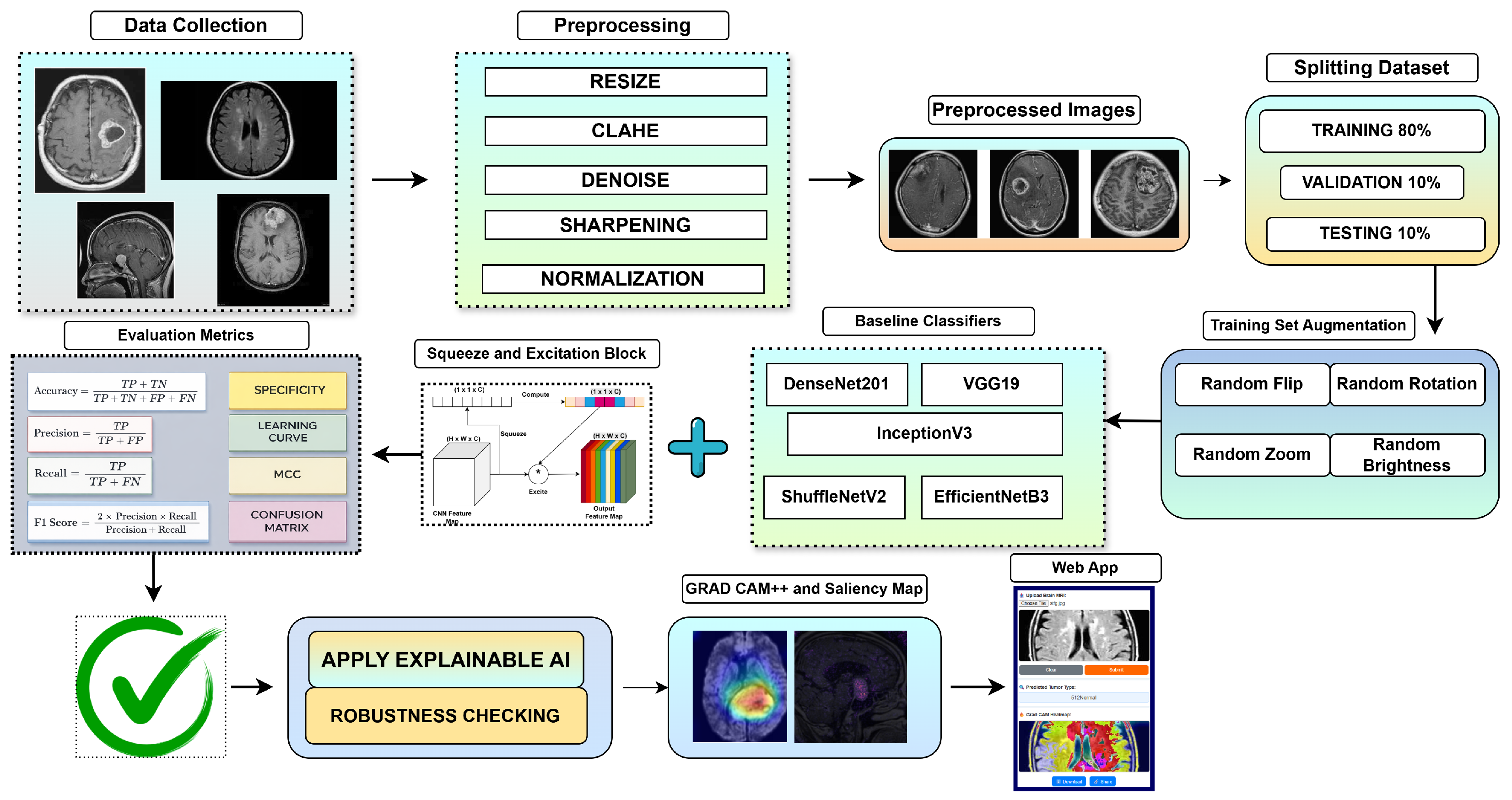
- An interpretable deep learning framework for brain tumor classification is developed using the PMRAM Bangladeshi MRI dataset, which is relatively underexplored in the existing research.
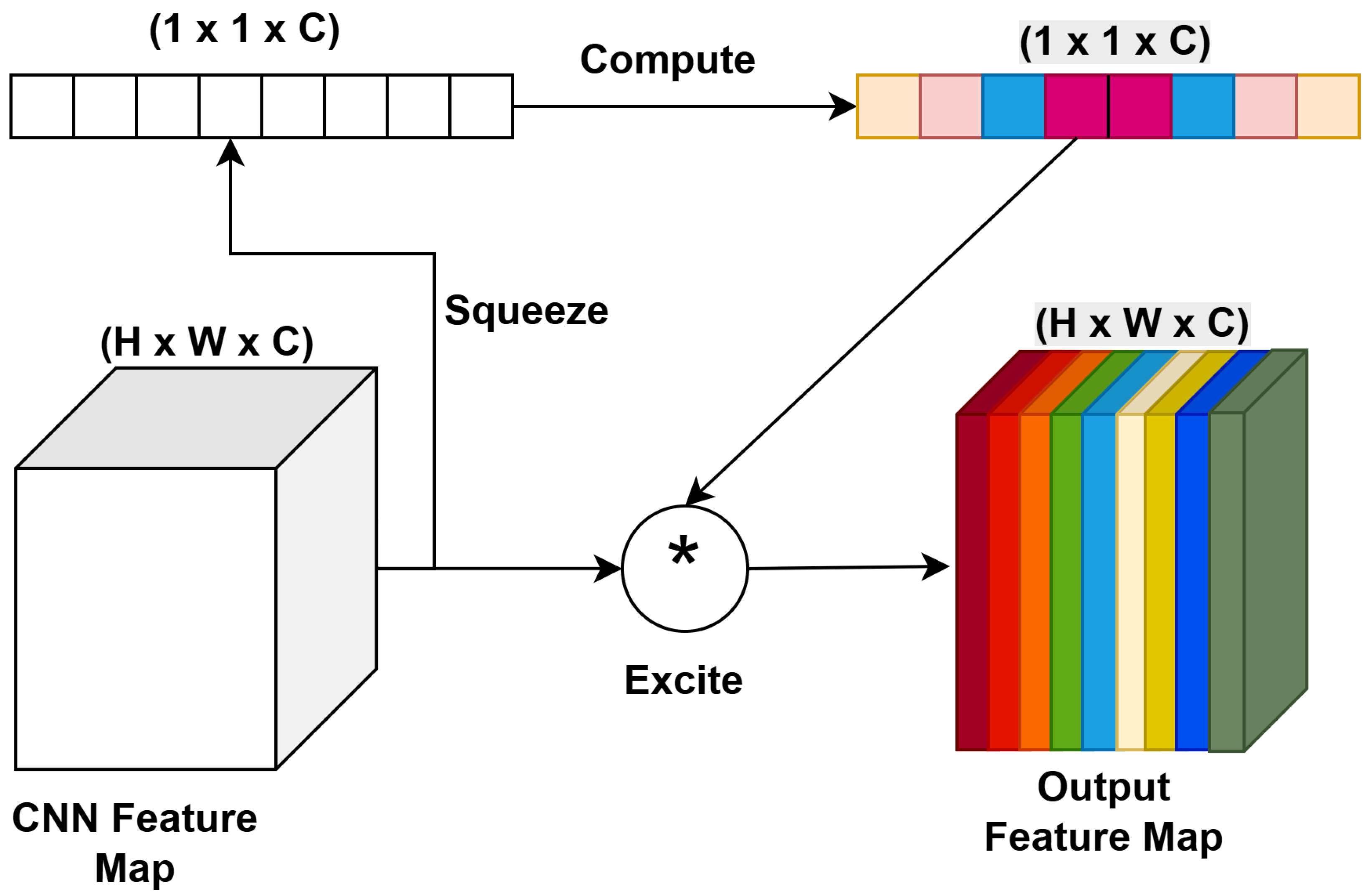
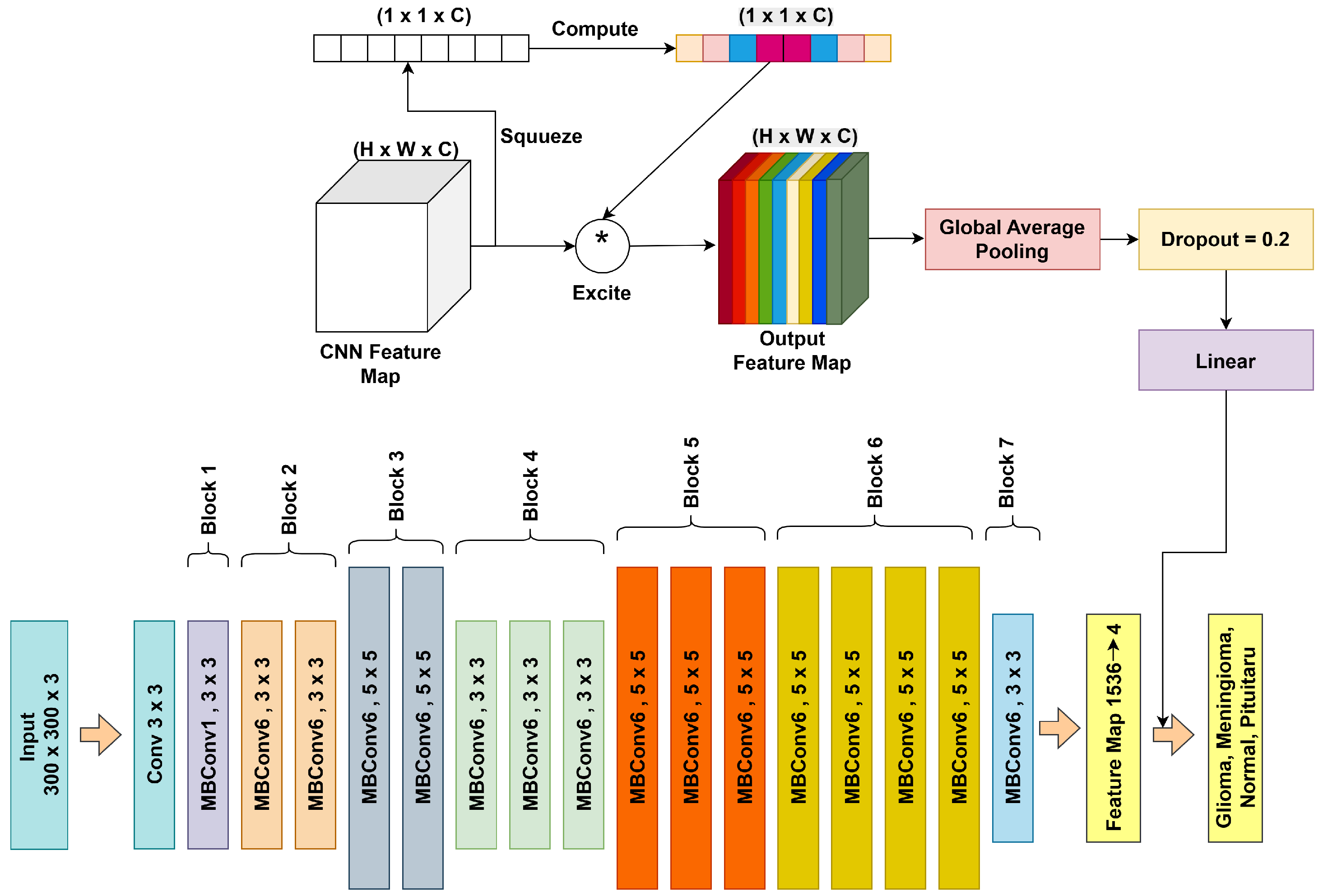
- Several baseline convolutional neural network architectures, including VGG19, DenseNet201, MobileNetV3-Large, InceptionV3, and EfficientNetB3, are enhanced using squeeze-and-excitation attention modules to improve channel-wise feature representation.
- A comprehensive evaluation framework is implemented, including robustness analysis under image perturbations, cross-dataset testing using the Sartaj dataset, and statistical significance analysis to examine model reliability and generalization capability.
- Explainable AI techniques such as Grad-CAM++ and saliency maps are integrated, and a real-time web-based application is deployed to enable interactive MRI-based brain tumor prediction with visual explanations.
2. Related Works
Research Gaps Identified
3. Methodology
3.1. Data Collection
3.2. Image Preprocessing and Feature Enhancement
3.3. Dataset Splitting and Data Augmentation
- Horizontal flip: The image was flipped left-to-right (along the vertical axis).
- Random rotation: The image was rotated by a random angle between and around its center, using reflection padding at the borders.
- Random zoom: The image was scaled by a random factor between 0.8 and 1.2, with appropriate cropping or padding to maintain the original size.
3.4. Baseline Models with Squeeze-and-Excitation Block (SE)
3.5. Squeeze-and-Excitation (SE) Attention Mechanism
3.5.1. SE-VGG19
3.5.2. SE-DenseNet201
3.5.3. SE-MobileNetV3-Large
3.5.4. SE-InceptionV3
3.5.5. Proposed SE-EfficientNetB3
3.5.6. Training Settings
3.6. Explainable AI (Grad-CAM++ and Saliency Maps)
3.7. Demo Web Application
3.8. Cross-Dataset Testing
3.9. Evaluation Metrics
4. Results and Discussion
4.1. Comparative Evaluation of Model Performance and Detailed Classification Metrics
4.2. Analysis of Accuracy and Loss Curve
4.3. Statistical Performance Analysis and Reliability Assessment
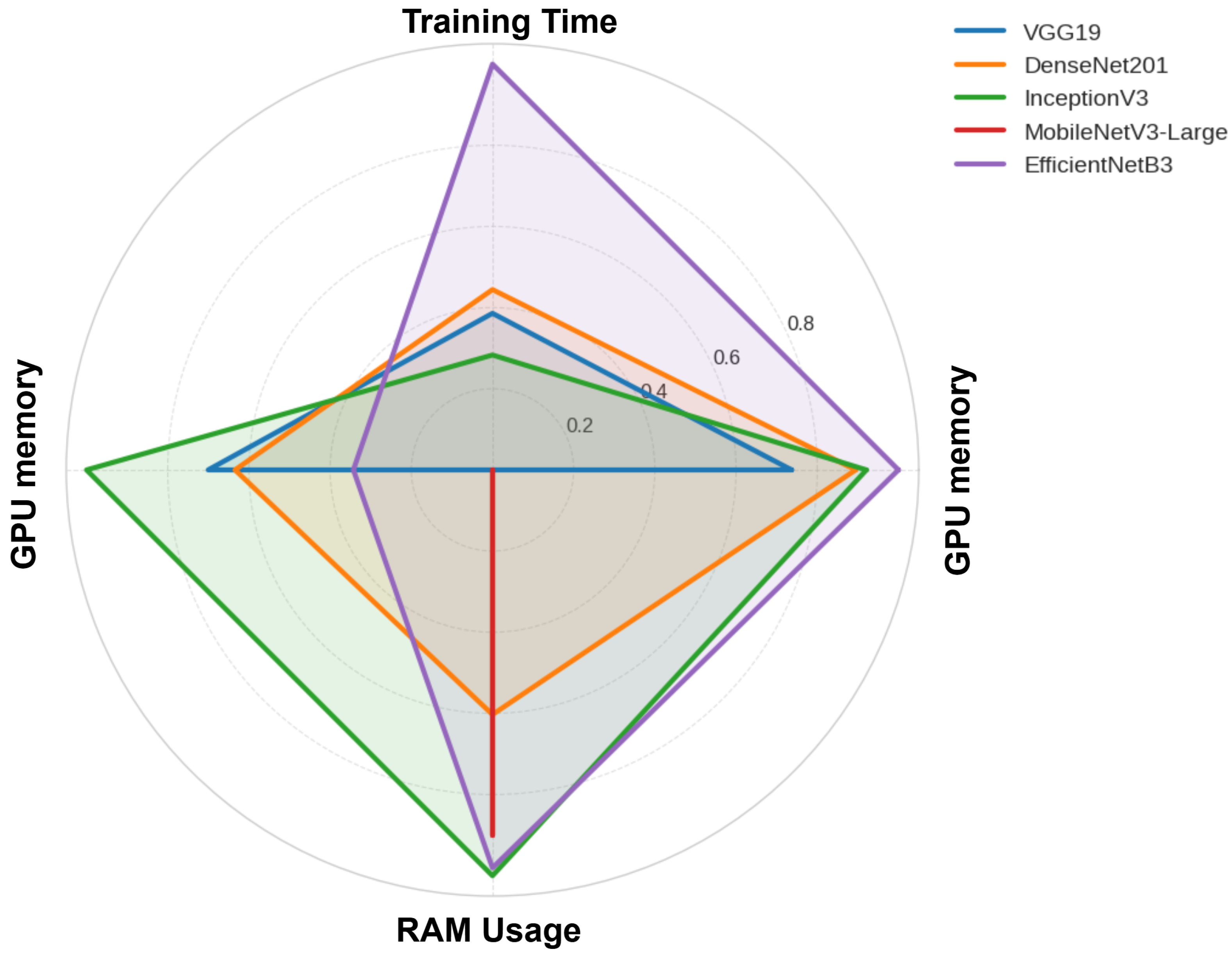
4.4. Analysis of Computational Cost
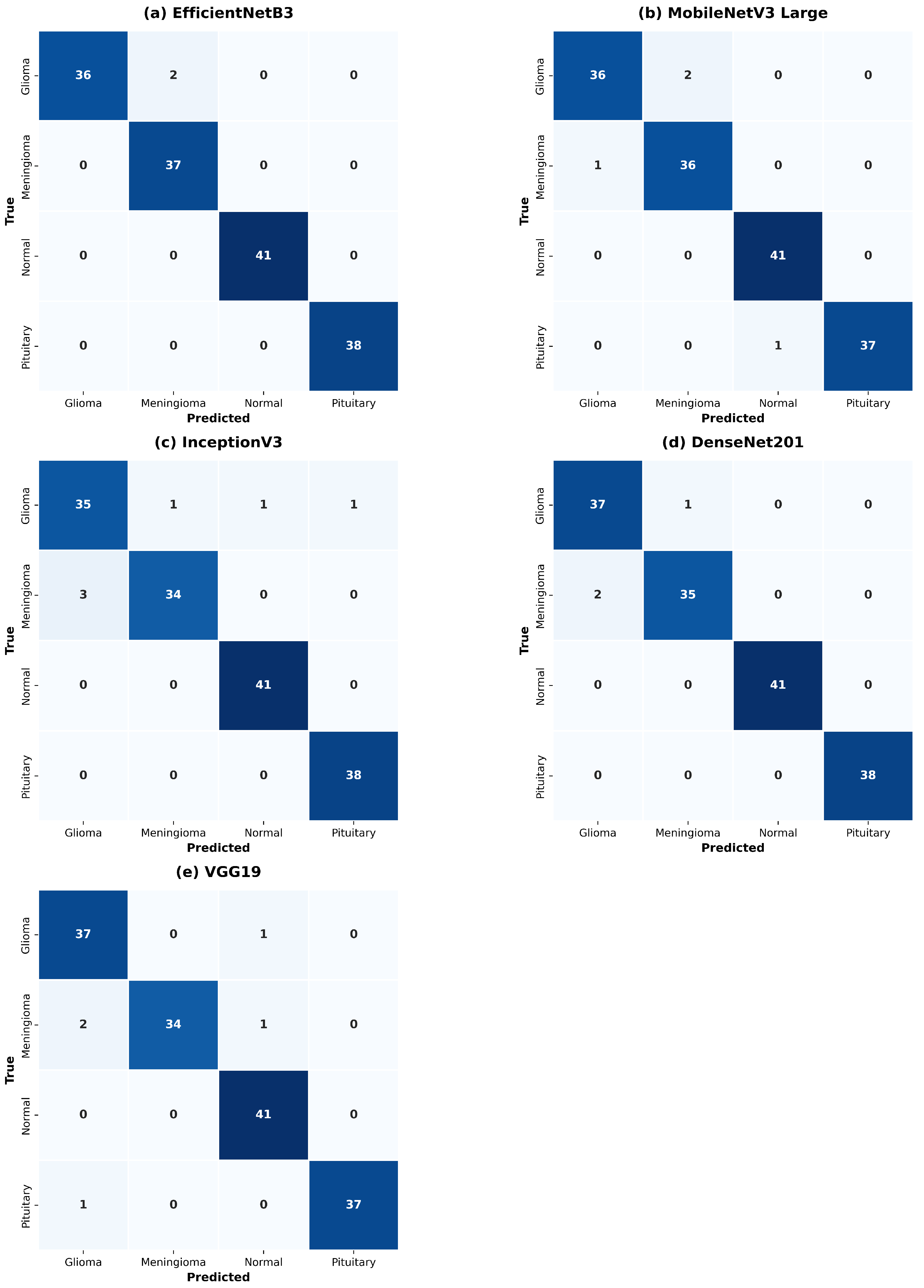
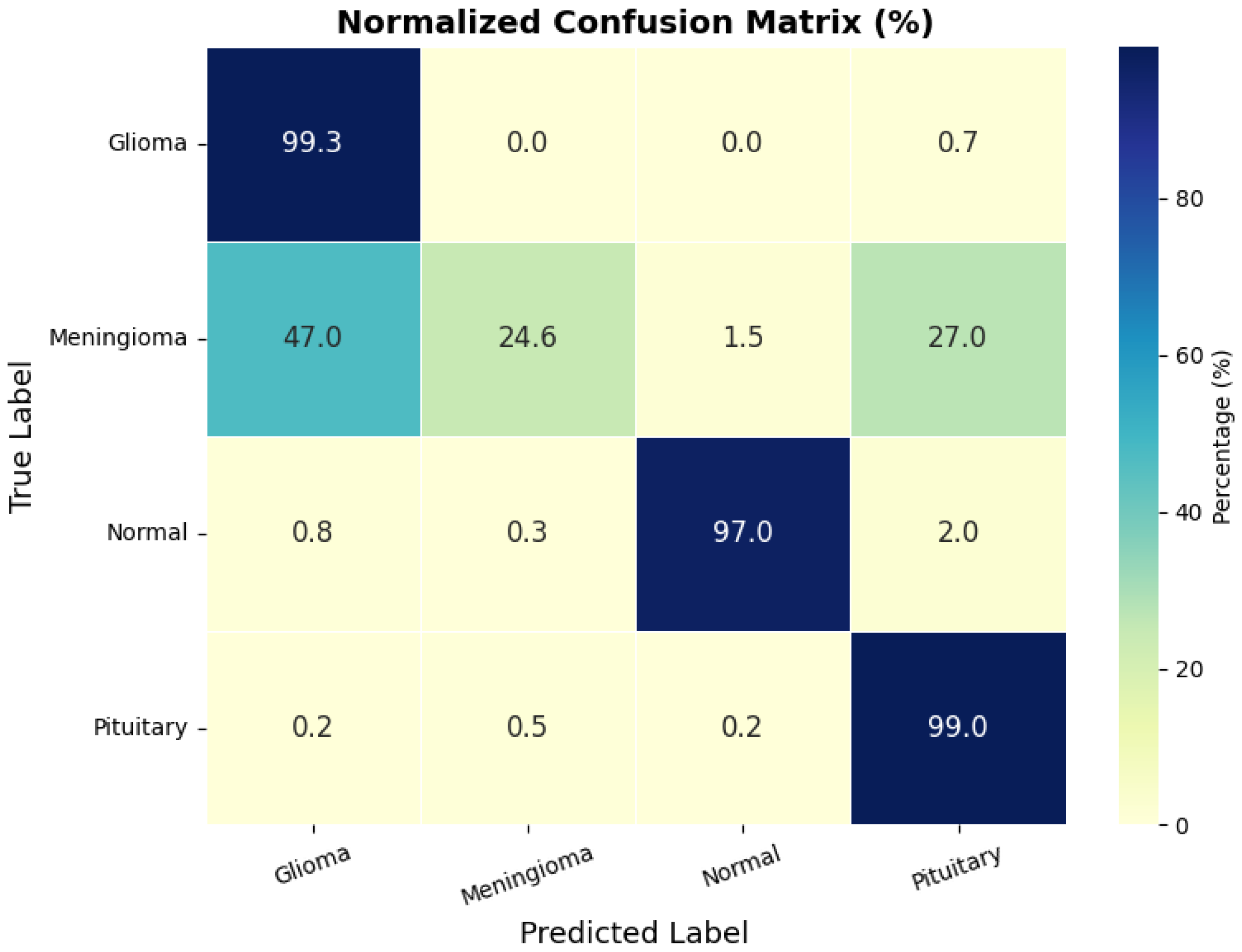
4.5. Analysis of Confusion Matrix
4.6. Identification of the Best-Performing Model
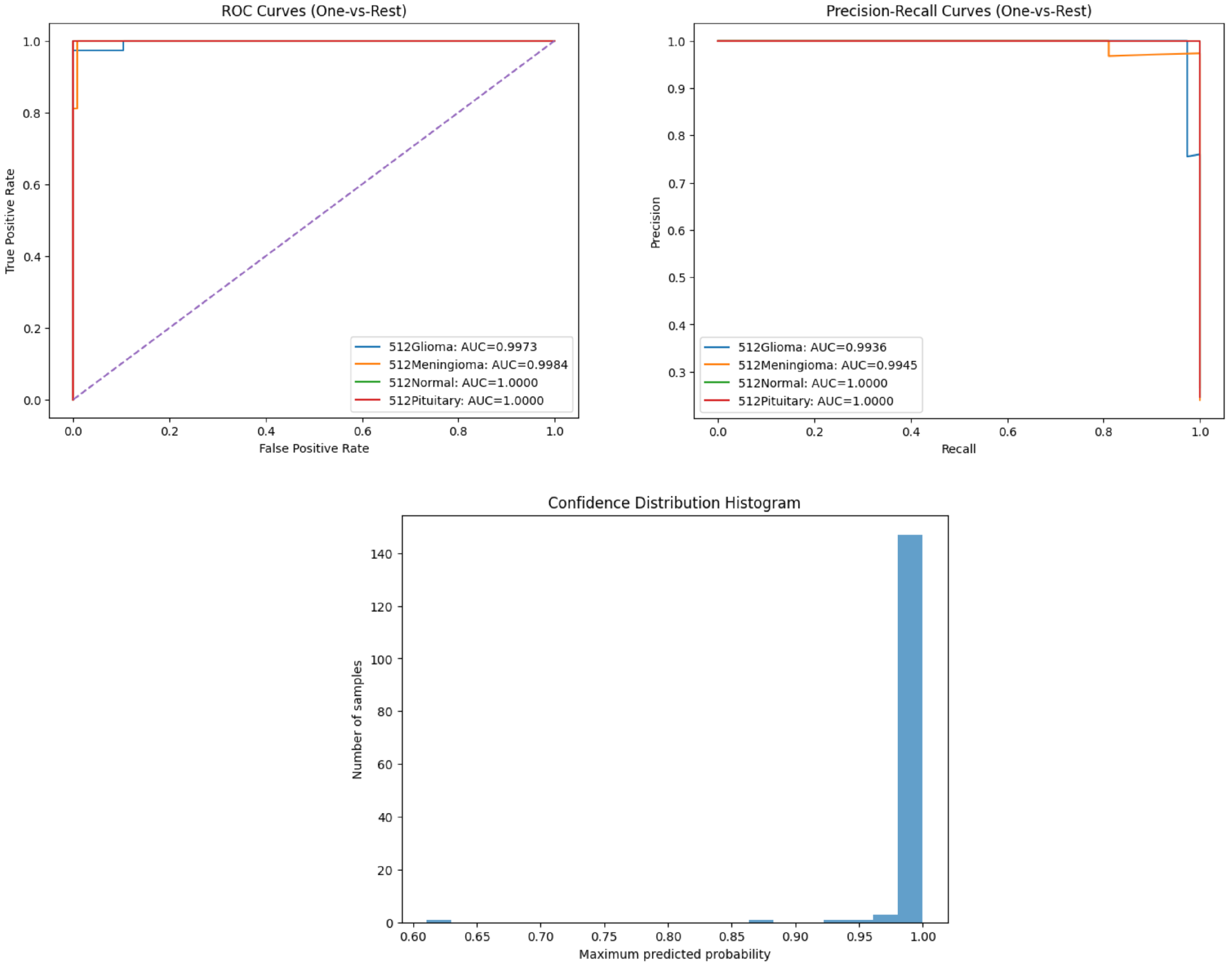
4.6.1. Discrimination and Confidence Analysis of EfficientNetB3
4.6.2. Generalization Analysis Using 5-Fold Cross-Validation
4.6.3. Robustness Analysis of SE-Enhanced EfficientNetB3 Under Image Perturbations
4.6.4. Seed-Wise Performance Stability and Reproducibility Analysis of SE-Enhanced EfficientNetB3
4.6.5. Ablation Study of EfficientNetB3 Without SE
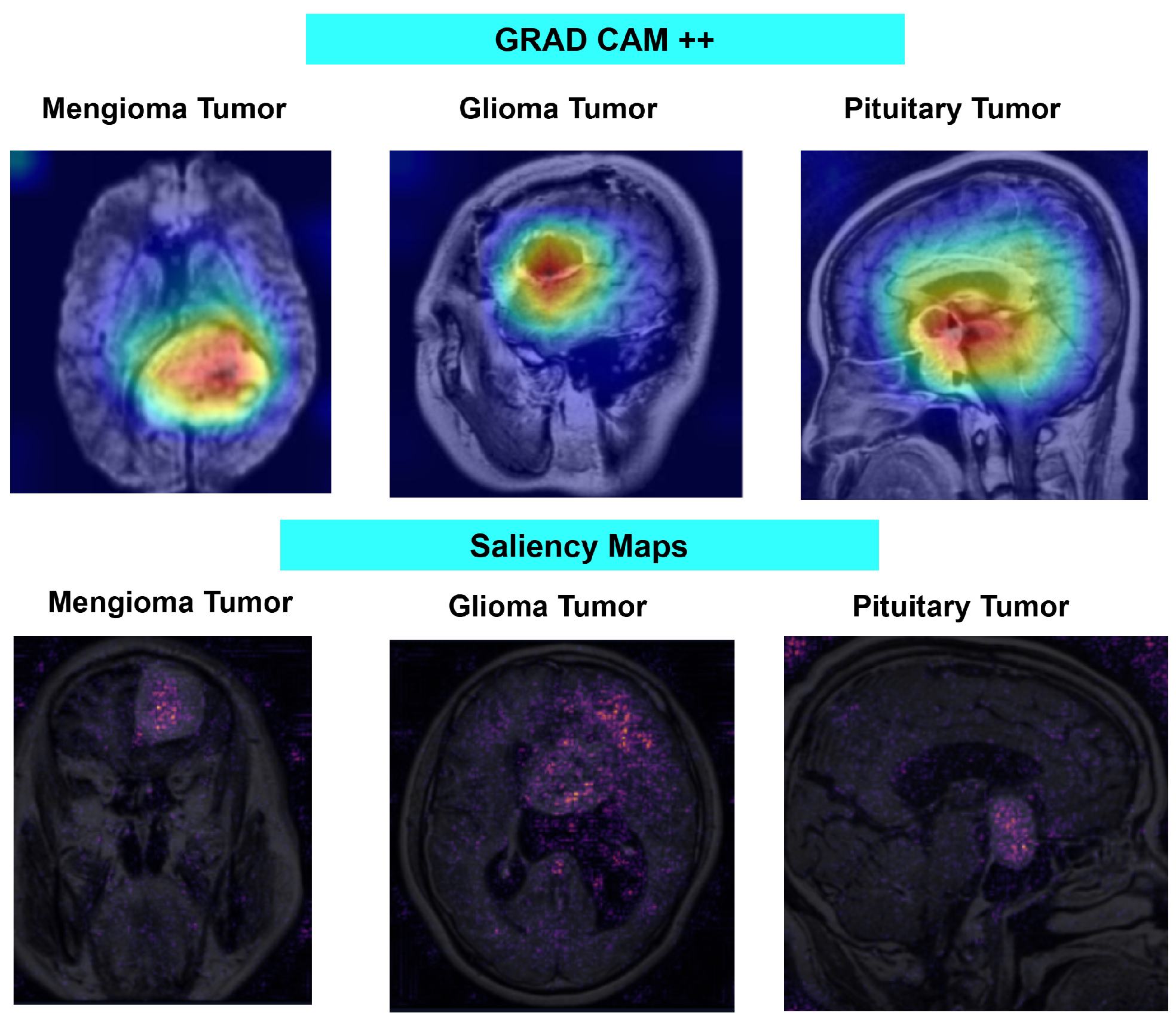
4.7. Interpretability Analysis of SE-Enhanced EfficientNetB3 Using Grad-CAM++ and Saliency Maps
4.8. Performance Comparison with State-of-the-Art Transformer Architectures
4.9. Cross-Dataset Evaluation with Sartaj Dataset
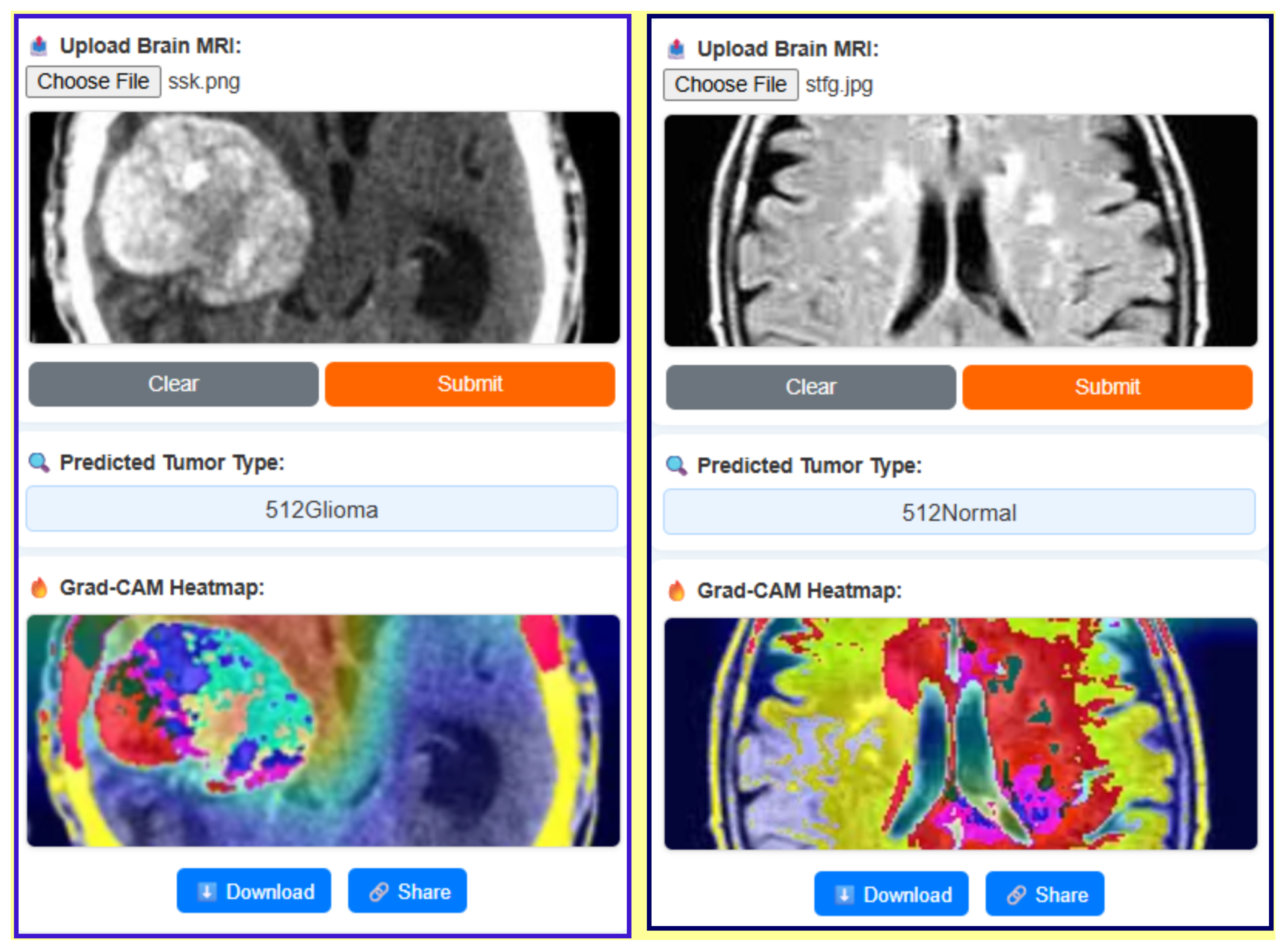
4.10. Online Visualization and Prediction Tool
4.11. Comparative Analysis with Previous Studies
5. Conclusions
Author Contributions
Funding
Institutional Review Board Statement
Data Availability Statement
Conflicts of Interest
References
- Chieffo, D.P.R.; Lino, F.; Ferrarese, D.; Belella, D.; Della Pepa, G.M.; Doglietto, F. Brain Tumor at Diagnosis: From Cognition and Behavior to Quality of Life. Diagnostics 2023, 13, 541. [Google Scholar] [CrossRef] [PubMed]
- Bar-Letkiewicz, I.; Pieczyńska, A.; Dudzic, M.; Szkudlarek, M.; Adamska, K.; Hojan, K. Advanced Neuroimaging and Emerging Systemic Therapies in Glioblastoma: Current Evidence and Future Directions. Biomedicines 2025, 13, 2597. [Google Scholar] [CrossRef]
- Alyami, J. Computer-aided analysis of radiological images for cancer diagnosis: Performance analysis on benchmark datasets, challenges, and directions. EJNMMI Rep. 2024, 8, 7. [Google Scholar] [CrossRef]
- Khan, R.; Taj, S.; Khan, Z.U.; Khan, S.U.; Khan, J.; Arshad, T.; Ayouni, S. High-precision brain tumor classification from MRI images using an advanced hybrid deep learning method with minimal radiation exposure. J. Radiat. Res. Appl. Sci. 2025, 18, 101858. [Google Scholar] [CrossRef]
- Sumona, R.B.; Biswas, J.P.; Shafkat, A.; Rahman, M.M.; Faruk, M.O.; Majeed, Y. An Integrated Deep Learning Approach for Enhancing Brain Tumor Diagnosis. Healthc. Anal. 2025, 8, 100421. [Google Scholar] [CrossRef]
- Haque, M.E.; Nurul Absur, M.; Al Farid, F.; Uddin, J.; Abdul Karim, H. A novel interpretable and real-time dengue prediction framework using clinical blood parameters with genetic and GAN-based optimization. Front. Artif. Intell. 2025, 8, 1626699. [Google Scholar] [CrossRef]
- Anaya-Isaza, A.; Mera-Jiménez, L.; Zequera-Diaz, M. An overview of deep learning in medical imaging. Inform. Med. Unlocked 2021, 26, 100723. [Google Scholar] [CrossRef]
- Saykat, T.H.; Al Emon, M.; Al-Imran, M.; Haque, M.E. Machine Learning and Explainable AI for Predicting Intubation Needs in an Intensive Care Unit. In Proceedings of the 2025 6th International Conference on Big Data Analytics and Practices (IBDAP), Chiang Mai, Thailand, 1–3 August 2025; pp. 227–232. [Google Scholar] [CrossRef]
- Rahman, T.; Islam, M.S.; Uddin, J. MRI-Based Brain Tumor Classification Using a Dilated Parallel Deep Convolutional Neural Network. Digital 2024, 4, 529–554. [Google Scholar] [CrossRef]
- Khaliki, M.; Başarslan, M. Brain tumor detection from images and comparison with transfer learning methods and 3-layer CNN. Sci. Rep. 2024, 14, 2664. [Google Scholar] [CrossRef] [PubMed]
- Aamir, M.; Namoun, A.; Munir, S.; Aljohani, N.; Alanazi, M.H.; Alsahafi, Y.; Alotibi, F. Brain Tumor Detection and Classification Using an Optimized Convolutional Neural Network. Diagnostics 2024, 14, 1714. [Google Scholar] [CrossRef]
- Agarwal, M.; Rani, G.; Kumar, A.; Kumar, P.K.; Manikandan, R.; Gandomi, A.H. Deep learning for enhanced brain tumor detection and classification. Results Eng. 2024, 22, 102117. [Google Scholar] [CrossRef]
- Rasheed, Z.; Ma, Y.K.; Ullah, I.; Ghadi, Y.Y.; Khan, M.Z.; Khan, M.A.; Abdusalomov, A.; Alqahtani, F.; Shehata, A.M. Brain Tumor Classification from MRI Using Image Enhancement and Convolutional Neural Network Techniques. Brain Sci. 2023, 13, 1320. [Google Scholar] [CrossRef] [PubMed]
- Martínez-Del-Río-Ortega, R.; Civit-Masot, J.; Luna-Perejón, F.; Domínguez-Morales, M. Brain Tumor Detection Using Magnetic Resonance Imaging and Convolutional Neural Networks. Big Data Cogn. Comput. 2024, 8, 123. [Google Scholar] [CrossRef]
- Krishnan, P.T.; Krishnadoss, P.; Khandelwal, M.; Gupta, D.; Nihaal, A.; Kumar, T.S. Enhancing brain tumor detection in MRI with a rotation invariant Vision Transformer. Front. Neuroinform. 2024, 18, 1414925. [Google Scholar] [CrossRef] [PubMed]
- Hosny, K.M.; Mohammed, M.A.; Salama, R.A.; Elshewey, A.M. Explainable ensemble deep learning-based model for brain tumor detection and classification. Neural Comput. Appl. 2024, 37, 1289–1306. [Google Scholar] [CrossRef]
- Mohamed Musthafa, M.; Mahesh, T.R.; Vinoth Kumar, V.; Guluwadi, S. Enhancing brain tumor detection in MRI images through explainable AI using Grad-CAM with Resnet 50. BMC Med. Imaging 2024, 24, 107. [Google Scholar] [CrossRef]
- Mathivanan, S.K.; Srinivasan, S.; Koti, M.S.; Kushwah, V.S.; Joseph, R.B.; Shah, M.A. A secure hybrid deep learning framework for brain tumor detection and classification. J. Big Data 2025, 12, 72. [Google Scholar] [CrossRef]
- Nhlapho, W.; Atemkeng, M.; Brima, Y.; Ndogmo, J.C. Bridging the Gap: Exploring Interpretability in Deep Learning Models for Brain Tumor Detection and Diagnosis from MRI Images. Information 2024, 15, 182. [Google Scholar] [CrossRef]
- Asif, R.N.; Naseem, M.T.; Ahmad, M.; Mazhar, T.; Khan, M.A.; Khan, M.A.; Al-Rasheed, A.; Hamam, H. Brain tumor detection empowered with ensemble deep learning approaches from MRI scan images. Sci. Rep. 2025, 15, 15002. [Google Scholar] [CrossRef]
- Nahiduzzaman, M.; Abdulrazak, L.F.; Kibria, H.B.; Khandakar, A.; Ayari, M.A.; Ahamed, M.F.; Ahsan, M.; Haider, J.; Moni, M.A.; Kowalski, M. A hybrid explainable model based on advanced machine learning and deep learning models for classifying brain tumors using MRI images. Sci. Rep. 2025, 15, 1649. [Google Scholar] [CrossRef]
- Saeedi, S.; Rezayi, S.; Keshavarz, H.; Kalhori, S.R.N. MRI-based brain tumor detection using convolutional deep learning methods and chosen machine learning techniques. BMC Med. Inform. Decis. Mak. 2023, 23, 16. [Google Scholar] [CrossRef]
- Tonni, S.I.; Sheakh, M.A.; Tahosin, M.S.; Hasan, M.Z.; Shuva, T.F.; Bhuiyan, T.; Almoyad, M.A.A.; Orka, N.A.; Rahman, M.T.; Khan, R.T.; et al. A Hybrid Transfer Learning Framework for Brain Tumor Diagnosis. Adv. Intell. Syst. 2025, 7, 2400495. [Google Scholar] [CrossRef]
- Mannan, M.S.P.; Chowdhury, M.; Rahman, R.; Tamim, A.U.; Rahman, M.M. PMRAM: Bangladeshi Brain Cancer—MRI Dataset. 2024. Available online: https://data.mendeley.com/datasets/m7w55sw88b/1 (accessed on 5 December 2025).
- Hu, J.; Shen, L.; Albanie, S.; Sun, G.; Wu, E. Squeeze-and-Excitation Networks. arXiv 2019, arXiv:1709.01507. [Google Scholar] [CrossRef]



| Class | Train | Val | Test |
|---|---|---|---|
| Glioma | 298 | 37 | 38 |
| Meningioma | 290 | 36 | 37 |
| Normal | 316 | 39 | 41 |
| Pituitary | 298 | 37 | 38 |
| Class | Total Images (Original + Augmented) |
|---|---|
| Glioma | 894 |
| Meningioma | 870 |
| Normal | 948 |
| Pituitary | 894 |
| Parameter | Setting |
|---|---|
| Models | VGG19, DenseNet201, EfficientNetB3, MobileNetV3-Large, InceptionV3 |
| Input Image Size | (VGG19, DenseNet201, MobileNetV3-Large) |
| (EfficientNetB3), (InceptionV3) | |
| Batch Size | 32 |
| Number of Epochs | 50 |
| Early Stopping Patience | 7 |
| Optimizer | AdamW |
| Learning Rate | |
| Weight Decay | |
| Loss Function | Cross-Entropy Loss |
| Learning Rate Scheduler | ReduceLROnPlateau |
| Scheduler Patience | 2 |
| Scheduler Factor | 0.5 |
| Dropout Rate | 0.2 |
| SE Reduction Ratio | 16 |
| Data Loader Workers | 2 |
| Platform | Kaggle Notebook |
| Hardware | NVIDIA Tesla P100 GPU |
| Model | Accuracy | Precision | Recall | F1-Score |
|---|---|---|---|---|
| VGG19 | 0.9675 | 0.9691 | 0.9675 | 0.9676 |
| DenseNet201 | 0.9805 | 0.9807 | 0.9805 | 0.9805 |
| InceptionV3 | 0.9610 | 0.9610 | 0.9610 | 0.9608 |
| MobileNetV3-Large | 0.9740 | 0.9743 | 0.9740 | 0.9740 |
| EfficientNetB3 | 0.9870 | 0.9877 | 0.9870 | 0.9870 |
| Model | MCC | Brier Score | Mean PPV | Mean NPV | Sensitivity | Specificity | 95% CI |
|---|---|---|---|---|---|---|---|
| VGG19 | 0.9572 | 0.0110 | 0.9675 | 0.9892 | 0.9675 | 0.9892 | [0.9351, 0.9935] |
| DenseNet201 | 0.9741 | 0.0078 | 0.9805 | 0.9935 | 0.9805 | 0.9935 | [0.9545, 1.0000] |
| InceptionV3 | 0.9482 | 0.0155 | 0.9610 | 0.9870 | 0.9610 | 0.9870 | [0.9286, 0.9870] |
| MobileNetV3-Large | 0.9655 | 0.0110 | 0.9740 | 0.9913 | 0.9740 | 0.9913 | [0.9481, 0.9935] |
| EfficientNetB3 | 0.9829 | 0.0045 | 0.9870 | 0.9957 | 0.9870 | 0.9957 | [0.9675, 1.0000] |
| Model | Chi-Square Statistic | p-Value | Friedman Statistic | Friedman p-Value |
|---|---|---|---|---|
| VGG19 | 423.7080 | 37.1922 | ||
| DenseNet201 | 438.4264 | 35.3377 | ||
| InceptionV3 | 415.8009 | 28.7532 | ||
| MobileNetV3-Large | 430.8195 | 11.9922 | ||
| EfficientNetB3 | 446.4130 | 15.8571 |
| Model Comparison | p-Value | Significance |
|---|---|---|
| EfficientNetB3 vs. VGG19 + SE | 0.125000 | Not Significant |
| EfficientNetB3 vs. DenseNet201 + SE | 0.625000 | Not Significant |
| EfficientNetB3 vs. InceptionV3 + SE | 0.375000 | Not Significant |
| EfficientNetB3 vs. MobileNetV3-Large + SE | 0.125000 | Not Significant |
| Metric/Fold | Value |
|---|---|
| Accuracy (mean ± std) | |
| Cohen’s Kappa (mean ± std) | |
| Matthews Correlation Coefficient (mean ± std) | |
| Fold 1 Accuracy | 0.9903 |
| Fold 2 Accuracy | 0.9903 |
| Fold 3 Accuracy | 0.9612 |
| Fold 4 Accuracy | 0.9251 |
| Fold 5 Accuracy | 0.9778 |
| Perturbation Technique | Parameters | Test Accuracy (%) |
|---|---|---|
| Intensity Shift | 98.70 | |
| CutMix Patch Mix | 96.75 | |
| Pixel Erase | 96.10 |
| Seed | Accuracy (%) | Precision (%) | Recall (%) | F1-Score (%) | MCC |
|---|---|---|---|---|---|
| 11 | 98.70 | 98.75 | 98.71 | 98.71 | 0.9828 |
| 22 | 98.70 | 98.68 | 98.71 | 98.69 | 0.9827 |
| 33 | 98.70 | 98.75 | 98.78 | 98.73 | 0.9829 |
| 44 | 98.70 | 98.70 | 98.78 | 98.72 | 0.9828 |
| 55 | 98.05 | 98.07 | 98.10 | 98.06 | 0.9742 |
| Average ± Std | 98.57 ± 0.26 | 98.59 ± 0.26 | 98.62 ± 0.26 | 98.58 ± 0.26 | 0.9811 ± 0.0034 |
| Metric | Precision | Recall | F1-Score |
|---|---|---|---|
| Macro Average | 0.9629 | 0.9598 | 0.9603 |
| Weighted Average | 0.9636 | 0.9610 | 0.9613 |
| Accuracy | 0.9610 | ||
| Model | Accuracy (%) |
|---|---|
| DeiT-Base | 96.10 |
| Swin-Tiny | 86.36 |
| PoolFormer-S36 (MetaFormer) | 97.40 |
| ConvNeXt-Tiny | 89.61 |
| Citation | Dataset | Best Model | Accuracy (%) | XAI Used | Cross-Dataset Testing | Real-Time Demo App |
|---|---|---|---|---|---|---|
| [10] | SARTAJ | VGG16 | 98.00 | No | No | No |
| [12] | Figshare | InceptionV3 | 98.89 | No | No | No |
| [15] | Kaggle | RViT | 98.60 | No | No | No |
| [16] | Figshare | DenseNet121 | 99.02 | Yes | No | No |
| [18] | Br35H + BraTS + Kaggle | BTDN | 99.68 | Yes | No | No |
| [19] | SARTAJ | EfficientNetB0 | 98.00 | Yes | No | No |
| [20] | Kaggle | InceptionV3 | 98.50 | No | No | No |
| [21] | Figshare + SARTAJ + Br35H | PDSCNN | 99.30 | Yes | No | No |
| [23] | Figshare + SARTAJ + Br35H | ResNet152V2 | 99.47 | Yes | No | No |
| Our Study | PMRAM | SE-Enhanced EfficientNetB3 | 98.70 | Yes | Yes | Yes |
Disclaimer/Publisher’s Note: The statements, opinions and data contained in all publications are solely those of the individual author(s) and contributor(s) and not of MDPI and/or the editor(s). MDPI and/or the editor(s) disclaim responsibility for any injury to people or property resulting from any ideas, methods, instructions or products referred to in the content. |
© 2026 by the authors. Licensee MDPI, Basel, Switzerland. This article is an open access article distributed under the terms and conditions of the Creative Commons Attribution (CC BY) license.
Share and Cite
Polash, M.S.H.; Saykat, M.T.H.; Haque, M.E.; Maniruzzaman, M.; Zabin, M.; Uddin, J. An Interpretable Deep Learning Approach for Brain Tumor Classification Using a Bangladeshi Brain MRI Dataset. BioMedInformatics 2026, 6, 19. https://doi.org/10.3390/biomedinformatics6020019
Polash MSH, Saykat MTH, Haque ME, Maniruzzaman M, Zabin M, Uddin J. An Interpretable Deep Learning Approach for Brain Tumor Classification Using a Bangladeshi Brain MRI Dataset. BioMedInformatics. 2026; 6(2):19. https://doi.org/10.3390/biomedinformatics6020019
Chicago/Turabian StylePolash, Md. Saymon Hosen, Md. Tamim Hasan Saykat, Md. Ehsanul Haque, Md. Maniruzzaman, Mahe Zabin, and Jia Uddin. 2026. "An Interpretable Deep Learning Approach for Brain Tumor Classification Using a Bangladeshi Brain MRI Dataset" BioMedInformatics 6, no. 2: 19. https://doi.org/10.3390/biomedinformatics6020019
APA StylePolash, M. S. H., Saykat, M. T. H., Haque, M. E., Maniruzzaman, M., Zabin, M., & Uddin, J. (2026). An Interpretable Deep Learning Approach for Brain Tumor Classification Using a Bangladeshi Brain MRI Dataset. BioMedInformatics, 6(2), 19. https://doi.org/10.3390/biomedinformatics6020019