
Understanding How a Public Transportation Network Training Program Can Improve the Self-Efficacy, Satisfaction and Experience of Community Mobility Among People with Disabilities: A Mixed Methods Research

 ,
,  , ,
, , 
Abstract
1. Introduction
2. Hypothesis
3. Materials and Methods
3.1. Design and Setting
3.2. Participants
3.3. Intervention
3.4. Conceptual Framework
3.5. Data Collection Procedures
3.6. Sociodemographic Variables
3.7. Variables of Interest
3.8. Post-P-SAMI Interviews
3.9. Data Analysis
3.9.1. Sociodemographic Data
3.9.2. Quantitative Data
3.9.3. Qualitative Data
Familiarization with the Data and Generation of Initial Codes
Generating, Reviewing, Defining and Naming Themes
4. Results
4.1. Characteristics of Participants
4.2. Quantitative Findings
4.3. Qualitative Findings
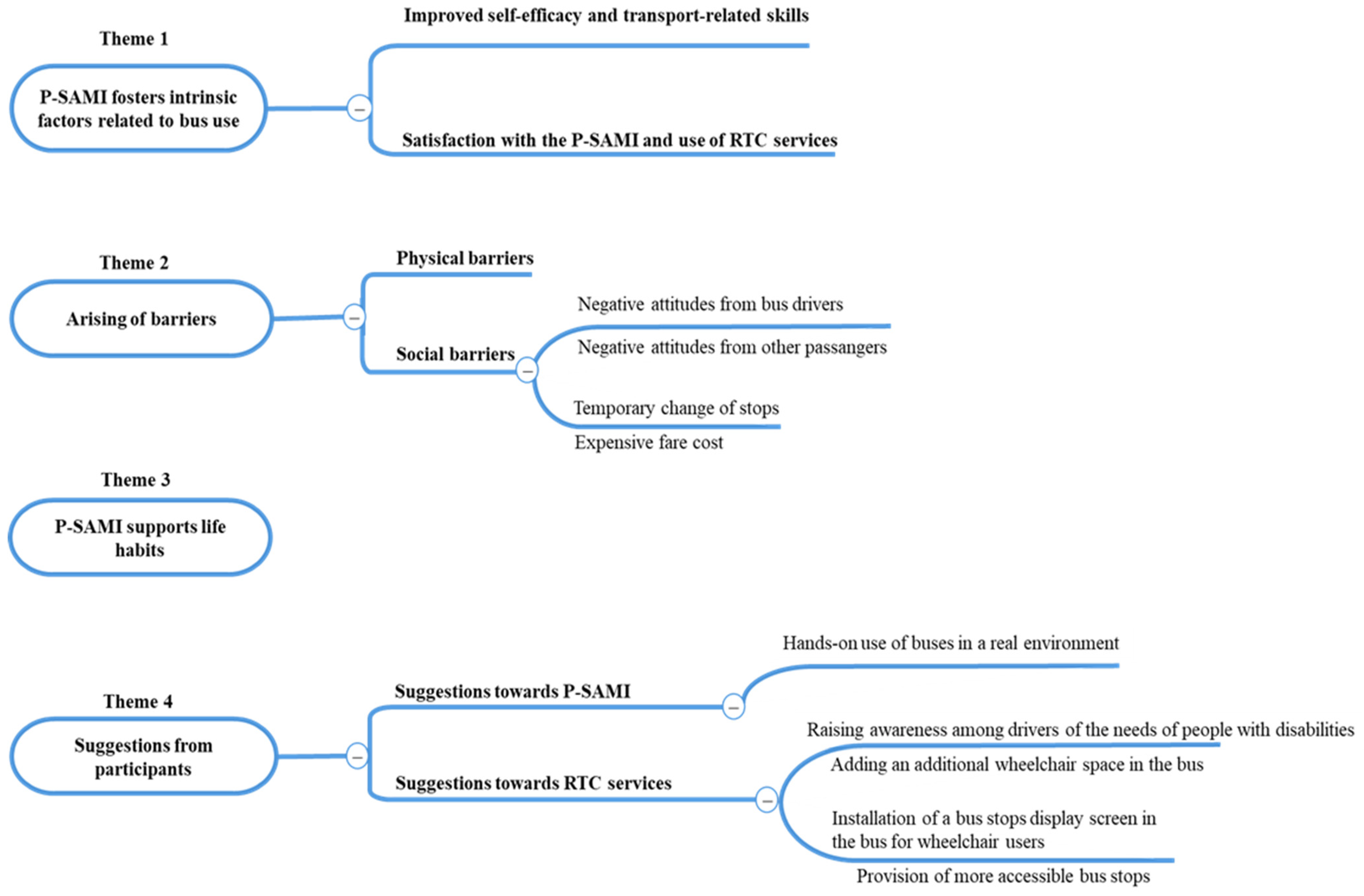
4.3.1. Theme 1: P-SAMI Fosters Intrinsic Factors Related to Bus Use
Self-Efficacy and Skills for Using the Bus
Satisfaction with the P-SAMI and Use of RTC Services
4.3.2. Theme 2: Arising Barriers When Using the Bus
To and from Bus Stop or Station
At the Bus Stops or Stations
During Boarding
Inside the Bus
4.3.3. Theme 3: P-SAMI Supports Life Habits
4.3.4. Theme 4: Suggestions
Suggestions for P-SAMI
Suggestions for RTC Services
4.4. Mixed Findings
5. Discussion
6. Strengths and Limitations
7. Conclusions
Author Contributions
Funding
Institutional Review Board Statement
Informed Consent Statement
Data Availability Statement
Acknowledgments
Conflicts of Interest
Disability Language/Terminology Positionality Statement
Abbreviations
| CIUSSS-CN | Centré intégré universitaire de santé et de services sociaux de la Capitale-Nationale |
| COPM | Canadian Occupational Performance Measure |
| ES | Effect size |
| HDM-DCP | Human Development Model-Disability Creation Process |
| LSA | Life Space Assessment |
| RTC | Réseau de transport de la Capitale |
| SAMI | Service d’accompagnement en mobilité intégrée |
| TiDier | Template for Intervention Description and Replication |
| VAS | Visual analog scale |
Appendix A. Semi-Structured Interview Guide
 | |
| Interview guide | |
| Introduction Hello, A few weeks ago, you participated in SAMI program (P-SAMI), a travel training program provided by the Réseau de transport de la Capitale (RTC). Today, we would like to discuss your experiences with P-SAMI and public transportation (PT), the barriers and facilitators to using PT, and the impact of the P-SAMI on your confidence and PT use. Please feel free to express your opinion, whatever it may be. There are no right or wrong answers; on the contrary, keep in mind that we are interested in both positive and negative comments. You are, of course, free to answer or not answer certain questions and have the right to withdraw from the study or take a break at any time if you wish. Please speak loudly, as the discussion is being recorded on audio tape and will be transcribed. We guarantee absolute confidentiality. No names will be attached to the information you provide, and all data will be anonymized and stored securely on a laboratory’s hard disk. Meeting schedule Duration: between 1 h and 1 h 30 min
Tell me a little about yourself:
French version of the interview guide translated using DeepL (https://www.deepl.com/fr/translator, accessed on 10 December 2025) | |
References
- Fristedt, S.; Dahl, A.K.; Wretstrand, A.; Björklund, A.; Falkmer, T. Changes in community mobility in older men and women. A 13-year prospective study. PLoS ONE 2014, 9, e87827. [Google Scholar] [CrossRef] [Scilit]
- American Occupational Therapy Association. Occupational Therapy Practice Framework: Domain and Process; American Occupational Therapy Association: Bethesda, MD, USA, 2020; Volume 74. [Google Scholar]
- Bezyak, J.L.; Sabella, S.A.; Gattis, R.H. Public transportation: An investigation of barriers for people with disabilities. J. Disabil. Policy Stud. 2017, 28, 52–60. [Google Scholar] [CrossRef] [Scilit]
- Feeley, C.; Deka, D.; Lubin, A.; McGackin, M. Detour to the Right Place: A Study with Recommendations for Addressing the Transportation Needs and Barriers of Adults on the Autism Spectrum in New Jersey; Rutgers University: New Brunswick, NJ, USA, 2015. [Google Scholar]
- King, D.A.; Smart, M.J.; Manville, M. The poverty of the carless: Toward universal auto access. J. Plan. Educ. Res. 2022, 42, 464–481. [Google Scholar] [CrossRef] [Scilit]
- World Health Organization. World Report on Disability; World Health Organization: Geneva, Switzerland, 2011; p. 24. [Google Scholar]
- Metz, D. Transport policy for an ageing population. Transp. Rev. 2003, 23, 375–386. [Google Scholar] [CrossRef] [Scilit]
- Mwaka, C.; Best, K.; Cunningham, C.; Gagnon, M.; Routhier, F. Barriers and facilitators of public transport use among people with disabilities: A scoping review. Front. Rehabil. Sci. 2024, 4, 1336514. [Google Scholar] [CrossRef] [Scilit]
- Mitchell, C.; Rickert, T. A Review of International Best Practice in Accessible Public Transportation for Persons with Disabilities; United Nations Development Programme: Kuala Lumpur, Malaysia, 2010. [Google Scholar]
- Unsworth, C.; So, M.H.; Chua, J.; Gudimetla, P.; Naweed, A. A systematic review of public transport accessibility for people using mobility devices. Disabil. Rehabil 2021, 43, 2253–2267. [Google Scholar] [CrossRef] [Scilit]
- Risser, R.; Lexell, E.M.; Bell, D.; Iwarsson, S.; Ståhl, A. Use of local public transport among people with cognitive impairments–A literature review. Transp. Res. Part F Traffic Psychol. Behav. 2015, 29, 83–97. [Google Scholar] [CrossRef] [Scilit]
- Tennakoon, V.; Wiles, J.; Peiris-John, R.; Wickremasinghe, R.; Kool, B.; Ameratunga, S. Transport equity in Sri Lanka: Experiences linked to disability and older age. J. Transp. Health 2020, 18, 100913. [Google Scholar] [CrossRef] [Scilit]
- Ducharme, C.; O’Neill, E.; Girard, S.-M.; Bélair, C.; Chagnon, M.; Levasseur, M. Effets du programme d’Apprentissage à l’utilisation du Transport en Commun (ATraCo): Une étude pré-expérimentale. Rev. Francoph. Rech. Ergothér. 2015, 1, 23–44. [Google Scholar]
- Bezyak, J.L.; Sabella, S.; Hammel, J.; McDonald, K.; Jones, R.A.; Barton, D. Community participation and public transportation barriers experienced by people with disabilities. Disabil. Rehabil. 2020, 42, 3275–3283. [Google Scholar] [CrossRef] [Scilit]
- Mwaka, C.R.; Best, K.L.; Gamache, S.; Gagnon, M.; Routhier, F. Public transport accessibility for people with disabilities: Protocol for a scoping review. JMIR Res. Protoc. 2023, 12, e43188. [Google Scholar] [CrossRef] [Scilit]
- Park, C.H.; Welch, E.W.; Sriraj, P.S. An integrative theory-driven framework for evaluating travel training programs. Eval. Program Plan. 2016, 59, 7–20. [Google Scholar] [CrossRef] [Scilit] [PubMed]
- Logan, P.A.; Dyas, J.; Gladman, J.R. Using an interview study of transport use by people who have had a stroke to inform rehabilitation. Clin. Rehabil. 2004, 18, 703–708. [Google Scholar] [CrossRef] [Scilit] [PubMed]
- Racicot-Lanoue, F.; Boissy, P.; Audet, M.; Lacerte, J.; Levasseur, M.; Baillargeon, D.; Delli-Colli, N.; Pigot, H.; Provencher, V. Become familiar with public transit by learning technological planning tools: Effects of a program co-constructed with community partners on seniors living with disabilities. Can. J. Aging Rev. Can. Vieil. 2023, 42, 525–537. [Google Scholar] [CrossRef] [Scilit]
- Bandura, A.; Ramachaudran, V.S. Encyclopedia of human behavior. N. Y. Acad. Press 1994, 4, 71–81. [Google Scholar]
- Bandura, A. Social Cognitive Theory: Handbook of Social Psychological Theories; Sage Publications: London, UK, 2011. [Google Scholar]
- Bandura, A. Self-efficacy: Toward a unifying theory of behavioral change. Psychol. Rev. 1977, 84, 191–215. [Google Scholar] [CrossRef] [PubMed]
- Bandura, A. Social Learning Theory; Prentice-Hall: Englewood Cliffs, NJ, USA, 1977. [Google Scholar]
- Ravensbergen, L.; Newbold, K.B.; Ganann, R. ‘It’s overwhelming at the start’: Transitioning to public transit use as an older adult. Ageing Soc. 2024, 44, 43–60. [Google Scholar] [CrossRef] [Scilit]
- Ogawa, M.; Hayashi, Y.; Sawada, T.; Kobashi, M.; Tanimukai, H. Psychological Effects of Hands-On Training Using Public Transportation among Inpatients with Physical Disabilities: Analysis of the Self-Efficacy and Perception of Occupational Enablement Using a Multimethod Design. Occup. Ther. Int. 2020, 2020, 1621595. [Google Scholar] [CrossRef] [Scilit]
- Shaheen, S.A.; Allen, D.; Liu, J. Public transit training: A mechanism to increase ridership among older adults. J. Transp. Res. Forum 2010, 49, 7–28. [Google Scholar]
- Cochran, A.L. Understanding the role of transportation-related social interaction in travel behavior and health: A qualitative study of adults with disabilities. J. Transp. Health 2020, 19, 100948. [Google Scholar] [CrossRef] [Scilit]
- Skarin, F.; Olsson, L.E.; Friman, M.; Wästlund, E. Importance of motives, self-efficacy, social support and satisfaction with travel for behavior change during travel intervention programs. Transp. Res. Part F Traffic Psychol. Behav. 2019, 62, 451–458. [Google Scholar] [CrossRef] [Scilit]
- Ryan, R.M.; Deci, E.L. On happiness and human potentials: A review of research on hedonic and eudaimonic well-being. Annu. Rev. Psychol. 2001, 52, 141–166. [Google Scholar] [CrossRef] [Scilit] [PubMed]
- Taniguchi, A.; Grääs, C.; Friman, M. Satisfaction with travel, goal achievement, and voluntary behavioral change. Transp. Res. Part F Traffic Psychol. Behav. 2014, 26, 10–17. [Google Scholar] [CrossRef] [Scilit]
- Thatcher, R.; Gaffney, J.K.; EG&G Dynatrend. ADA Paratransit Handbook: Implementing the Complementary Paratransit Service Requirements of the Americans with Disabilities Act of 1990; Urban Mass Transportation Administration: Washington, DC, USA, 1991. [Google Scholar]
- Burkhardt, J.E.; Bernstein, D.J.; Kulbicki, K.; Eby, D.W.; Molnar, L.J.; Nelson, C.A.; McLary, J.M. Travel Training for Older Adults Part II: Research Report and Case Studies; The National Academies Press: Washington, DC, USA, 2014. [Google Scholar]
- McCarthy, D.P.; Shannon, L.; Wolf-Branigin, K. Current Practices Used by Travel Trainers for Seniors; National Aging and Disability Transportation Center: Washington, DC, USA, 2010. [Google Scholar]
- Wolf-Branigin, M.; Wolf-Branigin, K. The emerging field of travel training services: A systems perspective. J. Public Transp. 2008, 11, 109–123. [Google Scholar] [CrossRef] [Scilit]
- Lubin, A.; Alexander, K.; Harvey, E. Achieving Mobility Access for Older Adults Through Group Travel Instruction. Transp. Res. Rec. 2017, 2650, 18–24. [Google Scholar] [CrossRef] [Scilit]
- Ringsten, M.; Ivanic, B.; Iwarsson, S.; Lexell, E.M. Interventions to improve outdoor mobility among people living with disabilities: A systematic review. Campbell Syst. Rev. 2024, 20, e1407. [Google Scholar] [CrossRef] [Scilit]
- Filiatrault, J.; Boucher, N.; Archambault, P.; Croteau, C.; Gélinas, I.; Le Bouëdec, M.; Garcia, V. Formation, utilisation et expérience du transport en commun régulier à Montréal par des personnes ayant des limitations fonctionnelles motrices. Can. J. Disabil. Stud. 2021, 10, 196–224. [Google Scholar] [CrossRef] [Scilit]
- Pfeiffer, B.; Davidson, A.P.; Brusilovskiy, E.; Feeley, C.; Kinnealey, M.; Salzer, M. Effectiveness of a peer-mediated travel training intervention for adults with autism spectrum disorders. J. Transp. Health 2024, 35, 101781. [Google Scholar] [CrossRef] [Scilit]
- Pfeiffer, B.; Sell, A.; Bevans, K.B. Initial evaluation of a public transportation training program for individuals with intellectual and developmental disabilities: Short report. J. Transp. Health 2020, 16, 100813. [Google Scholar] [CrossRef] [Scilit]
- Babka, R.J.; Cooper, J.F.; Ragland, D.R. Evaluation of Urban Travel Training for Older Adults. Transp. Res. Rec. 2009, 2110, 149–154. [Google Scholar] [CrossRef] [Scilit]
- McDonnell, A.; Benham, S.; Fleming, C.; Raphael, A. Community-based public transportation training with the integration of assistive technology: A pilot program for young adults with intellectual disability. Technol. Disabil. 2021, 33, 109–121. [Google Scholar] [CrossRef] [Scilit]
- Price, R.; Marsh, A.J.; Fisher, M.H. Teaching young adults with intellectual and developmental disabilities community-based navigation skills to take public transportation. Behav. Anal. Pract. 2018, 11, 46–50. [Google Scholar] [CrossRef] [Scilit]
- Stock, S.E.; Davies, D.K.; Herold, R.G.; Wehmeyer, M.L. Technology to Support Transportation Needs Assessment, Training, and Pre-trip Planning by People with Intellectual Disability. Adv. Neurodev. Disord. 2019, 3, 319–324. [Google Scholar] [CrossRef] [Scilit]
- Culter Harris, K.; Frick Semmler, B.J.; Anderson, S.; Mance, E.; Stojkov, A.; Metzler, S.; DiGiovine, C.P. Innovative solutions to support individuals with disabilities accessing public transportation: A case study. Assist. Technol. 2024, 36, 285–294. [Google Scholar] [CrossRef] [Scilit] [PubMed]
- Lesoleil. Un Service D’accompagnement en Mobilité Intégrée. Available online: https://www.lesoleil.com/2021/07/16/un-service-daccompagnement-en-mobilite-integree-a03d21357299474bc1877fe24bc39e2a/ (accessed on 3 February 2025).
- Tovin, M.M.; Wormley, M.E. Systematic development of standards for mixed methods reporting in rehabilitation health sciences research. Phys. Ther. 2023, 103, pzad084. [Google Scholar] [CrossRef] [Scilit] [PubMed]
- Hoffmann, T.C.; Glasziou, P.P.; Boutron, I.; Milne, R.; Perera, R.; Moher, D.; Altman, D.G.; Barbour, V.; Macdonald, H.; Johnston, M. Better reporting of interventions: Template for intervention description and replication (TIDieR) checklist and guide. BMJ 2014, 348, g1687. [Google Scholar] [CrossRef] [Scilit]
- Cloutier, C.; Poulin, M.-M.; Sauvé, M.R.; Fougeyrollas, P.; Cloutier, R.; Bergeron, H.L.N. Réseau International sur le Processus de Production du Handicap. Classification Internationale: Modèle de Développement Humain-Processus de Production du Handicap (MDH-PPH), 2nd ed.; RIPPH, Réseau International sur le Processus de Production du Handicap: Québec, QC, Canada, 2018. [Google Scholar]
- Auger, C.; Demers, L.; Gélinas, I.; Routhier, F.; Jutai, J.; Guérette, C.; Deruyter, F. Development of a French-Canadian version of the Life-Space Assessment (LSA-F): Content validity, reliability and applicability for power mobility device users. Disabil. Rehabil. Assist. Technol. 2009, 4, 31–41. [Google Scholar] [CrossRef] [Scilit]
- Carswell, A.; McColl, M.A.; Baptiste, S.; Law, M.; Polatajko, H.; Pollock, N. The Canadian Occupational Performance Measure: A research and clinical literature review. Can. J. Occup. Ther. 2004, 71, 210–222. [Google Scholar] [CrossRef] [Scilit]
- Cup, E.H.; Scholte op Reimer, W.; Thijssen, M.C.; van Kuyk-Minis, M. Reliability and validity of the Canadian Occupational Performance Measure in stroke patients. Clin. Rehabil. 2003, 17, 402–409. [Google Scholar] [CrossRef] [Scilit]
- Kinney, A.R.; Eakman, A.M.; Graham, J.E. Novel effect size interpretation guidelines and an evaluation of statistical power in rehabilitation research. Arch. Phys. Med. Rehabil. 2020, 101, 2219–2226. [Google Scholar] [CrossRef] [Scilit]
- Byrne, D. A worked example of Braun and Clarke’s approach to reflexive thematic analysis. Qual. Quant. 2022, 56, 1391–1412. [Google Scholar] [CrossRef] [Scilit]
- Fetters, M.D.; Guetterman, T.C. Development of a joint display as a mixed analysis. In The Routledge Reviewer’s Guide to Mixed Methods Analysis; Routledge: New York, NY, USA, 2021; pp. 259–276. [Google Scholar]
- Skamagki, G.; King, A.; Carpenter, C.; Wåhlin, C. The concept of integration in mixed methods research: A step-by-step guide using an example study in physiotherapy. Physiother. Theory Pract. 2024, 40, 197–204. [Google Scholar] [CrossRef] [Scilit]
- Schunk, D.H.; DiBenedetto, M.K. Motivation and social cognitive theory. Contemp. Educ. Psychol. 2020, 60, 101832. [Google Scholar] [CrossRef] [Scilit]
- Schwarzer, R. Modeling health behavior change: How to predict and modify the adoption and maintenance of health behaviors. Appl. Psychol. 2008, 57, 1–29. [Google Scholar] [CrossRef] [Scilit]
- Rothman, A.J. Toward a theory-based analysis of behavioral maintenance. Health Psychol. 2000, 19, 64. [Google Scholar] [CrossRef] [Scilit]
- European Commission. MEthodology for Describing the Accessibility of Transport in Europe. Available online: https://cordis.europa.eu/project/id/218684/reporting?format=pdf (accessed on 19 December 2024).
- Kubina, L.-A.; Dubouloz, C.-J.; Davis, C.G.; Kessler, D.; Egan, M.Y. The process of re-engagement in personally valued activities during the two years following stroke. Disabil. Rehabil. 2013, 35, 236–243. [Google Scholar] [CrossRef] [Scilit]
- Bandura, A. Auto-Efficacité: Le Sentiment D’efficacité Personnelle; De Boeck: Brussels, Belgium, 2007. [Google Scholar]
- Saturni, S.; Bellini, F.; Braido, F.; Paggiaro, P.; Sanduzzi, A.; Scichilone, N.; Santus, P.; Morandi, L.; Papi, A. Randomized Controlled Trials and real life studies. Approaches and methodologies: A clinical point of view. Pulm. Pharmacol. Ther. 2014, 27, 129–138. [Google Scholar] [CrossRef] [Scilit]


| Sociodemographic Variables | Total (n = 33) | % |
|---|---|---|
| Age (years), mean ± SD | 53.7 ± 14.9 | |
| ˃80 | 1 | 3.0 |
| 80–71 | 3 | 9.1 |
| 70–61 | 7 | 21.2 |
| 60–51 | 8 | 24.2 |
| 50–41 | 8 | 24.2 |
| 40–31 | 4 | 12.1 |
| 30–21 | 2 | 6.1 |
| Sex or gender, n (%) | ||
| Male | 16 | 48.5 |
| Female | 17 | 51.5 |
| Disability status, n (%) | ||
| Physical disability | 29 | 87.9 |
| Visual disability | 3 | 9.1 |
| Physical and language disability (mild aphasia post-stroke) | 1 | 3.0 |
| Mobility aids | ||
| Scooter | 2 | 6.1 |
| Manual wheelchair | 13 | 39.4 |
| Power wheelchair | 1 | 3.0 |
| Walker | 2 | 6.1 |
| Waking stick | 10 | 30.3 |
| Crutches | 1 | 3.0 |
| Without mobility aid | 4 | 12.1 |
| Self-reported annual net income (Canadian dollar), n (%) | ||
| ˃75,000 $ | 3 | 9.1 |
| 60,000 $–74,999 $ | 1 | 3.0 |
| 45,000 $–59,999 $ | 1 | 3.0 |
| 30,000 $–44,999 $ | 2 | 6.1 |
| 15,000 $–29,999 $ | 14 | 42.4 |
| <14,999 $ | 11 | 33.3 |
| I prefer not to answer | 1 | 3.0 |
| Outcome | Before-P-SAMI Score Mean (Range) | After-P-SAMI Score Mean (Range) | p Value | Effect Size |
|---|---|---|---|---|
| VAS | 56.6 ± 30.0 (0–100) | 65.6 ± 23.5 (10–100) | 0.004 ** | −0.686 |
| LSA | 44.8 ± 18.6 (8–112.5) | 44.5 ± 17.4 (8–90) | 0.529 | 0.013 |
| COPMs | 6.6 ± 2.3 (1.5–10) | 7.3 ± 1.4 (3.2–9.6) | 0.006 ** | −0.460 |
| Dependent Variables | Quantitative Findings | Qualitative Findings | Meta-Inferences |
|---|---|---|---|
| Self-efficacy | VAS scores before versus after P-SAMI showed statistically significant difference (p < 0.01). | “I feel confident. I also feel confident that we can take public transit in the city, rather than waiting at home for STAC [Paratransit Service of Canada] in that sense. My confidence has improved.” (A man with visual disability; 57-year-old) “There is more confidence. Now, as I was saying, I have more tools to know what to do, if I am in a bad situation, I can see that it is feasible. I have seen to what extent it is suitable too. It is increased my confidence.” (A woman wheelchair user; 32-year-old) | Convergence: The results of two methods indicated an improvement in the self-efficacy of people with disabilities following their participation in the P-SAMI |
| Life-space mobility | LSA scores before versus after p-SAMI demonstrated no statistically significant difference (p ˃ 0.05) | “I was more motivated by public transit, I was less afraid, the RTC, yes. I took the RTC [bus] to go to the restaurant, I went not far from our home to the Galeries de Charlesbourg with the [bus] 801. I went to see my mother, who was in a private RPA [residence for older adults] across from Patro Roc-Amadour [Quebec City Community Center]. I took the 801 and it worked out well. I went to visit my mother, who is in a private residence. I also went to rue Saint-Jean, once, I went up to René Lévesque. Once, yes, for leisure.” (A man with physical disability; 62-year-old) | Divergence: Only qualitative showed a gain in mobility, especially in the bus use after P-SAMI |
| Satisfaction | COPM scores (mean ± SD) before versus after P-SAMI indicated statistically significant difference (p < 0.01) | “I’m Um, I’m very satisfied. It’s going well overall. And I can find my seat pretty easily. And my trip is going pretty well. I have, I have, um, as much as the drivers are willing to help me, the passengers are also willing to help me, whether it’s to change buses, to transfer, or sometimes to find the stop if I’m not quite at the stop. I ask to find out how long it will be before the bus arrives. And especially the new app, it makes it much easier for me to use. The voice that announces the stops is also there.” (A man with visual disability; 58-year-old) | Convergence: Both results demonstrated improvements or a high level of satisfaction with bus use among people with disabilities after P-SAMI. |
Disclaimer/Publisher’s Note: The statements, opinions and data contained in all publications are solely those of the individual author(s) and contributor(s) and not of MDPI and/or the editor(s). MDPI and/or the editor(s) disclaim responsibility for any injury to people or property resulting from any ideas, methods, instructions or products referred to in the content. |
© 2025 by the authors. Licensee MDPI, Basel, Switzerland. This article is an open access article distributed under the terms and conditions of the Creative Commons Attribution (CC BY) license (https://creativecommons.org/licenses/by/4.0/).
Share and Cite
Mwaka, C.R.; Best, K.L.; Tcheutchoua, T.A.A.; Brais, N.; Henriquez, D.; Routhier, F. Understanding How a Public Transportation Network Training Program Can Improve the Self-Efficacy, Satisfaction and Experience of Community Mobility Among People with Disabilities: A Mixed Methods Research. Disabilities 2025, 5, 119. https://doi.org/10.3390/disabilities5040119
Mwaka CR, Best KL, Tcheutchoua TAA, Brais N, Henriquez D, Routhier F. Understanding How a Public Transportation Network Training Program Can Improve the Self-Efficacy, Satisfaction and Experience of Community Mobility Among People with Disabilities: A Mixed Methods Research. Disabilities. 2025; 5(4):119. https://doi.org/10.3390/disabilities5040119
Chicago/Turabian StyleMwaka, Claudel R., Krista L. Best, Toufo A. A. Tcheutchoua, Nicole Brais, Dannia Henriquez, and François Routhier. 2025. "Understanding How a Public Transportation Network Training Program Can Improve the Self-Efficacy, Satisfaction and Experience of Community Mobility Among People with Disabilities: A Mixed Methods Research" Disabilities 5, no. 4: 119. https://doi.org/10.3390/disabilities5040119
APA StyleMwaka, C. R., Best, K. L., Tcheutchoua, T. A. A., Brais, N., Henriquez, D., & Routhier, F. (2025). Understanding How a Public Transportation Network Training Program Can Improve the Self-Efficacy, Satisfaction and Experience of Community Mobility Among People with Disabilities: A Mixed Methods Research. Disabilities, 5(4), 119. https://doi.org/10.3390/disabilities5040119