1. Introduction
Reinforcing steels are key structural components in reinforced concrete structures and play a decisive role in maintaining the stability and durability of civil engineering infrastructures subjected to seismic actions. In earthquake-prone regions, reinforcing bars must accommodate significant inelastic deformations without premature brittle fracture in order to preserve the structural integrity of buildings during seismic events. Consequently, seismic-resistant reinforcing steels should exhibit an adequate balance between yield strength, ductility, and strain-hardening capacity, which are crucial for ensuring sufficient deformation capacity and energy dissipation under cyclic loading conditions [
1].
Unlike conventional reinforcing steels, seismic steels are specifically engineered to achieve enhanced strain-hardening capacity and ductility while maintaining adequate tensile and yield strengths. Key performance parameters widely used in international seismic design standards include the tensile-to-yield strength ratio (Rm/Re) and the total elongation at maximum force (Agt). A high Rm/Re ratio (typically 1.15–1.35) combined with a total elongation Agt ≥ 7% is generally recommended to ensure a stable post-yield behavior and significant energy absorption before rupture under cyclic loads [
2,
3].
In the Moroccan context, reinforcing steels are generally produced according to conventional strength-based requirements, while explicit ductility-related criteria for seismic applications remain less emphasized compared to international seismic standards such as Eurocode 8 [
4] or BS 4449 [
5]. As a result, locally produced reinforcing steels may satisfy the required yield strength levels but still exhibit limited optimization with respect to strain-hardening capacity and ductility-related seismic parameters. This highlights the importance of developing reinforcing steels capable of combining higher strength with improved seismic performance for structural applications in seismic regions such as Morocco.
Table 1 summarizes the main differences between international seismic performance recommendations and the characteristics generally associated with conventional reinforcing steels used in the local context.
The local-context column summarizes general characteristics commonly associated with conventional reinforcing steels used in the local market for conventional structural applications.
One metallurgical approach that has recently gained attention for improving the mechanical performance of reinforcing steels, and particularly their strain-hardening and ductility behavior, is microalloying [
3,
6,
7]. Microalloying consists of adding small quantities of alloying elements—such as vanadium (V), niobium (Nb), or titanium (Ti)—to modify microstructural evolution during thermomechanical processing and thereby enhance mechanical properties [
8,
9]. While microalloying has long been widely employed in structural steels to improve strength and toughness, its application to reinforcing steels designed for seismic performance has received increasing attention in recent years, as researchers aim to better balance strength with deformation capacity and energy absorption [
10,
11,
12].
Among microalloying elements, vanadium has shown particular promise for seismic reinforcing steels due to its pronounced precipitation strengthening effect and its ability to influence microstructural features that are closely related to strain-hardening behavior. Vanadium forms fine vanadium carbides and carbonitrides, typically denoted V(C,N), which can precipitate during cooling after hot working or controlled thermomechanical treatments. These nanoscale precipitates contribute to yield strength but also affect dislocation dynamics and ferrite grain size, which are key factors governing ductility and strain-hardening capacity [
3,
12].
Recent studies have demonstrated that vanadium microalloying can refine the microstructure and modify precipitation behavior in reinforcing steels, leading to improved mechanical performance. For instance, research shows that increased vanadium content promotes the formation of more homogeneous and finer precipitate distributions, which is associated with enhanced yield strength and favorable strain-hardening response without compromising ductility [
13]. Furthermore, vanadium’s interaction with other alloying elements and processing parameters, such as hot rolling schedules and cooling rates, can play a significant role in optimizing the balance between strength and ductility for seismic applications [
14].
Despite these promising findings, most investigations to date have focused on fundamental aspects of vanadium precipitation and its effects on tensile properties in lab-scale steels, with limited applied research on reinforcing bars produced at an industrial scale and evaluated specifically against seismic performance criteria. Moreover, there remains a lack of comprehensive studies aimed at understanding how controlled vanadium additions can be tailored to meet the mechanical requirements of seismic design codes in different geographical and industrial contexts.
In the Moroccan construction sector, reinforcing steels are widely used in infrastructure and building projects. However, their traditional metallurgical design has primarily focused on satisfying conventional structural requirements, while the optimization of ductility-related parameters associated with seismic performance remains an important challenge. Previous investigations on locally produced reinforcing steels showed that conventional grades can satisfy the required yield and tensile strength levels, while ductility-related parameters such as Rm/Re and Agt may vary depending on steel composition and processing conditions and may in some cases remain close to the lower limits commonly associated with seismic-grade reinforcing steels. This highlights the importance of developing reinforcing steels with tailored alloy design for earthquake-resistant structural applications [
15].
Consequently, improving the strain-hardening capacity and ductility of reinforcing steels through targeted microalloying approaches—particularly with ferrovanadium additions—represents a promising strategy for developing cost-effective seismic-resistant reinforcing steels adapted to specific seismic conditions. The present study therefore investigates the influence of different levels of ferrovanadium additions on the microstructural evolution and mechanical performance of reinforcing bars, with a focus on microstructural characterization, grain refinement, and seismic performance indicators such as Rm/Re and Agt. By linking vanadium microalloying to seismic performance criteria, this work aims to provide a scientific basis for the development of optimized reinforcing steels capable of satisfying both industrial production constraints and stringent seismic design requirements.
2. Materials and Methods
2.1. Material Selection
Three batches of reinforcing steel bars were investigated in this study to evaluate the effect of vanadium microalloying on the microstructure and mechanical properties of seismic reinforcing steels. All specimens consisted of hot-rolled reinforcing bars with a nominal diameter of 16 mm, corresponding to a commonly produced industrial diameter. The use of a single bar diameter ensured comparable thermomechanical processing conditions, particularly with respect to rolling and cooling histories, between the investigated steels.
It should be noted that conventional reinforcing steels commonly used in Morocco typically contain around 0.65 wt.% Mn and no vanadium. In the present study, steels with comparable manganese content (1.04–1.14 wt.% Mn) were used as the base composition to evaluate the effect of vanadium additions.
The first batch served as the reference steel, containing approximately 1.14 wt.% Mn without vanadium addition. The second batch had a manganese content of 1.09 wt.% Mn with an addition of 0.037 wt.% V, while the third batch contained 0.067 wt.% V with a manganese content of 1.04 wt.% Mn.
The steels were produced at an industrial scale using a conventional steel-making route consisting of electric arc furnace (EAF) melting, followed by secondary refining in a ladle furnace (LF), continuous casting (CCM), and subsequent hot rolling to obtain reinforcing bars of 16 mm diameter. This industrial processing route ensured production conditions representative of commercial seismic reinforcing steels.
By maintaining a nearly constant manganese content while varying the vanadium concentration, the influence of vanadium microalloying on the microstructural evolution and mechanical behavior of the steels could be systematically investigated.
2.2. Chemical Composition
The chemical composition of the investigated steels was determined by optical emission spectroscopy (OES) using a spark emission spectrometer manufactured by Thermo Fisher Scientific (Waltham, MA, USA), in accordance with ASTM E415 [
16].
2.3. Microstructure Examination
Metallographic samples were prepared according to standard procedures, involving mechanical polishing followed by etching with 2% Nital (2% HNO3 in ethanol). The resulting microstructures were examined using an optical microscope manufactured by ZEISS (Oberkochen, Germany), allowing the evaluation of phase distribution, grain size, and the presence of inclusions.
The grain size was determined in accordance with the ASTM E112 [
17] standard using the Jeffries planimetric method. Several representative micrographs were analyzed to ensure the accuracy and reproducibility of the measurements.
2.4. Mechanical Testing
Tensile tests were performed in accordance with ISO 6892-1 [
18] using a universal testing machine manufactured by Galdabini (Cardano al Campo, Italy) under controlled strain rate conditions to ensure reliable and reproducible results. The mechanical parameters obtained from the tensile tests included yield strength (Re), ultimate tensile strength (Rm), elongation at fracture (A%), total elongation at maximum force (Agt%), and the Rm/Re ratio, which was used to evaluate the ductility behavior of the investigated steels.
In addition, hardness measurements were conducted on longitudinally sectioned specimens using the Rockwell hardness method (HRC scale) in accordance with ISO 6508-1 [
19], using a Micro Italiana IDROMIM 6080 hardness tester (Milan, Italy).
3. Results and Discussion
3.1. Chemical Composition of the Studied Steels
The chemical compositions of the investigated steels are summarized in
Table 2. The three steels exhibit similar base compositions typical of low-carbon structural steels produced under industrial conditions. The carbon content ranges from 0.20 to 0.21 wt.%, which provides a suitable compromise between strength, ductility, and weldability. Silicon (0.215–0.231 wt.%) and manganese (1.04–1.14 wt.%) are present as deoxidizing and strengthening elements, contributing to solid solution strengthening and improving hardenability. The contents of phosphorus and sulfur remain relatively low (≤0.02 wt.%), which is beneficial for maintaining good toughness and reducing the risk of detrimental inclusions.
The main compositional difference between the studied steels lies in the vanadium content. Steel A contains only a residual amount of vanadium (0.003 wt.%), whereas Steel B and Steel C contain higher vanadium levels of 0.037 wt.% and 0.067 wt.%, respectively, resulting from ferrovanadium addition. Vanadium is widely recognized as an effective microalloying element that can contribute to strengthening through precipitation and grain refinement mechanisms during thermomechanical processing. The nitrogen content, ranging between 0.006 and 0.010 wt.%, may also influence the interaction between vanadium and interstitial elements during solidification and subsequent processing. Furthermore, the calculated carbon equivalent (Ceq ≈ 0.43–0.45) indicates that the steels remain within a composition range compatible with good weldability for structural applications. The parameter RM reported in
Table 1 corresponds to the total residual metallic content, calculated as the sum of Cu, Mo, Ni, and Cr contents. These compositional variations provide an appropriate basis for evaluating the influence of ferrovanadium addition on the mechanical properties of the studied steels.
In order to assess the effect of the compositional variations, particularly the vanadium content, tensile tests were performed to evaluate the mechanical properties of the investigated steels.
3.2. Monotonic Tensile Tests
The mechanical properties obtained from tensile testing for the investigated steels are summarized in
Table 3. Steel A corresponds to the grade containing approximately 1.1 wt.% Mn with only a residual vanadium content, whereas Steel B and Steel C contain vanadium additions of about 0.037 wt.% and 0.067 wt.%, respectively. For each investigated steel, three tensile specimens were tested, and the reported values correspond to the average results obtained from these measurements.
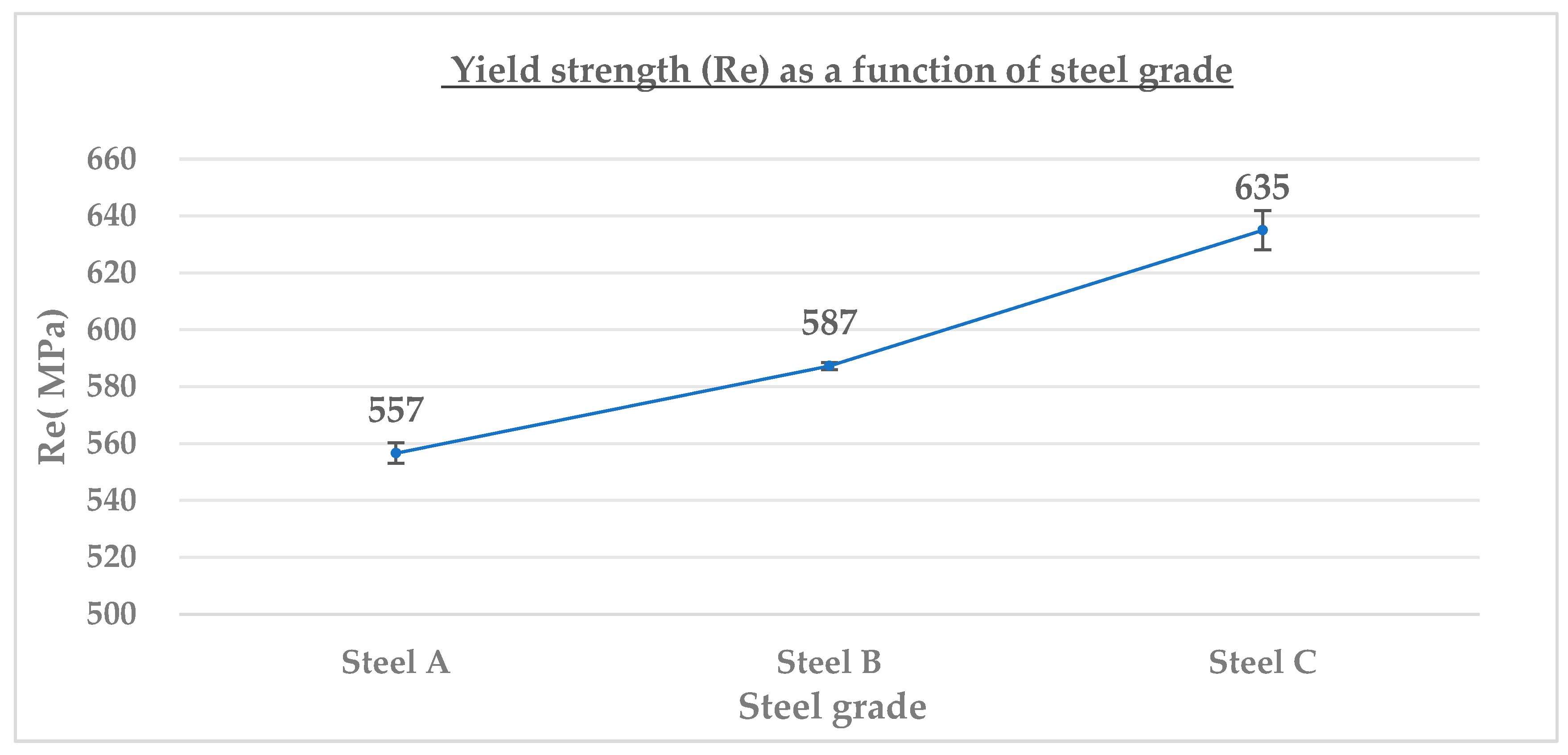
The results show a clear variation in strength and ductility among the three steels. Steel A exhibits a yield strength of 557 MPa and a tensile strength of 666 MPa, with the highest strain-hardening capacity, as indicated by the Rm/Re ratio of 1.20. This steel also shows the highest total elongation (A% ≈ 21.61%), reflecting relatively good ductility.
Steel B, containing 0.037 wt.% V, shows an intermediate behavior, with a yield strength of 587 MPa and a tensile strength of 689 MPa. Its Rm/Re ratio (1.17) is slightly lower than that of Steel A, while the total elongation (A% ≈ 19.15%) and Agt (≈10.26%) indicate a moderate reduction in ductility compared to Steel A.
Steel C, with the highest vanadium content (0.06 wt.% V), exhibits the highest mechanical strength, with a yield strength of 635 MPa and a tensile strength of 721 MPa. However, this increase in strength is accompanied by a slight reduction in ductility, as shown by A% ≈ 19.52% and Agt ≈ 9.69%. The Rm/Re ratio (1.14) remains relatively stable, indicating comparable strain-hardening behavior among the steels.
Overall, the results indicate a progressive increase in strength with increasing vanadium content, from Steel A to Steel C, as shown in
Figure 1, accompanied by a slight reduction in ductility and Rm/Re ratio. Increasing vanadium content was associated with higher yield and tensile strengths, reflecting the typical strength–ductility trade-off often reported in microalloyed steels [
20]. Among the investigated compositions, Steel B exhibited the most balanced mechanical behavior, combining higher yield and tensile strengths than Steel A with an Rm/Re ratio above 1.15, which is commonly associated with seismic-grade reinforcing steels. These results suggest that moderate vanadium addition may enhance mechanical strength while maintaining sufficient strain-hardening capacity, as reflected by the Rm/Re ratio, which is considered a key parameter for seismic-resistant reinforcing steels.
In this context, the objective of vanadium microalloying was not only to increase the yield strength but also to maintain ductility-related parameters compatible with seismic performance requirements. Increasing the yield strength while preserving acceptable Rm/Re and Agt values may contribute to improved seismic performance and energy dissipation capacity in reinforced concrete structures. However, excessive vanadium addition, as observed for Steel C, may lead to a slight reduction in strain-hardening capacity, reflected by the decrease in the Rm/Re ratio toward the lower limit generally recommended for seismic-grade reinforcing steels.
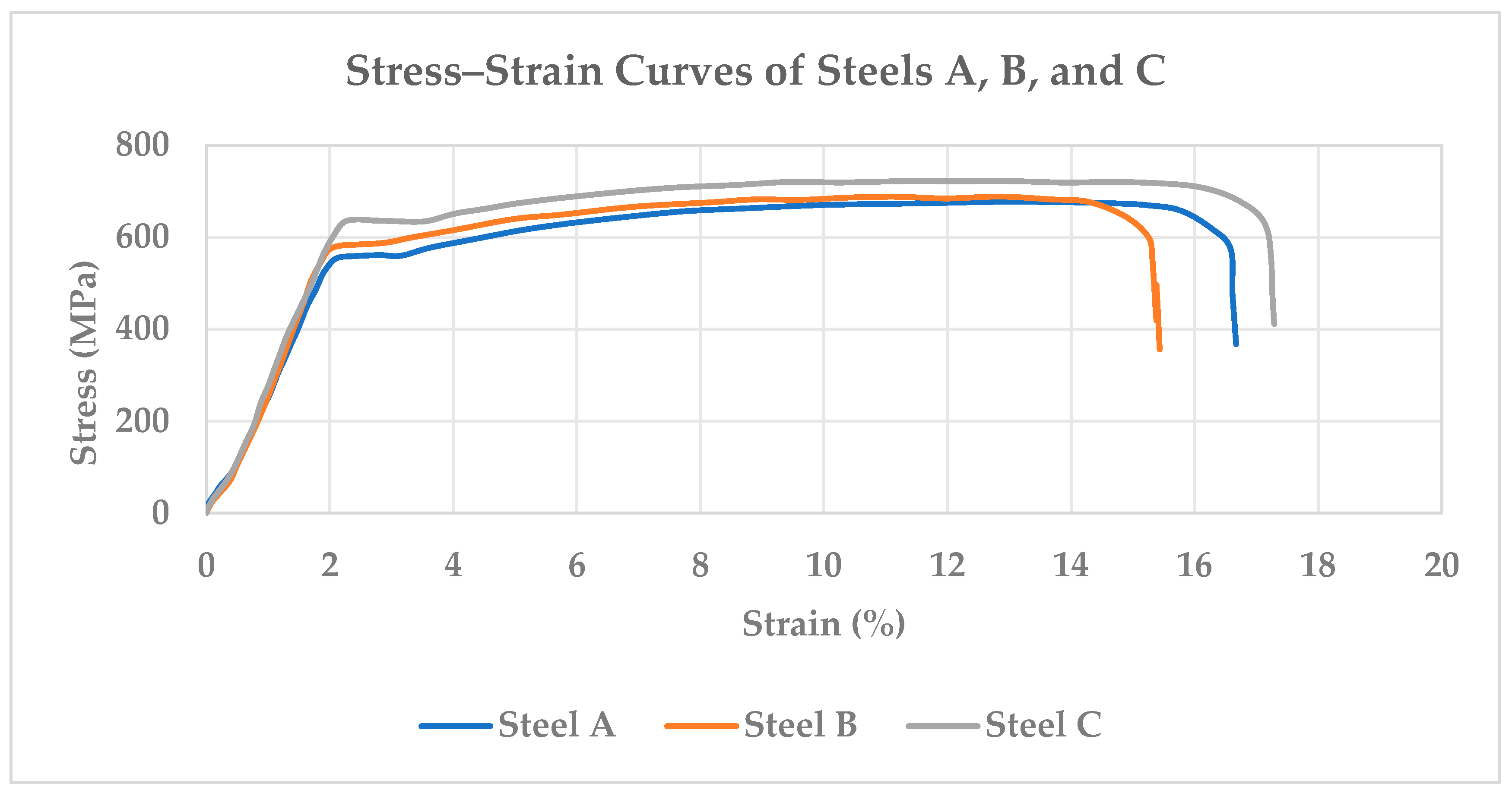
Representative engineering stress–strain curves of samples A, B, and C are presented in
Figure 2, allowing a direct comparison of their mechanical behavior.
The addition of vanadium is beneficial in enhancing the strength of the investigated steels through precipitation strengthening and grain refinement. However, this improvement is accompanied by a slight reduction in ductility, highlighting a typical strength–ductility trade-off. Therefore, an optimal vanadium content is required to achieve a balanced combination of mechanical properties.
Overall, Steel B (0.037 wt.% V) appears to provide the most favorable balance between strength and ductility, combining a noticeable improvement in strength with a still acceptable level of ductility.
3.3. Effect of Vanadium Addition on Strength–Ductility Balance
3.3.1. Effect of Vanadium Addition on Tensile Behavior
The observed evolution of mechanical properties can be primarily attributed to the variation in vanadium content among the studied steels. As the vanadium content increases from Steel A (residual V) to Steel C (0.067 wt.% V), a clear improvement in both yield strength and tensile strength is observed. This trend highlights the effectiveness of vanadium as a microalloying element in enhancing the strength of low-carbon steels.
The strengthening effect associated with vanadium addition is generally related to its influence on microstructural evolution during processing, particularly through grain refinement and precipitation-related mechanisms. These features will be further analyzed and discussed in relation to the microstructural characterization presented in the following section. In addition, the presence of nitrogen in the steels may promote interactions with vanadium, potentially enhancing its strengthening efficiency.
On the other hand, the results indicate a slight reduction in ductility with increasing vanadium content, as observed in Steel C. This behavior is commonly reported in microalloyed steels, where strength enhancement is often accompanied by a moderate decrease in elongation. Nevertheless, the Rm/Re ratio remains within a relatively narrow range, indicating that the strain-hardening capacity is preserved despite the increase in strength. This is a key requirement for structural and seismic applications, where both strength and energy absorption capacity are critical.
Overall, the results demonstrate that ferrovanadium addition allows for a significant improvement in strength while maintaining an acceptable level of ductility, leading to a favorable strength–ductility balance in the studied steels.
3.3.2. Hardness Measurements
In addition to the tensile results, hardness measurements were carried out to provide further insight into the strengthening effect induced by vanadium addition.
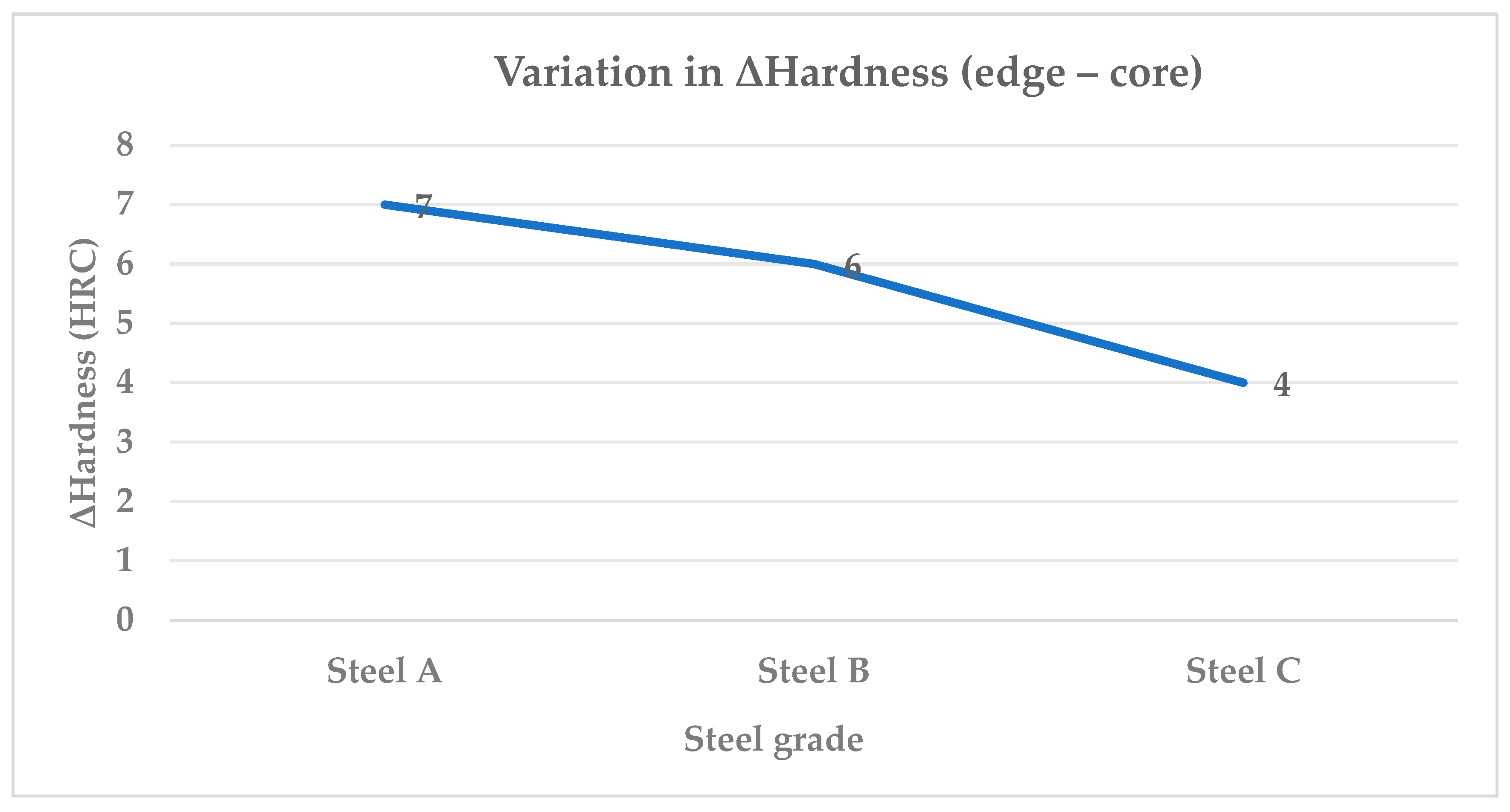
The hardness gradient between the edge and the core decreases with increasing vanadium content, from 7 HRC in the vanadium-free steel to 4 HRC in the steel with the highest vanadium addition (
Figure 3). This trend suggests an improvement in microstructural homogeneity. In the absence of vanadium, the relatively high hardness variation may be associated with heterogeneous phase transformations and non-uniform cooling conditions across the section.
Table 4 presents the hardness distribution across the bar section for the investigated steels. The results indicate that increasing vanadium content was associated with a progressive increase in core hardness, leading to a reduction in the hardness gradient between the edge and the core.
The addition of vanadium may influence the microstructural evolution, potentially through the formation of fine and relatively stable vanadium carbide (VC) precipitates [
21], which are reported in the literature to contribute to grain refinement and to reduce local microstructural heterogeneities in microalloyed steels [
3]. Consequently, vanadium-containing steels exhibit a more uniform hardness distribution, suggesting improved through-thickness homogeneity.
3.4. Microstructural Characterization of the Studied Steels
3.4.1. Thermodynamic Considerations of Vanadium Precipitation
The precipitation of vanadium-containing phases in Fe–C–V steels is primarily governed by thermodynamic stability, which can be described in terms of the Gibbs free energy of the system. According to thermodynamic principles and CALPHAD-based studies reported in the literature, the formation of vanadium carbides (VC) becomes thermodynamically favorable when the Gibbs free energy change is negative (ΔG < 0) [
22].
At temperatures close to the end of hot rolling (~600 °C), the decrease in temperature enhances the tendency for carbide formation. Under these conditions, vanadium, which has a strong affinity for carbon, tends to form stable interstitial compounds such as VC and V(C,N), commonly observed in Fe–V–C systems [
3].
Thermodynamic studies, particularly those based on CALPHAD calculations, show that VC is one of the most stable carbide phases at intermediate temperatures. This is mainly due to its low solubility in ferrite, which provides a significant driving force for precipitation [
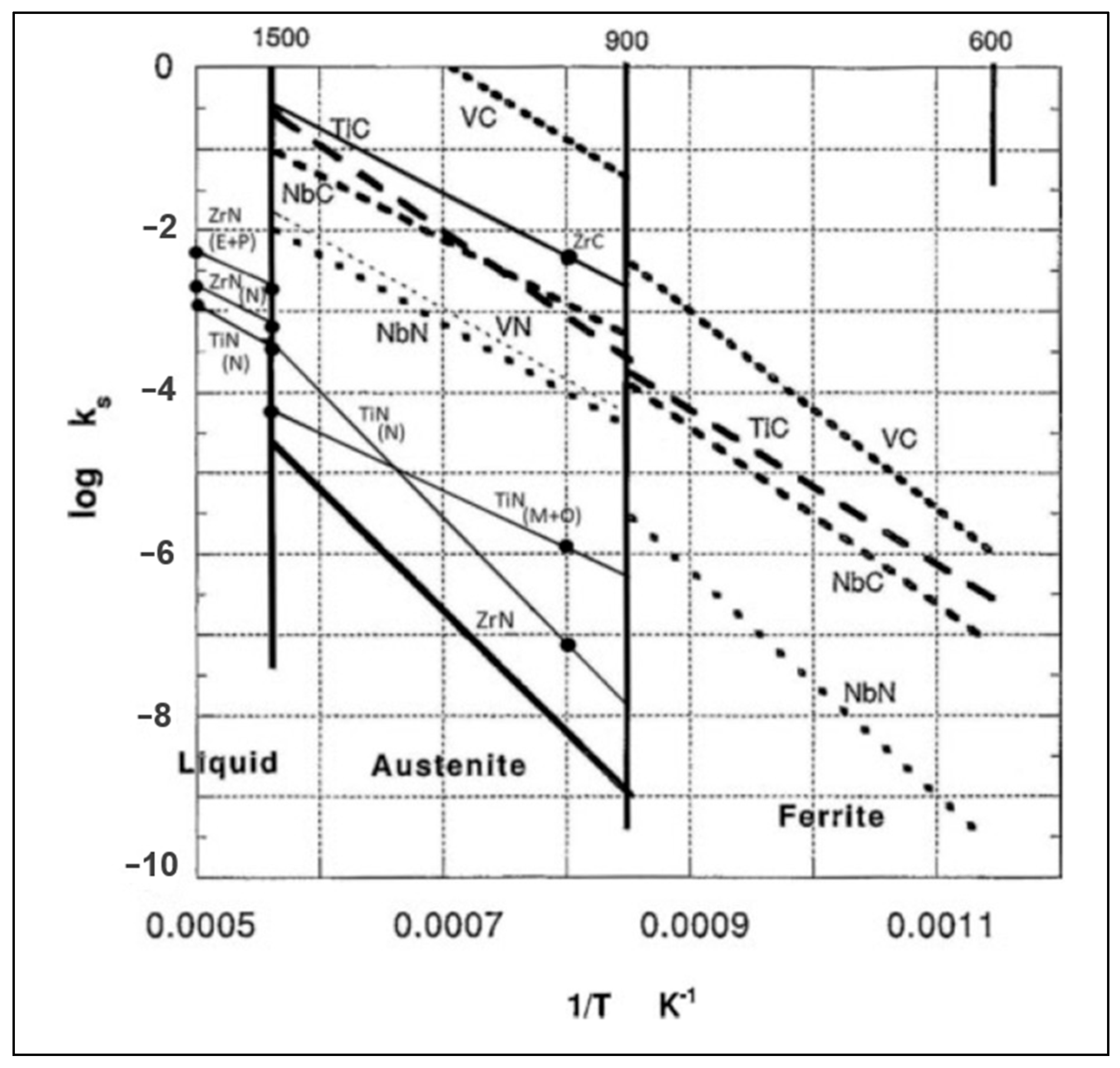
23]. This trend is consistent with thermodynamic solubility diagrams reported in the literature [
3] (
Figure 4), which indicate that VC precipitates at lower temperatures within the ferrite region compared to other microalloy carbides such as NbC and TiC. Such low-temperature stability may promote fine precipitation during cooling and enhance precipitation strengthening [
21].
However, precipitation does not depend on thermodynamics alone. It is also influenced by kinetic factors such as cooling rate and thermal history. As a result, vanadium can remain in solid solution at high temperatures and progressively precipitate during cooling, potentially contributing to the strengthening of the steel [
3].
The thermodynamic driving force for vanadium carbide precipitation may contribute to subsequent microstructural evolution, particularly grain refinement through precipitation pinning effects.
It should be noted that no quantitative CALPHAD simulations specific to the investigated steel compositions were performed in the present study. Therefore, the thermodynamic discussion is mainly based on qualitative interpretation supported by literature data and previously reported thermodynamic calculations for Fe–V–C systems.
3.4.2. Microstructural Analysis
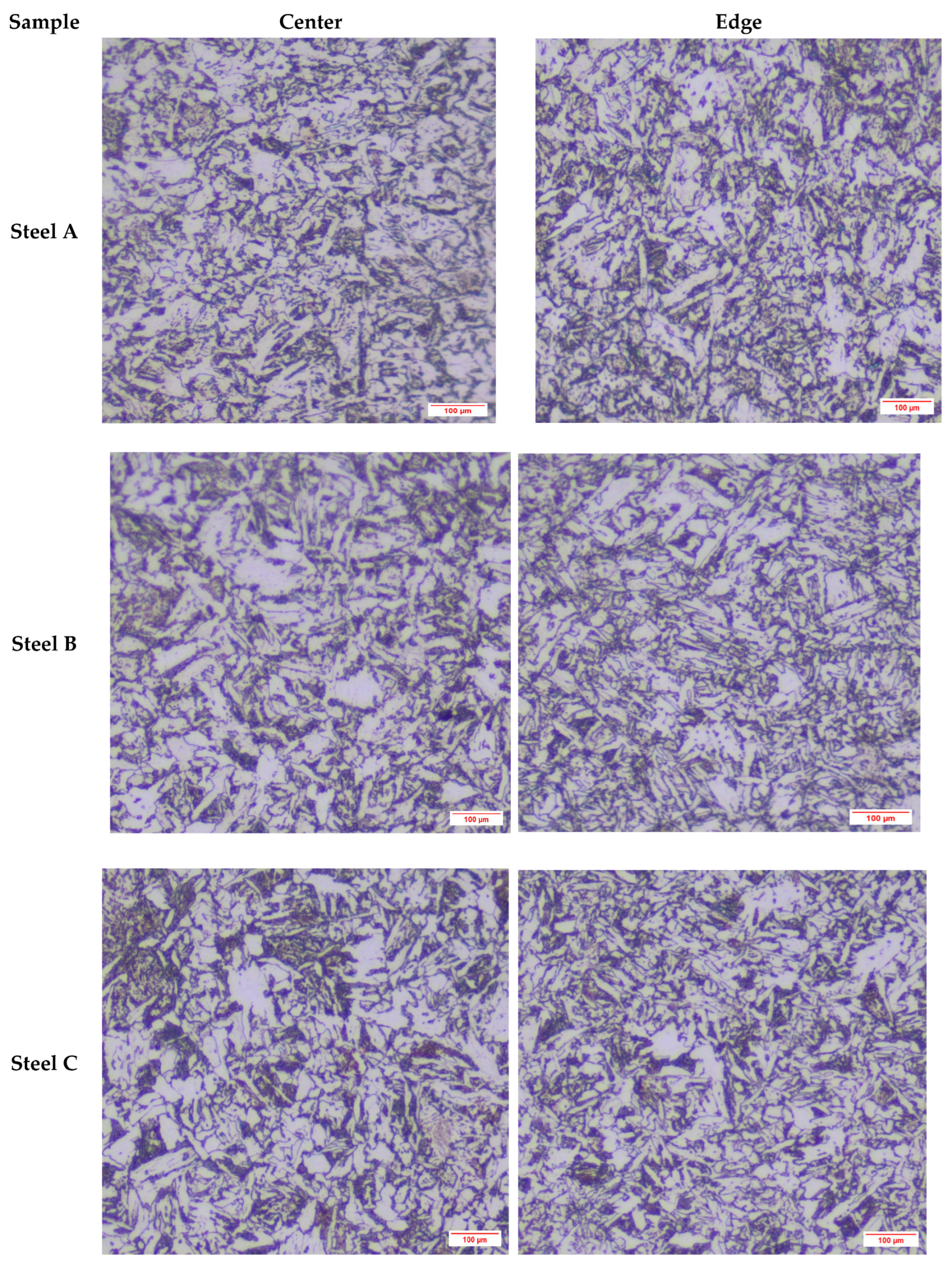
Microstructural examinations were conducted to assess the effect of increasing vanadium content on the evolution of the microstructure and its spatial homogeneity from the center to the edge of the specimens.
Figure 5 below reports the microstructural characterization of the studied samples at different locations across the cross-section, namely the center and edge regions.
The microstructures of steels A, B, and C, corresponding, respectively, to 0 wt.% V, 0.037 wt.% V, and 0.067 wt.% V, were examined at the center and edge regions of the specimens.
Steel A (without vanadium) exhibits a relatively coarse ferrite–pearlite microstructure with an heterogeneous pearlite distribution and larger ferritic regions. Slight variations between the center and the edge can be observed, which may be associated with differences in cooling conditions across the section.
With the addition of 0.037 wt.% V (steel B), a noticeable microstructural refinement is observed at both the center and the edge, characterized by finer ferrite grains and a more homogeneous pearlite distribution.
Increasing the vanadium content to 0.067 wt.% V (steel C) further enhances this refinement, resulting in a finer and more uniform microstructure between the center and the edge regions. The ferritic matrix appears more equiaxed, and the pearlite colonies become more uniformly dispersed.
This progressive refinement from steel A to C suggests that vanadium addition influences the transformation behavior and grain growth during cooling. Although no vanadium-rich precipitates were directly identified, the observed refinement may be related to the microalloying effect of vanadium, which is known to influence phase transformation kinetics and contribute to ferrite grain refinement during cooling. However, direct characterization of nanoscale V(C,N) precipitates by TEM or other advanced techniques was beyond the scope of the present study. Therefore, the proposed precipitation strengthening mechanism remains based on indirect evidence from mechanical behavior, microstructural observations, thermodynamic considerations, and previous literature on vanadium microalloyed steels.
3.4.3. Grain Size Measurements
Grain size measurements of the three investigated steels were performed according to ASTM E112 [
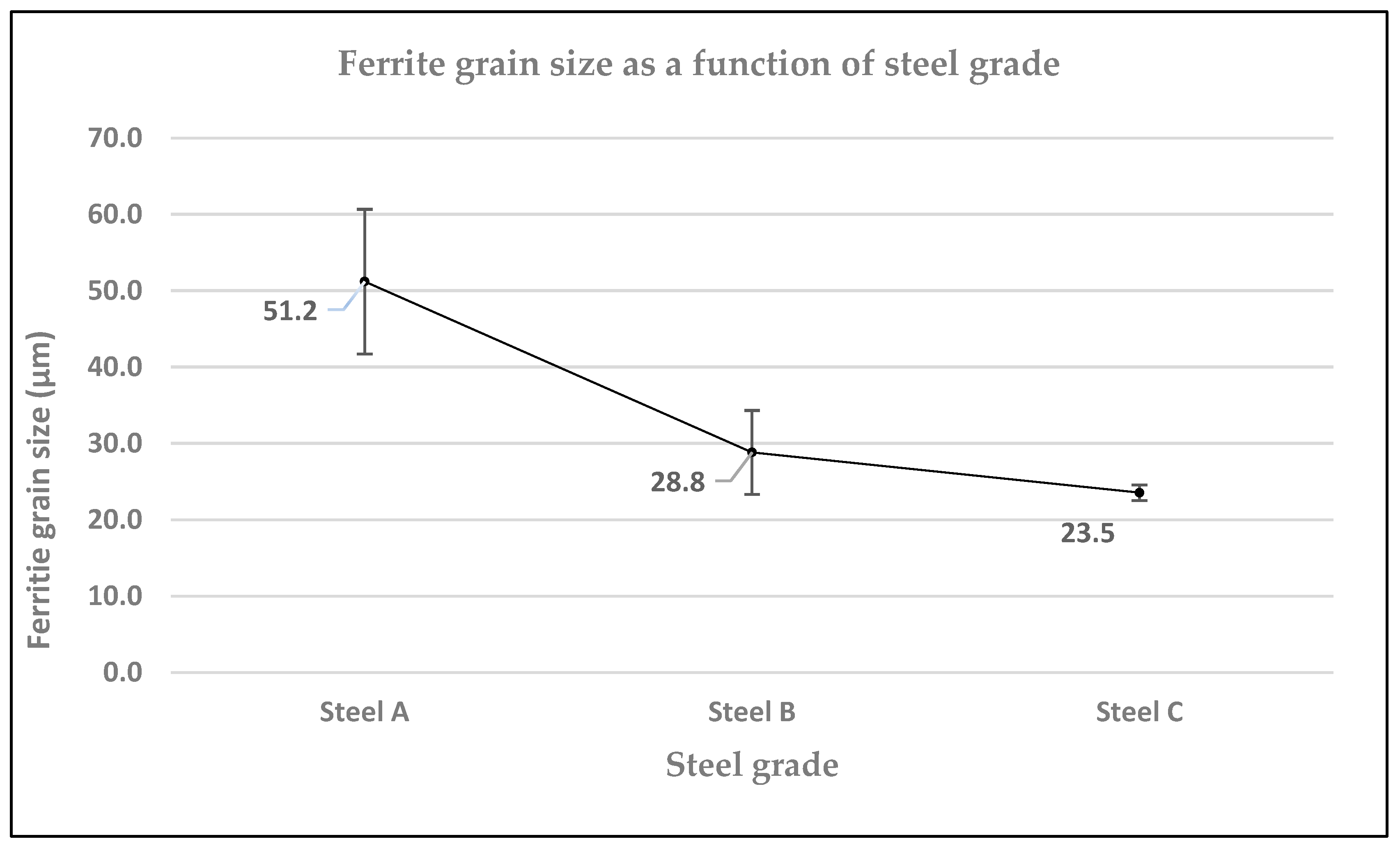
17] using the Jeffries planimetric method. A total of 15 measurements were conducted for each sample on representative micrographs to improve the reliability and reproducibility of the results. The obtained average grain size values are presented in
Figure 6.
The addition of vanadium may influence grain size evolution, potentially through the precipitation of fine VC particles, as commonly reported in microalloyed steels. Such precipitates are known from the literature to act as obstacles to grain boundary migration. These precipitates are generally considered to exert a pinning force on grain boundaries, commonly described by the Zener pinning effect, thereby potentially limiting grain growth during thermomechanical processing [
24].
The effectiveness of this mechanism may be associated with the possible formation of fine and relatively stable vanadium-containing precipitates during cooling within the investigated temperature range. Consequently, the observed grain refinement in the vanadium-containing steels may be associated with the effect of vanadium microalloying. However, no direct observation of V(C,N) precipitates was performed in the present study, since only optical microscopy was employed. Therefore, the contribution of precipitation strengthening is discussed as a probable mechanism inferred from the observed mechanical behavior, grain refinement results, and previous literature on vanadium microalloyed steels [
25].
This grain refinement may contribute to the improvement of mechanical properties, particularly yield strength, which is commonly interpreted through the Hall–Petch relationship, where smaller grain sizes are generally associated with higher strength. However, the overall strengthening behavior may also be influenced by additional factors, including possible precipitation strengthening and dislocation density effects [
26].
The ferrite grain size tends to decrease from Steel A to Steel C with increasing vanadium content, as shown in
Figure 6. This trend may suggest that vanadium addition influences the transformation behavior during cooling. The presence of vanadium in solid solution, together with the possible formation of fine vanadium-containing precipitates, may contribute to limiting ferrite grain growth and promoting microstructural refinement. Consequently, the vanadium-containing steels exhibit finer ferrite grain sizes and a more refined microstructure compared to Steel A. Such behavior is generally consistent with the reported role of vanadium microalloying in influencing phase transformation and microstructural evolution in low-alloy steels.
4. Conclusions
The present study investigated the effect of vanadium addition on the mechanical properties and microstructural evolution of microalloyed steels with different V contents. The results obtained from monotonic tensile tests, hardness measurements, and microstructural characterization allow a comprehensive understanding of the role of vanadium in modifying the strength–ductility balance and microstructural homogeneity.
The tensile results indicate that vanadium addition leads to an overall improvement in strength while maintaining an acceptable level of ductility. This behavior suggests an effective strengthening response associated with microalloying, without severely compromising plastic deformation capacity. The observed improvement in mechanical performance becomes more pronounced with increasing vanadium content, highlighting the beneficial contribution of this alloying element in microstructural strengthening.
Hardness measurements further confirm this trend, showing an increase in hardness level with vanadium addition, together with a reduction in the hardness gradient between the edge and the core of the studied samples. The decrease in ΔHRC from the vanadium-free steel to the highest vanadium-containing steel indicates an improvement in through-thickness microstructural homogeneity. This behavior suggests a more uniform distribution of strengthening mechanisms across the section.
Microstructural observations reveal a refined ferritic structure in vanadium-containing steels compared to the reference steel without vanadium. This refinement is consistent with the presence of fine second-phase particles that are commonly reported in microalloyed steels. In particular, vanadium is known to form stable carbide and carbonitride precipitates during cooling, which may contribute to grain refinement and the restriction of grain growth.
From a thermodynamic standpoint, the formation of vanadium carbides is driven by a favorable Gibbs free energy change at intermediate temperatures. As the temperature decreases during cooling, the thermodynamic driving force for precipitation increases, which may promote the formation of fine VC precipitates. These particles are widely reported in the literature to play a key role in grain refinement through the Zener pinning effect by hindering grain boundary migration and limiting grain growth.
The combined effect of grain refinement, precipitation strengthening, and improved microstructural homogeneity explains the enhanced mechanical response of vanadium-containing steels. In particular, the reduction in grain size contributes to strengthening through the Hall–Petch relationship, while fine precipitates may also act as obstacles to dislocation motion, further increasing strength.
From the perspective of seismic reinforcing steel performance, the investigated steels generally exhibited ductility-related parameters compatible with the ranges commonly associated with seismic-grade reinforcing steels. In particular, Steel B provided the most favorable balance between strength enhancement and ductility-related parameters, with Rm/Re and Agt values remaining within the commonly targeted ranges reported in international reinforcing steel specifications. Although Steel C exhibited the highest yield strength, its Rm/Re ratio slightly decreased below the commonly targeted value generally associated with seismic-grade reinforcing steels, suggesting that excessive vanadium addition may reduce the strain-hardening capacity.
Overall, the results demonstrate that vanadium addition is an effective strategy to enhance the mechanical performance of microalloyed steels. It promotes a refined and more homogeneous microstructure, leading to improved strength and a more uniform hardness distribution. However, the extent of these improvements strongly depends on the processing conditions and the precipitation state, which may influence the final microstructural balance.
Further work could focus on a more detailed characterization of precipitates using advanced techniques such as transmission electron microscopy (TEM) and on thermodynamic/kinetic simulations using CALPHAD-based approaches to better quantify precipitation behavior in Fe–C–V systems.
Author Contributions
Conceptualization, J.E.H.; methodology, J.E.H.; validation, J.E.H., B.O. and A.F.; formal analysis, J.E.H.; investigation, J.E.H.; resources, B.O. and A.F.; data curation, J.E.H.; writing—original draft preparation, J.E.H.; writing—review and editing, B.O. and A.F.; visualization, J.E.H.; supervision, B.O. and A.F.; project administration, B.O. All authors have read and agreed to the published version of the manuscript.
Funding
This research received no external funding.
Data Availability Statement
The data supporting the findings of this study are available from the corresponding author upon reasonable request.
Acknowledgments
The authors would like to thank Riva Industries for providing access to industrial facilities and technical support during the experimental work.
Conflicts of Interest
Authors Jihane El Hamzaoui and Ahmed Faih are employed by Riva Industries. Bennaceur Ouaki declares no conflict of interest.
Abbreviations
The following abbreviations are used in this manuscript:
| Re | Yield strength |
| Rm | Ultimate tensile strength |
| Rm/Re | Tensile to yield strength ratio |
| A% | Total elongation |
| Agt | Total elongation at maximal force |
| HRC | Rockwell hardness (C scale) |
| V | Vanadium |
| Nb | Niobium |
| Ti | Titanium |
| Mn | Manganese |
| ΔG | Gibbs free energy change |
| CALPHAD | Calculation of phase diagrams |
References
- Sun, C.; Zhuang, M.L.; Dong, B. Experimental evaluation of effect factors on seismic performance of concrete columns reinforced with HTRB630 high-strength steel bars. Int. J. Concr. Struct. Mater. 2022, 16, 45. [Google Scholar] [CrossRef]
- Salvatore, W.; Caprili, S.; Braconi, A.; Finetto, M.; Bianco, L.; Ascanio, C.; Moersch, J.; Apostolopoulos, C.; Ferreira Pimenta, G. Effects of Corrosion on Low-Cycle Fatigue (Seismic) Behaviour of High-Strength Steel Reinforcing Bars (Rusteel); Final Report; Research Fund for Coal and Steel, European Commission: Brussels, Belgium, 2014. [Google Scholar]
- Baker, T.N. Microalloyed steels. Ironmak. Steelmak. 2016, 43, 264–307. [Google Scholar] [CrossRef]
- CEN. Eurocode 8: Design of Structures for Earthquake Resistance—Part 1: General Rules, Seismic Actions and Rules for Buildings; European Committee for Standardization (CEN): Brussels, Belgium, 2004. [Google Scholar]
- BS 4449; Steel for the Reinforcement of Concrete—Weldable Reinforcing Steel—Bar, Coil and Decoiled Product—Specification. British Standards Institution (BSI): London, UK, 2005.
- Liu, H.; Yang, B.; Chen, Y.; Li, C.; Liu, C. Precipitation law of vanadium in microalloyed steel and its performance influencing factors. Materials 2022, 15, 8146. [Google Scholar] [CrossRef] [PubMed]
- Hashimoto, S.; Nakamura, M. Effects of Microalloying Elements on Mechanical Properties of Reinforcing Bars. ISIJ Int. 2006, 46, 1510–1515. [Google Scholar] [CrossRef]
- Lv, Y.; Sheng, G.; Jiao, Y. Effect of V/N ratio on the high strain and low cycle fatigue behaviors of V–N microalloyed rebars. Constr. Build. Mater. 2014, 69, 18–25. [Google Scholar] [CrossRef]
- Ahmed, E.; Ibrahim, S.; Galal, M.; Elnekhaily, S.A.; Allam, T. Microstructure and mechanical properties of V-alloyed rebars subjected to Tempcore process. Metals 2021, 11, 246. [Google Scholar] [CrossRef]
- Han, R.; Yang, G.; Xu, D.; Jiang, L.; Fu, Z.; Zhao, G. Effect of V on the precipitation behavior of Ti–Mo microalloyed high-strength steel. Materials 2022, 15, 5965. [Google Scholar] [CrossRef] [PubMed]
- Chung, J.; Kim, T.Y.; Lee, J.S. Study on the Effect of V Microalloying on Earthquake Resisting High-Strength Reinforcing Bar Steels. Mater. Sci. Forum 2021, 1016, 345–353. [Google Scholar]
- Baker, T.N. Processes, microstructure and properties of vanadium microalloyed steels. Mater. Sci. Technol. 2009, 25, 1083–1107. [Google Scholar] [CrossRef]
- Lagneborg, R.; Hutchinson, B.; Siwecki, T.; Zajac, S. The Role of Vanadium in Microalloyed Steels. Scand. J. Metall. 1999, 28, 186–241. [Google Scholar]
- Huang, S.; Li, C.; Li, Z.; Zhuang, C.; Zeng, Z.; Wang, J. Effect of Thermal Simulation Process on Microstructure of Seismic Steel Bars. Materials 2022, 15, 3438. [Google Scholar] [CrossRef] [PubMed]
- El Hamzaoui, J.; Ouaki, B.; Faih, A. Towards the development of seismic-resistant rebar: A case study of conventional steels produced in Morocco. Results Mater. 2026, 30, 100940. [Google Scholar] [CrossRef]
- ASTM E415-21; Standard Test Method for Analysis of Carbon and Low-Alloy Steel by Spark Atomic Emission Spectrometry. ASTM International: West Conshohocken, PA, USA, 2021.
- ASTM E112-13; Standard Test Methods for Determining Average Grain Size. ASTM International: West Conshohocken, PA, USA, 2021.
- ISO 6892-1; Metallic Materials—Tensile Testing—Part 1: Method of Test at Room Temperature. 3rd ed. International Organization for Standardization: Geneva, Switzerland, 2019.
- ISO 6508-1; Metallic Materials—Rockwell Hardness Test—Part 1: Test Method. 5th ed. International Organization for Standardization: Geneva, Switzerland, 2023.
- Bi, N.; Tang, H.; Shi, Z.; Wang, X.; Han, F.; Liang, J. Effects of Vanadium Microalloying and Intercritical Annealing on Yield Strength–Ductility Trade-Offs of Medium-Manganese Steels. Materials 2023, 16, 2220. [Google Scholar] [CrossRef] [PubMed]
- Wojtacha, A.; Opiela, M. Thermodynamic analysis of precipitation process of complex carbonitride TixV1−x Cy N1−y in HSLA-type steel. Adv. Sci. Technol. Res. J. 2022, 16, 64–73. [Google Scholar]
- Gladman, T. The Physical Metallurgy of Microalloyed Steels; The Institute of Materials: London, UK, 1997. [Google Scholar]
- Lee, B.-J.; Lee, D.N. A thermodynamic study on the V–C and Fe–V systems. Calphad 1991, 15, 283–291. [Google Scholar]
- Oikawa, T.; Zhang, J.J.; Enomoto, M.; Adachi, Y. Influence of carbide particles on the grain growth of ferrite in an Fe–0.1C–0.09V alloy. ISIJ Int. 2013, 53, 1245–1252. [Google Scholar] [CrossRef]
- Cong, T.; Chen, G.; Liu, X.; Cong, J.; Yang, Y.; Wang, X. Effects of vanadium on the microstructures and mechanical properties of microalloyed steel for forged wheels. J. Mater. Res. Technol. 2025, 39, 2790–2802. [Google Scholar] [CrossRef]
- Cordero, Z.C.; Knight, B.E.; Schuh, C.A. Six decades of the Hall–Petch effect—A survey of grain-size strengthening studies on pure metals. Int. Mater. Rev. 2016, 61, 495–512. [Google Scholar] [CrossRef]
| Disclaimer/Publisher’s Note: The statements, opinions and data contained in all publications are solely those of the individual author(s) and contributor(s) and not of MDPI and/or the editor(s). MDPI and/or the editor(s) disclaim responsibility for any injury to people or property resulting from any ideas, methods, instructions or products referred to in the content. |