
Thermodynamic Assessment of Heat Pump Configurations for Waste Heat Integrated Carnot Batteries



Abstract
1. Introduction
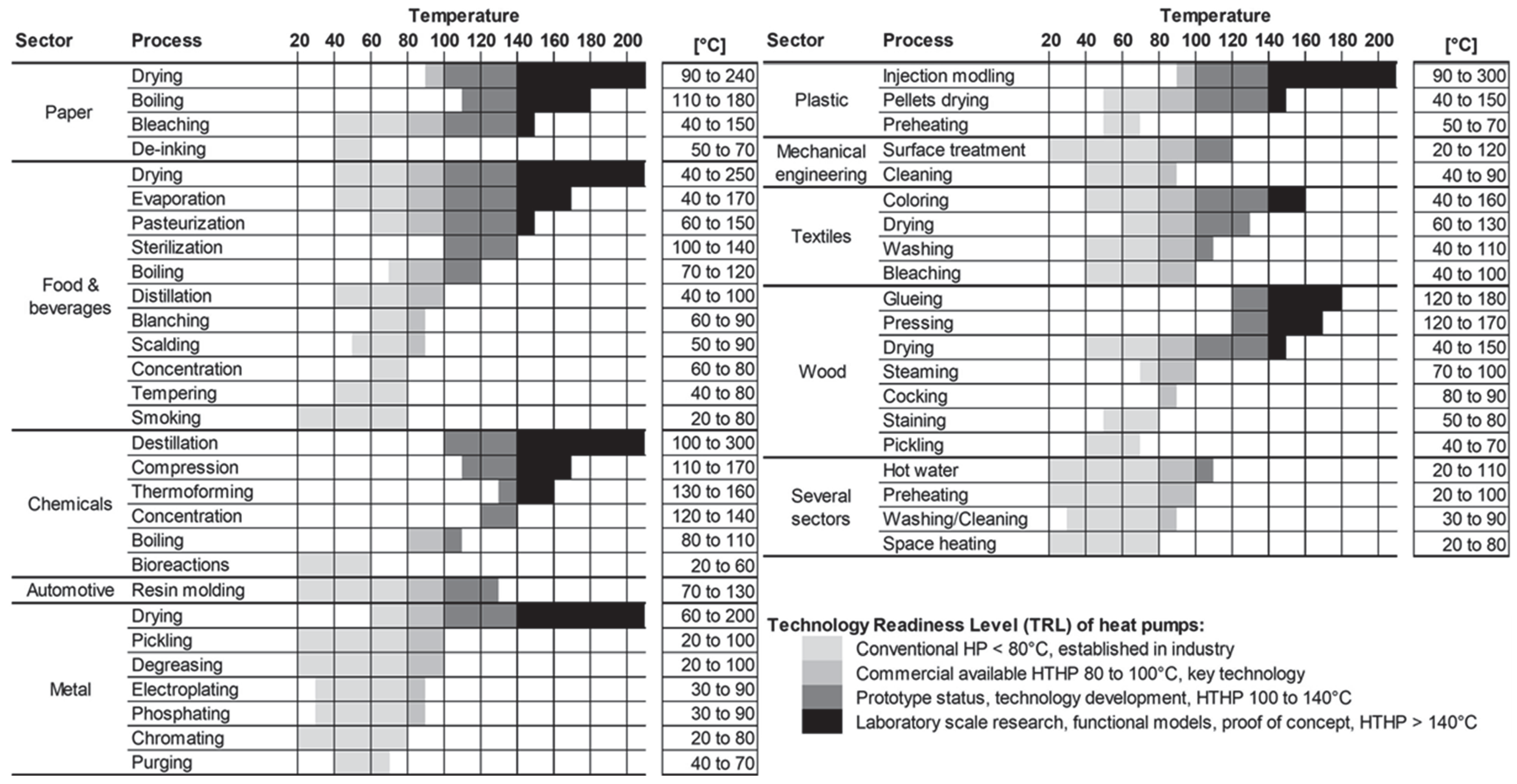
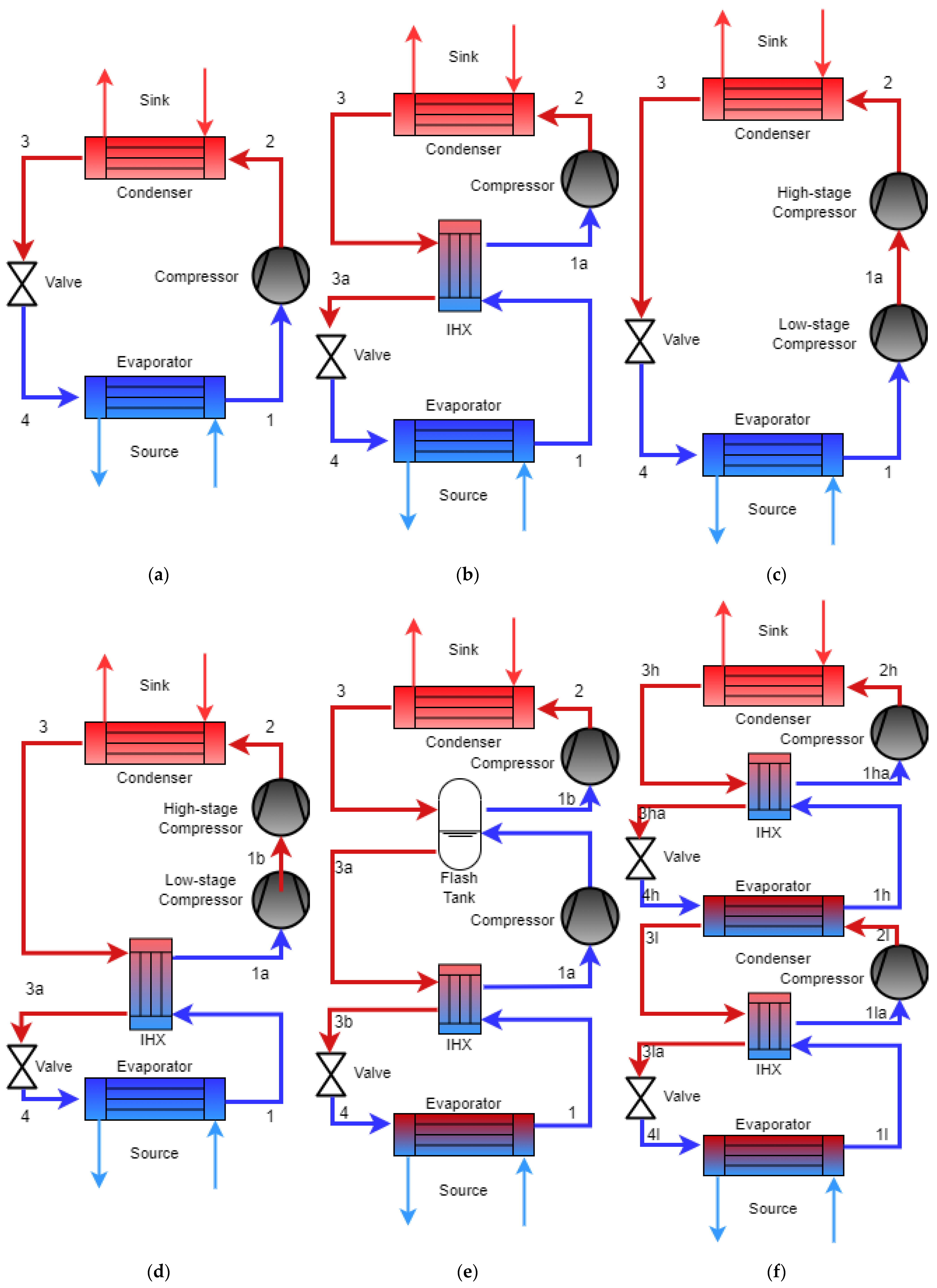
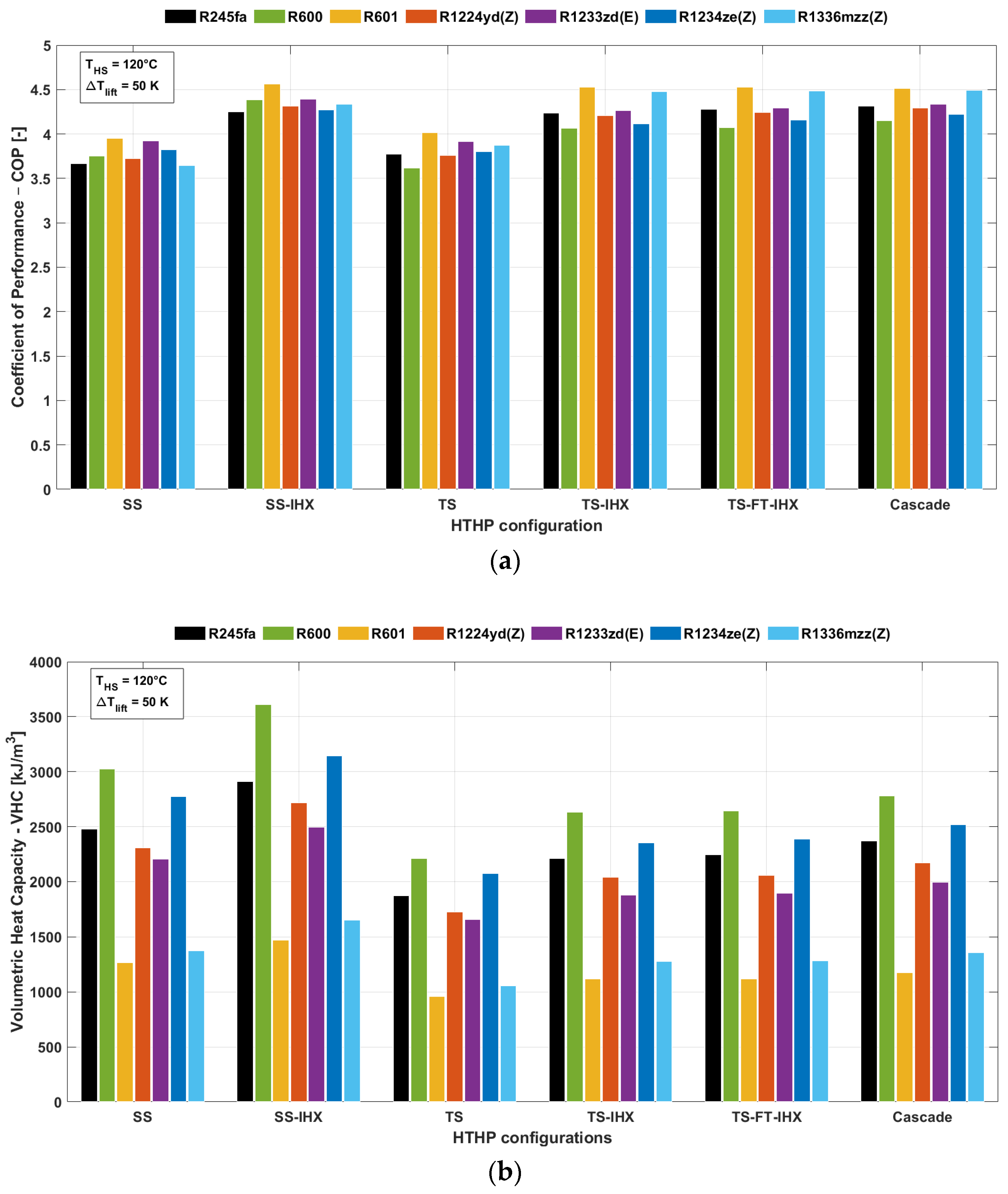
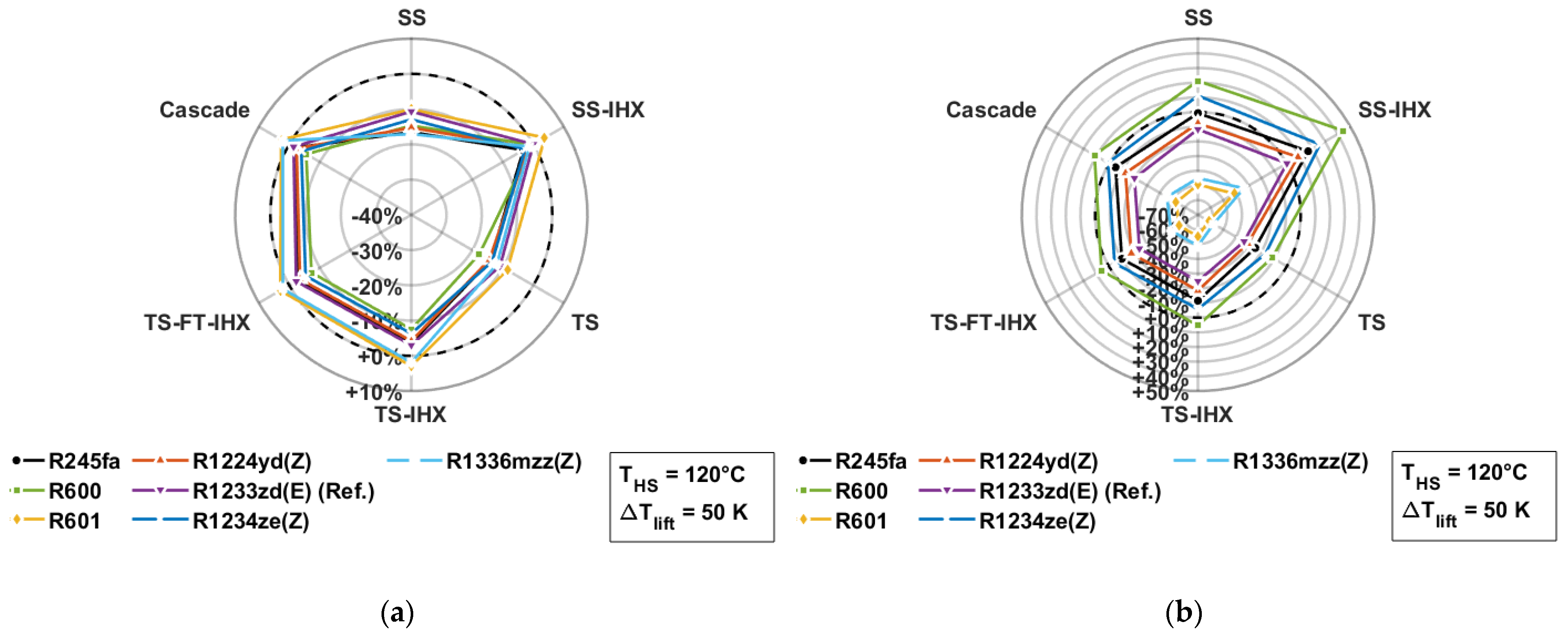
- To systematically assess the impact of high-temperature heat pump configurations and low-GWP working fluid selection on Carnot battery charging performance, by comparing single-stage, multi-stage, and cascade architectures with internal heat recovery under representative operating conditions and evaluating their effects on the coefficient of performance and volumetric heat capacity.
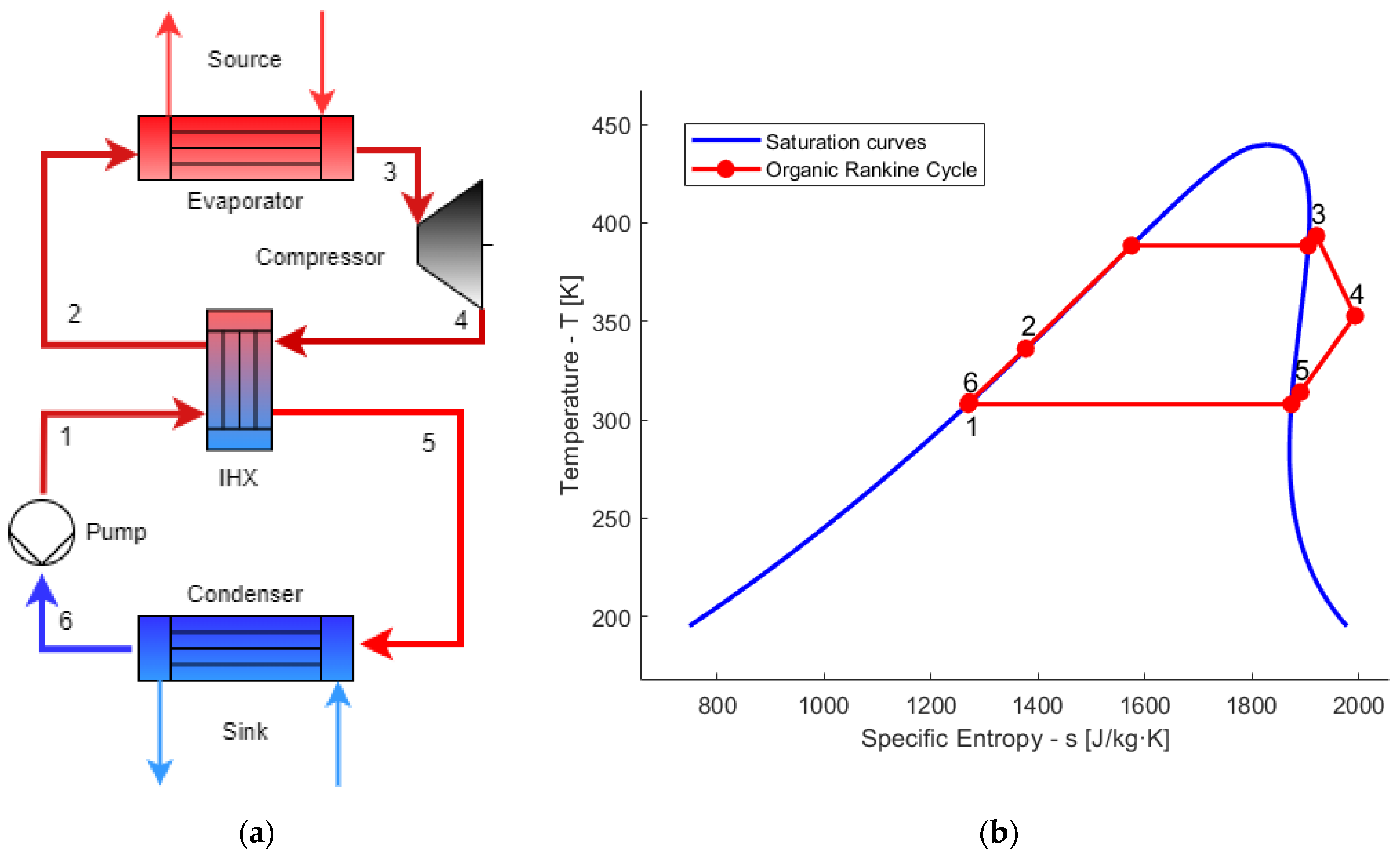
- To develop and apply a more rigorous modelling of the ORC discharging subsystem, in which the turbine isentropic efficiency is not assumed to be constant but varies with operating conditions, allowing off-design behavior and over-expansion effects to be realistically captured.
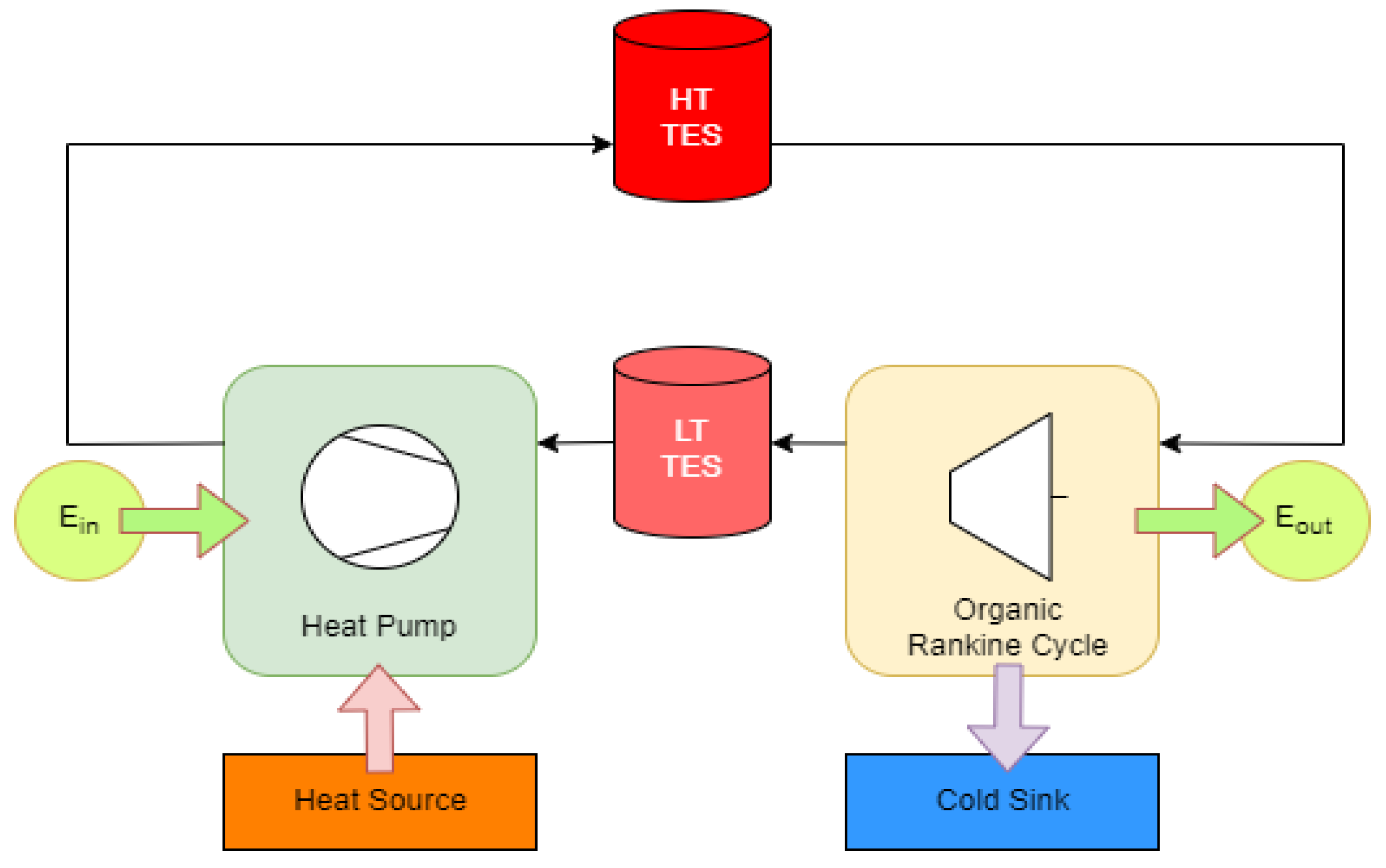
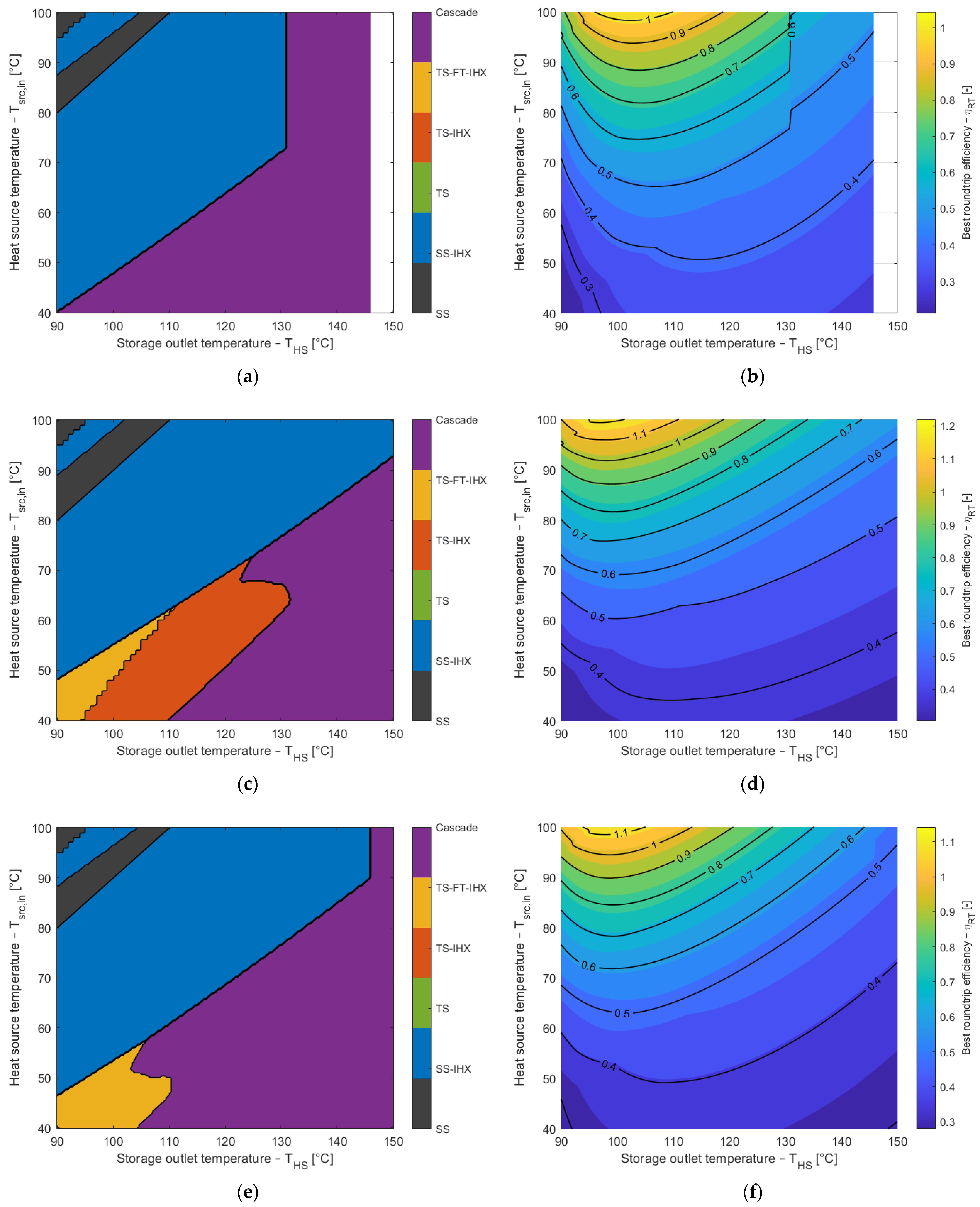
- To evaluate the resulting system-level performance of HP–ORC Carnot batteries in terms of round-trip efficiency, through grid-search optimization across a wide range of storage outlet and waste heat source temperatures, providing operating maps and design guidance for industrial Carnot battery applications.
2. Carnot Battery System and Model
2.1. System Description
2.2. Thermodynamic Model
- Steady-state operation of both HTHP and ORC;
- Negligible thermal losses from the storage tanks and heat exchangers;
- No pressure drop in pipes and heat exchangers;
- Kinetic and potential energy variations of the working fluid are neglected;
- No auxiliary electricity consumption from pumps, fans, and control systems,
- Pressurized water is used as the heat-transfer fluid in the heat source, thermal storage, and cold sink.
2.3. Working Fluids
3. Results
3.1. Parametric Analysis
3.1.1. Comparison of HTHP Configurations
3.1.2. Comparison of Low-GWP Refrigerants
3.2. Configurations and Refrigerants: A Combined Comparison
3.3. Carnot Battery Roundtrip Efficiency
4. Conclusions
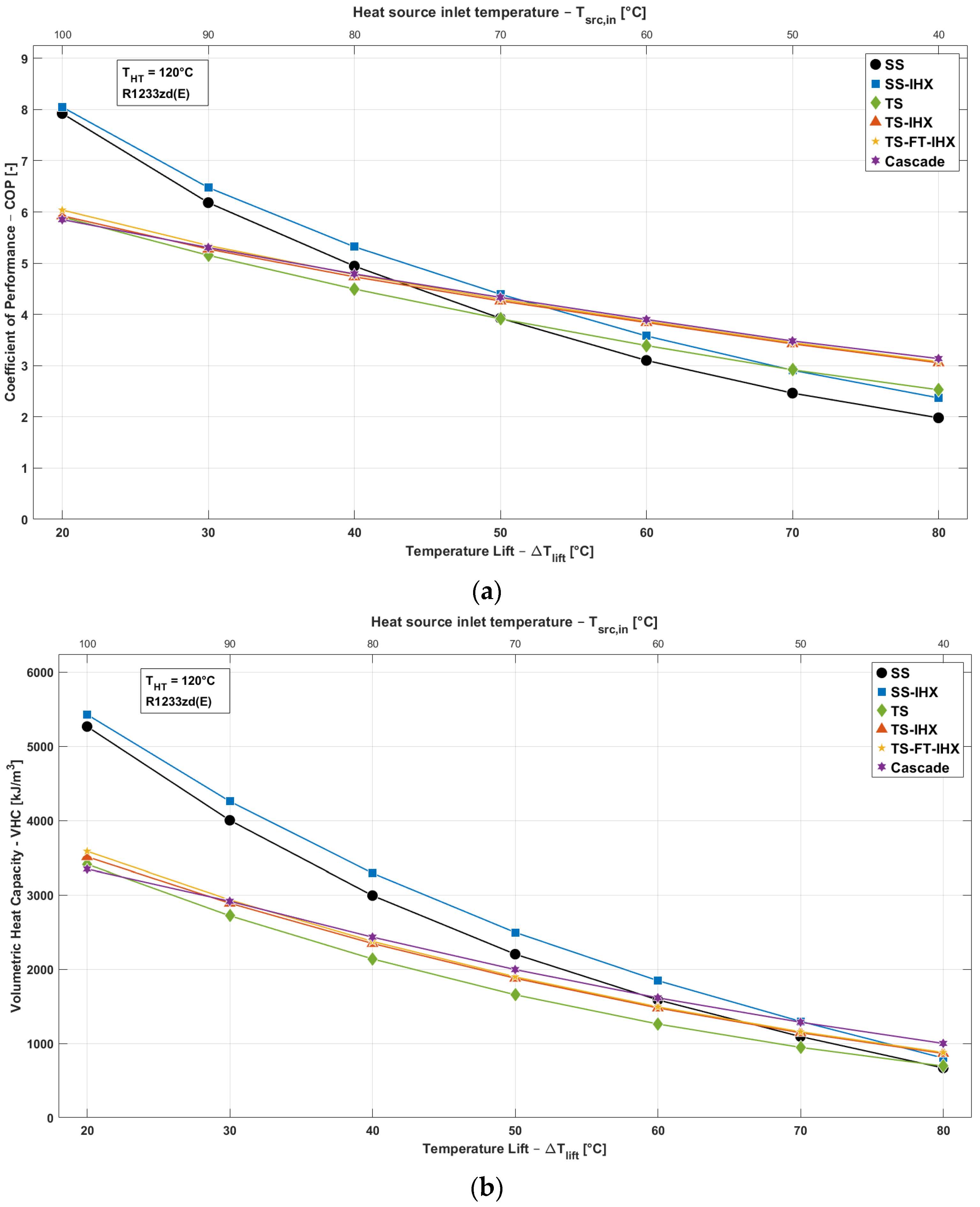
- Heat pump configuration plays a dominant role in system performance, with single-stage configurations with internal heat exchange providing the best performance at low to moderate temperature lifts, combining simplicity with favorable volumetric characteristics. As the temperature lift increases, two-stage and cascade configurations become more advantageous, as they mitigate compression losses through pressure ratio splitting and intercooling, enabling efficient operation under demanding high-temperature conditions.
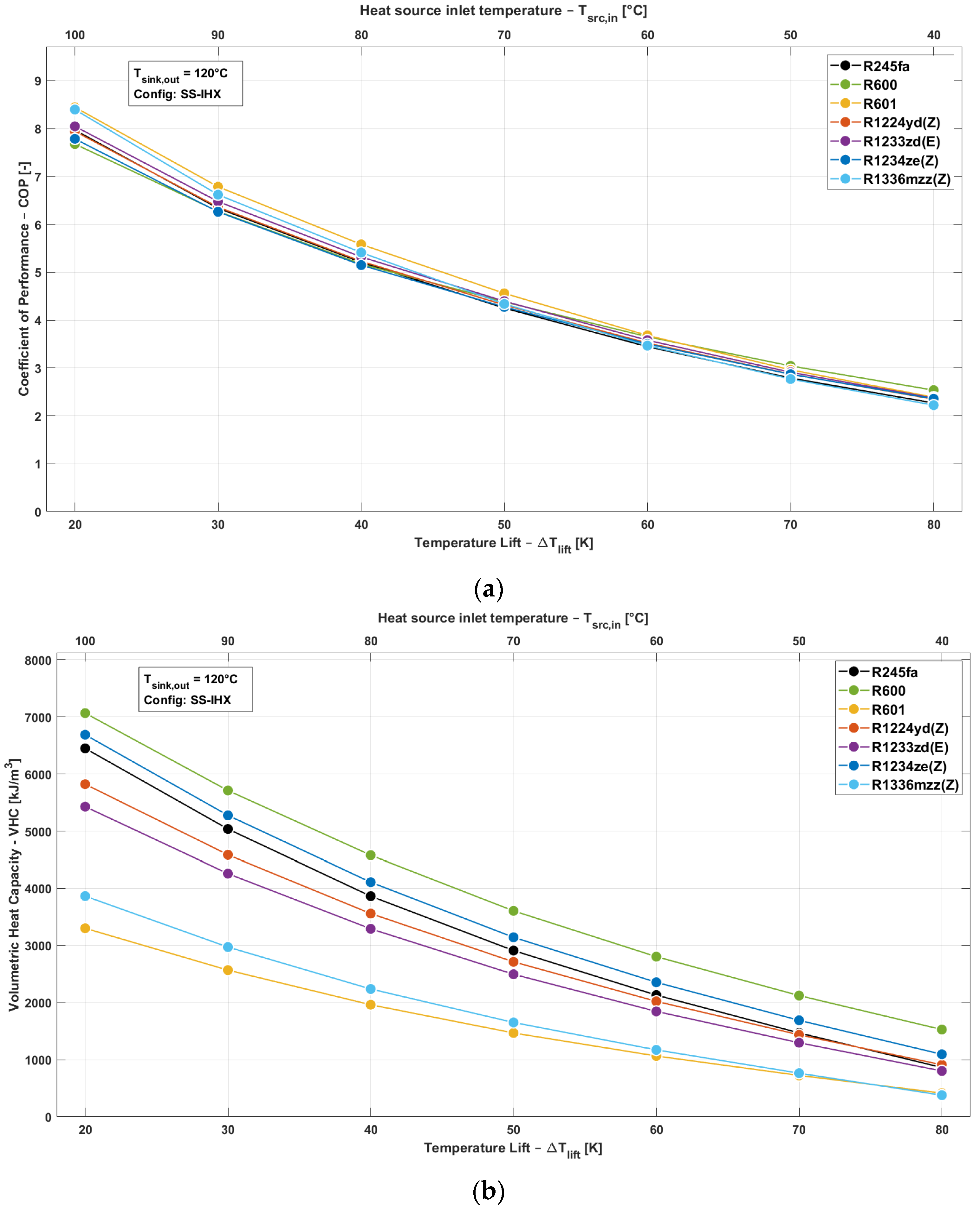
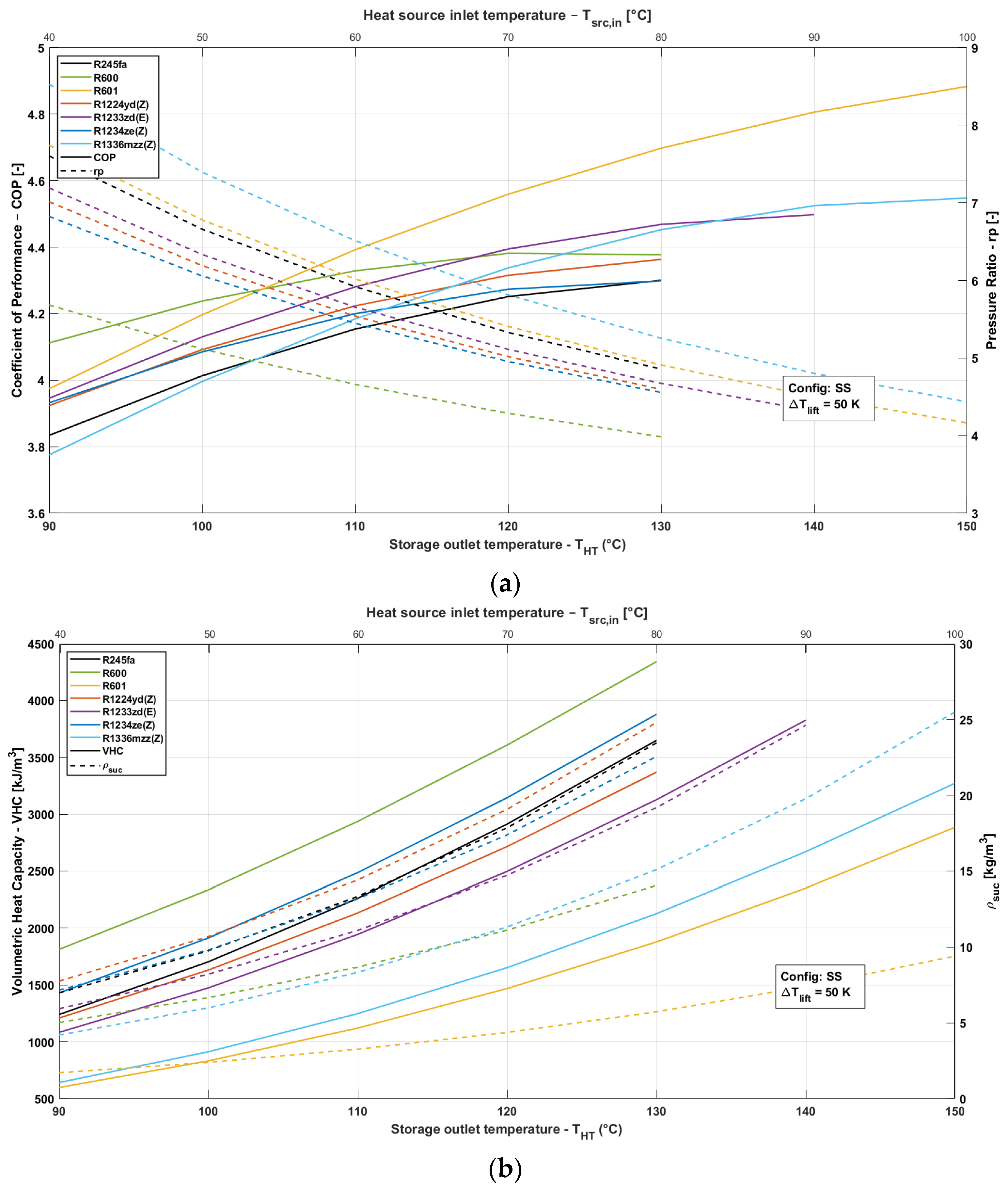
- Refrigerant choice has a strong and non-uniform impact on performance. R-601 and R-1233zd(E) exhibit superior energetic performance at elevated temperature levels, while R-600 consistently achieves the highest volumetric heat capacity due to its high suction vapor density. These trends highlight a fundamental trade-off between efficiency-oriented designs and compact system layouts.
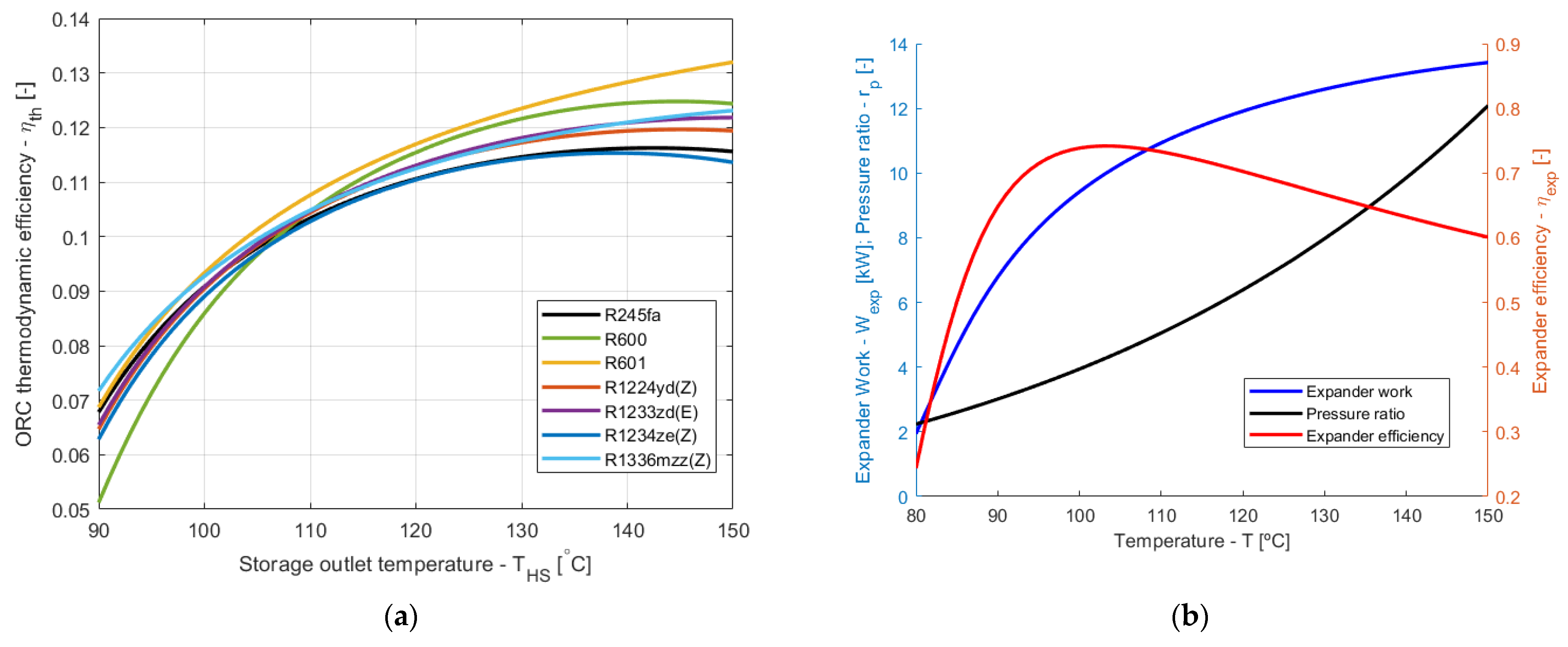
- The recuperative ORC benefits from increasing storage outlet temperatures, which enhances turbine work and cycle efficiency. However, turbine off-design behavior plays a critical role at high operating temperatures, where over-expansion leads to a reduction in isentropic efficiency and limits marginal gains in ORC performance.
- Grid-search optimization of the complete Carnot battery revealed that no single configuration or working fluid is universally optimal. The optimal solution depends strongly on the combination of storage temperature and waste heat source temperature, confirming the need for integrated system-level optimization rather than isolated component selection.
- The resulting operating maps show that R-600 is best suited for applications with moderate storage temperatures and high-quality waste heat sources, whereas R-601 achieves the highest round-trip efficiencies at elevated storage temperatures, at the expense of increased compressor size. R-1233zd(E) provides a balanced compromise, offering robust performance across a wide operating range while complying with stringent environmental constraints.
Author Contributions
Funding
Data Availability Statement
Conflicts of Interest
Abbreviations
| Acronyms and Abbreviations | |
| BVR | Built-in volume ratio |
| CB | Carnot battery |
| COP | Coefficient of performance |
| GWP | Global worming potential |
| HP | Heat pump |
| HT | High temperature |
| HTHP | High temperature heat pump |
| IHX | Internal heat exchanger |
| KPI | Key performance indicators |
| LT | Low temperature |
| ORC | Organic Rankine cycle |
| RTE | Roundtrip efficiency |
| PTES | Pumped thermal energy storage |
| SS | Single stage |
| TES | Thermal Energy Storage |
| TS | Two-stage |
| VHC | Volumetric heat capacity |
| Symbols | |
| E | Electrical energy |
| h | Specific enthalpy (kJ/kg) |
| Mass flow rate (kg/s) | |
| N | Rotational speed (rpm) |
| Pressure ratio (-) | |
| p | Pressure (kPa, abs.) |
| P | Power (W) |
| Heat transfer rate (W) | |
| s | Specific entropy (kJ/kgK) |
| T | Temperature (°C) |
| Mechanical power (W) | |
| Vapor quality (-) | |
| Greek letters: | |
| Density (kg/m3) | |
| Variation (-) | |
| Efficiency (-) | |
| Time duration (s) | |
| Efficiency (-) | |
| Subscripts: | |
| ad | charge |
| ch | charge |
| cond | Condenser |
| cold | Cold |
| comp | Compressor |
| dis | discharge |
| el | Electric |
| em | Electro-magnetic |
| evap | Evaporator |
| exp | turbine |
| f | Working fluid |
| ft | Flash tank |
| hot | Hot |
| in | Inlet |
| is | Isentropic |
| liq | Liquid |
| ou | Over-under |
| out | Outlet |
| pp | Pinch point |
| pump | Pump |
| rt | Roundtrip |
| sat | saturation |
| sc | Subcooling |
| sh | Superheating |
| snk | Sink fluid |
| src | Source fluid |
| sto | Storage fluid |
| turb | turbine |
| tv | Throttle valve |
| vap | Vapor |
| vol | Volumetric |
References
- Liang, T.; Vecchi, A.; Knobloch, K.; Sciacovelli, A.; Engelbrecht, K.; Li, Y.; Ding, Y. Key components for Carnot Battery: Technology review, technical barriers and selection criteria. Renew. Sustain. Energy Rev. 2022, 163, 112478. [Google Scholar] [CrossRef]
- Rabi, A.M.; Radulovic, J.; Buick, J.M. Pumped Thermal Energy Storage Technology (PTES): Review. Thermo 2023, 3, 396–411. [Google Scholar] [CrossRef]
- Dumont, O.; Frate, G.F.; Pillai, A.; Lecompte, S.; De paepe, M.; Lemort, V. Carnot battery technology: A state-of-the-art review. J. Energy Storage 2020, 32, 101756. [Google Scholar] [CrossRef]
- Zhang, M.; Shi, L.; Hu, P.; Pei, G.; Shu, G. Carnot battery system integrated with low-grade waste heat recovery: Toward high energy storage efficiency. J. Energy Storage 2023, 57, 106234. [Google Scholar] [CrossRef]
- Santos, M.; André, J.; Mendes, R.; Ribeiro, J.B. Thermo-economic optimization of a Carnot Battery under transient conditions. In Proceedings of the 36th International Conference on Efficiency, Cost, Optimization, Simulation and Environmental Impact of Energy Systems, ECOS 2023, Las Palmas de Gran Canaria, Spain, 25–30 June 2023; pp. 2171–2182. [Google Scholar] [CrossRef]
- Santos, M.; André, J.; Mendes, R.; Ribeiro, J.B. Multi-objective optimization of a Carnot battery system for energy storage. In Proceedings of the ECOS 2024 37th International Conference on Efficiency, Cost, Optimization, Simulation and Environmental Impact of Energy Systems; Karellas, S., Roumpedakis, T., Braimakis, K., Eds.; Curran Associates: Red Hook, NY, USA, 2024; pp. 778–787. [Google Scholar]
- Novotny, V.; Basta, V.; Smola, P.; Spale, J. Review of Carnot Battery Technology Commercial Development. Energies 2022, 15, 647. [Google Scholar] [CrossRef]
- Frate, G.F.; Ferrari, L.; Desideri, U. Rankine carnot batteries with the integration of thermal energy sources: A review. Energies 2020, 13, 4766. [Google Scholar] [CrossRef]
- Frate, G.F.; Antonelli, M.; Desideri, U. A novel Pumped Thermal Electricity Storage (PTES) system with thermal integration. Appl. Therm. Eng. 2017, 121, 1051–1058. [Google Scholar] [CrossRef]
- Dumont, O.; Lemort, V. Mapping of performance of pumped thermal energy storage (Carnot battery) using waste heat recovery. Energy 2020, 211, 118963. [Google Scholar] [CrossRef]
- Zhou, T.; Shi, L.; Sun, X.; Zhang, M.; Zhang, Y.; Yao, Y.; Pan, Z.; Hu, Q.; Jiang, Z.; Tian, H.; et al. Performance enhancement of thermal-integrated Carnot battery through zeotropic mixtures. Energy 2024, 311, 133328. [Google Scholar] [CrossRef]
- Frate, G.F.; Ferrari, L.; Desideri, U. Multi-criteria investigation of a pumped thermal electricity storage (PTES) system with thermal integration and sensible heat storage. Energy Convers. Manag. 2020, 208, 112530. [Google Scholar] [CrossRef]
- Zhang, Y.; Xu, L.; Li, J.; Zhang, L.; Yuan, Z. Technical and economic evaluation, comparison and optimization of a Carnot battery with two different layouts. J. Energy Storage 2022, 55, 105583. [Google Scholar] [CrossRef]
- Fan, R.; Xi, H. Energy, exergy, economic (3E) analysis, optimization and comparison of different Carnot battery systems for energy storage. Energy Convers. Manag. 2022, 252, 115037. [Google Scholar] [CrossRef]
- Bellos, E.; Tzivanidis, C.; Said, Z. Investigation and optimization of a solar-assisted pumped thermal energy storage system with flat plate collectors. Energy Convers. Manag. 2021, 237, 114137. [Google Scholar] [CrossRef]
- Eppinger, B.; Zigan, L.; Karl, J.; Will, S. Pumped thermal energy storage with heat pump-ORC-systems: Comparison of latent and sensible thermal storages for various fluids. Appl. Energy 2020, 280, 115940. [Google Scholar] [CrossRef]
- Weitzer, M.; Reiß, S.; Steger, D.; Kolb, S.; Karl, J. Experimental characterization of a reversible heat pump—Organic Rankine cycle pilot plant as a thermally integrated Carnot battery. Appl. Therm. Eng. 2025, 260, 124872. [Google Scholar] [CrossRef]
- Poletto, C.; De Pascale, A.; Ottaviano, S.; Dumont, O.; Branchini, L. Techno-economic assessment of a Carnot battery thermally integrated with a data center. Appl. Therm. Eng. 2025, 260, 124952. [Google Scholar] [CrossRef]
- Arpagaus, C.; Bless, F.; Uhlmann, M.; Schiffmann, J.; Bertsch, S.S. High temperature heat pumps: Market overview, state of the art, research status, refrigerants, and application potentials. Energy 2018, 152, 985–1010. [Google Scholar] [CrossRef]
- Bell, I.H.; Wronski, J.; Quoilin, S.; Lemort, V. Pure and Pseudo-pure Fluid Thermophysical Property Evaluation and the Open-Source Thermophysical Property Library CoolProp. Ind. Eng. Chem. Res. 2014, 53, 2498–2508. [Google Scholar] [CrossRef]
- Mateu-Royo, C.; Arpagaus, C.; Mota-Babiloni, A.; Navarro-Esbrí, J.; Bertsch, S.S. Advanced high temperature heat pump configurations using low GWP refrigerants for industrial waste heat recovery: A comprehensive study. Energy Convers. Manag. 2021, 229, 113752. [Google Scholar] [CrossRef]
- Winandy, E.; Saavedra, C.; Lebrun, J. Experimental analysis and simplified modelling of a hermetic scroll refrigeration compressor. Appl. Therm. Eng. 2002, 22, 107–120. [Google Scholar] [CrossRef]
- Cuevas, C.; Lebrun, J.; Lemort, V.; Winandy, E. Characterization of a scroll compressor under extended operating conditions. Appl. Therm. Eng. 2010, 30, 605–615. [Google Scholar] [CrossRef]
- Lemort, V.; Quoilin, S.; Cuevas, C.; Lebrun, J. Testing and modeling a scroll expander integrated into an Organic Rankine Cycle. Appl. Therm. Eng. 2009, 29, 3094–3102. [Google Scholar] [CrossRef]
- Santos, M.; André, J.; Mendes, R.; Ribeiro, J.B. General framework for hermetic scroll expander modelling derived from commercial compressor. Appl. Therm. Eng. 2025, 271, 126314. [Google Scholar] [CrossRef]
- Declaye, S.; Quoilin, S.; Guillaume, L.; Lemort, V. Experimental study on an open-drive scroll expander integrated into an ORC (Organic Rankine Cycle) system with R245fa as working fluid. Energy 2013, 55, 173–183. [Google Scholar] [CrossRef]
- Pacejka, H.B. Tyre and Vehicle Dynamics; Butterworth-Heinemann: Oxford, UK, 2006. [Google Scholar]
- Mateu-Royo, C.; Navarro-Esbrí, J.; Mota-Babiloni, A.; Amat-Albuixech, M.; Molés, F. Theoretical evaluation of different high-temperature heat pump configurations for low-grade waste heat recovery. Int. J. Refrig. 2018, 90, 229–237. [Google Scholar] [CrossRef]
- Jiang, J.; Hu, B.; Wang, R.Z.; Deng, N.; Cao, F.; Wang, C.C. A review and perspective on industry high-temperature heat pumps. Renew. Sustain. Energy Rev. 2022, 161, 112106. [Google Scholar] [CrossRef]



| System | Parameters | Value | Units |
|---|---|---|---|
| HP | Heat source heat load () | 100 | kW |
| Heat source inlet temperature () | 40–100 | °C | |
| Heat source temperature glide () | 10 | °C | |
| Superheat degree () | 15 | °C | |
| Subcooling degree () | 10 | °C | |
| Pinch point heat exchangers () | 5 | °C | |
| Storage outlet temperature () | 90–150 | °C | |
| Storage temperature glide () | 15 | °C | |
| Built-in volume ratio () | 3.5 | - | |
| Compressor/turbine electromechanical efficiency () | 95 | % | |
| ORC | Cold sink outlet temperature () | 20 | °C |
| Cold sink temperature glide () | 10 | °C | |
| Pinch point heat exchangers () | 5 | °C | |
| Superheat degree () | 5 | °C | |
| Subcooling degree ) | 0 | °C | |
| Isentropic efficiency of the pump | 60 | % |
| Working Fluid | Formula | Critical Temperature, °C | Critical Pressure, Bar | Boiling Point, °C | ODP | GWP | Class (ASHRAE) |
|---|---|---|---|---|---|---|---|
| R245fa | C3H3F5 | 154.1 | 36.5 | 15.2 | 0 | 858 | B1 |
| R600 | C4H10 | 152.0 | 38.0 | −0.5 | 0 | 4 | A3 |
| R601 | C5H12 | 196.6 | 33.7 | 36.1 | 0 | 20 | A3 |
| R1224yd(Z) | CF3CF=CHCl | 155.5 | 33.4 | 14.6 | 0 | <1 | A1 |
| R1233zd(E) | CF3CH=CHCl(E) | 166.5 | 36.2 | 18.3 | 0 | 1 | A1 |
| R1234ze(Z) | CHF=CHCF3(Z) | 150.1 | 35.3 | 9.7 | 0 | 1 | A2L |
| R1336mzz(Z) | CF3CH=CHCF3 (Z) | 171.4 | 29.0 | 33.5 | 0 | 2 | A1 |
| Fluid | [°C] | [°C] | VHC | COP [-] | [%] | [-] | HP Config |
|---|---|---|---|---|---|---|---|
| R245fa | 100 | 95 | 7.67 | 14.81 | 8.12 | 1.2035 | SS-IHX |
| R600 | 100 | 102 | 7.94 | 11.52 | 9.06 | 1.0435 | SS-IHX |
| R601 | 100 | 97 | 3.70 | 13.96 | 8.75 | 1.2205 | SS-IHX |
| R1224yd(Z) | 100 | 96 | 6.83 | 14.13 | 8.22 | 1.1608 | SS-IHX |
| R1233zd(E) | 100 | 97 | 6.24 | 13.46 | 8.48 | 1.1424 | SS-IHX |
| R1234ze(Z) | 100 | 97 | 7.85 | 13.42 | 8.30 | 1.1138 | SS-IHX |
| R1336mzz(Z) | 100 | 95 | 4.48 | 15.49 | 8.39 | 1.2989 | SS-IHX |
Disclaimer/Publisher’s Note: The statements, opinions and data contained in all publications are solely those of the individual author(s) and contributor(s) and not of MDPI and/or the editor(s). MDPI and/or the editor(s) disclaim responsibility for any injury to people or property resulting from any ideas, methods, instructions or products referred to in the content. |
© 2026 by the authors. Licensee MDPI, Basel, Switzerland. This article is an open access article distributed under the terms and conditions of the Creative Commons Attribution (CC BY) license.
Share and Cite
Santos, M.; Sousa, A.; André, J.; Mendes, R.; Ribeiro, J.B. Thermodynamic Assessment of Heat Pump Configurations for Waste Heat Integrated Carnot Batteries. Thermo 2026, 6, 21. https://doi.org/10.3390/thermo6010021
Santos M, Sousa A, André J, Mendes R, Ribeiro JB. Thermodynamic Assessment of Heat Pump Configurations for Waste Heat Integrated Carnot Batteries. Thermo. 2026; 6(1):21. https://doi.org/10.3390/thermo6010021
Chicago/Turabian StyleSantos, Márcio, André Sousa, Jorge André, Ricardo Mendes, and José B. Ribeiro. 2026. "Thermodynamic Assessment of Heat Pump Configurations for Waste Heat Integrated Carnot Batteries" Thermo 6, no. 1: 21. https://doi.org/10.3390/thermo6010021
APA StyleSantos, M., Sousa, A., André, J., Mendes, R., & Ribeiro, J. B. (2026). Thermodynamic Assessment of Heat Pump Configurations for Waste Heat Integrated Carnot Batteries. Thermo, 6(1), 21. https://doi.org/10.3390/thermo6010021