
A CFD Model for the Evaporation of Sub-Micron Droplet Sprays Across Normal Shocks

 ,
,  ,
,  ,
,  , ,
, ,  and
and
Abstract
1. Introduction
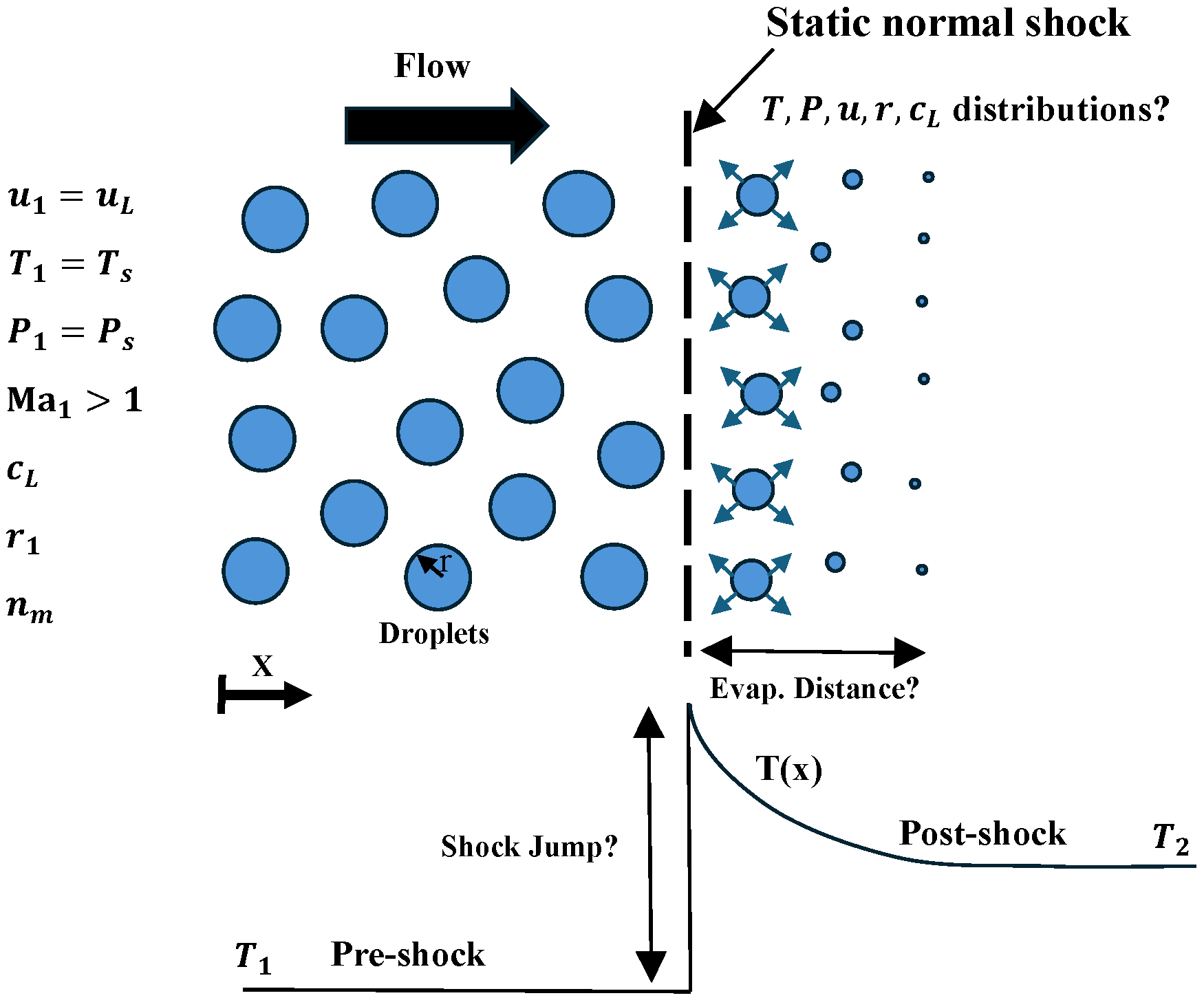
2. Problem Definition
2.1. Initial and Boundary Conditions
2.2. Mixture Governing Equations
2.3. Liquid Phase Governing Equations
2.4. Solution Method
3. Results and Discussion
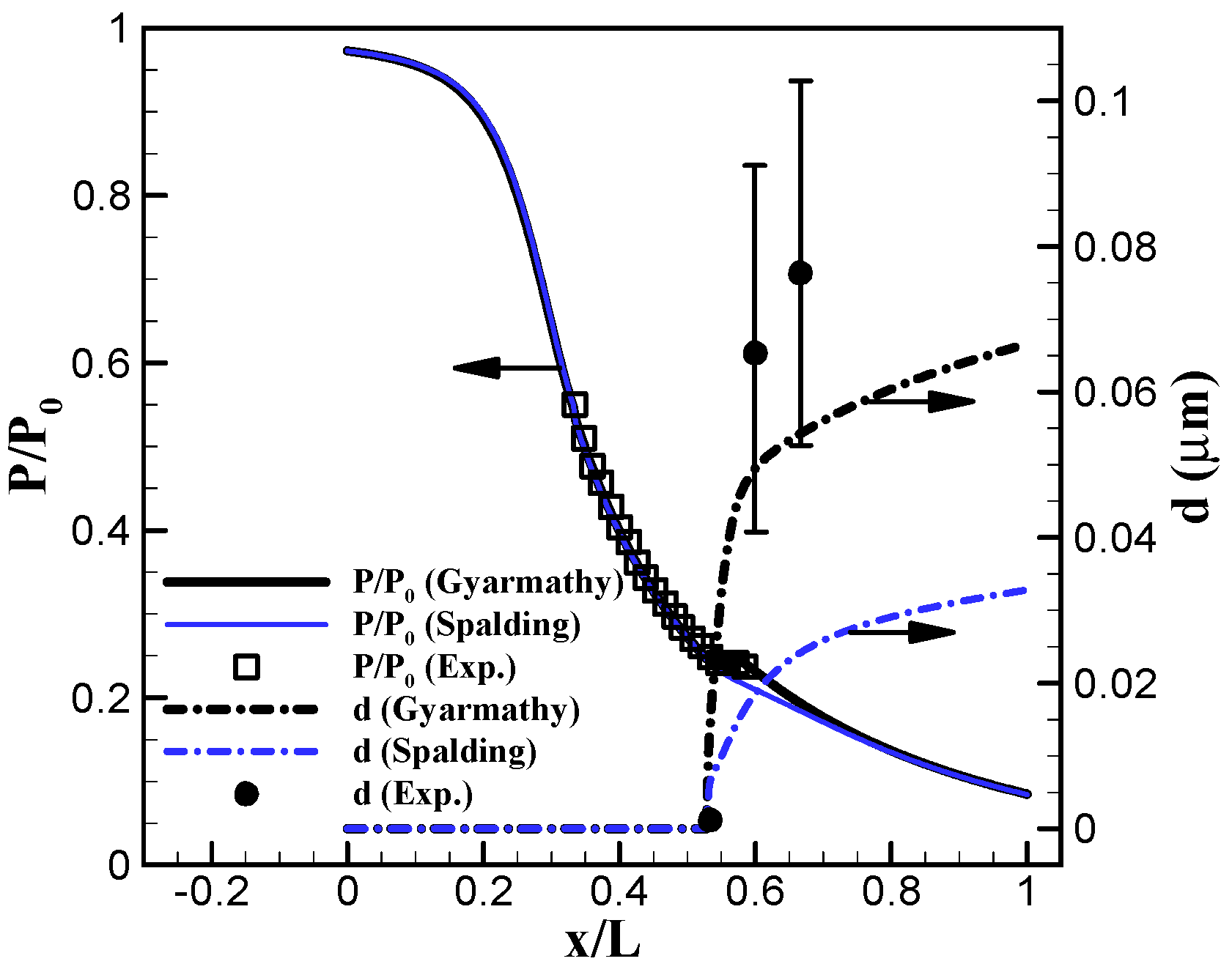
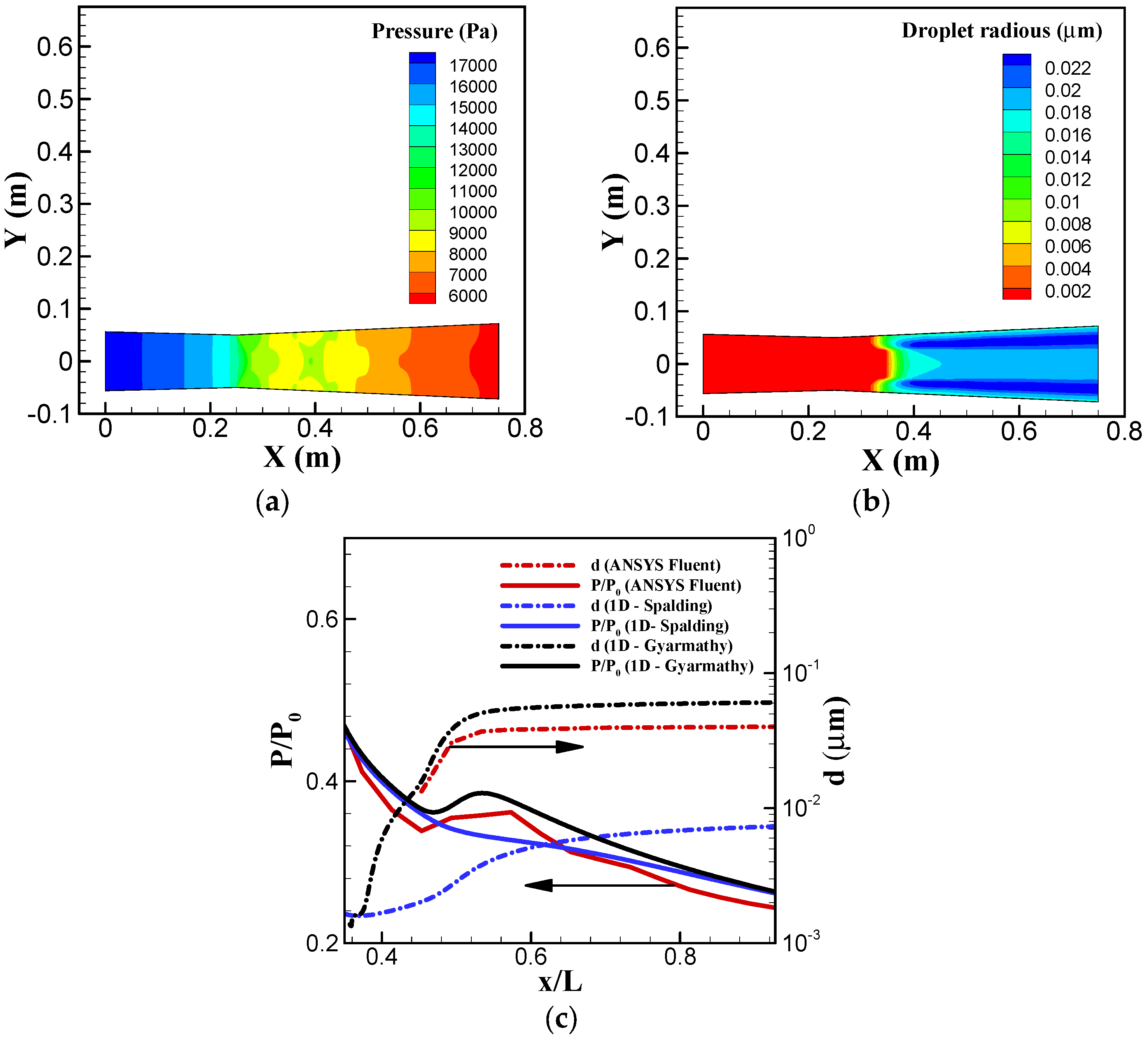
3.1. Validation Against Experimental Data
3.2. Phase Diagram Analysis
3.3. Analysis of the Evaporation Process
3.4. Analysis of the Flow Thermodynamics
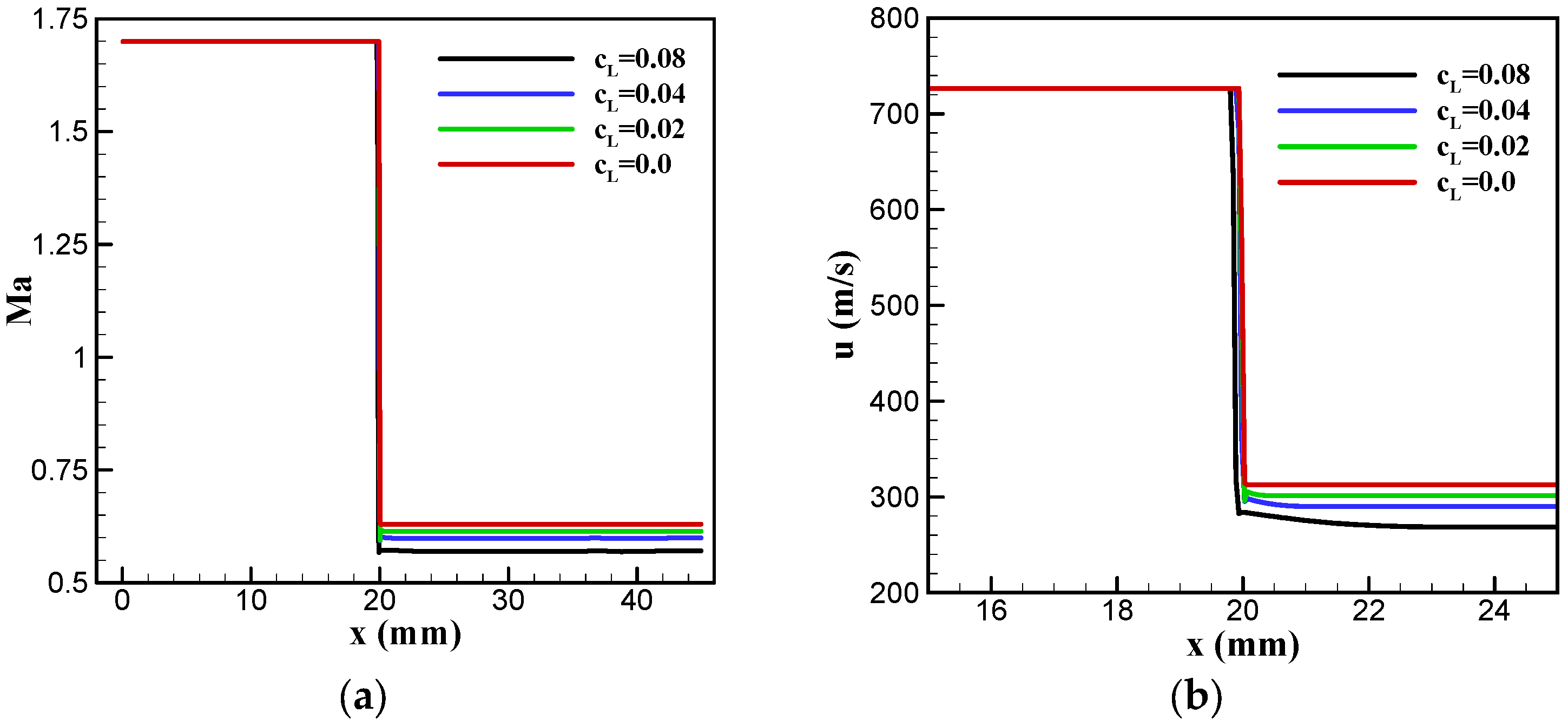
3.5. Analysis of the Flow Dynamics
4. Concluding Remarks
Author Contributions
Funding
Data Availability Statement
Acknowledgments
Conflicts of Interest
Nomenclature
| Channel cross-sectional area, | |
| Spalding mass transfer number | |
| Liquid mass fraction | |
| Gas isobaric specific heat capacity, | |
| Gas isochoric specific heat capacity, | |
| Diameter of droplets, | |
| Specific internal energy of two-phase flow, | |
| Vector of surface flux | |
| Specific enthalpy of two-phase flow, | |
| Latent heat of evaporation per unit mass, | |
| Knudsen number | |
| Cross-sectional change coefficient, | |
| Channel length, | |
| Length of free molecular mean path, | |
| Lewis number of gas | |
| Mass, | |
| Mass flow rate, | |
| Molar mass, | |
| Mach number | |
| Total number of control volumes | |
| Total droplets number density, | |
| Static pressure, | |
| Prandtl number of the gas | |
| Saturation pressure, | |
| Vapor pressure, | |
| Conservative variable vector | |
| First component of conservative vector | |
| Gas constant, | |
| Droplet radius, | |
| Source term vector | |
| Supersaturation degree | |
| Stokes number | |
| Flow temperature, | |
| Time, s | |
| Flow velocity, | |
| V | Volume, |
| Specific volume, | |
| Weber number | |
| Axial distance from domain inlet, | |
| Greek letters | |
| Heat transfer coefficient, | |
| Time step, | |
| Length of control volume, | |
| Convergence criterion | |
| Isentropic exponent of gas | |
| Thermal conductivity, | |
| Dynamic viscosity, | |
| Density of two-phase mixture, | |
| Surface tension, | |
| Subscripts | |
| 1 | One vapor molecule, pre-shock state |
| 2 | Post-shock state |
| Critical | |
| Droplet | |
| Gaseous phase | |
| Liquid phase | |
| Elements index | |
| Maximum | |
| Total number of elements | |
| Time step index | |
| Nucleation | |
| Droplet radius | |
| Saturation | |
| total | |
| Vapor | |
| Channel inlet stagnation condition, Ideal gas | |
| Abbreviations | |
| Advection Upstream Splitting Method | |
| Courant-Friedrichs-Lewy number | |
| CFD | Computational Fluid Dynamics |
| Control Volume | |
| Equation Of State | |
| International Wet Steam Experimental Project | |
| 1D | One Dimensional |
Appendix A. Physical Relations for the Liquid and Gaseous Phases

| 4.240234 | 0.1520876 | 0.0019527 | 0.000008893 | |
| 4.297223 | 0.1615944 | 0.0022271 | 0.000019118 | |
| −5.39522765 | 0.5250517 | −0.002388 | 0.0000392712 |
| 638.9391809947 | 1.337287169 | −0.0026840395 | −0.0000195513 |
| 0.1028 | 1.211 | −0.09453 | 5.585 |
Appendix B. Derivation of Modified Rankine—Hugoniot Expressions
Appendix B.1. Energy Conservation Analysis
Appendix B.2. Mass Conservation Analysis
Appendix B.3. Momentum Conservation Analysis
References
- Law, C.K. Recent advances in droplet vaporization and combustion. Prog. Energy Combust. Sci. 1982, 8, 171–201. [Google Scholar] [CrossRef]
- Martínez-Ruiz, D.; Urzay, J.; Sánchez, A.; Liñán, A.; Williams, F. Dynamics of thermal ignition of spray flames in mixing layers. J. Fluid Mech. 2013, 734, 387–423. [Google Scholar] [CrossRef]
- Neek, S.J.; Ghassemi, H.; Ganji, M.J.Z.; Kamalinejad, M. Oleaster (Elaeagnus angustifolia L.) low-fibrous extract to powder: Drying kinetics analysis. Powder Technol. 2024, 433, 119249. [Google Scholar] [CrossRef]
- Niknam, P.H.; Fiaschi, D.; Mortaheb, H.R.; Mokhtarani, B. Numerical investigation of multiphase flow in supersonic separator considering inner body effect. Asia-Pac. J. Chem. Eng. 2019, 14, e2380. [Google Scholar] [CrossRef]
- Terziev, A. Numerical Modelling of Two-component Liquid Fuels Evaporation. In Proceedings of the 11-th National Congress on Theoretical and Applied Mechanics, Borovets, Bulgaria, 2–5 September 2009. Available online: https://nctam.imbm.bas.bg/index.php/nctam/nctam2009/paper/view/63/0 (accessed on 19 February 2026).
- Liñán, A.; Martinez-Ruiz, D.; Sánchez, A.L.; Urzay, J. Regimes of spray vaporization and combustion in counterflow configurations. Combust. Sci. Technol. 2015, 187, 103–131. [Google Scholar] [CrossRef]
- Dykas, S.; Wróblewski, W. Single-and two-fluid models for steam condensing flow modeling. Int. J. Multiph. Flow 2011, 37, 1245–1253. [Google Scholar] [CrossRef]
- Bian, J.; Cao, X.; Yang, W.; Song, X.; Xiang, C.; Gao, S. Condensation characteristics of natural gas in the supersonic liquefaction process. Energy 2019, 168, 99–110. [Google Scholar] [CrossRef]
- Bakhtar, F.; Young, J.B.; White, A.J.; Simpson, D. Classical nucleation theory and its application to condensing steam flow calculations. Proc. Inst. Mech. Eng. Part C J. Mech. Eng. Sci. 2005, 219, 1315–1333. [Google Scholar] [CrossRef]
- Martínez-Ruiz, D. On the structure of steady one-dimensional liquid-fueled detonations. Phys. Fluids 2023, 35, 086122. [Google Scholar]
- Huang, Z.; Zhang, H. On the interactions between a propagating shock wave and evaporating water droplets. Phys. Fluids 2020, 32, 123315. [Google Scholar] [CrossRef]
- Duke-Walker, V.; Maxon, W.C.; Almuhna, S.R.; McFarland, J.A. Evaporation and breakup effects in the shock-driven multiphase instability. J. Fluid Mech. 2021, 908, A13. [Google Scholar] [CrossRef]
- Hernández-Sánchez, R.; Huete, C.; Martínez-Ruiz, D. Pathological detonations in mono-disperse spray media. Proc. Combust. Inst. 2024, 40, 105505. [Google Scholar] [CrossRef]
- Lu, T.; Law, C.K. Heterogeneous effects in the propagation and quenching of spray detonations. J. Propuls. Power 2004, 20, 820–827. [Google Scholar] [CrossRef]
- Cheatham, S.; Kailasanath, K. Numerical modelling of liquid-fuelled detonations in tubes. Combust. Theory Model. 2005, 9, 23–48. [Google Scholar] [CrossRef]
- Asrardel, M.; Muelas, Á.; Ballester, J. A pseudocomponent-based approach for the formulation of evaporation surrogates of practical liquid fuels. Combust. Sci. Technol. 2024, 196, 3937–3968. [Google Scholar] [CrossRef]
- He, X.; Karagozian, A. Reactive flow phenomena in pulse detonation engines. In Proceedings of the 41st Aerospace Sciences Meeting and Exhibit, Reno, NV, USA, 6–9 January 2003; p. 1171. [Google Scholar] [CrossRef]
- He, X.; Karagozian, A.R. Numerical simulation of pulse detonation engine phenomena. J. Sci. Comput. 2003, 19, 201–224. [Google Scholar] [CrossRef]
- Hwang, P.; Fedkiw, R.; Merriman, B.; Aslam, T. Numerical resolution of pulsating detonation waves. Combust. Theory Model. 2000, 4, 217. [Google Scholar] [CrossRef]
- Liu, Y.; Cao, X.; Guo, D.; Cao, H.; Bian, J. Influence of shock wave/boundary layer interaction on condensation flow and energy recovery in supersonic nozzle. Energy 2023, 263, 125662. [Google Scholar] [CrossRef]
- Neek, S.J.; Ganji, M.J.Z.; Ghassemi, H. A Theoretical-Data-Driven Coupled Model for Drying History and Shell Formation of Droplets with Impermeable Crust: Case Study on Oleaster Low-Fibrous Extract. Meas. Food 2025, 20, 100253. [Google Scholar] [CrossRef]
- Terziev, A.K.; Antonov, I.S. Numerical Research of Non-Isothermal Two-Phase Flow (Gas Solid Particles) with Variable Density. In Proceedings of the 11-th National Congress on Theoretical and Applied Mechanics, Borovets, Bulgaria, 2–5 September 2009; Available online: https://nctam.imbm.bas.bg/index.php/nctam/nctam2009/paper/view/88 (accessed on 19 February 2026).
- Antonov, I.; Terziev, A.; Antonov, S.; Nguyen, N.T. Two Phase Mixture Filtration. J. Sci. Technol. Dev. 2010, 13, 5–17. [Google Scholar] [CrossRef]
- Williams, F.A. Structure of detonations in dilute sprays. Phys. Fluids 1961, 4, 1434–1443. [Google Scholar] [CrossRef]
- Kailasanath, K. Liquid-fueled detonations in tubes. J. Propuls. Power 2006, 22, 1261–1268. [Google Scholar] [CrossRef]
- Benedick, W.; Lee, J.; Knystautas, R. Detonation of Unconfined Large Scale Fuel Spray-Air Clouds; Sandia National Lab. (SNL-NM): Albuquerque, NM, USA, 1989. Available online: https://www.osti.gov/biblio/5911298 (accessed on 19 February 2026).
- Frolov, S. Liquid-fueled, air-breathing pulse detonation engine demonstrator: Operation principles and performance. J. Propuls. Power 2006, 22, 1162–1169. [Google Scholar] [CrossRef]
- Yin, P.; Li, T.; Cao, X.; Teng, L.; Li, Q.; Bian, J. Condensation properties of water vapor under different back pressures in nozzle. Case Stud. Therm. Eng. 2022, 31, 101783. [Google Scholar] [CrossRef]
- Liu, Y.; Cao, X.; Chong, D.; Yang, W.; Zhao, Z.; Bian, J. Effects of energy conversion under shock wave on the effective liquefaction efficiency in the nozzle during natural gas dehydration. Energy 2023, 283, 129030. [Google Scholar] [CrossRef]
- Bian, J.; Zhao, Z.; Cao, X.; Liu, Y. Study on non-equilibrium condensation and energy conversion of ammonia gas in swirl nozzles. Appl. Therm. Eng. 2025, 268, 125883. [Google Scholar] [CrossRef]
- Wang, B.; Li, T.; Gong, F.; Othman, M.H.D.; Xiao, R. Ammonia as a green energy carrier: Electrochemical synthesis and direct ammonia fuel cell-a comprehensive review. Fuel Process. Technol. 2022, 235, 107380. [Google Scholar] [CrossRef]
- Jiang, L.; Fu, X. An ammonia-hydrogen energy roadmap for carbon neutrality: Opportunity and challenges in China. Engineering 2021, 7, 1688–1691. [Google Scholar] [CrossRef]
- Li, Y.; Zhang, W.; Ren, J.; Zhou, W.; Wang, Z. Ammonia decomposition for carbon-free hydrogen production over Ni/Al-Ce catalysts: Synergistic effect between Al and Ce. Fuel 2024, 358, 130176. [Google Scholar] [CrossRef]
- Lin, L.; Zhang, L.; Luo, Y.; Luo, J.; Chen, C.; Jiang, L. Highly-integrated and cost-efficient ammonia-fueled fuel cell system for efficient power generation: A comprehensive system optimization and techno-economic analysis. Energy Convers. Manag. 2022, 251, 114917. [Google Scholar] [CrossRef]
- Bian, J.; Zhao, Z.; Liu, Y.; Zhang, Z.; Cao, X. Exploring the interactions of NH3 and H2O co-condensation: A study on the potential of supersonic separators for NH3–H2 separation. Case Stud. Therm. Eng. 2024, 55, 104189. [Google Scholar] [CrossRef]
- Liu, Y.; Ding, C. Performance Study of a Supersonic Swirl Separator. Processes 2023, 11, 2218. [Google Scholar] [CrossRef]
- Yang, Y.; Wen, C. CFD modeling of particle behavior in supersonic flows with strong swirls for gas separation. Sep. Purif. Technol. 2017, 174, 22–28. [Google Scholar] [CrossRef]
- Arabkhalaj, A.; Azimi, A.; Ghassemi, H.; Markadeh, R.S. A fully transient approach on evaporation of multi-component droplets. Appl. Therm. Eng. 2017, 125, 584–595. [Google Scholar] [CrossRef]
- Millán-Merino, A.; Fernández-Tarrazo, E.; Sánchez-Sanz, M. Theoretical and numerical analysis of the evaporation of mono-and multicomponent single fuel droplets. J. Fluid Mech. 2021, 910, A11. [Google Scholar] [CrossRef]
- Sánchez, A.L.; Urzay, J.; Liñán, A. The role of separation of scales in the description of spray combustion. Proc. Combust. Inst. 2015, 35, 1549–1577. [Google Scholar] [CrossRef]
- Sahami, M.; Ghassemi, H.; Terziev, A.; Pitchurov, G. Homogeneous condensation in high-speed flows: A review on droplet nucleation and growth models. J. Braz. Soc. Mech. Sci. Eng. 2025, 47, 1–43. [Google Scholar] [CrossRef]
- Aliabadi, M.A.F.; Lakzian, E.; Jahangiri, A.; Khazaei, I. Numerical investigation of effects polydispersed droplets on the erosion rate and condensation loss in the wet steam flow in the turbine blade cascade. Appl. Therm. Eng. 2020, 164, 114478. [Google Scholar] [CrossRef]
- Sahami, M.; Ghassemi, H. Effects of non-equilibrium condensation on the nozzle performance of a cold gas thruster. Acta Astronaut. 2022, 197, 200–216. [Google Scholar] [CrossRef]
- Bian, J.; Guo, D.; Li, Y.; Cai, W.; Hua, Y.; Cao, X. Homogeneous nucleation and condensation mechanism of methane gas: A molecular simulation perspective. Energy 2022, 249, 123610. [Google Scholar] [CrossRef]
- Bian, J.; Ding, G.; Cao, H.; Liu, Y.; Cao, X. Surface crystallization mechanism of n-hexane droplets. Energy 2023, 263, 125921. [Google Scholar] [CrossRef]
- Bolaños-Acosta, A.; Restrepo, J.; Simões-Moreira, J. Two semi-analytical approaches for solving condensation shocks in supersonic nozzle flows. Int. J. Heat Mass Transf. 2021, 173, 121212. [Google Scholar] [CrossRef]
- Hamidi, S.; Kermani, M. Numerical study of non-equilibrium condensation and shock waves in transonic moist-air and steam flows. Aerosp. Sci. Technol. 2015, 46, 188–196. [Google Scholar] [CrossRef]
- Shabani, S.; Majkut, M.; Dykas, S.; Smołka, K.; Lakzian, E. An investigation comparing various numerical approaches for simulating the behaviour of condensing flows in steam nozzles and turbine cascades. Eng. Anal. Bound. Elem. 2024, 158, 364–374. [Google Scholar] [CrossRef]
- Jiang, B.; Ziyuan, Z.; Junwen, C.; Dan, G. Supersonic condensation characteristics of ammonia under different nozzle back pressures. Low-Carbon Chem. Chem. Eng. 2023, 48, 127–133. [Google Scholar] [CrossRef]
- Gyarmathy, G. Grundlagen Einer Theorie der Nassdampfturbine. Ph.D. Thesis, ETH Zurich, Zurich, Switzerland, 1962. [Google Scholar] [CrossRef]
- Bermudez, A.; López, X.; Vázquez-Cendón, M.E. Numerical solution of non-isothermal non-adiabatic flow of real gases in pipelines. J. Comput. Phys. 2016, 323, 126–148. [Google Scholar] [CrossRef]
- Pilch, M.; Erdman, C. Use of breakup time data and velocity history data to predict the maximum size of stable fragments for acceleration-induced breakup of a liquid drop. Int. J. Multiph. Flow 1987, 13, 741–757. [Google Scholar] [CrossRef]
- Subramaniam, S. Lagrangian–Eulerian methods for multiphase flows. Prog. Energy Combust. Sci. 2013, 39, 215–245. [Google Scholar] [CrossRef]
- Borgnakke, C.; Sonntag, R.E. Fundamentals of Thermodynamics; John Wiley & Sons: Hoboken, NJ, USA, 2020. [Google Scholar]
- Spalding, D.B. Combustion of liquid fuels. Nature 1950, 165, 160. [Google Scholar] [CrossRef]
- Young, J. The condensation and evaporation of liquid droplets at arbitrary Knudsen number in the presence of an inert gas. Int. J. Heat Mass Transf. 1993, 36, 2941–2956. [Google Scholar] [CrossRef]
- Kalikmanov, V.I. Classical nucleation theory. In Nucleation Theory; Springer: Berlin/Heidelberg, Germany, 2012; pp. 17–41. [Google Scholar] [CrossRef]
- Poling, B.E.; Prausnitz, J.M.; O’Connell, J.P. Properties of Gases and Liquids; McGraw-Hill Education: New York, NY, USA, 2001; Available online: https://www.accessengineeringlibrary.com/content/book/9780070116825 (accessed on 19 February 2026).
- Liou, M.-S. A sequel to ausm: Ausm+. J. Comput. Phys. 1996, 129, 364–382. [Google Scholar] [CrossRef]
- Zhang, G.; Dykas, S.; Majkut, M.; Smołka, K.; Cai, X. Experimental and numerical research on the effect of the inlet steam superheat degree on the spontaneous condensation in the IWSEP nozzle. Int. J. Heat Mass Transf. 2021, 165, 120654. [Google Scholar] [CrossRef]
- ANSYS Fluent Theory Guide; Release 2021 R2; ANSYS Inc.: Canonsburg, PA, USA, 2021.
- Moore, M.J. Predicting the fog-drop size in wet-steam turbines. In Proceedings of the IMechE Conference on Heat and Fluid Flow in Steam and Gas Turbine Plant; Institution of Mechanical Engineers: London, UK, 1973; Available online: https://cir.nii.ac.jp/crid/1574231874929479936 (accessed on 19 February 2026).
- Arina, R. Numerical simulation of near-critical fluids. Appl. Numer. Math. 2004, 51, 409–426. [Google Scholar] [CrossRef]
- Mulero, A.; Cachadina, I.; Parra, M. Recommended correlations for the surface tension of common fluids. J. Phys. Chem. Ref. Data 2012, 41, 043105. [Google Scholar] [CrossRef]
- Zayernouri, M.; Kermani, M. Development of an analytical solution for compressible two-phase steam flow. Trans. Can. Soc. Mech. Eng. 2006, 30, 279–296. [Google Scholar] [CrossRef]
- Kermani, M.; Zayemouri, M.; Avval, M.S. Generalization of an Analytical Two-Phase Steam Flow Calculator to High-Pressure Cases. Trans. Can. Soc. Mech. Eng. 2006, 30, 581–595. [Google Scholar] [CrossRef]





| Boundary Condition | |||||
|---|---|---|---|---|---|
| Inlet | |||||
| Outlet | extrapolation |
Disclaimer/Publisher’s Note: The statements, opinions and data contained in all publications are solely those of the individual author(s) and contributor(s) and not of MDPI and/or the editor(s). MDPI and/or the editor(s) disclaim responsibility for any injury to people or property resulting from any ideas, methods, instructions or products referred to in the content. |
© 2026 by the authors. Licensee MDPI, Basel, Switzerland. This article is an open access article distributed under the terms and conditions of the Creative Commons Attribution (CC BY) license.
Share and Cite
Sahami, M.; Ghassemi, H.; Terziev, A.; Fikiin, K.; Stankov, B.; Pitchurov, G.; Ivanov, M. A CFD Model for the Evaporation of Sub-Micron Droplet Sprays Across Normal Shocks. Thermo 2026, 6, 15. https://doi.org/10.3390/thermo6010015
Sahami M, Ghassemi H, Terziev A, Fikiin K, Stankov B, Pitchurov G, Ivanov M. A CFD Model for the Evaporation of Sub-Micron Droplet Sprays Across Normal Shocks. Thermo. 2026; 6(1):15. https://doi.org/10.3390/thermo6010015
Chicago/Turabian StyleSahami, Masoud, Hojat Ghassemi, Angel Terziev, Kostadin Fikiin, Borislav Stankov, George Pitchurov, and Martin Ivanov. 2026. "A CFD Model for the Evaporation of Sub-Micron Droplet Sprays Across Normal Shocks" Thermo 6, no. 1: 15. https://doi.org/10.3390/thermo6010015
APA StyleSahami, M., Ghassemi, H., Terziev, A., Fikiin, K., Stankov, B., Pitchurov, G., & Ivanov, M. (2026). A CFD Model for the Evaporation of Sub-Micron Droplet Sprays Across Normal Shocks. Thermo, 6(1), 15. https://doi.org/10.3390/thermo6010015