Review

Thermodynamic Analysis of Plastic Waste Conversion to Hydrogen: Heat Integration and System Performance—A Review


1
Faculty of Engineering, Sohar University, Sohar 122, Oman
2
School of Engineering, Chemical Engineering, Faculty of Science and Engineering, University of Hull, Kingston Upon Hull HU6 7RX, UK
Thermo 2026, 6(1), 14; https://doi.org/10.3390/thermo6010014
Submission received: 29 January 2026 / Revised: 15 February 2026 / Accepted: 17 February 2026 / Published: 19 February 2026

Abstract

Thermochemical conversion of plastic waste to hydrogen and synthesis gas represents a potential pathway for energy recovery from heterogeneous waste streams. The feasibility and performance of such systems are fundamentally governed by thermodynamic constraints and heat-management requirements. This review critically examines the thermodynamic and heat-integration aspects of plastic waste conversion to hydrogen and syngas, with emphasis on pyrolysis, steam reforming, gasification, and system-level behaviour. Key thermodynamic features of plastic pyrolysis, reforming, and gasification are discussed, including reaction endothermicity, equilibrium limitations, temperature effects, and product distribution trends. The role of steam reforming and water–gas shift reactions in enhancing hydrogen yield is assessed from equilibrium and energy-demand perspectives. Heat integration emerges as a critical determinant of overall efficiency, with recoverable waste heat present at multiple process stages offering opportunities for internal heat recovery. Energy and exergy analyses identify dominant sources of irreversibility and enable comparison of plastic-derived hydrogen systems with conventional thermochemical hydrogen production routes. Quantitatively, conventional steam methane reforming achieves energy efficiencies of 65–75% and exergy efficiencies of 60–70%, whilst plastic-derived systems without extensive heat integration report 45–60% and 40–55%, respectively. Key challenges include limited thermodynamic property data for real plastic-derived mixtures, insufficient reconciliation of equilibrium and kinetic behaviour, incomplete system-level heat-integration analysis, and scarcity of comprehensive exergy-based evaluations. This review provides a thermodynamic framework for assessing the opportunities and limitations of hydrogen production from plastic waste.

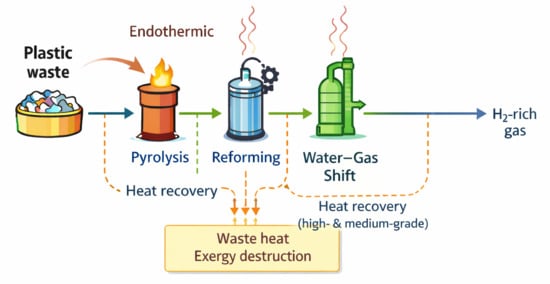
Graphical Abstract

1. Introduction

Global plastic waste generation has reached approximately 400 million tonnes annually, with the majority still disposed of through landfilling or incineration rather than material recovery [1,2]. Conventional mechanical recycling is constrained by material degradation, contamination sensitivity, and inability to recover embedded energy value [3]. These limitations have motivated research into thermochemical conversion routes that can process heterogeneous waste streams whilst recovering both material and energetic value [4,5].
Thermochemical conversion enables recovery of both energy and chemical feedstocks from heterogeneous waste streams under controlled high-temperature conditions [6,7]. Among such routes, pyrolysis and gasification can process heterogeneous and contaminated plastic mixtures with minimal pre-sorting requirements. Pyrolysis involves thermal decomposition in the absence of oxygen, producing gaseous, liquid, and solid fractions, whilst gasification relies on partial oxidation or gasifying agents to convert plastics into synthesis gas rich in hydrogen and carbon monoxide [6,8,9,10].
The gaseous products from pyrolysis and gasification—collectively termed synthesis gas or syngas—consist primarily of hydrogen, carbon monoxide, methane, and carbon dioxide. Syngas composition, heating value, and hydrogen yield are strongly influenced by operating conditions such as temperature, pressure, residence time, and the choice of reacting agents [11]. Thermodynamic equilibrium studies show that plastic-derived syngas can exhibit high hydrogen content, particularly at elevated temperatures or when steam is employed as a reforming agent [12].
Thermodynamic considerations play a central role in determining the performance limits of plastic waste conversion systems. Pyrolysis, steam reforming, and gasification reactions are predominantly endothermic, requiring substantial heat input to achieve high conversion and hydrogen yield [13,14,15,16]. Whilst increasing temperature generally promotes gas formation and hydrogen production, it also imposes higher energy demand and exacerbates irreversibilities associated with heat transfer and chemical reaction pathways. Reaction enthalpies, entropy changes, and equilibrium constraints thus impose fundamental limits on achievable yields and efficiencies, largely independent of reactor configuration or catalyst selection [17,18].
In addition to reaction thermodynamics, heat management represents a critical factor influencing overall system efficiency. Plastic-to-hydrogen conversion systems typically involve multiple high-temperature units—such as pyrolysis reactors, reformers, and gasifiers—that generate significant quantities of recoverable waste heat. If effectively integrated, this internally generated heat can partially offset the external energy input required for endothermic reactions, improving overall energetic performance and reducing exergy destruction [19,20]. Despite its importance, heat integration is often treated implicitly in the literature, with limited synthesis of internal heat recovery opportunities across multiple conversion stages or temperature levels [21,22].
Existing reviews on plastic waste conversion largely emphasise process configurations, catalytic development, or environmental and techno-economic assessments [4,23]. Whilst these studies provide valuable insight into process performance and sustainability metrics, comparatively less attention has been devoted to a unified examination of thermodynamic behaviour, equilibrium constraints, and heat-integration considerations across plastic-to-hydrogen systems. More broadly, thermodynamic and exergy-based analyses have been widely applied to assess efficiency limits in high-temperature energy systems; however, their systematic application to plastic waste conversion remains fragmented across individual processes rather than treated at an integrated system level [24,25].
Accordingly, this review aims to critically examine the thermodynamic and heat-integration aspects of plastic waste conversion to hydrogen and syngas. Emphasis is placed on fundamental thermodynamic principles, temperature and equilibrium effects, energy and exergy considerations, and qualitative heat-integration strategies relevant to pyrolysis, reforming, and gasification systems. Techno-economic analysis, life-cycle assessment, and detailed process simulations are intentionally excluded to maintain focus on thermal-science-driven insights aligned with the scope of Thermo.

2. Fundamentals of Plastic Pyrolysis Thermodynamics

2.1. Thermodynamic Nature of Plastic Pyrolysis

Plastic pyrolysis is a thermochemical process in which polymeric materials are decomposed into smaller molecular fragments under oxygen-free conditions at elevated temperatures. The process is predominantly endothermic, as substantial energy input is required to cleave the carbon–carbon and carbon–hydrogen bonds characteristic of polymer chains [13,14,26,27]. Consequently, the extent of conversion and product distribution are strongly dependent on temperature, pressure, heating rate, and feedstock composition.
Thermodynamic equilibrium modelling based on Gibbs free energy minimisation has been applied to assess the limiting behaviour of plastic pyrolysis systems. Such approaches enable prediction of equilibrium product distributions without reliance on specific reaction pathways, providing insight into fundamental constraints imposed by temperature, pressure, and elemental composition [28]. These methods, widely used in solid fuel pyrolysis and gasification analysis, establish theoretical yield limits independent of reactor configuration or kinetic effects.
Gibbs free energy minimisation analyses consistently indicate that increasing temperature favours formation of lighter gaseous species at the expense of liquid hydrocarbons and char, reflecting the entropy-driven nature of high-temperature decomposition reactions [15,29]. Reported thermodynamic parameters confirm the endothermic character across a wide range of polymer types. For mixed plastic waste streams, positive enthalpy changes (ΔH > 0) and decreasing Gibbs free energy values with increasing temperature indicate that spontaneous decomposition is thermodynamically favoured only at sufficiently high temperatures [30,31]. Similar behaviour has been observed for individual polymers such as polyethylene terephthalate, where positive enthalpy changes are progressively offset by entropy contributions at elevated temperatures [32].

2.2. Effect of Temperature on Product Distribution

Temperature is the most influential operating parameter affecting plastic pyrolysis outcomes. At moderate temperatures (450–550 °C), liquid hydrocarbons often dominate the product distribution, whilst higher temperatures promote secondary cracking reactions that increase gas yields and reduce condensable fractions [8,15,33]. Equilibrium assessments confirm that composition progressively shifts toward hydrogen, methane, and carbon monoxide as temperature increases.
Hydrogen yield increases markedly at elevated temperatures due to enhanced dehydrogenation, reforming, and cracking reactions [13,34]. However, these benefits are accompanied by significantly higher energy demand, underscoring a fundamental trade-off between hydrogen production and thermal efficiency. Optimal operating temperatures must therefore balance increased hydrogen yield against substantial heat input requirements for endothermic reactions.
The temperature dependence is closely linked to entropy generation associated with molecular fragmentation. At elevated temperatures, positive entropy changes increasingly offset the endothermic enthalpy penalty of polymer bond cleavage, leading to more favourable Gibbs free energy changes and enhanced gas-phase formation [30,31,34]. Thermodynamic studies on polyethylene-containing systems and mixed plastic waste streams consistently report positive entropy changes (ΔS > 0), reflecting increased molecular disorder associated with polymer chain scission and gas formation [31,35].

2.3. Influence of Feedstock Composition

Thermodynamic behaviour is strongly influenced by feedstock composition. Different polymers exhibit distinct decomposition pathways and energy requirements due to variations in molecular structure, branching, aromaticity, and heteroatom content. Polyolefins such as polyethylene and polypropylene typically decompose into aliphatic hydrocarbons, whilst oxygen-containing polymers such as polyethylene terephthalate generate oxygenated intermediates that influence downstream reforming and gasification behaviour [29,30,36].
Mixed plastic waste streams exhibit broader product distributions compared to single-polymer feeds, reflecting the superposition of multiple decomposition mechanisms and interaction effects among polymers [26,27,37]. These complexities reinforce the need for thermodynamic frameworks capable of accommodating heterogeneous feedstocks when evaluating system-level performance.

2.4. Steam Reforming of Pyrolysis Products

To enhance hydrogen production, plastic pyrolysis is frequently coupled with steam reforming of the resulting gases or vapours. Steam reforming reactions are strongly endothermic and favoured at high temperatures and low pressures [34,38,39]. Increasing the steam-to-carbon ratio shifts equilibrium toward hydrogen production whilst suppressing carbon formation, although this simultaneously increases the overall heat duty of the system.
Equilibrium analyses indicate that hydrogen-rich gases can be theoretically achievable under optimised reforming conditions, particularly when combined with subsequent water–gas shift reactions [15]. Nevertheless, these yields remain fundamentally constrained by thermodynamic limits, highlighting the importance of effective heat supply and integration strategies.

2.5. Gasification and Equilibrium Constraints

Gasification represents an alternative thermochemical route in which plastics are converted directly into synthesis gas through reactions with gasifying agents such as steam, air, oxygen, or carbon dioxide. The choice of gasifying agent significantly influences equilibrium composition, product gas heating value, and hydrogen yield.
Steam gasification generally produces the highest hydrogen fractions due to the water–gas shift equilibrium and steam reforming reactions occurring simultaneously within the gasification environment [17]. Air gasification introduces nitrogen dilution, reducing heating value but offering operational simplicity and lower oxygen costs. Oxygen gasification eliminates nitrogen dilution and enables higher temperatures, favouring hydrogen and carbon monoxide formation, but requires pure oxygen supply with associated energy penalties [12]. Carbon dioxide gasification, whilst less common, can enhance carbon conversion through the Boudouard reaction (C + CO2 → 2CO) and provides opportunities for CO2 utilisation, though hydrogen yields are typically lower than steam-based systems [12].
Equilibrium analyses consistently show that gasification favours hydrogen and carbon monoxide formation at high temperatures, whilst lower temperatures promote char and tar formation [12,17,40]. The equivalence ratio (ratio of actual oxygen to stoichiometric oxygen) in air or oxygen gasification critically affects product distribution: sub-stoichiometric conditions favour syngas formation, whilst excess oxygen shifts equilibrium toward complete combustion products.
The inherently endothermic nature of gasification reactions imposes substantial energy requirements when targeting hydrogen-rich syngas compositions. Equilibrium constraints therefore define the upper limits of achievable hydrogen yield, largely independent of reactor scale or configuration.

2.6. Thermodynamic Implications for Process Design

Thermodynamic analyses of plastic pyrolysis, reforming, and gasification demonstrate that hydrogen production from plastic waste is intrinsically energy intensive. Reaction endothermicity, equilibrium limitations, entropy effects, and temperature-dependent product distributions impose fundamental constraints on system performance. These constraints underscore the necessity of integrating thermodynamic considerations into process design, particularly with respect to heat supply, recovery, and utilisation.
Understanding these thermodynamic foundations provides the basis for evaluating heat-integration strategies and energy efficiency improvements examined in subsequent sections.

3. Steam Reforming and Water–Gas Shift Reactions: Thermodynamic Considerations

3.1. Role of Steam Reforming in Plastic-Derived Hydrogen Production

Steam reforming is employed as a downstream process to enhance hydrogen production from plastic pyrolysis gases or condensable vapours. Steam reforming involves conversion of hydrocarbons and oxygenated species into hydrogen and carbon monoxide in the presence of steam, typically at elevated temperatures. These reactions are strongly endothermic and require substantial external heat input [34,38,39].
Gibbs free energy minimisation analyses consistently show that steam reforming becomes increasingly favourable with rising temperature and decreasing pressure, conditions that promote hydrogen formation whilst suppressing heavier hydrocarbons and condensable species [17]. Consequently, reforming units integrated with plastic pyrolysis commonly operate at temperatures exceeding 700 °C, where equilibrium hydrogen yields are maximised [16,41].
Equilibrium optimisation studies demonstrate that Gibbs free energy change for reforming reactions decreases progressively at elevated temperatures, confirming that high-temperature operation is thermodynamically favourable but energetically demanding due to substantial heat duty requirements [15].

3.2. Effect of Temperature and Steam-to-Carbon Ratio

Temperature and steam-to-carbon (S/C) ratio are the dominant parameters governing equilibrium composition of reforming products. Increasing temperature shifts equilibrium toward hydrogen and carbon monoxide formation due to the endothermic nature of reforming reactions, whilst higher S/C ratios promote hydrogen production by favouring steam-driven reaction pathways and suppressing coke formation [17,41].
Thermodynamic analyses indicate that hydrogen-rich gases can be theoretically achievable under optimised reforming conditions, particularly when sufficient steam is supplied and equilibrium limitations are approached [15]. However, increasing the S/C ratio imposes additional thermal penalties associated with steam generation and superheating, highlighting a trade-off between hydrogen yield and overall system energy efficiency.

3.3. Carbon Formation and Thermodynamic Constraints

A key thermodynamic challenge in steam reforming is potential formation of solid carbon via reactions such as methane cracking and the Boudouard reaction. Equilibrium analyses show that carbon formation is favoured at lower temperatures, higher pressures, and insufficient steam availability, posing risks of catalyst deactivation and operational instability [34,42].
Increasing temperature and steam concentration shifts equilibrium away from carbon formation and toward gas-phase products, but at the expense of increased heat demand and exergy destruction [34,38]. These competing thermodynamic effects underscore the importance of carefully balancing operating conditions to maintain high hydrogen yield whilst minimising carbon-related inefficiencies.

3.4. Water–Gas Shift Reaction and Hydrogen Enhancement

The water–gas shift (WGS) reaction plays a critical role in further increasing hydrogen yield by converting carbon monoxide and steam into hydrogen and carbon dioxide. The WGS reaction is mildly exothermic (ΔH < 0) and favoured at lower temperatures, in contrast to strongly endothermic steam reforming reactions [16,38,39].
This opposing temperature dependence introduces an inherent thermodynamic trade-off in integrated systems: high temperatures are required to maximise reforming efficiency, whilst lower temperatures favour equilibrium hydrogen production via the WGS reaction. Multistage reactor configurations or temperature-swing strategies are frequently proposed to exploit favourable thermodynamic regimes for each reaction step [16,28].
Equilibrium calculations consistently show that increasing temperature shifts WGS equilibrium away from hydrogen formation, reinforcing the need for staged thermal management when integrating reforming and WGS processes [17,38].

3.5. Equilibrium Limitations and System-Level Implications

Equilibrium constraints impose upper bounds on achievable hydrogen yields. These limits are governed by reaction enthalpies, entropy changes, and equilibrium distribution of chemical species at given temperatures and pressures [17,40].
Achieving hydrogen-rich product streams requires sustained high-temperature operation and substantial heat input, reinforcing the intrinsically energy-intensive nature of plastic-derived hydrogen production. Equilibrium-based modelling studies indicate that high hydrogen yields in integrated reforming–WGS systems require staged temperature management and effective thermal coupling, rather than single-temperature operation [15,16,43].
The opposing thermodynamic temperature dependencies of steam reforming and the water–gas shift reaction impose an inherent system-level trade-off. Whilst high temperatures favour reforming equilibria and hydrocarbon conversion, lower temperatures are required to maximise hydrogen production via the exothermic water–gas shift reaction. Equilibrium analyses of coupled reforming–WGS systems consistently indicate that staged temperature operation or thermal decoupling is required to approach optimal hydrogen yield, as single-temperature operation cannot simultaneously satisfy the thermodynamic optima of both reactions [15,17]. The thermodynamic trends reported across plastic pyrolysis, reforming, and gasification studies are summarised in Table 1.

4. Heat Integration in Plastic-to-Hydrogen Systems

4.1. Importance of Heat Integration in Thermochemical Plastic Conversion

Thermochemical conversion of plastic waste to hydrogen is inherently energy intensive due to the strongly endothermic nature of pyrolysis, steam reforming, and gasification reactions. These processes typically operate at temperatures exceeding 500–800 °C, resulting in substantial heat demand that strongly influences overall system efficiency and feasibility [13,14,15]. Consequently, heat integration represents a critical determinant of thermodynamic performance.
In integrated conversion pathways, multiple unit operations operate simultaneously at elevated temperatures, generating both significant heating requirements and high-grade waste heat. Without effective heat recovery, external energy input becomes the dominant contributor to overall energy consumption, substantially reducing system efficiency and increasing exergy destruction [19,20]. Maximising internal heat recovery is therefore essential for mitigating the intrinsic energy intensity of plastic-derived hydrogen production.
The effectiveness of heat integration is fundamentally governed by the temperature levels at which heat is supplied and recovered, rather than by total heat quantity alone. Classical thermodynamic analyses have shown that poor thermal matching between heat sources and sinks leads to excessive entropy generation and irreversible degradation of energy quality, even when sufficient waste heat is available [25,44]. These principles are directly applicable to plastic-to-hydrogen systems, where high-temperature endothermic reactions coexist with multiple potential heat recovery opportunities across wide temperature ranges.
Process integration studies demonstrate that effective heat recovery depends on matching heat sources and sinks at compatible temperature intervals to minimise entropy generation and external utility demand [21,22]. Poor thermal matching, by contrast, leads to irreversible heat degradation and avoidable performance losses.

4.2. Sources and Characteristics of Waste Heat

Plastic-to-hydrogen systems generate recoverable waste heat at multiple stages, including pyrolysis reactors, reformers, gasifiers, and downstream cooling and condensation units. High-temperature product gases exiting pyrolysis and reforming units typically contain substantial sensible heat that can be reused for feed preheating, steam generation, or supporting upstream endothermic reactions [19,20].
Thermodynamic assessments indicate that waste heat quality varies significantly across process stages. High-temperature streams provide greater potential for internal heat recovery and effective integration, whilst low-grade heat is more difficult to utilise without additional upgrading technologies [21]. Matching heat sources and sinks based on temperature levels is therefore essential for maximising heat recovery whilst minimising entropy generation.
Exergy-based evaluations show that significant performance losses arise when high-grade thermal energy is degraded through uncontrolled heat transfer, excessive cooling, or inefficient heat exchange prior to recovery. Combined pinch and exergy analyses demonstrate that improved thermal coupling and temperature matching can substantially reduce irreversibilities and external heating requirements in high-temperature thermochemical systems [22,45].
Quantitatively, heat recovery efficiency in thermochemical plastic conversion systems typically ranges from 40–70% depending on system configuration and integration strategy, with higher values achievable through multi-stage heat exchange networks and optimised heat recovery systems [21,46]. Effective temperature matching requires maintaining approach temperatures (ΔTapproach) of 20–50 °C in heat exchangers to balance heat transfer driving force against equipment size and capital cost [47]. For plastic-to-hydrogen systems, high-temperature heat recovery (above 500 °C) can achieve exergy efficiencies of 60–75%, whilst lower-grade heat recovery (below 300 °C) typically achieves 30–50% exergy efficiency due to greater irreversibilities in low-temperature heat transfer processes.

4.3. Conceptual Heat Integration Strategies

Several conceptual heat-integration strategies have been proposed to enhance the energetic performance of plastic-to-hydrogen systems. These include direct thermal coupling of pyrolysis and reforming units, utilisation of hot product gases for feedstock preheating, and recovery of sensible heat for steam generation and reforming support [15,19,20]. Such strategies aim to reduce reliance on external fuel or electricity inputs by redistributing internally available heat.
Systematic heat-integration methodologies, such as pinch analysis, provide a thermodynamic framework for identifying minimum external heating and cooling requirements based on temperature–enthalpy constraints. Originally developed for chemical process industries, pinch-based concepts have been applied to high-temperature energy systems to guide internal heat recovery and thermal coupling strategies [44]. In plastic-to-hydrogen systems, such approaches can be used qualitatively to identify feasible heat recovery pathways even when detailed heat-exchanger network design is not pursued.
These approaches reduce irreversibilities associated with heat transfer across large temperature differences. Although detailed pinch analysis is not always applied explicitly, qualitative pinch-based principles are frequently used to identify opportunities for improved thermal matching and internal heat recovery in plastic conversion systems [20,21].

4.4. Pinch Analysis Framework for Heat Integration

Pinch analysis provides a systematic framework for identifying minimum external heating and cooling requirements in multi-stream processes by employing temperature–enthalpy composite curves to visualise heat availability and demand across different temperature levels [44]. The pinch point—the location of minimum temperature difference (ΔTmin) between hot and cold curves—defines the thermodynamic constraint limiting internal heat recovery, with external heating required above the pinch and external cooling required below the pinch [47].
Application of pinch analysis to thermochemical waste conversion and biomass hydrogen production has demonstrated significant potential for improving energy efficiency through systematic heat integration [46,48]. Recent studies have employed composite curve analysis to optimise heat recovery in thermochemical processes [49] and integrate gasification systems with downstream energy conversion units [50]. For plastic-to-hydrogen systems, these principles enable systematic matching of hot streams (pyrolysis gases, reformer exit gases) with cold streams (feedstock preheating, steam generation, endothermic reaction requirements) to maximise internal heat recovery. Although detailed pinch analysis requires comprehensive stream data rarely available at conceptual design stages, the qualitative principles—matching heat sources and sinks at appropriate temperature levels and minimising temperature differences during heat transfer—remain valuable for guiding system-level integration strategies in plastic waste conversion pathways [21].

4.5. Heat Integration and Energy Efficiency Trade-Offs

Whilst heat integration can significantly improve overall energy efficiency, it also introduces important design trade-offs. Increasing operating temperature enhances hydrogen yield and gas-phase product formation but simultaneously increases heat demand and thermal losses [13,15]. Similarly, higher steam-to-carbon ratios improve reforming performance and suppress carbon formation but raise the energy required for steam generation and superheating.
Thermodynamic assessments consistently show that optimal system performance requires balancing hydrogen yield against total energy input. Heat integration strategies that reduce external heat supply can mitigate these trade-offs, but their effectiveness is ultimately constrained by equilibrium limitations and availability of high-grade waste heat within the system [34,40]. System-level optimisation must therefore consider both reaction thermodynamics and thermal integration simultaneously.

4.6. Implications for System-Level Performance

Effective heat integration has a direct and measurable impact on system-level energy and exergy efficiency. Studies demonstrate that integrating heat recovery units can substantially reduce overall energy consumption and improve thermal efficiency compared to non-integrated configurations [20]. Minimising heat losses and entropy generation is essential for improving the overall performance of plastic-to-hydrogen conversion pathways.
Despite its importance, heat integration is often treated as a secondary consideration in plastic waste conversion studies, which frequently focus on reaction performance, catalyst development, or product yields. A systematic thermodynamic perspective that explicitly incorporates heat recovery, utilisation, and thermal matching is necessary to accurately assess the feasibility, limitations, and optimisation potential of plastic-derived hydrogen systems.
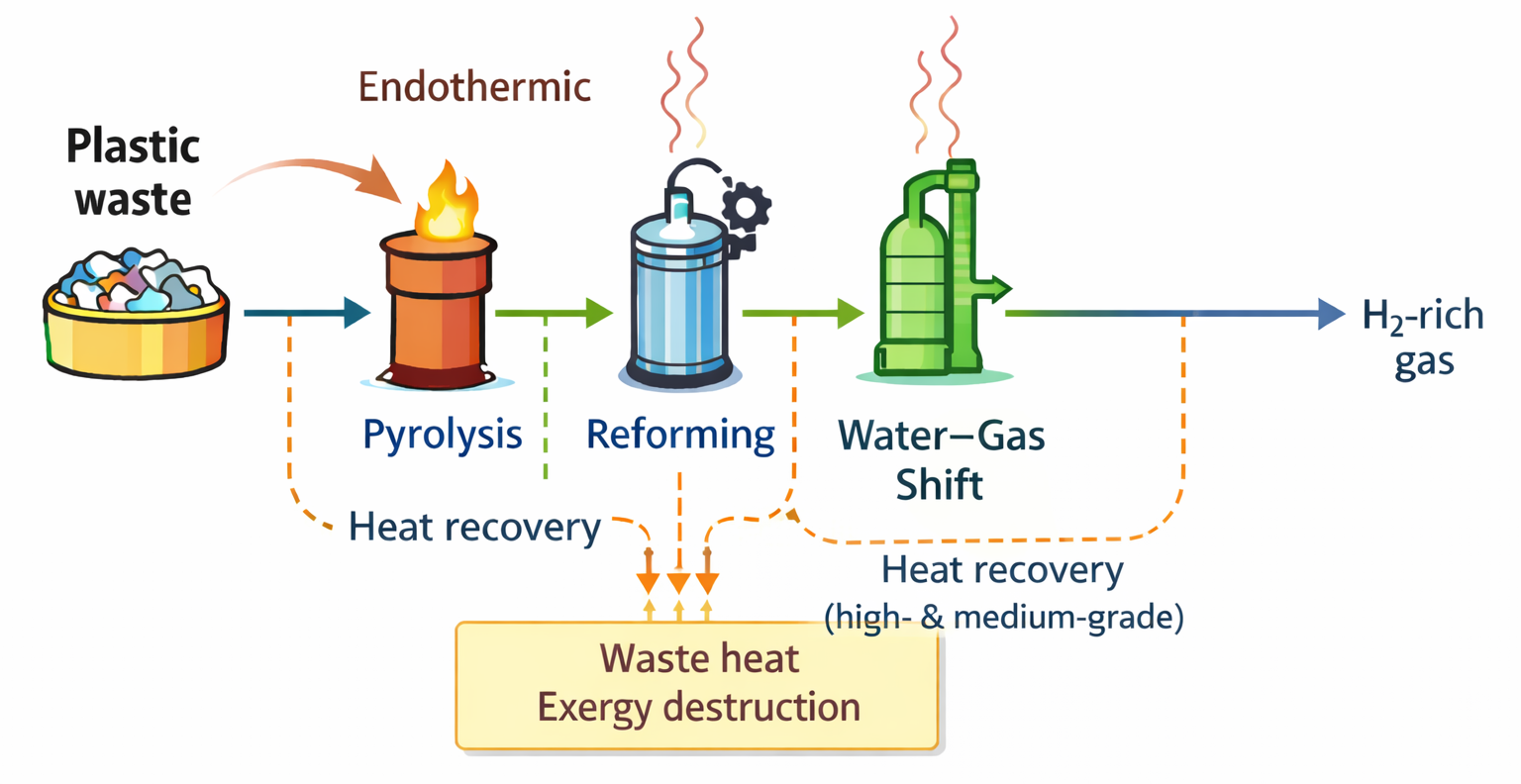
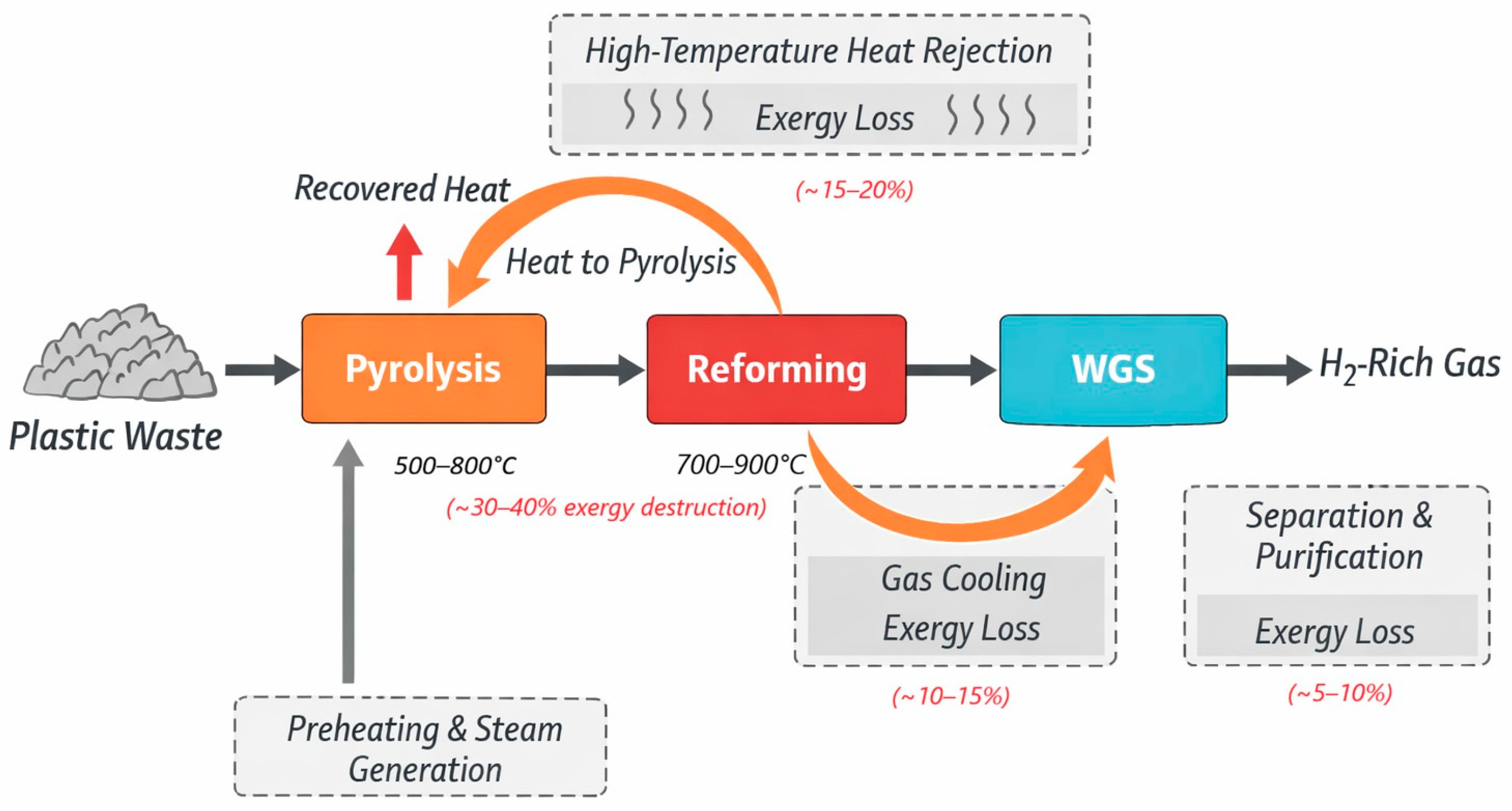
The thermodynamic characteristics and key limitations of the major process stages are summarised in Table 2. A conceptual overview of the thermodynamic interactions and heat-integration opportunities across plastic-to-hydrogen systems is illustrated in Figure 1, highlighting the redistribution of internally generated heat and the major sources of exergy destruction associated with high-temperature reactions, heat transfer, and downstream cooling and separation stages.
From an economic perspective, effective heat integration can reduce capital costs by minimising the size and number of external heaters and coolers required for process operation [47]. Recovering high-temperature waste heat to preheat feed streams or drive endothermic reactions reduces external fuel consumption and associated heating equipment, whilst recovering lower-grade heat for steam generation or feedstock drying can offset cooling system requirements. Although detailed techno-economic analysis remains beyond the scope of this thermodynamic review, the capital cost implications of heat integration represent an important consideration in practical system design and deployment.

5. Exergy and Energy Efficiency Perspectives

5.1. Energy Versus Exergy in Plastic-to-Hydrogen Systems

Energy efficiency alone is often insufficient to fully characterise the performance of thermochemical plastic waste conversion systems. Whilst energy balances ensure compliance with the first law of thermodynamics, they do not account for the quality, usability, or degradation of energy streams. Exergy analysis addresses this limitation by quantifying the maximum useful work obtainable from a system relative to its environment, thereby providing a rigorous measure of irreversibility and performance loss [18].
Exergy efficiency is typically defined as ηex = Exout/Exin, where Exout represents the exergy content of useful products (hydrogen-rich gas) and Exin represents the total exergy input to the system, including feedstock chemical exergy and external energy inputs.
In plastic-to-hydrogen systems, substantial high-temperature heat input is required to drive endothermic reactions such as pyrolysis, steam reforming, and gasification. Although total energy may be conserved across these processes, significant exergy destruction occurs due to irreversible heat transfer, entropy generation during chemical reactions, and mixing effects associated with multicomponent product streams [13,14,15]. Consequently, systems exhibiting similar energy efficiencies may display markedly different exergy efficiencies, underscoring the importance of exergy-based evaluation.
Classical exergy theory demonstrates that whilst energy is conserved, exergy is continuously destroyed due to irreversibilities associated with entropy generation, particularly in high-temperature processes [25]. Energy efficiency alone can mask substantial performance losses in thermochemical conversion systems, reinforcing the need for exergy-based evaluation when assessing plastic-to-hydrogen pathways.
Whilst many thermochemical plastic conversion studies report energy efficiencies as a primary performance metric, exergy-based analyses consistently reveal deeper performance limitations associated with high-temperature operation. These studies highlight the distinction between energy conservation and energy quality degradation, demonstrating that favourable energy balances do not necessarily imply efficient utilisation of available work potential.

5.2. Sources of Exergy Destruction

Exergy destruction in plastic-to-hydrogen systems arises primarily from three sources: chemical reactions, heat transfer across finite temperature differences, and downstream cooling and separation processes. Endothermic chemical reactions contribute to chemical exergy losses through entropy generation associated with molecular bond cleavage and product redistribution [13,15,30,51].
Heat transfer processes represent another major source of irreversibility, particularly when high-grade thermal energy is supplied externally and subsequently rejected at lower temperatures. Thermodynamic assessments consistently show that poor thermal matching between heat sources and sinks significantly increases entropy generation and exergy destruction [19,21]. In addition, gas cooling, condensation, and hydrogen separation steps introduce further exergy losses, especially when large temperature gradients or pressure drops are involved [17,52].
System-level exergy analyses of waste-derived thermochemical conversion systems indicate that the reactor section typically constitutes the dominant source of exergy destruction, followed by heat rejection and gas conditioning units [40,52]. These findings emphasise that performance improvements cannot be achieved through isolated unit-level optimisation alone.
Methodological exergy frameworks developed for high-temperature thermochemical systems demonstrate that meaningful reductions in exergy destruction require coordinated optimisation of reaction conditions, thermal coupling, and heat recovery strategies rather than incremental improvements in individual process components [18,53].

5.3. Impact of Operating Conditions on Exergy Efficiency

Operating conditions such as temperature, pressure, and steam-to-carbon ratio exert a strong influence on both energy and exergy efficiencies. Increasing temperature generally enhances hydrogen yield and reaction conversion; however, it also increases exergy destruction due to higher heat input requirements and larger temperature differences during heat transfer [13,14,15].
Similarly, increasing the steam-to-carbon ratio improves reforming performance and suppresses carbon formation but raises the exergy demand associated with steam generation and superheating [15,38]. These competing effects highlight the importance of optimising operating conditions from an exergy perspective rather than focusing solely on maximising hydrogen yield or conversion efficiency.

5.4. Role of Heat Integration in Improving Exergy Performance

Heat integration plays a central role in mitigating exergy losses by enabling the reuse of internally generated heat at appropriate temperature levels. By recovering sensible heat from hot product streams and redistributing it to support endothermic reactions, feed preheating, or steam generation, integrated systems reduce dependence on external high-grade energy sources [19,20].
Exergy-based system analyses show that reducing irreversibilities requires coordinated optimisation of reaction severity, heat recovery, and thermal coupling rather than isolated improvements to individual process units. Studies of high-temperature thermochemical systems consistently demonstrate that effective heat integration can significantly reduce total exergy destruction by limiting heat transfer across large temperature differences and improving utilisation of internally generated heat [54]. These principles are directly applicable to plastic-to-hydrogen systems, where multi-stage operation and wide temperature spans amplify exergy losses in the absence of integration.
Effective heat integration minimises entropy generation by reducing heat transfer across large temperature differences. System-level thermodynamic assessments consistently show that heat-integrated configurations achieve higher exergy efficiencies than non-integrated systems, even when overall energy efficiencies appear similar [21,22].

5.5. Exergy Perspective on System Feasibility

Exergy analysis provides critical insight into the fundamental feasibility limits of plastic-derived hydrogen production pathways. Whilst energy balances may suggest favourable performance, exergy-based evaluations often reveal that a substantial fraction of input energy is irreversibly degraded into low-quality heat, limiting the useful output of the system [34,40].
These findings reinforce the conclusion that plastic-to-hydrogen systems are intrinsically energy intensive and that meaningful performance improvements must focus on reducing irreversibilities rather than simply increasing reaction severity. Consequently, exergy-based evaluation is essential for identifying realistic and thermodynamically sound pathways for improving system efficiency through heat integration, staged temperature management, and optimised operating conditions.
To synthesise the thermodynamic behaviour of plastic-to-hydrogen systems, Table 3 summarises the dominant thermodynamic drivers, irreversibility sources, and associated heat-integration opportunities across major process stages. The dominant sources of energy and exergy losses reported across plastic-to-hydrogen thermochemical systems are synthesised in Table 4, providing a system-level perspective on the thermodynamic origins of irreversibilities that constrain overall performance.

6. Comparison with Conventional Hydrogen Routes

6.1. Conventional Thermochemical Hydrogen Production

Conventional hydrogen production is dominated by thermochemical routes, most notably steam methane reforming (SMR), which converts natural gas into hydrogen-rich synthesis gas at elevated temperatures. SMR is a strongly endothermic process that requires substantial external heat input to sustain reforming reactions and achieve high hydrogen yields [18,38]. Despite its widespread industrial deployment and technological maturity, SMR remains fundamentally constrained by equilibrium limitations and significant energy demand associated with high-temperature operation.
Thermodynamic analyses of SMR systems consistently show that hydrogen yield and efficiency are strongly dependent on operating temperature, pressure, and steam-to-carbon ratio. Increasing temperature favours hydrogen formation and methane conversion but simultaneously increases heat demand and exergy destruction, underscoring intrinsic trade-offs between conversion efficiency and energy input that cannot be eliminated through reactor design alone [18,42].

6.2. Thermodynamic Comparison with Plastic-Derived Hydrogen

Hydrogen production from plastic waste via pyrolysis, reforming, or gasification shares several fundamental similarities with conventional SMR. Both routes rely on high-temperature endothermic reactions and are governed by equilibrium constraints that limit achievable hydrogen yields and impose substantial heat input requirements when targeting hydrogen-rich product streams [15,16].
However, plastic-derived hydrogen systems often exhibit additional thermodynamic complexity due to feedstock heterogeneity and multi-stage conversion pathways. The integration of pyrolysis with downstream reforming and water–gas shift reactions introduces multiple temperature levels and reaction environments, increasing the importance of internal heat recovery, staged temperature management, and thermal matching [13,15]. In contrast, SMR systems typically operate with uniform feed composition, continuous operation, and well-established heat integration schemes developed over decades of industrial optimisation.

6.3. Energy and Exergy Efficiency Considerations

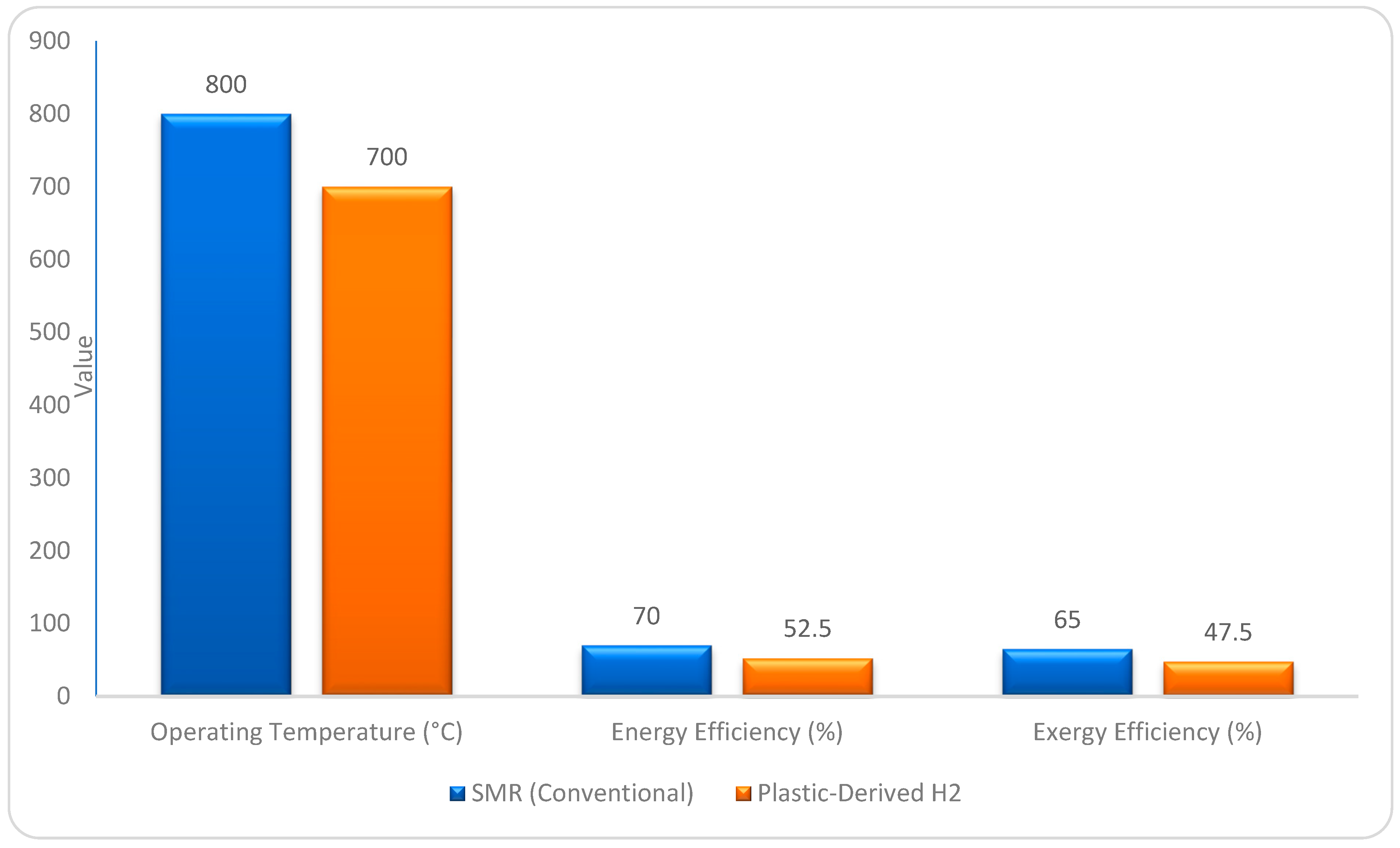
Quantitatively, conventional SMR systems typically achieve energy efficiencies in the range of 65–75% and exergy efficiencies of 60–70% under optimised conditions [18,38]. By contrast, plastic-derived hydrogen systems operating without extensive heat integration generally report energy efficiencies of 45–60% and exergy efficiencies of 40–55%, reflecting the additional thermodynamic penalties associated with feedstock heterogeneity, multi-stage processing, and less mature thermal integration strategies [13,15,20], as illustrated in Figure 2.
Plastic-to-hydrogen systems tend to exhibit lower exergy efficiencies due to greater irreversibilities associated with feedstock variability, multi-stage processing, intermittent heat transfer, and wider temperature gradients across unit operations [15,16,40]. These differences highlight that performance comparisons should be framed in thermodynamic and exergy terms rather than based solely on hydrogen yield, process complexity, or feedstock origin.

6.4. Comparison with Biomass Gasification Systems

Placing plastic-derived hydrogen production within the broader context of waste-to-energy routes provides additional perspective. Biomass gasification systems, which share thermochemical similarities with plastic conversion pathways, typically report energy efficiencies of 50–70% and exergy efficiencies of 45–60% under optimised operating conditions [48,50]. These values position plastic-derived systems within a comparable performance range to other thermochemical waste valorisation routes, rather than representing a fundamentally distinct class of conversion technology. Both biomass and plastic waste gasification face similar thermodynamic constraints arising from endothermic reaction requirements, equilibrium limitations, and irreversibilities associated with high-temperature operation and multi-component product streams.

6.5. Comparison with Water Electrolysis

Water electrolysis represents an alternative hydrogen production pathway driven by electrical rather than thermal energy input. Electrolysis systems typically achieve energy efficiencies of 60–80% when evaluated on a higher heating value basis, depending on technology type (alkaline, proton exchange membrane, or solid oxide electrolysis) and operating conditions [38,55,56]. However, direct comparison of thermochemical and electrochemical routes requires consideration of primary energy sources: electrolysis efficiency reflects electrical-to-chemical conversion, whereas plastic-derived hydrogen systems involve thermal-to-chemical conversion with waste feedstock valorisation. When electricity generation efficiency (~40–50% for conventional power plants) is included, the overall primary energy-to-hydrogen efficiency of grid-powered electrolysis falls to 25–40%, significantly lower than integrated thermochemical plastic conversion systems [15,55]. Consequently, plastic-to-hydrogen systems offer particular advantages in scenarios with available waste plastic feedstock and process heat integration opportunities, whilst electrolysis remains preferable when renewable electricity is abundant and direct thermal conversion infrastructure is unavailable.

6.6. Role of Heat Integration in Narrowing Performance Gaps

Heat integration plays a decisive role in narrowing the thermodynamic performance gap between plastic-derived hydrogen systems and conventional SMR. Effective recovery and reuse of internally generated heat can significantly reduce external energy demand and mitigate exergy destruction associated with high-temperature operation, particularly in multi-stage plastic conversion pathways [19,20,21].
Thermodynamic analyses indicate that heat-integrated plastic-to-hydrogen systems can approach the energy efficiency of conventional reforming routes when internal heat recovery, thermal matching, and staged temperature management are optimised. However, equilibrium limitations and feedstock-related irreversibilities continue to impose upper bounds on achievable performance, reinforcing the importance of system-level integration rather than reaction chemistry alone [22].

6.7. Thermodynamic Limits and Practical Implications

Despite differences in feedstock origin, both conventional and plastic-derived hydrogen routes are subject to similar thermodynamic constraints imposed by reaction enthalpy and entropy changes. Achieving high hydrogen yields invariably requires high-temperature operation and substantial heat input, fundamentally limiting achievable efficiency improvements across all thermochemical hydrogen production pathways [40].
Plastic-derived hydrogen should therefore be viewed as an alternative thermochemical pathway operating within comparable energetic limits rather than as a fundamentally lower-energy or intrinsically superior option. This perspective provides a balanced basis for evaluating plastic waste conversion systems without overstating performance advantages relative to established hydrogen production routes.

7. Challenges and Research Gaps

7.1. Limitations in Thermodynamic Property Data for Real Plastic-Derived Mixtures

Thermodynamic analysis of plastic waste conversion systems is frequently constrained by limited availability of reliable thermodynamic property data for real plastic-derived mixtures. Whilst numerous studies report thermodynamic parameters—such as enthalpy changes, Gibbs free energy variations, or entropy contributions—for individual polymers or model compounds, these analyses are typically derived from single-component plastics or idealised feed representations [27,30]. In practice, pyrolysis vapours generated from mixed plastic waste streams consist of highly complex, compositionally variable mixtures whose thermodynamic properties are not comprehensively characterised.
System-level thermodynamic assessments often rely on simplifying assumptions regarding mixture behaviour, ideal gas properties, or lumped species representations. These assumptions can obscure the true equilibrium limits, heat requirements, and entropy generation associated with real plastic-derived streams, particularly in integrated pyrolysis–reforming–gasification systems [17]. The absence of robust thermodynamic property datasets for heterogeneous plastic mixtures therefore remains a fundamental limitation in accurately evaluating energy and exergy performance. Specifically, critical gaps exist in heat capacity data (Cp) for complex pyrolysis vapour mixtures across relevant temperature ranges, enthalpies of formation (ΔHf°) for oxygenated and branched hydrocarbon intermediates, vapour pressure correlations for multi-component condensable fractions, and mixture interaction parameters needed for activity coefficient predictions in non-ideal systems. Experimental approaches to address these gaps could include differential scanning calorimetry (DSC) and thermogravimetric analysis (TGA) for heat capacity measurements and thermal decomposition behaviour [57,58,59], high-temperature reaction calorimetry for enthalpy determinations, vapour-liquid equilibrium (VLE) cells for phase behaviour characterisation, and controlled pyrolysis experiments with detailed product speciation to provide validation datasets for predictive models [36].
Addressing this limitation will require combined experimental and computational approaches. Machine learning techniques, such as artificial neural networks and predictive modelling frameworks, show promise for predicting process performance and thermodynamic behaviour of complex plastic-derived systems [60,61]. Hybrid approaches that integrate limited experimental measurements with data-driven predictive models could enable development of representative property frameworks for real plastic-derived streams, thereby improving the accuracy and reliability of system-level thermodynamic assessments without requiring exhaustive experimental characterisation of every possible feedstock composition.

7.2. Limited Reconciliation of Equilibrium Predictions with Kinetic Constraints

Equilibrium-based thermodynamic analyses are widely employed to estimate achievable product distributions and hydrogen yields in plastic pyrolysis, reforming, and gasification processes. In parallel, extensive kinetic studies have examined reaction mechanisms, activation energies, and degradation pathways for individual polymers and plastic mixtures. However, these two analytical perspectives are frequently treated independently, with limited reconciliation between equilibrium predictions and kinetic feasibility under realistic operating conditions [13,16].
In many cases, equilibrium calculations assume idealised conditions or local equilibrium, whilst experimental and pilot-scale systems operate under kinetic, mass-transfer, and residence-time constraints that prevent attainment of equilibrium states. The lack of integrated frameworks that explicitly link thermodynamic driving forces with kinetic limitations at the system level represents a notable gap in the current literature. Addressing this disconnect is essential for translating equilibrium-based insights into realistic performance expectations.
Addressing this gap requires development of integrated modelling frameworks that explicitly couple thermodynamic equilibrium calculations with detailed kinetic models, reactor residence time distributions, and transport phenomena. Multi-scale simulation approaches combining computational fluid dynamics with reaction kinetics can bridge the disconnect between equilibrium potential and achievable performance under realistic operating constraints [60,62].

7.3. Heat Integration Addressed Predominantly at a Conceptual Level

Heat integration is frequently recognised as a critical strategy for improving the energetic performance of plastic waste conversion systems. Numerous studies discuss internal heat recovery, thermal coupling of process units, or reuse of sensible heat from hot product streams [20]. However, such discussions are often qualitative or schematic in nature, with limited thermodynamic closure of heat source–sink matching across the full conversion pathway.
Consequently, the quantitative impact of heat integration on overall energy demand, entropy generation, and exergy efficiency is not always rigorously evaluated. The absence of systematic, thermodynamics-based heat-integration analysis limits the ability to compare different process configurations on a consistent basis and to identify realistic performance ceilings. This gap is particularly relevant for multi-stage plastic-to-hydrogen systems, where heat recovery potential depends strongly on temperature levels and thermal coupling efficiency.
Practical implementation of heat integration strategies would benefit from application of systematic design methodologies including pinch analysis, exergy-based optimization, and heat exchanger network synthesis. These approaches enable quantification of minimum utility requirements, identification of optimal heat recovery configurations, and techno-economic evaluation of integration schemes for plastic-to-hydrogen systems [44,46,47,63].

7.4. Scarcity of Comprehensive Exergy-Based System Evaluations

Although many studies report energy efficiencies or thermodynamic parameters for individual process steps, comprehensive exergy-based evaluations of plastic-to-hydrogen systems remain comparatively scarce. Exergy destruction associated with chemical reactions, heat transfer across finite temperature differences, and downstream cooling and separation processes is often not explicitly quantified in plastic-to-hydrogen systems [20,40,54].
Without detailed exergy analysis, it is difficult to identify dominant sources of irreversibility or to assess the true effectiveness of proposed heat-integration strategies. This limitation is particularly significant for high-temperature thermochemical systems, where substantial degradation of energy quality can occur even when overall energy balances appear favourable. Exergy-based system assessments are therefore essential for identifying realistic pathways for performance improvement.
Future work should prioritise comprehensive exergy analyses that account for all system components including feedstock pretreatment, multi-stage conversion, product purification, and heat integration networks. Standardised exergy accounting frameworks and reporting conventions would facilitate meaningful comparisons across studies and enable systematic identification of improvement opportunities in plastic-derived hydrogen systems [15,21].

7.5. Limited Consideration of Scale-Up and Integrated System Effects

Most thermodynamic and kinetic studies of plastic waste conversion are conducted at laboratory or conceptual scales, frequently using thermogravimetric analysis, bench-scale reactors, or simplified process models. Whilst these approaches provide valuable insight into fundamental reaction behaviour, scale-up introduces additional thermodynamic challenges, including thermal gradients, heat-transfer limitations, and constraints associated with equipment integration and heat distribution [20].
Moreover, the interaction of plastic conversion systems with broader industrial energy infrastructure—such as steam networks, waste heat sources, or co-located processes—is rarely addressed explicitly. System-level thermodynamic performance under realistic operating and integration conditions remains insufficiently explored, limiting the transferability of laboratory-scale insights to practical applications.
Process simulation tools such as Aspen Plus, which employ rigorous thermodynamic property packages and equilibrium-based reactor models, offer a pathway for translating laboratory-scale observations to industrial-scale predictions. These platforms enable systematic exploration of scale-up effects through heat and mass balance calculations, equipment sizing, sensitivity analyses, and evaluation of process integration schemes under realistic operating constraints [64,65]. However, the accuracy of such simulations remains dependent on the availability of validated thermodynamic property data and kinetic parameters for real plastic-derived streams, reinforcing the importance of addressing property data limitations identified in Section 7.1.

7.6. Synthesis of Key Research Gaps

Based on the synthesis of existing literature, several structural gaps can be identified in the thermodynamic assessment of plastic waste conversion to hydrogen and syngas. First, comprehensive thermodynamic property datasets for real, mixed plastic-derived streams remain limited. Second, equilibrium and kinetic analyses are often conducted independently, with limited system-level reconciliation. Third, heat integration is commonly discussed conceptually but rarely treated through rigorous thermodynamic closure. Fourth, exergy-based evaluations of complete plastic-to-hydrogen systems remain comparatively scarce. Finally, scale-up effects and integrated system performance are insufficiently addressed in most studies.

8. Future Directions

8.1. Development of Thermodynamic Property Frameworks for Real Plastic-Derived Streams

Future research should prioritise the development of thermodynamic property frameworks that better represent real plastic-derived mixtures. Current thermodynamic analyses often rely on simplified assumptions based on single polymers, surrogate compounds, or idealised gas mixtures, which limits their applicability to heterogeneous waste-derived streams. Advancing property models that capture the effective thermodynamic behaviour of realistic pyrolysis vapours is essential for improving the accuracy of equilibrium, energy, and exergy assessments at the system level.
Progress in this area may be enabled through combined use of advanced analytical characterisation, mixture property estimation techniques, and hybrid data-driven approaches. Improved thermodynamic property representation would provide a more reliable basis for evaluating equilibrium constraints, heat requirements, and integration potential in plastic-to-hydrogen systems.

8.2. Integrated Treatment of Thermodynamics and Kinetics

Bridging equilibrium-based thermodynamic analysis with kinetic feasibility represents a key future research direction. Whilst equilibrium calculations establish theoretical performance limits, real systems are governed by reaction rates, residence times, transport limitations, and non-ideal operating conditions. Future studies should therefore seek to explicitly relate thermodynamic driving forces to kinetic constraints without conflating equilibrium potential with achievable performance.
Integrated thermodynamic–kinetic frameworks would allow clearer identification of operating regimes where systems approach equilibrium behaviour and where kinetic limitations dominate. Such approaches are particularly important for multi-stage plastic conversion pathways, where deviations from equilibrium can accumulate across sequential process units.

8.3. Systematic Heat-Integration-Oriented Thermodynamic Analysis

Heat integration should be treated as a central component of thermodynamic analysis rather than as an auxiliary design feature. Future research would benefit from systematic identification and matching of heat sources and sinks across pyrolysis, reforming, gasification, and separation stages, guided explicitly by thermodynamic principles.
Qualitative pinch-based reasoning can be complemented by more rigorous system-level energy and exergy assessments to evaluate the true impact of heat recovery strategies. Emphasising thermodynamic closure of heat flows—rather than isolated unit-level optimisation—will be essential for defining realistic performance limits and identifying feasible integration pathways in plastic-to-hydrogen systems.

8.4. Expanded Use of Exergy Analysis for Performance Evaluation

Exergy analysis should be more widely adopted as a standard evaluation tool for plastic-to-hydrogen systems. Future studies should move beyond reporting overall energy efficiency and explicitly quantify exergy destruction associated with chemical reactions, heat transfer across finite temperature differences, and downstream cooling and separation processes.
Such analyses can reveal dominant sources of irreversibility that are not apparent from energy balances alone and provide clearer guidance on where design or operational changes yield meaningful efficiency improvements. Integrating exergy-based metrics alongside conventional energy analysis would support more transparent and thermodynamically consistent comparison between alternative thermochemical conversion pathways.

8.5. Consideration of Scale-Up and Integrated Energy Systems

Future thermodynamic assessments should increasingly address scale-up effects and system integration challenges. At larger scales, thermal gradients, heat-transfer limitations, and equipment integration constraints can significantly influence both energy and exergy performance. Explicit consideration of these effects is necessary to ensure that thermodynamic evaluations remain relevant beyond laboratory or conceptual studies.
In addition, evaluating plastic waste conversion systems within broader energy or industrial contexts—such as integration with existing high-temperature heat networks or adjacent industrial processes—may reveal new opportunities for improving thermodynamic efficiency through system-level coupling rather than isolated optimisation.

8.6. Outlook

Future progress in plastic waste conversion to hydrogen and syngas will depend on advancing thermodynamic analysis from isolated reaction-focused studies toward integrated, system-level evaluation. Addressing limitations in thermodynamic property data, reconciling equilibrium analysis with kinetic constraints, strengthening heat-integration treatment, and expanding exergy-based assessment are central to developing realistic and thermodynamically consistent performance benchmarks.
By focusing on these directions, future research can better clarify the true thermodynamic potential and limitations of plastic-derived hydrogen systems, providing a sound basis for evaluating and designing thermochemical waste-to-energy pathways within their fundamental energetic constraints.

9. Conclusions

This review has examined the thermodynamic and heat-integration aspects of plastic waste conversion to hydrogen and syngas, with focus on pyrolysis, steam reforming, gasification, and system-level performance. Plastic-derived hydrogen production is fundamentally governed by thermodynamic constraints: reaction endothermicity, equilibrium limitations, and substantial exergy losses impose inherent performance ceilings on all thermochemical conversion routes.
Temperature exerts a dominant influence on product distribution and hydrogen yield. Increasing temperature promotes gas-phase formation but demands significant heat input and amplifies exergy destruction. Downstream steam reforming and water–gas shift reactions enhance hydrogen production, yet their effectiveness remains bounded by equilibrium behaviour and opposing temperature dependencies, necessitating staged thermal management in integrated systems.
Heat integration represents a critical determinant of system feasibility. Effective recovery of internally generated heat can partially offset external energy requirements and reduce irreversibilities. However, current studies often address heat integration qualitatively, without rigorous thermodynamic closure. Exergy analysis reveals that dominant performance losses arise from irreversible chemical reactions, heat transfer across finite temperature differences, and downstream separation processes, emphasising the necessity of exergy-based evaluation.
Comparison with conventional steam methane reforming demonstrates that plastic-derived systems operate within comparable thermodynamic limits, whilst facing additional challenges from feedstock heterogeneity and multi-stage processing. Quantitatively, conventional systems achieve energy efficiencies of 65–75% and exergy efficiencies of 60–70%, whilst plastic-derived systems without extensive heat integration report 45–60% and 40–55%, respectively.
Meaningful performance improvements depend on reducing irreversibilities through effective heat integration, staged temperature management, and thermodynamically informed system design. This perspective provides a realistic basis for assessing the thermodynamic potential and practical limitations of plastic-derived hydrogen systems within sustainable waste management and energy recovery strategies

Funding

This research received no external funding.

Data Availability Statement

No new data were created or analysed in this study. Data sharing is not applicable to this article.

Conflicts of Interest

The author declares no conflicts of interest.

References

  1. Geyer, R.; Jambeck, J.R.; Law, K.L. Production, use, and fate of all plastics ever made. Sci. Adv. 2017, 3, e1700782. [Google Scholar] [CrossRef] [PubMed]
  2. 2. PlasticsEurope. Plastics—The Facts 2023. 2023. Available online: https://plasticseurope.org/knowledge-hub/plastics-the-fast-facts-2023/ (accessed on 15 February 2026).
  3. Ragaert, K.; Delva, L.; Van Geem, K. Mechanical and Chemical Recycling of Solid Plastic Waste. Waste Manag. 2017, 69, 24–58. [Google Scholar] [CrossRef] [PubMed]
  4. Nanda, S.; Sarker, T.R.; Kang, K.; Li, D.; Dalai, A.K. Perspectives on Thermochemical Recycling of End-of-Life Plastic Wastes to Alternative Fuels. Materials 2023, 16, 4563. [Google Scholar] [CrossRef] [PubMed]
  5. Majzoub, W.; Al-Rawashdeh, M.; Al-Mohannadi, D.M. Toward Building Circularity in Sustainable Plastic Waste Conversion. ACS Sustain. Chem. Eng. 2024, 12, 8642–8661. [Google Scholar] [CrossRef]
  6. Arena, U. Process and Technological Aspects of Municipal Solid Waste Gasification. A Review. Waste Manag. 2012, 32, 625–639. [Google Scholar] [CrossRef]
  7. Klass, D.L. Biomass for Renewable Energy, Fuels, and Chemicals; Academic Press: San Diego, CA, USA, 1998. [Google Scholar]
  8. Brems, A.; Dewil, R.; Baeyens, J.; Zhang, R. Gasification of Plastic Waste as Waste-to-Energy or Waste-to-Syngas Recovery Route. Nat. Sci. 2013, 5, 695–704. [Google Scholar] [CrossRef]
  9. Saad, J.M.; Williams, P.T. Pyrolysis-Catalytic Dry (CO2) Reforming of Waste Plastics for Syngas Production: Influence of Process Parameters. Fuel 2017, 193, 7–14. [Google Scholar] [CrossRef]
  10. Lopez, G.; Artetxe, M.; Amutio, M.; Bilbao, J.; Olazar, M. Thermochemical Routes for the Valorization of Waste Polyolefinic Plastics to Produce Fuels and Chemicals. A Review. Renew. Sustain. Energy Rev. 2017, 73, 346–368. [Google Scholar] [CrossRef]
  11. Vamvuka, D.; Chatzifotiadis, I. Energy Recovery From Solid Waste Materials via a Two-Step Gasification Process by Steam. Eur. J. Energy Res. 2022, 2, 20–24. [Google Scholar] [CrossRef]
  12. Ong, H.M.; Veksha, A.; Ha, Q.L.M.; Huang, J.; Tsakadze, Z.; Lisak, G. Catalytic Activity and Coke Resistance of Gasification Slag-Supported Ni Catalysts During Steam Reforming of Plastic Pyrolysis Gas. ACS Sustain. Chem. Eng. 2022, 10, 17167–17176. [Google Scholar] [CrossRef]
  13. Aminu, I.; Nahil, M.A.; Williams, P.T. Hydrogen from Waste Plastics by Two-Stage Pyrolysis/Low-Temperature Plasma Catalytic Processing. Energy Fuels 2020, 34, 11679–11689. [Google Scholar] [CrossRef]
  14. Aminu, I.; Nahil, M.A.; Williams, P.T. High-Yield Hydrogen from Thermal Processing of Waste Plastics. Proc. Inst. Civ. Eng. Waste Resour. Manag. 2022, 175, 3–13. [Google Scholar] [CrossRef]
  15. Alshareef, R.; Nahil, M.A.; Williams, P.T. Hydrogen Production by Three-Stage (I) Pyrolysis, (II) Catalytic Steam Reforming, and (III) Water Gas Shift Processing of Waste Plastic. Energy Fuels 2023, 37, 3894–3907. [Google Scholar] [CrossRef] [PubMed]
  16. Alshareef, R.; Sait-Stewart, R.; Nahil, M.A.; Williams, P.T. Three-Stage Pyrolysis–Steam Reforming–Water Gas Shift Processing of Household, Commercial and Industrial Waste Plastics for Hydrogen Production. Waste Dispos. Sustain. Energy 2024, 6, 25–37. [Google Scholar] [CrossRef]
  17. Xie, H.; Yu, Q.; Wang, K.; Shi, X.; Li, X. Thermodynamic Analysis of Hydrogen Production From Model Compounds of Bio-oil Through Steam Reforming. Environ. Prog. Sustain. Energy 2013, 33, 1008–1016. [Google Scholar] [CrossRef]
  18. Tsatsaronis, G.; Boyano, A.; Morosuk, T.; Blanco-Marigorta, A.M. Advanced Exergoenvironmental Analysis of a Steam Methane Reforming System for Hydrogen Production. In Proceedings of the ASME 2010 International Mechanical Engineering Congress and Exposition, Volume 5: Energy Systems Analysis, Thermodynamics and Sustainability; NanoEngineering for Energy; Engineering to Address Climate Change, Parts A and B, Vancouver, BC, Canada, 12–18 November 2010; ASME: New York, NY, USA, 2010; pp. 839–848. [Google Scholar] [CrossRef]
  19. Barbarias, I.; Arregi, A.; Artetxe, M.; Alvarez, J.; Bilbao, J.; Lopez, G.; Santamaria, L.; Aguado, R.; Olazar, M. Waste Plastics Valorization by Fast Pyrolysis and in Line Catalytic Steam Reforming for Hydrogen Production. In Hydrogen Economy; IntechOpen: London, UK, 2020. [Google Scholar] [CrossRef]
  20. Afzal, S.; Singh, A.; Nicholson, S.R.; Uekert, T.; DesVeaux, J.S.; Tan, E.C.D.; Dutta, A.; Carpenter, A.C.; Baldwin, R.M.; Beckham, G.T. Techno-Economic Analysis and Life Cycle Assessment of Mixed Plastic Waste Gasification for Production of Methanol and Hydrogen. Green Chem. 2023, 25, 5068–5085. [Google Scholar] [CrossRef]
  21. Becker, H.; Maréchal, F.; Vuillermoz, A. Process Integration and Opportunities for Heat Pump in Industrial Processes. Int. J. Thermodyn. 2011, 14, 59–70. Available online: https://izlik.org/JA63LE35KF (accessed on 15 February 2026). [CrossRef]
  22. Wallerand, A.S.; Kermani, M.; Voillat, R.; Kantor, I.; Maréchal, F. Optimal Design of Solar-Assisted Industrial Processes Considering Heat Pumping: Case Study of a Dairy. Renew. Energy 2018, 128, 565–585. [Google Scholar] [CrossRef]
  23. Rafey, A.; Ahmad, E.; Pant, K.K.; Upadhyayula, S. Transforming Plastic Waste Into Hydrogen and Nanocarbon: A Sustainable Path to Clean Energy and a Circular Economy. Ind. Eng. Chem. Res. 2025, 64, 3651–3675. [Google Scholar] [CrossRef]
  24. Rosen, M.A.; Dincer, I. Exergy as the Confluence of Energy, Environment and Sustainable Development. Exergy Int. J. 2001, 1, 3–13. [Google Scholar] [CrossRef]
  25. Bejan, A.; Tsatsaronis, G.; Moran, M.J. Thermal Design and Optimization; John Wiley & Sons: New York, NY, USA, 1995. [Google Scholar]
  26. Dubdub, I.; Al-Yaari, M. Pyrolysis of Mixed Plastic Waste: I. Kinetic Study. Materials 2020, 13, 4912. [Google Scholar] [CrossRef]
  27. Singh, R.K.; Gupta, P.; Ruj, B.; Sadhukhan, A.K.; Gupta, P. Thermal Degradation of Virgin and Waste Plastics: Estimation of Kinetic and Thermodynamic Parameters Using Model-free Iso-conversional Methods. Int. J. Chem. Kinet. 2024, 56, 61–80. [Google Scholar] [CrossRef]
  28. Li, W.-J.; Kuo, J.-H.; Yang, R.-X.; Wey, M.-Y. Effect of Preparation Solvent and Calcination Atmosphere on Ni@SiO2 Catalyst for Simultaneous Production of Hydrogen and Carbon Nanotubes from Simulated Plastic Waste Syngas. Energy Technol. 2019, 7, 1800586. [Google Scholar] [CrossRef]
  29. Liu, H.; Wang, C.; Zhang, J.; Zhao, W.; Fan, M. Pyrolysis Kinetics and Thermodynamics of Typical Plastic Waste. Energy Fuels 2020, 34, 2385–2390. [Google Scholar] [CrossRef]
  30. Negi, P.S.; Dubey, P.K.; Palodkar, A.V.; Kumar, S.; Kumar, A. Thermo-Kinetics of Chemical Recycling of Real-World Waste Plastics. ACS Sustain. Chem. Eng. 2023, 11, 15951–15963. [Google Scholar] [CrossRef]
  31. Rasaidi, N.; Mohamad Daud, A.R.; Ismail, S.N. Kinetic and Thermodynamic Analysis of Thermal Decomposition of Waste Virgin PE and Waste Recycled PE. Int. J. Renew. Energy Dev. 2022, 11, 829–838. [Google Scholar] [CrossRef]
  32. Yousef, S.; Eimontas, J.; Striūgas, N.; Mohamed, A.; Abdelnaby, M.A. Pyrolysis Kinetic Behavior and Thermodynamic Analysis of PET Nonwoven Fabric. Materials 2023, 16, 6079. [Google Scholar] [CrossRef]
  33. Tsai, H.-L.; Wang, C.; Duc, P.M. Control Design of Ethanol Steam Reforming in Thermal Plasma Reformer. In Proceedings of the 2007 IEEE International Conference on Control Applications; IEEE: Singapore, 2007; pp. 706–711. [Google Scholar] [CrossRef]
  34. Xie, H.; Yu, Q.; Duan, W.; Yao, X.; Li, X.; Qin, Q. Selection of CO2 Sorbent Used in Bio-oil Steam Reforming Process for Hydrogen Production. Environ. Prog. Sustain. Energy 2015, 34, 1208–1214. [Google Scholar] [CrossRef]
  35. Bisen, D.; Chouhan, A.P.S.; Sarma, A.K.; Rajamohan, S.; Elumalai, P.V.; Balasubramanian, D.; Cherie, A. Thermogravimetric Analysis of Rice Husk and Low-Density Polyethylene Co-Pyrolysis: Kinetic and Thermodynamic Parameters. Sci. Rep. 2024, 14, 31798. [Google Scholar] [CrossRef]
  36. Kim, Y.S.; Kim, Y.S.; Kim, S.H. Investigation of Thermodynamic Parameters in the Thermal Decomposition of Plastic Waste-Waste Lube Oil Compounds. Environ. Sci. Technol. 2010, 44, 5313–5317. [Google Scholar] [CrossRef]
  37. Koo, J.-K.; Kim, S.-W. Reaction Kinetic Model for Optimal Pyrolysis of Plastic Waste Mixtures. Waste Manag. Res. 1993, 11, 515–529. [Google Scholar] [CrossRef]
  38. Lim, Y.; Lee, C.-J.; Jeong, Y.S.; Song, I.H.; Lee, C.J.; Han, C. Optimal Design and Decision for Combined Steam Reforming Process With Dry Methane Reforming to Reuse CO2 as a Raw Material. Ind. Eng. Chem. Res. 2012, 51, 4982–4989. [Google Scholar] [CrossRef]
  39. Casas-Ledón, Y.; Arteaga-Pérez, L.E.; Morales Pérez, M.C.; Peralta-Suárez, L.M. Thermodynamic Analysis of the Hydrogen Production From Ethanol: First and Second Laws Approaches. ISRN Thermodyn. 2012, 2012, 672691. [Google Scholar] [CrossRef][Green Version]
  40. Kindra, V.; Rogalev, A.; Oparin, M.; Kovalev, D.A.; Ostrovsky, M.A. Research and Development of the Oxy-Fuel Combustion Power Cycle for the Combined Production of Electricity and Hydrogen. Energies 2023, 16, 5983. [Google Scholar] [CrossRef]
  41. Farshchi Tabrizi, F.; Seyed Mousavi, S.A.H.S.; Atashi, H. Thermodynamic Analysis of Steam Reforming of Methane with Statistical Approaches. Energy Convers. Manag. 2015, 103, 1065–1077. [Google Scholar] [CrossRef]
  42. Pashchenko, D.; Gnutikova, M. Thermodynamic Analysis of Carbon Formation Conditions in a Steam Methane Reforming Process. Therm. Sci. 2021, 25, 3643–3954. [Google Scholar] [CrossRef]
  43. Yi, C.Q.; Bojeng, M.N.; Kamis, S.K.; Mubarak, N.M.; Karri, R.R.; Azri, H. Production of Hydrogen Using Plastic Waste via Aspen Hysys Simulation. Sci. Rep. 2024, 14, 4934. [Google Scholar] [CrossRef]
  44. Kemp, I.C. Pinch Analysis and Process Integration, A User Guide on Process Integration for the Efficient Use of Energy; Butterworth-Heinemann: Oxford, UK, 2007. [Google Scholar]
  45. Goodarzvand-Chegini, F.; GhasemiKafrudi, E. Application of Exergy Analysis to Improve the Heat Integration Efficiency in a Hydrocracking Process. Energy Environ. 2017, 28, 564–579. [Google Scholar] [CrossRef]
  46. Behzadi, A.; Gholamian, E.; Houshfar, E.; Habibollahzade, A. Multi-Objective Optimization and Exergoeconomic Analysis of Waste Heat Recovery from Tehran’s Waste-to-Energy Plant Integrated with an ORC Unit. Energy 2018, 160, 1055–1068. [Google Scholar] [CrossRef]
  47. Smith, R. Chemical Process Design and Integration, 2nd ed.; John Wiley & Sons: Chichester, UK, 2016. [Google Scholar]
  48. Tock, L.; Maréchal, F. Co-production of Hydrogen and Electricity from Lignocellulosic Biomass: Process Design and Thermo-economic Optimization. Energy 2012, 45, 339–349. [Google Scholar] [CrossRef]
  49. Ortiz, F.; López-Guirao, F. A Practical Approach to Using Energy Integration in the Simulation of Biomass Thermochemical Processes: Application to Supercritical Water Gasification. Appl. Sci. 2024, 14, 1577. [Google Scholar] [CrossRef]
  50. Zhang, X.; Zhou, Y.; Jia, X.; Feng, Y.; Dang, Q. Multi-criteria Optimization of a Biomass-Based Hydrogen Production System Integrated with Organic Rankine Cycle. Front. Energy Res. 2020, 8, 584215. [Google Scholar] [CrossRef]
  51. Aminu, I.; Nahil, M.A.; Williams, P.T. Hydrogen Production by Pyrolysis–Nonthermal Plasma Catalytic Reforming of Waste Plastic over Different Catalyst Support Materials. Energy Fuels 2022, 36, 3788–3801. [Google Scholar] [CrossRef]
  52. Jiang, P.; Parvez, A.M.; Yang, M.; Xu, M.; Xu, M.; Meng, Y.; Lv, Y.; Afzal, M.T.; Cai, J. Novel Two-Stage Fluidized Bed-Plasma Gasification Integrated With SOFC and Chemical Looping Combustion for the High Efficiency Power Generation From MSW: A Thermodynamic Investigation. Energy Convers. Manag. 2021, 236, 114066. [Google Scholar] [CrossRef]
  53. Lourenço, A.B.; Santos, J.J.C.; Donatelli, J.L.M. Exergy Analysis and Fuel Exergy Allocation in a HTGR Direct Combined Cycle. In Proceedings of the 20th International Conference on Nuclear Engineering and the ASME 2012 Power Conference, Anaheim, CA, USA, 30 July–3 August 2012. [Google Scholar] [CrossRef]
  54. Bejan, A. Advanced Engineering Thermodynamics; John Wiley & Sons: Hoboken, NJ, USA, 2016. [Google Scholar]
  55. Dincer, I.; Acar, C. Review and Evaluation of Hydrogen Production Methods for Better Sustainability. Int. J. Hydrogen Energy 2015, 40, 11094–11111. [Google Scholar] [CrossRef]
  56. Shiva Kumar, S.; Lim, H. An Overview of Water Electrolysis Technologies for Green Hydrogen Production. Energy Rep. 2022, 8, 13793–13813. [Google Scholar] [CrossRef]
  57. Dubdub, I. Kinetics Study of Polypropylene Pyrolysis by Non-Isothermal Thermogravimetric Analysis. Materials 2023, 16, 584. [Google Scholar] [CrossRef]
  58. Meena, P.; Bhoi, R. Thermodynamic and Kinetic Analysis of Waste Plastic Pyrolysis: Synergistic Effects and Sustainability Perspectives. Next Sustain. 2025, 5, 100132. [Google Scholar] [CrossRef]
  59. Al-Abedi, H.J.; Smith, J.D.; Al-Rubaye, H.; Shakor, Z.M.; Erdem, A.; Ani, P.C. Synergistic Co-pyrolysis of Corn Stover and Refuse-Derived Fuel with Microplastics: Kinetic and Thermodynamic Study. Biofuels 2024, 15, 1197–1213. [Google Scholar] [CrossRef]
  60. Lahafdoozian, M.; Khoshkroudmansouri, H.; Zein, S.H.; Jalil, A.A. Hydrogen Production from Plastic Waste: A Comprehensive Simulation and Machine Learning Study. Int. J. Hydrogen Energy 2024, 59, 465–479. [Google Scholar] [CrossRef]
  61. Tomme, L.; Ureel, Y.; Dobbelaere, M.R.; Lengyel, I.; Vermeire, F.H.; Stevens, C.V.; Van Geem, K.M. Machine Learning Applications for Thermochemical and Kinetic Property Prediction. Rev. Chem. Eng. 2025, 41, 419–449. [Google Scholar] [CrossRef]
  62. Yansaneh, O.Y.; Zein, S.H. Recent Advances on Waste Plastic Thermal Pyrolysis: A Critical Overview. Processes 2022, 10, 332. [Google Scholar] [CrossRef]
  63. Al-Qadri, A.A.; Ahmed, U.; Jameel, A.G.A.; Ahmad, N.; Zahid, U.; Zein, S.H.; Naqvi, S.R. Process Design and Techno-Economic Analysis of Dual Hydrogen and Methanol Production from Plastics Using Energy Integrated System. Int. J. Hydrogen Energy 2023, 48, 10797–10811. [Google Scholar] [CrossRef]
  64. Salaudeen, S.A.; Arku, P.; Dutta, A. Gasification of Plastic Solid Waste and Competitive Technologies. In Plastics to Energy; Al-Salem, S.M., Ed.; Plastics Design Library; William Andrew Publishing: Norwich, NY, USA, 2019; pp. 269–293. [Google Scholar] [CrossRef]
  65. Lopez, G.; Artetxe, M.; Amutio, M.; Alvarez, J.; Bilbao, J.; Olazar, M. Recent Advances in the Gasification of Waste Plastics. A Critical Overview. Renew. Sustain. Energy Rev. 2018, 82, 576–596. [Google Scholar] [CrossRef]
Figure 1. Conceptual schematic illustrating thermodynamic interactions and heat-integration opportunities in plastic-to-hydrogen systems.
Thermo 06 00014 g001
Figure 2. Comparative thermodynamic characteristics of conventional steam methane reforming (SMR) and plastic-derived hydrogen production systems. Operating temperature represents typical mid-range values; energy and exergy efficiencies reflect performance under optimised heat integration conditions and are calculated on a lower heating value (LHV) basis. Values synthesised from thermodynamic analyses of SMR systems [18,38] and plastic waste conversion pathways [13,15,20].
Thermo 06 00014 g002
Table 1. Thermodynamic characteristics of key process stages in plastic-to-hydrogen systems (pyrolysis, reforming, gasification).
Process StageFeedstock/StreamTemperature Regime (Qualitative)Thermodynamic NatureKey Thermodynamic LimitationsRepresentative References
Plastic pyrolysisPE, PET, mixed plastic wasteHigh-temperature regime (typically ≥500 °C)Strongly endothermicHigh external heat demand; equilibrium favours gas formation at elevated temperature[27,30,32]
Steam reforming of plastic-derived gasesPyrolysis gases/vapours from plasticsHigh-temperature regime (≥700 °C)EndothermicLarge heat duty; equilibrium-limited hydrogen formation[15]
Water–gas shift (WGS)Reformate gas from plastic-derived reformingModerate-temperature regime (≈250–450 °C)Mildly exothermicTemperature trade-off with upstream reforming stage[15]
Plastic gasificationMixed plastic wasteHigh-temperature regime (typically ≥800 °C)EndothermicHigh energy intensity; equilibrium constraints on syngas composition[9,40]
Gas cooling and separationPlastic-derived syngas/H2-rich gasTemperature reduction requiredNon-reactive, irreversibleExergy loss due to heat rejection and pressure drops[19,20]
Table 2. Thermodynamic characteristics of key reactions in plastic-to-hydrogen systems (steam reforming and water–gas shift).
Process StageMain Reactions InvolvedThermodynamic NatureEffect of TemperatureKey Thermodynamic Limitations
Plastic pyrolysisPolymer chain scissionStrongly endothermicHigher temperatures favour gas-phase products and lighter speciesHigh external heat demand; equilibrium shift limited by entropy effects
Steam reforming of pyrolysis productsHydrocarbon–steam reactionsEndothermicIncreasing temperature enhances hydrogen formationCarbon formation risk; large heat input requirement
Water–gas shift reactionCO + H2O ⇌ CO2 + H2Mildly exothermicLower temperatures favour hydrogen at equilibriumTrade-off with reforming temperature requirements
Plastic gasificationPartial oxidation and reformingEndothermicHigher temperatures promote syngas and hydrogen formationSignificant energy intensity; equilibrium constraints
Gas cooling and separationPhase change and separation processesNon-reactive, irreversibleTemperature reduction required for separationExergy destruction due to heat rejection and pressure losses
Table 3. Thermodynamic drivers, dominant irreversibilities, and heat-integration opportunities across key stages of plastic-to-hydrogen systems. Synthesised from thermodynamic and system-level analyses reported for plastic pyrolysis, reforming, and integrated waste-to-hydrogen systems [13,14,15,19,20,40].
Process StageDominant Thermodynamic DriverMain Source of IrreversibilityExergy ImpactHeat-Integration Opportunity
Plastic pyrolysisStrongly endothermic polymer bond scission (ΔH > 0, ΔS > 0)External high-temperature heat supply; reactor heat lossesHigh chemical and thermal exergy destructionFeed preheating using hot reformer or gasifier effluent
Steam reforming of pyrolysis productsEndothermic reforming reactions; equilibrium-limited H2 formationLarge temperature gradients; reaction irreversibilityMajor contributor to total system exergy destructionSensible heat recovery from reformer outlet for steam generation
Water–gas shift (WGS)Mildly exothermic equilibrium shift toward H2Heat rejection at intermediate temperaturesModerate exergy loss due to heat downgradingHeat recovery for feed preheating or low-pressure steam
Gas cooling and cleanupNon-reactive but highly irreversible coolingSensible heat rejection; pressure dropsSignificant physical exergy lossCascaded heat recovery to lower-temperature sinks
Integrated systemInteraction of multiple equilibrium-limited stepsMismatched heat sources and sinksCumulative system-level exergy destructionSystem-wide heat cascading and thermal coupling
Table 4. Dominant sources of energy and exergy losses in plastic-to-hydrogen thermochemical systems.
System StageDominant Loss MechanismThermodynamic OriginQualitative ImpactRepresentative Plastic-Specific References
Pyrolysis reactorHigh external heat demandStrong endothermicity; entropy increaseLarge primary energy input[13,27]
Steam reformerReaction irreversibilityHigh-temperature chemical exergy lossMajor exergy destruction zone[15,51]
WGS stageThermal mismatchExothermic reaction at lower TInefficient heat utilisation[15]
Heat exchangersFinite-ΔT heat transferEntropy generationRecoverable vs. unrecoverable heat[19,20]
Gas coolingSensible heat rejectionLow-grade heat lossSignificant physical exergy loss[19]
Gas separationPressure drop and coolingMechanical & thermal irreversibilityEfficiency penalty[20]
Integrated systemPoor thermal couplingSystem-level irreversibilityReduced overall exergy efficiency[40,52]
Disclaimer/Publisher’s Note: The statements, opinions and data contained in all publications are solely those of the individual author(s) and contributor(s) and not of MDPI and/or the editor(s). MDPI and/or the editor(s) disclaim responsibility for any injury to people or property resulting from any ideas, methods, instructions or products referred to in the content.