Article

Molecular Dynamics Studies on Epitope-Resolved Structural Dynamics and Energetics of Japanese Cedar Cry j 1 Allergen Adsorption onto PET Microplastics


by
Tochukwu Oluwatosin Maduka
*,
Qingyue Wang
* and
Christian Ebere Enyoh
Graduate School of Science and Engineering, Saitama University, 255 Shimo Okubo, Sakura-ku, Saitama City 338-8570, Japan
*
Authors to whom correspondence should be addressed.
Physchem 2026, 6(2), 29; https://doi.org/10.3390/physchem6020029
Submission received: 28 March 2026 / Revised: 7 May 2026 / Accepted: 15 May 2026 / Published: 19 May 2026
(This article belongs to the Section Theoretical and Computational Chemistry)

Abstract

The interaction between airborne allergens and environmental microplastics is an emerging concern in the context of increasing plastic pollution and allergic disease prevalence. In this study, we investigated the molecular interaction between Cry j 1, the major allergen of Japanese cedar (Cryptomeria japonica) pollen, and polyethylene terephthalate (PET) microplastic surfaces using all-atom molecular dynamics simulations integrated with computational epitope selection analyses. The simulations showed that Cry j 1 adsorbs onto PET primarily through hydrophobic and van der Waals interactions, with residues Pro165, Ala227, Tyr228, and Val163 contributing prominently to surface association. Mapping of selected epitope regions indicated that several linear B-cell epitopes remained solvent exposed following adsorption, whereas two CD4+ T-cell epitope regions (T5 and T6) contributed more directly to PET interaction. PET adsorption was accompanied by moderate changes in conformational dynamics, including reduced residue-level flexibility and localized secondary-structure adjustments, while the overall protein fold remained structurally stable throughout the simulation. Small decreases in radius of gyration and solvent-accessible surface area suggested mild adsorption-associated compaction rather than major unfolding. These findings indicate that PET association can influence the structural dynamics and interfacial behavior of Cry j 1 without extensive disruption of its global architecture. Because the study is entirely computational, the immunological implications remain hypothetical and require experimental validation. Nevertheless, this work provides a molecular-level framework for understanding how airborne microplastics may influence allergen behavior and protein-surface interactions in polluted atmospheric environments.

1. Introduction

Airborne allergens are major contributors to allergic diseases such as allergic rhinitis and asthma, which continue to increase globally and represent an important environmental health burden [1]. Among pollen-associated respiratory allergens, Cry j 1 from Japanese cedar (Cryptomeria japonica) is one of the most clinically important aeroallergens in East Asia, where seasonal cedar pollinosis affects a substantial portion of the population [2]. Cry j 1 is known to trigger both IgE-mediated and CD4+ T-cell immune responses, and several experimentally identified epitope regions of cry j 1 have been associated with allergenic recognition and T-cell activation [3,4,5]. Computational immunology approaches have increasingly been used to identify candidate antigenic regions in allergenic proteins and to guide structural interpretation of immune recognition [6,7,8,9,10]. These approaches can help identify surface-exposed and potentially immunologically relevant regions, although they remain predictive and require experimental validation. Importantly, most available computational tools primarily identify linear epitopes, whereas many native IgE-binding epitopes are conformational in nature.
Microplastics have recently emerged as widespread environmental contaminants in marine, terrestrial, and atmospheric environments [11,12]. Polyethylene terephthalate (PET), extensively used in textiles and packaging materials, is among the dominant polymers detected in airborne microplastic sample [12]. Increasing evidence suggests that airborne microplastics can adsorb biomolecules and pollutants, potentially acting as carriers or environmental reservoirs for bioactive compounds [13,14,15]. In experimental studies, microplastics have been shown to associate with pollen particles and allergenic proteins, forming hybrid complexes that may influence transport behavior, persistence, and cellular responses [13,15]. The adsorption of the protein onto solid interfaces is frequently accompanied by structural and dynamic rearrangements driven by hydrophobic interactions, dispersion forces, and solvent reorganization [16,17,18]. Depending on the surface properties, adsorption may alter protein flexibility, secondary structure organization, hydration behavior, and conformational sampling without necessarily causing complete unfolding [19]. In allergens, reports suggest that structural perturbations could potentially influence epitope accessibility or antigen processing pathways [20]. However, the molecular mechanisms governing allergen–microplastic interactions remain poorly understood, particularly for airborne pollen allergens.
Molecular dynamics (MD) simulation provides a useful computational framework for investigating protein–surface interactions at atomic resolution [21]. The MD approaches have been widely used to characterize adsorption energetics, residue-level contacts, conformational stability, hydration effects, and interfacial dynamics in protein–material systems [16]. Previous simulations have shown that adsorption onto PET surfaces is commonly dominated by van der Waals interactions and hydrophobic surface complementarity [22,23]. Nevertheless, mechanistic studies focusing specifically on allergen adsorption onto atmospheric microplastics remain limited.
The present study investigates the molecular interaction between the Japanese cedar allergen Cry j 1 and an amorphous PET microplastic surfaces using all-atom molecular dynamics simulations integrated with computational epitope mapping. We hypothesized that adsorption onto PET would preferentially involve localized hydrophobic and surface-accessible regions while preserving the overall structural integrity of Cry j 1. Specifically, we aimed to (i) identify candidate B-cell and CD4+ T-cell epitope regions using a multi-tool computational approach, (ii) characterize the adsorption behavior of Cry j 1 on PET, (iii) evaluate structural and dynamic responses associated with surface interaction, and (iv) assess whether adsorption alters the accessibility or flexibility of selected epitope regions. Rather than establishing direct immunological outcomes, this work provides a computational framework for understanding how airborne allergens may interact with atmospheric microplastic surfaces and how such interactions could influence structural behavior in polluted environmental systems.

2. Materials and Methods

2.1. Selection of B Cell Epitopes and T-Cell Epitopes of Cry j 1

Using existing immunoinformatics pipelines, linear B-cell and CD4+ T-cell epitope regions were identified to describe the immunogenic landscape of Cry j 1. Five separate techniques were used to identify linear B-cell epitopes: SVM-TriP [24], BCPred [10,25], BcePred [7], ABCpred [6], and the Immunomedicine Group server [26]. For every tool, default parameters were used. The Cry j 1 main sequence was used to map the predicted regions, and a consensus-based method was used to combine them. For structural analysis, regions found using four or more of the five techniques were kept. We emphasize that linear B-cell epitopes represent only an estimated 10–20% of native B-cell epitopes, and all identified regions are in silico predictions that require experimental validation.
Using the IEDB TepiTool [26,27], CD4+ T-cell epitope identification was carried out, concentrating on human MHC class II alleles pertinent to East Asian and global populations: HLA-DRB1*09:01, HLA-DRB1*15:01, HLA-DRB1*04:01, HLA-DRB1*07:01, and HLA-DQA1*03:01/DQB1*03:02 [28]. 10-residue overlap was used to create overlapping 15-mer peptides, and the IEDB-recommended consensus technique was used to score the predictions. Potential binders were defined as peptides with a percentile rating of ≤10. Peptides expected to bind at least two HLA class II alleles were referred to as promiscuous epitope areas. Antigen processing, presentation efficiency, and T-cell receptor recognition are not taken into consideration by these theoretical computational binding estimations. In order to evaluate the differing adsorption effects on surface-exposed versus surface-interacting protein segments, the discovered areas are mainly used as structural reference points. Consensus B-cell epitopes and promiscuous CD4+ T-cell epitope regions were mapped onto the three-dimensional structure of Cry j 1 using UCSF ChimeraX [29]. Full prediction results from individual tools are provided in Supplementary Tables S1 and S2.

2.2. Molecular Dynamics Simulation

2.2.1. Construction of the PET Microplastic Model

A PET hexamer (6-mer) chain was generated using CHARMM-GUI. To construct an amorphous microplastic surface, 180 PET 6-mer molecules were randomly packed into a 12 × 12 × 15 nm3 simulation box using Packmol. In order to achieve an amorphous configuration, the system underwent energy minimization and thermal annealing (300–600 K), which was followed by NVT and NPT equilibration. The resulting PET slab has an average density of 1.25 g cm−3, which is consistent with an amorphous polymer structure and around 6% less than experimental amorphous PET (1.33 g cm−3). We acknowledge that a 6-mer represents an oligomer rather than a true polymer chain; the terminal hydroxyl and carboxyl groups may influence surface polarity and hydration differently than high-molecular-weight PET. However, the assembled slab of 180 chains achieved near-bulk amorphous density and remained stable throughout the simulation, supporting its appropriateness for investigating fundamental protein-surface interactions. Full details of PET model construction and validation are provided in Supplementary Section S1 and in our previous report [12].

2.2.2. Protein Structure Preparation

The structure of Cry j 1 (Cry j 1.0101) was obtained from the Structural Database of Allergenic Proteins (SDAP 2.0; Allergen ID: 1125; UniProt entry P18632), based on an AlphaFold model with pLDDT = 94 and pTM = 0.85, derived from experimental template 1PXZ_A (80% sequence identity) [30]. The protein was solvated in a rectangular simulation box containing TIP3P water molecules and ionized to physiological ionic strength (0.15 M KCl) using CHARMM-GUI. The CHARMM36 force field was applied consistently to both protein and polymer components.

2.2.3. Protein-PET System Assembly and Molecular Dynamics Protocol

For adsorption simulations, the solvated Cry j 1 protein was positioned approximately 3 nm above the PET slab surface, with the major epitope region oriented toward the polymer interface. The simulation box dimensions were adjusted to maintain a minimum solvent padding of 2 nm in all directions. Energy minimization was performed using the steepest descent algorithm. The system was then equilibrated for 100 ps under the NVT ensemble followed by 1 ns under NPT conditions. Production molecular dynamics simulations were performed for 200 ns, extending previous short-timescale simulations (20 ns) reported in our earlier work to capture long-timescale adsorption dynamics and conformational adaptation. Although only one initial orientation was used, this orientation was selected based on biological relevance and prior structural analysis. Several orientations may yield different interaction patterns and should be explored in future work. All simulations were carried out using GROMACS 2025.1 with the CHARMM36 force field. Temperature was maintained at 300 K using the Nosé–Hoover thermostat, and pressure was controlled at 1 bar using the Parrinello–Rahman barostat. Long-range electrostatic interactions were treated using the particle mesh Ewald (PME) method, and covalent bonds involving hydrogen atoms were constrained using the LINCS algorithm. A 2-fs integration timestep was used for all simulations.

2.3. Trajectory Analyses

Trajectory analyses were performed using GROMACS analysis tools after removing periodic boundary artifacts and aligning trajectories to the reference structure using least-squares fitting. Backbone root-mean-square deviation (RMSD) and root-mean-square fluctuation (RMSF) were calculated using gmx rms and gmx rmsf. Radius of gyration (Rg) was computed using gmx gyrate to assess global structural compactness. Solvent-accessible surface area (SASA) was calculated using the gmx sasa tool. Secondary structure evolution was determined using the DSSP algorithm (gmx dssp), with elements grouped into helix, β-sheet, turn, and loop categories. Binding free energy was calculated using the MM/GBSA method implemented in gmx_MMPBSA. A total of 201 snapshots were extracted at 1 ns interval from the equilibrated trajectory. Per-residue decomposition analysis was performed to identify key residues contributing to adsorption. Convergence was evaluated using final 100 ns and final 50 ns trajectory windows. The hydration environment surrounding the protein was analyzed using radial distribution functions (RDF), hydration shell population, and water diffusion dynamics. RDFs between protein heavy atoms and water oxygen atoms were calculated using GROMACS analysis tools. Water molecules within 0.35 nm of the protein surface were defined as belonging to the first hydration shell, and their population was calculated for each trajectory frame. The mean square displacement (MSD) of hydration-shell water molecules was calculated to evaluate interfacial solvent mobility. Interactions between predicted epitope regions and the PET surface were evaluated using minimum distance and contact analyses. Nine epitope groups were defined in the trajectory index file, including three B-cell epitopes (B1–B3) and six T-cell epitopes (T1–T6). Minimum distances and contact numbers were calculated using gmx mindist with a 0.35 nm cutoff. Hydrogen bonds were analyzed using gmx hbond with geometric criteria of donor–acceptor distance ≤ 0.35 nm and angle ≥ 135°. Water contacts surrounding epitope residues were also quantified to evaluate solvent accessibility during adsorption. Advanced dynamic analyses (dynamic cross-correlation analysis, principal component analysis, and free energy landscape reconstruction) are described in Supplementary Section S6. All reported values represent averages calculated over the entire molecular dynamics’ trajectory.

2.4. Statistical Analysis of Molecular Dynamics Trajectory Data

Statistical analysis was performed on the equilibrated phase of the 200 ns simulations. For time dependent structural metrics (RMSD, RMSF, Rg, hydration shell population, interfacial contact counts), mean values and standard deviations (SD) were computed from frame-resolved data extracted at 10 ps intervals using custom Python scripts with the NumPy and SciPy libraries. Comparisons between the aqueous control and PET bound systems were performed using two sample Welch’s t tests (unequal variances). To quantify the magnitude of observed differences, Cohen’s d effect sizes were calculated for key comparisons (e.g., secondary structure populations, global stability metrics) using the pooled standard deviation. Significance was defined as p < 0.05; highly significant differences are reported for p < 0.01. For secondary structure analysis, DSSP assignments were aggregated into four structural classes (α-helix, β-sheet, turn, and loop), and mean occupancy percentages with standard deviations were calculated per frame. Statistical comparisons between systems were then performed on these frame-resolved populations. For DCCM analysis, global correlation descriptors (mean absolute correlation, fraction of strongly correlated pairs) were derived from the distribution of correlation coefficients in the upper triangular matrix. Binding free energy estimates from MM/GBSA are reported as mean ± standard deviation over all sampled frames (n = 201). Convergence was assessed by comparing results from the final 200 ns, 100 ns, and 50 ns windows; consistency among these windows was taken as evidence of energetic convergence. All statistical calculations, trajectory post processing, and graphical visualization were conducted using Python (Version 3.12.13) (NumPy (Version 2.0.2), SciPy (Version 1.16.1), Matplotlib (Version 3.10.x)) and R-studio 2026.01.0 (R version 4.5.2). Uncertainties are reported as one standard deviation unless otherwise indicated.

3. Results and Discussion

3.1. Structural Mapping of Putative Epitope Regions in Cry j 1

The accuracy of bioinformatic methods for predicting allergen epitopes is becoming more dependable due to the advancement of bioinformatics and the growth of allergen information. Ref. [31] used a variety of bioinformatic techniques to identify arginine kinase and tropomyosin allergenic epitopes in Chinese shrimp. The similar technique was also used by [32,33] to predict the possible allergenic epitopes of the egg allergen Gal d 5 & Gal d 6 and Gal d 1, respectively, and to identify the critical amino acids in allergenic epitopes that offered novel targets for immunotherapy. The identification of the immunologically active portions of the protein is necessary to comprehend the interaction between environmental elements and allergens since the immune system uses these areas to recognize allergens. Using bioinformatic methods, we identified the structural elements responsible for B-cell and CD4+ T-cell recognition in order to predict the epitope landscape of Cry j 1.

3.1.1. Surface Distribution of Putative B-Cell Epitope Regions

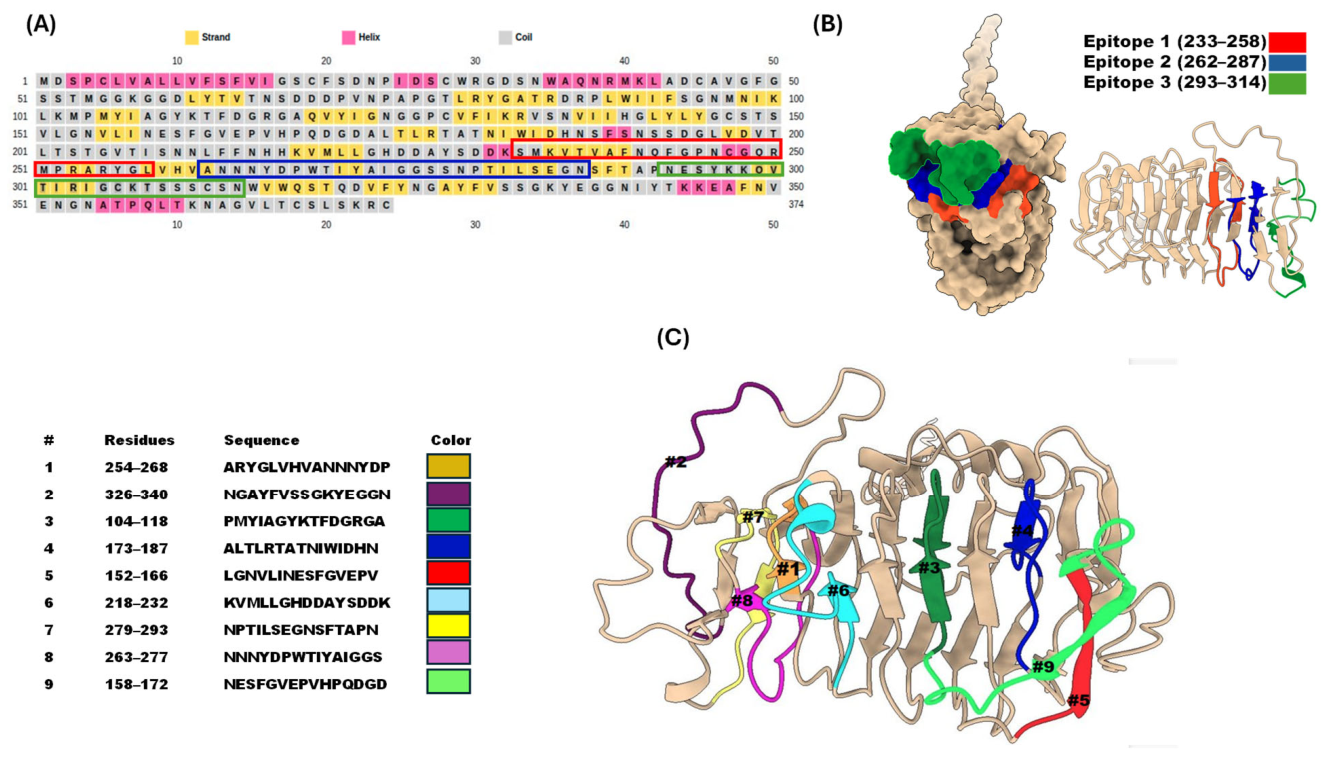
Linear B-cell epitope regions were identified using five independent immunoinformatics tools, and consensus regions were selected based on overlap across techniques (Table 1; full results in Table S1). Three regions were consistently identified, spanning residues 234–257, 268–283, and 293–314. The C-terminal segment (293–314) was detected by all tools and overlaps with experimentally reported IgE-binding epitopes ((296–308) recognized by human IgE from Japanese patients) reported by Midoro-Horiuti et al. [3]. Structural mapping demonstrated that these predicted epitopes are solvent-exposed and spatially clustered on a single face of the protein (Figure 1). Such spatial clustering is a well-recognized structural feature of potent aeroallergens, as the proximity of multiple IgE-binding epitopes promotes efficient B-cell receptor engagement and IgE cross-linking which are key mechanisms underlying allergic activation [34]. Experimental studies by Takagi et al. [35] provide additional support for the antigenic potential of the Cry j 1 C-terminal using overlapping peptide mapping to identify a human IgE-binding epitope NGNATPQLTKNA (331–342) supported by competitive ELISA experiments, while murine studies identified another sequential B-cell epitope within residues 141–160, with a minimal core VHPQDGDA [36]. Although some of these experimentally validated epitopes reported in literature occur outside the major consensus clusters identified here, their presence reinforces the concept that Cry j 1 contains multiple antigenic hotspots distributed across the protein surface. It is important to note that these regions represent linear epitopes only, which constitute a limited fraction of total B-cell epitopes. All identified epitopes are based on in silico methods and should be considered hypothetical pending experimental validation.

3.1.2. Mapping of Putative CD4+ T-Cell Binding Regions

An MHC class II binding prediction technique spanning several HLA alleles was used to identify possible CD4+ T-cell binding epitopes to supplement the structural mapping of B-cell epitopes. Presented in Table S2 and Figure 1C, a number of peptide sequences demonstrated the ability to bind numerous alleles in silico, indicating that Cry j 1 comprises sequence segments that might be identified in various HLA situations. Among these, the peptide that spans residues 254–268 (ARYGLVHVANNNYDP) showed favorable binding scores across all assessed HLA-DR alleles, as did the C-terminal epitopes (327–341). Interestingly, several of these regions such as those in 327–341 and 218–232 overlap with T-cell epitopes that have been experimentally documented [4,37]. Experimental results, however, show that T-cell recognition is dispersed among several protein domains and might not be entirely captured by prediction techniques alone [37]. It is crucial to stress that these findings are not verified T-cell epitopes, but rather in silico identified binding tendencies. Antigen processing, peptide presentation effectiveness, and T-cell receptor recognition, all of which affect actual immunogenicity are not taken into consideration by MHC binding predictions. As a result, the discovered sections are mostly employed as structural reference points to assess the potential differential effects of adsorption on the protein’s surface-exposed and surface-interacting epitopes.
Figure 1. Shows the structural mapping of T-cell and B-cell consensus epitopes on Cry j 1. (A) Mapping Epitope 1 (233–258, red), Epitope 2 (262–287, blue), and Epitope 3 (293–314, green) to the sequence; (B) Mapping the same epitopes to the cry j 1 surface in three dimensions. (C) Using the IEDB-recommended MHC class II prediction approach (15-mer peptides, percentile rank ≤ 10), projected promiscuous CD4+ T-cell epitopes are highlighted in a bottom-view cartoon depiction of the Cry j 1 allergen. A wide epitope-dense interface that may be important for T-cell recognition across several HLA class II alleles is shown when all epitope areas are displayed concurrently and colored differently to demonstrate their accessibility and spatial distribution on a single protein face.
Physchem 06 00029 g001

3.1.3. Convergence of B-Cell and T-Cell Epitopes Defines an Immunogenic Hotspot Relevant to Environmental Interactions

A significant co-localization of B-cell and T-cell epitopes within Cry j 1 was found when B-cell and T-cell epitope predictions were integrated. Interestingly, the experimentally reported B-cell epitope cluster spanning p218–229 (identified by 33.3% of patients) and the immunodominant CD4+ T-cell epitope p218–232 overlap, creating a shared immunogenic hotspot that can support both T-cell activation and antibody recognition [3,4,37]. Furthermore, the B-cell epitope area p293–314 is next to the dominant T-cell epitope p327–341, which elicited responses in 41.7% of patients [37]. This suggests that the C-terminal region may be another site of immunological convergence [3,37]. This kind of spatial convergence of B-cell and T-cell epitopes is known to improve antigen absorption and presentation by antigen-presenting cells and is a well-known characteristic of clinically relevant allergens. In particular, allergen internalization is facilitated by B-cell receptor-mediated binding, which is followed by effective processing and presentation of T-cell epitopes via MHC class II molecules, hence enhancing immune responses specific to allergens. There are significant environmental ramifications to this structural arrangement. The prominent epitope areas form an extended antigenic interface by being both surface exposed and grouped on distinct structural faces. This structure implies that these immunologically active areas may remain partially accessible rather than completely hidden even after adsorption onto environmental components like air particles or microplastics.

3.2. Adsorption of Cry j 1 onto PET Microplastics

We conducted 200 ns all-atom molecular dynamics simulations of the allergen in the presence of a PET slab in order to clarify the molecular mechanism driving Cry j 1 interaction with PET microplastics. For control, a parallel simulation in aqueous solution was used.

3.2.1. Energetic Driving Forces and Anchoring Hotspots of PET Binding

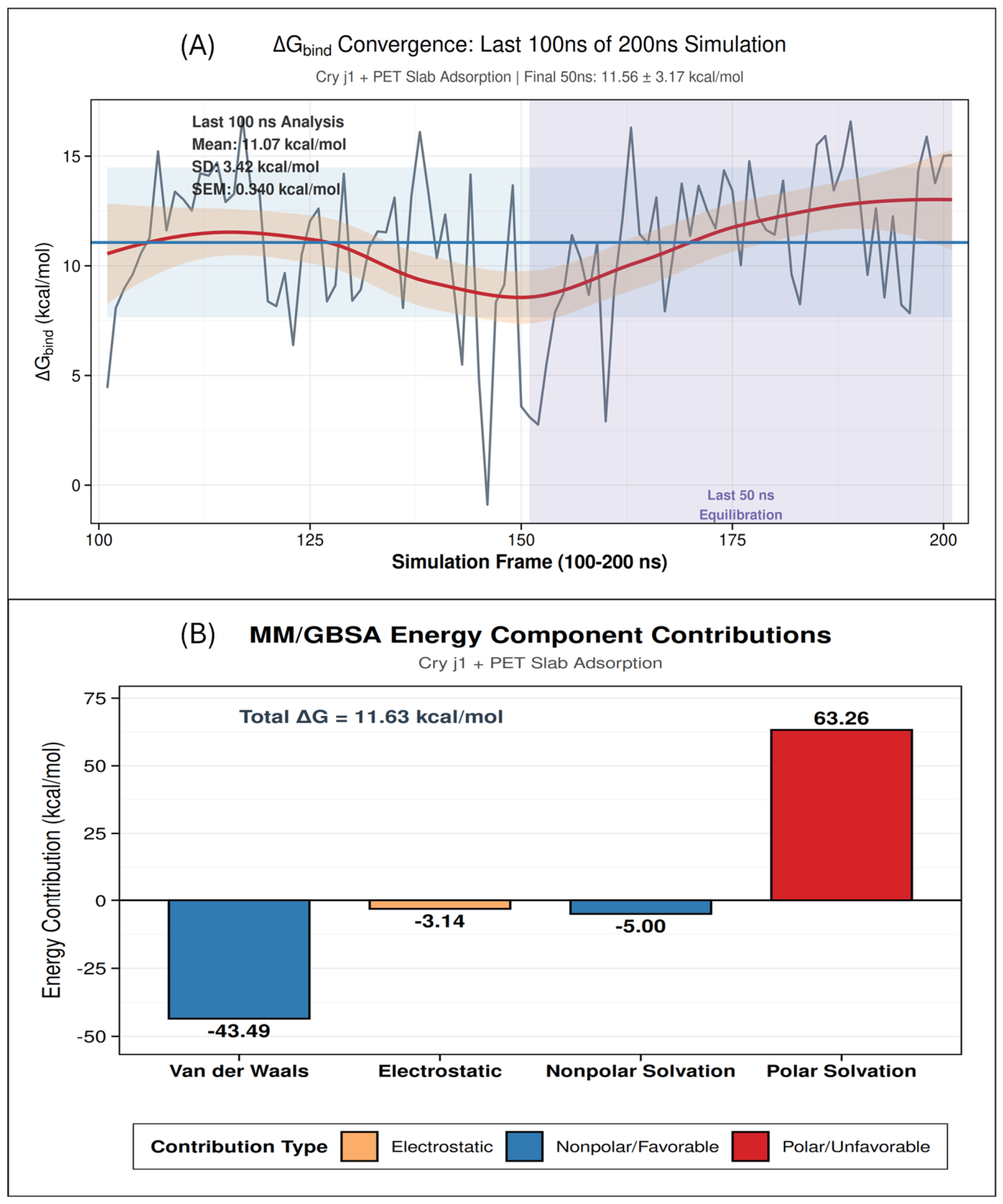
MM/GBSA calculations were carried out on 201 snapshots taken from the last 100 ns of the equilibrated trajectory in order to describe the molecular driving forces controlling Cry j 1 adsorption onto PET (Figure 2A). Early in the simulation, the estimated free energy profile fluctuated, but after around 100 ns, it stabilized. Over the last 50 ns, the mean ΔG value was 11.56 ± 3.17 kcal mol−1 (SEM = 0.34 kcal mol−1), suggesting convergence of the sampled configurations. According to the energy decomposition analysis, adsorption was dominated by van der Waals interactions (ΔEvdw = −43.49 kcal mol−1) (Table S3, Figure 2B), indicating that dispersion forces and hydrophobic surface complementarity are the primary contributors to interfacial association. In contrast, electrostatic interactions contributed minimally (ΔEele = −3.14 kcal mol−1), consistent with the largely nonpolar and chemically inert nature of the PET surface. The favorable nonpolar solvation term (ΔGnonpolar = −5.00 kcal mol−1) further supports a predominantly hydrophobic adsorption mechanism [12,23]. Conversely, the polar solvation term imposed a substantial energetic penalty (ΔGpolar = +63.26 kcal mol−1), reflecting the energetic cost associated with desolvation of polar protein residues upon formation of the protein–polymer interface. The favorable nonbonded interactions are outweighed by this contribution, leading to a net positive ΔG value. Crucially, the positive free energy suggests that, for extended polymer–protein interfaces, MM/GBSA results should be interpreted qualitatively rather than as absolute thermodynamic measurement. In systems where interactions take place across wide, heterogeneous surfaces rather than discrete binding sites, generalized Born models which are mainly parameterized for ligand–receptor systems with clearly defined binding pockets may overestimate desolvation penalties [38,39]. Therefore, rather than definitive binding affinities, the current approach is better interpreted as offering mechanistic insight into interaction trends.
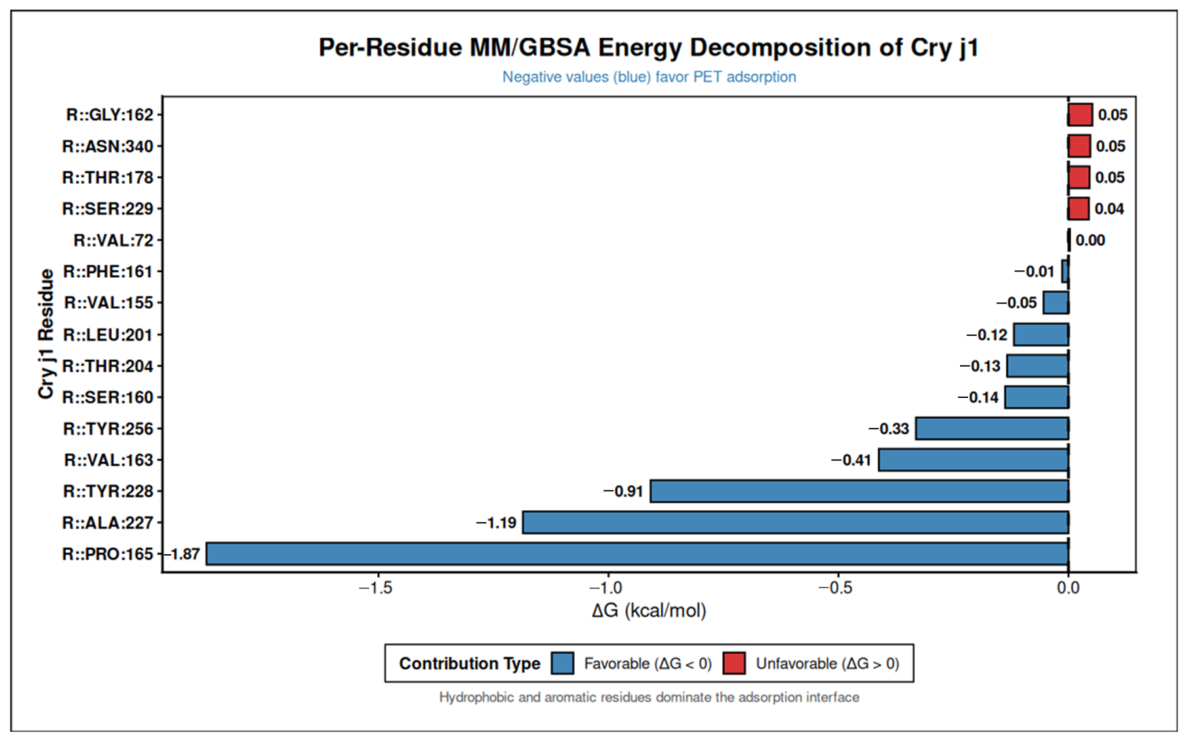
Per-residue energy decomposition was used to better understand the spatial origin of these interactions (Table S4, Figure 3). Only a few numbers of mostly hydrophobic and aromatic residues exhibit favorable contributions. The largest contribution was shown by Pro165 (−1.87 kcal mol−1), followed by Ala227 (−1.19 kcal mol−1), Tyr228 (−0.91 kcal mol−1), and Val163 (−0.41 kcal mol−1). Leu201 (−0.12 kcal mol−1) and Tyr256 (−0.33 kcal mol−1) are additional stabilizing residues. An adsorption mechanism driven by dispersion is supported by the prevalence of hydrophobic residues. The participation of aromatic residues, such as Tyr228 and Tyr256, is also compatible with possible π–π interactions with PET’s terephthalate rings. Conversely, polar residues reinforce the restricted effect of electrostatic interactions by making a negligible or marginally negative contribution. Together, these findings suggest that localized hydrophobic-aromatic patches may facilitate Cry j 1 adsorption, resulting in a spatially heterogeneous interface with distinct anchoring regions as opposed to homogeneous surface engagement.

3.2.2. Differential Engagement of Selected Epitopes

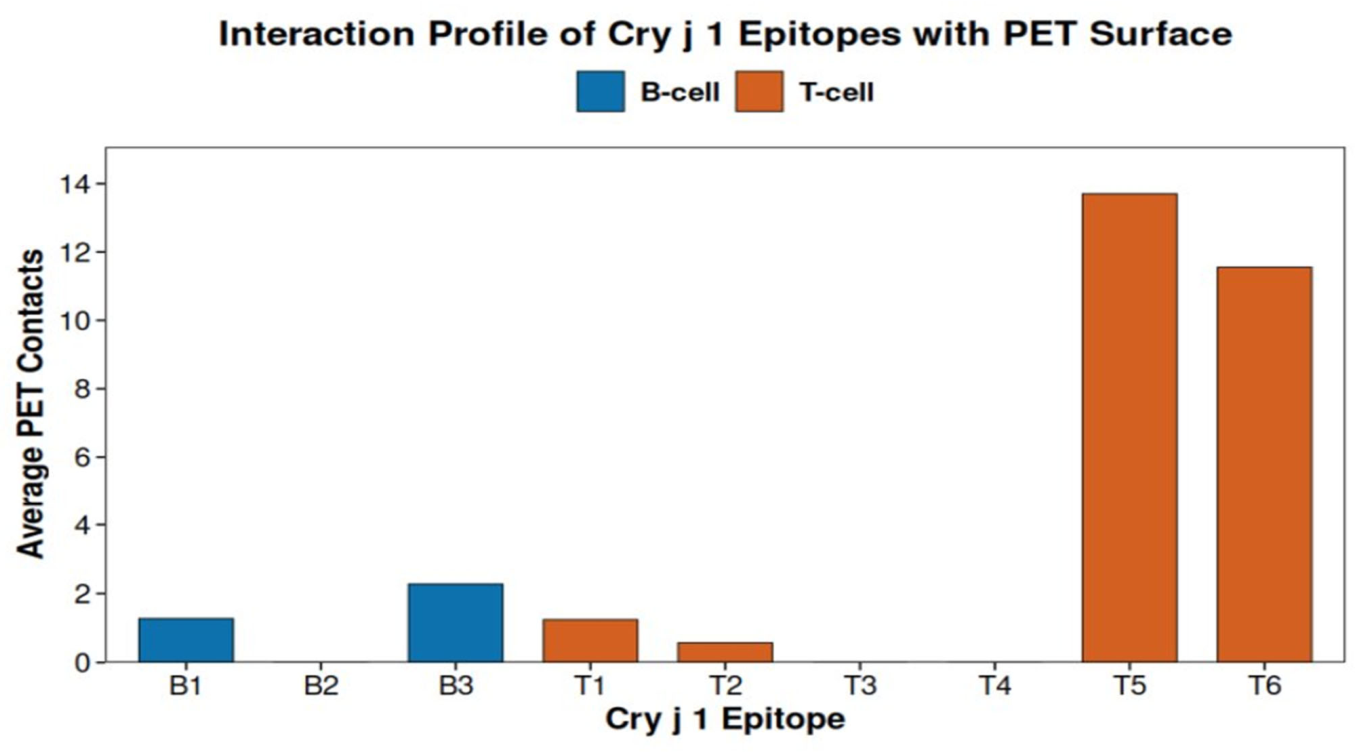
After determining the overall process of adsorption, we investigated whether the immunologically significant portions of Cry j 1 (B-cell and T-cell epitopes) are specifically involved in PET contact. Surface engagement was clearly spatially selective, according to epitope-resolved interaction analysis (Table S5, Figure 4). The three B-cell epitopes (B1–B3) out of the nine epitopes examined exhibited little interaction with the PET surface during the 200 ns simulation. Only modest or fleeting closeness to the polymer was indicated by average contact numbers ranging from 0 to 2.28 and minimum distances between 0.59 and 0.77 nm. These distances indicate limited direct interaction with the surface since they are greater than the usual range (~0.35–0.40 nm) associated with steady van der Waals contact. Water contact studies supported the solvent-exposed character of these regions by showing that they are nonetheless well hydrated (~141–389 water contacts). For the T-cell epitopes, a contrasting pattern was seen. Similar poor interaction characteristics were shown by epitopes T1–T4, with minimum distances larger than 0.60 nm and contact numbers less than 1.3. Epitopes T5 and T6, on the other hand, showed noticeably more interaction with the PET surface. While T6 maintained 11.55 interactions with an average minimum distance of 0.44 nm, epitope T5 had an average of 13.70 contacts and a minimum distance of 0.35 nm, showing sustained closeness to the interface. Only small contributions were revealed by hydrogen bond analysis; measurable interactions were found for T6 at low frequencies (0.21 on average), which is consistent with a mostly non-polar interaction mechanism. These findings suggest that adsorption is spatially selective, with some areas remaining solvent exposed and others serving as anchoring sites [20].

3.2.3. Interfacial Hydration Changes

Protein adsorption usually happens at material boundaries concurrently with the surrounding solvent’s rearrangement. The hydration environment of Cry j 1 upon PET attachment was characterized using three complementary methods: radial distribution functions (RDF), hydration-shell population dynamics, and water mobility using mean square displacement (MSD). Adsorption of Cry j 1 onto PET in the current system was linked to mild protein surface dehydration and decreased interfacial water molecule mobility when compared to the aqueous control (Detail in Supplementary Section S2, Figure S1). The changes demonstrate the formation of a more ordered and limited hydration layer at the protein-polymer interface, which is consistent with bulk water displacement and constrained solvent dynamics near the surface. Such interfacial water structuring has been seen during protein adsorption onto hydrophobic surfaces. These findings imply that PET contact causes localized hydration changes without significantly altering the solvent environment of the protein.

3.3. Structural Response of Cry j 1 to PET Adsorption

In order to examine how the interaction with PET affects the conformational behavior of Cry j 1, global stability, residue-level flexibility, structural compactness, and secondary structure organization were examined.

3.3.1. Global Conformational Stability and Residue-Level Flexibility

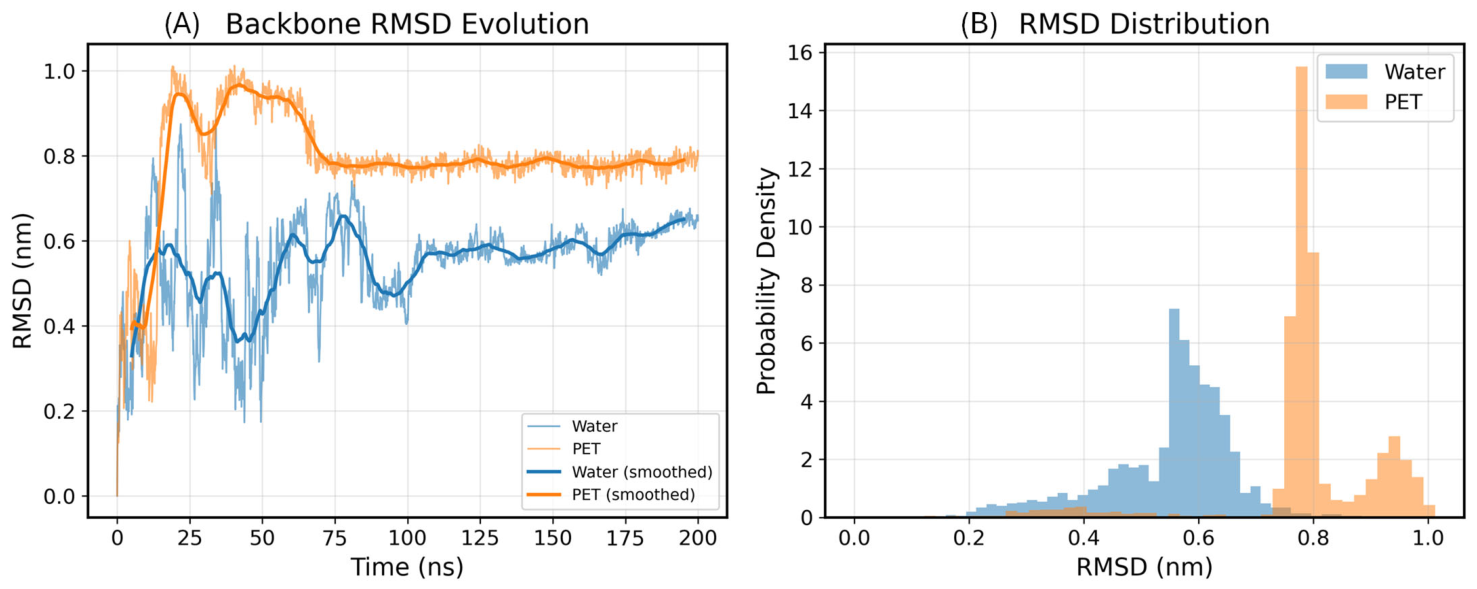
The global structural integrity of Cry j 1 was assessed using backbone RMSD (Figure 5). Cry j 1 in aqueous solution equilibrated in around 30 ns and remained stable, with a mean RMSD of 0.60 ± 0.06 nm. Conversely, the PET-associated system showed a shift in conformational sampling compared to the aqueous system, stabilizing at a greater mean RMSD of 0.79 ± 0.05 nm and requiring a longer equilibrium duration (~60 ns) (Figure 5A). This result was supported by RMSD distributions (Figure 5B). The aqueous system displayed a limited unimodal distribution, consistent with confinement to a single dominant conformational basin, but the PET-associated system displayed a wider and right-shifted distribution, indicating a higher sampling of many conformations. These results are consistent with adaptive structural rearrangement rather than instability, suggesting that PET contact may change the conformational landscape of Cry j 1 without exhibiting global unfolding. This pattern is consistent with earlier molecular dynamics studies of protein adsorption on polymer surfaces, which have demonstrated that a common reaction to hydrophobic interfaces is conformational adaptation rather than catastrophic disintegration. Das Sarkar et al. [40] demonstrated that proteins undergoing environmental perturbation exhibit altered RMSD profiles while retaining their global fold, supporting our interpretation that the observed changes represent adaptive remodeling rather than destabilization.
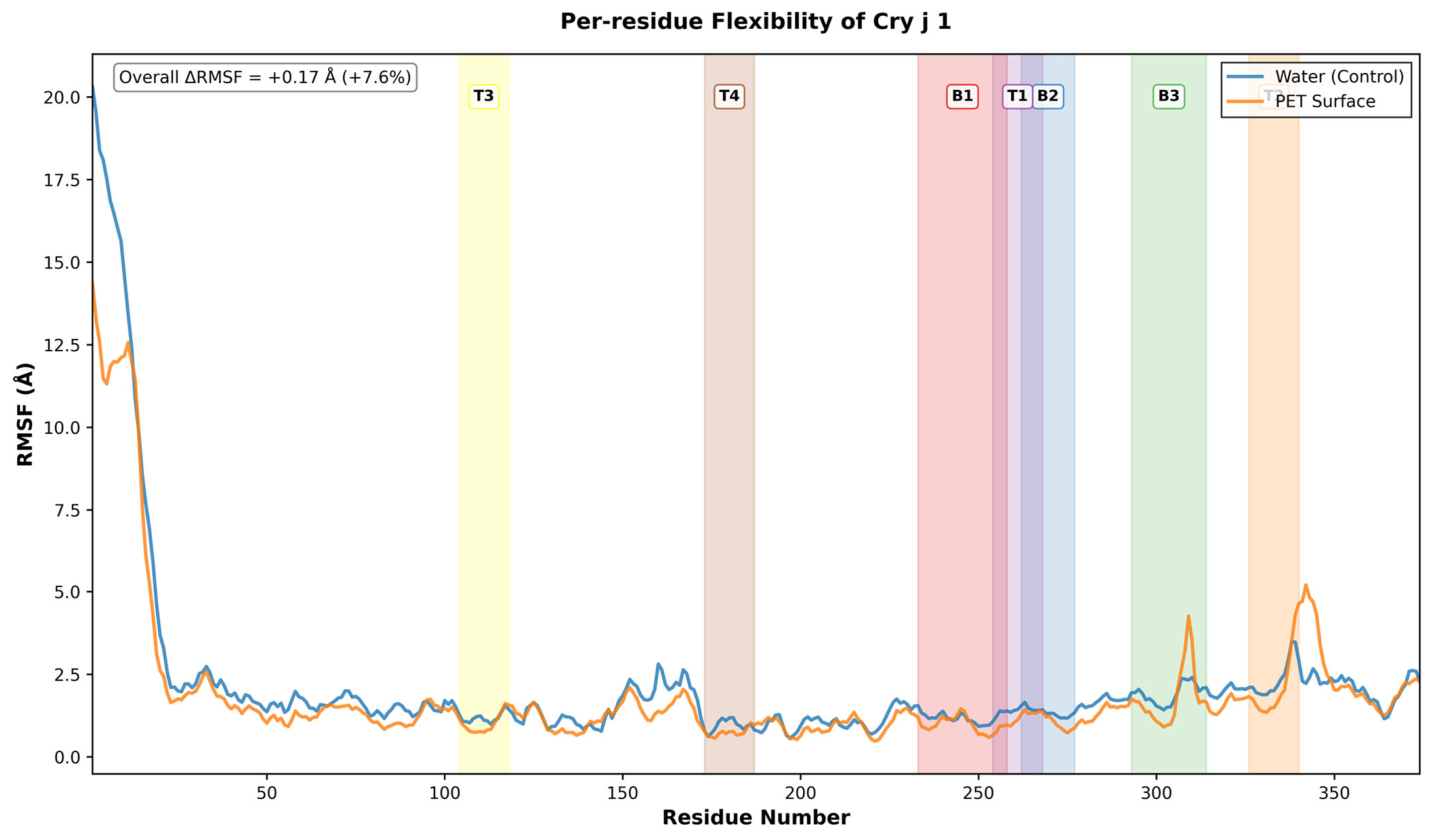
To determine whether this enhanced conformational variation is the consequence of global instability or localized structural changes, residue-level flexibility was evaluated using RMSF analysis (Figure 6). With most residues having RMSF values less than 0.25 Å, Cry j 1 exhibited relatively uniform back-bone fluctuations in aqueous solution, which is consistent with a stable globular protein. The RMSF profile revealed region-specific dynamic remodeling following PET adsorption, as opposed to uniform disintegration (Figure 6). When compared to the aqueous control, a number of adjacent segments had different fluctuations, suggesting localized structural disturbances related to adsorption. Differential RMSF analysis (ΔRMSF = PET − water) revealed that the sequence was dominated by negative values, indicating that residue mobility was significantly reduced after adsorption (Figure S2A). The striking coincidence of minima in the ΔRMSF profile with predicted B-cell and T-cell epitope sites indicates that PET contact selectively stabilizes immunologically significant sections. The average RMSF values among epitope regions provided additional insight into this pattern (Figure S2B,C). For the two primary B-cell epitopes, RMSF dropped by around 17% and 25%, respectively. Mobility decreased by up to 30% in T4, T5, and T6, and all T-cell epitopes demonstrated comparable decreases. Slight localized increases in fluctuations were observed next to the T6 region; this suggests compensatory structural rearrangements rather than extensive instability.
This notable reduction in flexibility within anticipated B-cell and T-cell epitopes may incite important functional implications. Biner et al. [41] has shown that protein flexibility plays a critical role in B-cell epitope recognition and that methods based on flexibility outperform solvent accessibility measurements in identifying immunogenic regions. Their study showed that the conformational flexibility of antigenic loops enables optimal complementarity between the antigen surface and antibody paratopes. The observed 17–25% decrease in RMSF inside B-cell epitopes suggests that PET adsorption may restrict the conformational plasticity required for efficient IgE binding. Furthermore, Bush and Knotts [42] showed that antigen flexibility significantly influences Fab-antigen binding near solid surfaces, with reduced molecular mobility hindering recognition kinetics. Similarly, the suppression of fluctuations across many CD4 T-cell epitopes suggests altered dynamics in regions involved in antigen processing, since reduced flexibility can impact proteolytic cleavage and peptide presentation through MHC-II molecules. When considered collectively, these results imply that by dispersing conformational dynamics over the protein surface, adsorption results in localized rigidification of immunologically important regions rather than uniform instability. Therefore, rather than concealing epitopes, PET microplastics may influence allergenic potential by changing the structural dynamics of immunologically important allergen regions.

3.3.2. Structural Compactness and Solvent Exposure

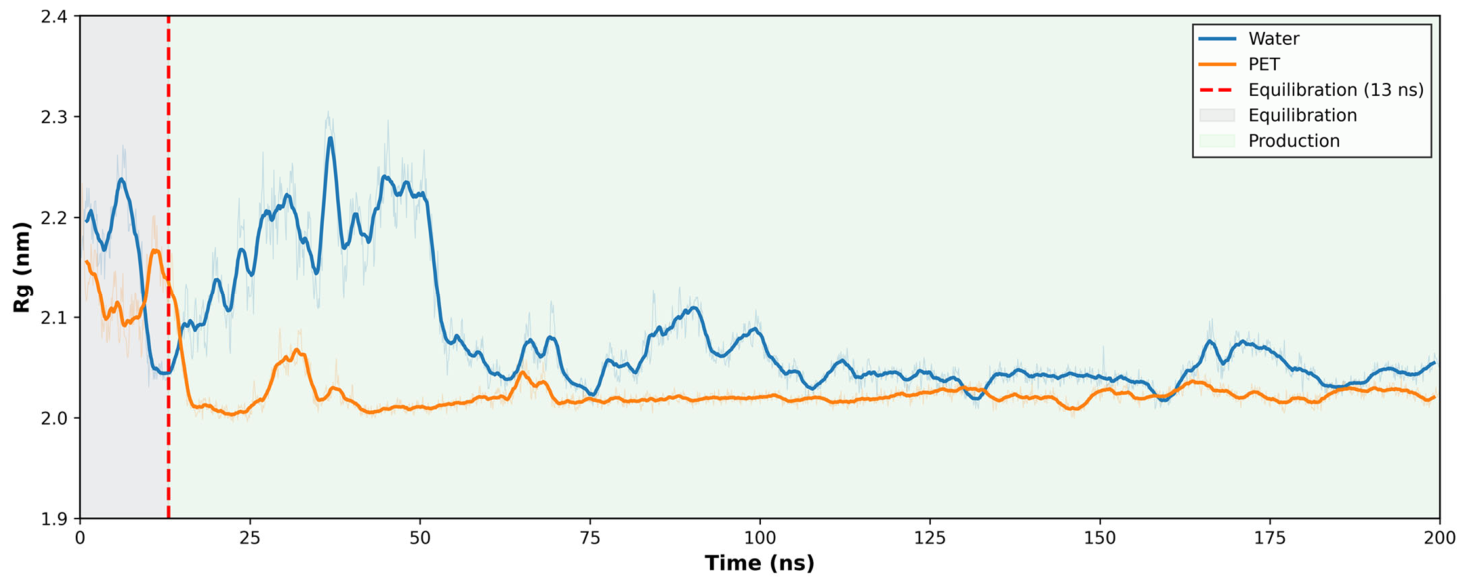
To ascertain whether PET adsorption alters global protein packing, the solvent-accessible surface area (SASA) and radius of gyration (Rg) of Cry j 1 were employed (Supplementary Section S3, Figure 7). Both measurements show small reductions upon adsorption when compared to the aqueous system, indicating a little decrease in overall dimensions and solvent exposure. However, the minimal magnitude of these changes suggests that there isn’t much compaction or unfolding. Subsequent analysis of epitope regions shows that solvent exposure is consistent, with just minor variations across B-cell and T-cell regions (Supplementary Section S4). These results support the epitope interaction results (Section 3.2) by demonstrating that antigenic regions remain accessible despite surface association.

3.3.3. Secondary Structure Remodeling

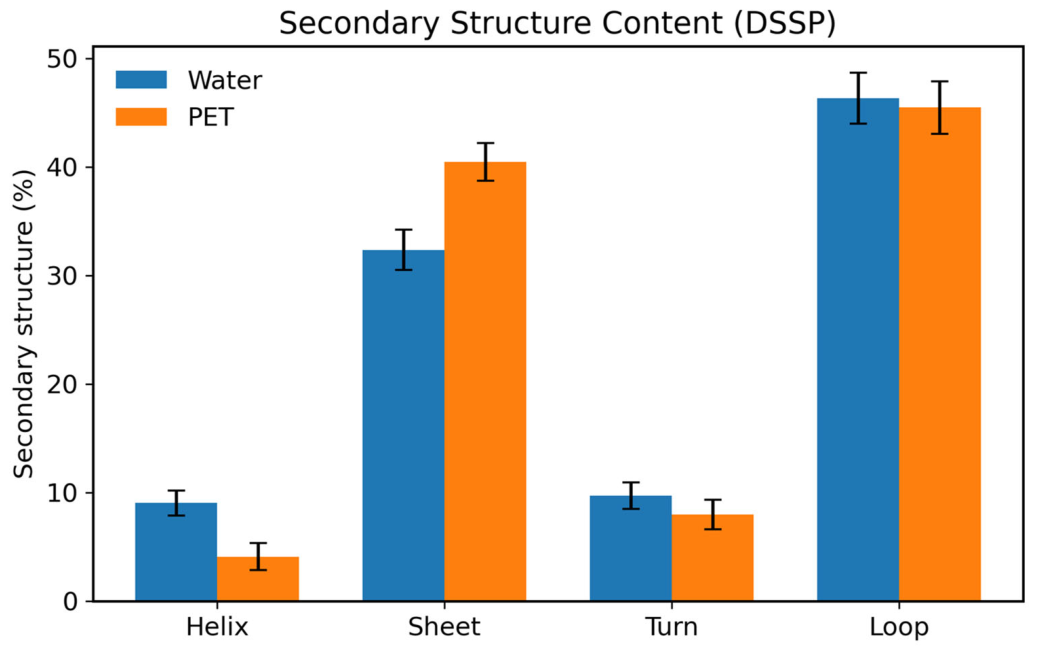
Secondary structure composition was evaluated using DSSP in order to ascertain whether PET adsorption alters the folding properties of Cry j 1 (Supplementary Section S5, Figure 8). The distribution of secondary structures is altered by adsorption, as evidenced by an increase in β-sheet content and a decrease in α-helical content relative to the aqueous system. There aren’t many adjustments to turn and loop content. The RMSD and Rg studies come to the conclusion that, in spite of these differences, the total amount of structural change is still modest and consistent with local conformational adjustment rather than global unfolding. When considered collectively, these findings imply that partial redistribution of secondary structure elements occurs in conjunction with PET association, indicating adaptation to the interfacial environment rather than extensive structural damage [43]. Additional analyses of correlated motions and conformational sampling (DCCM, PCA, FEL) revealed modest reductions in dynamic coupling and conformational space upon PET association (Supplementary Section S5), but these effects were secondary to the structural and interfacial features described above.

4. Conclusions

In this study, we used all-atom molecular dynamics simulations to examine how the major aeroallergen Cry j 1 interacts with a model PET microplastic surface. The results demonstrate that hydrophobic and van der Waals interactions are the primary forces behind adsorption, with local contributions from residues such as Pro165, Ala227, Tyr228, and Val163. This method is compatible with adsorption occurring through spatially chosen contacts rather than uniform surface binding. Analysis of epitope areas revealed that most of the linear B-cell epitopes under examination are still solvent exposed; however, some regions that belong to T-cell epitopes, namely T5 and T6, showed increased surface contact and may function as anchoring sites. These results suggest that adsorption is spatially selective, with some protein segments engaging at the interface while others remain solvent-accessible. PET contact was accompanied at the structural level by minor changes in protein structure, such as minor reductions in residue-level flexibility and minor modifications in global compactness, without any sign of broad unfolding. Importantly, alterations in the solvent accessibility of epitope regions were minimal, indicating that adsorption does not block these surfaces under the conditions investigated. Together, our findings provide a chemical explanation for the interaction between Cry j 1 and PET-like surfaces, highlighting a mechanism based on spatially selective adsorption and hydrophobic association. However, all epitope identifications and structural interpretations rely on in silico analysis, thus this work is limited to linear epitope representations. Therefore, any effects on allergy behavior are hypothetical and require experimental verification. From an environmental standpoint, our findings imply that adsorption to microplastic surfaces can take place without totally losing the structural characteristics linked to antigen exposure. To find out if such interactions affect IgE binding, antigen processing, or immune responses in physiological settings, experimental research will be needed.

Supplementary Materials

The following supporting information can be downloaded at: https://www.mdpi.com/article/10.3390/physchem6020029/s1 [44,45]. Table S1: Linear B-cell epitope selections for the Cry j 1 allergen generated using five immunoinformatics algorithms; Table S2: Promiscuous CD4+ T-cell epitope selections of Cry j 1 across multiple HLA class II alleles identified using the IEDB-recommended TepiTool pipeline.; Table S3: Molecular mechanics generalized Born surface area (MMGBSA) energy components describing Cry j 1 adsorption onto PET microplastics averaged over the final 100 ns of simulation; Table S4: Per-residue MMGBSA decomposition highlighting the dominant Cry j 1 residues contributing to PET adsorption and interfacial stabilization; Table S5: Quantitative interaction metrics describing the association of Cry j 1 epitopes with the PET surface during the molecular dynamics simulation; Figure S1: Hydration behavior of Cry j 1 in aqueous and PET-bound systems, including radial distribution functions (RDF), hydration-shell population analysis, and mean square displacement (MSD) of hydration water molecules; Figure S2: Residue-level flexibility and epitope dynamics of Cry j 1 in water and PET-bound systems, including differential RMSF profiles and epitope-specific flexibility changes upon adsorption; Table S6: Radius of gyration statistics for Cry j 1 in aqueous and PET-associated systems, including mean values, structural variability, statistical comparisons, and effect-size analysis; Table S7: Time-window analysis of radius of gyration during Cry j 1 simulations; Figure S3: Structural compactness analysis of Cry j 1 showing probability density distributions of radius of gyration values for aqueous and PET-bound simulations; Table S8: Global solvent-accessible surface area (SASA) statistics for Cry j 1 in aqueous and PET-bound systems; Figure S4: Solvent-accessible surface area (SASA) analysis of Cry j 1 for aqueous and PET-bound systems; Table S9: Epitope-specific solvent-accessible surface area of Cry j 1 in water and PET-bound systems averaged over the equilibrated simulation interval; Figure S5: Effect of PET adsorption on epitope solvent accessibility and SASA distributions for selected B-cell and CD4+ T-cell epitopes; Table S10: Secondary structure composition of Cry j 1 during molecular dynamics simulations in aqueous solution and upon PET adsorption; Table S11: Effect-size analysis of PET-induced secondary structure changes in Cry j 1 using Cohen’s d values; Table S12: Quantitative comparison of residue-level dynamic correlations between aqueous and PET-bound systems derived from dynamic cross-correlation matrix (DCCM) analysis; Figure S6: Dynamic cross-correlation matrix (DCCM) analysis comparing correlated residue motions in aqueous and PET-bound systems, including differential correlation mapping (ΔDCCM); Figure S7: Principal component analysis (PCA) of Cry j 1 conformational dynamics showing variance contributions and cumulative variance profiles for aqueous and PET-bound systems; Figure S8: Free-energy landscapes projected onto PC1–PC2 conformational space for aqueous and PET-bound systems, illustrating adsorption-induced restriction of conformational sampling; Table S13: Quantitative comparison of conformational landscapes between aqueous and PET systems, including convex hull area, conformational sampling reduction, and low-energy basin analysis.

Author Contributions

T.O.M.: conceptualization, methodology, data curation, formal analysis, software, validation, writing-original draft. Q.W.: supervision, funding acquisition, project administration, writing-review and editing. C.E.E.: review and editing. All authors have read and agreed to the published version of the manuscript.

Funding

This study was partially supported by the Grant-in-Aid for Scientific Research (KAKENHI), including Special Funds for Innovative Area Research and Basic Research (Category B), provided by the Ministry of Education, Culture, Sports, Science and Technology (MEXT), Japan. The funding was awarded under grant numbers 22H03747 (FY2022-FY2024), 24K20941 (FY2024-FY2026), and 25K03267 (FY2025-FY2028). We also thank the Comprehensive Analysis Center for Science, Saitama University, for allowing us to conduct some analyses and providing insight and expertise that greatly assisted the research.

Data Availability Statement

The data used in this research are included within the manuscript and Supplementary File; further information can be provided upon request.

Conflicts of Interest

The authors declare no conflicts of interest.

References

  1. Pawankar, R.; Wang, J.-Y.; Wang, I.-J.; Thien, F.; Chang, Y.-S.; Latiff, A.H.A.; Fujisawa, T.; Zhang, L.; Thong, B.Y.-H.; Chatchatee, P.; et al. Asia Pacific Association of Allergy Asthma and Clinical Immunology White Paper 2020 on Climate Change, Air Pollution, and Biodiversity in Asia-Pacific and Impact on Allergic Diseases. Asia Pac. Allergy 2020, 10, e11. [Google Scholar] [CrossRef]
  2. Takahashi, Y. Current State of Japanese Cedar (Cryptomeria Japonica D. Don) Pollen Information and Future Directions for Its Airborne Allergen Determination and Improved Pollen Monitoring. Aerobiology 2024, 2, 1–17. [Google Scholar] [CrossRef]
  3. Midoro-Horiuti, T.; Schein, C.H.; Mathura, V.; Braun, W.; Czerwinski, E.W.; Togawa, A.; Kondo, Y.; Oka, T.; Watanabe, M.; Goldblum, R.M. Structural Basis for Epitope Sharing between Group 1 Allergens of Cedar Pollen. Mol. Immunol. 2006, 43, 509–518. [Google Scholar] [CrossRef][Green Version]
  4. Sone, T.; Morikubo, K.; Miyahara, M.; Komiyama, N.; Shimizu, K.; Tsunoo, H.; Kino, K. T Cell Epitopes in Japanese Cedar (Cryptomeria Japonica) Pollen Allergens: Choice of Major T Cell Epitopes in Cry j 1 and Cry j 2 toward Design of the Peptide-Based Immunotherapeutics for the Management of Japanese Cedar Pollinosis. J. Immunol. 1998, 161, 448–457. [Google Scholar] [CrossRef] [PubMed]
  5. Kusano, S.; Ueda, S.; Oryoji, D.; Toyoumi, A.; Hashimoto-Tane, A.; Kishi, H.; Hamana, H.; Muraguchi, A.; Jin, H.; Arase, H.; et al. Contributions of the N-Terminal Flanking Residues of an Antigenic Peptide from the Japanese Cedar Pollen Allergen Cry j 1 to the T-Cell Activation by HLA-DP5. Int. Immunol. 2023, 35, 447–458. [Google Scholar] [CrossRef]
  6. Saha, S.; Raghava, G.P.S. Prediction of Continuous B-cell Epitopes in an Antigen Using Recurrent Neural Network. Proteins 2006, 65, 40–48. [Google Scholar] [CrossRef]
  7. Saha, S.; Raghava, G.P.S. BcePred: Prediction of Continuous B-Cell Epitopes in Antigenic Sequences Using Physico-Chemical Properties. In Artificial Immune Systems; Nicosia, G., Cutello, V., Bentley, P.J., Timmis, J., Eds.; Lecture Notes in Computer Science; Springer: Berlin, Heidelberg, 2004; Volume 3239, pp. 197–204. ISBN 978-3-540-23097-7. [Google Scholar]
  8. Wang, P.; Sidney, J.; Dow, C.; Mothé, B.; Sette, A.; Peters, B. A Systematic Assessment of MHC Class II Peptide Binding Predictions and Evaluation of a Consensus Approach. PLoS Comput. Biol. 2008, 4, e1000048. [Google Scholar] [CrossRef]
  9. Kumar, N.; Bajiya, N.; Patiyal, S.; Raghava, G.P.S. Multi-perspectives and Challenges in Identifying B-cell Epitopes. Protein Sci. 2023, 32, e4785. [Google Scholar] [CrossRef] [PubMed]
  10. EL-Manzalawy, Y.; Dobbs, D.; Honavar, V. Predicting Linear B-cell Epitopes Using String Kernels. J. Mol. Recognit. 2008, 21, 243–255. [Google Scholar] [CrossRef] [PubMed]
  11. Enyoh, C.E.; Wang, Q.; Ovuoraye, P.E.; Maduka, T.O. Toxicity Evaluation of Microplastics to Aquatic Organisms through Molecular Simulations and Fractional Factorial Designs. Chemosphere 2022, 308, 136342. [Google Scholar] [CrossRef]
  12. Maduka, T.O.; Wang, Q.; Enyoh, C.E.; Suzuki, M.; Wang, W.; Rana, M.S. Polyethylene Terephthalate Micro/Nano-Plastics Induce Structural and Conformational Changes in Cedar Pollen Proteins: Spectroscopic and Molecular Dynamics Evidence. Appl. Sci. 2026, 16, 1577. [Google Scholar] [CrossRef]
  13. Hou, G.; Hu, W.; Zhao, J.; Lu, J.; Zhang, W.; Liu, X.; Lu, S.; Shinichi, Y.; Ebere, E.C.; Wang, Q.; et al. Studies on Adsorption and Synergistic Biological Effects Induced by Microplastic Particles and the Platanus Pollen Allergenic Protein 3(Pla A3). Environ. Pollut. 2025, 373, 126149. [Google Scholar] [CrossRef]
  14. Gligorijevic, N.; Lujic, T.; Mutic, T.; Vasovic, T.; De Guzman, M.K.; Acimovic, J.; Stanic-Vucinic, D.; Cirkovic Velickovic, T. Ovalbumin Interaction with Polystyrene and Polyethylene Terephthalate Microplastics Alters Its Structural Properties. Int. J. Biol. Macromol. 2024, 267, 131564. [Google Scholar] [CrossRef] [PubMed]
  15. Placci, A.; Fadda, M.; Coralli, I.; Wang, J.; Zattoni, A.; Costa, A.L.; Portela, R.; Giovannozzi, A.M.; Fabbri, D.; Melucci, D.; et al. Multitechnique Characterization of Eco-Corona Formation on Airborne Nanoplastics. RSC Adv. 2025, 15, 30849–30864. [Google Scholar] [CrossRef]
  16. Latour, R.A. Molecular Simulation of Protein-Surface Interactions: Benefits, Problems, Solutions, and Future Directions. Biointerphases 2008, 3, FC2–FC12. [Google Scholar] [CrossRef] [PubMed]
  17. Rabe, M.; Verdes, D.; Seeger, S. Understanding Cooperative Protein Adsorption Events at the Microscopic Scale: A Comparison between Experimental Data and Monte Carlo Simulations. J. Phys. Chem. B 2010, 114, 5862–5869. [Google Scholar] [CrossRef] [PubMed]
  18. Wei, Q.; Becherer, T.; Angioletti-Uberti, S.; Dzubiella, J.; Wischke, C.; Neffe, A.T.; Lendlein, A.; Ballauff, M.; Haag, R. Protein Interactions with Polymer Coatings and Biomaterials. Angew. Chem. Int. Ed. 2014, 53, 8004–8031. [Google Scholar] [CrossRef]
  19. Gerasimovich, E.; Karaulov, A.; Nabiev, I.; Sukhanova, A. Protein Adsorption on Nano- and Microparticles: Dependence on Morphological and Physicochemical Properties of Particles and Effect on Particle–Cell Interactions. Nanomaterials 2025, 15, 1013. [Google Scholar] [CrossRef]
  20. Johnson, L.; Aglas, L.; Soh, W.T.; Geppert, M.; Hofer, S.; Hofstätter, N.; Briza, P.; Ferreira, F.; Weiss, R.; Brandstetter, H.; et al. Structural Alterations of Antigens at the Material Interface: An Early Decision Toolbox Facilitating Safe-by-Design Nanovaccine Development. Int. J. Mol. Sci. 2021, 22, 10895. [Google Scholar] [CrossRef]
  21. Galata, A.A.; Kröger, M. Globular Proteins and Where to Find Them within a Polymer Brush—A Case Study. Polymers 2023, 15, 2407. [Google Scholar] [CrossRef]
  22. Polêto, M.D.; Lemkul, J.A. Structural and Electronic Properties of Poly(Ethylene Terephthalate) (PET) from Polarizable Molecular Dynamics Simulations. Macromolecules 2025, 58, 403–414. [Google Scholar] [CrossRef]
  23. Sahihi, M.; Fayon, P.; Nauton, L.; Goujon, F.; Devémy, J.; Dequidt, A.; Hauret, P.; Malfreyt, P. Probing Enzymatic PET Degradation: Molecular Dynamics Analysis of Cutinase Adsorption and Stability. J. Chem. Inf. Model. 2024, 64, 4112–4120. [Google Scholar] [CrossRef]
  24. Yao, B.; Zheng, D.; Liang, S.; Zhang, C. SVMTriP: A Method to Predict B-Cell Linear Antigenic Epitopes. In Immunoinformatics; Tomar, N., Ed.; Methods in Molecular Biology; Springer: New York, NY, USA, 2020; Volume 2131, pp. 299–307. ISBN 978-1-0716-0388-8. [Google Scholar]
  25. Chen, J.; Liu, H.; Yang, J.; Chou, K.-C. Prediction of Linear B-Cell Epitopes Using Amino Acid Pair Antigenicity Scale. Amino Acids 2007, 33, 423–428. [Google Scholar] [CrossRef] [PubMed]
  26. Gomez-Perosanz, M.; Ras-Carmona, A.; Reche, P.A. PCPS: A Web Server to Predict Proteasomal Cleavage Sites. In Immunoinformatics; Tomar, N., Ed.; Methods in Molecular Biology; Springer US: New York, NY, USA, 2020; Volume 2131, pp. 399–406. ISBN 978-1-0716-0388-8. [Google Scholar]
  27. Paul, S.; Sidney, J.; Sette, A.; Peters, B. TepiTool: A Pipeline for Computational Prediction of T Cell Epitope Candidates. Curr. Protoc. Immunol. 2016, 114, 18.19.1–18.19.24. [Google Scholar] [CrossRef]
  28. Wang, P.; Sidney, J.; Kim, Y.; Sette, A.; Lund, O.; Nielsen, M.; Peters, B. Peptide Binding Predictions for HLA DR, DP and DQ Molecules. BMC Bioinform. 2010, 11, 568. [Google Scholar] [CrossRef]
  29. Meng, E.C.; Goddard, T.D.; Pettersen, E.F.; Couch, G.S.; Pearson, Z.J.; Morris, J.H.; Ferrin, T.E. UCSF ChimeraX: Tools for Structure Building and Analysis. Protein Sci. 2023, 32, e4792. [Google Scholar] [CrossRef]
  30. Negi, S.S.; Schein, C.H.; Braun, W. The Updated Structural Database of Allergenic Proteins (SDAP 2.0) Provides 3D Models for Allergens and Incorporated Bioinformatics Tools. J. Allergy Clin. Immunol. Glob. 2023, 2, 100162. [Google Scholar] [CrossRef]
  31. Fu, L.; Wang, J.; Ni, S.; Wang, C.; Wang, Y. Identification of Allergenic Epitopes and Critical Amino Acids of Major Allergens in Chinese Shrimp (Penaeus chinensis) by Immunoinformatics Coupled with Competitive-Binding Strategy. J. Agric. Food Chem. 2018, 66, 2944–2953. [Google Scholar] [CrossRef]
  32. Huang, L.; Shao, Y.; Li, X.; Li, H.; Liu, Y.; Zhu, G. Designing Multi-Epitope Diagnosis of Gal d 5 and Gal d 6 Based on Immunoinformatics Approaches Against Egg Yolk Allergy. Int. J. Pept. Res. Ther. 2021, 27, 1577–1588. [Google Scholar] [CrossRef]
  33. Wang, T.; Zhang, L.; Raghavan, V.; Liu, Y.; Wang, J. Analysis of Epitopes and Structural Responses in Egg Allergen Gal d 1 Using Bioinformatic Tools and Molecular Dynamics Simulation. Curr. Res. Food Sci. 2025, 10, 101048. [Google Scholar] [CrossRef] [PubMed]
  34. Mitropoulou, A.N.; Bowen, H.; Dodev, T.S.; Davies, A.M.; Bax, H.J.; Beavil, R.L.; Beavil, A.J.; Gould, H.J.; James, L.K.; Sutton, B.J. Structure of a Patient-Derived Antibody in Complex with Allergen Reveals Simultaneous Conventional and Superantigen-like Recognition. Proc. Natl. Acad. Sci. USA 2018, 115, E8707–E8716. [Google Scholar] [CrossRef]
  35. Takagi, K.; Teshima, R.; Sawada, J. Determination of Human Linear IgE Epitopes of Japanese Cedar Allergen Cry j 1. Biol. Pharm. Bull. 2005, 28, 1496–1499. [Google Scholar] [CrossRef][Green Version]
  36. Tamura, Y.; Sasaki, R.; Inouye, S.; Kawaguchi, J.; Serizawa, N.; Toda, M.; Takemori, T.; Sakaguchi, M. Identification of a Sequential B-Cell Epitope on Major Allergen (Cry j 1) of Japanese Cedar (Cryptomeria japonica) Pollen in Mice. Int. Arch. Allergy Immunol. 2000, 123, 228–235. [Google Scholar] [CrossRef]
  37. Masuyama, K.; Chikamatsu, K.; Ikagawa, S.; Matsuoka, T.; Takahashi, G.; Yamamoto, T.; Endo, S. Analysis of Helper T Cell Responses to Cry j 1-Derived Peptides in Patients with Nasal Allergy: Candidate for Peptide-Based Immunotherapy of Japanese Cedar Pollinosis. Allergol. Int. 2009, 58, 63–70. [Google Scholar] [CrossRef]
  38. Li, Y.; Cong, Y.; Feng, G.; Zhong, S.; Zhang, J.Z.H.; Sun, H.; Duan, L. The Impact of Interior Dielectric Constant and Entropic Change on HIV-1 Complex Binding Free Energy Prediction. Struct. Dyn. 2018, 5, 064101. [Google Scholar] [CrossRef]
  39. Tuccinardi, T. What Is the Current Value of MM/PBSA and MM/GBSA Methods in Drug Discovery? Expert. Opin. Drug Discov. 2021, 16, 1233–1237. [Google Scholar] [CrossRef]
  40. Sarkar, I.D.; Sil, A.; Guchhait, B.; Das, S. Hydrogen-Bond Induced Non-Linear Size Dependence of Lysozyme under the Influence of Aqueous Glyceline. J. Chem. Phys. 2025, 162, 114506. [Google Scholar] [CrossRef]
  41. Biner, D.W.; Grosch, J.S.; Ortoleva, P.J. B-Cell Epitope Discovery: The First Protein Flexibility-Based Algorithm–Zika Virus Conserved Epitope Demonstration. PLoS ONE 2023, 18, e0262321. [Google Scholar] [CrossRef] [PubMed]
  42. Bush, D.B.; Knotts, T.A. The Effects of Antigen Size, Binding Site Valency, and Flexibility on Fab-Antigen Binding near Solid Surfaces. J. Chem. Phys. 2018, 149, 165102. [Google Scholar] [CrossRef] [PubMed]
  43. Czeslik, C.; Wittemann, A. Adsorption Mechanism, Secondary Structure and Local Distribution of Proteins at Polyelectrolyte Brushes. Colloid. Polym. Sci. 2020, 298, 775–789. [Google Scholar] [CrossRef]
  44. Tanaka, M.; Morita, S.; Hayashi, T. Interfacial Water States and the Biocompatibility of Biomaterials: The Role of Intermediate Water. Polym. J. 2026, 58, 343–356. [Google Scholar] [CrossRef]
  45. Ikemoto, Y.; Harada, Y.; Tanaka, M.; Nishimura, S.; Murakami, D.; Kurahashi, N.; Moriwaki, T.; Yamazoe, K.; Washizu, H.; Ishii, Y.; et al. Infrared Spectra and Hydrogen-Bond Configurations of Water Molecules at the Interface of Water-Insoluble Polymers under Humidified Conditions. J. Phys. Chem. B 2022, 126, 4143–4151. [Google Scholar] [CrossRef] [PubMed]
Figure 2. (A) Time evolution of MMGBSA binding free energy (ΔGbinding) for Cry j1 adsorption onto PET over the last 100 ns of the 200 ns simulation. The gray trace represents the instantaneous ΔGbinding values calculated for individual trajectory snapshots, while the red LOESS smoothing curve highlights the overall energetic trend and convergence behavior. The blue horizontal line indicates the mean binding free energy, and the shaded regions represent the statistical variability and equilibrated sampling window used for the final MM/GBSA analysis. (B) MMGBSA energy components contributions. Negative values indicate favorable contributions to PET adsorption.
Physchem 06 00029 g002
Figure 3. Per-residue MMGBSA energy decomposition of Cry j1. Negative values indicate favorable contributions to PET adsorption. Hydrophobic and aromatic residues dominate the adsorption interface.
Physchem 06 00029 g003
Figure 4. Epitope-resolved interaction profile between Cry j1 and the PET surface obtained from the molecular dynamics simulation. The average number of PET contacts for each epitope is shown, highlighting selective adsorption at specific regions of the allergen.
Physchem 06 00029 g004
Figure 5. Global conformational stability of Cry j 1 in aqueous solution and upon PET adsorption. (A) Time evolution of backbone RMSD during 200 ns MD simulations. Solid lines represent smoothed trajectories. (B) Probability density distributions of RMSD values over the equilibrated phase.
Physchem 06 00029 g005
Figure 6. Residue-level flexibility and epitope dynamics of Cry j 1 in water and on PET. Residue-wise RMSF profiles showing per-residue flexibility. Highlighted regions indicate specific structural elements: T3 (yellow), T4 (light brown), B1 (light red), T1 (light purple), B2 (light blue), B3 (light green), and the C-terminal region (light orange).
Physchem 06 00029 g006
Figure 7. Structural compactness analysis of Cry j 1 in aqueous solution and upon PET adsorption. Time evolution of radius of gyration (Rg) during 200 ns MD simulations. Dashed vertical line indicates equilibration boundary (13 ns).
Physchem 06 00029 g007
Figure 8. Secondary structure composition of Cry j 1 during molecular dynamics simulations in aqueous solution and upon adsorption onto PET. Bar plots represent the average percentage of α-helix, β-sheet, turn, and loop structures calculated using the DSSP algorithm across equilibrated trajectories. Error bars indicate standard deviations.
Physchem 06 00029 g008
Table 1. Consensus B-cell epitopes of Cry j 1 identified by multiple prediction tools. Regions shown were predicted by at least four of the five immunoinformatics tools employed, applying a consensus strategy to minimize false-positive predictions.
Consensus Region (aa)Representative Core EpitopePrediction Tools Supporting the RegionNo. of AAsNo. of Tools
234–257MKVTVAFNQFGPNCGQRMPRARYABCpred, BCPred, Immunomedicine Group, SVM TriP244
268–283PWTIYAIGGSSNPTILABCpred, BCPred, BcePred, Immunomedicine Group164
293–314NESYKKQVTIRIGCKTSSSCSNABCpred, BCPred, BcePred, Immunomedicine Group, SVM TriP225
Disclaimer/Publisher’s Note: The statements, opinions and data contained in all publications are solely those of the individual author(s) and contributor(s) and not of MDPI and/or the editor(s). MDPI and/or the editor(s) disclaim responsibility for any injury to people or property resulting from any ideas, methods, instructions or products referred to in the content.