


Abstract
Given the depletion of conventional oil and gas resources, oil shale represents a promising alternative source of hydrocarbons that can be recovered through pyrolysis. This study examines the thermal decomposition of raw oil shale from the Tarfaya deposit and its decarbonized concentrate, studied by thermogravimetric analysis at different heating rates (5, 10, 20 and 40 °C/min). Pretreatment with acetic acid enabled the selective removal of calcite, confirmed by elemental, XRF, and XRD analyses, which revealed a relative enrichment in silica and dolomite in the oil shale concentrate. Pyrolysis of the raw shale occurs primarily between 300 and 500 °C, with a conversion rate of approximately 30%. In contrast, for the oil shale concentrate, the pyrolysis process begins at a relatively low temperature, within a wider temperature range (260–520 °C). Kinetic analysis based on Flynn–Wall–Ozawa (FWO) and Kissinger–Akahira–Sunose (KAS) methods shows that at a conversion rate of 60%, the activation energy achieves 14.09 kJ/mol and 10.78 kJ/mol, respectively. The results indicate that the selective removal of calcite by acetic acid treatment facilitates kerogen pyrolysis by reducing mineral–organic interactions. Indeed, calcite dilutes the reactive organic fraction and can act as a physical barrier limiting heat and mass transfer within the oil shale. Its removal improves, on the one hand, the accessibility of kerogen to thermal cracking and promotes its decomposition, and on the other hand, reduces the amount of residue after pyrolysis. In addition, the kinetic analysis based on Criado master curves reveals changes in the reaction mechanism after decarbonation treatment depending on the heating rate (β). A shift from a two-dimensional Avrami–Erofeev model (A2) to a three-dimensional model (A3) was observed at a low heating rate (β = 5 °C/min), suggesting a change in nucleation and growth dynamics during kerogen decomposition. At high heating rates (10, 20 and 40 °C/min), the thermal decomposition of kerogen combines several reaction mechanisms depending on the temperature range considered.
1. Introduction
Oil shale is a heterogeneous sedimentary rock with an intricate assembly of a complex matrix between organic (kerogen) and inorganic phases that fluctuates depending on the specific deposit [1]. The mineralogical fraction is mainly composed of silica-quartz [2,3], calcite, dolomite, and clay minerals, serving as versatile precursors, which positions it as a highly viable raw material for many applications, such as cement [4], road construction [5], ceramic [6], and adsorbent materials [7,8].
Moroccan oil shales represent 15% of the known world’s oil shales, comprising the sixth largest oil shale reserve in the world after France, Scotland, Sweden, Estonia, Spain, South Africa, Australia, and China [9]. Beyond its mineralogical potential, this local petroleum rock is the second-largest natural resource, following phosphate [10], where the Tarfaya and Timahdit basins are the primary shale deposits. Specifically, the Tarfaya region is distinguished by its high carbonate content (roughly 70%), which facilitates its valorization for advanced industrial applications and makes the nation a major stakeholder in unconventional energy resources.
According to the National Office of Hydrocarbons and Mines (ONHYM), the leading authority for resource exploration in Morocco, the Tarfaya oil shale has not been fully explored due to the environmental impacts of land use, waste disposal, contamination of air and water, and potential employment and social effects of oil shale mining on local communities [8]. Considering these challenges, the urgent need to develop a sustainable management strategy and implement an optimized thermochemical process has become a research priority to mitigate the ecological impact of this sedimentary rock. Several techniques have been recently employed to transform kerogen into valuable hydrocarbons, including gasification [11], in situ electric heating [12], thermal distillation [13], thermal hydrogenation (HYTORT) [14], direct thermal liquefaction, and supercritical fluid extraction [15], all of which rely on the input of thermal or thermochemical energy. Despite their efficacy, they have significant drawbacks, such as high energy consumption, high costs, technological complexity, and environmental and industrial risks [16]. In this context, pyrolysis remains an attractive option because it thermally decomposes organic matter in an oxygen-free atmosphere to generate oil, gas, and a solid carbonaceous residue, while offering operational simplicity and potentially favorable liquid yields [17].
Over the past few decades, a host of researchers have employed various sophisticated methods to thoroughly analyze the factors that influence oil shale and the associated structural changes during the pyrolysis process, such as thermogravimetric analysis coupled with Fourier transform infrared (TGA-FTIR) [18], pyrolysis–gas chromatography–mass spectrometry (Py-GC-MS) and thermogravimetric analysis–Fourier transform infrared–gas chromatography–mass spectrometry (TG-FTIR-GC-MS) [19]. Thermal analysis is commonly chosen because of its simplicity compared to other techniques, particularly kinetic methods used to prove thermal behavior. It is a powerful tool for studying thermal behavior using various kinetic models, including those of Friedman, Flynn–Wall–Ozawa (FWO), and Kissinger–Akahira–Sunose (KAS), and for understanding the reaction mechanism using Criado master plots and the Coats–Redfern method.
Recent studies have also emphasized that the mineral matrix is not merely an inert fraction, but a key driver of oil shale conversion, as it can markedly affect both the efficiency of pyrolysis and the yield and quality of the produced oil [20,21]. In general, oil shale mineralogy is largely composed of carbonates, silicates, and pyrite, although the relative proportions are controlled by geological origin and depositional history [20,21]. Building on these observations, recent works have investigated how mineral matter modulates pyrolysis pathways and kinetics. Cao et al., 2023 [22] studied the thermal behavior of the raw oil shale from Jimsar deposit in China (JM-R), which was subjected to a sequential acid treatment using HCl (JM-C) and subsequently HF (JM-S). This rock is mainly composed of Si (62.27%) and small amounts of Al (11.91%), Ca (7.24%), Fe (6.15%), and Mg (5.48%). Based on KAS and FWO isoconversional analyses, they concluded that the mineral matrix can markedly modulate the apparent pyrolysis kinetics. They reported average activation energies of 67.06 kcal/mol (≈280.6 kJ/mol) for the raw oil shale, 75.91 kcal/mol (≈317.6 kJ/mol) after HCl treatment, and 59.63 kcal/mol (≈249.5 kJ/mol) after HF treatment. Based on these results, the authors concluded that the carbonate phase promotes kerogen decomposition and increases the release of volatile compounds, while silicate minerals tend to inhibit the thermal degradation of organic matter. In contrast, Pan et al., 2016 [23] investigated the thermal behavior of Jimsar oil shale subjected to demineralization with HCl and HF and HNO3, and reported that the activation energy distribution associated with kerogen decomposition remained largely unchanged after acid treatment. They therefore suggested that the mineral matter, primarily composed of silicon, has a limited influence on the decomposition of kerogen, while it predominantly governs the secondary transformations of volatiles released during their migration through the mineral structure. In addition, Sert et al., 2012 [17], studied the effect of sequential demineralization of Göynük oil shale (Turkey) on the kinetic decomposition. They concluded that the activation energy increased from 31.56 kJ/mol for the raw sample (GOS-R) to 51.46 kJ/mol after HCl washing (GOS-C) in a temperature range of 300–420 °C; conversely, it remained comparable to the initial value after HNO3 and HF treatments. In the temperature range of 420–520 °C, the activation energy decreased from 102.62 kJ/mol for the raw sample (GOS-R) to 97.84 kJ/mol after HCl treatment, and dropped more substantially after HNO3 treatment (66.33 kJ/mol) and HF treatment (61.47 kJ/mol).
Moroccan oil shales have also been the subject of kinetic studies, particularly rocks from the Tarfaya deposit. Aboulkas et al., 2008 [24] examined the raw oil shale and its kerogen isolated by successive treatments with hydrochloric acid (HCl) and hydrofluoric acid (HF), in order to study the influence of mineral matter on the kerogen conversion. Using the KAS, Friedman, and Coats–Redfern methods, and comparing the behavior of raw oil shale and kerogen in the temperature range of 159 °C to 600 °C, they showed that the removal of minerals influences both the apparent kinetic parameters and the inferred reaction mechanism. They reported that apparent activation energies decreased from 80–87 kJ/mol for the oil shale to 69–76 kJ/mol for kerogen, and concluded that mineral phases significantly influenced kinetic and mechanistic interpretations. However, the authors did not specify which mineral phases influenced the thermal decomposition of oil shale and kerogen, nor the mechanisms involved in their conversion. Overall, these results highlight the non-uniform behaviors, depending on the minerals the rock encompasses and on the removal process parameters.
To the best of our knowledge, acetic acid (CH3COOH) has not yet been reported as a decarbonation agent for oil shale. This reagent could nonetheless represent a promising alternative because it is less corrosive and potentially less harmful than strong mineral acids, while remaining capable of solubilizing carbonate phases in a controlled manner. Such a pre-treatment may promote the release and/or accessibility of organic matter, while limiting excessive organic loss and reducing the likelihood of toxic gas emissions. Therefore, the present study investigates the pyrolytic behavior of Tarfaya oil shale (OSR) and its concentrate after acetic acid pre-treatment (OSRA). Non-isothermal TGA is conducted at multiple heating rates (5, 10, 20, and 40 °C/min), complemented by CHNOS elemental analysis, XRF, XRD, FTIR, and thermal analysis. Kinetic parameters are determined using the Friedman, KAS, and FWO model-free methods (Kinetics Neo–version 3.6.0), while the combined use of Criado master plots and Coats–Redfern fitting is employed to elucidate the most plausible reaction mechanism(s) and refine kinetic descriptors for this complex, multi-step system.
2. Materials and Methods
2.1. Materials
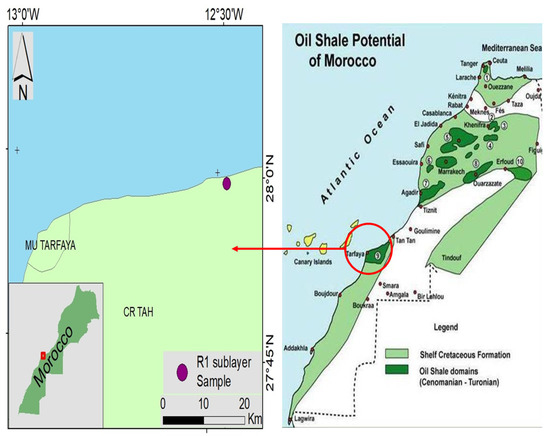
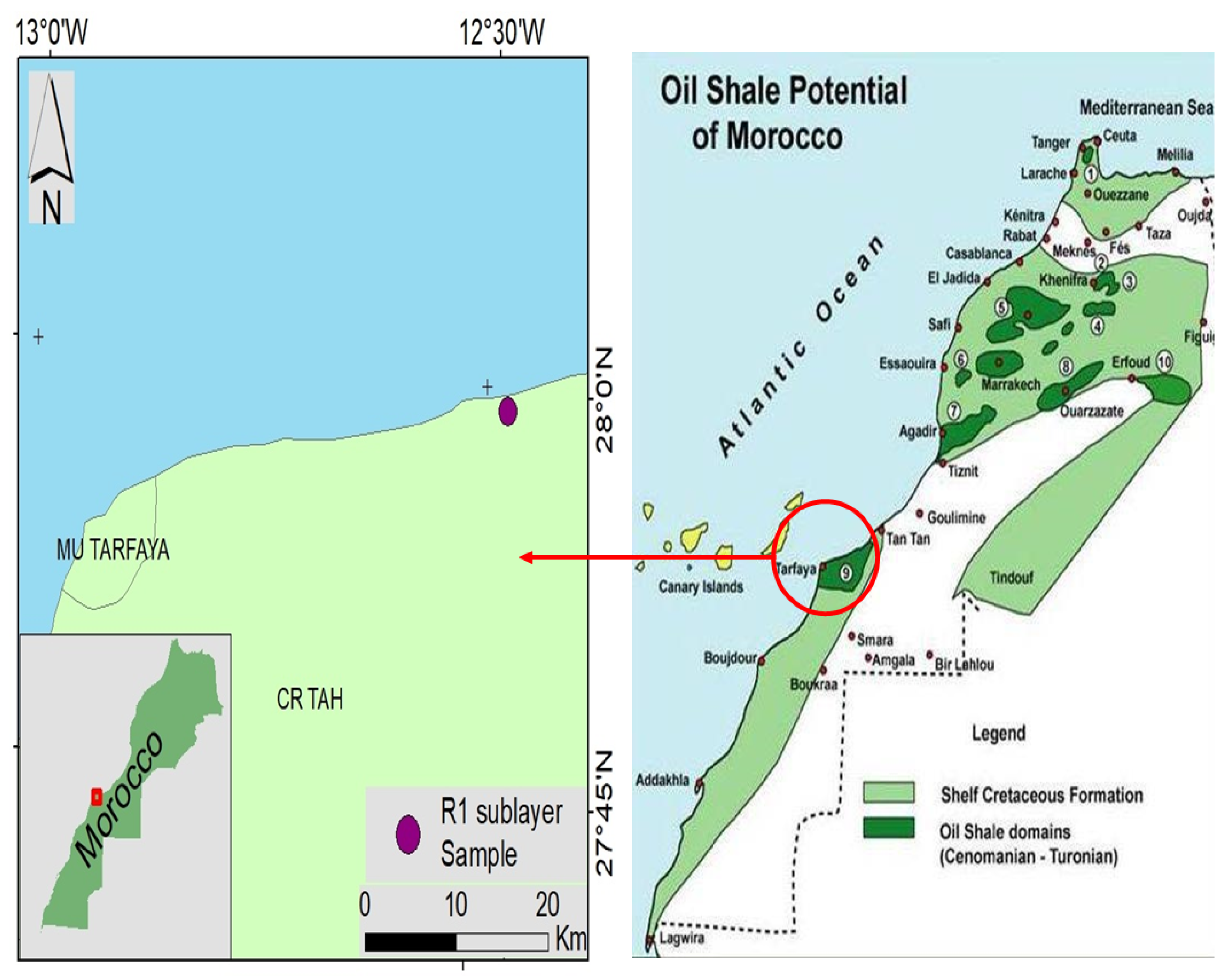
The oil shale was supplied by the Moroccan National Office of Hydrocarbons and Mines (ONHYM). It originates from the Tarfaya Basin test mine, located at the east of Tarfaya city (coordinates: 28°00′16.8″ N; 12°28′41.3″ W). The geographic positions of the Tarfaya deposit and the studied sublayer (R1) are given in Figure 1.
Figure 1.
Geographic position of the Tarfaya deposit and the R1 sublayer.
The Tarfaya deposit covers an area of 2500 km2 between Sebkhat Tah in the southwest and the Amma Fatna wadi in the northeast. Bounded to the north by the Atlantic Ocean, it has a known width of 50 km along a northwest/southeast axis [24]. Geologically, it is mainly composed of Middle and Upper Cretaceous marls and chalks. Its high organic matter content makes it one of the most important oil shale deposits in Morocco. The R1 sublayer features an outcrop thickness of 2 m, with a total organic carbon (TOC) content of approximately 10% and an oil yield of 90 L/t.
High-purity acetic acid (99.9%, Sigma Aldrich, Darmstadt, Germany) was used for the decarbonation process of the oil shale. Acetic acid solutions were prepared using distilled water.
2.2. Oil Shale Decarbonation
The raw oil shale was denoted as OSR. It was crushed, ground, and sieved. A ventilated oven was implemented to calculate its moisture content at 115 °C, for a maximum of 24 h, according to the following equation:
A0 is the empty basket weight, and Ae denotes the weight of the test sample. A0 and Ae are expressed in grams (g).
The raw oil shale (OSR) is treated with the acetic acid aqueous solution in order to remove carbonates to recover the oil shale concentrate. This acetic acid treatment was selected after a series of experiments in our laboratory and based on earlier investigations [25].
In an Erlenmeyer flask, 10 g of OSR (particle size: 0.5–1 mm) was stirred into an acetic acid aqueous solution for one hour. Following treatment with several solutions, the solid residues underwent some processing, including filtration, washing to remove acid traces, and drying. The samples identified as (OSRA) were stored in sealed plastic bags for subsequent analysis.
2.3. Characterization Methods
The Rock-Eval 6 (Vinci technologies, Nanterre, France) Standard analyzer is used to determine the organic composition of rocks. This method, developed by the French Petroleum Institute, involves pyrolyzing chopped samples (between 500 and 600 °C) in a helium atmosphere to determine the quantity of the products. This analysis was conducted in the laboratory of the National Office of Hydrocarbons and Mines (ONHYM).
A CHNS/O elemental analyzer Flash (2000, Thermo Fisher Scientific, Milan, Italy) was used to measure the elemental composition of the samples (C, H, N, S, and O). After accurately weighing the samples (10 mg), they were burned in the presence of oxygen at a high temperature (~950 °C). Gas chromatography was used to separate the gases generated (CO2, H2O, N2, and SO2), and a thermal conductivity detector (TCD) (Thermo Fisher Scientific, Milan, Italy) was used to quantify them. Pyrolysis or differential calculations were used to quantify oxygen. To ensure reproducibility, each analysis was performed three times.
The elemental composition, including trace metal analysis, was quantified using an X-ray fluorescence (XRF) spectrometer (Malvern Panalytical, Almelo, The Netherlands) and an EPSILON 3 XL spectrometer (Malvern Panalytical Almelo, The Netherlands).
Structural and mineralogical analyses were performed by X-ray diffraction (XRD) on a Shimadzu XD-L instrument (Shimadzu Corporation, Kyoto, Japan) with Cu Kα (40 kV, 30 mA). The diffraction patterns were recorded over a 2 theta angular range of 5–70°, with a step size of 0.02° and a scanning speed of 10 min−1.
The molecular structure and functional groups were examined using Fourier transform infrared spectroscopy (FTIR) with a Shimadzu IRAffinity-1S spectrometer (Shimadzu Corporation, Kyoto, Japan). Measurements were performed in the 4000–500 cm−1 range, with a resolution of 4 cm−1, using the attenuated total reflectance (ATR) method to ensure accurate identification of functional groups and structural characteristics. Together, these techniques provided comprehensive information on the chemical and structural characteristics of the materials.
TGA/DTG was used to study the stability and thermal decomposition of the 25 mg test samples under a nitrogen flow (Setsys Evolution, Setaram, Lyon, France). Measurements were performed between 20 °C and 1000 °C using linear heating ramps of 5, 10, 20, and 40 °C/min.
The kinetic behavior of raw oil shale and its concentrate, as well as the exploitation of various kinetic methods, were computed and researched with NETZSCH-Gerätebau GmbH, Selb, Germany v 3.6.0.
3. Kinetic Modeling
The non-isothermal kinetic analysis of mass loss during the pyrolysis of complex solid materials, such as oil shale, is complicated by the existence of multiple simultaneous processes. A normalized reaction progression is employed to get around this complexity: Equation (2) illustrates the conversion rate (α), which assesses variations in the percentage of pyrolyzed material over time or temperature.
where the initial, instantaneous, and final masses are indicated by the symbols m0, mt, and mf, respectively.
For solid-state processes, the general kinetic expression is represented by Equation (3):
Here, the reaction mechanism is described by f(α), and the temperature-dependent rate constant K(T), is represented by Equation (4), which is usually modeled by the Arrhenius equation:
By combining these two expressions, the solid-state reaction rate becomes as follows via Equation (5):
By integrating the heating program β = dT/dt into Equation (5), we obtain Equation (6):
From Equation (6), the integration proceeds well according to Equation (7):
where x = Ea/RT, T0 is the initial temperature, g(α) is the integrated form of the reaction model, and p(x) is the temperature integral.
In the context of the kinetic analysis of solid-state reactions under non-isothermal heating, the temperature integral is as follows: , where p(x) does not have an accurate analytical solution. For this reason, several researchers have proposed approximations of this integral that allow for a simpler solution of the kinetic equations [26,27].
Numerous methods have been devised to identify the chemical parameters involved in the thermal breakdown of solids, and these methods can be broadly divided into two categories: model-free (isoconversional) and model-fitting methods [28].
Without presuming a particular reaction model, these techniques calculate the activation energy (Ea). Isoconversional methods are especially useful for identifying intricate, multi-step processes since they are based on the idea that the reaction rate at a specific conversion (α) solely depends on temperature [29]. To assess each model’s fitting accuracy, a comparative analysis was carried out, with special attention to how well the models applied to various stages of decomposition. Three isoconversional methods were used in this investigation.
3.1. Friedman Method
The Friedman method [30] is a differential method and one of the simplest methods to use to determine activation energy. In non-isothermal mode, and at a constant heating rate β = dT/dt, the expression is denoted by Equation (8):
Although it requires exact derivative values and is sensitive to noise in experimental data, it offers greater accuracy than integral methods [31]. Several experiments must be carried out at different heating rates β, in order to extract the activation energy from the slope of Friedman’s straight line, which represents lnβ(dα/dT) as a function of 1000/T.
3.2. Flynn–Wall–Ozawa Method
The Flynn–Wall–Ozawa (FWO) method is based on Doyle’s approximation, which is valid in the range 20 ≤ x ≤ 60 . In this case, the temperature integral is approximated by p(x)≈ −2.315 − 0.4567 x. By applying Doyle’s approximation to the integral form of the kinetic equation, the Flynn–Wall–Ozawa operational relationship is derived (Equation (9)), allowing the apparent activation energy (Ea) to be determined from non-isothermal thermogravimetric data obtained at different heating rates.
Thus, for x = const., the graph of log β as a function of 1000/T, obtained from thermograms recorded at several heating rates, should be a straight line whose slope can be used to evaluate the apparent activation energy.
3.3. Kissinger–Akahira–Sunose Method
The Kissinger–Akahira–Sunose (KAS) is based on the Coats–Redfern method, which used a different asymptotic expansion. The Doyle’s approximation of the KAS model was applied to maintain the functional dependence on , for the temperature integral
According to the KAS method [32,33], the activation energy is fixed for a particular conversion rate [34]. This can be expressed as follows in Equation (10):
Furthermore, the KAS method provides a more accurate estimate of the activation energy [9,34]. For a given α, the trace of with respect to 1000/T is a straight line, and the slope and the original order may be used to calculate the activation energy Ea.
3.4. Coats–Redfern Method
The Coats–Redfern method is an integral method that involves a thermal degradation mechanism. Applying an asymptotic approximation to solve Equation (6) (2RT Ea << 1), we get the following equation [35]:
3.5. Criado Method
One technique for examining non-isothermal reaction kinetics characteristics is the Criado method [36]. In order to generate the main graph and solve kinetic parameters like activation energy and frequency factor, it normalizes experimental data at various heating rates to the same level of conversion rate. The normalized relationship is used to express the primary graph method by Equation (12), where the temperature and the conversion rate at a conversion degree of 0.5 are denoted by T0.5 and (dα/dt)0.5, respectively.
The reaction mechanism specific expression f(α).g(α)/f(0.5).g(0.5) provides theoretically normalized curves based on several kinetic models on the left side of the equation. The conversion coefficient’s temperature change is shown on the right side, which is based on experimental data. Relevant models of solid-state pyrolysis reactions are well reported in the literature [37], and it is evident that the function f(α) depends on the nature of the reaction pathway.
The differential component of the method is described by the ratio of the reduced conversion rate α = 0.5 in Equation (13):
For each value of α, the experimental reduced conversion rate (dα/dt)/(dα/dt)0.5 and the theoretical value f(α)/f(0.5) remain equivalent when the chosen conversion function f(α) accurately represents the transformation process under study [37].
The integral component is obtained from the general velocity equation (Equation (7)), which, at the reference point α = 0.5, leads to the following normalized expression in Equation (14):
The experimental graphs p(x)/p(0.5) vs. conversion rate (α) give a preliminary estimate of the activation energy (Ea). The correct choice of the kinetic model is confirmed when the experimental p(x)/p(0.5) and theoretical g(α)/g(0.5) graphs coincide [38]. The most common reaction mechanisms used in this method are expressed by f(α) and g(α), which are given in Table 1.
Table 1.
Algebraic expressions of the functions of the most common reaction mechanisms.
4. Results and Discussion
4.1. Effect of Acetic Acid Treatment on the Oil Shale Concentrate Yield
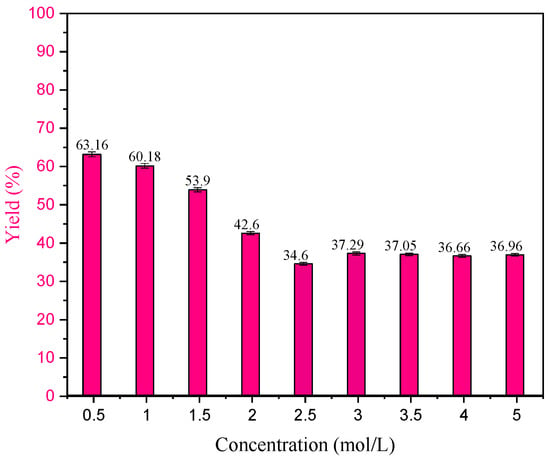
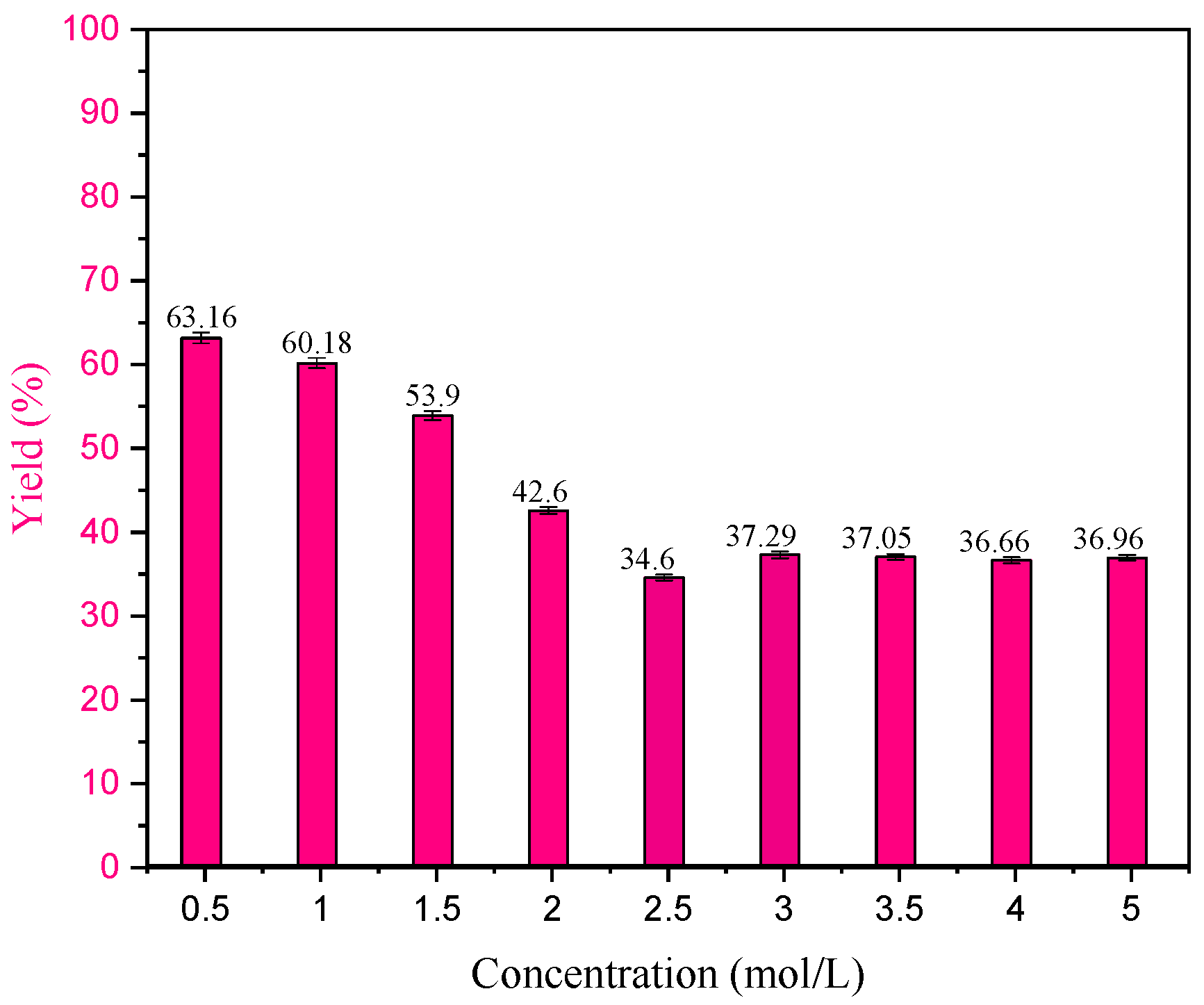
The effect of acetic acid concentration on carbonate removal and oil shale concentrate yield was evaluated after a one-hour treatment at ambient temperature. Figure 2 shows a progressive decrease in the mass of oil shale concentrate (OSRA) with an increase in acetic acid concentration from 0.5 mol/L (63.16%) to 2.5 mol/L (34.6%). Beyond this value, acid concentration no longer results in a significant change in oil shale concentrate yield. However, a slight increase in residual mass is observed above 3 mol/L (37.29%). Carbonate removal thus reaches an optimal level with a concentrate yield of 65.4% when the concentration of the aqueous acetic acid solution is set at 2.5 mol/L. For an optimal process and minimization of the residual mass of treated oil shale, these parameters are fixed throughout this study.
Figure 2.
Effect of acetic acid concentration on Tarfaya oil shale concentrate yield (OSRA).
4.2. Characterization of Oil Shale and Oil Shale Concentrate
4.2.1. Rock-Eval Pyrolysis
Rock-Eval pyrolysis is used in petroleum fields to evaluate the quantity, type, and thermal maturity of organic matter in sedimentary rocks. This rapid and cost-effective technique consists in heating the rock to 650 °C in an inert atmosphere and quantifying recovered products at laboratory scale. Rock-Eval pyrolysis analysis relies on three direct measurements that quantify hydrocarbon distribution in the source rock. Peak S1 represents the quantity of free hydrocarbons already present in the sample, volatilized at 300 °C, while peak S2 measures hydrocarbons generated by the thermal cracking of kerogen between 300 °C and 650 °C, thus defining the residual petroleum-generating potential. Finally, peak S3 quantifies the organic carbon dioxide (CO2) released during the initial heating phase, reflecting the oxygen content of the organic matter. From S1, S2 and S3, several indices are calculated to assess the quality and maturity of organic matter in terms of total organic carbon (TOC).
The hydrogen index (HI) expresses the hydrocarbon-generating potential and allows for the identification of the kerogen type. It is calculated using Equation (15): the oxygen index (OI) indicates the degree of oxidation of the organic matter, and the production index (PI), obtained by the ratio S1/(S1 + S2), serves as an indicator of thermal maturity or the presence of migrated hydrocarbons, with a value that increases progressively as the rock enters the oil window.
The low production index values (PI = 0.03 for OSR and 0.02 for OSRA) indicate low levels of free hydrocarbons (S1), reflecting limited amounts of extractable bitumen. Together with the Tmax values (414 °C for OSR and 413 °C for OSRA), these data, presented in Table 2, confirm the immature nature of the studied oil shale, corresponding to an early stage of thermal evolution.
Table 2.
Rock-Eval pyrolysis parameters of raw (OSR) and treated (OSRA) oil shale.
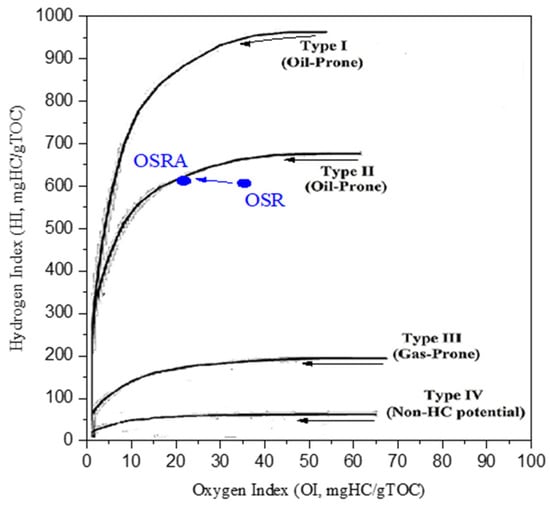
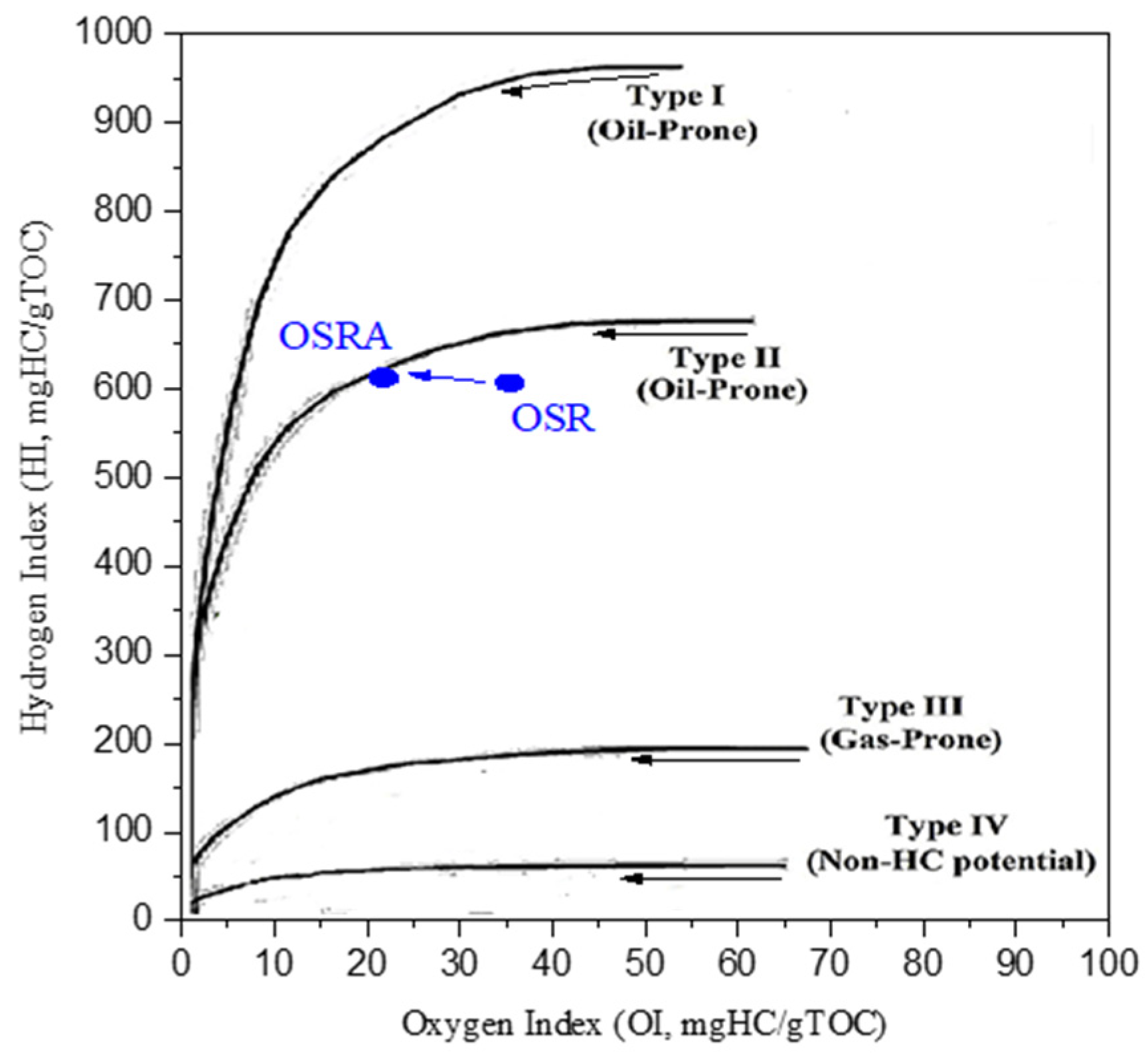
After acetic acid treatment, the TOC increased markedly from 12.2% for OSR to 20.3% for OSRA. This increase is mainly attributed to the substantial removal of calcites, as confirmed by the decrease in mineral carbon from 5.64% to 1.27%. In addition, the hydrogen index (HI) increased slightly from 601 to 614 mg HC/g TOC, while the oxygen index (OI) decreased from 36 to 21 after treatment. These values are plotted in Van Krevelen’s diagram. The treated oil shale (OSRA) shows a slight move to the left of the diagram (Figure 3), indicating a depletion of oxygen content in kerogen after acetic acid treatment. According to Van Krevelen’s diagram interpretation, this decrease is associated with an enrichment of the carbon network and an increase in the aromaticity, while the increase in HI reflects a shift towards more mature organic matter [39].
Figure 3.
Position of raw (OSR) and treated (OSRA) oil shale on the Van Krevelen diagram (OI vs. HI).
4.2.2. Elemental Analysis
Elemental analysis presented in Table 3 reveals that the raw shale (OSR) has a mass content of 19.97% carbon, 2.38% hydrogen, 0.91% nitrogen, 3.03% sulfur, and a relatively high oxygen content (11.64%). This composition reflects the presence of organic matter 340 still strongly associated with a mineral matrix rich in oxygenated phases, particularly carbonates and other minerals. In addition, decarbonated shale (OSRA) contains 22.31% C, 2.57% H, 1.00% N, 3.21% S, with a lower oxygen content (10.99%). This result shows a clear enrichment in elements characteristic of organic matter (C, H, N, O, S) and a decrease in oxygen-rich constituents.
Table 3.
Elemental analysis of raw oil shale (OSR) and its concentrate (OSRA).
4.2.3. X-Ray Fluorescence (XRF)
According to XRF analysis results (Table 4), the Tarfaya oil shale OSR encompassed mainly calcium (67.56%, CaO) and moderate contents of silicon (10.64%, SiO2) and sulfur (11.29%, SO3), with small amounts of iron (3.08% Fe2O3), aluminum (2.53% Al2O3), and Cl (3.05%). After decarbonation, a large decrease in calcium content is observed, and conversely, there is an increase in the contents of SiO2, Fe2O3, Al2O3, SO3, and Cl. Furthermore, a slight increase in MgO content was observed. These results confirm the selectivity of the acetic acid decarbonation process and the enrichment of OSRA after calcite removal.
Table 4.
Chemical composition of raw (OSR) and treated (OSRA) oil shale.
4.2.4. X-Ray Diffractometry (XRD)
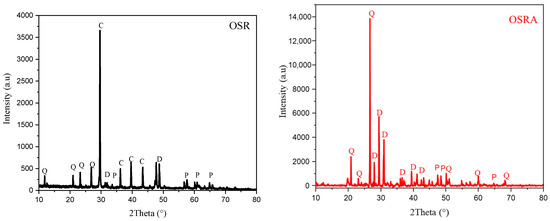
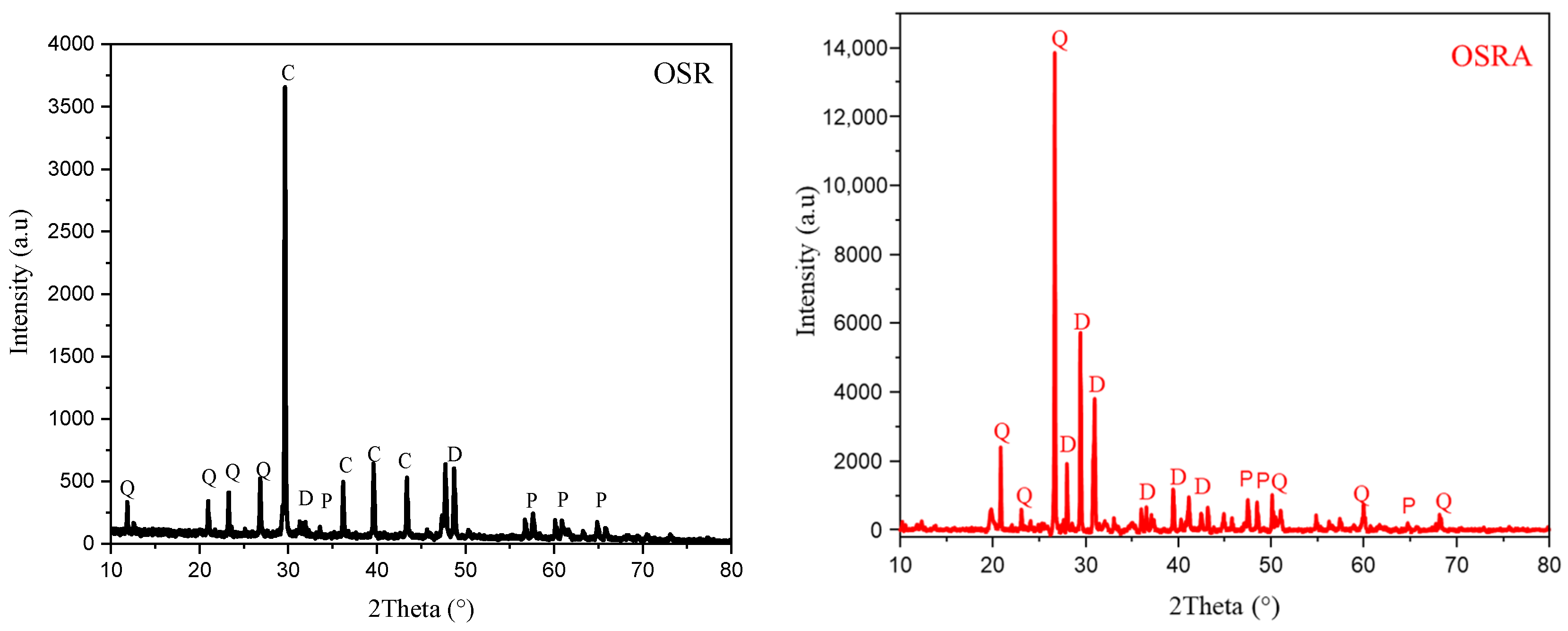
The X-ray diffraction patterns of the raw oil shale and its OSRA concentrate are shown in Figure 4. The diffractogram of the raw oil shale shows that calcite (PDF# 96-901-5074) is the predominant mineral phase. Quartz (PDF# 96-153-2513), dolomite (PDF# 96-900-3523), and pyrite (PDF# 96-156-4891) are also identified. On the OSRA’s diffractogram, the calcite-related peaks (between 29° and 43°) have completely disappeared, confirming the efficient removal of calcite during acetic acid treatment, and illustrating the selectivity of this treatment compared to hydrochloric acid treatment.
Figure 4.
X-ray diffractogram of raw oil shale (OSR) and (OSRA), Q: quartz, C: calcite, D: dolomite, P: pyrite.
4.2.5. FTIR Spectroscopy
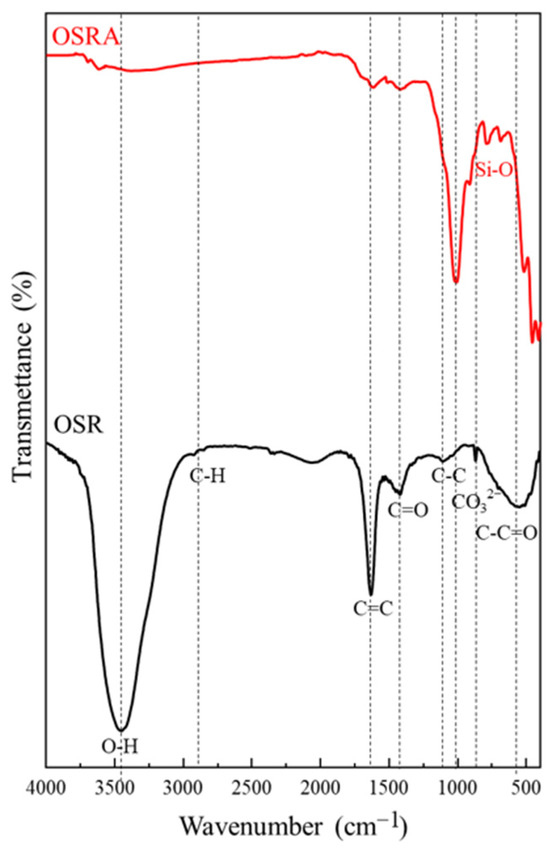
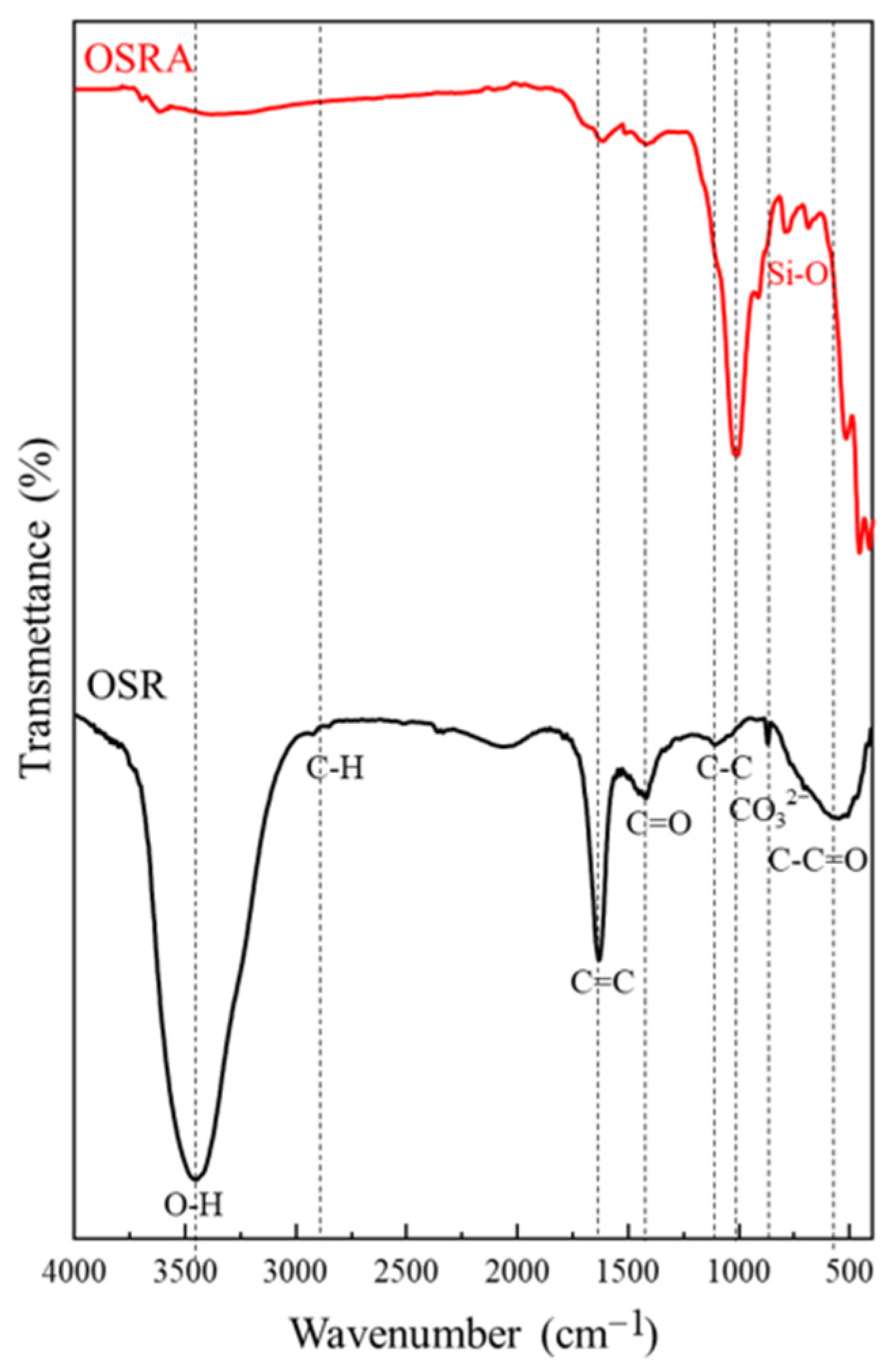
FTIR spectroscopic analysis was performed to determine the functional groups before and after decarbonation, as shown in Figure 5. The spectrum of the raw oil shale (OSR) exhibits a broad absorption band between 3400 and 3500 cm−1, attributed to the O-H stretching vibrations of phenolic and carboxylic groups [40]. The bands at 2850 cm−1 are assigned to the aliphatic C-H stretching of CH2 group [41]. The prominent peaks observed at 1424, 875, and 711 cm−1 correspond to the carbonate fraction [42]. In addition, the absorption band at 1009 cm−1 is associated with the C-OH stretching vibrations [37,43], while the aromatic C-H groups are observed in the peak 2920 cm−1 bending vibrations in [40,41]. Additionally, the bending modes around 875 cm−1 are related to the Si-O stretching vibration characteristic of quartz [44].
Figure 5.
FTIR spectra of OSR and OSRA.
The FTIR spectrum exhibits significant structural changes in OSRA due to the successful decarbonation process. The bands around 1424 cm−1 and 875 cm−1 are characteristics of carbonates. These bunds observed previously in the OSR’s FTIR spectrum disappeared after acetic acid treatment. Furthermore, the band around ~730 cm−1 in the OSRA spectrum is characteristic of dolomite (CaMg(CO3)2) and is assigned to the deformation vibrations of carbonate groups (CO32−) influenced by the occurrence of Mg2+ in the crystal structure [45]. In addition, the bands associated with silicate groups (850–1109 cm−1) show a relative increase in intensity. These results demonstrate that acetic acid treatment selectively removes the calcite without altering the dolomite structure.
4.2.6. Thermal Analysis (TGA)
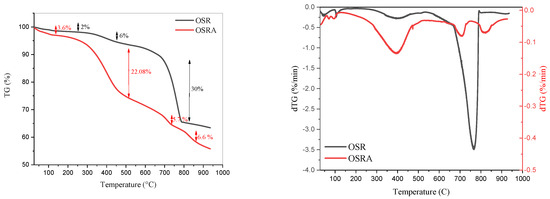
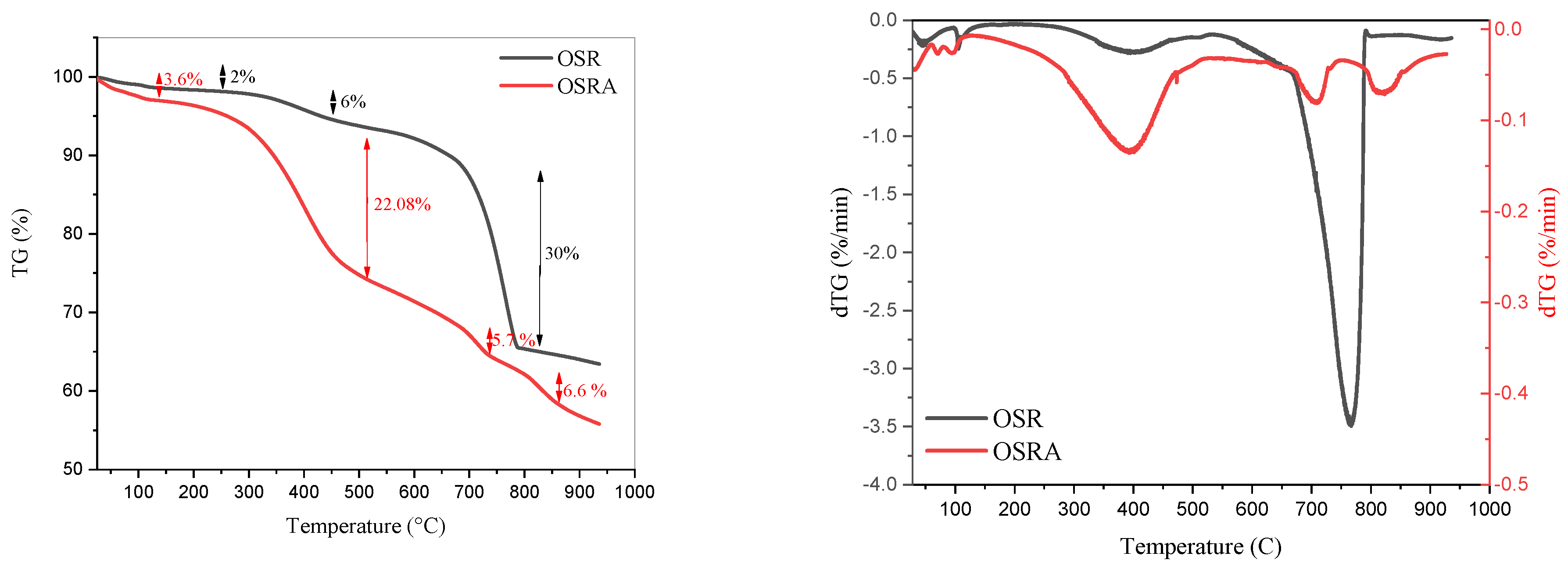
The thermogravimetric (TG) and derivative thermogravimetric (DTG) curves of the OSR and OSRA, obtained at 40 °C/min in the temperature range from room temperature to 1000 °C under nitrogen, are shown in Figure 6.
Figure 6.
TG and DTG curves of the OSR and OSRA at a heating rate of 40 °C/min.
The thermal decomposition process of OSR occurs in three distinct stages. In the temperature range below 200 °C, the observed weight loss of approximately 2% is primarily due to the evaporation of water particles adsorbed in the interstices of the clay minerals present in the matrix of the untreated and decarbonated oil shale [42,46]. Between 300 °C and 500 °C, untreated oil shale exhibits maximum weight loss at 400 °C of about 6%. This degradation process was also reported by Aboulkas et al., 2009 [42], and Bai et al., 2017 [46], Sun et al., 2014 [47]. This stage is primarily attributed to the decomposition of kerogen and the formation of volatile hydrocarbons. The third degradation phase occurs between 600 °C and 800 °C, with a pronounced maximum loss (30%) observed at approximately 720 °C, corresponding to the carbonate’s decomposition. At the end of the reaction, the residual weight is approximately 62%.
The thermal degradation of the oil shale concentrate (OSRA) reveals four distinct decomposition stages. The first stage, occurring at 3.6% between 0 and 150 °C, is attributed to the loss of absorbed water. The second stage, extending from approximately 150 °C to 500 °C, corresponds to the decomposition of organic matter and the formation of volatile hydrocarbons. The maximum mass loss at this stage occurs at approximately 380 °C, amounting to around 22.08%, which is higher than that observed in OSR. This difference can be explained by the elimination of calcite during treatment with acetic acid, which promotes the early onset of decomposition of organic matter in the decarbonated bituminous shales of Tarfaya, as confirmed by the significant extent of this mass loss. The last two stages, occurring between 600 °C and 950 °C, amounting to around 5.7% and 6.6% respectively, correspond to the decomposition of dolomite in OSRA. According to Mako (1999) [48], MgO and CaCO3 are generated between 550 and 700 degrees Celsius. After reaching 750 degrees Celsius, the generated CaCO3 splits into CaO and MgO. At last, the calcite breaks down into CaO, as confirmed by DTG curves, confirming the efficient removal of calcite after acetic acid treatment. These results are correlated with XRD and FTIR results from OSRA, which confirm the presence of dolomite.
4.3. Kinetic Analysis
4.3.1. Conversion of Reactions α(T)
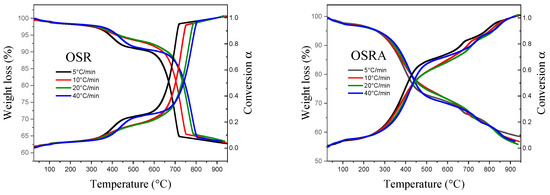
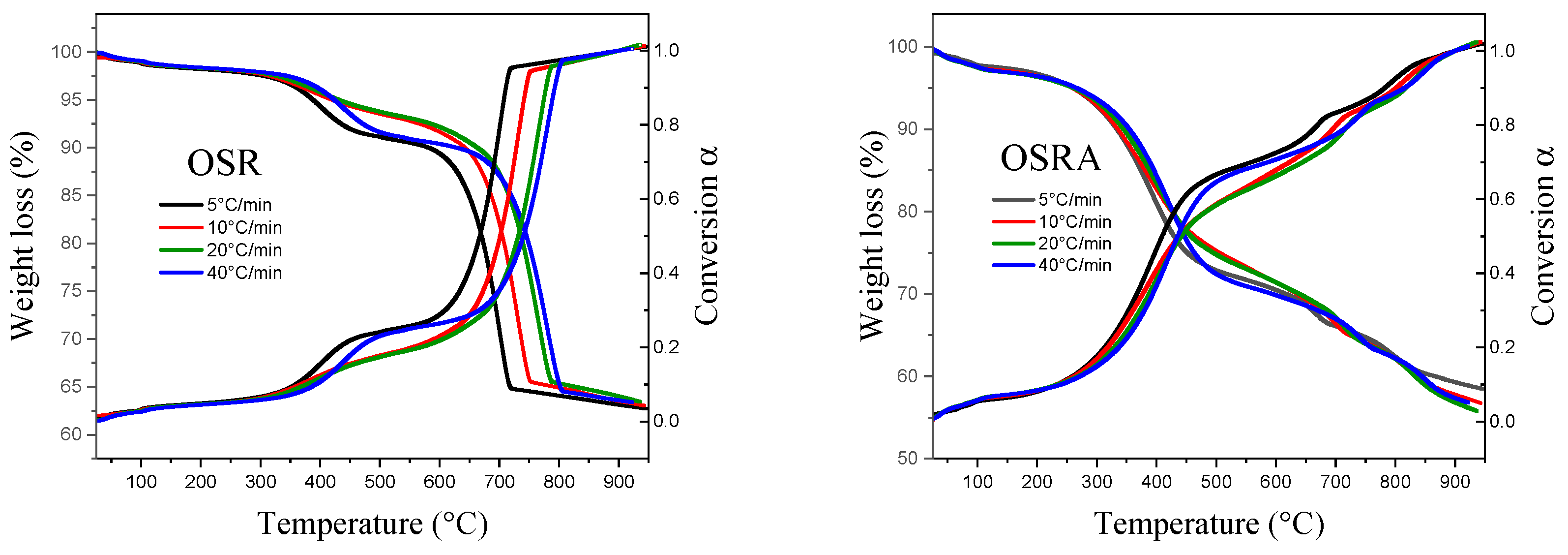
From non-isothermal thermogravimetric analysis (TG/DTG) data, α(T) conversion curves were established for four applied heating rates (5, 10, 20, and 40 °C/min). The conversion profiles shown in Figure 7 reflect the evolution of mass loss as a function of temperature for each sample.
Figure 7.
Experimental conversion curves for OSR and OSRA at different heating rates.
For the raw sample (OSR), conversion begins around 200 °C, indicating the start of the thermal transformation of the organic fraction. A significant mass loss is observed between approximately 350 and 550 °C (~8%), corresponding to the main pyrolysis stage of the kerogen fraction of the Tarfaya oil shale, as described in the literature [49]. At even higher temperatures (≈700–900 °C), further weight loss (~27%) is observed due to the decomposition of carbonate minerals (dolomite, calcite), which contribute significantly to the mineral matrix (more than 60% of Tarfaya oil shale rock) [50].
In the OSRA sample, the removal of the calcite leads to a simplification of the thermal behavior. Indeed, the α(T) curves show that the main conversion is concentrated in the range of ~250–550 °C (~25%) of mass loss. Above 550 °C, a continuous mass loss is observed in the high-temperature zone (~15%). Thus, the comparison between OSR and OSRA clearly highlights the impact of decarbonation on overall thermal behavior: the removal of the calcite favors the kerogen decomposition and shifts thermal decomposition towards processes dominated primarily by organic matter. This observation is consistent with the conclusions drawn by Aboulkas and El Harfi, 2008 [24], who studied the kinetics and mechanisms of the thermal decomposition of kerogen isolated from the Tarfaya oil shale.
4.3.2. Isoconversional Methods
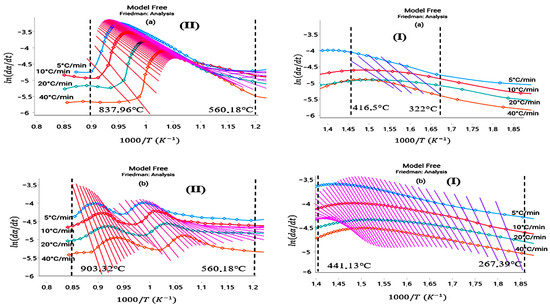
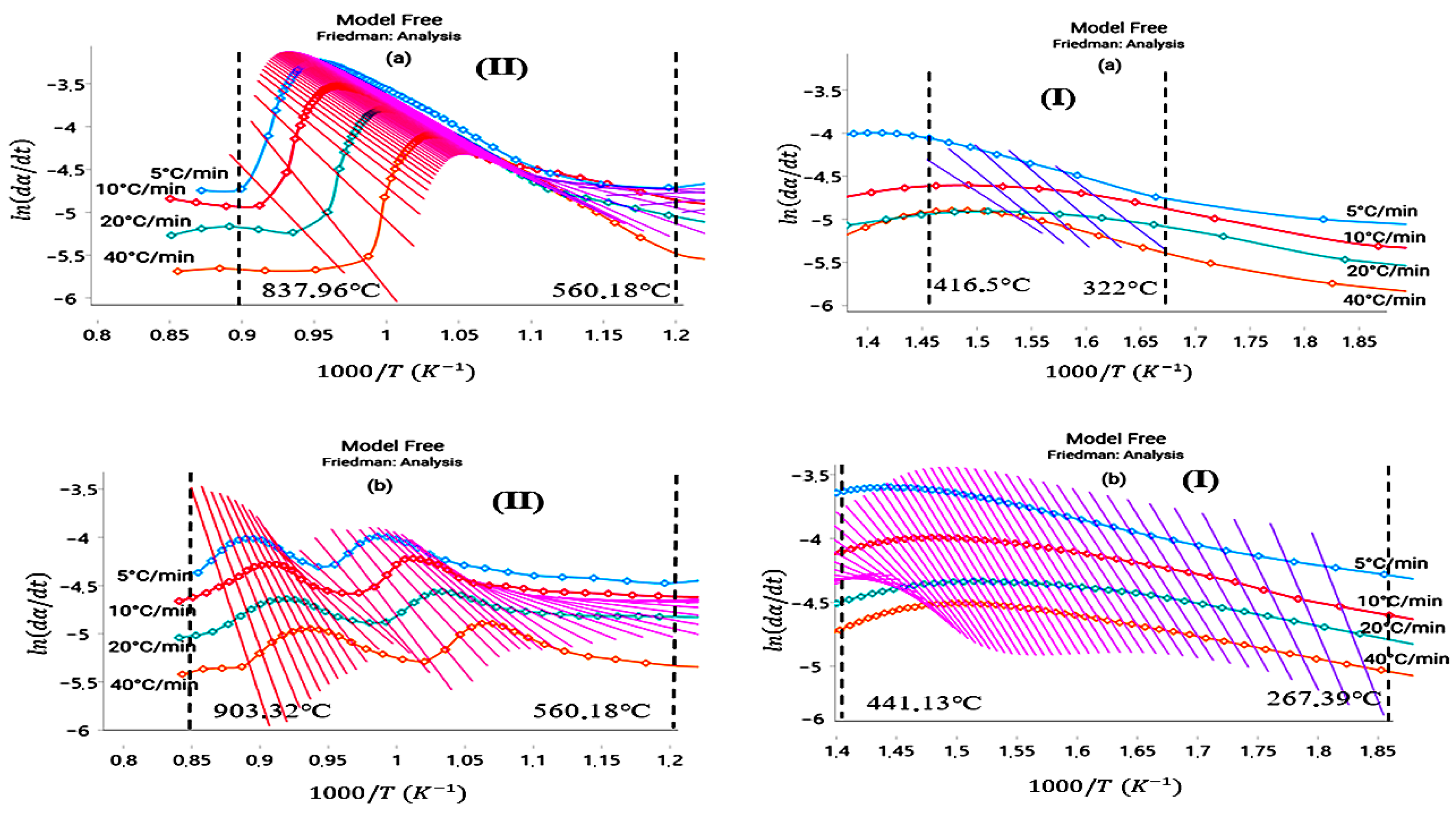
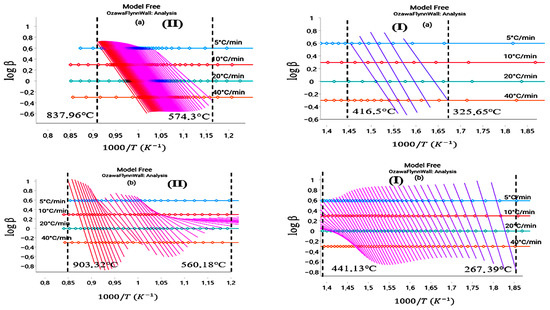
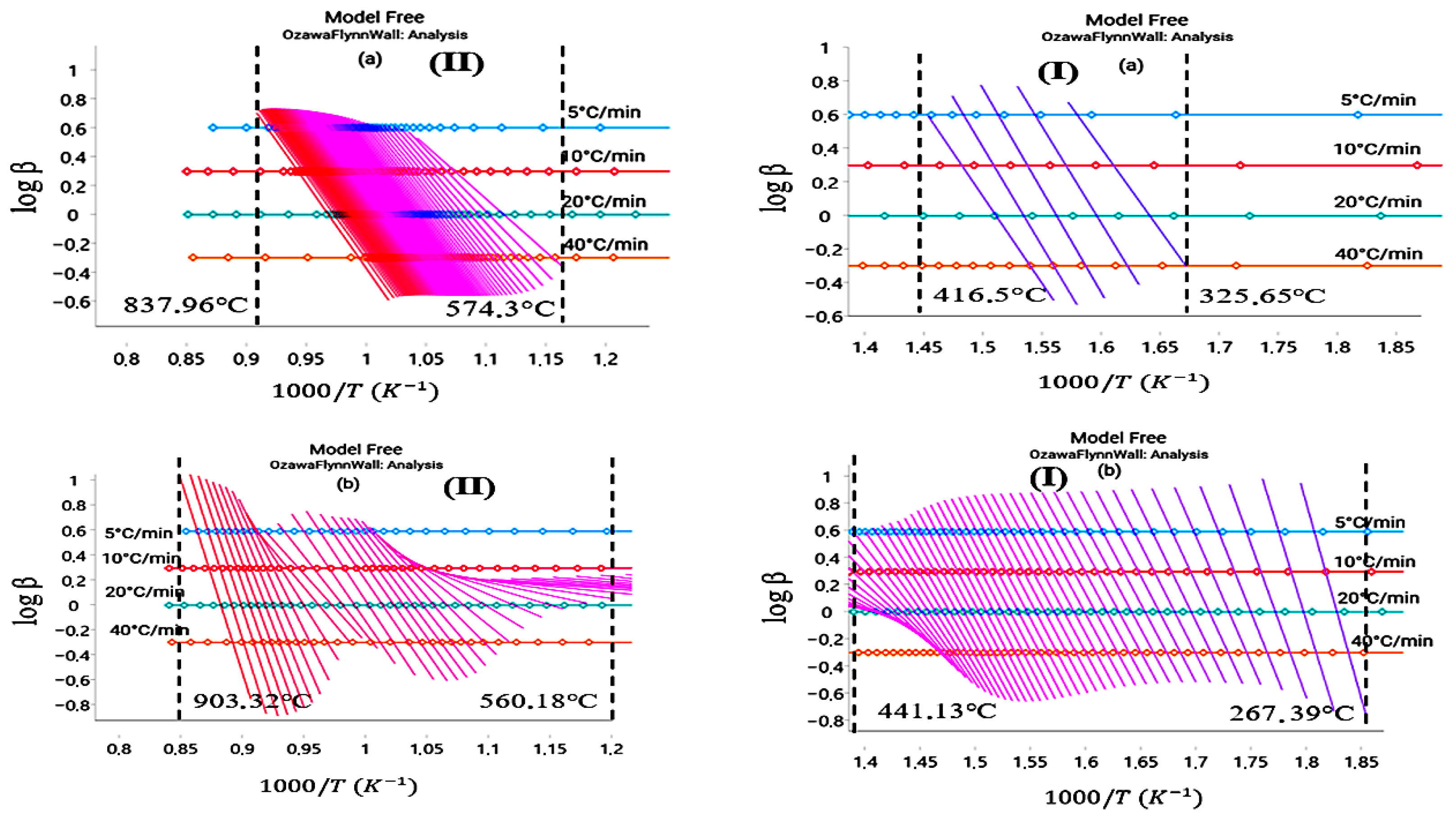
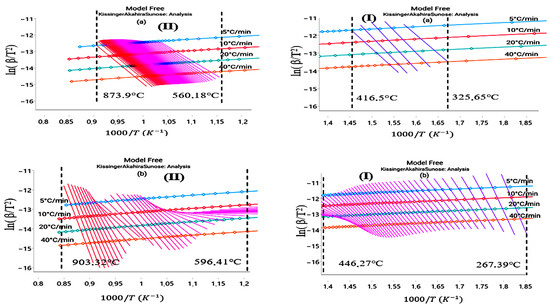
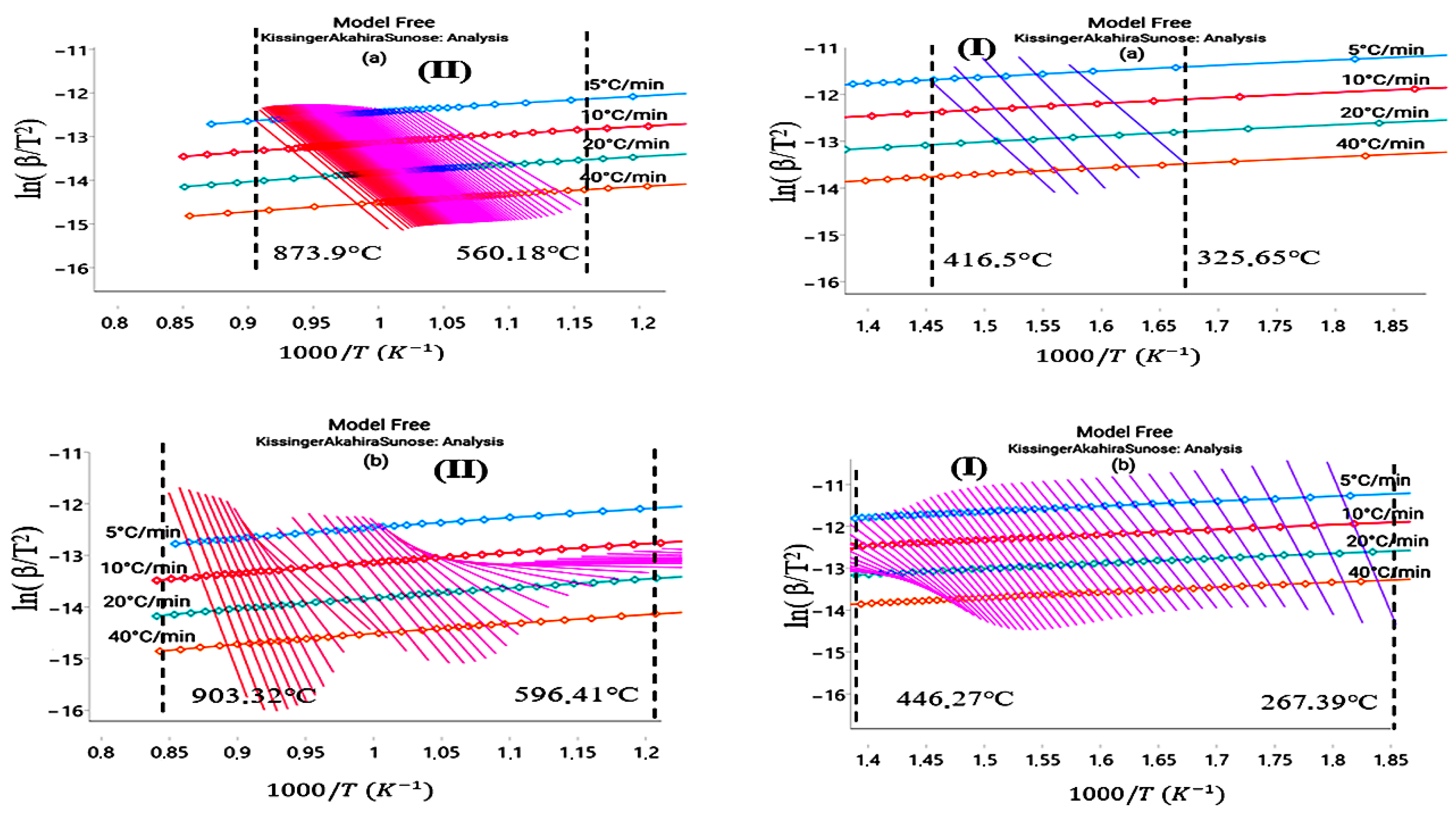
The application of model-free kinetic methods to non-isothermal TG data has been used to extract reliable parameters in accordance with the principles of isoconversion kinetics developed by Vyazovkin and Wight, 1999 [51]. This approach reveals a strong dependence of the activation energy on the degree of conversion, highlighting the multi-step nature of the complex reaction mechanism. For both the raw (OSR) and the treated (OSRA) oil shale, the activation energies were determined from the plots of ln(dα/dt), ln(β), and ln(β/T2) versus 1000/T, corresponding respectively to the Friedman, FWO, and KAS methods, as illustrated in Figure 8, Figure 9 and Figure 10. These methods were applied to TG data recorded at four heating rates of 5, 10, 20, and 40 °C/min. The evolution of activation energy (Ea) versus the conversion range α, reveals two main kinetic domains, likely associated with different overlapping stages of oil shale thermal conversion. Domain (I), observed at lower temperatures, is mainly related to the decomposition of the organic fraction, whereas domain (II), observed at higher temperatures, may reflect advanced organic transformations combined with mineral decomposition.
Figure 8.
Friedman model-free graphs at different heating rates (5, 10, 20, and 40 °C/min) for: (a) raw oil shale (OSR), indicating the organic matter pyrolysis phase (I) and the mineral matter decomposition phase (II); (b) oil shale concentrate (OSRA), indicating the organic matter pyrolysis phase (I) and the mineral matter decomposition phase (II).
Figure 9.
FWO model-free graphs at different heating rates (5, 10, 20, and 40 °C/min) for: (a) raw oil shale (OSR), showing the organic matter pyrolysis phase (I) and mineral matter decomposition phase (II); (b) oil shale concentrate (OSRA), showing the organic matter pyrolysis phase (I) and mineral matter decomposition phase (II).
Figure 10.
KAS model-free graphs at different heating rates (5, 10, 20, and 40 °C/min) for: (a) raw oil shale (OSR), showing the organic matter pyrolysis phase (I) and the mineral matter decomposition phase (II); (b) oil shale concentrate (OSRA), showing the organic matter pyrolysis phase (I) and the mineral matter decomposition phase (II).
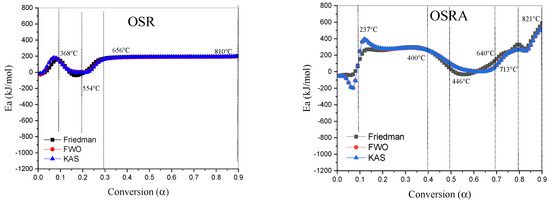
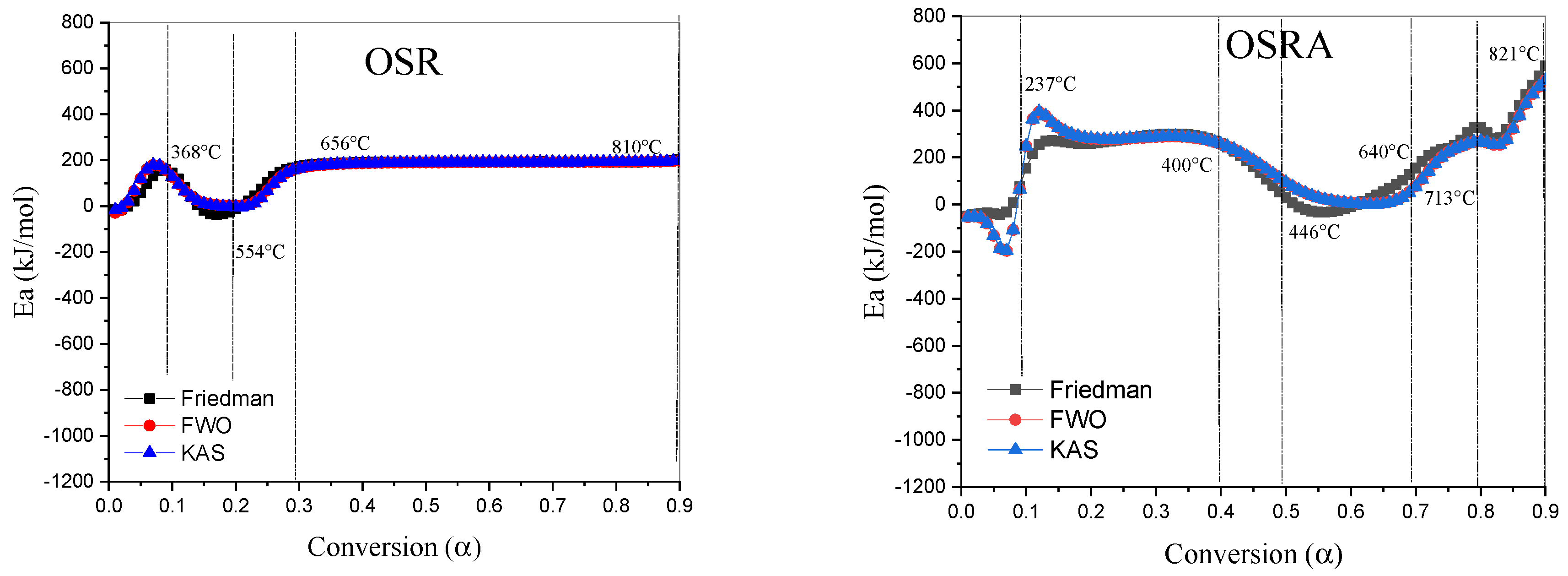
At a low conversion rate (α = 0.10), corresponding to the temperature range 236–369 °C, for OSR, the activation energies are moderate and relatively consistent among the three methods, reaching 145.5 kJ/mol with Friedman, 149.31 kJ/mol with FWO, and 149.20 kJ/mol with KAS. This stage is mainly associated with the desorption of physically adsorbed water and the release of light volatile compounds. In contrast, this conversion level (α = 0.10) is reached at low temperature, ranging from 90 to 237 °C for OSRA. In this domain, the apparent energies remain low and more dispersed; the values are 8.43 kJ/mol and 39.63 kJ/mol for Friedman and FWO, respectively, and a negative value is observed for KAS. At low conversion, this negative value should not be interpreted as an effective negative energy barrier, but rather as an artifact associated with overlapping physical phenomena during the initial stage of the process, including desorption of light volatile species, structural rearrangements, and heat and mass transfer limitations. The negative value of apparent energy at low conversion has also been documented in previous studies, especially the investigation conducted by Burnham and Braun, 2000 [52], and Williams and Ahmad, 1999 and 2000 [53,54]. This behavior often reflects an apparent decrease in the overall rate constant due to the predominance of physical processes, such as diffusion or endothermic desorption, over chemical reaction steps at low temperatures. The atypical behavior observed at low conversion rate in the case of OSRA suggests that the thermal decomposition of kerogen is not solely governed by the intrinsic conversion of organic matter, but is also influenced by changes in organo-mineral structure induced by acetic acid treatment.
The second stage corresponding to the kerogen decomposition for the raw oil shale (OSR) is observed in the temperature range of 350–600 °C. In this stage, the conversion rate does not exceed 30% (α < 0.3). In this temperature domain, and for all the heating rates, the isoconversional lines are more regular and nearly parallel, especially for the integral methods FWO and KAS, indicating a relatively stable dominant kinetic regime within this conversion interval, as shown in Figure 8, Figure 9 and Figure 10. For OSRA, the low conversion rates (α < 0.3) observed at 220 °C < T < 363 °C are markedly higher energies, approximately 290 kJ/mol according to Friedman and 280 kJ/mol according to FWO and KAS, suggesting that the organic matter decomposition appears to proceed through a more kinetically controlled mechanism after decarbonation.
The thermal behavior of OSRA completely changed when the temperature increased at 447 °C, which corresponds to a conversion rate α = 0.50. A pronounced decrease in activation energy is observed and Ea drops to 80.6 kJ/mol within Friedman, whereas FWO and KAS yield 138.64 and 138.29 kJ/mol, respectively. Furthermore, a substantial increase in ln(dα/dt) suggests a great change in the kinetic regime. The conversion range of α = 0.50–0.70, corresponding to 446 °C < T < 640 °C, appears thus as the most favorable pyrolysis stage for the OSRA. In this temperature domain, the decarbonation markedly modifies the pyrolysis behavior and lowers the apparent kinetic barrier. At α = 0.60, the activation energy drastically drops to 14.09 kJ/mol according to FWO and 10.78 kJ/mol according to KAS and has a negative value for Friedman, reflecting a substantial reduction in the kinetic barrier. This phenomenon is probably due to the cleavage of C-C and C-O bonds, which accelerates the thermal decomposition of the kerogen and facilitates volatile hydrocarbon diffusion during the pyrolysis process. This may be related to the structural modifications and macroporosity developed during the acetic acid treatment.
At higher temperatures, T > 684 °C, corresponding to 0.40 < α < 0.90 for raw oil shale OSR, and with relatively stable activation energies, ranging from 192 to 202 kJ/mol with Friedman and around 191 kJ/mol with FWO and KAS. In contrast, the higher value of the conversion (α > 0.80) at 713 °C indicates the small amount of residual matter. At this stage, the activation energy increases sharply, reaching 360 kJ/mol and 500 kJ/mol when the conversion rate is α for 0.8 and 0.9, respectively, showing the refractoriness of the treated oil shale residue, which is mainly composed in quartz, as confirmed by XRD and FTIR analyses. The calculated activation energies and corresponding R2 values are summarized in Table 5.
Table 5.
Activation energies and R2 related to Friedman, Flynn–Wall–Ozawa and Kissinger–Akahira–Sunose methods for the raw oil shale (OSR) and its concentrate (OSRA).
The divergence observed between Friedman’s differential method and the integral methods (FWO and KAS), particularly for OSRA at high conversion levels (α > 0.7), as shown in Figure 11, can be explained by the different mathematical nature of these approaches. Unlike the Flynn–Wall–Ozawa (FWO) and Kissinger–Akahira–Sunose (KAS) methods, which smooth the data through integration of the temperature function, Friedman’s method is based on the instantaneous reaction rate (dα/dt), and is therefore more sensitive to small fluctuations in the thermogravimetric signal and to experimental noise, especially at the end of pyrolysis where volatile release becomes very limited, as reported by Friedman et al., 1964 [30]. Although this sensitivity may help detect subtle transitions toward a diffusion-controlled regime associated with char formation, it can also induce significant fluctuations in the calculated Ea values.
Figure 11.
Activation energy as a function of the conversion rate for the raw (OSR) and treated oil shale (OSRA) by Friedman, Flynn–Wall–Ozawa and Kissinger–Akahira–Sunose methods.
4.3.3. Master Plots by Criado Method
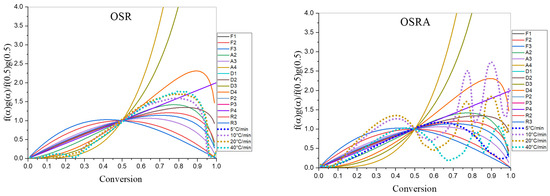
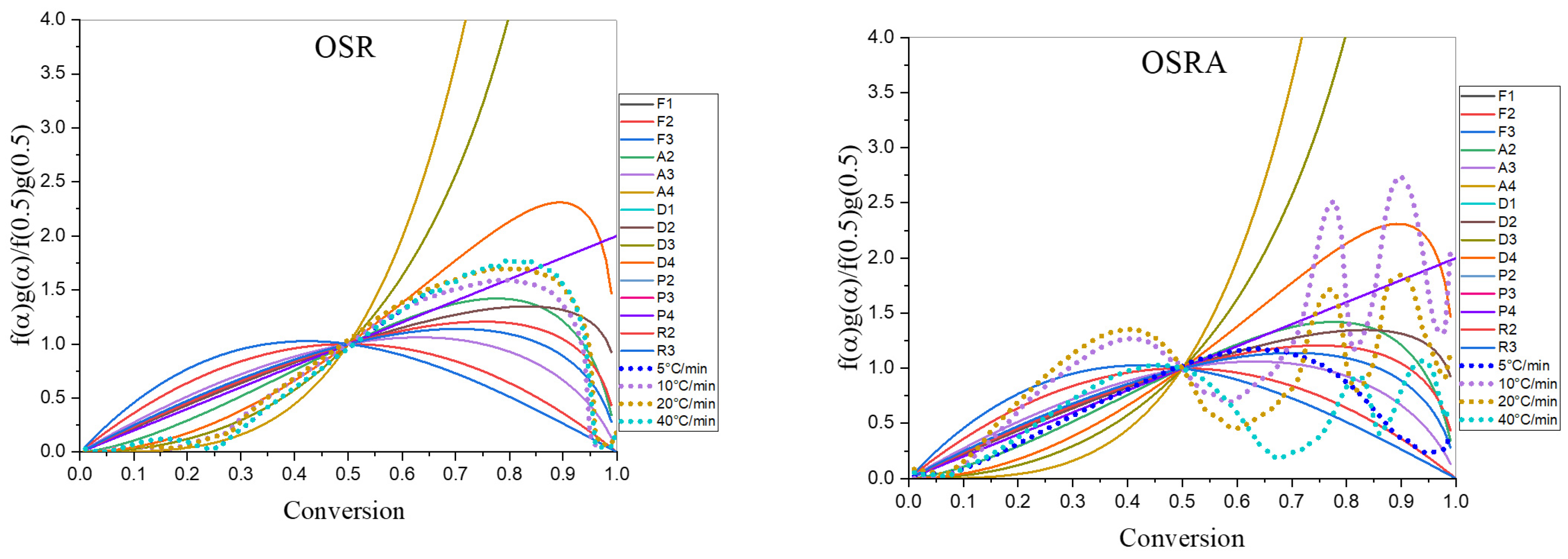
Analysis of the reaction mechanisms using the Criado method for oven-applied heating rates (5, 10, 20, and 40 °C/min), as shown in Figure 12, reveals that the thermal decomposition of OSR is intrinsically linked to its mineral matrix. In the temperature range of 350 to 702 °C, corresponding to low conversion rates (α < 0.40), the process is governed by diffusion models D3 (Jander) and D4 (Ginstling–Brounshtein). The predominance of these models indicates that the pyrolysis process is not limited by breaking chemical bonds of kerogen, but by resistance to mass transfer. The calcite, which is the main component of this rock (>60%C), acts as a physical barrier, forcing volatile hydrocarbons to diffuse through a restricted porous network, thus maintaining a stable activation energy between 191 and 202 kJ/mol. As conversion progresses beyond α ≥ 0.70 (T > 725 °C), a transition to the A2 nucleation model occurs, reflecting the initiation of more rapid decomposition from active sites released by the thermal destabilization of carbonates.
Figure 12.
Criado master plots curves and experimental pyrolysis data for OSR and concentrate (OSRA) for different heating rates.
After acetic acid treatment, the treated oil shale (OSRA) exhibits a radical modification of the kinetic landscape by removing the initial diffusion constraints. For a temperature between 220 and 446 °C (α < 0.50), the system deviates from diffusion regimes towards the reaction order models F2 and F3. This change demonstrates that demineralization allows the kinetics to reflect the intrinsic reactivity of kerogen more accurately, where the breaking of chemical bonds becomes the limiting factor within a structure rendered porous by calcite removal.
During the intense decomposition stage (0.5 ≤ α ≤0.7), corresponding to 446 < T < 640 °C, the mechanism shifts towards the R2 (contracting interface area) and D2 models. The R2 model, characteristic of the dissociation of residual carbonate phases such as dolomite, is accompanied by a drastic drop in activation energy to values of 10 to 14 kJ/mol, indicating an acceleration of degradation due to the collapse of the solid structure and the reduction in the energy barrier. Beyond a conversion rate of 0.70, the behavior of OSRA becomes extremely unstable and no longer correlates with classical kinetic models. In this temperature range (T > 713 °C), the Criado curves exhibit strong oscillations, while the reaction rate collapses. Simultaneously, the activation energy drastically increased, reaching 500 kJ/mol in the 821 °C range. Thus, while demineralization facilitates degradation during the pyrolysis process, it leads to a more complex and energy-intensive reaction endpoint, marked by a complete deviation from standard prediction models.
4.3.4. Kinetic Compensation
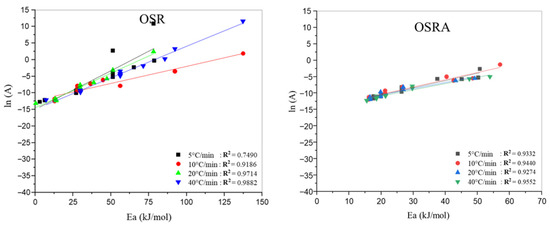
The kinetic study of the Tarfaya oil shale pyrolysis reveals a kinetic compensation effect, characterized by a linear interdependence between the activation energy (Ea) and the pre-exponential factor (ln A), for ORSA, as shown in Table 6 and Table 7 and Figure 13. The analysis highlights the decisive impact of selective decarbonation with acetic acid by removing calcite while preserving dolomite. This treatment transformed an initially heterogeneous system whose mechanism was characterized by a high dispersion of Ea (0 to 140 kJ/mol) into a coherent system with attenuated energy dispersion (15 to 60 kJ/mol). This homogenization, confirmed by determination coefficients R2 greater than 0.93 for OSRA, suggests that simplifying the mineral matrix reduces parasitic interactions while maintaining a controlled catalytic environment thanks to the dolomite. From a fundamental perspective, this correlation reflects the linear relationship between entropy and activation enthalpy during the formation of activated complexes, thus validating the effectiveness of this protocol for isolating and studying the intrinsic reactivity of kerogen.
Table 6.
Activation energies and Ln(A) of the pyrolysis of OSR according to the Coats–Redfern method.
Table 7.
Activation energies and Ln (A) of the pyrolysis of concentrate (OSRA) according to the Coats–Redfern method.
Figure 13.
Compensation effect curves of raw (OSR) and treated (OSRA) oil shale pyrolysis.
4.3.5. Comparative Study
Table 8 presents a synthesis of various studies compared to our results. The activation energy of the raw oil shale from the Tarfaya deposit, studied here, is approximately 190 kJ/mol. Compared to other regions, this value is relatively low, ranging between 200 and 350 kJ/mol globally. However, for oil shale from the same region, a slightly higher energy was obtained, but with a 20% conversion rate. This difference can be explained by the geological variations in these regions and also by the differences in working conditions and kinetic models chosen. After decarbonation, this energy decreases to 10 kJ/mol. This result is promising and scientifically important, as a low activation energy reflects the greater thermal reactivity of the oil shale and facilitates the pyrolysis of kerogen. In short, acetic-acid-treated oil shale requires a lower energy barrier to initiate pyrolysis reactions, meaning that it can be converted at lower temperatures or with reduced energy consumption. This confirms the choice of the decarbonation process as a potential method for exploiting Tarfaya oil shale as an energy source and is a strong indicator of high reactivity and suitability for thermochemical valorization. The reduction in activation energy is directly linked to the improved energy efficiency of the pyrolysis process. Compared to oil shales described in the literature, which generally exhibit high activation energies, our samples stand out with more favorable kinetic behavior, suggesting a less thermally organic structure or a more pronounced catalytic influence of the mineral phase. The presence of dolomite after calcite removal is often cited as a factor that can facilitate the breaking of organic bonds and lower the energy barrier of decomposition reactions. This result validates the choice of decarbonation process by demonstrating that the material studied has a more favorable energy potential than many oil shales already described in the literature, opening interesting prospects for its industrial exploitation and for optimizing pyrolysis processes with reduced energy consumption.
Table 8.
Comparative study of oil shale pyrolysis in various countries.
5. Conclusions
The selective removal of carbonate phases by acetic acid treatment was confirmed by XRF and XRD analyses, showing a marked reduction in carbonate minerals and a relative enrichment of silicate phases, while preserving the overall nature of the organic matter. The thermal degradation behavior of Tarfaya oil shale (OSR) and its treated concentrate (OSRA) revealed three main decomposition stages: moisture release below 260 °C, kerogen pyrolysis between 260 and 640 °C, and carbonate decomposition between 640 and 930 °C. Kinetic analysis performed using Kinetics Neo software, together with Criado master plots, the Coats–Redfern method, and model-free approaches including Friedman, Flynn–Wall–Ozawa (FWO), and Kissinger–Akahira–Sunose (KAS), highlighted significant differences in activation energy profiles and reaction pathways between the two samples.
In the main pyrolysis domain, raw oil shale exhibited relatively high apparent activation energies, reaching 192.91 kJ/mol for Friedman, 190.93 kJ/mol for Flynn–Wall–Ozawa, and 190.86 kJ/mol for Kissinger–Akahira–Sunose at α = 0.3, indicating that the decomposition process remained strongly influenced by the organo-mineral matrix. After acetic acid treatment, the apparent activation energy dropped markedly, reaching 14.09 kJ/mol and 10.78 kJ/mol according to FWO and KAS, respectively, reflecting a major reduction in the kinetic barrier and a strong acceleration of the degradation process. This change is attributed not only to carbonate removal itself, but also to the structural modifications induced by decarbonation, including reduced diffusion constraints, increased porosity, and improved release of volatile species.
The mechanistic analysis further confirmed that oil shale pyrolysis cannot be described by a single global model over the entire conversion range. Instead, the process evolves through multiple regimes depending on conversion and mineral composition. In OSR, the early stages are mainly controlled by diffusion-related mechanisms, consistent with the barrier effect exerted predominantly by calcite, whereas after treatment, the OSRA sample shifts toward reaction-order and contracting-interface behaviors during the main decomposition stage. These findings show that the role of carbonate minerals is not uniform throughout pyrolysis: calcite mainly hinders the early degradation of organic matter, while the removal of this constraint by acetic acid treatment promotes a more reactive and less diffusion-limited kinetic regime.
Overall, this study demonstrates that controlled decarbonation is an effective way to modify the organo-mineral interactions governing oil shale pyrolysis and to enhance the thermal conversion of kerogen. These findings highlight the importance of mineral-phase modification for improving the efficiency of oil shale valorization processes.
Author Contributions
H.F.: investigation, data analysis, writing—original draft, editing, reviewing. A.K.: investigation, editing, reviewing. S.A.: investigation, data analysis, reviewing. N.O.: investigation, reviewing. E.P.C.: data analysis, reviewing. M.O.: supervision, conceptualization and methodology, investigation, reviewing, final approval. All authors have read and agreed to the published version of the manuscript.
Funding
This research received no external funding. The APC was funded by the authors.
Data Availability Statement
The data presented in this study are available within the article.
Acknowledgments
This research received support from the Engineering and Materials Laboratory (LIMAT) at Hassan II University. We express our gratitude to the ONHYM for its technical support and expertise during the data analysis phase.
Conflicts of Interest
The authors declare that this study received a technical support from the ONHYM (the National Office of Hydrocarbons and Mines). The ONHYM was not involved in the study design, collection, analysis, interpretation of data, the writing of this article or the decision to submit it for publication.
References
- Jiang, Z.; Liang, C.; Wu, J.; Zhang, J.; Zhang, W.; Wang, Y.; Liu, H.; Chen, X. Several issues in sedimentological studies on hydrocarbon-bearing fine-grained sedimentary rocks. Acta Pet. Sin. 2013, 34, 1031. [Google Scholar] [CrossRef]
- Krime, A.; Saoiabi, S.; Tlemcani, M.; Saoiabi, A.; Carreiro, E.P.; Carrott, M.R. Turning Waste into Wealth: Sustainable Amorphous Silica from Moroccan Oil Shale Ash. Recycling 2025, 10, 143. [Google Scholar] [CrossRef] [Scilit]
- Krime, A.; Eloufir, M.R.; Saoiabi, S.; Tlemcani, M.; Morais, M.; Saoiabi, A. Extracting High Purity Nano-Silica from Oil Shale: Valorising a Neglected Natural Resource. Mater. Res. Bull. 2025, 192, 113561. [Google Scholar] [CrossRef] [Scilit]
- Ashteyat, A.M.; Al Rjoub, Y.S.; Obaidat, A.T.; Kirgiz, M.; Abdel-Jaber, M.; Smadi, A. Roller Compacted Concrete with Oil Shale Ash as a Replacement of Cement: Mechanical and Durability Behavior. Int. J. Pavement Res. Technol. 2024, 17, 151–168. [Google Scholar] [CrossRef] [Scilit]
- Alaloul, W.S.; Al Salaheen, M.; Malkawi, A.B.; Alzubi, K.; Al-Sabaeei, A.M.; Musarat, M.A. Utilizing oil shale ash as a construction material: A systematic review. Constr. Build. Mater. 2021, 299, 123844. [Google Scholar] [CrossRef] [Scilit]
- Rakcho, Y.; Mouiya, M.; Abouliatim, Y.; Bouazizi, A.; Sehaqui, H.; Mansouri, S.; Benhammou, A.; Hannache, H.; Alami, J.; Abourriche, A. Effect of firing temperature on porous ceramic properties fabricated by Moroccan red clay and oil shale. Mater. Today Proc. 2024. [Google Scholar] [CrossRef] [Scilit]
- Chafyq, E.H.; Legrouri, K.; Aghrouch, M.; Oumam, M.; Mansouri, S.; Khouya, E.; Hannache, H. Adsorption of the crystal violet dye on an adsorbent material prepared from Moroccan oil shales. J. Iran. Chem. Soc. 2023, 20, 351–359. [Google Scholar] [CrossRef] [Scilit]
- Rachid, Z.; Nordine, N.; Hamza, E.F.; Anas, K.; Soufiane, H.; Carreiro, E.P. Spatial Distribution, Health Risks and Heavy Metal Pollution Assessment of Surface Water Under Multiple Anthropogenic Stressors: Case Study in Middle Moulouya Watershed, Morocco. Resources 2025, 14, 183. [Google Scholar] [CrossRef] [Scilit]
- Glikson-Simpson, M. Oil Shales: A Complete Story; Springer: Cham, Switzerland, 2021. [Google Scholar] [CrossRef] [Scilit]
- El Bamiki, R.; Raji, O.; Ouabid, M.; Elghali, A.; Yazami, O.K.; Bodinier, J.-L. Phosphate Rocks: A Review of Sedimentary and Igneous Occurrences in Morocco. Minerals 2021, 11, 1137. [Google Scholar] [CrossRef] [Scilit]
- Qudaih, R.; Talab, I.; Syed, S.; Janajreh, I.; Hamdan, M. Material characterization and gasification of Jordanian oil shale. Int. J. Energy Environ. Econ. 2011, 19, 339. [Google Scholar]
- Pan, Y.; Fan, X. Research progress on electric heating technology for oil shale in situ mining. Oil Shale 2024, 41, 273–288. [Google Scholar] [CrossRef] [Scilit]
- Pan, Y.; Zhang, X.; Liu, S.; Yang, S.; Ren, N. A Review on Technologies for Oil Shale Surface Retort. J. Chem. Soc. Pak. 2012, 34, 1331–1338. [Google Scholar]
- Lu, X.; Tan, K.B.; Zhao, J.; Zhan, G. Advances in integrated catalysts for CO2 thermal hydrogenation to multicarbon products. Chem Catal. 2025, 5, 101264. [Google Scholar] [CrossRef] [Scilit]
- Li, Z.; Li, Y.; Wang, S.; Ren, M.; Duan, Y.; Liu, H. Supercritical hydrothermal combustion: Basic principles, characteristics and applications in energy and environment. Clean Energy Sci. Technol. 2025, 1, 122. [Google Scholar] [CrossRef] [Scilit]
- Antolinez, J.D.; Miri, R.; Nouri, A. In Situ Combustion: A Comprehensive Review of the Current State of Knowledge. Energies 2023, 16, 6306. [Google Scholar] [CrossRef] [Scilit]
- Sert, M.; Ballice, L.; Yüksel, M.; Sağlam, M. The effects of acid treatment on the pyrolysis of Göynük oil shale (Turkey) by thermogravimetric analysis. Oil Shale 2012, 29, 51–62. [Google Scholar] [CrossRef] [Scilit]
- Singh, S.; Wu, C.; Williams, P.T. Pyrolysis of waste materials using TGA-MS and TGA-FTIR as complementary characterisation techniques. J. Anal. Appl. Pyrolysis 2012, 94, 99–107. [Google Scholar] [CrossRef] [Scilit]
- Zhang, H.; Wang, S.; Shi, C.; Yan, J.; Ge, X.; Shen, J.; Chen, B.; Jiang, X.; Guo, Y. Evolution characteristics of products retorted from Gonghe oil shale based on TG-FTIR and Py-GC/MS. Thermochim. Acta 2022, 716, 179325. [Google Scholar] [CrossRef] [Scilit]
- Palayangoda, S.S.; Nguyen, Q.P. An ATR-FTIR procedure for quantitative analysis of mineral constituents and kerogen in oil shale. Oil Shale 2012, 29, 344–356. [Google Scholar] [CrossRef] [Scilit]
- Maaten, B.; Loo, L.; Konist, A.; Siirde, A. Mineral matter effect on the decomposition of Ca-rich oil shale. J. Therm. Anal. Calorim. 2017, 131, 2087–2091. [Google Scholar] [CrossRef] [Scilit]
- Cao, R.; Yang, D.; Kang, Z.; Huang, D.; Cui, Z.; Lu, Y. Effects of inherent minerals on pyrolysis behavior and kinetics of Jimsar oil shale. ACS Omega 2023, 8, 40396–40406. [Google Scholar] [CrossRef] [Scilit]
- Pan, L.; Dai, F.; Huang, J.; Liu, S.; Li, G. Study of the effect of mineral matters on the thermal decomposition of Jimsar oil shale using TG–MS. Thermochim. Acta 2016, 627–629, 31–38. [Google Scholar] [CrossRef] [Scilit]
- Aboulkas, A.; El Harfi, K. Study of the kinetics and mechanisms of thermal decomposition of Moroccan Tarfaya oil shale and its kerogen. Oil Shale 2008, 25, 426. [Google Scholar] [CrossRef] [Scilit]
- Makouki, L.; Tarbaoui, M.; Mansouri, S.; Hannache, H.; Oumam, M. Obtaining the protocol of elimination of carbonates from Moroccan oil shale using Plackett–Burman design. Int. J. Adv. Res. 2020, 8, 411–421. [Google Scholar] [CrossRef] [Scilit]
- Khawam, A.; Flanagan, D.R. Solid-state kinetic models: Basics and mathematical fundamentals. J. Phys. Chem. B 2006, 110, 17315–17328. [Google Scholar] [CrossRef] [Scilit] [PubMed]
- Koga, N. Physico-geometric kinetics of solid-state reactions by thermal analyses. J. Therm. Anal. 1997, 49, 45–56. [Google Scholar] [CrossRef] [Scilit]
- Vyazovkin, S.; Linert, W. The application of isoconversional methods for analyzing isokinetic relationships occurring at thermal decomposition of solids. J. Solid State Chem. 1995, 114, 392–398. [Google Scholar] [CrossRef] [Scilit]
- Brown, M.E.; Gallagher, P.K. Handbook of Thermal Analysis and Calorimetry: Recent Advances, Techniques and Applications; Elsevier: Amsterdam, The Netherlands, 2011. [Google Scholar]
- Friedman, H.L. Kinetics of thermal degradation of char-forming plastics from thermogravimetry. J. Polym. Sci. Part C Polym. Symp. 1964, 6, 183–195. [Google Scholar] [CrossRef] [Scilit]
- Vyazovkin, S.; Burnham, A.K.; Criado, J.M.; Pérez-Maqueda, L.A.; Popescu, C.; Sbirrazzuoli, N. ICTAC Kinetics Committee recommendations for performing kinetic computations on thermal analysis data. Thermochim. Acta 2011, 520, 1–19. [Google Scholar] [CrossRef] [Scilit]
- Kissinger, H.E. Variation of peak temperature with heating rate in differential thermal analysis. J. Res. Natl. Bur. Stand. 1956, 57, 217. [Google Scholar] [CrossRef] [Scilit]
- Akahira, T.; Sunose, T. Method of determining activation deterioration constant of electrical insulating materials. Res. Rep. Chiba Inst. Technol. 1971, 16, 22–31. [Google Scholar]
- Du, J.; Gao, L.; Yang, Y.; Chen, G.; Guo, S.; Omran, M.; Chen, J.; Ruan, R. Study on thermochemical characteristics and pyrolysis kinetics of mixtures of waste corn stalk and pyrolusite. Bioresour. Technol. 2021, 324, 124660. [Google Scholar] [CrossRef] [Scilit]
- Coats, A.W.; Redfern, J.P. Kinetic parameters from thermogravimetric data. Nature 1964, 201, 68–69. [Google Scholar] [CrossRef] [Scilit]
- Criado, J.M. Kinetic analysis of DTG data from master curves. Thermochim. Acta 1978, 24, 186–189. [Google Scholar] [CrossRef] [Scilit]
- Altun, N.E.; Hicyilmaz, C.; Hwang, J.-Y.; Bagci, A.S. Evaluation of a Turkish low-quality oil shale by flotation as a clean energy source. Fuel Process. Technol. 2006, 87, 783–791. [Google Scholar] [CrossRef] [Scilit]
- Koga, N.; Criado, J.M. Kinetic analyses of solid-state reactions with a particle-size distribution. J. Am. Ceram. Soc. 1998, 81, 2901–2909. [Google Scholar] [CrossRef] [Scilit]
- Johannes, I.; Luik, H.; Bojesen-Koefoed, J.A.; Tiikma, L.; Vink, N.; Luik, L. Effect Of Organic Matter Content And Type of Mineral Matter On The Oil Yield From Oil Shales. Oil Shale 2012, 29, 206. [Google Scholar] [CrossRef] [Scilit]
- Wang, Q.; Ye, J.; Yang, H.; Liu, Q. Chemical composition and structural characteristics of oil shales and their kerogens using FTIR spectroscopy and solid-state 13C NMR. Energy Fuels 2016, 30, 6271–6280. [Google Scholar] [CrossRef] [Scilit]
- Shin, S.-M.; Park, J.-K.; Jung, S.-M. Changes of aromatic CH and aliphatic CH in in situ FT-IR spectra of bituminous coals in the thermoplastic range. ISIJ Int. 2015, 55, 1591–1598. [Google Scholar] [CrossRef] [Scilit]
- Aboulkas, A.; El Harfi, K. Effects of acid treatments on Moroccan Tarfaya oil shale and pyrolysis of oil shale and their kerogen. J. Fuel Chem. Technol. 2009, 37, 659–667. [Google Scholar] [CrossRef] [Scilit]
- Wang, Q.; Zhang, L.; Bai, J.; Liu, X. The influence of microwave drying on physicochemical properties of Liushuhe oil shale. Oil Shale 2011, 28, 29–41. [Google Scholar] [CrossRef] [Scilit]
- Cheikh Moine, E.; Groune, K.; El Hamidi, A.; Khachani, M.; Halim, M.; Arsalane, S. Multistep process kinetics of the non-isothermal pyrolysis of Moroccan Rif oil shale. Energy 2016, 115, 931–941. [Google Scholar] [CrossRef] [Scilit]
- Jozanikohan, G.; Abarghooei, M.N. The FTIR analysis for clay mineralogy studies in a clastic reservoir. J. Pet. Explor. Prod. Technol. 2021, 12, 2093–2106. [Google Scholar] [CrossRef] [Scilit]
- Bai, F.; Sun, Y.; Liu, Y.; Guo, M. Evaluation of the porous structure of Huadian oil shale during pyrolysis using multiple approaches. Fuel 2017, 187, 1–8. [Google Scholar] [CrossRef] [Scilit]
- Sun, Y.; Bai, F.; Liu, B.; Liu, Y.; Guo, M.; Guo, W.; Wang, Q.; Lü, X.; Yang, F.; Yang, Y. Characterization of the oil shale products derived via topochemical reaction method. Fuel 2014, 115, 338–346. [Google Scholar] [CrossRef] [Scilit]
- Kristóf-Makó, É.; Juhász, A.Z. Effect of mechanical treatment on the crystal structure and thermal decomposition of dolomite. Thermochim. Acta 1999, 342, 105–114. [Google Scholar] [CrossRef] [Scilit]
- Saoiabi, A.; Doukkali, A.; Hamad, M.; Zrineh, A.; Ferhat, M.; Debyser, Y. Comportement thermique des schistes bitumineux de Timahdit (Maroc). C. R. Acad. Sci. Ser. IIC Chem. 2001, 4, 361–366. [Google Scholar] [CrossRef] [Scilit]
- Lamloumi, R. Comportement des Matériaux Minéraux de Grande Diffusion Lors Du Séchage: Étude Expérimentale et Modélisation. Ph.D. Thesis, Université de Limoges, Limoges, France, 2015. [Google Scholar]
- Vyazovkin, S.; Wight, C.A. Model-free and model-fitting approaches to kinetic analysis of isothermal and non-isothermal data. Thermochim. Acta 1999, 340–341, 53–68. [Google Scholar] [CrossRef] [Scilit]
- Burnham, A.K. Computational aspects of kinetic analysis: ICTAC kinetics project. Thermochim. Acta 2000, 355, 165–170. [Google Scholar] [CrossRef] [Scilit]
- Williams, P.T.; Ahmad, N. Investigation of oil-shale pyrolysis processing conditions using thermogravimetric analysis. Appl. Energy 2000, 66, 113–133. [Google Scholar] [CrossRef] [Scilit]
- Williams, P.T.; Ahmad, N. Influence of process conditions on the pyrolysis of Pakistani oil shales. Fuel 1999, 78, 653–662. [Google Scholar] [CrossRef] [Scilit]
- Bouamoud, R.; Cheikh Moine, E.; Mulongo-Masamba, R.; El Hamidi, A.; Halim, M.; Arsalane, S. Type I kerogen-rich oil shale from the Democratic Republic of the Congo. Pet. Sci. 2020, 17, 255–267. [Google Scholar] [CrossRef] [Scilit]
- Bai, F.; Sun, Y.; Liu, Y.; Li, Q.; Guo, M. Thermal and kinetic characteristics of pyrolysis and combustion of three oil shales. Energy Convers. Manag. 2015, 97, 374–381. [Google Scholar] [CrossRef] [Scilit]
- Chang, Z.; Chu, M.; Zhang, C.; Bai, S.; Ma, L. Investigation of the effect of selected transition metal salts on the pyrolysis of Huadian oil shale. Oil Shale 2017, 34, 354–367. [Google Scholar] [CrossRef] [Scilit]

Disclaimer/Publisher’s Note: The statements, opinions and data contained in all publications are solely those of the individual author(s) and contributor(s) and not of MDPI and/or the editor(s). MDPI and/or the editor(s) disclaim responsibility for any injury to people or property resulting from any ideas, methods, instructions or products referred to in the content. |
© 2026 by the authors. Licensee MDPI, Basel, Switzerland. This article is an open access article distributed under the terms and conditions of the Creative Commons Attribution (CC BY) license.