
Article

DFT Investigation of the Thermoelectric, Electronic, and Hydrogen Storage Properties of MgMH3 (M = Mn and Ni) Perovskites Using BoltzTrap

1
Engineering and Applied Physics Laboratory (EAPL), Superior School of Technology, Sultan Moulay Slimane University, Beni Mellal 23000, Morocco
2
The Moroccan Association of Sciences and Techniques for Sustainable Development, Beni Mellal 23000, Morocco
3
ERCI2A, FSTH, Abdelmalek Essaadi University, Tetouan 93000, Morocco
4
National Institute of Astrophysics, Optics and Electronics (INAOE), Puebla 72840, Mexico
5
Secretariat of Science, Humanities, Technology and Innovation (Secihti), Ciudad de México 03940, Mexico
6
SECIHTI-Faculty of Chemical Sciences and Engineering, Autonomous University of the State of Morelos (UAEM), Cuernavaca 62209, Mexico
*
Author to whom correspondence should be addressed.
Physchem 2026, 6(2), 21; https://doi.org/10.3390/physchem6020021
Submission received: 17 November 2025 / Revised: 1 January 2026 / Accepted: 31 March 2026 / Published: 6 April 2026

Abstract

This study provides a theoretical assessment of the structural, electronic, and thermal properties of MgMH3 (M = Mn and Ni) compounds using the full-potential linearized augmented plane wave (FP-LAPW) method, with a range of modern functionals. The thermoelectric properties that are surveyed here relate to the power factor, the dimensionless thermoelectric figure of merit, the thermal conductivity, and the electrical conductivity that are associated with these compounds. The study finds that MgNiH3 has superior thermoelectric properties compared to MgMnH3. The analysis of the band structure reveals that both materials conduct electricity like metals, as there is no energy gap (0 eV), indicating that the conduction and valence bands overlap. The thermal conductivity was found to be linearly related to an increase in temperature, whereas the electrical conductivity varied with temperature. At elevated temperatures, the maximum power factor values reach 1.45 × 10⁻³ W/(K2.m) for MgMnH3 and 1.96 × 10⁻³ W/(K2.m) for MgNiH3 at 900 K. Upon examination of the electronic states, the contributions to the metallic nature of these hydrides come largely from the Ni and Mn orbitals. This type of prospective information on the potential of MgNiH3 and MgMnH3 in industrial applications, especially thermoelectric applications, is a valuable contribution. Understanding their thermal and electronic structure will demonstrate their potential for industry.

1. Introduction

Hydrogen storage is a major challenge for the energy transition, given its growing role as a clean, sustainable energy carrier [1,2]. It is particularly attractive for the transport, industry, and power generation sectors, thanks to its use in fuel cells in particular, where it only releases water as a by-product [3,4,5,6,7]. Nevertheless, the physical and chemical characteristics of hydrogen make its storage a complex task. Its low volumetric density and high diffusivity present significant technical challenges for ensuring safe and efficient containment [8,9,10]. To overcome these limitations, various storage strategies are being studied, each with its own specific advantages and disadvantages. Currently, three main approaches are being explored: gaseous, liquid and solid storage [11,12,13]. Compressing hydrogen at a high pressure (350–700 bar) in reinforced tanks is known as gaseous storage [14,15]. This method is widely adopted, particularly for hydrogen-powered vehicles, but requires advanced materials and stringent safety features [16,17,18]. Liquid storage relies on the liquefaction of hydrogen at −253 °C, which improves its energy density [19,20,21]. However, this approach is energetically costly and requires complex cryogenic infrastructures [19,22,23]. Finally, solid-state storage exploits materials that are capable of absorbing or chemically reacting with hydrogen, such as metal hydrides, nanomaterials and porous structures [24,25]. Although this technique is promising for reversible storage at lower pressures, it remains in the development phase and requires advances in absorption/desorption kinetics and storage capacity [26,27].
Recent developments in thermal management and intelligent energy systems further emphasize the relevance of materials with optimized thermoelectric properties. For instance, a multi-U-shaped microchannel liquid cooling plate design has been shown to enhance battery thermal efficiency [28], while real-time optimal energy management strategies for connected plug-in hybrid vehicles demonstrate the growing role of such materials in intelligent transportation energy systems.
To understand and optimize the properties of semiconductor materials, it is essential to use advanced theoretical tools. Among these, density functional theory (DFT) plays a crucial role in predicting and analyzing the fundamental characteristics of materials at the atomic scale. This approach makes it possible to explore the density of electronic states, as well as the structural, optoelectronic, and magnetic properties of crystalline compounds [29,30,31,32]. In the realm of hydrogen storage, DFT enables the accurate calculation of several relevant properties, specifically the hydride formation energy, thermodynamic stability, and electronic and thermal transport properties. These methods are particularly favored by researchers to predict and improve thermoelectric materials. The DFT analysis of crystalline structures is useful for evaluating the structural, thermal, and electrical conductivity; the Seebeck coefficient; and the thermoelectric figure of merit properties [33,34,35,36]. Among the properties of interest is ABH3 perovskite-type hydrides, which are the focus of many theoretical and experimental studies due not only to their fascinating hydrogen storage capacity but also their electron transport characteristics. The DFT has been utilized broadly to study the structural, electronic, and thermal properties of perovskite materials, providing insight into the fundamental interactions driving their stability and performance [37,38,39,40]. Several perovskite hydrides have been synthesized and characterized experimentally. For example, the cubic perovskite hydride RbCaH3 has been synthesized by Hui Wu et al. [36] using a traditional solid-state synthesis method. Similarly, K. Komiya et al. determined the synthesis of the KMgH3 hydride by mechanical grinding and reported a simple, stable cubic structure [41]. In further development, the physical properties of XSnH3 (X = K, Li) were explored to evaluate their suitability for solid hydrogen storage, highlighting the promising nature of these compounds [42]. In this regard, DFT modeling is a powerful tool for an in-depth exploration of the potential hydrogen storage materials’ electrical, thermoelectric, and structural characteristics. In particular, ABH3 perovskite-type hydrides have received increasing attention for their reversible hydrogen storage capability, while also having tunable electronic and thermodynamic properties. Recent developments that are related to how hydrogen interacts with the structure are advancing the understanding of the stability and density of electronic states and the thermoelectric properties of these materials.
For that purpose, it is the appropriate use of perovskite-type hydrides in the storage of hydrogen that depends upon a detailed knowledge of the electronic and thermoelectric properties of those hydrides. In our research, the electrical and thermoelectric properties of MgMH3-type hydrides (where M = Mn and Ni) are studied by the generalized gradient approximation (GGA), which is assisted by the computer package BoltzTrap. The objective is to evaluate the effects of the thermodynamic parameters on their performance, with a focus on the effects of temperature on their thermoelectric properties. The overall goal of this work is to search for optimized materials that can serve as hydrogen storage and energy conversion materials based on advanced electronic structure calculations. Specifically, our work offers a comprehensive ab initio study of the structural, electronic, and thermoelectric properties of MgMH3 (M = Mn, Ni) perovskite hydrides, which have not been thoroughly examined in previous research. The novelty of our research lies in its ability to accurately connect the electronic band structure with the thermoelectric performance parameters, such as the Seebeck coefficient and the power factor. Additionally, the findings indicate that replacing the transition metal (Mn with Ni) significantly impacts the electronic transport properties, thus addressing the potential for compositional engineering to enhance the thermoelectric efficiency. These insights provide valuable theoretical guidance for the experimental synthesis and optimization of similar hydride-based materials. Furthermore, we highlight that MgMH3 perovskite hydrides offer two key functionalities: their lightweight nature and hydrogen-rich content make them promising candidates for solid-state hydrogen storage, and their exceptional thermoelectric properties suggest potential uses in energy conversion devices, especially waste heat recovery systems. The continuation of this work will outline the methodologies that were applied, summarize the results that were obtained, and discuss the implications for producing more effective and sustainable hydrogen storage materials.

2. Calculation Method

To enable further exploration of the electronic and thermoelectric properties of MgMH3 (where M = Mn and Ni), we will apply sophisticated modeling methods based on DFT. This approach allows us to investigate the electronic structure and fundamental interactions as a function of potential use for hydrogen storage and energy conversion. In particular, the generalized gradient approximation (GGA) in the form of the Perdew–Burke–Ernzerhof (PBE) functional was chosen to describe electron exchange and correlation interactions, thus guaranteeing an accurate description of the system’s electronic and thermoelectric properties. In this study, theoretical calculations were carried out using the DFT framework implemented in the Wien2k code [43,44], which is an ab initio calculation software based on the linearized augmented plane wave (LAPW) method. The thermoelectric properties were evaluated using the BoltzTrap package, which estimates electronic transport coefficients based on the constant relaxation time approximation (CRTA) and an efficient interpolation of the band structure. The CRTA was chosen because it is a standard and widely used approach in the theoretical studies of thermoelectric materials. Although it does not yield absolute values for transport coefficients, it provides consistent and reliable trends that allow for a meaningful comparison between MgMnH3 and MgNiH3, which is the main objective of this study.
The WIEN2k package, based on the FP-LAPW method, was used to perform geometry optimization, total energy, and electronic structure calculations. The BoltzTrap code was employed to evaluate thermoelectric properties by computing transport coefficients such as the electrical conductivity, the Seebeck coefficient, and the thermal conductivity within the CRTA. The CRTA allows for a consistent comparison between the studied materials by assuming a uniform scattering time for the charge carriers.
The crystal structure was optimized using the Birch–Murnaghan equation of state to ensure a well-structured geometry and minimize the system’s overall energy. The convergence of the calculations was established for charge and total energy, setting tolerances at 0.0001 (e) and 0.001 (Ry), respectively, which ensured robustness and reliability in the calculations. Moreover, to get a finer description of the band structure and transport properties, the Brillouin zone was sampled using a dense grid of 1000 k-points. Using this method allows for a refined calculation of thermoelectric coefficients, which are essential parameters in evaluating the suitability of the materials studied for energy accumulation and conversion applications.
It is important to note that all the calculations in this study were carried out in the non-spin-polarized mode. Although spin polarization and possible magnetic orderings (ferromagnetic or antiferromagnetic) may occur in transition metal hydrides, such as those containing Mn and Ni, the present work focuses primarily on the structural, electronic, and thermoelectric properties of MgMH3 compounds. The objective was to analyze the general transport behavior (electrical conductivity, Seebeck coefficient, and thermal conductivity) based on the non-magnetic DFT results obtained using the BoltzTrap code. The investigation of magnetic effects lies beyond the scope of the current study and will be considered in future work.

3. Results and Discussion

3.1. Structural Properties

The MgMH3 (M = Mn and Ni) have a well-defined cubic crystal structure consisting of well-defined units of packed atoms in a lattice. In this structure, the magnesium atoms (Mg) are found at the vertices of the cube at (0,0,0), while the transition (M = Mn or Ni) transitive atoms are at the center of the conventional lattice at (1/2,1/2,1/2), leading to a stable homogeneous lattice. Additionally, the hydrogen atoms are located on octahedral sites at (0,1/2,1/2), (1/2,0,1/2) and (1/2,1/2,0), leading to a balanced bonding environment of the atoms in the crystal structure. This structure follows the space group Pm 3 m ¯ (no. 221) characteristic of cubic perovskites and confers high structural symmetry to the hydrides studied. The evaluation of the lattice parameters obtained from ab initio calculations (presented in Table 1) confirms the stability and accuracy of the results, which are in agreement with the experimental and theoretical values reported in the literature. The consistency of the values obtained testifies to the reliability of the calculation methods that were employed and provides a better understanding of the fundamental interactions governing these materials.
The atomic configuration shown in Figure 1 is an example of the crystal structure for MgMH3 (M = Mn and Ni) perovskite hydrides. The arrangement shows the octahedral coordination of the hydride ions situated about the central metal atom, which plays a significant role in the electronic and thermoelectric properties, which are commonly discussed within the literature. This morphological configuration has numerous opportunities for an ongoing exploration of structural and energetic properties, particularly with respect to the potential relevance of applications in hydrogen storage and energy conversion contexts. A more thorough examination of the crystal structure and surrounding dynamics will complement our understanding of the electronic density of states and the thermoelectric properties of these materials.
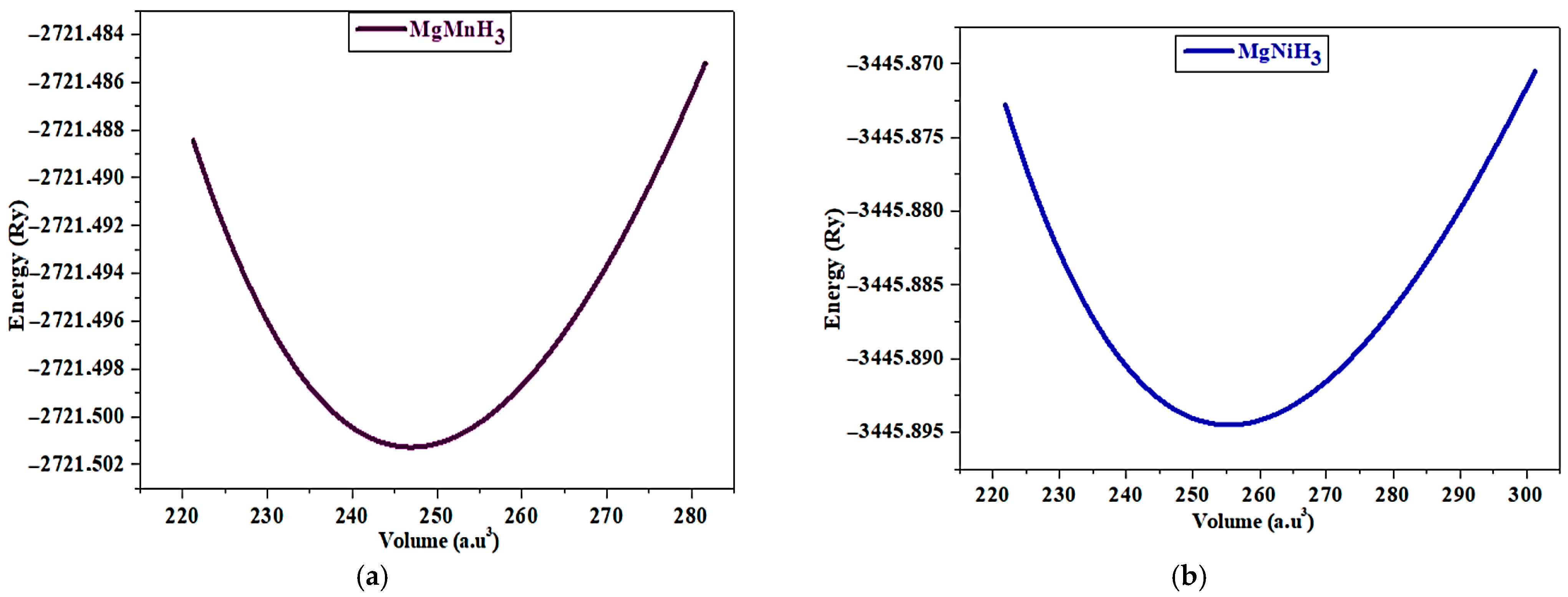
The geometric optimization of MgMH3 (M = Mn and Ni) has been carried out to determine the most stable ground-state configuration of the system, as presented in Figure 2. This process is based on the minimization of the total energy as a function of structural parameters, notably the unit cell volume and the c/a ratio. Initially, the internal forces acting on the atoms of the crystal lattice are computed and made to approach zero iteratively. This situation guarantees that the atoms are close to their equilibrium state, where the geometric arrangement reaches a minimum in energy. Then, the total energy of the system is computed for the different values of the volume and c/a ratio, and we can construct an energy–volume relationship that characterizes the structural behavior of the systems studied. The Birch–Murnaghan equation of state [48] was used to construct this relationship between the energy E and the volume V of the system according to:
E = E 0 + B 0 B 0 V V 0 B 0 V 0 B 0 1 B 0   V V 0 1 B 0 1
where E0 is the minimum energy of the system at the ground state and the energetic stability of the optimized structure, V0 is the optimal volume of the unit cell, which is the equilibrium configuration of the material, B0 is the compressibility modulus, which is a significant parameter characterizing the resistance of the material to compression, B0′ is the pressure derivative of the compressibility modulus, characterizing the change in the compressibility modulus under external stress. The results are shown in Table 2. The precise adjustment of this equation makes it possible to extract these fundamental parameters, providing crucial information on the rigidity and mechanical stability of MgMH3. The analysis of the total energy convergence point thus makes it possible to determine the optimum material configuration, followed by further optimization tests to validate the structural stability of the MgMH3 phases (M = Mn and Ni). These results provide a solid basis for exploring the potential of these materials in hydrogen storage and energy conversion applications.

3.2. Hydrogen Storage Properties

To evaluate their suitability for hydrogen storage, the gravimetric capacity of MgMH3 (M = Mn, Ni) perovskites was determined using Equation (2). This gravimetric percentage (Cwt%) reflects the mass fraction of hydrogen stored in relation to the total mass of the material. The calculation of Cwt% follows the formula outlined below [49]:
C w % = H M m H m H o s t + H M m H × 100 %
Both compounds exhibit Cwt% values above three, suggesting that MgMH3 (M = Mn and Ni) perovskites are promising candidates for hydrogen storage applications [45,49]. Table 3 illustrates a representation of the gravimetric storage capacity of these materials. Among the two, MgMnH3 shows a slightly higher capacity, likely due to its crystal structure, which may facilitate a better hydrogen storage efficiency compared to MgNiH3.

3.3. Mechanical Properties

The mechanical stability and elastic behavior of MgMH3 (M = Mn and Ni) perovskite hydrides were evaluated through the calculation of their elastic constants and derived mechanical parameters. For cubic systems, mechanical stability is ensured when the Born criteria are satisfied: C11 + 2C12 > 0, C11-C12 > 0, C11 > 0 and C11 > B > C12. As presented in Table 4, both compounds meet these conditions. For MgNiH3, the elastic constants are C11 = 205.13 GPa, C12 = 42.97 GPa, and C44 = 35.22 GPa, while MgMnH3 exhibits higher values with C11 = 634.63 GPa, C12 = 73.83 GPa, and C44 = 27.25 GPa, indicating a stronger resistance to elastic deformation and an enhanced lattice stiffness.
The bulk modulus (B), shear modulus (G), and Young’s modulus (E) were calculated using the Voigt–Reuss–Hill approximation and are summarized in Table 5. MgNiH3 presents B = 97.02 GPa, G = 49.54 GPa, and E = 127.01 GPa, whereas significantly higher values are obtained for MgMnH3 with B = 260.76 GPa, G = 84.23 GPa, and E = 228.10 GPa. These results confirm that MgMnH3 is mechanically stiffer and more resistant to both volumetric and shear deformations compared to MgNiH3. B/G and v are identified as the brittleness and toughness of the materials according to their critical values 1.75 and 0.26 [50], respectively. While brittleness is indicated by a low value, ductility is linked to a high B/G ratio. Roughly 1.75 is the crucial number that divides materials into ductile and brittle categories; that is, (brittle < 1.75 < ductile) [51]. In addition, when Poisson’s ratio is greater than 0.26, the material is ductile, and a larger value corresponds to a higher ductility [50]. Both compounds exhibit B/G values exceeding the critical limit of 1.75, with MgNiH3 showing a value of 1.96 and MgMnH3 reaching 3.10, indicating a pronounced ductile behavior, particularly for MgMnH3. Additionally, the calculated Poisson’s ratios are 0.282 for MgNiH3 and 0.354 for MgMnH3, further confirming their ductile nature and suggesting that the central interatomic forces dominate the bonding mechanism. Overall, these mechanical properties demonstrate that MgMH3 perovskite hydrides possess adequate structural stability and mechanical robustness, making them suitable candidates for hydrogen storage and thermoelectric applications under operating conditions involving thermal and mechanical stresses.

3.4. Thermoelectrical Properties

The thermoelectric properties of materials are directly influenced by their electronic structure and electron transport behavior. In this study, these characteristics are analyzed using the BoltzTrap code. These methods explore the electrical conductivity (σ), the thermal conductivity (κ), the Seebeck coefficient (S), the power factor (PF), as well as the thermoelectric figure of merit (zT). The thermoelectric materials play a key role in the recovery and conversion of thermal energy into electricity, particularly in the field of renewable energies. A large proportion of thermal energy is, in fact, dissipated in current energy systems, motivating the search for new materials with optimized properties. In this context, MgMH3 (M = Mn and Ni) perovskite hydrides are promising candidates due to their potential thermoelectric performance at temperatures between 300 K and 900 K.
The conventional thermoelectric materials, such as Bi2Te3, are narrow bandgap semiconductors that achieve high thermoelectric efficiency through a balance between moderate electrical conductivity, large Seebeck coefficient, and reduced thermal conductivity [52,53]. In contrast, MgMH3 (M = Mn, Ni) compounds exhibit metallic or semi-metallic behavior, leading to a high electrical conductivity but relatively low Seebeck coefficients. Although this metallic nature limits their zT values compared to optimized semiconductors like Bi2Te3, it offers advantages in terms of carrier mobility, thermal stability, and structural robustness at elevated temperatures. The recent studies have shown that metallic thermoelectric materials can be attractive for high-temperature and waste heat recovery applications [54,55], particularly when strategies such as chemical substitution or phonon scattering are employed to suppress lattice thermal conductivity. Therefore, analyzing the thermoelectric performance of MgMH3 hydrides provides valuable insight into alternative thermoelectric material classes beyond the conventional semiconductors.
The transport properties discussed in this section are evaluated within the constant relaxation time approximation. As a result, the calculated electrical conductivity and power factor should be interpreted in terms of relative trends rather than absolute magnitudes. This approach allows a consistent comparison of the thermoelectric performance between MgMnH3 and MgNiH3 and provides a valuable insight into the role of electronic structure in governing transport behavior.

3.4.1. Electrical Conductivity

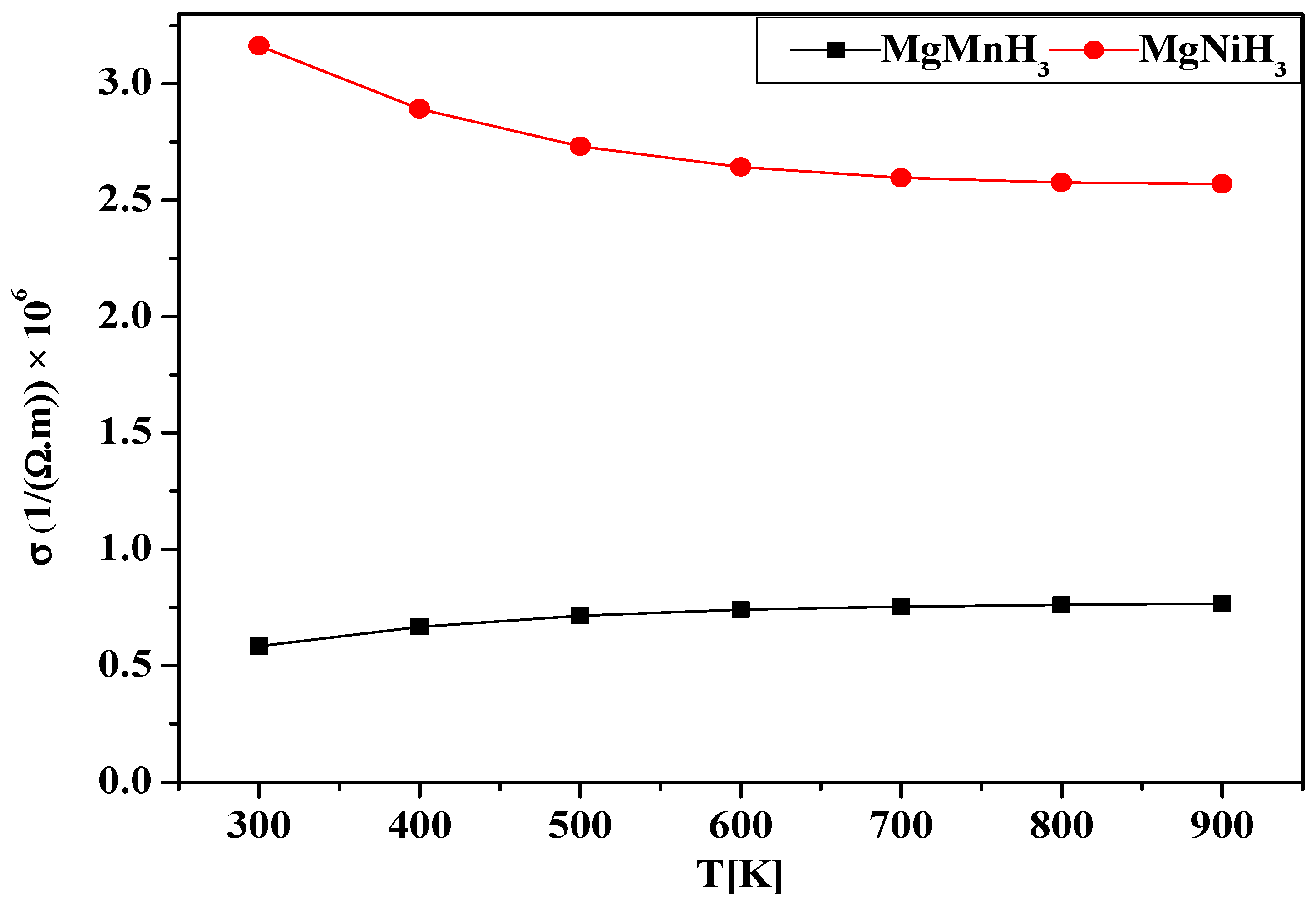
The σ is a key property of thermoelectric materials, governing the transport of charge carriers within the crystal lattice. Conductivity is crucial to the conversion of thermal energy into electrical energy, and is influenced by several factors, including chemical composition and crystal structure. Figure 3 displays distinct changes in σ as a function of temperature for MgMH3 (M = Mn and Ni). For MgMnH3, it increases progressively with the rising temperature, reaching a value of 0.75 × 106·1/(Ω·m) at 900 K. In contrast, for MgNiH3, σ decreases with the temperature rise, rising from 3.60 × 106·1/(Ω·m) at 300 K to 2.54 × 106·1/(Ω·m) at 900 K. The results, plotted in Figure 3, show that trends in σ differ according to the nature of the transition element M in the MgMH3 structure. This can be attributed to variations in the number of available charge carriers, changes in electron mobility, and electron–phonon interactions at high temperatures.

3.4.2. Seebeck Coefficient

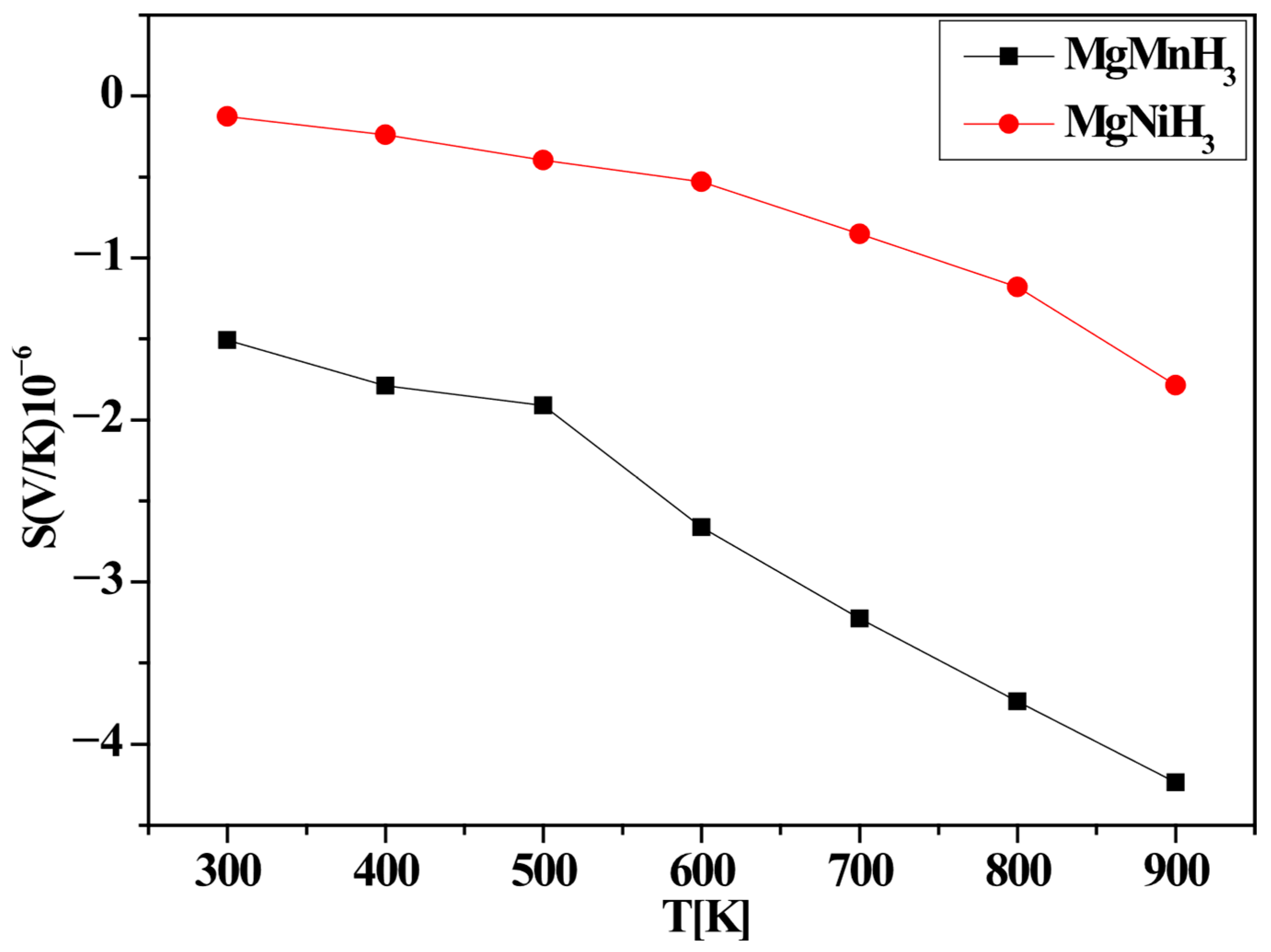
Figure 4 shows the variation in the Seebeck coefficient (S) as a function of temperature (T) for the compounds MgMnH3 and MgNiH3. Both materials show a decrease in S as the temperature increases from 300 K to 900 K. The negative values of the Seebeck coefficient indicate that MgMnH3 and MgNiH3 are n-type, meaning that electrons are the majority charge carriers. It can be seen that MgNiH3 has higher S values than MgMnH3, indicating a better potential thermoelectric capacity. The decrease in S with the temperature suggests an increase in charge carrier concentration. Thus, MgNiH3 appears to perform better for thermoelectric applications than MgMnH3.

3.4.3. Power Factor

The power factor is a key indicator of the efficiency of a thermoelectric material. It is defined by the following expression [56]:
Power factor (PF) = σS2
A high power factor is essential for maximizing the efficiency of thermoelectric devices, particularly in high-temperature industrial applications [57].
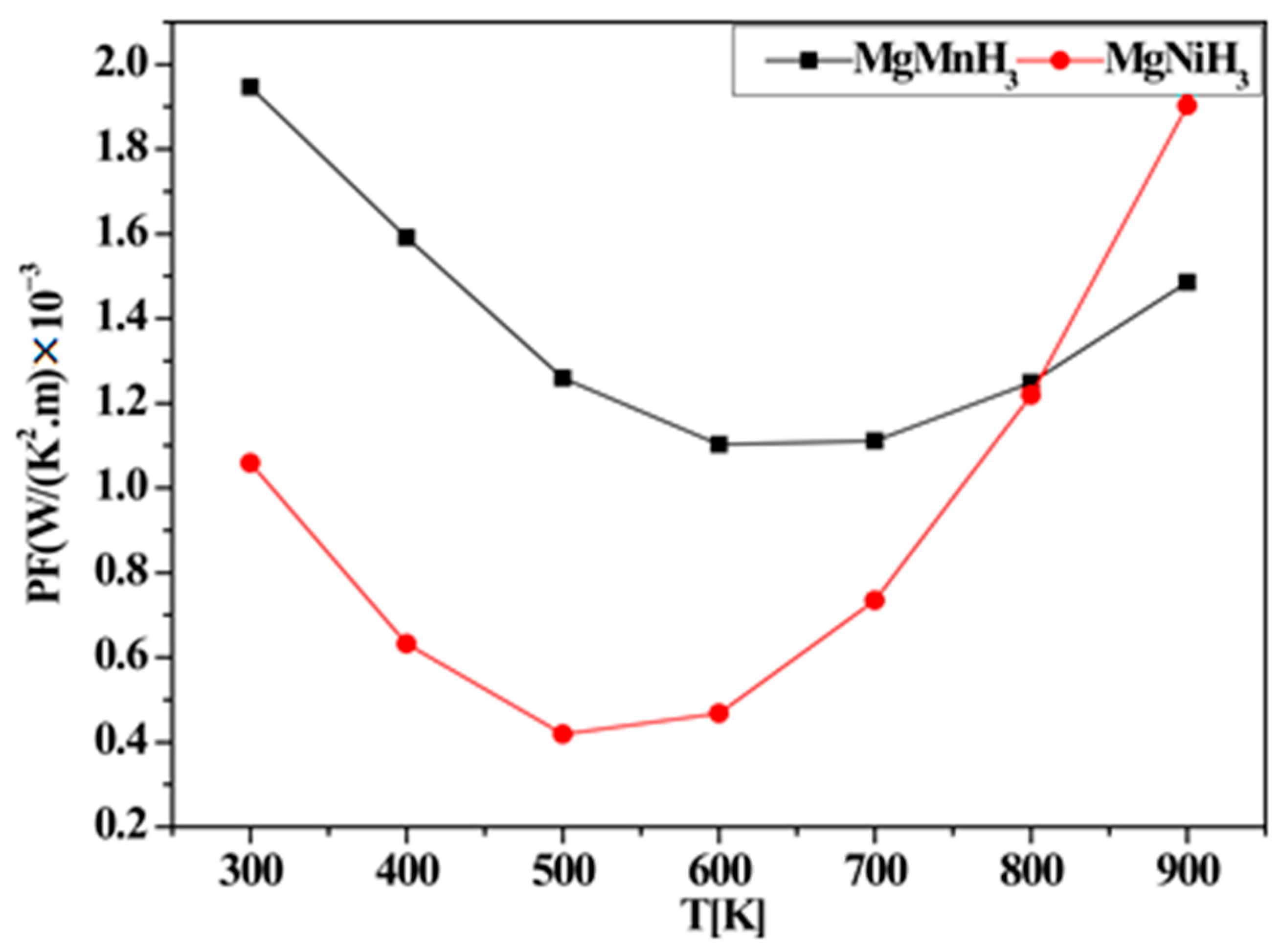
The results obtained show that the element M strongly influences the PF of MgMH3 (M = Mn and Ni), as shown in Figure 5. Comparative analysis of the compounds MgMnH3 and MgNiH3 reveals specific trends. For MgMnH3, the PF decreases between 300 K and 600 K, then increases between 600 K and 900 K, and for MgNiH3, the PF decreases between 300 K and 500 K, before increasing between 500 K and 900 K.
At elevated temperatures, maximum power factor values reach 1.45 × 10⁻³ W/(K2·m) for MgMnH3 and 1.96 × 10⁻³ W/(K2·m) for MgNiH3 at 900 K. Interestingly, MgMnH3 exhibits a particularly high power factor from 300 K, reaching 1.98 × 10⁻³ W/(K2·m), making it a promising candidate for moderate temperature applications.

3.4.4. Thermal Conductivity

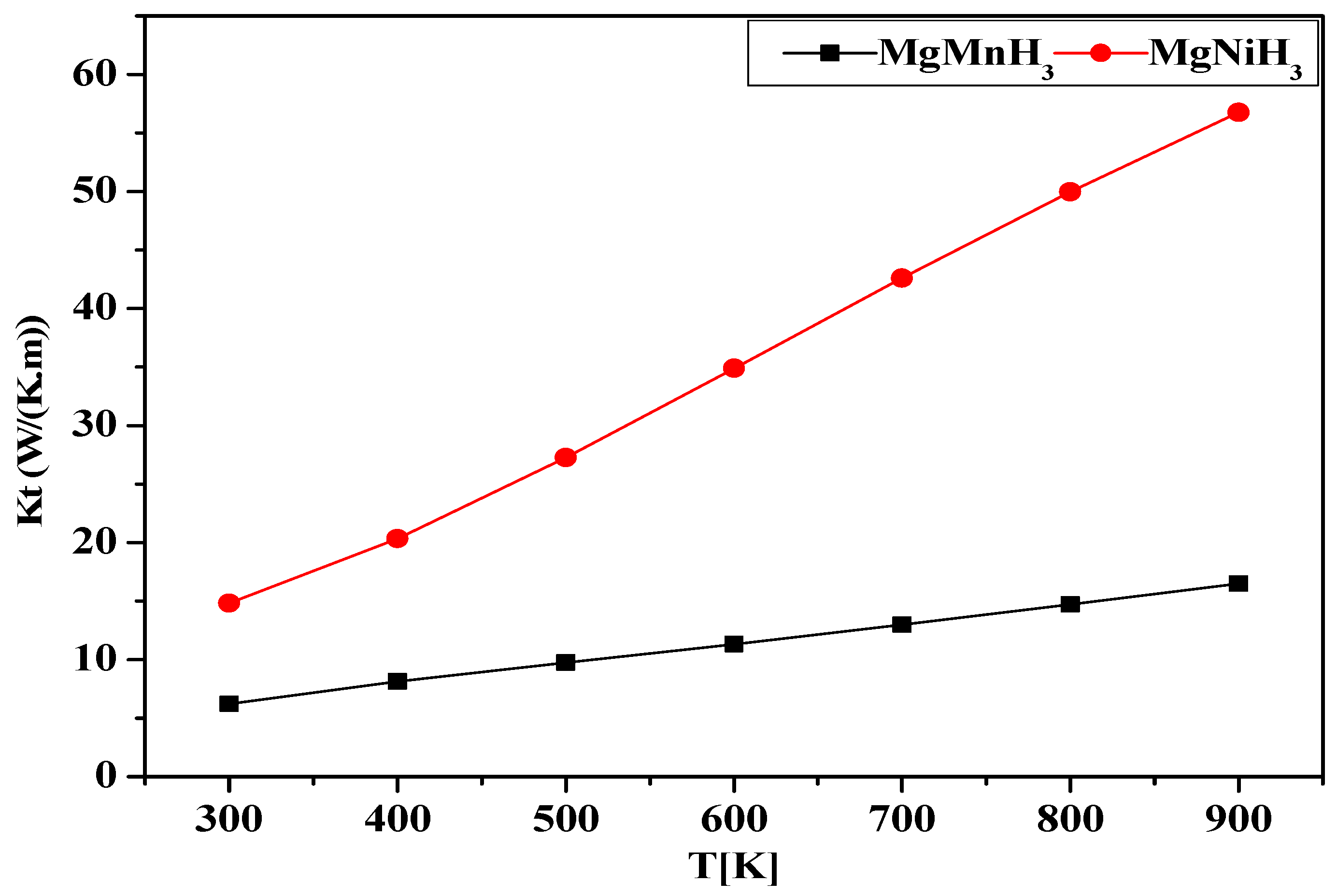
The κ is a crucial property when exploring thermoelectric materials as it enables heat transfer in a material. This property is inherently associated with the movement of free electrons and phonons in the lattice of the crystal. The κ of MgMH3 (M = Mn and Ni) exhibits a linear evolution with temperature, in which no rapid transitions are observed. The data that were collected show a linear change in κ with the temperature (Figure 6) that reaches 57 W (K·m) for MgMnH3 and 11.50 W (K·m) for MgNiH3 at 900 K. This is due to the progressive build-up of molecular vibrations within the lattices that is observed with an increasing temperature. The temperature rise produces a higher number of excitations of both the free electrons and phonons, thus increasing thermal transport through the material. Therefore, we conclude that the κ of MgMH3 (M = Mn and Ni) is considerably temperature-dependent and shows a potential avenue for improving the thermoelectric performance if κ could be reduced.

3.4.5. Merit Factor

The zT is a dimensionless quantity that characterizes the efficiency of a thermoelectric material in converting heat into electricity. It is defined by the following relationship [56]:
zT   =   σ s 2 T κ
An elevated dimensionless thermoelectric figure of merit (zT) reflects an excellent thermoelectric performance, which is typically achieved through a combination of high electrical conductivity, low thermal conductivity, and a significant Seebeck coefficient [58].
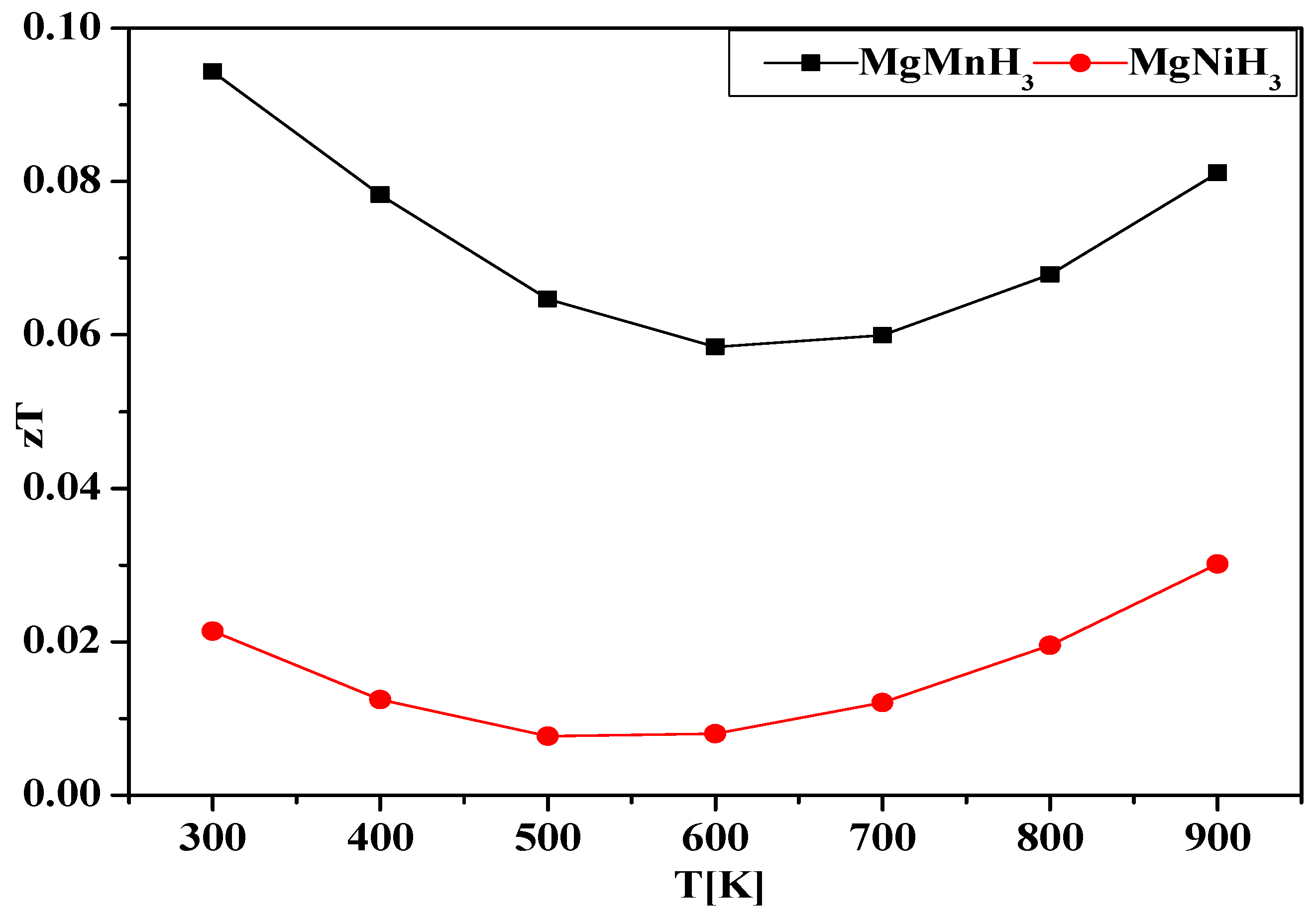
The zT for MgMH3 (M = Mn and Ni) is influenced by the temperature and the intrinsic electronic properties of the material, as shown in Figure 7. The results obtained show that, for MgNiH3, zT decreases between 300 K and 600 K, then increases between 600 K and 900 K, and for MgMnH3, zT decreases between 300 K and 500 K, before increasing between 500 K and 900 K.
At 900 K, the maximum values reach 0.03 for MgNiH3 and 0.08 for MgMnH3. However, it is notable that MgMnH3 exhibits a relatively high zT as early as 300 K, reaching 0.097, which is significant for thermoelectric applications at moderate temperatures. These observations show that, although the thermal and electrical conductivity of MgMH3 hydrides is relatively high (which limits their thermoelectric performance), optimizing the chemical composition and reducing the thermal conductivity could improve their efficiency. These results thus open up interesting prospects for integrating these materials into thermal energy recovery devices.
The non-monotonic evolution of zT with temperature originates from the competing contributions of the Seebeck coefficient, electrical conductivity, and thermal conductivity. In the 300–600 K range, the decrease in zT is mainly governed by the reduction in the Seebeck coefficient and the increasing thermal conductivity that is associated with enhanced phonon activity. Above 600 K, the improvement in the power factor (σS2), combined with a slower increase in thermal conductivity, leads to a recovery and subsequent increase in zT values. Such behavior is commonly observed in metallic and semi-metallic thermoelectric materials.

3.5. Electronic Properties

3.5.1. Band Structures of MgNiH3 and MgMnH3

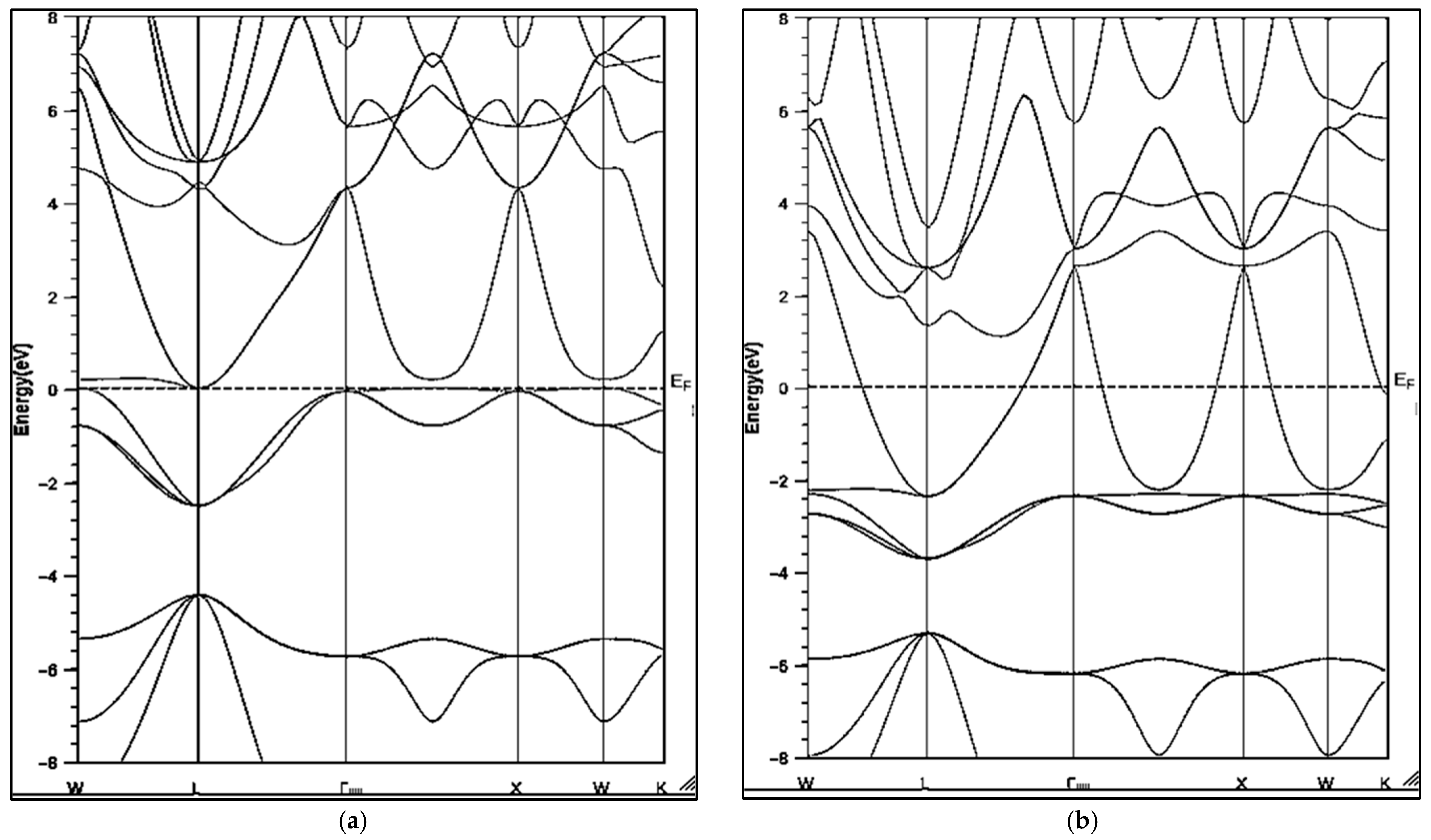
Figure 8 presents the electronic band structures of MgMnH3 (a) and MgNiH3 (b) compounds. The high symmetry directions in the Brillouin zone (W–L–Γ–X–K) are plotted along the x-axis, and the energy in electron volts (eV) is plotted on the y-axis. The Fermi level (EF) is marked with a horizontal red dotted line, and the valence and conduction bands are represented by black curves. Some of the points of contact or separation between the bands at the Fermi level can be seen, confirming the electronic nature of the two materials [59,60]. The differences in dispersion in the two diagrams confirm the sensitivity of the electronic structure of the compound to the insertion of the transition metal (Mn or Ni).
The band structure calculation shows that MgMnH3 and MgNiH3 possess different electronic characteristics. MgMnH3 exhibits the Fermi level crossing a very narrow overlap between the conduction band and the valence band, indicating metal or semi-metal character with a non-zero density of states at the Fermi level and, thus, better electronic conductivity. In contrast, MgNiH3 has a well-defined band gap between the valence and the conduction, reflecting its semiconductor character. The incorporation of Ni changes the electronic distribution and influences the optical and thermoelectric material properties. The more dispersed conduction band in MgNiH3 would mean greater electron mobility, and this would be responsible for the higher Seebeck coefficient values of this compound.
Additionally, substituting Mn with Ni creates a tighter hybridization between d orbitals and H orbitals, increasing the band gap. Hence, MgNiH3 seems to be more suitable for use where the electronic stability and regulated conductivity are needed [45,60].
Therefore, investigations of the band structures will improve understanding of electronic interactions in these materials and predict their effectiveness in applications, in particular, renewable energy and thermoelectrics.

3.5.2. Total and Partial Density of States

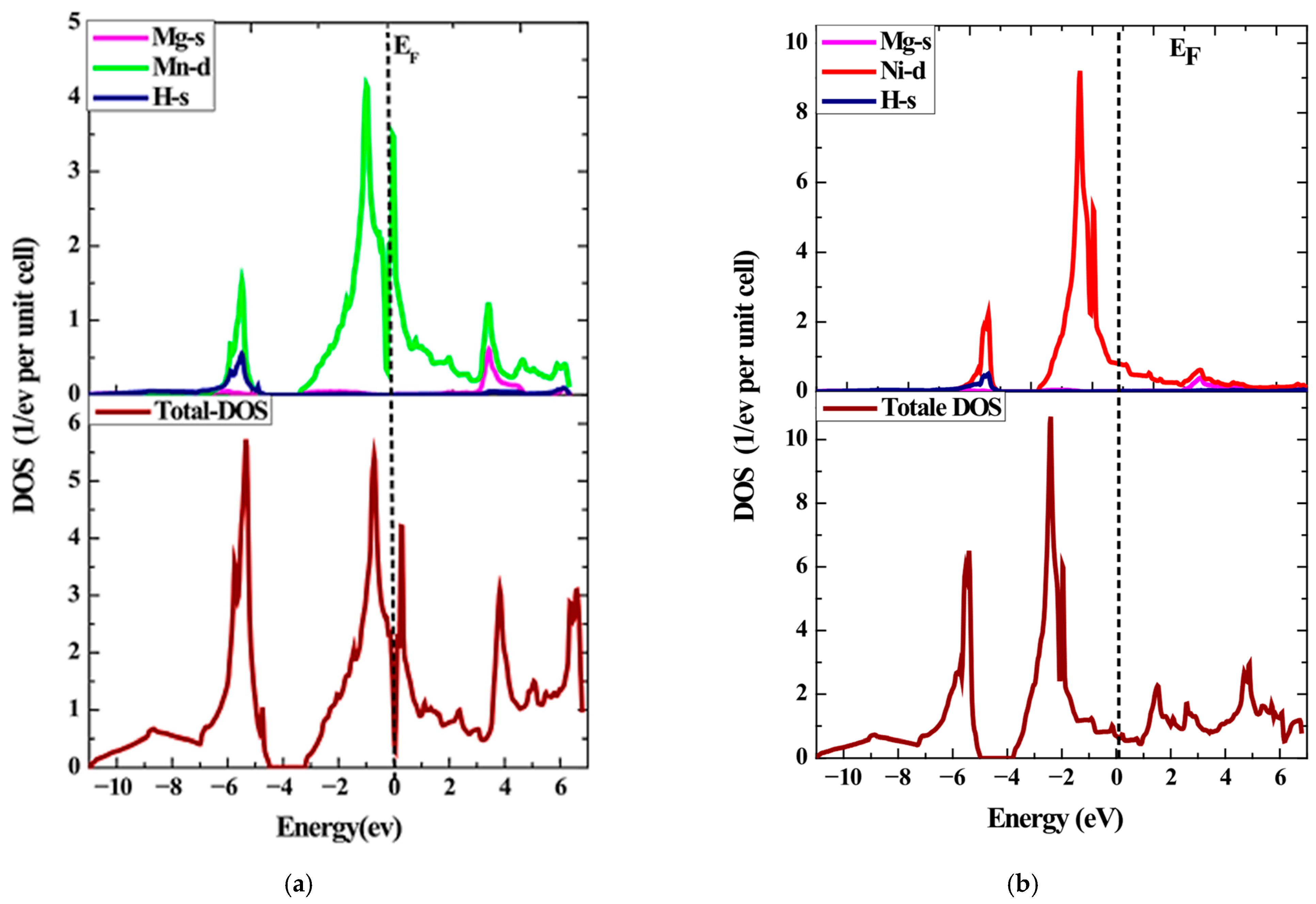
The density of states (DOS) is a key concept for analyzing the physical behavior of materials. It enables the determination of most electronic properties and offers valuable insights into the nature of chemical bonding and charge transfer between atoms. Ultimately, DOS serves as a powerful tool for understanding the electronic structure and the interactions governing a material’s internal dynamics [61,62,63]. The TDOS and PDOS plots, presented in Figure 9, show that the Mg-s and H-s states play an essential role in CB formation. A distinct peak is discernible for these states, exhibiting a progressive shift toward higher energy levels. This trend reflects a diminished thermodynamic stability of the compound as the energy increases [64,65,66]. Figure 9a shows that the MgMnH3 material has an energy peak located at −1 eV, while Figure 9b shows an energy peak at −2.5 eV for MgNiH3. Comparing the two, the MgNiH3 peak reaches a value of 8.7, which is significantly higher than that of MgMnH3, which is 4.2. The d states of Ni and Mn contribute significantly, according to the DOS study. With secondary contributions from Mg and H states as well as additional Ni and Mn electronic states, these d states predominate in the metallic behavior of the hydride that is under study. It is particularly noteworthy that the inter-metallic behavior of MgMH3 is enhanced as the Mn-d states peak shifts and disperses in the VB [67]. This shift indicates a shift in the electronic properties of the material that may impact its potential uses in a number of technologies.

4. Conclusions

In this study, we performed a thorough theoretical study to predict the structural, thermal, and electronic properties of MgMH3 (M = Mn and Ni) materials using the FP-LAPW method, combined with several up-to-date functionals. The obtained information gives a value to understand the behavior of these elements, which provides a view of the thermoelectric properties σ, S, PF, κ, and zT. The study shows that MgNiH3 has superior thermoelectric properties to MgNiH3 with a very high PF and very high κ; therefore, it is a desirable material for use in energy applications, as its properties were found to be more efficient than MgMnH3. As for the band structures, the CB and VB overlap in MgNiH3 and MgMnH3, resulting in a gap of 0 eV, demonstrating the conductivity behavior of the metal. The thermal properties showcase thermal conductivity, which increases linearly with temperature as a result of the molecular vibrations in the MgMH3 compounds increasing. However, κ seems stable for some materials and varies as a function of temperature for others. It is primarily influenced by the d states of Ni and Mn, reflecting metallic behavior. Overall, the detailed and somewhat interesting information explained here gives further understanding of the electronic and thermal conductance behaviors of MgNiH3 and MgMnH3. These results underline the importance of thermal and electronic structures in assessing the viability of these materials for various technological applications and demonstrate their potential in the field of thermoelectric materials.

Author Contributions

A.K.: Writing—original draft, visualization, validation, investigation, formal analysis, data curation, conceptualization. Y.Z.: Supervision, visualization. H.B.: Visualization, validation, formal analysis. C.L.: Visualization. N.L.: Visualization. Z.Z.: Visualization. All authors have read and agreed to the published version of the manuscript.

Funding

The authors are warmly grateful to the support of “The Moroccan Association of Sciences and Techniques for Sustainable Development (MASTSD), Beni Mellal, Morocco”.

Data Availability Statement

Data will be made available on request.

Acknowledgments

The authors are warmly grateful for the support of “the Moroccan Association of Sciences and Techniques for Sustainable Development (MASTSD), Beni Mellal, Morocco,” and to its president, Charaf Laghlimi, for the valuable proposals. The authors would like to thank the Library of Lycee Technique Mohammed 5, Hay Atlas, Beni Mellal, Morocco.

Conflicts of Interest

The authors declare that they have no known competing financial interests or personal relationships that could have appeared to influence the work reported in this paper.

References

  1. Kovač, A.; Paranos, M.; Marciuš, D. Hydrogen in energy transition: A review. Int. J. Hydrogen Energy 2021, 46, 10016–10035. [Google Scholar] [CrossRef]
  2. Guilbert, D.; Vitale, G. Hydrogen as a clean and sustainable energy vector for global transition from fossil-based to zero-carbon. Clean Technol. 2021, 3, 881–909. [Google Scholar] [CrossRef]
  3. Alaswad, A.; Baroutaji, A.; Achour, H.; Carton, J.; Al Makky, A.; Olabi, A.G. Developments in fuel cell technologies in the transport sector. Int. J. Hydrogen Energy 2016, 41, 16499–16508. [Google Scholar] [CrossRef]
  4. Luo, Y.; Wu, Y.; Li, B.; Mo, T.; Li, Y.; Feng, S.-P.; Qu, J.; Chu, P.K. Development and application of fuel cells in the automobile industry. J. Energy Storage 2021, 42, 103124. [Google Scholar] [CrossRef]
  5. Ajanovic, A.; Haas, R. Prospects and impediments for hydrogen and fuel cell vehicles in the transport sector. Int. J. Hydrogen Energy 2021, 46, 10049–10058. [Google Scholar] [CrossRef]
  6. Cigolotti, V.; Genovese, M.; Fragiacomo, P. Comprehensive review on fuel cell technology for stationary applications as sustainable and efficient poly-generation energy systems. Energies 2021, 14, 4963. [Google Scholar] [CrossRef]
  7. Fakhreddine, O.; Gharbia, Y.; Derakhshandeh, J.F.; Amer, A.M. Challenges and solutions of hydrogen fuel cells in transportation systems: A review and prospects. World Electr. Veh. J. 2023, 14, 156. [Google Scholar] [CrossRef]
  8. Heinemann, N.; Alcalde, J.; Miocic, J.M.; Hangx, S.J.T.; Kallmeyer, J.; Ostertag-Henning, C.; Hassanpouryouzband, A.; Thaysen, E.M.; Strobel, G.J.; Schmidt-Hattenberger, C.; et al. Enabling large-scale hydrogen storage in porous media–the scientific challenges. Energy Environ. Sci. 2021, 14, 853–864. [Google Scholar] [CrossRef]
  9. Navaid, H.B.; Emadi, H.; Watson, M. A comprehensive literature review on the challenges associated with underground hydrogen storage. Int. J. Hydrogen Energy 2023, 48, 10603–10635. [Google Scholar] [CrossRef]
  10. Laghlimi, C.; Moutcine, A.; Ziat, Y.; Belkhanchi, H.; Koufi, A.; Bouyassan, S. Hydrogen, Chronology and Electrochemical Production. Sol. Energy Sustain. Dev. J. 2024, 14, 22–37. [Google Scholar] [CrossRef]
  11. Meda, U.S.; Bhat, N.; Pandey, A.; Subramanya, K.N.; Raj, M.L.A. Challenges associated with hydrogen storage systems due to the hydrogen embrittlement of high strength steels. Int. J. Hydrogen Energy 2023, 48, 17894–17913. [Google Scholar] [CrossRef]
  12. Ledwaba, K.; Karimzadeh, S.; Jen, T.C. Emerging borophene two-dimensional nanomaterials for hydrogen storage. Mater. Today Sustain. 2023, 22, 100412. [Google Scholar] [CrossRef]
  13. Osman, A.I.; Abd-Elaziem, W.; Nasr, M.; Farghali, M.; Rashwan, A.K.; Hamada, A.; Wang, Y.M.; Darwish, M.A.; Sebaey, T.A.; Khatab, A.; et al. Enhanced hydrogen storage efficiency with sorbents and machine learning: A review. Environ. Chem. Lett. 2024, 22, 1703–1740. [Google Scholar] [CrossRef]
  14. Alves, M.P.; Gul, W.; Cimini Junior, C.A.; Ha, S.K. A review on industrial perspectives and challenges on material, manufacturing, design and development of compressed hydrogen storage tanks for the transportation sector. Energies 2022, 15, 5152. [Google Scholar] [CrossRef]
  15. Hassan, I.A.; Ramadan, H.S.; Saleh, M.A.; Hissel, D. Hydrogen storage technologies for stationary and mobile applications: Review, analysis and perspectives. Renew. Sustain. Energy Rev. 2021, 149, 111311. [Google Scholar] [CrossRef]
  16. Sazali, N. Emerging technologies by hydrogen: A review. Int. J. Hydrogen Energy 2020, 45, 18753–18771. [Google Scholar] [CrossRef]
  17. Li, H.; Cao, X.; Liu, Y.; Shao, Y.; Nan, Z.; Teng, L.; Peng, W.; Bian, J. Safety of hydrogen storage and transportation: An overview on mechanisms, techniques, and challenges. Energy Rep. 2022, 8, 6258–6269. [Google Scholar] [CrossRef]
  18. Guo, L.; Su, J.; Wang, Z.; Shi, J.; Guan, X.; Cao, W.; Ou, Z. Hydrogen safety: An obstacle that must be overcome on the road towards future hydrogen economy. Int. J. Hydrogen Energy 2024, 51, 1055–1078. [Google Scholar] [CrossRef]
  19. Aziz, M. Liquid hydrogen: A review on liquefaction, storage, transportation, and safety. Energies 2021, 14, 5917. [Google Scholar] [CrossRef]
  20. Langmi, H.W.; Engelbrecht, N.; Modisha, P.M.; Bessarabov, D. Hydrogen storage. In Electrochemical Power Sources: Fundamentals, Systems, and Applications; Elsevier: Amsterdam, The Netherlands, 2022; pp. 455–486. [Google Scholar]
  21. Faye, O.; Szpunar, J.; Eduok, U. A critical review on the current technologies for the generation, storage, and transportation of hydrogen. Int. J. Hydrogen Energy 2022, 47, 13771–13802. [Google Scholar] [CrossRef]
  22. Thiyagarajan, S.R.; Emadi, H.; Hussain, A.; Patange, P.; Watson, M. A comprehensive review of the mechanisms and efficiency of underground hydrogen storage. J. Energy Storage 2022, 51, 104490. [Google Scholar] [CrossRef]
  23. Ma, N.; Zhao, W.; Wang, W.; Li, X.; Zhou, H. Large scale of green hydrogen storage: Opportunities and challenges. Int. J. Hydrogen Energy 2023, 50, 379–396. [Google Scholar] [CrossRef]
  24. Desai, F.J.; Uddin, M.N.; Rahman, M.M.; Asmatulu, R. A critical review on improving hydrogen storage properties of metal hydride via nanostructuring and integrating carbonaceous materials. Int. J. Hydrogen Energy 2023, 48, 29256–29294. [Google Scholar] [CrossRef]
  25. Comanescu, C. Recent development in nanoconfined hydrides for energy storage. Int. J. Mol. Sci. 2022, 23, 7111. [Google Scholar] [CrossRef]
  26. Xiao, J.; Ji, G.; Zhang, Y.; Ma, G.; Mechtcherine, V.; Pan, J.; Wang, L.; Ding, T.; Duan, Z.; Du, S. Large-scale 3D printing concrete technology: Current status and future opportunities. Cem. Concr. Compos. 2021, 122, 104115. [Google Scholar] [CrossRef]
  27. Bu, F.; Zhou, W.; Xu, Y.; Du, Y.; Guan, C.; Huang, W. Recent developments of advanced micro-supercapacitors: Design, fabrication and applications. npj Flex. Electron. 2020, 4, 31. [Google Scholar] [CrossRef]
  28. Qi, W.; Lan, P.; Yang, J.; Chen, Y.; Zhang, Y.; Wang, G.; Peng, F.; Hong, J. Multi-U-Style micro-channel in liquid cooling plate for thermal management of power batteries. Appl. Therm. Eng. 2024, 256, 123984. [Google Scholar] [CrossRef]
  29. Ziat, Y.; Zarhri, Z.; Belkhanchi, H.; Cisneros-Villalobos, L. Ferromagnetism properties of Carbon co-doped LiMg (Fe, Ni) P half Heusler using DFT method. Funct. Mater. Lett. 2023, 16, 2350017. [Google Scholar] [CrossRef]
  30. Ziat, Y.; Zarhri, Z.; Belkhanchi, H. Crystal field, electronegativity and magnetic behavior of Mn-, Fe-, Co-and Ni-doped LiMgN half-Heusler: KKR-CPA approximation. Int. J. Mod. Phys. B 2023, 38, 2450388. [Google Scholar] [CrossRef]
  31. Miri, M.; Ziat, Y.; Belkhanchi, H.; Zarhri, Z.; El Kadi, Y.A. Structural and optoelectronic properties of LiYP (Y = Ca, Mg, and Zn) half-Heusler alloy under pressure: A DFT study. Phys. B Condens. Matter 2023, 667, 415216. [Google Scholar] [CrossRef]
  32. Saini, R.S.; Mosaddad, S.A.; Heboyan, A. Application of density functional theory for evaluating the mechanical properties and structural stability of dental implant materials. BMC Oral Health 2023, 23, 958. [Google Scholar] [CrossRef] [PubMed]
  33. Wang, Y.; Hu, Y.J.; Bocklund, B.; Shang, S.L.; Zhou, B.C.; Liu, Z.K.; Chen, L.Q. First-principles thermodynamic theory of Seebeck coefficients. Phys. Rev. B 2018, 98, 224101. [Google Scholar] [CrossRef]
  34. Hu, S.; Ren, Z.; Djurišić, A.B.; Rogach, A.L. Metal halide perovskites as emerging thermoelectric materials. ACS Energy Lett. 2021, 6, 3882–3905. [Google Scholar] [CrossRef]
  35. Kumari, P.; Srivastava, V.; Khenata, R.; Dar, S.A.; Naqib, S.H. A first-principles prediction of thermophysical and thermoelectric performances of SrCeO3 perovskite. Int. J. Energy Res. 2022, 46, 2934–2946. [Google Scholar] [CrossRef]
  36. Bouzaid, A.; Ziat, Y.; Belkhanchi, H.; Hamdani, H.; Koufi, A.; Miri, M.; Laghlimi, C.; Zarhri, Z. Ab initio study of the structural, electronic, and optical properties of MgTiO3 perovskite materials doped with N and P. In Proceedings of the E3S Web of Conferences; EDP Sciences: Paris, France, 2024; Volume 582, p. 02006. [Google Scholar]
  37. Koufi, A.; Ziat, Y.; Belkhanchi, H. Study of the Gravimetric, Electronic and Thermoelectric Properties of XAlH3 (X = Be, Na, K) as hydrogen storage perovskite using DFT and the BoltzTrap Software Package. Sol. Energy Sustain. Dev. 2024, 14, 53–66. [Google Scholar] [CrossRef]
  38. Motahhir, H.; Bouzaid, A.; Ziat, Y.; Belkhanchi, H.; Lakouari, N.; Laghlimi, C.; Baghli, F.Z.; Forsal, I. Exploring the Impact of Halogen (F, Cl, Br, I) Doping on CaTiO3: A First Principles Study. In Proceedings of the E3S Web of Conferences; EDP Sciences: Paris, France, 2025; Volume 649, p. 01006. [Google Scholar] [CrossRef]
  39. Koufi, A.; Ziat, Y.; Belkhanchi, H.; Bouzaid, A. Investigation of Thermoelectric and Structural Properties of BeAlH3, BeGaH3, and BeInH3 perovskite Hydrides for Energy Applications. Sol. Energy Sustain. Dev. 2025, 14, 1–14. [Google Scholar] [CrossRef]
  40. Noureddine, N.; Ziat, Y.; Belkhanchi, H.; Koufi, A. DFT Approach for Improving the Electronic and Optical Properties of Kznf3 Perovskite: Impact of Copper Doping. Sol. Energy Sustain. Dev. 2025, 14, 51–66. [Google Scholar] [CrossRef]
  41. Komiya, K.; Morisaku, N.; Rong, R.; Takahashi, Y.; Shinzato, Y.; Yukawa, H.; Morinaga, M. Synthesis and decomposition of perovskite-type hydrides, MMgH3 (M = Na, K, Rb). J. Alloys Compd. 2008, 453, 157–160. [Google Scholar] [CrossRef]
  42. Tahir, M.; Usman, M.; Rehman, J.U.; Tahir, M.B. A first-principles study to investigate the physical properties of Sn-based hydride perovskites XSnH3 (X = K, Li) for hydrogen storage application. Int. J. Hydrogen Energy 2024, 50, 845–853. [Google Scholar] [CrossRef]
  43. Blaha, P.; Schwarz, K.; Tran, F.; Laskowski, R.; Madsen, G.K.H.; Marks, L.D. WIEN2k: An APW+ lo program for calculating the properties of solids. J. Chem. Phys. 2020, 152, 074101. [Google Scholar] [CrossRef]
  44. Perdew, J.P.; Burke, K.; Ernzerhof, M. Ernzerhof, Generalized gradient approximation made simple. Phys. Rev. Lett. 1996, 77, 3865. [Google Scholar] [CrossRef]
  45. Rehman, Z.U.; Rehman, M.A.; Rehman, B.; Amjad, M.; Awais, M.; Iqbal, I.; Rafique, A. A DFT study of structural, electronic, mechanical, phonon, thermodynamic, and H2 storage properties of lead-free perovskite hydride MgXH3 (X = Cr, Fe, Mn). J. Phys. Chem. Solids 2024, 186, 111801. [Google Scholar] [CrossRef]
  46. Matar, S.F.; Al Alam, A.F.; Ouaini, N. Hydrogen Insertion Effects on the Electronic Structure of Equiatomic MgNi Traced by ab initio Calculations. Z. Für Naturforschung B 2013, 68, 44–50. [Google Scholar] [CrossRef][Green Version]
  47. Abdellaoui, M.; Lakhal, M.; Benzidi, H.; Mounkachi, O.; Benyoussef, A.; El Kenz, A.; Loulidi, M. The hydrogen storage properties of Mg-intermetallic-hydrides by ab initio calculations and kinetic Monte Carlo simulations. Int. J. Hydrogen Energy 2020, 45, 11158–11166. [Google Scholar] [CrossRef]
  48. Miri, M.; Ziat, Y.; Belkhanchi, H.; El Kadi, Y.A. The effect of pressure on the structural, optoelectronic and mechanical conduct of the XZnF3 (X = Na, K and Rb) perovskite: First-principles study. Mod. Phys. B 2024, 39, 2550096. [Google Scholar] [CrossRef]
  49. Surucu, G.; Candan, A.; Gencer, A.; Isik, M. First-principle investigation for the hydrogen storage properties of NaXH3 (X = Mn, Fe, Co) perovskite type hydrides. Int. J. Hydrogen Energy 2019, 44, 30218–30225. [Google Scholar] [CrossRef]
  50. Wang, G.; Jiang, Y.; Li, Z.; Chong, X.; Feng, J. Balance between strength and ductility of dilute Fe2B by high-throughput first-principles calculations. Ceram. Int. 2021, 47, 4758–4768. [Google Scholar] [CrossRef]
  51. Bouafia, H.; Hiadsi, S.; Abidri, B.; Akriche, A.; Ghalouci, L.; Sahli, B. Structural, elastic, electronic and thermodynamic properties of KTaO3 and NaTaO3: Ab initio investigations. Comput. Mater. Sci. 2013, 75, 1–8. [Google Scholar] [CrossRef]
  52. Rasmi, T.; Bose, R.S.C.; Varun, T.S.; Aarya, P.; Srikanth, P.; Haripriya, V.K.; Malini, K.A. Enhanced thermoelectric performance of n-type Bi2Te3 thin films via thermal evaporation and optimized post-annealing. J. Alloys Compd. 2025, 1034, 181378. [Google Scholar] [CrossRef]
  53. Liu, S.; Liu, W.-D.; Lyu, W.; Yin, L.-C.; Yue, Y.; Gao, H.; Li, M.; Shi, X.-L.; Liu, Q.; Wang, N.; et al. Alignment of edge dislocations–the reason lying behind composition inhomogeneity induced low thermal conductivity. Nat. Commun. 2025, 16, 9775. [Google Scholar] [CrossRef]
  54. Ohtaki, M. Recent aspects of oxide thermoelectric materials for power generation from mid-to-high temperature heat source. J. Ceram. Soc. Jpn. 2011, 119, 770–775. [Google Scholar] [CrossRef]
  55. Dong, Z.; Zhang, Y.; Luo, J.; Jiang, Y.; Yu, Z.; Zhao, N.; Wu, L.; Ruan, Y.; Zhang, F.; Guo, K.; et al. High-performance non-Fermi-liquid metallic thermoelectric materials. npj Comput. Mater. 2023, 9, 41. [Google Scholar] [CrossRef]
  56. Yaseen, M.; Ambreen, H.; Mehmood, R.; Iqbal, M.; Iqbal, J.; Alshahrani, T.; Noreen, S.; Laref, A. Investigation of optical and thermoelectric properties of PbTiO3 under pressure. Phys. B Condens. Matter 2021, 16, 9775. [Google Scholar] [CrossRef]
  57. Banerjee, P.K. A Novel Energy-Efficient Technique to Effectively Decouple Electrical/Thermal Transport of Printable Thermoelectric Composites. Ph.D. Thesis, University of Maryland, Baltimore County, Catonsville, MD, USA, 2023. [Google Scholar]
  58. Ding, C.-H.; Duan, Z.-F.; Ding, Z.-K.; Pan, H.; Wang, J.; Xiao, W.-H.; Liu, W.-P.; Li, Q.-Q.; Luo, N.-N.; Zeng, J.; et al. XMoSiN (X = S, Se, Te): A novel 2D Janus semiconductor with ultra-high carrier mobility and excellent thermoelectric performance. Europhys. Lett. 2023, 143, 16002. [Google Scholar] [CrossRef]
  59. Reshak, A.H.; Azam, S. Electronic band structure and specific features of Sm2NiMnO6 compound: DFT calculation. J. Magn. Magn. Mater. 2013, 342, 80–86. [Google Scholar] [CrossRef]
  60. Candan, A.; Kurban, M. Electronic structure, elastic and phonon properties of perovskite-type hydrides MgXH3 (X = Fe, Co) for hydrogen storage. Solid State Commun. 2018, 281, 38–43. [Google Scholar] [CrossRef]
  61. Houari, M.; Mesbah, S.; Lantri, T.; Bouadjemi, B.; Boucherdoud, A.; Khatar, A.; Akham, A.; Haid, S.; Achour, B.; Bentata, S.; et al. Exploring the Physical and Optoelectronic Properties of Co 2 ZrZ Compounds: Insights from Computational Analysis and Thermoelectric Characterization; Research Square Platform LLC: Durham, NC, USA, 2024. [Google Scholar]
  62. Sikder, M.M.; Chakma, U.; Kumer, A.; Islam, M.J.; Habib, A.; Alam, M.M. The exploration of structural, electronic and optical properties for MoS2 and Mo0.95W0.05S2 photocatalyst effort on wastewater treatment using DFT, functional of first principle approach. Appl. J. Environ. Eng. Sci. 2021, 7, 103–113. [Google Scholar]
  63. Ali, H.; Khatun, H.; Khan, M.S.S.; Roy, S.; Roy, S.; Hossain, R.; Mia, R.; Khan, A.R.; Hussain, S.A.; Hossen, B.; et al. Theoretical and computational exploration of electronic structure, optical properties, open circuit voltage, and toxicity of perovskites solar Cell: (Cs2SiX6, X = Cl, Br, and I). Hybrid Adv. 2023, 4, 100084. [Google Scholar] [CrossRef]
  64. Pan, Y. Influence of N-vacancy on the electronic and optical properties of bulk GaN from first-principles investigations. Energy Res. 2021, 45, 15512–15520. [Google Scholar] [CrossRef]
  65. Pan, Y. First-principles investigation of structural stability, electronic and optical properties of suboxide (Zr3O). Mater. Sci. Eng. 2022, 281, 115746. [Google Scholar] [CrossRef]
  66. Onyeocha, V.O.; Onuchukwu, A.I. A review of the essence of stability constants in the thermodynamic assessments of chemical compounds. Int. J. Anesthesiol. Pract. 2022, 1, 1058489. [Google Scholar]
  67. Khan, W.; Masood, M.K.; Chaoui, K.; Sharma, R.; Ashraf, N.; Rafique, R.; Hammad, A.; Alothman, A.A.; Rehman, J. First-principles analysis of physical properties of the novel calcium-based hydrides for hydrogen storage application. Phys. Lett. A 2024, 504, 129443. [Google Scholar] [CrossRef]
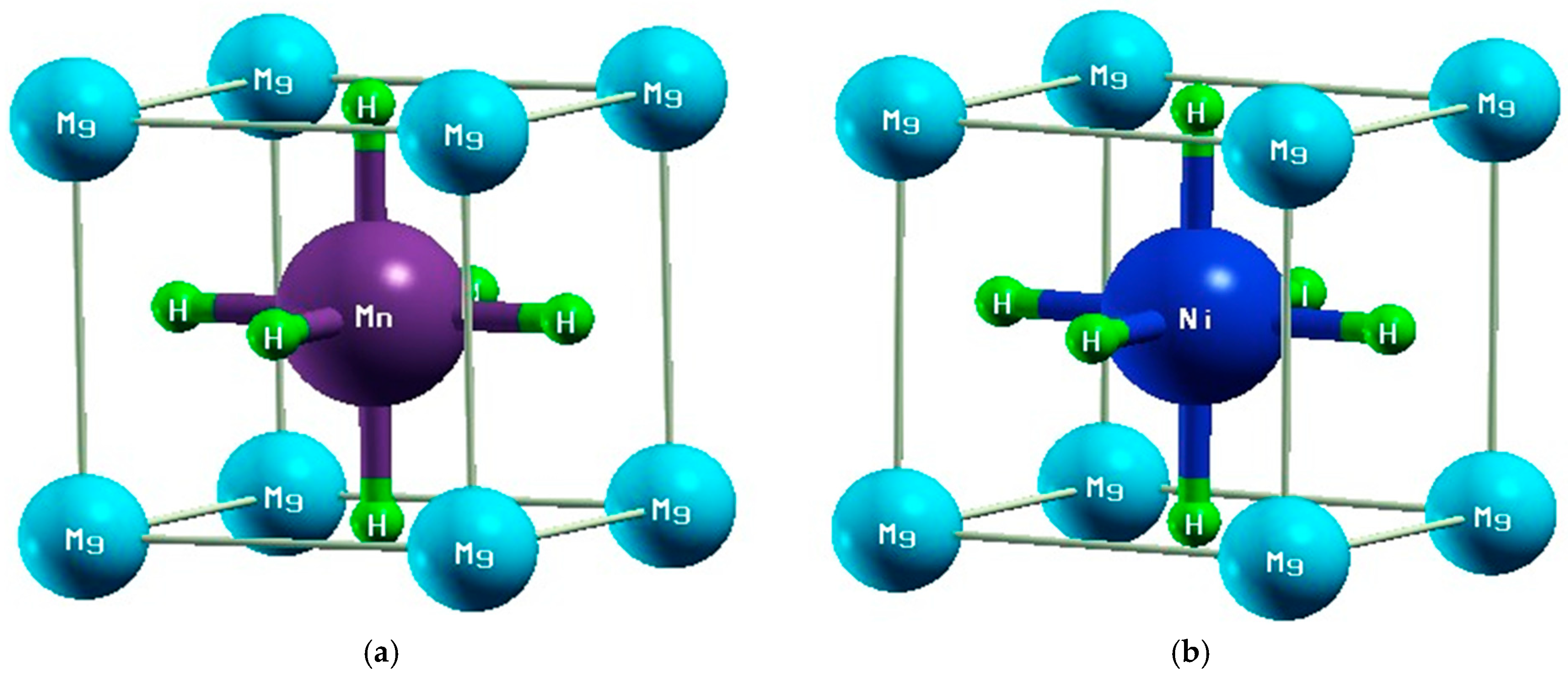
Figure 1. The crystallin structure of (a) MgMnH3 and (b) MgNiH3.
Physchem 06 00021 g001
Figure 2. The energy vs. volume for (a) MgMnH3 and (b) MgNiH3.
Physchem 06 00021 g002
Figure 3. The electrical conductivity of MgMH3 (M = Mn and Ni).
Physchem 06 00021 g003
Figure 4. The Seebeck coefficient of MgMH3 (M = Mn and Ni).
Physchem 06 00021 g004
Figure 5. The power factor of MgMH3 (M = Mn and Ni).
Physchem 06 00021 g005
Figure 6. The thermal conductivity of MgMH3 (M = Mn and Ni).
Physchem 06 00021 g006
Figure 7. The dimensionless thermoelectric figure of merit of MgMH3 (M = Mn and Ni).
Physchem 06 00021 g007
Figure 8. The band structures of (a) MgMnH3 and (b) MgNiH3.
Physchem 06 00021 g008
Figure 9. The TDOS and PDOS: (a) MgMnH3 and (b) MgNiH3.
Physchem 06 00021 g009
Table 1. The lattice parameters.
Compounda0 = b0 = c0 in Å
MgMnH33.34 [45] Exp
3.3485 [45] Other work
3.3199 This work
MgNiH33.32 [46] Exp
3.370 [47] Other work
3.3572 This work
Table 2. The calculated optimized parameters a0, V, E, B and B’ of MgMH3 (M = Mn, Ni).
ParameterLattice Parameter a0 (Å)Volume Minimum
V ([a.u]3)
Total Energy E (Ry)Bulk Modulus
B (GPa)
Pressure Derivative B’
OptimizedOther Work
MgMnH33.3199 Å3.3485 Å [45]246.9368−2721.501274119.26843.6840
MgNiH33.3572 Å3.370 Å [47]255.3368−3445.894495113.87854.2121
Table 3. The gravimetric hydrogen storage capacity of MgMH3 (M = Mn, Ni) in Cwt%.
CompoundCwt%Work
MgNiH33.51483Present work
(M = Mn, Ni)
MgMnH33.67527
MgCrH33.771 [45]Other work
(M = Cr, Fe)
MgFeH33.606 [45]
Table 4. The elastic constants Cij of MgMH3.
CompoundC11C12C44
MgNiH3205.12642.97035.221
MgMnH3634.6342773.825427.2459
Table 5. The calculated elastic moduli B, G, E, (B/G) and v of MgMH3.
CompoundBGEB/Gv
MgNiH397.0249.54127.011.960.282
MgMnH3260.7684.23228.13.100.354
Disclaimer/Publisher’s Note: The statements, opinions and data contained in all publications are solely those of the individual author(s) and contributor(s) and not of MDPI and/or the editor(s). MDPI and/or the editor(s) disclaim responsibility for any injury to people or property resulting from any ideas, methods, instructions or products referred to in the content.