Article

Ni/Mo Regulated Nb35Hf30Co15Ni20-xMox High-Entropy Alloy Membranes for High Hydrogen Permeability and Hydrogen Embrittlement Resistance


1
Key Laboratory of Aerospace Materials and Performance, Ministry of Education, School of Materials Science and Engineering, Beihang University, No.37 Xueyuan Road, Beijing 100191, China
2
State Power Investment Corporation Science and Technology Research Institute Co., Ltd., Beijing 102200, China
3
Inner Mongolia Huomei Hongjun Aluminum Electric Co., Ltd., Holingol 029200, China
*
Author to whom correspondence should be addressed.
These authors contributed equally to this work.
Physchem 2026, 6(2), 18; https://doi.org/10.3390/physchem6020018
Submission received: 24 December 2025 / Revised: 15 March 2026 / Accepted: 23 March 2026 / Published: 26 March 2026
(This article belongs to the Section Solid-State Chemistry and Physics)

Abstract

Efficient hydrogen separation and purification technology plays a crucial role in the hydrogen energy industry. VB-group alloy membranes have demonstrated favorable hydrogen permeability, but their hydrogen embrittlement resistance remains generally insufficient. This work designed Nb35Hf30Co15Ni20-xMox high-entropy alloy (HEA) membranes with regulated Ni and Mo contents. The influences of HEA compositions on microstructures, hydrogen permeability and hydrogen embrittlement resistance were systematically analyzed. On the one hand, the doping of Mo increased the volume and proportion of BCC-Nb phase, thus promoting hydrogen permeation; on the other hand, the hydrogen solubility was reduced, thus enhancing the hydrogen embrittlement resistance. The lattice distortion effect, sluggish diffusion effect and optimized Mo content collectively enhanced the comprehensive performance of Nb35Hf30Co15Ni12.5Mo7.5, achieving a hydrogen permeability (Φ) of 2.68 × 10⁻⁸ mol H2 m−1·s−1·Pa−0.5 at 673 K and exhibiting excellent hydrogen embrittlement resistance, showing no hydrogen-induced fractures even at room temperature. This quantitatively demonstrates its excellent performance, which represents a certain breakthrough compared to related studies. The novel Nb35Hf30Co15Ni20-xMox HEA membranes offer excellent hydrogen permeability and improved hydrogen embrittlement resistance, thereby highlighting the potential for future hydrogen purification applications.

1. Introduction

In recent years, the continued exploitation and use of traditional fossil fuels have resulted in a series of environmental pollution issues and energy crises, which have attracted global attention. The development and utilization of renewable clean energy sources must be prioritized to address the challenges effectively. As an emerging clean energy source, hydrogen is particularly attractive due to its pollution-free and renewable characteristics [1]. Furthermore, high-purity hydrogen has a wide range of applications, including in the pharmaceuticals, aerospace, defense, food processing, metallurgy and energy sectors [2]. In comparison with traditional pressure swing absorption and cryogenic separation techniques, membrane separation technology for hydrogen purification possesses a number of advantages, such as low costs, high efficiency and operational convenience. As a result, it is regarded as one of the most promising methods for hydrogen separation and purification [1,3,4,5]. However, traditional Pd-based alloy membranes (e.g., Pd-Ag and Pd-Au alloys) are costly, which results in high application expenses. Furthermore, these membranes are easily poisoned by sulfur compounds in mixed gases, reducing hydrogen separation efficiency. Therefore, it can be concluded that Pd-based alloy membranes are unsuitable for large-scale industrial applications. In light of the aforementioned considerations, VB-group metals, which exhibit excellent hydrogen permeability and lower costs, particularly Nb-based alloys, have emerged as a focal point in hydrogen permeation membrane research. These materials exhibit considerable potential as alternatives to Pd-based alloys, especially for hydrogen separation [6,7].
To date, extensive research has been conducted on Nb-based alloy membranes. Hashi et al. [8] were the first to identify that ternary Nb-Ti-Ni hydrogen permeation alloys comprise two phases: primary phase (BCC-(Nb, Ti)) responsible for hydrogen permeation, and eutectic phase ({(Nb, Ti) + TiNi}) that enhances hydrogen embrittlement resistance. The alloy exhibited favorable hydrogen permeability and hydrogen embrittlement resistance. They pointed out that the eutectic phase plays a crucial role in mitigating hydrogen embrittlement in the (BCC-(Nb, Ti)) phase, and that hydrogen permeability increases with the content of the (BCC-(Nb, Ti)) phase. This suggests that the (BCC-(Nb, Ti)) phase is the primary contributor to hydrogen permeability in Ni-Ti-Nb alloys. Research by Luo et al. [9] indicates that in Ni-Ti-Nb system alloys, the hydrogen permeability increases parabolically with the volume fraction of the (BCC-(Nb, Ti)) phase. In the Ni-Ti-M (M = Fe, Co, or Ni) system, the (BCC-(Nb, Ti)) phase present in the eutectic structure serves as the main pathway for hydrogen permeation, with a permeability approximately 100 times higher than that of the B2-type TiM compound [10]. Based on these findings, Hashi et al. [8] proposed a design principle for hydrogen permeation alloys: by using a multi-element Nb-based alloy system, a two-phase structure is obtained, which contains the BCC-Nb phase responsible for hydrogen absorption and the eutectic phase (BCC + B2) responsible for hydrogen resistance, thereby improving the hydrogen absorption performance. Subsequently, a multitude of studies have been conducted on Nb-based hydrogen permeation alloys based on this concept, resulting in the development of an array of alloy systems, including Nb-Ti-Ni [9,11], Nb-Ti-Co [12,13], Nb-Hf-Ni [14,15], and Nb-Hf-Co [1,16]. Nevertheless, despite enhancements in the hydrogen permeability of these conventional Nb-based alloys, their hydrogen embrittlement resistance remains inadequate, rendering it difficult to attain an equilibrium between hydrogen permeability and hydrogen embrittlement resistance, which ultimately constrains the overall performance. The high hydrogen permeability of VB-group metals originates from their high hydrogen solubility; however, this property also leads to significant hydrogen embrittlement. Alloying VB-group metals with elements such as Mo and Ni can effectively reduce hydrogen solubility by altering lattice parameters, thereby mitigating hydrogen embrittlement. Specifically, alloying with Mo not only suppresses the formation of impurity phases but also enhances the proportion of the primary BCC-Nb phase, which is beneficial for improving the hydrogen permeability of the alloy [11,17,18]. Meanwhile, the incorporation of Ni promotes the formation of secondary phases, and the resulting two-phase structure (primary BCC phase + eutectic structure, consisting of BCC and B2 phases) significantly enhances resistance to hydrogen embrittlement [8]. Therefore, the introduction of appropriate alloying elements is a crucial method for improving the hydrogen permeability of alloy materials.
Since the late 20th century, HEAs (HEA) have attracted significant attention as potential hydrogen storage materials, prompting extensive research on their crystal structures and hydrogen storage properties [19,20,21,22]. HEA typically contains at least five elements, with each component having an atomic percentage between 5 at% and 35 at% [23,24]. This results in the formation of unique crystal structures, which exhibit a range of effects, including the high-entropy effect, lattice distortion effect, sluggish diffusion effect, and the “cocktail effect” [22,25]. In comparison to traditional hydrogen permeation alloys, high-entropy hydrogen permeation alloys exhibit improved element compatibility due to the high mixing entropy effect. This prevents the formation of intermetallic compounds, enhancing overall hydrogen permeability [26,27,28,29]. Kashkarov et al. [30] investigated the hydrogen permeability of Nb-Ni-Ti-Zr-Co HEA and found that Nb20Ni20Ti20Co20Zr20 exhibited superior hydrogen permeability at lower temperatures. The alloy demonstrated superior hydrogen permeability at temperatures between 0 and 350 °C, with an operational lifespan of 26 h in hydrogen permeability experiments. This surpassed the performance of the Nb40Ni25Ti18Zr12Co5 alloy, which exhibited hydrogen-induced fractures after only 12 h. However, current research on high-entropy hydrogen permeation alloys remains limited, and the reported HEA exhibited relatively low hydrogen permeability, with hydrogen embrittlement resistance requiring further improvement.
Herein, this work develops Nb35Hf30Co15Ni20-xMox HEA membranes, building on a ternary Nb-Hf-Co alloy system. Since nickel (Ni) and molybdenum (Mo) can enhance the resistance to hydrogen embrittlement and permeability [17,28], herein, we develop the Nb35Hf30Co15Ni20-xMox HEA membranes by altering the Ni and Mo contents, resulting in changes to the microstructure and hydrogen permeation performance. Nb35Hf30Co15Ni20-xMox HEA membranes with enhanced hydrogen permeability and hydrogen embrittlement resistance were produced. The unique high-entropy effect of high-entropy alloys enables them to achieve even more outstanding anti-hydrogen embrittlement properties. Of the membranes synthesized, the Nb35Hf30Co15Ni12.5Mo7.5 exhibited the optimal overall performance in terms of hydrogen permeability and hydrogen embrittlement resistance. It demonstrated stable and excellent hydrogen permeability across a wide temperature range, and no hydrogen-induced fractures occurred during constant-pressure cooling. This study comprehensively analyzes the effects of elemental composition, phase structure, and microstructure on the hydrogen permeability and hydrogen embrittlement resistance of HEA membranes. It provides a theoretical foundation for future research and large-scale application of Nb-based HEA membranes.

2. Materials and Methods

The purity of Nb, Hf, Ti, Co, Ni, and Mo is higher than 99.95 wt.%, and all metal raw materials are purchased from the Beijing Cuibolin Non-ferrous Metal Technology Development Center in Beijing, China.
The compositions of the Nb35Hf30Co15Ni20-xMox HEA membranes with varied Ni and Mo contents were designed as Nb35Hf30Co15Ni15Mo5, Nb35Hf30Co15Ni12.5Mo7.5 and Nb35Hf30Co15Ni10Mo10. The requisite raw materials were weighed in accordance with the specified weight percentages, and the 30 g button ingots of Nb35Hf30Co15Ni20-xMox were prepared by arc-melting under purified argon. To ensure compositional and microstructural homogeneity, each ingot was melted under 250 A for 5 min and turned over at least 5 times. The samples with a diameter of 20 mm and a thickness of 0.8 mm were machined from the center of each button ingot using the wire-cutting electrical discharge machine. Subsequently, the samples were ground and polished to achieve a final thickness of approximately 0.6 mm. Before the hydrogen permeability measurements, uniform Pd layers (~190 nm) were deposited on both sides of each sample via magnetron sputtering.
X-ray diffraction (XRD, D/Max2200, Rigaku Corporation in Tokyo, Japan) with Cu Kα radiation was used to analyze the phase composition of the high-entropy hydrogen permeation alloys. Furthermore, a scanning electron microscope (SEM, JSM-7500, JEOL in Tokyo, Japan) equipped with a backscattered electron imaging mode (BSE) and energy dispersive spectrometer (EDS) was used to examine the microstructure and chemical composition of the samples.
In this paper, a Sieverts-type apparatus was utilized to investigate the hydrogen solubility of Nb35Hf30Co15Ni20-xMox HEA membranes [31]. The Sieverts-type apparatus, based on the volumetric method, is widely used due to its low testing cost and simple structural design. The principle of hydrogen storage performance testing involves monitoring pressure changes in the sample chamber during hydrogen absorption and desorption processes [32]. A sensor detects these pressure variations, and the collected data are analyzed using the ideal gas law to determine the hydrogen absorption and desorption capacity of the alloy. The hydrogen absorption kinetics test was conducted at 673 K with a hydrogen pressure of 0.4 MPa for 1 h. Subsequently, the sample was subjected to desorption tests under 100 Pa at 673 K for 1 h.
The hydrogen permeability measurements comprised both measurements of hydrogen permeability and hydrogen embrittlement resistance. The samples were placed within the custom-built hydrogen permeability measurement device, evacuated on both sides and heated to 673 K for 30 min to ensure system stability. To maximize the efficiency of hydrogen absorption during the measurement, each of the samples underwent an activation process. The upstream and downstream of the system were connected and isolated from the external environment, and 0.15 MPa hydrogen was passed through for activation purposes. The hydrogen permeability measurement was conducted following the activation. The downstream maintains atmospheric pressure (Pd = 0.1 MPa) and is linked to the flowmeter, while the upstream was continuously supplied with pure hydrogen at pressures (Pu) ranging from 0.2 to 0.4 MPa. The measurements were conducted over a temperature range of 523 to 673 K, with pressure and temperature increments of 0.05 bar and 50 K, respectively. The hydrogen flux (J) through the alloy membrane was quantified using the downstream flowmeter, and the hydrogen permeability coefficient (Φ) was calculated using the following equation:
J = D × C L = D × k × P u 0.5 P d 0.5 L = Φ × Δ P 0.5 L
where Pu represents the hydrogen pressure at the upstream side of the alloy membrane, Pd represents the downstream hydrogen pressure, and Φ is the hydrogen permeability coefficient. At the given temperature, the hydrogen flux per unit thickness (J × L) exhibits a linear relationship with the ΔP0.5. At the same time, the slope of Equation (1) corresponds to the Φ, which directly reflects the hydrogen permeability of the alloy membranes. Once the hydrogen permeability coefficient measurement was concluded, the upstream hydrogen pressure was maintained at 0.4 MPa, and the samples were programmed to cool at a rate of 1 K/min through the heating furnace’s temperature control device. Meanwhile, the hydrogen flux at the corresponding temperature was recorded until the sample broke, which caused an abrupt increase in the hydrogen flux, or the hydrogen flux gradually decreased to 0 mol H2 m−1 s−1. The temperature at which the hydrogen flux exhibits a sudden increase was identified as the hydrogen embrittlement temperature.

3. Results and Discussion

The design principle of the alloy composition in this paper is based on the Nb-Hf-Co system, because both Nb and Hf are VB-group metals and have high hydrogen permeability; Co can promote the formation of the B2 phase and enhance the resistance to hydrogen embrittlement, while the introduction of Ni further strengthens the resistance to hydrogen embrittlement. This choice is based on the design principle that hydrogen-permeable alloys should contain the BCC-Nb phase as the main hydrogen-permeating phase, and the B2 phase as the phase for improving the resistance to hydrogen embrittlement. At the same time, in order to ensure the design of the alloy structure, the atomic size difference (δ > 6.6), valence electron concentration (VEC > 5.50), and thermodynamic parameters (1.00 ≤ Ω ≤ 1.50) need to meet the requirements. Therefore, the final alloy composition was designed based on the calculation results of the relevant parameters. Numerous studies have demonstrated that the phase structure and stability of HEA are inextricably linked to a series of characteristic parameters, including atomic size mismatch (δ), valence electron concentration (VEC), and thermodynamic parameters (Ω) [33,34]. The atomic size mismatch (δ) can be calculated using Equation (2). Following the structural guidelines for HEA, when δ is less than or equal to 6.6, the alloy is inclined to form a single-phase structure. Conversely, for δ values exceeding 6.6, it was possible to form a multi-phase structure [34,35]. According to the design principle for hydrogen permeation alloys [8], alloys with δ > 6.6 were selected to achieve the multi-phase structure for hydrogen permeation membranes. The valence electron concentration (VEC), defined as the total number of outer-shell electrons per atom, is given by the following Equation (3). Reduction in VEC can enhance the solubility of hydrogen in HEA, which is unfavorable for the prevention of embrittlement [36]. Accordingly, in the design of HEA membranes, it is recommended that the VEC should be greater than 5.50. In their study, Zhang et al. [37] defined the thermodynamic parameter Ω, which is related to the mixing enthalpy, mixing entropy, and melting points of the constituent elements, as shown in Equation (6).
δ = i = 1 n { c i ( 1 r i r ¯ ) 2 } × 100 %
VEC = i = 1 n c i VEC i
Δ H mix = i = 1 , i j n Ω ij c i c j , Ω ij = 4 Δ H ij mix
Δ S mix = R i = 1 n c i Ln c i
Ω = T m Δ S mix | Δ H mix | ,   T m = i = 1 n c i ( T m ) i
In the equations, ci and cj are the atomic fractions of elements i and j; Hij is the mixing enthalpy of elements i and j at the same molar concentration in a binary solution, (Tm)i is the melting temperature of element i; R is the ideal gas constant. To prevent the formation of the Laves phase intermetallic compounds, it is necessary to ensure that the Ω is greater than 1. Furthermore, to avoid the complete solid solution of alloy elements into a single phase, it is essential that Ω cannot be excessively high. Therefore, the designed HEA must satisfy that 1.00 ≤ Ω ≤ 1.50. Based on the above content, this work has developed three HEA membranes: Nb35Hf30Co15Ni15Mo5, Nb35Hf30Co15Ni12.5Mo7.5, and Nb35Hf30Co15Ni10Mo10. Ni was employed to enhance hydrogen embrittlement resistance, while Mo was introduced to improve hydrogen permeability [8,11,17]. The characteristic parameters of these alloys are presented in Table 1.

3.1. Microstructural Analysis

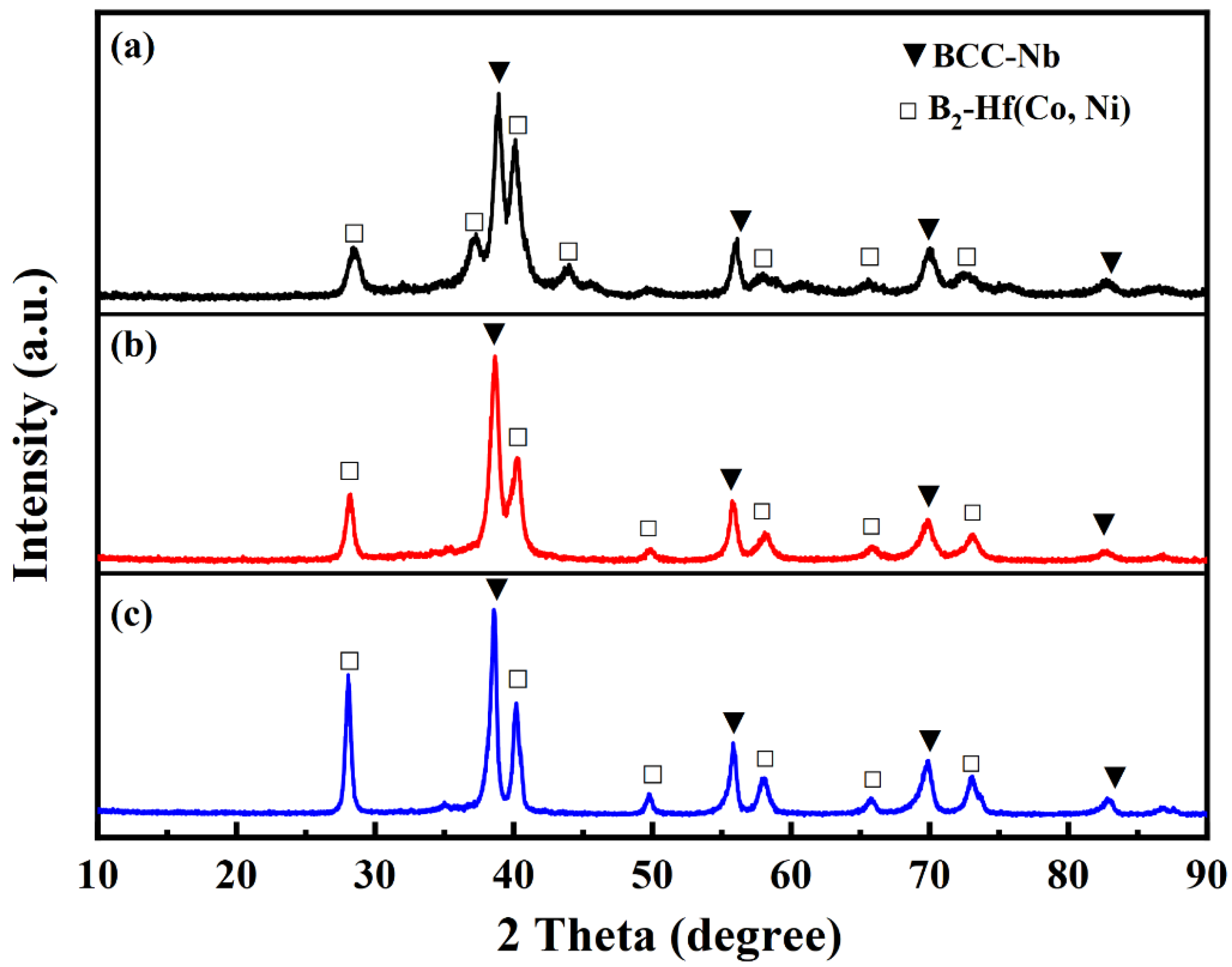
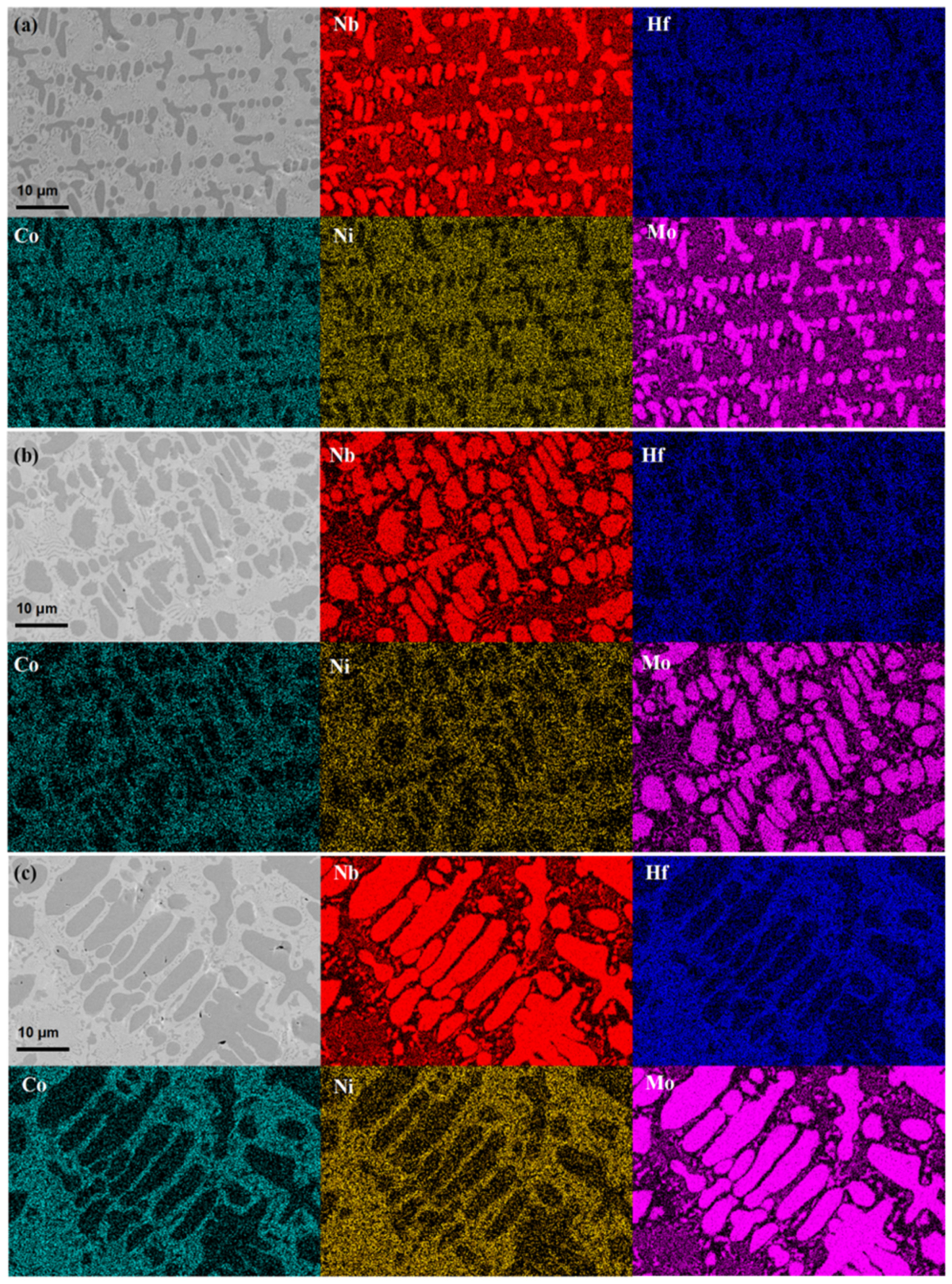
Figure 1 illustrates the XRD patterns of Nb35Hf30Co15Ni20-xMox HEA membranes. The XRD patterns indicate that all three membranes are primarily composed of BCC-Nb (PDF# 34-0370) and B2-Hf(Co, Ni) (PDF# 18-0404) phases, which is consistent with the phase composition reported for multi-component Nb-based hydrogen permeation alloys [13,38,39,40]. The diffraction peaks at 38.5°, 55.5°, and 69.7° are in excellent agreement with the reference pattern for PDF#34-0370 (JCPDS) of the BCC- Nb phase, while the peaks at 28.6°, 40.7°, 50.2°, 58.6°, 66.4°, and 73.6° align precisely with PDF#18-0404 (JCPDS) of the B2-Hf(Co,Ni) phase. This result indicates that Mo can be fully dissolved in the alloy without altering its phase composition. Furthermore, as the Mo content increases, the BCC-Nb phase peak shifts toward lower angles, with 2θ decreasing from 38.9° to 38.6° and 38.5°. This is attributed to Mo’s larger atomic radius than Ni, which increases the lattice constant in solid solution. The BCC-Nb phase is conducive to hydrogen interaction, thereby enhancing the alloy’s hydrogen permeability. In contrast, the B2-Hf(Co, Ni) phase exhibits reduced solubility with hydrogen, which contributes to improved hydrogen embrittlement resistance [8,38]. Figure 2 presents BSE and EDS mapping images of the Nb35Hf30Co15Ni20-xMox, and the proportion and composition of the BCC-Nb phase are demonstrated in Table 2. According to the results in Figure 2, the content of the Mo element is positively correlated with the content of the BCC-Nb phase. In Nb35Hf30Co15Ni15Mo5, due to the low content of Mo, the peak intensity of the B2-Hf(Co,Ni) phase is relatively high. While in other samples, due to the higher content of Mo, the peak intensity of the BCC-Nb phase is higher, resulting in some of the peaks of the B2-Hf(Co,Ni) phase being relatively less distinct, making it difficult to detect.
As illustrated in Figure 2a, the Nb35Hf30Co15Ni15Mo5 is primarily composed of short rod-like primary BCC-Nb phase (28%) and eutectic {BCC-Nb + B2-Hf(Co, Ni)} phase. The EDS mapping images indicate that Mo and Nb exhibit a similar distribution, suggesting that Mo is fully dissolved in the BCC-Nb phase. As illustrated in Figure 2b, the Nb35Hf30Co15Ni12.5Mo7.5 maintains the two-phase structure, comprising a thicker rod-like primary BCC-Nb phase (38%) and eutectic {BCC-Nb + B2-Hf(Co, Ni)} phase. The increase in the proportion of the BCC-Nb phase indicates that Mo plays an active role in promoting its formation. Upon further increasing the Mo content, the volume of the BCC-Nb phase in Nb35Hf30Co15Ni10Mo10 expands further, forming elongated rod-like structures with a phase proportion of 49% (see Figure 2c). The results indicate that the addition of Mo enhances the solid solubility of the BCC-Nb phase and consequently increases its phase proportion. Given that the BCC-Nb phase serves as the primary phase with hydrogen permeation capability, an elevated proportion of the BCC phase facilitates improved hydrogen permeability. Consequently, the incorporation of Mo is advantageous for enhancing hydrogen permeation performance.

3.2. Hydrogen Permeation Performance

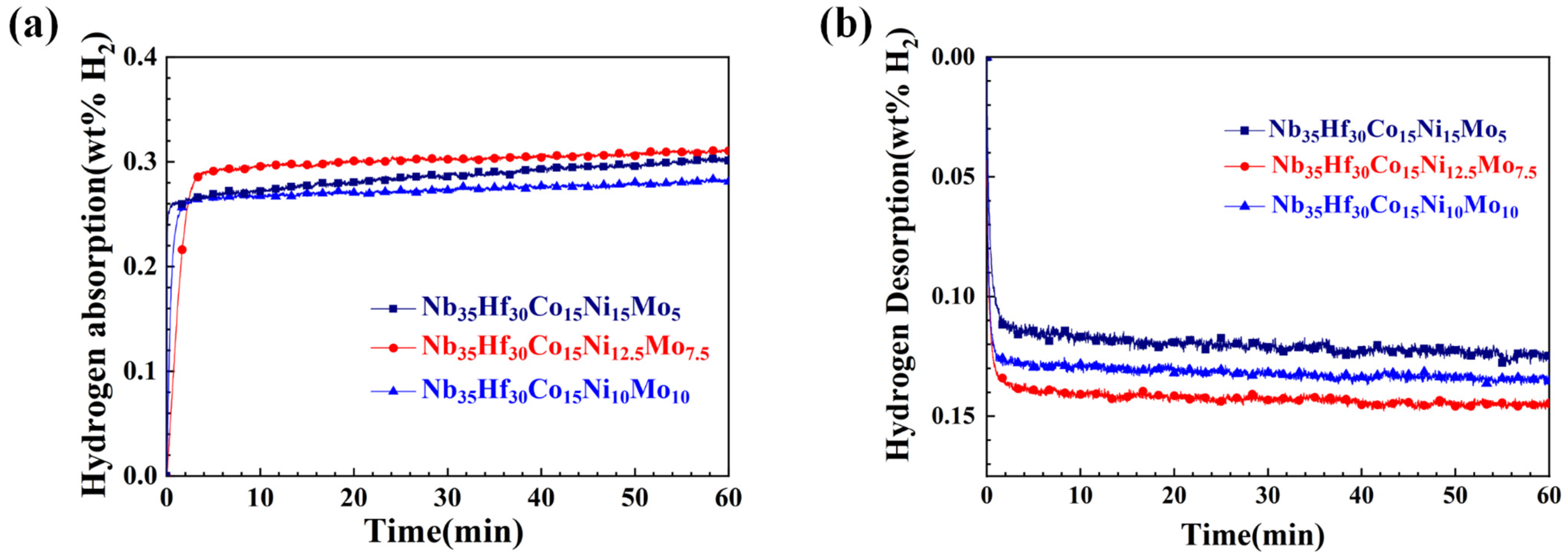
The hydrogen permeability and hydrogen embrittlement resistance of Nb-based hydrogen permeability alloys are contingent upon the solubility of hydrogen in the alloy. An appropriate level of hydrogen solubility is essential for optimal hydrogen permeability. The enhancement of hydrogen solubility facilitates achieving superior hydrogen permeability; however, high hydrogen solubility results in excessive hydrogen absorption in Nb-based alloys, which may reduce the mechanical stability of the alloy membranes and lead to hydrogen-induced cracking during the testing process [41,42,43]. Consequently, it is essential to achieve an optimal hydrogen solubility level that enhances the resistance to hydrogen embrittlement while preserving high hydrogen permeability. Accordingly, before testing the hydrogen permeability of Nb35Hf30Co15Ni20-xMox HEA membranes, preliminary hydrogen solubility measurements were conducted on the three membranes using the custom-built Sievert-type apparatus. The experiments were performed at 673 K with a hydrogen absorption pressure of 0.4 MPa and hydrogen desorption under near-vacuum conditions (100 Pa). As illustrated in Figure 3, all three alloys demonstrated a rapid hydrogen absorption and desorption rate, reaching equilibrium within 3 min. This rapid absorption and desorption rate ensures that hydrogen molecules are simultaneously absorbed at the upstream side and released at the downstream side of the HEA membranes. As the Mo content increased, the maximum hydrogen absorption capacities of the alloys reached 0.30 wt.%, 0.31 wt.%, and 0.28 wt.% H2, respectively. At the same time, the maximum hydrogen desorption capacities reached 0.12 wt.%, 0.13 wt.%, and 0.14 wt.% H2, respectively. Furthermore, by comparing the residual hydrogen content in the alloys after the absorption and desorption tests (the difference between Figure 3a,b), it can be observed that the hydrogen content remaining in the alloys decreases with increasing Mo content, measuring 0.18 wt.% H2, 0.18 wt.% H2, and 0.14 wt.% H2, respectively. This suggests that an increase in Mo content reduces hydrogen solubility, thereby influencing the hydrogen permeability. When compared with the hydrogen storage capacity of pure Pd reported in other studies [44], the three alloys in this work exhibit higher hydrogen absorption capacities under identical testing conditions. Consequently, their hydrogen permeation performance is superior to that of pure Pd; at the same time, their hydrogen storage capacity is significantly lower than that of pure Nb and other high Nb content alloys [45]. Therefore, these alloys are less prone to hydrogen embrittlement caused by excessively high hydrogen solubility, as seen in pure Nb. These findings suggest that all three HEA membranes possess adequate hydrogen solubility, enabling the hydrogen-permeable membranes to absorb hydrogen upstream and release it downstream efficiently. This characteristic ensures their potential for achieving both high hydrogen permeability and hydrogen embrittlement resistance.
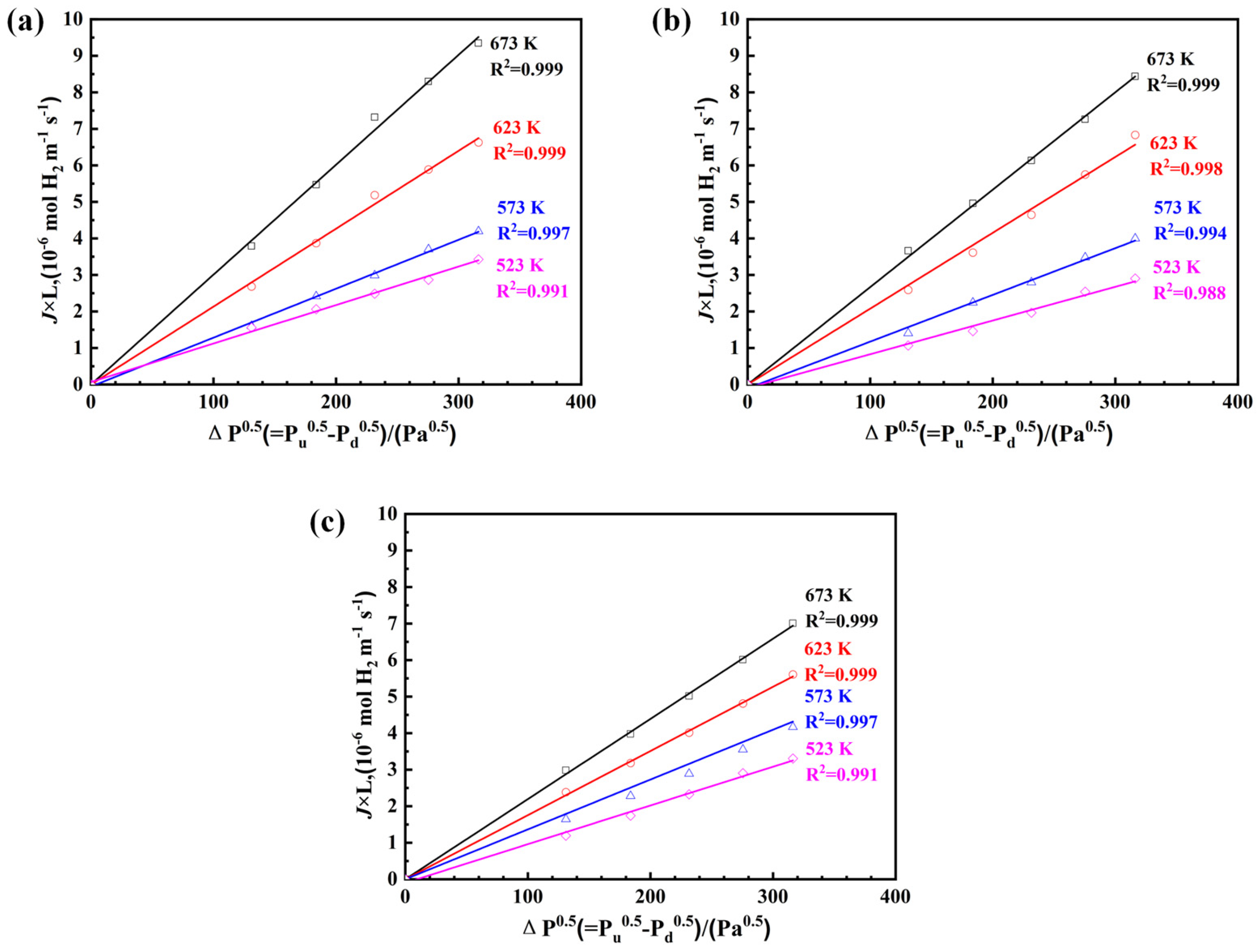
The Φ of the Nb35Hf30Co15Ni20-xMox HEA membranes was determined through the hydrogen permeability measuring system. Figure 4 illustrates the correlation between hydrogen flux (J × L) and pressure differential ΔP0.5 for the three membranes. The results demonstrate that, at a given pressure differential, (J × L) increases significantly with rising temperatures. As the illustration demonstrates, the values of (J × L) for the Nb35Hf30Co15Ni15Mo5 membranes at temperatures of 673, 623, 573, and 523 K were 9.36, 6.74, 4.18, and 3.40 × 10⁻⁶ mol H2 m−1 s−1, respectively. These results demonstrate that the membranes exhibit enhanced hydrogen permeability at higher temperatures. At 673 K, an increase in upstream pressure from 0.2 MPa to 0.35 MPa resulted in (J × L) of 3.79, 5.47, 7.31, and 8.28 × 10⁻⁶ mol H2 m−1 s−1. However, an increase in the Mo content resulted in a decrease in the (J × L) of the Nb35Hf30Co15Ni20-xMox membranes. At 673 K, the Nb35Hf30Co15Ni12.5Mo7.5 and Nb35Hf30Co15Ni10Mo10 exhibited (J × L) of 8.44 and 7.00 × 10⁻⁶ mol H2 m−1 s−1, respectively.
As illustrated in Figure 4, the correlation between (J × L) and ΔP0.5 for Nb35Hf30Co15Ni20-xMox alloys is robust, with R2 values approaching 1. This enables the determination of the Φ from the slope of the linear fit. In general, the Arrhenius equation (Equation (7)) can be employed to represent the relationship between the Φ and T. Its logarithmic form (Equation (8)) can be utilized to calculate the activation energy for hydrogen permeability.
Φ = Φ 0 exp ( E a RT )
ln ( Φ Φ 0 ) = E a R × 1 T
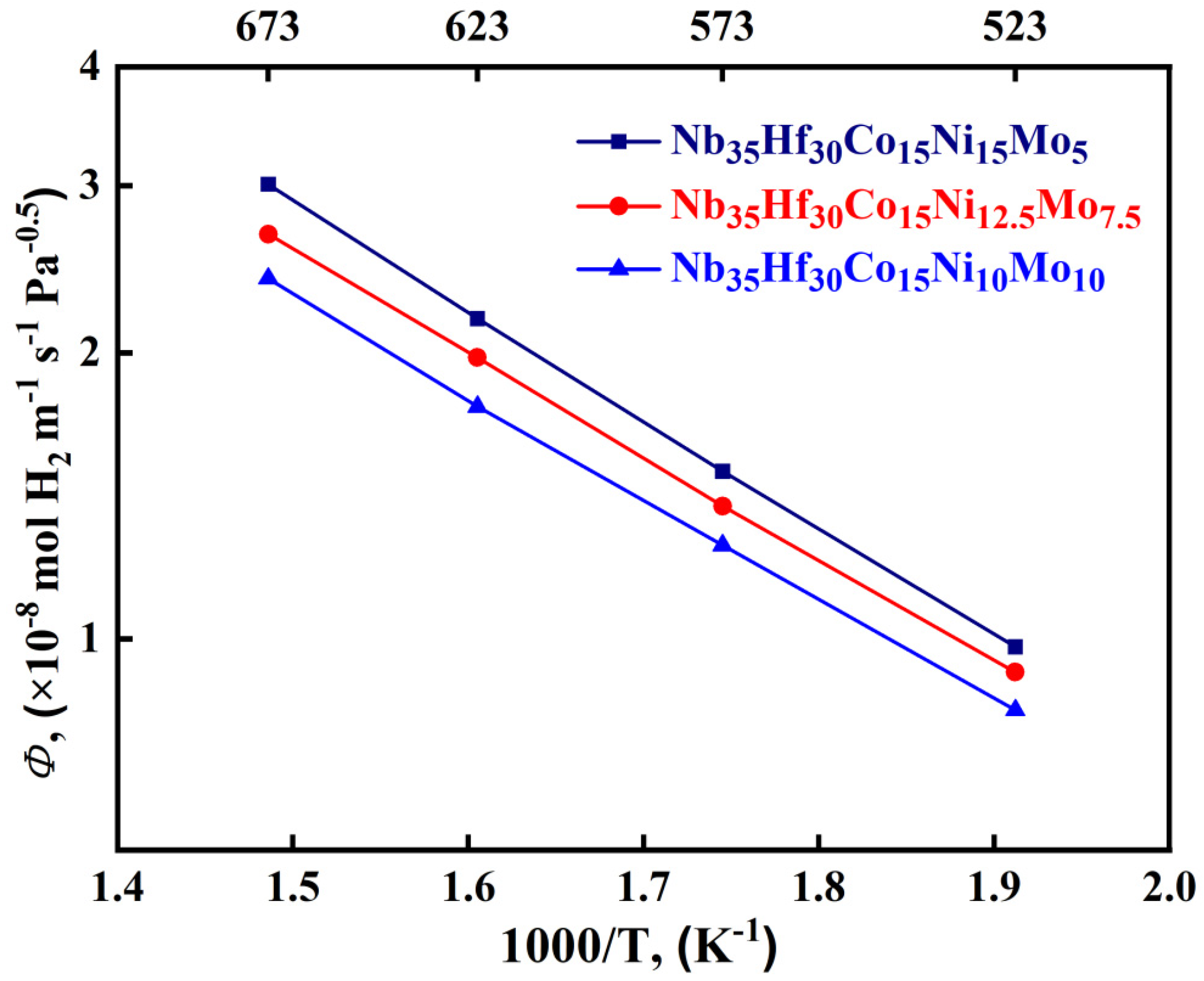
where Ea is the activation energy for hydrogen permeability, Φ0 is the pre-exponential factor, R is the perfect gas constant, and T is the temperature. A linear relationship was observed between the logarithm of Φ and the inverse of T. The Φ and Ea for the three membranes are presented in Table 3, and the relationship between Φ and 1000/T is shown in Figure 5. The Nb35Hf30Co15Ni15Mo5 exhibited the highest Φ at all temperatures, with values of 3.01 × 10⁻⁸, 2.13 × 10⁻⁸, 1.40 × 10⁻⁸ and 1.00 × 10⁻⁸ mol H2 m−1 s−1 Pa−0.5 at 673, 623, 573 and 523 K, respectively. At 673 K, the Φ of Nb35Hf30Co15Ni15Mo5 is approximately 1.9 times that of pure Pd [39]. As the Mo content increased, the Φ of the Nb35Hf30Co15Ni20-xMox exhibited a decline, suggesting the inverse correlation between hydrogen permeability and Mo content. This can be attributed to the higher electronegativity of Mo(2.16) relative to Nb(1.60), which is comparable to the electronegativity of H(2.20). As Mo atoms enter the BCC lattice, they reduce the electron affinity of H atoms in interstitial positions and weaken the bond energy between H and lattice interstices, which results in a decrease in hydrogen solubility and thus a lower Φ [11,46]. Furthermore, the Ea for hydrogen permeability decreases with increasing Mo content, with values of 39.06, 33.74, and 29.87 kJ·mol−1. This phenomenon is conducive to the promotion of hydrogen permeability reactions. Therefore, although increasing the Mo content reduces hydrogen solubility, which in turn decreases the hydrogen permeability and capacity (Figure 5), the further doping of Mo in the microstructure promotes the precipitation of the BCC-Nb phase (Table 2). This increases the volume fraction of the hydrogen-permeable BCC-Nb phase (28–38–49%) and, from an energy perspective, also lowers the activation energy required for hydrogen permeation. As a result, the hydrogen permeation process becomes easier to proceed, and the overall resistance to hydrogen permeation is reduced [47]. As the Mo content increases from 5 to 10, the hydrogen solubility decreases from 0.18 wt.% H2 to 0.14 wt.% H2 (Figure 3), activation energy decreases from 39.06 kJ·mol−1 to 29.87 kJ·mol−1 (Table 3), and the fraction of BCC-Nb phase increases from 28% to 49% (Table 2). These data indicate that the addition of Mo increases the fraction of BCC-Nb phase and reduces the activation energy, while simultaneously decreasing hydrogen solubility and enhancing the resistance to hydrogen embrittlement.
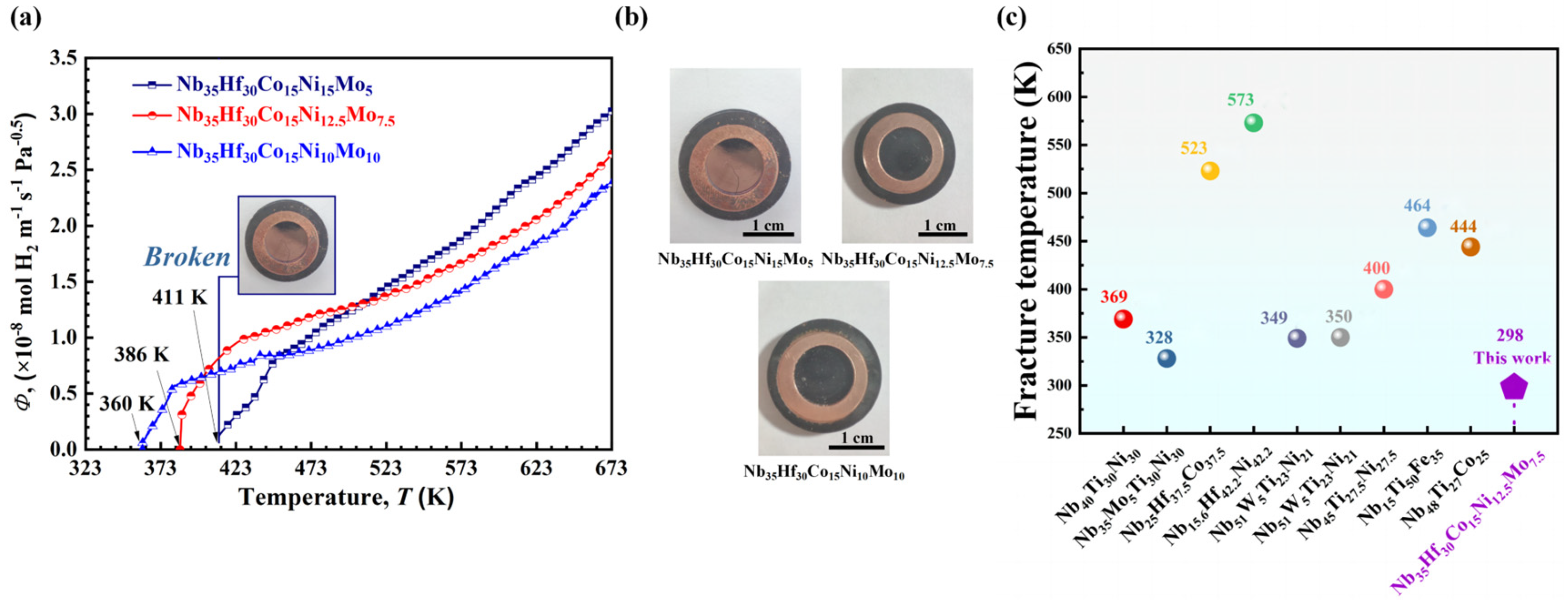
The solid solution of hydrogen in hydrogen permeability alloy membranes can result in hydrogen embrittlement, which has a considerable impact on the mechanical strength of alloy membranes and may lead to fracture. The hydrogen embrittlement resistance of Nb35Hf30Co15Ni20-xMox HEA membranes was evaluated through a constant-pressure cooling experiment with a constant upstream hydrogen pressure of 0.4 MPa. As illustrated in Figure 6a, the Nb35Hf30Co15Ni15Mo5 failed due to hydrogen embrittlement at 411 K. In contrast, the Nb35Hf30Co15Ni12.5Mo7.5 and Nb35Hf30Co15Ni10Mo10 exhibited no fracture, with the hydrogen flux reaching 0 at 386 K and 360 K, respectively (Figure 6b). Compared to the fracture behavior of other Nb-based hydrogen permeation membranes, Nb35Hf30Co15Ni12.5Mo7.5 and Nb35Hf30Co15Ni10Mo10 exhibit exceptional resistance to hydrogen-induced embrittlement at lower temperatures. It did not fracture, even after being cooled to room temperature during the testing process. It is reported that the hydrogen-permeable membranes in other related studies exhibited fractures during testing (298–673 K) [11,12,15,39,41,48,49]. The test results showed that when the Mo content increased from 5 to 10, the hydrogen embrittlement temperatures were 411, 386, and 360 K, respectively. This indicates that the increase in Mo content improves the anti-hydrogen embrittlement performance. For every 2.5% increase in Mo content, the hydrogen embrittlement temperature decreased by approximately 25 K. In this work, Nb35Hf30Co15Ni12.5Mo7.5 and Nb35Hf30Co15Ni10Mo10 effectively preserve the structural integrity of the membranes (Figure 6c), indicating that the alloys possess good resistance to hydrogen embrittlement. It can be attributed to the elevated Mo content in the membranes, which can diminish the occupation of H in the solid solution gap of the BCC-Nb phase and consequently reduce the hydrogen solid solubility of the alloy membranes, thereby markedly enhancing the hydrogen embrittlement resistance. Consequently, the enhancement of Mo content can markedly enhance the resistance of the alloy to hydrogen embrittlement, although it concomitantly diminishes the alloy’s Φ. In addition, the lattice distortion effect of HEA increases the lattice expansion coefficient, thereby creating additional diffusion pathways for H atoms and enhancing the diffusion of H. The significant lattice distortion induced by the increased Mo content in the alloy enhances the solid solution strengthening effect, thereby improving the mechanical properties and resistance to hydrogen embrittlement of the alloy membranes [45,50,51]. Furthermore, the sluggish diffusion effect stabilizes the phase structure of the membranes, enabling excellent mechanical stability under hydrogen-rich conditions and further improving hydrogen embrittlement resistance [28,30]. Of the synthesized HEA membranes, the Nb35Hf30Co15Ni12.5Mo7.5, which exhibits comprehensive hydrogen permeability and hydrogen embrittlement resistance, is worthy of note. This alloy exhibits a high Φ while simultaneously demonstrating robust hydrogen embrittlement resistance, thereby achieving optimal comprehensive performance for HEA membranes.

3.3. Mechanism Discussion

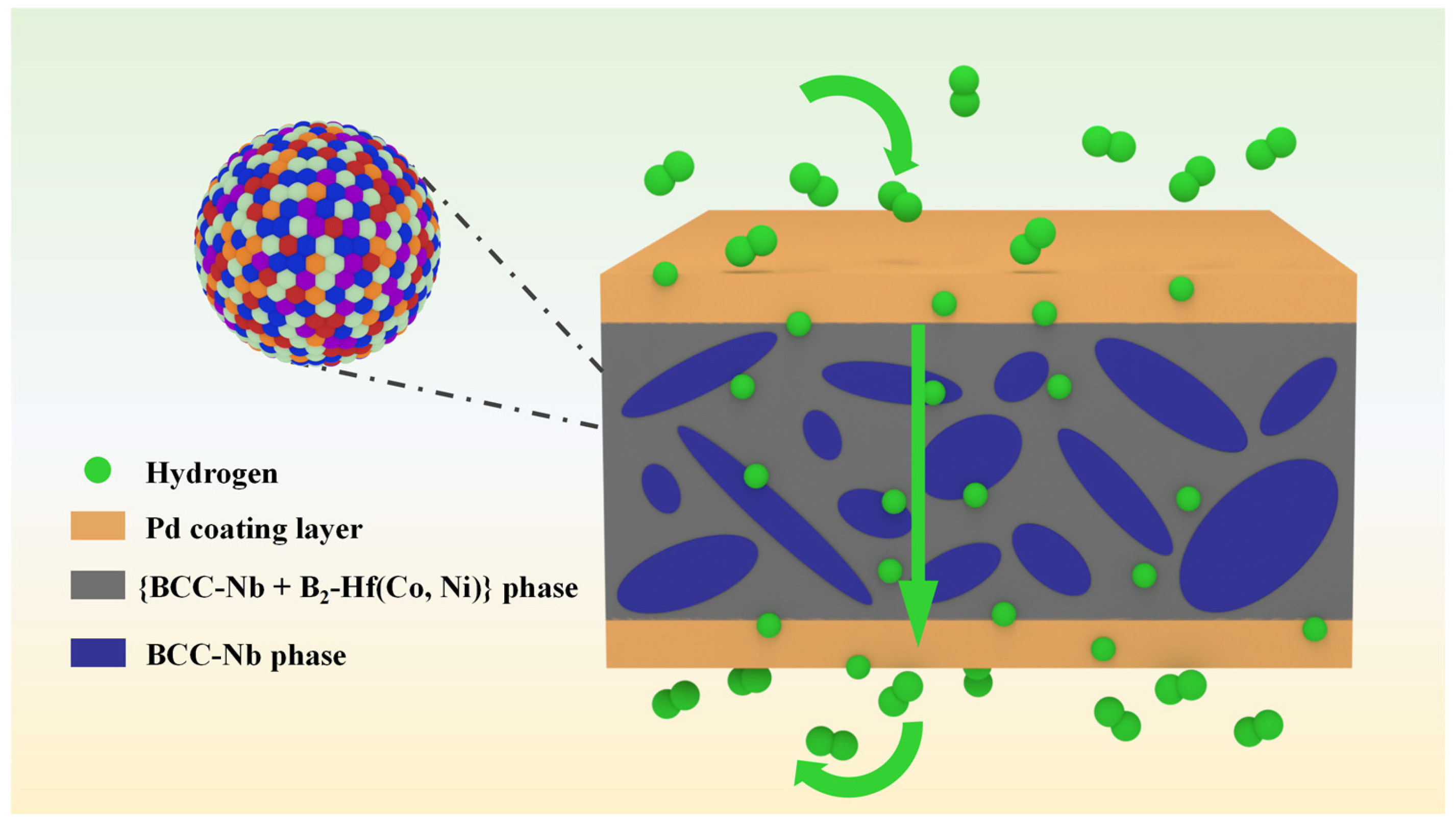
To summarize, the hydrogen permeation mechanism of the Nb35Hf30Co15Ni20-xMox HEA membranes can be outlined as follows (Figure 7). The dual-phase structure of these membranes facilitates the diffusion of hydrogen atoms through the two-phase heterogeneous interface, thereby enhancing hydrogen permeability. The primary BCC-Nb phase contributes to an improvement in hydrogen permeability, while the eutectic {BCC-Nb + B2-Hf(Co, Ni)} phase provides an additional enhancement in resistance to hydrogen embrittlement. The elevated Mo content plays a pivotal role in enhancing hydrogen embrittlement resistance, conferring robust resistance to hydrogen-induced fracture through the reduction of hydrogen solid solubility. Additionally, the lattice distortion, sluggish diffusion, and high-entropy effects characteristic of HEAs significantly bolster the hydrogen embrittlement resistance. These combined factors enable the Nb35Hf30Co15Ni20-xMox HEA membranes to exhibit stable hydrogen permeation performance across a wide temperature range, effectively preventing hydrogen-induced fracture. Therefore, it can be concluded that the Nb35Hf30Co15Ni20-xMox HEA membranes demonstrate both outstanding hydrogen permeability and excellent resistance to hydrogen-induced fracture.

4. Conclusions

In this study, HEA membranes with varying Ni and Mo contents, designated as Nb35Hf30Co15Ni20-xMox, were successfully designed and synthesized. A systematic analysis was conducted on the microstructure, hydrogen permeability, and hydrogen embrittlement resistance of the membranes. The experimental results demonstrate that the phase composition of Nb35Hf30Co15Ni20-xMox is predominantly constituted by BCC-Nb and B2-Hf(Co, Ni) phases. As the Mo content increases, the volume and proportion of the BCC-Nb phase gradually increase, thereby promoting hydrogen diffusion. All three membranes display satisfactory hydrogen permeability, although the Φ declines as the Mo content rises. The Nb35Hf30Co15Ni15Mo5 alloy exhibits the highest Φ of 3.01 × 10⁻⁸ mol H2 m−1·s−1·Pa−0.5 at 673 K, thereby demonstrating excellent hydrogen permeability. The introduction of Mo, in conjunction with the lattice distortion and sluggish diffusion effects of HEA, markedly enhances the hydrogen embrittlement resistance of these materials. Both the Nb35Hf30Co15Ni12.5Mo7.5 and Nb35Hf30Co15Ni10Mo10 alloys exhibit no signs of hydrogen embrittlement fracture. The Nb35Hf30Co15Ni12.5Mo7.5 alloy exhibits the most favorable overall performance in terms of hydrogen permeability and hydrogen embrittlement resistance, demonstrating stable hydrogen permeability across a broad temperature range without any embrittlement fracture. In conclusion, the Nb35Hf30Co15Ni20-xMox HEA membranes developed in this study exhibit excellent hydrogen permeability at high temperatures, accompanied by noteworthy enhancements in hydrogen embrittlement resistance. This study lays a foundation for the development of high-performance hydrogen separation materials with potential industrial applications.

Author Contributions

Conceptualization, X.X. and T.L.; methodology, B.C., C.S. and M.W.; validation, B.C. and C.S.; formal analysis, X.X., C.C. and W.Z.; investigation, Z.Z. and L.L.; resources, Y.L.; data curation, B.C., Z.Z., C.C. and Y.L.; writing—original draft preparation, B.C.; writing—review and editing, C.S. and T.L.; project administration, T.L.; funding acquisition, T.L. All authors have read and agreed to the published version of the manuscript.

Funding

This research was funded by “Key Technology Research on Long Distance Hydrogen Mixing Transportation and Terminal Application of Natural Gas Pipeline” of State Power Investment Group Co., Ltd. (KYB12022QN02).

Data Availability Statement

The original contributions presented in this study are included in the article. Further inquiries can be directed to the corresponding author.

Acknowledgments

The authors acknowledge the support of this work by the research project “Key Technology Research on Long Distance Hydrogen Mixing Transportation and Terminal Application of Natural Gas Pipeline” of State Power Investment Group Co., Ltd. (KYB12022QN02). The authors gratefully acknowledge the support of the engineers (Mingming Wang and Shuangyu Wang) of Zijing Microscopy (Beijing) Technology Co., Ltd.

Conflicts of Interest

Authors Chen Sun, Chong Cui, Yanghui Lu were employed by the company State Power Investment Corporation Science and Technology Research Institute Co., Ltd. Authors Wei Zheng and Liangliang Lv were employed by the company Inner Mongolia Huomei Hongjun Aluminum Electric Co., Ltd. The authors declare that this study received funding from the company State Power Investment Group Co., Ltd. The funder was not involved in the study design, collection, analysis, interpretation of data, the writing of this article or the decision to submit it for publication.

Abbreviations

The following abbreviations are used in this manuscript:
HEAHigh-Entropy Alloy
ΦHydrogen Permeability coefficient
JHydrogen Flux
δAtomic Size Mismatch
VECValence Electron Concentration
ΩThermodynamic Parameters

References

  1. Yan, E.; Li, T.W.; Zhang, J.L.; Zhang, K.X.; Guo, Z.J.; Liu, W.; Zhang, S.; Wang, Y.H.; Zou, Y.J.; Chu, H.L.; et al. Improved the H2S corrosion resistance for Nb30Hf35Co35 alloy by modifying surface catalytic layer. J. Mater. Sci. 2023, 58, 17664–17674. [Google Scholar] [CrossRef]
  2. Sharma, G.; Dewangan, A.K.; Yadav, A.K.; Ahmad, A. Current status of research on hydrogen generation, storage and transportation technologies: A state-of-the-art review towards sustainable energy. Process Saf. Environ. Prot. 2024, 191, 1445–1460. [Google Scholar] [CrossRef]
  3. Kuzenov, S.R.; Alimov, V.N.; Busnyuk, A.O.; Peredistov, E.U.; Livshits, A.I. Hydrogen transport through V–Fe alloy membranes: Permeation, diffusion, effects of deviation from Sieverts’ law. J. Membr. Sci. 2023, 674, 121504. [Google Scholar] [CrossRef]
  4. Lee, Y.-S.; Shim, J.-H.; Suh, J.-Y. A finite outlet volume correction to the time lag method: The case of hydrogen permeation through V-alloy and Pd membranes. J. Membr. Sci. 2019, 585, 253–259. [Google Scholar] [CrossRef]
  5. Lanjekar, P.R.; Panwar, N.L. Hydrogen gas separation through membrane technology and sustainability analysis of membrane: A review. Emergent Mater. 2023, 6, 1727–1750. [Google Scholar] [CrossRef]
  6. Si, H.; Zhang, G.; Huang, T.; Liu, Y.; Fang, M.; Feng, Y. Design of Al2O3-supported Pd-based alloys for high-performance hydrogen/deuterium separation. Int. J. Hydrogen Energy 2025, 149, 150127. [Google Scholar] [CrossRef]
  7. Li, P.; Li, T.; Xiao, R. A review of catalytic hydrogen production using metallic membrane reactors. Int. J. Hydrogen Energy 2025, 130, 176–190. [Google Scholar] [CrossRef]
  8. Hashi, K.; Ishikawa, K.; Matsuda, T.; Aoki, K. Hydrogen permeation characteristics of multi-phase Ni-Ti-Nb alloys. J. Alloys Compd. 2004, 368, 215–220. [Google Scholar] [CrossRef]
  9. Luo, W.; Ishikawa, K.; Aoki, K. Hydrogen Permeability in Nb-Ti-Ni Alloys Containing Much Primary (Nb,Ti) Phase. Mater. Trans. 2005, 46, 2253–2259. [Google Scholar] [CrossRef]
  10. Ishikawa, K.; Watanabe, S.; Aoki, K. Microstructure and hydrogen permeability in Nb–TiFe alloys. J. Alloys Compd. 2013, 566, 68–72. [Google Scholar] [CrossRef]
  11. Zhu, K.J.; Li, X.Z.; Zhu, Z.F.; Chen, R.R.; Su, Y.Q.; Guo, J.J.; Rettenmayr, M.; Liu, D.M. Analysis of W/Mo alloying on hydrogen permeation performance of dual phase Nb-Ti-Ni alloys based on hydrogen chemical potentials. J. Membr. Sci. 2019, 584, 290–299. [Google Scholar] [CrossRef]
  12. Zhu, K.; Zhang, Q.; Li, X.; Ma, Z.; Zhao, X.; Liu, Z.; Guo, J. A novel method to design Nb(W)–Ti–Co(Fe) alloy membrane with high hydrogen permeability and strong resistance to hydrogen embrittlement. J. Mater. Res. Technol. 2023, 26, 4918–4924. [Google Scholar] [CrossRef]
  13. Zhu, K.; Li, X.; Geng, H.; Liu, Z.; Zhao, X.; Guo, J. Mechanism of tungsten strengthening hydrogen transportation in Nb48Ti27Co25 hydrogen permeable alloy membrane. J. Mater. Res. Technol. 2023, 23, 5413–5422. [Google Scholar] [CrossRef]
  14. Shi, F.; Song, X. Effect of niobium on the microstructure, hydrogen embrittlement, and hydrogen permeability of NbxHf(1−x)/2Ni(1−x)/2 ternary alloys. Int. J. Hydrogen Energy 2010, 35, 10620–10623. [Google Scholar] [CrossRef]
  15. Shi, F.; Wang, X. Microscopic structure, hydrogen permeability and hydrogen embrittlement resistance of Nb-Hf-Ni eutectic alloy. Int. J. Hydrogen Energy 2021, 46, 1330–1333. [Google Scholar] [CrossRef]
  16. Yan, E.; Zhang, S.; Liu, W.; Zhang, K.; Huang, G.; Jia, L.; Tao, L.; Chen, H.; Bai, J.; Chu, H.; et al. Development of Nb-based alloy membranes with improved resistance to corrosion by H2S. J. Membr. Sci. 2024, 700, 122714. [Google Scholar] [CrossRef]
  17. Xu, Z.J.; Wang, Z.M.; Tang, J.L.; Deng, J.Q.; Yao, Q.R.; Zhou, H.Y. Effects of Mo alloying on the structure and hydrogen-permeation properties of Nb metal. J. Alloys Compd. 2018, 740, 810–815. [Google Scholar] [CrossRef]
  18. Yan, E.; Tao, L.; Zhang, K.; Chen, H.; Huang, G.; Bai, J.; Li, Y.; Liao, K.; Zou, Y.; Zhang, H.; et al. A new strategy for designing Nb-based H2-selective alloys based on physical-chemical parameter matching rules. J. Mater. Res. Technol. 2025, 38, 2782–2793. [Google Scholar] [CrossRef]
  19. Yeh, J.W.; Chen, S.K.; Lin, S.J.; Gan, J.Y.; Chin, T.S.; Shun, T.T.; Tsau, C.H.; Chang, S.Y. Nanostructured high-entropy alloys with multiple principal elements: Novel alloy design concepts and outcomes. Adv. Eng. Mater. 2004, 6, 299–303. [Google Scholar] [CrossRef]
  20. Zhang, X.; Zhang, Z.; Xu, C.; Xing, X.; Wei, M.; Cao, B.; Liu, T. Ti/Cr regulated and strategic Ce doped V-Ti-Cr-Mn-Fe high-entropy alloys with extraordinary reversible hydrogen storage properties at ambient temperature. Chem. Eng. J. 2024, 499, 156643. [Google Scholar] [CrossRef]
  21. Wei, M.; Liu, Y.; Xing, X.; Zhang, Z.; Liu, T. (TiVZrNb)83Cr17 high-entropy alloy as catalyst for hydrogen storage in MgH2. Chem. Eng. J. 2023, 476, 146639. [Google Scholar] [CrossRef]
  22. Marques, F.; Balcerzak, M.; Winkelmann, F.; Zepon, G.; Felderhoff, M. Review and outlook on high-entropy alloys for hydrogen storage. Energy Environ. Sci. 2021, 14, 5191–5227. [Google Scholar] [CrossRef]
  23. Anandkumar, M.; Trofimov, E. Synthesis, properties, and applications of high-entropy oxide ceramics: Current progress and future perspectives. J. Alloys Compd. 2023, 960, 170690. [Google Scholar] [CrossRef]
  24. Chen, S.; Tong, Y.; Liaw, P.K. Additive Manufacturing of High-Entropy Alloys: A Review. Entropy 2018, 20, 937. [Google Scholar] [CrossRef]
  25. Yang, F.S.; Wang, J.; Zhang, Y.; Wu, Z.; Zhang, Z.X.; Zhao, F.Q.; Huot, J.; Novakovic, J.G.; Novakovic, N. Recent progress on the development of high entropy alloys (HEAs) for solid hydrogen storage: A review. Int. J. Hydrogen Energy 2022, 47, 11236–11249. [Google Scholar] [CrossRef]
  26. Eissmann, N.; Klöden, B.; Weissgärber, T.; Kieback, B. High-entropy alloy CoCrFeMnNi produced by powder metallurgy. Powder Metall. 2017, 60, 184–197. [Google Scholar] [CrossRef]
  27. Guo, W.; Dmowski, W.; Noh, J.Y.; Rack, P.; Liaw, P.K.; Egami, T. Local Atomic Structure of a High-Entropy Alloy: An X-Ray and Neutron Scattering Study. Metall. Mater. Trans. A 2013, 44, 1994–1997. [Google Scholar] [CrossRef]
  28. Tong, Y.; Velisa, G.; Zhao, S.; Guo, W.; Yang, T.; Jin, K.; Lu, C.; Bei, H.; Ko, J.Y.P.; Pagan, D.C. Evolution of local lattice distortion under irradiation in medium- and high-entropy alloys. Materialia 2018, 2, 73–81. [Google Scholar] [CrossRef]
  29. Yeh, J.W. Alloy Design Strategies and Future Trends in High-Entropy Alloys. JOM 2013, 65, 1759–1771. [Google Scholar] [CrossRef]
  30. Kashkarov, E.; Krotkevich, D.; Koptsev, M.; Ognev, S.; Svyatkin, L.; Travitzky, N.; Lider, A. Microstructure and Hydrogen Permeability of Nb-Ni-Ti-Zr-Co High Entropy Alloys. Membranes 2022, 12, 1157. [Google Scholar] [CrossRef]
  31. Checchetto, R.; Trettel, G.; Miotello, A. Sievert-type apparatus for the study of hydrogen storage in solids. Meas. Sci. Technol. 2004, 15, 127. [Google Scholar] [CrossRef]
  32. Antoniou, M.K.; Policicchio, A.; Dimos, K.; Gournis, D.; Karakassides, M.A.; Agostino, R.G. Naphthalene-based periodic nanoporous organosilicas: II. Hydrogen and methane adsorption and physicochemical study. Microporous Mesoporous Mater. 2012, 158, 332–338. [Google Scholar] [CrossRef]
  33. Miracle, D.B.; Senkov, O.N. A critical review of high entropy alloys and related concepts. Acta Mater. 2017, 122, 448–511. [Google Scholar] [CrossRef]
  34. Zhang, Y.; Zhou, Y.J.; Lin, J.P.; Chen, G.L.; Liaw, P.K. Solid-solution phase formation rules for multi-component alloys. Adv. Eng. Mater. 2008, 10, 534–538. [Google Scholar] [CrossRef]
  35. Nygård, M.M.; Slawinski, W.A.; Ek, G.; Sorby, M.H.; Sahlberg, M.; Keen, D.A.; Hauback, B.C. Local order in high-entropy alloys and associated deuterides—A total scattering and Reverse Monte Carlo study. Acta Mater. 2020, 199, 504–513. [Google Scholar] [CrossRef]
  36. Nygård, M.M.; Ek, G.; Karlsson, D.; Sorby, M.H.; Sahlberg, M.; Hauback, B.C. Counting electrons—A new approach to tailor the hydrogen sorption properties of high-entropy alloys. Acta Mater. 2019, 175, 121–129. [Google Scholar] [CrossRef]
  37. Yang, X.; Zhang, Y. Prediction of high-entropy stabilized solid-solution in multi-component alloys. Mater. Chem. Phys. 2012, 132, 233–238. [Google Scholar] [CrossRef]
  38. Liu, D.M.; Li, X.Z.; Geng, H.Y.; Chen, R.R.; Rettenmayr, M.; Su, Y.Q.; Li, H.; Guo, J.J.; Fu, H.Z. Development of Nb35Mo5Ti30Ni30 alloy membrane for hydrogen separation applications. J. Membr. Sci. 2018, 553, 171–179. [Google Scholar] [CrossRef]
  39. Yan, E.; Chen, Y.; Zhang, K.; Zou, Y.; Chu, H.; Sun, L. Design of hydrogen separatinwg Nb-Ti-Fe membranes with high permeability and low cost. Sep. Purif. Technol. 2021, 257, 117945. [Google Scholar] [CrossRef]
  40. Zhang, S.; Liu, S.; Wan, J.; Liu, W. Effect of Nb–Ti multi-microalloying on the hydrogen trapping efficiency and hydrogen embrittlement susceptibility of hot-stamped boron steel. Mater. Sci. Eng. A 2020, 772, 138788. [Google Scholar] [CrossRef]
  41. Li, X.; Liang, X.; Liu, D.; Chen, R.; Huang, F.; Wang, R.; Rettenmayr, M.; Su, Y.; Guo, J.; Fu, H. Design of (Nb, Mo)40Ti30Ni30 alloy membranes for combined enhancement of hydrogen permeability and embrittlement resistance. Sci. Rep. 2017, 7, 209. [Google Scholar] [CrossRef] [PubMed]
  42. Yan, E.; Sun, L.; Xu, F.; Xu, D.; Qiu, S.; Xiang, C.; Zhang, H.; Sun, Y. Changes in microstructure, solidification path and hydrogen permeability of Nb–Hf–Co alloy by adjusting Hf/Co ratio. Int. J. Hydrogen Energy 2016, 41, 1391–1400. [Google Scholar] [CrossRef]
  43. Hashi, K.; Ishikawa, K.; Matsuda, T.; Aoki, K. Microstructure and hydrogen permeability in Nb–Ti–Co multiphase alloys. J. Alloys Compd. 2006, 425, 284–290. [Google Scholar] [CrossRef]
  44. Hakamada, M.; Nakano, H.; Furukawa, T.; Takahashi, M.; Mabuchi, M. Hydrogen Storage Properties of Nanoporous Palladium Fabricated by Dealloying. J. Phys. Chem. C 2010, 114, 868–873. [Google Scholar] [CrossRef]
  45. Awakura, Y.; Nambu, T.; Matsumoto, Y.; Yukawa, H. Hydrogen solubility and permeability of Nb–W–Mo alloy membrane. J. Alloys Compd. 2011, 509, S877–S880. [Google Scholar] [CrossRef]
  46. Aboud, S.; Wilcox, J. A Density Functional Theory Study of the Charge State of Hydrogen in Metal Hydrides. J. Phys. Chem. C 2010, 114, 10978–10985. [Google Scholar] [CrossRef]
  47. Tang, H.X.; Ishikawa, K.; Aoki, K. Effect of elements addition on hydrogen permeability and ductility of Nb40Ti18Zr12Ni30 alloy. J. Alloys Compd. 2008, 461, 263–266. [Google Scholar] [CrossRef]
  48. Yan, E.; Li, X.; Liu, D.; Rettenmayr, M.; Su, Y.; Guo, J. Nb–HfCo alloys with pronounced high hydrogen permeability: A new family of metallic hydrogen permeation membranes. Int. J. Hydrogen Energy 2014, 39, 8385–8389. [Google Scholar] [CrossRef]
  49. Zhu, K.; Li, X.; Zhang, Y.; Zhao, X.; Liu, Z.; Guo, J. Tailoring the hydrogen transport properties of highly permeable Nb51W5Ti23Ni21 alloy membrane by Pd substitution. Int. J. Hydrogen Energy 2022, 47, 6734–6744. [Google Scholar] [CrossRef]
  50. Kwon, Y.J.; Won, J.W.; Park, S.H.; Lee, J.H.; Lim, K.R.; Na, Y.S.; Lee, C.S. Ultrahigh-strength CoCrFeMnNi high-entropy alloy wire rod with excellent resistance to hydrogen embrittlement. Mater. Sci. Eng. A 2018, 732, 105–111. [Google Scholar] [CrossRef]
  51. Yang, D.C.; Baek, J.-H.; Song, S.Y.; Jang, T.J.; Zargaran, A.; Kim, Y.K.; Suh, J.-Y.; Luo, H.; Na, Y.S.; Sohn, S.S. Massive Mo alloying for enhancing resistance to hydrogen-induced crack propagation in medium-entropy CoNiMo alloy. Mater. Sci. Eng. A 2024, 918, 147476. [Google Scholar] [CrossRef]
Figure 1. XRD patterns of the Nb35Hf30Co15Ni20-xMox HEA membranes: (a) Nb35Hf30Co15Ni15Mo5, (b) Nb35Hf30Co15Ni12.5Mo7.5, (c) Nb35Hf30Co15Ni10Mo10.
Physchem 06 00018 g001
Figure 2. BSE and EDS mapping images of the Nb35Hf30Co15Ni20-xMox HEA membranes: (a) Nb35Hf30Co15Ni15Mo5, (b) Nb35Hf30Co15Ni12.5Mo7.5, (c) Nb35Hf30Co15Ni10Mo10.
Physchem 06 00018 g002
Figure 3. Hydrogen absorption/desorption properties of Nb35Hf30Co15Ni20-xMox HEA membranes: (a) hydrogen absorption capacity; (b) hydrogen desorption capacity.
Physchem 06 00018 g003
Figure 4. Relationship between (J × L) and ΔP0.5 for Nb35Hf30Co15Ni20-xMox HEA membranes: (a) Nb35Hf30Co15Ni15Mo5, (b) Nb35Hf30Co15Ni12.5Mo7.5, (c) Nb35Hf30Co15Ni10Mo10.
Physchem 06 00018 g004
Figure 5. Relationship between Φ and 1000/T for Nb35Hf30Co15Ni20-xMox HEA membranes.
Physchem 06 00018 g005
Figure 6. (a) Constant-pressure slow-cooling curves of Nb35Hf30Co15Ni20-xMox HEA membranes, (b) the macro pictures of HEA membranes at room temperature, and (c) the hydrogen embrittlement temperatures of other reported Nb-based hydrogen permeation membranes [11,12,15,39,41,48,49].
Physchem 06 00018 g006
Figure 7. The hydrogen absorption mechanism of the Nb35Hf30Co15Ni20-xMox HEA membranes.
Physchem 06 00018 g007
Table 1. The composition and characteristic parameters of Nb35Hf30Co15Ni20-xMox.
SampleDeltaVECΔHmix (kJ·mol−1)ΔSmix (J·mol−1·K−1)Ω
Nb35Hf30Co15Ni15Mo59.026.10−25.5912.031.12
Nb35Hf30Co15Ni12.5Mo7.58.836.00−23.3212.201.26
Nb35Hf30Co15Ni10 Mo108.655.90−21.0112.251.42
Table 2. The proportion and composition of BCC-Nb phase in Nb35Hf30Co15Ni20-xMox HEA membranes.
SamplePhaseProportionComposition (at%)
NbHfCoNiMo
Nb35Hf30Co15Ni15Mo5BCC-Nb28%62.7714.527.197.488.04
Nb35Hf30Co15Ni12.5Mo7.5BCC-Nb38%56.3413.745.664.7019.56
Nb35Hf30Co15Ni10Mo10BCC-Nb49%55.8712.744.362.8624.17
Table 3. Φ and Ea for Nb35Hf30Co15Ni20-xMox HEA membranes at different temperatures.
SampleΦ (×10−8 mol H2 m−1·s−1·Pa−0.5)Ea
(kJ·mol−1)
673 K623 K573 K523 K
Nb35Hf30Co15Ni15Mo53.012.131.401.0039.06
Nb35Hf30Co15Ni12.5Mo7.52.681.981.380.9333.74
Nb35Hf30Co15Ni10Mo102.401.761.260.8429.87
Disclaimer/Publisher’s Note: The statements, opinions and data contained in all publications are solely those of the individual author(s) and contributor(s) and not of MDPI and/or the editor(s). MDPI and/or the editor(s) disclaim responsibility for any injury to people or property resulting from any ideas, methods, instructions or products referred to in the content.