
Systematic Review

Rethinking Oasis Research in North Africa and Sahel: A Systematic Review of Scientific Gaps, Methodological Biases, and Conservation Priorities for Agrobiodiversity

1
Bio-Agrodiversity Team, Biology, Ecology, and Health Laboratory, Faculty of Sciences, Abdelmalek Essaâdi University, P.O. Box 2121, Tétouan 93030, Morocco
2
Institute for Electromagnetic Sensing of the Environment, National Research Council, CNR-IREA via A. Corti, 12, 20133 Milan, Italy
3
Laboratory of Botany, Biotechnology, and Plant Protection, Faculty of Sciences, Ibn Tofail University, P.O. Box 133, Kenitra 14000, Morocco
4
Regional Center of Agricultural Research of Marrakech, National Institute of Agricultural Research, Avenue Ennasr, Rabat Principale, P.O. Box 415, Rabat 10090, Morocco
5
Independent Researcher, P.O. Box 2062, Tétouan 93030, Morocco
*
Author to whom correspondence should be addressed.
Conservation 2026, 6(3), 115; https://doi.org/10.3390/conservation6030115
Submission received: 27 July 2026 / Revised: 5 September 2026 / Accepted: 15 September 2026 / Published: 17 September 2026

Abstract

North African oases constitute critical socio-ecosystems characterised by complex agro-biodiversity and millennia of traditional ecological knowledge (TEK). Nevertheless, such fragile landscapes are confronted with mounting pressures from climate change and an-thropogenic activities driven by agri-industrial modernisation. This systematic review, executed in accordance with the PRISMA 2020 (Preferred Reporting Items for Systematic Reviews and Meta-Analyses) guidelines, appraises the contemporary state of scientific literature concerning agrobiodiversity and local knowledge in North African oases, with the objective of identifying evolutionary trends and crucial research gaps. A comprehensive search of the Web of Science database yielded a substantial corpus of 270 studies, which were subsequently subjected to a rigorous, standardised analysis to ascertain the reliability and validity of the results. The results obtained demonstrate a significant structural imbalance in the distribution of research efforts. Geographically, there is a notable concentration of studies in the Maghreb region (Tunisia, Algeria, and Morocco), which collectively account for over 80% of the extant literature. In contrast, the Sahelo-Saharan arc remains significantly under-researched. The thematic orientation of re-search remains predominantly reductionist and species-centric, with a preponderance of studies focused on date palm (Phoenix dactylifera L.) and conventional agronomy. This narrow focus obscures the functional intricacies of the three-tiered stratified system and its agropastoral interconnections. Moreover, although the need to assess landscape degradation and knowledge erosion is urgent, the integration of geospatial technologies (GIS), accounting for a mere 1.5% of studies, with ethnobotanical approaches remains marginal. The necessity for a paradigm shift is emphasised by these findings. It is essential that future research adopts transdisciplinary frameworks, which should integrate advanced geospatial monitoring with the socio-economic revitalisation of TEK. This transition is required to occur from a utilitarian perspective to holistic, locally grounded conservation strategies. The latter should ensure the long-term resilience of such agroecosystems.

1. Introduction

The North African oasis is not merely a sporadic area of verdure in a desolate landscape, but rather a socio-ecosystem of remarkable complexity, shaped over millennia by biocultural engineering [1,2]. The agroecosystems under consideration are characterised by an intensively stratified cultivation architecture, which is organised into three distinct tiers. The first tier consists of the date palm (Phoenix dactylifera L.), which forms a protective canopy. The second tier comprises an intermediate fruit-tree stratum, and the third tier consists of ground-level vegetable and fodder crops [3,4]. This system, combined with a stringent water resource management strategy and integrated agropastoralism, has historically ensured the assurance of food security and ecological stability within hyper-arid regions [5,6].
This capacity for resilience is widely considered to be fundamentally associated with traditional ecological knowledge (TEK) [7]. This field of knowledge includes sophisticated hydraulic engineering (e.g., foggaras in Algeria and khettaras in Morocco) and community governance institutions that are represented by the Jemaa council system [8,9]. However, these anthropogenic landscapes are now facing a multitude of unprecedented and compounding threats. Climate change, as evidenced by the intensification of aridity and the decline in groundwater availability, is contributing to the progressive destabilisation of the ecological equilibrium of these environments [10,11]. Concurrently, the process of modernisation within agriculture has precipitated a fundamental transition within the agricultural landscape, moving away from traditional polycultural systems towards oasis extensions dominated by the monoculture of high-value commercial date cultivars, principally ‘Deglet Nour’ and ‘Medjool’. This transition has been shown to result in rapid genetic and cultural erosion [12,13].
In spite of an expanding corpus of scientific literature on the subject, current research is characterised by significant methodological and geographical fragmentation. A marked geographic bias has been observed to result in an increased concentration of research activity within the Maghreb countries. Concurrently, the oasis dynamics of the Sahel-Saharan arc, particularly evident in Sudan and Niger, have received comparatively limited exploration. Moreover, the incorporation of geographical monitoring instruments, such as Geographic Information Systems (GIS) and remote sensing, within ethnobotanical inquiries of local knowledge systems remains negligible [14,15].
In light of these challenges, there is an urgent need for a comprehensive synthesis of available knowledge to determine the necessary strategies for future conservation efforts. The current article presents a systematic literature review, carried out in accordance with the PRISMA 2020 guidelines [16], with the aim of evaluating the role of agrobiodiversity and local knowledge in the long-term sustainability of North African oases. Through the analysis of the final dataset of 270 studies, this work aims to (1) quantify the spatial and thematic distribution of existing research; (2) elucidate the functional linkages between biological diversity and traditional practices; and (3) identify critical research gaps in order to advocate for a paradigm shift toward a transdisciplinary and holistic approach to oasis agroecosystem management.

2. Materials and Methods

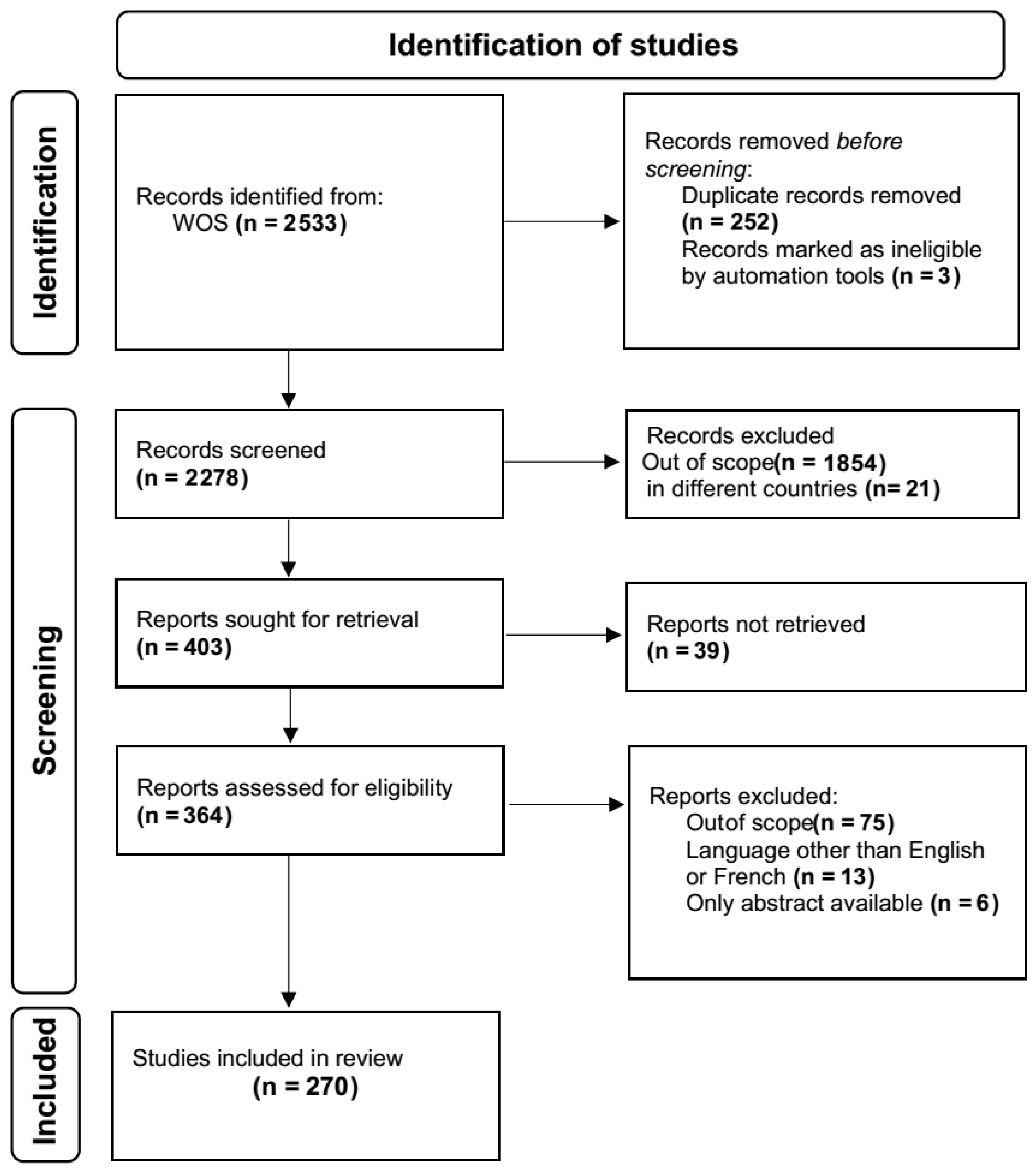
The present systematic review was carried out in accordance with the reporting standards of PRISMA 2020 (Preferred Reporting Items for Systematic Reviews and Meta-Analyses), with a view to ensuring methodological rigor, transparency, and reproducibility [16]. The completed PRISMA 2020 checklist, detailing the reporting of each item across the manuscript, is provided in (Table S1). A systematic literature search was conducted across prominent scientific databases, namely Web of Science and Scopus, utilising pre-defined keywords pertaining to oasis agroecosystems in arid environments. The selection of studies was conducted through a rigorous multi-stage screening procedure (identification, screening, eligibility, and inclusion), the details of which are outlined in Figure 1 of the PRISMA flow diagram. In order to ensure consistency and relevance, explicit inclusion and exclusion criteria were applied. The focus of the research was on peer-reviewed articles addressing the ecological, agricultural and socio-environmental aspects of oasis systems; conference proceedings, book chapters, and grey literature were not considered, consistent with the eligibility criteria applied during screening. The data extraction process was conducted in accordance with a standardised protocol, with the objective of capturing key variables such as geographic location, typology of oasis systems, research themes, and methodological approaches. For each included study, data were extracted on geographic location, oasis typology, key species, and primary research theme. A comprehensive summary of these characteristics is presented in Table S2 and the Supplementary Data Source List (Supplementary Materials).
The present study utilised the Web of Science database, a renowned platform selected for its superior indexing, meticulous journal selection criteria, and its international recognition in bibliometric and systematic review studies. Comparative tests were carried out using identical search strings in both databases. These revealed that the bibliographic retrieval process was, for the most part, consistent. In addition, highly comparable levels of relevance and precision were demonstrated by the results. This similarity lends support to the robustness of the search strategy across various platforms. Ultimately, the Web of Science database was retained as the principal source due to its marginally higher levels of consistency and reliability in the selection of pertinent records.
In contrast to approaches that restrict the analysis to a predefined time period, this study was not subject to temporal limitations. Rather than imposing temporal constraints, the aim was to encompass the entire spectrum of relevant scientific output by incorporating all publications indexed in Web of Science. This strategy is intended to provide researchers with a more comprehensive and historically contextual understanding of the evolution of research on oasis systems, agrobiodiversity, and local practices. Additionally, it aims to mitigate the risk of omitting seminal or foundational studies.
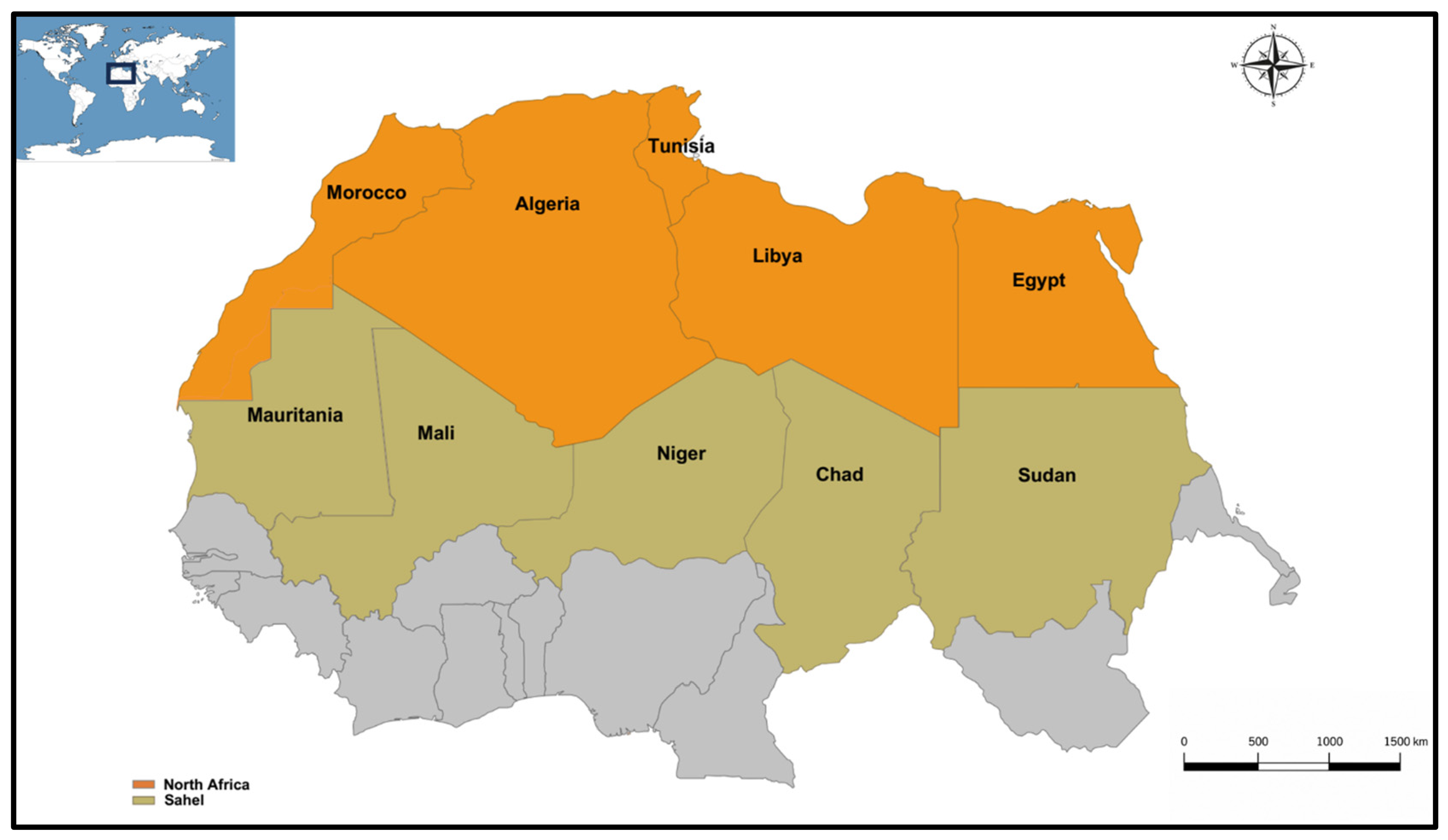
The geospatial targeting approach was utilised for the identification of oasis systems and the subsequent analysis of their characteristics. The present study is focused on ten countries in North Africa and the Sahel (Morocco, Algeria, Tunisia, Libya, Egypt, Mauritania, Mali, Chad, Sudan and Niger). The selection of these countries was primarily driven by the prevalence of arid and hyper-arid climates, as well as the high probability of discovering oasis agroecosystems in the southern regions of North Africa (Figure 2).
The search was conducted in February 2026 using the keyword ‘oasis’ in conjunction with the specific country name in titles, abstracts, and keywords. Utilising the country name as a search parameter successfully excluded research on oases located outside the specified study area, while the primary term optimised the overall retrieval of relevant material. The selection of articles was subject to a two-step filtration process. In the initial phase of the research, the titles and abstracts of the papers were reviewed with a view to eliminating those that were not relevant to the subject under discussion (for example, those dealing with geology, archaeology and medicine, as well as papers dealing with oases outside of North Africa). Consequently, a thorough full-text evaluation was carried out on the retained articles to guarantee strict adherence to the review’s objectives. The data extraction process for the selected publications was conducted via an in-depth, full-text review. A standardised database was utilised to document bibliometric and geographic data (e.g., authors, title, keywords, journal, citation count, and country), in conjunction with the agrobiodiversity profiles, indigenous local knowledge (LK), Thematic Areas of Research and methodological approaches examined in each study. A detailed analysis was conducted on each article to ascertain the primary traditional practices and plant varieties that were emphasised.
It is important to note that this systematic review was not prospectively registered in a public registry. No formal review protocol was prepared prior to the literature search and data extraction. In consideration of the descriptive, bibliometric-thematic character of this review, and in contrast to an intervention-outcome synthesis, prospective registration was not considered a methodological prerequisite. Nevertheless, the comprehensive search strategy, screening criteria, and extraction variables are meticulously delineated in Section 2 (Materials and Methods) to ensure transparency and reproducibility.

3. Results and Discussion

3.1. Characteristics of the Included Studies

The preliminary literature search, carried out using the Web of Science (WOS) database, resulted in a total of 2533 records. Before the preliminary screening stage, 252 duplicate records were eliminated, along with three records flagged as ineligible by automated tools. The following 2278 records were subjected to a title and abstract screening. This process resulted in the exclusion of 1875 records, primarily due to their categorisation as out of scope (n = 1854) or their execution in countries beyond the targeted geographical area (n = 21). Consequently, full-text reports were obtained for the 403 remaining records, although 39 of these could not be successfully retrieved. A comprehensive full-text eligibility assessment was subsequently conducted on the 364 retrieved reports. During this stage of the process, 94 reports were excluded for the following reasons: It was established that 75 of the publications were out of scope, 13 were published in a language other than English or French, and 6 provided only an abstract. The rigorous systematic selection process was thus undertaken, and this process ultimately resulted in a final cohort of 270 studies included in the review (Figure 2).

3.2. Bibliometric and Geographical Distribution

3.2.1. Temporal Trends of the Included Studies

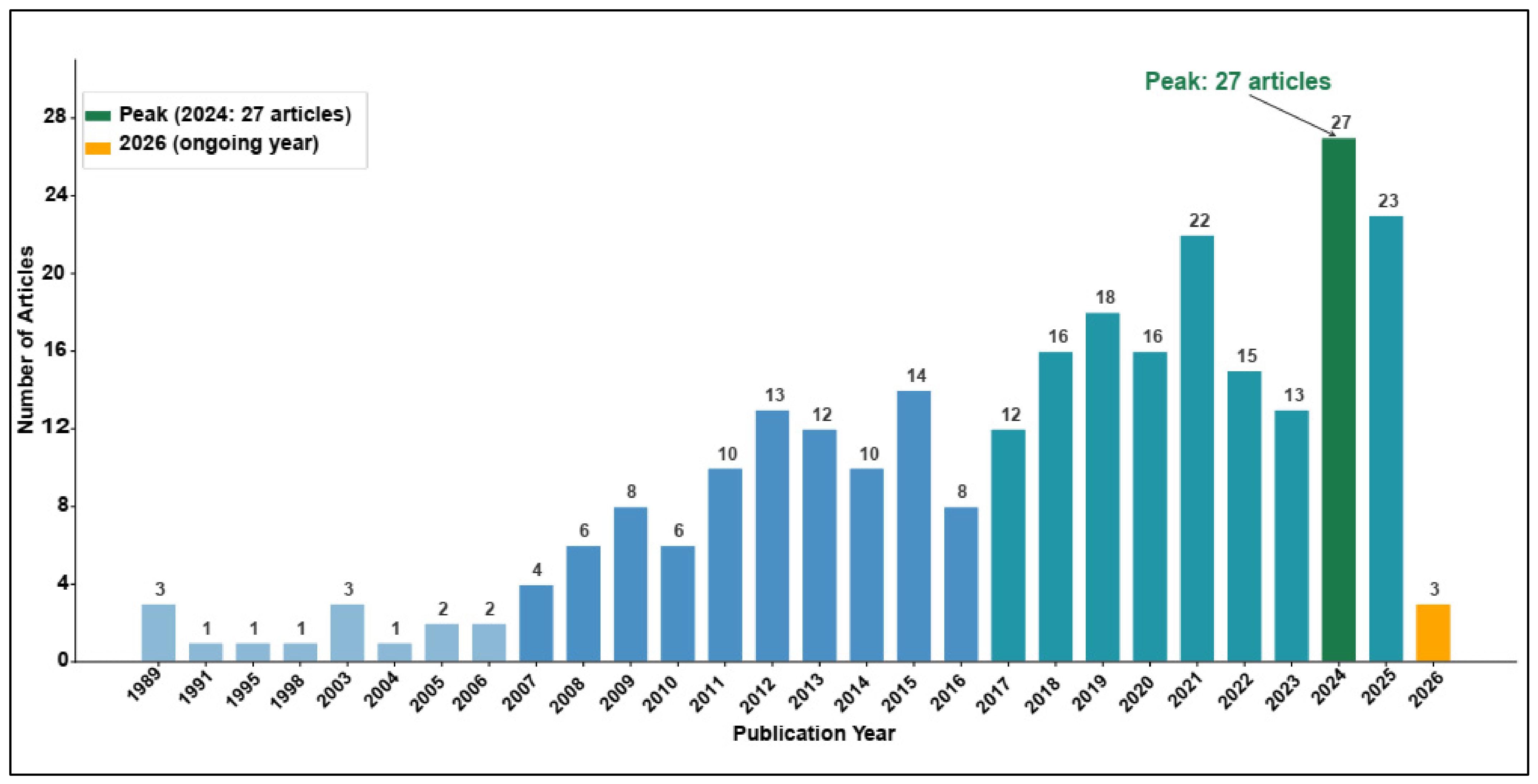
The distribution of the 270 included studies over time demonstrates a significant and consistent increase in scientific attention over the past decades, reaching a peak in 2024 with 27 publications (Figure 3).
This observed upward trajectory is indicative of global trends in dryland agroecosystem research, yet it is evident that there has been a marked shift in thematic foci across different periods. The initial phase of research (1989–2010) was characterised by the genetic characterisation of forage legumes and the application of conventional hydraulics [8,17]. During the intermediate phase, which occurred between 2011 and 2018, there was an increase in the variety of methodological approaches. Among these approaches was the integration of Geographic Information Systems, alongside analyses of the socio-agrarian systems [18,19]. This most recent phase (2019–2026) is marked by transdisciplinary research frameworks integrating genomics with assessments of sustainability, along with the quantification of climate change impacts and the development of research into a circular bioeconomy [11].

3.2.2. Spatial Distribution and Geographic Disparities of the Included Studies

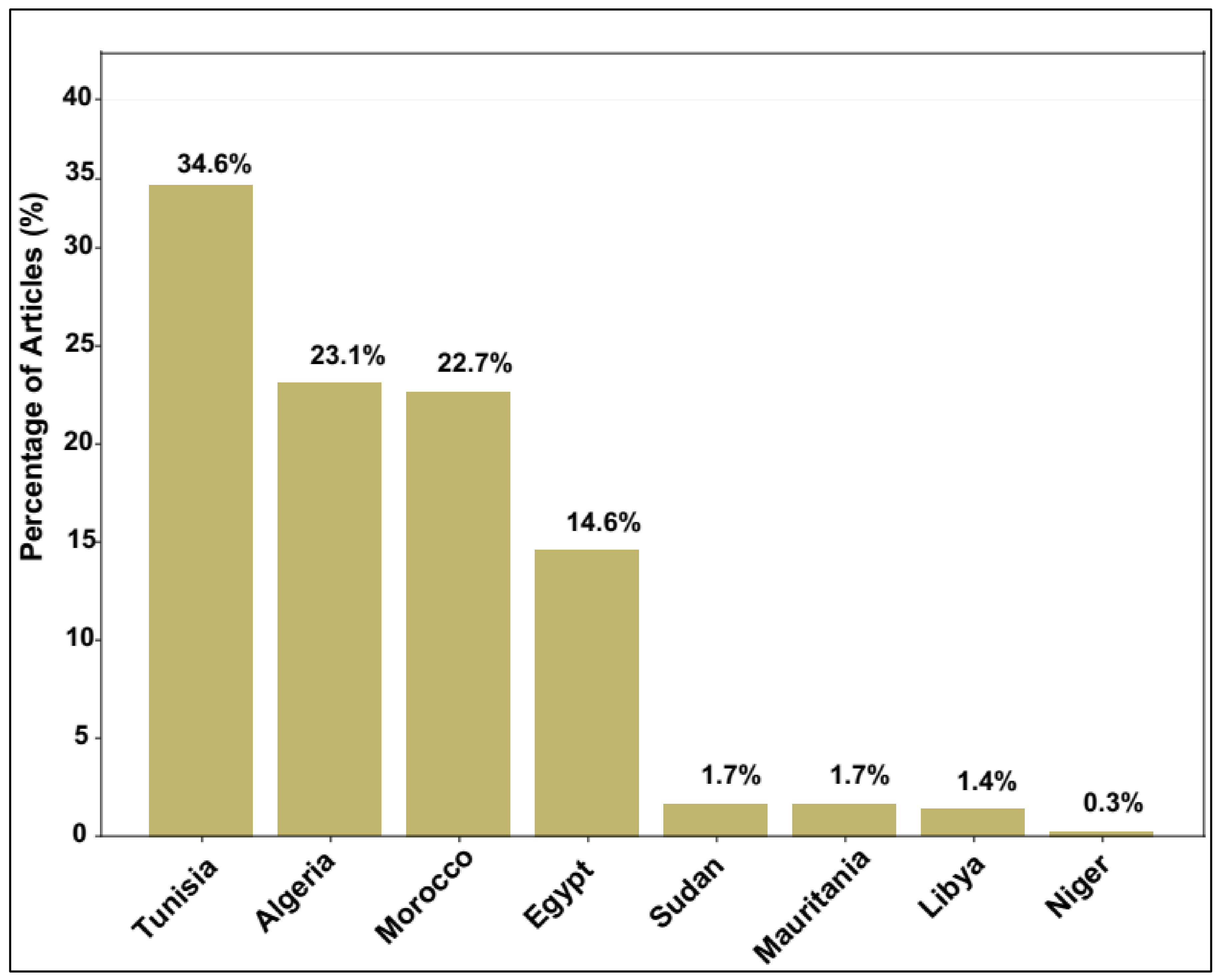
The geographical distribution of the corpus indicates a notable concentration within the Maghreb region. These percentages are based on a total of 295 country occurrences, with some studies covering multiple countries and consequently being counted multiple times. Tunisia alone contributes 34.6% (n = 102) of the analysed articles. Algeria and Morocco are the second and third most represented countries, with 23.1% (n = 68) and 22.7% (n = 67), respectively. Furthermore, Egypt represents a significant proportion of the research focus, accounting for 14.6% (n = 43) of the selected studies. In contrast, a paucity of studies is evident in other countries within or adjacent to the Saharan belt. As demonstrated in Figure 4, a number of countries have been found to be substantially underrepresented in the current body of literature. These countries include Sudan (1.7%, n = 5), Mauritania (1.7%, n = 5), Libya (1.4%, n = 4), and Niger (0.3%, n = 1). The present research has focused primarily on the subjects of desert land reclamation [20] and archaeobotany [21,22]. In addition, sub-regional disparities are equally pronounced within the Maghreb. Tunisian studies are concentrated in the southern oases of the Djerid, Nefzaoua, and Gabès [23,24,25]. By contrast, Algerian research is focused on the Ziban, M’zab, and Adrar regions [19,26,27]. Meanwhile, Moroccan research is centred on the Tafilalet, Drâa, and pre-Saharan High Atlas systems [4,28,29].

3.3. Spatial Diversity of the Investigated Oasis Sites

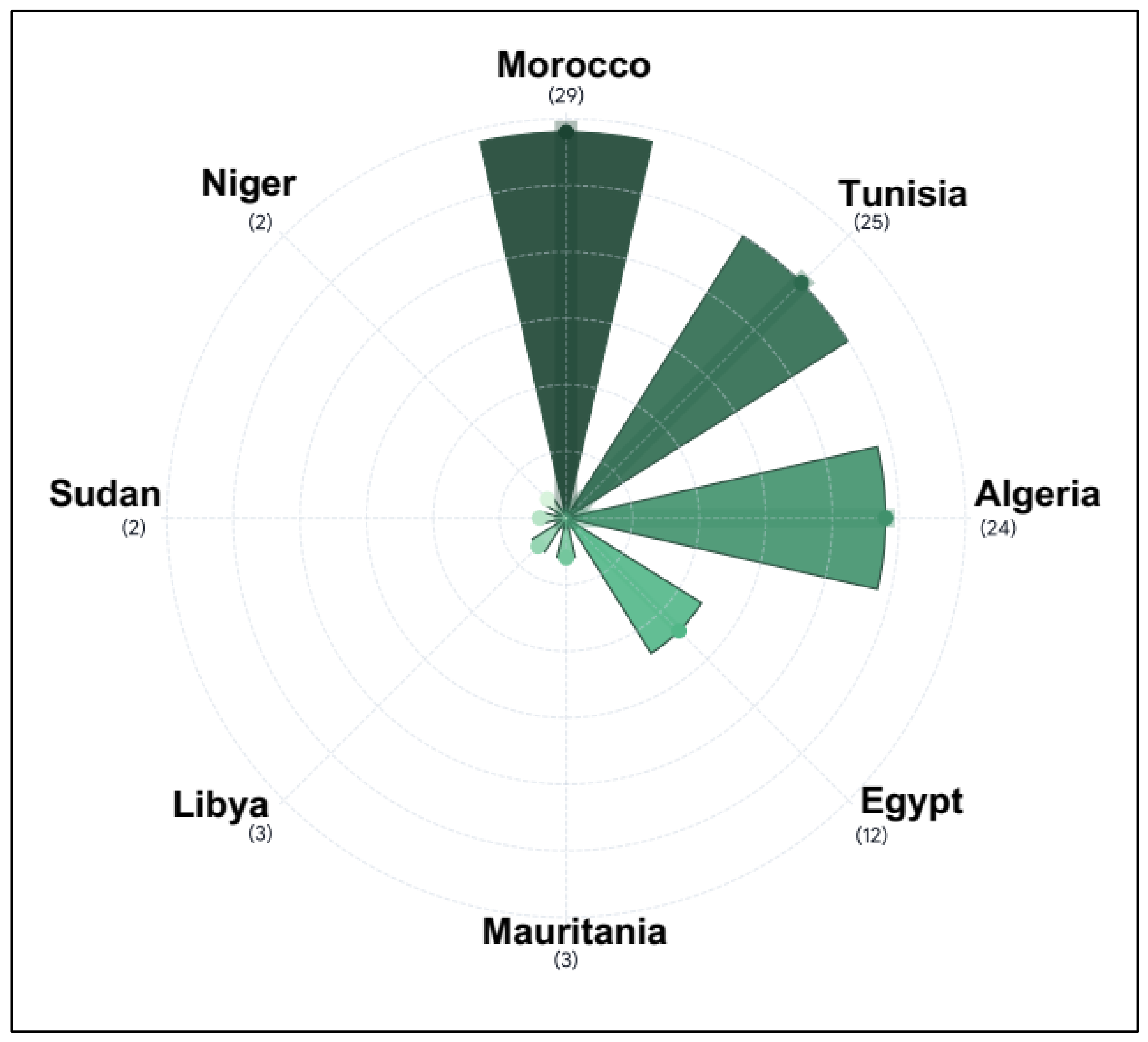
A more detailed analysis of the literature, which goes beyond national-level publication metrics, shows that a total of 100 different oasis systems were explicitly investigated across the systematic review corpus (Figure 5). Morocco demonstrates the highest degree of spatial diversity in research, with 29 specific oases having been studied, including major traditional systems such as the Tafilalt and the Draa Valley. Tunisia (n = 25 oases) and Algeria (n = 24 oases) similarly demonstrate a broad geographical research scope, indicating a commitment to comprehensive exploration and analysis across a wide range of geographical areas. Within the Algerian context, investigations frequently target highly stratified, historical agricultural hubs, with sites such as the Touat, the Zibans, and the M’Zab Valley acting as prominent focal points for agrobiodiversity and ethnobotanical assessments. In contrast, a marked absence of spatial data is evident in the remaining part of the region under study. It is evident that a significantly restricted number of locations have been studied in all other countries, including Egypt (n = 12 oases), Mauritania (n = 3 oases), Libya (n = 3 oases), Sudan (n = 2 oases) and Niger (n = 2 oases). Although Chad was included among the countries considered in the review methodology, no eligible studies on oasis agrobiodiversity were identified for this country.

3.4. Thematic Classification of the Included Studies

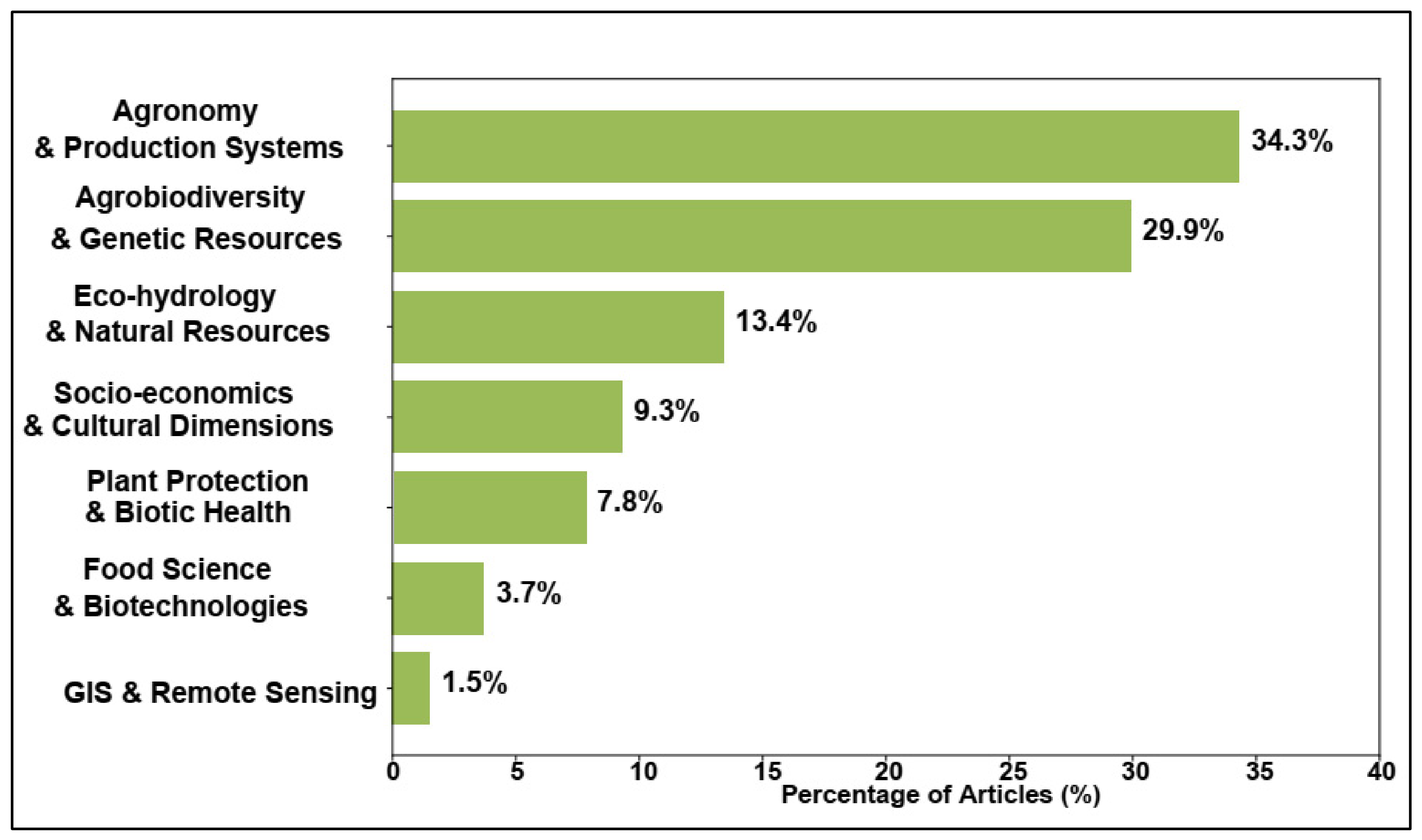
The thematic categorisation of the 270 articles included in this study indicates a notable focus on research efforts within the agricultural and biological sciences. Agronomy and Production Systems has been identified as the most prevalent research domain, accounting for 34.3% of the reviewed literature [30,31,32,33]. This is followed by a significant corpus of studies dedicated to Agrobiodiversity & Genetic Resources, constituting 29.9%. This scientific focus is characterised by an emphasis on the characterisation and preservation of endemic plant species and traditional cultivars within these fragile environments [26,34,35]. Research that pertains to eco-hydrology and natural resources represents 13.4% of the studies, thereby reflecting the critical challenges of water management and soil conservation in arid oasis ecosystems [36,37,38]. The socio-economics and cultural dimensions, including the critical elements of traditional local knowledge and community practices, account for 9.3% of the extant literature [39,40,41]. The remaining domains demonstrate a significantly lower level of representation: As demonstrated in the research conducted by Nogot et al. [42] and Ben Alaya et al. [43], the field of Plant Protection and Biotic Health accounts for 7.8%. Similarly, Alahyane et al. [44] and Alotaibi et al. [45] found that Food Science and Biotechnologies represent 3.7%. It is noteworthy that, despite the increasing significance of spatial analysis in contemporary ecology, the field of Geographic Information Systems (GIS) and remote sensing is the least represented thematic area, with a mere 1.5% of the reviewed articles addressing it [46,47,48]. This distribution underscores a pronounced, well-established orientation towards fundamental production and biodiversity, while concurrently identifying conspicuous research lacunae in the implementation of geospatial technologies and post-harvest value addition in oasis agroecosystems (Figure 6).

3.5. Methodological Classification of the Included Studies

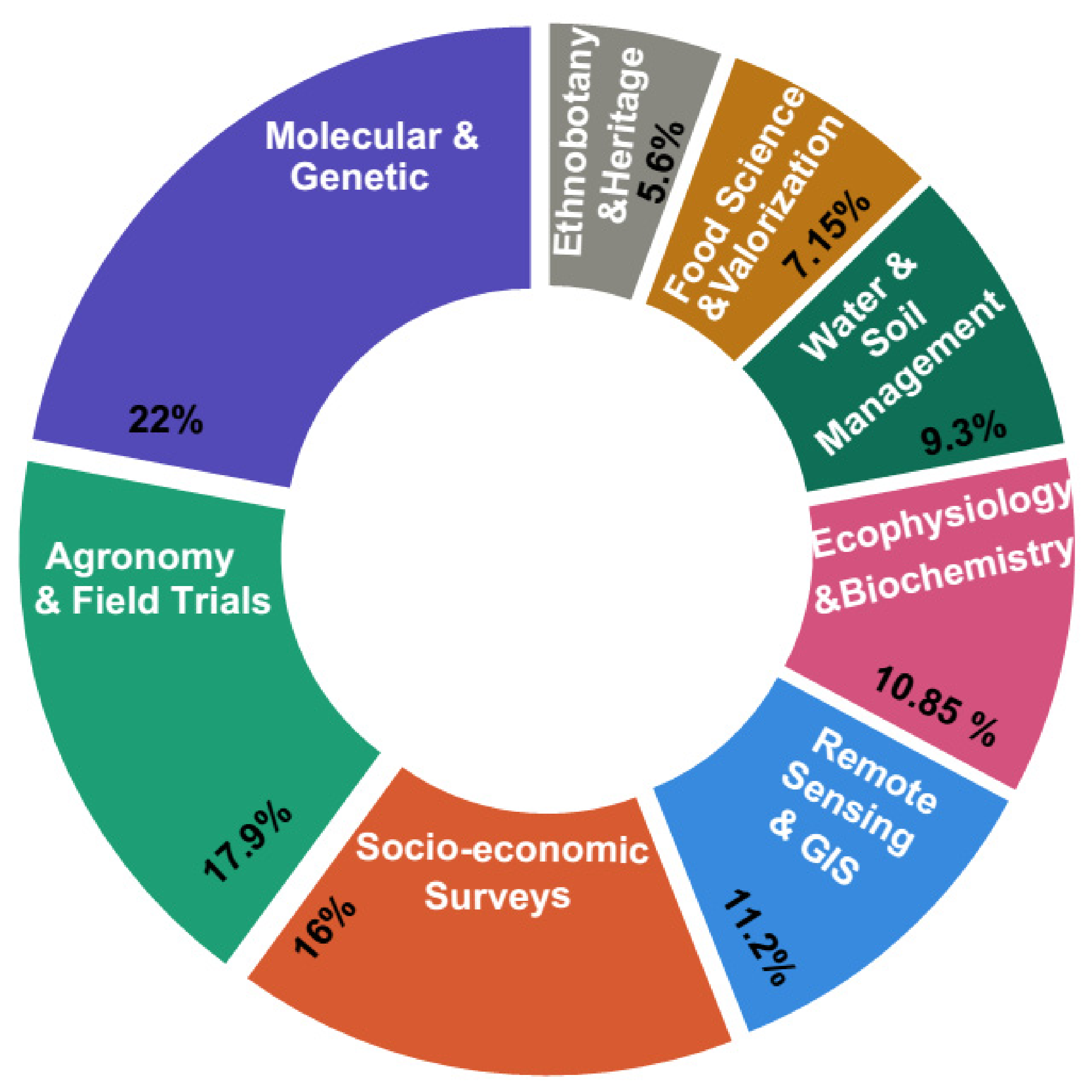
The investigation of the 270 peer-reviewed articles indicates considerable methodological heterogeneity, which mirrors the multidisciplinary character of oasis research. The analysis yielded eight distinct categories. Although the methodological categories are presented separately, they are not mutually exclusive, as individual studies may adopt multiple methodological approaches and were therefore assigned to more than one category. Molecular and genetic approaches were the most prevalent (22%), closely followed by agronomy and field trials (17.9%) [42,49]. Socio-economic research constituted a significant proportion of the overall studies (16%) [7,39,50], emphasising the pivotal human dimension within these ecosystems. The studies of Abdel Kawy and Abou El-Magd [20] and Mihi et al. [15] observed intermediate frequencies for remote sensing and GIS-based studies, with a percentage of 11.2%. Similarly, Ahmed [51] and Alahyane et al. [44] observed intermediate frequencies in ecophysiology/biochemistry approaches (10.85%). Research focusing on water and soil management (9.3%) [52,53] and food science/valorisation (7.1%) was less prevalent [54,55]. It is noteworthy that ethnobotany and cultural heritage studies constituted the least represented category (5.6%) (Figure 7). The findings demonstrate an overarching prevalence of experimental frameworks, encompassing both molecular and field-based methodologies. Concurrently, there is an indication of a transition towards more interdisciplinary approaches, characterised by the integration of spatial and socio-economic dimensions.

3.6. Taxonomic Distribution and Research Focus Across Studied Species

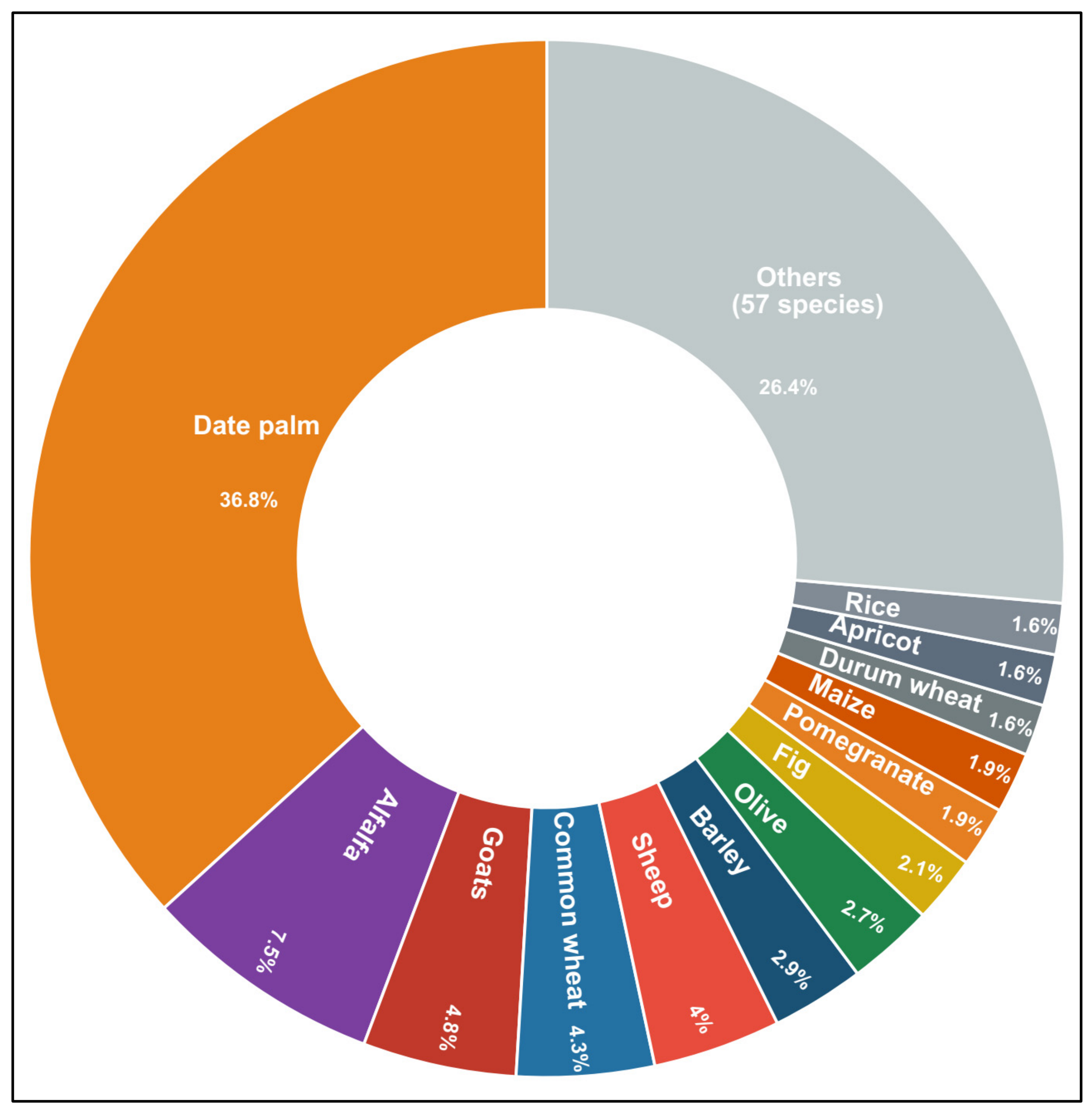
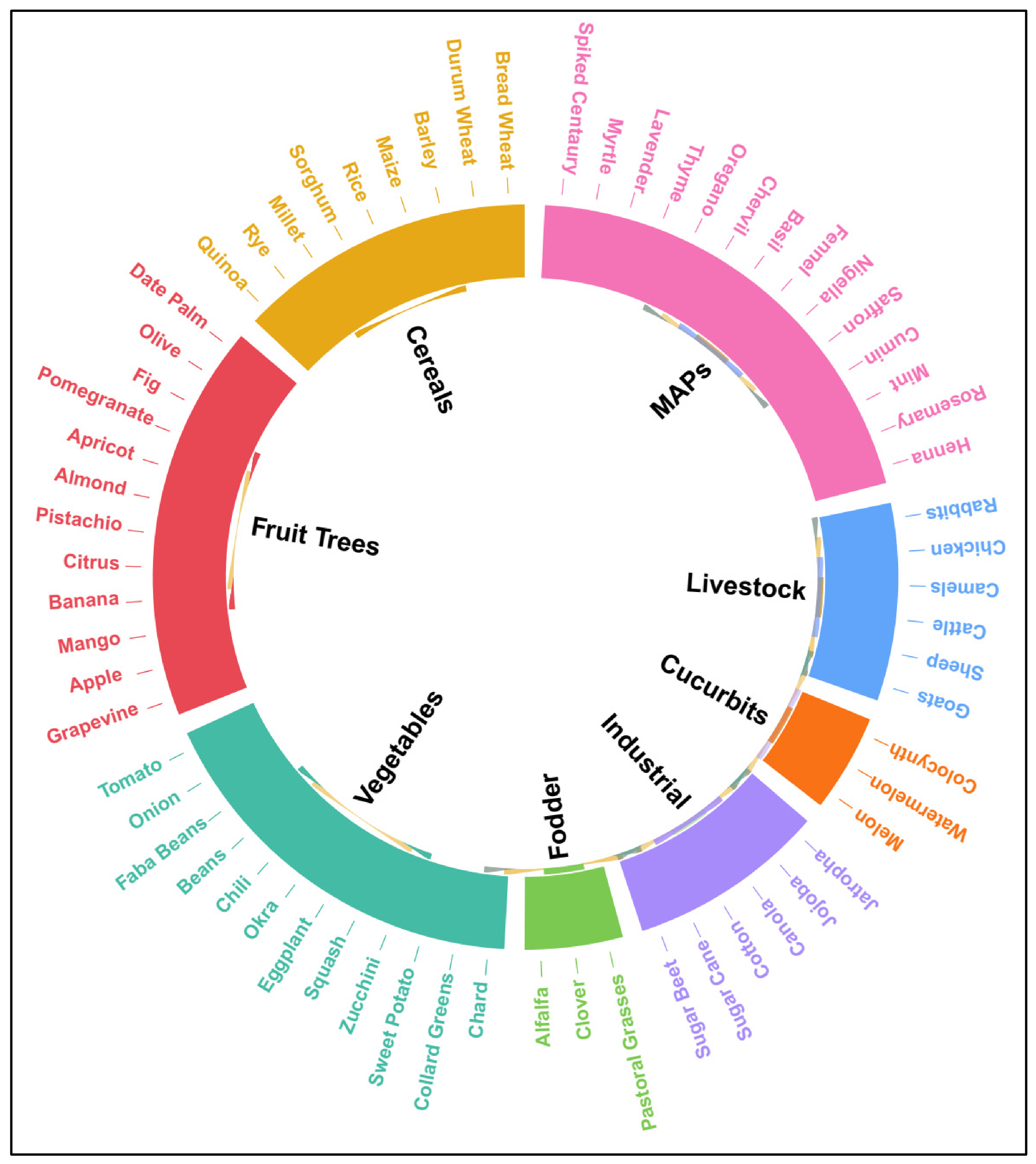
A detailed analysis of the specific taxa targeted within the reviewed literature reveals a pronounced, albeit expected, skew in research focus. The date palm (P. dactylifera L.) is the focus of the majority of scientific literature, accounting for 36.8% (n = 138) of the investigated species (Figure 8 and Figure 9).
The findings demonstrate a consistent dominance across all three Maghreb countries, with a particularly pronounced prevalence in Algeria (74.6%) and Morocco (64.7%). The extant research on this species is distributed across three primary domains. The existing literature on the subject has documented the existence of two major genetic pools, an Occidental North African pool and an Oriental Middle Eastern pool [56]. This has been achieved through genetic and molecular characterization [12,57,58]. In addition, agronomy and water-use optimisation [11,49,58] and phytopathology, particularly Bayoud disease caused by Fusarium oxysporum f. sp. albedinis [59,60,61], have also been thoroughly explored.
Medicago sativa L. is the second most commonly studied species (n = 28; 7.5%), reflecting its pivotal role as the dominant forage crop in oasis understories. Research has repeatedly demonstrated its noteworthy tolerance to salinity and water deficit [62,63], its capacity for nitrogen fixation [64], and its role in enhancing soil organic carbon sequestration under prolonged cultivation [65]. Documentation pertaining to cereal landraces (primarily Triticum spp., n = 16; 4.3%) is predominantly attributable to genetic characterisation of Saharan landraces that have adapted to extreme abiotic constraints [66,67,68], Hordeum vulgare L. (2.9%) [45,69], Zea mays L. (1.9%) [70,71], Triticum durum Desf. (syn. Triticum turgidum subsp. durum (Desf.) Husn.) (1.6%) [68,72], and Oryza sativa L. (1.6%) [73] to provide a comprehensive illustration of the persistence of the essential practice of agriculture for the purpose of personal sustenance. Fruit tree species: Olea europaea L. (n = 10; 2.7%) [74], Ficus carica L. (n = 8; 2.1%) [75], Punica granatum L. (n = 7; 1.9%) [7], Prunus armeniaca L. (n = 6; 1.6%) [76,77], represent the intermediate stratum of the tripartite oasis architecture but account collectively for only 6.4% of the corpus, a proportion manifestly disproportionate to their ecological and cultural importance.
Livestock species are represented by Capra hircus Linnaeus, 1758 (n = 18; 2.0%) [78,79] and Ovis aries Linnaeus, 1758 (n = 15; 2.8%) [54,80], with studies documenting local breeds (D’man sheep, Arbi goats, Gharbi sheep) as keystones of the crop–livestock circular economy [29]. Camelid research is strikingly underrepresented (n = 2), despite the dromedary’s recognized role in Saharan agroecosystems [81,82].

3.7. Traditional Local Knowledge and Ethnobotanical Uses

The results obtained from this review illustrate that the capacity of oasis agroecosystems to demonstrate resilience is contingent upon the intricate integration of biological resources and TEK, which operates across multiple interdependent functional levels. In terms of fundamental infrastructure, the acquisition and distribution of water resources are governed by strict customary institutions, including the Jemaa and local jurisprudence frameworks. These institutions ensure the equitable management of this critical resource [8,9,36,83,84,85,86]. This management is typically achieved through the utilisation of traditional hydraulic systems, such as foggaras and khettaras, which play a crucial role in the distribution network.
At the cultivated strata level, high agronomic diversification (e.g., cereals, legumes, and market garden crops) is achieved through farmers’ empirical phenotypic selection and the utilisation of informal seed exchange networks [4,34,68,72]. The concept of seed sovereignty finds further expression in on-farm seed production, individual plant or ear selection, and community-based exchange systems. Collectively, these practices contribute to the in situ conservation of locally adapted genetic resources [34,87]. The integration of legumes and compost into crop rotations, the preservation of the distinctive three-tier cultivation system, and the conservation of local seed varieties by participatory means [88,89,90,91] serve to reinforce these practices. As is indicated in a substantial corpus of research, a high level of agropastoral integration is characterised by what might be termed a ‘circular economic logic’. The products resulting from the cultivation of date palms are systematically redirected towards the feeding of livestock. Meanwhile, animal manure, from both goats and sheep, is utilised as essential organic fertilisation for nutrient-poor oasis soils, without prior treatment [27,29,37,88]. This process of recycling agricultural waste, which includes manure, compost, and plant residues, in combination with the implementation of water-efficient management practices, is indicative of a coherent strategy of resource circularity, oriented towards the long-term sustainability of agroecosystems [92].
The utilisation of agrobiodiversity transcends the realm of production, extending into post-harvest practices. This is exemplified by a profound tradition of phytotherapy that employs local aromatic and medicinal plants [93], in addition to artisanal processing of agricultural produce. This local ingenuity is exemplified by time-honoured culinary and therapeutic preparations such as Tassabount, a nutritional and therapeutic date-based paste or juice. These preparations utilise a closed-loop valorisation approach that tends towards a zero-waste philosophy [94,95]. In a similar way, the artisanal production of (P. granatum) juice through heating to produce Amaghousse demonstrates the sophistication of local knowledge concerning food transformation [7].

3.8. Geographic, Taxonomic, and Systemic Imbalances in Oasis Research

A pivotal finding of this review is the notable spatial distribution of oasis research. The Maghreb countries (Tunisia, Algeria, Morocco) represent over 80% of the scientific literature, which demonstrates a robust focus on historically stratified oases such as Tafilalt [49,96], the M’Zab valley [37], Jérid [97], and Siwa oases [98]. The over-representation of these regions can be partly attributed to their historical economic importance, their centuries-old agricultural infrastructure, and significant state investment in irrigation and agricultural development [19].
In contrast, countries within the Saharan and adjacent belts, such as Mauritania (1.7%), Sudan (1.7%), Libya (1.4%), and Niger (0.3%), exhibit a marked underrepresentation. Despite the paucity of literature on the subject [66,81,99], it is suggested that the oasis ecosystems in question contain genetic resources of great importance to climate change adaptation. This geographic blind spot has a detrimental effect on any attempt to understand oasis resilience on a continental scale. Indeed, it represents a significant obstacle to the development of evidence-based conservation policy. This imbalance can be attributed to the historically utilitarian framing of oasis agroecosystems within research agendas, wherein commercial imperatives have historically superseded scientific priorities. The redressing of this imbalance necessitates the implementation of targeted funding mechanisms and the establishment of international partnerships, with the objective of extending systematic research coverage to the Sahelo-Saharan belt.
This utilitarian logic may be considered consistent in the taxonomic distribution of the literature. The date palm (P. dactylifera) is a prominent species in the corpus, accounting for 36.8% of the studied species. The analysis places significant emphasis on genetic and molecular approaches [12,59,100]. This emphasis is substantiated by the agronomic and economic significance of the species. The species’ canopy creates a critical microclimate that moderates extreme abiotic conditions for understory crops. Its fruits are a principal food security resource, and its by-products (fronds, stones, rachises) are fundamental to the promotion of circular economy practices across oasis communities [97,101,102]. A considerable body of research has documented the major threats to date palm biodiversity, including genetic erosion driven by the commercial monoculture of elite cultivars (Deglet Nour, Medjool), devastating fungal diseases (Bayoud, caused by F. o. f. sp. albedinis), and climate-induced abiotic stresses, including prolonged drought, rising water tables, and soil salinization [11,56,103]. Recent advancements in the domain of responsive research have yielded several promising strategies, including deficit and subsurface drip irrigation [49,58], optimised pollination via metaxenia effects [104], and the valorisation of residual biomass as organic soil amendments [105].
Nevertheless, the pervasive emphasis on P. dactylifera frequently obscures the fundamental tripartite architecture of oasis agroecosystems. The intermediate fruit-tree stratum, which is dominated by olive (O. europaea), fig (F. carica), pomegranate (P. granatum), apricot (P. armeniaca), and almond (Prunus dulcis (Mill.) D.A.Webb), constitutes a rich in situ conservation reservoir of local genetic diversity. This diversity is maintained through grafting and seed-propagation networks [7,87,106]. In a similar vein, the herbaceous understory constitutes a selection of drought-, heat-, and salinity-tolerant ecotypes that have existed for millennia [4,68,107]. These ecotypes encompass a diverse array of crops, including cereals such as T. turgidum subsp. durum (Desf.) Husn., H. vulgare, Sorghum bicolor L. Moench, and Pennisetum glaucum L., legumes like Vicia faba L., vegetables like Solanum lycopersicum L. (syn. Lycopersicon esculentum Mill.), Allium cepa L., Capsicum annuum L., Solanum melongena L., and Cucurbita pepo L., and cucurbits such as Cucumis melo L., Citrullus lanatus (Thunb.) Matsum. & Nakai, and Citrullus colocynthis (L.) Schrad, all of which have been maintained through informal seed networks [4]. The progressive substitution of these subsistence crops by export-oriented cash crops (irrigated C. lanatus, greenhouse S. lycopersicum, C. annuum) reflects a broader intensification dynamic that simultaneously erodes agrobiodiversity and escalates groundwater exploitation.
A recurrent, albeit under-theorised, motif pervades the reviewed literature, elucidating a symbiotic relationship between crop production and livestock husbandry. Alfalfa (Medicago sativa), the dominant forage species, has been observed to occupy up to 80% of forage areas under palm canopies [4]. The plant’s deep root system, capacity for nitrogen fixation, and tolerance to salinity and water deficit make it a productive resource and a soil-fertility restoration tool [26,63]. This is complemented by grazing of peripheral rangelands and the integration of annual forages (e.g., Trifolium alexandrinum L. in Nile Valley oases). Oasis livestock, principally comprising small ruminants (sheep and goat breeds including D’man, Gharbi, Arbi, and Serti), dromedaries, and backyard poultry, have been shown to valorise agricultural by-products and marginal rangelands [27,78]. In addition, the production of organic manure, which serves as the primary fertility input, has been demonstrated to sustain the productive capacity of sandy oasis soils. It is evident that, in the absence of this crop–livestock coupling, the long-term agronomic sustainability of oasis systems would be fundamentally compromised [29]. Notwithstanding its ecological centrality, agropastoral integration remains a peripheral research theme. The moderate attention given to alfalfa (7.5%) and the limited focus on livestock–crop interactions in policy-oriented literature suggest a systemic undervaluation of this component in both research agendas and development strategies.

3.9. Erosion of Traditional Knowledge, Hydro-Social Crisis, and Future Research Directions

The sustainability of oases has historically been based on a complex socio-technical foundation combining traditional governance institutions (such as the Jemaa council system) and sophisticated hydraulic engineering. Traditional water collection systems such as foggaras (Algeria) and khettaras (Morocco) represent centuries of accumulated ecological knowledge, tailored to local hydrological regimes and community governance frameworks [8,108].
The ecohydrological literature (13.4%) documents growing threats to this foundation. The proliferation of modern pumping technologies and the expansion of commercial agricultural frontiers on the outskirts of oases have placed unprecedented pressure on fossil aquifer systems [109]. This hydraulic transition is undermining both the physical infrastructure of traditional irrigation and the social institutions that ensured its equitable distribution. At the same time, the low proportion of studies devoted to ethnobotany and cultural heritage (5.6%) highlights a critical gap in the documentation and preservation of TEK. The erosion of informal seed-sharing networks and phenotypic selection practices reduces the agroecosystem’s intrinsic adaptive capacity and its resilience to biotic and abiotic stresses [110]. This loss, which is largely irreversible, calls for immediate scientific and institutional attention.
Water scarcity and secondary salinisation constitute the most widely documented set of threats in the included studies, appearing in 139 studies (55.6%). This ubiquity reflects the structural dependence of oasis agriculture on non-renewable fossil aquifers, which are being exploited at rates estimated at between 172 and 228% of their recharge capacity in the Nefzaoua region [38,111]. The transition from traditional gravity-fed systems (foggaras, khettaras, seguias) to individual motorised pumping has significantly accelerated the depletion of aquifers, with the number of functional foggaras in Algeria falling from around 11,500 to 4200 over the last few decades [108,112]. Studies of individual oases document the direct impact of irrigation frequency on agrobiodiversity: plots irrigated at least three times a month in Kébili, Tunisia, have maintained their complete three-tiered vegetation structure, whilst those with reduced access to water have shifted towards a monoculture of date palms [23].
Genetic erosion, identified in 21 studies (8.4%), is consistently linked to the pressure of commercial monoculture exerted by elite cultivars (Deglet Nour and Mejhoul), whose market-driven expansion is displacing hundreds of locally adapted ecotypes [56,113]. Molecular studies have documented that farmers’ active selection for heterozygosity has historically maintained the genetic diversity of the date palm [113], a mechanism now threatened by the standardisation of production systems. Climate change (n = 18; 7.2%) is increasingly recognised as a threat multiplier, with predictive studies forecasting a 20–36% decline in oasis vegetation cover in Algeria under RCP 8.5 scenarios [114] and significant reductions in date palm yields under future temperature and evapotranspiration regimes [11]. Biotic threats, primarily Bayoud disease, documented in 16 studies (6.4%), have cumulatively destroyed around 13 million palm trees in North Africa, with ongoing concerns about the eastward spread of virulent strains [59,60].
The adaptation strategies documented in the reviewed literature fall into three non-mutually exclusive categories: deficit drip irrigation [49], underground drainage [53], algae-based biostimulants [42]; genetic resource management (conservation of khalts and local cultivars) [96], assisted selection of pollinators [104,115], and socio-ecological practices (agropastoral integration for the circular management of soil fertility) [27], community seed banks [89], and the cooperative promotion of traditional products led by women [7,94,116].
Beyond the thematic imbalances, this review identifies significant methodological shortcomings. Remote sensing and GIS approaches, despite their recognised power and validity for monitoring land degradation, agricultural expansion and urban sprawl in arid environments, account for only 1.5% of primary research topics, although 11.2% of studies incorporate them as a secondary method [117]. This underutilisation limits the scientific community’s capacity for spatio-temporal monitoring, precisely at the scale at which oasis degradation dynamics operate. Similarly, food science and biotechnology (3.7%) remain under-represented given the economic potential of oasis sectors; the circular economy approach to date by-products represents a documented yet under-researched economic lever for diversifying rural incomes and reducing waste [118,119].
Taken together, these gaps set out clear priorities for future research. Firstly, a deliberate geographical rebalancing towards the Sahel-Saharan arc is essential for any coherent understanding of the resilience of North African oases at the continental scale. Secondly, a shift from species-centred approaches to systemic approaches that integrate the three cultivated strata and their agro-pastoral linkages is necessary to grasp the functional complexity underpinning oasis sustainability [120]. Thirdly, the integration of geospatial monitoring tools with ethnobotanical and socio-economic methodologies will enable researchers to simultaneously track the spatial dynamics of degradation and the erosion of the knowledge systems that have historically underpinned these landscapes. Fourthly, transdisciplinary frameworks combining cutting-edge geospatial analysis with the revitalisation of TEK are urgently needed to inform conservation and development policies that are both scientifically rigorous and locally rooted.

3.10. Limitations and Recommendations

When interpreting the results of this review, it is important to consider several limitations. Initially, the search was restricted to Web of Science; however, a comparative analysis of Scopus revealed a comparable number of records, yet a disproportionate proportion of Scopus-exclusive records pertained to Sahelo-Saharan countries. This finding suggests that the selection of the database may itself contribute to the geographic imbalance discussed in Section 3.8. Second, the search was limited to English and French. However, it should be noted that the majority of countries in the study area are French-speaking, with the exception of Egypt, where the use of Arabic in scientific publications is limited. Generally speaking, scientific publications follow the global trend toward anglicization, with the exception of documents and studies intended for local use. In addition, the absence of eligible studies from Chad may reflect its limited representation in major international bibliographic databases, potentially due to structural constraints related to research funding, infrastructure, and scientific dissemination.
It is recommended that future research efforts place a greater emphasis on conducting multilingual, multi-database searches (e.g., AGRIS, CAB Abstracts, regional platforms) employing Arabic-language terminology. Such endeavours should be complemented by targeted research initiatives in countries that have received insufficient attention. Additionally, there is a need for prospective registration and formal quality appraisal mechanisms. Furthermore, there is a pressing need for greater integration of geospatial, ethnobotanical, and socio-economic approaches within research frameworks.

4. Conclusions

This systematic review comprises 270 peer-reviewed studies, representing the most comprehensive synthesis to date of scientific knowledge regarding North African oasis agroecosystems, and consequently, it exposes structural asymmetries that inherently restrict both scientific understanding and the effective conservation of such socio-ecological systems. Three overarching findings emerge from the evidence presented. Firstly, the marked geographical concentration of research in the Maghreb region, constituting over 80% of the reviewed literature, results in a significant knowledge gap across the Sahel-to-Sahel region. In this area, oasis ecosystems, which are rich in genetic resources with high adaptive value for climate change resilience, remain largely unexamined. Secondly, the reductionist, date-palm-centric research focus continues to obscure the oasis’s tripartite functional complexity. Thirdly, the paucity of ethnobotanical and geospatial methodologies, constituting 5.6% and 1.5% of the thematic research remit, respectively, is indicative of a paradigm shift between isolated studies of biological resources and the more integrated socio-ecological reality of living oasis landscapes.
The most critical conservation challenges identified across the corpus are deeply interconnected and structurally resistant to disciplinary approaches. These challenges include groundwater over-exploitation driven by the collapse of traditional hydraulic governance, genetic erosion accelerated by commercial monoculture, and the progressive dissolution of informal seed exchange networks. Despite the quantitative growth of extant research, it remains insufficient to support spatially explicit, evidence-based policy at either the oasis scale or the continental scale.
Moving forward, the field requires a deliberate paradigm shift toward transdisciplinary research frameworks that (i) systematically document traditional ecological knowledge and seed-exchange networks before their irreversible loss; (ii) integrate remote sensing and GIS methodologies with ethnobotanical and socio-economic approaches to simultaneously monitor spatial degradation dynamics and knowledge erosion; (iii) advance locally grounded conservation strategies that recognize oasis agrobiodiversity as biocultural heritage rather than a utilitarian genetic reservoir; and (iv) extend systematic research coverage to the Sahelo-Saharan belt through targeted international partnerships and funding mechanisms. Implementing these priorities in research agendas and conservation policy constitutes the most urgent pathway toward ensuring the long-term ecological resilience and cultural sovereignty of North African oasis agroecosystems.

Supplementary Materials

The following supporting information can be downloaded at: https://www.mdpi.com/article/10.3390/conservation6030115/s1, Table S1: PRISMA 2020 Checklist; Table S2. Characteristics of the included studies; Supplementary Data Source List.

Author Contributions

Conceptualization, M.E.M.; methodology, M.E.M.; software, M.E.M., K.K. and J.K.; validation, M.E.M., J.K. and K.K.; formal analysis, M.E.M.; investigation, M.E.M., K.K. and J.K.; resources, M.E.M., K.K., J.K. and M.A.; data curation, M.E.M., J.K. and V.A.B.; writing—original draft preparation, M.E.M., K.K. and J.K.; writing—review and editing, M.E.M., M.A. and J.K.; visualization, K.K., S.C., V.A.B. and M.H.; supervision, M.A. All authors have read and agreed to the published version of the manuscript.

Funding

This research received no external funding.

Institutional Review Board Statement

Not applicable.

Informed Consent Statement

Not applicable.

Data Availability Statement

The dataset generated during this review, which comprises a standardised extraction database for the 270 included studies (bibliometric data, geographic and thematic classifications, and methodological codes), is available from the corresponding author upon reasonable request.

Acknowledgments

The authors express their sincere gratitude to all individuals who contributed to and facilitated this review.

Conflicts of Interest

The authors declare that they have no conflicts of interest.

References

  1. Jouve, P. Les oasis du Maghreb, des agro-écosystèmes de plus en plus menacés: Comment renforcer leur durablité? LE Courr. DE l’Environ. DE l’INRA 2012, 62, 113–122. [Google Scholar]
  2. Munier, P. Note sur le palmier des Canaries, Phoenix canariensis Hort. (Chabaud). Fruits 1973, 28, 559. [Google Scholar]
  3. Rhouma, A.; Mougou, I.; Rhouma, H. Determining the pressures on and risks to the natural and human resources in the Chott Sidi Abdel Salam oasis, southeastern Tunisia. Euro-Mediterr. J. Environ. Integr. 2020, 5, 37. [Google Scholar] [CrossRef] [Scilit]
  4. Houssni, M.; Kassout, J.; El Mahroussi, M.; Chakkour, S.; Kadiri, M.; Ater, M.; Petrisor, A.I. Evaluation and structuring of agrodiversity in oases agroecosystems of Southern Morocco. Agriculture 2023, 13, 1413. [Google Scholar] [CrossRef] [Scilit]
  5. Sraïri, M.T.; Azahra M’ghar, F.; Benidir, M.; Bengoumi, M. Analyse typologique de la diversité et des performances de l’élevage oasien. Cah. Agric. 2017, 26, 15005. [Google Scholar] [CrossRef] [Scilit]
  6. Santoro, A. Traditional oases in Northern Africa as multifunctional agroforestry systems: A systematic literature review of the provided ecosystem services and of the main vulnerabilities. Agrofor. Syst. 2023, 97, 81–96. [Google Scholar] [CrossRef] [Scilit]
  7. El Mahroussi, M.; Kassout, J.; Houssni, M.; Kadaoui, K.; Chakkour, S.; Sahli, A.; Boselli, V.A.; Hassan, B.; Ater, M. Traditional knowledge, gendered practices, and agro-biodiversity conservation: A case study of pomegranate in Moroccan pre-Saharan oases. Conservation 2025, 5, 66. [Google Scholar] [CrossRef] [Scilit]
  8. Aroua, N. Traditional qanat related jurisprudence in Algeria. Water Sci. Technol. Water Supply 2014, 14, 1149–1157. [Google Scholar] [CrossRef] [Scilit]
  9. Rezzoug, C.; Remini, B.; Hamoudi, S. Les techniques traditionnelles de captage et de partage des eaux d’irrigation dans l’oasis de Ouakda. J. Fundam. Appl. Sci. 2017, 9, 378–391. [Google Scholar]
  10. Dhaouadi, L.; Besser, H.; Wassar, F.; Kharbout, N.; Brahim, N.B.; Wahba, M.A.; Kang, Y.K. Agriculture sustainability in arid lands of Southern Tunisia: Ecological impacts of irrigation water quality and human practices. Irrig. Drain. 2020, 69, 974–996. [Google Scholar] [CrossRef] [Scilit]
  11. Zemni, N.; Sidhom, O.; Dhaouadi, L.; Bouhlila, R.; Berndtsson, R.; Bouksila, F.; Slama, F.; Dakhlaoui, H. Strategies for present and future bubbler irrigation system management in a Saharan date palm oasis under climate change. Agric. Water Manag. 2025, 319, 109811. [Google Scholar] [CrossRef] [Scilit]
  12. Zehdi, S.; Trifi, M.; Billotte, N.; Hanana, M.; Salhi-Hannachi, A. Genetic diversity of Tunisian date palms (Phoenix dactylifera L.) revealed by nuclear microsatellite polymorphism. Hereditas 2004, 141, 278–287. [Google Scholar] [CrossRef] [Scilit] [PubMed]
  13. Hamamouche, M.F.; Kuper, M.; Amichi, H.; Lejars, C.; Ghodbani, T. New reading of Saharan agricultural transformation: Continuities of ancient oases and their extensions (Algeria). World Dev. 2018, 107, 210–223. [Google Scholar] [CrossRef] [Scilit]
  14. Battesti, V. Les possibilités d’une île, insularités oasiennes au Sahara et genèse des oasis. In Mer et Désert de l’Antiquité à Nos Jours, Approches Croisées, Histoire; Tallet, G., Sauzeau, T., Eds.; Presses Universitaires de Rennes: Rennes, France, 2018; pp. 105–144. [Google Scholar] [CrossRef] [Scilit]
  15. Mihi, A. Etude Écologique et Cartographique de l’Écosystème Oasien par l’Outil SIG et Télédétection: Cas de l’Oasis de Biskra, Algérie Sud. Ph.D. Thesis, Université de Sétif, Sétif, Algeria, 2018. [Google Scholar]
  16. Page, M.J.; McKenzie, J.E.; Bossuyt, P.M.; Boutron, I.; Hoffmann, T.C.; Mulrow, C.D.; Moher, D. The PRISMA 2020 statement: An updated guideline for reporting systematic reviews. BMJ 2021, 372, n71. [Google Scholar] [CrossRef] [Scilit] [PubMed]
  17. Birouk, A.; Dattee, Y.; Sadiki, M.; Roumet, P. Evaluation agronomique et adaptation de populations marocaines de luzerne (Medicago sativa L.). Agronomie 1989, 9, 363–376. [Google Scholar] [CrossRef] [Scilit]
  18. Hamamouche, M.F.; Kuper, M.; Lejars, C. Émancipation des jeunes des oasis du Sahara algérien par le déverrouillage de l’accès à la terre et à l’eau. Cah. Agric. 2015, 24, 412–419. [Google Scholar] [CrossRef] [Scilit]
  19. Daoudi, A.; Lejars, C. De l’agriculture oasienne à l’agriculture saharienne dans la région des Ziban en Algérie. Acteurs du dynamisme et facteurs d’incertitude. New Medit 2016, 15, 45–52. [Google Scholar]
  20. Abdel Kawy, W.A.; Abou El-Magd, I.H. Assessing crop water requirements on the bases of land suitability of the soils South El Farafra Oasis, Western Desert. Egypt. Arab. J. Geosci. 2013, 6, 2313–2328. [Google Scholar] [CrossRef] [Scilit]
  21. McDonald, M.M. Early African pastoralism: View from Dakhleh Oasis (south central Egypt). J. Anthropol. Archaeol. 1998, 17, 124–142. [Google Scholar] [CrossRef] [Scilit]
  22. Attia, E.A.E.; Malleson, C.; Fahmy, A.G.; Lucarini, G. New Data on Plant Use in the Eastern Sahara: The Macro-Remain Assemblage from Sheikh el-Obeiyid Villages and Bir el-Obeiyid Playa, Farafra Oasis, Egyptian Western Desert. J. Afr. Archaeol. 2021, 20, 83–106. [Google Scholar] [CrossRef] [Scilit]
  23. Taha, R.; Sihem, B.M.; Marianne, S.; Ali, S.; Ahmed, N.; Mars, M. Variability of Physicochemical Properties of ‘Deglet Nour’ Date Fruits Collected from Different Oases in Djerid Region, Tunisia. J. Hortic. Postharvest Res. 2020, 3, 85–100. [Google Scholar] [CrossRef] [Scilit]
  24. Rhouma, A.; Mougou, I.; Bedjaoui, H.; Rhouma, H.; Matrood, A.A.A. Ecology in Chott Sidi Abdel Salam Oasis, Southeastern Tunisia: Cultivated Vegetation, Fungal Diversity and Livestock Population. J. Coast. Conserv. 2021, 25, 52. [Google Scholar] [CrossRef] [Scilit]
  25. Charieg, H.; Dhraief, M.Z.; Gharbi, I.; Ben Saad, A. Enhancing the resilience of vulnerable social-ecological systems: Pathways toward sustainable oases in southeastern Tunisia. Front. Sustain. Food Syst. 2025, 9, 1623641. [Google Scholar] [CrossRef] [Scilit]
  26. Chabouni, A.; Issolah, R.; Benabdelkader, E.H.; Melouki, A.; Tareb, S.; Mefti, M. Morphological and phenological variability within seven oasis populations of perennial alfalfa (Medicago sativa L.) in hyper-arid zone of Southern Algeria. Pak. J. Bot. 2024, 56, 1049–1058. [Google Scholar] [CrossRef] [Scilit] [PubMed]
  27. Bel Messaoud, R.; Guedioura, I.; Cüce, E.; Letaim, F.; Ikhlef, H. Agroecological sustainability analysis of small ruminants farms in the Saharan context of El Oued, Algeria. Environ. Prog. Sustain. Energy 2026, 45, 70307. [Google Scholar] [CrossRef] [Scilit]
  28. Bossenbroek, L.; Ftouhi, H.; Berger, E.; Kadiri, Z. Femmes oasiennes au Maroc: Actrices de la survie des oasis. Cah. Agric. 2024, 33, 33. [Google Scholar] [CrossRef] [Scilit]
  29. Sraïri, M.T.; Amartini, H. Diversité des exploitations agricoles d’oasis de montagne: Une analyse par le travail, les revenus et le couplage entre cultures et élevage. Cah. Agric. 2024, 33, 17. [Google Scholar] [CrossRef] [Scilit]
  30. Tidiane Sall, A.; Chiari, T.; Legesse, W.; Seid-Ahmed, K.; Ortiz, R.; Van Ginkel, M.; Bassi, F.M. Durum wheat (Triticum durum Desf.): Origin, cultivation and potential expansion in Sub-Saharan Africa. Agronomy 2019, 9, 263. [Google Scholar] [CrossRef] [Scilit]
  31. Guettouchi, A.; Ahmedani, M.S.; Redaoui, L.; Yahiaoui, A. The effect of some hormones on the in vitro culture of date palm (Phoenix dactylifera L.) of Bou-Saâda, Algeria. Pak. J. Bot. 2022, 54, 2089–2093. [Google Scholar] [CrossRef] [Scilit] [PubMed]
  32. Maghzaoui, A.; Aridhi, E.; Ben Yahia, S.; Bahroun, S.; Mami, A. Dataset of Deglet Nour date palm bunches for smart harvesting. Data Brief 2025, 59, 112217. [Google Scholar] [CrossRef] [Scilit] [PubMed]
  33. Fico, J. Frontiers of fortune: Mobilising land, water, and collective identity for watermelon production in Southeastern Morocco. J. N. Afr. Stud. 2026, 31, 10–33. [Google Scholar] [CrossRef] [Scilit]
  34. Chentoufi, L.; Sahri, A.; Arbaoui, M.; Belqadi, L.; Birouk, A.; Roumet, P.; Muller, M.-H. Anchoring durum wheat diversity in the reality of traditional agricultural systems: Varieties, seed management, and farmers’ perception in two Moroccan regions. J. Ethnobiol. Ethnomed. 2014, 10, 58. [Google Scholar] [CrossRef] [Scilit] [PubMed]
  35. Othmani, A.; Jemni, M.; Kadri, K.; Amel, S.; Artés, F.; Al-Khayri, J.M. Preharvest fruit drop of date palm (Phoenix dactylifera L.) Cv. Deglet Nour at Kimri Stage: Development, physico-chemical characterization, and functional properties. Int. J. Fruit Sci. 2020, 20, 414–432. [Google Scholar] [CrossRef] [Scilit]
  36. Remini, B.; Achour, B.; Albergel, J. The qanat of Algerian Sahara: An evolutionary hydraulic system. Appl. Water Sci. 2015, 5, 359–366. [Google Scholar] [CrossRef] [Scilit]
  37. Saidani, A.M.; Kuper, M.; Hamamouche, F.M.; Benmihoub, A. Reinventing the wheel: Adapting a traditional circular irrigation system to ‘modern’ agricultural extension areas in the Algerian Sahara. New Medit 2022, 21, 35–53. [Google Scholar] [CrossRef] [Scilit]
  38. Dhaouadi, L.; Besser, H.; Karbout, N.; Moussa, M. Natural resources management in Southern Tunisia: Sustainable exploitation and degradation issues of the oasis agro-systems. Desalin. Water Treat. 2022, 263, 87–97. [Google Scholar] [CrossRef] [Scilit]
  39. Amichi, F.; Bouarfa, S.; Lejars, C.; Kuper, M.; Hartani, T.; Daoudi, A.; Amichi, H.; Belhamra, M. Des serres et des hommes: Des exploitations motrices de l’expansion territoriale et de l’ascension socioprofessionnelle sur un front pionnier de l’agriculture saharienne en Algérie. Cah. Agric. 2015, 24, 11–19. [Google Scholar] [CrossRef] [Scilit]
  40. Darwish, E.A.; Mansour, Y.; Elmously, H.; Abdelrahman, A. Development of sustainable building components utilizing date palm midribs for light wide-span multi-purpose structures for rural communities in Egypt. J. Build. Eng. 2019, 24, 100770. [Google Scholar] [CrossRef] [Scilit]
  41. Ftouhi, H.; Saidani, A.M.; Bossenbroek, L.; Hamamouche, M.F.; Kadiri, Z. Entre vulnérabilité et résilience: Le vécu de la pandémie de COVID-19 dans deux sociétés oasiennes du Maghreb. Cah. Agric. 2021, 30, 30. [Google Scholar] [CrossRef] [Scilit]
  42. Nogot, A.; Akaddar, M.; Khardi, A.; El Abbassi, A.; Jaiti, F. Enhancing young date palm Boufeggouss cv. seedling tolerance to drought stress with fermented seaweed extracts from Gelidium sesquipedale. Euro-Mediterr. J. Environ. Integr. 2024, 9, 2123–2135. [Google Scholar] [CrossRef] [Scilit]
  43. Ben Alaya, A.; Khiari, B.; Ben Slimene, I.; Chaouachi, M.; Badri, M.; Gentzbittel, L.; Ben, C.; Djébali, N. Diversity and spectrum of pathogenicity of fungi associated with wilt disease of alfalfa in southern Tunisian oases. Eur. J. Plant Pathol. 2024, 169, 799–823. [Google Scholar] [CrossRef] [Scilit]
  44. Alahyane, A.; Harrak, H.; Ayour, J.; Elateri, I.; Ait-Oubahou, A.; Benichou, M. Bioactive compounds and antioxidant activity of seventeen Moroccan date varieties and clones (Phoenix dactylifera L.). South Afr. J. Bot. 2019, 121, 402–409. [Google Scholar] [CrossRef] [Scilit]
  45. Alotaibi, M.M.; Aljuaid, A.; Alsudays, I.M.; Aloufi, A.S.; AlBalawi, A.N.; Alasmari, A.; Alghanem, S.M.S.; Albalawi, B.F.; Alwutayd, K.M.; Gharib, H.S.; et al. Effect of Bio-Fertilizer Application on Agronomic Traits, Yield, and Nutrient Uptake of Barley (Hordeum vulgare) in Saline Soil. Plants 2024, 13, 951. [Google Scholar] [CrossRef] [Scilit] [PubMed]
  46. Kato, H.; Kimura, R.; Elbeih, S.F.; Iwasaki, E.; Zaghloul, E.A. Land use change and crop rotation analysis of a government well district in Rashda village–Dakhla Oasis, Egypt based on satellite data. Egypt. J. Remote Sens. Space Sci. 2012, 15, 185–195. [Google Scholar] [CrossRef] [Scilit]
  47. Ait Lamqadem, A.; Afrasinei, G.M.; Saber, H. Analysis of Landsat-derived multitemporal vegetation cover to understand drivers of oasis agroecosystems change. J. Appl. Remote Sens. 2019, 13, 014517. [Google Scholar] [CrossRef] [Scilit]
  48. Ben Khalfallah, C.; Delaitre, E.; Ouerchefani, D.; Demagistri, L.; Darragi, F.; Seyler, F. Monitoring vegetation change in Tozeur Oases in Southern Tunisia by using trend analysis of MODIS NDVI time series (2000–2016). Can. J. Remote Sens. 2021, 47, 586–603. [Google Scholar] [CrossRef] [Scilit]
  49. Sabri, A.; Bouaziz, A.; Hammani, A.; Kuper, M.; Douaik, A.; Badraoui, M. Effet de l’irrigation déficitaire contrôlée sur la croissance et le développement foliaire du palmier dattier (Phoenix dactylifera L.). Cah. Agric. 2017, 26, 55005. [Google Scholar] [CrossRef] [Scilit]
  50. Ahrabous, M.; Allali, K.; Fadlaoui, A.; Arib, F. Sustaining agricultural livelihoods: The influence of agrotourism on enhancing wellbeing and income in the Todgha Oasis, Morocco. J. Arid Environ. 2025, 227, 105333. [Google Scholar] [CrossRef] [Scilit]
  51. Ahmed, M.M.M. Palm secondary products as a source of organic material for compost production: Applied examples from Egypt. Mater. Res. Proc. 2019, 11, 150–158. [Google Scholar] [CrossRef] [Scilit]
  52. Ben Mohamed, M. Étude des Caractéristiques et des Dynamiques des Oasis Tunisiennes; Ministère de l’Agriculture: Tunis, Tunisia, 2003. [Google Scholar]
  53. Askri, B.; Khodmi, S.; Bouhlila, R. Impact of subsurface drainage system on waterlogged and saline soils in a Saharan palm grove. Catena 2022, 212, 106070. [Google Scholar] [CrossRef] [Scilit]
  54. Dhaoui, A.; Chniter, M.; Atigui, M.; Dbara, M.; Seddik, M.M.; Hammadi, M. Factors Affecting the Milk Yield and Composition over Lactation of Prolific D’man Ewes in Tunisian Oases. Trop. Anim. Health Prod. 2019, 51, 507–518. [Google Scholar] [CrossRef] [Scilit] [PubMed]
  55. Djaoudene, O.; Bey, M.B.; Louaileche, H. Physicochemical characteristics and nutritional compositions of some date (Phoenix dactylifera L.) fruit cultivars. Acta Univ. Cibiniensis. Ser. E Food Technol. 2019, 23, 129–138. [Google Scholar] [CrossRef] [Scilit]
  56. Zehdi-Azouzi, S.; Cherif, E.; Moussouni, S.; Gros-Balthazard, M.; Abbas Naqvi, S.; Ludeña, B.; Aberlenc-Bertossi, F. Genetic structure of the date palm (Phoenix dactylifera) in the Old World reveals a strong differentiation between eastern and western populations. Ann. Bot. 2015, 116, 101–112. [Google Scholar] [CrossRef] [Scilit] [PubMed]
  57. Rekis, A.; Elbar, D.; Belhamra, M.; Laiadi, Z. Floristic diversity of a Saharan region in the south east of Algeria. J. Algér. Des Régions Arid. 2023, 15, 90–100. [Google Scholar]
  58. Bourziza, R.; Hammani, A.; Mailhol, J.C.; Bouaziz, A.; Kuper, M. Modélisation de l’irrigation en goutte à goutte enterré du palmier dattier sous les conditions oasiennes. Cah. Agric. 2017, 26, 35007. [Google Scholar] [CrossRef] [Scilit]
  59. Khayi, S.; Armitage, A.D.; Gaboun, F.; Meftah-Kadmiri, S.; Lahlali, R.; Fokar, M.; Mentag, R. Chromosome-scale assembly uncovers genomic compartmentation of Fusarium oxysporum f. sp. albedinis, the causal agent of Bayoud disease in date palm. Front. Microbiol. 2023, 14, 1268051. [Google Scholar] [CrossRef] [Scilit] [PubMed]
  60. Djekiref, L.; Boukehil, K.; Cilas, C.; Tirichine, M. Impact of soil chemical attributes on the behavior and spread of Fusarium oxysporum in date palm. Plant-Environ. Interact. 2025, 6, e70095. [Google Scholar] [CrossRef] [Scilit] [PubMed]
  61. Rabhi, N.E.H.; Saadaoui, N.; Bouremani, N.; Silini, A.; Hamidechi, M.A.; Barka, E.A.; Cherif-Silini, H. Biocontrol of Bayoud disease: Indigenous Bacillus and Actinobacteria as antagonists of Fusarium oxysporum f. sp. albedinis in date palms. Eur. J. Plant Pathol. 2025, 173, 523–543. [Google Scholar] [CrossRef] [Scilit]
  62. Farissi, M.; Bouizgaren, A.; Faghire, M.; Bargaz, A.; Ghoulam, C. Agrophysiological and biochemical properties associated with adaptation of Medicago sativa populations to water deficit. Turk. J. Bot. 2013, 37, 1166–1175. [Google Scholar] [CrossRef] [Scilit]
  63. Guiza, M.; Benabdelrahim, M.A.; Brini, F.; Haddad, M.; Saibi, W. Assessment of Alfalfa (Medicago sativa L.) Cultivars for Salt Tolerance Based on Yield, Growth, Physiological, and Biochemical Traits. J. Plant Growth Regul. 2022, 41, 3117–3126. [Google Scholar] [CrossRef] [Scilit]
  64. Saidi, S.; Bouri, S.; Dhia, H.B.; Anselme, B. A GIS-based susceptibility indexing method for irrigation and drinking water management planning: Application to Chebba–Mellouleche Aquifer, Tunisia. Agric. Water Manag. 2009, 96, 1683–1690. [Google Scholar] [CrossRef] [Scilit]
  65. Touati, F.Z.B.; Boumadda, A.; Benbrahim, F.; Benslama, A.; Navarro-Pedreño, J. Effects of long-term soil management under alfalfa cultivation on soil fertility and salinity in arid agroecosystems of the Ziban region, Algeria. Soil Syst. 2025, 9, 132. [Google Scholar] [CrossRef] [Scilit]
  66. Zaharieva, M.; Bonjean, A.; Monneveux, P. Saharan wheats: Before they disappear. Genet. Resour. Crop Evol. 2014, 61, 1065–1084. [Google Scholar] [CrossRef] [Scilit]
  67. Hadji, M.; Petrisor, A.-I. From agricultural oasis to urbanization: Path of oasis green infrastructures in Biskra, Algeria. Sci. Pap. Ser. B. Hortic. 2024, 68, 621–628. [Google Scholar]
  68. Oumata, S.; Monneveux, P.; Zaharieva, M.; Mekliche-Hanifi, L.; David, J. Variation of morphological traits among wheat (Triticum aestivum L.) landraces from two regions of the Algerian Sahara. Genet. Resour. Crop Evol. 2025, 72, 235–250. [Google Scholar] [CrossRef] [Scilit]
  69. Zriba, Z.; Karbout, N.; Ben Azaiez, F.E.; Lamourou, H.; Bousnina, H.; Moussa, M. Effect of different soil amendments on irrigation and crop yields in the oases of southern Tunisia. Emir. J. Food Agric. 2023, 35, 297–305. [Google Scholar] [CrossRef] [Scilit]
  70. Djemel, A.; Revilla, P.; Hanifi-Mekliche, L.; Malvar, R.A.; Álvarez, A.; Khelifi, L. Maize (Zea mays L.) from the Saharan oasis: Adaptation to temperate areas and agronomic performance. Genet. Resour. Crop Evol. 2012, 59, 1493–1504. [Google Scholar] [CrossRef] [Scilit]
  71. Maafi, O.; Revilla, P.; Álvarez-Iglesias, L.; Malvar, R.A.; Djemel, A. Adaptation assessment of drought tolerance in maize populations from the Sahara in both shores of the Mediterranean Sea. Euphytica 2021, 217, 172. [Google Scholar] [CrossRef] [Scilit]
  72. Robbana, C.; Kehel, Z.; Ben Naceur, M.; Sansaloni, C.; Bassi, F.; Amri, A. Genome-wide genetic diversity and population structure of Tunisian durum wheat landraces based on DArTseq technology. Int. J. Mol. Sci. 2019, 20, 1352. [Google Scholar] [CrossRef] [Scilit] [PubMed]
  73. Gabr, M.E.S. Management of irrigation requirements using FAO-CROPWAT 8.0 model: A case study of Egypt. Model. Earth Syst. Environ. 2022, 8, 3127–3142. [Google Scholar] [CrossRef] [Scilit]
  74. Debbabi, O.S.; Amar, F.B.; Rahmani, S.M.; Taranto, F.; Montemurro, C.; Miazzi, M.M. The status of genetic resources and olive breeding in Tunisia. Plants 2022, 11, 1759. [Google Scholar] [CrossRef] [Scilit] [PubMed]
  75. Maatallah, S.; Guizani, M.; Lahbib, K.; Montevecchi, G.; Santunione, G.; Hessini, K.; Dabbou, S. Physiological traits, fruit morphology and biochemical performance of six old fig genotypes grown in warm climates “Gafsa oasis” in Tunisia. J. Agric. Food Res. 2024, 17, 101253. [Google Scholar] [CrossRef] [Scilit]
  76. Bourguiba, H.; Batnini, M.A.; Naccache, C.; Zitouna, N.; Trifi-Farah, N.; Audergon, J.M.; Krichen, L. Chloroplastic and nuclear diversity of endemic Prunus armeniaca L. species in the oasis agroecosystems. Genetica 2021, 149, 239–251. [Google Scholar] [CrossRef] [Scilit] [PubMed]
  77. Mamouni, A.; El Bakkali, A.; Lambert, P.; Krichen, L.; Oukabli, A.; Audergon, J.M.; Chatelet, P.; El Modafar, C.; Khadari, B. Bottleneck and gene flow effects impact the genetic structure of seed-propagated apricot populations in Moroccan oasis agroecosystems. Plant Genet. Resour. 2013, 12, 215–225. [Google Scholar] [CrossRef] [Scilit]
  78. Khaldi, Z.; Nafti, M.; Jilani, M.T. Baseline composition and microbial quality assessment of raw milk from small ruminants and Maghrebi camels in the oasis area of Tunisia. Trop. Anim. Health Prod. 2022, 54, 391. [Google Scholar] [CrossRef] [Scilit] [PubMed]
  79. Nafti, M.; Khaldi, Z.; Ferchichi, M.A.; Bejaoui, S.; Jilani, M.T.; Jemmali, B. Compositional features, microbial quality, and sensory evaluation of milk and cheese obtained from Oases autochthonous Arbi goat. J. Agric. Environ. Int. Dev. 2024, 118, 153–180. [Google Scholar] [CrossRef] [Scilit]
  80. Chniter, M.; Hammadi, M.; Khorchani, T.; Krit, R.; Lahsoumi, B.; Sassi, M.B.; Hamouda, M.B. Phenotypic and seasonal factors influence birth weight, growth rate and lamb mortality in D’man sheep maintained under intensive management in Tunisian oases. Small Rumin. Res. 2011, 99, 166–170. [Google Scholar] [CrossRef] [Scilit]
  81. Faye, B.; Senoussi, H.; Jaouad, M. Le dromadaire et l’oasis: Du caravansérail à l’élevage périurbain. Cah. Agric. 2017, 26, 14001. [Google Scholar] [CrossRef] [Scilit]
  82. Alary, V.; Caulfield, M.E.; Amsidder, L.; Juanes, X.; Boujenane, I.; Sraïri, M.T.; Sam, A.; Hammond, J.; Van Wijk, M. Heterogeneity of resilience of livelihood strategies in pastoral and agropastoral farming systems of rural semi-arid to arid areas in Morocco. Front. Sustain. Food Syst. 2022, 5, 723994. [Google Scholar] [CrossRef] [Scilit]
  83. Ben-Hamouche, M.; Mousselmal, B. Beyond the UNESCO Intangible/Tangible Cultural Heritage Duality: Islamic Principles as an Intangible Heritage—The Case of North African Medinas. Conserv. Patrim. 2026, 52, 88–104. [Google Scholar] [CrossRef] [Scilit]
  84. Remini, B.; Achour, B.; Albergel, J. Timimoun’s foggara (Algeria): An heritage in danger. Arab. J. Geosci. 2011, 4, 495–506. [Google Scholar] [CrossRef] [Scilit]
  85. Idda, S.; Bonté, B.; Mansour, H.; Bellal, S.A.; Kuper, M. Monument historique ou système bien vivant ? Les foggaras des oasis du Touat (Algérie) et leur réalimentation en eau par pompage. Cah. Agric. 2017, 26, 55007. [Google Scholar] [CrossRef] [Scilit]
  86. Laadam, J.A.; Hasnaoui, Y. The Role and Impact of Islamic Jurisprudence in the Legal Framework of Morocco. J. Islam. Stud. Cult. 2025, 13, 1–10. [Google Scholar] [CrossRef] [Scilit]
  87. Santoro, A.; Venturi, M.; Ben Maachia, S.; Benyahia, F.; Corrieri, F.; Piras, F.; Agnoletti, M. Agroforestry heritage systems as agrobiodiversity hotspots: The case of the mountain oases of Tunisia. Sustainability 2020, 12, 4054. [Google Scholar] [CrossRef] [Scilit]
  88. Benaoun, A.; Elbakkey, M.; Ferchichi, A. Change of oases farming systems and their effects on vegetable species diversity: Case of oasian agro-systems of Nefzaoua (South of Tunisia). Sci. Hortic. 2014, 180, 167–175. [Google Scholar] [CrossRef] [Scilit]
  89. Peano, C.; Caron, S.; Mahfoudhi, M.; Zammel, K.; Zaidi, H.; Sottile, F. A participatory agrobiodiversity conservation approach in the oases: Community actions for the promotion of sustainable development in fragile areas. Diversity 2021, 13, 253. [Google Scholar] [CrossRef] [Scilit]
  90. El Janati, M.; Akkal-Corfini, N.; Bouaziz, A.; Oukarroum, A.; Robin, P.; Sabri, A.; Thomas, Z. Benefits of circular agriculture for cropping systems and soil fertility in oases. Sustainability 2021, 13, 4713. [Google Scholar] [CrossRef] [Scilit]
  91. Boucherit, H.; Benaradj, A.; Mihi, A. The pastoral development of the steppe rangelands in Naâma (Western Algeria). Proc. Bulg. Acad. Sci. 2025, 78, 532–542. [Google Scholar] [CrossRef] [Scilit]
  92. Kalukuta Mahina, L.; Gagou, E.; Chakroune, K.; Hakkou, A.; El Jaziri, M.; Lamkami, T.; Potterie, B. Turning Waste into Wealth: The Case of Date Palm Composting. Sustainability 2025, 17, 7980. [Google Scholar] [CrossRef] [Scilit]
  93. El Mansouri, L.; Ennabili, A.; Bousta, D. Socioeconomic interest and valorization of medicinal plants from the Rissani oasis (SE of Morocco). Bol. Latinoam. Y Del Caribe De Plantas Med. Y Aromát. 2011, 10, 30–45. [Google Scholar]
  94. Harrak, H.; Lebrun, M.; Ismaïli Alaoui, M.M.; Senhaji, A.F.; Hamouda, A. Vers une valorisation du savoir-faire local des oasis: Cas du jus de dattes. Fruits 2009, 64, 253–260. [Google Scholar] [CrossRef] [Scilit]
  95. Houssni, M.; El Mahroussi, M.; Kassout, J.; Chakkour, S.; Sahli, A.; Kadaoui, K.; Ater, M. Reviving Traditional Know-How: A Comprehensive Analysis of Date Juice Processing in Moroccan Oases. Acta Bot. Hung. 2024, 66, 167–191. [Google Scholar] [CrossRef] [Scilit]
  96. El Bakouri, Z.; Meziani, R.; Bouzelmate, H.; Rabach, B.; Jaiti, F. Étude de la diversité génétique du palmier dattier et des facteurs l’influençant dans les palmeraies du Tafilalet au Maroc. Cah. Agric. 2025, 34, 3. [Google Scholar] [CrossRef] [Scilit]
  97. Moujahed, N.; Hammou, J.; Guesmi, H.; Attia, K.; Ben Ismail, H. Evaluation of date palm tree (Phoenix dactylifera L.) residues and wastage as alternative to some conventional feed resources for ruminant in the Southern Tunisia. Trop. Anim. Health Prod. 2025, 57, 175. [Google Scholar] [CrossRef] [Scilit] [PubMed]
  98. Moghazy, N.H.; Kaluarachchi, J.J. Assessment of groundwater resources in Siwa Oasis, Western Desert, Egypt. Alex. Eng. J. 2020, 59, 149–163. [Google Scholar] [CrossRef] [Scilit]
  99. Brachet, J. Perceptions de l’enclavement dans une oasis saharienne du Nord Niger. Espace Popul. Soc./Space Popul. Soc. 2005, 2005, 99–109. [Google Scholar] [CrossRef] [Scilit]
  100. Gros-Balthazard, M.; Battesti, V.; Ivorra, S.; Terral, J.-F.; Newton, C. On the necessity of combining ethnobotany and genetics to assess date palm agrobiodiversity and its evolution and conservation. Evol. Appl. 2020, 13, 1982–1997. [Google Scholar] [CrossRef] [Scilit] [PubMed]
  101. El May, Y.; Dorge, S.; Jeguirim, M.; Trouvé, G.; Said, R. Measurement of Gaseous and Particulate Pollutants during Combustion of Date Palm Wastes for Energy Recovery. Aerosol Air Qual. Res. 2012, 12, 814–825. [Google Scholar] [CrossRef] [Scilit]
  102. Ibrahimi, M.; Brhadda, N.; Ziri, R.; Fokar, M.; Amghar, I.; Gaboun, F.; Habach, A.; Meziani, R.; Elfadile, J.; Abdelwahd, R.; et al. Analysis of genetic diversity and population structure of Moroccan date palm (Phoenix dactylifera L.) using SSR and DAMD molecular markers. J. Genet. Eng. Biotechnol. 2023, 21, 50. [Google Scholar] [CrossRef] [Scilit] [PubMed]
  103. Faci, M. Typology and varietal biodiversity of date palm farms in the North-East of Algerian Sahara. J. Taibah Univ. Sci. 2019, 13, 764–771. [Google Scholar] [CrossRef] [Scilit]
  104. Kadri, K.; Jemni, M.; Mesnoua, M.; Sharma, S.S.; Malik, A.A.; Makhlouf, S.; Elsafy, M. Study on the effects of pollen sources on the agronomic, biochemical, mineral, and pomological traits of date palm (Phoenix dactylifera L.) cv ‘Deglet Nour’ fruits in Degache Oases (Tunisia). Genet. Resour. Crop Evol. 2024, 71, 3721–3733. [Google Scholar] [CrossRef] [Scilit]
  105. Ghouili, E.; Hidri, Y.; M’Hamed, H.C.; Somenahally, A.C.; Xue, Q.; Znaïdi, I.E.A.; Jebara, M.; Nefissi Ouertani, R.; Muhovski, Y.; Riahi, J. Assessment of Phytotoxicity and Efficiency of Date Palm Waste Compost on Barley Seeds Germination and Seedlings Growth. Commun. Soil Sci. Plant Anal. 2024, 55, 2126–2139. [Google Scholar] [CrossRef] [Scilit]
  106. Bourguiba, H.; Khadari, B.; Krichen, L.; Trifi-Farah, N.; Santoni, S.; Audergon, J.M. Grafting versus seed propagated apricot populations: Two main gene pools in Tunisia evidenced by SSR markers and model-based Bayesian clustering. Genetica 2010, 138, 1023–1032. [Google Scholar] [CrossRef] [Scilit] [PubMed]
  107. Elbekkay, M.; Hamza, H.; Desbiez, C.; Djebali, N. Resistance to viral and fungal diseases in local cucurbit cultivars from the arid regions of Tunisia. Genet. Resour. Crop Evol. 2025, 72, 4829–4842. [Google Scholar] [CrossRef] [Scilit]
  108. Remini, B.; Achour, B. The foggaras of In Salah (Algeria): The forgotten heritage. Larhyss J. 2013, 15, 85–95. [Google Scholar]
  109. Benmihoub, A.; Akli, S.; Benabid, N. Enjeux, pratiques et contraintes pour une mise en valeur agroécologique des terres au Sahara. Cas d’un périmètre péri-oasien dans la Vallée du M’Zab (Algérie). New Medit 2021, 20, 79–96. [Google Scholar] [CrossRef] [Scilit]
  110. Battesti, V.; Gros-Balthazard, M.; Ogéron, C.; Ivorra, S.; Terral, J.F.; Newton, C. Date Palm Agrobiodiversity (Phoenix dactylifera L.) in Siwa Oasis, Egypt: Combining Ethnography, Morphometry, and Genetics. Hum. Ecol. 2018, 46, 529–546. [Google Scholar] [CrossRef] [Scilit]
  111. Dhaouadi, L.; Besser, H.; Wassar, F.; Kharbout, N.; Alomrane, A.R. Assessment of natural resources in Tunisian Oases: Degradation of irrigation water quality and continued overexploitation of groundwater. Euro-Mediterr. J. Environ. Integr. 2021, 6, 36. [Google Scholar] [CrossRef] [Scilit]
  112. Remini, B.; Achour, B.; Kechad, R. La foggara en Algérie: Un patrimoine hydraulique mondial. Rev. Des Sci. DE L’eau 2010, 23, 105–117. [Google Scholar] [CrossRef] [Scilit]
  113. Moussouni, S.; Pintaud, J.C.; Vigouroux, Y.; Bouguedoura, N. Diversity of Algerian oases date palm (Phoenix dactylifera L., Arecaceae): Heterozygote excess and cryptic structure suggest farmer management had a major impact on diversity. PLoS ONE 2017, 12, e0175232. [Google Scholar] [CrossRef] [Scilit] [PubMed]
  114. Baioni, E.; Fiantanese, G.; Porta, G.M. Data-driven assessment of climate change and vegetative cover dynamics in traditional oases. J. Hydrol. Reg. Stud. 2025, 59, 102266. [Google Scholar] [CrossRef] [Scilit]
  115. Chaouch Khouane, A.; Akkak, A.; Benbouza, H. Genetic diversity of date palm (Phoenix dactylifera L.) in Algeria. Sci. Hortic. 2020, 274, 109668. [Google Scholar] [CrossRef] [Scilit]
  116. Bouzid, A.; Hamamouche, M.F.; Faysse, N. Stratégies de femmes entrepreneures dans les oasis de Ghardaïa en Algérie: S’adapter à un contexte patriarcal et saisir de nouvelles opportunités économiques. Cah. Agric. 2024, 33, 29. [Google Scholar] [CrossRef] [Scilit]
  117. Ait Lamqadem, A.; Saber, H.; Pradhan, B. Long-term monitoring of transformation from pastoral to agricultural land use using time-series Landsat data in the Feija Basin (Southeast Morocco). Earth Syst. Environ. 2019, 3, 525–538. [Google Scholar] [CrossRef] [Scilit]
  118. Benmoussa, H.; El Kadri, N.; Ben Aissa, N.; Ben Mimoun, M. Impact of Water Availability on Agro-Biodiversity of Oases in the Kebili Region of Southern Tunisia. In Proceedings of the XXXI International Horticultural Congress (IHC2022): International Symposium on Water: A Worldwide Challenge for Horticulture, Tunisia, August 2022; International Society for Horticultural Science (ISHS): Korbeek-Lo, Belgium, 2022; pp. 179–186. [Google Scholar] [CrossRef] [Scilit]
  119. Benmoussa, H.; El Kadri, N.; Ben Aissa, N.; Ben Mimoun, M. A field survey suggests changes in oasis characteristics in the Kebili region of southern Tunisia. New Medit 2022, 21, 1–20. [Google Scholar] [CrossRef] [Scilit]
  120. Merrouchi, L.; Bouammar, B.; Fantazi, K.; Aouidane, L. The impact of small ruminants breeding in the operation of oasian agricultural farms in Algeria. J. Livest. Sci. 2021, 12, 147–154. [Google Scholar] [CrossRef] [Scilit]
Figure 1. PRISMA flow diagram illustrating the study selection process.
Conservation 06 00115 g001
Figure 2. Study countries and their geographical location.
Conservation 06 00115 g002
Figure 3. Distribution of included studies over time (1989–2026).
Conservation 06 00115 g003
Figure 4. Country-level distribution of the included studies.
Conservation 06 00115 g004
Figure 5. Geographical distribution of the included studies’ oases across North African and Sahelian regions. The numbers in parentheses indicate the number of oases included for each country.
Conservation 06 00115 g005
Figure 6. Thematic distribution of the included studies.
Conservation 06 00115 g006
Figure 7. Distribution of Research Methods.
Conservation 06 00115 g007
Figure 8. Taxonomic composition of the studied species across the reviewed literature.
Conservation 06 00115 g008
Figure 9. Distribution of agricultural species and crops across major production categories.
Conservation 06 00115 g009
Disclaimer/Publisher’s Note: The statements, opinions and data contained in all publications are solely those of the individual author(s) and contributor(s) and not of MDPI and/or the editor(s). MDPI and/or the editor(s) disclaim responsibility for any injury to people or property resulting from any ideas, methods, instructions or products referred to in the content.