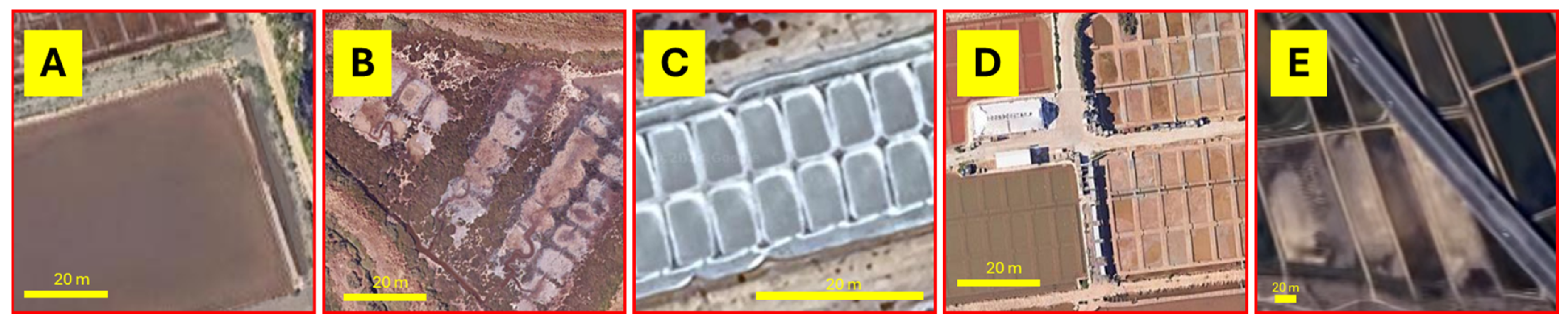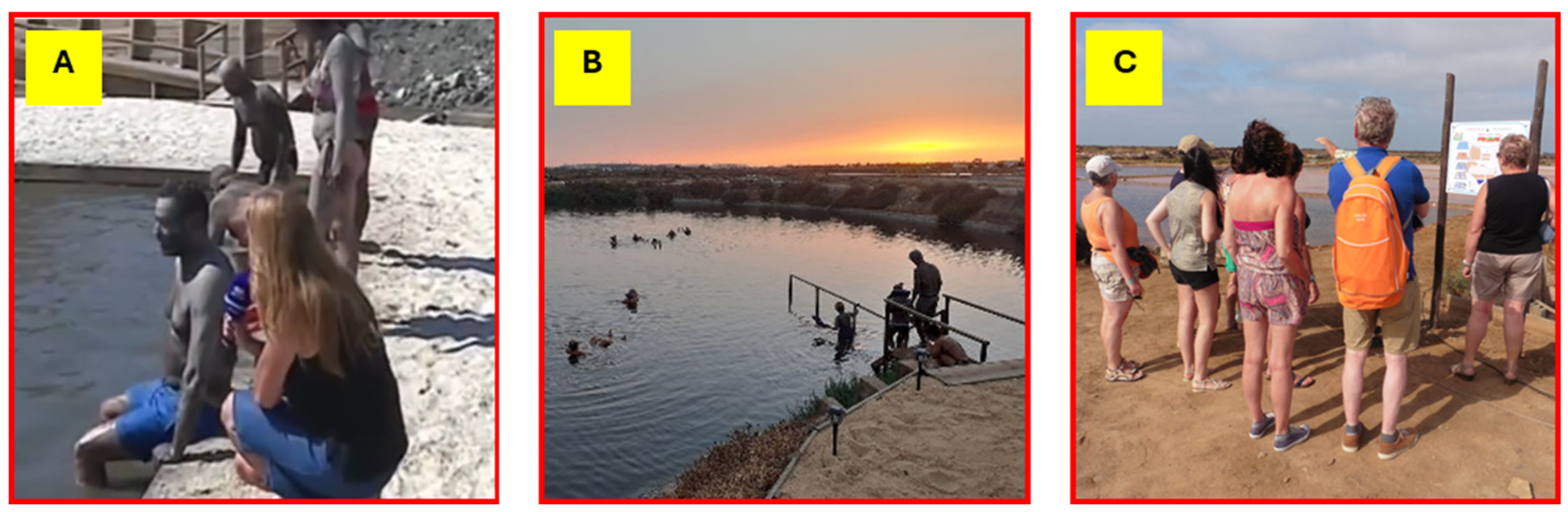

What Is Driving the Conservation of Traditional Saltscapes? The Roles of Culture and Tourism


Abstract
1. Introduction
2. Literature Review
2.1. Saltern Land Use in Portugal
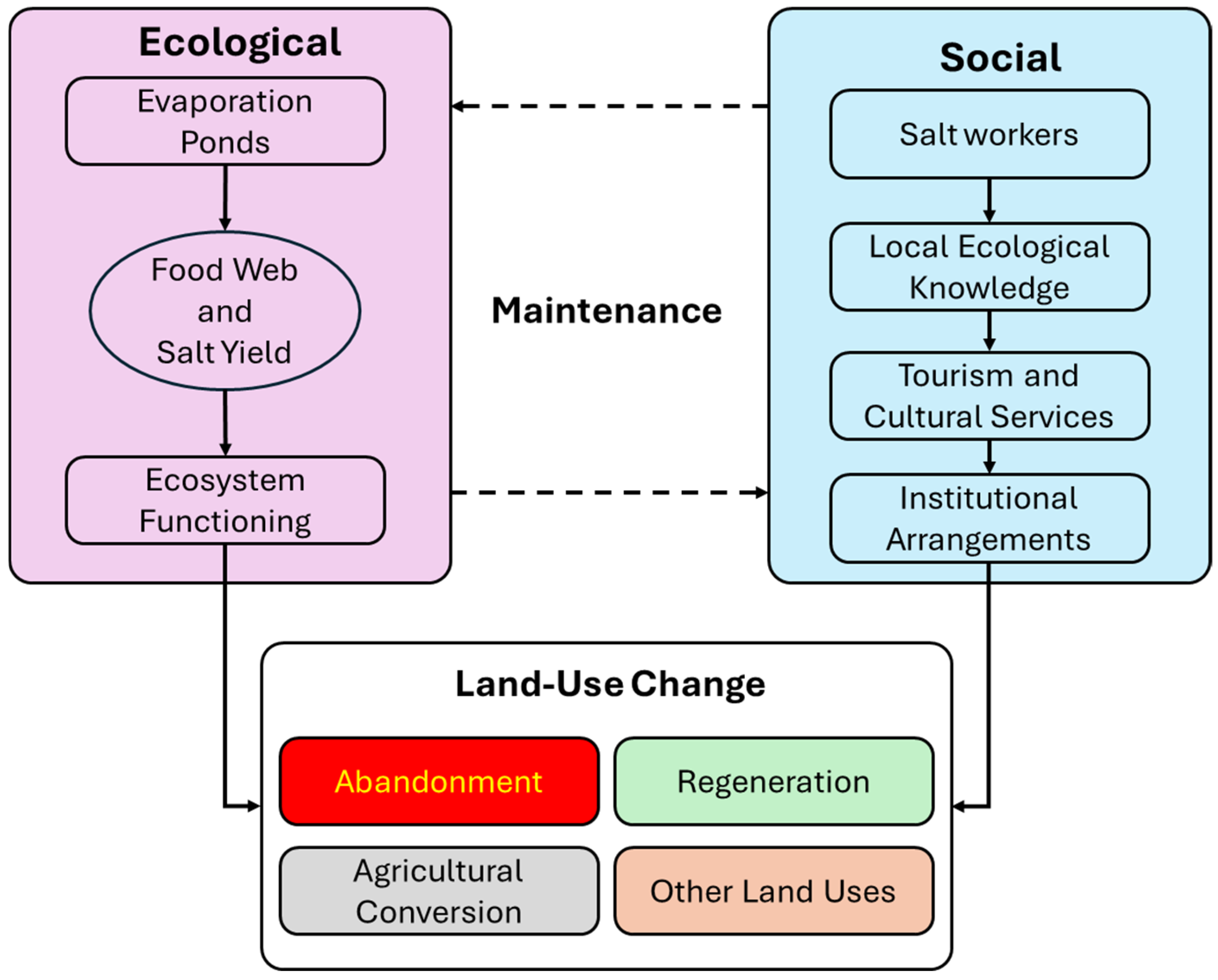
2.2. Salt Pans as Social–Ecological Systems
2.3. Entrepreneurial Innovation and Socio-Ecological Transformation in Salt Pans
2.4. Cultural Tourism as a Driver of Socio–Ecological and Land-Use Transformation in Salt Pans
3. Methodology
3.1. Conceptual Framework
3.2. Research Question
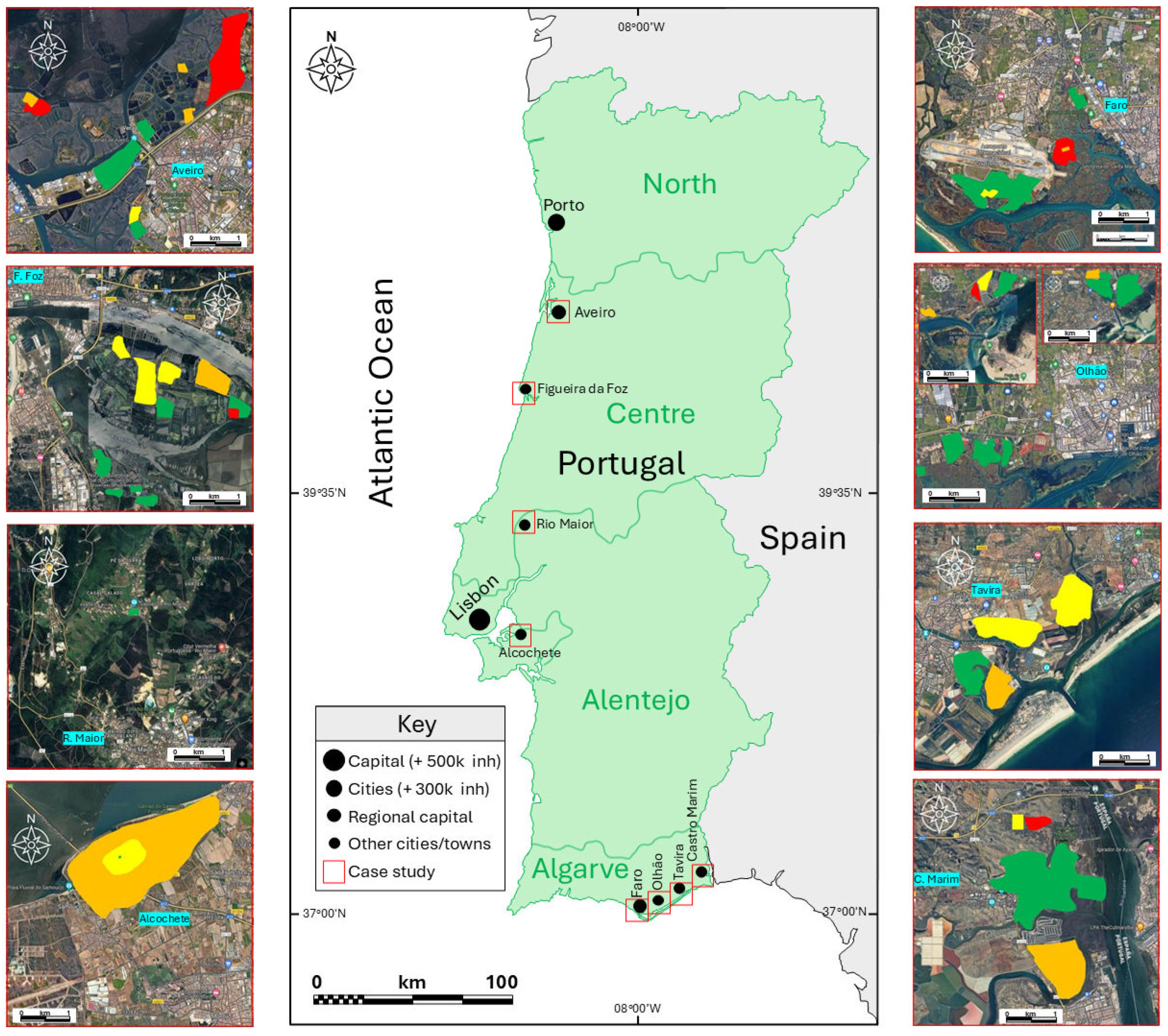
3.3. Data Collection
3.4. Hypothesis Construction
3.5. Testing the Hypothesis
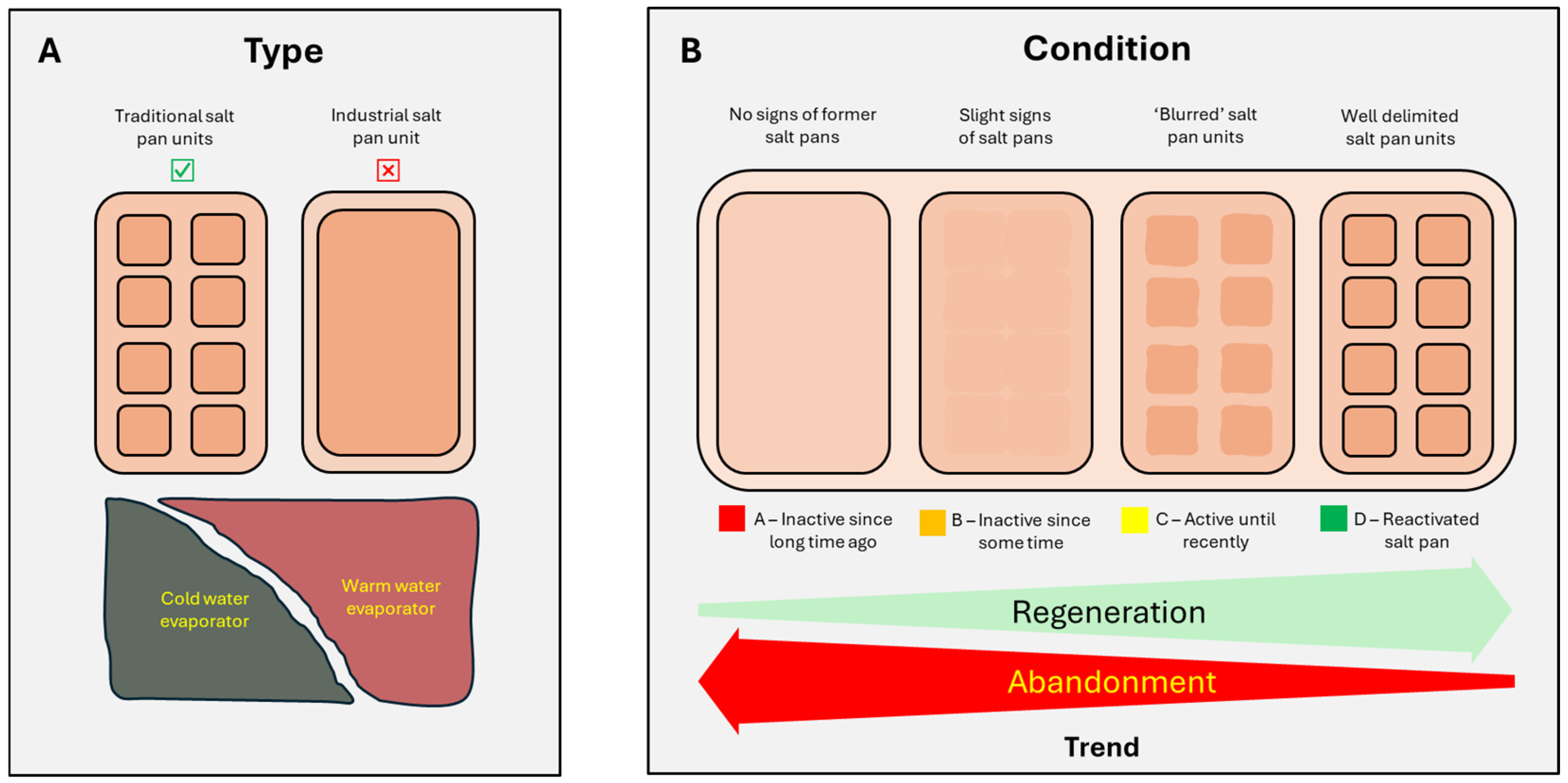
3.6. Data Analysis and SES–Saltscape Interpretation
4. Results
4.1. Trends in Salt Pan Dynamics and Land-Use Transitions
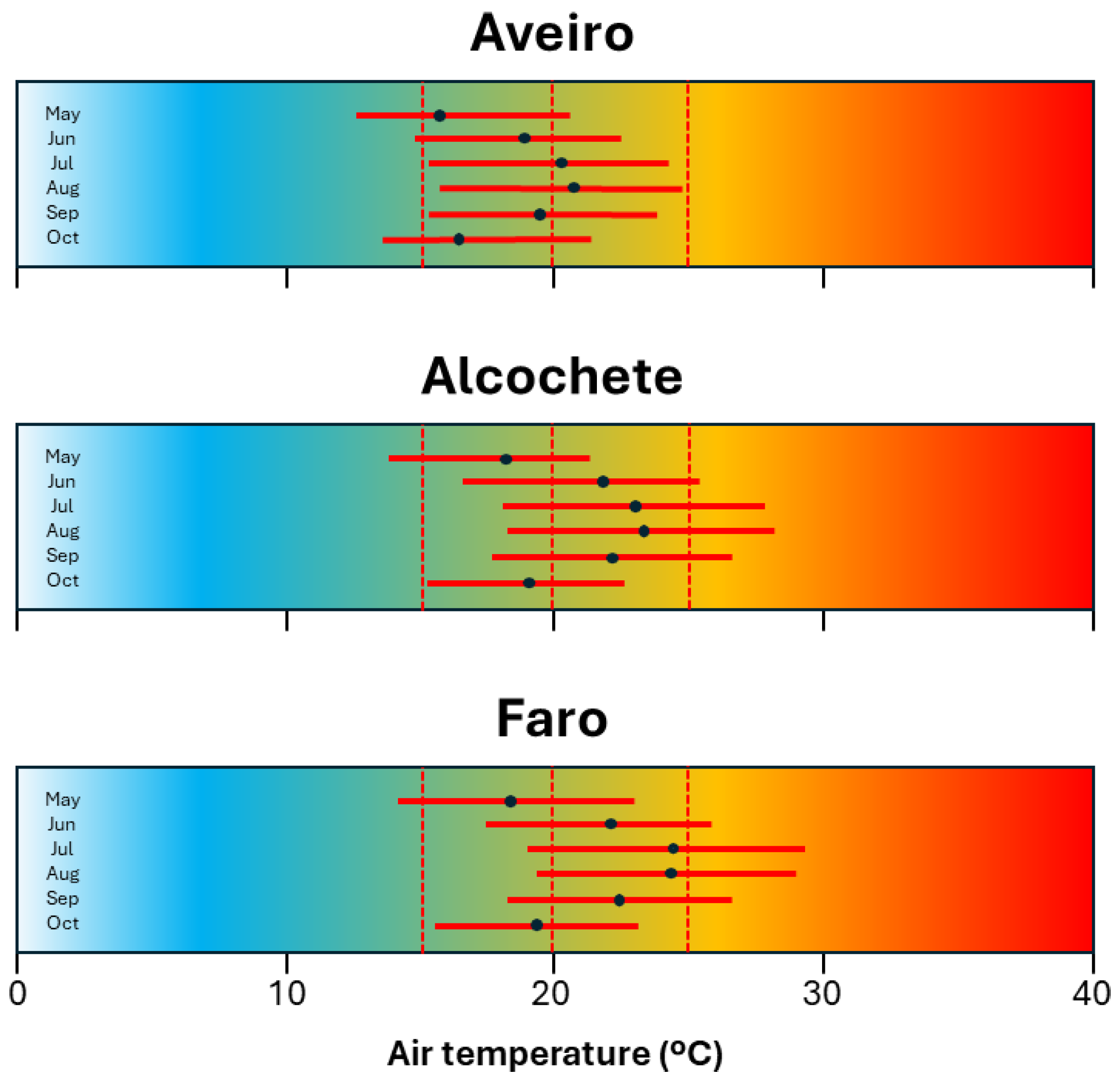
4.2. Main Social–Ecological Saltscapes in Portugal
4.3. Assessing Regeneration Through Social–Ecological and Land-Use–Land-Cover Change Indicators
4.4. Data Analysis
5. Discussion
5.1. Salt Pan Landscapes as Social–Ecological Systems
5.2. Reactivation and Adaptive Reuse of Saltscapes
5.3. Cultural-Ecological Value and the Role of Tourism
6. Conclusions
- -
- Saltscapes represent dynamic social–ecological systems, often situated at the intersection of natural conservation, heritage preservation, and land-based livelihoods.
- -
- Their reactivation is frequently supported by multifunctional uses—including eco-tourism, environmental education, and artisanal salt production—which contribute to rural resilience and adaptive land management.
- -
- Spatial and seasonal dependencies are important to consider because in more temperate northern latitudes, reactivation efforts are often constrained by climatic limitations, while southern regions show more consistent regeneration linked to tourism flows and environmental planning.
Funding
Institutional Review Board Statement
Informed Consent Statement
Data Availability Statement
Conflicts of Interest
Abbreviations
| FoS | Flower of salt |
| ES | Ecosystem service(s) |
| LEK | Local ecological knowledge |
| SES | Social–ecological system |
| TMS | Traditional marine salt |
| TSP | Traditional salt production area(s) |
References
- Harding, A. Salt in Prehistoric Europe; Sidestone Press: Leiden, The Netherlands, 2013. [Google Scholar]
- MacGregor, G.A.; De Wardener, H.E. Salt, Diet and Health; Cambridge University Press: Cambridge, UK, 1998. [Google Scholar] [CrossRef]
- Sandu, I.; Poruciuc, A.; Alexianu, M.; Curca, R.G.; Weller, O. Salt and human health: Science, archaeology, ancient texts and traditional practices of Eastern Romania. Mank. Q. 2010, 50, 225. [Google Scholar] [CrossRef]
- Sousa, C.A.; Cunha, M.E.; Ribeiro, L. Tracking 130 years of coastal wetland reclamation in Ria Formosa, Portugal: Opportunities for conservation and aquaculture. Land Use Policy 2020, 94, 104544. [Google Scholar] [CrossRef]
- Calvert, A.F. Salt and the Salt Industry; Good Press: Glasgow, UK, 2023. [Google Scholar]
- de Melo Soares, R.H.R.; de Assunção, C.A.; de Oliveira Fernandes, F.; Marinho-Soriano, E. Identification and analysis of ecosystem services associated with biodiversity of saltworks. Ocean. Coast. Manag. 2018, 163, 278–284. [Google Scholar] [CrossRef]
- Diniz, M.T.M.; Vasconcelos, F.P.; Martins, M.B. Inovação tecnológica na produção brasileira de sal marinho e as alterações sócioterritoriais dela decorrentes: Uma análise sob a ótica da teoria do empreendedorismo de Schumpeter. Soc. Nat. 2015, 27, 421–437. (In Portuguese) [Google Scholar] [CrossRef]
- Dufossé, L.; Donadio, C.; Valla, A.; Meile, J.C.; Montet, D. Determination of speciality food salt origin by using 16S rDNA fingerprinting of bacterial communities by PCR–DGGE: An application on marine salts produced in solar salterns from the French Atlantic Ocean. Food Control 2013, 32, 644–649. [Google Scholar] [CrossRef]
- Ramos, J. Tourism and work environment in sea salt pans. J. Herit. Tour. 2023, 18, 828–845. [Google Scholar] [CrossRef]
- Davy, A.J.; Bakker, J.P.; Figueroa, M.E. Human modification of European salt marshes. In Human Impacts on Salt Marshes: A Global Perspective; University of California Press: Berkeley, CA, USA, 2009; pp. 311–336. [Google Scholar]
- Quilez, J.; Salas-Salvado, J. Salt in bread in Europe: Potential benefits of reduction. Nutr. Rev. 2012, 70, 666–678. [Google Scholar] [CrossRef]
- Bawahab, M.; Faqeha, H.; Ve, Q.L.; Faghih, A.; Date, A.; Akbarzadah, A. Industrial heating application of a salinity gradient solar pond for salt production. Energy Procedia 2019, 160, 231–238. [Google Scholar] [CrossRef]
- Ostrom, E. A general framework for analyzing sustainability of social-ecological systems. Science 2009, 325, 419–422. [Google Scholar] [CrossRef]
- De Andrés, M.; Barragán, J.M.; Sanabria, J.G. Ecosystem services and urban development in coastal Social-Ecological Systems: The Bay of Cádiz case study. Ocean. Coast. Manag. 2018, 154, 155–167. [Google Scholar] [CrossRef]
- Ramos, J.; Rosová, V.; Campos, A.C. Sunny, windy, muddy and salty creative tourism experience in a salt pan. Rev. Port. Estud. Reg. 2019, 51, 41–53. [Google Scholar] [CrossRef]
- Ramos, J.; Puertas, R.R. Deactivated Saltpans: What Are the Consequences for Nature and Tourism Behavior? In Cases on Traveler Preferences, Attitudes, and Behaviors: Impact in the Hospitality Industry; IGI Global: Hershey, PA, USA, 2023; pp. 54–72. [Google Scholar] [CrossRef]
- Serra, P.; Pons, X.; Saurí, D. Land-cover and land-use change in a Mediterranean landscape: A spatial analysis of driving forces integrating biophysical and human factors. Appl. Geogr. 2008, 28, 189–209. [Google Scholar] [CrossRef]
- Tan, L.; Ge, Z.; Ji, Y.; Lai, D.Y.; Temmerman, S.; Li, S.; Li, X.; Tang, J. Land use and land cover changes in coastal and inland wetlands cause soil carbon and nitrogen loss. Glob. Ecol. Biogeogr. 2022, 31, 2541–2563. [Google Scholar] [CrossRef]
- Hueso-Kortekaas, K.; Carrasco-Vayá, J.F. The Patrimonialization of Traditional Salinas in Europe, a Successful Transformation from a Productive to a Services-Based Activity. Land 2024, 13, 772. [Google Scholar] [CrossRef]
- Sainz-López, N. Comparative analysis of traditional solar saltworks and other economic activities in a Portuguese protected estuary. Boletín Investig. Mar. Costeras–INVEMAR 2017, 46, 171–189. [Google Scholar] [CrossRef]
- Costa, S.; Oliveira, E.; Coelho, C.; Lopes, M.P. Erosion and deposition rates in estuaries–the saltpans area of Aveiro Lagoon, Portugal. J. Coast. Res. 2011, 1472–1476. Available online: https://www.jstor.org/stable/26482420 (accessed on 24 May 2024).
- Balsas, C.J.L. Revaluing saltscapes in Portugal: Ecotourism, ecomuseums, and environmental education. In Global Trends, Practices, and Challenges in Contemporary Tourism and Hospitality Management; IGI Global: Hershey, PA, USA, 2019; pp. 31–57. [Google Scholar] [CrossRef]
- Freitas, D.; Gomes, J.; Luis, T.S.; Madruga, L.; Marques, C.; Baptista, G.; Rosalino, L.M.; Antunes, P.; Santos, R.; Santos-Reis, M. Otters and fish farms in the Sado estuary: Ecological and socio-economic basis of a conflict. Hydrobiologia 2007, 587, 51–62. [Google Scholar] [CrossRef]
- Vieira, N.; Bio, A. Spatial and temporal variability of water quality and zooplankton in an artisanal salina. J. Sea Res. 2011, 65, 293–303. [Google Scholar] [CrossRef]
- Athearn, N.D.; Takekawa, J.Y.; Bluso-Demers, J.D.; Shinn, J.M.; Arriana Brand, L.; Robinson-Nilsen, C.W.; Strong, C.M. Variability in habitat value of commercial salt production ponds: Implications for waterbird management and tidal marsh restoration planning. Hydrobiologia 2012, 697, 139–155. [Google Scholar] [CrossRef]
- Sousa, L.P.; Lillebø, A.I.; Gooch, G.D.; Soares, J.A.; Alves, F.L. Incorporation of local knowledge in the identification of Ria de Aveiro lagoon ecosystem services (Portugal). J. Coast. Res. 2013, 65, 1051–1056. [Google Scholar] [CrossRef]
- Saccò, M.; White, N.E.; Harrod, C.; Salazar, G.; Aguilar, P.; Cubillos, C.F.; Meredith, K.; Baxter, B.K.; Oren, A.; Anufriieva, E.; et al. Salt to conserve: A review on the ecology and preservation of hypersaline ecosystems. Biol. Rev. 2021, 96, 2828–2850. [Google Scholar] [CrossRef] [PubMed]
- Almeida, D.; Neto, C.; Esteves, L.S.; Costa, J.C. The impacts of land-use changes on the recovery of saltmarshes in Portugal. Ocean. Coast. Manag. 2014, 92, 40–49. [Google Scholar] [CrossRef]
- Carlos, D.M.; Pereira, M.; Costa, S.; Pinho-Lopes, M.; Coelho, C. Walls of the saltpans of the Aveiro Lagoon, Portugal–current status and proposed new solutions using geosynthetics. J. Coast. Res. 2011, 1467–1471. Available online: https://www.researchgate.net/publication/260411115_Walls_of_the_Saltpans_of_the_Aveiro_Lagoon_Portugal_-_Current_Status_and_Proposed_New_Solutions_Using_Geosynthetics (accessed on 24 May 2024).
- Rodrigues, C.M.; Bio, A.; Amat, F.; Vieira, N. Artisanal salt production in Aveiro/Portugal-an ecofriendly process. Saline Syst. 2011, 7, 3. [Google Scholar] [CrossRef] [PubMed]
- Borràs-Pentinat, S. The 2030 Biodiversity Strategy: The EU’s international commitment and responsibility to reverse the biodiversity loss 1. In Deploying the European Green Deal; Routledge: London, UK, 2024; pp. 52–76. [Google Scholar]
- Mammides, C.; Zotos, S.; Martini, F. Quantifying the amount of land lost to artificial surfaces in European habitats: A comparison inside and outside Natura 2000 sites using a quasi-experimental design. Biol. Conserv. 2024, 293, 110556. [Google Scholar] [CrossRef]
- Davis, J.B.; Guillemain, M.; Kaminski, R.M.; Arzel, C.; Eadie, J.M.; Rees, E.C. Habitat and resource use by waterfowl in the northern hemisphere in autumn and winter. Wildfowl 2014, 17–69. Available online: https://www.researchgate.net/publication/268817046_Habitat_and_resource_use_by_waterfowl_in_the_northern_hemisphere_in_autumn_and_winter (accessed on 24 May 2024).
- Zadereev, E.; Lipka, O.; Karimov, B.; Krylenko, M.; Elias, V.; Pinto, I.S.; Alizade, V.; Anker, Y.; Feest, A.; Kuznetsova, D.; et al. Overview of past, current, and future ecosystem and biodiversity trends of inland saline lakes of Europe and Central Asia. Inland Waters 2020, 10, 438–452. [Google Scholar] [CrossRef]
- Morgado, R.; Nobre, M.; Ribeiro, A.; Puga, J.; Luís, A. The importance of the Salgado for the management of wintering shorebirds in the Ria de Aveiro (Portugal). J. Integr. Coast. Zone Manag. 2009, 9, 79–93. [Google Scholar]
- Knowles, J.M.; Garrett, G.S.; Gorstein, J.; Kupka, R.; Situma, R.; Yadav, K.; Yusufali, R.; Pandav, C.; Aaron, G.J. The Universal Salt Iodization Coverage Survey Team; et al. Household coverage with adequately iodized salt varies greatly between countries and by residence type and socioeconomic status within countries: Results from 10 national coverage surveys. J. Nutr. 2017, 147, 1004S–1014S. [Google Scholar] [CrossRef]
- Delbos, G. Les paludiers de Guérande et la météo. Ethnol. Française 1982, 12, 261–274. (In French) [Google Scholar]
- Geslin, P. L’amitié respectueuse, production de sel et préservation des mangroves de Guinée. Bois For. Des Trop. 2002, 273, 55–67. (In French) [Google Scholar]
- Tomaselli, V.; Mantino, F.; Tarantino, C.; Albanese, G.; Adamo, M. Changing landscapes: Habitat monitoring and land transformation in a long-time used Mediterranean coastal wetland. Wetl. Ecol. Manag. 2023, 31, 31–58. [Google Scholar] [CrossRef]
- Renard, M.C.; Thomé, H. Cultural heritage and food identity: The pre-Hispanic salt of Zapotitlán Salinas, Mexico. Cult. Hist. Digit. J. 2016, 5, e004. [Google Scholar] [CrossRef]
- del Valle, L. Safeguarding intangible cultural heritage for sustainable development. The case of traditional salt activity. J. Cult. Herit. Manag. Sustain. Dev. 2023. [Google Scholar] [CrossRef]
- Moreno, J.M.; Ortiz, I.L. From industrial activity to cultural and environmental heritage: The Torrevieja and La Mata lagoons (Alicante). Boletín Asoc. Geógrafos Españoles 2008, 47, 311–331. [Google Scholar]
- Lageard, J.G.; Drew, I.B. Evaporating legacies: Industrial heritage and salt in Cheshire, UK. Ind. Archaeol. Rev. 2015, 37, 48–61. [Google Scholar] [CrossRef]
- Matias, P.S.S. A Importância da Atividade Turística Associada às Salinas de Rio Maior Para a Sustentabilidade do Território. Ph.D. Thesis, Instituto Politecnico de Leiria, Leiria, Portugal, 2012. (In Portuguese). [Google Scholar]
- Eggenkamp, H.G.M.; Marques, J.M.; Graça, H. Application of stable chlorine isotopes to develop a conceptual model for the origin of the ground water circulating near the “salinas” at Rio Maior (Central Portugal). Comun. Geológicas 2013, 100, 49–53. [Google Scholar]
- Hueso, K.; Petanidou, T. Cultural aspects of Mediterranean salinas. In Culture and Wetlands in the Mediterranean: An Evolving Story; Papayannis, T., Pritchard, D.E., Eds.; Med-INA: Athens, Greece, 2011; p. 213226. [Google Scholar]
- Lemonnier, P.; Héral, M. Une Approche de la perception, par les paludiers guérandais, des facteurs en jeu dans la production du sel. Penn Ar Bed 1975, 10, 207–219. (In French) [Google Scholar]
- Perraud, C. La renaissance du sel marin de l’Atlantique en France (1970–2004). In I Seminário Internacional Sobre o Sal Portugués; Amorim, I., Ed.; Instituto de História Moderna da Universidade do Porto: Porto, Portugal, 2005; pp. 423–430. Available online: https://ler.letras.up.pt/site/geral.aspx?id=3&tit=Lista%20de%20assuntos&tp=5&as=Atl%C3%A2ntico&ida=2859 (accessed on 24 May 2024). (In French)
- Donadio, C.; Bialecki, A.; Valla, A.; Dufossé, L. Carotenoid-derived aroma compounds detected and identified in brines and speciality sea salts (fleur de sel) produced in solar salterns from Saint-Armel (France). J. Food Compos. Anal. 2011, 24, 801–810. [Google Scholar] [CrossRef]
- Kortekaas, K.H.; Vaya, J.F.C. Biodiversity of inland saltscapes of the Iberian Peninsula. Nat. Resour. Environ. Issues 2009, 15, 30. [Google Scholar]
- Gauci, R.; Schembri, J.A.; Inkpen, R. Traditional use of shore platforms: A study of the artisanal management of salinas on the Maltese Islands (Central Mediterranean). Sage Open 2017, 7, 2158244017706597. [Google Scholar] [CrossRef]
- Herbert, R.J.; Broderick, L.G.; Ross, K.; Moody, C.; Cruz, T.; Clarke, L.; Stillman, R.A. Artificial coastal lagoons at solar salt-working sites: A network of habitats for specialised, protected and alien biodiversity. Estuar. Coast. Shelf Sci. 2018, 203, 1–16. [Google Scholar] [CrossRef]
- Ramos, J. Fleur de sel: How Does a Pinch of Suitable Choice Practices Value This Sustainable Natural Resource? Resources 2022, 11, 63. [Google Scholar] [CrossRef]
- Cardoso, A.R.; Morin, L.P. Male labor scarcity, technology adoption and female labor market integration: A quantitative and qualitative study of Portugal. Econ. Lett. 2025, 252, 112347. [Google Scholar] [CrossRef]
- Sainz-López, N.; Boski, T.; Sampath, D.M.R. Fleur de sel composition and production: Analysis and numerical simulation in an artisanal saltern. J. Coast. Res. 2019, 35, 1200–1214. [Google Scholar] [CrossRef]
- Galvis-Sánchez, A.C.; Lopes, J.A.; Delgadillo, I.; Rangel, A.O. Sea salt. In Comprehensive Analytical Chemistry; Elsevier: Amsterdam, The Netherlands, 2013; Volume 60, pp. 719–740. [Google Scholar]
- Nogueira, C.; Pinto, H.; Guerreiro, J. Innovation and tradition in the valorisation of endogenous resources: The case of salt flower in Algarve. J. Marit. Res. 2014, 11, 45–52. [Google Scholar]
- Wu, T.C.E.; Xie, P.F.; Tsai, M.C. Perceptions of attractiveness for salt heritage tourism: A tourist perspective. Tour. Manag. 2015, 51, 201–209. [Google Scholar] [CrossRef]
- Jamhawi, M.M.; Hajahjah, Z.A. A bottom-up approach for cultural tourism management in the old city of As-Salt, Jordan. J. Cult. Herit. Manag. Sustain. Dev. 2017, 7, 91–106. [Google Scholar] [CrossRef]
- Kimic, K.; Smaniotto Costa, C.; Negulescu, M. Creating tourism destinations of underground built heritage—The cases of salt mines in Poland, Portugal, and Romania. Sustainability 2021, 13, 9676. [Google Scholar] [CrossRef]
- Van, K.T.; Nguyen, A.T.; Tuyen, V.V. Prioritizing Risks in Production Activities: A Study of Salt Processing Enterprises in the Central Region of Vietnam. Int. J. Saf. Secur. Eng. 2025, 15, 275–285. [Google Scholar] [CrossRef]
- Martins, F.; Pedrosa, A.; da Silva, M.F.; Fidélis, T.; Antunes, M.; Roebeling, P. Promoting tourism businesses for “Salgado de Aveiro” rehabilitation. J. Outdoor Recreat. Tour. 2020, 29, 100236. [Google Scholar] [CrossRef]
- Silva, P.; Carneiro, M.J. A experiência turística associada ao sal. Rev. Tur. Desenvolv. (RTD)/J. Tour. Dev. 2023, 43, 49–66. (In Portuguese) [Google Scholar]
- Ramos, J.; Pinto, P.; Pintassilgo, P.; Resende, A.; Cancela da Fonseca, L. Activating an artisanal saltpan: Tourism crowding in or waterbirds crowding out? Int. J. Cult. Tour. Hosp. Res. 2022, 16, 294–305. [Google Scholar] [CrossRef]
- Balsas, C. Mediterranean Saltscapes: The need to enhance fragile ecological and cultural resources in Portugal. ZARCH 2016, 7, 106–119. [Google Scholar] [CrossRef]
- Rojon, C.; Saunders, M.N. Formulating a convincing rationale for a research study. Coach. Int. J. Theory Res. Pract. 2012, 5, 55–61. [Google Scholar] [CrossRef]
- INE. Instituto Nacional de Estatística—Estatísticas da Pesca: 2017; INE: Lisboa, Portugal, 2018; Available online: https://www.ine.pt/xurl/pub/320384843 (accessed on 24 May 2024)ISSN 0377-225-x. ISBN 978-989-25-0393-6.
- INE. Instituto Nacional de Estatística—Estatísticas da Pesca: 2018; INE: Lisboa, Portugal, 2019; Available online: https://www.ine.pt/xurl/pub/358627638 (accessed on 24 May 2024)ISSN 0377-225-x. ISBN 978-989-25-0489-6.
- INE. Instituto Nacional de Estatística—Estatísticas da Pesca: 2019; INE: Lisboa, Portugal, 2020; Available online: https://www.ine.pt/xurl/pub/435690295 (accessed on 24 May 2024)ISSN 0377-225-X. ISBN 978-989-25-0540-4.
- INE. Instituto Nacional de Estatística—Estatísticas da Pesca: 2020; INE: Lisboa, Portugal, 2021; Available online: https://www.ine.pt/xurl/pub/280980980 (accessed on 24 May 2024)ISSN 0377-225-X. ISBN 978-989-25-0566-4.
- INE. Instituto Nacional de Estatística—Estatísticas da Pesca: 2021; INE: Lisboa, Portugal, 2022; Available online: https://www.ine.pt/xurl/pub/36828280 (accessed on 24 May 2024)ISSN 0377-225-X. ISBN 978-989-25-0602-9.
- INE. Instituto Nacional de Estatística—Estatísticas da Pesca: 2022; INE: Lisboa, Portugal, 2023; Available online: https://www.ine.pt/xurl/pub/66322600 (accessed on 24 May 2024)ISSN 0377-225-X. ISBN 978-989-25-0643-2.
- INE. Instituto Nacional de Estatística—Estatísticas da Pesca: 2023; INE: Lisboa, Portugal, 2024; Available online: https://www.ine.pt/xurl/pub/439542305 (accessed on 24 May 2024)ISSN 0377-225-X. ISBN 978-989-25-0679-1.
- Imai, H. The liminal nature of alleyways: Understanding the alleyway roji as a ‘Boundary’ between past and present. Cities 2013, 34, 58–66. [Google Scholar] [CrossRef]
- Quagliarini, E.; Bernardini, G.; Romano, G.; D’Orazio, M. Users’ vulnerability and exposure in Public Open Spaces (squares): A novel way for accounting them in multi-risk scenarios. Cities 2023, 133, 104160. [Google Scholar] [CrossRef]
- Castel’Branco, R.; da Costa, A.R. From maximum urban porosity to city’s disaggregation: Evidence from the Portuguese case. Cities 2024, 148, 104836. [Google Scholar] [CrossRef]
- Kent, J. Can urban fabric encourage tolerance? Evidence that the structure of cities influences attitudes toward migrants in Europe. Cities 2022, 121, 103494. [Google Scholar] [CrossRef]
- Marchesani, F.; Masciarelli, F.; Doan, H.Q. Innovation in cities a driving force for knowledge flows: Exploring the relationship between high-tech firms, student mobility, and the role of youth entrepreneurship. Cities 2022, 130, 103852. [Google Scholar] [CrossRef]
- INE. Censos 2021. Divulgação dos Resultados Provisórios; Instituto Nacional de Estatística: Lisboa, Portugal. Available online: https://www.ine.pt/ (accessed on 27 May 2024).
- IPMA. Climate Monitoring; Instituto Português do Mar e da Atmosfera: Lisboa, Portugal. Available online: https://www.ipma.pt/en/oclima/monitorizacao/ (accessed on 28 May 2024).
- Partidario, M.R.; Gomes, R.C. Ecosystem services inclusive strategic environmental assessment. Environ. Impact Assess. Rev. 2013, 40, 36–46. [Google Scholar] [CrossRef]
- Pallero, C.; Barragán, J.M.; Scherer, M. Management international estuarine systems: The case of the Guadiana river (Spain-Portugal). Environ. Sci. Policy 2018, 80, 82–94. [Google Scholar] [CrossRef]
- Rodier, R.; Boutron, O.; Béchet, A.; Therond, O. Interdependencies among hydro-saline dynamics, economic activities, ecological processes, and biodiversity in a deltaic social-ecological system: Insights from the Rhône delta (southern France). Ecol. Soc. 2025, 30, 11. [Google Scholar] [CrossRef]
- Santos, E.S.; Salazar, M.; Mendes, S.; Lopes, M.; Pacheco, J.; Marques, D. Rehabilitation of abandoned areas from a Mediterranean nature reserve by Salicornia crop: Influence of the salinity and shading. Arid. Land Res. Manag. 2017, 31, 29–45. [Google Scholar] [CrossRef]
- Lai, F. Nature and the city: The salt-works park in the urban area of Cagliari (Sardinia, Italy). J. Political Ecol. 2013, 20, 329–341. [Google Scholar] [CrossRef]
- Perino, A.; Pereira, H.M.; Navarro, L.M.; Fernández, N.; Bullock, J.M.; Ceaușu, S.; Cortés-Avizanda, A.; van Klink, R.; Kuemmerle, T.; Lomba, A.; et al. Rewilding complex ecosystems. Science 2019, 364, eaav5570. [Google Scholar] [CrossRef]
- Mutillod, C.; Buisson, É.; Mahy, G.; Jaunatre, R.; Bullock, J.M.; Tatin, L.; Dutoit, T. Ecological restoration and rewilding: Two approaches with complementary goals? Biol. Rev. 2024, 99, 820–836. [Google Scholar] [CrossRef]
- Zerbe, S. Types of traditional cultural landscapes throughout the world. In Restoration of Multifunctional Cultural Landscapes: Merging Tradition and Innovation for a Sustainable Future; Springer International Publishing: Cham, Switzerland, 2022; pp. 19–76. [Google Scholar] [CrossRef]
- Hueso-Kortekaas, K.; Iranzo-García, E. Salinas and “Saltscape” as a Geological Heritage with a Strong Potential for Tourism and Geoeducation. Geosciences 2022, 12, 141. [Google Scholar] [CrossRef]
- Gordon, J.E. Geoheritage, geotourism and the cultural landscape: Enhancing the visitor experience and promoting geoconservation. Geosciences 2018, 8, 136. [Google Scholar] [CrossRef]
- Nistoreanu, P.; Aluculesei, A.C.; Dumitrescu, G.C. A bibliometric study of the importance of tourism in Salt landscapes for the sustainable development of rural areas. Land 2024, 13, 1703. [Google Scholar] [CrossRef]





| Innovation/Practice | Social–Ecological Component | Land-Use/Land-Cover Change Impact |
|---|---|---|
| -Harvesting techniques for fleur de sel [9] | -Requires local ecological knowledge (LEK) for surface collection and ecological timing [26] | -Reactivation of crystallizer ponds for production management [28,29] |
| -Revalorization of artisanal salt products [30,53,57] | -Cultural valorization of traditional foods; reconnection to heritage production systems [43] | -Conversion of disused salt pans into heritage-linked productive land use [17] |
| -Higher income from premium products [30] | -Economic incentive for producers to remain in or return to traditional livelihoods [20] | -Prevents abandonment; promotes continued or expanded salt production [18] |
| -Tourism and cultural entrepreneurship [15,19,63,64,65] | -Integration of ecosystem services (recreation, education, well-being) with extractive use [16,22] | -Creation of multifunctional landscapes blending production and tourism [9] |
| -Infrastructure for tourism (e.g., trails, spas) [19,59,60,63] | -Involvement of new stakeholders; diversification of service-based land use [58,62] | -Physical transformation of salt pan surroundings for public access and services [21] |
| -Cultural recognition (e.g., intangible heritage status) [41] | -Institutional support for maintaining traditional practices [20] | -Long-term land-use conservation; reduced risk of conversion to urban/intensive agriculture [7] |
| Region and Municipality | Inhabitants (2021) | Municipality Area (km2) | People Density (Pop/km2) | TSP Area (ha) | Estimated TSP Jobs (No. Workers) |
|---|---|---|---|---|---|
| Centre | |||||
| +Aveiro | 80,880 | 198 | 408 | ~270 | 100–150 |
| +Figueira da Foz | 62,125 | 379 | 164 | ~300 | n.a. |
| Lisbon and Tagus | |||||
| +Rio Maior | 21,192 | 273 | 78 | 2.7 | 20–30 |
| +Alcochete | 17,569 | 128 | 137 | ~360 | n.a. |
| Algarve | |||||
| +Faro | 60,995 | 203 | 300 | ~200 | n.a. |
| +Olhão | 45,396 | 131 | 347 | ~400 | 50–70 |
| +Tavira | 26,167 | 607 | 43 | ~290 | n.a. |
| +Castro Marim | 6747 | 301 | 22 | ~540 | 200–250 |
| Region/Municipality | TSP Area (ha) * | Condition | |||
|---|---|---|---|---|---|
| PA | PB | PC | PD | ||
| Centre | |||||
| +Aveiro | ~270 | 0.50 | 0.15 | 0.05 | 0.30 |
| +Figueira da Foz | ~300 | 0.05 | 0.25 | 0.40 | 0.30 |
| Lisbon and Tagus | |||||
| +Rio Maior ** | 2.7 | 0.00 | 0.00 | 0.00 | 1.00 |
| +Alcochete | ~360 | 0.00 | 0.90 | 0.09 | 0.01 |
| Algarve | |||||
| +Faro | ~200 | 0.19 | 0.01 | 0.05 | 0.75 |
| +Olhão | ~400 | 0.05 | 0.05 | 0.10 | 0.80 |
| +Tavira | ~290 | 0.00 | 0.25 | 0.50 | 0.25 |
| +Castro Marim | ~540 | 0.05 | 0.00 | 0.05 | 0.90 |
Disclaimer/Publisher’s Note: The statements, opinions and data contained in all publications are solely those of the individual author(s) and contributor(s) and not of MDPI and/or the editor(s). MDPI and/or the editor(s) disclaim responsibility for any injury to people or property resulting from any ideas, methods, instructions or products referred to in the content. |
© 2026 by the author. Licensee MDPI, Basel, Switzerland. This article is an open access article distributed under the terms and conditions of the Creative Commons Attribution (CC BY) license.
Share and Cite
Ramos, J. What Is Driving the Conservation of Traditional Saltscapes? The Roles of Culture and Tourism. Conservation 2026, 6, 6. https://doi.org/10.3390/conservation6010006
Ramos J. What Is Driving the Conservation of Traditional Saltscapes? The Roles of Culture and Tourism. Conservation. 2026; 6(1):6. https://doi.org/10.3390/conservation6010006
Chicago/Turabian StyleRamos, Jorge. 2026. "What Is Driving the Conservation of Traditional Saltscapes? The Roles of Culture and Tourism" Conservation 6, no. 1: 6. https://doi.org/10.3390/conservation6010006
APA StyleRamos, J. (2026). What Is Driving the Conservation of Traditional Saltscapes? The Roles of Culture and Tourism. Conservation, 6(1), 6. https://doi.org/10.3390/conservation6010006