3.2. Overview of Themes
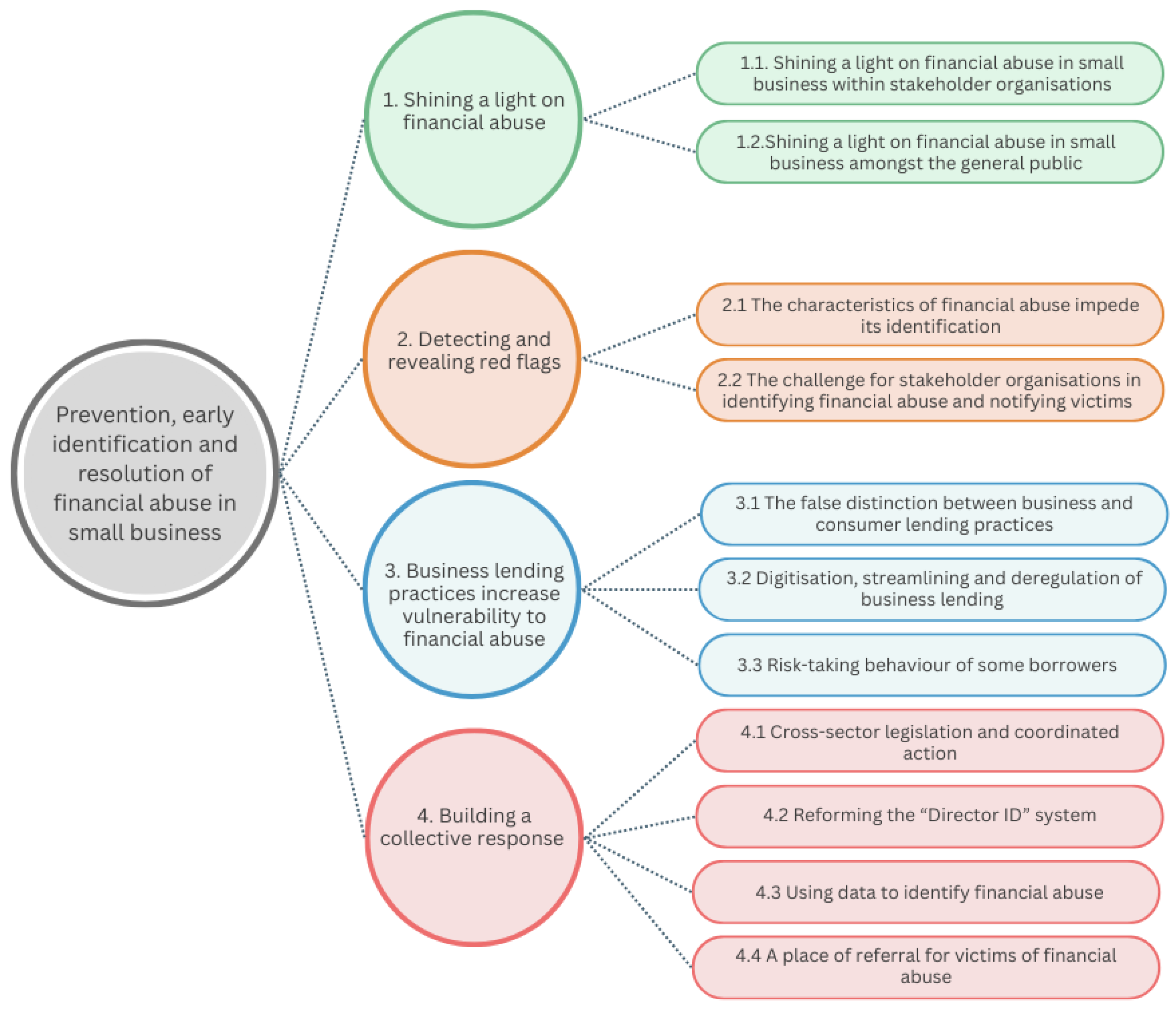
Four main themes were generated relating to the prevention, early identification and resolution of financial abuse in small businesses: (1) shining a light on financial abuse; (2) detecting and revealing red flags; (3) business lending practices create vulnerability; and (4) building a collective response (
Figure 1). Each of the themes and relevant subthemes are presented below, with supporting quotes attributed to participants’ organisation type, where possible.
The first theme concerns the need to raise awareness of financial abuse, both within stakeholder organisations (subtheme 1.1) and amongst the general public (subtheme 1.2). Raising awareness was seen as a critical first step in an organisation’s capacity to prevent, identify and resolve financial abuse.
Participants from all stakeholder organisations consistently reported that they were at the very early stages of understanding financial abuse in small business contexts, often describing their awareness as ‘foundational’ or admitting they were ‘very new to the concept’. As one participant stated: ‘we’re only just starting to really tap the surface of it’ (Participant, Group 1), highlighting both a lack of knowledge and the need for clearer identification and organisational education. Many participants acknowledged the need to build internal capacity through staff training and the development of practical resources, with one noting, ‘if people don’t understand what it looks like, how do you then identify it?’ (Participant, Group 1). Participants also highlighted the value of the workshop itself in raising awareness of the issue and providing the opportunity for ‘listening and learning’ (Participant, Group 1), in order to initiate new strategies within their organisations:
“This conversation now is actually giving a bit of a voice, which means we can put time to it, we can look at it, what we can do in the meantime, until maybe legislative reform happens…. Let’s go back and then have a look at it, and then possibly do something with it.”
(Participant, Group 1)
Further to this, participants consistently reported a lack of preparedness to recognise and respond to financial abuse in small business contexts, with one participant noting, ‘staff in organisations might not always recognise the signs, or what they need to do next’ (Participant, Group 2). While many professionals possess technical qualifications, it was reported that there is a significant gap in the social awareness needed to detect abuse, as ‘a lot of us that are in the business of money are not in the business of social justice’ (Participant, Group 3). This lack of education and nuanced understanding among lenders, brokers, and financial advisors was thought to contribute to a system where abuse went unnoticed, ‘I think it’s educating the lenders, the brokers, the people who are arranging the finance, to understand the softer skills, and overcome their unconscious biases, that often facilitate this type of thing going on.’ (Participant, Group 3).
Despite a widely held belief amongst participants in the need for education and training on financial abuse in small businesses, participants from smaller organisations reported significant challenges in developing and delivering education due to limited capacity and resources, with one participant noting, ‘we are stretched at capacity and then some… anything else that we take on board sacrifices another thing’ (Participant, Group 3). While there was willingness to act, many would rely on leveraging external resources and partnerships, acknowledging that the education and training achievable in larger institutions ‘can’t apply… at a lower level. It’s just not going to work’ (Participant, Group 3).
There was overwhelming agreement among participants that the general public lacked both awareness of financial abuse in small businesses and fundamental financial literacy. As one participant emphasised, ‘Financial literacy is really, really important… it is the strongest [tool] anybody can have’ (Participant, Group 2), yet challenges persist, such as ‘not understanding what people are signing… when you’re setting up a company structure, when you’re taking out the lending’ (Participant, Group 2). Participants emphasised that people frequently gained critical financial knowledge only after harm occurred, with one stating, ‘the biggest thing we have clients telling us is, “if only I had known”’ (Participant, Group 2).
Participants voiced that public education on financial abuse and financial literacy is urgently needed to protect individuals, particularly those in vulnerable or coercive relationships, from long-term financial harm. One participant highlighted the vital role education plays in empowering individuals with the knowledge and tools they need when they are ready to act, relaying the account of a woman she provided advice to with a lived experience of financial abuse:
“But what that woman said was, had I had that information, it would have made it so much easier for me to leave and to get the help I needed when it was safe for me to do so, …. I would have known the right area to go to, and I would have known the words to use, and I would have known how to navigate that.”
(Participant, Group 1)
It was also acknowledged that full responsibility for identifying financial abuse should not be placed upon the victims, but that improving their financial literacy could help with identifying financial abuse at an earlier stage: ‘And I know that we’re not putting onus on individuals to identify it themselves, but if they don’t have that foundational financial literacy, they’re not going to see it to raise the red flag until we’re at crisis point.’ (Participant, Group 3).
Despite information and training available through institutions, including Money Smart and Director Education programs, one participant highlighted the challenge in how that information is accessed, delivered and understood, stating: ‘How do you make someone read that and understand it?’ As another contributor noted, ‘You cannot judge… how much they have understood. It’s really complex.’ (Participant, Group 1).
To address this, it was widely perceived that delivery methods for financial education must be multifaceted, engaging, and community-integrated. Traditional resources like websites and formal courses were thought to serve some, but a broader reach required innovation, as one stakeholder pointed out, ‘You have to go where the people are’ (Participant, Group 2), citing platforms such as TikTok and 15 s social media snippets as effective channels. Others stressed the need for simple, non-paternalistic messaging: ‘Don’t sign something you don’t understand’ (Participant, Group 2). Beyond digital outreach, embedding financial education into community networks and frontline services was thought to be critical, as one participant explained, ‘What we do with some of our education programs is distribute to community partners… working with people at the grassroots’ (Participant, Group 2).
Participants also highlighted the challenge of reaching culturally and language diverse (CALD) communities due to language barriers and the absence of culturally appropriate materials. One participant noted that while there is ‘a lot of material’, it is often not available in ‘other languages’, and key terms ‘don’t have direct translations into Vietnamese’, making it difficult for some to understand the concepts—an issue compounded by the fact that ‘some may not be as comfortable as others in communicating or having those conversations’, due to cultural norms (Participant, Group 3).
The second theme relates to the challenge of detecting financial abuse in small businesses. Subthemes relate to how the characteristics of financial abuse impede its identification (subtheme 2.1) and the subsequent challenge for stakeholder organisations in notifying victims of financial abuse (subtheme 2.2).
The characteristics of financial abuse in small business contexts were thought to significantly hinder its identification, often due to the subtle, progressive nature of coercion and a lack of clear recognition by both victims and professionals. Participants recognised that many cases of financial abuse begin with mutual trust and legitimate intent, only to evolve into coercive control over time. For instance, one participant noted: ‘Starting a business is a dream… and it’s all very fine and rosy… but things happen over time…’ (Participant, Group 3).
Such scenarios highlighted how legal and financial decisions made at the outset—often under the influence of trust or relational dynamics—can become problematic when power imbalances later emerge. The reality that victims may be unaware they are in abusive situations was underscored by another participant: ‘they don’t actually know a lot of the time that they are being abused… it’s not till they go further… until they do realise’ (Participant, Group 1). Furthermore, systemic issues, such as the tendency to communicate with only one partner during loan origination stages, were thought to create significant barriers to identification. One participant highlighted the importance of communicating with both partners:
“When you know that it’s a couple, then one partner is just passive. It’s their asset, their livelihood, their family unit that is at stake. I think the onus is on the lender to actually make sure that the other person is aware of it. So, unless you are actually able to sit and talk to both people, you really are not going to get a feel for whether that person understands anything that’s going on, whether the director is a really dominant person who is sort of coercing the other person.”
(Participant, Group 2)
In family businesses, hierarchical structures and intergenerational control were also thought to complicate accountability, as ‘it becomes more of a family situation, more about respecting the family… having priority over other concerns’ (Participant, Group 3). Participants also highlighted the misuse of powers of attorney, particularly in agriculture, where ‘generational farmers will have a power of attorney for the older person that still owns the property’, and use it to access finances or buy equipment, despite ‘no benefit to that person that’s in a nursing home’ (Participant, Group 3). Such actions, while technically legal, were noted to reflect deeper issues of control and exploitation.
Compounding the invisibility of financial abuse is the deep stigma and shame felt by those affected, which was perceived to discourage disclosure and conversation. Victims were thought to resist identifying with the label of ‘financial abuse’ because of the emotional toll and perceived failure involved, particularly when the abuse emerges within trusted personal relationships. One participant (who was also a survivor of financial abuse in small businesses) shared, ‘I don’t want to admit that I’ve been duped… I’m a smart person… I don’t want to admit that I’m dealing with things’ (Participant, Group 3). This reluctance was noted to be mirrored by professionals, who are often hesitant to inquire too deeply for fear of overstepping, especially in emotionally charged or culturally complex family business environments. As one participant reflected, ‘some people don’t want to be victims, so they don’t want to identify with it either’ (Participant, Group 2), illustrating the double bind of silence, shame was thought to inhibit both the ability of victims to articulate their experiences and of professionals to recognise red flags, leading to intervention being too late and only after significant harm—such as unanticipated debt recovery or legal action—has taken place: ‘The nightmare isn’t revealed until there is a notice in the mail, a registered post from a liquidator, or something like that in the mail. That’s when the house of cards starts to fall.’ (Participant, Group 2).
Identifying financial abuse was reported to be a significant challenge for stakeholder organisations, as abuse is often disguised within legitimate business structures, and ‘not always that obvious’ (Participant, Group 2), with one participant noting, ‘it is grey, it is vague’ (Participant, Group 1). Representatives of financial institutions reported that they struggled with detection because ‘financial abuse is often a pattern of behaviour’ (Participant, Group 1), that may only become apparent ‘through an interaction with a customer’ (Participant, Group 1), while others noted that ‘sometimes the thing is, it is okay at the start’ (Participant, Group 2), making early identification difficult.
Furthermore, in the process of setting up a small business, it was reported that clients typically interact with multiple professionals—such as accountants, financial planners, lawyers, and lenders—each representing a distinct touch point. Participants acknowledged the practical limitations of oversight—‘we can’t be in every room as a part of every conversation’ (Participant, Group 2)—underscoring how gaps can leave abuse undetected. One participant noted that financial planners may be in a better position than accountants to detect such abuse due to their broader view of clients’ financial affairs:
“As a financial planner, I see a greater picture of what’s going on. I never saw that when I just did the tax of the small business, but as a financial planner, I actually can identify ‘Oh, something’s going on.’”
(Participant, Group 1)
Additionally, it was noted that, as business lending itself has become more segmented and impersonal—with different roles handling separate aspects of the process—cohesive oversight has weakened. One experienced lender noted:
“I would have done all five jobs back then because the volume was a lot less and it was more personal. These days, …it’s split up into five jobs—someone to do the sales, then someone to do the data input, and then someone to do the assessment, then someone with delegate lending authority to do the oversight, and someone do the docs, and then someone do the settlement. I think that’s part of the equation.”
(Participant, Group 2)
Participants highlighted that determining the right moment to notify a victim of financial abuse is also fraught with complexity, as ‘it’s very, very difficult to know when to intervene and what information… actually makes you know when to intervene.’ (Participant, Group 3). It was acknowledged that implementing protective strategies could create tension between lenders and clients:
“From the lenders perspective though that sort of creates a bit of tension over the actions you’ve taken to try and protect this other person. Then you’ve created this tension in that marriage, which I suppose again, you’re damned if you do, and damned if you don’t.”
(Participant, Group 2)
Frontline staff often faced the dilemma of responding to subtle indicators without overwhelming or alienating the individual, as one participant recalled, ‘we’ve heard of people… [being asked] ‘are you safe?’ and they’re like… ‘how dare you, that’s so paternalistic’ (Participant, Group 1), despite the staff’s training flagging potential abuse. Building awareness of red flags—such as unexpected changes in credit reports—and embedding subtle, non-intrusive interventions, such as ‘press 8 if you feel unsafe’ Interactive Voice Response (IVR) options, or notifications regarding bank payments, were suggested as offering safer and more acceptable avenues for notification and support.
Artificial intelligence (AI) was also thought to have a role in recognising patterns of financial abuse, with systems ‘running in the background picking up on certain things that… contribute to this picture’ (Participant, Group 1). Organisations reported that they have begun to build models that ‘identify words that trigger financial difficulty, trouble with payments, [or] domestic violence’ (Participant, Group 1), which then prompt quality assurance teams to review flagged interactions. However, participants emphasised the importance of the human element, noting that AI may not fully understand the context or nuance of a situation, and that ‘you need a human being to train [the AI]… and keep adjusting’ (Participant, Group 1), especially given the risks of bias embedded in algorithms.
The third theme relates to the characteristics of business lending which leave customers vulnerable to financial abuse, including the false distinction between business lending practices and individual consumer lending practices (subtheme 3.1), the digitisation, streamlining and fragmentation of business lending (subtheme 3.2), and the risk-taking behaviour of some borrowers (subtheme 3.3).
Participants reported that, historically, consumer and commercial lending have been treated as fundamentally distinct categories, with significantly different protections and regulatory obligations. This divide was thought to have critical implications for victims of financial abuse, as one participant observed, ‘we have this distinction between commercial and consumer, but… when we look at the impact on victims… a lot of the impact is the same or similar.’ (Participant, Group 1).
Furthermore, the regulatory support offered to victims varies substantially. For example, it was highlighted that consumer lending is protected under responsible lending laws and the National Consumer Credit Protection (NCCP) Act, while commercial borrowers often fall outside these frameworks, with one participant explaining, ‘a host of other legal and regulatory consumer protections… [apply] if the accounts… have a consumer type instead of a commercial type.’ (Participant, Group 1).
However, some participants reported that this dichotomy between consumer and commercial lending is increasingly outdated, with several institutions beginning to treat small business customers more like consumers when it comes to financial abuse and hardship. One respondent noted, ‘we very much try to offer a business what we would offer a consumer’ (Participant, Group 1), while another added, ‘we afforded those business borrowers the same rights as a consumer’ (Participant, Group 3). This shift reflects an emerging consensus that the nature of harm, rather than the type of loan, should guide support practices. Some participants reported that their organisations are no longer waiting for legislative reform, choosing instead to implement internal policies that offer parity in hardship assistance and complaint processes: ‘they’re making it easier for people to engage and just have assistance… irrespective of commercial or consumer’ (Participant, Group 1). These changes are slowly bridging the regulatory gap and acknowledging that small business owners, particularly sole traders or those in abusive relationships, require the same protections afforded to consumers.
Another aspect of business lending which was reported to contribute to financial abuse is the false assumption that business borrowers are more financially literate than consumers, with one participant noting that, ‘it is just overcoming that assumption that, [if] it is business, that people understand’ (Participant, Group 2), and another pointed out, ‘people don’t have this assumed level of financial literacy’ (Participant, Group 2), despite how articulate or confident they may appear.
The digitisation and streamlining of business banking, while intended to enhance access and efficiency, have also reportedly created significant potential for financial abuse. Participants reported that traditional safeguards, such as face-to-face banking, where ‘you’d be in a branch, people make appointment with you… so you can eyeball them’ (Participant, Group3), have declined, and therefore opportunities to assess a borrower’s true financial circumstances have diminished. The shift toward ‘frictionless approval in five minutes’ (Participant, Group 1) can remove critical checkpoints: ‘How do you know [if something’s wrong]? And then it can change over time’ (Participant, Group 3). The emphasis on quick approvals and ease of doing business was often seen to override caution, with government agencies actively removing regulatory friction to support growth: ‘Looking at things like the small business exemption for responsible lending, that’s made at a treasury end, they’re thinking about business growth, about the economy, there’s factors that they’re taking into account [that are] very well intentioned.’ (Participant, Group 2).
It was also widely held that ‘fringe lenders’ and brokers can play a significant role in shaping poor business lending practices, contributing to financial abuse in the small business sector. Participants reported that many small business borrowers are first introduced to lenders through brokers, which can limit the lender’s visibility into the borrower’s true financial situation. While brokers conduct preliminary assessments, it was highlighted that the final decision rests with lenders, creating a fragmented process that can weaken accountability. Participants had experienced situations where a major banking institution had identified red flags and declined a loan, and borrowers kept ‘going down, until they find someone who is prepared to do it’ (Participant, Group 2), frequently ending up with ‘fringe lenders’ that operate outside mainstream regulatory frameworks. In some cases, fringe lenders issued loans based solely on revenue, ‘with no assessment of even financials’ (Participant, Group 2), exposing businesses to poorly matched, high-risk credit.
Furthermore, several participants noted an ‘inherent conflict of interest’ when brokers, lenders, and advisors are incentivised to lend to business borrowers, rather than raise concerns that might hinder them. It was a widely held belief that many lending decisions are primarily focused on safeguarding the lender’s interests. For instance, due diligence checks are often ‘done for the protection of the lender’ (Participant, Group 2), rather than to ensure the borrower’s wellbeing. This was felt to be further reflected in the routine practice of securing loans against personal assets—particularly homes. However, one participant highlighted the need for that mentality to change, in favour of greater due diligence:
“I think [what] banks have done historically is try to get as much tangible property as possible, and whether we need to rethink that part of it, because if you’re taking someone’s home …. as banks, we feel secure, then we feel good about that, so potentially, we’re not being as interested or have as much due diligence around the health of that company that we could be doing if it was an unsecured loan.”
(Participant, Group3)
Several participants emphasised that borrowers’ own risk-taking behaviour can play a critical role in exposing small business owners to financial abuse, particularly at the early stages of business formation when optimism is high and caution is low, as one participant observed, ‘people are optimists quite a lot’ (Participant, Group 2), often driven more by enthusiasm and ambition than by a clear understanding of financial risks. It was reported that borrowers are typically focused on the ‘shiny success objectives of their business’ (Participant, Group 2) at the early stages and may not fully absorb the financial information or warnings presented to them. This mindset can lead to hasty decision-making and underestimation of long-term obligations.
The final theme relates to the challenge of bringing together multiple, diverse stakeholder organisations to identify, prevent and resolve financial abuse in small business contexts. Subthemes relate to the need for cross-sector legislation and coordination (subtheme 4.1), reform of the ‘Director ID’ system (subtheme 4.2), a coordinated approach to data sharing (subtheme 4.3), and a central provider of advice or place of referral for victims of financial abuse (subtheme 4.4).
Despite growing awareness of financial abuse in small business contexts, many participants asserted that the current lack of consistent legal deterrents and regulatory frameworks leaves victims exposed and perpetrators largely unaccountable. As one participant observed, even with clear evidence of fraud, such as forged signatures, ‘no financial institution will go after the perpetrator… there is zero, absolutely zero, for the perpetrator’ (Participant, Group 2), allowing abuse to be repeated with impunity. Unlike financial planners, who now operate under stricter conduct rules following the ‘Hayne Royal Commission’ (the Royal Commission into Misconduct in the Banking, Superannuation and Financial Services Industry (
Commonwealth of Australia, 2019)), participants noted that other professionals such as accountants and lawyers often remain unregulated in this space, still able to act for both parties even post-separation, leading to commercial interests overriding ethical responsibilities. Participants stressed the need for cross-sector reform, noting that protections must be ‘as bulletproof as possible’ (Participant, Group 2) to prevent abusers from exploiting loopholes. Suggestions included national registers, safe whistle-blower mechanisms, and extending regulatory accountability to trusted advisors who knowingly and unknowingly enable abuse.
In addition to legislative reform, participants noted the need for ‘collective action’ across stakeholder organisations to prevent financial abuse. Individuals noted that each organisation has their own role to play in preventing financial abuse, with one participant stating:
“Our role in this is also having a look at our products, processes, platforms, and are they actually in a position to be misused to perpetrate financial abuse. So that’s something we can do, regardless of legislation, and anything else.”
(Participant, Group 1)
Participants highlighted that small business owners often interact with multiple advisors—banks, accountants, solicitors, and brokers—yet without shared standards or aligned responsibilities, and efforts to prevent abuse can be siloed or undermined. For example, common business practices like asset protection and company structuring can obscure financial abuse, making it extremely difficult for professionals like accountants to distinguish between legitimate advice and actions that may be weaponised to control or harm others, with one participant expressing:
“In Australia, we’ve got such an acceptance of people setting up business and an accountant will advise, you’re better off putting it in your wife’s name, because it’s going to get better tax benefit if you do it that way, so there’s … nothing that stops that.”
(Participant, Group 2)
Participants expressed broad willingness for cross-sector collaboration, integrated responses, and shared accountability, with participants recognising that ‘we all play a part’ (Participant, Group 3) and that prevention should not rely on any single door, but a connected system to support victims and disrupt abuse: ‘This goes back to what I think that you’re saying, like, it’s the village, we all play a role.’ (Participant, Group 1).
One potential area for legislative reform highlighted by participants is the ‘Director Identification (ID)’ system, which may contribute to financial abuse in small business contexts. In Australia, a director identification number (director ID) is a unique identifier that people who want to become directors need in order to register as a company director. Participants expressed that becoming a company director is alarmingly easy, with one participant noting, ‘you could become a director without hitting any kind of warning along the way’ (Participant, Group 1). The onboarding process is reportedly vulnerable to manipulation—especially when perpetrators control contact details like email addresses, preventing victims from receiving notifications. Language barriers were also perceived to further increase the risk of coercion. Participants noted that, while the ATO manages Director IDs and ASIC handles company appointments, the systems remain poorly integrated, and linking IDs to companies is still incomplete. Participants emphasised the need for better safeguards, multilingual support, victim alerts, and education opportunities to close these critical gaps, with one participant noting that reform is imminent: ‘So, there are still considerations before government now as to what happens next with the director identification number. Treasury are in the process of doing further consultation about that.’ (Participant, Group 2).
There was a broad consensus that data and the strategic linkage of datasets could potentially identify financial abuse in small businesses, particularly when institutions leverage the information they already collect. As one participant from the Australian Financial Security Authority (AFSA) noted, their organisation holds rich, underutilised data, including details on gender, debt levels, creditors, and the nature of insolvency cases—data that ‘could be useful’ (Participant, Group 1) in quantifying and understanding patterns of financial abuse. However, several participants highlighted fragmented systems and a lack of integration. ‘Sometimes we have data in different systems, and those systems don’t always talk well to each other’ (Participant, Group1), one participant explained, highlighting the missed opportunities for internal insights. Another participant emphasised the need to ‘join the dots’ (Participant, Group 2), pointing out that cross-referencing information, such as connections between directors and disqualified persons, could help uncover concerning behaviours. Participants acknowledged that the data is not routinely connected, either within organisations or across them. Efforts to consolidate and analyse these existing datasets—what one participant called a ‘focused piece of work’ (Participant, Group1)—could reveal patterns of abuse that are currently hidden.
Many participants emphasised the difficulty of collaboration due to stringent data privacy provisions and legal barriers, describing the system as one where ‘data sharing between agencies is really difficult’ (Participant, Group 1). Even when red flags are raised—such as suspicious banking behaviours—there is no consistent mechanism for banks or government bodies to share this information, with one participant expressing that, ‘there is a lot of information available, but nobody knows how to use it right’ (Participant, Group 1). Reportedly, the parliamentary inquiry into financial abuse has highlighted these concerns, particularly the inability to communicate across financial institutions to protect victims.
Participants expressed that the resolution of financial abuse in small business contexts is currently handled by lenders and other stakeholder agencies on a case-by-case basis, often involving multiple parties such as creditors and legal advisors and financial counsellors. Participants also highlighted that this approach lacks systemic consistency. Participants highlighted that victims of financial abuse may face confusion and delays, especially when their cases involve complex relationships or unclear responsibilities, such as being a signatory or director without full knowledge of the debt. This ad hoc model often leaves victims unsupported, particularly those unable to access services like tax clinics or legal aid.
Consequently, many participants voiced the clear need for a centralised referral service to support victims of financial abuse in small businesses. Unlike elder financial abuse, where referral pathways are starting to be established, participants frequently reported, ‘I don’t know where to offer people to’ (Participant, Group 3), in small business cases. One potential model proposed was the ‘One Stop, One Story Hub’, where service providers can access shared client information to streamline support and reduce the burden on victims, who otherwise must ‘repeat their story over and over again’ (Participant, Group 1). A centralised triage point—‘a number that I could call’ (Participant, Group 3), as one participant put it—could reportedly reduce delays, misdirection, and distress, allowing people to be connected to the right legal, financial, or counselling services immediately.




 ,
,