

Understanding the Offshore Mixed Sourcing Strategy: A Case Study of a Japanese Affiliated Apparel Factory in China


Abstract
1. Introduction
2. Literature Reviews
2.1. The OLI Framework
2.2. Mixed Sourcing Strategies
2.3. Offshore Mixed Sourcing Strategies
3. Methodology
3.1. Conceptual Framework for Characterising Production Capabilities
3.2. Case Selection and Data Collection
3.3. Data Collection and Triangulation
- Quantitative Data: Monthly Key Performance Indicators (KPIs) from 2015 to 2018 (N = 48 months’ observations for each factory).
- Qualitative Data: Semi-structured interviews with factory managers for each factory.
4. Empirical Findings
4.1. Overviews of the Case Factories
- Factory A is established in the late 1990s by the case company. Factory A accounts for almost half of the production lots in the company’s Chinese production. The number of workers is around 150–200, and Factory A has several facilities, including wash-and-wear treatments, embroidery, and printing to textile. Factory A played the role of a mother factory in the establishment of Factory B and Factory E.
- Factory B is a small factory (the number of workers is less than ten), but the quality is unstable due to poor management. Factory B focuses on small lot productions, and the turnover rate of workers is minimal. This factory was established at the end of the 2000s with technical and capital assistance from Factory A.
- Factory C is also a relatively small factory with around 30 workers. The manager of Factory C is not able to manage the workers, so the turnover rate is relatively high. Factory C has other business partners and receives orders from Factory A based on labour costs.
- Factory D is not the main factory for Factory A and mainly receives orders during the low season. The number of workers is the largest of the six subcontractors, and Factory D has other main business partners.
- Factory E is a relatively larger factory, and the number of workers is around 40. Factory E is 100% dependent on orders from Factory A because it was set up in the late 2000s with technical and capital assistance from Factory A.
- Factory F is an irregular subcontractor and provided no specific information for this study.
- Factory G is also an irregular subcontractor. The number of workers is small. Factory G is called in when the delivery date does not seem to be on time.
4.2. Characteristics of the Case Factories
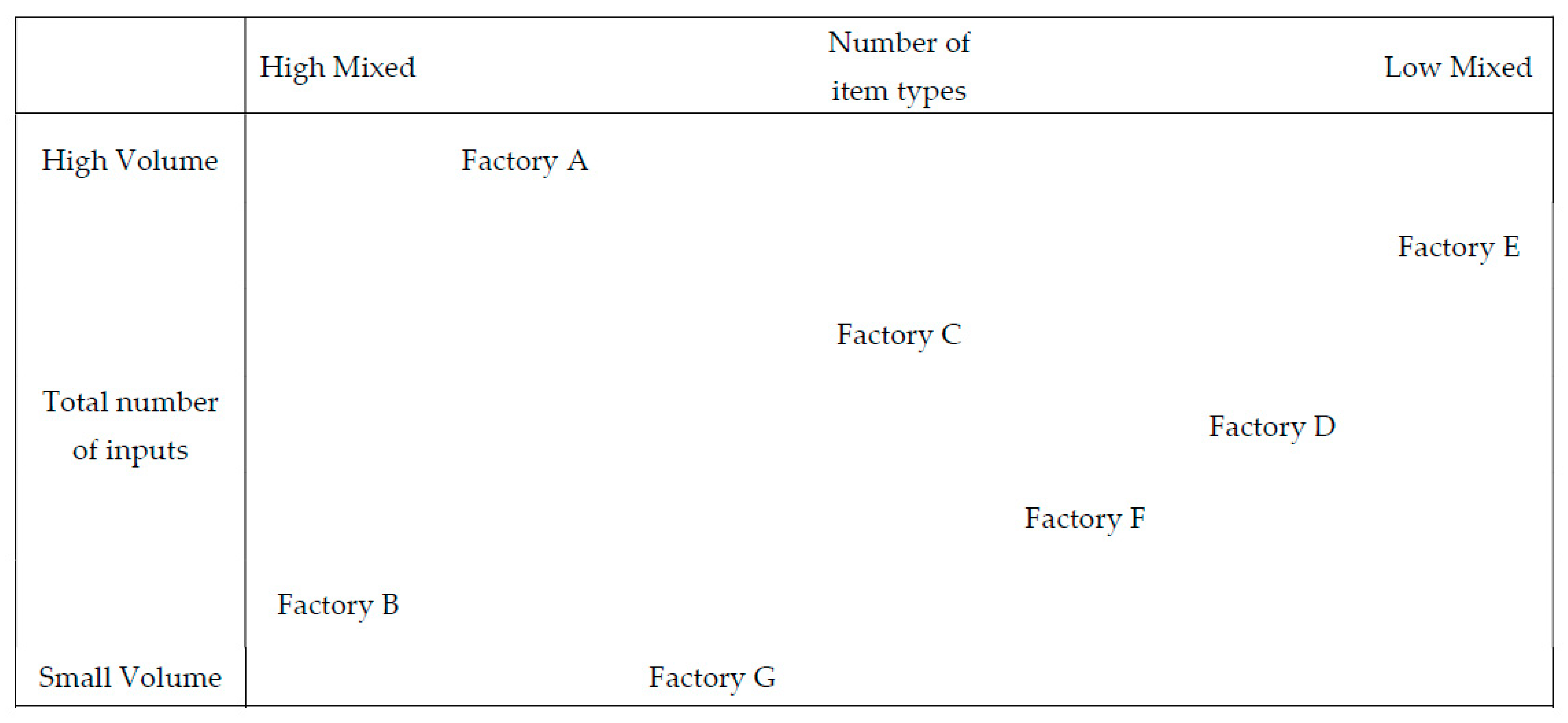
- Factory A has the highest number of item types and total production among the seven factories and is close to the HMLV production style.
- Factory B is the quasi-main supplier and receives orders almost every month. The total production is the second lowest, but the number of items is relatively high. Compared to Factory C, Factory B concentrates on HMLV production.
- Factory C is the quasi-main supplier and receives orders almost every month. It ranks third in total production and fourth in number of items.
- Factory D is also a quasi-main supplier and has received orders in 35 months. The total production is the fourth, and the number of items is the second lowest. Compared to Factory C, Factory D is relatively focused on HMLV production.
- Factory E is the main outsourcing factory and receives orders every month. The total production and the number of item types are the second highest, but the lot size is relatively large (HVLM production).
- Factory F is an irregular subcontractor (20 months in 4 years). The total production and the number of items are the lowest among the subcontractors.
- Factory G is an irregular subcontractor (21 months in 4 years). The total production is the fifth (more than factory B’s) and the number of items is the fifth. The production style is relatively HMLV.
5. Discussion and Conclusions
5.1. Discussion
5.2. Theoretical and Managerial Implications
5.3. Limitation and Further Research
Author Contributions
Funding
Data Availability Statement
Conflicts of Interest
References
- Anderson, S. W. (1995). Measuring the impact of product mix heterogeneity on manufacturing overhead cost. Accounting Review, 70(3), 363–387. Available online: https://www.jstor.org/stable/248530 (accessed on 21 April 2026). [CrossRef]
- Buckley, P. J. (2016). The contribution of Internalisation theory to international business: New realities and unanswered questions. Journal of World Business, 51(1), 74–82. [Google Scholar] [CrossRef]
- Buckley, P. J., & Tian, X. (2017). Internalisation theory and the performance of emerging-market multi-national enterprises. International Business Review, 26(5), 976–990. [Google Scholar] [CrossRef]
- Cassidey, T. B., Freeman, N., & Melouk, S. (2022). Leveraging concurrent sourcing for risk mitigation and pricing. Omega, 113, 102723. [Google Scholar] [CrossRef]
- Casson, M., Porter, L., & Wadeson, N. (2016). Internalisation theory: An unfinished agenda. International Business Review, 25(6), 1223–1234. [Google Scholar] [CrossRef]
- Choi, J. J., Ju, M., Kotabe, M., Trigeorgis, L., & Zhang, X. T. (2018). Flexibility as firm value driver: Evidence from offshore outsourcing. Global Strategy Journal, 8(2), 351–376. [Google Scholar] [CrossRef]
- Cohen, M. A., Cui, S., Ernst, R., Huchzermeier, A., Kouvelis, P., Lee, H. L., Matsuo, H., Steuber, M., & Tsay, A. A. (2018). OM Forum—Benchmarking global production sourcing decisions: Where and why firms offshore and reshore. Manufacturing & Service Operations Management, 20(3), 389–402. [Google Scholar] [CrossRef]
- Contractor, F. J., Kumar, V., Kundu, S., & Pedersen, T. (2010). Reconceptualising the firm in a world of outsourcing and offshoring: The organisational and geographical relocation of high-value company functions. Journal of Management Studies, 47(8), 1417–1433. [Google Scholar] [CrossRef]
- Cui, Y., & Lu, C. (2018). Recent developments in China’s labor market: Labor shortage, rising wages and their implications. Review of Development Economics, 22(3), 1217–1238. [Google Scholar] [CrossRef]
- Denzin, N. K. (1978). Triangulation: A Case for Methodological Evaluation and Combination. Sociological Methods, 56, 339–357. [Google Scholar]
- Dunning, J. H. (1977). Trade, location of economic activity and the MNE: A search for an eclectic approach. In B. Ohlin, P.-O. Hesselborn, & P. M. Wijkman (Eds.), The international allocation of economic activity (pp. 395–418). Macmillan Press. [Google Scholar]
- Dunning, J. H. (1980). Toward an eclectic theory of international production: Some empirical tests. Journal of International Business Studies, 11(1), 9–31. [Google Scholar] [CrossRef]
- Dunning, J. H. (1981). International production and the multinational enterprise. Allen and Unwin. [Google Scholar]
- Dunning, J. H. (2001). The eclectic (OLI) paradigm of international production: Past, present and future’. International Journal of the Economics of Business, 8(2), 173–190. [Google Scholar] [CrossRef]
- Eden, L. (2003). A critical reflection and some conclusions on OLI. In J. Cantwell, & R. Narula (Eds.), International business and the eclectic paradigm. Developing the oli framework (pp. 277–297). Routledge. [Google Scholar]
- Eisenhardt, K. M. (1989). Building theories from case study research. Academy of Management Review, 14(4), 532. [Google Scholar] [CrossRef]
- Erdener, C., & Shapiro, D. M. (2005). The internationalisation of Chinese family enterprises and dunning’s eclectic MNE paradigm. Management and Organization Review, 1(3), 411–436. [Google Scholar] [CrossRef]
- Gereffi, G., Humphrey, J., & Sturgeon, T. (2005). The governance of global chains. Review of International Political Economy, 12(1), 78–104. [Google Scholar] [CrossRef]
- Heide, J. B. (2003). Plural governance in industrial purchasing. Journal of Marketing, 67(4), 18–29. [Google Scholar] [CrossRef]
- Heide, J. B., Kumar, A., & Wathne, K. H. (2014). Concurrent sourcing, governance mechanisms, and performance outcomes in industrial value chains. Strategic Management Journal, 35(8), 1164–1185. [Google Scholar] [CrossRef]
- Inoguchi, J., Komiya, K., Kim, W., & Urakami, T. (2012). Strategies within Japanese apparel manufacturers. The Research Journal of the Costume Culture, 20(3), 443–450. [Google Scholar] [CrossRef][Green Version]
- Iwasaki, F., Chokyu, A., & Ueki, Y. (2025). Why are labour-intensive factories surviving in Japan? A case study of apparel sewing SMEs in the North Iwate. Administrative Sciences, 15, 154. [Google Scholar] [CrossRef]
- Iwasaki, F., & Ueki, Y. (2022). From buyer-driven fragmented to consumer-driven vertically integrated value chains: A case study of Japanese apparel and accessory SMEs. IDE Discussion Paper No. 838. IDE-JETRO. [Google Scholar] [CrossRef]
- Ju, M., Murray, J. Y., Gao, G. Y., & Kotabe, M. (2019). Concurrent sourcing strategy of multi-national firms in China: Drivers and performance implications. Journal of World Business, 54(6), 1010–1015. [Google Scholar] [CrossRef]
- Krzeminska, A., Hoetker, G., & Mellewigt, T. (2013). Reconceptualising plural sourcing. Strategic Management Journal, 34(13), 1614–1627. [Google Scholar] [CrossRef]
- Mols, N. P. (2010). Economic explanations for concurrent sourcing. Journal of Purchasing and Supply Management, 16(1), 61–69. [Google Scholar] [CrossRef]
- Mols, N. P., Hansen, J. R., & Villadsen, A. R. (2012). Plural governance: The effect of internal production on supplier performance. Industrial Marketing Management, 41(5), 874–885. [Google Scholar] [CrossRef]
- Mudambi, R., & Venzin, M. (2010). The strategic nexus of offshoring and outsourcing decisions. Journal of Management Studies, 47, 1510–1515. [Google Scholar] [CrossRef]
- Mukherjee, D., Nuruzzaman, N., Gaur, A. S., & Singh, D. (2023). Pro-market reforms and the outsourcing tradeoffs: Evidence from the transition economies. International Business Review, 32(4), 102105. [Google Scholar] [CrossRef]
- Nordigården, D., Rehme, J., Brege, S., Chicksand, D., & Walker, H. (2014). Outsourcing decisions—The case of parallel production. International Journal of Operations & Production Management, 34(8), 974–1002. [Google Scholar]
- Parmigiani, A. (2007). Why do firms both make and buy? An investigation of concurrent sourcing. Strategic Management Journal, 28(3), 285–311. [Google Scholar] [CrossRef]
- Parmigiani, A., & Mitchell, W. (2009). Complementarity, capabilities, and the boundaries of the firm: The impact of within-firm and interfirm expertise on concurrent sourcing of complementary components. Strategic Management Journal, 30(10), 1065–1091. [Google Scholar] [CrossRef]
- Pheng, L. S., & Hongbin, J. (2006). Analysing ownership, locational and internalisation advantages of Chinese construction MNCs using rough sets analysis. Construction Management and Economics, 24(11), 1149–1165. [Google Scholar] [CrossRef]
- Puranam, P., Gulati, R., & Bhattacharya, S. (2013). How much to make and how much to buy? An analysis of optimal plural sourcing strategies. Strategic Management Journal, 34(10), 1145–1161. [Google Scholar] [CrossRef]
- Qian, C., Dion, P. A., Wagner, R., & Seuring, S. (2023). Efficacy of supply chain relationships—Differences in performance appraisals between buyers and suppliers. Operations Management Research, 16(3), 1302–1320. [Google Scholar] [CrossRef]
- Randall, T., & Ulrich, K. (2001). Product variety, supply chain structure, and firm performance: Analysis of the US bicycle industry. Management Science, 47(12), 1588–1604. [Google Scholar] [CrossRef]
- Rothaermel, F. T., Hitt, M. A., & Jobe, L. A. (2006). Balancing vertical integration and strategic outsourcing: Effects on product portfolio, product success, and firm performance. Strategic Management Journal, 27(11), 1033–1056. [Google Scholar] [CrossRef]
- Seawright, J., & Gerring, J. (2008). Case selection techniques in case study research. Political Research Quarterly, 61(2), 294–308. [Google Scholar] [CrossRef]
- Song, S. (2021). When do multinational corporations adjust production volume flexibly among in-network subsidiaries? Journal of Business Research, 135, 532–542. [Google Scholar] [CrossRef]
- Sørensen, S. B., Hoetker, G., Leiblein, M. J., & Mellewigt, T. (2022). Crossing the streams of plural governance research: Simultaneously considering franchising, dual distribution, and concurrent sourcing. Journal of Management, 49(8), 2831–2862. [Google Scholar] [CrossRef]
- Teng, W., Chan, R. Y. K., Kim, N., Zhang, X., & Shen, L. (2023). Manufacturers’ acquiescence to buyers’ sourcing requests in industrial markets. Journal of Business-to-Business Marketing, 30(3), 277–295. [Google Scholar] [CrossRef]
- Theyel, G., Hofmann, K., & Gregory, M. (2018). Understanding manufacturing location decision making: Rationales for retaining, offshoring, reshoring, and hybrid approaches. Economic Development Quarterly, 32(4), 300–312. [Google Scholar] [CrossRef]
- Walker, G., & Weber, D. (1984). A transaction cost approach to make-or-buy decisions. Administrative Science Quarterly, 29(3), 373–391. [Google Scholar] [CrossRef]
- Williamson, O. E. (1985). The economic institutions of capitalism. Free Press. [Google Scholar]
- Witt, M. A., Lewin, A. Y., Li, P. P., & Gaur, A. (2023). Decoupling in international business: Evidence, drivers, impact, and implications for IB research. Journal of World Business, 58(1), 101399. [Google Scholar] [CrossRef]
- Yin, R. (2003). Case study research: Design and methods. SAGE. [Google Scholar]
- Yu, H., Zeng, A. Z., & Zhao, L. (2009). Single or dual sourcing: Decision-making in the presence of supply chain disruption risks. Omega, 37(4), 788–800. [Google Scholar] [CrossRef]
- Zeng, A. Z. (2000). A synthetic study of sourcing strategies. Industrial Management & Data Systems, 100(5), 219–226. [Google Scholar] [CrossRef]
- Zhao, J. (2011). The upgrading of the Japanese textile and apparel industry and comparison with China. Contemporary Economy of Japan, 1, 72–79. [Google Scholar]


| In-House (China) | Outsourcing (China) | In-House (Japan) | |
|---|---|---|---|
| O | Operational flexibility | Capacity flexibility, Low fixed cost | Operational flexibility, Timeliness |
| L | Single-skilled labour abundance | Single-skilled labour abundance | Multi-skilled labour abundance, Proximity to the market (Japan) |
| I | Quality control and reliability | Cost | Quality control and reliability |
| Total | The number of inputs from raw materials. |
| Shipment | The number of shipments. |
| Number | The number of item types each factory produces in one month. |
| Defect | The number of defects at each production process. |
| Repairs | The number of repairs. After repairing, the variable becomes the “Shipment” volume. |
| Sewing_Defect | The number of defects occurred in the sewing process. This variable is a sub-category of the variable for Defect. |
| Month | The number of months in which each factory has a shipment. |
| Factory Name | Number of Workers | Characteristics of Firms | The Turnover Rate of Workers | Quality of the Products | Notes |
|---|---|---|---|---|---|
| Factory A | Around 150–200 | The affiliated factory of the focal firm | Low | High | The mother factory for Factory B and Factory E |
| Factory B | Less than 10 | A regular subcontractor | Low | Not Low | Established with the assistance of Factory A |
| Factory C | Around 30 | A sub-regular subcontractor | High | Not Low | |
| Factory D | N/A (large-sized among the 6 subcontractors) | A sub-regular subcontractor | High | Not Low | |
| Factory E | Around 30–40 | A regular subcontractor | Low | High | Established with the assistance of Factory A |
| Factory F | N/A | An irregular subcontractor | N/A | N/A | |
| Factory G | N/A (small-sized) | An irregular subcontractor | N/A | N/A |
| Factory A | Factory B | Factory C | Factory D | Factory E | Factory F | Factory G | All Factories (Average) | |
|---|---|---|---|---|---|---|---|---|
| Number | 1 | 0.146144 | 0.138686 | 0.100104 | 0.313869 | 0.054745 | 0.110532 | 0.317434 |
| Total | 1 | 0.129254 | 0.180593 | 0.16575 | 0.605124 | 0.060072 | 0.132422 | 0.386 |
| Shipment | 1 | 0.130163 | 0.182284 | 0.166488 | 0.616763 | 0.0616 | 0.133645 | 0.388899 |
| Repairs | 1 | 0.20221 | 0.30702 | 0.236038 | 0.418556 | 0.046958 | 0.234168 | 0.401558 |
| Sewing_Defect | 1 | 0.148129 | 0.224449 | 0.202279 | 0.503917 | 0.033055 | 0.121677 | 0.379711 |
| Defect | 1 | 0.143815 | 0.204222 | 0.192289 | 0.55909 | 0.031937 | 0.147067 | 0.386486 |
| Lot_size | 1 | 0.922052 | 1.268616 | 1.887357 | 1.983115 | 1.212166 | 1.551715 | 1.391434 |
| Sewing_Defect_rate | 1 | 1.078564 | 1.304637 | 1.239539 | 0.837455 | 0.706283 | 1.094991 | 1.050426 |
| Repairs_rate | 1 | 1.551682 | 1.789528 | 1.417693 | 0.685025 | 0.713172 | 1.733287 | 1.260387 |
| Defect_rate | 1 | 1.045035 | 1.212271 | 1.188876 | 0.916897 | 0.629407 | 1.39295 | 1.055573 |
| Number of month (max = 48) | 48 | 46 | 42 | 35 | 48 | 20 | 21 | 260 |
| Defect Rate | Repairs Rate |
|---|---|
| External factory average: 1.064 (approximately 6% higher than Factory A) | External factory average: 1.315 (approximately 31% higher than Factory A) |
| t-test p-value: 0.581 (no significant difference) | t-test p-value: 0.180 (no significant difference) |
| Wilcoxon test p-value: 0.563 (no significant difference) | Wilcoxon test p-value: 0.156 (no significant difference) |
Disclaimer/Publisher’s Note: The statements, opinions and data contained in all publications are solely those of the individual author(s) and contributor(s) and not of MDPI and/or the editor(s). MDPI and/or the editor(s) disclaim responsibility for any injury to people or property resulting from any ideas, methods, instructions or products referred to in the content. |
© 2026 by the authors. Licensee MDPI, Basel, Switzerland. This article is an open access article distributed under the terms and conditions of the Creative Commons Attribution (CC BY) license.
Share and Cite
Iwasaki, F.; Ueki, Y. Understanding the Offshore Mixed Sourcing Strategy: A Case Study of a Japanese Affiliated Apparel Factory in China. Businesses 2026, 6, 25. https://doi.org/10.3390/businesses6020025
Iwasaki F, Ueki Y. Understanding the Offshore Mixed Sourcing Strategy: A Case Study of a Japanese Affiliated Apparel Factory in China. Businesses. 2026; 6(2):25. https://doi.org/10.3390/businesses6020025
Chicago/Turabian StyleIwasaki, Fusanori, and Yasushi Ueki. 2026. "Understanding the Offshore Mixed Sourcing Strategy: A Case Study of a Japanese Affiliated Apparel Factory in China" Businesses 6, no. 2: 25. https://doi.org/10.3390/businesses6020025
APA StyleIwasaki, F., & Ueki, Y. (2026). Understanding the Offshore Mixed Sourcing Strategy: A Case Study of a Japanese Affiliated Apparel Factory in China. Businesses, 6(2), 25. https://doi.org/10.3390/businesses6020025