Durability of One-Part Alkali-Activated Binder Made with Alternative Sodium Silicate


Abstract
1. Introduction
2. Materials and Methods
2.1. Materials
2.2. OPAAB Production
2.3. Mortar Production
2.4. Methods
2.4.1. Air Permeability, Total Water Absorption, and Void Index
- Air permeability
- Total water absorption and void index
2.4.2. Resistance to High Temperature
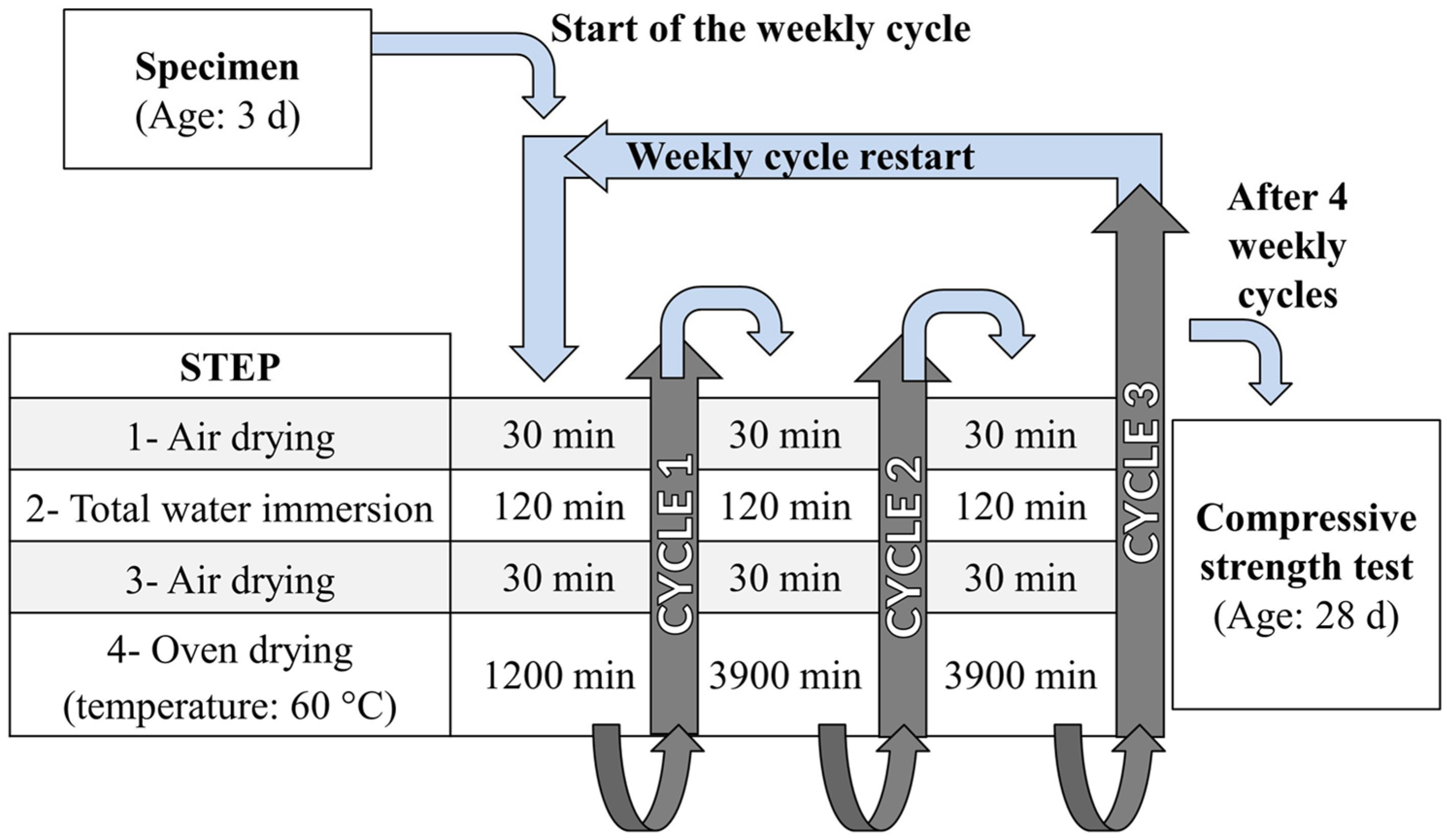
2.4.3. Resistance to Wet–Dry Cycles
2.4.4. Sulfate and Acid Attack
3. Results and Discussion
4. Conclusions
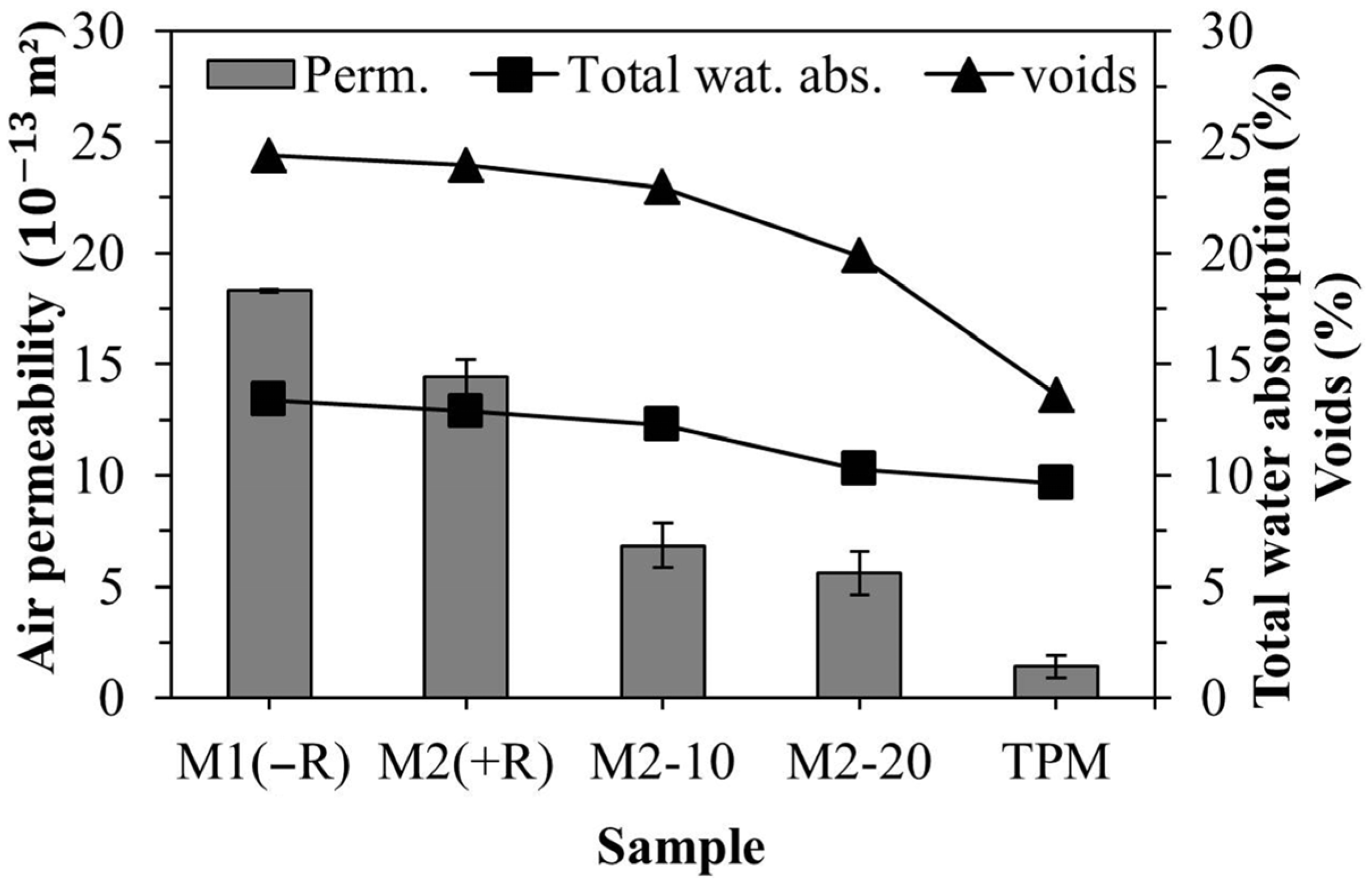
- The decrease in the water content used to produce the mortars led to reductions in the porosity and permeability of the materials. The OPAAB-based mortars presented higher porosity compared to mortar made in a two-part mixture, indicating microstructural differences between the one-part and two-part alkali-activated systems.
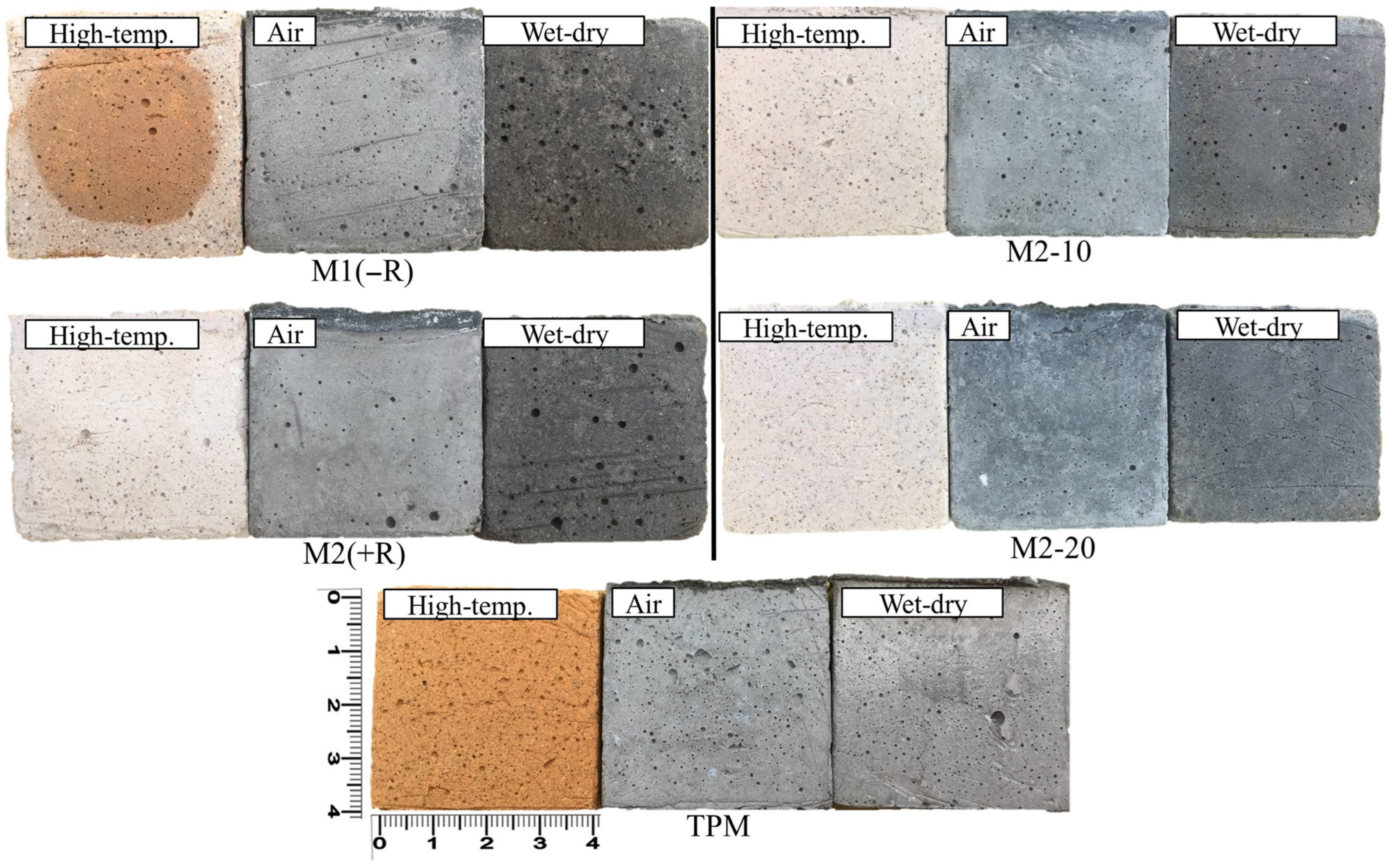
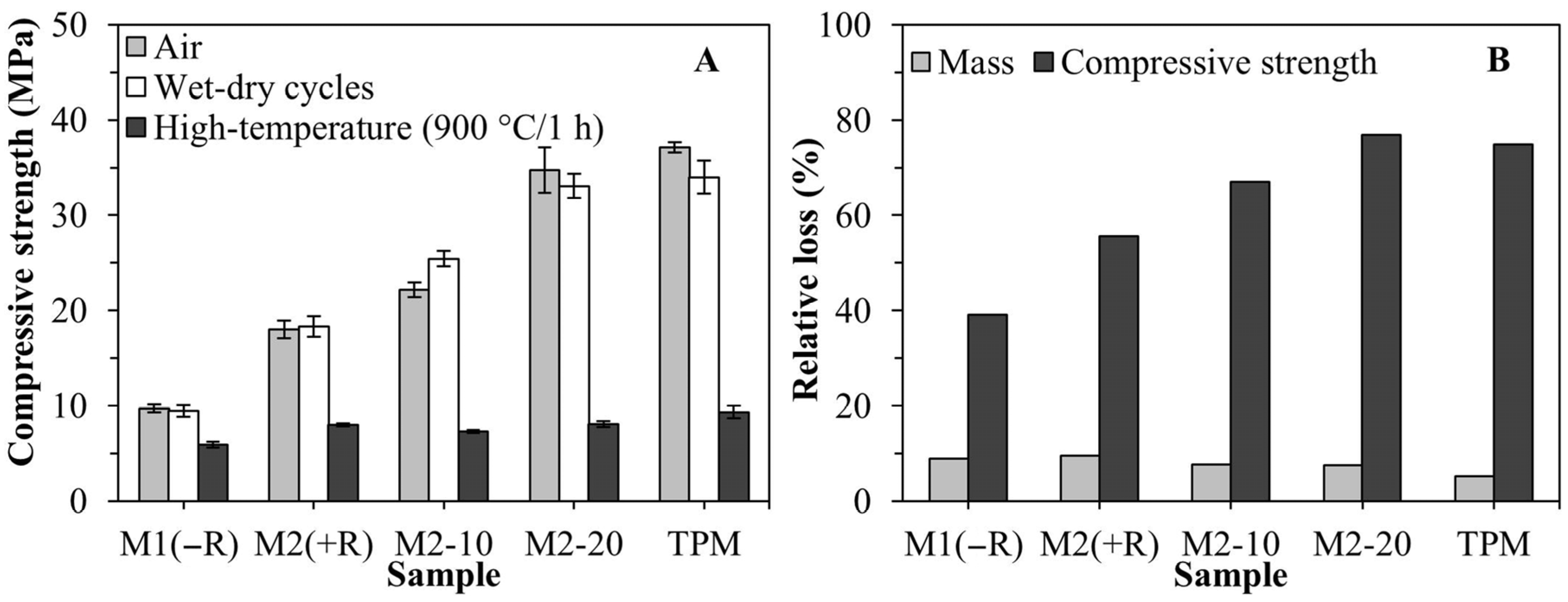
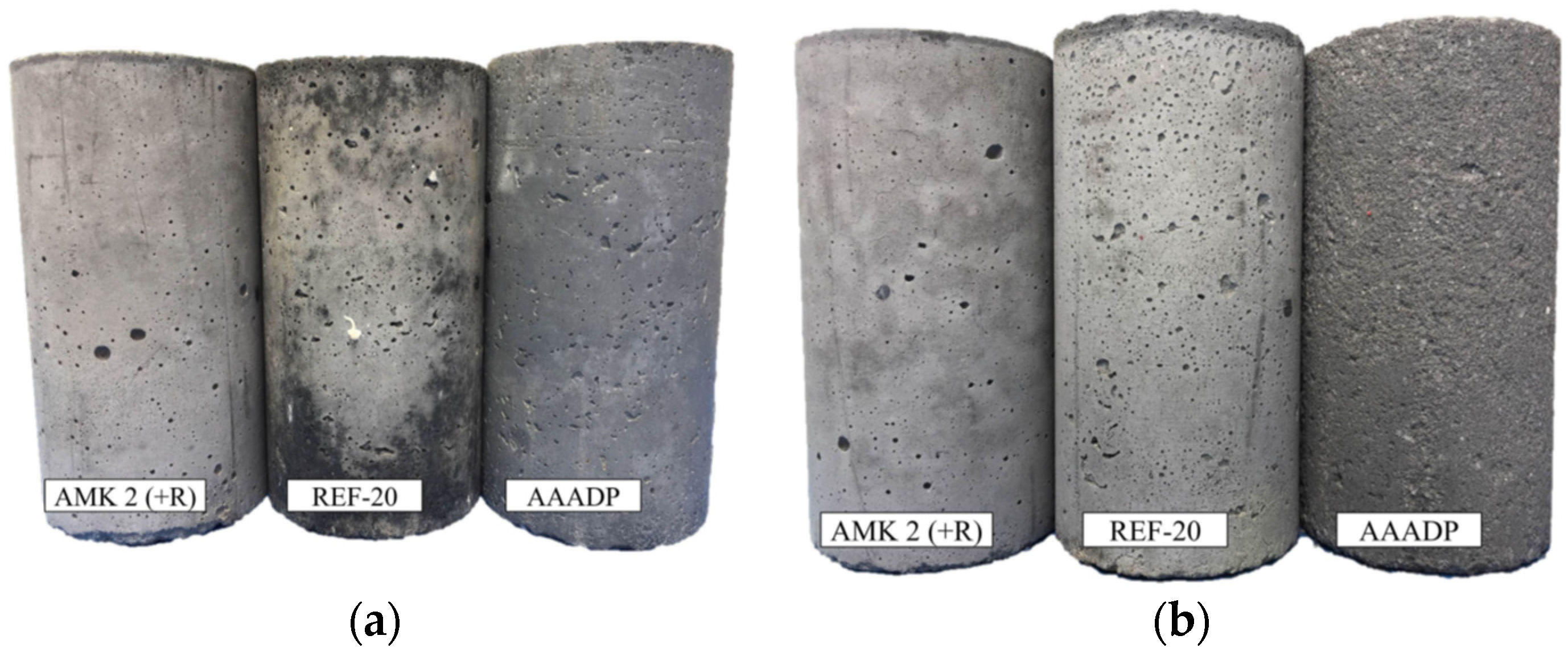
- The wet–dry cycles applied to mortars only 3 days after molding did not result in compressive strength reduction, resulting only in minor surface discoloration. This suggests that the OPAAB produced can develop a good performance when submitted to wet–dry cycles.
- The OPAAB-based mortars remained structurally intact after exposure to high temperature (temperature of 900 °C for 1 h). All specimens maintained a residual compressive strength higher than 5 MPa after the test, which is very important in fire situations.
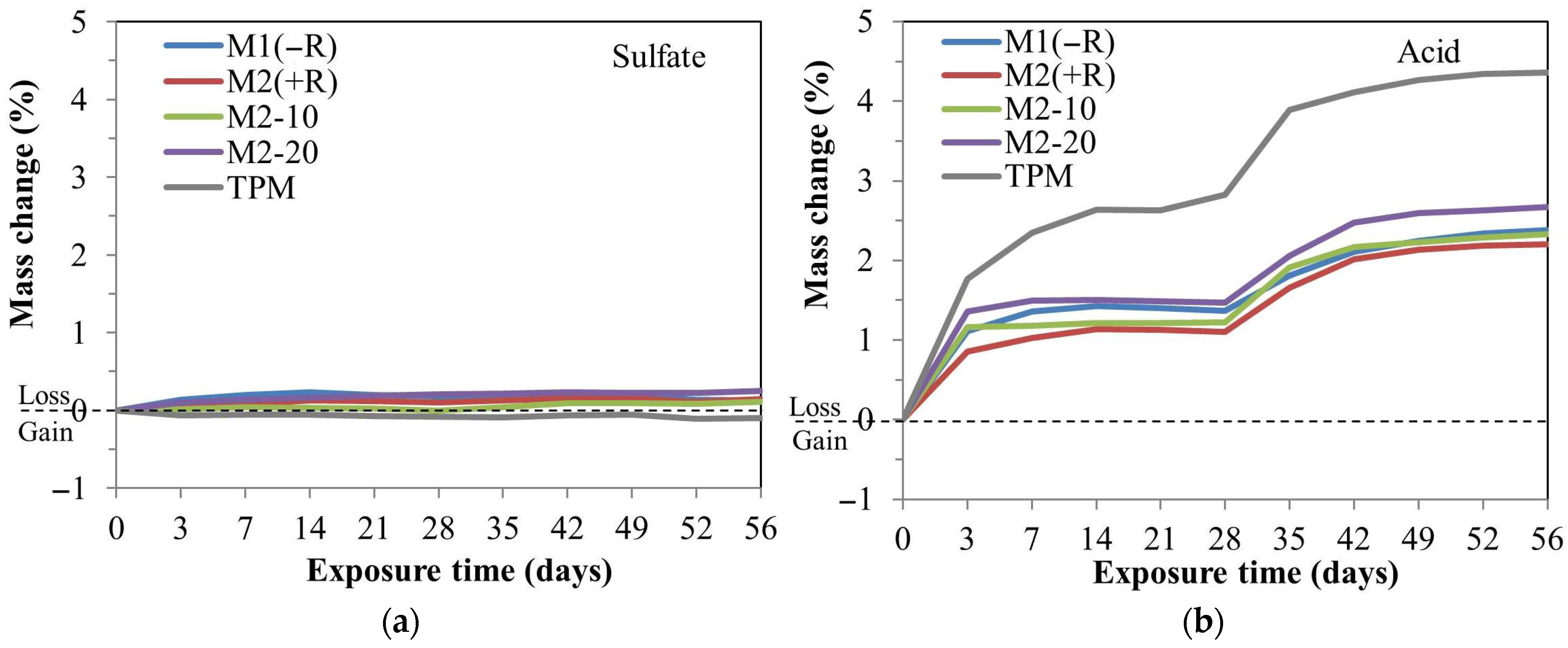
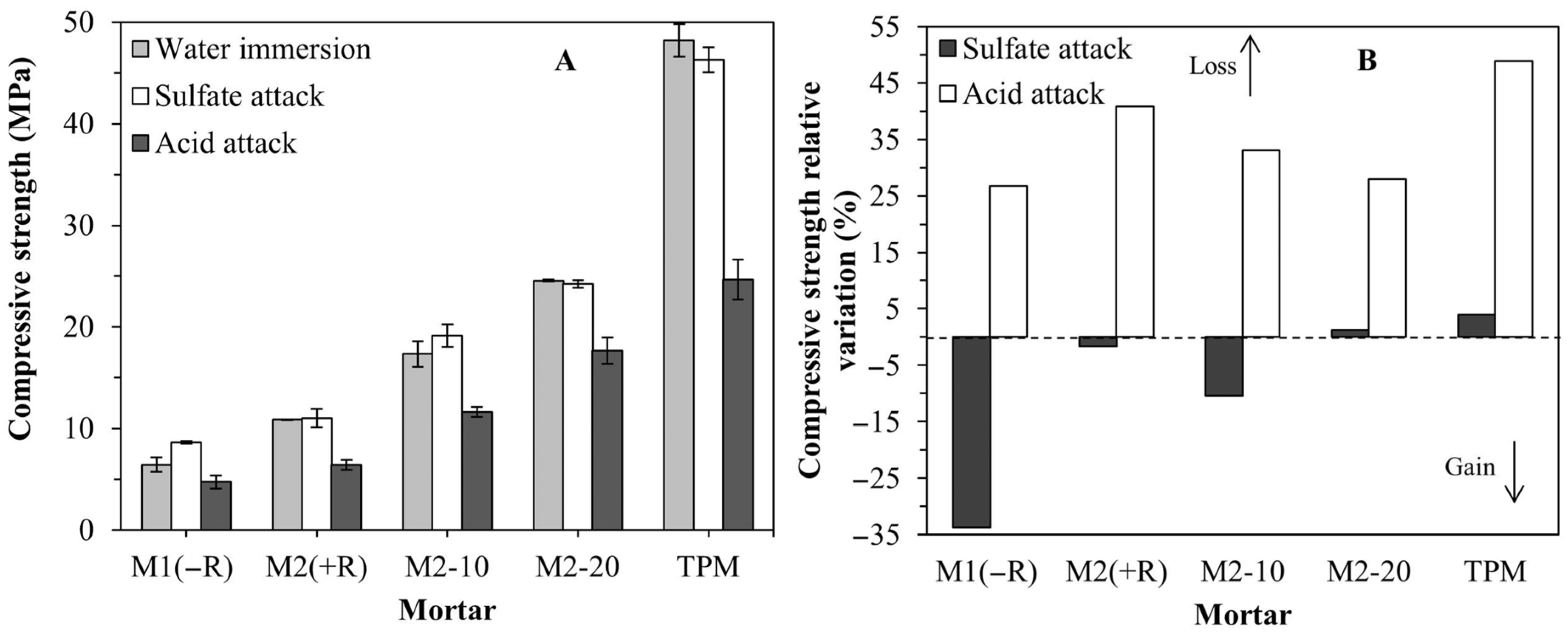
- Exposure to sulfate-rich environments (concentration of 5% by mass for 56 days) caused negligible mass variation and no significant loss of compressive strength, indicating good sulfate resistance for both OPAAB and TPM mortars over the evaluated period.
- The immersion of specimens in acid solution (concentration of 5% by mass for 56 days) demonstrated that TPM mortars lost proportionally more mass and compressive strength than the OPAAB-based mortars. All the mortars made with the OPAAB had a residual compressive strength higher than 4 MPa.
Author Contributions
Funding
Data Availability Statement
Conflicts of Interest
Abbreviations
| OPAAB | One-part alkali-activated binder |
| AAB | Alkali-activated binder |
| PC | Portland cement |
| GHG | Greenhouse gas |
| CO2 | Carbon dioxide |
| RHA | Rice husk ash |
| NaOH | Sodium hydroxide |
| MK | Metakaolin |
| TPM | Two-part mix |
| ASSP | Alternative sodium silicate in powder |
| RH | Relative humidity |
References
- Rasuli, M.I.; Tajunnisa, Y.; Yamamura, A.; Shigeishi, M. A Consideration on the One-Part Mixing Method of Alkali-Activated Material: Problems of Sodium Silicate Solubility and Quick Setting. Heliyon 2022, 8, e08783. [Google Scholar] [CrossRef] [PubMed]
- Alrefaei, Y.; Dai, J.G. Effects of Delayed Addition of Polycarboxylate Ether on One-Part Alkali-Activated Fly Ash/Slag Pastes: Adsorption, Reaction Kinetics, and Rheology. Constr. Build. Mater. 2022, 323, 126611. [Google Scholar] [CrossRef]
- Davidovits, J. Properties of Geopolymer Cements. In Proceedings of the First International Conference on Alkaline Cements and Concretes, Kiev, Ukraine, 11–14 October 1994; pp. 131–149. [Google Scholar]
- Khale, D.; Chaudhary, R. Mechanism of Geopolymerization and Factors Influencing Its Development: A Review. J. Mater. Sci. 2007, 42, 729–746. [Google Scholar] [CrossRef]
- Duxson, P.; Provis, J.L.; Lukey, G.C.; van Deventer, J.S.J. The Role of Inorganic Polymer Technology in the Development of “Green Concrete”. Cem. Concr. Res. 2007, 37, 1590–1597. [Google Scholar] [CrossRef]
- Jiang, M.; Chen, X.; Rajabipour, F.; Hendrickson, C.T. Comparative Life Cycle Assessment of Conventional, Glass Powder, and Alkali-Activated Slag Concrete and Mortar. J. Infrastruct. Syst. 2014, 20, 04014020. [Google Scholar] [CrossRef]
- Robayo-Salazar, R.A.; Mejía-Arcila, J.M.; Mejía de Gutiérrez, R. Eco-Efficient Alkali-Activated Cement Based on Red Clay Brick Wastes Suitable for the Manufacturing of Building Materials. J. Clean. Prod. 2017, 166, 242–252. [Google Scholar] [CrossRef]
- Borges, P.H.R.; Lourenço, T.M.D.F.; Foureaux, A.F.S.; Pacheco, L.S. Estudo Comparativo Da Análise de Ciclo de Vida de Concretos Geopoliméricos e de Concretos à Base de Cimento Portland Composto (CP II). Ambiente Construído 2014, 14, 153–168. [Google Scholar] [CrossRef]
- Weil, M.; Dombrowski, K.; Buchwald, A. Life-Cycle Analysis of Geopolymers. In Geopolymers: Structure, Processing, Properties and Industrial Applications; Provis, J., van Deventer, J.S.J., Eds.; Woodhead Publishing Limited: Cambridge, UK, 2009; pp. 194–210. ISBN 978-1-84569-449-4. [Google Scholar]
- Mellado, A.; Catalán, C.; Bouzón, N.; Borrachero, M.V.; Monzó, J.M.; Payá, J. Carbon Footprint of Geopolymeric Mortar: Study of the Contribution of the Alkaline Activating Solution and Assessment of an Alternative Route. RSC Adv. 2014, 4, 23846–23852. [Google Scholar] [CrossRef]
- Abdulkareem, M.; Havukainen, J.; Nuortila-Jokinen, J.; Horttanainen, M. Environmental and Economic Perspective of Waste-Derived Activators on Alkali-Activated Mortars. J. Clean. Prod. 2021, 280, 124651. [Google Scholar] [CrossRef]
- Yang, K.H.; Song, J.K.; Song, K. Il Assessment of CO2 Reduction of Alkali-Activated Concrete. J. Clean. Prod. 2013, 39, 265–272. [Google Scholar] [CrossRef]
- Passuello, A.; Rodríguez, E.D.; Hirt, E.; Longhi, M.; Bernal, S.A.; Provis, J.L.; Kirchheim, A.P. Evaluation of the Potential Improvement in the Environmental Footprint of Geopolymers Using Waste-Derived Activators. J. Clean. Prod. 2017, 166, 680–689. [Google Scholar] [CrossRef]
- Carreño-Gallardo, C.; Tejeda-Ochoa, A.; Perez-Ordonez, O.I.; Ledezma-Sillas, J.E.; Lardizabal-Gutierrez, D.; Prieto-Gomez, C.; Valenzuela-Grado, J.A.; Robles Hernandez, F.C.; Herrera-Ramirez, J.M. In the CO2 Emission Remediation by Means of Alternative Geopolymers as Substitutes for Cements. J. Environ. Chem. Eng. 2018, 6, 4878–4884. [Google Scholar] [CrossRef]
- Habert, G.; d’Espinose de Lacaillerie, J.B.; Roussel, N. An Environmental Evaluation of Geopolymer Based Concrete Production: Reviewing Current Research Trends. J. Clean. Prod. 2011, 19, 1229–1238. [Google Scholar] [CrossRef]
- McLellan, B.C.; Williams, R.P.; Lay, J.; Van Riessen, A.; Corder, G.D. Costs and Carbon Emissions for Geopolymer Pastes in Comparison to Ordinary Portland Cement. J. Clean. Prod. 2011, 19, 1080–1090. [Google Scholar] [CrossRef]
- Heath, A.; Paine, K.; McManus, M. Minimising the Global Warming Potential of Clay Based Geopolymers. J. Clean. Prod. 2014, 78, 75–83. [Google Scholar] [CrossRef]
- Teh, S.H.; Wiedmann, T.; Castel, A.; de Burgh, J. Hybrid Life Cycle Assessment of Greenhouse Gas Emissions from Cement, Concrete and Geopolymer Concrete in Australia. J. Clean. Prod. 2017, 152, 312–320. [Google Scholar] [CrossRef]
- Nguyen, L.; Moseson, A.J.; Farnam, Y.; Spatari, S. Effects of Composition and Transportation Logistics on Environmental, Energy and Cost Metrics for the Production of Alternative Cementitious Binders. J. Clean. Prod. 2018, 185, 628–645. [Google Scholar] [CrossRef]
- Maddalena, R.; Roberts, J.J.; Hamilton, A. Can Portland Cement Be Replaced by Low-Carbon Alternative Materials? A Study on the Thermal Properties and Carbon Emissions of Innovative Cements. J. Clean. Prod. 2018, 186, 933–942. [Google Scholar] [CrossRef]
- Turner, L.K.; Collins, F.G. Carbon Dioxide Equivalent (CO2-e) Emissions: A Comparison between Geopolymer and OPC Cement Concrete. Constr. Build. Mater. 2013, 43, 125–130. [Google Scholar] [CrossRef]
- Wang, X.; Wu, W.; Zhang, L.; Fu, L.; Li, X. Preparation of One-Part Alkali-Activated Nickel Slag Binder Using an Optimal Ball Milling Process. Constr. Build. Mater. 2022, 322, 125902. [Google Scholar] [CrossRef]
- Yang, T.; Gao, X.; Zhang, J.; Zhuang, X.; Wang, H.; Zhang, Z. Sulphate Resistance of One-Part Geopolymer Synthesized by Calcium Carbide Residue-Sodium Carbonate-Activation of Slag. Compos. Part B Eng. 2022, 242, 110024. [Google Scholar] [CrossRef]
- Dişçi, E.; Polat, R. The Influence of Nano-CaO and Nano-Al2O3 and Curing Conditions on Perlite Based Geopolymer Concrete Produced by the One-Part Mixing Method. Constr. Build. Mater. 2022, 346, 128484. [Google Scholar] [CrossRef]
- Yin, K.; Jiang, Y.; He, H.; Ren, J.; Li, Z. Microstructure and Shrinkage of One-Part Alkali-Activated Slag with Rice Straw Ash. Constr. Build. Mater. 2022, 345, 128403. [Google Scholar] [CrossRef]
- Abdollahnejad, Z.; Luukkonen, T.; Mastali, M.; Giosue, C.; Favoni, O.; Ruello, M.L.; Kinnunen, P.; Illikainen, M. Microstructural Analysis and Strength Development of One-Part Alkali-Activated Slag/Ceramic Binders Under Different Curing Regimes. Waste Biomass Valorization 2020, 11, 3081–3096. [Google Scholar] [CrossRef]
- Shah, S.F.A.; Chen, B.; Oderji, S.Y.; Haque, M.A.; Ahmad, M.R. Improvement of Early Strength of Fly Ash-Slag Based One-Part Alkali Activated Mortar. Constr. Build. Mater. 2020, 246, 118533. [Google Scholar] [CrossRef]
- Guo, S.; Ma, C.; Long, G.; Xie, Y. Cleaner One-Part Geopolymer Prepared by Introducing Fly Ash Sinking Spherical Beads: Properties and Geopolymerization Mechanism. J. Clean. Prod. 2019, 219, 686–697. [Google Scholar] [CrossRef]
- Peng, M.X.; Wang, Z.H.; Shen, S.H.; Xiao, Q.G.; Li, L.J.; Tang, Y.C.; Hu, L.L. Alkali Fusion of Bentonite to Synthesize One-Part Geopolymeric Cements Cured at Elevated Temperature by Comparison with Two-Part Ones. Constr. Build. Mater. 2017, 130, 103–112. [Google Scholar] [CrossRef]
- Askarian, M.; Tao, Z.; Adam, G.; Samali, B. Mechanical Properties of Ambient Cured One-Part Hybrid OPC-Geopolymer Concrete. Constr. Build. Mater. 2018, 186, 330–337. [Google Scholar] [CrossRef]
- Bong, S.H.; Nematollahi, B.; Nazari, A.; Xia, M.; Sanjayan, J. Efficiency of Different Superplasticizers and Retarders on Properties of “one-Part” Fly Ash-Slag Blended Geopolymers with Different Activators. Materials 2019, 12, 3410. [Google Scholar] [CrossRef] [PubMed]
- Lv, W.; Sun, Z.; Su, Z. Study of Seawater Mixed One-Part Alkali Activated GGBFS-Fly Ash. Cem. Concr. Compos. 2020, 106, 103484. [Google Scholar] [CrossRef]
- Abdulkareem, M.; Havukainen, J.; Horttanainen, M. Environmental Assessment of Alkali-Activated Mortars Using Different Activators. In Proceedings of the 17th International Waste Management and Landfill Symposium, Cagliari, Italy, 30 September–4 October 2019. [Google Scholar]
- Tong, K.T.; Vinai, R.; Soutsos, M.N. Use of Vietnamese Rice Husk Ash for the Production of Sodium Silicate as the Activator for Alkali-Activated Binders. J. Clean. Prod. 2018, 201, 272–286. [Google Scholar] [CrossRef]
- Villaquirán-Caicedo, M.A.; Mejía De Gutiérrez, R.; Gallego, N.C. A Novel MK-Based Geopolymer Composite Activated with Rice Husk Ash and KOH: Performance at High Temperature. Mater. Constr. 2017, 67, 117. [Google Scholar] [CrossRef]
- Geraldo, R.H.; Gonçalves, J.P.; Camarini, G. Production Process of an Eco-Friendly One-Part Alkali-Activated Binder. Mater. Res. 2022, 25, e20210433. [Google Scholar] [CrossRef]
- Geraldo, R.H.; Gonçalves, J.P.; Camarini, G. Mechanical Properties of an Eco-Friendly One-Part Alkali-Activated Binder: Influence of Metakaolin and Water Content. Ceram. Int. 2022, 49, 113260. [Google Scholar] [CrossRef]
- Provis, J.L. Geopolymers and Other Alkali Activated Materials: Why, How, and What? Mater. Struct. 2014, 47, 11–25. [Google Scholar] [CrossRef]
- Geraldo, R.H.; Fernandes, L.F.R.; Camarini, G. Water Treatment Sludge and Rice Husk Ash to Sustainable Geopolymer Production. J. Clean. Prod. 2017, 149, 146–155. [Google Scholar] [CrossRef]
- ABNT NBR 9778; Hardened Mortar and Concrete—Determination of Absorption, Voids and Specific Gravity. Brazilian Association of Technical Standards: Rio de Janeiro, Brazil, 2009; p. 4.
- Farias Filho, J.; Menezes, R.R.; Ferreira, H.S.; Santana, L.N.L.; Neves, G.A.; Ferreira, H.C. Durability Study of Alternative Mortars Containing Wastes, Estudo Da Durabilidade de Argamassas Alternativas Contendo Resíduos. Ceramica 2011, 57, 395–403. [Google Scholar] [CrossRef]
- Aiken, T.A.; Kwasny, J.; Sha, W.; Soutsos, M.N. Effect of Slag Content and Activator Dosage on the Resistance of Fly Ash Geopolymer Binders to Sulfuric Acid Attack. Cem. Concr. Res. 2018, 111, 23–40. [Google Scholar] [CrossRef]
- Sturm, P.; Gluth, G.J.G.; Jäger, C.; Brouwers, H.J.H.; Kühne, H.C. Sulfuric Acid Resistance of One-Part Alkali-Activated Mortars. Cem. Concr. Res. 2018, 109, 54–63. [Google Scholar] [CrossRef]
- Longhi, M.A.; Zhang, Z.; Rodríguez, E.D.; Kirchheim, A.P.; Wang, H. Efflorescence of Alkali-Activated Cements (Geopolymers) and the Impacts on Material Structures: A Critical Analysis. Front. Mater. 2019, 6, 89. [Google Scholar] [CrossRef]
- Provis, J.L.; Duxson, P.; van Deventer, J.S.J. The Role of Particle Technology in Developing Sustainable Construction Materials. Adv. Powder Technol. 2010, 21, 2–7. [Google Scholar] [CrossRef]
- Hajimohammadi, A.; Provis, J.L.; Van Deventer, J.S.J. One-Part Geopolymer Mixes from Geothermal Silica and Sodium Aluminate. Ind. Eng. Chem. Res. 2008, 47, 9396–9405. [Google Scholar] [CrossRef]
- Zhang, Z.; Provis, J.L.; Reid, A.; Wang, H. Fly Ash-Based Geopolymers: The Relationship between Composition, Pore Structure and Efflorescence. Cem. Concr. Res. 2014, 64, 30–41. [Google Scholar] [CrossRef]
- Kong, D.L.Y.; Sanjayan, J.G. Effect of Elevated Temperatures on Geopolymer Paste, Mortar and Concrete. Cem. Concr. Res. 2010, 40, 334–339. [Google Scholar] [CrossRef]
- Kirchhof, L.D. Estudo Teórico-Experimental Da Influência Do Teor de Umidade No Fenômeno de Spalling Explosivo Em Concretos Expostos a Elevadas Temperaturas. Ph.D. Thesis, Universidade Federal do Rio Grande do Sul, Porto Alegre, Rio Grande do Sul, Brazil, 2010. [Google Scholar]
- Chithambaram, S.J.; Kumar, S.; Prasad, M.M. Thermo-Mechanical Characteristics of Geopolymer Mortar. Constr. Build. Mater. 2019, 213, 100–108. [Google Scholar] [CrossRef]
- Bakharev, T. Resistance of Geopolymer Materials to Acid Attack. Cem. Concr. Res. 2005, 35, 658–670. [Google Scholar] [CrossRef]
- Sata, V.; Sathonsaowaphak, A.; Chindaprasirt, P. Resistance of Lignite Bottom Ash Geopolymer Mortar to Sulfate and Sulfuric Acid Attack. Cem. Concr. Compos. 2012, 34, 700–708. [Google Scholar] [CrossRef]
- Džunuzović, N.; Komljenović, M.; Nikolić, V.; Ivanović, T. External Sulfate Attack on Alkali-Activated Fly Ash-Blast Furnace Slag Composite. Constr. Build. Mater. 2017, 157, 737–747. [Google Scholar] [CrossRef]
- Huang, T.; Fan, Y.; Long, Y.; Pang, Z. Quantitative Calculation for the Contribution of Acid Rain to Carbonate Weathering. J. Hydrol. 2019, 568, 360–371. [Google Scholar] [CrossRef]
- Bašcarevic, Z. The Resistance of Alkali-Activated Cement-Based Binders to Chemical Attack. In Handbook of Alkali-Activated Cements, Mortars and Concretes; Pacheco-Torgal, F., Ed.; Woodhead Publishing Limited: Cambridge, UK, 2014; pp. 373–393. ISBN 978-1-78242-288-4. [Google Scholar]
- Mauri, J.; Dias, D.P.; Cordeiro, G.C.; Dias, A.A. Argamassa Geopolimérica: Estudo Da Degradação Por Sulfato de Sódio e Ácido Sulfúrico. Rev. Matér. 2009, 14, 1039–1046. [Google Scholar] [CrossRef]
- Fernandez-Jimenez, A.; García-Lodeiro, I.; Palomo, A. Durability of Alkali-Activated Fly Ash Cementitious Materials. J. Mater. Sci. 2007, 42, 3055–3065. [Google Scholar] [CrossRef]
- Abora, K.; Beleña, I.; Bernal, S.A.; Dunster, A.; Nixon, P.A.; Provis, J.L.; Arezki, T.-H.; Winnefeld, F. Durability and Testing—Chemical Matrix Degradation Processes. In Alkali Activated Materials; State-of-the-Art Report, RILEM TC 224-AAM; Provis, J.L., van Deventer, J.S.J., Eds.; RILEM State-of-the-Art Reports; Springer: Dordrecht, The Netherlands, 2014; Volume 13, ISBN 978-94-007-7671-5. [Google Scholar]



| CO2 and Other GHG Reduction Rate 1 | Reference |
|---|---|
| 80–90 | Davidovits [3] |
| 80 | Khale and Chaudhary [4] |
| 80 | Duxson et al. [5] |
| 73 | Jiang et al. [6] |
| 73 | Robayo-Salazar et al. [7] |
| 72.4 | Borges et al. [8] |
| 70 | Weil et al. [9] |
| 63 | Mellado et al. [10] |
| 62 | Abdulkareem et al. [11] |
| 55–75 | Yang et al. [12] |
| 55–75 | Passuello et al. [13] |
| 54 | Carreño-Gallardo et al. [14] |
| 45 | Habert et al. [15] |
| 44–64 | McLellan et al. [16] |
| 40 | Heath et al. [17] |
| 32–43 | Teh et al. [18] |
| 27–45 | Nguyen et al. [19] |
| 23–55 | Maddalena et al. [20] |
| 9 | Turner and Collins [21] |
| Oxides (Mass %) | MK1 | MK2 | RHA |
|---|---|---|---|
| SiO2 | 49.36 | 51.30 | 93.19 |
| Al2O3 | 41.07 | 43.48 | 1.27 |
| K2O | 2.45 | 1.20 | 1.51 |
| Fe2O3 | 2.08 | 0.51 | 0.05 |
| TiO2 | 1.40 | 0.03 | - |
| MgO | 0.82 | 0.11 | 0.33 |
| CaO | 0.07 | 0.04 | 0.58 |
| Others | 0.30 | 0.34 | 0.99 |
| Loss on ignition | 2.45 | 2.99 | 2.08 |
| pH | 6.00 | 6.08 | 9.94 |
| Physical properties | |||
| Specific mass (kg/m3) | 2775 | 2664 | 2388 |
| Bulk density (kg/m3) | 439 | 422 | 479 |
| D10% (μm) | 2.17 | 1.18 | 2.47 |
| D50% (μm) | 11.32 | 6.15 | 13.83 |
| D90% (μm) | 41.37 | 47.15 | 51.10 |
| Mortar | ASSP 6 (g) | NaOH (g) | MK1 (g) | MK2 (g) | RHA (g) | Sand (g) | Water (g) | SiO2/Al2O3 (mol/mol) |
|---|---|---|---|---|---|---|---|---|
| M1(−R) 1 | 42.0 | - | 80 | 0 | 3.6 | 244 | 71.80 | 3.3 |
| M2(+R) 2 | 42.0 | - | 0 | 80 | 3.6 | 244 | 71.80 | 3.1 |
| M2-10 3 | 42.0 | - | 0 | 80 | 3.6 | 244 | 64.62 | 3.1 |
| M2-20 4 | 42.0 | - | 0 | 80 | 3.6 | 244 | 57.44 | 3.1 |
| TPM 5 | - | 81 | 355 | - | 104 | 1065 | 230 | 4.2 |
Disclaimer/Publisher’s Note: The statements, opinions and data contained in all publications are solely those of the individual author(s) and contributor(s) and not of MDPI and/or the editor(s). MDPI and/or the editor(s) disclaim responsibility for any injury to people or property resulting from any ideas, methods, instructions or products referred to in the content. |
© 2026 by the authors. Licensee MDPI, Basel, Switzerland. This article is an open access article distributed under the terms and conditions of the Creative Commons Attribution (CC BY) license.
Share and Cite
Geraldo, R.H.; Gonçalves, J.P.; Camarini, G. Durability of One-Part Alkali-Activated Binder Made with Alternative Sodium Silicate. Constr. Mater. 2026, 6, 8. https://doi.org/10.3390/constrmater6010008
Geraldo RH, Gonçalves JP, Camarini G. Durability of One-Part Alkali-Activated Binder Made with Alternative Sodium Silicate. Construction Materials. 2026; 6(1):8. https://doi.org/10.3390/constrmater6010008
Chicago/Turabian StyleGeraldo, Rodrigo H., Jardel P. Gonçalves, and Gladis Camarini. 2026. "Durability of One-Part Alkali-Activated Binder Made with Alternative Sodium Silicate" Construction Materials 6, no. 1: 8. https://doi.org/10.3390/constrmater6010008
APA StyleGeraldo, R. H., Gonçalves, J. P., & Camarini, G. (2026). Durability of One-Part Alkali-Activated Binder Made with Alternative Sodium Silicate. Construction Materials, 6(1), 8. https://doi.org/10.3390/constrmater6010008