Article

Performance of Piezoball and Piezo-T Flow Penetrometers Compared with Conventional In Situ Tests in Brazilian Soft Soils


by
Jonatas Sosnoski
1,
Gracieli Dienstmann
1,*,
Helena Paula Nierwinski
1,
Edgar Odebrecht
2,
Graziella Maria Faquim Jannuzzi
3 and
Fernando Artur Brasil Danziger
3
1
Postgraduate Program, Civil Engineering, Federal University of Santa Catarina (UFSC), Florianópolis 88040900, SC, Brazil
2
Postgraduate Program, Civil Engineering, State University of Santa Catarina (UDESC), Joinville 89219710, SC, Brazil
3
Postgraduate Program, Civil Engineering, Federal University of Rio de Janeiro (COOPE), Rio de Janeiro 21941914, RJ, Brazil
*
Author to whom correspondence should be addressed.
Geotechnics 2026, 6(1), 24; https://doi.org/10.3390/geotechnics6010024
Submission received: 5 December 2025 / Revised: 30 January 2026 / Accepted: 11 February 2026 / Published: 3 March 2026
(This article belongs to the Special Issue Recent Advances in Geotechnical Engineering (3rd Edition))

Abstract

Limitations of the cone penetration test, especially to accurately determine undrained shear strength (Su) in soft soil deposits with high in situ stresses, have motivated the development of alternative devices, such as the T-bar and ball penetration tests, commonly referred to as flow penetrometers. These devices can estimate, in a single test, both the undrained shear strength (Su) and the remolded strength (Sur). When equipped with pore pressure sensors, they also provide valuable information on soil stratigraphy and consolidation parameters, making them versatile tools for characterizing soft soils. This study presents the development of two flow penetrometers, piezoball and piezo-T, highlighting relevant aspects of their design and calibration, followed by experimental campaigns conducted in two Brazilian clay deposits (Tubarão/SC and Sarapuí/RJ). Field tests enabled a direct comparison between the flow penetrometers and conventional methods, both in terms of Su and Sur. The investigation also examined the coefficient of consolidation of the soft soils. The results demonstrate good repeatability and consistent values for the bearing capacity factors (Nb and Nt) and remolded behavior (Nb-rem and Nt-rem). Regarding the performance of the pore pressure transducers, the piezoball test demonstrated good performance in pore pressure measurements and derived coefficients of consolidation. In contrast, despite the proposed design modifications, the piezo-T exhibited instability in the readings. Although the findings are derived from specific sites, the discussion is framed in light of the ranges reported internationally, highlighting potential local implications and reinforcing the need to expand robust geotechnical databases to support future applications.

1. Introduction

The accurate determination of undrained shear strength is essential for the design of foundations and structures in soft soils, which are typical environments in coastal zones and offshore sites [1]. Conventional in situ tests, such as the vane shear test (FVT) and the piezocone penetration test (CPTu), are widely used to estimate the undrained shear strength (Su), but they exhibit well-known limitations.
FVT is indeed the most appropriate method for determining the undrained shear strength of clayey soils, as it allows for the direct measurement of both the undrained shear strength and the remolded undrained shear strength [2]. However, the field vane test (FVT) is limited to point measurements with depth. Continuous profiling makes the use of CPTu tests advantageous. Nevertheless, the complex penetration mechanism, which induces both shear and volumetric deformations in the soil, introduces the need for appropriate correction factors, such as Nkt and NΔu, whose calibration strongly depends on local soil conditions and geological settings [3,4].
In this context, flow penetrometer tests, such as the T-bar and ball penetration tests, have emerged as complementary tools to the CPTu and FVT, offering greater reliability in estimating the undrained strength, particularly in very soft clays. The literature indicates that the coefficients required for determining undrained shear strength from ball penetration tests (coefficient Nb) and T-bar tests (coefficient NT) exhibit less variability than that observed for CPTu-based coefficients (Nkt), suggesting a lower sensitivity to soil properties, e.g., [1,5,6].
In general, penetrometric tests employ the same pushing system as the CPTu but replace the conical tip with T-shaped or ball-shaped geometries, which are specifically designed to promote a full-flow soil mechanism around the probe. Randolph et al. [5]. Their instrumented variants, Piezo-T and Piezoball, incorporate pore pressure transducers, enabling not only the determination of undrained strength but also the evaluation of drainage behavior during penetration [4].
Piezoball and Piezo-T probes also enable dissipation tests, from which the consolidation coefficient and permeability parameters can be derived. Different pore pressure sensor configurations have been reported in the literature, with transducers positioned at the tip (u1), mid-face (u2), and equator (u3) of the probe. The transducer location plays a critical role in selecting the most appropriate theoretical framework for data interpretation, as both theoretical [7,8] and empirical [9] approaches are available depending on the adopted instrumentation setup.
Another important application involves cyclic penetration tests, which are performed through controlled insertion and extraction of the probe at a predetermined depth. This procedure allows for the investigation of strength degradation and the estimation of soil sensitivity [10,11,12]. The analysis is based on degradation curves, expressed as the ratio qn/qin, where qn is the measured resistance at cycle n and qin is the resistance from the initial cycle. The stabilization of this ratio with increasing number of cycles indicates the remolded resistance (qrem), from which the remolded undrained strength (Sur) and the soil sensitivity (ST = Su/Sur) can be obtained.
From an experimental perspective, several practical challenges have been reported, particularly regarding the saturation of porous elements and the clogging of pore pressure sensors, especially at the tip (u1) position [13]. Moreover, the literature remains scarce regarding the combined execution of dissipation and cyclic tests within the same investigation profile. O’Loughlin et al. [14], for example, discuss how the interplay between strength degradation and reconsolidation gain can influence practical scenarios, such as the behavior of seabed pipelines subjected to cyclic loading. These authors propose the use of episodic cyclic tests and emphasize that protocol calibration and the interpretation of design parameters should be adapted to the conditions of each site.
Practical considerations also favor the use of Piezoball over Piezo-T tests, as its axisymmetric geometry reduces load-cell bending and is better suited for downhole testing [14]. Peuchen and Terwindt [15] reported a ratio of offshore ball test to T-bar about 10:1 to 100:1 when expressed in meters penetration. This also helps explain the limited availability of consolidation interpretation frameworks for T-bar tests. Nevertheless, T-bar probes offer notable advantages, such as requiring lower penetration forces and serving as a pipeline component model that provides direct information for the design of pipelines and risers [12].
Indeed, penetrometers tests remain highly attractive for onshore applications and are particularly effective in very soft clays, in which the driven mechanism and design analysis were originally established [16]. Although advantageous for determining intact undrained shear strength and remolded strength, the use of T-bar and ball tests is recommended and considered more suitable for soil profiles of “very soft to soft clays and clayey silts with an undrained shear strength <50 kPa”, with penetration resistance (qm) typically limited to 0.5 to 1 MPa [11,15]. In contrast, CPTu tests exhibit a penetration resistance (qc) range of 50 MPa to 100 MPa. These limits are established regarding the risk associated with equipment damage and loss, making CPTu tests more attractive in stiffer and heterogeneous soil profiles.
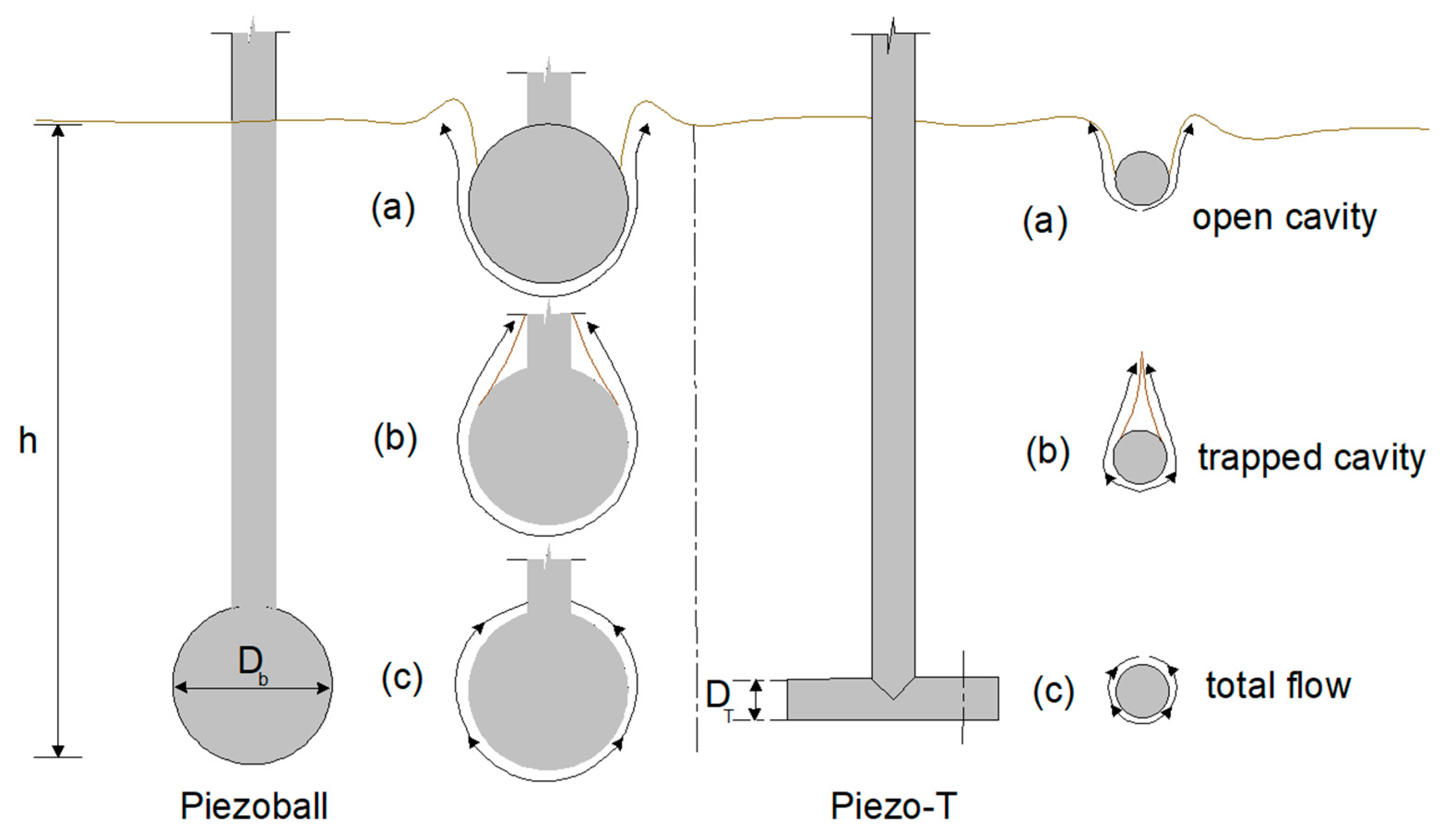
In this context, complex stratigraphic profiles require attention, sometimes necessitating pre-drilling in profiles with stiffer upper layers. In such cases, ball and traditional conical geometries exhibit a more positive response [15]. Furthermore, the effect of underlying layers on the soil flow mechanism around the probe must be carefully evaluated [16], as this affects the mobilized resistance and drainage response. Penetrometer tests become more accurate in determining undrained shear strength when the full-flow mechanism is established, i.e., when the cavity formed behind the advancing probe is fully closed (see Figure 1). With the full-flow mechanism achieved, the bearing capacity factor, used to calculate undrained shear strength, tends to be constant and can be derived from theoretically classical approaches as described in Randolph et al. [17]. In heterogeneous soils, a trapped cavity mechanism may produce inconsistencies in determining bearing capacity factors and, consequently, Su. The effects of heterogeneity and layering are extensively evaluated in laboratory settings and through numerical models [1,16,18,19,20]. Nevertheless, even under favorable penetrability conditions in homogeneous soft soils, it is recommended to evaluate rate effects, such as viscosity and partial drainage behavior, to properly derive resistance and consolidation parameters [8,10,11].
Although flow penetrometer tests are not new technology, their application remains incipient in Brazilian practice. This paper presents the development and application of a set of piezoball and piezo-T probes. The equipment was developed through a partnership between the State University of Santa Catarina (UDESC), Joinville/SC, Brazil, the Federal University of Santa Catarina (UFSC), Florianópolis/SC, Brazil, and Geoforma Engenharia Ltda, Joinville/SC, Brazil. The development of the equipment was motivated by the need for greater accuracy in predicting undrained shear strength in clayey profiles, as well as in characterizing the degradation behavior of undrained strength of local clay deposits with pronounced extension along the Brazilian coast. The Brazilian coastline extends for approximately 7500 km, ranking among the longest in the world and offering significant opportunities for sustainable coastal development and the need for reliable projects.
In addition to describing the developed equipment, this paper presents results from two experimental sites where the penetrometer probes were tested. The selected sites had previously been the subject of extensive geotechnical investigations, with data reported in the literature, e.g., [21,22]. The sites, designated as the Tubarão/SC and Sarapuí/RJ experimental fields, were selected for their known characteristics of relative homogeneity with depth, negligible surficial crust or stiff layers, and classification as normally consolidated to lightly overconsolidated clays with low penetration resistance and undrained shear strengths ranging around 5 to 20 kPa.
The execution of piezoball and piezo-T field tests at the experimental sites was preceded by a characterization campaign, comprising CPTu, FVT and sample collection (the latter only at Tubarão/SC) carried out at the sites following the “investigation island” concept [2], that is, the set of field tests and sampling verticals was executed at close distances (around 1.5 m), allowing direct comparison. This systematic comparison enabled the evaluation of the performance and applicability of the developed tests, as well as the identification of suitable correction factors to serve as a guidance for Brazilian geotechnical practice. Although the findings are derived from specific sites, the discussion is framed in light of the ranges reported internationally, highlighting potential local implications and reinforcing the need to expand robust geotechnical databases to support future applications worldwide.

2. Theoretical Background and Interpretation

Flow penetrometers are in situ testing devices derived from conventional cone penetration tests. Using the same pushing system, T-bar and ball tests can be performed using the same rod assembly and driving system, simply replacing the conventional conical tip in a piezocone system with a T-shaped tip (T-bar) or spherical tip (ball). When pore pressure transducers are incorporated, these devices are referred to as piezoball and piezo-T penetrometers, respectively. They were developed as complementary tools to improve the assessment of undrained shear strength in soft clay deposits [7,9,10,12,14]. In particular, the development of flow penetrometer probes was motivated by errors associated with the accuracy of penetration and pore pressure readings in CPTu tests in deep, very soft clay profiles. In deep low-strength profiles, the literature reports the need for corrections of 20 to 40% in resistance measured by piezocone tests due to high stress effects [23]. Randolph et al. [5] developed a full-flow penetrometer in 1994 to solve the above problem by increasing the coverage area of the penetrometer based on the full flow theory.
The term flow penetrometer refers to the soil–probe interaction mechanism that occurs around the penetrating element, as illustrated in Figure 1 (adapted from Chen et al. [6]). The penetration process can be divided into three stages: (a) a shallow penetration stage characterized by an open cavity, (b) a transition stage with a partially confined cavity, and (c) a full-flow stage where the cavity becomes completely closed. According to theoretical and experimental studies, e.g., [1,5,6], once the full-flow mechanism is reached, the corresponding bearing capacity factor used to derive the undrained shear strength (Su) becomes approximately constant, typically ranging from 10.3 to 11 for ball penetrometers and 10.9–12.7 for the T shape [10]. These factors are less sensitive to soil properties than those used in CPTu interpretation (e.g., Nkt, Nku), which makes full-flow penetrometers particularly attractive for soft clays.
In addition, the larger projected area of the ball and T-bar compared with the cone results in higher penetration resistance, thereby reducing the relative error associated with the measurement of penetration resistance (qc). Compared with conventional CPTu tests, the combination of higher measured forces and less variability in bearing capacity factors leads to more accurate estimates of undrained shear strength [1,12,14].

2.1. Readings and Measurements

During penetration, the probes measure the penetration resistance (qm) and pore pressure (u). With respect to pore pressure measurements, different sensor locations have been adopted in the literature. Kelleher and Randolph [24] and Colreavy et al. [25] employed configurations with pore pressure sensors positioned at the equator (u3) and mid-face (u2). Measurements at the tip position (u1) have also been reported [4].
Among these configurations, the midface position (u2) has been shown to provide the most reliable estimates of the coefficient of consolidation (ch) [9]. In contrast, measurements taken at the equator (u3) are more difficult to interpret because the stress field involves a combination of compression and extension zones, often resulting in dissipation curves that initially rise before decreasing, even in contractive soils. Measurements at the tip position (u1) have proven unreliable in practice because of frequent filter clogging, which can render the sensor unresponsive during testing [9].
To correct for the so-called unequal area effect—arising from the difference between the cross-sectional areas at the top and base of the probe—Randolph [26] proposed accounting for the cross-sectional area of the probe (Ap) and that of the pushing rod immediately above the ball (As) when computing the net penetration resistance (qnet), as expressed in Equation (1):
q n e t = q m [ σ v 0 u ( 1 a ) ] A s A p ,
where σv0 is the total vertical stress, u is the hydrostatic pore pressure, and a represents the ratio between the load cell areas of the equipment.
On the basis of recommendations in the literature, the area ratio (Ap/As) should ideally be approximately 10:1 [10,27]. However, practical experience indicates that ratios greater than 5:1 are generally sufficient to minimize the influence of the pushing rod on the soil flow mechanism around the probe.

2.2. Interpretation of Shear Strength

The undrained shear strength can be estimated from the relationship between q n e t and a bearing capacity factor ( N b or N T ), as expressed in Equation (2):
S u = q n e t N b   o r   N T ,
where Nb is the bearing capacity (or resistance) factor for the piezoball and NT is the corresponding factor for the piezo-T.
The determination of these capacity factors can be performed directly through the correlation between Su values obtained from field tests (such as FVT) or laboratory tests (such as UU triaxial tests). Alternatively, these factors can be determined indirectly based on several empirical or theoretical proposals available in the literature, which relate measured or derived quantities from penetration tests to the coefficients Nb and NT. Table 1 presents a compilation of these published correlations.
In general, the proposals listed in Table 1 make use of soil sensitivity to derive the coefficients Nb and NT and of the corresponding parameters for remolded strength, Nb-rem and NT-rem. The sensitivity—defined by Equation (3) as the ratio between the undisturbed strength (Su) and the remolded strength (Sur)—has been shown to have a strong influence on the bearing capacity factors [11].
S T = S u S u r

2.3. Cyclic Test

Penetrometer tests can also be performed under cyclic loading conditions by repeatedly inserting and extracting the probe at predetermined depths. The monitored resistance can be used to evaluate the degradation of the undrained shear strength. The total strength degradation is determined on the basis of the experimentally measured initial (qin) and remolded (qrem) penetration resistances. The remolded resistance corresponds to the value measured at the end of the cyclic loading process.
According to the literature, e.g., [27,28,29,30], a minimum displacement region of 150 mm, or at least three times the ball diameter, is recommended to ensure adequate soil remolding. Stabilization of the mobilized resistance is typically achieved after approximately ten cycles. Cyclic loading should be initiated immediately after the probe reaches the target depth to minimize potential soil consolidation effects, which could influence the measured response [31].
Once the degradation curve—which represents the relationship between the resistance per cycle and the number of cycles—is obtained, the remolded undrained shear strength can be estimated via Equation (4).
S u r = q r e m N b r e m   o r   N T r e m  

2.4. Dissipation Test

The determination of the soil’s hydraulic conductivity using piezoball penetrometers can be performed through dissipation tests, following the same principles applied to piezocone tests. In this context, dissipation tests are recommended to reach at least 50% of the excess pore pressure generated during probe penetration at the target depth [31].
The coefficient of consolidation (ch) is derived from the interpretation of normalized excess pore pressure curves using a dimensionless time factor (T). When applied to piezoball penetration, different definitions of the dimensionless time factor (Tb) have been proposed in the literature. These formulations have been established through numerical modeling [7,8] or empirical data [9]. The main equations considered in this study are summarized in Table 2.
Inspired by the classical Teh and Houlsby [32] solution and large deformation finite element (LDFE) analyses, Mahmoodzadeh et al. [7] investigated the dissipation response of pore pressure sensors positioned at the equator (u3) and mid-face (u2) of the piezoball. The effects of soil stiffness variation and ball geometry were also analyzed. In their approach, once the appropriate Tb value is determined, ch is estimated using the 50% dissipation time (t50), the soil rigidity index (Ir), and the diameter ratio between the ball (Db) and the pushing rod (d) located immediately above it.
Similarly, Liu et al. [8], who extended the classical Teh and Houlsby [32] solution through extensive numerical modeling combined with centrifuge testing, proposed a unified relationship between normalized pore pressure and Tb for measurements taken at the equatorial position (u3) of the piezoball.
On the basis of a dataset comprising four field tests and two centrifuge studies performed in kaolin clay, Colreavy et al. [9] proposed an empirical method for estimating ch from pore pressure dissipation readings at the equator (u3). This approach utilizes both the tmax value, which corresponds to the time at which the maximum excess pore pressure is reached, and the t50 value, which represents the 50% dissipation time.
There is no established method for determining ch from T-bar tests.

3. Equipment and Procedures

The piezoball and piezo-T devices used in this study were developed through a collaboration between Geoforma Engenharia Ltd.a., Universidade do Estado de Santa Catarina (UDESC), and Universidade Federal de Santa Catarina (UFSC). Their development aimed to increase the accuracy of undrained behavior prediction in soft clays. The initial design concept of the equipment was presented by Meert [33]. Sosnoski [34] subsequently introduced physical modifications to the devices, particularly concerning the configuration of the porous stone and the positioning of the pore pressure transducers. The main objective of this latter work was to mitigate issues related to pore pressure readings caused by saturation loss and measurement instability, as previously reported by Meert [33]. The main characteristics of the tests are presented in the following sections.

3.1. General Overview of the Piezoball

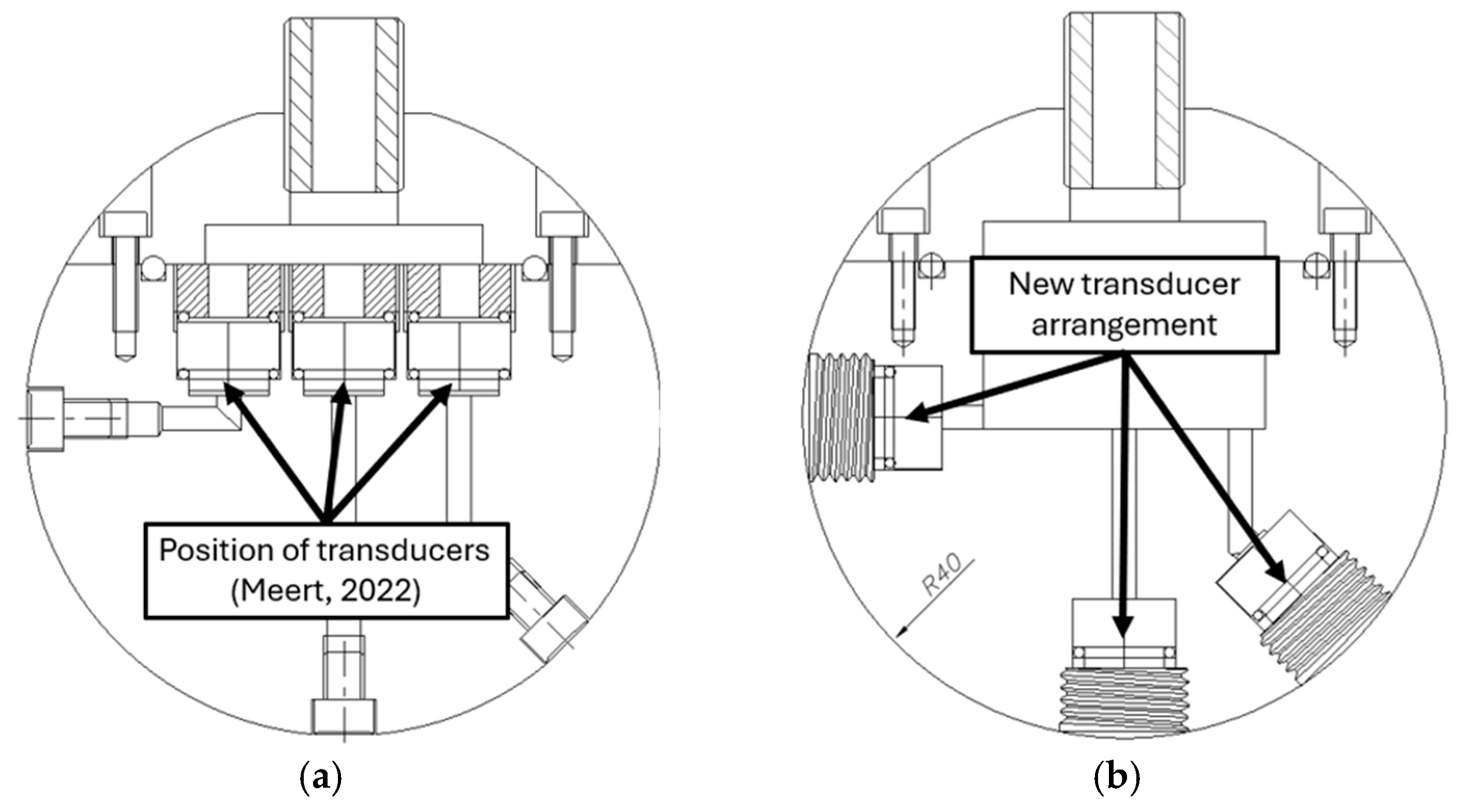
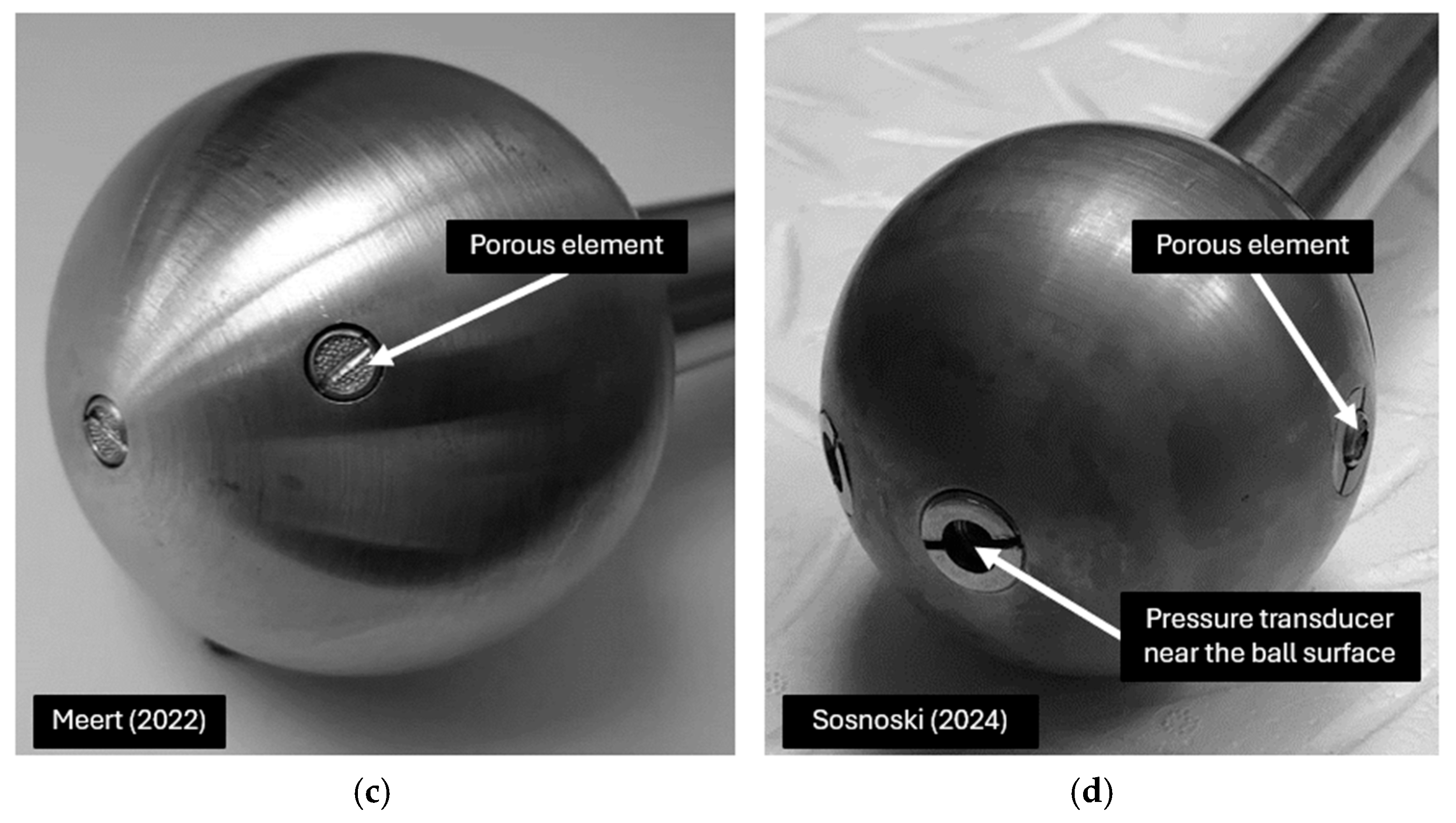
Figure 2 presents an overview of the piezoball device, which has a diameter of 80 mm, corresponding to a cross-sectional area of 50 cm2, and an area ratio (Ap/As) of 7:1. Meaning the probe’s cross-sectional area is about seven times the rod’s area. The probe is equipped with three pore pressure transducers positioned at the tip (u1), the mid-face (u2 = 45°), and along the equator of the sphere (u3 = 90°), as illustrated in Figure 2a.
The figure also shows a comparison between the initial design of the porous elements and the adapted configuration implemented to reposition the pore pressure transducers, minimizing the distance between the sensors and the porous elements. To position the transducer closer to the probe surface, as illustrated in Figure 2b, a new porous element design was required since, in the original configuration, the filter was directly fixed to the spherical face. The adopted solution consisted of designing a hollow threaded bushing, with both external and internal threads, made of the same material used for the penetrometers (martensitic stainless steel VC150). The external thread ensures attachment to the probe surface (either the sphere or the bar), whereas the internal thread allows the insertion of the porous element.

3.2. General Overview of the Piezo-T

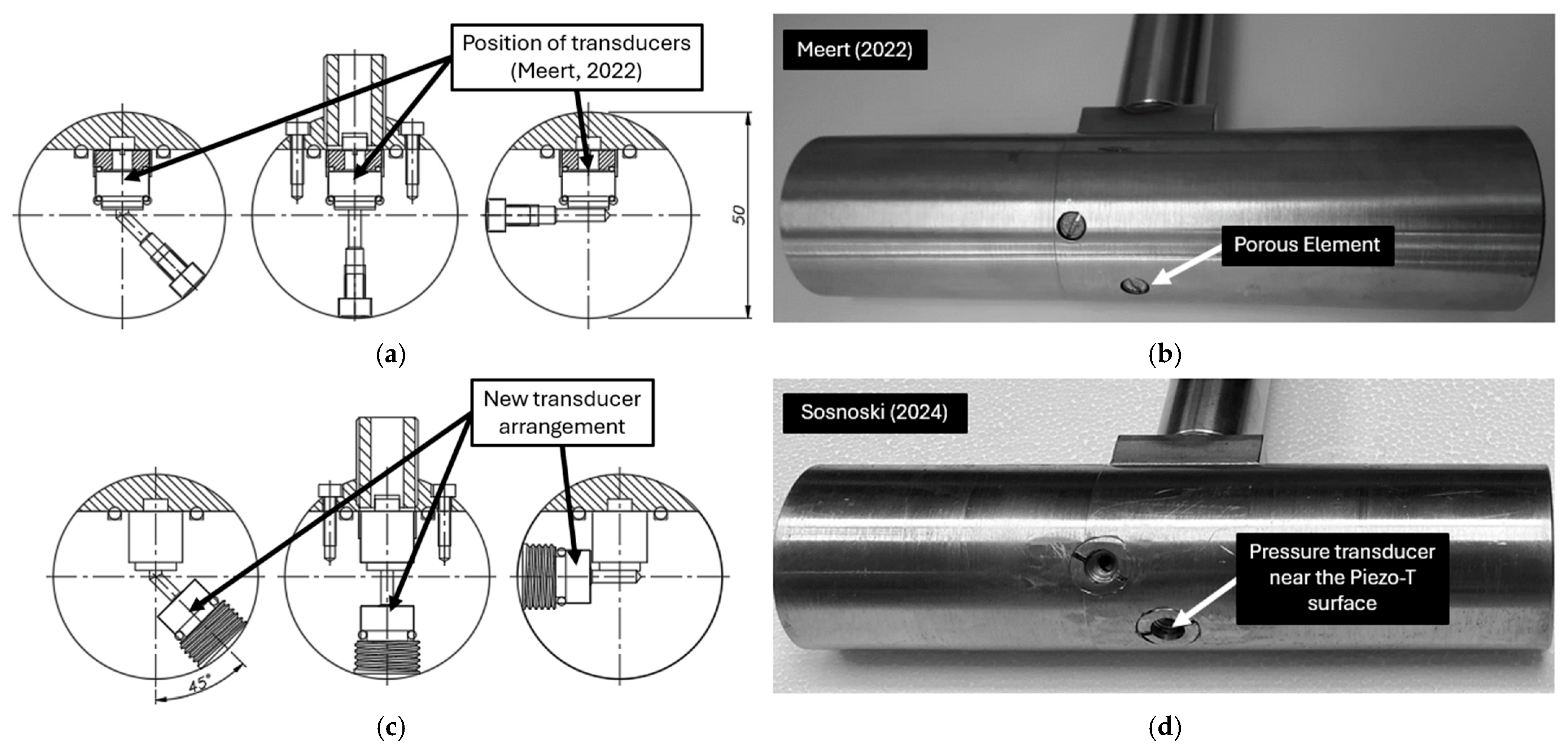
The piezo-T device has a total length of 200 mm and a diameter of 50 mm, resulting in a projected area of 100 cm2. Considering a shaft area of 7 cm2, the corresponding area ratio (Ap/As) is 14:1, meaning the probe’s cross-sectional area is about fourteen times the rod’s area. Like the piezoball, the piezo-T probe is equipped with three pore pressure transducers located at the tip (u1), at the mid-face (u2 = 45°), and along the equator (u3 = 90°), as well as a system for recording both penetration and extraction resistance.
Figure 3a illustrates the initial piezo-T design proposed by Meert [33], showing the internal arrangement of the pore pressure transducers within the bar. Figure 3b presents the modified configuration developed for the present study.
The penetration and extraction forces are measured by a load cell positioned immediately behind the probe, which is equipped with four strain gauges and protected by an O-ring sealing system.

3.3. Machining Processes, Calibration, and Reading Control

In general, this section presents relevant aspects of the probe manufacturing process, calibration, and reading control. A complete description of the procedures can be found in Sosnoski [34].
The penetrometer probes were machined from martensitic stainless steel (VC-150), containing approximately 0.35% carbon and 13% chromium, and subjected to heat treatment after machining to eliminate residual stress. The process included quenching at temperatures between 980 °C and 1040 °C, followed by tempering. The load cells were tempered at 580 °C, aiming for a mechanical strength on the order of 1 kN/mm2 and a hardness of approximately 330 Brinell, ensuring elastic behavior during testing. The load cell, responsible for measuring penetration and extraction resistance, consists of four electrical strain gauges (PA-06-125TG-350-LEN) configured in a full Wheatstone bridge, positioned immediately behind the probes and protected by an O-ring sealing system. Pore pressure measurements are performed by ASHCROFT transducers (model K8 3000 MV F1 500#) with a capacity of 3000 kPa, with a porous stone serving as the interface between the soil and the sensor.
The load cells (strain gauges) and pore pressure transducers used in the piezoball and piezo-T equipment were individually calibrated before the field campaigns, following ASTM D5778 [35] principles and the procedures described in Sosnoski [34]. Calibration covered the entire operating range of the sensors, verifying linearity, repeatability, and zero offset.
The load cells were calibrated in the laboratory using incremental static loading, with offset verification before and after calibration and at the end of the campaigns; no significant drift was observed. The pore pressure transducers were calibrated across their entire pressure range, with prior offset verification. Saturation of the pore pressure sensors was performed prior to testing, following a controlled procedure described in Sosnoski [34], including the saturation of porous elements with a viscous fluid (typically silicone oil). The saturation condition was verified via the pore pressure response during penetration and dissipation tests, with special attention to the u1 position. During testing, pore pressure records were continuously monitored; data showing loss of response or inconsistent behavior were flagged and excluded from interpretation. Only measurements with stable and physically coherent responses were considered in the analysis.

3.4. Site Characterization

3.4.1. Tubarão/SC

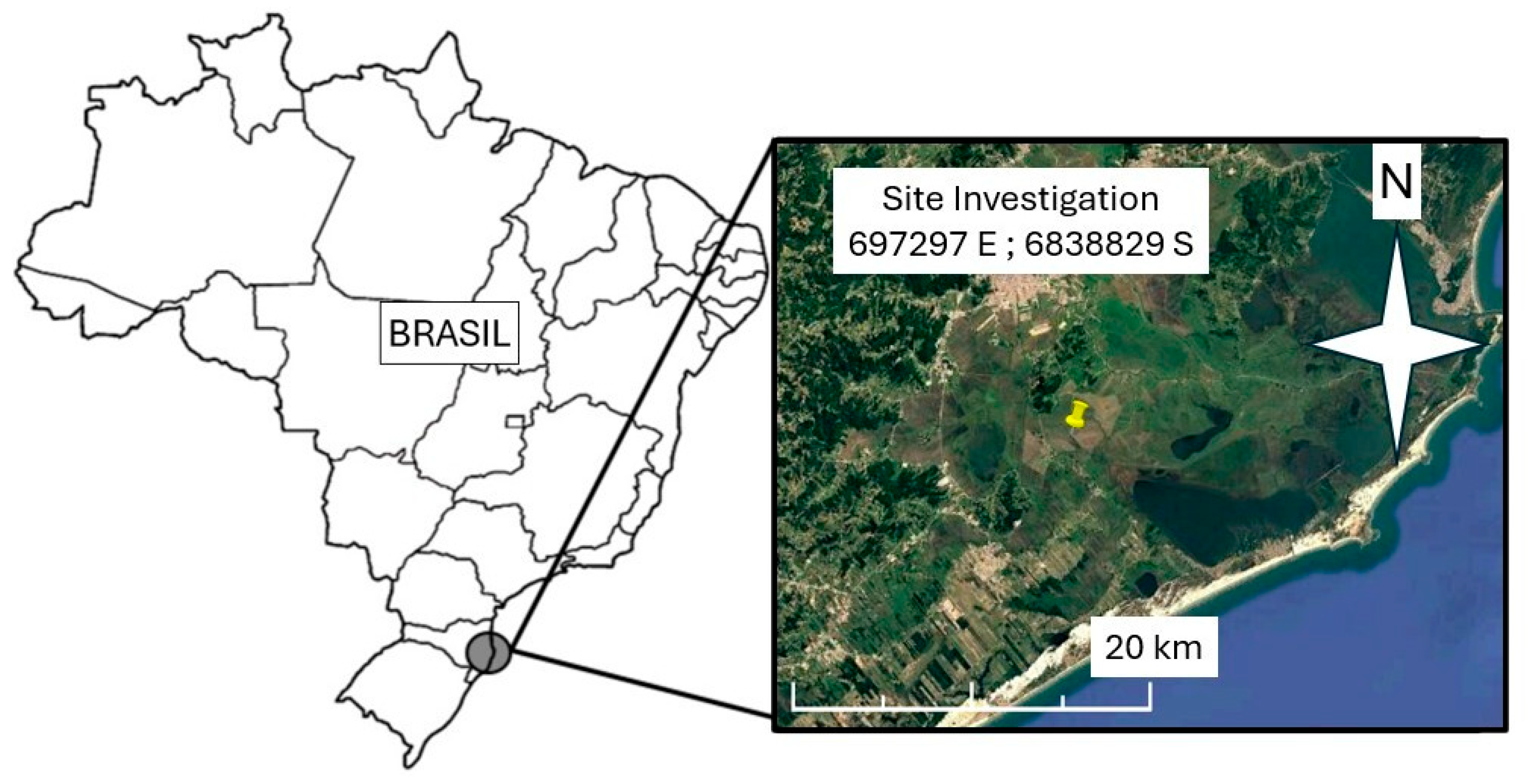
This study presents a series of tests conducted at the experimental field site located in Tubarão, Santa Catarina State, in the southern region of Brazil (Figure 4). The sedimentary deposit has a Quaternary formation and is part of a complex depositional system along the mid-south coast of Santa Catarina State, as highlighted by Carvalho do Amaral et al. [36]. This system is characterized by a mosaic of interdependent eolian, lagoonal, and marine processes. These marine-lacustrine environmental conditions have led to the development of normally consolidated lightly overconsolidated soft soils, which exhibit high water content, some organic matter, high compressibility, and low shear strength properties [21,37].
The geological formation processes of the lagoon system have been described in detail by several authors, including Giannini et al. [38,39] and Carvalho do Amaral et al. [36], among others. With respect to geotechnical site investigation data, notable studies include those by Mantaras et al. [40], Schnaid et al. [41], Odebrecht and Schnaid [21], and, more recently, Meert [33] and Sosnoski [34]. In general, the typical soil profiles in the area are characterized by superficial sand-silty layers overlying approximately 20 m thick, very soft, essentially normally consolidated clay deposits [21]. Field investigations at the site have included piezocone tests, vane shear tests (FVT), Marchetti dilatometer tests, and laboratory characterization tests [21,40,41].
A representative local soil profile obtained from piezocone and vane shear tests conducted by Sosnoski [34] is shown in Figure 5. The CPTu test presented in the Figure was performed at the standard rate of 20 mm/s [27,35], and the FVT tests followed ASTM D2573 [42] recommendations, with a rotation speed of 6°/min. Piezocone dissipation tests were performed at 5 distinct depths, with sufficient time to achieve at least 50% dissipation of the generated excess pore pressure. The campaign also included sample collection for characterization, consolidation, and triaxial tests. Undisturbed samples were collected using a 4” Shelby tube sampler, following normative prescriptions (ABNT NBR 9820, 1997 [43] and ASTM D1587/D1587M, 2015 [44]).
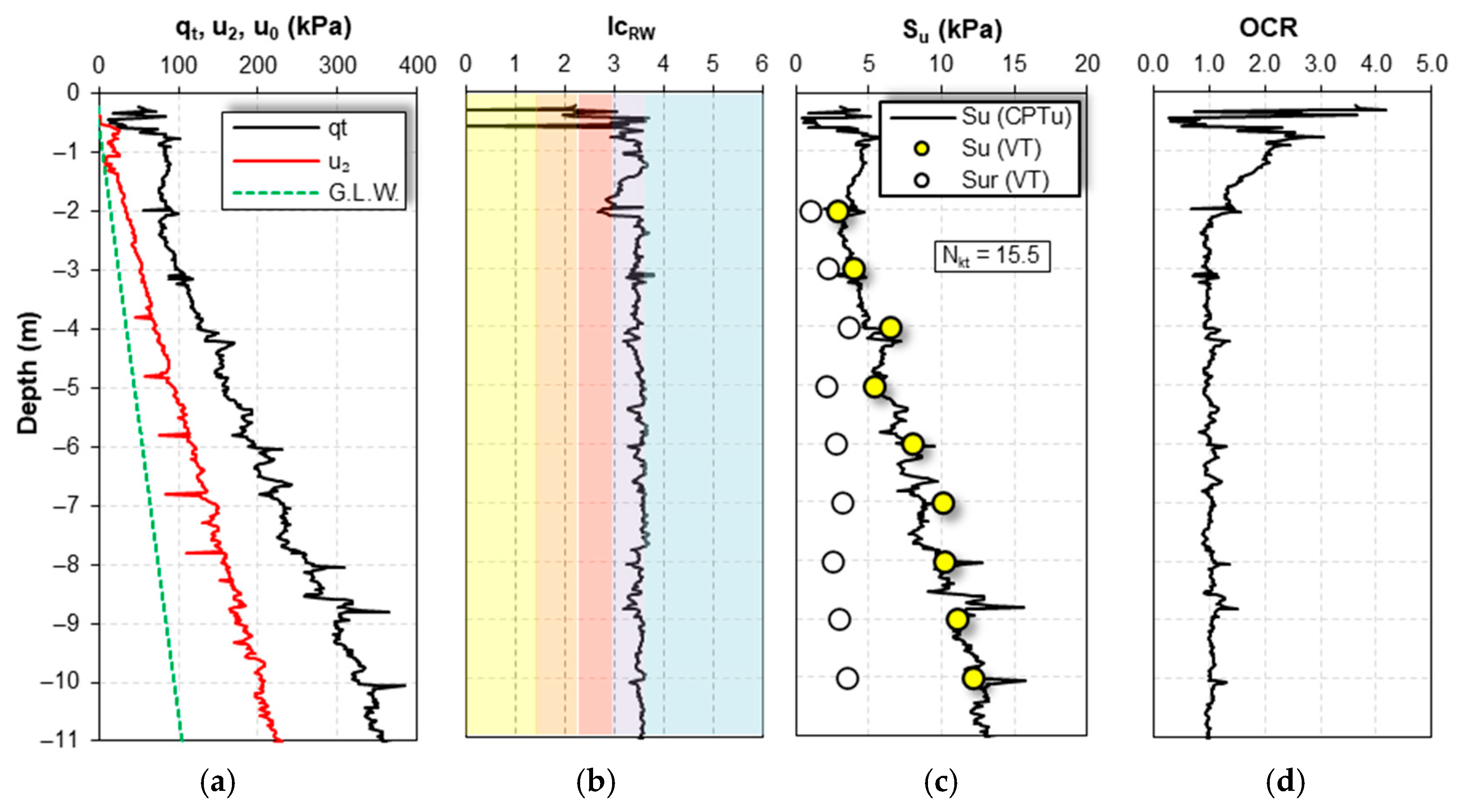
Piezocone (CPTu) and field vane test (FVT) results are presented in Figure 5, comprising tip resistance (qt), pore pressure (u2), the soil behavior type index (ICrw) according to Robertson & Wride [45], undrained (Su) and remolded (Sur) shear strength profiles, and the interpretation of the overconsolidation ratio (OCR). Equations (5)–(7) were used to derive the aforementioned parameters presented in the Figure 5.
I c r w = [ 3.47 l o g ( Q t n ) ] 2 + [ 1.22 + log ( F r ) ] 2 ,   with   Q t n = ( q t σ v 0 σ a t m ) . ( σ a t m σ v 0 ) n , and   F r = ( f s q t σ v 0 ) ,
S u = ( q t σ v 0 N k t ) ,
O C R = k ( q t σ v ) σ v o
where qt is the total penetration resistance, σv0 is the total vertical stress, σ′v0 is the effective vertical stress, σatm is the atmospheric pressure, n and k are correction coefficients, fs is the friction sleave, and N k t is the piezocone bearing capacity factor. n = 1 and k = 0.3 were considered in the present study.
Observing Figure 5, it is verified that the local soil exhibited typical clay behavior, with low tip resistance (qt ranging from 10 to 400 kPa) and significant excess pore pressure generation (u2 from 0 to 230 kPa). The ICrw values fall near 3.6, corresponding to clay and organic clay, as proposed by Robertson & Wride [45].
The undrained shear strength (Su) from FVT increases with depth from approximately 3 to 12 kPa. These values were used to define a cone factor NKt of 15.5, which was adopted to estimate the Su profile shown in Figure 5. The results are consistent with the typical profile reported by Odebrecht and Schnaid [21], with the main difference being that the Sosnoski [34] campaign indicates a thinner layer of younger surficial soils (approximately 2 m). This upper layer corresponds to the AC (active channel) and IF (interchannel fines) formations, described as sandy and clayey thin layers or lenses with occasional shells (see reference [21]). Below this shallow layer, the profile transitions into the older depositional unit characterized by an OCR close to unity (Figure 5d).
Figure 5. The Tubarão/SC test site (a) CPTu tip resistance qt, pore pressure u2 and hydrostatic pore pressure uequil; (b) soil index (ICrw) behavior from Robertson & Wride [34], where each color-coded region represents an expected soil behavior; (c) undrained shear strength Su; (d) overconsolidation ratio OCR—adapted from Sosnoski et al. [46].
Geotechnics 06 00024 g005
Laboratory tests conducted by Sosnoski [34] on samples collected from the profile indicate fine, clay–silty materials (29–45% clay; 38–44% silt; 11–33% sand), with specific gravities ranging from 2.69 to 2.78 g/cm3 and high plasticity indices (plasticity indices (PIs) between 26.5% and 38%). Oedometer tests revealed high initial void ratios, ranging from 2.604 to 3.620; compression indices Cc between 1.13 and 2.73; recompression indices Cr from 0.10 to 0.55; and vertical consolidation coefficients varying from 1.12 × 10⁻⁴ to 3.77 × 10⁻² cm2/s. Although, these values are comparable to those reported by Odebrecht and Schnaid [21], a quality assessment of the samples based on the criteria proposed by Lunne et al. [47] and Coutinho [48] showed low sample quality, especially for the deeper samples. In this sense, the set of results was analyzed with caution, and preference was given to comparisons prioritizing field tests.

3.4.2. Sarapuí/RJ

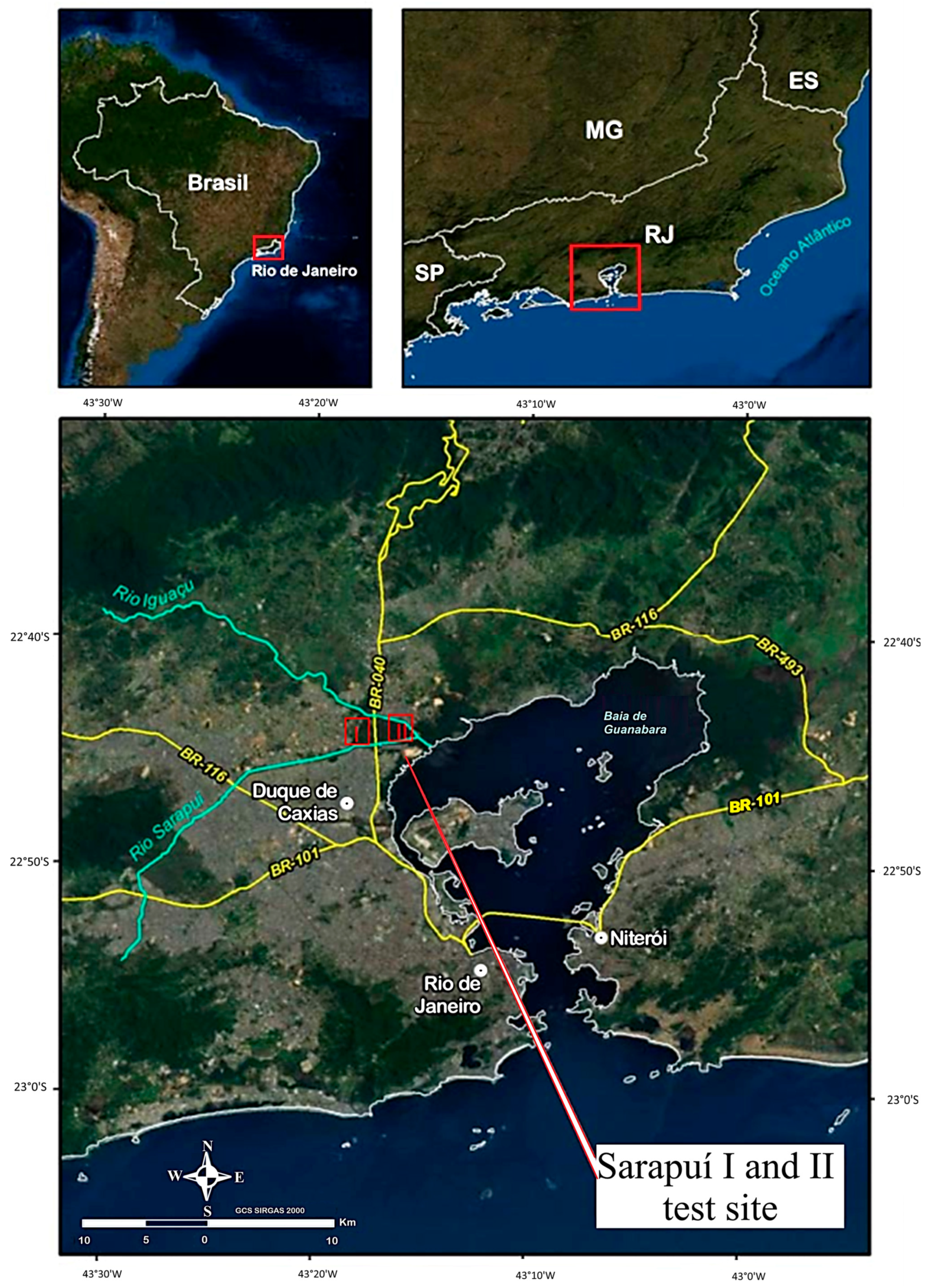
The Sarapuí II test site is situated on the left bank of the Sarapuí River and is approximately 7 km from Rio de Janeiro city. The test site was established at the beginning of the 20th century, after deactivating the Sarapuí I test site (1.5 km from Sarapuí II, on the same riverbank), which was set up in the mid-1970s, after a significant number of studies, e.g., [49,50]. Sarapuí I was the first geotechnical test site established in Brazil [51]. The Sarapuí II test site has been extensively studied over the past 20 years. According to Jannuzzi [52], the site hosts two major research programs focused on pile behavior [51,53,54,55]. In 2008, PETROBRAS/CENPES established a partnership with COPPE/UFRJ to develop new testing equipment for offshore applications. To date, several in situ tests, undisturbed sampling, laboratory tests and large joint research projects, such as Petrobras-UFRJ, have been carried out at the Sarapuí II test site, e.g., [22,56,57,58,59] (Figure 6).
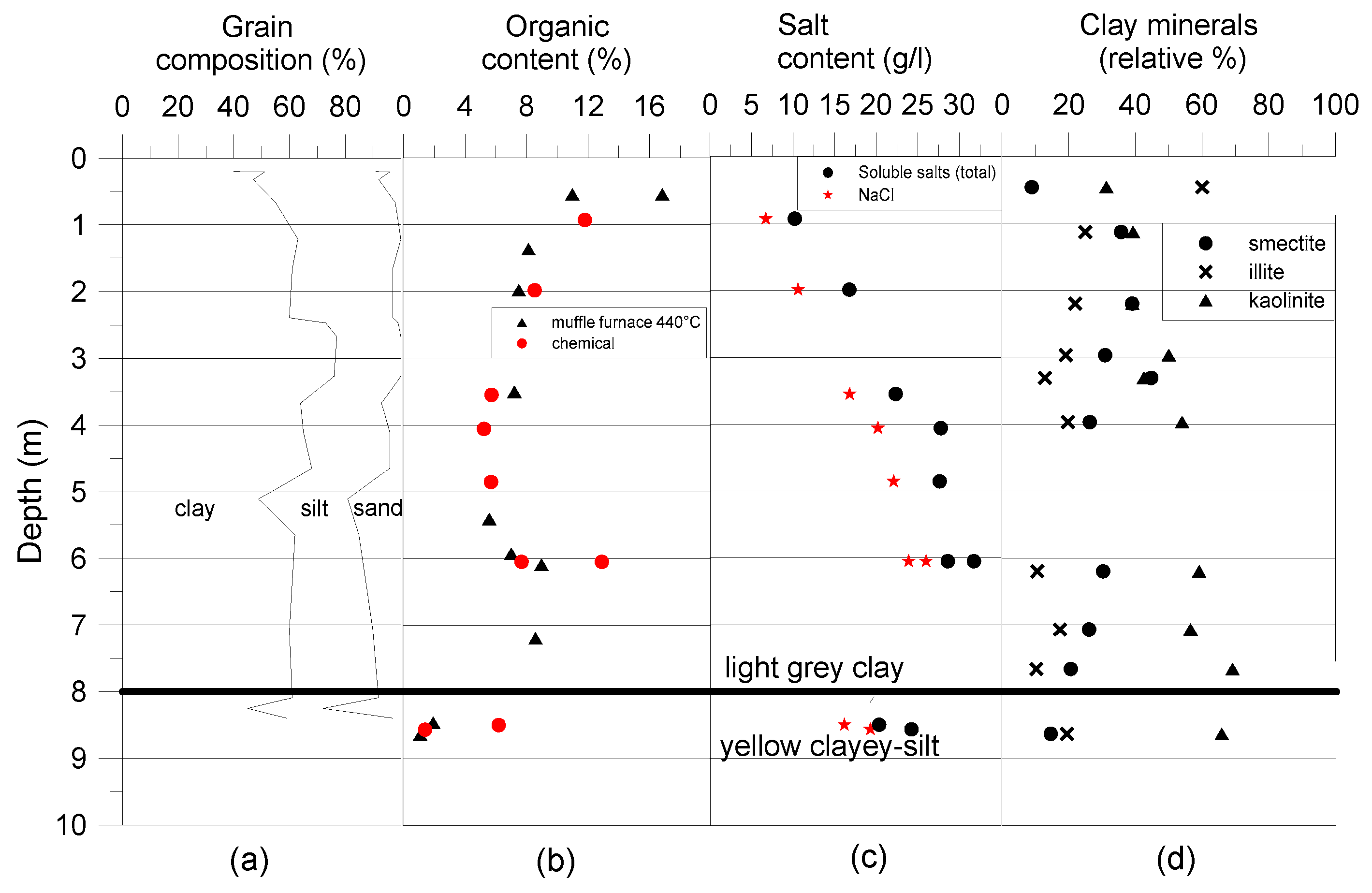
The set of Figure 7, Figure 8 and Figure 9 presents a compilation of results already discussed in the literature regarding the characteristics of the local soil in Sarapuí/RJ. The presented results were obtained from field tests and laboratory tests performed on undisturbed samples, following classic geotechnical characterization procedures for soft soils. Data interpretation and parameter derivation were based on established formulations in the literature, considering the hypotheses associated with each test method. It is noteworthy that the complete description of the sampling methodology, test execution, and interpretation criteria is detailed in the original works associated with the Figure 7, Figure 8 and Figure 9.
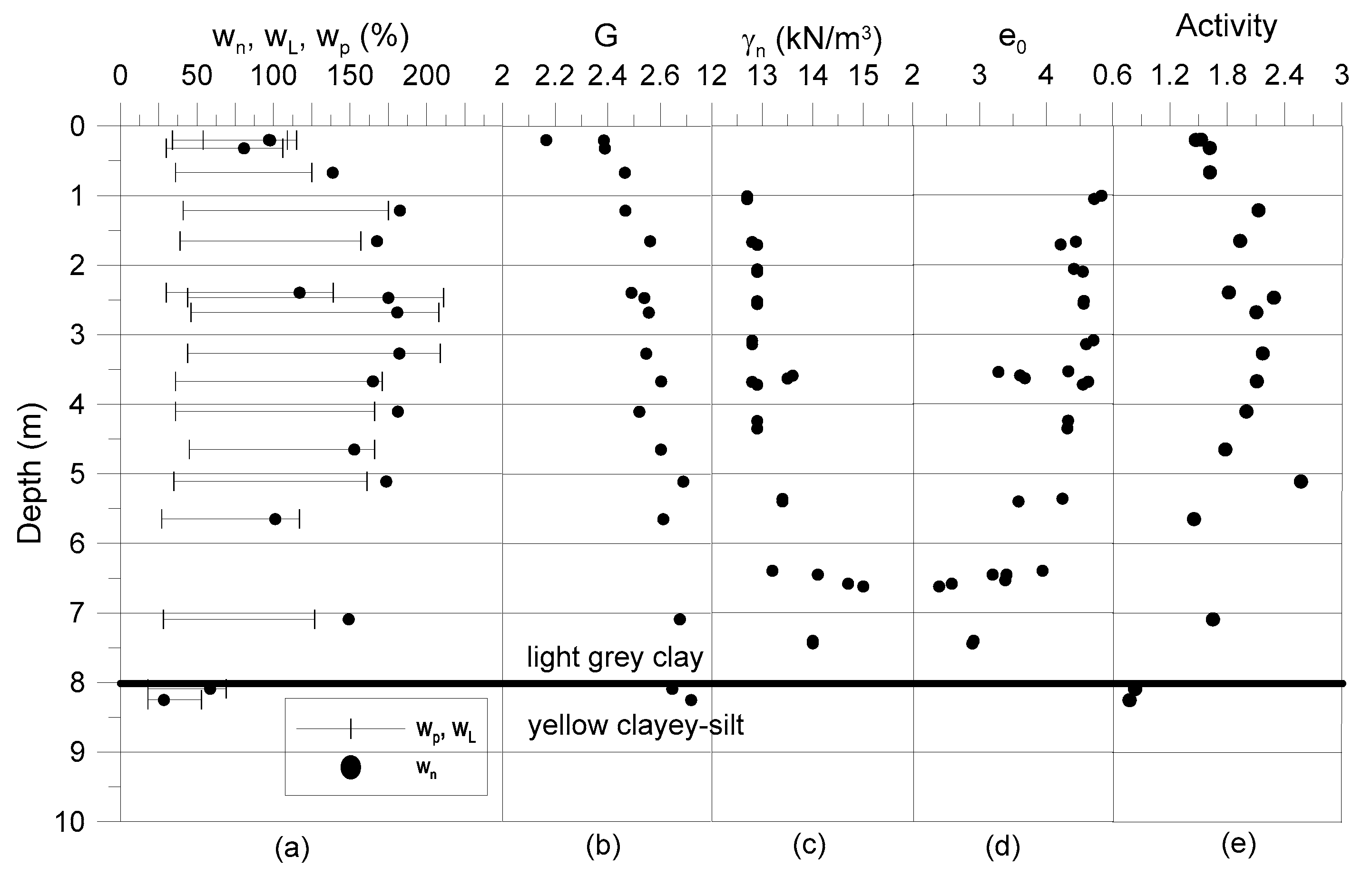
The thickness of the very soft soil in the test site area ranges from 6.5 m to 10 m. An underlying layer of yellow clayey silt has also been characterized. This very soft soil formed in the Holocene and overlies Pleistocene yellow silty clay [58]. The soil is silty clay, with 60% clay, 35–40% silt and 0–5% sand on average. The organic content decreases with depth, from 12 to 16% to 6%. NaCl is predominant with respect to other soluble salts, and the total soluble salt content increases from 10 g/L at 1 m depth to 30 g/L at 6 m depth. Kaolinite and smectite are the predominant clay minerals until 4 m. After 4 m, kaolinite is the predominant clay mineral, with smaller fractions of ilite and smectite [22,58] (Figure 7).
Figure 8 shows that the plasticity index (PI) is very high, in the range of 60–170%. The specific gravity (G) increases approximately linearly with depth, in the range of 2.20–2.65, except for the zone near the surface, which is affected by the roots. The total unit weight (γn) is reasonably constant to approximately 4.5 m depth, with an average value of 13 kN/m3, increasing linearly with depth to the bottom of the clay layer, reaching approximately 15 kN/m3. The natural void ratio (e0) is reasonably constant to approximately 4.5 m depth, with an average value of 4.5. Then, it decreases linearly with depth, reaching 2.4 at 8 m depth. Soft clay is classified as active, with an average activity of 1.8, according to the classification of Skempton [22,60].
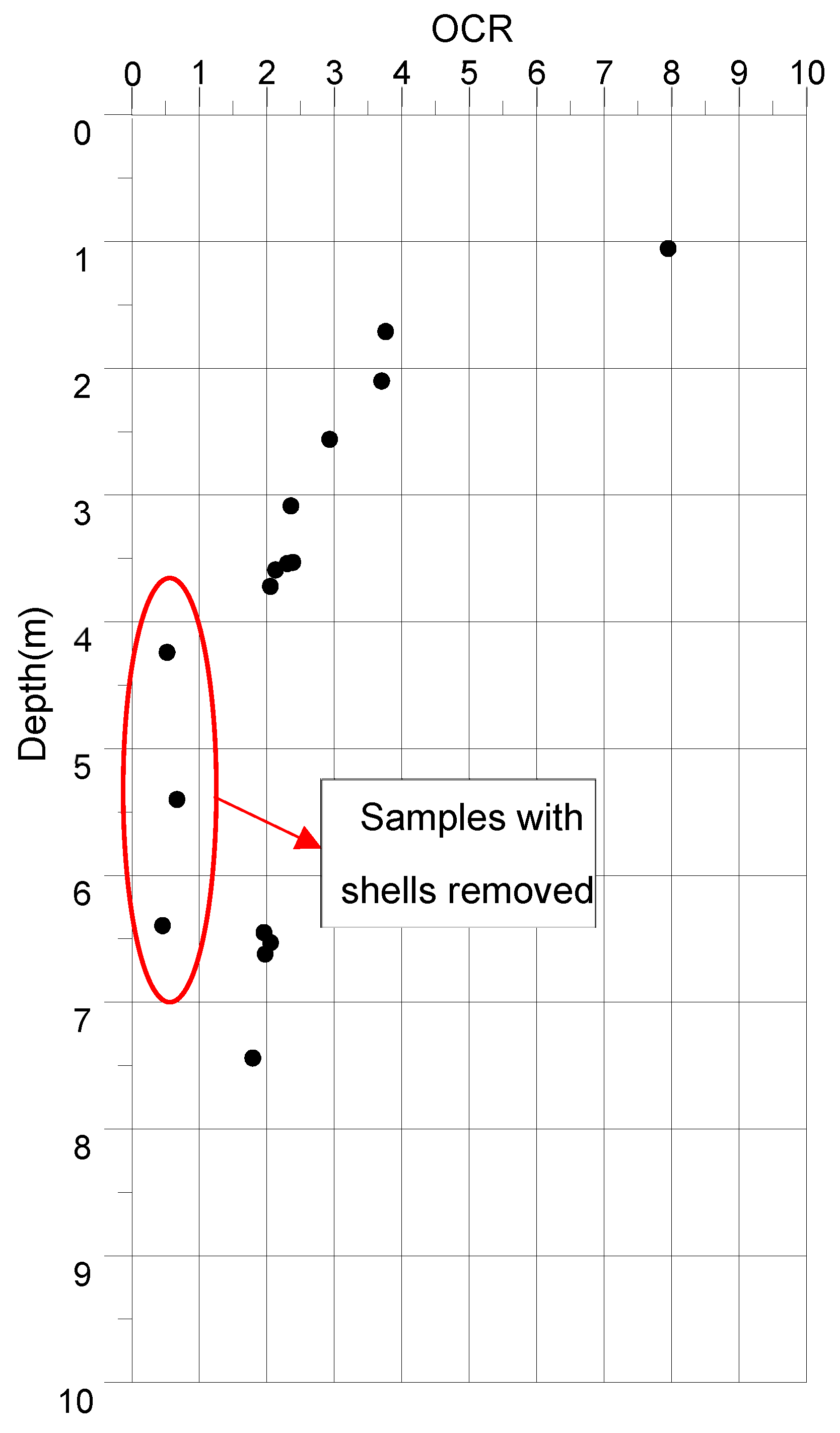
The overconsolidation (OCR) profile, obtained from 24 h incremental loading (IL) testing, is shown in Figure 9. There was a significant decrease in the OCR from 1 m depth (OCR = 8) to 3 m depth (OCR = 2), and constant values were observed until the bottom of the layer. The values between 4.0 m and 6.5 m are not representative because of the presence of shells. The overconsolidation of the deposit, excluding the top 2.5 m, could be attributed to secondary consolidation [58].
Dating samples throughout the very soft organic clay profile provided values between 8590 and 2300 cal. yr BP. The average rate of deposition is 0.9 mm/yr. The very soft clay overlies yellow clayey silt soil of Pleistocene origin (12,630–12,240 cal. yr BP).
The horizontal soil permeability, kh, in situ was measured by Vargas et al. [59] with a BAT probe. kh is greater than 2 × 10⁻⁹ m/s at a depth of 1 m and decreases to approximately 6 × 10⁻¹⁰ m/s at a depth of 6 m.

3.5. Testing Program

3.5.1. Tubarão/SC

Two piezoball tests, referred to as Piezoball-A and Piezoball-B, and one piezo-T test were performed in the vicinity of a set of conventional tests, approximately 1.5 m apart. For convenience, throughout this paper, the term “conventional tests” refers collectively to piezocone penetration tests (CPTu), vane shear tests (FVT), and the collection of undisturbed samples for laboratory characterization, consolidation, and triaxial testing. The results of the laboratory program are briefly presented in Section 3.4.1, together with the derived soil profile obtained from the CPTu and FVT.
Considering the penetrometer piezoball and piezo-T tests the procedures adopted of testing are similar to those used for CPTu. Accordingly, the same reaction system and rod assembly employed in CPTu testing were used, and a standard penetration rate of 20 ± 5 mm/s was adopted, with data acquisition at each second. The data acquisition comprises the forces required for penetration (qm) and pore pressure readings at different locations (u1, u2, and u3). The measured penetration resistance may subsequently be corrected to obtain the net penetration resistance (qnet), as defined in Equation (1).
In cyclic penetration tests, the adopted cycling procedure consisted of repeated insertion and extraction of the probe over minimum up-and-down distances of at least 0.15 m, or three times the ball diameter, whichever was greater. In this study, a cycle length of 0.40 m was adopted, at a nominal rate of 20 ± 5 mm/s. The degradation during cyclic was monitored through the determination of the remolded penetration resistance (qrem), defined as the average of the penetration insertion resistance (qin) and extraction resistance (qext). A minimum of ten cycles was adopted in all tests. In cases where stabilization was not achieved within ten cycles, the cyclic loading continued until stabilization was observed. The number of cycles required to reach stabilization is reported in Table 3.
The main distinction between tests Piezoball-A and Piezoball-B lies in the dissipation stage: while Piezoball-A included only cyclic loading at target depths, Piezoball-B incorporated dissipation tests prior to cycling. In the Piezoball-B test, dissipation measurements were initiated after penetration to the target depth. To ensure the stability of the pore pressure readings, the pushing system was anchored to the ground surface during the test. Pore pressure responses at the tip (u1), mid-face (u2), and equator (u3) were monitored until at least 70% dissipation was achieved.
For the piezo-T test, penetration was performed at the standard rate of 20 mm/s, with cyclic loading executed at the same depths as those used for the piezoball tests. However, no dissipation tests were conducted, and owing to logistical constraints, only a single piezo-T profile was obtained.
Table 3 summarizes the main characteristics of the piezoball (Piezoball-A and Piezoball-B) and Piezo-T tests carried out at the Tubarão site, including the testing depths, number of cycles, and dissipation times for test Piezoball-B.

3.5.2. Sarapuí/RJ

In the Sarapuí II experimental field, located in Duque de Caxias, Rio de Janeiro, a testing program comprising both piezoball and piezo-T penetration tests, as well as a set of conventional tests, was conducted. The procedures adopted for the conventional tests followed the same methodological framework used in the Tubarão/SC campaign. Although, for this specific site no undisturbed samples were collected. In this case, the extensive data available in the literature and briefly presented in previous section (Section 3.4.2) were considered representative.
Three piezoball tests were performed, identified as Piezoball-A, Piezoball-B, and Piezoball-C, with the following configurations: Piezoball-A—penetration and extraction without cyclic loading; Piezoball-B—penetration followed by dissipation tests at predetermined depths and subsequent cyclic loading; Piezoball-C—penetration and cyclic loading without dissipation tests.
All piezoball tests presented in the present paper were executed at a constant penetration rate of 20 mm/s. For tests involving dissipation measurements, the rod system was anchored to the surface to ensure stability during pore pressure readings.
For the piezo-T tests, two profiles were performed. In Piezo-T-A, the probe was penetrated and extracted without cyclic loading. In Piezo-T-B, penetration was followed by cyclic loading at predefined depths. Unfortunately, due to technical issues with pore pressure transducers, reliable pore pressure data were not recorded during the piezo-T tests.
Table 4 summarizes the main characteristics of the piezoball (Piezoball-A, Piezoball-B, and Piezoball-C) and piezo-T (Piezo-T-A and Piezo-T-B) tests conducted at the Sarapuí site, including testing depths, number of cycles, and dissipation times for test Piezoball-B.

4. Results and Discussion

4.1. Soil Behavior Profile with Depth

4.1.1. Tubarão/SC

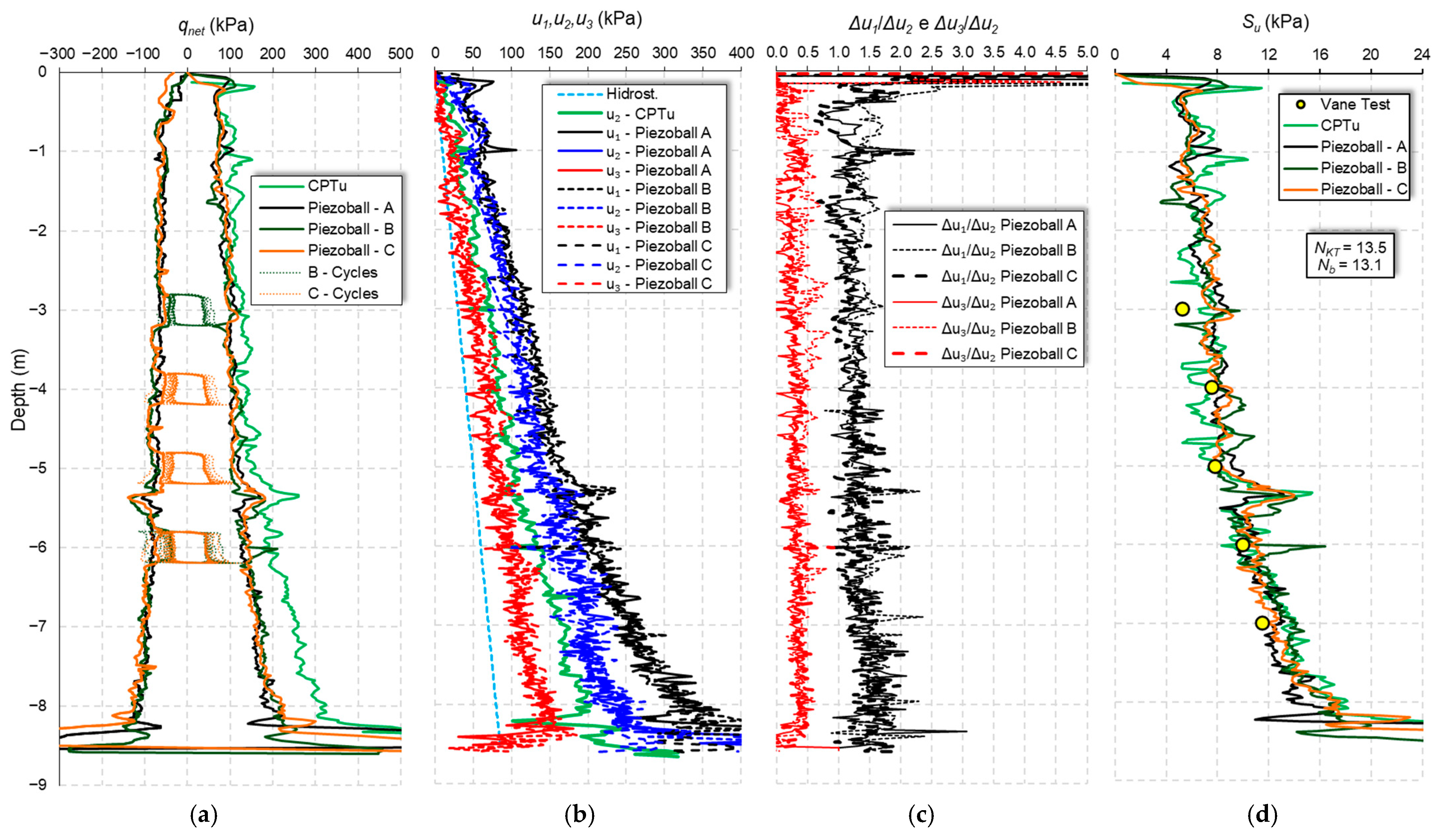
Figure 10 and Figure 11 present the characteristic penetration resistance (qnet) and pore pressure (u) at different sensor positions and the undrained shear strength (Su) obtained from the field tests performed at the Tubarão Experimental Site (SC, Brazil). For comparison purposes, the response obtained from the CPTu test is also shown in the figures.
Figure 10 shows the penetration resistance profiles (qnet) for the piezoball tests Piezoball-A and Piezoball-B, which are in good agreement with each other. Compared with those in the CPTu test, the penetration resistances measured using the penetrometer probes are lower, which is consistent with observations reported by previous authors [31]. The generated pore pressures also exhibited good consistency, with the highest values recorded at position u1, followed by those recorded at positions u2 and u3.
Figure 10c shows the relationship between the excess pore pressures measured at the tip (Δu1) and at the equator (Δu3) of Piezoball, normalized by the excess pore pressure measured at the midface (Δu2). Except for the uppermost two meters, the Δu1u2 ratios ranged between 1.3 and 1.8 for tests A and B, respectively. The Δu3u2 ratios remained at approximately 0.5 for both tests. These results are consistent with those reported by Colreavy et al. [9,13] for normally consolidated clays, where the average values were approximately 0.5 for Δu3u2 and between 1.3 and 1.7 for Δu1u2.
With respect to the undrained shear strength (Su), Figure 10d compares the results obtained from the vane shear test, the CPTu, and the piezoball tests (Piezoball-A and Piezoball-B). Good agreement between the profiles was observed when a mean bearing factor (Nb) of 12.98 was adopted. The adopted Nb value was determined on the basis of the sensitivity (ST) measured via the vane test (Equation (3)) and was found to be consistent with the range of values reported in the literature [11,27]. For the CPTu test, a bearing factor Nkt of 15.5 was also determined directly from the Su measured in the vane test.
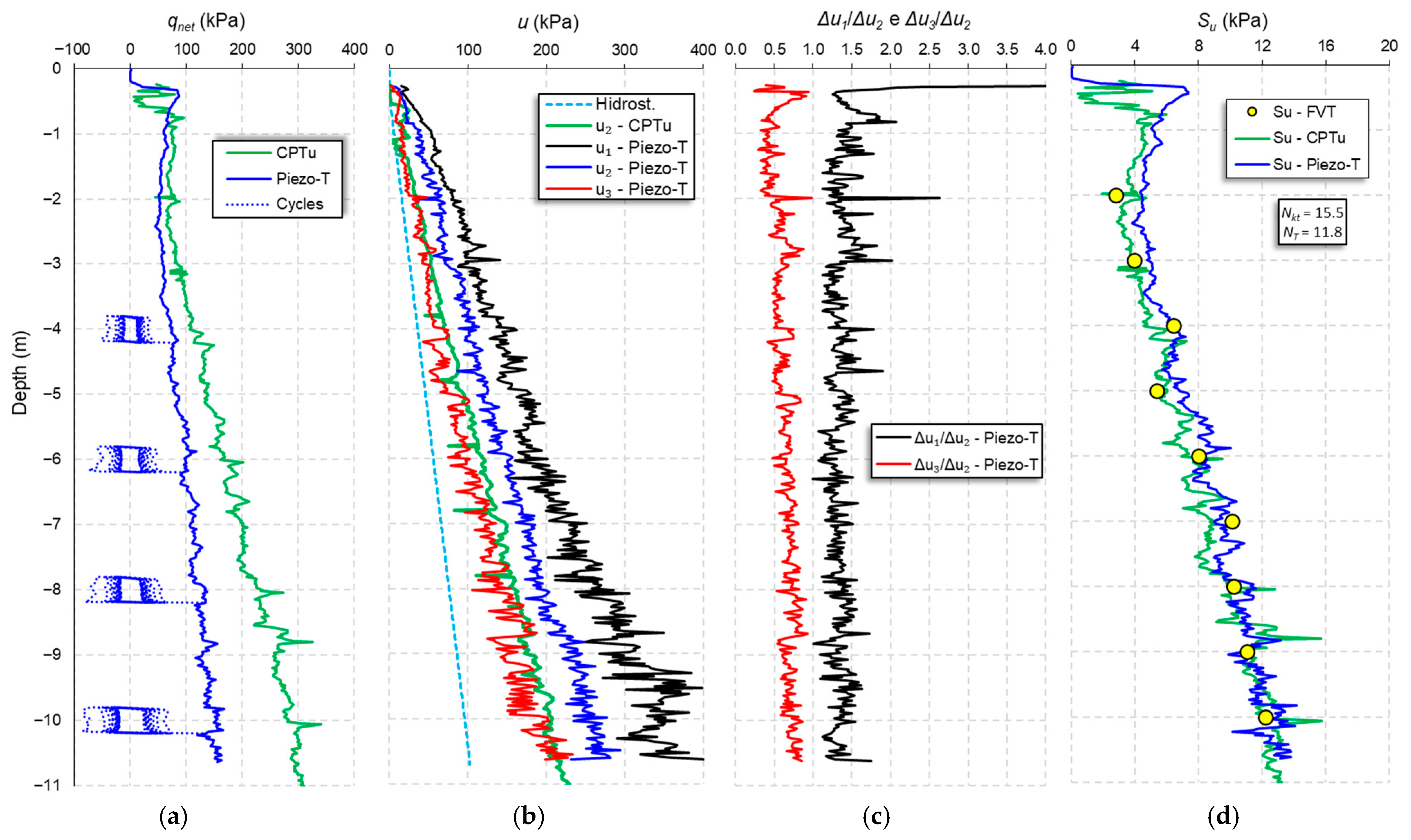
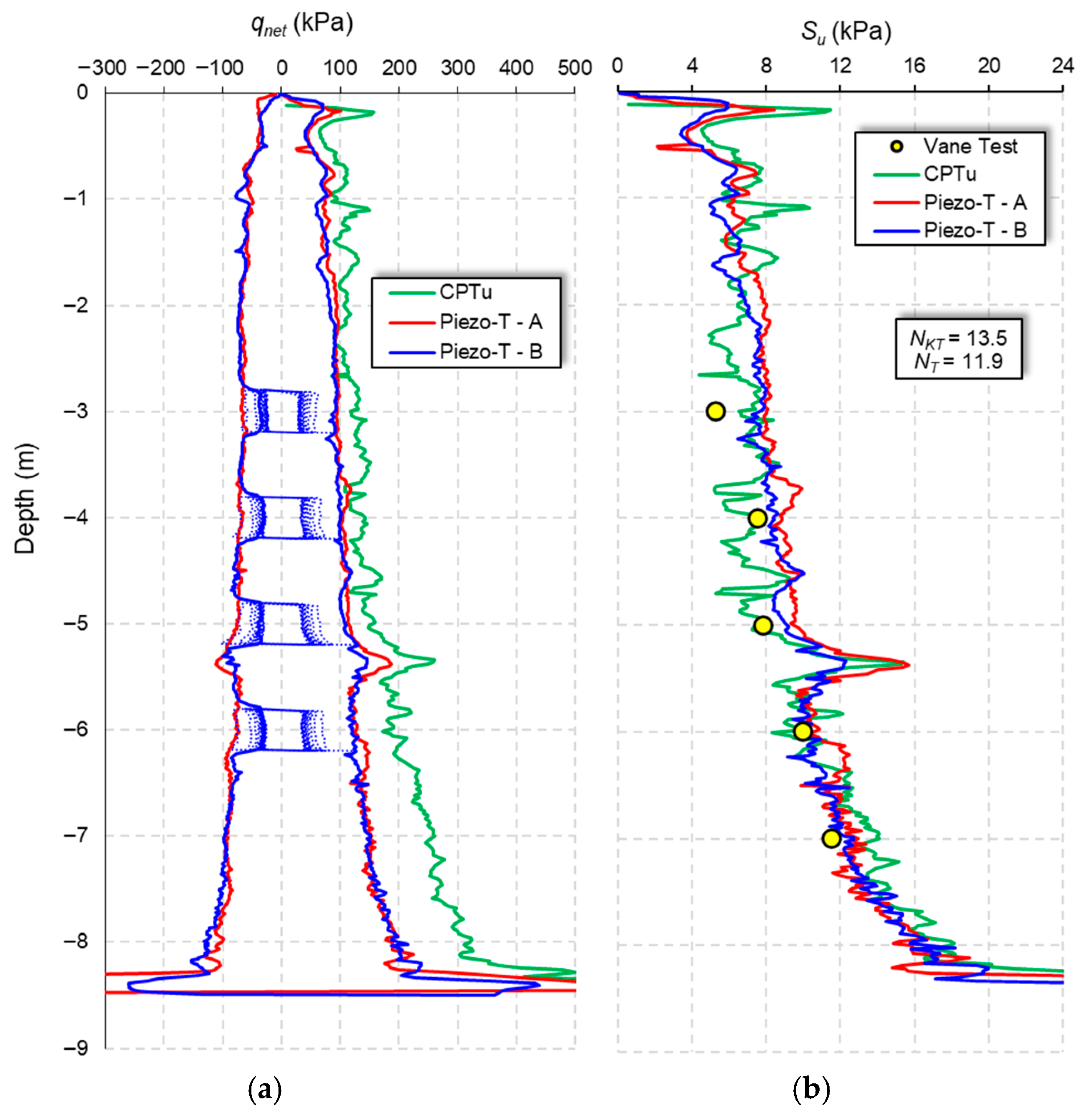
Figure 11 presents the profiles obtained from the Piezo-T and CPTu tests for comparative purposes. The pore pressure measurements recorded at the three transducers are shown, along with the corresponding mid-face readings (u2) from the CPTu for reference.
As shown in Figure 11a, the penetration resistances measured with Piezo-T were generally lower than the qnet values obtained from the CPTu. The excess pore pressures recorded (Figure 11b) at the base of the cone were similar, although slightly lower, than the mid-face measurements (u2) of Piezo-T throughout the depth profile. The pore pressures measured at the tip (u1) were consistently higher than those at the other positions, corroborating the results observed in the piezoball tests.
Figure 11c presents the relationships between the excess pore pressures measured at the tip (Δu1) and at the equator (Δu3) with respect to the mid-face (Δu2). The Δu1/Δu2 ratios ranged between 1.2 and 1.7 with depth, showing a slight decrease below approximately 6.0 m. The Δu3/Δu2 ratios averaged approximately 0.62, with a slight increase also observed above 6.0 m. These values are consistent with those obtained from the Piezoball tests discussed previously.
In terms of mobilized resistance, a mean bearing factor (NT) of 11.8 was used to calculate Su, which is in good agreement with the range of values reported in previous studies involving the Piezo-T test, e.g., [61,62].
Furthermore, it is worth highlighting that the differences observed between the results presented in Figure 10 and Figure 11 do not indicate methodological inconsistencies, but reflect characteristics inherent to the different soil–probe interaction mechanisms, as well as the natural variability of the deposit. It is emphasized that the compared results involve equipment with distinct geometries (piezoball, T-Bar, and CPTu), which mobilize different stress fields in the soil. In particular, resistance values obtained with full-flow penetrometers are not directly equivalent to cone resistance values, as the CPTu does not achieve a full-flow regime, whereas bar and ball tests are designed precisely for this mechanism. Thus, small differences between resistance profiles are expected and are widely documented in the literature [9,27]. Although no corrections for temperature effects were applied to the data in this study, Colreavy et al. [9] reported that temperature-related corrections of up to 50% may be required for cone resistance ( q c ) measured in CPTu tests, whereas negligible effects (typically less than 3%) were observed for T-bar and ball penetrometer tests, which could partially explain and potentially reduce the discrepancies observed between the resistance measurements. Additionally, local discrepancies can be attributed to stratigraphic soil heterogeneity, typical of natural deposits, as well as scale effects and spatial positioning of the tests, even when performed in close proximity. Nevertheless, it is emphasized that the general trend with depth, as well as the ranges of values obtained, prove to be consistent across the different methods. An analysis of the variability of the basic statistical parameters is presented in Table 5.
Table 5 presents a compilation of vane shear test strengths and the derived parameters ST, Nb, Nb-rem, NT, and NT-rem for the Tubarão/SC site. The table also reports the mean values of these parameters and generally highlights their low variability, as indicated by standard deviations (STD) of approximately 0.15 for Nb and NT, and higher values ranging from 0.28 to 0.49 for the remolded parameters Nb-rem and NT-rem, respectively. The variability of the bearing capacity factors can also be evaluated by the coefficient of variation (COV), which ranged from 1.13% to 1.19%, Nb and NT, respectively. In contrast, the variability of Nkt, based on data from Sosnoski [34], shows a COV of 14.06%, indicating a wider distribution of the coefficients obtained for the piezocone test, as previously stated by DeJong et al. [11].

4.1.2. Sarapuí/RJ

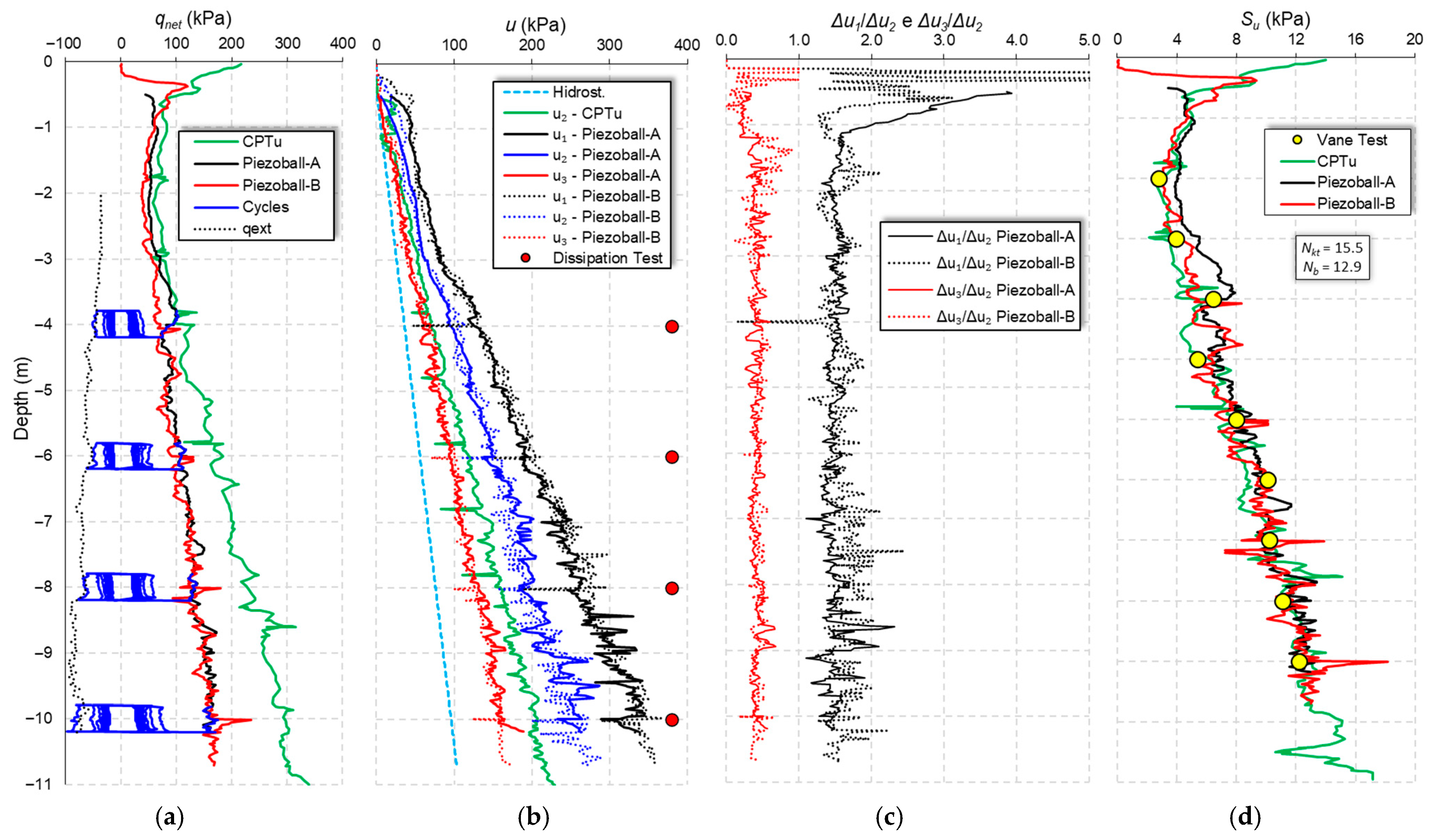
Similarly, the results obtained at the Sarapuí experimental site (RJ) are shown in Figure 12 and Figure 13, which include profiles of penetration resistance, pore pressure response, pore pressure ratio, and undrained shear strength. Figure 12 presents the piezocone and piezoball results, whereas Figure 13 compares the piezocone and piezo-T data.
In Figure 12, good agreement is observed among the qₙₑₜ and pore pressure responses from the piezoball tests, demonstrating high repeatability. Figure 12c shows the ratios of excess pore pressures measured at the tip (Δu1) and equator (Δu3) normalized by the mid-face response (Δu2). Except for the upper 2 m, the Δu1/Δu2 ratios ranged between 1.0 and 1.5 for all three tests, showing a slight increasing trend with depth. The Δu3/Δu2 ratios were close to but below 0.5 and slightly increased with depth. These values were marginally lower than those observed at Tubarão and those reported by Colreavy et al. [9,13], who reported average Δu3/Δu2 ≈ 0.5 and Δu1/Δu2 values between 1.3 and 1.7.
Assuming an average bearing capacity factor Nb = 13.1, Figure 12d presents the resulting undrained shear strength profiles, which demonstrate good consistency among the tests. The adopted value of Nb was determined from the relationship between the soil sensitivity (ST) and bearing capacity factor, where the ST was obtained from vane shear tests (Equation (3)). The compiled results are summarized in Table 5.
Conversely, Figure 13 presents the results obtained from the piezo-T tests. Due to the clogging of the porous stones, the pore pressure measurements were lost during the tests. Therefore, only the penetration resistance and interpreted undrained shear strength profiles are presented. Overall, the profiles interpreted using an average bearing factor of NT = 13.1 showed consistent trends and a representative description of the deposit behavior, confirming the suitability of the derived parameters for the site.
Table 6 presents a compilation of vane shear test strengths and the derived parameters ST, Nb, Nb-rem, NT, and NT-rem for the Sarapuí/RJ site. Following the same analysis reported for Tubarão/SC, the table also reports the mean values of the bearing factors highlighting their low variability, as indicated by standard deviations (STD) of 0.08 for Nb, and 0.25 for NT. For the remolded parameters Nb-rem and NT-rem the corresponding standard deviations are 0.16 and 0.24, respectively. COV values for the bearing capacity factors of the deposit indicate a variability ranging from 0.64% to 2.35% for the coefficients Nb and NT, respectively. In contrast, an Nkt variability of 16.27% was observed.
Aiming to refine the variability and sensitivity analysis of the equipment, the basic statistics of the derived Su parameters were analyzed and are presented in Table 7. Although more robust analyses, such as distribution analysis and spatial correlations are recommended, the direct comparison of the basic statistics (mean, STD, and COV) obtained for the Tubarão/SC deposit indicates a tendency of reduced variability when flow penetrometers are considered. The COV values were 34.58% for piezoball and 32.30% for piezo-T, in contrast to the 39.07% obtained from Su derived from piezocone tests. A similar pattern was observed in the Sarapuí/RJ data: COV of 29.53% for piezoball and 24.99% for piezo-T, versus 36.80% for piezocone. DeJong et al. [11] attribute the higher variability of Su from piezocone tests to the need for more accurate measurements of penetration resistance and pore pressure for deriving undrained strength, whereas penetrometer tests exhibit a lower dependence on these factors, making them potentially more reliable for estimating undrained strengths.
Although discrepancies between the mean undrained shear strength (Su) values obtained from the different tests are generally small, variations of less than 6% were observed when comparing the mean Su values for each profile (see Table 7). Differences in mean Su values and, more importantly, variations in the coefficient of variation (COV) have a direct impact on risk analyses and, consequently, on design decisions. According to [63], the COV is one of the most critical parameters in the characterization of soil variability, and it is well established in slope stability and embankment analyses that the probability of failure increases as higher COV values are considered [64].
In this context, penetrometric tests may be advantageous, as they can reduce measurement variability and, consequently, lead to lower estimated probabilities of failure, particularly for embankments constructed on soft soil deposits.
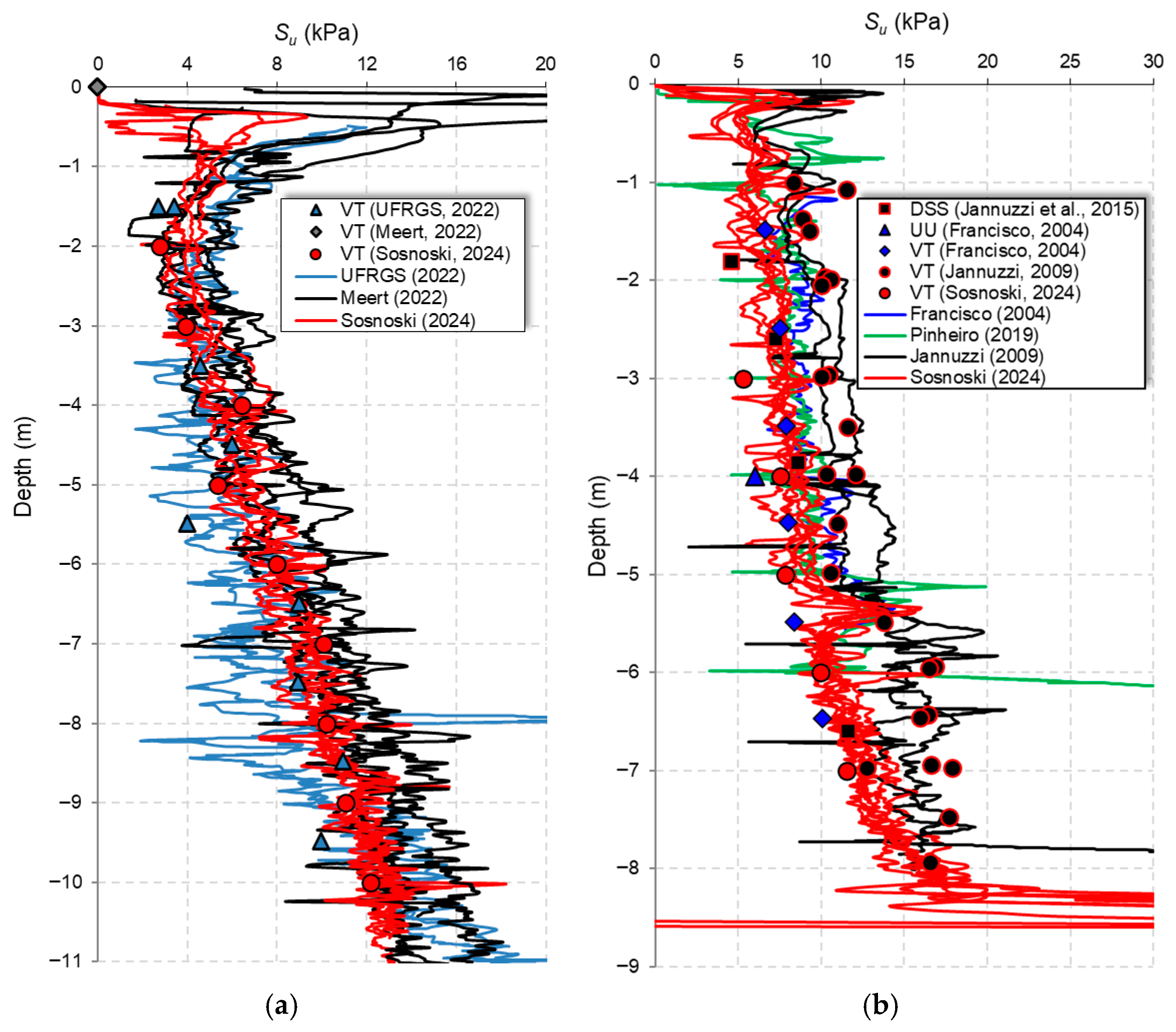
Furthermore, aiming to generally assess the quality of the tests performed in this research, a direct comparison was made between the profiles obtained in this study and those reported in the literature. In summary, Figure 14 presents the undrained shear strength profiles determined in the present study alongside direct comparisons with previously conducted campaigns in the investigated regions. Specifically, Figure 14a includes, in addition to the Tubarão/SC data already shown, resistance profiles presented in [33,34]; for Sarapuí/RJ, in addition to data already shown profiles from Francisco [55], Jannuzzi et al. [22], Pinheiro [65], and Jannuzzi [66] are also plotted. Overall, there is good agreement among the datasets: both deposits exhibit a continuous increase in shear strength with depth, with Sᵤ values ranging from approximately 4–12 kPa at Tubarão/SC and from 5 to 15 kPa at Sarapuí/RJ.

4.2. Degradation and Remolded Shear Strength

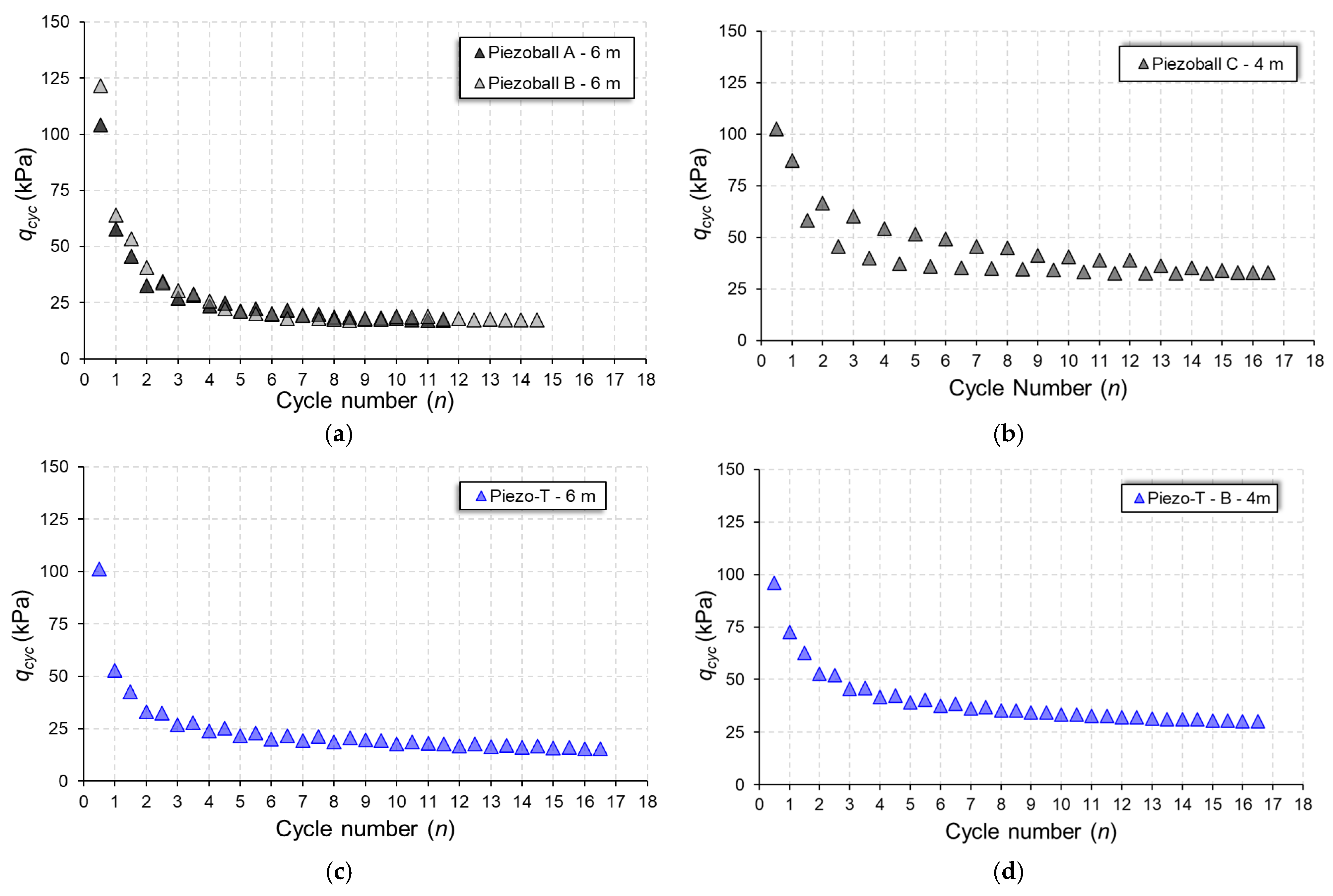
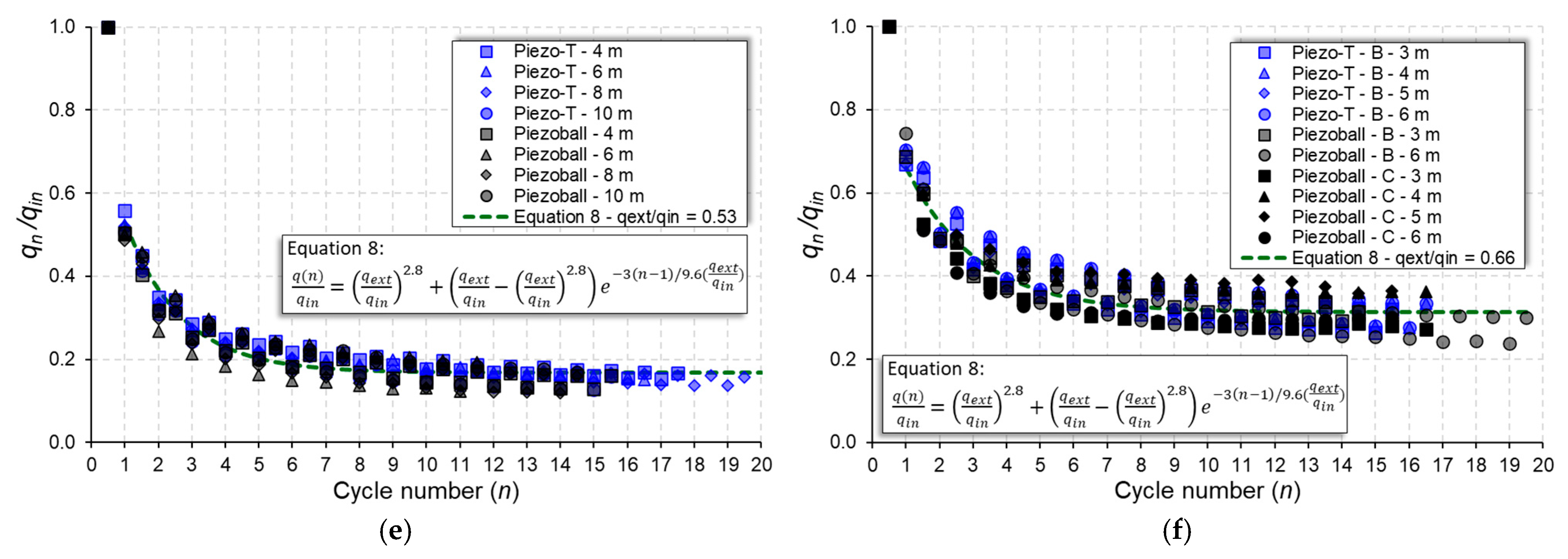
Typical results from the cyclic degradation tests conducted in the Tubarão/SC and Sarapuí/RJ campaigns are presented in Figure 15. Figure 15a–d shows the reduction in resistance and the stabilization trend occurring for a number of cycles (n) between 14 and 16. Figure 15a,b presents the typical results obtained with the piezoball, whereas Figure 15c,d corresponds to the piezo-T tests.
To highlight similar trends, Figure 15e,f plots the normalized resistance ratio q n / q i n , which is defined as the resistance at cycle n divided by the initial penetration resistance. This normalization enables a direct comparison between tests performed at different depths, removing the influence of the confining stress and allowing the grouping of curves and the definition of representative degradation trends. For Tubarão/SC, the remolded resistance stabilized at q n / q i n = 0.2 , whereas for Sarapuí, it stabilized at approximately q n / q i n = 0.3 .
Cycling resistance is associated with the material’s initial strength, the rate of strain softening, and sensitivity [11]. In this sense, the evolution of the normalized resistance ratio and its stabilization are also influenced by these characteristics. The normalized cyclic degradation curves for various sites presented in Yafrate et al. [10] indicate a general trend of lower stabilized q n / q i n values for soils with higher sensitivity. Although the sensitivity of the Sarapuí/RJ clay obtained in the field campaign of Sosnoski [34] is on the order of 2.34 (Table 6) and that of the Tubarão/SC deposit is approximately 2.94 (Table 5), sensitivity alone does not fully explain the observed differences in stabilization. Distinct consolidation states also play a role: the higher degree of overconsolidation at Sarapuí (OCR close to 2) contrasts with the essentially normally consolidated conditions at Tubarão (OCR ≈ 1), which contributes to differences in the stabilized response. Similarly, Jannuzzi et al. [66] reported the stabilization of the q n / q i n ratio for Sarapuí at approximately 0.3. Grain size characteristics and distribution, as well as the presence of roots or organic matter, may also contribute to the remolded resistance observed after cycling.
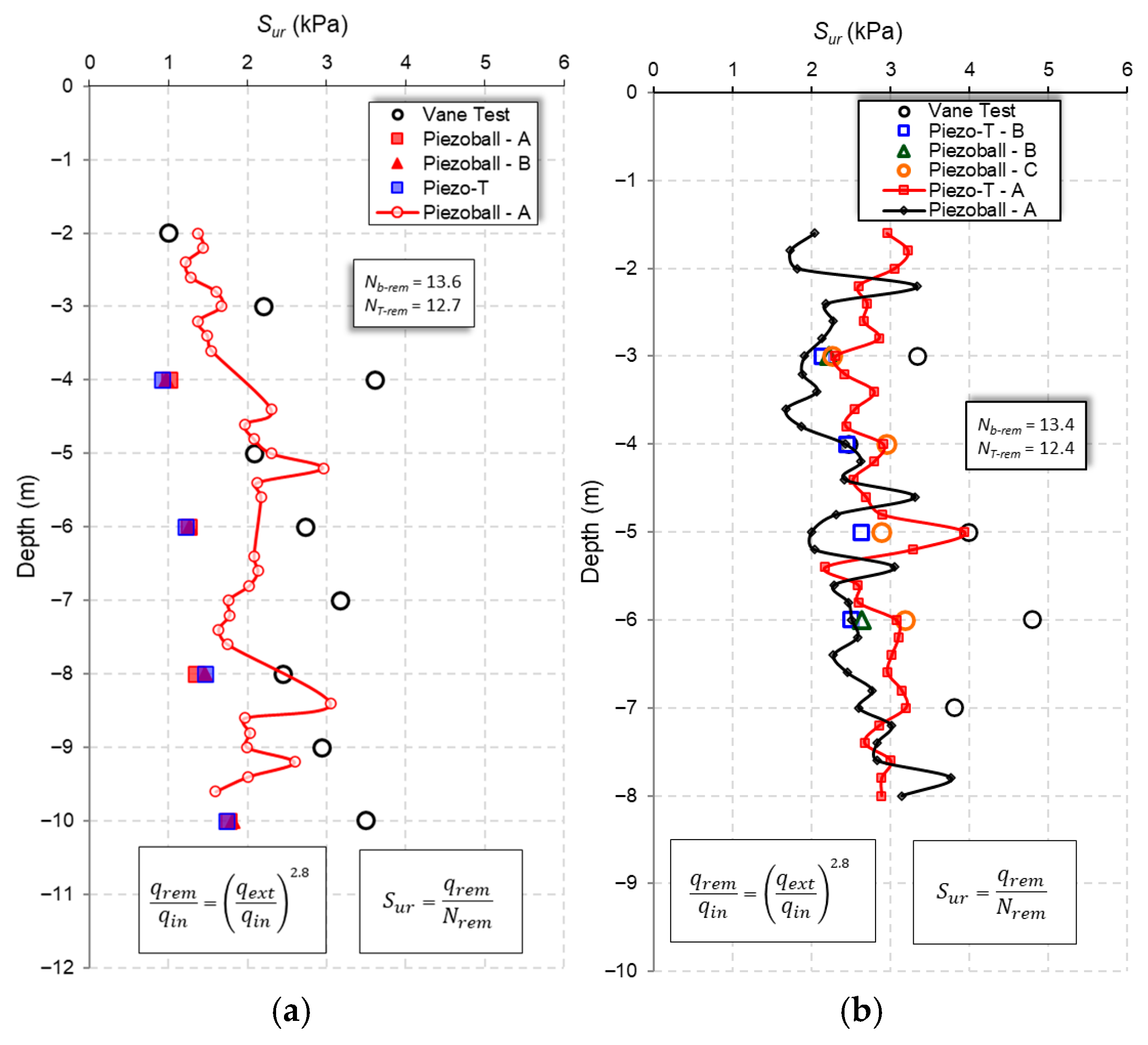
Soil sensitivity was used to determine the bearing capacity factors Nb, and NT, for consistency, Nb-rem and NT-rem. The latter were used to convert qrem—the penetration resistance after cyclic testing and stabilization—into the remolded undrained shear strength (Sur), as shown in the profiles of Figure 16. These results indicate good agreement between the predicted and measured values for the Sarapuí/RJ site, whereas greater scatter was observed between the predicted and directly measured vane shear strengths for the Tubarão deposit.

4.3. Dissipation

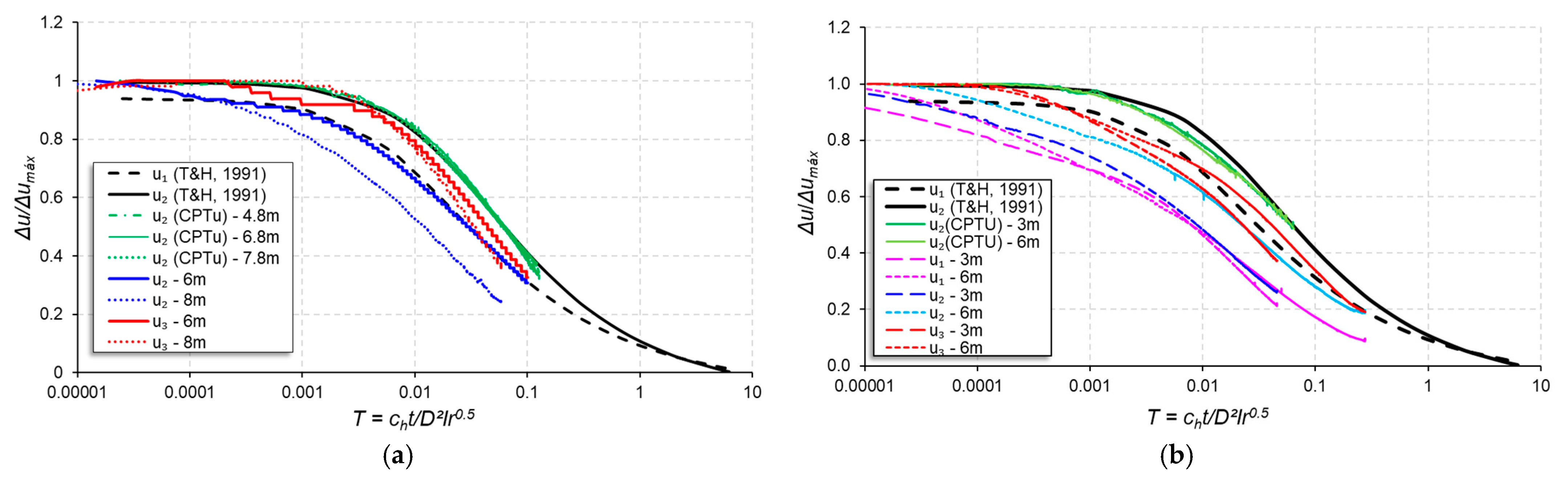
Dissipation tests were performed using the Piezoball-B probe at the Tubarão/SC site at depths of 6, 8, and 10 m. At the Sarapuí/RJ site, dissipation tests were also conducted using the Piezoball-B probe at depths of 3 m and 6 m. Table 8 summarizes the interpreted values of the coefficient of consolidation ch, according to the methods proposed by Teh and Houlsby [32] for piezocone tests; Mahmoodzadeh et al. [7] and Colreavy et al. [9] for piezoball tests at positions u2 and u3; and Liu et al. [8] for the piezoball at position u3 (equations provided in Table 2). The diameter of each device was considered in the calculation of the dimensionless time factor T for all interpretations. Rigidity Index (Ir) for Tubarão/SC was defined through the analysis of the triaxial tests considering a maximum shear stress (qu) and the young modulus at 50% deformation (E50%), Ir = qu/E50%, resulting in an average value of 108, which is in accordance with the reported in [28]. For Sarapuí/RJ the reported Ir = 44 from [67] was considered.
Overall, as shown in Figure 17, the dissipation curves exhibit a consistent monotonic (contractive) trend across all test configurations, allowing for the application of the selected interpretation methods without difficulty. The range of interpreted values indicates that the piezoball tests produced dissipation behavior very similar to that observed in the piezocone tests. Considering the derivation of horizontal coefficients for the Tubarão/SC site, the formulation proposed by Liu et al. [8], derived for the u3 position, generally provided results closer to those obtained from piezocone tests. In contrast, the analysis of the results from the Sarapuí/RJ site indicated that the formulation proposed by Mahmoodzadeh et al. [7], also for the u3 position, yielded coefficients more consistent with those derived from piezocone tests when a direct comparison was performed.

5. Discussion and Conclusions

Based on the results obtained, the following conclusions can be drawn:
1.
Equipment performance and saturation: The improvements implemented in the testing devices proved effective, particularly regarding the saturation of the porous element. For the piezoball tests, saturation was well maintained, and data consistency was satisfactory throughout the penetration process. In contrast, during the Sarapuí/RJ campaign, the piezo-T probes exhibited a loss of pore pressure readings during penetration. This issue highlights the need for further refinement of the piezo-T device and reinforces the current absence of a reliable method for estimating ch based on piezo-T tests.
2.
Repeatability and derived parameters: Considering the piezoball test the repeatability of the measured penetration resistance (qₙₑₜ), pore pressure (u), and undrained shear strength (Sᵤ) was evident at both investigated sites. Comparisons with previous field campaigns further supported this consistency. In the evaluation of the profiles obtained from piezo-T tests, good repeatability was observed in the measurements of qnet. However, issues related to saturation and clogging of the porous stones impaired the verification of pore pressure profiles in some cases. In this context, the results from piezo-T tests should be interpreted with caution, and improvements in the transducers are required. Despite these limitations, the derivation of undrained shear strength (Su) values from piezo-T tests proved to be adequate. Notably, good agreement between the measured and interpreted Sᵤ and Sᵤᵣ values was achieved using the bearing capacity factors (Nb, NT, Nb-ᵣₑₘ, and NT-ᵣₑₘ), which were derived from equations incorporating the soil sensitivity. Sensitivity values determined directly from vane shear tests (FVT) were shown to be reliable, whereas estimates obtained from cyclic qᵢₙ and qₑₓₜ measurements proved less appropriate.
3.
Cyclic degradation behavior: The observed degradation pattern in the cyclic tests showed consistent behavior when normalized by the ratio qₙ/qᵢₙ. This normalization enabled the grouping of degradation curves from different depths and test types, providing a coherent assessment of the reduction in strength with repeated penetration. For the Tubarão/SC site, the remolded strength stabilized at qₙ/qᵢn ≈ 0.2, whereas for Sarapuí/RJ, stabilization occurred at qₙ/qᵢₙ ≈ 0.3.
4.
Dissipation response: Dissipation tests conducted with piezoball probes yielded ch values consistent with those interpreted from piezocone tests, demonstrating the potential applicability of the piezoball device for estimating soil drainage characteristics. Considering the data from the Tubarão/SC site, the formulation proposed by Liu et al. [8], derived for the u3 position, generally yielded results closer to those obtained from piezocone tests. In contrast, the analysis of the Sarapuí/RJ dataset indicated that the formulation proposed by Mahmoodzadeh et al. [7], also for the u3 position, provided coefficients more consistent with those derived from piezocone tests when a direct comparison was performed. In this context, no single formulation is recommended over the others. Instead, it is recommended that different formulations be evaluated and that dissipation curves be plotted to analyze the pore pressure–time response. Atypical dissipation curves should be interpreted with caution, and the effects of partial drainage should also be carefully assessed. Additionally, dissipation tests using CPTu tests are recommended in nearby profiles for validation purposes.
Finally, it is important to emphasize that, although limited to two experimental sites, the results presented herein are part of an ongoing research project and provide a consistent initial dataset of Piezoball and Piezo-T tests conducted in Brazilian soils. Complementary experimental campaigns are planned as part of future research efforts, together with further improvements in the Piezo-T probe and in result interpretation methodologies.
For future applications, it is also recommended to perform complementary tests incorporating seismic measurements, which may provide valuable information regarding soil stiffness. In addition, the use of these tests in soil profiles associated with practical design projects is encouraged, allowing for a realistic assessment of the impact of penetrometric tests on the definition of design parameters.
The present study is limited to the discussion of aspects related to probe conception and validation of their application in well-known and well-behaved soil deposits. Future studies should expand the range of investigation sites and include physical and numerical modeling of the tests, aiming to provide greater robustness to the interpretation and presentation of the results.

Author Contributions

Conceptualization, J.S. and G.D.; methodology, J.S. and G.D.; formal analysis, J.S., G.D., H.P.N., E.O., G.M.F.J. and F.A.B.D.; investigation, J.S.; resources, G.D.; data curation, J.S. and G.D.; writing—original draft preparation, G.D.; writing—review and editing, H.P.N. and G.M.F.J.; supervision, G.D. and E.O.; project administration, G.D. All authors have read and agreed to the published version of the manuscript.

Funding

National Council for Scientific and Technological Development (CNPq). Founding number: 408889/2021-7.

Institutional Review Board Statement

Not applicable.

Informed Consent Statement

Not applicable.

Data Availability Statement

The data presented in this study are available on request from the corresponding author due to privacy.

Acknowledgments

This work was carried out with the support of the National Council for Scientific and Technological Development (CNPq). The authors also thank the Soil Mechanics Laboratory and the Postgraduate Program in Civil Engineering (PPGEC) of the Federal University of Santa Catarina (UFSC) and Geoforma Engenharia for their assistance in the elaboration of this study.

Conflicts of Interest

The authors declare no conflicts of interest.

Abbreviations

The following abbreviations are used in this manuscript:
aLoad cell ratio
ApCross-sectional area of the probe
AsCross-section area of the pushing rod
CcCompressibility coefficient
chHorizontal consolidation parameter
COVCoefficient of variation
CPTuPiezocone test
CrRecompression coefficient
cvVertical consolidation parameter
dPushing rod diameter
DProbe diameter
DbPiezoball diameter
DTPiezo-T diameter
e0Initial void ratio
FVTField Vane Test
fsSleeve friction
GSpecific gravity
ICrwSoil index
IrRigidity index
khHorizontal permeability
nNumber of cycles
NbPiezoball shear strength factor
Nb-remPiezoball remolded shear strength factor
NktPiezocone shear strength factor-total stress
NkuPiezocone shear strength factor-pore pressure
NTPiezo-T shear strength factor
NT-remPiezo-T remolded shear strength factor
OCROver consolidation ratio
PIPlasticity index
qcTip penetration resistance-piezocone
qextExtraction resistance
qinPenetration(insertion) resistance
qmPenetration resistance
qnPenetration resistance of a given cycle
qnetNet penetration resistance
qremRemolded penetration resistance
qtTotal tip penetration resistance-piezocone
STSensitivity
STDStandard deviation
SuUndrained shear strength
SurRemolded undrained shear strength
tTime
TTime factor
TbTime factor-piezoball
Tb50Piezoball time factor required for 50% excess pore pressure dissipation
t50Time required for 50% excess pore pressure dissipation
T50Time factor required for 50% excess pore pressure dissipation
tmaxMaximum excess pore pressure’s time
UUUnconsolidated shear Undrained test
uHydrostatic pore pressure
ueqlHydrostatic pore pressure-equilibrium pore pressure
u1Probe’s tip pore pressure
u2Probe’s mid face pore pressure
u3Probe’s equator pore pressure
wWater content
wlLiquid limit
wnNatural water content
wpPlastic water content
αRoughness factor
γnTotal soil weight
ΔtTime gap between measurements
ΔuExcess pore pressure
ΔuiniInitial excess pore pressure
ΔumaxMaximum excess pore pressure
σNormal stress
σ3Confining stress
σv0Total overburden stress

References

  1. Guo, X.; Nian, T.; Wang, D.; Gu, Z. Evaluation of undrained shear strength of surficial marine clays using ball penetration-based CFD modelling. Acta Geotechnica 2022, 17, 1627–1643. [Google Scholar] [CrossRef]
  2. Schnaid, F. In Situ Testing in Geomechanics: The Main Tests, 1st ed.; Taylor & Francis Group: London, UK, 2009; p. 352. [Google Scholar] [CrossRef]
  3. Mayne, P.W. Cone Penetration Testing. In NCHRP Synthesis of Highway Practice; Georgia Institute of Technology: Atlanta, GA, USA, 2007. [Google Scholar]
  4. DeJong, J.T.; Yafrate, N.J.; Randolph, M.F. Use of pore pressure measurements in a ball full-flow penetrometer. In Proceedings of the 3rd International Conference on Site Characterization; Taylor and Francis: London, UK, 2008; pp. 1269–1275. [Google Scholar]
  5. Randolph, M.; Hefer, P.A.; Geise, J.M.; Watson, P. Improved seabed strenght profiling using T-bar penetrometer. In Proceedings of the International Conference Offshore Site Investigation and Foundation Behaviour; New Frontiers: London, UK, 1998; Volume 1. [Google Scholar]
  6. Chen, X.; Han, C.; Liu, J.; Hu, Y. Interpreting strength parameters of strain-softening clay from shallow to deep embedment using ball and T-bar penetrometers. Comput. Geotech. 2021, 138, 104331. [Google Scholar] [CrossRef]
  7. Mahmoodzadeh, H.; Wang, D.; Randolph, M.F. Interpretation of piezoball dissipation testing in clay. Géotechnique 2015, 65, 831–842. [Google Scholar] [CrossRef]
  8. Liu, K.; Wang, D.; Zheng, J. Numerical study of piezoball dissipation test with penetration under partially drained conditions. Comput. Geotech. 2023, 159, 105469. [Google Scholar] [CrossRef]
  9. Colreavy, C.; O’Loughlin, C.D.; Randolph, M.F. Estimating consolidation parameters from field piezoball tests. Géotechnique 2016, 66, 333–343. [Google Scholar] [CrossRef]
  10. Yafrate, N.J.; DeJong, J.T.; DeGroot, D.J.; Randolph, M.F. Evaluation of remolded shear strength and sensitivity of soft clay using full-flow penetrometers. J. Geotech. Geoenviron. Eng. 2009, 135, 1179–1189. [Google Scholar] [CrossRef]
  11. DeJong, J.T.; Yafrate, N.J.; DeGroot, D.J. Evaluation of undrained shear strength using full-flow penetrometers. J. Geotech. Geoenviron. Eng. 2011, 137, 14–26. [Google Scholar] [CrossRef]
  12. Qiao, H.; Liu, L.; He, H.; Liu, X.; Liu, X.; Peng, P. The Practice and Development of T-Bar Penetrometer Tests in Offshore Engineering Investigation: A Comprehensive Review. J. Mar. Sci. Eng. 2023, 11, 1160. [Google Scholar] [CrossRef]
  13. Colreavy, C.; O’Loughlin, C.D.; Randolph, M.F. Experience with a dual pore pressure element piezoball. Int. J. Phys. Model. Geotech. 2015, 16, 101–118. [Google Scholar] [CrossRef]
  14. O’Loughlin, C.; White, D.; Randolph, M.; Zhou, Z.; Stanier, S. Advances in full flow penetrometer testing. In Proceedings of the 6th International Conference on Geotechnical and Geophysical Site Characterization, Budapest, Hungary, 11 September 2020; Available online: https://www.issmge.org/uploads/publications/25/111/ISC2020-497.pdf (accessed on 27 November 2025).
  15. Peuchen, J.; Terwindt, J. Critical appraisal of T-bar penetration tests. In Proceedings of the Fifth International Conference on Geotechnical and Geophysical Site Characterization (ISC’5), Gold Coast, Australia, 5–9 September 2016; Available online: https://www.issmge.org/publications/publication/critical-appraisal-of-t-bar-penetration-tests (accessed on 12 January 2026).
  16. Wang, Y.; Hu, Y.; Hossain, M.S. Soil flow mechanisms of full-flow penetrometers in layered clays through particle image velocimetry analysis in centrifuge test. Can. Geotech. J. 2020, 57, 1719–1732. [Google Scholar] [CrossRef]
  17. Randolph, M.F.; Martin, C.M.; Hu, Y. Limiting resistance of a spherical penetrometer in cohesive material. Géotechnique 2000, 50, 573–582. [Google Scholar] [CrossRef]
  18. Yang, Y.; Zhou, X.; Zhou, M.; Zhang, X. The behavior of ball penetrometer in soft-over-stiff soil deposits. Ocean. Eng. 2023, 273, 114011. [Google Scholar] [CrossRef]
  19. Li, C.; Yu, L.; Kong, X.; Zhang, H. Estimation of undrained shear strength in rate-dependent and strain-softening surficial marine clay using ball penetrometer. Comput. Geotech. 2023, 153, 105084. [Google Scholar] [CrossRef]
  20. Li, Z.; Yi, P.; Liu, J. Interpreting intact undrained shear strength of nonhomogeneous clay using ball penetrometer. Acta Geotech. 2025, 20, 2943–2964. [Google Scholar] [CrossRef]
  21. Odebrecht, E.; Schnaid, F. Assessment of the stress history of quaternary clay from Piezocone tests. Soils Rocks 2018, 41, 179–189. [Google Scholar] [CrossRef]
  22. Jannuzzi, G.M.F.; Danziger, F.A.B.; Martins, I.S.M. Geological-geotechnical characterisation of Sarapuí II clay. Eng. Geol. 2015, 190, 77–86. [Google Scholar] [CrossRef]
  23. Chung, S.F.; Randolph, M.F.; Schneider, J.A. Effect of penetration rate on penetrometer resistance in clay. J. Geotech. Geoenviron. Eng. 2006, 132, 1188–1196. [Google Scholar] [CrossRef]
  24. Kelleher, P.J.; Randolph, M.F. Seabed geotechnical characterization with a ball penetrometer deployed from the portable remotely operated drill. Front. Offshore Geotech. 2005, 365–371. [Google Scholar] [CrossRef]
  25. Colreavy, C.; O’Loughlin, C.; Long, M.; Boylan, N.; Ward, D. Field experience of the piezoball in soft clay. In Proceedings of the Second International Symposium on Cone Penetration Testing—CPT’10, Huntington Beach, CA, USA, 1 May 2010. [Google Scholar]
  26. Randolph, M.F. Characterization of soft sediments for offshore applications. In Proceedings of the 2nd International Conference on Site Characterization, Porto, Portugal, 19–22 September 2004; pp. 209–232. [Google Scholar]
  27. Lunne, T.; Andersen, K.H.; Low, H.E.; Randolph, M.F.; Sjursen, M. Guidelines for offshore in situ testing and interpretation in deepwater soft clays. Can. Geotech. J. 2011, 48, 543–556. [Google Scholar] [CrossRef]
  28. Chung, S.F.; Randolph, M.F. Penetration resistance in soft clay for different shaped penetrometers. In Proceedings of the 2nd International Conference on Geotechnical and Geophysical Site Characterization, Porto, Portugal, 19–22 September 2004; Millpress: Bethlehem, PA, USA, 2004; Volume 1, pp. 671–677. [Google Scholar]
  29. Yafrate, N.J.; DeJong, J.T. Considerations in evaluating the remoulded undrained shear strength from full-flow penetrometer cycling. In Proceedings of the International Symposium on Frontiers in Offshore Geotechnics, Perth, Australia, 19–21 September 2005; pp. 991–997. [Google Scholar]
  30. Yubin, R.; Yang, Q.; Wang, Y.; Zhao, W. Experimental study on the undrained shear strength of deep-sea soft soil using improved T-bar penetrometer. Mar. Georesources Geotechnol. 2019, 38, 1199–1208. [Google Scholar] [CrossRef]
  31. DeJong, J.T.; Yafrate, N.J.; DeGroot, D.J.; Low, H.E.; Randolph, M.F. Recommended Practice for Full-Flow Penetrometer Testing and Analysis. Geotech. Testing J. 2010, 33, 137–149. [Google Scholar] [CrossRef]
  32. Teh, C.I.; Houlsby, G.T. An Analytical Study of the Cone Penetration Test in Clay. Géotechnique 1991, 41, 17–34. [Google Scholar] [CrossRef]
  33. Meert, R. Development, Execution, and Validation of T-Bar and Ball Tests. Master’s Thesis, PPGEC, State University of Santa Catarina, Joinville, Brazil, 2022. (In Portuguese) [Google Scholar]
  34. Sosnoski, J. Characterization of Soft Soils Using Flow Penetrometers. Ph.D. Thesis, UFSC, Federal University of Santa Catarina, Florianópolis, Brazil, 2024. (In Portuguese) [Google Scholar]
  35. ASTM D5778; Standard Test Method for Electronic Friction Cone and Piezocone Penetration Testing of Soils. ASTM International: West Conshohocken, PA, USA, 2020.
  36. Carvalho do Amaral, P.G.; Giannini, P.C.F.; Sylvestre, F.; Pessenda, L.C.R. Paleoenvironmental recon struction of a late Quaternary lagoon system in southern Brazil (Jaguaruna region, Santa Catarina state) based on multi-proxy analysis. J. Quat. Sci. 2012, 27, 181–191. [Google Scholar] [CrossRef]
  37. Dienstmann, G.; Cordeiro, R.F.; Sakamoto, M.Y. Compressibility and stability analysis of an embankment on soft soil: A case study. Proc. Inst. Civ. Eng.-Geotech. Eng. 2022, 175, 570–591. [Google Scholar] [CrossRef]
  38. Giannini, P.C.F. The Costal Quaternary Depositional System in the Southern Brazil Region of Jaguaruna and Imbituba Region. Ph.D. Thesis, University of São Paulo, São Paulo, Brazil, 1993; p. 439. [Google Scholar]
  39. Giannini, P.C.F.; Sawakuchi, A.O.; Martinho, C.T.; Tatumi, S.H. Eolian depositional episodes controlled by late Quaternary relative sea level changes on the Imbituba-Laguna coastal zone (southern Brazil). Mar. Geol. 2007, 237, 143–168. [Google Scholar] [CrossRef]
  40. Mantaras, F.M.B.; Odebrecht, E.; Schnaid, F. Using piezocone dissipation test to estimate the undrained shear strength in cohesive soil. In Proceedings of the 3th International Symposium on the Cone Penetration Testing, Las Vegas, NV, USA, 13–14 May 2014; pp. 323–330. [Google Scholar]
  41. Schnaid, F.; Odebrecht, E.; Sosnoski, J.; Robertson, P.K. Effects of Test Procedure on Flat Dilatometer Test (DMT) Results in Intermediate Soils. Can. Geotech. J. 2016, 53, 1270–1280. [Google Scholar] [CrossRef]
  42. ASTM D2573; Standard Test Method for Field Vane Shear Test in Saturated Fine-Grained Soils. ASTM International: West Conshohocken, PA, USA, 2018.
  43. ABNT NBR 9820; Sampling of Undisturbed Low-Consistency Soils in Boreholes—Procedure. ABNT—Brazilian Association of Technical Standards: Rio de Janeiro, Brazil, 1997; 5p.
  44. ASTM D1587/D1587M; Standard Practice for Thin-Walled Tube Sampling of Fine-Grained Soils for Geotechnical Purposes. ASTM International: West Conshohocken, PA, USA, 2015.
  45. Robertson, P.K.; Wride, C.V. Evaluating Cyclic Liquefaction Potential Using the Cone Penetration Test. Can. Geotech. J. 1998, 35, 442–459. [Google Scholar] [CrossRef]
  46. Sosnoski, J.; Meier, A.L.; Dienstmann, G.; Nierwinski, H.P.; Odebrecht, E.; Mantaras, F.M. Piezoball and T-Bar Application on a Brazilian Soft Soil Deposit. In Proceedings of the 7th International Conference on Geotechnical and Geophysical Site Characterization (ISC7-24), Barcelona, Spain, 18–21 June 2024. [Google Scholar] [CrossRef]
  47. Lunne, T.; Berre, T.; Strandvik, S. Sample disturbance effects in soft low plastic Norwegian clay. In Proceedings of the Symposium on Recent Developments in Soil and Pavement Mechanics, Rio de Janeiro, Brazil, 25 June 1997. [Google Scholar]
  48. Coutinho, R.Q. Characterization and engineering properties of Recife soft clays—Brazil. In Characterisation and Engineering Properties of Natural Soils; Taylor & Francis: London, UK, 2007. [Google Scholar]
  49. Lacerda, W.A.; Costa Filho, L.M.; Coutinho, R.Q. Consolidation characteristics of Rio de Janeiro soft clay. In Proceedings of the Conference on Geotechnical Aspects of Soft Clays, Bangkok, Thailand, 5–7 July 1977; pp. 231–243. [Google Scholar]
  50. Ortigão, J.A.R.; Werneck, M.L.G.; Lacerda, W.A. Embankment failure on clay near Rio de Janeiro. J. Geotech. Eng. 1983, 109, 1460–1479. [Google Scholar] [CrossRef]
  51. Cavalcante, E.H.; Coutinho, R.Q.; Danziger, F.A.B.; Giacheti, H.L. Brazilian test sites. Workshop on test sites for foundations. In Proceedings of the XIII Brazilian Conference on Soil Mechanics and Geotechnical Engineering, Curitiba, Brazil, 27 August 2006; pp. 1–90. (In Portuguese) [Google Scholar]
  52. Jannuzzi, G.M.F. Innovative and Traditional Methods to Characterise the Sarapuí II Soft Clay. Ph.D. Thesis, COPPE, Federal University of Rio de Janeiro, Rio de Janeiro, Brazil, 2013. (In Portuguese) [Google Scholar]
  53. Alves, A.M.L. The Influence of Soil Viscosity and Time on the Dynamic Pile-Soil Interaction in Clays. Ph.D. Thesis, COPPE, Federal University of Rio de Janeiro, Rio de Janeiro, Brazil, 2004. (In Portuguese) [Google Scholar]
  54. Alves, A.M.L.; Lopes, F.R.; Randolph, M.F.; Danziger, B.R. Investigations on the dynamic behavior of a small-diameter pile driven in soft clay. Can. Geotech. J. 2009, 46, 1418–1430. [Google Scholar] [CrossRef]
  55. Francisco, G.M. Time Effect on Piles in Soft Clay. Ph.D. Thesis, COPPE, Federal University of Rio de Janeiro, Rio de Janeiro, Brazil, 2004. (In Portuguese) [Google Scholar]
  56. Porto, E.C.; Medeiros, C.J., Jr.; Henriques, P.R.D., Jr. The development of the torpedo-piezocone. In Proceedings of the of the 29th International Conference on Ocean, Offshore and Arctic Engineering, OMAE, Shanghai, China, 1 June 2010; American Society of Mechanical Engineers: New York, NY, USA, 2010. [Google Scholar]
  57. Guimarães, G.V.M. Horizontal load test on instrumented model torpedo-pile in soft clay. Ph.D. Thesis, COPPE, Federal University of Rio de Janeiro, Rio de Janeiro, Brazil, 2015. (In Portuguese) [Google Scholar]
  58. Danziger, F.A.B.; Jannuzzi, G.M.F.; Martins, I.S. The relationship between sea-level change, soil formation and stress history of a very soft clay deposit. Aims Geosci. 2019, 5, 461–479. [Google Scholar] [CrossRef]
  59. Vargas, J.W.S.; Danziger, F.A.B.; Lopes, F.R.; Lunne, T. Inflow and outflow permeability tests in a very soft clay under low stresses. J. Rock Mech. Geotech. Eng. 2024, 16, 3270–3283. [Google Scholar] [CrossRef]
  60. Skempton, A.W. The Effective Stresses in Saturated Clays Strained at Constant Volume. In Proceedings of the 7th International Conference of Applied Mechanics, London, UK, 5–11 September 1948; Volume 1, p. 378. [Google Scholar]
  61. Lu, Q.; Hu, Y.; Randolph, M.F. FE Analysis for T-Bar and Spherical Penetrometers in Cohesive Soil. In Proceedings of the 10th International Offshore and Polar Engineering Conference, Seattle, WA, USA, 28 May 2000; International Society of Offshore and Polar Engineers: Mountain View, CA, USA, 2000. [Google Scholar]
  62. Randolph, M.F.; Andersen, K.H. Numerical Analysis of T-Bar Penetration in Soft Clay. Int. J. Geomech. 2006, 6, 411–420. [Google Scholar] [CrossRef]
  63. Phoon, K.K.; Kulhawy, F.H. Characterization of geotechnical variability. Can. Geotech. J. 1999, 36, 612–624. [Google Scholar] [CrossRef]
  64. Griffiths, D.V.; Fenton, G.A. Probabilistic slope stability analysis by finite elements. Géotechnique 2004, 54, 513–525. [Google Scholar] [CrossRef]
  65. Pinheiro, A.V.S. Execution and Interpretation of Tests on a Prototype of the Torpedo Piezocone. Master’s Thesis, Civil Engineering—COPPE, Federal University of Rio de Janeiro, Rio de Janeiro, Brazil, 2019. [Google Scholar]
  66. Jannuzzi, G.M.F.; Danziger, F.A.B.; Martins, I.S.M. Cyclic T-Bar Tests to Evaluate the Remoulded Undrained Shear Strength of the Sarapuí II Soft Clay. Soils Rocks 2012, 35, 279–294. [Google Scholar] [CrossRef]
  67. Danziger, F.A.B.; Almeida, M.S.S.; Sills, G.C. The significance of the strain path analysis in the interpretation of piezocone dissipation data. Géotechnique 1997, 47, 901–914. [Google Scholar] [CrossRef]
Figure 1. Failure mechanism for piezoball and piezo-T penetrometers: (a) shallow penetration; (b) transition; (c) full-flow stage.
Geotechnics 06 00024 g001
Figure 2. Piezoball (a) transducer positions in the original design; (b) updated transducer positions; (c) general view and detail of the porous element in the original design; (d) general view and detail of the adapted porous element [33,34].
Geotechnics 06 00024 g002aGeotechnics 06 00024 g002b
Figure 3. Piezo-T: (a) transducer positions in the original design; (b) updated transducer positions; (c) general view and detail of the porous element in the original design; (d) general view and detail of the adapted porous element [33,34].
Geotechnics 06 00024 g003
Figure 4. The Tubarão/SC Test Site.
Geotechnics 06 00024 g004
Figure 6. The Sarapuí test site area.
Geotechnics 06 00024 g006
Figure 7. The Sarapuí test site: (a) grain size distribution; (b) organic content; (c) total salt content and NaCl content (data from Onsøy clay also included); (d) relative percentage of clay minerals versus depth [22].
Geotechnics 06 00024 g007
Figure 8. The Sarapuí test site: (a) liquid limit, plastic limit, and natural water content; (b) specific gravity; (c) total unit weight; (d) initial void ratio; (e) activity versus depth [22].
Geotechnics 06 00024 g008
Figure 9. The Sarapuí test site: OCR versus depth for IL 24 h consolidation tests (modified from Jannuzzi et al. [22]).
Geotechnics 06 00024 g009
Figure 10. Results of piezoball tests (A and B) and piezocone tests: (a) net penetration resistance (qnet); (b) pore pressure measurements; (c) pore pressure ratios between transducer positions; (d) undrained shear strength.
Geotechnics 06 00024 g010
Figure 11. Results of the piezo-T and piezocone test: (a) net penetration resistance (qnet); (b) pore pressure measurements; (c) pore pressure ratios between transducer positions; (d) undrained shear strength.
Geotechnics 06 00024 g011
Figure 12. Results of piezoball tests (A, B and C) and piezocone tests: (a) net penetration resistance (qnet); (b) pore pressure measurements; (c) pore pressure ratios between transducer positions; (d) undrained shear strength.
Geotechnics 06 00024 g012
Figure 13. Results of Piezo-T tests (A and B) and piezocone tests: (a) net penetration resistance (qnet); (b) undrained shear strength.
Geotechnics 06 00024 g013
Figure 14. Comparison with other local studies (a) Tubarão/SC and (b) Sarapuí/RJ [22,33,34,52,55,65,66].
Geotechnics 06 00024 g014
Figure 15. Degradation curves from cyclic tests: (a) qcyc—Piezoball-Tubarão/SC; (b) qcyc—Piezoball-Sarapuí/RJ; (c) qcyc—Piezo-T-Tubarão/SC; (d) qcyc—Piezo-T-Sarapuí/RJ; (e) qn/qin—Tubarão/SC; (f) qn/qin—Sarapuí/RJ.
Geotechnics 06 00024 g015aGeotechnics 06 00024 g015b
Figure 16. Remolded undrained shear strength (Sur) profiles (a) Tubarão/SC and (b) Sarapuí/RJ.
Geotechnics 06 00024 g016
Figure 17. Excess pore pressure normalized versus time factor: Teh & Houlsby [23] proposal (a) Tubarão/SC and (b) Sarapuí/RJ [32].
Geotechnics 06 00024 g017
Table 1. Bearing capacity factors and strength relationships.
ReferenceEquationParameters
DeJong et al. [11] N b = 13.2 7.5 1 + ( S T 10 ) 3
ST—sensitivity;
qin—initial penetration resistance;
qext—extraction measurement;
qrem—remolded resistance measurement.
N b = 13.2 7.5 1 + ( q i n / q e x t 1.9 ) 20
N T = 12 6.5 1 + ( S T 10 ) 3
N T = 12 6.5 1 + ( q i n / q e x t 1.8 ) 20
Yafrate et al. [10] N b r e m = 13.2 + 7.5 1 + ( S T 8 ) 3
N T r e m = 12 + 5.5 1 + ( S T 6 ) 3
N b r e m = 13.2 + 7.5 1 + ( q i n / q e x t 1.8 ) 20
N T r e m = 12 + 5.5 1 + ( q i n / q e x t 1.8 ) 20
Table 2. Interpretation of the pore pressure dissipation.
ReferencePosition of Poro pressure SensorEquationParameters
Mahmoodzadeh et al. [7]u2 and u3 c h = T b 50 D b d I r 0.25 t 50
t50 is the time required for 50% dissipation,
Tb50 is the dimensionless time for 50% dissipation,
Db and d are the ball’s and pushing rod’s diameters just above the ball, respectively,
Ir is the Rigidity Index.
tmax is time required to reach the highest value of excess pore pressure generated in the dissipation test.
Colreavy et al. [9]u3 c h = 0.7 ( D b d I r 0.25 t m a x ) ( t m a x t 50 ) 1.2
Liu et al. [8]u3 c h = T b 50 ( D b 2 ) 2 I r 0.25 t 50
Table 3. Field campaign details at the Tubarão/SC site.
Average Depth (m)Nominal Interval Cycled (m)Number of CyclesDissipation Time (s)
Piezoball-APiezoball-BPiezo-TPiezoball-B
−43.8–4.216161633,160 *
−65.8–6.21114166870
−87.8–8.21415186860
−109.8–10.21416155900
* measured only at the u1 position.
Table 4. Field campaign details at the Sarapuí/RJ site.
Average Depth (m)Nominal Interval Cycled (m)Number of CyclesDissipation
Time (s)
PiezoballPiezoballPiezoballPiezo-TPiezo-TPiezoball
ABCABB
−32.8–3.2-1416-159101
−43.8–4.2--16-16-
−54.8–5.2--15-12-
−65.8–6.2-1715-1554,893
Table 5. Undrained shear strength from vane tests and derived capacity factors for Tubarão/SC.
Tubarão/SC
Depth (m)Su (kPa)Sur (kPa)STNbNb-remNTNt-remNkt
−2.02.791.002.7913.0413.5111.8612.5019.64
−3.03.952.211.7913.1613.2811.9612.1415.33
−4.06.433.611.7813.1613.2811.9612.1412.79
−5.05.362.092.5613.0813.4411.8912.4017.74
−6.08.002.732.9313.0213.5511.8412.5714.35
−7.010.093.173.1812.9713.6411.8012.7113.09
−8.010.202.454.1612.7014.1311.5613.3814.65
−9.011.072.943.7712.8213.9111.6713.0916.22
−10.012.193.503.4812.9013.7711.7412.9016.09
Average7.792.632.9412.9813.6111.8012.7015.55
STD3.330.810.820.150.280.130.422.19
COV (%)42.7830.8327.871.192.081.133.3114.06
Table 6. Undrained shear strength from vane tests and derived capacity factors for Sarapuí/RJ.
Sarapuí/RJ
Depth (m)Su (kPa)Sur (kPa)STNbNb-remNTNT-remNkt
−3.05.303.341.5913.1713.2611.7412.1016.90
−4.07.542.483.0412.9913.5911.8712.6312.89
−5.07.844.001.9613.1413.3111.9312.1911.13
−6.09.964.802.0813.1313.3311.3612.2212.80
−7.011.503.813.0213.0013.5811.3612.6212.58
Average8.433.692.3413.0913.4111.6512.3513.26
STD2.380.860.660.080.160.270.262.16
COV (%)28.2723.2228.170.641.192.352.0716.27
Table 7. Undrained shear strength variability considering different tests.
PiezoconePiezoball Piezo-T S u p i e z o b a l l S u p i e z o c o n e S u p i e z o T S u p i e z o c o n e
Mean
(kPa)
STD
(kPa)
COV
(%)
Mean
(kPa)
STD
(kPa)
COV
(%)
Mean
(kPa)
STD
(kPa)
COV
(%)
Tubarão/SC8.233.2139.078.402.9034.588.592.7832.301.0211.044
Sarapuí/RJ9.553.5136.809.522.8129.5310.102.5324.990.9971.059
Table 8. Summary of dissipation tests.
Depth (m)Tubarão ch (cm2/s)
Teh & Houlsby [32]Mahmoodzadeh et al. [7]Colreavy et al. [9]Liu et al. [8]
u2u2u3u2u3u3
−69.99 × 10−34.77 × 10−34.62 × 10−36.12 × 10−33.62 × 10−37.53 × 10−3
−85.89 × 10−36.78 × 10−33.73 × 10−39.33 × 10−34.13 × 10−36.08 × 10−3
−10-1.23 × 10−24.34 × 10−31.92 × 10−35.32 × 10−37.07 × 10⁻³
Depth (m)Sarapuí ch (cm2/s)
Teh & Houlsby [32]Mahmoodzadeh et al. [7]Colreavy et al. [9]Liu et al. [8]
u2u2u3u2u3u3
−33.22 × 10−35.17 × 10−33.02 × 10−36.77 × 10−34.61 × 10−34.92 × 10−3
−61.79 × 10−32.07 × 10−31.68 × 10−32.59 × 10−32.00 × 10−32.73 × 10−3
Disclaimer/Publisher’s Note: The statements, opinions and data contained in all publications are solely those of the individual author(s) and contributor(s) and not of MDPI and/or the editor(s). MDPI and/or the editor(s) disclaim responsibility for any injury to people or property resulting from any ideas, methods, instructions or products referred to in the content.